Social Work Report: Social Work Practice Skills in Luanda's Case Study
VerifiedAdded on 2020/04/21
|16
|3223
|109
Report
AI Summary
This report presents a detailed analysis of Luanda's case, a 15-year-old girl referred to a community social worker due to family issues and bullying. The report includes a background of the case, a family genogram, and an identification of issues using the Kit Model. It reflects on the interviewer's strengths and weaknesses, particularly focusing on listening, empathy, and communication skills. The report also discusses areas for improvement, such as the use of open-ended questions and the application of social work theories like strength-based and empowerment theories. The conclusion summarizes the key findings and emphasizes the importance of empathy, ethics, values, and social work practice standards in addressing Luanda's needs. The report highlights the importance of active listening, empathy, and effective communication in the context of social work practice. The report underscores the need for a nuanced approach to social work practice, one that takes into consideration the client's background, family dynamics, and personal experiences to provide effective support and intervention.
Running head: SOCIAL WORK WITH FAMILIES AND CHILDREN
Table of Contents
Introduction………………………………………………………………………………………3
Background Information of the Case……………………………………………………………..3
Why Client Being Referred Community Social Worker………………………………………….4
Family Genogram…………………………………………………………………………………5
Issues Identified Using Kit Model………………………………………………………………..5
Reflection……………………………………………………………………………………….10
Personal Strength and Weakness………………………………………………………………..10
Skills that Needed Improvement in Luanda’s Case…………………………………………….11
a. Improvement of the Listening Skills………………………………………………………….11
b. Empathic Response towards Client…………………………………………………………..12
c. Communication Skills…………………………………………………………………………12
d. Use of Open Ended Questions………………………………………………………………..12
e. Speaking about Empathy, Ethics, Values and Social Work Practice Standards……………..13
f. Focus on Social Work Theories……………………………………………………………….13
Strength Based Theory…………………………………………………………………………..13
Empowerment Theory…………………………………………………………………………...13
4. Conclusion……………………………………………………………………………………15
References………………………………………………………………………………………17
Table of Contents
Introduction………………………………………………………………………………………3
Background Information of the Case……………………………………………………………..3
Why Client Being Referred Community Social Worker………………………………………….4
Family Genogram…………………………………………………………………………………5
Issues Identified Using Kit Model………………………………………………………………..5
Reflection……………………………………………………………………………………….10
Personal Strength and Weakness………………………………………………………………..10
Skills that Needed Improvement in Luanda’s Case…………………………………………….11
a. Improvement of the Listening Skills………………………………………………………….11
b. Empathic Response towards Client…………………………………………………………..12
c. Communication Skills…………………………………………………………………………12
d. Use of Open Ended Questions………………………………………………………………..12
e. Speaking about Empathy, Ethics, Values and Social Work Practice Standards……………..13
f. Focus on Social Work Theories……………………………………………………………….13
Strength Based Theory…………………………………………………………………………..13
Empowerment Theory…………………………………………………………………………...13
4. Conclusion……………………………………………………………………………………15
References………………………………………………………………………………………17

Paraphrase This Document
Need a fresh take? Get an instant paraphrase of this document with our AI Paraphraser
1
SOCIAL WORK WITH FAMILIES AND CHILDREN
Introduction:
Background Information of the Case
The case here deals with Luanda, a 15-year-old girl,living with her mother and twelve-year-
old sister. Her father however just passed away two years ago due to heart condition. The death
of her father compelled her mother to move to Sydney where she remained highly distressed due
to the father’s favoritism towards the younger daughter and overtly critical nature towards
Luanda. This also led to difference between the sisters and gradually pushed Luanda to dark
moods. This made her act as an outsider in school that was also the reason why her friends
bullied her all the time. This forced her mother to seek counselors help who herself was under
medication for depression. Therefore, in this essay I intend to find the evidence of the reflective
capacity and critically analyze the practice skills of the interviewer. The essay also helps in
identification of the strengths and the areas of further development of the interviewer (student in
role) while engaging and communicating with young person. Further, the essay also puts forward
the feedback of the interviewer given by the client during and after role play in regard to
principles of family and child centered practice leading to the development of the knowledge and
skills in this area.
Why Client Being Referred Community Social Worker
Luanda father always preferred her sister Carmel and remained overtly critical towards her.
As a result, she was lonely which gradually resulted in her dark moods. This affected her so
badly that she preferred to stay aloof and acted as an outsider in school. This forced her mother
Louise to refer her to a community social worker. Thus, the reasons for Luanda’s referral to the
social worker were her loneliness that was gradually pushing her to loneliness.
SOCIAL WORK WITH FAMILIES AND CHILDREN
Introduction:
Background Information of the Case
The case here deals with Luanda, a 15-year-old girl,living with her mother and twelve-year-
old sister. Her father however just passed away two years ago due to heart condition. The death
of her father compelled her mother to move to Sydney where she remained highly distressed due
to the father’s favoritism towards the younger daughter and overtly critical nature towards
Luanda. This also led to difference between the sisters and gradually pushed Luanda to dark
moods. This made her act as an outsider in school that was also the reason why her friends
bullied her all the time. This forced her mother to seek counselors help who herself was under
medication for depression. Therefore, in this essay I intend to find the evidence of the reflective
capacity and critically analyze the practice skills of the interviewer. The essay also helps in
identification of the strengths and the areas of further development of the interviewer (student in
role) while engaging and communicating with young person. Further, the essay also puts forward
the feedback of the interviewer given by the client during and after role play in regard to
principles of family and child centered practice leading to the development of the knowledge and
skills in this area.
Why Client Being Referred Community Social Worker
Luanda father always preferred her sister Carmel and remained overtly critical towards her.
As a result, she was lonely which gradually resulted in her dark moods. This affected her so
badly that she preferred to stay aloof and acted as an outsider in school. This forced her mother
Louise to refer her to a community social worker. Thus, the reasons for Luanda’s referral to the
social worker were her loneliness that was gradually pushing her to loneliness.
2
SOCIAL WORK WITH FAMILIES AND CHILDREN
Louise
Father
Louise Husband
Luanda Carmel
Death
Living Together
Strained relation
Louise
Mother
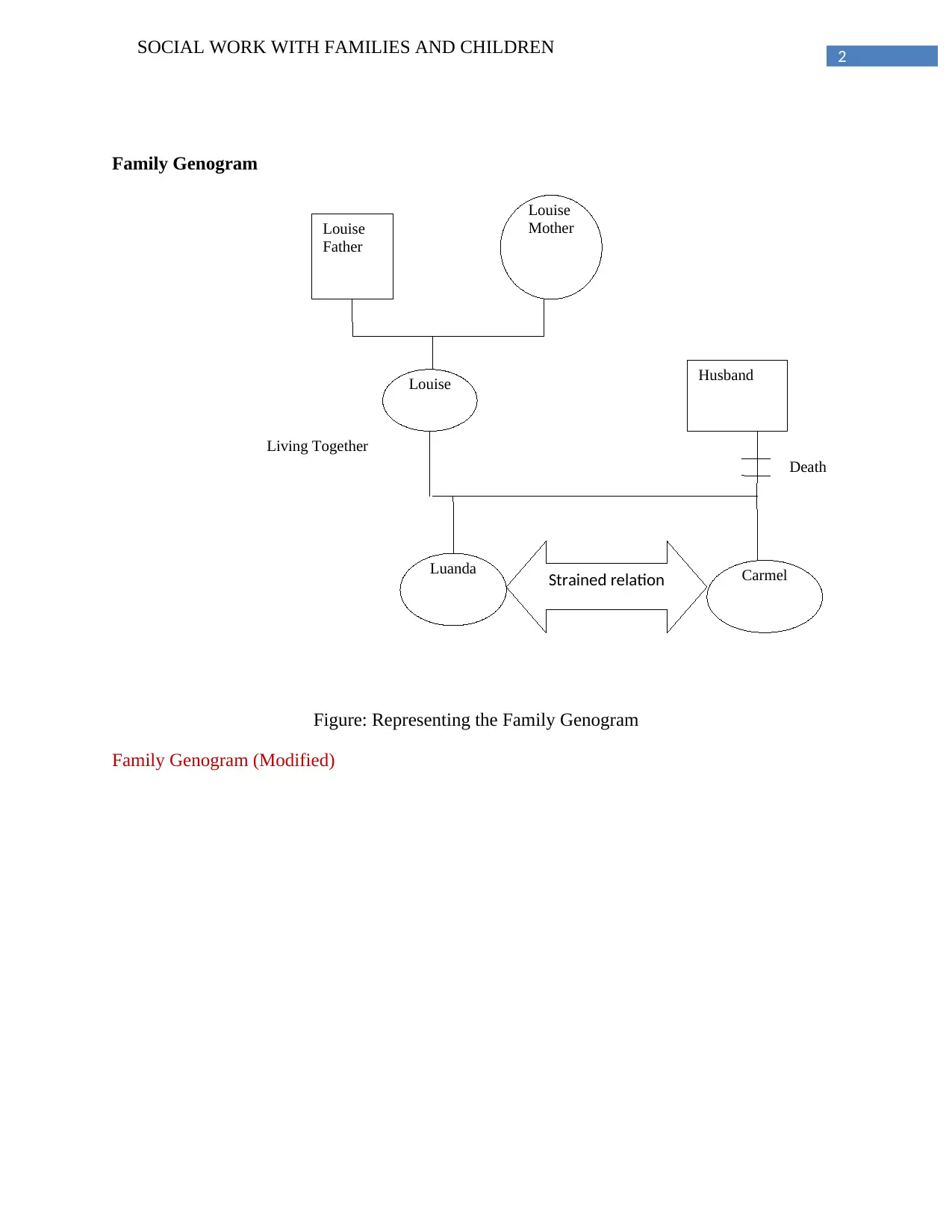
Family Genogram
Figure: Representing the Family Genogram
Family Genogram (Modified)
SOCIAL WORK WITH FAMILIES AND CHILDREN
Louise
Father
Louise Husband
Luanda Carmel
Death
Living Together
Strained relation
Louise
Mother
Family Genogram
Figure: Representing the Family Genogram
Family Genogram (Modified)
⊘ This is a preview!⊘
Do you want full access?
Subscribe today to unlock all pages.

Trusted by 1+ million students worldwide
3
SOCIAL WORK WITH FAMILIES AND CHILDREN
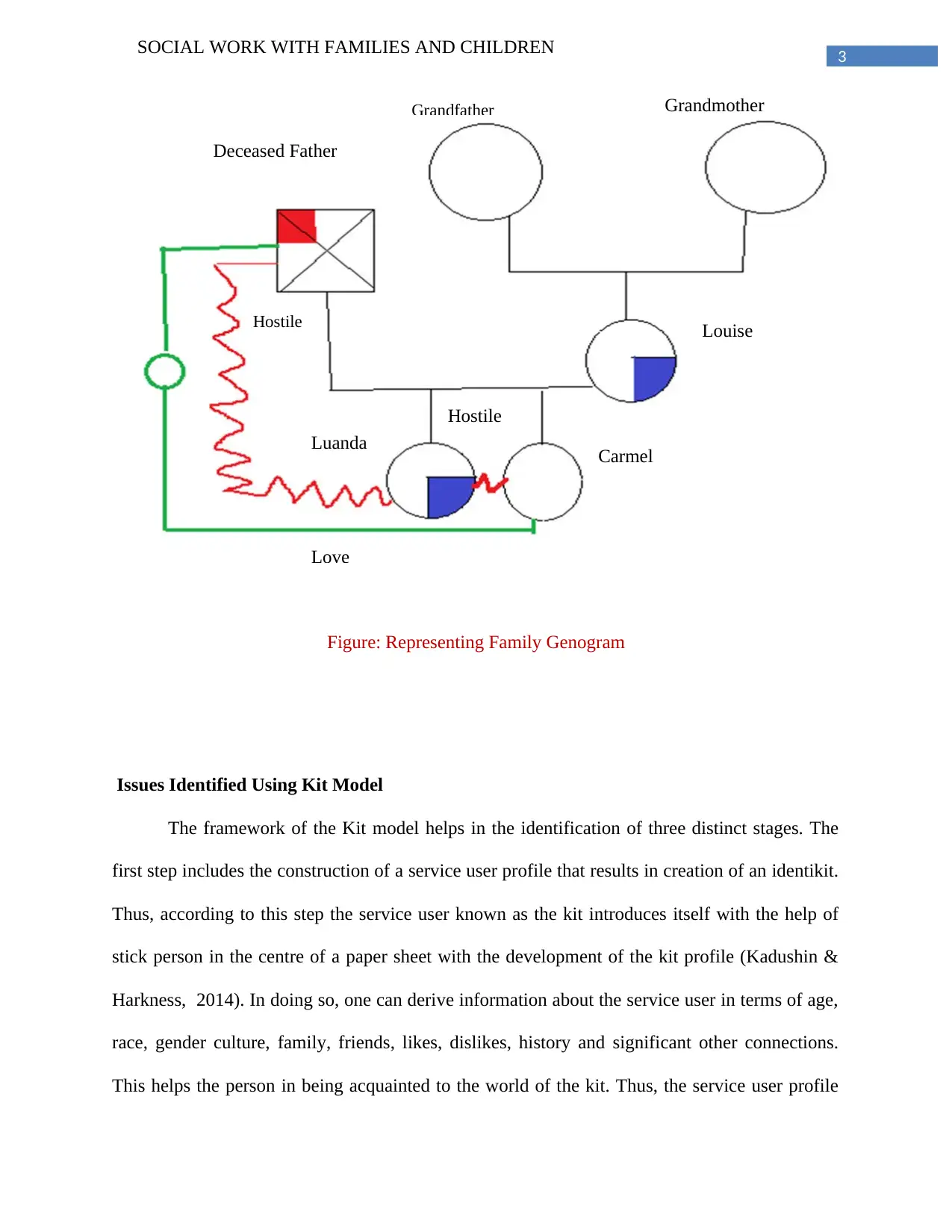
Figure: Representing Family Genogram
Issues Identified Using Kit Model
The framework of the Kit model helps in the identification of three distinct stages. The
first step includes the construction of a service user profile that results in creation of an identikit.
Thus, according to this step the service user known as the kit introduces itself with the help of
stick person in the centre of a paper sheet with the development of the kit profile (Kadushin &
Harkness, 2014). In doing so, one can derive information about the service user in terms of age,
race, gender culture, family, friends, likes, dislikes, history and significant other connections.
This helps the person in being acquainted to the world of the kit. Thus, the service user profile
Grandfather Grandmother
Louise
Luanda Carmel
Hostile
Deceased Father
Love
Hostile
SOCIAL WORK WITH FAMILIES AND CHILDREN
Figure: Representing Family Genogram
Issues Identified Using Kit Model
The framework of the Kit model helps in the identification of three distinct stages. The
first step includes the construction of a service user profile that results in creation of an identikit.
Thus, according to this step the service user known as the kit introduces itself with the help of
stick person in the centre of a paper sheet with the development of the kit profile (Kadushin &
Harkness, 2014). In doing so, one can derive information about the service user in terms of age,
race, gender culture, family, friends, likes, dislikes, history and significant other connections.
This helps the person in being acquainted to the world of the kit. Thus, the service user profile
Grandfather Grandmother
Louise
Luanda Carmel
Hostile
Deceased Father
Love
Hostile
Paraphrase This Document
Need a fresh take? Get an instant paraphrase of this document with our AI Paraphraser
4
SOCIAL WORK WITH FAMILIES AND CHILDREN
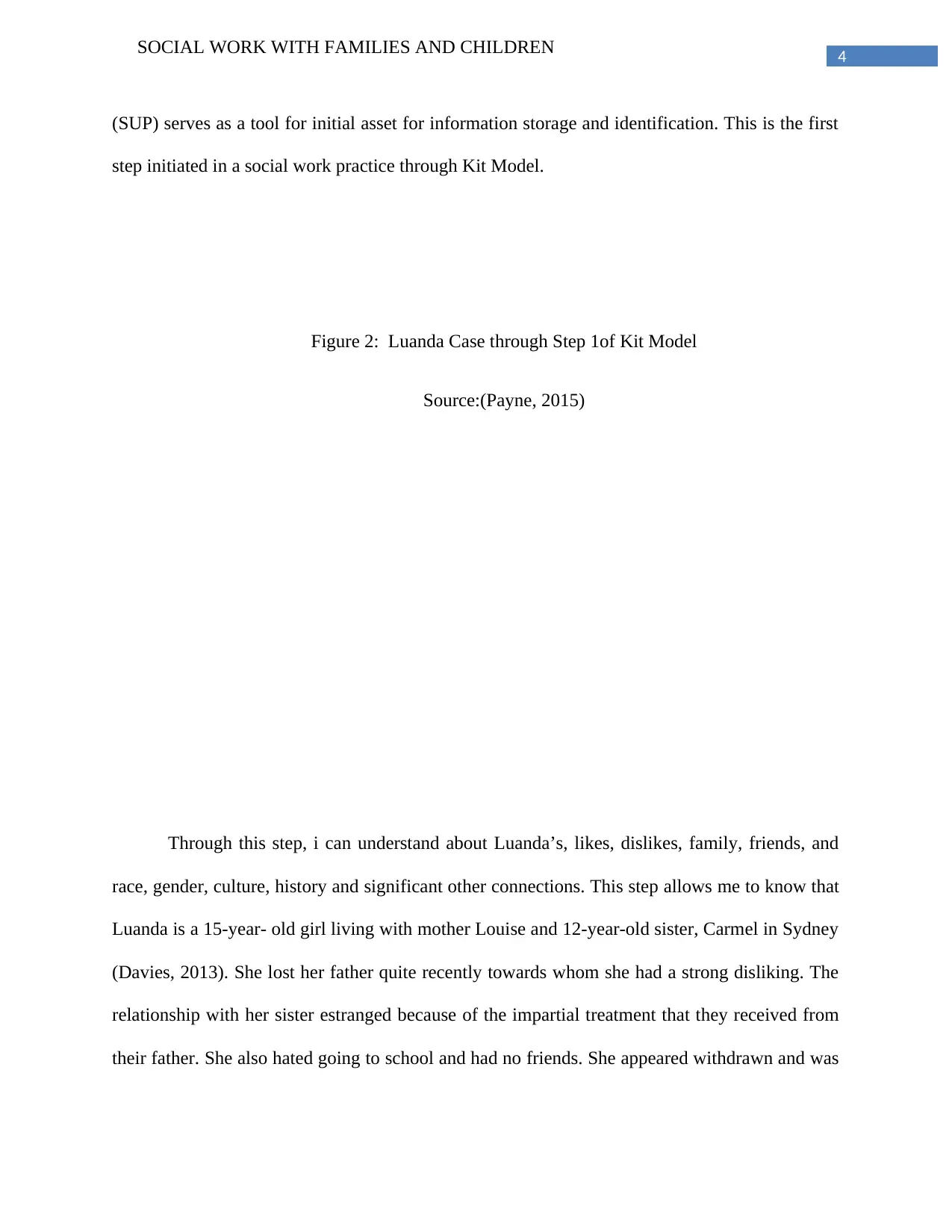
(SUP) serves as a tool for initial asset for information storage and identification. This is the first
step initiated in a social work practice through Kit Model.
Figure 2: Luanda Case through Step 1of Kit Model
Source:(Payne, 2015)
Through this step, i can understand about Luanda’s, likes, dislikes, family, friends, and
race, gender, culture, history and significant other connections. This step allows me to know that
Luanda is a 15-year- old girl living with mother Louise and 12-year-old sister, Carmel in Sydney
(Davies, 2013). She lost her father quite recently towards whom she had a strong disliking. The
relationship with her sister estranged because of the impartial treatment that they received from
their father. She also hated going to school and had no friends. She appeared withdrawn and was
SOCIAL WORK WITH FAMILIES AND CHILDREN
(SUP) serves as a tool for initial asset for information storage and identification. This is the first
step initiated in a social work practice through Kit Model.
Figure 2: Luanda Case through Step 1of Kit Model
Source:(Payne, 2015)
Through this step, i can understand about Luanda’s, likes, dislikes, family, friends, and
race, gender, culture, history and significant other connections. This step allows me to know that
Luanda is a 15-year- old girl living with mother Louise and 12-year-old sister, Carmel in Sydney
(Davies, 2013). She lost her father quite recently towards whom she had a strong disliking. The
relationship with her sister estranged because of the impartial treatment that they received from
their father. She also hated going to school and had no friends. She appeared withdrawn and was
5
SOCIAL WORK WITH FAMILIES AND CHILDREN
affected by dark moods. However, she loves her mother, loves painting and has expressed
immense interest in meeting me (social worker) when her mother introduced her to me.
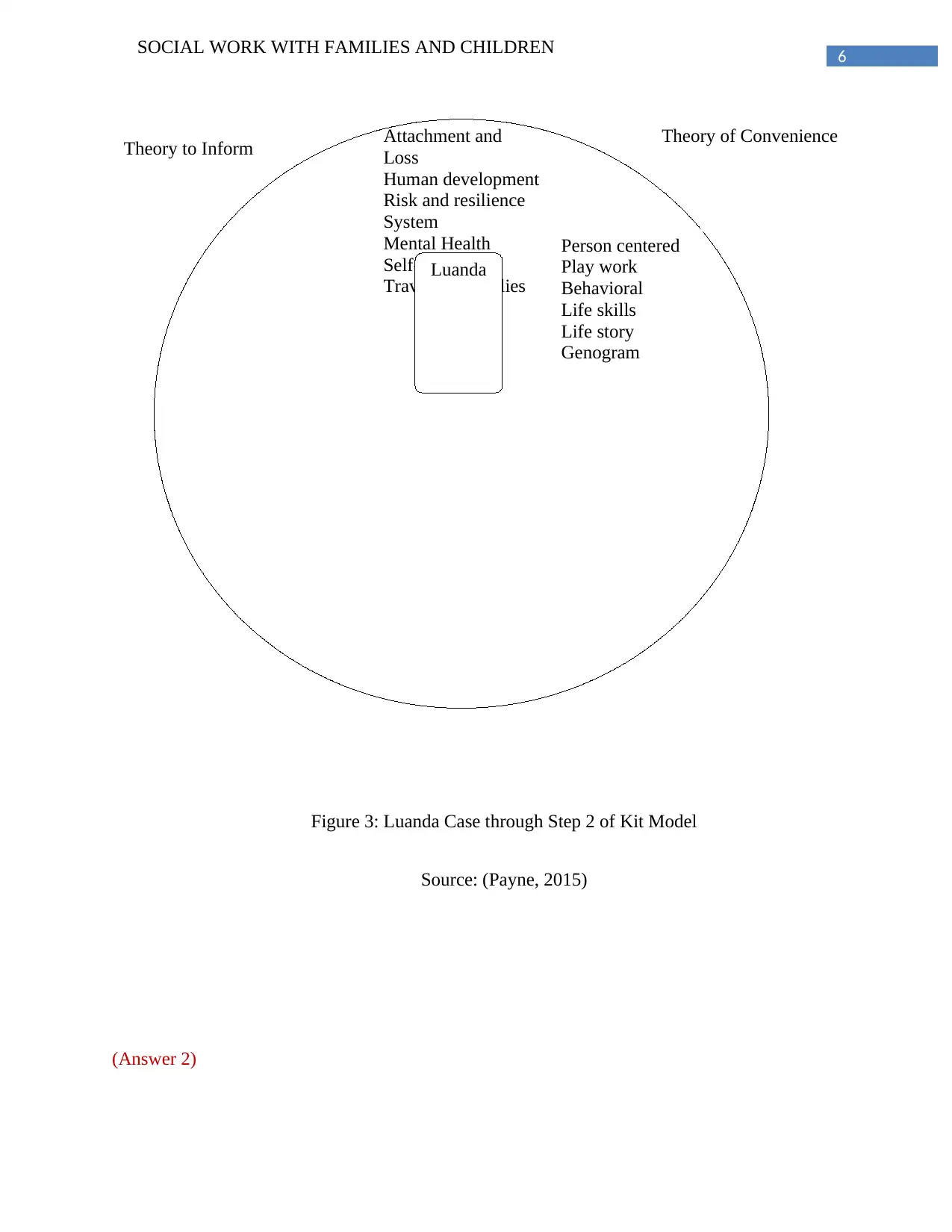
The second stage of the Kit model refers to the theory used for explaining Luanda’s
world and the social interventions that are most appropriate. This stage represented by a theory
circle where the left half of the circle encourages the person to be specific and thereby identify
the theoretical ideas required in understanding the ambience inhabited by Luanda (Padgett,
2016). Here one can however draw the relevant ideas from the attachment theory, human
development, mental health, risk and resilience, sociological and social policy understanding and
self-harm. The theories entered in the left half will not enable the intervention of social work to
take place. This is however possible only when one enters the right half of the circle.
Interventions include person-centered ideas needed to work alongside Luanda which includes
acceptance, congruence, empathy, doing play work, construction of a genogram or life story
work.
SOCIAL WORK WITH FAMILIES AND CHILDREN
affected by dark moods. However, she loves her mother, loves painting and has expressed
immense interest in meeting me (social worker) when her mother introduced her to me.
The second stage of the Kit model refers to the theory used for explaining Luanda’s
world and the social interventions that are most appropriate. This stage represented by a theory
circle where the left half of the circle encourages the person to be specific and thereby identify
the theoretical ideas required in understanding the ambience inhabited by Luanda (Padgett,
2016). Here one can however draw the relevant ideas from the attachment theory, human
development, mental health, risk and resilience, sociological and social policy understanding and
self-harm. The theories entered in the left half will not enable the intervention of social work to
take place. This is however possible only when one enters the right half of the circle.
Interventions include person-centered ideas needed to work alongside Luanda which includes
acceptance, congruence, empathy, doing play work, construction of a genogram or life story
work.
⊘ This is a preview!⊘
Do you want full access?
Subscribe today to unlock all pages.
Trusted by 1+ million students worldwide
6
SOCIAL WORK WITH FAMILIES AND CHILDREN
Attachment and
Loss
Human development
Risk and resilience
System
Mental Health
Self-harm
Travelling families
Luanda
Theory to Inform Theory of Convenience
Person centered
Play work
Behavioral
Life skills
Life story
Genogram
Figure 3: Luanda Case through Step 2 of Kit Model
Source: (Payne, 2015)
(Answer 2)
SOCIAL WORK WITH FAMILIES AND CHILDREN
Attachment and
Loss
Human development
Risk and resilience
System
Mental Health
Self-harm
Travelling families
Luanda
Theory to Inform Theory of Convenience
Person centered
Play work
Behavioral
Life skills
Life story
Genogram
Figure 3: Luanda Case through Step 2 of Kit Model
Source: (Payne, 2015)
(Answer 2)
Paraphrase This Document
Need a fresh take? Get an instant paraphrase of this document with our AI Paraphraser
7
SOCIAL WORK WITH FAMILIES AND CHILDREN
TherThwr
Knowledge
Theory of Intervention in Luanda’s world
Theory
To Inform and
And
Explain
Luanda’s worldLuanda
1. The legislative framework
2. Agency Policy
3. Organizational Context
4. Resources
Skills
1. Communication
2. Enabling
3. Assessment
4. Advocacy
5. Report Writing
Theory to Intervene
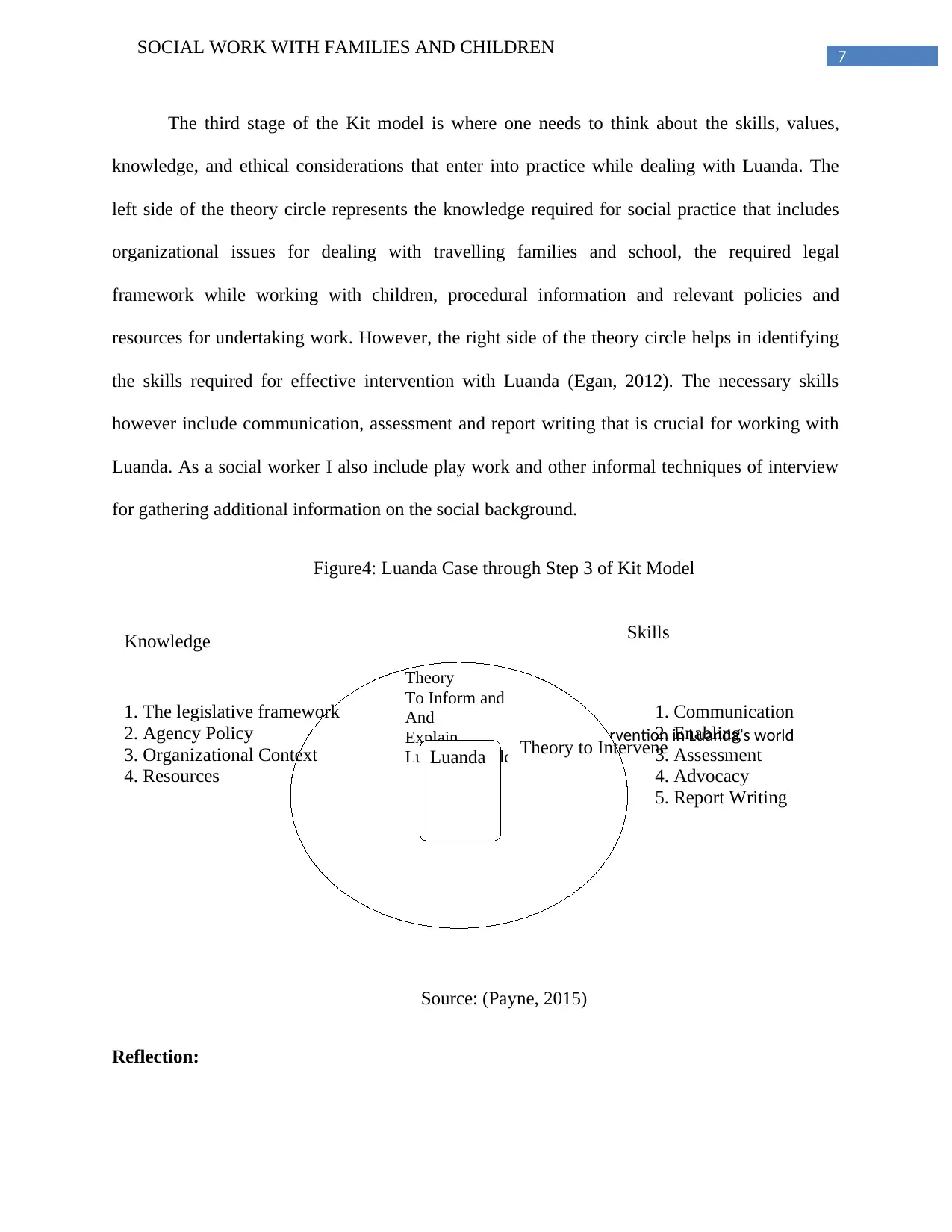
The third stage of the Kit model is where one needs to think about the skills, values,
knowledge, and ethical considerations that enter into practice while dealing with Luanda. The
left side of the theory circle represents the knowledge required for social practice that includes
organizational issues for dealing with travelling families and school, the required legal
framework while working with children, procedural information and relevant policies and
resources for undertaking work. However, the right side of the theory circle helps in identifying
the skills required for effective intervention with Luanda (Egan, 2012). The necessary skills
however include communication, assessment and report writing that is crucial for working with
Luanda. As a social worker I also include play work and other informal techniques of interview
for gathering additional information on the social background.
Figure4: Luanda Case through Step 3 of Kit Model
Source: (Payne, 2015)
Reflection:
SOCIAL WORK WITH FAMILIES AND CHILDREN
TherThwr
Knowledge
Theory of Intervention in Luanda’s world
Theory
To Inform and
And
Explain
Luanda’s worldLuanda
1. The legislative framework
2. Agency Policy
3. Organizational Context
4. Resources
Skills
1. Communication
2. Enabling
3. Assessment
4. Advocacy
5. Report Writing
Theory to Intervene
The third stage of the Kit model is where one needs to think about the skills, values,
knowledge, and ethical considerations that enter into practice while dealing with Luanda. The
left side of the theory circle represents the knowledge required for social practice that includes
organizational issues for dealing with travelling families and school, the required legal
framework while working with children, procedural information and relevant policies and
resources for undertaking work. However, the right side of the theory circle helps in identifying
the skills required for effective intervention with Luanda (Egan, 2012). The necessary skills
however include communication, assessment and report writing that is crucial for working with
Luanda. As a social worker I also include play work and other informal techniques of interview
for gathering additional information on the social background.
Figure4: Luanda Case through Step 3 of Kit Model
Source: (Payne, 2015)
Reflection:
8
SOCIAL WORK WITH FAMILIES AND CHILDREN
Personal Strength and Weakness
The strength perspective refers to looking at families, individuals and communities in a
different manner. However, the seeing must be based on talent, capacities, possibilities,
competencies, visions, values and hopes in spite of the fact how distorted and disturbed they may
have become through trauma, circumstance and oppression (Saleebey, 2012). Thus, the strength
based practice defined as a philosophy that represents way of working and way of thinking
necessary for guiding a practice. Therefore,there is a need for composing roster of resource that
might exist around and within the family, individual or community.
However, in dealing with Luanda’s case I possessed the strength of introducing myself
and maintaining privacy towards her case. I also ensured a non-verbal attendance through eye
contact and frequent nods. I possessed ability as an active listener during the interview. While
talking to her I also tried to reflect and understand the feelings that she possesses for her sister. I
also possessed the ability to summarizing the case. However, compared to my strengths my
weaknesses lied in being more empathetic towards her condition and undertaking more
exploration through open-ended questions. In addition, I have scored higher in active listening
and non-verbal attendance. Moreover, while dealing with Luanda building a rapport was more
important rather than targeting on achieving a goal.
Skills that Needed Improvement in Luanda’s Case
a. Improvement of the Listening Skills
Through improvement of my listening skills, I will be able to validate the need of Luanda
to vent out, heard and be understood. This will help Luanda to build a trust, as she will consider
me empathic in realizing her situation (Goh, 2012). The ability to listen actively has helped me in
SOCIAL WORK WITH FAMILIES AND CHILDREN
Personal Strength and Weakness
The strength perspective refers to looking at families, individuals and communities in a
different manner. However, the seeing must be based on talent, capacities, possibilities,
competencies, visions, values and hopes in spite of the fact how distorted and disturbed they may
have become through trauma, circumstance and oppression (Saleebey, 2012). Thus, the strength
based practice defined as a philosophy that represents way of working and way of thinking
necessary for guiding a practice. Therefore,there is a need for composing roster of resource that
might exist around and within the family, individual or community.
However, in dealing with Luanda’s case I possessed the strength of introducing myself
and maintaining privacy towards her case. I also ensured a non-verbal attendance through eye
contact and frequent nods. I possessed ability as an active listener during the interview. While
talking to her I also tried to reflect and understand the feelings that she possesses for her sister. I
also possessed the ability to summarizing the case. However, compared to my strengths my
weaknesses lied in being more empathetic towards her condition and undertaking more
exploration through open-ended questions. In addition, I have scored higher in active listening
and non-verbal attendance. Moreover, while dealing with Luanda building a rapport was more
important rather than targeting on achieving a goal.
Skills that Needed Improvement in Luanda’s Case
a. Improvement of the Listening Skills
Through improvement of my listening skills, I will be able to validate the need of Luanda
to vent out, heard and be understood. This will help Luanda to build a trust, as she will consider
me empathic in realizing her situation (Goh, 2012). The ability to listen actively has helped me in
⊘ This is a preview!⊘
Do you want full access?
Subscribe today to unlock all pages.
Trusted by 1+ million students worldwide
9
SOCIAL WORK WITH FAMILIES AND CHILDREN
developing insight on the ways of improving systems and requirements for Luanda. Moreover,
active listening helps in boosting my self-confidence. Through active listening, I am able to
connect to Luanda, get insights into her life, and develop a bond. Luanda suffers from extreme
loneliness therefore active listening is all that she needs that will help her regain her value.
Therefore, active listening portrays thinking among people that they are valued and cared for.
b. Empathic Response towards Client
Empathy is a vital indicator of being an effective counselor. Therefore, possession of
empathy is also essential in building the client counselor interaction. My character of empathy
will enable me in effectively understanding the concerns of Luanda (Cournoyer, 2016). Thus, by
being more empathetic I will be able to not only build relationship but also enable stimulation of
self-exploration. In addition, empathy provides support and helps in betterassisting
communication in addition to focusing attention on my client Luanda.
c. Communication Skills
Effective communication skill is considered as one of the crucial components for my job
(Lee & Hudson, 2017). This will enable me gain more information about Luanda. At the same
time, it will also help in conveying critical information that will finally leads to important
decisions related to improving her condition.However, lack of effectiveness in communication
will not allow me to gather or convey information thereby leading to harmful effects.
d. Use of Open Ended Questions
The advantages of using open-ended questions allow Luanda to provide me with any
possible number of answers that she considers to be relevant. It also helps me in collecting more
detail and learning something that is beyond expectation. Thus, open ended questions helps in
SOCIAL WORK WITH FAMILIES AND CHILDREN
developing insight on the ways of improving systems and requirements for Luanda. Moreover,
active listening helps in boosting my self-confidence. Through active listening, I am able to
connect to Luanda, get insights into her life, and develop a bond. Luanda suffers from extreme
loneliness therefore active listening is all that she needs that will help her regain her value.
Therefore, active listening portrays thinking among people that they are valued and cared for.
b. Empathic Response towards Client
Empathy is a vital indicator of being an effective counselor. Therefore, possession of
empathy is also essential in building the client counselor interaction. My character of empathy
will enable me in effectively understanding the concerns of Luanda (Cournoyer, 2016). Thus, by
being more empathetic I will be able to not only build relationship but also enable stimulation of
self-exploration. In addition, empathy provides support and helps in betterassisting
communication in addition to focusing attention on my client Luanda.
c. Communication Skills
Effective communication skill is considered as one of the crucial components for my job
(Lee & Hudson, 2017). This will enable me gain more information about Luanda. At the same
time, it will also help in conveying critical information that will finally leads to important
decisions related to improving her condition.However, lack of effectiveness in communication
will not allow me to gather or convey information thereby leading to harmful effects.
d. Use of Open Ended Questions
The advantages of using open-ended questions allow Luanda to provide me with any
possible number of answers that she considers to be relevant. It also helps me in collecting more
detail and learning something that is beyond expectation. Thus, open ended questions helps in
Paraphrase This Document
Need a fresh take? Get an instant paraphrase of this document with our AI Paraphraser
10
SOCIAL WORK WITH FAMILIES AND CHILDREN
securing adequate answer to issues that are complex. They also encourage self-expression and
enable client to give creative answers. These questions also help me in understanding the thought
process of Luanda. Further, with these questions I can explore issues that I was not aware of
previously.
e. Speaking about Empathy, Ethics, Values and Social Work Practice Standards
Empathy in social work practice standards, it is of vital importance since clients who
experience empathy through their treatment process have better outcomes. Through empathy, I
can effectively balance my role (Banks, 2012). On the other hand, ethical awareness is also a
fundamental part of their practice. The commitment and ability of acting ethically is important
when dealing with the client. Thus, Australian Association of Social Workers (AASW) have
formulated a guide mentioning the professional conduct to be followed by the workers in the
protecting the client. In dealing with Luanda, I must also possess value that provides the ethical
and moral guidelines that help in the determination of the performance of our life and work
f. Focus on Social Work Theories
Strength Based Theory
The strength-based theory refers to a social practice that put emphases on people’s
strengths and self-determination (O’Leary, Tsui, & Ruch, 2012). This is a philosophy and way of
viewing the clients as resilient and resourceful in times of adversity. There are two aspects of
defining the client strength that includes the conceptualization process and the enactments of the
therapist. The conceptualization process implies discovering the strength of the client through
asking questions, through therapeutic relationship, discovering strengths embedded in client
SOCIAL WORK WITH FAMILIES AND CHILDREN
securing adequate answer to issues that are complex. They also encourage self-expression and
enable client to give creative answers. These questions also help me in understanding the thought
process of Luanda. Further, with these questions I can explore issues that I was not aware of
previously.
e. Speaking about Empathy, Ethics, Values and Social Work Practice Standards
Empathy in social work practice standards, it is of vital importance since clients who
experience empathy through their treatment process have better outcomes. Through empathy, I
can effectively balance my role (Banks, 2012). On the other hand, ethical awareness is also a
fundamental part of their practice. The commitment and ability of acting ethically is important
when dealing with the client. Thus, Australian Association of Social Workers (AASW) have
formulated a guide mentioning the professional conduct to be followed by the workers in the
protecting the client. In dealing with Luanda, I must also possess value that provides the ethical
and moral guidelines that help in the determination of the performance of our life and work
f. Focus on Social Work Theories
Strength Based Theory
The strength-based theory refers to a social practice that put emphases on people’s
strengths and self-determination (O’Leary, Tsui, & Ruch, 2012). This is a philosophy and way of
viewing the clients as resilient and resourceful in times of adversity. There are two aspects of
defining the client strength that includes the conceptualization process and the enactments of the
therapist. The conceptualization process implies discovering the strength of the client through
asking questions, through therapeutic relationship, discovering strengths embedded in client
11
SOCIAL WORK WITH FAMILIES AND CHILDREN
weakness and understanding the expression of the client’s strength in the cultural context. On the
other hand, enactments of the therapist refer to the doings of doings of the therapist that uses the
strength of the client in the process of change. This is done through identification of the strength
of the client, reframing of the strengths and using them in solving problems and attending to
strengths whenever necessary. The strength observed in case of Luanda is her willingness to
meet the therapist and look forward to attending the counseling service. This means that she does
not want to be lonely and is ready to behave as a normal girl in front of the therapist.
Empowerment Theory
Empowerment refers to theoretical model that helps in understanding the consequences
of efforts for exerting control over the decisions that not only affects one’s life but also the
community life and organizational functioning (Pulla, 2012). Empowerment also measures the
value orientation of working in community. Thus, empowerment theory put forward a
framework and principles for organizing the knowledge we possess. This theory also enables
advancing the construct beyond the political manipulation and passing fad . The application of
the empowerment theory in Luanda’s cases with help me in getting a clear picture of the
consequences that is affecting her life. This will allow me to help her deal with her situation
and push her towards a better life.
Sleepy Therapy
Sleepy Therapy primarily deals with sleep wake disorders. Thus, this theory focuses
mainly on achieving and setting of goals, changes in behaviors, adopting relaxation skills and
becoming self-aware (Astill, Van der Heijden, Van IJzendoorn, & Van Someren, 2012). The
application of sleepy theory will help Luanda to get over her dark moods and help her sleep
peacefully without succumbing to any worries.
SOCIAL WORK WITH FAMILIES AND CHILDREN
weakness and understanding the expression of the client’s strength in the cultural context. On the
other hand, enactments of the therapist refer to the doings of doings of the therapist that uses the
strength of the client in the process of change. This is done through identification of the strength
of the client, reframing of the strengths and using them in solving problems and attending to
strengths whenever necessary. The strength observed in case of Luanda is her willingness to
meet the therapist and look forward to attending the counseling service. This means that she does
not want to be lonely and is ready to behave as a normal girl in front of the therapist.
Empowerment Theory
Empowerment refers to theoretical model that helps in understanding the consequences
of efforts for exerting control over the decisions that not only affects one’s life but also the
community life and organizational functioning (Pulla, 2012). Empowerment also measures the
value orientation of working in community. Thus, empowerment theory put forward a
framework and principles for organizing the knowledge we possess. This theory also enables
advancing the construct beyond the political manipulation and passing fad . The application of
the empowerment theory in Luanda’s cases with help me in getting a clear picture of the
consequences that is affecting her life. This will allow me to help her deal with her situation
and push her towards a better life.
Sleepy Therapy
Sleepy Therapy primarily deals with sleep wake disorders. Thus, this theory focuses
mainly on achieving and setting of goals, changes in behaviors, adopting relaxation skills and
becoming self-aware (Astill, Van der Heijden, Van IJzendoorn, & Van Someren, 2012). The
application of sleepy theory will help Luanda to get over her dark moods and help her sleep
peacefully without succumbing to any worries.
⊘ This is a preview!⊘
Do you want full access?
Subscribe today to unlock all pages.
Trusted by 1+ million students worldwide

1 out of 16


Your All-in-One AI-Powered Toolkit for Academic Success.
+13062052269
info@desklib.com
Available 24*7 on WhatsApp / Email
![[object Object]](/_next/static/media/star-bottom.7253800d.svg)
Unlock your academic potential
Copyright © 2020–2026 A2Z Services. All Rights Reserved. Developed and managed by ZUCOL.