Microeconomics Discussion: Examining the Lumber Price Phenomenon

Verified

Added on  2023/06/03

|5
|870
|470
Discussion Board Post
AI Summary
This discussion board post analyzes the recent exponential increase in lumber prices, primarily from August 2017 to May 2018. The student examines the interplay of supply and demand, highlighting the role of increased demand due to a resurgence in the property market, new markets like China, and the use of lumber as a primary construction material. The analysis delves into supply-side constraints, including natural resource limitations, beetle infestations, wildfires, and trade tariffs. The post uses microeconomic principles, including supply and demand curves, to illustrate how shifts in demand and supply affect market prices and quantities. The student also discusses the potential long-term implications of these price increases on the housing market and the lumber industry, and the impact of supply chain inefficiencies.
Document Page
Running head: MICROECONOMICS
Microeconomics
Student’s Name:
Institution Affiliation:
tabler-icon-diamond-filled.svg

Paraphrase This Document

Need a fresh take? Get an instant paraphrase of this document with our AI Paraphraser
Document Page
2
Discussion
In the recent past, lumber prices have increased exponentially. On average, the price shot up by
up to 30% of the initial price beginning from August 2017 all the way to May 2018 (Olick,
2018). A reason for the sharp increase in prices is due to the increase in demand over the same
period of time while supply is not keeping pace with it. Lumber being a natural resource has a
limit as to how much can be harvested in a given period of time. The growth in demand has been
occasioned by the recent resurgence of the property market to what one would refer to as a
property boom (Skerritt, 2018). As a matter of fact, single dwelling construction increased by
seven percent from January 2017 to January 2018 (Olick, 2018).
Demand has also raised due to the emergence of new markets as other regions of the world
experience an economic boom leading to increased wealth. A point in case is China, which
increased its importation of the commodity and continues to see a surge in the demand for the
commodity. Lumber is the primary timber material used in the construction of homes as well as
other properties. Thereby, an increase in demand for housing leads to increased demand for
lumber. As stated above, the increase in demand has not been matched by a similar increase in
the supply of the product. Aside from the obvious reason of Lumber being a natural product with
limits to its availability, recent infestations by wood-destroying beetles in British Columbia have
destroyed whole sections of forests leading to a slump in the supply (Olick, 2018).
In addition, wildfires in the main producing areas of Canada during the summer have led to the
deforestation of whole sections of forests causing a huge supply hiccup in the United States. The
United States government raised tariffs on Canada in a recent trade spat by a whopping 20%
resulting in a substantial increase in the price of the commodity (Olick, 2018). With Canada
Document Page
3
being the United States largest lumber supply with a market share of close to thirty percent at
28%, any disruption in its ability to supply the commodity leads to a slump in supply (Skerritt,
2018).
Canadian producers too have to contend with a with a general rise I the production cost of
lumber which include labor and transport costs which hampers supply. A case in point in the
increase of supply costs is the recent increase by 24% of a flatbed truck used to ferry lumber.
According to estimates, the high prices are expected to remain in place until 2020. With framing
lumber accounting for about 20% of a property construction, the increase in lumber prices will
result in the continued rise in home constructions in the short to medium term.
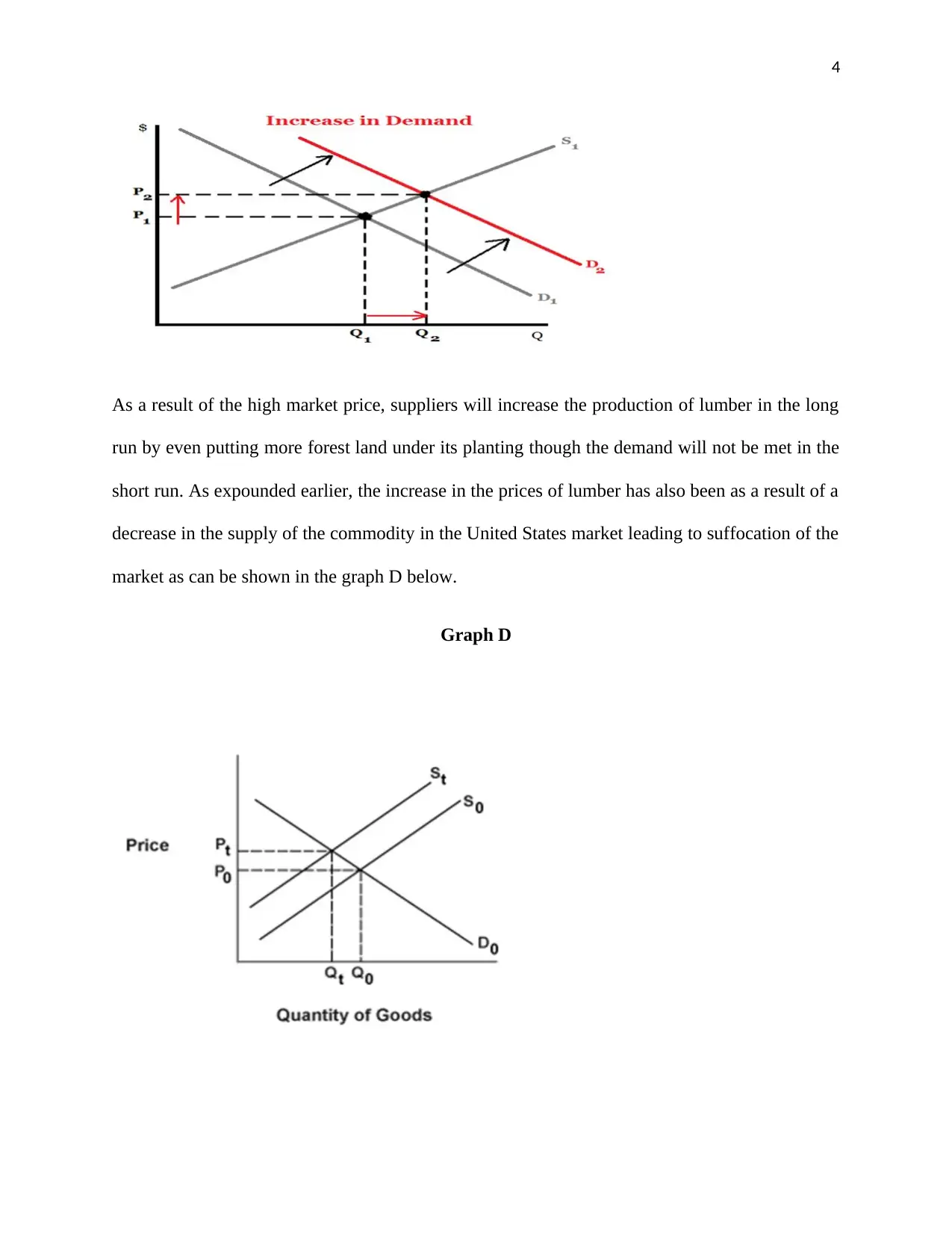
As discussed in the article, the recent boom in the housing sector has led to an increase in
demand for lumber as it is an input in home construction. Increased demand shifts the demand
curve upwards and to the right in the graph as shown below. As a result of the shift from D1 to
D2 the price increase from the initial P1 TO P2 while quantity demanded also faces a similar
shift from Q1 to Q2. The increase in demand is made worse by a supply chain that does not meet
the demand resulting in a market failure as the few available units are chased by many
consumers. Naturally, suppliers increase the price by charging the absolute maximum for which
the consumer is willing to pay.
Graph A
Document Page
4
As a result of the high market price, suppliers will increase the production of lumber in the long
run by even putting more forest land under its planting though the demand will not be met in the
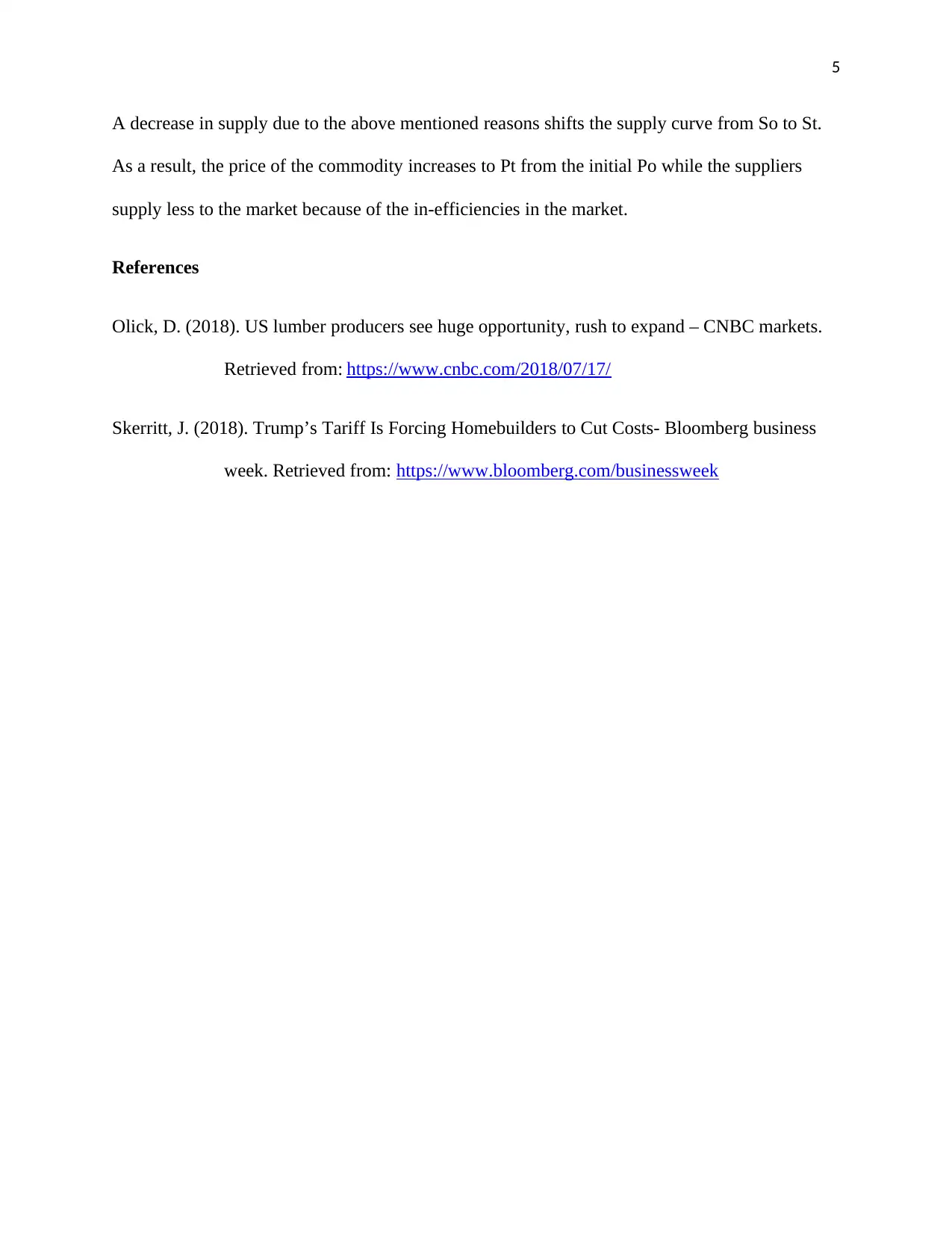
short run. As expounded earlier, the increase in the prices of lumber has also been as a result of a
decrease in the supply of the commodity in the United States market leading to suffocation of the
market as can be shown in the graph D below.
Graph D
tabler-icon-diamond-filled.svg

Paraphrase This Document

Need a fresh take? Get an instant paraphrase of this document with our AI Paraphraser
Document Page
5
A decrease in supply due to the above mentioned reasons shifts the supply curve from So to St.
As a result, the price of the commodity increases to Pt from the initial Po while the suppliers
supply less to the market because of the in-efficiencies in the market.
References
Olick, D. (2018). US lumber producers see huge opportunity, rush to expand – CNBC markets.
Retrieved from: https://www.cnbc.com/2018/07/17/
Skerritt, J. (2018). Trump’s Tariff Is Forcing Homebuilders to Cut Costs- Bloomberg business
week. Retrieved from: https://www.bloomberg.com/businessweek
chevron_up_icon
1 out of 5
circle_padding
hide_on_mobile
zoom_out_icon
[object Object]