Luxottica's External Environment, Ethics, CSR, and Culture Analysis
VerifiedAdded on 2023/05/30
|11
|3395
|389
Report
AI Summary
This report provides a comprehensive analysis of Luxottica, examining its general and specific external environments, ethical practices, corporate social responsibility (CSR), and organizational culture. It defines and discusses the impact of the general external environment, focusing on the technological factors influencing Luxottica's operations, such as automation, robotics, and digital transformation programs. The report also explores the specific external environment, highlighting the impact of employees, Luxottica's commitment to employee welfare, and talent development. Furthermore, it delves into Luxottica's ethics and CSR initiatives, including environmental sustainability through technological advancements and waste management. Finally, the report discusses organizational culture and includes a personal insight from a quiz evaluating the right organizational culture fit. This detailed analysis aims to provide a holistic view of Luxottica's operational context and its approach to ethical and social responsibilities.
Unit code:
Student Name
Deakin College ID:
Lecturer Name:
Class Number:
Day and Time:
Management
ASSIGNMENT 1 PART B
Student Name
Deakin College ID:
Lecturer Name:
Class Number:
Day and Time:
Management
ASSIGNMENT 1 PART B

Paraphrase This Document
Need a fresh take? Get an instant paraphrase of this document with our AI Paraphraser
Contents
1.Introduction........................................................................................................................................2
2.Task 1:................................................................................................................................................2
2.1 Definition & Discussion of impact of General External Environment...............................................2
2.2 Analysis & Evaluation of Impact of Technological Factor for Luxottica............................................3
3.Task 2:................................................................................................................................................3
3.1Definition & Discussion of impact of Specific External Environment................................................3
3.2 Analysis & Evaluation of Impact employees Factor for Luxottica....................................................4
4.Task 3:................................................................................................................................................5
4.1Definition & Discussion of ethics & CSR of organisation...................................................................5
4.2Analysis and evaluation of Ethics & CSR for Luxottica......................................................................6
5.Task 4:................................................................................................................................................7
5.1Definition & Discussion of culture of organisation...........................................................................7
5.2Reporting, analysing and evaluating personal insight of quiz ‘What’s the Right Organisational
Culture for Me?.....................................................................................................................................8
6.Conclusion..........................................................................................................................................9
7. References.........................................................................................................................................9
1.Introduction........................................................................................................................................2
2.Task 1:................................................................................................................................................2
2.1 Definition & Discussion of impact of General External Environment...............................................2
2.2 Analysis & Evaluation of Impact of Technological Factor for Luxottica............................................3
3.Task 2:................................................................................................................................................3
3.1Definition & Discussion of impact of Specific External Environment................................................3
3.2 Analysis & Evaluation of Impact employees Factor for Luxottica....................................................4
4.Task 3:................................................................................................................................................5
4.1Definition & Discussion of ethics & CSR of organisation...................................................................5
4.2Analysis and evaluation of Ethics & CSR for Luxottica......................................................................6
5.Task 4:................................................................................................................................................7
5.1Definition & Discussion of culture of organisation...........................................................................7
5.2Reporting, analysing and evaluating personal insight of quiz ‘What’s the Right Organisational
Culture for Me?.....................................................................................................................................8
6.Conclusion..........................................................................................................................................9
7. References.........................................................................................................................................9
1.Introduction
In this report the concept of general environment, specific environment, dimension of ethics
and corporate social responsibility as well as culture of Luxottica is presented along with
detailed analysis and evaluation of impacts of all the aspects of environment in which the
organisation operates.
2.Task 1:
2.1 Definition & Discussion of impact of General
External Environment
According to Robbins, Stephen P., et al. (2015) the general environment of a firm includes
sociocultural, technological, economic, political/legal and global aspects of society within
which a firm operates and alteration in these elements impact general environment which
ultimately influences the firms thereby further impacting a firm’s specific environment. The
socio-cultural element consist of cultural and demographic attributes of society like under
cultural elements comes customs, values, preferences and behaviour while under
demographic characteristics comes gender, education, income, race, ethnicity etc. These
elements of general environment influences social trends that affects firms products, services
and attitude of workforce within firms that is of value for society. Like preference of
customers towards green and ethically sourced products have resulted from cultural aspects
of society. Another component of general environment of firm is technological that shapes
scientific developments and consist of knowledge, application utilised to transform resources
into products/ services and is related to product/ technological procedure in firms which
results into creation of new product or improvement in the features or abilities of existing
products. Example, cloud and big data technology have facilitated inventory management.
Another element of general environment of firm is economic aspect that is related to
economic well being of nation where the firm operates and consist of existing economic
systems, situation and cycles. Economic systems include capitalist, socialist or combination
of both such as Australia is capitalist and China is socialist. Economic situation include
interest, inflation rate that influences cost, demand of product/services of firm and economic
cycle includes period of growth or fall. Also political/legal aspect is another element of
In this report the concept of general environment, specific environment, dimension of ethics
and corporate social responsibility as well as culture of Luxottica is presented along with
detailed analysis and evaluation of impacts of all the aspects of environment in which the
organisation operates.
2.Task 1:
2.1 Definition & Discussion of impact of General
External Environment
According to Robbins, Stephen P., et al. (2015) the general environment of a firm includes
sociocultural, technological, economic, political/legal and global aspects of society within
which a firm operates and alteration in these elements impact general environment which
ultimately influences the firms thereby further impacting a firm’s specific environment. The
socio-cultural element consist of cultural and demographic attributes of society like under
cultural elements comes customs, values, preferences and behaviour while under
demographic characteristics comes gender, education, income, race, ethnicity etc. These
elements of general environment influences social trends that affects firms products, services
and attitude of workforce within firms that is of value for society. Like preference of
customers towards green and ethically sourced products have resulted from cultural aspects
of society. Another component of general environment of firm is technological that shapes
scientific developments and consist of knowledge, application utilised to transform resources
into products/ services and is related to product/ technological procedure in firms which
results into creation of new product or improvement in the features or abilities of existing
products. Example, cloud and big data technology have facilitated inventory management.
Another element of general environment of firm is economic aspect that is related to
economic well being of nation where the firm operates and consist of existing economic
systems, situation and cycles. Economic systems include capitalist, socialist or combination
of both such as Australia is capitalist and China is socialist. Economic situation include
interest, inflation rate that influences cost, demand of product/services of firm and economic
cycle includes period of growth or fall. Also political/legal aspect is another element of
⊘ This is a preview!⊘
Do you want full access?
Subscribe today to unlock all pages.

Trusted by 1+ million students worldwide
general environment of firm that includes legislative and government systems in which a firm
operates and consist of political stability, government rules, norms etc which influence
decision making and planning in firms. Example consumer protection, employee health and
safety regulation influences policies and practices of firms. Another element of general
environment is global aspect that include global event or change and institutional force that
impacts trade and business operation. Example, internet is global aspect that has enabled
advanced communication and transport and has reduced geographic barriers between firms
activities as well as enabled exchange of product or resources due to globalisation.
2.2 Analysis & Evaluation of Impact of Technological
Factor for Luxottica
According to Glor (2015) in the technological dimension of general environment of Luxottica
various automation and robotics process is integrated in their manufacturing procedure with
incorporation of computing and big data which has helped to improvise speed, flexibility,
quality and productivity of their manufacturing process and has even improved their
operational excellence with exploitation of new technology and digital tools so as to attain
high level of factory digitalisation. Luxottica also use Digital Transformation Program to
recognise manufacturing requirement in advance and monitor real time production data so as
to improvise work and employee safety and this even enables employees to resolve issue
rapidly with more proactive measures than ever before. Another example of impact of
technological aspect of general environment dimension on Luxottica is evident in their retail
brand LensCrafters which uses technological advancement tool like AccuFit Digital
Measurement for digital transformation and innovation to enhance customer fulfilment
through associating services with iPads which enhances customers omnichannel encounters
along with other tool such as ClarifySM which enhances customers digital eye examination
experience in numerous locations (Luxottica Company, 2018)
3.Task 2:
3.1Definition & Discussion of impact of Specific External
Environment
operates and consist of political stability, government rules, norms etc which influence
decision making and planning in firms. Example consumer protection, employee health and
safety regulation influences policies and practices of firms. Another element of general
environment is global aspect that include global event or change and institutional force that
impacts trade and business operation. Example, internet is global aspect that has enabled
advanced communication and transport and has reduced geographic barriers between firms
activities as well as enabled exchange of product or resources due to globalisation.
2.2 Analysis & Evaluation of Impact of Technological
Factor for Luxottica
According to Glor (2015) in the technological dimension of general environment of Luxottica
various automation and robotics process is integrated in their manufacturing procedure with
incorporation of computing and big data which has helped to improvise speed, flexibility,
quality and productivity of their manufacturing process and has even improved their
operational excellence with exploitation of new technology and digital tools so as to attain
high level of factory digitalisation. Luxottica also use Digital Transformation Program to
recognise manufacturing requirement in advance and monitor real time production data so as
to improvise work and employee safety and this even enables employees to resolve issue
rapidly with more proactive measures than ever before. Another example of impact of
technological aspect of general environment dimension on Luxottica is evident in their retail
brand LensCrafters which uses technological advancement tool like AccuFit Digital
Measurement for digital transformation and innovation to enhance customer fulfilment
through associating services with iPads which enhances customers omnichannel encounters
along with other tool such as ClarifySM which enhances customers digital eye examination
experience in numerous locations (Luxottica Company, 2018)
3.Task 2:
3.1Definition & Discussion of impact of Specific External
Environment
Paraphrase This Document
Need a fresh take? Get an instant paraphrase of this document with our AI Paraphraser
According to Robbins, Stephen P., et al. (2015) the specific external environment of firm
consist of elements like customers, supplier, competitors, industry regulator & government
agency, employees & labour market, Interest group & strategic partners. These groups or
individuals are called stakeholders with which a firm corresponds while operating business
and as such these are either affected or affect the functioning of firm and influence
performance. Customers are one of the factors of specific environment of firm and they
impact the kind of product/ service offered as well as their quality and prices. Example,
regular customers seek for affordable prices of products and more personalised offers from
firm and these are often met to avoid losing loyal customer business. Another factor is
supplier who are firm or individuals that offer inputs to perform operations of a firm and
these inputs include material, human, financial, information resource or business service.
They impact a firm’s availability, cost and quality of material and thus impact the final
product/ service quality, manufacturing capacity, competitiveness and profit generation.
According to Smith, Jones & Gard (2016) competitor is another factor which are rivals of a
firm with whom competition exist for resources at various levels such as for funding, clients,
employees, technology, partners as well as for customers. Example, when customers need
clothes they can visit either a specific store or can buy online so here competition exist for
customers against online shopping stores as well as against other clothing outlets which
impacts product offering, availability, distribution access and prices altogether to influence
profit of firm. Further, employees are another factor of specific environment of firm which
includes resource or labour that work for firm and offer their effort, knowledge, creativity to
meet organisational goal and outcomes. According to Radosavljevic, Radosavljevic &
Anðelkovic (2015) the balance between supply and demand of talent resource impacts
performance of firm by impacting their cost and capacity. Example if niche skilled employees
is vital to firms products then it will govern firms capacity and performance as well as if
demand of certain skilled resource exceeds supply then labour cost for these resource rises in
labour market which influences firms cost that hires these kind of resources. Strategic
partners are another factor of specific environment of firm that include organisations which
work together for shared benefits and such collaborations helps to enhance resources,
learning and sharing knowledge as well as helps to distribute risks. Regulators are factor of
specific environment of firm which are people or agencies that develop and execute rules to
safeguard interest of society, employees or consumers and they influence firm by imposing
several regulations that affects their operations. Example, regulators impose norms of
consist of elements like customers, supplier, competitors, industry regulator & government
agency, employees & labour market, Interest group & strategic partners. These groups or
individuals are called stakeholders with which a firm corresponds while operating business
and as such these are either affected or affect the functioning of firm and influence
performance. Customers are one of the factors of specific environment of firm and they
impact the kind of product/ service offered as well as their quality and prices. Example,
regular customers seek for affordable prices of products and more personalised offers from
firm and these are often met to avoid losing loyal customer business. Another factor is
supplier who are firm or individuals that offer inputs to perform operations of a firm and
these inputs include material, human, financial, information resource or business service.
They impact a firm’s availability, cost and quality of material and thus impact the final
product/ service quality, manufacturing capacity, competitiveness and profit generation.
According to Smith, Jones & Gard (2016) competitor is another factor which are rivals of a
firm with whom competition exist for resources at various levels such as for funding, clients,
employees, technology, partners as well as for customers. Example, when customers need
clothes they can visit either a specific store or can buy online so here competition exist for
customers against online shopping stores as well as against other clothing outlets which
impacts product offering, availability, distribution access and prices altogether to influence
profit of firm. Further, employees are another factor of specific environment of firm which
includes resource or labour that work for firm and offer their effort, knowledge, creativity to
meet organisational goal and outcomes. According to Radosavljevic, Radosavljevic &
Anðelkovic (2015) the balance between supply and demand of talent resource impacts
performance of firm by impacting their cost and capacity. Example if niche skilled employees
is vital to firms products then it will govern firms capacity and performance as well as if
demand of certain skilled resource exceeds supply then labour cost for these resource rises in
labour market which influences firms cost that hires these kind of resources. Strategic
partners are another factor of specific environment of firm that include organisations which
work together for shared benefits and such collaborations helps to enhance resources,
learning and sharing knowledge as well as helps to distribute risks. Regulators are factor of
specific environment of firm which are people or agencies that develop and execute rules to
safeguard interest of society, employees or consumers and they influence firm by imposing
several regulations that affects their operations. Example, regulators impose norms of
employment practices and standard of safety for employees that influences decisions,
practices and policies of a firm.
3.2 Analysis & Evaluation of Impact employees Factor
for Luxottica
Luxottica in the year 2017 had nearly 85,150 employees that included around 57. 5%
employed in retail business, 11% in wholesale and around 30.7% in production and logistics.
Also their workforce include 63% women employees and they hold around 50% of
managerial roles. The active involvement of women workforce reflects Luxottica’s
commitment for development and opportunity for all to facilitate talent and leadership and
further underpins company’s initiative for female employment that describes their actions and
measures to ensure larger gender diversity and inclusion in workforce (Luxottica Company,
2018). These reflect that Luxottica’ sees their employees as assets and is committed to meet
their needs and fulfil their aspirations at both personal and professional level. Also Luxottica
invests in employees capability enrichment and welfare systems to facilitate their well being
and fulfilment and hence the employees of Luxottica are fully determined to their
responsibilities and work with best of efforts in context to creativity, commitment and team
work. Luxottica listens to their employees needs to improvise their work-life balance and
meet their ambitions as they value employees and recognise that each employee is first and
foremost which helps to safeguard employees interest and needs with more effective
practices. Also Luxottica values effort of employees with rewards and have wage policies and
performance assessment systems that establishes synergy of practices to support employees.
Luxottica even focuses on quality of recruitment and training to improve competence of their
employees with focus on talent development which consist of three key aspects i.e. procedure
of review of resources which ensure employees essential growth and fulfilment, talent
development through encouraging employees to participate in training and advanced learning
to make them adaptive to dynamic business changes and focus on monitoring employees
performance to keep them evolving for long term success.
practices and policies of a firm.
3.2 Analysis & Evaluation of Impact employees Factor
for Luxottica
Luxottica in the year 2017 had nearly 85,150 employees that included around 57. 5%
employed in retail business, 11% in wholesale and around 30.7% in production and logistics.
Also their workforce include 63% women employees and they hold around 50% of
managerial roles. The active involvement of women workforce reflects Luxottica’s
commitment for development and opportunity for all to facilitate talent and leadership and
further underpins company’s initiative for female employment that describes their actions and
measures to ensure larger gender diversity and inclusion in workforce (Luxottica Company,
2018). These reflect that Luxottica’ sees their employees as assets and is committed to meet
their needs and fulfil their aspirations at both personal and professional level. Also Luxottica
invests in employees capability enrichment and welfare systems to facilitate their well being
and fulfilment and hence the employees of Luxottica are fully determined to their
responsibilities and work with best of efforts in context to creativity, commitment and team
work. Luxottica listens to their employees needs to improvise their work-life balance and
meet their ambitions as they value employees and recognise that each employee is first and
foremost which helps to safeguard employees interest and needs with more effective
practices. Also Luxottica values effort of employees with rewards and have wage policies and
performance assessment systems that establishes synergy of practices to support employees.
Luxottica even focuses on quality of recruitment and training to improve competence of their
employees with focus on talent development which consist of three key aspects i.e. procedure
of review of resources which ensure employees essential growth and fulfilment, talent
development through encouraging employees to participate in training and advanced learning
to make them adaptive to dynamic business changes and focus on monitoring employees
performance to keep them evolving for long term success.
⊘ This is a preview!⊘
Do you want full access?
Subscribe today to unlock all pages.
Trusted by 1+ million students worldwide
4.Task 3:
4.1Definition & Discussion of ethics & CSR of
organisation
According to Robbins, Stephen P., et al. (2015) Ethics and CSR are significant for a firm
because they help to meet expectation of society for a business to be ethically and socially
responsible in their decision and practices. Many employable resource as well as investors
take interest in firms that are more ethical and responsible socially as such these are
important for firm. CSR defines a firms intentions that outreaches their legal and economic
liabilities to ensure goodness for society and these actions mainly surrounds areas of
philanthropy, employee relationships, resource conservation, product quality, pricing etc.
These social responsibilities impacts firms actions as well as decisions and manner they are
carried out.
According to Slack, Corlett & Morris (2015) the CSR activities of firm focuses on three
elements i.e. fulfilling social liabilities, being socially responsive and being socially
responsible. Firms that fulfil social liability reflect their social responsibility by doing things
as per law or only to meet economic objectives as required such as firms may adhere to
recycling to comply with national pollution and waste minimisation norms to maintain
essential legal mandate. Further another element of CSR of firms includes being socially
responsive which means they get involved in social actions as they are in demand and are in
social pressure to oblige such social actions. Example, firms provide their employees with
onsite childcare benefits to be socially responsive as working parents have demanded such
social actions. Another element of CSR for firms is being socially responsible where firms
consider actions by which society gets affected and engages in initiatives that bring positive
influence on society to reduce harm. Example, minimising emission to be environmentally
responsible or funding community development programs or giving employees paid off to
volunteer for charitable social works. According to Tonder & Roberts-Lombard (2013) firms
engage in CSR practices to support public expectations from business beyond profit making
to meet social objectives so as to secure long term profits by being socially responsible. Also
this helps to improve public image and enhances favourability for firms in public as well as
firms ensure CSR practices to develop better social environment by solving social issues.
CSR practices even boosts business stocks prices as well as helps to retain support of
4.1Definition & Discussion of ethics & CSR of
organisation
According to Robbins, Stephen P., et al. (2015) Ethics and CSR are significant for a firm
because they help to meet expectation of society for a business to be ethically and socially
responsible in their decision and practices. Many employable resource as well as investors
take interest in firms that are more ethical and responsible socially as such these are
important for firm. CSR defines a firms intentions that outreaches their legal and economic
liabilities to ensure goodness for society and these actions mainly surrounds areas of
philanthropy, employee relationships, resource conservation, product quality, pricing etc.
These social responsibilities impacts firms actions as well as decisions and manner they are
carried out.
According to Slack, Corlett & Morris (2015) the CSR activities of firm focuses on three
elements i.e. fulfilling social liabilities, being socially responsive and being socially
responsible. Firms that fulfil social liability reflect their social responsibility by doing things
as per law or only to meet economic objectives as required such as firms may adhere to
recycling to comply with national pollution and waste minimisation norms to maintain
essential legal mandate. Further another element of CSR of firms includes being socially
responsive which means they get involved in social actions as they are in demand and are in
social pressure to oblige such social actions. Example, firms provide their employees with
onsite childcare benefits to be socially responsive as working parents have demanded such
social actions. Another element of CSR for firms is being socially responsible where firms
consider actions by which society gets affected and engages in initiatives that bring positive
influence on society to reduce harm. Example, minimising emission to be environmentally
responsible or funding community development programs or giving employees paid off to
volunteer for charitable social works. According to Tonder & Roberts-Lombard (2013) firms
engage in CSR practices to support public expectations from business beyond profit making
to meet social objectives so as to secure long term profits by being socially responsible. Also
this helps to improve public image and enhances favourability for firms in public as well as
firms ensure CSR practices to develop better social environment by solving social issues.
CSR practices even boosts business stocks prices as well as helps to retain support of
Paraphrase This Document
Need a fresh take? Get an instant paraphrase of this document with our AI Paraphraser
employees and customers. Moreover, firms are expected to maintain ethics to oblige actions
that are right to be done for betterment of their people and society and decision for ethical
behaviour is made on three aspects that includes interpretation of dilemma or problem to be
solved, recognising stakeholders who would be affected by decision and applying ethical
principles to govern the manner of ethical behaviour.
4.2Analysis and evaluation of Ethics & CSR for Luxottica
Luxottica to maintain their responsibility for environment problems ensures technological
advancement and innovations that supports improved activities and procedures which have
resulted to more sustainability in context to energy and water conservation, low Carbon
emission and waste management through recycling and disposable measures. They make
continued investment in policies and initiatives that helps to reduce environmental footprint
in their manufacturing process through low environment impact, optimum use of resources,
minimisation and recovery of waste to ensure higher responsibility for society and
environment. Example, Luxottica makes continuous investment in best low environment
impact technology to increase effectiveness of their manufacturing process which assures
more efficacious usage of energy, natural resources and water resource. In 2016 Luxottica
made investment over €2.7 mn in projects for energy efficiency, treatment of atmospheric
emission and disposal of waste and in 2017 witnessed these benefit from these investment to
ensure environment protection and well being of employees and society which even impacted
behaviour of employees making them focused on efforts to optimise energy and water usage
(Luxottica Company, 2018)
In addition to these Luxottica also maintains ethical practices under their code of ethics
specifically while dealing with reports, complaints in context to violation of principle and
rules defined in organisational policies. The code of ethics presents Luxottica’s values that
underpins their business practices and these are regularly reviewed and updated to meet with
regulations requirement and set principles to handle complaint or notification for fraud,
violation of ethical behaviour, irregularity or negligence in accounting, audit and controls to
ensure practise of ethical conduct for everyone in Luxottica.
5.Task 4:
5.1Definition & Discussion of culture of organisation
that are right to be done for betterment of their people and society and decision for ethical
behaviour is made on three aspects that includes interpretation of dilemma or problem to be
solved, recognising stakeholders who would be affected by decision and applying ethical
principles to govern the manner of ethical behaviour.
4.2Analysis and evaluation of Ethics & CSR for Luxottica
Luxottica to maintain their responsibility for environment problems ensures technological
advancement and innovations that supports improved activities and procedures which have
resulted to more sustainability in context to energy and water conservation, low Carbon
emission and waste management through recycling and disposable measures. They make
continued investment in policies and initiatives that helps to reduce environmental footprint
in their manufacturing process through low environment impact, optimum use of resources,
minimisation and recovery of waste to ensure higher responsibility for society and
environment. Example, Luxottica makes continuous investment in best low environment
impact technology to increase effectiveness of their manufacturing process which assures
more efficacious usage of energy, natural resources and water resource. In 2016 Luxottica
made investment over €2.7 mn in projects for energy efficiency, treatment of atmospheric
emission and disposal of waste and in 2017 witnessed these benefit from these investment to
ensure environment protection and well being of employees and society which even impacted
behaviour of employees making them focused on efforts to optimise energy and water usage
(Luxottica Company, 2018)
In addition to these Luxottica also maintains ethical practices under their code of ethics
specifically while dealing with reports, complaints in context to violation of principle and
rules defined in organisational policies. The code of ethics presents Luxottica’s values that
underpins their business practices and these are regularly reviewed and updated to meet with
regulations requirement and set principles to handle complaint or notification for fraud,
violation of ethical behaviour, irregularity or negligence in accounting, audit and controls to
ensure practise of ethical conduct for everyone in Luxottica.
5.Task 4:
5.1Definition & Discussion of culture of organisation
According to Robbins, Stephen P., et al. (2015) the culture of a firm is defined as shared
values, customs, principles that impacts the actions, behaviour and thinking of their people
and shapes the personality of the employees working in a firm and this is unique for each
firm. Moreover, culture of firm reflects the manner it communicates with its environment
while handling environmental possibilities and risks so that a firm can grow and sustain as
well as defines a firms integration of structure and activities to manage their employees
together. There are basically seven elements of culture of a firm which includes team
orientation, people orientation, outcome orientation, aggressiveness, stability, attention to
detail and innovation and risk taking. These shapes the firms personality and the manner their
people work. For example some firms culture focus on innovation which motivates their
people to take risk and be creative for new product development and firms too remain
supportive to employees innovative behaviour to support these objectives and risk taking.
According to Ng & Ng (2014) The culture of a firm generally projects vision and mission of
firms that establishes their image and their core values which helps employees learn to
impose the vision into reality through culture of a firm.
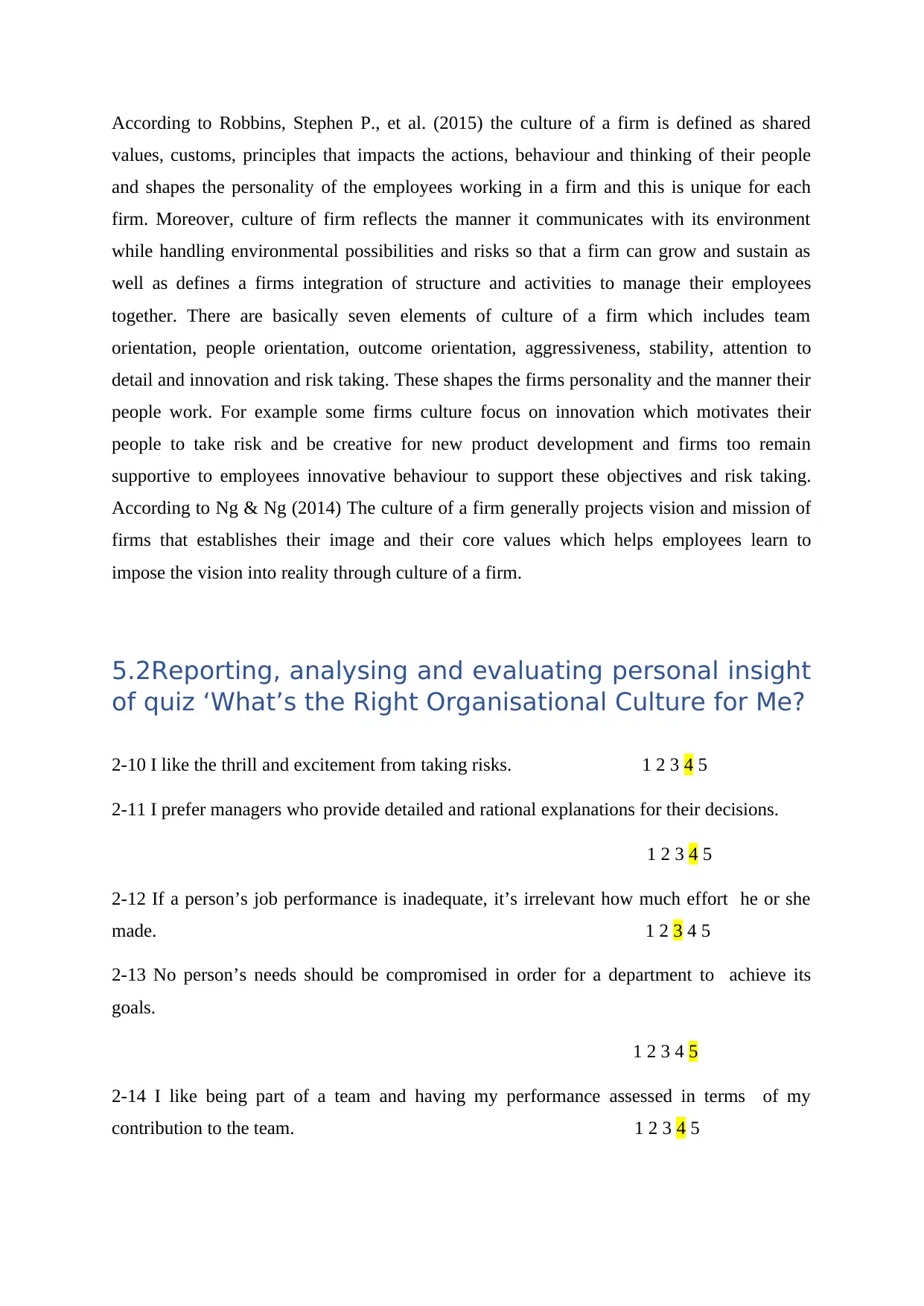
5.2Reporting, analysing and evaluating personal insight
of quiz ‘What’s the Right Organisational Culture for Me?
2-10 I like the thrill and excitement from taking risks. 1 2 3 4 5
2-11 I prefer managers who provide detailed and rational explanations for their decisions.
1 2 3 4 5
2-12 If a person’s job performance is inadequate, it’s irrelevant how much effort he or she
made. 1 2 3 4 5
2-13 No person’s needs should be compromised in order for a department to achieve its
goals.
1 2 3 4 5
2-14 I like being part of a team and having my performance assessed in terms of my
contribution to the team. 1 2 3 4 5
values, customs, principles that impacts the actions, behaviour and thinking of their people
and shapes the personality of the employees working in a firm and this is unique for each
firm. Moreover, culture of firm reflects the manner it communicates with its environment
while handling environmental possibilities and risks so that a firm can grow and sustain as
well as defines a firms integration of structure and activities to manage their employees
together. There are basically seven elements of culture of a firm which includes team
orientation, people orientation, outcome orientation, aggressiveness, stability, attention to
detail and innovation and risk taking. These shapes the firms personality and the manner their
people work. For example some firms culture focus on innovation which motivates their
people to take risk and be creative for new product development and firms too remain
supportive to employees innovative behaviour to support these objectives and risk taking.
According to Ng & Ng (2014) The culture of a firm generally projects vision and mission of
firms that establishes their image and their core values which helps employees learn to
impose the vision into reality through culture of a firm.
5.2Reporting, analysing and evaluating personal insight
of quiz ‘What’s the Right Organisational Culture for Me?
2-10 I like the thrill and excitement from taking risks. 1 2 3 4 5
2-11 I prefer managers who provide detailed and rational explanations for their decisions.
1 2 3 4 5
2-12 If a person’s job performance is inadequate, it’s irrelevant how much effort he or she
made. 1 2 3 4 5
2-13 No person’s needs should be compromised in order for a department to achieve its
goals.
1 2 3 4 5
2-14 I like being part of a team and having my performance assessed in terms of my
contribution to the team. 1 2 3 4 5
⊘ This is a preview!⊘
Do you want full access?
Subscribe today to unlock all pages.
Trusted by 1+ million students worldwide
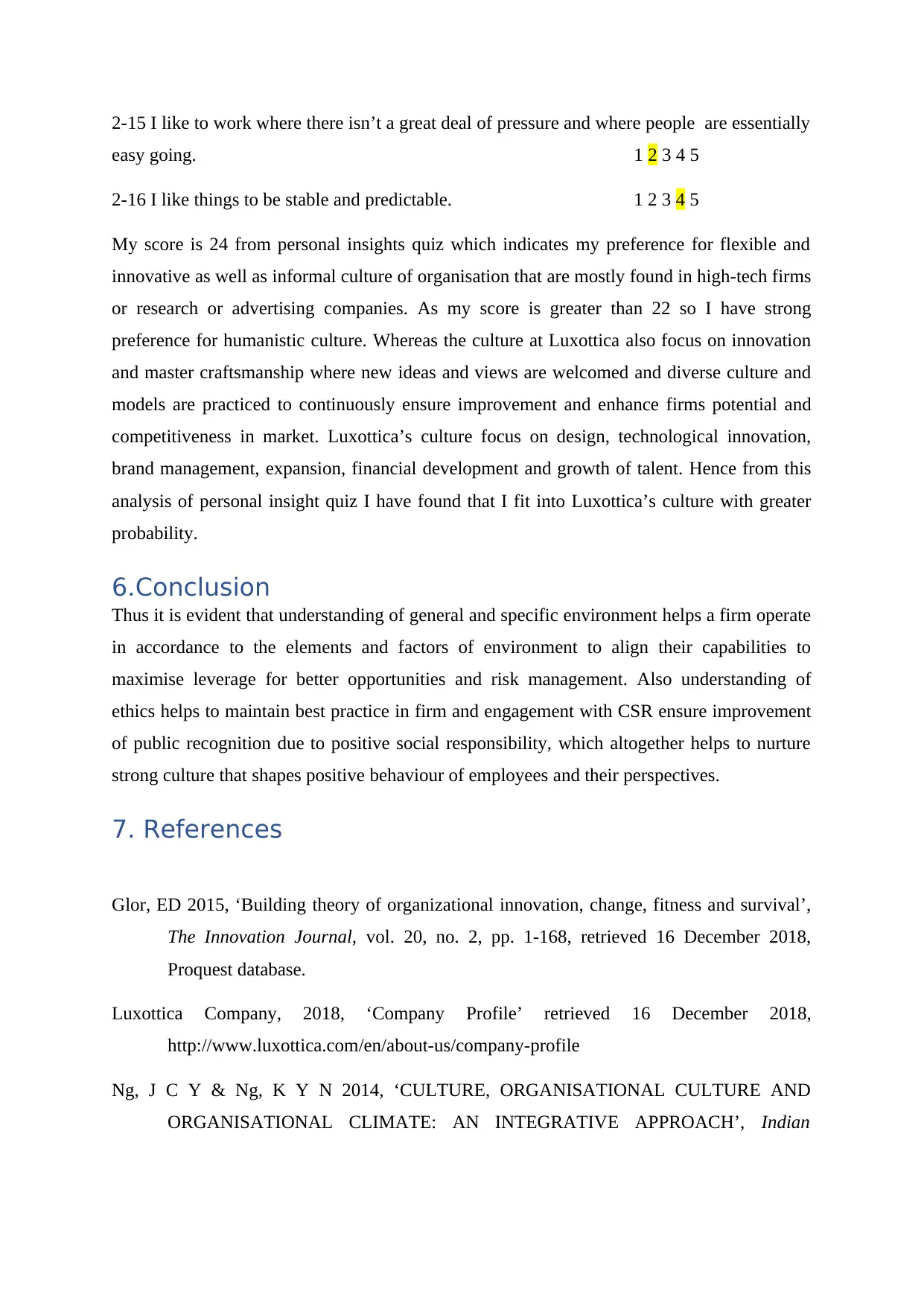
2-15 I like to work where there isn’t a great deal of pressure and where people are essentially
easy going. 1 2 3 4 5
2-16 I like things to be stable and predictable. 1 2 3 4 5
My score is 24 from personal insights quiz which indicates my preference for flexible and
innovative as well as informal culture of organisation that are mostly found in high-tech firms
or research or advertising companies. As my score is greater than 22 so I have strong
preference for humanistic culture. Whereas the culture at Luxottica also focus on innovation
and master craftsmanship where new ideas and views are welcomed and diverse culture and
models are practiced to continuously ensure improvement and enhance firms potential and
competitiveness in market. Luxottica’s culture focus on design, technological innovation,
brand management, expansion, financial development and growth of talent. Hence from this
analysis of personal insight quiz I have found that I fit into Luxottica’s culture with greater
probability.
6.Conclusion
Thus it is evident that understanding of general and specific environment helps a firm operate
in accordance to the elements and factors of environment to align their capabilities to
maximise leverage for better opportunities and risk management. Also understanding of
ethics helps to maintain best practice in firm and engagement with CSR ensure improvement
of public recognition due to positive social responsibility, which altogether helps to nurture
strong culture that shapes positive behaviour of employees and their perspectives.
7. References
Glor, ED 2015, ‘Building theory of organizational innovation, change, fitness and survival’,
The Innovation Journal, vol. 20, no. 2, pp. 1-168, retrieved 16 December 2018,
Proquest database.
Luxottica Company, 2018, ‘Company Profile’ retrieved 16 December 2018,
http://www.luxottica.com/en/about-us/company-profile
Ng, J C Y & Ng, K Y N 2014, ‘CULTURE, ORGANISATIONAL CULTURE AND
ORGANISATIONAL CLIMATE: AN INTEGRATIVE APPROACH’, Indian
easy going. 1 2 3 4 5
2-16 I like things to be stable and predictable. 1 2 3 4 5
My score is 24 from personal insights quiz which indicates my preference for flexible and
innovative as well as informal culture of organisation that are mostly found in high-tech firms
or research or advertising companies. As my score is greater than 22 so I have strong
preference for humanistic culture. Whereas the culture at Luxottica also focus on innovation
and master craftsmanship where new ideas and views are welcomed and diverse culture and
models are practiced to continuously ensure improvement and enhance firms potential and
competitiveness in market. Luxottica’s culture focus on design, technological innovation,
brand management, expansion, financial development and growth of talent. Hence from this
analysis of personal insight quiz I have found that I fit into Luxottica’s culture with greater
probability.
6.Conclusion
Thus it is evident that understanding of general and specific environment helps a firm operate
in accordance to the elements and factors of environment to align their capabilities to
maximise leverage for better opportunities and risk management. Also understanding of
ethics helps to maintain best practice in firm and engagement with CSR ensure improvement
of public recognition due to positive social responsibility, which altogether helps to nurture
strong culture that shapes positive behaviour of employees and their perspectives.
7. References
Glor, ED 2015, ‘Building theory of organizational innovation, change, fitness and survival’,
The Innovation Journal, vol. 20, no. 2, pp. 1-168, retrieved 16 December 2018,
Proquest database.
Luxottica Company, 2018, ‘Company Profile’ retrieved 16 December 2018,
http://www.luxottica.com/en/about-us/company-profile
Ng, J C Y & Ng, K Y N 2014, ‘CULTURE, ORGANISATIONAL CULTURE AND
ORGANISATIONAL CLIMATE: AN INTEGRATIVE APPROACH’, Indian
Paraphrase This Document
Need a fresh take? Get an instant paraphrase of this document with our AI Paraphraser
Journal of Commerce and Management Studies, vol. 5, no. 2), pp. 18-26. retrieved 16
December 2018, Proquest database.
Radosavljevic, Z, Radosavljevic, M & Anðelkovic, A 2015, ‘THE NECESSITY OF
ELIMINATING CLASSICAL CONCEPTS AND INTRODUCTION OF NEW
CONCEPTS INTO STRATEGIC MANAGEMENT AND BUSINESS’, Ekonomika,
vol. 61, no.1,pp. 23-42, retrieved 16 December 2018, Proquest database.
Robbins, Stephen P., et al. 2015, ‘Management: The Essentials’, P.Ed Australia, pp. 32-59.
retrieved 16 December 2018, ProQuest database
Slack, R E, Corlett, S & Morris, R 2015, ‘Exploring employee engagement with (corporate)
social responsibility: A social exchange perspective on organisational participation’,
Journal of Business Ethics, vol. 127, no. 3, pp. 537-548, retrieved 16 December 2018,
Proquest database.
Smith, R, Jones, P & Gard, S 2016, Understanding Management, Wiley & Sons, Sydney.
Tonder, E V & Roberts-Lombard, M 2013, ‘A theoretical framework for managing CSR
plans and related initiatives in the modern business environment’, Journal of Business
& Economics Research, vol. 11, no. 12, pp. 503, retrieved 16 December 2018,
Proquest database.
December 2018, Proquest database.
Radosavljevic, Z, Radosavljevic, M & Anðelkovic, A 2015, ‘THE NECESSITY OF
ELIMINATING CLASSICAL CONCEPTS AND INTRODUCTION OF NEW
CONCEPTS INTO STRATEGIC MANAGEMENT AND BUSINESS’, Ekonomika,
vol. 61, no.1,pp. 23-42, retrieved 16 December 2018, Proquest database.
Robbins, Stephen P., et al. 2015, ‘Management: The Essentials’, P.Ed Australia, pp. 32-59.
retrieved 16 December 2018, ProQuest database
Slack, R E, Corlett, S & Morris, R 2015, ‘Exploring employee engagement with (corporate)
social responsibility: A social exchange perspective on organisational participation’,
Journal of Business Ethics, vol. 127, no. 3, pp. 537-548, retrieved 16 December 2018,
Proquest database.
Smith, R, Jones, P & Gard, S 2016, Understanding Management, Wiley & Sons, Sydney.
Tonder, E V & Roberts-Lombard, M 2013, ‘A theoretical framework for managing CSR
plans and related initiatives in the modern business environment’, Journal of Business
& Economics Research, vol. 11, no. 12, pp. 503, retrieved 16 December 2018,
Proquest database.

1 out of 11


Related Documents


Your All-in-One AI-Powered Toolkit for Academic Success.
+13062052269
info@desklib.com
Available 24*7 on WhatsApp / Email
![[object Object]](/_next/static/media/star-bottom.7253800d.svg)
Unlock your academic potential
Copyright © 2020–2025 A2Z Services. All Rights Reserved. Developed and managed by ZUCOL.