LW309 - Challenging Minister's Decision: A Judicial Review Case
VerifiedAdded on 2023/06/07
|11
|3058
|424
Case Study
AI Summary
This case study examines the principles of administrative law, focusing on the judicial review of actions taken by a minister against an individual named Abusu. The analysis centers on the Immigration Act No. 10 of 2000 and whether the minister acted within the bounds of the law. Abusu's potential grounds for seeking judicial review include non-consultation, violation of natural justice principles, and unreasonable exercise of discretion. The study references key legal precedents to illustrate the importance of due process, proper authorization, and the right to representation. It also addresses the concept of ultra vires and unauthorized governmental actions, emphasizing the necessity of adhering to legal requirements before taking action against an individual. The document concludes that Abusu has valid grounds to challenge the minister's decision through judicial review.
Administrative Law 1
ADMINISTRATIVE LAW
by (Student’s Name)
Professor’s Name
Institution
Location of Institution
Course
Date
ADMINISTRATIVE LAW
by (Student’s Name)
Professor’s Name
Institution
Location of Institution
Course
Date

Paraphrase This Document
Need a fresh take? Get an instant paraphrase of this document with our AI Paraphraser
Administrative Law 2
Administrative Law
Abusu should move to the court to defend himself against the actions taken upon him by
the minister. Such a decision can be challenged in the court through a judicial review. A judicial
review typically is a process in which the decisions made by a particular authoritarian body is
reviewed in the court. The courts have often emphasized that only those authorized to take a
particular action against another as contained in the law (Bell, 2017 p.233). In the circumstance
in which an unauthorized person takes action, the courts responds to it by declaring that the
decision which was made is invalid and also that the physical act is unlawful and thus should be
stopped through an order of injunction.
Immigration Act No.10 of 2000
The act lays down the rights of an immigrant from a particular country and this is in
relation to court cases. Just like any other citizen, the immigrants also have certain rights granted
to them which protects them from any form of discrimination. For example, the immigrants can
appeal in a high for decisions which have been taken against them and they must have a
representation to act on their behalf. However the minister of immigration has been granted
certain powers which enables them to remove a non-citizen who has committed criminal offense
and an activity which is detrimental to the security of the country. According to this act such a
person should not be consulted by the minister but instead be deported out of the country.
Further the section of the immigration act applies not withstanding any other of the provisions in
the act.
According to Bradley, Ewing, and Knight (2018 p.100), there are various grounds for
seeking judicial review. Some of the grounds to seek for judicial review may include, non-
consultation with the person who is likely to be affected by the decision made. The other ground
Administrative Law
Abusu should move to the court to defend himself against the actions taken upon him by
the minister. Such a decision can be challenged in the court through a judicial review. A judicial
review typically is a process in which the decisions made by a particular authoritarian body is
reviewed in the court. The courts have often emphasized that only those authorized to take a
particular action against another as contained in the law (Bell, 2017 p.233). In the circumstance
in which an unauthorized person takes action, the courts responds to it by declaring that the
decision which was made is invalid and also that the physical act is unlawful and thus should be
stopped through an order of injunction.
Immigration Act No.10 of 2000
The act lays down the rights of an immigrant from a particular country and this is in
relation to court cases. Just like any other citizen, the immigrants also have certain rights granted
to them which protects them from any form of discrimination. For example, the immigrants can
appeal in a high for decisions which have been taken against them and they must have a
representation to act on their behalf. However the minister of immigration has been granted
certain powers which enables them to remove a non-citizen who has committed criminal offense
and an activity which is detrimental to the security of the country. According to this act such a
person should not be consulted by the minister but instead be deported out of the country.
Further the section of the immigration act applies not withstanding any other of the provisions in
the act.
According to Bradley, Ewing, and Knight (2018 p.100), there are various grounds for
seeking judicial review. Some of the grounds to seek for judicial review may include, non-
consultation with the person who is likely to be affected by the decision made. The other ground
Administrative Law 3
is associated with the acceptance of the courts to prosecute senior government ministers and this
is unlike previously where there was fear to arraign such individuals in the courts. One of the key
remedies pertaining to the case study is on the erosion of limited concept of jurisdiction. The
remedy could be as a result of the breach of natural justice. According to the court of Queen's
Bench, the breach of natural justice occurs when the parties involved are not made aware of their
offenses and also the evidence produced against them. Like in the case, Abusu was not told about
the proceedings, and even the offenses he had committed that would warrant his arrest, and this
is, therefore, a violation of the principles of natural justice (Okpaluba, 2015 p.400). Just like in
the case of Errington v. Minister of Health (1935), the minister was provided with additional
evidence form the local authority to confirm the housing scheme and not from the objectors.
Such an action was considered as a violation of the principles of natural justice.
According to the law, there are certain conditions and things which must be done before
taking a particular action usually of a government nature. Such actions are typically considered
as compulsory, and in the event that they are not adhered to, the action is considered to be
unauthorised.The court can, therefore, stop action through the judicial review. The law,
therefore, prescribes some of the requirements which would indicate that a particular action is
unauthorized (Cohn, 2014 p.23). For example, when a document is filed by an individual who is
not a moral authority to do so, the action is considered to be unauthorised. In the case of R v
Paddington and St. Marylebone Rent Tribunal, Ex parte Bell Properties Ltd [1949], there was an
application made by a particular local authority for the review of the rent of 310 tenancies was
owned by a company. The court made a decision which prevented the tribunal set to decide on
the case, and this was because the applications were to be made by tenants only and not just
several applications by the local authority (French, 2014 p.1).
is associated with the acceptance of the courts to prosecute senior government ministers and this
is unlike previously where there was fear to arraign such individuals in the courts. One of the key
remedies pertaining to the case study is on the erosion of limited concept of jurisdiction. The
remedy could be as a result of the breach of natural justice. According to the court of Queen's
Bench, the breach of natural justice occurs when the parties involved are not made aware of their
offenses and also the evidence produced against them. Like in the case, Abusu was not told about
the proceedings, and even the offenses he had committed that would warrant his arrest, and this
is, therefore, a violation of the principles of natural justice (Okpaluba, 2015 p.400). Just like in
the case of Errington v. Minister of Health (1935), the minister was provided with additional
evidence form the local authority to confirm the housing scheme and not from the objectors.
Such an action was considered as a violation of the principles of natural justice.
According to the law, there are certain conditions and things which must be done before
taking a particular action usually of a government nature. Such actions are typically considered
as compulsory, and in the event that they are not adhered to, the action is considered to be
unauthorised.The court can, therefore, stop action through the judicial review. The law,
therefore, prescribes some of the requirements which would indicate that a particular action is
unauthorized (Cohn, 2014 p.23). For example, when a document is filed by an individual who is
not a moral authority to do so, the action is considered to be unauthorised. In the case of R v
Paddington and St. Marylebone Rent Tribunal, Ex parte Bell Properties Ltd [1949], there was an
application made by a particular local authority for the review of the rent of 310 tenancies was
owned by a company. The court made a decision which prevented the tribunal set to decide on
the case, and this was because the applications were to be made by tenants only and not just
several applications by the local authority (French, 2014 p.1).
⊘ This is a preview!⊘
Do you want full access?
Subscribe today to unlock all pages.

Trusted by 1+ million students worldwide
Administrative Law 4
There is also another requirement that a copy of a document of the arrest should be
provided to the individuals who could be affected by the decisions made. Such a copy is
necessary to enable the individuals to be aware of the case concerning them. In the event that the
copy is not provided to the person, then it is considered that the action was not legal and this is as
illustrated in the following cases;
Howard v. Bodington (1877) 2 PD 203
In the case, there was the issue that the bishop of the Church of England was to be issued
with a copy of the document within 21 days. However, that did not happen. The judge on his
ruling said that he had no jurisdiction and this was because the complainant had already been
provided with the document after the expected time.
R v Lancashire Justices (1857)
In the case, the legislation of England allowed that in the event that the various justices had given
approval for the public highway to remain closed, then there would be a possibility of appealing
such a decision in ten days' notice to the local authorities and thereafter to the Quarter Sessions.
However, the Quarter Session made a decision even before the ten-day notice, and this was
against the law.
There is another requirement that the individual who is likely to be impacted by the
action be consulted before a particular action is taken against him or her. The written law
requires that a public official who takes an action which is governmental must consult the
individual who is likely to be affected by the action. Additionally, the individual must be
provided with adequate information about the issue upon which legal action will be taken against
him or her (Cooper, 2017 p.45). The significance of this requirement is that it will enable the
person likely to be affected to adjust his or her affairs appropriately when a particular action is
There is also another requirement that a copy of a document of the arrest should be
provided to the individuals who could be affected by the decisions made. Such a copy is
necessary to enable the individuals to be aware of the case concerning them. In the event that the
copy is not provided to the person, then it is considered that the action was not legal and this is as
illustrated in the following cases;
Howard v. Bodington (1877) 2 PD 203
In the case, there was the issue that the bishop of the Church of England was to be issued
with a copy of the document within 21 days. However, that did not happen. The judge on his
ruling said that he had no jurisdiction and this was because the complainant had already been
provided with the document after the expected time.
R v Lancashire Justices (1857)
In the case, the legislation of England allowed that in the event that the various justices had given
approval for the public highway to remain closed, then there would be a possibility of appealing
such a decision in ten days' notice to the local authorities and thereafter to the Quarter Sessions.
However, the Quarter Session made a decision even before the ten-day notice, and this was
against the law.
There is another requirement that the individual who is likely to be impacted by the
action be consulted before a particular action is taken against him or her. The written law
requires that a public official who takes an action which is governmental must consult the
individual who is likely to be affected by the action. Additionally, the individual must be
provided with adequate information about the issue upon which legal action will be taken against
him or her (Cooper, 2017 p.45). The significance of this requirement is that it will enable the
person likely to be affected to adjust his or her affairs appropriately when a particular action is
Paraphrase This Document
Need a fresh take? Get an instant paraphrase of this document with our AI Paraphraser
Administrative Law 5
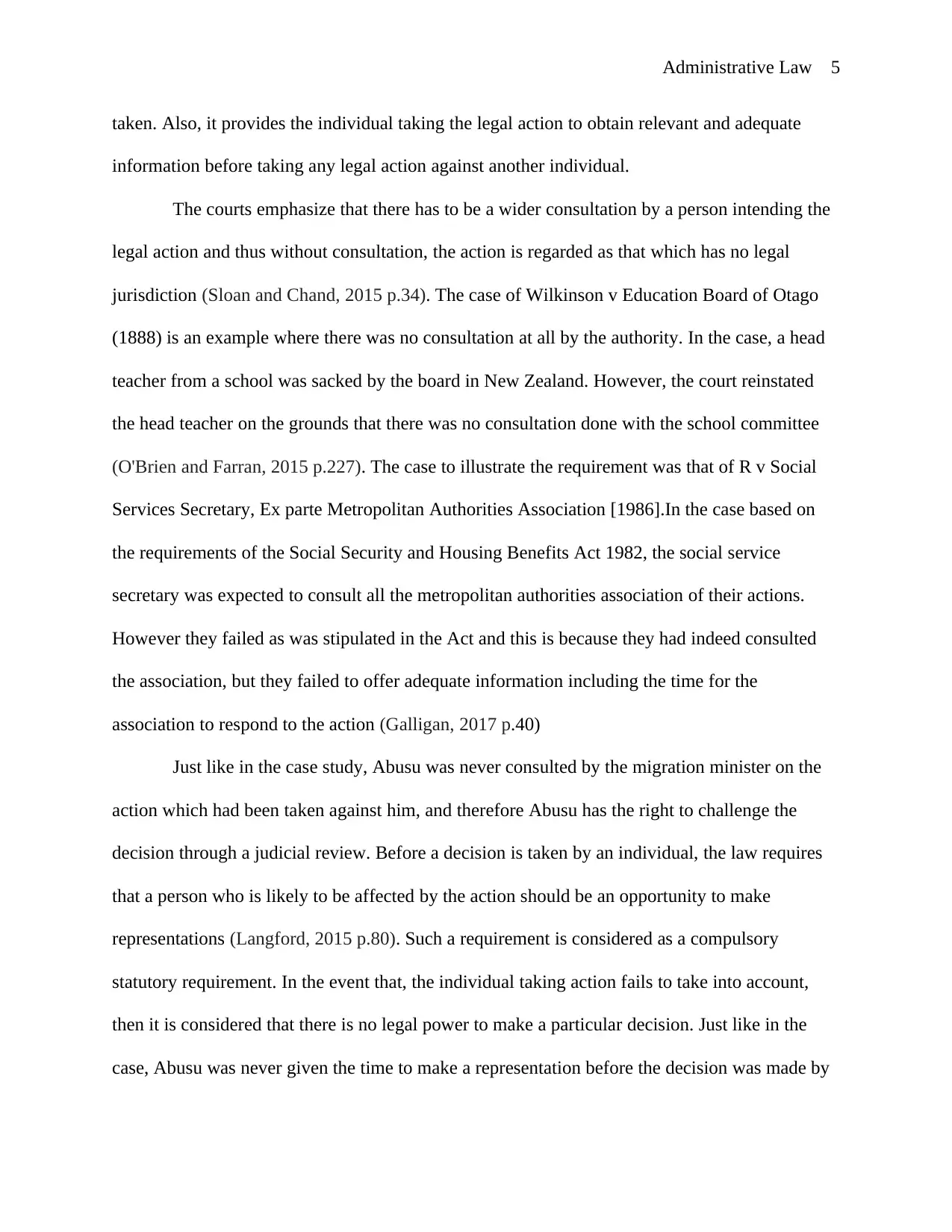
taken. Also, it provides the individual taking the legal action to obtain relevant and adequate
information before taking any legal action against another individual.
The courts emphasize that there has to be a wider consultation by a person intending the
legal action and thus without consultation, the action is regarded as that which has no legal
jurisdiction (Sloan and Chand, 2015 p.34). The case of Wilkinson v Education Board of Otago
(1888) is an example where there was no consultation at all by the authority. In the case, a head
teacher from a school was sacked by the board in New Zealand. However, the court reinstated
the head teacher on the grounds that there was no consultation done with the school committee
(O'Brien and Farran, 2015 p.227). The case to illustrate the requirement was that of R v Social
Services Secretary, Ex parte Metropolitan Authorities Association [1986].In the case based on
the requirements of the Social Security and Housing Benefits Act 1982, the social service
secretary was expected to consult all the metropolitan authorities association of their actions.
However they failed as was stipulated in the Act and this is because they had indeed consulted
the association, but they failed to offer adequate information including the time for the
association to respond to the action (Galligan, 2017 p.40)
Just like in the case study, Abusu was never consulted by the migration minister on the
action which had been taken against him, and therefore Abusu has the right to challenge the
decision through a judicial review. Before a decision is taken by an individual, the law requires
that a person who is likely to be affected by the action should be an opportunity to make
representations (Langford, 2015 p.80). Such a requirement is considered as a compulsory
statutory requirement. In the event that, the individual taking action fails to take into account,
then it is considered that there is no legal power to make a particular decision. Just like in the
case, Abusu was never given the time to make a representation before the decision was made by
taken. Also, it provides the individual taking the legal action to obtain relevant and adequate
information before taking any legal action against another individual.
The courts emphasize that there has to be a wider consultation by a person intending the
legal action and thus without consultation, the action is regarded as that which has no legal
jurisdiction (Sloan and Chand, 2015 p.34). The case of Wilkinson v Education Board of Otago
(1888) is an example where there was no consultation at all by the authority. In the case, a head
teacher from a school was sacked by the board in New Zealand. However, the court reinstated
the head teacher on the grounds that there was no consultation done with the school committee
(O'Brien and Farran, 2015 p.227). The case to illustrate the requirement was that of R v Social
Services Secretary, Ex parte Metropolitan Authorities Association [1986].In the case based on
the requirements of the Social Security and Housing Benefits Act 1982, the social service
secretary was expected to consult all the metropolitan authorities association of their actions.
However they failed as was stipulated in the Act and this is because they had indeed consulted
the association, but they failed to offer adequate information including the time for the
association to respond to the action (Galligan, 2017 p.40)
Just like in the case study, Abusu was never consulted by the migration minister on the
action which had been taken against him, and therefore Abusu has the right to challenge the
decision through a judicial review. Before a decision is taken by an individual, the law requires
that a person who is likely to be affected by the action should be an opportunity to make
representations (Langford, 2015 p.80). Such a requirement is considered as a compulsory
statutory requirement. In the event that, the individual taking action fails to take into account,
then it is considered that there is no legal power to make a particular decision. Just like in the
case, Abusu was never given the time to make a representation before the decision was made by
Administrative Law 6
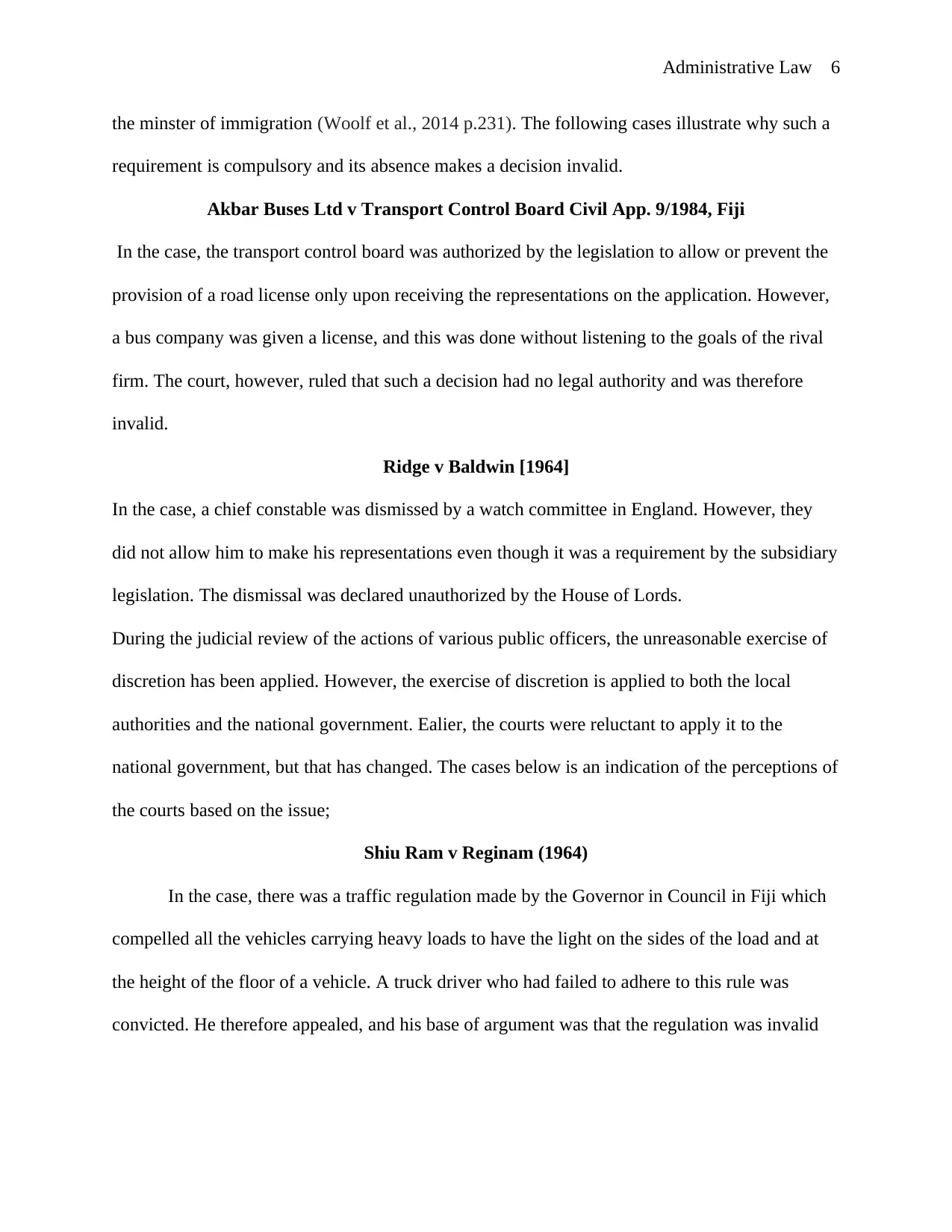
the minster of immigration (Woolf et al., 2014 p.231). The following cases illustrate why such a
requirement is compulsory and its absence makes a decision invalid.
Akbar Buses Ltd v Transport Control Board Civil App. 9/1984, Fiji
In the case, the transport control board was authorized by the legislation to allow or prevent the
provision of a road license only upon receiving the representations on the application. However,
a bus company was given a license, and this was done without listening to the goals of the rival
firm. The court, however, ruled that such a decision had no legal authority and was therefore
invalid.
Ridge v Baldwin [1964]
In the case, a chief constable was dismissed by a watch committee in England. However, they
did not allow him to make his representations even though it was a requirement by the subsidiary
legislation. The dismissal was declared unauthorized by the House of Lords.
During the judicial review of the actions of various public officers, the unreasonable exercise of
discretion has been applied. However, the exercise of discretion is applied to both the local
authorities and the national government. Ealier, the courts were reluctant to apply it to the
national government, but that has changed. The cases below is an indication of the perceptions of
the courts based on the issue;
Shiu Ram v Reginam (1964)
In the case, there was a traffic regulation made by the Governor in Council in Fiji which
compelled all the vehicles carrying heavy loads to have the light on the sides of the load and at
the height of the floor of a vehicle. A truck driver who had failed to adhere to this rule was
convicted. He therefore appealed, and his base of argument was that the regulation was invalid
the minster of immigration (Woolf et al., 2014 p.231). The following cases illustrate why such a
requirement is compulsory and its absence makes a decision invalid.
Akbar Buses Ltd v Transport Control Board Civil App. 9/1984, Fiji
In the case, the transport control board was authorized by the legislation to allow or prevent the
provision of a road license only upon receiving the representations on the application. However,
a bus company was given a license, and this was done without listening to the goals of the rival
firm. The court, however, ruled that such a decision had no legal authority and was therefore
invalid.
Ridge v Baldwin [1964]
In the case, a chief constable was dismissed by a watch committee in England. However, they
did not allow him to make his representations even though it was a requirement by the subsidiary
legislation. The dismissal was declared unauthorized by the House of Lords.
During the judicial review of the actions of various public officers, the unreasonable exercise of
discretion has been applied. However, the exercise of discretion is applied to both the local
authorities and the national government. Ealier, the courts were reluctant to apply it to the
national government, but that has changed. The cases below is an indication of the perceptions of
the courts based on the issue;
Shiu Ram v Reginam (1964)
In the case, there was a traffic regulation made by the Governor in Council in Fiji which
compelled all the vehicles carrying heavy loads to have the light on the sides of the load and at
the height of the floor of a vehicle. A truck driver who had failed to adhere to this rule was
convicted. He therefore appealed, and his base of argument was that the regulation was invalid
⊘ This is a preview!⊘
Do you want full access?
Subscribe today to unlock all pages.
Trusted by 1+ million students worldwide
Administrative Law 7
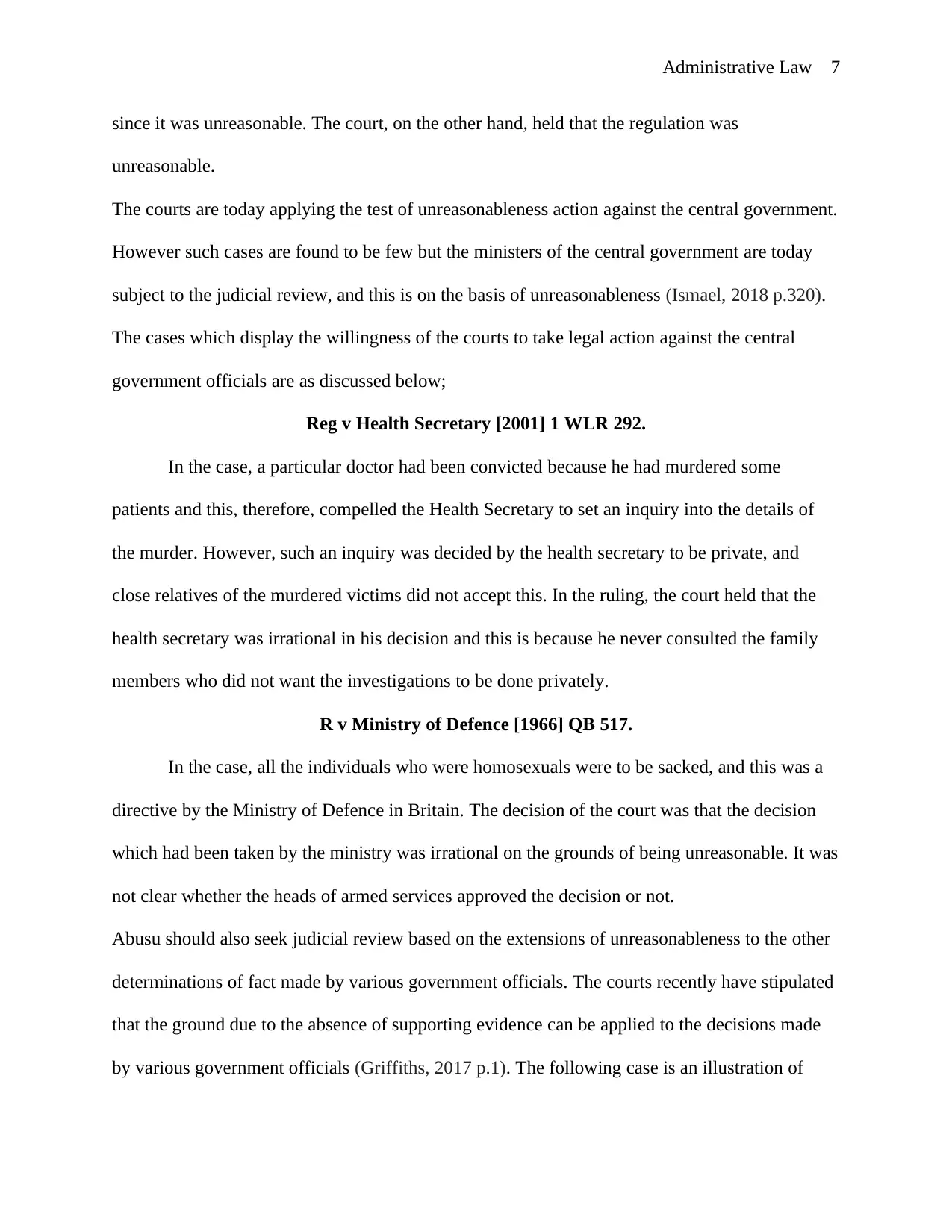
since it was unreasonable. The court, on the other hand, held that the regulation was
unreasonable.
The courts are today applying the test of unreasonableness action against the central government.
However such cases are found to be few but the ministers of the central government are today
subject to the judicial review, and this is on the basis of unreasonableness (Ismael, 2018 p.320).
The cases which display the willingness of the courts to take legal action against the central
government officials are as discussed below;
Reg v Health Secretary [2001] 1 WLR 292.
In the case, a particular doctor had been convicted because he had murdered some
patients and this, therefore, compelled the Health Secretary to set an inquiry into the details of
the murder. However, such an inquiry was decided by the health secretary to be private, and
close relatives of the murdered victims did not accept this. In the ruling, the court held that the
health secretary was irrational in his decision and this is because he never consulted the family
members who did not want the investigations to be done privately.
R v Ministry of Defence [1966] QB 517.
In the case, all the individuals who were homosexuals were to be sacked, and this was a
directive by the Ministry of Defence in Britain. The decision of the court was that the decision
which had been taken by the ministry was irrational on the grounds of being unreasonable. It was
not clear whether the heads of armed services approved the decision or not.
Abusu should also seek judicial review based on the extensions of unreasonableness to the other
determinations of fact made by various government officials. The courts recently have stipulated
that the ground due to the absence of supporting evidence can be applied to the decisions made
by various government officials (Griffiths, 2017 p.1). The following case is an illustration of
since it was unreasonable. The court, on the other hand, held that the regulation was
unreasonable.
The courts are today applying the test of unreasonableness action against the central government.
However such cases are found to be few but the ministers of the central government are today
subject to the judicial review, and this is on the basis of unreasonableness (Ismael, 2018 p.320).
The cases which display the willingness of the courts to take legal action against the central
government officials are as discussed below;
Reg v Health Secretary [2001] 1 WLR 292.
In the case, a particular doctor had been convicted because he had murdered some
patients and this, therefore, compelled the Health Secretary to set an inquiry into the details of
the murder. However, such an inquiry was decided by the health secretary to be private, and
close relatives of the murdered victims did not accept this. In the ruling, the court held that the
health secretary was irrational in his decision and this is because he never consulted the family
members who did not want the investigations to be done privately.
R v Ministry of Defence [1966] QB 517.
In the case, all the individuals who were homosexuals were to be sacked, and this was a
directive by the Ministry of Defence in Britain. The decision of the court was that the decision
which had been taken by the ministry was irrational on the grounds of being unreasonable. It was
not clear whether the heads of armed services approved the decision or not.
Abusu should also seek judicial review based on the extensions of unreasonableness to the other
determinations of fact made by various government officials. The courts recently have stipulated
that the ground due to the absence of supporting evidence can be applied to the decisions made
by various government officials (Griffiths, 2017 p.1). The following case is an illustration of
Paraphrase This Document
Need a fresh take? Get an instant paraphrase of this document with our AI Paraphraser
Administrative Law 8
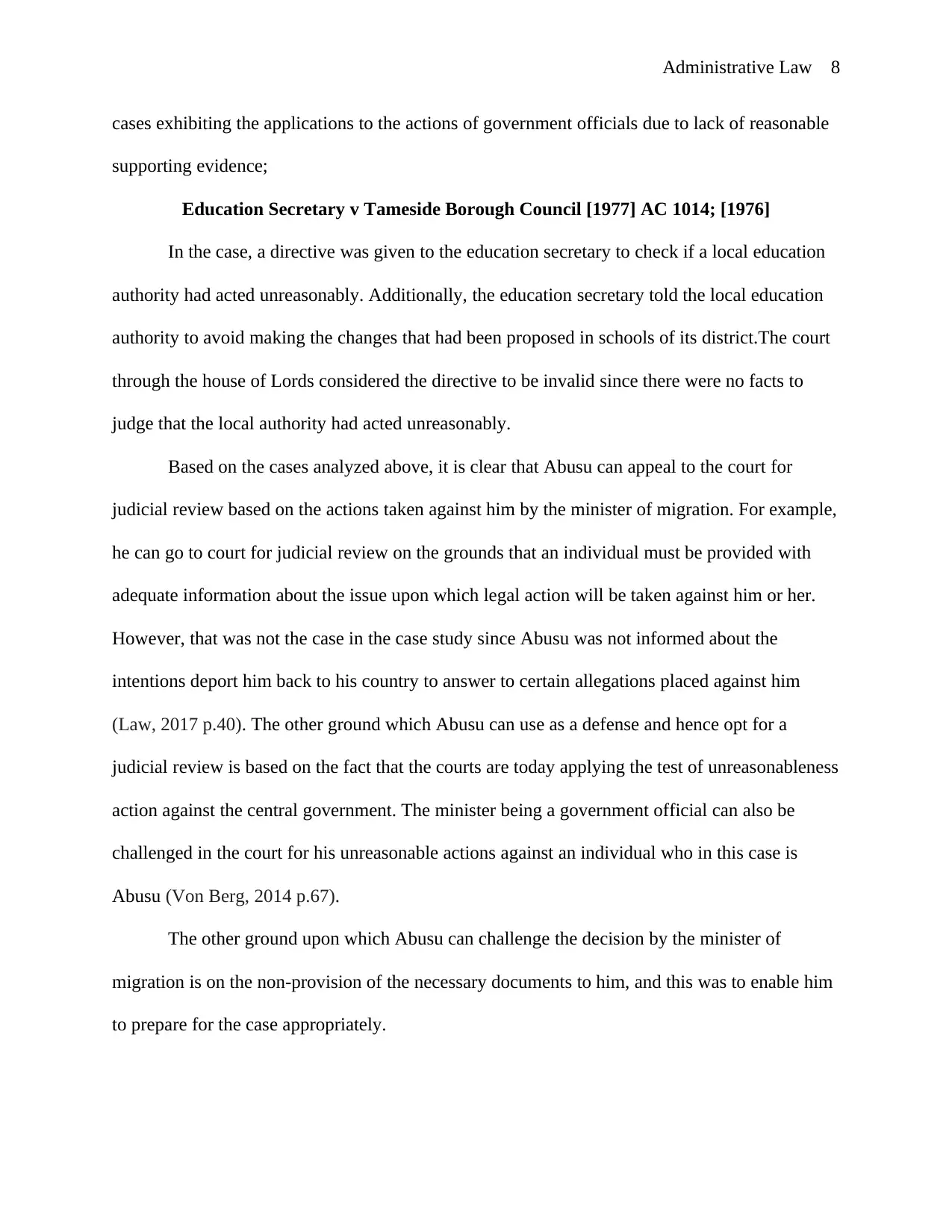
cases exhibiting the applications to the actions of government officials due to lack of reasonable
supporting evidence;
Education Secretary v Tameside Borough Council [1977] AC 1014; [1976]
In the case, a directive was given to the education secretary to check if a local education
authority had acted unreasonably. Additionally, the education secretary told the local education
authority to avoid making the changes that had been proposed in schools of its district.The court
through the house of Lords considered the directive to be invalid since there were no facts to
judge that the local authority had acted unreasonably.
Based on the cases analyzed above, it is clear that Abusu can appeal to the court for
judicial review based on the actions taken against him by the minister of migration. For example,
he can go to court for judicial review on the grounds that an individual must be provided with
adequate information about the issue upon which legal action will be taken against him or her.
However, that was not the case in the case study since Abusu was not informed about the
intentions deport him back to his country to answer to certain allegations placed against him
(Law, 2017 p.40). The other ground which Abusu can use as a defense and hence opt for a
judicial review is based on the fact that the courts are today applying the test of unreasonableness
action against the central government. The minister being a government official can also be
challenged in the court for his unreasonable actions against an individual who in this case is
Abusu (Von Berg, 2014 p.67).
The other ground upon which Abusu can challenge the decision by the minister of
migration is on the non-provision of the necessary documents to him, and this was to enable him
to prepare for the case appropriately.
cases exhibiting the applications to the actions of government officials due to lack of reasonable
supporting evidence;
Education Secretary v Tameside Borough Council [1977] AC 1014; [1976]
In the case, a directive was given to the education secretary to check if a local education
authority had acted unreasonably. Additionally, the education secretary told the local education
authority to avoid making the changes that had been proposed in schools of its district.The court
through the house of Lords considered the directive to be invalid since there were no facts to
judge that the local authority had acted unreasonably.
Based on the cases analyzed above, it is clear that Abusu can appeal to the court for
judicial review based on the actions taken against him by the minister of migration. For example,
he can go to court for judicial review on the grounds that an individual must be provided with
adequate information about the issue upon which legal action will be taken against him or her.
However, that was not the case in the case study since Abusu was not informed about the
intentions deport him back to his country to answer to certain allegations placed against him
(Law, 2017 p.40). The other ground which Abusu can use as a defense and hence opt for a
judicial review is based on the fact that the courts are today applying the test of unreasonableness
action against the central government. The minister being a government official can also be
challenged in the court for his unreasonable actions against an individual who in this case is
Abusu (Von Berg, 2014 p.67).
The other ground upon which Abusu can challenge the decision by the minister of
migration is on the non-provision of the necessary documents to him, and this was to enable him
to prepare for the case appropriately.
Administrative Law 9
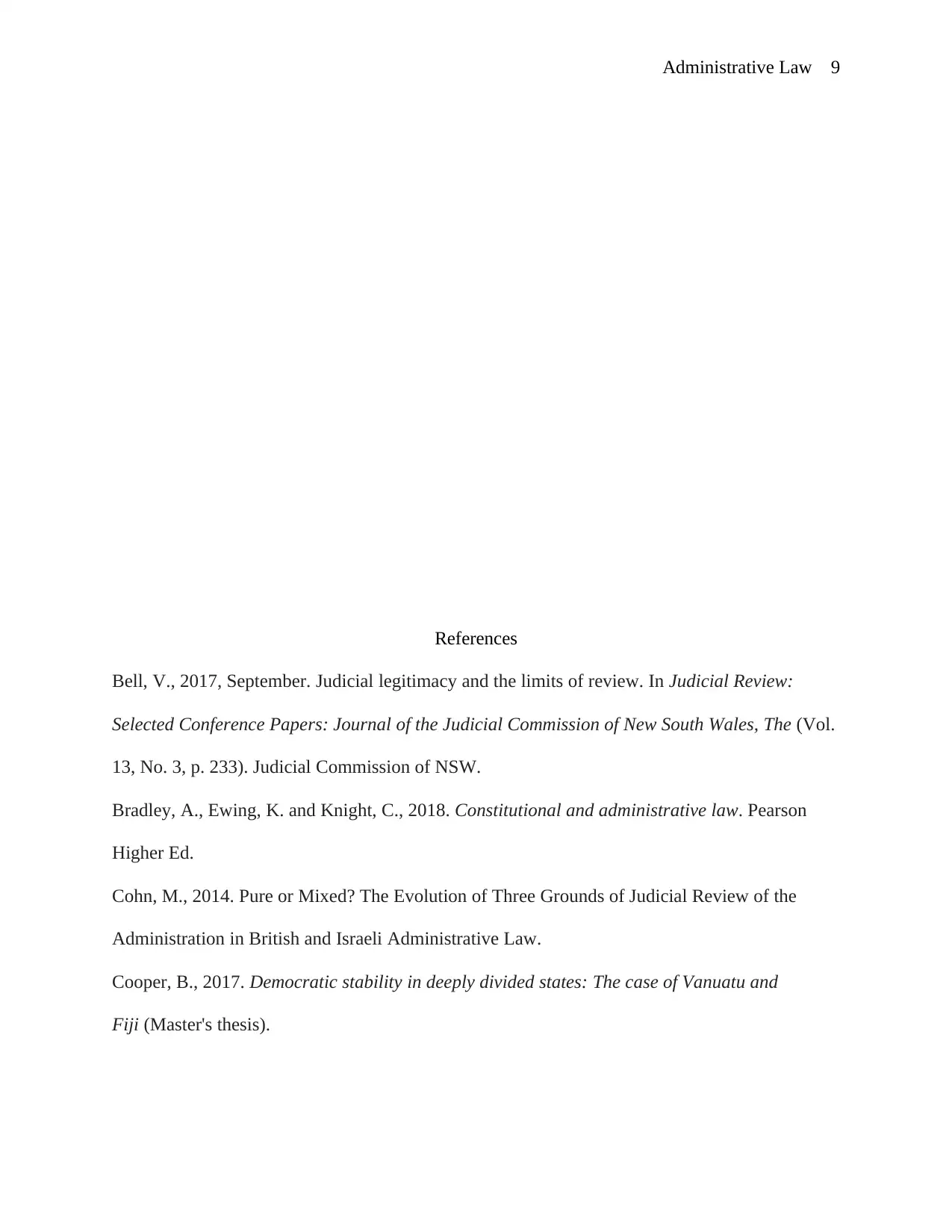
References
Bell, V., 2017, September. Judicial legitimacy and the limits of review. In Judicial Review:
Selected Conference Papers: Journal of the Judicial Commission of New South Wales, The (Vol.
13, No. 3, p. 233). Judicial Commission of NSW.
Bradley, A., Ewing, K. and Knight, C., 2018. Constitutional and administrative law. Pearson
Higher Ed.
Cohn, M., 2014. Pure or Mixed? The Evolution of Three Grounds of Judicial Review of the
Administration in British and Israeli Administrative Law.
Cooper, B., 2017. Democratic stability in deeply divided states: The case of Vanuatu and
Fiji (Master's thesis).
References
Bell, V., 2017, September. Judicial legitimacy and the limits of review. In Judicial Review:
Selected Conference Papers: Journal of the Judicial Commission of New South Wales, The (Vol.
13, No. 3, p. 233). Judicial Commission of NSW.
Bradley, A., Ewing, K. and Knight, C., 2018. Constitutional and administrative law. Pearson
Higher Ed.
Cohn, M., 2014. Pure or Mixed? The Evolution of Three Grounds of Judicial Review of the
Administration in British and Israeli Administrative Law.
Cooper, B., 2017. Democratic stability in deeply divided states: The case of Vanuatu and
Fiji (Master's thesis).
⊘ This is a preview!⊘
Do you want full access?
Subscribe today to unlock all pages.
Trusted by 1+ million students worldwide
Administrative Law 10
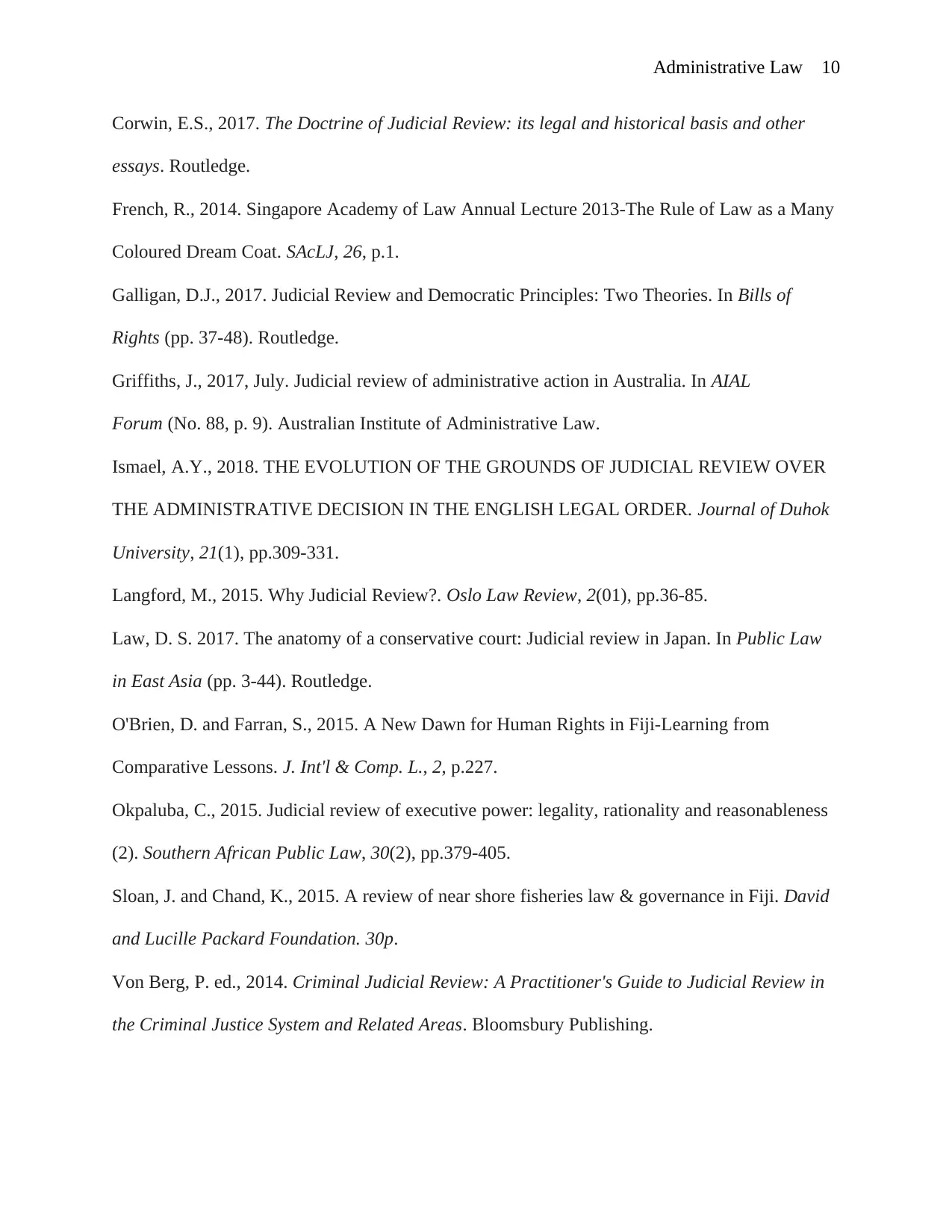
Corwin, E.S., 2017. The Doctrine of Judicial Review: its legal and historical basis and other
essays. Routledge.
French, R., 2014. Singapore Academy of Law Annual Lecture 2013-The Rule of Law as a Many
Coloured Dream Coat. SAcLJ, 26, p.1.
Galligan, D.J., 2017. Judicial Review and Democratic Principles: Two Theories. In Bills of
Rights (pp. 37-48). Routledge.
Griffiths, J., 2017, July. Judicial review of administrative action in Australia. In AIAL
Forum (No. 88, p. 9). Australian Institute of Administrative Law.
Ismael, A.Y., 2018. THE EVOLUTION OF THE GROUNDS OF JUDICIAL REVIEW OVER
THE ADMINISTRATIVE DECISION IN THE ENGLISH LEGAL ORDER. Journal of Duhok
University, 21(1), pp.309-331.
Langford, M., 2015. Why Judicial Review?. Oslo Law Review, 2(01), pp.36-85.
Law, D. S. 2017. The anatomy of a conservative court: Judicial review in Japan. In Public Law
in East Asia (pp. 3-44). Routledge.
O'Brien, D. and Farran, S., 2015. A New Dawn for Human Rights in Fiji-Learning from
Comparative Lessons. J. Int'l & Comp. L., 2, p.227.
Okpaluba, C., 2015. Judicial review of executive power: legality, rationality and reasonableness
(2). Southern African Public Law, 30(2), pp.379-405.
Sloan, J. and Chand, K., 2015. A review of near shore fisheries law & governance in Fiji. David
and Lucille Packard Foundation. 30p.
Von Berg, P. ed., 2014. Criminal Judicial Review: A Practitioner's Guide to Judicial Review in
the Criminal Justice System and Related Areas. Bloomsbury Publishing.
Corwin, E.S., 2017. The Doctrine of Judicial Review: its legal and historical basis and other
essays. Routledge.
French, R., 2014. Singapore Academy of Law Annual Lecture 2013-The Rule of Law as a Many
Coloured Dream Coat. SAcLJ, 26, p.1.
Galligan, D.J., 2017. Judicial Review and Democratic Principles: Two Theories. In Bills of
Rights (pp. 37-48). Routledge.
Griffiths, J., 2017, July. Judicial review of administrative action in Australia. In AIAL
Forum (No. 88, p. 9). Australian Institute of Administrative Law.
Ismael, A.Y., 2018. THE EVOLUTION OF THE GROUNDS OF JUDICIAL REVIEW OVER
THE ADMINISTRATIVE DECISION IN THE ENGLISH LEGAL ORDER. Journal of Duhok
University, 21(1), pp.309-331.
Langford, M., 2015. Why Judicial Review?. Oslo Law Review, 2(01), pp.36-85.
Law, D. S. 2017. The anatomy of a conservative court: Judicial review in Japan. In Public Law
in East Asia (pp. 3-44). Routledge.
O'Brien, D. and Farran, S., 2015. A New Dawn for Human Rights in Fiji-Learning from
Comparative Lessons. J. Int'l & Comp. L., 2, p.227.
Okpaluba, C., 2015. Judicial review of executive power: legality, rationality and reasonableness
(2). Southern African Public Law, 30(2), pp.379-405.
Sloan, J. and Chand, K., 2015. A review of near shore fisheries law & governance in Fiji. David
and Lucille Packard Foundation. 30p.
Von Berg, P. ed., 2014. Criminal Judicial Review: A Practitioner's Guide to Judicial Review in
the Criminal Justice System and Related Areas. Bloomsbury Publishing.
Paraphrase This Document
Need a fresh take? Get an instant paraphrase of this document with our AI Paraphraser

Administrative Law 11
Woolf, R.H.L., Jowell, J., Le Sueur, A., Hare, I. and Donnelly, C., 2014. De Smith? s Judicial
Review: First Supplement to the 7th edition. Sweet & Maxwell.
Woolf, R.H.L., Jowell, J., Le Sueur, A., Hare, I. and Donnelly, C., 2014. De Smith? s Judicial
Review: First Supplement to the 7th edition. Sweet & Maxwell.

1 out of 11


Related Documents


Your All-in-One AI-Powered Toolkit for Academic Success.
+13062052269
info@desklib.com
Available 24*7 on WhatsApp / Email
![[object Object]](/_next/static/media/star-bottom.7253800d.svg)
Unlock your academic potential
Copyright © 2020–2026 A2Z Services. All Rights Reserved. Developed and managed by ZUCOL.