University Report: Machine Learning for IoT Big Data Analysis
VerifiedAdded on 2023/01/19
|10
|2256
|48
Report
AI Summary
This report investigates the application of machine learning to manage and exploit big data derived from Internet of Things (IoT) devices. It begins with an introduction to the concept of IoT and the challenges associated with big data, emphasizing the need for effective management strategies. The discussion delves into the technologies employed, specifically highlighting machine learning's role in data collection, analysis, and integration. The report outlines the advantages of using machine learning, such as efficient data querying, removal of data silos, and faster analytics, while also acknowledging limitations like the need for high-quality data and potential system design flaws. Furthermore, it explores the technology's usefulness in an organizational context, particularly in handling vast amounts of customer data and enhancing security. The report provides examples of machine learning applications in digital marketing and fraud detection. The conclusion reiterates the significance of machine learning in addressing big data challenges and underscores the importance of well-designed systems. The report includes references to relevant academic sources.
Running head: MACHINE LEARNING
Exploiting Big Data from IoT (Internet of Things) devices using Machine Learning
Name of Student:
Name of the University:
Exploiting Big Data from IoT (Internet of Things) devices using Machine Learning
Name of Student:
Name of the University:
Paraphrase This Document
Need a fresh take? Get an instant paraphrase of this document with our AI Paraphraser

1
MACHINE LEARNING
Table of Contents
Introduction................................................................................................................................2
Discussion..................................................................................................................................2
Internet of Things...................................................................................................................2
Technology for managing the big data...................................................................................3
Advantages of the technology................................................................................................4
Limitation of the chosen technology......................................................................................5
Usefulness of chosen technology in organizational context..................................................5
Conclusion..................................................................................................................................7
References..................................................................................................................................8
MACHINE LEARNING
Table of Contents
Introduction................................................................................................................................2
Discussion..................................................................................................................................2
Internet of Things...................................................................................................................2
Technology for managing the big data...................................................................................3
Advantages of the technology................................................................................................4
Limitation of the chosen technology......................................................................................5
Usefulness of chosen technology in organizational context..................................................5
Conclusion..................................................................................................................................7
References..................................................................................................................................8

2
MACHINE LEARNING
Introduction
Now days, every organization is facing the issue of handling the big data. Big data are
huge amount of both the unstructured and structured data, necessary to conduct the day- to-
day organizational activities. In order to simplify the organizational activities, this issue needs
to be addressed. However, the aggregated huge amount of data in the IoT technology,
sometime responsible for creating the issue of big data. The use of Machine learning
technology in order to manage those big data can be beneficial to the organizations. In this
report, a brief explanation with the usefulness of Internet of things is going to be explained.
The impact of machine learning in order to manage the big data from the IoT is going to be
described along with its pros and cons. Apart from that, the impact of this technology in
terms of organizational context will be emphasized.
Discussion
Internet of Things
Internet of things is the concept for extending and expanding the power of internet
beyond smartphones and computer systems. Explaining the above statement, it can be
described that the concept of internet of things is a computerized method explaining the
process of connecting day-to-day physical items to the internet for simplifying computerized
works (Da Xu, He and Li 2014). The significance of this concept is clearly noticeable as the
object can find itself else represent itself digitally. In today’s technological era, almost every
single person is using the internet infrastructure according to his/her flexibility. IoT
effectively provides the advantages of advanced clear connectivity to the internet to amplify
the computerized works. The working methodology of an IoT is dependable on a host of
technologies like one application program interface, which provides advanced connectivity to
the internet. Furthermore, big data management tool, Data Lake, machine learning, AI,
MACHINE LEARNING
Introduction
Now days, every organization is facing the issue of handling the big data. Big data are
huge amount of both the unstructured and structured data, necessary to conduct the day- to-
day organizational activities. In order to simplify the organizational activities, this issue needs
to be addressed. However, the aggregated huge amount of data in the IoT technology,
sometime responsible for creating the issue of big data. The use of Machine learning
technology in order to manage those big data can be beneficial to the organizations. In this
report, a brief explanation with the usefulness of Internet of things is going to be explained.
The impact of machine learning in order to manage the big data from the IoT is going to be
described along with its pros and cons. Apart from that, the impact of this technology in
terms of organizational context will be emphasized.
Discussion
Internet of Things
Internet of things is the concept for extending and expanding the power of internet
beyond smartphones and computer systems. Explaining the above statement, it can be
described that the concept of internet of things is a computerized method explaining the
process of connecting day-to-day physical items to the internet for simplifying computerized
works (Da Xu, He and Li 2014). The significance of this concept is clearly noticeable as the
object can find itself else represent itself digitally. In today’s technological era, almost every
single person is using the internet infrastructure according to his/her flexibility. IoT
effectively provides the advantages of advanced clear connectivity to the internet to amplify
the computerized works. The working methodology of an IoT is dependable on a host of
technologies like one application program interface, which provides advanced connectivity to
the internet. Furthermore, big data management tool, Data Lake, machine learning, AI,
⊘ This is a preview!⊘
Do you want full access?
Subscribe today to unlock all pages.

Trusted by 1+ million students worldwide

3
MACHINE LEARNING
predictive analysis, radio frequency identifier are the examples of key technologies associated
with the Internet of things (Al-Fuqaha et al. 2015). The examples of internet of things has
described below;
Different object, which can efficiently fall into the scope of the IoT comprises with
the thermostats, security systems, cars, speaker systems, vending machines and many
more(Cui 2016). Moreover, the business organizations mainly take the advantages of features
of the internet of things. Taking an instance, in order to performing several automate safety
tasks such as, providing notification of alert in case of broken fire extinguisher the IoT plays
a vital role. Apart from that, sensor detections, network cameras also add effective examples
to the concept of internet of things.
Technology for managing the big data
Prior to discussing the technology, it is important to highlight the issue, which can
cause by the big data. Big data is nothing but the huge amount of computerized data, which
need to be managed in order to simplify the organizational activities (Chen, Mao and Liu
2014). Therefore, managing of the issues caused by big data is necessary. In recent
technological era, the concept of machine learning and automation is creating buzz in
handling the issues related to the big data (Witten et al.2016). The efficient automated tools
provided by the machine learning algorithms, helps in collection, analysis and integrating the
data. In combination with the cloud computing approach, the discussed technology of
machine learning provides a thorough and fast integration and processing of a vast amount of
data (Cao and Cai 2018). Most of the big data operations such as, diagnostic, planning,
scenario simulation, predictive and descriptive can enhanced by the application of machine
learning into it. However, it is necessary to note the fact that, application of the machine
learning for collecting the big data solution is simply an infinity loop (Jordan and Mitchell
2015). The ML algorithm is designed in order to satisfy certain purpose, which are to be
MACHINE LEARNING
predictive analysis, radio frequency identifier are the examples of key technologies associated
with the Internet of things (Al-Fuqaha et al. 2015). The examples of internet of things has
described below;
Different object, which can efficiently fall into the scope of the IoT comprises with
the thermostats, security systems, cars, speaker systems, vending machines and many
more(Cui 2016). Moreover, the business organizations mainly take the advantages of features
of the internet of things. Taking an instance, in order to performing several automate safety
tasks such as, providing notification of alert in case of broken fire extinguisher the IoT plays
a vital role. Apart from that, sensor detections, network cameras also add effective examples
to the concept of internet of things.
Technology for managing the big data
Prior to discussing the technology, it is important to highlight the issue, which can
cause by the big data. Big data is nothing but the huge amount of computerized data, which
need to be managed in order to simplify the organizational activities (Chen, Mao and Liu
2014). Therefore, managing of the issues caused by big data is necessary. In recent
technological era, the concept of machine learning and automation is creating buzz in
handling the issues related to the big data (Witten et al.2016). The efficient automated tools
provided by the machine learning algorithms, helps in collection, analysis and integrating the
data. In combination with the cloud computing approach, the discussed technology of
machine learning provides a thorough and fast integration and processing of a vast amount of
data (Cao and Cai 2018). Most of the big data operations such as, diagnostic, planning,
scenario simulation, predictive and descriptive can enhanced by the application of machine
learning into it. However, it is necessary to note the fact that, application of the machine
learning for collecting the big data solution is simply an infinity loop (Jordan and Mitchell
2015). The ML algorithm is designed in order to satisfy certain purpose, which are to be
Paraphrase This Document
Need a fresh take? Get an instant paraphrase of this document with our AI Paraphraser

4
MACHINE LEARNING
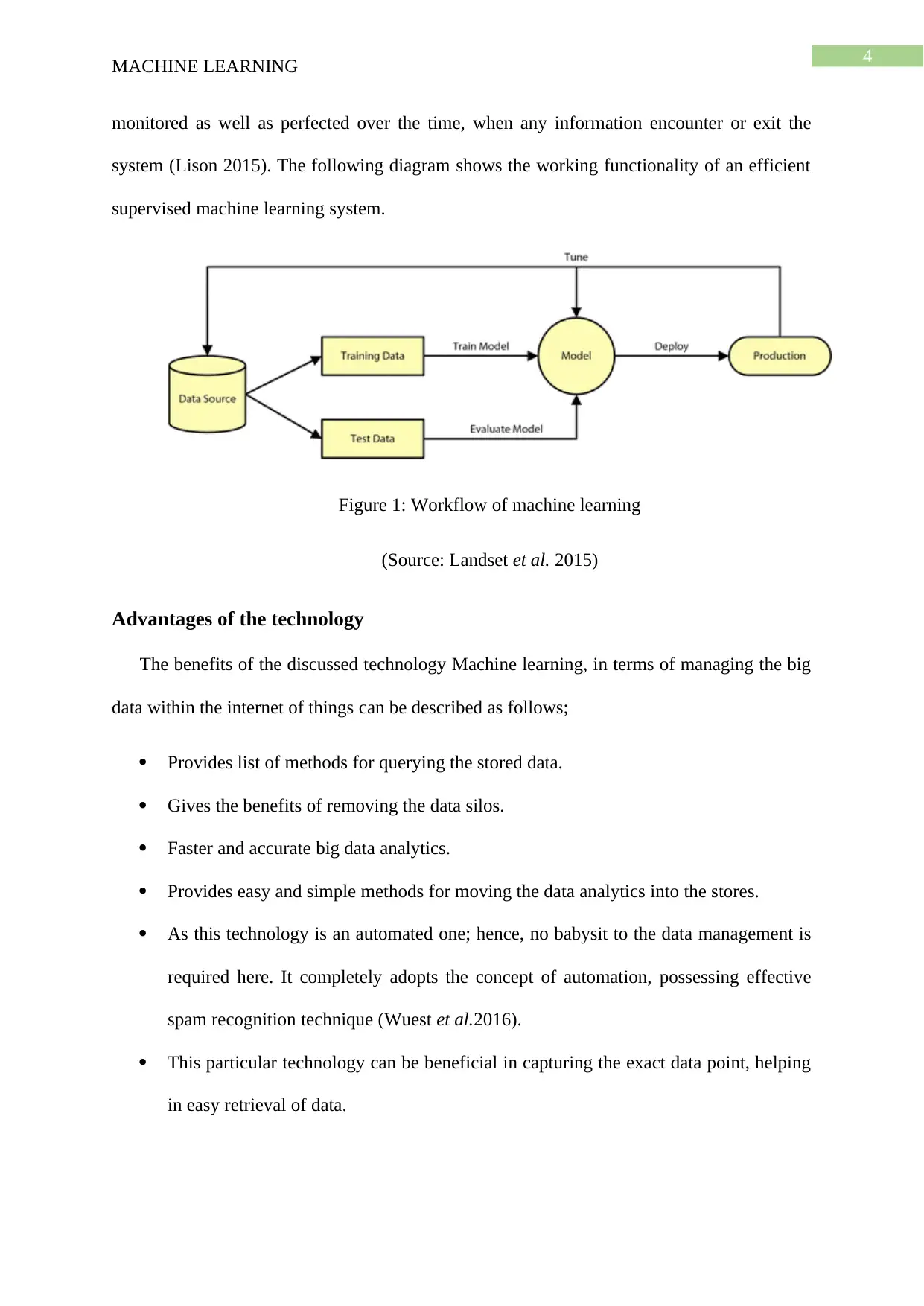
monitored as well as perfected over the time, when any information encounter or exit the
system (Lison 2015). The following diagram shows the working functionality of an efficient
supervised machine learning system.
Figure 1: Workflow of machine learning
(Source: Landset et al. 2015)
Advantages of the technology
The benefits of the discussed technology Machine learning, in terms of managing the big
data within the internet of things can be described as follows;
Provides list of methods for querying the stored data.
Gives the benefits of removing the data silos.
Faster and accurate big data analytics.
Provides easy and simple methods for moving the data analytics into the stores.
As this technology is an automated one; hence, no babysit to the data management is
required here. It completely adopts the concept of automation, possessing effective
spam recognition technique (Wuest et al.2016).
This particular technology can be beneficial in capturing the exact data point, helping
in easy retrieval of data.
MACHINE LEARNING
monitored as well as perfected over the time, when any information encounter or exit the
system (Lison 2015). The following diagram shows the working functionality of an efficient
supervised machine learning system.
Figure 1: Workflow of machine learning
(Source: Landset et al. 2015)
Advantages of the technology
The benefits of the discussed technology Machine learning, in terms of managing the big
data within the internet of things can be described as follows;
Provides list of methods for querying the stored data.
Gives the benefits of removing the data silos.
Faster and accurate big data analytics.
Provides easy and simple methods for moving the data analytics into the stores.
As this technology is an automated one; hence, no babysit to the data management is
required here. It completely adopts the concept of automation, possessing effective
spam recognition technique (Wuest et al.2016).
This particular technology can be beneficial in capturing the exact data point, helping
in easy retrieval of data.

5
MACHINE LEARNING
Limitation of the chosen technology
There is no doubt that the concept of using machine learning in order to manage the data
is comparatively beneficial in terms of managing the big data; yet, there exist some
limitations to the chosen technology, which are described as follows;
Lack of effective and proper designing of the machine learning system can be riskier.
In order to design and train an effective machine learning it requires massive amount
of good quality, inclusive as well as unbiased data (Singh and Nene 2013).
Interruption in the result of a machine learning system sometime adds limitation to the
system, this generally happens due to wrong algorithm in the system.
Usefulness of chosen technology in organizational context
Managing the big data within an organization is always a major issue and concern for the
organization that need to be focused. Large private organizations or any government entities
such as the health care industry, telecom industry and many more, requires dealing with a
huge amount of customer data every day. However, such a vast amount of data can cause
complexity to the database and managing those data is not easy. Apart from managing the
data, a security issue always attached to the big data, as higher the amount of data, stronger
the security is necessary. Using machine learning, this particular problem of causing the big
data can be surely eliminated. Especially, the elimination of the data silos can be
advantageous for the organizations. In case of large organization, following a hierarchy
structure, where the functional activities of every single department depends or relays on
every other department, it is necessary to get access to some of the departmental data for
smooth running of the organizational work. Data silos is a process where, a fixed amount of
data remains under the control of a particular department, where the other department
remains isolated from accessing the same. In such case, machine learning can effectively
MACHINE LEARNING
Limitation of the chosen technology
There is no doubt that the concept of using machine learning in order to manage the data
is comparatively beneficial in terms of managing the big data; yet, there exist some
limitations to the chosen technology, which are described as follows;
Lack of effective and proper designing of the machine learning system can be riskier.
In order to design and train an effective machine learning it requires massive amount
of good quality, inclusive as well as unbiased data (Singh and Nene 2013).
Interruption in the result of a machine learning system sometime adds limitation to the
system, this generally happens due to wrong algorithm in the system.
Usefulness of chosen technology in organizational context
Managing the big data within an organization is always a major issue and concern for the
organization that need to be focused. Large private organizations or any government entities
such as the health care industry, telecom industry and many more, requires dealing with a
huge amount of customer data every day. However, such a vast amount of data can cause
complexity to the database and managing those data is not easy. Apart from managing the
data, a security issue always attached to the big data, as higher the amount of data, stronger
the security is necessary. Using machine learning, this particular problem of causing the big
data can be surely eliminated. Especially, the elimination of the data silos can be
advantageous for the organizations. In case of large organization, following a hierarchy
structure, where the functional activities of every single department depends or relays on
every other department, it is necessary to get access to some of the departmental data for
smooth running of the organizational work. Data silos is a process where, a fixed amount of
data remains under the control of a particular department, where the other department
remains isolated from accessing the same. In such case, machine learning can effectively
⊘ This is a preview!⊘
Do you want full access?
Subscribe today to unlock all pages.

Trusted by 1+ million students worldwide

6
MACHINE LEARNING
distribute the data model architecture. The modification of machine learning with Data Lake
can help to resolve the issue and can add values to the organizational activities. However,
prior to selecting the technology of machine learning for data management, it is necessary to
ensure whether it is suitable for a particular organization or not. In order to check the
suitability of this technology, the organization need to focus on the followings;
Evaluating the data complexity that is if the organizational data really complex and
huge, then it is time for considering an appropriate machine learning technology can
resolve the storage complexity.
Moreover, the organizations need to examine the cost effectiveness of the data storage
that is, if the data storage is too costly, then an effective machine learning can
efficiently eliminate the issue of expensive storage of the raw data (Al-Jarrah et al.
2015).
The advantages of machine learning automation system can add value to different
business by adding successful big data implementation and management inside the
organizational work place. Some of the use case of the discussed technology are as
follows;
In digital marketing the machine learning helps in user modelling and conducting
efficient market research.
After analyzing the customer needs, the machine-learning algorithm can conduct
predictive analysis in order to simplify the business process (Wuest et al.2016).
By recognizing the big data pattern, accessing the data credibility the machine
learning system can nullify the fraud encountering in the business process by
blocking them from the system before any thrash takes place.
MACHINE LEARNING
distribute the data model architecture. The modification of machine learning with Data Lake
can help to resolve the issue and can add values to the organizational activities. However,
prior to selecting the technology of machine learning for data management, it is necessary to
ensure whether it is suitable for a particular organization or not. In order to check the
suitability of this technology, the organization need to focus on the followings;
Evaluating the data complexity that is if the organizational data really complex and
huge, then it is time for considering an appropriate machine learning technology can
resolve the storage complexity.
Moreover, the organizations need to examine the cost effectiveness of the data storage
that is, if the data storage is too costly, then an effective machine learning can
efficiently eliminate the issue of expensive storage of the raw data (Al-Jarrah et al.
2015).
The advantages of machine learning automation system can add value to different
business by adding successful big data implementation and management inside the
organizational work place. Some of the use case of the discussed technology are as
follows;
In digital marketing the machine learning helps in user modelling and conducting
efficient market research.
After analyzing the customer needs, the machine-learning algorithm can conduct
predictive analysis in order to simplify the business process (Wuest et al.2016).
By recognizing the big data pattern, accessing the data credibility the machine
learning system can nullify the fraud encountering in the business process by
blocking them from the system before any thrash takes place.
Paraphrase This Document
Need a fresh take? Get an instant paraphrase of this document with our AI Paraphraser

7
MACHINE LEARNING
Conclusion
Internet of things is a concept, where a number of interrelated structural computing
devices such as, vending machines, sensors, security systems and many more are connected
to the internet, by providing the devices to send, retrieve and gather data from the internet.
Hence, in this case occurring the issue inefficient handling of big data is obvious. Regardless
of the size of an organization, the presence of big data might be hazardous to the database by
creating numerous complexities. An efficient machine learning system can eliminate such
problem by providing effective storage, management and retrieval of data. However, it is
necessary to design an effective machine learning system in order to get benefits. The above-
discussed report describes the concept of IoT along with the issue of big data and provided
solution in terms of machine learning. Apart from that, the advantages and limitations of the
machine learning along with the business application of those have discussed here.
MACHINE LEARNING
Conclusion
Internet of things is a concept, where a number of interrelated structural computing
devices such as, vending machines, sensors, security systems and many more are connected
to the internet, by providing the devices to send, retrieve and gather data from the internet.
Hence, in this case occurring the issue inefficient handling of big data is obvious. Regardless
of the size of an organization, the presence of big data might be hazardous to the database by
creating numerous complexities. An efficient machine learning system can eliminate such
problem by providing effective storage, management and retrieval of data. However, it is
necessary to design an effective machine learning system in order to get benefits. The above-
discussed report describes the concept of IoT along with the issue of big data and provided
solution in terms of machine learning. Apart from that, the advantages and limitations of the
machine learning along with the business application of those have discussed here.

8
MACHINE LEARNING
References
Al-Fuqaha, A., Guizani, M., Mohammadi, M., Aledhari, M. and Ayyash, M., 2015. Internet
of things: A survey on enabling technologies, protocols, and applications. IEEE
communications surveys & tutorials, 17(4), pp.2347-2376.
Al-Jarrah, O.Y., Yoo, P.D., Muhaidat, S., Karagiannidis, G.K. and Taha, K., 2015. Efficient
machine learning for big data: A review. Big Data Research, 2(3), pp.87-93.
Cao, H. and Cai, J., 2018. Distributed multiuser computation offloading for cloudlet-based
mobile cloud computing: A game-theoretic machine learning approach. IEEE Transactions
on Vehicular Technology, 67(1), pp.752-764.
Chen, M., Mao, S. and Liu, Y., 2014. Big data: A survey. Mobile networks and
applications, 19(2), pp.171-209.
Cui, X., 2016. The internet of things. In Ethical Ripples of Creativity and Innovation (pp. 61-
68). Palgrave Macmillan, London.
Da Xu, L., He, W. and Li, S., 2014. Internet of things in industries: A survey. IEEE
Transactions on industrial informatics, 10(4), pp.2233-2243.
Jordan, M.I. and Mitchell, T.M., 2015. Machine learning: Trends, perspectives, and
prospects. Science, 349(6245), pp.255-260.
Landset, S., Khoshgoftaar, T.M., Richter, A.N. and Hasanin, T., 2015. A survey of open
source tools for machine learning with big data in the Hadoop ecosystem. Journal of Big
Data, 2(1), p.24.
MACHINE LEARNING
References
Al-Fuqaha, A., Guizani, M., Mohammadi, M., Aledhari, M. and Ayyash, M., 2015. Internet
of things: A survey on enabling technologies, protocols, and applications. IEEE
communications surveys & tutorials, 17(4), pp.2347-2376.
Al-Jarrah, O.Y., Yoo, P.D., Muhaidat, S., Karagiannidis, G.K. and Taha, K., 2015. Efficient
machine learning for big data: A review. Big Data Research, 2(3), pp.87-93.
Cao, H. and Cai, J., 2018. Distributed multiuser computation offloading for cloudlet-based
mobile cloud computing: A game-theoretic machine learning approach. IEEE Transactions
on Vehicular Technology, 67(1), pp.752-764.
Chen, M., Mao, S. and Liu, Y., 2014. Big data: A survey. Mobile networks and
applications, 19(2), pp.171-209.
Cui, X., 2016. The internet of things. In Ethical Ripples of Creativity and Innovation (pp. 61-
68). Palgrave Macmillan, London.
Da Xu, L., He, W. and Li, S., 2014. Internet of things in industries: A survey. IEEE
Transactions on industrial informatics, 10(4), pp.2233-2243.
Jordan, M.I. and Mitchell, T.M., 2015. Machine learning: Trends, perspectives, and
prospects. Science, 349(6245), pp.255-260.
Landset, S., Khoshgoftaar, T.M., Richter, A.N. and Hasanin, T., 2015. A survey of open
source tools for machine learning with big data in the Hadoop ecosystem. Journal of Big
Data, 2(1), p.24.
⊘ This is a preview!⊘
Do you want full access?
Subscribe today to unlock all pages.

Trusted by 1+ million students worldwide

9
MACHINE LEARNING
Lison, P., 2015. An introduction to machine learning.
Singh, J. and Nene, M.J., 2013. A survey on machine learning techniques for intrusion
detection systems. International Journal of Advanced Research in Computer and
Communication Engineering, 2(11), pp.4349-4355.
Witten, I.H., Frank, E., Hall, M.A. and Pal, C.J., 2016. Data Mining: Practical machine
learning tools and techniques. Morgan Kaufmann.
Wuest, T., Weimer, D., Irgens, C. and Thoben, K.D., 2016. Machine learning in
manufacturing: advantages, challenges, and applications. Production & Manufacturing
Research, 4(1), pp.23-45.
MACHINE LEARNING
Lison, P., 2015. An introduction to machine learning.
Singh, J. and Nene, M.J., 2013. A survey on machine learning techniques for intrusion
detection systems. International Journal of Advanced Research in Computer and
Communication Engineering, 2(11), pp.4349-4355.
Witten, I.H., Frank, E., Hall, M.A. and Pal, C.J., 2016. Data Mining: Practical machine
learning tools and techniques. Morgan Kaufmann.
Wuest, T., Weimer, D., Irgens, C. and Thoben, K.D., 2016. Machine learning in
manufacturing: advantages, challenges, and applications. Production & Manufacturing
Research, 4(1), pp.23-45.
1 out of 10
Related Documents
Your All-in-One AI-Powered Toolkit for Academic Success.
+13062052269
info@desklib.com
Available 24*7 on WhatsApp / Email
Unlock your academic potential
Copyright © 2020–2025 A2Z Services. All Rights Reserved. Developed and managed by ZUCOL.