ECON1010 Macroeconomics Assignment: Australian Economic Analysis
VerifiedAdded on 2023/06/07
|7
|1441
|468
Homework Assignment
AI Summary
This macroeconomics assignment delves into various aspects of the Australian economy, including an analysis of government statistics, assets and liabilities, and unemployment rates. It examines the relationship between economic growth and CO2 emissions across different countries, highlighting that high economic growth does not necessarily lead to high emissions due to factors like emission regulations and diverse economic sectors. The assignment also discusses the impact of federal budget surpluses and business optimism on the Australian economy, emphasizing the importance of government regulation to manage price fluctuations. Furthermore, it addresses the issue of future housing affordability for young Australians, proposing solutions such as removing minimum size limits on houses, encouraging banks to approve loans for smaller properties, and reviewing planning laws to promote housing development. Desklib offers this assignment as a study resource, providing students with access to solved papers and comprehensive academic support.
Running head: MACROECONOMICS 1
Macroeconomics
Name of the student:
Name of the University:
Authors Note:
Macroeconomics
Name of the student:
Name of the University:
Authors Note:
Paraphrase This Document
Need a fresh take? Get an instant paraphrase of this document with our AI Paraphraser

1MACROECONOMICS
Number one
A. I disagree with the statement mentioned above because the current
statistics of Australian Bureau indicate that the revenue of the government by
September 4, 2018, exceeded the expenses by around $17,525 million. Therefore, it is
false to say that Australia is less than half as wealthy as the government statistics. In
addition, the statistics also indicate an average earning of $1,586.20 every week in
Australia. To indicate that the statistics of the Australia government are correct, the
level of the unemployed people is at a low rate of 5.4% (Herzer et al, 2013).
B. b). I agree with the above statement which indicates that a deposit in
the bank account is considered as an asset and a cars loan is also considered as a
liability. In this case, it is noted that in case an individual sells a car and fails to get
the expected or required money to cover up the loan that someone owes, it is therefore
termed as a liability. Therefore, if the car is not worth the amount that someone owes
it then the amount becomes a liability. On the other hand, if a bank deposit is
considered as an asset by banks because it is something that a company or person
owns that provides future benefits to the bank. However, the cash deposit in banks can
either be an asset or liability according to its type (Herzer et al, 2013).
C. b). I disagree with the above statement which states that the
elimination of hundreds of thousand jobs in Australia in 2010 led to the increase in
unemployment. In this case, it is noted that the removal or elimination of jobs didn't
create any impact on the jobs in Australia. As compared with the statistical rate of
2009 and 2018, it is clear that in the financial year 2008-2009 the rate of
unemployment was at 6.6% as compared to 5.1% in 2018. Therefore, the removal of
most jobs in Australia did not affect the rate of employment. According to the
research by Bouman & John (2011), the rise in employment in Australia has been as a
Number one
A. I disagree with the statement mentioned above because the current
statistics of Australian Bureau indicate that the revenue of the government by
September 4, 2018, exceeded the expenses by around $17,525 million. Therefore, it is
false to say that Australia is less than half as wealthy as the government statistics. In
addition, the statistics also indicate an average earning of $1,586.20 every week in
Australia. To indicate that the statistics of the Australia government are correct, the
level of the unemployed people is at a low rate of 5.4% (Herzer et al, 2013).
B. b). I agree with the above statement which indicates that a deposit in
the bank account is considered as an asset and a cars loan is also considered as a
liability. In this case, it is noted that in case an individual sells a car and fails to get
the expected or required money to cover up the loan that someone owes, it is therefore
termed as a liability. Therefore, if the car is not worth the amount that someone owes
it then the amount becomes a liability. On the other hand, if a bank deposit is
considered as an asset by banks because it is something that a company or person
owns that provides future benefits to the bank. However, the cash deposit in banks can
either be an asset or liability according to its type (Herzer et al, 2013).
C. b). I disagree with the above statement which states that the
elimination of hundreds of thousand jobs in Australia in 2010 led to the increase in
unemployment. In this case, it is noted that the removal or elimination of jobs didn't
create any impact on the jobs in Australia. As compared with the statistical rate of
2009 and 2018, it is clear that in the financial year 2008-2009 the rate of
unemployment was at 6.6% as compared to 5.1% in 2018. Therefore, the removal of
most jobs in Australia did not affect the rate of employment. According to the
research by Bouman & John (2011), the rise in employment in Australia has been as a

2MACROECONOMICS
result of many part-time jobs which range from 27,500 to 3.306m and the rise of full-
time jobs form 18,400 - 7.795m (Bouman & John, 2011).
Number two
a) The 5 countries with the highest growth rate CO2emmissions include
South Korea, China, Bangladesh, Argentina, and South Africa (Bouman & John,
2011).
b) The five countries with the highest economic growth rate include;
Nigeria, Russia, Bangladesh, China, and South Korea (Bouman & John, 2011).
c) In this case, it is not true that high economic growth rate does not
necessarily lead to high emissions of CO2 because; some states have a regulation of
emissions of fossils by industries. Therefore, it is not a guarantee that if the economic
state of the nation grows then it has to lead to the high emission of Co2. In addition,
there are some countries which have grown not because of the industrial sector part
also other sectors such as agriculture. As evidenced by the statistics listed, some states
have a high economic growth but their emission of Co2 is less compared to some
countries with a low economic growth. For example, Nigeria has an economic growth
of 6.07 and Co2 emission of-2.46 but South Africa has an economic growth os 2.39
and Co2 emission of 0.80. Therefore it indicates that some countries high economic
growth do not lead to high emotions of Co2 (Blanchard & Olivier, 2017).
Number three
a) Figure 1
result of many part-time jobs which range from 27,500 to 3.306m and the rise of full-
time jobs form 18,400 - 7.795m (Bouman & John, 2011).
Number two
a) The 5 countries with the highest growth rate CO2emmissions include
South Korea, China, Bangladesh, Argentina, and South Africa (Bouman & John,
2011).
b) The five countries with the highest economic growth rate include;
Nigeria, Russia, Bangladesh, China, and South Korea (Bouman & John, 2011).
c) In this case, it is not true that high economic growth rate does not
necessarily lead to high emissions of CO2 because; some states have a regulation of
emissions of fossils by industries. Therefore, it is not a guarantee that if the economic
state of the nation grows then it has to lead to the high emission of Co2. In addition,
there are some countries which have grown not because of the industrial sector part
also other sectors such as agriculture. As evidenced by the statistics listed, some states
have a high economic growth but their emission of Co2 is less compared to some
countries with a low economic growth. For example, Nigeria has an economic growth
of 6.07 and Co2 emission of-2.46 but South Africa has an economic growth os 2.39
and Co2 emission of 0.80. Therefore it indicates that some countries high economic
growth do not lead to high emotions of Co2 (Blanchard & Olivier, 2017).
Number three
a) Figure 1
⊘ This is a preview!⊘
Do you want full access?
Subscribe today to unlock all pages.

Trusted by 1+ million students worldwide

3MACROECONOMICS
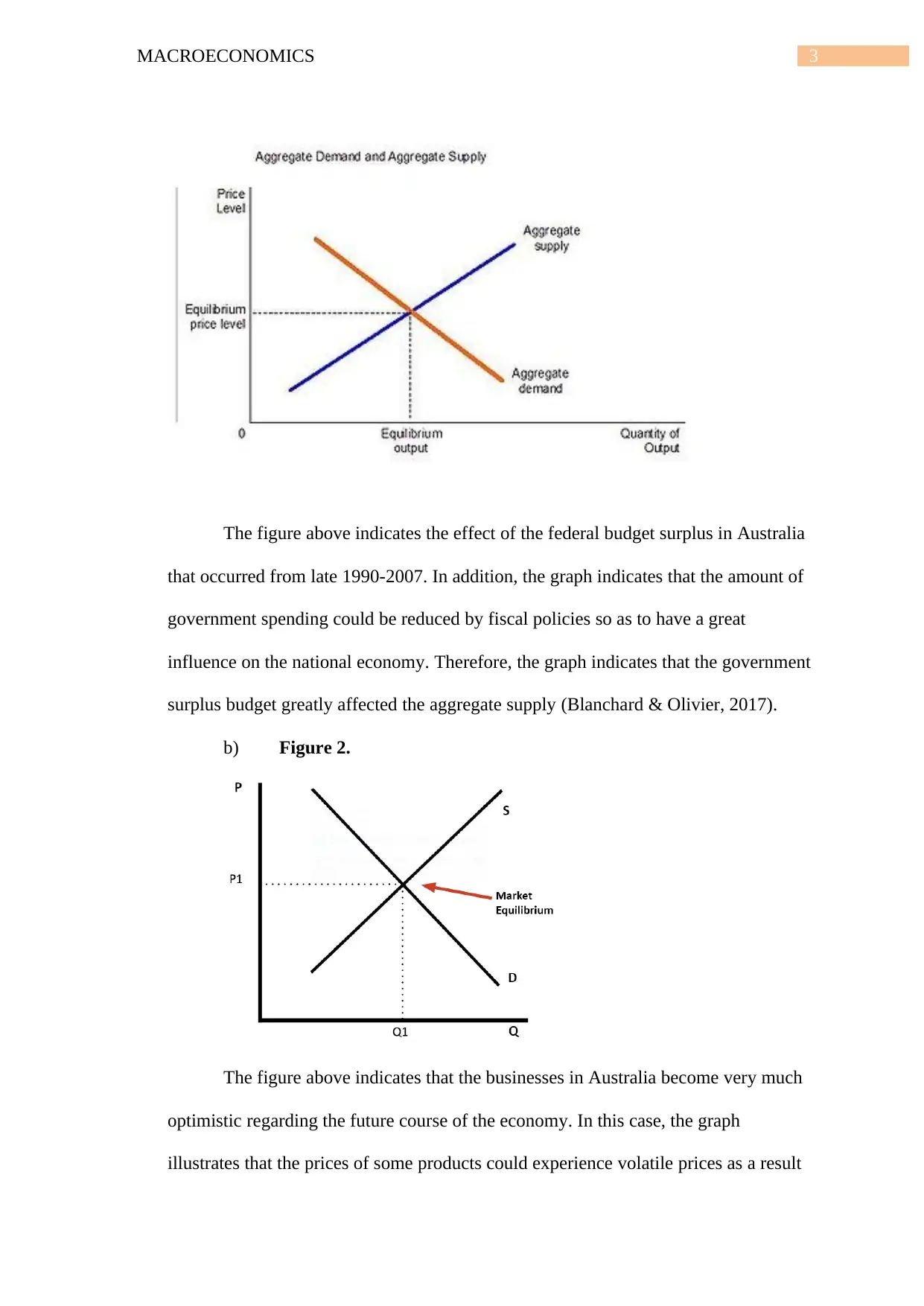
The figure above indicates the effect of the federal budget surplus in Australia
that occurred from late 1990-2007. In addition, the graph indicates that the amount of
government spending could be reduced by fiscal policies so as to have a great
influence on the national economy. Therefore, the graph indicates that the government
surplus budget greatly affected the aggregate supply (Blanchard & Olivier, 2017).
b) Figure 2.
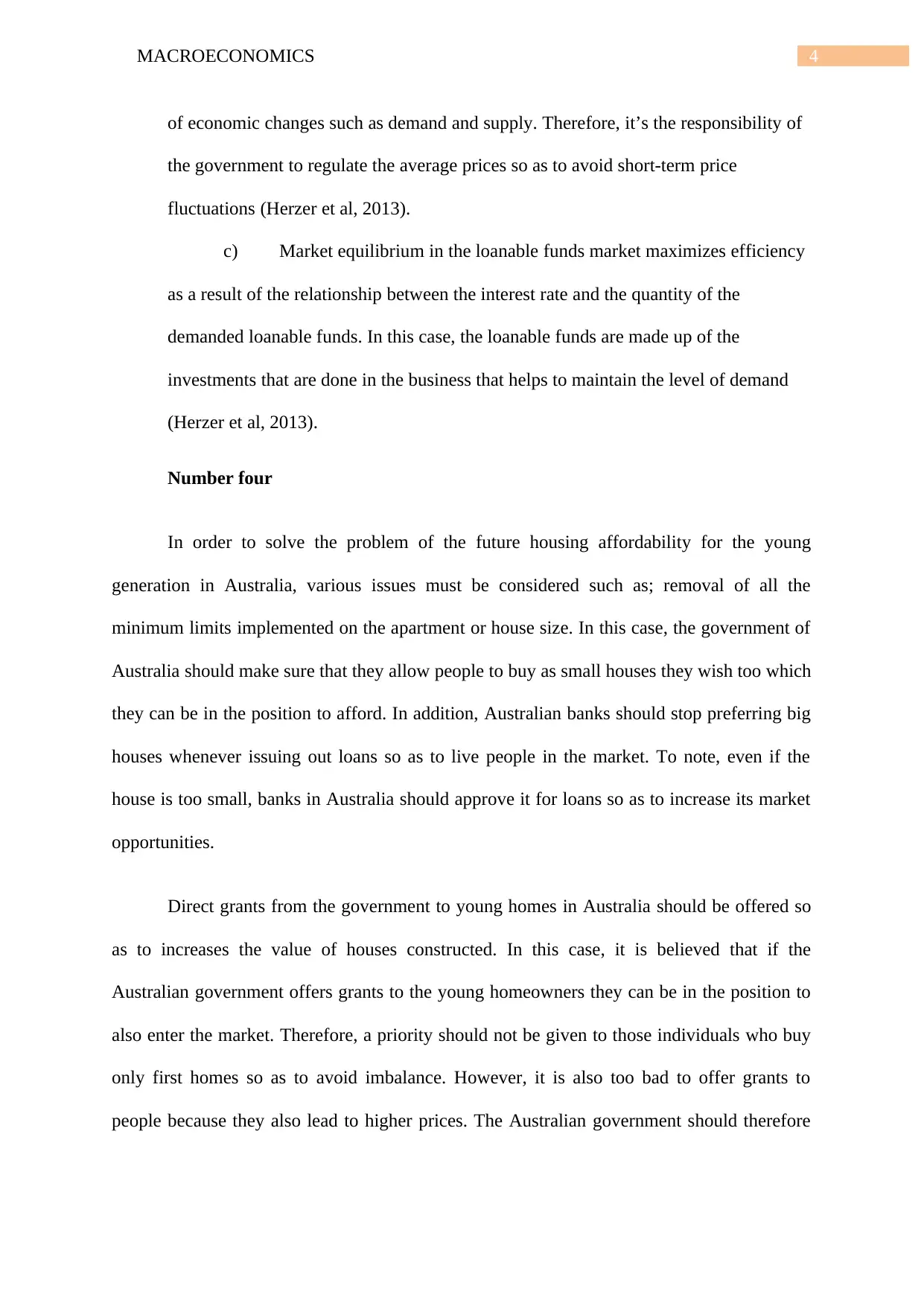
The figure above indicates that the businesses in Australia become very much
optimistic regarding the future course of the economy. In this case, the graph
illustrates that the prices of some products could experience volatile prices as a result
The figure above indicates the effect of the federal budget surplus in Australia
that occurred from late 1990-2007. In addition, the graph indicates that the amount of
government spending could be reduced by fiscal policies so as to have a great
influence on the national economy. Therefore, the graph indicates that the government
surplus budget greatly affected the aggregate supply (Blanchard & Olivier, 2017).
b) Figure 2.
The figure above indicates that the businesses in Australia become very much
optimistic regarding the future course of the economy. In this case, the graph
illustrates that the prices of some products could experience volatile prices as a result
Paraphrase This Document
Need a fresh take? Get an instant paraphrase of this document with our AI Paraphraser

4MACROECONOMICS
of economic changes such as demand and supply. Therefore, it’s the responsibility of
the government to regulate the average prices so as to avoid short-term price
fluctuations (Herzer et al, 2013).
c) Market equilibrium in the loanable funds market maximizes efficiency
as a result of the relationship between the interest rate and the quantity of the
demanded loanable funds. In this case, the loanable funds are made up of the
investments that are done in the business that helps to maintain the level of demand
(Herzer et al, 2013).
Number four
In order to solve the problem of the future housing affordability for the young
generation in Australia, various issues must be considered such as; removal of all the
minimum limits implemented on the apartment or house size. In this case, the government of
Australia should make sure that they allow people to buy as small houses they wish too which
they can be in the position to afford. In addition, Australian banks should stop preferring big
houses whenever issuing out loans so as to live people in the market. To note, even if the
house is too small, banks in Australia should approve it for loans so as to increase its market
opportunities.
Direct grants from the government to young homes in Australia should be offered so
as to increases the value of houses constructed. In this case, it is believed that if the
Australian government offers grants to the young homeowners they can be in the position to
also enter the market. Therefore, a priority should not be given to those individuals who buy
only first homes so as to avoid imbalance. However, it is also too bad to offer grants to
people because they also lead to higher prices. The Australian government should therefore
of economic changes such as demand and supply. Therefore, it’s the responsibility of
the government to regulate the average prices so as to avoid short-term price
fluctuations (Herzer et al, 2013).
c) Market equilibrium in the loanable funds market maximizes efficiency
as a result of the relationship between the interest rate and the quantity of the
demanded loanable funds. In this case, the loanable funds are made up of the
investments that are done in the business that helps to maintain the level of demand
(Herzer et al, 2013).
Number four
In order to solve the problem of the future housing affordability for the young
generation in Australia, various issues must be considered such as; removal of all the
minimum limits implemented on the apartment or house size. In this case, the government of
Australia should make sure that they allow people to buy as small houses they wish too which
they can be in the position to afford. In addition, Australian banks should stop preferring big
houses whenever issuing out loans so as to live people in the market. To note, even if the
house is too small, banks in Australia should approve it for loans so as to increase its market
opportunities.
Direct grants from the government to young homes in Australia should be offered so
as to increases the value of houses constructed. In this case, it is believed that if the
Australian government offers grants to the young homeowners they can be in the position to
also enter the market. Therefore, a priority should not be given to those individuals who buy
only first homes so as to avoid imbalance. However, it is also too bad to offer grants to
people because they also lead to higher prices. The Australian government should therefore

5MACROECONOMICS
not offer grants to any kind of house but only the new houses which boast the supply of
housing and also adds demand for construction companies (Blanchard & Olivier, 2011)
The government of Australia should review their planning laws that are not in favor of
changing the demand for houses. The review of the existing planning laws and policies will
pave way for the enaction of laws that suit the current dynamics in the Australian economy.
In this case, it should be noted that planning laws play an important role in the development
of the housing sector in most states. Hence unfavourable policies affects the overall
development of the housing sector both in urban and rural areas.Therefore, the Australian
government should move with the changing plans so as to ensure that all various categories
of people are looked at (Blanchard & Olivier, 2011). The current laws have a number of loop
holes and are
not offer grants to any kind of house but only the new houses which boast the supply of
housing and also adds demand for construction companies (Blanchard & Olivier, 2011)
The government of Australia should review their planning laws that are not in favor of
changing the demand for houses. The review of the existing planning laws and policies will
pave way for the enaction of laws that suit the current dynamics in the Australian economy.
In this case, it should be noted that planning laws play an important role in the development
of the housing sector in most states. Hence unfavourable policies affects the overall
development of the housing sector both in urban and rural areas.Therefore, the Australian
government should move with the changing plans so as to ensure that all various categories
of people are looked at (Blanchard & Olivier, 2011). The current laws have a number of loop
holes and are
⊘ This is a preview!⊘
Do you want full access?
Subscribe today to unlock all pages.

Trusted by 1+ million students worldwide

6MACROECONOMICS
References
Blanchard, Olivier. (2011). Macroeconomics Updated (5th ed.). Englewood Cliffs: Prentice
Hall. ISBN 978-0-13-215986-9.
Bouman, John. (2011). Principles of Macroeconomics – free fully comprehensive Principles
of Microeconomics and Macroeconomics texts. Columbia, Maryland.
Blanchard, Olivier. (2017), The need for different classes of macroeconomic models, blog
post, Jan. 12, 2017, Peterson Institute for International Economics.
Herzer, Dierk; Vollmer, Sebastian. (2013). "Rising top incomes do not raise the tide". Journal
of Policy Modeling. 35(4): 504–19. doi:10.1016/j.jpolmod.2013.02.011unfavourable to
specific population sects.
References
Blanchard, Olivier. (2011). Macroeconomics Updated (5th ed.). Englewood Cliffs: Prentice
Hall. ISBN 978-0-13-215986-9.
Bouman, John. (2011). Principles of Macroeconomics – free fully comprehensive Principles
of Microeconomics and Macroeconomics texts. Columbia, Maryland.
Blanchard, Olivier. (2017), The need for different classes of macroeconomic models, blog
post, Jan. 12, 2017, Peterson Institute for International Economics.
Herzer, Dierk; Vollmer, Sebastian. (2013). "Rising top incomes do not raise the tide". Journal
of Policy Modeling. 35(4): 504–19. doi:10.1016/j.jpolmod.2013.02.011unfavourable to
specific population sects.
1 out of 7
Your All-in-One AI-Powered Toolkit for Academic Success.
+13062052269
info@desklib.com
Available 24*7 on WhatsApp / Email
Unlock your academic potential
Copyright © 2020–2026 A2Z Services. All Rights Reserved. Developed and managed by ZUCOL.