Macro & Microeconomics Exam Solution: Facebook Case Study
VerifiedAdded on 2023/04/21
|24
|5174
|436
Homework Assignment
AI Summary
This assignment delves into the microeconomic and macroeconomic aspects of Facebook's market position. It begins by defining Facebook as a natural monopoly, examining its characteristics, including high infrastructural costs and barriers to entry, and illustrating this with positive network externalities and supernormal profits. The solution then explores economic advantages leading to market failure, such as lack of competition and positive network externalities, and analyzes the shape of Facebook’s average total cost curve. The assignment also discusses the impact of data breaches, the role of behavioral economics, and potential regulatory approaches like privacy and data security policies. Furthermore, it covers collusion in the market, price discrimination strategies (specifically second-degree), and profit maximization for fitness centers. The solution also provides insights into the effects of increased fixed costs and the potential responses of businesses to maintain profitability.

Running Head: MACRO & MICROECONOMICS EXAM 1
MACRO & MICROECONOMICS EXAM
Student Name
Institution Affiliation
Facilitator
Course
Date
MACRO & MICROECONOMICS EXAM
Student Name
Institution Affiliation
Facilitator
Course
Date

Paraphrase This Document
Need a fresh take? Get an instant paraphrase of this document with our AI Paraphraser
MACRO & MICROECONOMICS EXAM 2
MICRO: (Salvatore, 2017)
Question 1 (a)
A natural monopoly is a type of monopoly where high infrastructural costs and other
kinds of barriers to entry in regard to the market size produce the largest supplier in the industry
and that largest supplier is often the first supplier in such a market and has an overwhelming
advantage over the potential competitors. With an eye on the above definition, Facebook Inc.
directly fits in the category of a natural monopoly. This is in consideration to the steps it has
made in terms of favorable online features like video calling and others which have denied its
close competitors like the LinkedIn to compete favorably as companies in the same being in the
same sector.
Facebook Inc. is therefore without any reasonable doubt operating as a monopoly in the
digital advertising media. First of all, the steps it has made since the industry came into existence
are so many to an extent that the costs of reaching its level by its close competitors like the
LinkedIn are high and unaffordable. The high cost of implementing features which have already
been implemented by Facebook Inc. has become a barrier to entry by other companies with the
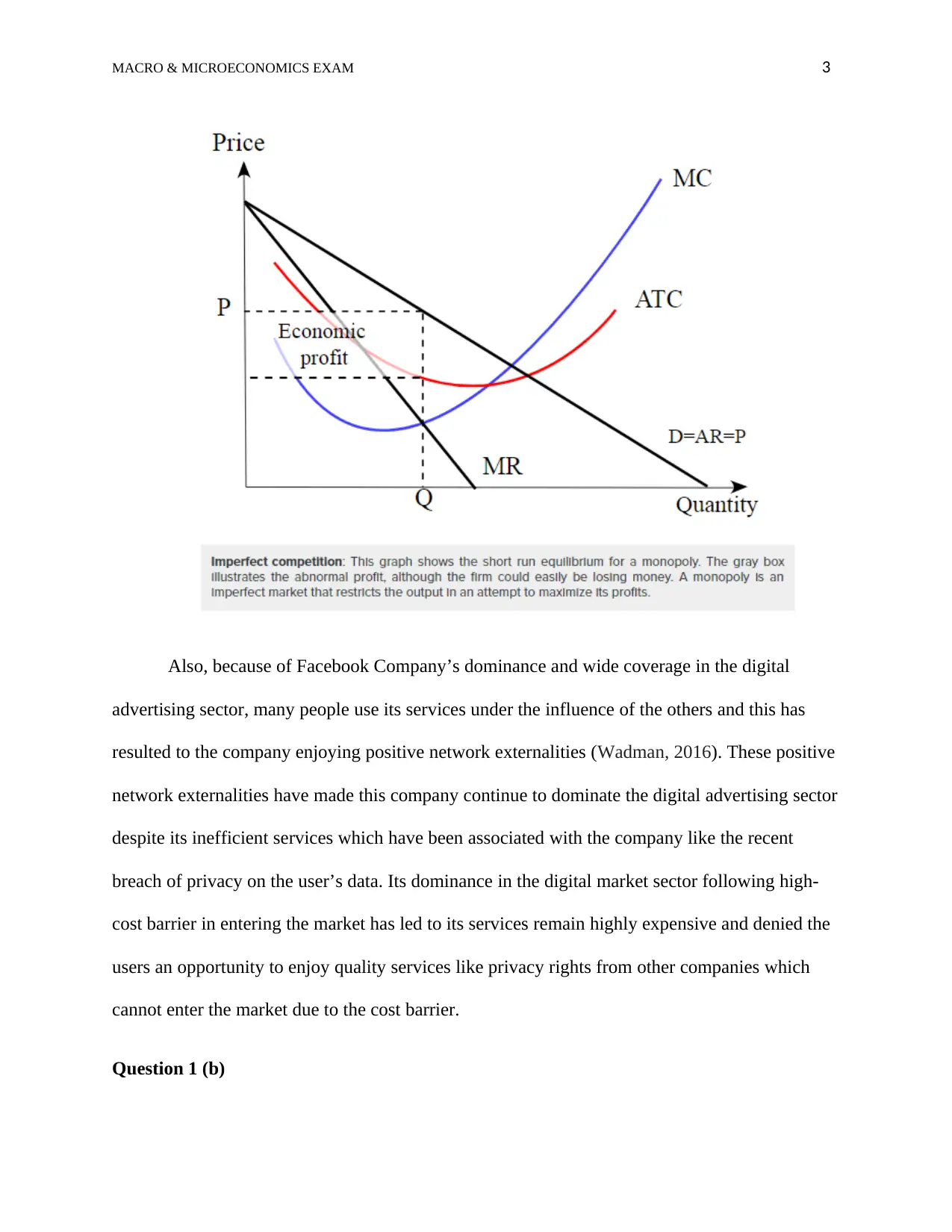
potential in the digital advertising sector. In regard to the company’s profitability, analysts have
revealed that Facebook reports a profit of more than $1.36 per share on total revenue of $11.4
billion in every quarter, which is, without doubt, an abnormal profit.
MICRO: (Salvatore, 2017)
Question 1 (a)
A natural monopoly is a type of monopoly where high infrastructural costs and other
kinds of barriers to entry in regard to the market size produce the largest supplier in the industry
and that largest supplier is often the first supplier in such a market and has an overwhelming
advantage over the potential competitors. With an eye on the above definition, Facebook Inc.
directly fits in the category of a natural monopoly. This is in consideration to the steps it has
made in terms of favorable online features like video calling and others which have denied its
close competitors like the LinkedIn to compete favorably as companies in the same being in the
same sector.
Facebook Inc. is therefore without any reasonable doubt operating as a monopoly in the
digital advertising media. First of all, the steps it has made since the industry came into existence
are so many to an extent that the costs of reaching its level by its close competitors like the
LinkedIn are high and unaffordable. The high cost of implementing features which have already
been implemented by Facebook Inc. has become a barrier to entry by other companies with the
potential in the digital advertising sector. In regard to the company’s profitability, analysts have
revealed that Facebook reports a profit of more than $1.36 per share on total revenue of $11.4
billion in every quarter, which is, without doubt, an abnormal profit.
MACRO & MICROECONOMICS EXAM 3
Also, because of Facebook Company’s dominance and wide coverage in the digital
advertising sector, many people use its services under the influence of the others and this has
resulted to the company enjoying positive network externalities (Wadman, 2016). These positive
network externalities have made this company continue to dominate the digital advertising sector
despite its inefficient services which have been associated with the company like the recent
breach of privacy on the user’s data. Its dominance in the digital market sector following high-
cost barrier in entering the market has led to its services remain highly expensive and denied the
users an opportunity to enjoy quality services like privacy rights from other companies which
cannot enter the market due to the cost barrier.
Question 1 (b)
Also, because of Facebook Company’s dominance and wide coverage in the digital
advertising sector, many people use its services under the influence of the others and this has
resulted to the company enjoying positive network externalities (Wadman, 2016). These positive
network externalities have made this company continue to dominate the digital advertising sector
despite its inefficient services which have been associated with the company like the recent
breach of privacy on the user’s data. Its dominance in the digital market sector following high-
cost barrier in entering the market has led to its services remain highly expensive and denied the
users an opportunity to enjoy quality services like privacy rights from other companies which
cannot enter the market due to the cost barrier.
Question 1 (b)
⊘ This is a preview!⊘
Do you want full access?
Subscribe today to unlock all pages.

Trusted by 1+ million students worldwide
MACRO & MICROECONOMICS EXAM 4
As a monopoly company, Facebook Inc. enjoys some additional economic advantages which in
the long run will lead to market failure. Some of these advantages include
Lack of competition
As a monopoly firm and without close competitors, the company has a potential of
raising its service prices indefinitely which is a critical detriment to consumers. This is because it
does not have competition within the industry and therefore, its price is the market price and its
demand is the market demand. Even when it sets its prices very high, the customers will have to
struggle to afford them because they cannot substitute the services with another affordable
alternative. With such powers bestowed on the company, the company is likely to provide
substandard services like in the previously reported incidence where there was a breach in the
privacy of user data. This is a typical market failure
Positive Network externalities
Enjoying positive network externalities will lead to market failure because its service
price equilibrium will not accurately reflect the real costs and benefits of the service. This is
because equilibrium as a representative of the ideal balance between the producer’s costs and
buyer’s benefits should result in an optimal level of production. The equilibrium level is however
flawed when there is a significant externality, creating an incentive that drives the individual
actors to come up with decisions which worsen the group. This is a market failure.
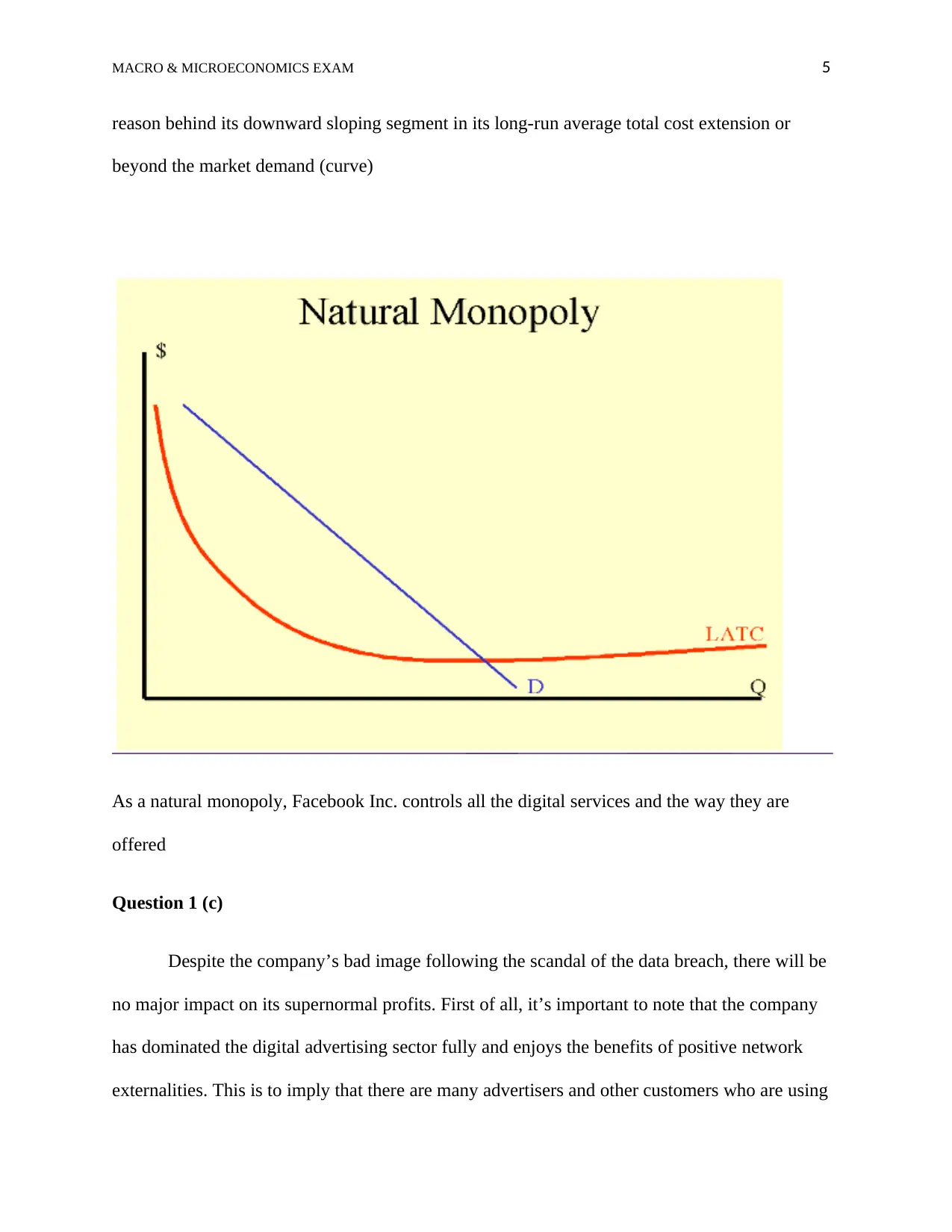
As a natural monopoly, Facebook Inc. has its average total cost curve sloping
downwards. This is because its economies of scale are extensive as a result of competition and
have expanded gradually and priced other competitors out of the market. This has been the
As a monopoly company, Facebook Inc. enjoys some additional economic advantages which in
the long run will lead to market failure. Some of these advantages include
Lack of competition
As a monopoly firm and without close competitors, the company has a potential of
raising its service prices indefinitely which is a critical detriment to consumers. This is because it
does not have competition within the industry and therefore, its price is the market price and its
demand is the market demand. Even when it sets its prices very high, the customers will have to
struggle to afford them because they cannot substitute the services with another affordable
alternative. With such powers bestowed on the company, the company is likely to provide
substandard services like in the previously reported incidence where there was a breach in the
privacy of user data. This is a typical market failure
Positive Network externalities
Enjoying positive network externalities will lead to market failure because its service
price equilibrium will not accurately reflect the real costs and benefits of the service. This is
because equilibrium as a representative of the ideal balance between the producer’s costs and
buyer’s benefits should result in an optimal level of production. The equilibrium level is however
flawed when there is a significant externality, creating an incentive that drives the individual
actors to come up with decisions which worsen the group. This is a market failure.
As a natural monopoly, Facebook Inc. has its average total cost curve sloping
downwards. This is because its economies of scale are extensive as a result of competition and
have expanded gradually and priced other competitors out of the market. This has been the
Paraphrase This Document
Need a fresh take? Get an instant paraphrase of this document with our AI Paraphraser
MACRO & MICROECONOMICS EXAM 5
reason behind its downward sloping segment in its long-run average total cost extension or
beyond the market demand (curve)
As a natural monopoly, Facebook Inc. controls all the digital services and the way they are
offered
Question 1 (c)
Despite the company’s bad image following the scandal of the data breach, there will be
no major impact on its supernormal profits. First of all, it’s important to note that the company
has dominated the digital advertising sector fully and enjoys the benefits of positive network
externalities. This is to imply that there are many advertisers and other customers who are using
reason behind its downward sloping segment in its long-run average total cost extension or
beyond the market demand (curve)
As a natural monopoly, Facebook Inc. controls all the digital services and the way they are
offered
Question 1 (c)
Despite the company’s bad image following the scandal of the data breach, there will be
no major impact on its supernormal profits. First of all, it’s important to note that the company
has dominated the digital advertising sector fully and enjoys the benefits of positive network
externalities. This is to imply that there are many advertisers and other customers who are using
MACRO & MICROECONOMICS EXAM 6
its services not because they are the best but because there is no alternative service provider. Its
customers keep on increasing on daily basis and that implies that the exit by the few advertisers
will have no significant impact on its supernormal profits because many more advertisers are
enrolling on its services on daily basis.
Question 1 (d)
According to behavioral economic theory, when a customer has a negative experience
with a business; 58% of such customers never use the services of the company again, 49% goes
ahead to share their experience with their colleagues so that they may not use the services and
34% usually take revenge by posting negative reviews either online or sharing their poor
experience on social media platforms. This is an indication that the company’s bad reputation
widely spread beyond the few individuals who were affected by the scandal.
Considering the fact that the company is still operating as a natural monopoly, the
impacts of this scandal may not be felt at the moment but in the long run, when there will be a
closer competitor of the company, poor customer loyalty as a result of this scandal will haunt the
company. This is because the competitor will use the scandal to put down the company and
customers will definitely be swayed away.
Having a close competitor will also lead to the loss of company profits. This will come as
a result of losing both the existing and other potential customers following their fear of privacy
and which has been the main scandal by Facebook Inc.
Question 1 (e)
its services not because they are the best but because there is no alternative service provider. Its
customers keep on increasing on daily basis and that implies that the exit by the few advertisers
will have no significant impact on its supernormal profits because many more advertisers are
enrolling on its services on daily basis.
Question 1 (d)
According to behavioral economic theory, when a customer has a negative experience
with a business; 58% of such customers never use the services of the company again, 49% goes
ahead to share their experience with their colleagues so that they may not use the services and
34% usually take revenge by posting negative reviews either online or sharing their poor
experience on social media platforms. This is an indication that the company’s bad reputation
widely spread beyond the few individuals who were affected by the scandal.
Considering the fact that the company is still operating as a natural monopoly, the
impacts of this scandal may not be felt at the moment but in the long run, when there will be a
closer competitor of the company, poor customer loyalty as a result of this scandal will haunt the
company. This is because the competitor will use the scandal to put down the company and
customers will definitely be swayed away.
Having a close competitor will also lead to the loss of company profits. This will come as
a result of losing both the existing and other potential customers following their fear of privacy
and which has been the main scandal by Facebook Inc.
Question 1 (e)
⊘ This is a preview!⊘
Do you want full access?
Subscribe today to unlock all pages.
Trusted by 1+ million students worldwide
MACRO & MICROECONOMICS EXAM 7
In the dawn of the current high-profile technology scares such as the Facebook’s alleged
mishandling of private data, stricter regulations of the industry along the lines of the financial
sector have become a policy question du jour. Below are the main two approaches to regulate
digital technology companies in the modern economy.
Privacy policy
European Union, for instance, has introduced new laws under their General Data
Protection Regulation aimed at protecting people’s privacy rights when using digital platforms
like Facebook and others. The legislation targeted all the European member states and has
shifted the control of customer data away from the technology companies which sell it to the
highest bidders. The union has also proposed some laws to crack down the proliferation of
propaganda, libel, and fraud across the internet.
Data security policy
Besides the privacy initiatives, governments have also begun to catch up on data security
matters in the wired and globalized world. For instance, US has recently signed the law of
Clarifying Lawful Overseas Use of Data Act or the Cloud act which allows the federal law
enforcement agency to compel US-based technology companies to avail any data stored in their
servers once requested regardless of whether it is stored in the US or foreign countries.
Question 2 (a)
Collusion in the market occurs in several ways but produce the same end results,
consumers being disadvantaged in one way or the other. There are different forms through which
collusion takes place
In the dawn of the current high-profile technology scares such as the Facebook’s alleged
mishandling of private data, stricter regulations of the industry along the lines of the financial
sector have become a policy question du jour. Below are the main two approaches to regulate
digital technology companies in the modern economy.
Privacy policy
European Union, for instance, has introduced new laws under their General Data
Protection Regulation aimed at protecting people’s privacy rights when using digital platforms
like Facebook and others. The legislation targeted all the European member states and has
shifted the control of customer data away from the technology companies which sell it to the
highest bidders. The union has also proposed some laws to crack down the proliferation of
propaganda, libel, and fraud across the internet.
Data security policy
Besides the privacy initiatives, governments have also begun to catch up on data security
matters in the wired and globalized world. For instance, US has recently signed the law of
Clarifying Lawful Overseas Use of Data Act or the Cloud act which allows the federal law
enforcement agency to compel US-based technology companies to avail any data stored in their
servers once requested regardless of whether it is stored in the US or foreign countries.
Question 2 (a)
Collusion in the market occurs in several ways but produce the same end results,
consumers being disadvantaged in one way or the other. There are different forms through which
collusion takes place
Paraphrase This Document
Need a fresh take? Get an instant paraphrase of this document with our AI Paraphraser
MACRO & MICROECONOMICS EXAM 8
Price fixing
This occurs when the number of companies in the marketplace is small, commonly
known as oligopoly and essentially offering the same products and where an agreement is made
to set minimum prices under the collaboration. It is a criterion which barely succeeds because
any firm aspires to outdo each other and that leads to violation of the collusion secretly.
Setting maximum prices for supplies
In this approach, companies collude to eliminate and reduce competition. This is
especially when new entrants are not willing to enter into the collusion agreement. Colluding
companies, therefore, attempt to eliminate the new entrant by reducing the access to crucial
business partners in the market such as the key suppliers and distributors. It is a form of collusion
whose success rate is high considering that the main agenda is to drive away the competition.
Synchronization of advertising campaigns
Through this approach, companies are operating in the same market limit consumer
knowledge about products or services in an attempt to deter them from comparing the prices of
products or services being offered in the industry. It is a collusion criterion whose success rate is
also high because the colluders have the same agenda.
Considering that the health and fitness sector of Ireland is booming as expressed in the
case study and the number of service providers is small, the possibility of gym operators in IFSC
is high because all the operators are making profits and any opportunity which can yield them
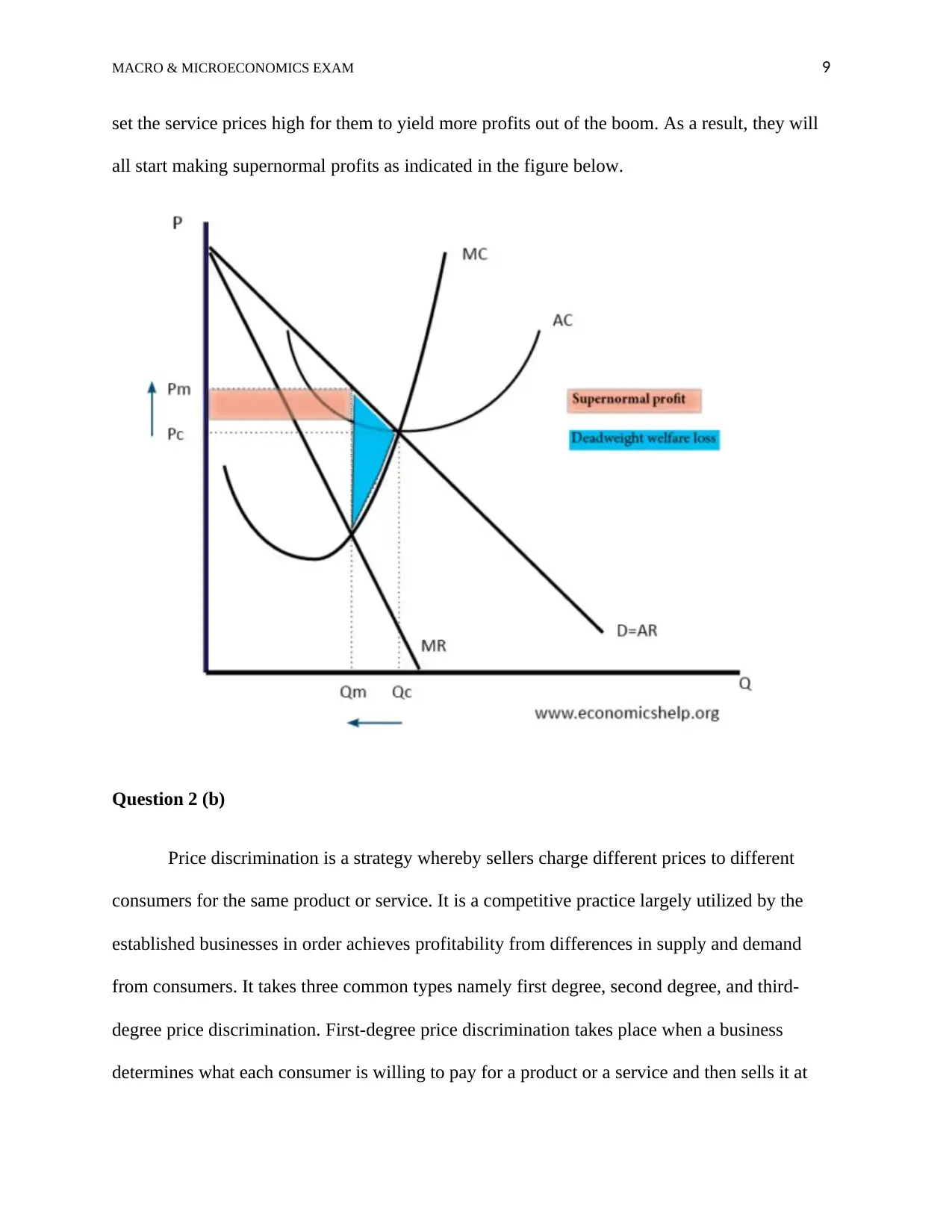
higher profits are likely to be embraced fully. The collusion will be formal collusion where these
few gym operators competing against each other will collude in a form of a cartel agreement and
Price fixing
This occurs when the number of companies in the marketplace is small, commonly
known as oligopoly and essentially offering the same products and where an agreement is made
to set minimum prices under the collaboration. It is a criterion which barely succeeds because
any firm aspires to outdo each other and that leads to violation of the collusion secretly.
Setting maximum prices for supplies
In this approach, companies collude to eliminate and reduce competition. This is
especially when new entrants are not willing to enter into the collusion agreement. Colluding
companies, therefore, attempt to eliminate the new entrant by reducing the access to crucial
business partners in the market such as the key suppliers and distributors. It is a form of collusion
whose success rate is high considering that the main agenda is to drive away the competition.
Synchronization of advertising campaigns
Through this approach, companies are operating in the same market limit consumer
knowledge about products or services in an attempt to deter them from comparing the prices of
products or services being offered in the industry. It is a collusion criterion whose success rate is
also high because the colluders have the same agenda.
Considering that the health and fitness sector of Ireland is booming as expressed in the
case study and the number of service providers is small, the possibility of gym operators in IFSC
is high because all the operators are making profits and any opportunity which can yield them
higher profits are likely to be embraced fully. The collusion will be formal collusion where these
few gym operators competing against each other will collude in a form of a cartel agreement and
MACRO & MICROECONOMICS EXAM 9
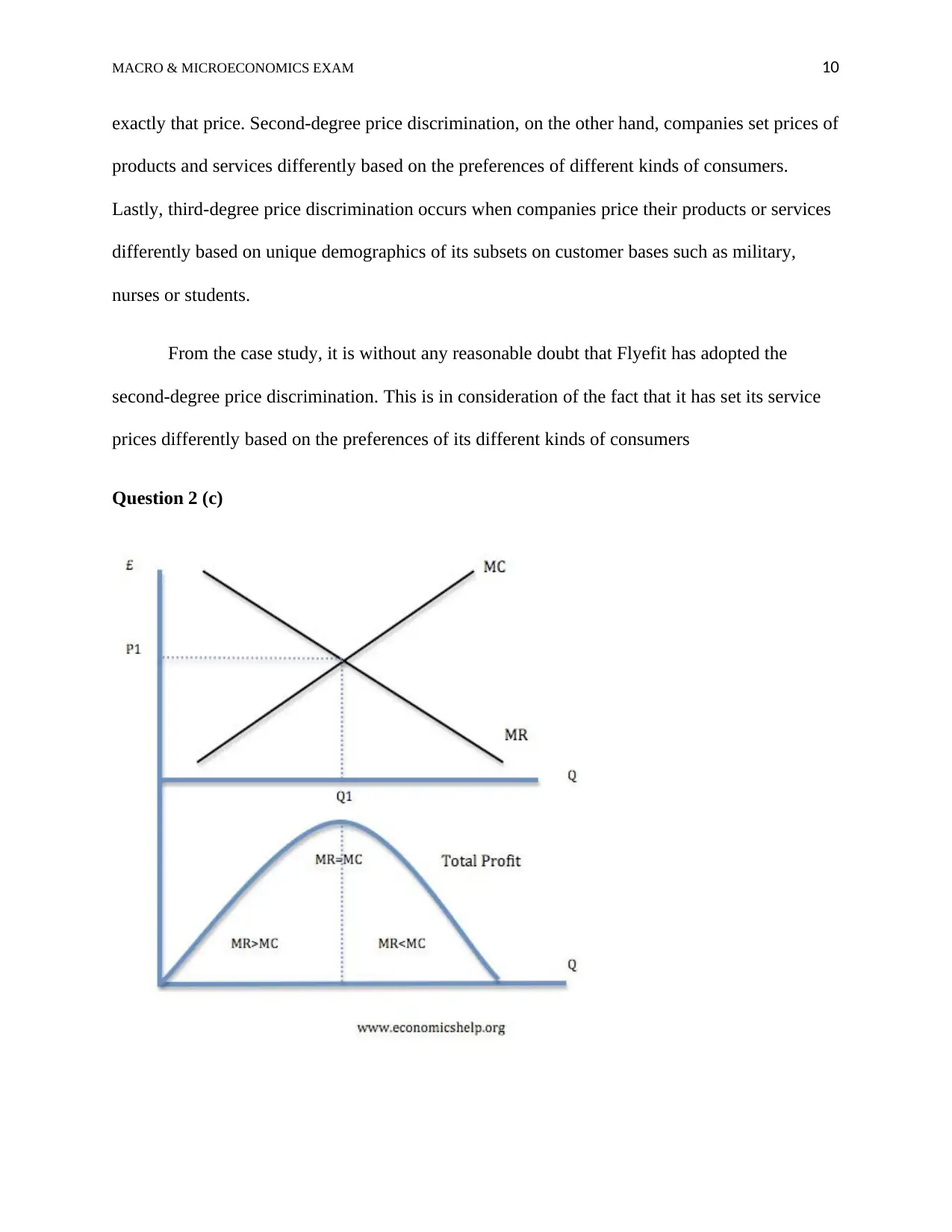
set the service prices high for them to yield more profits out of the boom. As a result, they will
all start making supernormal profits as indicated in the figure below.
Question 2 (b)
Price discrimination is a strategy whereby sellers charge different prices to different
consumers for the same product or service. It is a competitive practice largely utilized by the
established businesses in order achieves profitability from differences in supply and demand
from consumers. It takes three common types namely first degree, second degree, and third-
degree price discrimination. First-degree price discrimination takes place when a business
determines what each consumer is willing to pay for a product or a service and then sells it at
set the service prices high for them to yield more profits out of the boom. As a result, they will
all start making supernormal profits as indicated in the figure below.
Question 2 (b)
Price discrimination is a strategy whereby sellers charge different prices to different
consumers for the same product or service. It is a competitive practice largely utilized by the
established businesses in order achieves profitability from differences in supply and demand
from consumers. It takes three common types namely first degree, second degree, and third-
degree price discrimination. First-degree price discrimination takes place when a business
determines what each consumer is willing to pay for a product or a service and then sells it at
⊘ This is a preview!⊘
Do you want full access?
Subscribe today to unlock all pages.
Trusted by 1+ million students worldwide
MACRO & MICROECONOMICS EXAM 10
exactly that price. Second-degree price discrimination, on the other hand, companies set prices of
products and services differently based on the preferences of different kinds of consumers.
Lastly, third-degree price discrimination occurs when companies price their products or services
differently based on unique demographics of its subsets on customer bases such as military,
nurses or students.
From the case study, it is without any reasonable doubt that Flyefit has adopted the
second-degree price discrimination. This is in consideration of the fact that it has set its service
prices differently based on the preferences of its different kinds of consumers
Question 2 (c)
exactly that price. Second-degree price discrimination, on the other hand, companies set prices of
products and services differently based on the preferences of different kinds of consumers.
Lastly, third-degree price discrimination occurs when companies price their products or services
differently based on unique demographics of its subsets on customer bases such as military,
nurses or students.
From the case study, it is without any reasonable doubt that Flyefit has adopted the
second-degree price discrimination. This is in consideration of the fact that it has set its service
prices differently based on the preferences of its different kinds of consumers
Question 2 (c)
Paraphrase This Document
Need a fresh take? Get an instant paraphrase of this document with our AI Paraphraser
MACRO & MICROECONOMICS EXAM 11
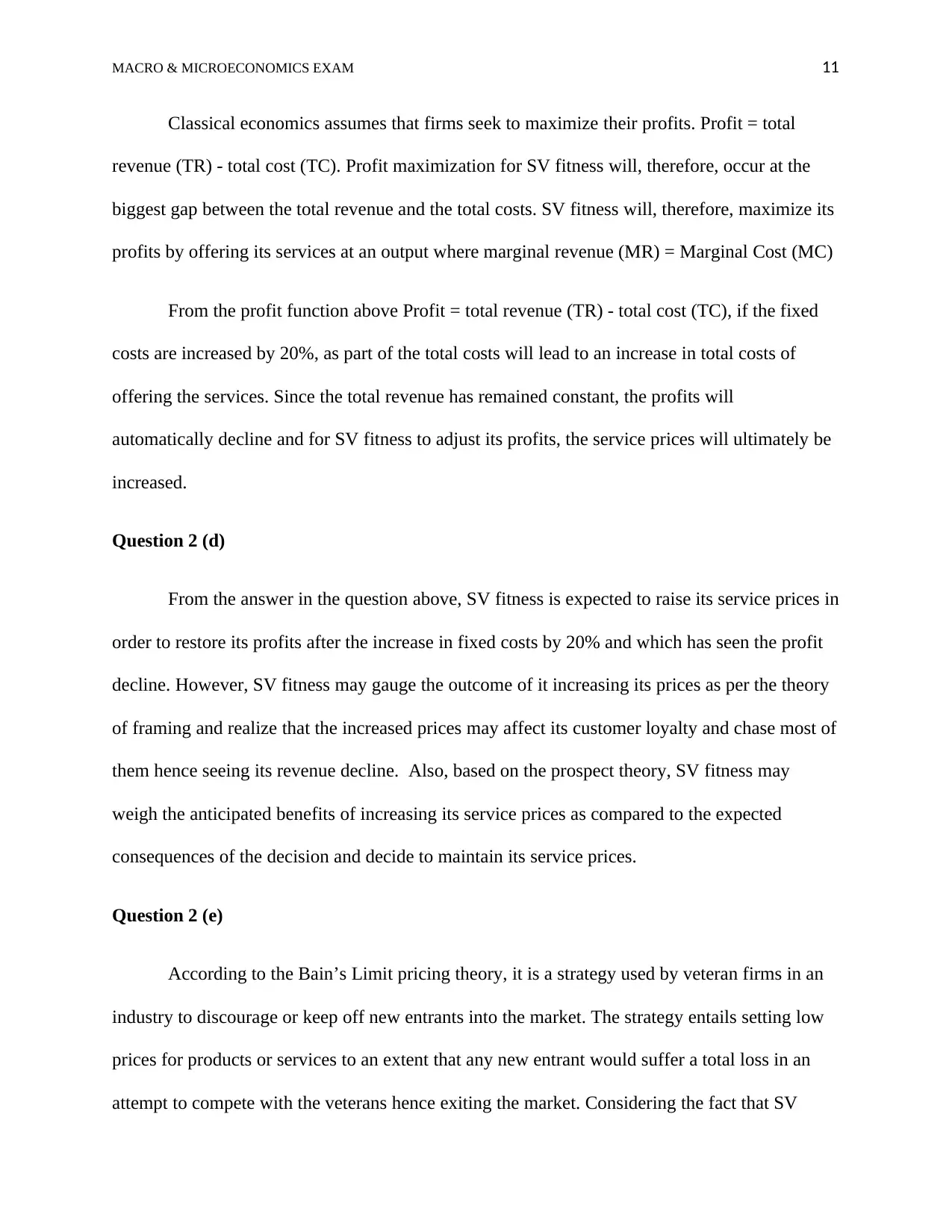
Classical economics assumes that firms seek to maximize their profits. Profit = total
revenue (TR) - total cost (TC). Profit maximization for SV fitness will, therefore, occur at the
biggest gap between the total revenue and the total costs. SV fitness will, therefore, maximize its
profits by offering its services at an output where marginal revenue (MR) = Marginal Cost (MC)
From the profit function above Profit = total revenue (TR) - total cost (TC), if the fixed
costs are increased by 20%, as part of the total costs will lead to an increase in total costs of
offering the services. Since the total revenue has remained constant, the profits will
automatically decline and for SV fitness to adjust its profits, the service prices will ultimately be
increased.
Question 2 (d)
From the answer in the question above, SV fitness is expected to raise its service prices in
order to restore its profits after the increase in fixed costs by 20% and which has seen the profit
decline. However, SV fitness may gauge the outcome of it increasing its prices as per the theory
of framing and realize that the increased prices may affect its customer loyalty and chase most of
them hence seeing its revenue decline. Also, based on the prospect theory, SV fitness may
weigh the anticipated benefits of increasing its service prices as compared to the expected
consequences of the decision and decide to maintain its service prices.
Question 2 (e)
According to the Bain’s Limit pricing theory, it is a strategy used by veteran firms in an
industry to discourage or keep off new entrants into the market. The strategy entails setting low
prices for products or services to an extent that any new entrant would suffer a total loss in an
attempt to compete with the veterans hence exiting the market. Considering the fact that SV
Classical economics assumes that firms seek to maximize their profits. Profit = total
revenue (TR) - total cost (TC). Profit maximization for SV fitness will, therefore, occur at the
biggest gap between the total revenue and the total costs. SV fitness will, therefore, maximize its
profits by offering its services at an output where marginal revenue (MR) = Marginal Cost (MC)
From the profit function above Profit = total revenue (TR) - total cost (TC), if the fixed
costs are increased by 20%, as part of the total costs will lead to an increase in total costs of
offering the services. Since the total revenue has remained constant, the profits will
automatically decline and for SV fitness to adjust its profits, the service prices will ultimately be
increased.
Question 2 (d)
From the answer in the question above, SV fitness is expected to raise its service prices in
order to restore its profits after the increase in fixed costs by 20% and which has seen the profit
decline. However, SV fitness may gauge the outcome of it increasing its prices as per the theory
of framing and realize that the increased prices may affect its customer loyalty and chase most of
them hence seeing its revenue decline. Also, based on the prospect theory, SV fitness may
weigh the anticipated benefits of increasing its service prices as compared to the expected
consequences of the decision and decide to maintain its service prices.
Question 2 (e)
According to the Bain’s Limit pricing theory, it is a strategy used by veteran firms in an
industry to discourage or keep off new entrants into the market. The strategy entails setting low
prices for products or services to an extent that any new entrant would suffer a total loss in an
attempt to compete with the veterans hence exiting the market. Considering the fact that SV
MACRO & MICROECONOMICS EXAM 12
fitness and Spencer Health Club are veterans in the gym provision services in IFSC, limit pricing
strategy can be applicable to halt Flyefit’s entry into the market. Through this strategy, the two
veterans would sacrifice on their profits for some period of time setting their service prices low
thus attracting all the customers including the Flyefit’s potential and loyal customers. Within
such duration of limit pricing, Flyefit’s will lack customers and eventually suffer loses in case it
tries to lower its prices to compete with the two veterans who are already established in the
market. Eventually, Flyefit will be forced to quit the market.
Question 3 (a)
Market power denotes the ability by a single firm or a few firms to manipulate the prices of
products or services in the market by altering the level of supply and demand. Drawing from the
case study, the grocery market in Ireland has been presented as a market dominated by three
firms; Supervalu, Tesco, and Dunnes. The three can be termed as market powers in this market
because they can collude to manipulate the prices of goods by altering the supply and demand for
those products. This result into an oligopoly market structure, where the three firms have control
of the whole market as far as pricing of products is concerned. This kind of market can be
described by the graph below
fitness and Spencer Health Club are veterans in the gym provision services in IFSC, limit pricing
strategy can be applicable to halt Flyefit’s entry into the market. Through this strategy, the two
veterans would sacrifice on their profits for some period of time setting their service prices low
thus attracting all the customers including the Flyefit’s potential and loyal customers. Within
such duration of limit pricing, Flyefit’s will lack customers and eventually suffer loses in case it
tries to lower its prices to compete with the two veterans who are already established in the
market. Eventually, Flyefit will be forced to quit the market.
Question 3 (a)
Market power denotes the ability by a single firm or a few firms to manipulate the prices of
products or services in the market by altering the level of supply and demand. Drawing from the
case study, the grocery market in Ireland has been presented as a market dominated by three
firms; Supervalu, Tesco, and Dunnes. The three can be termed as market powers in this market
because they can collude to manipulate the prices of goods by altering the supply and demand for
those products. This result into an oligopoly market structure, where the three firms have control
of the whole market as far as pricing of products is concerned. This kind of market can be
described by the graph below
⊘ This is a preview!⊘
Do you want full access?
Subscribe today to unlock all pages.
Trusted by 1+ million students worldwide

1 out of 24


Related Documents


Your All-in-One AI-Powered Toolkit for Academic Success.
+13062052269
info@desklib.com
Available 24*7 on WhatsApp / Email
![[object Object]](/_next/static/media/star-bottom.7253800d.svg)
Unlock your academic potential
Copyright © 2020–2026 A2Z Services. All Rights Reserved. Developed and managed by ZUCOL.