Comprehensive Analysis of Venezuela's Economic Performance

Verified

Added on  2022/09/06

|3
|1080
|19
Project
AI Summary
This project provides an analysis of the Venezuelan economy, focusing on key macroeconomic indicators. It examines the country's reliance on the petroleum sector and its impact on economic growth, including the significant contractions experienced in the early 2010s. The analysis delves into GDP per capita trends, highlighting the impact of the non-oil sector and the effects of inflation on economic performance. It also explores Venezuela's export profile, particularly the role of petroleum, and discusses the impact of overpopulation and high inflation rates. The project further considers the factors contributing to both economic growth and decline, including capital accumulation, productivity, and the influence of government policies. The study concludes by emphasizing the negative effects of high inflation on investment and economic growth, offering a comprehensive overview of the country's economic challenges and opportunities.
Document Page
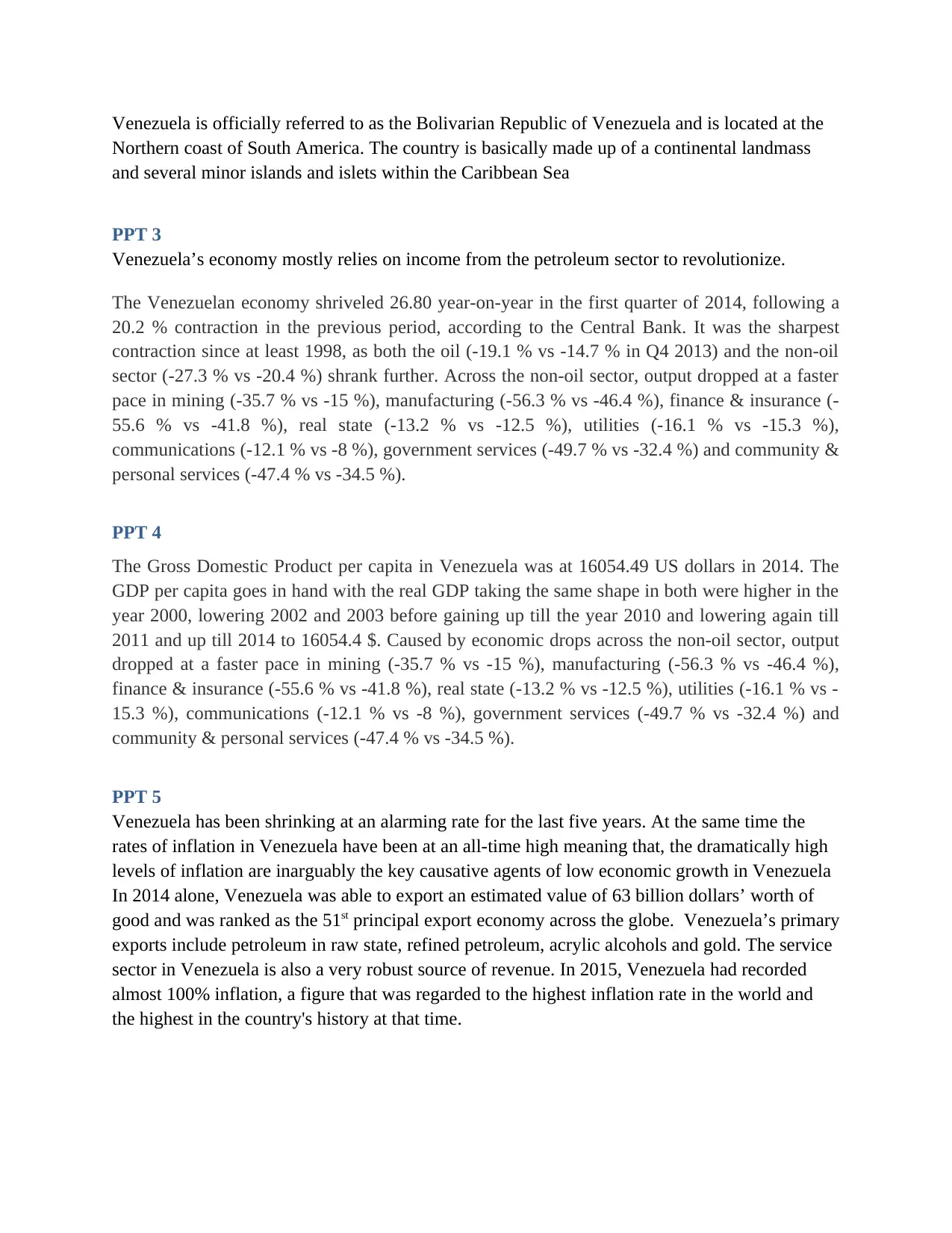
Venezuela is officially referred to as the Bolivarian Republic of Venezuela and is located at the
Northern coast of South America. The country is basically made up of a continental landmass
and several minor islands and islets within the Caribbean Sea
PPT 3
Venezuela’s economy mostly relies on income from the petroleum sector to revolutionize.
The Venezuelan economy shriveled 26.80 year-on-year in the first quarter of 2014, following a
20.2 % contraction in the previous period, according to the Central Bank. It was the sharpest
contraction since at least 1998, as both the oil (-19.1 % vs -14.7 % in Q4 2013) and the non-oil
sector (-27.3 % vs -20.4 %) shrank further. Across the non-oil sector, output dropped at a faster
pace in mining (-35.7 % vs -15 %), manufacturing (-56.3 % vs -46.4 %), finance & insurance (-
55.6 % vs -41.8 %), real state (-13.2 % vs -12.5 %), utilities (-16.1 % vs -15.3 %),
communications (-12.1 % vs -8 %), government services (-49.7 % vs -32.4 %) and community &
personal services (-47.4 % vs -34.5 %).
PPT 4
The Gross Domestic Product per capita in Venezuela was at 16054.49 US dollars in 2014. The
GDP per capita goes in hand with the real GDP taking the same shape in both were higher in the
year 2000, lowering 2002 and 2003 before gaining up till the year 2010 and lowering again till
2011 and up till 2014 to 16054.4 $. Caused by economic drops across the non-oil sector, output
dropped at a faster pace in mining (-35.7 % vs -15 %), manufacturing (-56.3 % vs -46.4 %),
finance & insurance (-55.6 % vs -41.8 %), real state (-13.2 % vs -12.5 %), utilities (-16.1 % vs -
15.3 %), communications (-12.1 % vs -8 %), government services (-49.7 % vs -32.4 %) and
community & personal services (-47.4 % vs -34.5 %).
PPT 5
Venezuela has been shrinking at an alarming rate for the last five years. At the same time the
rates of inflation in Venezuela have been at an all-time high meaning that, the dramatically high
levels of inflation are inarguably the key causative agents of low economic growth in Venezuela
In 2014 alone, Venezuela was able to export an estimated value of 63 billion dollars’ worth of
good and was ranked as the 51st principal export economy across the globe. Venezuela’s primary
exports include petroleum in raw state, refined petroleum, acrylic alcohols and gold. The service
sector in Venezuela is also a very robust source of revenue. In 2015, Venezuela had recorded
almost 100% inflation, a figure that was regarded to the highest inflation rate in the world and
the highest in the country's history at that time.
tabler-icon-diamond-filled.svg

Paraphrase This Document

Need a fresh take? Get an instant paraphrase of this document with our AI Paraphraser
Document Page
PPT 6
The growth era is mainly accounted for by an upsurge in capital accretion and knowledge
transmission allied with foreign investment in the booming oil industry whereas the downfall era
is accounted for correspondingly by a fall in total factor productivity and in capital accumulation.
It is visible that in the context of this model, policies and institutions that favour unproductive in
detriment of more productive activities can generate substantial negative effects in TFP and in
capital accumulation. In particular, we find that reasonable idiosyncratic policies and entry costs
can account for a large portion of the low capital accumulation, TFP, and GDP per capita
observed in Venezuela relative to the United States in the collapse period.
PPT 7
The population of Venezuela has been growing steadily over time, which to a bigger extend has
raised problems to the government, making it unable to provide services to its people. Poverty is
the leading cause of overpopulation. A lack of educational resources, coupled with high death
rates leading to higher birth rates, result in impoverished areas seeing large booms in population.
PPT 8
The average number of live births per women over a lifetime has fallen markedly in many
regions over the past several decades to below 2.1 births per woman. Life expectancy at birth for
the Venezuela reached 72.6 years in 2014.
PPT 9
When inflation is at a dramatically high level, it will lead to very negative growth rates. Well,
high inflation tends to greatly minimize the level of investment and thus, reduces a nation’s
overall investment rates which in turn, undesirably affect the overall economic growth rates.
Furthermore, since economic growth is fully dependent on the rates of return, high rates of
inflation are undoubtedly going to have a negative effect on economic growth mainly because
high rates of inflation are definitely going to minimize the rates of return. Consequently, poor
employment rate
PPT 10
When inflation is at a reasonable percentage, it tends to raise the level of economic growth by
pushing the distribution of income towards a direction that generally tends to favour higher
saving capitalists. Subsequently, when the levels of savings within a given economy rise, the
economy is definitely going to experience positive growth. Furthermore, according to my
opinion, when inflation can neither be said to be too low or too high, it is mostly going to
increase the rate of profits for private investors. An increase in the rates of profits is most likely
going to increase the levels of private investment thus fostering economic growth.
Document Page
Venezuela has been shrinking at an alarming rate for the last five years. At the same time the
rates of inflation in Venezuela have been at an all-time high meaning that, the dramatically high
levels of inflation are inarguably the key causative agents of low economic growth in Venezuela.
In 2015, Venezuela had recorded almost 100% inflation, a figure that was regarded to the highest
inflation rate in the world and the highest in the country's history.
chevron_up_icon
1 out of 3
circle_padding
hide_on_mobile
zoom_out_icon
[object Object]