Macroeconomics Assignment: Analysis of Economic Concepts
VerifiedAdded on 2021/06/17
|18
|4295
|26
Homework Assignment
AI Summary
This macroeconomics assignment provides an analysis of various economic concepts and models. It begins with an examination of supply and demand, price ceilings and floors, and their effects on market equilibrium. The assignment then delves into GDP, differentiating between real and nominal GDP and discussing its limitations. It further explores unemployment, including different types and the impact of minimum wage. The document also covers inflation, the consumer price index, and the relationship between nominal and real interest rates. Economic growth, financial intermediaries, and government borrowing are also discussed. The assignment concludes with an examination of monetary policy, the AS-AD model, and long-term economic goals. The assignment uses figures and diagrams to illustrate the concepts and includes references to relevant economic literature.
Running head: MACROECONOMICS
Macroeconomics
Name of the student
Name of the university
Author Note
Macroeconomics
Name of the student
Name of the university
Author Note

Paraphrase This Document
Need a fresh take? Get an instant paraphrase of this document with our AI Paraphraser
1MACROECONOMICS
Table of Contents
Unit 3.1:......................................................................................................................................2
Unit 3.2:......................................................................................................................................5
Unit 4.1:......................................................................................................................................6
Unit 4.2:......................................................................................................................................7
Unit 5.1:......................................................................................................................................8
Unit 5.2:......................................................................................................................................9
Unit 6.1:......................................................................................................................................9
Unit 6.2:....................................................................................................................................10
Unit 7.1:....................................................................................................................................10
Unit 7.2:....................................................................................................................................11
Unit 8.1:....................................................................................................................................11
Unit 8.2:....................................................................................................................................12
Unit 9.1:....................................................................................................................................12
Unit 9.2:....................................................................................................................................13
Unit 10.1:..................................................................................................................................13
Unit 10.2:..................................................................................................................................13
References:...............................................................................................................................15
Table of Contents
Unit 3.1:......................................................................................................................................2
Unit 3.2:......................................................................................................................................5
Unit 4.1:......................................................................................................................................6
Unit 4.2:......................................................................................................................................7
Unit 5.1:......................................................................................................................................8
Unit 5.2:......................................................................................................................................9
Unit 6.1:......................................................................................................................................9
Unit 6.2:....................................................................................................................................10
Unit 7.1:....................................................................................................................................10
Unit 7.2:....................................................................................................................................11
Unit 8.1:....................................................................................................................................11
Unit 8.2:....................................................................................................................................12
Unit 9.1:....................................................................................................................................12
Unit 9.2:....................................................................................................................................13
Unit 10.1:..................................................................................................................................13
Unit 10.2:..................................................................................................................................13
References:...............................................................................................................................15
2MACROECONOMICS
Unit 3.1:
a) Supply and demand are the basic factors of market economy based on which producers
take decision about production with limited resources.
Hence, these two concepts help to answer three basic questions of economy, viz.,
what to produce, how to produce and what amount to produce.
The producer may decide to produce a product by large amount, if it has excess
demand in market. On the other side, the concerned person may reduce the production of
another product, which has limited comparatively low demand in market (Vahlne &
Johanson, 2017). Hence, according to the market demand, the person can allocate limited
resources.
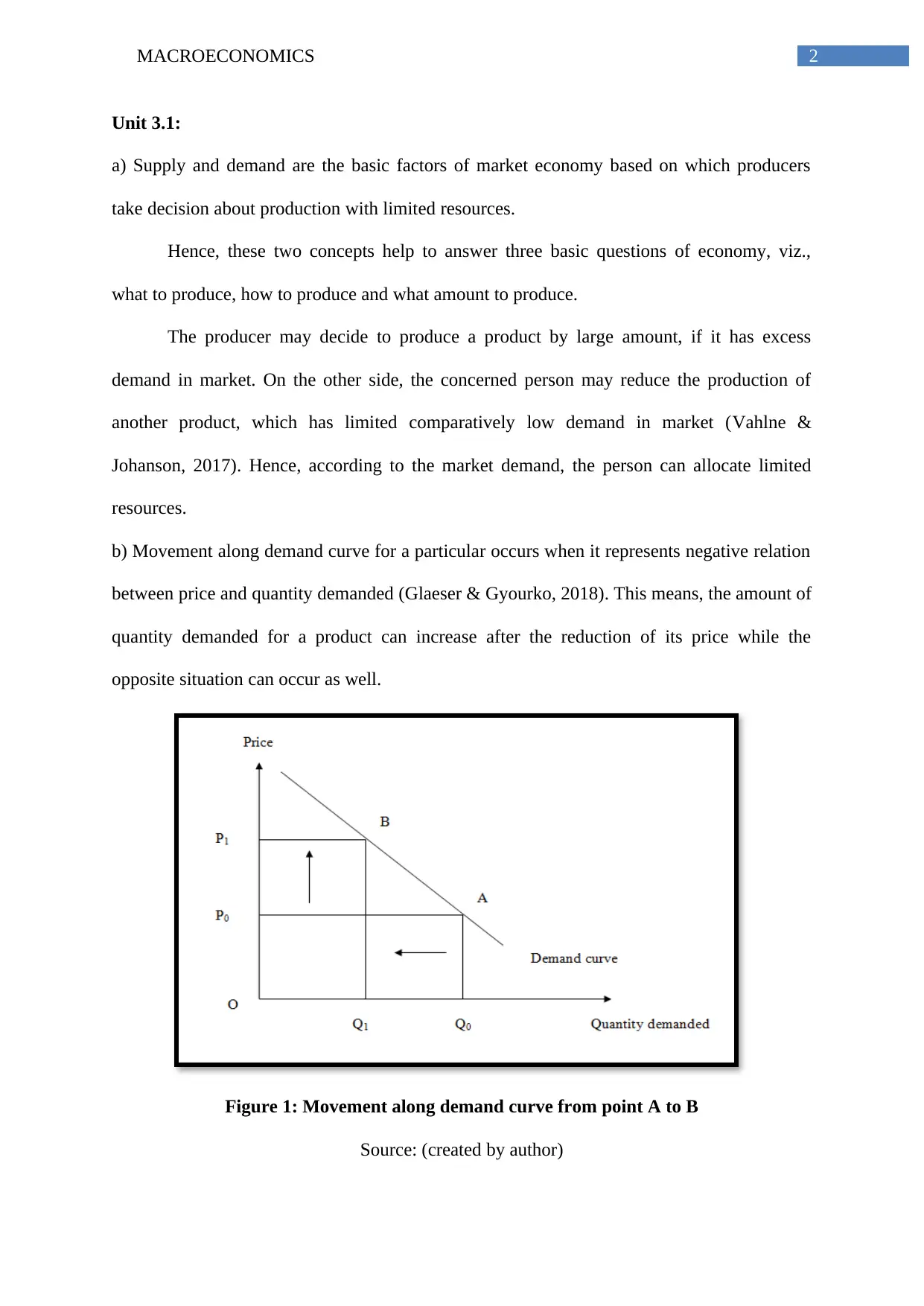
b) Movement along demand curve for a particular occurs when it represents negative relation
between price and quantity demanded (Glaeser & Gyourko, 2018). This means, the amount of
quantity demanded for a product can increase after the reduction of its price while the
opposite situation can occur as well.
Figure 1: Movement along demand curve from point A to B
Source: (created by author)
Unit 3.1:
a) Supply and demand are the basic factors of market economy based on which producers
take decision about production with limited resources.
Hence, these two concepts help to answer three basic questions of economy, viz.,
what to produce, how to produce and what amount to produce.
The producer may decide to produce a product by large amount, if it has excess
demand in market. On the other side, the concerned person may reduce the production of
another product, which has limited comparatively low demand in market (Vahlne &
Johanson, 2017). Hence, according to the market demand, the person can allocate limited
resources.
b) Movement along demand curve for a particular occurs when it represents negative relation
between price and quantity demanded (Glaeser & Gyourko, 2018). This means, the amount of
quantity demanded for a product can increase after the reduction of its price while the
opposite situation can occur as well.
Figure 1: Movement along demand curve from point A to B
Source: (created by author)
⊘ This is a preview!⊘
Do you want full access?
Subscribe today to unlock all pages.

Trusted by 1+ million students worldwide
3MACROECONOMICS
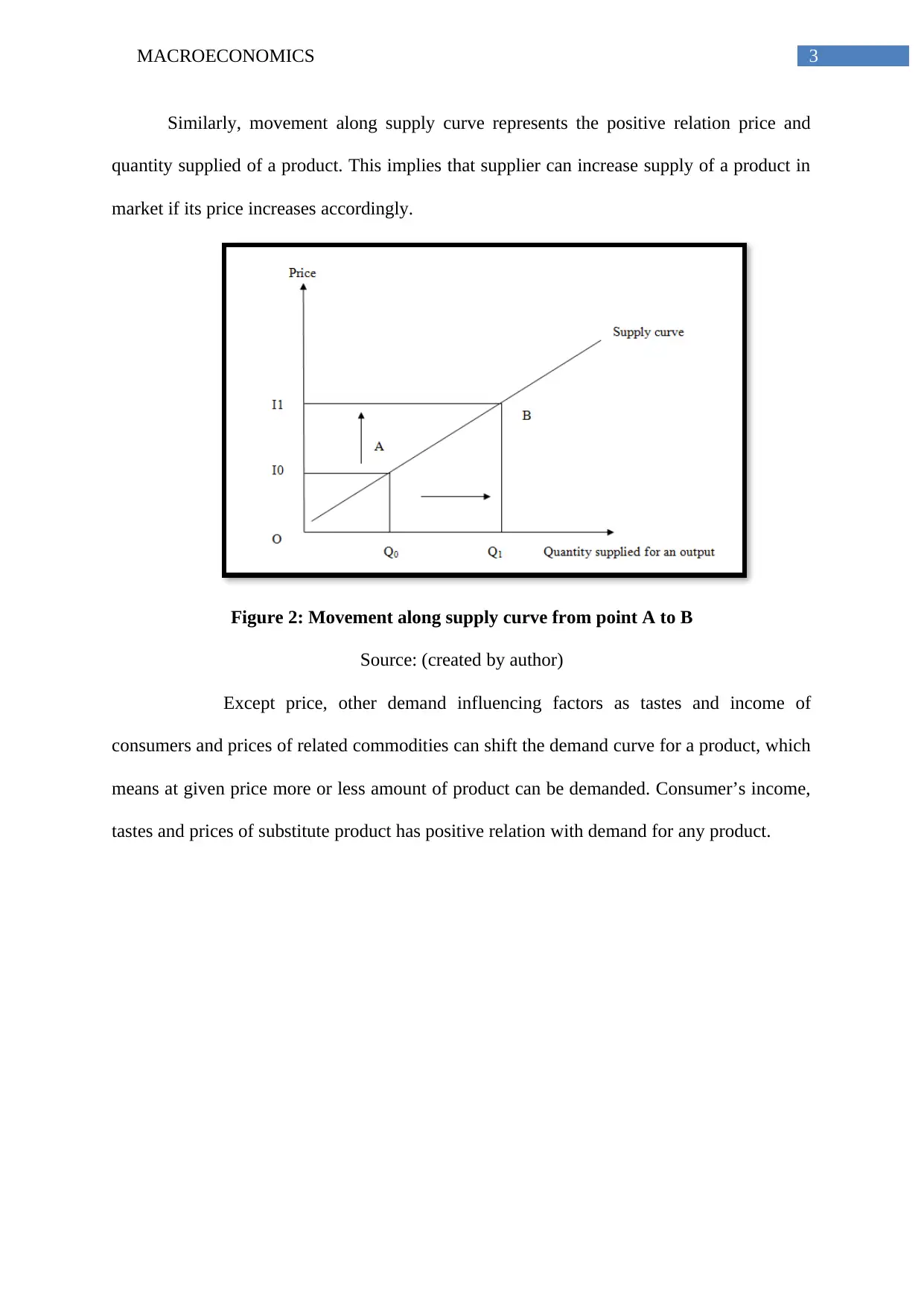
Similarly, movement along supply curve represents the positive relation price and
quantity supplied of a product. This implies that supplier can increase supply of a product in
market if its price increases accordingly.
Figure 2: Movement along supply curve from point A to B
Source: (created by author)
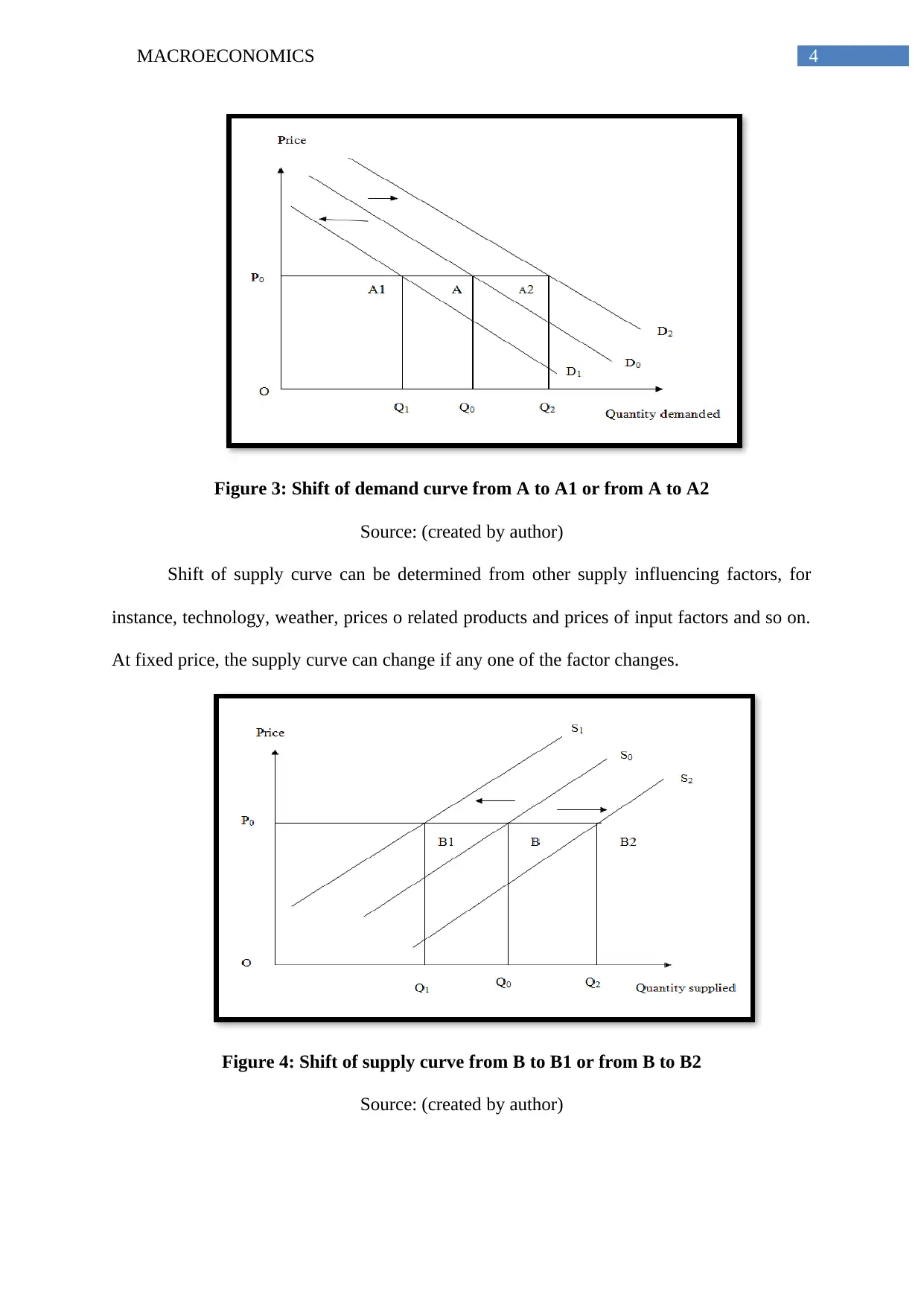
Except price, other demand influencing factors as tastes and income of
consumers and prices of related commodities can shift the demand curve for a product, which
means at given price more or less amount of product can be demanded. Consumer’s income,
tastes and prices of substitute product has positive relation with demand for any product.
Similarly, movement along supply curve represents the positive relation price and
quantity supplied of a product. This implies that supplier can increase supply of a product in
market if its price increases accordingly.
Figure 2: Movement along supply curve from point A to B
Source: (created by author)
Except price, other demand influencing factors as tastes and income of
consumers and prices of related commodities can shift the demand curve for a product, which
means at given price more or less amount of product can be demanded. Consumer’s income,
tastes and prices of substitute product has positive relation with demand for any product.
Paraphrase This Document
Need a fresh take? Get an instant paraphrase of this document with our AI Paraphraser
4MACROECONOMICS
Figure 3: Shift of demand curve from A to A1 or from A to A2
Source: (created by author)
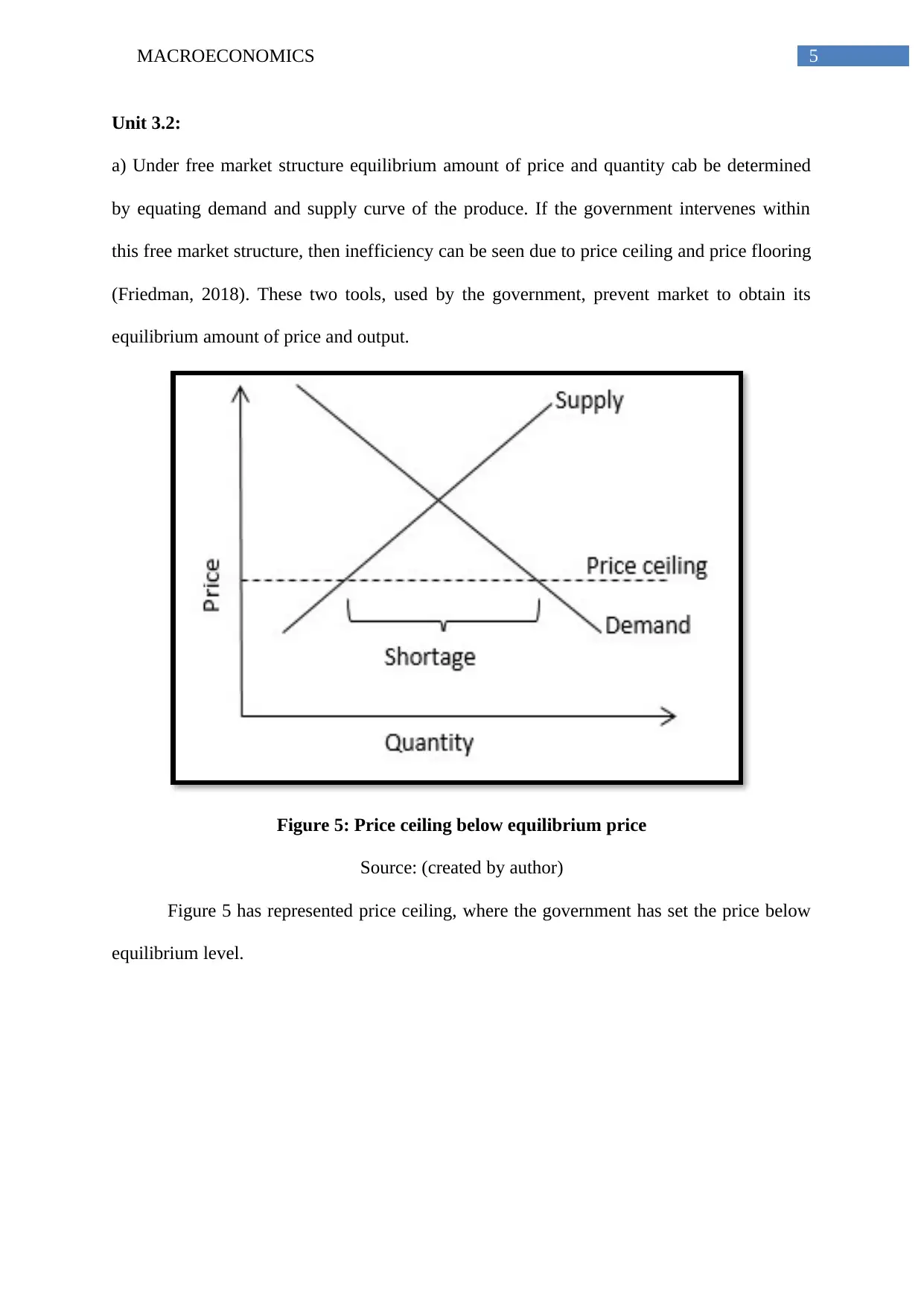
Shift of supply curve can be determined from other supply influencing factors, for
instance, technology, weather, prices o related products and prices of input factors and so on.
At fixed price, the supply curve can change if any one of the factor changes.
Figure 4: Shift of supply curve from B to B1 or from B to B2
Source: (created by author)
Figure 3: Shift of demand curve from A to A1 or from A to A2
Source: (created by author)
Shift of supply curve can be determined from other supply influencing factors, for
instance, technology, weather, prices o related products and prices of input factors and so on.
At fixed price, the supply curve can change if any one of the factor changes.
Figure 4: Shift of supply curve from B to B1 or from B to B2
Source: (created by author)
5MACROECONOMICS
Unit 3.2:
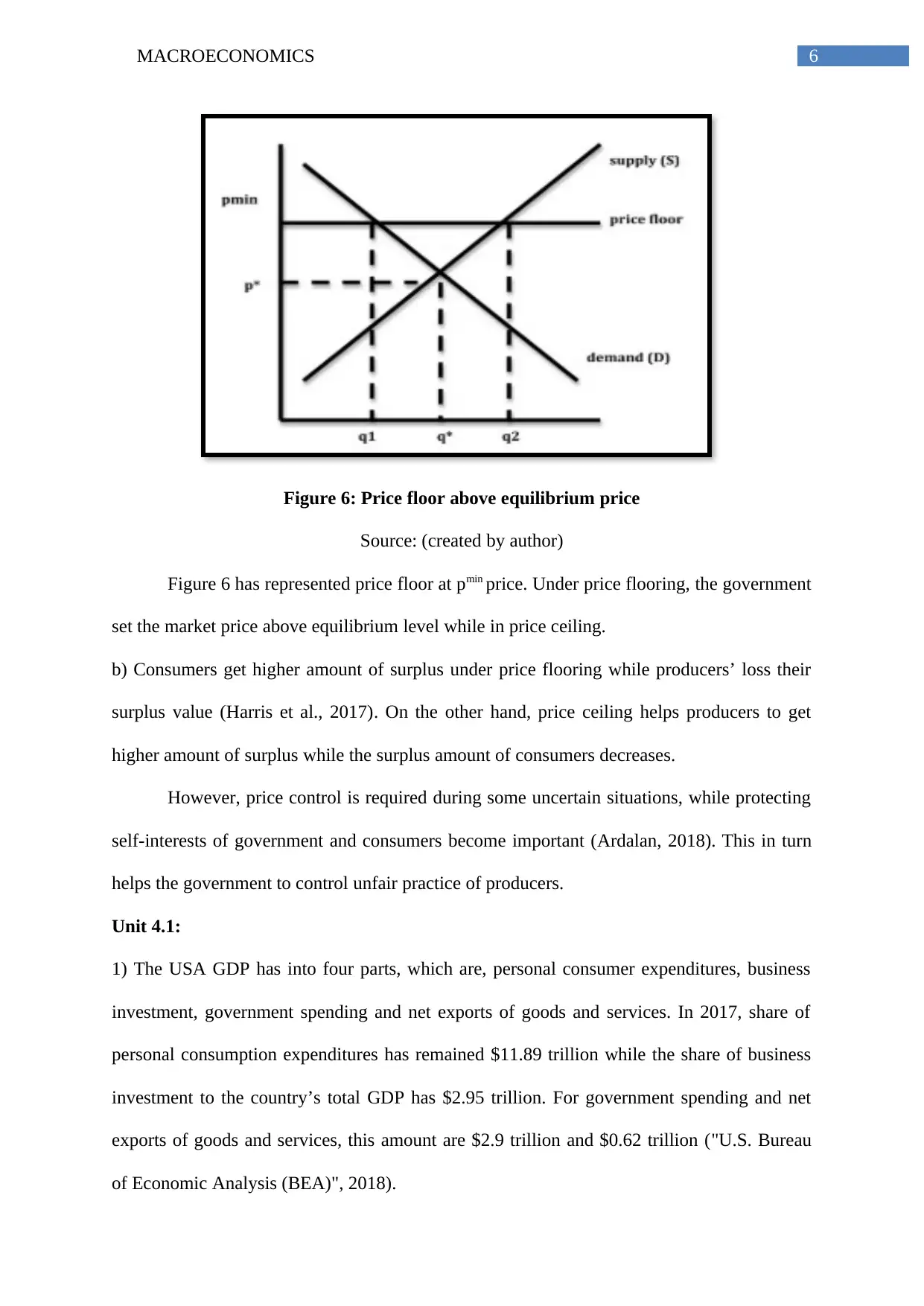
a) Under free market structure equilibrium amount of price and quantity cab be determined
by equating demand and supply curve of the produce. If the government intervenes within
this free market structure, then inefficiency can be seen due to price ceiling and price flooring
(Friedman, 2018). These two tools, used by the government, prevent market to obtain its
equilibrium amount of price and output.
Figure 5: Price ceiling below equilibrium price
Source: (created by author)
Figure 5 has represented price ceiling, where the government has set the price below
equilibrium level.
Unit 3.2:
a) Under free market structure equilibrium amount of price and quantity cab be determined
by equating demand and supply curve of the produce. If the government intervenes within
this free market structure, then inefficiency can be seen due to price ceiling and price flooring
(Friedman, 2018). These two tools, used by the government, prevent market to obtain its
equilibrium amount of price and output.
Figure 5: Price ceiling below equilibrium price
Source: (created by author)
Figure 5 has represented price ceiling, where the government has set the price below
equilibrium level.
⊘ This is a preview!⊘
Do you want full access?
Subscribe today to unlock all pages.
Trusted by 1+ million students worldwide
6MACROECONOMICS
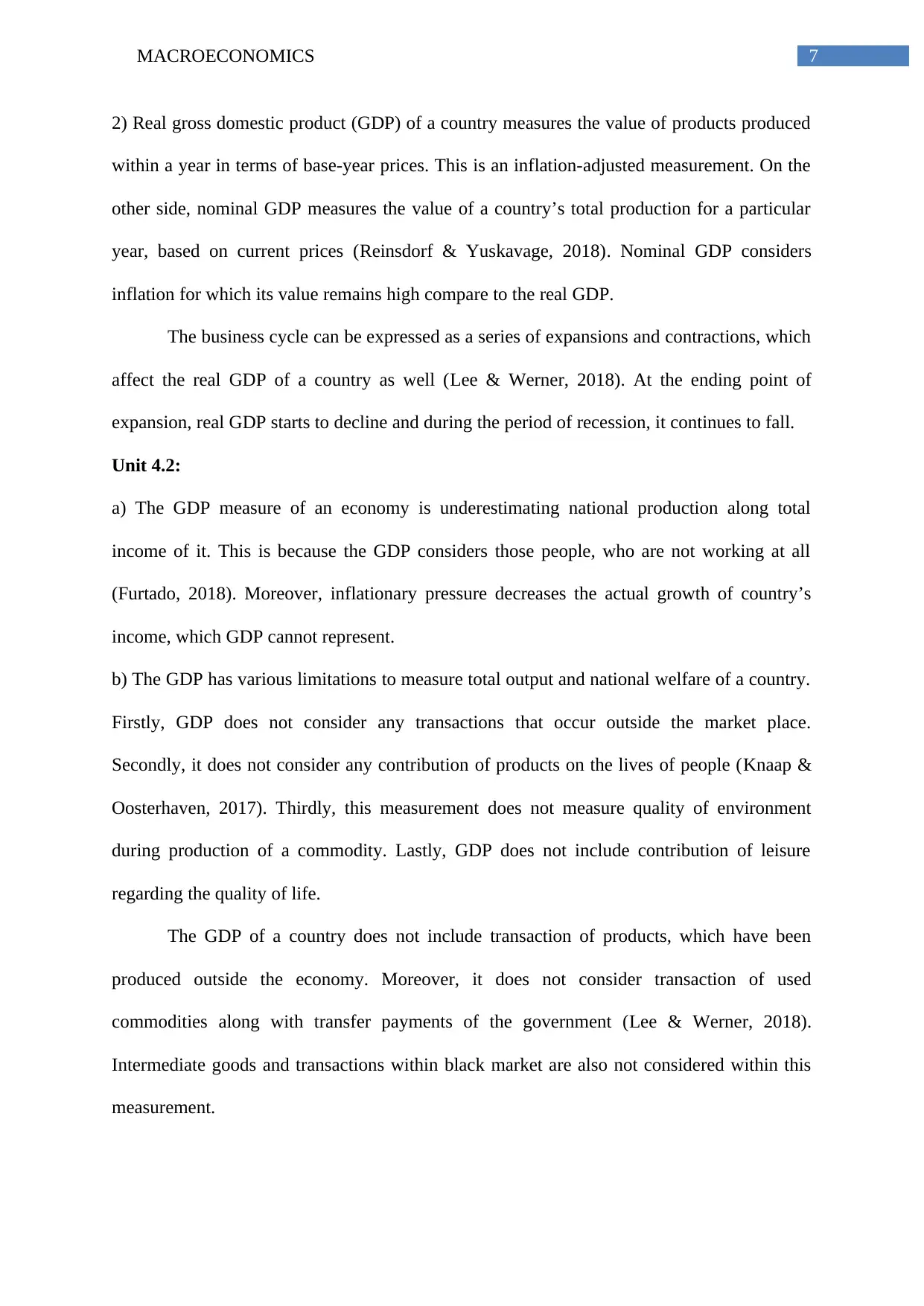
Figure 6: Price floor above equilibrium price
Source: (created by author)
Figure 6 has represented price floor at pmin price. Under price flooring, the government
set the market price above equilibrium level while in price ceiling.
b) Consumers get higher amount of surplus under price flooring while producers’ loss their
surplus value (Harris et al., 2017). On the other hand, price ceiling helps producers to get
higher amount of surplus while the surplus amount of consumers decreases.
However, price control is required during some uncertain situations, while protecting
self-interests of government and consumers become important (Ardalan, 2018). This in turn
helps the government to control unfair practice of producers.
Unit 4.1:
1) The USA GDP has into four parts, which are, personal consumer expenditures, business
investment, government spending and net exports of goods and services. In 2017, share of
personal consumption expenditures has remained $11.89 trillion while the share of business
investment to the country’s total GDP has $2.95 trillion. For government spending and net
exports of goods and services, this amount are $2.9 trillion and $0.62 trillion ("U.S. Bureau
of Economic Analysis (BEA)", 2018).
Figure 6: Price floor above equilibrium price
Source: (created by author)
Figure 6 has represented price floor at pmin price. Under price flooring, the government
set the market price above equilibrium level while in price ceiling.
b) Consumers get higher amount of surplus under price flooring while producers’ loss their
surplus value (Harris et al., 2017). On the other hand, price ceiling helps producers to get
higher amount of surplus while the surplus amount of consumers decreases.
However, price control is required during some uncertain situations, while protecting
self-interests of government and consumers become important (Ardalan, 2018). This in turn
helps the government to control unfair practice of producers.
Unit 4.1:
1) The USA GDP has into four parts, which are, personal consumer expenditures, business
investment, government spending and net exports of goods and services. In 2017, share of
personal consumption expenditures has remained $11.89 trillion while the share of business
investment to the country’s total GDP has $2.95 trillion. For government spending and net
exports of goods and services, this amount are $2.9 trillion and $0.62 trillion ("U.S. Bureau
of Economic Analysis (BEA)", 2018).
Paraphrase This Document
Need a fresh take? Get an instant paraphrase of this document with our AI Paraphraser
7MACROECONOMICS
2) Real gross domestic product (GDP) of a country measures the value of products produced
within a year in terms of base-year prices. This is an inflation-adjusted measurement. On the
other side, nominal GDP measures the value of a country’s total production for a particular
year, based on current prices (Reinsdorf & Yuskavage, 2018). Nominal GDP considers
inflation for which its value remains high compare to the real GDP.
The business cycle can be expressed as a series of expansions and contractions, which
affect the real GDP of a country as well (Lee & Werner, 2018). At the ending point of
expansion, real GDP starts to decline and during the period of recession, it continues to fall.
Unit 4.2:
a) The GDP measure of an economy is underestimating national production along total
income of it. This is because the GDP considers those people, who are not working at all
(Furtado, 2018). Moreover, inflationary pressure decreases the actual growth of country’s
income, which GDP cannot represent.
b) The GDP has various limitations to measure total output and national welfare of a country.
Firstly, GDP does not consider any transactions that occur outside the market place.
Secondly, it does not consider any contribution of products on the lives of people (Knaap &
Oosterhaven, 2017). Thirdly, this measurement does not measure quality of environment
during production of a commodity. Lastly, GDP does not include contribution of leisure
regarding the quality of life.
The GDP of a country does not include transaction of products, which have been
produced outside the economy. Moreover, it does not consider transaction of used
commodities along with transfer payments of the government (Lee & Werner, 2018).
Intermediate goods and transactions within black market are also not considered within this
measurement.
2) Real gross domestic product (GDP) of a country measures the value of products produced
within a year in terms of base-year prices. This is an inflation-adjusted measurement. On the
other side, nominal GDP measures the value of a country’s total production for a particular
year, based on current prices (Reinsdorf & Yuskavage, 2018). Nominal GDP considers
inflation for which its value remains high compare to the real GDP.
The business cycle can be expressed as a series of expansions and contractions, which
affect the real GDP of a country as well (Lee & Werner, 2018). At the ending point of
expansion, real GDP starts to decline and during the period of recession, it continues to fall.
Unit 4.2:
a) The GDP measure of an economy is underestimating national production along total
income of it. This is because the GDP considers those people, who are not working at all
(Furtado, 2018). Moreover, inflationary pressure decreases the actual growth of country’s
income, which GDP cannot represent.
b) The GDP has various limitations to measure total output and national welfare of a country.
Firstly, GDP does not consider any transactions that occur outside the market place.
Secondly, it does not consider any contribution of products on the lives of people (Knaap &
Oosterhaven, 2017). Thirdly, this measurement does not measure quality of environment
during production of a commodity. Lastly, GDP does not include contribution of leisure
regarding the quality of life.
The GDP of a country does not include transaction of products, which have been
produced outside the economy. Moreover, it does not consider transaction of used
commodities along with transfer payments of the government (Lee & Werner, 2018).
Intermediate goods and transactions within black market are also not considered within this
measurement.
8MACROECONOMICS
Unit 5.1:
a) Within an economy, various types of unemployment can be seen, for instance, frictional,
seasonal, technological, structural and cyclical. Those types of unemployment can be seen for
various economical conditions. Frictional unemployment generates when people change their
job. It is a temporary issue and consequently does not affect the economy in an adverse way
(Michaillat & Saez, 2015). Seasonal unemployment generates due to changing nature of
season, which in turn affects the business activities of some market, for instance, agriculture.
Technological unemployment occurs due to improvements of technology for which, workers
are replaced. Structural unemployment occurs during the structural changes of the economy
while cycle unemployment can be seen during the recession period within an economy. The
number of employed workers and unemployment rate can increase together if labour
participation rate increases within the economy (Dosi et al., 2016).
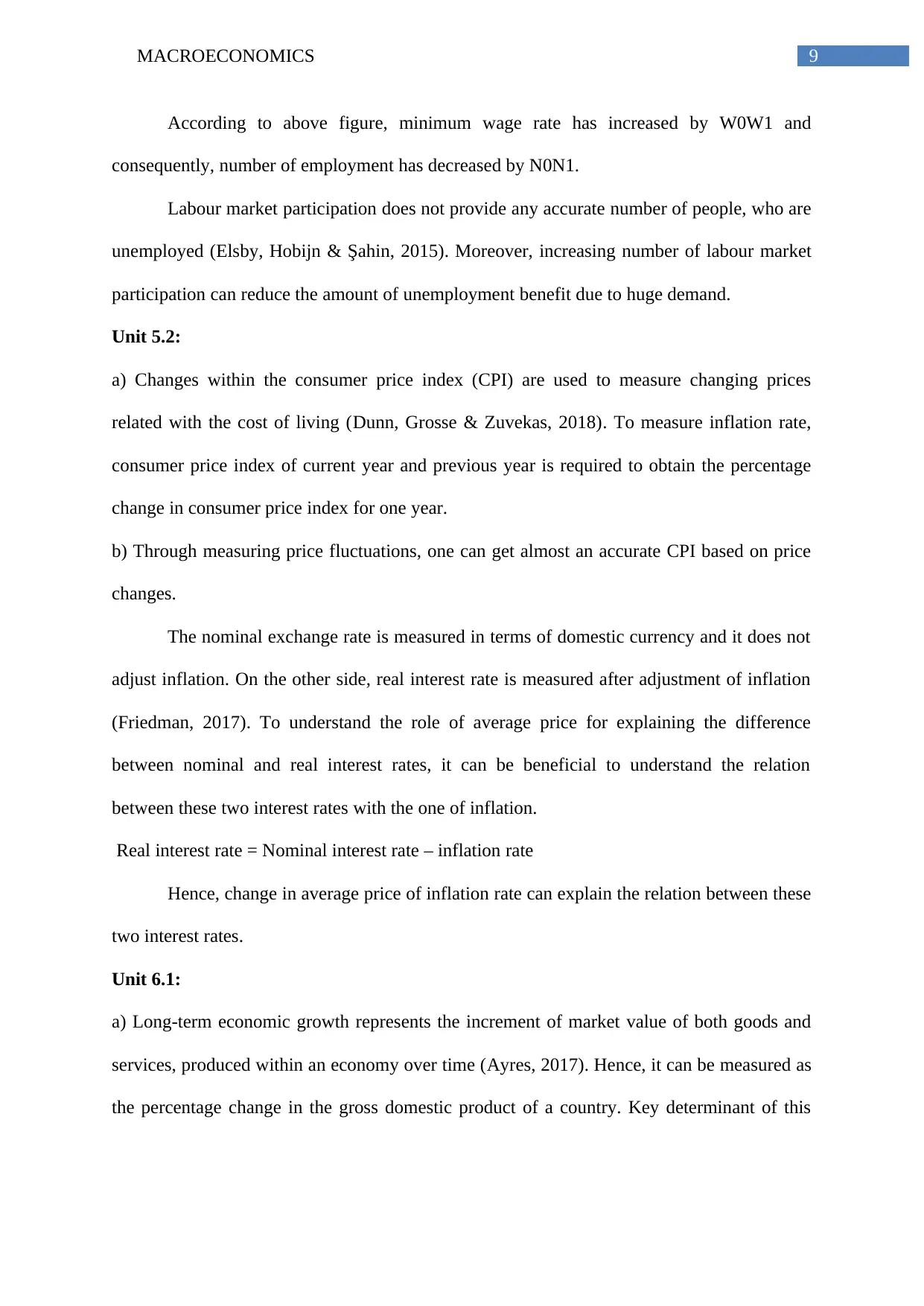
b) Wage rate and demand for labour has an inverse relationship. Hence, by increasing
minimum wage, producers can decrease their demand for labours, which in turn can increase
the unemployment rate within an economy (Deininger et al., 2018).
Figure 7: Impact of increasing minimum wage rate on labour market
Source: (created by author)
Unit 5.1:
a) Within an economy, various types of unemployment can be seen, for instance, frictional,
seasonal, technological, structural and cyclical. Those types of unemployment can be seen for
various economical conditions. Frictional unemployment generates when people change their
job. It is a temporary issue and consequently does not affect the economy in an adverse way
(Michaillat & Saez, 2015). Seasonal unemployment generates due to changing nature of
season, which in turn affects the business activities of some market, for instance, agriculture.
Technological unemployment occurs due to improvements of technology for which, workers
are replaced. Structural unemployment occurs during the structural changes of the economy
while cycle unemployment can be seen during the recession period within an economy. The
number of employed workers and unemployment rate can increase together if labour
participation rate increases within the economy (Dosi et al., 2016).
b) Wage rate and demand for labour has an inverse relationship. Hence, by increasing
minimum wage, producers can decrease their demand for labours, which in turn can increase
the unemployment rate within an economy (Deininger et al., 2018).
Figure 7: Impact of increasing minimum wage rate on labour market
Source: (created by author)
⊘ This is a preview!⊘
Do you want full access?
Subscribe today to unlock all pages.
Trusted by 1+ million students worldwide
9MACROECONOMICS
According to above figure, minimum wage rate has increased by W0W1 and
consequently, number of employment has decreased by N0N1.
Labour market participation does not provide any accurate number of people, who are
unemployed (Elsby, Hobijn & Şahin, 2015). Moreover, increasing number of labour market
participation can reduce the amount of unemployment benefit due to huge demand.
Unit 5.2:
a) Changes within the consumer price index (CPI) are used to measure changing prices
related with the cost of living (Dunn, Grosse & Zuvekas, 2018). To measure inflation rate,
consumer price index of current year and previous year is required to obtain the percentage
change in consumer price index for one year.
b) Through measuring price fluctuations, one can get almost an accurate CPI based on price
changes.
The nominal exchange rate is measured in terms of domestic currency and it does not
adjust inflation. On the other side, real interest rate is measured after adjustment of inflation
(Friedman, 2017). To understand the role of average price for explaining the difference
between nominal and real interest rates, it can be beneficial to understand the relation
between these two interest rates with the one of inflation.
Real interest rate = Nominal interest rate – inflation rate
Hence, change in average price of inflation rate can explain the relation between these
two interest rates.
Unit 6.1:
a) Long-term economic growth represents the increment of market value of both goods and
services, produced within an economy over time (Ayres, 2017). Hence, it can be measured as
the percentage change in the gross domestic product of a country. Key determinant of this
According to above figure, minimum wage rate has increased by W0W1 and
consequently, number of employment has decreased by N0N1.
Labour market participation does not provide any accurate number of people, who are
unemployed (Elsby, Hobijn & Şahin, 2015). Moreover, increasing number of labour market
participation can reduce the amount of unemployment benefit due to huge demand.
Unit 5.2:
a) Changes within the consumer price index (CPI) are used to measure changing prices
related with the cost of living (Dunn, Grosse & Zuvekas, 2018). To measure inflation rate,
consumer price index of current year and previous year is required to obtain the percentage
change in consumer price index for one year.
b) Through measuring price fluctuations, one can get almost an accurate CPI based on price
changes.
The nominal exchange rate is measured in terms of domestic currency and it does not
adjust inflation. On the other side, real interest rate is measured after adjustment of inflation
(Friedman, 2017). To understand the role of average price for explaining the difference
between nominal and real interest rates, it can be beneficial to understand the relation
between these two interest rates with the one of inflation.
Real interest rate = Nominal interest rate – inflation rate
Hence, change in average price of inflation rate can explain the relation between these
two interest rates.
Unit 6.1:
a) Long-term economic growth represents the increment of market value of both goods and
services, produced within an economy over time (Ayres, 2017). Hence, it can be measured as
the percentage change in the gross domestic product of a country. Key determinant of this
Paraphrase This Document
Need a fresh take? Get an instant paraphrase of this document with our AI Paraphraser
10MACROECONOMICS
long-term growth are demographic changes, growth of productivity and labour force
participation.
b) Economics growth and productivity has a positive relationship. Higher amount of
productivity leads a country to produce more amount of output at given technology compare
to before (Huchet‐Bourdon, Le Mouël & Vijil, 2018). Consequently, this higher amount of
revenue helps the country to increase its national income and to achieve economic growth as
well. The major source of increasing labour productivity is the technological improvement.
With modern technology, a labour can produce more amount of product with limited
resources at same time duration.
Unit 6.2:
a) Financial intermediaries and loanable funds help households and firms to deposit or
withdraw cash accordingly (Quartey, Danquah & Iddrisu, 2017). Hence, firms through these
financial institutions acquire funds and promote their production, which in turn helps the
economy to achieve economic growth. Firms collect funds from market to increase their
production through large amount of investment. On the contrary, households save money
within those institutions for earning interest rates.
b) Crowd out affects occur due to large amount of government borrowing (Quartey, Danquah
& Iddrisu, 2017).
Government deficit occurs when government spending exceeds its revenue.
Unit 7.1:
a) The Fed uses three types of instruments for its monetary policy (Baker, Bloom & Davis,
2016). Those instruments are discount rate, open market operation and reserve requirements.
b) Through contractionary monetary policy, the government controls inflation and stabilize
prices within market. Those are pros of this policy. On the contrary, this policy reduces
long-term growth are demographic changes, growth of productivity and labour force
participation.
b) Economics growth and productivity has a positive relationship. Higher amount of
productivity leads a country to produce more amount of output at given technology compare
to before (Huchet‐Bourdon, Le Mouël & Vijil, 2018). Consequently, this higher amount of
revenue helps the country to increase its national income and to achieve economic growth as
well. The major source of increasing labour productivity is the technological improvement.
With modern technology, a labour can produce more amount of product with limited
resources at same time duration.
Unit 6.2:
a) Financial intermediaries and loanable funds help households and firms to deposit or
withdraw cash accordingly (Quartey, Danquah & Iddrisu, 2017). Hence, firms through these
financial institutions acquire funds and promote their production, which in turn helps the
economy to achieve economic growth. Firms collect funds from market to increase their
production through large amount of investment. On the contrary, households save money
within those institutions for earning interest rates.
b) Crowd out affects occur due to large amount of government borrowing (Quartey, Danquah
& Iddrisu, 2017).
Government deficit occurs when government spending exceeds its revenue.
Unit 7.1:
a) The Fed uses three types of instruments for its monetary policy (Baker, Bloom & Davis,
2016). Those instruments are discount rate, open market operation and reserve requirements.
b) Through contractionary monetary policy, the government controls inflation and stabilize
prices within market. Those are pros of this policy. On the contrary, this policy reduces
11MACROECONOMICS
production and increase unemployment rate (Delis, Hasan & Mylonidis, 2017). On the other
side, through expansionary monetary policy, the economy gets opposite outcomes.
Contractionary monetary policy is more appropriate today as it helps to reduce
inflation within economy.
Unit 7.2:
a) Inflation tax refers the situation when the purchasing power parity (PPP) of consumers
reduces due to inflation (Al-Marhubi, 2018). When the government remain unable to charge
taxes on people, it creates inflation through printing money and this in turn reduces the
purchasing power of people.
During inflation, overall price level increases and consequently cost of living also
increases (Geromichalos & Herrenbrueck, 2016). This leads the people to save less amount of
money, which tends to investment to decrease further.
b) Relative prices measure value of one product in terms of others. This indicates relative
scarcity of goods and allocation of them efficiently (Fama & French, 2016). However,
changing in relative prices through inflation and changing in scarcity of commodities do not
have any relation and this consequently leads an inefficient allocation of resources and
commodities.
Unit 8.1:
a) The importance of aggregate supply (AS) and aggregate demand (AD) model is that, it can
represents a country’s goods and services for a particular time (Challe et al., 2017).
Moreover, it represents that an economy can suffer under recession through creating
unemployment, if it has an insufficient AD.
b) To shift the AD or AS curve, there are various factors exist within an economy. Those
factors are population, income, credit availability, wealth and government demand (Hein,
production and increase unemployment rate (Delis, Hasan & Mylonidis, 2017). On the other
side, through expansionary monetary policy, the economy gets opposite outcomes.
Contractionary monetary policy is more appropriate today as it helps to reduce
inflation within economy.
Unit 7.2:
a) Inflation tax refers the situation when the purchasing power parity (PPP) of consumers
reduces due to inflation (Al-Marhubi, 2018). When the government remain unable to charge
taxes on people, it creates inflation through printing money and this in turn reduces the
purchasing power of people.
During inflation, overall price level increases and consequently cost of living also
increases (Geromichalos & Herrenbrueck, 2016). This leads the people to save less amount of
money, which tends to investment to decrease further.
b) Relative prices measure value of one product in terms of others. This indicates relative
scarcity of goods and allocation of them efficiently (Fama & French, 2016). However,
changing in relative prices through inflation and changing in scarcity of commodities do not
have any relation and this consequently leads an inefficient allocation of resources and
commodities.
Unit 8.1:
a) The importance of aggregate supply (AS) and aggregate demand (AD) model is that, it can
represents a country’s goods and services for a particular time (Challe et al., 2017).
Moreover, it represents that an economy can suffer under recession through creating
unemployment, if it has an insufficient AD.
b) To shift the AD or AS curve, there are various factors exist within an economy. Those
factors are population, income, credit availability, wealth and government demand (Hein,
⊘ This is a preview!⊘
Do you want full access?
Subscribe today to unlock all pages.
Trusted by 1+ million students worldwide

1 out of 18


Related Documents


Your All-in-One AI-Powered Toolkit for Academic Success.
+13062052269
info@desklib.com
Available 24*7 on WhatsApp / Email
![[object Object]](/_next/static/media/star-bottom.7253800d.svg)
Unlock your academic potential
Copyright © 2020–2026 A2Z Services. All Rights Reserved. Developed and managed by ZUCOL.