Macroeconomics Report: Income Inequality in OECD Countries
VerifiedAdded on 2023/02/01
|7
|1379
|47
Report
AI Summary
This macroeconomics report investigates the growing issue of income inequality, particularly in the context of developing nations and the contrasting trend of budget consolidation in developed economies. The report analyzes the impact of external debt on developing countries, highlighting the significant debt burden and its implications, especially in the wake of the global financial crisis. It examines the demand for income redistribution policies to address inequality, while also discussing the governments' focus on budget consolidation packages. The study further explores income inequality in OECD countries, referencing the Kuznets curve and wage rate stagnation. The report includes a table showing income inequality in OECD countries and concludes that budget consolidation is a key strategy to address rising income inequality and promote economic growth. It references various sources to support its analysis.
Running head: Macroeconomics
MACROECONOMICS
Name of the student
Course Id
Course name:
MACROECONOMICS
Name of the student
Course Id
Course name:
Paraphrase This Document
Need a fresh take? Get an instant paraphrase of this document with our AI Paraphraser

1
Macroeconomics
Introduction
The study is considering the fact that with the emergence of income inequality in the
developing nation have urged the demand of income redistribution. However, the presence of
high public growth is forcing the government of developed nations to indulge into a policy of
budget consolidation package over income distribution. Most of the developed economics are
facing huge level of income inequality. This is important in the sense that after going through
the phase of development, trickle down strategy is going to be implemented as the intensive
amount of investment will definitely allow the economy to be under the domain of capitalists.
Body
The report that has been published by World bank’s global development finance
report in 2012 shows that total level of the external debt in stocks by the developing countries
increased by $437 billion over 12 months and they have stood at $4 trillion by the end of
2010. Due to prevalence of the global financial crisis, the debts for the cash rich western part
of the world is increasing by huge margin. The US had gross external debt amounting to
$14.3 trillion that was about 95% of the world GDP by 2010 (Mead, 2012). These external
debts mostly consisted of lending by commercial banks, governments, individuals or
international financial institutions in the form of IMF and World bank. On the other hand,
UK has owned about $9 trillion of external debt in the same period. The amount is about
400% of the GDP (Mead, 2012). However, most of the external debts that are owned by the
developed nations are balanced by the amount of the debts owned to them by other countries.
It is important aspect in the sense that the amount of debt that is owned by UK is through
banks and government. The amount of external debt that is owned to UK is around 20% that
is quite low compared to many developing countries. However, it has been seen that scenario
is not same in some of the poorest countries. It has been seen that about 40% of the external
Macroeconomics
Introduction
The study is considering the fact that with the emergence of income inequality in the
developing nation have urged the demand of income redistribution. However, the presence of
high public growth is forcing the government of developed nations to indulge into a policy of
budget consolidation package over income distribution. Most of the developed economics are
facing huge level of income inequality. This is important in the sense that after going through
the phase of development, trickle down strategy is going to be implemented as the intensive
amount of investment will definitely allow the economy to be under the domain of capitalists.
Body
The report that has been published by World bank’s global development finance
report in 2012 shows that total level of the external debt in stocks by the developing countries
increased by $437 billion over 12 months and they have stood at $4 trillion by the end of
2010. Due to prevalence of the global financial crisis, the debts for the cash rich western part
of the world is increasing by huge margin. The US had gross external debt amounting to
$14.3 trillion that was about 95% of the world GDP by 2010 (Mead, 2012). These external
debts mostly consisted of lending by commercial banks, governments, individuals or
international financial institutions in the form of IMF and World bank. On the other hand,
UK has owned about $9 trillion of external debt in the same period. The amount is about
400% of the GDP (Mead, 2012). However, most of the external debts that are owned by the
developed nations are balanced by the amount of the debts owned to them by other countries.
It is important aspect in the sense that the amount of debt that is owned by UK is through
banks and government. The amount of external debt that is owned to UK is around 20% that
is quite low compared to many developing countries. However, it has been seen that scenario
is not same in some of the poorest countries. It has been seen that about 40% of the external

2
Macroeconomics
debt stock is accounted by BRIC (Brazil, Russia, India and China) country. Jubilee Debt
Campaign (JDC) debt is still a huge concern for the developing countries. This is because, the
exports of these countries are decreasing, nationals working outside is having less money to
send at homes and multinational companies are contracting back investment and costs (Mead,
2012). The amount of external debt that is owned by the developing countries is around $4
trillion of external debt that is more than $1.5 billion repayments in a single day. This is an
important scenario in the sense the poor economies are having huge amount of external debt
but the developed nations are having high level of income inequality.
In order to respond to this growing inequality most of the economies and their
government is demanding the policy of income redistribution. But the growing level of
inequality is actually a concern for the government. In other words, taxation and distributing
the income to the poor sections of the economy is one of the best ways to reduce inequality
but the rich countries are paying less amount of tax (Imf.org, 2019). Taxing personal income
is almost 10 times lower than the GDP growth in advanced economies. In most of the
developing nations due to indulgence of regressive taxation, the rich peoples tend to save
more. It has been claimed that indirect amount of taxation may increase the poverty level in
the developing nations depending on the structure of tax and pattern of household
consumption. Most of the government is focussing mainly on the budget consolidation policy
that has been keen to restrain the consuming pattern of the developed nations (Imf.org, 2019).
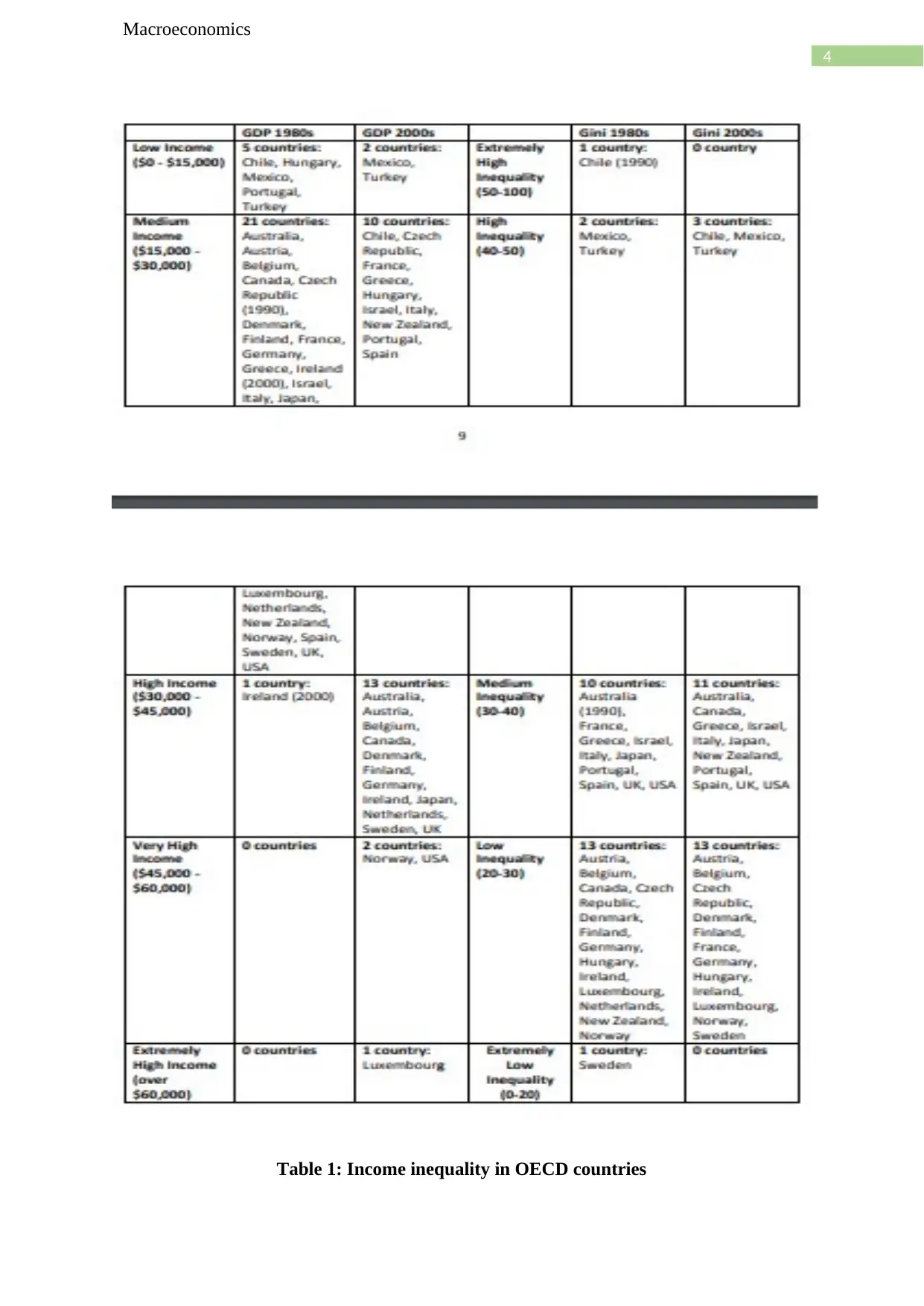
Income inequality in most of the OECD countries are increasing since 1980’s. In spite
of having increased level of income inequality the purchasing power parity is around 69.7%.
According to the Kuznets curve, UK and US have entered the stage of economic
development in the early 1980. This is important in the sense that in order to increase the
development of resource utilisation, the developed nations are growing. This is important in
the sensed that through the introduction of Kuznets curve, the developed nations are mainly
Macroeconomics
debt stock is accounted by BRIC (Brazil, Russia, India and China) country. Jubilee Debt
Campaign (JDC) debt is still a huge concern for the developing countries. This is because, the
exports of these countries are decreasing, nationals working outside is having less money to
send at homes and multinational companies are contracting back investment and costs (Mead,
2012). The amount of external debt that is owned by the developing countries is around $4
trillion of external debt that is more than $1.5 billion repayments in a single day. This is an
important scenario in the sense the poor economies are having huge amount of external debt
but the developed nations are having high level of income inequality.
In order to respond to this growing inequality most of the economies and their
government is demanding the policy of income redistribution. But the growing level of
inequality is actually a concern for the government. In other words, taxation and distributing
the income to the poor sections of the economy is one of the best ways to reduce inequality
but the rich countries are paying less amount of tax (Imf.org, 2019). Taxing personal income
is almost 10 times lower than the GDP growth in advanced economies. In most of the
developing nations due to indulgence of regressive taxation, the rich peoples tend to save
more. It has been claimed that indirect amount of taxation may increase the poverty level in
the developing nations depending on the structure of tax and pattern of household
consumption. Most of the government is focussing mainly on the budget consolidation policy
that has been keen to restrain the consuming pattern of the developed nations (Imf.org, 2019).
Income inequality in most of the OECD countries are increasing since 1980’s. In spite
of having increased level of income inequality the purchasing power parity is around 69.7%.
According to the Kuznets curve, UK and US have entered the stage of economic
development in the early 1980. This is important in the sense that in order to increase the
development of resource utilisation, the developed nations are growing. This is important in
the sensed that through the introduction of Kuznets curve, the developed nations are mainly
⊘ This is a preview!⊘
Do you want full access?
Subscribe today to unlock all pages.

Trusted by 1+ million students worldwide

3
Macroeconomics
prone to high income inequality because of the difference in standard of living of the people.
It is an important aspect in the sense that most of the developed nations will tend to hide their
income. Countries like Turkey is having 94.7% of market capitalisation by the listed
companies, Hungary is having a 81.4% of market capitalisation and Mexico around 76.19%
(Imf.org, 2019). Apart from all these, income inequalities are increasing because of low
growth in the wage rate. The employees are not getting desired level of the wage as per their
labour. They are getting less payment compared to their scheduled income and their
purchasing power of their income is decreasing as the price within the economy is increasing.
They are not being able to consume many baskets of goods. It is important for government to
go beyond the traditional level of policies and should indulge in the development of the better
economy.
Macroeconomics
prone to high income inequality because of the difference in standard of living of the people.
It is an important aspect in the sense that most of the developed nations will tend to hide their
income. Countries like Turkey is having 94.7% of market capitalisation by the listed
companies, Hungary is having a 81.4% of market capitalisation and Mexico around 76.19%
(Imf.org, 2019). Apart from all these, income inequalities are increasing because of low
growth in the wage rate. The employees are not getting desired level of the wage as per their
labour. They are getting less payment compared to their scheduled income and their
purchasing power of their income is decreasing as the price within the economy is increasing.
They are not being able to consume many baskets of goods. It is important for government to
go beyond the traditional level of policies and should indulge in the development of the better
economy.
Paraphrase This Document
Need a fresh take? Get an instant paraphrase of this document with our AI Paraphraser

4
Macroeconomics
Table 1: Income inequality in OECD countries
Macroeconomics
Table 1: Income inequality in OECD countries

5
Macroeconomics
(Source: Econ.jhu.edu, 2019)
Conclusion
The whole study is concluding the fact that in order to increase the economic growth
and highly rising income inequality, budget consolidation is one of the important strategies so
that they can put a restriction to the income inequality. Through the incorporation of income
distribution most of the developed nations will not pay individual level of tax. Through the
incorporation of better policy, the government will identify the resources and will increase
the income inequality. It has been seen that most of developed nations are having high growth
and mainly capitalist sector of the economy is mainly increasing income inequality.
Macroeconomics
(Source: Econ.jhu.edu, 2019)
Conclusion
The whole study is concluding the fact that in order to increase the economic growth
and highly rising income inequality, budget consolidation is one of the important strategies so
that they can put a restriction to the income inequality. Through the incorporation of income
distribution most of the developed nations will not pay individual level of tax. Through the
incorporation of better policy, the government will identify the resources and will increase
the income inequality. It has been seen that most of developed nations are having high growth
and mainly capitalist sector of the economy is mainly increasing income inequality.
⊘ This is a preview!⊘
Do you want full access?
Subscribe today to unlock all pages.

Trusted by 1+ million students worldwide

6
Macroeconomics
Reference list
Aguiar, M. and Bils, M., 2015. Has consumption inequality mirrored income inequality?.
American Economic Review, 105(9), pp.2725-56.
Dabla-Norris, M.E., Kochhar, M.K., Suphaphiphat, M.N., Ricka, M.F. and Tsounta, E., 2015.
Causes and consequences of income inequality: A global perspective. International Monetary
Fund.
Econ.jhu.edu. (2019). [online] Available at:
https://econ.jhu.edu/wp-content/uploads/sites/27/2016/02/Pini-The-Kuznets-Curve-and-
Inequality.pdf [Accessed 22 Apr. 2019].
Imf.org. (2019). [online] Available at:
https://www.imf.org/external/np/pp/eng/2014/012314.pdf [Accessed 22 Apr. 2019].
Mead, N. (2012). A developing world of debt. [online] the Guardian. Available at:
https://www.theguardian.com/global-development/poverty-matters/2012/may/15/developing-
world-of-debt [Accessed 22 Apr. 2019].
Pickett, K.E. and Wilkinson, R.G., 2015. Income inequality and health: a causal review.
Social science & medicine, 128, pp.316-326.
Solt, F., 2016. The standardized world income inequality database. Social science quarterly,
97(5), pp.1267-1281.
Summary, E., I, P., II, P., III, P., IV, P., V, P., us, A., Lab, W., Partners, F. and us, C. (2019).
Conclusion | World Inequality Report 2018. [online] Wir2018.wid.world. Available at:
https://wir2018.wid.world/conclusion.html [Accessed 22 Apr. 2019].
Macroeconomics
Reference list
Aguiar, M. and Bils, M., 2015. Has consumption inequality mirrored income inequality?.
American Economic Review, 105(9), pp.2725-56.
Dabla-Norris, M.E., Kochhar, M.K., Suphaphiphat, M.N., Ricka, M.F. and Tsounta, E., 2015.
Causes and consequences of income inequality: A global perspective. International Monetary
Fund.
Econ.jhu.edu. (2019). [online] Available at:
https://econ.jhu.edu/wp-content/uploads/sites/27/2016/02/Pini-The-Kuznets-Curve-and-
Inequality.pdf [Accessed 22 Apr. 2019].
Imf.org. (2019). [online] Available at:
https://www.imf.org/external/np/pp/eng/2014/012314.pdf [Accessed 22 Apr. 2019].
Mead, N. (2012). A developing world of debt. [online] the Guardian. Available at:
https://www.theguardian.com/global-development/poverty-matters/2012/may/15/developing-
world-of-debt [Accessed 22 Apr. 2019].
Pickett, K.E. and Wilkinson, R.G., 2015. Income inequality and health: a causal review.
Social science & medicine, 128, pp.316-326.
Solt, F., 2016. The standardized world income inequality database. Social science quarterly,
97(5), pp.1267-1281.
Summary, E., I, P., II, P., III, P., IV, P., V, P., us, A., Lab, W., Partners, F. and us, C. (2019).
Conclusion | World Inequality Report 2018. [online] Wir2018.wid.world. Available at:
https://wir2018.wid.world/conclusion.html [Accessed 22 Apr. 2019].
1 out of 7
Related Documents
Your All-in-One AI-Powered Toolkit for Academic Success.
+13062052269
info@desklib.com
Available 24*7 on WhatsApp / Email
Unlock your academic potential
Copyright © 2020–2025 A2Z Services. All Rights Reserved. Developed and managed by ZUCOL.