MBA 690: Macy's Mobile App - Product Life Cycle Management Analysis
VerifiedAdded on 2023/04/23
|14
|3816
|448
Report
AI Summary
This report provides a detailed analysis of the product life cycle management of Macy's mobile app, examining its journey through the introduction, growth, maturity, and decline phases. It discusses Macy's retail store overview, the mobile app's features, and strategies for each stage of the life cycle, including creating awareness, fortifying brand image, maximizing profitability, and reinvigorating the idea. The report also explores profit generation and cost-saving opportunities, phase-out plans, and the technologies used along the company’s supply chain, such as RFID tagging, bar coding, e-procurement, and 3PL. It further justifies the clicks or bricks decision, identifying key data needed to support inventory and supply chain management. This analysis provides insights into the future of the business and its sustainability in the marketplace.
Running head: PRODUCT LIFE CYCLE MANAGEMENT
Product Life Cycle Management
Name of the Student:
Name of the University:
Author’s Note:
Product Life Cycle Management
Name of the Student:
Name of the University:
Author’s Note:

Paraphrase This Document
Need a fresh take? Get an instant paraphrase of this document with our AI Paraphraser
1PRODUCT LIFE CYCLE MANAGEMENT
Table of Contents
Introduction................................................................................................................................2
Overview of Macy’s retail store.................................................................................................2
Mobile App of Macy’s retail store.............................................................................................3
Life Cycle of the mobile app idea..............................................................................................5
Introduction Phase..................................................................................................................5
Growth Phase.........................................................................................................................6
Maturity Phase.......................................................................................................................7
Decline Phase.........................................................................................................................7
Profit Generation and cost-saving opportunities........................................................................8
Phase-out Plan............................................................................................................................9
Conclusion................................................................................................................................10
References................................................................................................................................11
Table of Contents
Introduction................................................................................................................................2
Overview of Macy’s retail store.................................................................................................2
Mobile App of Macy’s retail store.............................................................................................3
Life Cycle of the mobile app idea..............................................................................................5
Introduction Phase..................................................................................................................5
Growth Phase.........................................................................................................................6
Maturity Phase.......................................................................................................................7
Decline Phase.........................................................................................................................7
Profit Generation and cost-saving opportunities........................................................................8
Phase-out Plan............................................................................................................................9
Conclusion................................................................................................................................10
References................................................................................................................................11
2PRODUCT LIFE CYCLE MANAGEMENT
Introduction
As opined by Stark (2015), the ever increasing competition within the business world
had made it imperative for the business firms to take into effective consideration the concept
of product life cycle. Wiesner et al. (2015) are of the viewpoint that the concept of product
life cycle can be defined as the combination of various stages through which a product
undergoes, right from its manufacture to its decline or extension with the other products
offered by the organisation. The four important stages or steps which are a part of the product
life cycle are introduction, growth, maturity and decline that are in synchronicity with the
changes in the marketing situation or the condition of the concerned product (Zhang et al.,
2017). This is perhaps one of the most important reasons why the different business
enterprises are designing their marketing strategies taking into effective consideration the
notion of product life cycle (MacCarthy et al., 2016). More importantly, it is seen that the
conditions in which a particular product is being sold changes overtime and thus the business
firms are required to utilise various strategies for the effective management of the different
stages through which the products offered by them goes through (Ayers & Odegaard, 2017).
Thus, the different business firms are increasingly resorting to the usage of the process of
product life cycle management for the formulation of the combination of strategies that are
likely to enhance the success of the products offered by them. This paper will discuss the
concept of product life cycle management in the particular context of the mobile app of the
organisation Macy’s retail store.
Overview of Macy’s retail store
Macy’s originally known as R. H. Macy & Co is the largest U.S departmental retail
store in terms of the sale of the products or services offered by it (Macys.com, 2019). The
retail chain was initially founded Rowland Hussey Macy in 1858 however in 1994 it became
Introduction
As opined by Stark (2015), the ever increasing competition within the business world
had made it imperative for the business firms to take into effective consideration the concept
of product life cycle. Wiesner et al. (2015) are of the viewpoint that the concept of product
life cycle can be defined as the combination of various stages through which a product
undergoes, right from its manufacture to its decline or extension with the other products
offered by the organisation. The four important stages or steps which are a part of the product
life cycle are introduction, growth, maturity and decline that are in synchronicity with the
changes in the marketing situation or the condition of the concerned product (Zhang et al.,
2017). This is perhaps one of the most important reasons why the different business
enterprises are designing their marketing strategies taking into effective consideration the
notion of product life cycle (MacCarthy et al., 2016). More importantly, it is seen that the
conditions in which a particular product is being sold changes overtime and thus the business
firms are required to utilise various strategies for the effective management of the different
stages through which the products offered by them goes through (Ayers & Odegaard, 2017).
Thus, the different business firms are increasingly resorting to the usage of the process of
product life cycle management for the formulation of the combination of strategies that are
likely to enhance the success of the products offered by them. This paper will discuss the
concept of product life cycle management in the particular context of the mobile app of the
organisation Macy’s retail store.
Overview of Macy’s retail store
Macy’s originally known as R. H. Macy & Co is the largest U.S departmental retail
store in terms of the sale of the products or services offered by it (Macys.com, 2019). The
retail chain was initially founded Rowland Hussey Macy in 1858 however in 1994 it became
⊘ This is a preview!⊘
Do you want full access?
Subscribe today to unlock all pages.

Trusted by 1+ million students worldwide
3PRODUCT LIFE CYCLE MANAGEMENT
a division of the Cincinnati-based Federated Department Stores (Macys.com, 2019). It was
through this merger that the retail chain was able to get affiliation to Bloomingdale's
department store chain and its name was changed to Macy’s Inc. (Macys.com, 2019). As per
the official website of the organisation it had more than “594 full-line stores” in different
parts of USA, Guam and Puerto Rico (Macys.com, 2019). The gross revenue generated by
the organisation for the year 2017 was $24.8 billion and it offers employment to more than
130,000 people in the above mentioned nations (Macys.com, 2019). More importantly, the
organisation is known for the wide range of products or services that it offers to the
customers starting from groceries to electronic goods, financial services and other similar
kind of services (Macys.com, 2019). However, in the recent times it is seen that the
organisation is facing various kinds of problems like fierce competition from its rivals in the
retail sector, the switching over of the customers to the e-commerce model of retail business
and others. The net result of this is that the organisation had experience a decline in its annual
revenue and also had to close some of its stores to compensate for the losses (Forbes.com,
2019). Thus, the organisation under discussion here in order to mitigate the adverse effects of
the challenges that it is presently facing in the retail sector of USA is trying to embrace the
omni-channel business model and thereby offer both e-commerce as well as ‘brick and
motor’ services to the customers. One of the most important initiatives taken by the
organisation in this regard is the launch of its mobile app through which the customers can
not only order the products or services offered by the concerned organisation but at the same
time make payments for the same as well.
Mobile App of Macy’s retail store
The mobile app of the organisation under discussion can be seen as an attempt on the
part of the organisation to enter into the field of e-commerce retail industry of the United
States of America which presently accounts for more than 60% of the entire retail industry
a division of the Cincinnati-based Federated Department Stores (Macys.com, 2019). It was
through this merger that the retail chain was able to get affiliation to Bloomingdale's
department store chain and its name was changed to Macy’s Inc. (Macys.com, 2019). As per
the official website of the organisation it had more than “594 full-line stores” in different
parts of USA, Guam and Puerto Rico (Macys.com, 2019). The gross revenue generated by
the organisation for the year 2017 was $24.8 billion and it offers employment to more than
130,000 people in the above mentioned nations (Macys.com, 2019). More importantly, the
organisation is known for the wide range of products or services that it offers to the
customers starting from groceries to electronic goods, financial services and other similar
kind of services (Macys.com, 2019). However, in the recent times it is seen that the
organisation is facing various kinds of problems like fierce competition from its rivals in the
retail sector, the switching over of the customers to the e-commerce model of retail business
and others. The net result of this is that the organisation had experience a decline in its annual
revenue and also had to close some of its stores to compensate for the losses (Forbes.com,
2019). Thus, the organisation under discussion here in order to mitigate the adverse effects of
the challenges that it is presently facing in the retail sector of USA is trying to embrace the
omni-channel business model and thereby offer both e-commerce as well as ‘brick and
motor’ services to the customers. One of the most important initiatives taken by the
organisation in this regard is the launch of its mobile app through which the customers can
not only order the products or services offered by the concerned organisation but at the same
time make payments for the same as well.
Mobile App of Macy’s retail store
The mobile app of the organisation under discussion can be seen as an attempt on the
part of the organisation to enter into the field of e-commerce retail industry of the United
States of America which presently accounts for more than 60% of the entire retail industry
Paraphrase This Document
Need a fresh take? Get an instant paraphrase of this document with our AI Paraphraser
4PRODUCT LIFE CYCLE MANAGEMENT
itself (Chen, Zhang & Zhao, 2017). More importantly, this app had been designed by the
organisation taking into effective consideration the ease as well as comfort level of the
customers so that the customers will not face any difficulty regarding the use of the app.
Furthermore, the customers through the use of this app would be able to order online the
groceries and other products offered by the organisations from the comfort of their home and
also receive home delivery as well. In addition to this, the organisation is offering the option
to the customers to either pay for these products or services over the app itself or when they
receive the delivery of these products or services in cash. Moreover, the customers in order to
download the app can access the official website of the organisation or can even download
the app from ‘Play Store’ as well. This app had designed by the organisation taking into
effective consideration the customers belonging to the tech-savvy segment and also for the
ones who do have the time to visit the retail stores of the concerned organisation. The
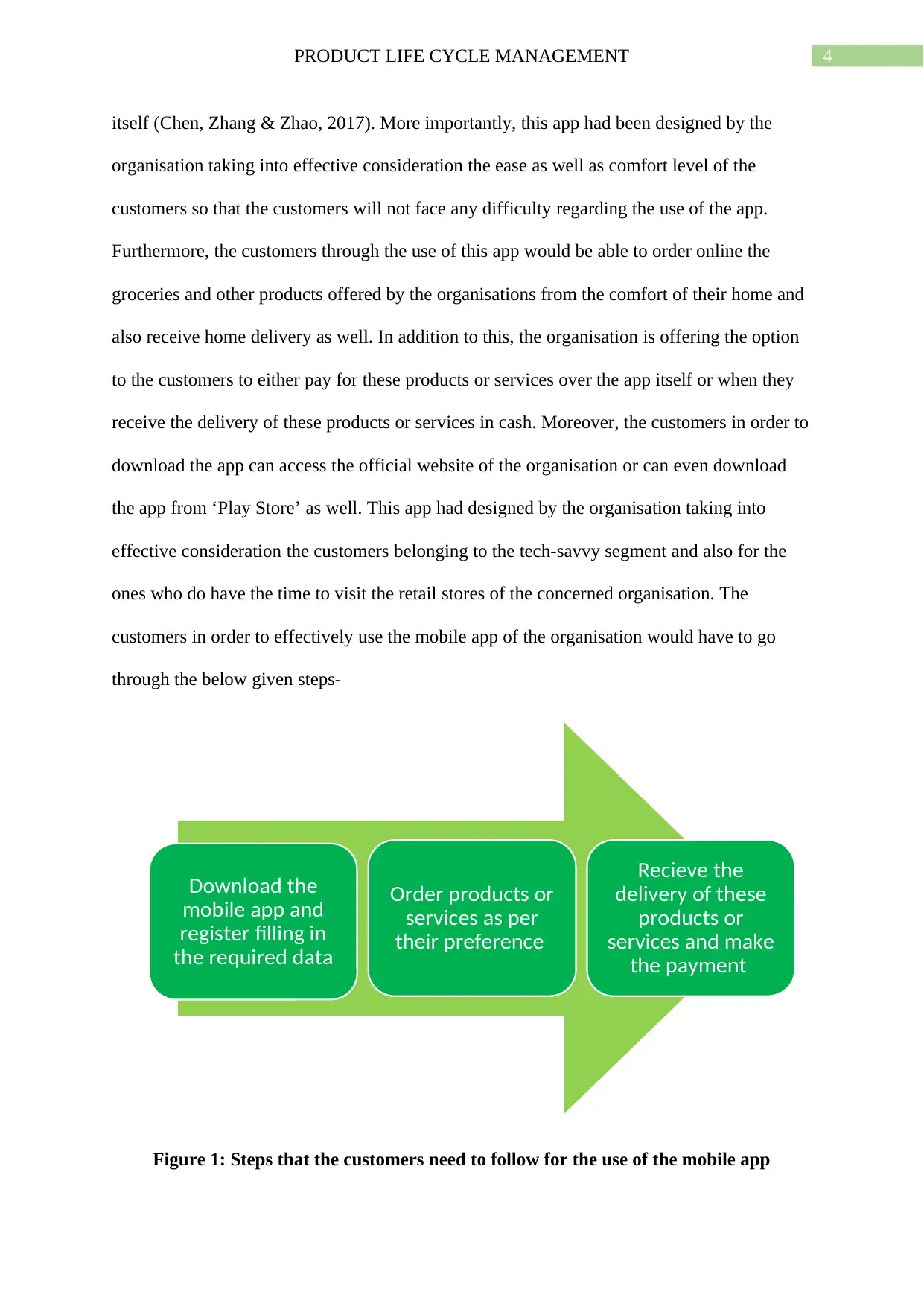
customers in order to effectively use the mobile app of the organisation would have to go
through the below given steps-
Figure 1: Steps that the customers need to follow for the use of the mobile app
Download the
mobile app and
register filling in
the required data
Order products or
services as per
their preference
Recieve the
delivery of these
products or
services and make
the payment
itself (Chen, Zhang & Zhao, 2017). More importantly, this app had been designed by the
organisation taking into effective consideration the ease as well as comfort level of the
customers so that the customers will not face any difficulty regarding the use of the app.
Furthermore, the customers through the use of this app would be able to order online the
groceries and other products offered by the organisations from the comfort of their home and
also receive home delivery as well. In addition to this, the organisation is offering the option
to the customers to either pay for these products or services over the app itself or when they
receive the delivery of these products or services in cash. Moreover, the customers in order to
download the app can access the official website of the organisation or can even download
the app from ‘Play Store’ as well. This app had designed by the organisation taking into
effective consideration the customers belonging to the tech-savvy segment and also for the
ones who do have the time to visit the retail stores of the concerned organisation. The
customers in order to effectively use the mobile app of the organisation would have to go
through the below given steps-
Figure 1: Steps that the customers need to follow for the use of the mobile app
Download the
mobile app and
register filling in
the required data
Order products or
services as per
their preference
Recieve the
delivery of these
products or
services and make
the payment
5PRODUCT LIFE CYCLE MANAGEMENT
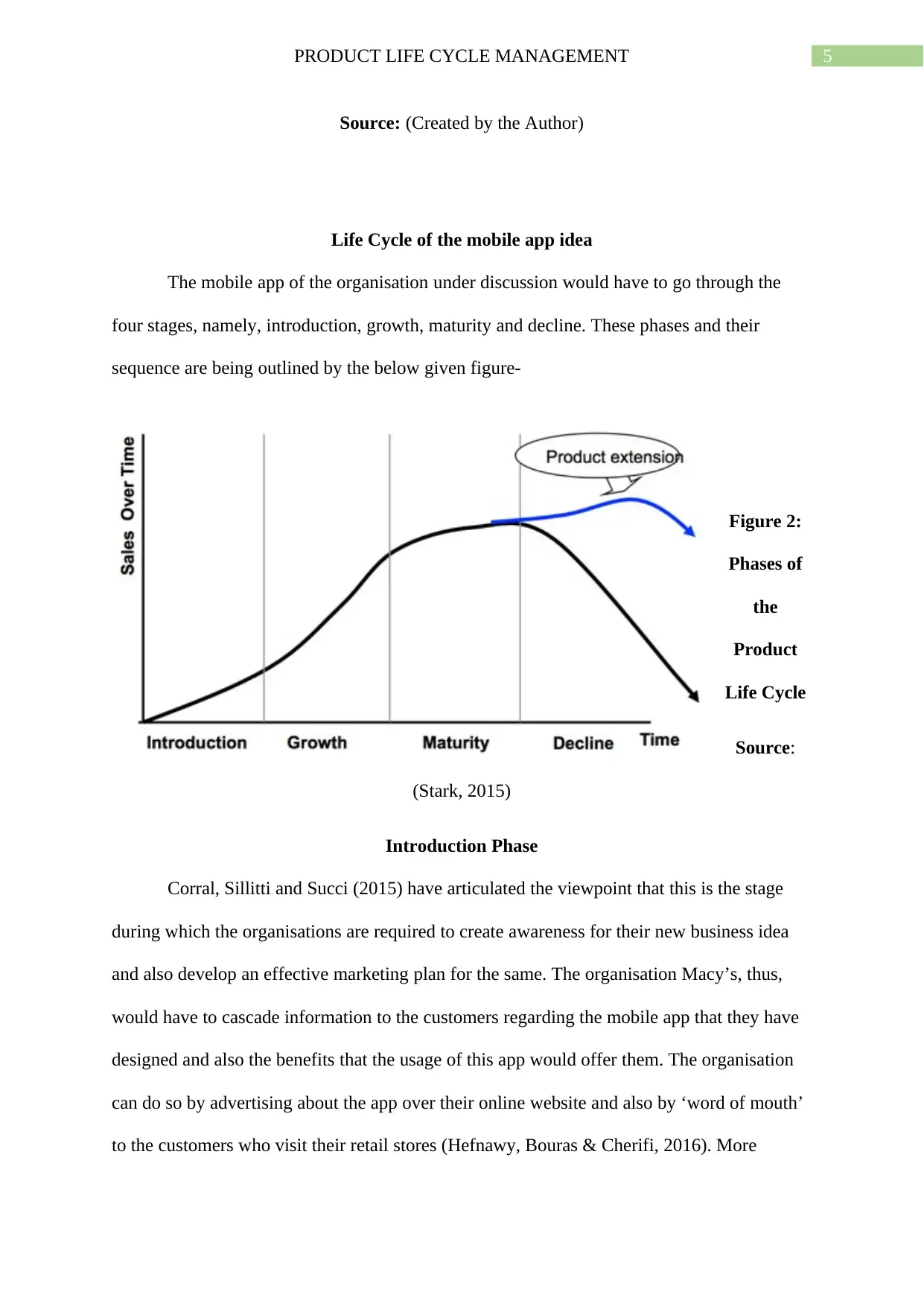
Source: (Created by the Author)
Life Cycle of the mobile app idea
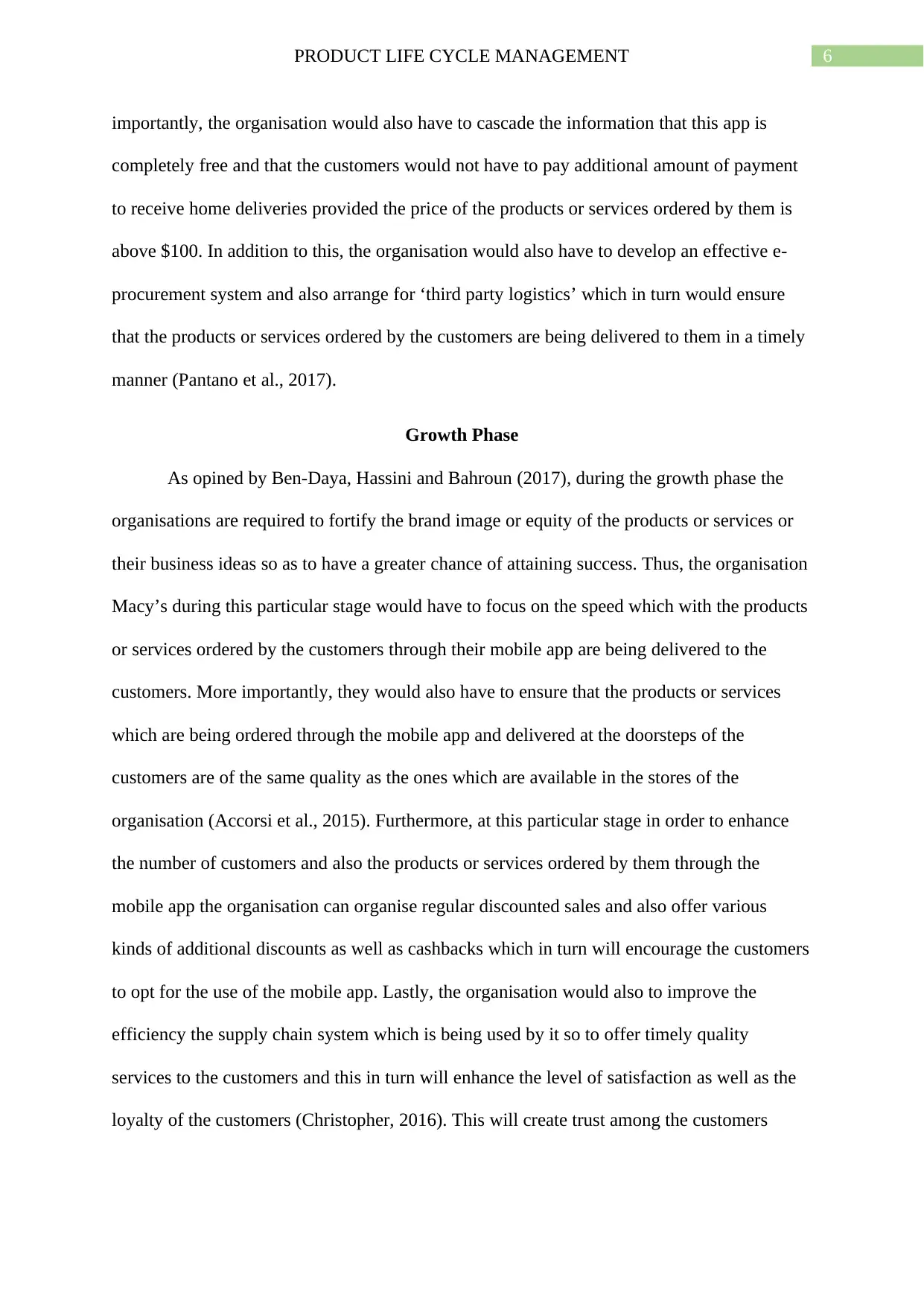
The mobile app of the organisation under discussion would have to go through the
four stages, namely, introduction, growth, maturity and decline. These phases and their
sequence are being outlined by the below given figure-
Figure 2:
Phases of
the
Product
Life Cycle
Source:
(Stark, 2015)
Introduction Phase
Corral, Sillitti and Succi (2015) have articulated the viewpoint that this is the stage
during which the organisations are required to create awareness for their new business idea
and also develop an effective marketing plan for the same. The organisation Macy’s, thus,
would have to cascade information to the customers regarding the mobile app that they have
designed and also the benefits that the usage of this app would offer them. The organisation
can do so by advertising about the app over their online website and also by ‘word of mouth’
to the customers who visit their retail stores (Hefnawy, Bouras & Cherifi, 2016). More
Source: (Created by the Author)
Life Cycle of the mobile app idea
The mobile app of the organisation under discussion would have to go through the
four stages, namely, introduction, growth, maturity and decline. These phases and their
sequence are being outlined by the below given figure-
Figure 2:
Phases of
the
Product
Life Cycle
Source:
(Stark, 2015)
Introduction Phase
Corral, Sillitti and Succi (2015) have articulated the viewpoint that this is the stage
during which the organisations are required to create awareness for their new business idea
and also develop an effective marketing plan for the same. The organisation Macy’s, thus,
would have to cascade information to the customers regarding the mobile app that they have
designed and also the benefits that the usage of this app would offer them. The organisation
can do so by advertising about the app over their online website and also by ‘word of mouth’
to the customers who visit their retail stores (Hefnawy, Bouras & Cherifi, 2016). More
⊘ This is a preview!⊘
Do you want full access?
Subscribe today to unlock all pages.
Trusted by 1+ million students worldwide
6PRODUCT LIFE CYCLE MANAGEMENT
importantly, the organisation would also have to cascade the information that this app is
completely free and that the customers would not have to pay additional amount of payment
to receive home deliveries provided the price of the products or services ordered by them is
above $100. In addition to this, the organisation would also have to develop an effective e-
procurement system and also arrange for ‘third party logistics’ which in turn would ensure
that the products or services ordered by the customers are being delivered to them in a timely
manner (Pantano et al., 2017).
Growth Phase
As opined by Ben-Daya, Hassini and Bahroun (2017), during the growth phase the
organisations are required to fortify the brand image or equity of the products or services or
their business ideas so as to have a greater chance of attaining success. Thus, the organisation
Macy’s during this particular stage would have to focus on the speed which with the products
or services ordered by the customers through their mobile app are being delivered to the
customers. More importantly, they would also have to ensure that the products or services
which are being ordered through the mobile app and delivered at the doorsteps of the
customers are of the same quality as the ones which are available in the stores of the
organisation (Accorsi et al., 2015). Furthermore, at this particular stage in order to enhance
the number of customers and also the products or services ordered by them through the
mobile app the organisation can organise regular discounted sales and also offer various
kinds of additional discounts as well as cashbacks which in turn will encourage the customers
to opt for the use of the mobile app. Lastly, the organisation would also to improve the
efficiency the supply chain system which is being used by it so to offer timely quality
services to the customers and this in turn will enhance the level of satisfaction as well as the
loyalty of the customers (Christopher, 2016). This will create trust among the customers
importantly, the organisation would also have to cascade the information that this app is
completely free and that the customers would not have to pay additional amount of payment
to receive home deliveries provided the price of the products or services ordered by them is
above $100. In addition to this, the organisation would also have to develop an effective e-
procurement system and also arrange for ‘third party logistics’ which in turn would ensure
that the products or services ordered by the customers are being delivered to them in a timely
manner (Pantano et al., 2017).
Growth Phase
As opined by Ben-Daya, Hassini and Bahroun (2017), during the growth phase the
organisations are required to fortify the brand image or equity of the products or services or
their business ideas so as to have a greater chance of attaining success. Thus, the organisation
Macy’s during this particular stage would have to focus on the speed which with the products
or services ordered by the customers through their mobile app are being delivered to the
customers. More importantly, they would also have to ensure that the products or services
which are being ordered through the mobile app and delivered at the doorsteps of the
customers are of the same quality as the ones which are available in the stores of the
organisation (Accorsi et al., 2015). Furthermore, at this particular stage in order to enhance
the number of customers and also the products or services ordered by them through the
mobile app the organisation can organise regular discounted sales and also offer various
kinds of additional discounts as well as cashbacks which in turn will encourage the customers
to opt for the use of the mobile app. Lastly, the organisation would also to improve the
efficiency the supply chain system which is being used by it so to offer timely quality
services to the customers and this in turn will enhance the level of satisfaction as well as the
loyalty of the customers (Christopher, 2016). This will create trust among the customers
Paraphrase This Document
Need a fresh take? Get an instant paraphrase of this document with our AI Paraphraser
7PRODUCT LIFE CYCLE MANAGEMENT
regarding the usage of the mobile app and the organisation would also be able to make a
higher amount of profit.
Maturity Phase
Li et al. (2015) are of the viewpoint that this is the stage during the success attained
by a particular business idea starts to diminish because of fierce competition from similar
business ideas and other factors. The net result of this is that the organisations try to not only
defend the market share that they hold but at the same time try to maximise their profitability
as well (Xing, Qian & Zaman, 2016). Likely, the organisation Macy’s and its mobile app is
also likely to face a significant amount of competition from the e-commerce model followed
by the other retail stores of USA and thereby would have to maximise their profitability from
the market share that they hold. The organisation for the attainment of this end can take the
help of the supply chain management strategy of time-based competition. The effective usage
of this strategy will help the organisation to reduce their product development cycle and also
the time that it is needed to deliver the products or services ordered by the customers through
their mobile app (Hsu, Tan & Zailani, 2016). In addition to this, the organisation can also
take the help of different kinds of technologies like RFID tagging, bar coding and others to
differentiate the products offered by them compared to the ones offered by the other similar
retail organisations (Nagashima et al., 2015). This will enable the organisation to attain a
unique position in the retail business market in terms of the differentiation of the products
offered by them and thereby enable it to maximise its profitability.
Decline Phase
Corral, Sillitti and Succi (2015) have noted that this is the stage during which the
success of the business idea of an organisation becomes stagnant and thus the organisations
are required to take the different kinds of strategies to reinvigorate the idea. Some of the most
important strategic options that are available to the organisations at this stage are merging the
regarding the usage of the mobile app and the organisation would also be able to make a
higher amount of profit.
Maturity Phase
Li et al. (2015) are of the viewpoint that this is the stage during the success attained
by a particular business idea starts to diminish because of fierce competition from similar
business ideas and other factors. The net result of this is that the organisations try to not only
defend the market share that they hold but at the same time try to maximise their profitability
as well (Xing, Qian & Zaman, 2016). Likely, the organisation Macy’s and its mobile app is
also likely to face a significant amount of competition from the e-commerce model followed
by the other retail stores of USA and thereby would have to maximise their profitability from
the market share that they hold. The organisation for the attainment of this end can take the
help of the supply chain management strategy of time-based competition. The effective usage
of this strategy will help the organisation to reduce their product development cycle and also
the time that it is needed to deliver the products or services ordered by the customers through
their mobile app (Hsu, Tan & Zailani, 2016). In addition to this, the organisation can also
take the help of different kinds of technologies like RFID tagging, bar coding and others to
differentiate the products offered by them compared to the ones offered by the other similar
retail organisations (Nagashima et al., 2015). This will enable the organisation to attain a
unique position in the retail business market in terms of the differentiation of the products
offered by them and thereby enable it to maximise its profitability.
Decline Phase
Corral, Sillitti and Succi (2015) have noted that this is the stage during which the
success of the business idea of an organisation becomes stagnant and thus the organisations
are required to take the different kinds of strategies to reinvigorate the idea. Some of the most
important strategic options that are available to the organisations at this stage are merging the
8PRODUCT LIFE CYCLE MANAGEMENT
business idea with the other thriving ideas of the organisation, liquidation of the idea,
reduction of cost and others (Pantano et al., 2017). The organisation under discussion here at
the decline phase of their mobile app idea would have to follow the above mentioned
strategies. The best possible measure that the organisation can follow is to merge this mobile
app idea with the other thriving business ideas that it is using to avoid a significant wastage
of capital as well as resources.
Profit Generation and cost-saving opportunities
The effective usage of the mobile app is likely to offer the maximum amount of
profitability to the organisation under discussion at the growth stage. More importantly, it is
during this stage that the organisation would be able to get the maximum number of
customers as well as the usage of the app and thereby the order of products or services
through the app (Hefnawy, Bouras & Cherifi, 2016). This in turn will offer the opportunity to
the organisation to maximise the amount of profit through the success of the business idea or
mobile app that they have developed. It is pertinent to note that the development of the
mobile app unlike the opening of new stores is not only likely to cost the organisation any
significant amount of expenditure and thus it is not likely to reduce the profitability of the
organisation (Chen, Zhang & Zhao, 2017). However, during the maturity as well as the
decline phase the organisation would have to take the help of different kinds of cost-saving
measures or take the help of the opportunities presented by the retail industry. In this regard,
some of the most important cost-saving opportunities that the organisation under discussion
here can utilise are the improvement of the inventory as well as distribution network, use of
time-based competition strategy to reduce the product development cycle and also speed-up
the delivery of products or services ordered through the mobile app, effective usage of
advertisements as well as promotions (Zhang et al., 2017). In addition to these, to lure the
customers to opt for the usage of the mobile app and through products or services online, the
business idea with the other thriving ideas of the organisation, liquidation of the idea,
reduction of cost and others (Pantano et al., 2017). The organisation under discussion here at
the decline phase of their mobile app idea would have to follow the above mentioned
strategies. The best possible measure that the organisation can follow is to merge this mobile
app idea with the other thriving business ideas that it is using to avoid a significant wastage
of capital as well as resources.
Profit Generation and cost-saving opportunities
The effective usage of the mobile app is likely to offer the maximum amount of
profitability to the organisation under discussion at the growth stage. More importantly, it is
during this stage that the organisation would be able to get the maximum number of
customers as well as the usage of the app and thereby the order of products or services
through the app (Hefnawy, Bouras & Cherifi, 2016). This in turn will offer the opportunity to
the organisation to maximise the amount of profit through the success of the business idea or
mobile app that they have developed. It is pertinent to note that the development of the
mobile app unlike the opening of new stores is not only likely to cost the organisation any
significant amount of expenditure and thus it is not likely to reduce the profitability of the
organisation (Chen, Zhang & Zhao, 2017). However, during the maturity as well as the
decline phase the organisation would have to take the help of different kinds of cost-saving
measures or take the help of the opportunities presented by the retail industry. In this regard,
some of the most important cost-saving opportunities that the organisation under discussion
here can utilise are the improvement of the inventory as well as distribution network, use of
time-based competition strategy to reduce the product development cycle and also speed-up
the delivery of products or services ordered through the mobile app, effective usage of
advertisements as well as promotions (Zhang et al., 2017). In addition to these, to lure the
customers to opt for the usage of the mobile app and through products or services online, the
⊘ This is a preview!⊘
Do you want full access?
Subscribe today to unlock all pages.
Trusted by 1+ million students worldwide
9PRODUCT LIFE CYCLE MANAGEMENT
organisation can offer these products or services at discounted rates and also offer combo-
offers to enhance the usage of the app and also the sale of the products or services offered by
it (MacCarthy et al., 2016).
Phase-out Plan
The best possible phase-out plan that the organisation Macy’s can use for the mobile
app that they have formulated is to integrate it with the other innovative services used as well
as offered by it to the customers. For example, the organisation in order to reinvigorate the
mobile app and also to avoid the wastage of capital as well as resources that it had spent on
the app can merge it with the other e-commerce strategies used by it like ordering products or
services via phone calls, through the official website of the organisation and others (Stark,
2015). However, to do so in an effective as well as sustainable manner so that this app makes
way for future innovation and profit streams the organisation would have to follow three
steps, namely, the planning process, the actual phase-out process and finally collection of
feedback (Li et al., 2015).
In the first stage, that is, the planning process, the organisation would have to analyse
the market demand as well as the benefits offered by the app and decide whether it wants to
phase-out the app or not (Hsu, Tan & Zailani, 2016). Furthermore, the organisation would
have to chalk out a detailed action plan for the same. In the second stage, the organisation
would have to actually implement the action plan that it had formulated like conveying the
information to the users regarding the phasing-out of the app, the reasons for the same, the
information that the app will be merged with the other similar e-commerce services like
ordering products or services through phone calls and others (Hefnawy, Bouras & Cherifi,
2016). In the final stage, the organisation would collect feedbacks from the users regarding
the positive and negative aspects as well as the manner in which the app could have been
improved and integrating them within the framework of the new service that had been
organisation can offer these products or services at discounted rates and also offer combo-
offers to enhance the usage of the app and also the sale of the products or services offered by
it (MacCarthy et al., 2016).
Phase-out Plan
The best possible phase-out plan that the organisation Macy’s can use for the mobile
app that they have formulated is to integrate it with the other innovative services used as well
as offered by it to the customers. For example, the organisation in order to reinvigorate the
mobile app and also to avoid the wastage of capital as well as resources that it had spent on
the app can merge it with the other e-commerce strategies used by it like ordering products or
services via phone calls, through the official website of the organisation and others (Stark,
2015). However, to do so in an effective as well as sustainable manner so that this app makes
way for future innovation and profit streams the organisation would have to follow three
steps, namely, the planning process, the actual phase-out process and finally collection of
feedback (Li et al., 2015).
In the first stage, that is, the planning process, the organisation would have to analyse
the market demand as well as the benefits offered by the app and decide whether it wants to
phase-out the app or not (Hsu, Tan & Zailani, 2016). Furthermore, the organisation would
have to chalk out a detailed action plan for the same. In the second stage, the organisation
would have to actually implement the action plan that it had formulated like conveying the
information to the users regarding the phasing-out of the app, the reasons for the same, the
information that the app will be merged with the other similar e-commerce services like
ordering products or services through phone calls and others (Hefnawy, Bouras & Cherifi,
2016). In the final stage, the organisation would collect feedbacks from the users regarding
the positive and negative aspects as well as the manner in which the app could have been
improved and integrating them within the framework of the new service that had been
Paraphrase This Document
Need a fresh take? Get an instant paraphrase of this document with our AI Paraphraser
10PRODUCT LIFE CYCLE MANAGEMENT
developed through the merger of this app and the phone call service so as to enhance its
efficiency and sustainability.
Conclusion
To conclude, the concept of product life cycle management had gained a significant
amount of prominence within the cannon of the contemporary business world because of the
benefits that it offers to the organisations. For example, it enables the organisations to
formulate effective marketing or promotional plans for the products or services depending on
the product life cycle phase at which the concerned product is. More importantly, it also helps
the organisations to take the help of various kinds of strategies like cost-saving opportunities
and others through the usage of which they can maximise the profit from the existing market
share that the concerned product holds. These aspects of the process of product life cycle
management become apparent from the above analysis of the mobile app of the retail
organisation Macy’s.
developed through the merger of this app and the phone call service so as to enhance its
efficiency and sustainability.
Conclusion
To conclude, the concept of product life cycle management had gained a significant
amount of prominence within the cannon of the contemporary business world because of the
benefits that it offers to the organisations. For example, it enables the organisations to
formulate effective marketing or promotional plans for the products or services depending on
the product life cycle phase at which the concerned product is. More importantly, it also helps
the organisations to take the help of various kinds of strategies like cost-saving opportunities
and others through the usage of which they can maximise the profit from the existing market
share that the concerned product holds. These aspects of the process of product life cycle
management become apparent from the above analysis of the mobile app of the retail
organisation Macy’s.
11PRODUCT LIFE CYCLE MANAGEMENT
References
Accorsi, R., Manzini, R., Pini, C., & Penazzi, S. (2015). On the design of closed-loop
networks for product life cycle management: Economic, environmental and
geography considerations. Journal of Transport Geography, 48, 121-134.
Ayers, J. B., & Odegaard, M. A. (2017). Retail supply chain management. CRC Press.
Ben-Daya, M., Hassini, E., & Bahroun, Z. (2017). Internet of things and supply chain
management: a literature review. International Journal of Production Research, 1-24.
Chen, Q., Zhang, M., & Zhao, X. (2017). Analysing customer behaviour in mobile app
usage. Industrial Management & Data Systems, 117(2), 425-438.
Christopher, M. (2016). Logistics & supply chain management. Pearson UK.
Corral, L., Sillitti, A., & Succi, G. (2015). Software assurance practices for mobile
applications. Computing, 97(10), 1001-1022.
Forbes.com, (2019). Brick-And-Mortar Retail Is Not Dead, But Department Stores Like
Macy's Sure Are. Retrieved from
https://www.forbes.com/sites/christopherwalton/2019/01/10/physical-retail-is-not-
dead-but-department-stores-like-macys-sure-are/#6b5dbf48dd0e
Hefnawy, A., Bouras, A., & Cherifi, C. (2016, March). Iot for smart city services: Lifecycle
approach. In Proceedings of the International Conference on Internet of things and
Cloud Computing (p. 55). ACM.
Hsu, C. C., Tan, K. C., & Mohamad Zailani, S. H. (2016). Strategic orientations, sustainable
supply chain initiatives, and reverse logistics: Empirical evidence from an emerging
market. International Journal of Operations & Production Management, 36(1), 86-
110.
References
Accorsi, R., Manzini, R., Pini, C., & Penazzi, S. (2015). On the design of closed-loop
networks for product life cycle management: Economic, environmental and
geography considerations. Journal of Transport Geography, 48, 121-134.
Ayers, J. B., & Odegaard, M. A. (2017). Retail supply chain management. CRC Press.
Ben-Daya, M., Hassini, E., & Bahroun, Z. (2017). Internet of things and supply chain
management: a literature review. International Journal of Production Research, 1-24.
Chen, Q., Zhang, M., & Zhao, X. (2017). Analysing customer behaviour in mobile app
usage. Industrial Management & Data Systems, 117(2), 425-438.
Christopher, M. (2016). Logistics & supply chain management. Pearson UK.
Corral, L., Sillitti, A., & Succi, G. (2015). Software assurance practices for mobile
applications. Computing, 97(10), 1001-1022.
Forbes.com, (2019). Brick-And-Mortar Retail Is Not Dead, But Department Stores Like
Macy's Sure Are. Retrieved from
https://www.forbes.com/sites/christopherwalton/2019/01/10/physical-retail-is-not-
dead-but-department-stores-like-macys-sure-are/#6b5dbf48dd0e
Hefnawy, A., Bouras, A., & Cherifi, C. (2016, March). Iot for smart city services: Lifecycle
approach. In Proceedings of the International Conference on Internet of things and
Cloud Computing (p. 55). ACM.
Hsu, C. C., Tan, K. C., & Mohamad Zailani, S. H. (2016). Strategic orientations, sustainable
supply chain initiatives, and reverse logistics: Empirical evidence from an emerging
market. International Journal of Operations & Production Management, 36(1), 86-
110.
⊘ This is a preview!⊘
Do you want full access?
Subscribe today to unlock all pages.
Trusted by 1+ million students worldwide

1 out of 14


Related Documents


Your All-in-One AI-Powered Toolkit for Academic Success.
+13062052269
info@desklib.com
Available 24*7 on WhatsApp / Email
![[object Object]](/_next/static/media/star-bottom.7253800d.svg)
Unlock your academic potential
Copyright © 2020–2026 A2Z Services. All Rights Reserved. Developed and managed by ZUCOL.