Case Study Analysis: Sustainability and Ethics at Mahindra & Mahindra
VerifiedAdded on 2020/10/04
|11
|3940
|454
Case Study
AI Summary
This case study examines Mahindra & Mahindra, an Indian automotive company, focusing on its approach to sustainability, ethics, and corporate governance. The report provides an overview of the company's history, operations, and achievements, highlighting its involvement in various sectors like automobiles, defense, and farm equipment. The core of the study revolves around a critical assessment of challenges faced by Mahindra, including integrating sustainable practices, managing waste disposal, addressing ethical conflicts among employees, and adapting to changing political and economic environments. The study analyzes issues such as the adoption of new technologies, environmental responsibilities, and the impact of economic fluctuations on the company's profitability. The case study also explores the problems faced by the company in maintaining a sustainable work environment and the dilemma faced by managers in making decisions. The report concludes with recommendations for addressing these challenges and ensuring the company's long-term sustainability and ethical conduct.
CASE STUDY

Paraphrase This Document
Need a fresh take? Get an instant paraphrase of this document with our AI Paraphraser
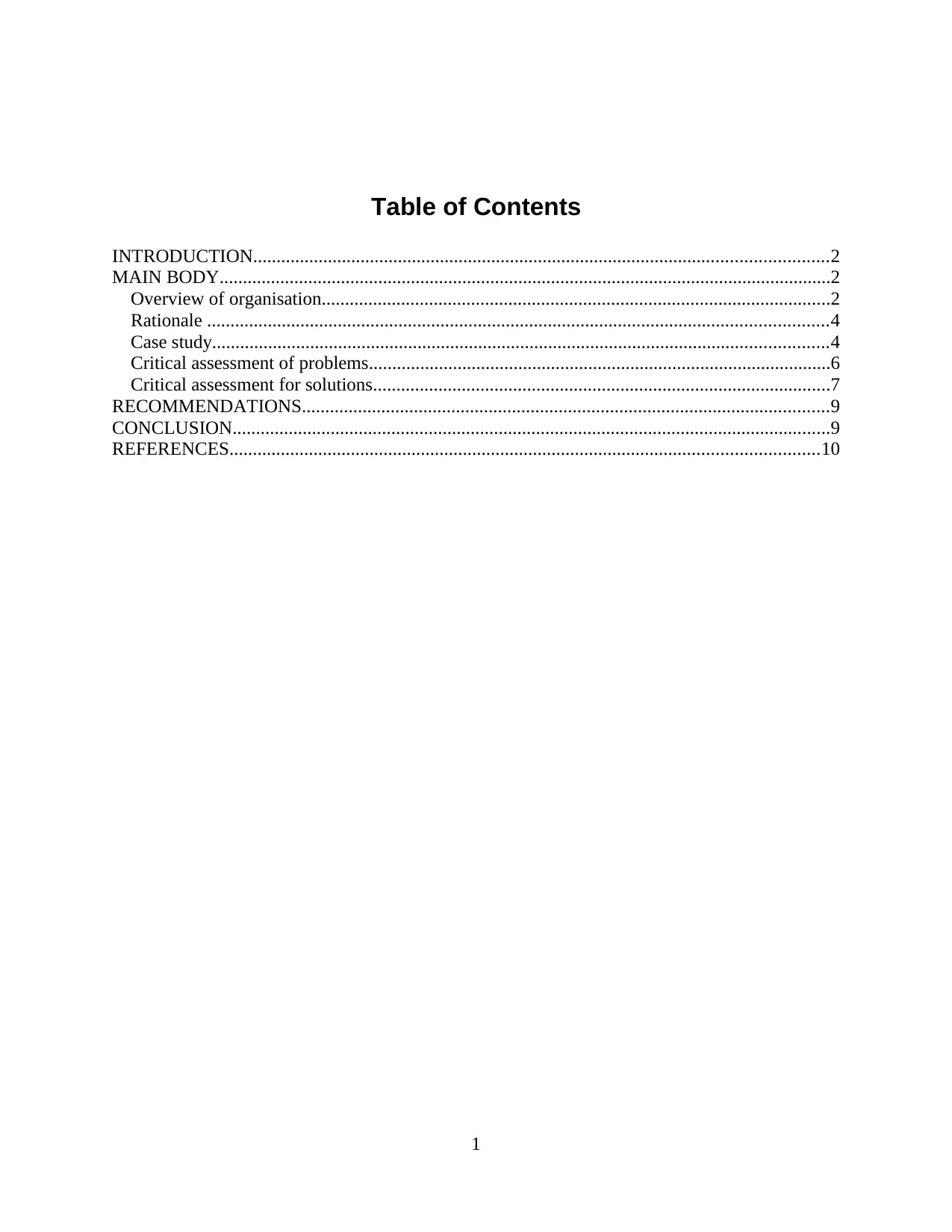
Table of Contents
INTRODUCTION...........................................................................................................................2
MAIN BODY...................................................................................................................................2
Overview of organisation.............................................................................................................2
Rationale .....................................................................................................................................4
Case study....................................................................................................................................4
Critical assessment of problems...................................................................................................6
Critical assessment for solutions..................................................................................................7
RECOMMENDATIONS.................................................................................................................9
CONCLUSION................................................................................................................................9
REFERENCES..............................................................................................................................10
1
INTRODUCTION...........................................................................................................................2
MAIN BODY...................................................................................................................................2
Overview of organisation.............................................................................................................2
Rationale .....................................................................................................................................4
Case study....................................................................................................................................4
Critical assessment of problems...................................................................................................6
Critical assessment for solutions..................................................................................................7
RECOMMENDATIONS.................................................................................................................9
CONCLUSION................................................................................................................................9
REFERENCES..............................................................................................................................10
1
INTRODUCTION
Sustainability refers to a process of making changes in existing process by maintaining
resources. This is done to maintain sustainability for the future purpose. It is achieved by
adopting innovative technologies which helpful in meeting needs and demands of humans.
Sustainability is achieved on three aspects; economic, environment and social. Ethics refers to
responsibilities and moral of a person in organization which impacts in making decisions in favor
of an individual and society. Ethics defined in such a way that individual in organization can
compare between good and bad behavior. This report discusses a case study on Mahindra and
Mahindra company in which different responses regarding sustainability, ethical and broader
governance issues, responsibilities are explored. A critical assessment is outlined in which
impact of different organizational practices on sustainable development is assessed.
MAIN BODY
Overview of organisation
Mahindra and Mahindra limited is an Indian company which deals with manufacturing of
car. It operates globally. It is categorized under automotive industry. It was founded on 1945 by
M. G. Muhammad, J. C. Mahindra, K. C. Mahindra. It has headquartered in Mumbai, India at
gateway building, Apollo Bunder. Currently, Anand Mahindra is chairman of Mahindra and
Mahindra limited company. There are approx 41,673 employees working in company in which
20,806 found to be temporary one who are doing apprenticeship and training. It has products like
automobiles, two- wheeler, commercial vehicles and tractors. Mahindra is one of the biggest
group which has existence in each and every sector. Mahindra and mahindra limited company is
also a part of mahindra group. In overall group there are 240,000 employees working. It has
presence in sectors like automotive, aerospace, energy, life space, steel company, solar, financial
and hospitality (Clayton and Radcliffe, 2018
Benn, Edwards and Williams, 2018). It is refereed as most reputed industry in all over the world.
It operates in approx 100 countries.
History
It was started in 1945 as a steel trading company in Ludhiana. It's initially name was
Mahindra & Mohmmed company. It was started by three brothers Kailash Chandra Mahindra,
Jagdish Chandra Mahindra and Malik Ghulam Mohammed. After, independence of India M. G.
Mohammed migrate to Pakistan. Then after, company name changes to Mahindra and Mahindra
2
Sustainability refers to a process of making changes in existing process by maintaining
resources. This is done to maintain sustainability for the future purpose. It is achieved by
adopting innovative technologies which helpful in meeting needs and demands of humans.
Sustainability is achieved on three aspects; economic, environment and social. Ethics refers to
responsibilities and moral of a person in organization which impacts in making decisions in favor
of an individual and society. Ethics defined in such a way that individual in organization can
compare between good and bad behavior. This report discusses a case study on Mahindra and
Mahindra company in which different responses regarding sustainability, ethical and broader
governance issues, responsibilities are explored. A critical assessment is outlined in which
impact of different organizational practices on sustainable development is assessed.
MAIN BODY
Overview of organisation
Mahindra and Mahindra limited is an Indian company which deals with manufacturing of
car. It operates globally. It is categorized under automotive industry. It was founded on 1945 by
M. G. Muhammad, J. C. Mahindra, K. C. Mahindra. It has headquartered in Mumbai, India at
gateway building, Apollo Bunder. Currently, Anand Mahindra is chairman of Mahindra and
Mahindra limited company. There are approx 41,673 employees working in company in which
20,806 found to be temporary one who are doing apprenticeship and training. It has products like
automobiles, two- wheeler, commercial vehicles and tractors. Mahindra is one of the biggest
group which has existence in each and every sector. Mahindra and mahindra limited company is
also a part of mahindra group. In overall group there are 240,000 employees working. It has
presence in sectors like automotive, aerospace, energy, life space, steel company, solar, financial
and hospitality (Clayton and Radcliffe, 2018
Benn, Edwards and Williams, 2018). It is refereed as most reputed industry in all over the world.
It operates in approx 100 countries.
History
It was started in 1945 as a steel trading company in Ludhiana. It's initially name was
Mahindra & Mohmmed company. It was started by three brothers Kailash Chandra Mahindra,
Jagdish Chandra Mahindra and Malik Ghulam Mohammed. After, independence of India M. G.
Mohammed migrate to Pakistan. Then after, company name changes to Mahindra and Mahindra
2
⊘ This is a preview!⊘
Do you want full access?
Subscribe today to unlock all pages.

Trusted by 1+ million students worldwide
in 1948. Then, it expanded the business by manufacturing vehicles on large scale. It start
manufacturing and selling large MUVs under the license of Willy jeep in India. After
manufacturing of Jeep, it took a step to manufacture light commercial vehicles and tractors that
can be used in agriculture sector. In last few years, M & M takes interest in foreign market and
start marketing vehicles on international basis. It also takes controlling of kinetic motors in India.
In 2011, it took a control on EPC industries of Nashik to have micro dip irrigation. In 2014, it
takes 51% share of Peugeot motorcycles to increase market share.
Operations
M & M brand sells its products by name “Mahindra”. It has key operations in like
automobiles, defense, energy and farm equipment which are described below: Automobile: Mahindra manufacture automotive vehicles like SUVs, light commercial
vehicles, saloon cars, two- wheeler, tractors and heavyweight vehicles. It is also
maintaining relation with some foreign companies for expanding marketing level and to
increase profitability like with Renault, France. Mahindra has a very great involvement
in transportation facilities. It provides executive facility services to trucks so that they are
efficient in transporting goods from one place to another. Military defense: Mahindra helped military department to have variety of vehicles which
give fast services. It introduces Willy Jeep that was used in world war II. Mahindra made
a joint venture with system of BAE which is a defence land system in India.
Energy: Mahindra introduces power engines and machines to energy sector in 2002.
They are used for generating electricity on large scale. It is helpful in meeting demands of
public and to increase electric power generation. In India, there are approx more than
150,000 engines installed and power plants (Crane and Matten, 2016). Even, it also
contributes in manufacturing of inverter, diesel generator sets, batteries. Manufacturing
of these equipment takes place at three places; Pune, Delhi and Chennai.
Farm equipment; Mahindra focused on agriculture sector to help farmers. It introduces
tractors in India during 1960. It is included in one of the top list in tractor company. This
makes 1.45 million customers for all over India. Tractor is of the best farm equipment
introduced by mahindra. It gets so many awards against this. Mahindra tractor has
presence in almost 40 countries including India.
Achievements
3
manufacturing and selling large MUVs under the license of Willy jeep in India. After
manufacturing of Jeep, it took a step to manufacture light commercial vehicles and tractors that
can be used in agriculture sector. In last few years, M & M takes interest in foreign market and
start marketing vehicles on international basis. It also takes controlling of kinetic motors in India.
In 2011, it took a control on EPC industries of Nashik to have micro dip irrigation. In 2014, it
takes 51% share of Peugeot motorcycles to increase market share.
Operations
M & M brand sells its products by name “Mahindra”. It has key operations in like
automobiles, defense, energy and farm equipment which are described below: Automobile: Mahindra manufacture automotive vehicles like SUVs, light commercial
vehicles, saloon cars, two- wheeler, tractors and heavyweight vehicles. It is also
maintaining relation with some foreign companies for expanding marketing level and to
increase profitability like with Renault, France. Mahindra has a very great involvement
in transportation facilities. It provides executive facility services to trucks so that they are
efficient in transporting goods from one place to another. Military defense: Mahindra helped military department to have variety of vehicles which
give fast services. It introduces Willy Jeep that was used in world war II. Mahindra made
a joint venture with system of BAE which is a defence land system in India.
Energy: Mahindra introduces power engines and machines to energy sector in 2002.
They are used for generating electricity on large scale. It is helpful in meeting demands of
public and to increase electric power generation. In India, there are approx more than
150,000 engines installed and power plants (Crane and Matten, 2016). Even, it also
contributes in manufacturing of inverter, diesel generator sets, batteries. Manufacturing
of these equipment takes place at three places; Pune, Delhi and Chennai.
Farm equipment; Mahindra focused on agriculture sector to help farmers. It introduces
tractors in India during 1960. It is included in one of the top list in tractor company. This
makes 1.45 million customers for all over India. Tractor is of the best farm equipment
introduced by mahindra. It gets so many awards against this. Mahindra tractor has
presence in almost 40 countries including India.
Achievements
3
Paraphrase This Document
Need a fresh take? Get an instant paraphrase of this document with our AI Paraphraser
It received many awards regarding quality of products and maintaining social
responsibilities in organization. It gets Bombay Chamber Good Corporate Citizen Award in
2007. It was rated as 2nd reputed manufacturing car company in India in automotive sector
conducted in 2012. For farm equipment like tractors, It gets Japan quality medal during 2007. it
is also included in reputed company recognized by Blue bytes news. It also achieved Deming
prize for farm equipment division in 2003 (Seema Chowdhry and Haris Zargar, 2018).
Rationale
Reason behind the choice of Mahindra and Mahindra limited company for this report is
because of it is to be included in one of the top favorite brand in automotive industry. It adopted
new technologies for making existing process sustained for the future purpose. It understands the
responsibility towards environment to maintain resources so that they can be more utilized for
the future purpose. Therefore, M & M took step to focus on renewable resources and to use
reclaimed or recycled materials for manufacturing motor vehicles. Ethical concerns are
addressed with each organization and same is with M & M. Moral issues occurred in
organization which made conflicts between employees. But management team of M & M plans
strategies that are useful in solving conflicts. Hierarchical structure is adopted by Mahindra
company which is the best structure to maintain sustainability in work place environment. This
makes choice justified to take M & M company and to make a case study and assessment on this
company (Epstein, 2018). It also has been researched that governance issues are addressed to the
organization based on political changes. Political parties make certain laws and policies for
company to manufacture products accordingly. M & M stands positively against such policies
and adopts in their process for welfare of people. It can be related to security terms.
Case study
Mahindra is running as one of the top automotive company. It started manufacturing new
motor vehicles which can be used in agriculture sector. This helps farmers to use heavyweight
vehicles and engines for farming. Tractors are one of them. Everything seems to be sustainable
to managers. M & M company is focusing on expanding marketing to foreign level. They are
contacting to other automotive industry for selling of cars and other vehicles, therefore, it made
a relationship with company like Renault, France. This is a step to sell vehicles in other countries
and make a position to becomes of the best brands in automobiles. But a challenge come in front
4
responsibilities in organization. It gets Bombay Chamber Good Corporate Citizen Award in
2007. It was rated as 2nd reputed manufacturing car company in India in automotive sector
conducted in 2012. For farm equipment like tractors, It gets Japan quality medal during 2007. it
is also included in reputed company recognized by Blue bytes news. It also achieved Deming
prize for farm equipment division in 2003 (Seema Chowdhry and Haris Zargar, 2018).
Rationale
Reason behind the choice of Mahindra and Mahindra limited company for this report is
because of it is to be included in one of the top favorite brand in automotive industry. It adopted
new technologies for making existing process sustained for the future purpose. It understands the
responsibility towards environment to maintain resources so that they can be more utilized for
the future purpose. Therefore, M & M took step to focus on renewable resources and to use
reclaimed or recycled materials for manufacturing motor vehicles. Ethical concerns are
addressed with each organization and same is with M & M. Moral issues occurred in
organization which made conflicts between employees. But management team of M & M plans
strategies that are useful in solving conflicts. Hierarchical structure is adopted by Mahindra
company which is the best structure to maintain sustainability in work place environment. This
makes choice justified to take M & M company and to make a case study and assessment on this
company (Epstein, 2018). It also has been researched that governance issues are addressed to the
organization based on political changes. Political parties make certain laws and policies for
company to manufacture products accordingly. M & M stands positively against such policies
and adopts in their process for welfare of people. It can be related to security terms.
Case study
Mahindra is running as one of the top automotive company. It started manufacturing new
motor vehicles which can be used in agriculture sector. This helps farmers to use heavyweight
vehicles and engines for farming. Tractors are one of them. Everything seems to be sustainable
to managers. M & M company is focusing on expanding marketing to foreign level. They are
contacting to other automotive industry for selling of cars and other vehicles, therefore, it made
a relationship with company like Renault, France. This is a step to sell vehicles in other countries
and make a position to becomes of the best brands in automobiles. But a challenge come in front
4
of managers of Mahindra to have consistent interaction with other companies. This makes
sometime loss for M & M to make customers and to solve their queries on time.
During the expansion of organization in other countries, managers deals with a case. In
this, mahindra group is analyzed as one of the top brands in tractor selling company in India. Its
revenue is also increasing day by day. But on a day, one manager analyze the competitive
environment and found that other automotive industries profit is increasing at more percentage
than mahindra (Voß and Kemp, 2015). Then they took a deep analysis in which they found
various cases like:
At a time, global warming was realized as main issue of world where everyone is
suffering from hot climate and certain diseases. This is an environmental aspect where no one is
focusing to recover this hot climate and finding reasons behind this. Scientist has researched
about this and found that deforestation and use of plastic materials are mainly cause of this
environment destruction and resulting in many diseases like cancer and tumor. After a certain
time, managers are focusing on quality of material that are using in manufacturing of motor
vehicles. Even Mahindra achieved quality medal from Japan too. But managers do not realize
the responsibility of them towards environment (Jindal and Jain, 2018). Materials that are used
form making vehicles part has a great contribution in environment destruction. Waste disposal is
not taking place effectively in mahindra work place. There are approx 20,000 employees
working in mahindra (Better Business for 2030: Putting the SDGs at the Core, 2017). Even
employees are also facing problems in having healthier environment. This is creating a
sustainability issue in mahindra company. Due to less technologies in Mahindra, employees are
not satisfied with work and struggling with problems to achieve goals and targets on time.
Managers make a meeting on one day but they do not reach to take a decision regarding such
issues that are occurring in work place.
During this period, elections are also held at India. On the day of result, existing political
party changed. Managers of Mahindra do not take this seriously and after some days, economy
rate is changed. This economy rate lead to increase in price of raw materials that are used for
manufacturing of vehicles part. This makes a loss for Mahindra for not having raw materials in
stock (Hicks and et.al., 2016). This affect the profit margin and selling of vehicles in India. At
that time other competitor brands make profit by having low cost raw materials in their stock
due to which their profitability do not get disturbed as compared with mahindra.
5
sometime loss for M & M to make customers and to solve their queries on time.
During the expansion of organization in other countries, managers deals with a case. In
this, mahindra group is analyzed as one of the top brands in tractor selling company in India. Its
revenue is also increasing day by day. But on a day, one manager analyze the competitive
environment and found that other automotive industries profit is increasing at more percentage
than mahindra (Voß and Kemp, 2015). Then they took a deep analysis in which they found
various cases like:
At a time, global warming was realized as main issue of world where everyone is
suffering from hot climate and certain diseases. This is an environmental aspect where no one is
focusing to recover this hot climate and finding reasons behind this. Scientist has researched
about this and found that deforestation and use of plastic materials are mainly cause of this
environment destruction and resulting in many diseases like cancer and tumor. After a certain
time, managers are focusing on quality of material that are using in manufacturing of motor
vehicles. Even Mahindra achieved quality medal from Japan too. But managers do not realize
the responsibility of them towards environment (Jindal and Jain, 2018). Materials that are used
form making vehicles part has a great contribution in environment destruction. Waste disposal is
not taking place effectively in mahindra work place. There are approx 20,000 employees
working in mahindra (Better Business for 2030: Putting the SDGs at the Core, 2017). Even
employees are also facing problems in having healthier environment. This is creating a
sustainability issue in mahindra company. Due to less technologies in Mahindra, employees are
not satisfied with work and struggling with problems to achieve goals and targets on time.
Managers make a meeting on one day but they do not reach to take a decision regarding such
issues that are occurring in work place.
During this period, elections are also held at India. On the day of result, existing political
party changed. Managers of Mahindra do not take this seriously and after some days, economy
rate is changed. This economy rate lead to increase in price of raw materials that are used for
manufacturing of vehicles part. This makes a loss for Mahindra for not having raw materials in
stock (Hicks and et.al., 2016). This affect the profit margin and selling of vehicles in India. At
that time other competitor brands make profit by having low cost raw materials in their stock
due to which their profitability do not get disturbed as compared with mahindra.
5
⊘ This is a preview!⊘
Do you want full access?
Subscribe today to unlock all pages.
Trusted by 1+ million students worldwide
Managers stuck in a dilemma to maintain sustainability in work environment so that
process can be secured for the future purpose (Gayathri, 2016). But they are confused about to
technologies that are used for maintaining sustainability. And also they have concern about
environmental responsibilities. But what they can do for it, making a problem for mangers to
take decisions. Due to less technologies, solving conflicts become a typical task for management
team of Mahindra. And they are in concern with governance issues that are changing
periodically and making loss for Mahindra.
Critical assessment of problems
Above case study assessed four issues in company for managers to get effective results.
This section will take a critical assessment of case study in which solutions are analyzed which
are adopted by managers for addressing them. These four issues are analyzed below:
One of the issue is sustainability. It refers to making process efficient in present for the
future purpose. It can be in terms of social, economic and environment. Managers are
facing problems in implementing technologies in existing process of manufacturing
vehicles. It has been analyzed that managers research about it and get to know about the
use of information technologies, artificial intelligence, automation and computer software
or applications. These technologies confuse them a lot and face issue in having a skilled
engineer who know about such technologies. Selection of a technology becomes a task
for managers and engineers (Sarker, Ray and Gazder, 2017).
Another issue is of responsibility. Managers have a concern about environment issues
that are addressed in above case study where waste disposal is one of the issue. After
using new materials for making vehicles part, a big task arises in front of managers to
dispose waste material. This waste material is emitting carbon dioxide in environment
which is a harmful matter and effects in global warming.
Another issue is related to ethics. Employees have their own moral which are discussed
in above case study. Individual moral gets conflicted between each other which create
problem in decision making for managers. For solving conflicts managers need to adopt a
organizational culture which makes employee comfortable for sharing of information.
Another issue is related to governmental changes. In above case study, a case is
discussed were mahindra is facing problems due to variations in economy rate. This
makes loss for company in investing for purchasing raw materials. If raw materials are
6
process can be secured for the future purpose (Gayathri, 2016). But they are confused about to
technologies that are used for maintaining sustainability. And also they have concern about
environmental responsibilities. But what they can do for it, making a problem for mangers to
take decisions. Due to less technologies, solving conflicts become a typical task for management
team of Mahindra. And they are in concern with governance issues that are changing
periodically and making loss for Mahindra.
Critical assessment of problems
Above case study assessed four issues in company for managers to get effective results.
This section will take a critical assessment of case study in which solutions are analyzed which
are adopted by managers for addressing them. These four issues are analyzed below:
One of the issue is sustainability. It refers to making process efficient in present for the
future purpose. It can be in terms of social, economic and environment. Managers are
facing problems in implementing technologies in existing process of manufacturing
vehicles. It has been analyzed that managers research about it and get to know about the
use of information technologies, artificial intelligence, automation and computer software
or applications. These technologies confuse them a lot and face issue in having a skilled
engineer who know about such technologies. Selection of a technology becomes a task
for managers and engineers (Sarker, Ray and Gazder, 2017).
Another issue is of responsibility. Managers have a concern about environment issues
that are addressed in above case study where waste disposal is one of the issue. After
using new materials for making vehicles part, a big task arises in front of managers to
dispose waste material. This waste material is emitting carbon dioxide in environment
which is a harmful matter and effects in global warming.
Another issue is related to ethics. Employees have their own moral which are discussed
in above case study. Individual moral gets conflicted between each other which create
problem in decision making for managers. For solving conflicts managers need to adopt a
organizational culture which makes employee comfortable for sharing of information.
Another issue is related to governmental changes. In above case study, a case is
discussed were mahindra is facing problems due to variations in economy rate. This
makes loss for company in investing for purchasing raw materials. If raw materials are
6
Paraphrase This Document
Need a fresh take? Get an instant paraphrase of this document with our AI Paraphraser
purchased in bulk in advance then, it can also a loss for mahindra due to decrease in
demands. Therefore, it can stock raw materials in limited quantity only. Change in
government also lead to changes in laws and policies which will make problem for
mahindra to have profitability. Certain laws are made which band the use of materials
like plastic for the welfare of citizens. But this make changes for an industry to adopt
another material in place of that. It stops the process for sometime or some days. It makes
problem in making customer satisfied and to solve their queries regarding delay.
Critical assessment for solutions
Sustainability:
To address this issue, managers hire skilled engineers and take advice from them to have
adoption of best technology. Engineers advice them to have all technologies in their specified
work like for storing big data and making it private, cloud computing is best technology at which
all employees in India can work at a single platform. It can also meet all stakeholder
requirements for maximize profit and maintaining business ethics. Other technologies like
automation, has been assess that it can make controlling and monitoring process too easier.
Then,without getting delay, managers took a decision to adopt automation process in their
manufacturing plant. It makes easy for engineers to detect faults that are occurred in between,
switching of process i.e., in and off is easier for engineers over a single device.
Another technology is analyzed to be artificial intelligence. But it is assessed that it takes
too much cost for implementing it. It has been advised by engineers to implement artificial
techniques at specified location only (Arora, Patel and Ubeja, 2015). This is helpful in
maintaining sustainability for longer time by doing experiments using robots in place of humans.
This is helpful in taking risk hazards where it can be threaten to employee life but not for robots.
These different technologies make sustained process for the future purpose. By implementing
this, Mahindra becomes the best sustainable car manufacturing company and have efficient
process in work which is accessed for long time.
Responsibility:
M & M takes a step to overcome this effect and adopts a method to recycle waste material and
use it in making steering and all. Currently, mahindra uses biodegradable materials for making
some parts of vehicles like steering, Tyre, brakes and all. This aspect of realizing responsibility
to managers helps them to expand network in manufacturing.
7
demands. Therefore, it can stock raw materials in limited quantity only. Change in
government also lead to changes in laws and policies which will make problem for
mahindra to have profitability. Certain laws are made which band the use of materials
like plastic for the welfare of citizens. But this make changes for an industry to adopt
another material in place of that. It stops the process for sometime or some days. It makes
problem in making customer satisfied and to solve their queries regarding delay.
Critical assessment for solutions
Sustainability:
To address this issue, managers hire skilled engineers and take advice from them to have
adoption of best technology. Engineers advice them to have all technologies in their specified
work like for storing big data and making it private, cloud computing is best technology at which
all employees in India can work at a single platform. It can also meet all stakeholder
requirements for maximize profit and maintaining business ethics. Other technologies like
automation, has been assess that it can make controlling and monitoring process too easier.
Then,without getting delay, managers took a decision to adopt automation process in their
manufacturing plant. It makes easy for engineers to detect faults that are occurred in between,
switching of process i.e., in and off is easier for engineers over a single device.
Another technology is analyzed to be artificial intelligence. But it is assessed that it takes
too much cost for implementing it. It has been advised by engineers to implement artificial
techniques at specified location only (Arora, Patel and Ubeja, 2015). This is helpful in
maintaining sustainability for longer time by doing experiments using robots in place of humans.
This is helpful in taking risk hazards where it can be threaten to employee life but not for robots.
These different technologies make sustained process for the future purpose. By implementing
this, Mahindra becomes the best sustainable car manufacturing company and have efficient
process in work which is accessed for long time.
Responsibility:
M & M takes a step to overcome this effect and adopts a method to recycle waste material and
use it in making steering and all. Currently, mahindra uses biodegradable materials for making
some parts of vehicles like steering, Tyre, brakes and all. This aspect of realizing responsibility
to managers helps them to expand network in manufacturing.
7
This gives idea to Mahindra and Mahindra limited company to open a new branch to use
renewable resources. Therefore, they start to give solar solutions for public which will reduce the
impact of thermal on environment. Mahindra system Pvt ltd is that part of Mahindra group which
has solar power plants for generating electricity. It is not limited for an individual building
purpose but also contributes to national grid system fro sharing of load and meeting demands of
electricity in Public. This solar adoption appraise other companies too. They make sure that less
carbon emission takes place (Ghosh, 2018). This environmental responsibility makes company
profitable and sustained for the future purpose. This will give more profit in future by expanding
network for all over the world and aware everyone to use renewable resources. Even recycling
process is also a better option. It saves money of Mahindra to buy new materials. Problem of
disposing waste material is also solved for managers. It will lead to negligible carbon emission to
environment and results in decrease in global warming.
Ethics:
M & M adopts hierarchical organizational structure in which top to bottom approach or
vice versa is introduced. Conflicts are occurred due to less knowledge and less information.
Therefore, this hierarchical structure will helps employees to get to know about information in
full manner.
Hierarchical organizational structure maintains sustainability in organization and solves
ethical issues that are occurred due to mis- conceptions. This helps management team to address
issues. It is also analyzed that exclusive training will be helpful for employees to increase their
work performance. Increase in efficiency of work will increase their morality which indirectly
solves ethical issues (Kattumuri and Kurian, 2017). Efficient training will lead to profitability for
the future purpose and to increase network of manufacturing and selling in other countries as
well.
Governmental changes:
Mahindra management team takes this as an positive issue and makes plans to make
recover profit margin in next season and to maintain sustainability for the future. Strategies
against other brands also made by research team and management team to have competitive
advantage. Governance and political changes do not make loss every time (Goel, 2017). It
sometimes gives benefits in favor of organization to make more market share.
8
renewable resources. Therefore, they start to give solar solutions for public which will reduce the
impact of thermal on environment. Mahindra system Pvt ltd is that part of Mahindra group which
has solar power plants for generating electricity. It is not limited for an individual building
purpose but also contributes to national grid system fro sharing of load and meeting demands of
electricity in Public. This solar adoption appraise other companies too. They make sure that less
carbon emission takes place (Ghosh, 2018). This environmental responsibility makes company
profitable and sustained for the future purpose. This will give more profit in future by expanding
network for all over the world and aware everyone to use renewable resources. Even recycling
process is also a better option. It saves money of Mahindra to buy new materials. Problem of
disposing waste material is also solved for managers. It will lead to negligible carbon emission to
environment and results in decrease in global warming.
Ethics:
M & M adopts hierarchical organizational structure in which top to bottom approach or
vice versa is introduced. Conflicts are occurred due to less knowledge and less information.
Therefore, this hierarchical structure will helps employees to get to know about information in
full manner.
Hierarchical organizational structure maintains sustainability in organization and solves
ethical issues that are occurred due to mis- conceptions. This helps management team to address
issues. It is also analyzed that exclusive training will be helpful for employees to increase their
work performance. Increase in efficiency of work will increase their morality which indirectly
solves ethical issues (Kattumuri and Kurian, 2017). Efficient training will lead to profitability for
the future purpose and to increase network of manufacturing and selling in other countries as
well.
Governmental changes:
Mahindra management team takes this as an positive issue and makes plans to make
recover profit margin in next season and to maintain sustainability for the future. Strategies
against other brands also made by research team and management team to have competitive
advantage. Governance and political changes do not make loss every time (Goel, 2017). It
sometimes gives benefits in favor of organization to make more market share.
8
⊘ This is a preview!⊘
Do you want full access?
Subscribe today to unlock all pages.
Trusted by 1+ million students worldwide
RECOMMENDATIONS
I want to recommend that issues that are observed during the assessment in Mahindra to
maintain sustainability, responsibility, ethics, government concerns. This all required
attentiveness which can overcomes these issues in less time. Environmental responsibilities take
a different way to overcome that so that it does not make any influence on environment.
Materials that are used for making vehicles part should be eco- friendly so that if any condition,
there waste is thrown off, then, it does not influence soil, air or water. It all will be
biodegradable.
I as a manager want to make changes in future according to sustainability. I recommend
that artificial intelligence techniques will make the system of making cars and tractor any other,
easier and efficient. involvement of humans will be less. Humans can make a mistake but
machines can not. This will be more profitable to have efficient process of manufacturing and
delivering.
CONCLUSION
This report summarized about the sustainability features in Mahindra & Mahindra limited
company. It has been analyzed that new technologies have a more contribution in maintaining
sustainability for the future purpose. Clod computing, automation, artificial intelligence type
technologies are addressed that mahindra is using to give positive outcomes and for increasing
productivity level. Environmental responsibility is addressed where mahindra adopted recycling
procedure to reuse materials in manufacturing parts of motor vehicles it has also been introduced
that mahindra has taken a step in using renewable resources to generate electricity. Mahindra is
addressed as big group where it has many sectors like technical, logistics, solar, defense,
education, energy, automobiles. Even it also lead to financial services and hospitality. Its main
product is tractor which is highly seller equipment in India. Ethical and governance issues are
addressed based on a case sudsy where managers facing problem in managing issues.
9
I want to recommend that issues that are observed during the assessment in Mahindra to
maintain sustainability, responsibility, ethics, government concerns. This all required
attentiveness which can overcomes these issues in less time. Environmental responsibilities take
a different way to overcome that so that it does not make any influence on environment.
Materials that are used for making vehicles part should be eco- friendly so that if any condition,
there waste is thrown off, then, it does not influence soil, air or water. It all will be
biodegradable.
I as a manager want to make changes in future according to sustainability. I recommend
that artificial intelligence techniques will make the system of making cars and tractor any other,
easier and efficient. involvement of humans will be less. Humans can make a mistake but
machines can not. This will be more profitable to have efficient process of manufacturing and
delivering.
CONCLUSION
This report summarized about the sustainability features in Mahindra & Mahindra limited
company. It has been analyzed that new technologies have a more contribution in maintaining
sustainability for the future purpose. Clod computing, automation, artificial intelligence type
technologies are addressed that mahindra is using to give positive outcomes and for increasing
productivity level. Environmental responsibility is addressed where mahindra adopted recycling
procedure to reuse materials in manufacturing parts of motor vehicles it has also been introduced
that mahindra has taken a step in using renewable resources to generate electricity. Mahindra is
addressed as big group where it has many sectors like technical, logistics, solar, defense,
education, energy, automobiles. Even it also lead to financial services and hospitality. Its main
product is tractor which is highly seller equipment in India. Ethical and governance issues are
addressed based on a case sudsy where managers facing problem in managing issues.
9
Paraphrase This Document
Need a fresh take? Get an instant paraphrase of this document with our AI Paraphraser
REFERENCES
Books and journals
Arora, S., Patel, J. and Ubeja, S., 2015. Event study on stock prices of Mahindra and Mahindra
Ltd.: A study on launch of Mahindra e2o. FIIB Business Review. 4(4). pp.71-77.
Benn, S., Edwards, M. and Williams, T., 2018. Organizational change for corporate
sustainability. Routledge.
Clayton, T. and Radcliffe, N., 2018. Sustainability: a systems approach. Routledge.
Crane, A. and Matten, D., 2016. Business ethics: Managing corporate citizenship and
sustainability in the age of globalization. Oxford University Press.
Epstein, M.J., 2018. Making sustainability work: Best practices in managing and measuring
corporate social, environmental and economic impacts. Routledge.
Gayathri, S., 2016. An Insight in to the CSR Activity of Mahindra & Mahindra
Ltd. International Journal of Innovative Research in Management Studies. 1(1). pp.108-
115.
Ghosh, A., 2018. Corporates’ Role in Addressing Energy Security: A Mahindra Perspective.
In Sustainable Energy Technology and Policies (pp. 217-228). Springer, Singapore.
Goel, P., 2017. Do Ethics Pay: A Study of Indian Companies. International Journal of Business
Ethics in Developing Economies. 6(1). p.29.
Hicks, C.C. and et.al., 2016. Engage key social concepts for sustainability. Science. 352(6281).
pp.38-40.
Jindal, D. and Jain, I., 2018. Role of Companies in Environmental Management Through
Corporate Social Responsibility and Sustainability Policy. In Green Chemistry in
Environmental Sustainability and Chemical Education (pp. 23-41). Springer, Singapore.
Kattumuri, R. and Kurian, S., 2017. Sustainable urban development in India: a tale of two
Mahindra World Cities.
Sarker, T., Ray, S. and Gazder, B., 2017. Mahindra & Mahindra–Mainstreaming Sustainability
Through Knowledge Building. In The Role of Corporate Sustainability in Asian
Development (pp. 145-165). Springer, Cham.
Voß, J.P. and Kemp, R., 2015. Sustainability and reflexive governance: introduction.
Technische Universität Berlin.
Online
Better Business for 2030: Putting the SDGs at the Core 2017. [Online]. Available through:
<https://www.oecd.org/dev/SDG2017_Better_Business_2030_Putting_SDGs_Core_We
b.pdf>.
Seema Chowdhry and Haris Zargar, 2018. There is very little talk about the impact of
sustainability work. [Online]. Available through:
<https://www.livemint.com/Leisure/fMokJkg1ijDL7aXJjpFtbI/There-is-very-little-talk-
about-the-impact-of-sustainability.html>.
10
Books and journals
Arora, S., Patel, J. and Ubeja, S., 2015. Event study on stock prices of Mahindra and Mahindra
Ltd.: A study on launch of Mahindra e2o. FIIB Business Review. 4(4). pp.71-77.
Benn, S., Edwards, M. and Williams, T., 2018. Organizational change for corporate
sustainability. Routledge.
Clayton, T. and Radcliffe, N., 2018. Sustainability: a systems approach. Routledge.
Crane, A. and Matten, D., 2016. Business ethics: Managing corporate citizenship and
sustainability in the age of globalization. Oxford University Press.
Epstein, M.J., 2018. Making sustainability work: Best practices in managing and measuring
corporate social, environmental and economic impacts. Routledge.
Gayathri, S., 2016. An Insight in to the CSR Activity of Mahindra & Mahindra
Ltd. International Journal of Innovative Research in Management Studies. 1(1). pp.108-
115.
Ghosh, A., 2018. Corporates’ Role in Addressing Energy Security: A Mahindra Perspective.
In Sustainable Energy Technology and Policies (pp. 217-228). Springer, Singapore.
Goel, P., 2017. Do Ethics Pay: A Study of Indian Companies. International Journal of Business
Ethics in Developing Economies. 6(1). p.29.
Hicks, C.C. and et.al., 2016. Engage key social concepts for sustainability. Science. 352(6281).
pp.38-40.
Jindal, D. and Jain, I., 2018. Role of Companies in Environmental Management Through
Corporate Social Responsibility and Sustainability Policy. In Green Chemistry in
Environmental Sustainability and Chemical Education (pp. 23-41). Springer, Singapore.
Kattumuri, R. and Kurian, S., 2017. Sustainable urban development in India: a tale of two
Mahindra World Cities.
Sarker, T., Ray, S. and Gazder, B., 2017. Mahindra & Mahindra–Mainstreaming Sustainability
Through Knowledge Building. In The Role of Corporate Sustainability in Asian
Development (pp. 145-165). Springer, Cham.
Voß, J.P. and Kemp, R., 2015. Sustainability and reflexive governance: introduction.
Technische Universität Berlin.
Online
Better Business for 2030: Putting the SDGs at the Core 2017. [Online]. Available through:
<https://www.oecd.org/dev/SDG2017_Better_Business_2030_Putting_SDGs_Core_We
b.pdf>.
Seema Chowdhry and Haris Zargar, 2018. There is very little talk about the impact of
sustainability work. [Online]. Available through:
<https://www.livemint.com/Leisure/fMokJkg1ijDL7aXJjpFtbI/There-is-very-little-talk-
about-the-impact-of-sustainability.html>.
10

1 out of 11


Your All-in-One AI-Powered Toolkit for Academic Success.
+13062052269
info@desklib.com
Available 24*7 on WhatsApp / Email
![[object Object]](/_next/static/media/star-bottom.7253800d.svg)
Unlock your academic potential
Copyright © 2020–2026 A2Z Services. All Rights Reserved. Developed and managed by ZUCOL.