Psychology Report: The Development and Maintenance of Addiction
VerifiedAdded on 2023/04/25
|7
|1523
|357
Report
AI Summary
This report provides a comprehensive analysis of addiction, focusing on its development and maintenance through biological, psychological, and social factors. It uses a case study to illustrate how these factors interact, examining the experiences of Carol Finley and her struggle with substance abuse. The report explores the influence of parental addiction, upbringing, and social environment on the individual's path to addiction. Furthermore, it discusses primary, secondary, and tertiary prevention strategies that could have been implemented to mitigate the severity of the addiction. The report also emphasizes the importance of psychological interventions and support systems in helping individuals overcome addiction and lead healthier lives. The reference list includes relevant literature on addiction, providing a foundation for the analysis and conclusions drawn within the report.
Running head: THE DEVELOPMENT AND MAINTENANCE OF ADDICTION
The Development and Maintenance of Addiction
Name of the Student
Name of the University
Author Note
The Development and Maintenance of Addiction
Name of the Student
Name of the University
Author Note
Paraphrase This Document
Need a fresh take? Get an instant paraphrase of this document with our AI Paraphraser

1THE DEVELOPMENT AND MAINTENANCE OF ADDICTION
Executive Summary
Addiction is a serious problem among the human beings in the present day. People get
addicted to a lot of substances because of substance abuse like alcohol, cocaine and other
drugs. It is because of the addiction to the substances that they become completely dependent
on the substances and as a result, they are unable to concentrate on any other activities
without intake of addictive substances like cocaine and other drugs. Therefore, they have to
depend on psychologists and other types of medications. This report will look at the problems
that Carol Finley faced as a result of being addicted to alcohol and other drugs from an early
age.
Executive Summary
Addiction is a serious problem among the human beings in the present day. People get
addicted to a lot of substances because of substance abuse like alcohol, cocaine and other
drugs. It is because of the addiction to the substances that they become completely dependent
on the substances and as a result, they are unable to concentrate on any other activities
without intake of addictive substances like cocaine and other drugs. Therefore, they have to
depend on psychologists and other types of medications. This report will look at the problems
that Carol Finley faced as a result of being addicted to alcohol and other drugs from an early
age.

2THE DEVELOPMENT AND MAINTENANCE OF ADDICTION
Table of Contents
Question - 1................................................................................................................................3
Question - 2................................................................................................................................4
Question – 3...............................................................................................................................4
Question -4.................................................................................................................................5
Question – 5...............................................................................................................................6
Reference List............................................................................................................................6
Table of Contents
Question - 1................................................................................................................................3
Question - 2................................................................................................................................4
Question – 3...............................................................................................................................4
Question -4.................................................................................................................................5
Question – 5...............................................................................................................................6
Reference List............................................................................................................................6
⊘ This is a preview!⊘
Do you want full access?
Subscribe today to unlock all pages.

Trusted by 1+ million students worldwide

3THE DEVELOPMENT AND MAINTENANCE OF ADDICTION
Question - 1
There are several biological factors mentioned in the Case Study that are relevant to
the development and the maintenance of addiction of Carol Finley as mentioned in the case
study. In the Case Study, it has been mentioned that Carol Finley mainly became an addict
due to the exposure to alcohol and drugs from a very young age. Her biological mother and
father whom she has never met in her life were addicted to cocaine.
These conditions prove that biological factors indeed play an important role in a
person becoming an addict. If an individual’s own parents prove to be victims of alcohol
abuse, then it is most probable that the individual himself/herself will become a victim of
substance abuse as well. This is because there is no one in the family who can supervise the
individual’s activities in his/her daily life. Addiction is a serious issue among the lives of the
Australians especially the Aboriginals or the Torres Island Strait people. Thus, if the
individual is not put under control, he/she will also start using cocaine and other forms of
addiction that could ultimately turn him/her into an addict as well (Joffe, 2015). Therefore,
biological factors of an individual also play an important role in that individual becoming an
addict himself/herself as the individual has no one to care for him/her and is left alone in
his/her life.
Question - 2
There are several psychological factors mentioned in the Case Study that are relevant
to the development and maintenance of the addiction problems of Carol Finley as had been
mentioned in the Case Study itself. Carol Finley’s adaptive parents were also addicted to
drinks just like here biological parents were. From the Case Study, itself, the readers get the
Question - 1
There are several biological factors mentioned in the Case Study that are relevant to
the development and the maintenance of addiction of Carol Finley as mentioned in the case
study. In the Case Study, it has been mentioned that Carol Finley mainly became an addict
due to the exposure to alcohol and drugs from a very young age. Her biological mother and
father whom she has never met in her life were addicted to cocaine.
These conditions prove that biological factors indeed play an important role in a
person becoming an addict. If an individual’s own parents prove to be victims of alcohol
abuse, then it is most probable that the individual himself/herself will become a victim of
substance abuse as well. This is because there is no one in the family who can supervise the
individual’s activities in his/her daily life. Addiction is a serious issue among the lives of the
Australians especially the Aboriginals or the Torres Island Strait people. Thus, if the
individual is not put under control, he/she will also start using cocaine and other forms of
addiction that could ultimately turn him/her into an addict as well (Joffe, 2015). Therefore,
biological factors of an individual also play an important role in that individual becoming an
addict himself/herself as the individual has no one to care for him/her and is left alone in
his/her life.
Question - 2
There are several psychological factors mentioned in the Case Study that are relevant
to the development and maintenance of the addiction problems of Carol Finley as had been
mentioned in the Case Study itself. Carol Finley’s adaptive parents were also addicted to
drinks just like here biological parents were. From the Case Study, itself, the readers get the
Paraphrase This Document
Need a fresh take? Get an instant paraphrase of this document with our AI Paraphraser

4THE DEVELOPMENT AND MAINTENANCE OF ADDICTION
idea that Carol’s adaptive parents were addicted to drinks and smoked marijuana. In fact, they
allowed Carol to have beers and smoke marijuana at the age of 13 years after which, she
started to smoke and drink regularly.
As stated by Becker (2015), all these facts from the Case Study proves that Carol’s
upbringing was different than other kids of her age. While other kids played, and ate and
drank ice cream and cold drinks. Carol spent her time in drinking and smoking marijuana.
These proves that her psychological upbringing was different which made her different from
other kids at her school. Although the addiction problem is less among the Aboriginals than
the mainland Australians, it still poses a major problem. This proved to be the psychological
factors which affected the development and the maintenance of the upbringing of Carol
Finley different from those of other kids. That is why psychological factors also affect the
development and the maintenance of the subject mentioned in the Case Study.
Question – 3
Just like biological and psychological factors, social factors also play an important
role in the development and the maintenance of addiction as mentioned in the Case Study.
From the Case Study, the readers get the idea that since Carol’s adaptive parents allowed her
to smoke and drink at home, she also started doing the same in school. Although her friends
initially thought this to be very cool since they were not allowed to do such things at home,
very soon they felt that these were not the right things to do and abandoned her. Having no
friends, Carol started meeting with people older than her who provided her with drugs. She
was kicked out of home when she was caught stealing money. Having no other options for
herself, she resorted to prostitution.
As stated by Berridge (2017), this above passage tells the readers about the social
factors that plays an important role in the development and maintenance of addiction. This is
idea that Carol’s adaptive parents were addicted to drinks and smoked marijuana. In fact, they
allowed Carol to have beers and smoke marijuana at the age of 13 years after which, she
started to smoke and drink regularly.
As stated by Becker (2015), all these facts from the Case Study proves that Carol’s
upbringing was different than other kids of her age. While other kids played, and ate and
drank ice cream and cold drinks. Carol spent her time in drinking and smoking marijuana.
These proves that her psychological upbringing was different which made her different from
other kids at her school. Although the addiction problem is less among the Aboriginals than
the mainland Australians, it still poses a major problem. This proved to be the psychological
factors which affected the development and the maintenance of the upbringing of Carol
Finley different from those of other kids. That is why psychological factors also affect the
development and the maintenance of the subject mentioned in the Case Study.
Question – 3
Just like biological and psychological factors, social factors also play an important
role in the development and the maintenance of addiction as mentioned in the Case Study.
From the Case Study, the readers get the idea that since Carol’s adaptive parents allowed her
to smoke and drink at home, she also started doing the same in school. Although her friends
initially thought this to be very cool since they were not allowed to do such things at home,
very soon they felt that these were not the right things to do and abandoned her. Having no
friends, Carol started meeting with people older than her who provided her with drugs. She
was kicked out of home when she was caught stealing money. Having no other options for
herself, she resorted to prostitution.
As stated by Berridge (2017), this above passage tells the readers about the social
factors that plays an important role in the development and maintenance of addiction. This is

5THE DEVELOPMENT AND MAINTENANCE OF ADDICTION
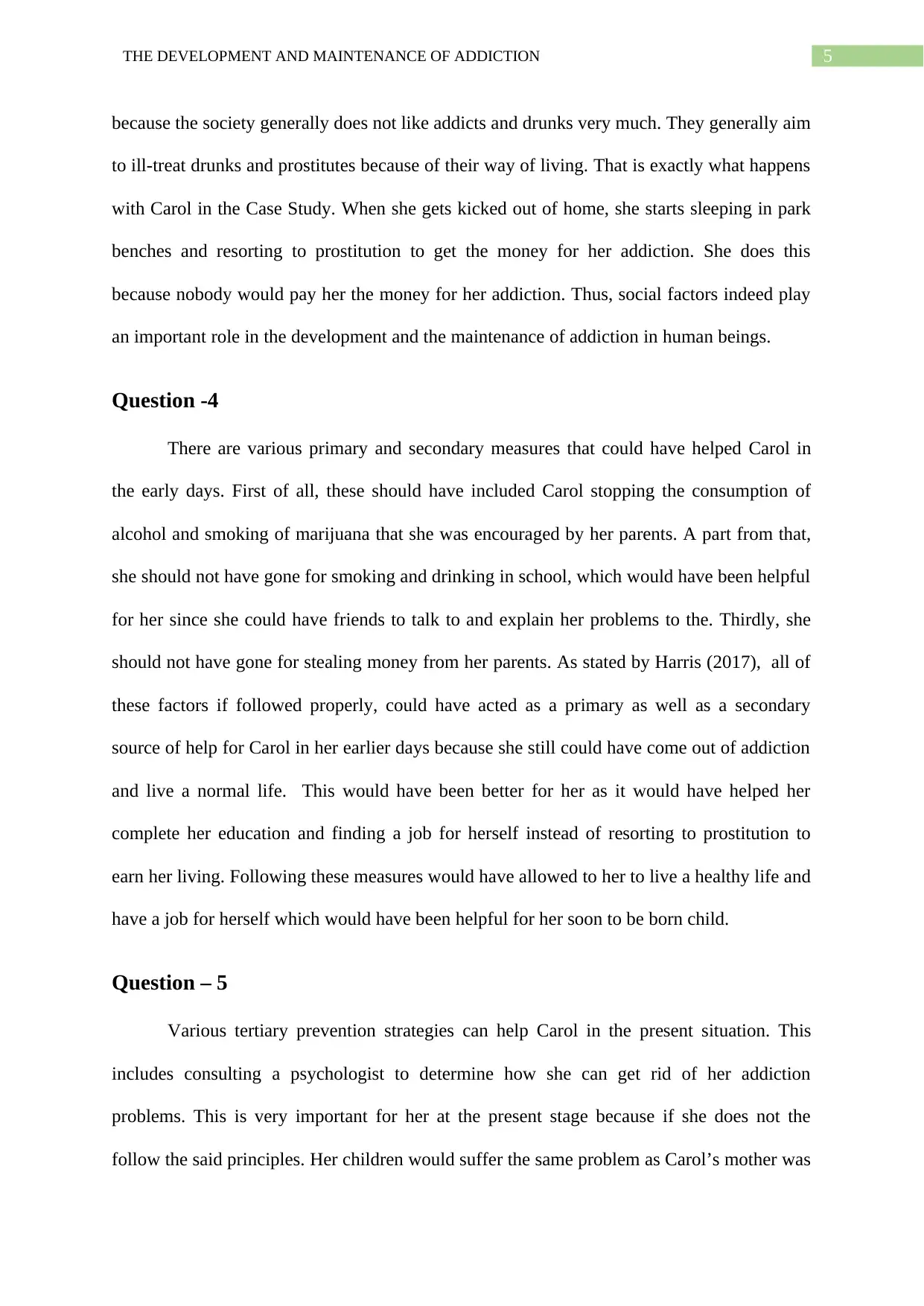
because the society generally does not like addicts and drunks very much. They generally aim
to ill-treat drunks and prostitutes because of their way of living. That is exactly what happens
with Carol in the Case Study. When she gets kicked out of home, she starts sleeping in park
benches and resorting to prostitution to get the money for her addiction. She does this
because nobody would pay her the money for her addiction. Thus, social factors indeed play
an important role in the development and the maintenance of addiction in human beings.
Question -4
There are various primary and secondary measures that could have helped Carol in
the early days. First of all, these should have included Carol stopping the consumption of
alcohol and smoking of marijuana that she was encouraged by her parents. A part from that,
she should not have gone for smoking and drinking in school, which would have been helpful
for her since she could have friends to talk to and explain her problems to the. Thirdly, she
should not have gone for stealing money from her parents. As stated by Harris (2017), all of
these factors if followed properly, could have acted as a primary as well as a secondary
source of help for Carol in her earlier days because she still could have come out of addiction
and live a normal life. This would have been better for her as it would have helped her
complete her education and finding a job for herself instead of resorting to prostitution to
earn her living. Following these measures would have allowed to her to live a healthy life and
have a job for herself which would have been helpful for her soon to be born child.
Question – 5
Various tertiary prevention strategies can help Carol in the present situation. This
includes consulting a psychologist to determine how she can get rid of her addiction
problems. This is very important for her at the present stage because if she does not the
follow the said principles. Her children would suffer the same problem as Carol’s mother was
because the society generally does not like addicts and drunks very much. They generally aim
to ill-treat drunks and prostitutes because of their way of living. That is exactly what happens
with Carol in the Case Study. When she gets kicked out of home, she starts sleeping in park
benches and resorting to prostitution to get the money for her addiction. She does this
because nobody would pay her the money for her addiction. Thus, social factors indeed play
an important role in the development and the maintenance of addiction in human beings.
Question -4
There are various primary and secondary measures that could have helped Carol in
the early days. First of all, these should have included Carol stopping the consumption of
alcohol and smoking of marijuana that she was encouraged by her parents. A part from that,
she should not have gone for smoking and drinking in school, which would have been helpful
for her since she could have friends to talk to and explain her problems to the. Thirdly, she
should not have gone for stealing money from her parents. As stated by Harris (2017), all of
these factors if followed properly, could have acted as a primary as well as a secondary
source of help for Carol in her earlier days because she still could have come out of addiction
and live a normal life. This would have been better for her as it would have helped her
complete her education and finding a job for herself instead of resorting to prostitution to
earn her living. Following these measures would have allowed to her to live a healthy life and
have a job for herself which would have been helpful for her soon to be born child.
Question – 5
Various tertiary prevention strategies can help Carol in the present situation. This
includes consulting a psychologist to determine how she can get rid of her addiction
problems. This is very important for her at the present stage because if she does not the
follow the said principles. Her children would suffer the same problem as Carol’s mother was
⊘ This is a preview!⊘
Do you want full access?
Subscribe today to unlock all pages.

Trusted by 1+ million students worldwide

6THE DEVELOPMENT AND MAINTENANCE OF ADDICTION
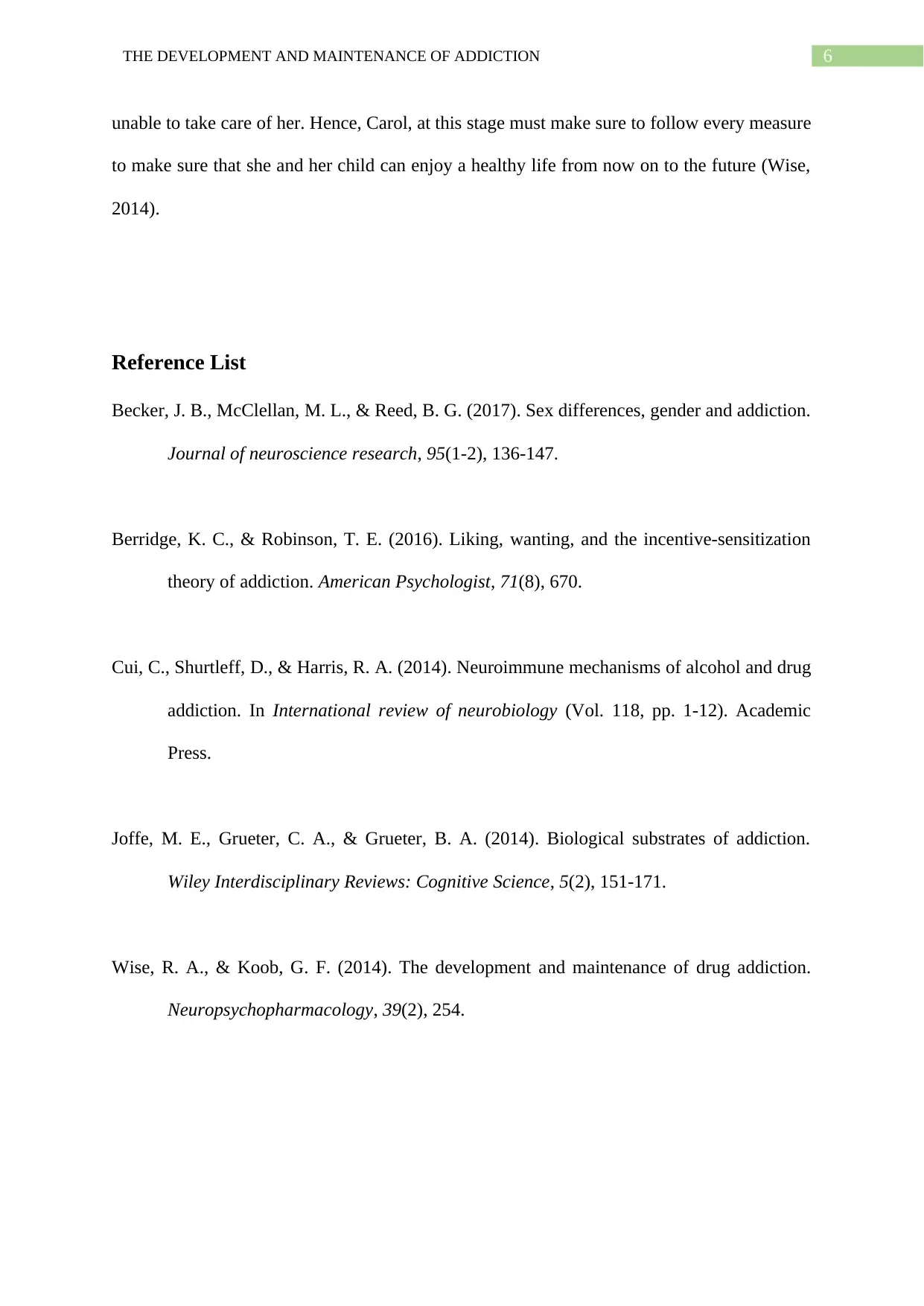
unable to take care of her. Hence, Carol, at this stage must make sure to follow every measure
to make sure that she and her child can enjoy a healthy life from now on to the future (Wise,
2014).
Reference List
Becker, J. B., McClellan, M. L., & Reed, B. G. (2017). Sex differences, gender and addiction.
Journal of neuroscience research, 95(1-2), 136-147.
Berridge, K. C., & Robinson, T. E. (2016). Liking, wanting, and the incentive-sensitization
theory of addiction. American Psychologist, 71(8), 670.
Cui, C., Shurtleff, D., & Harris, R. A. (2014). Neuroimmune mechanisms of alcohol and drug
addiction. In International review of neurobiology (Vol. 118, pp. 1-12). Academic
Press.
Joffe, M. E., Grueter, C. A., & Grueter, B. A. (2014). Biological substrates of addiction.
Wiley Interdisciplinary Reviews: Cognitive Science, 5(2), 151-171.
Wise, R. A., & Koob, G. F. (2014). The development and maintenance of drug addiction.
Neuropsychopharmacology, 39(2), 254.
unable to take care of her. Hence, Carol, at this stage must make sure to follow every measure
to make sure that she and her child can enjoy a healthy life from now on to the future (Wise,
2014).
Reference List
Becker, J. B., McClellan, M. L., & Reed, B. G. (2017). Sex differences, gender and addiction.
Journal of neuroscience research, 95(1-2), 136-147.
Berridge, K. C., & Robinson, T. E. (2016). Liking, wanting, and the incentive-sensitization
theory of addiction. American Psychologist, 71(8), 670.
Cui, C., Shurtleff, D., & Harris, R. A. (2014). Neuroimmune mechanisms of alcohol and drug
addiction. In International review of neurobiology (Vol. 118, pp. 1-12). Academic
Press.
Joffe, M. E., Grueter, C. A., & Grueter, B. A. (2014). Biological substrates of addiction.
Wiley Interdisciplinary Reviews: Cognitive Science, 5(2), 151-171.
Wise, R. A., & Koob, G. F. (2014). The development and maintenance of drug addiction.
Neuropsychopharmacology, 39(2), 254.
1 out of 7
Related Documents
Your All-in-One AI-Powered Toolkit for Academic Success.
+13062052269
info@desklib.com
Available 24*7 on WhatsApp / Email
Unlock your academic potential
Copyright © 2020–2025 A2Z Services. All Rights Reserved. Developed and managed by ZUCOL.