Literature Review on Malaria Parasites Drug Resistance and Fake Drugs
VerifiedAdded on 2020/10/22
|17
|4179
|159
Literature Review
AI Summary
This literature review critically examines the dual challenges of malaria parasites drug resistance and the proliferation of fake antimalarial drugs, both of which significantly impede effective treatment and contribute to increased infection rates. The review highlights the impact of poor-quality medicines (PQMs) on global health, emphasizing the deadly nature of the disease and its widespread prevalence. It explores various methods for developing effective drugs and vaccines, including pooled sequencing and rare variant association tests to identify determinants of drug resistance. The review further addresses the issue of fake malaria drugs, discussing the motivations behind their production and the strategies implemented by organizations like the World Health Organization (WHO) to combat this problem, including the 'prevent, detect, and respond' strategy. The findings underscore the need for improved drug quality, surveillance, and stricter regulations to protect patients and enhance malaria control efforts. This review provides valuable insights into the complexities of malaria treatment and the importance of addressing both drug resistance and counterfeit medications to improve patient outcomes.
LITERATURE REVIEW
(MALARIA PARASITES DRUG RESISTANCE AND FAKE MALARIA
DRUGS)
(MALARIA PARASITES DRUG RESISTANCE AND FAKE MALARIA
DRUGS)

Paraphrase This Document
Need a fresh take? Get an instant paraphrase of this document with our AI Paraphraser
ABSTRACT
From the present it has been assisted that malaria parasite drug resistance and fake
malaria drugs both are very crucial topic for treating this disease effectively. These two factors
are mainly responsible for the increase in the case of malaria infection in recent years. Proper
treatment of this disease is very crucial for the people as thousands of people have been dying
from malaria infections because of poor-quality medicines (PQMs). It is a deadly parasitic
disease which has affected more than 3 billion people worldwide in recent years due to poor-
quality antimalarial medicines that is provided to the patients in hospital. There are various
methods which can be used in manufacturing effective drugs and vaccines which can be used in
treating this disease, such as, pooled sequencing and rare variant association tests for the
identification of the determinants of emerging drug resistance in malaria parasites.
US national Institutes of health has given report in the year 2012 and has stated that one
third of anti malarial medicines that are distributed in market are of poor quality. Practising of
developing fake medicines or drugs for malaria is performed due to various issues, for example,
to earn a good revenue from this business. To control this problem of fake and substandard
malaria drugs, organizations like, World Health Organization, etc. has developed guidelines with
respect to the acquisition of malaria medicines which can help them in reducing the rates of fake
drugs. They have also proposed a three pronged strategy ‘prevent, detect and respond’ to tackle
this problem effectively.
From the present it has been assisted that malaria parasite drug resistance and fake
malaria drugs both are very crucial topic for treating this disease effectively. These two factors
are mainly responsible for the increase in the case of malaria infection in recent years. Proper
treatment of this disease is very crucial for the people as thousands of people have been dying
from malaria infections because of poor-quality medicines (PQMs). It is a deadly parasitic
disease which has affected more than 3 billion people worldwide in recent years due to poor-
quality antimalarial medicines that is provided to the patients in hospital. There are various
methods which can be used in manufacturing effective drugs and vaccines which can be used in
treating this disease, such as, pooled sequencing and rare variant association tests for the
identification of the determinants of emerging drug resistance in malaria parasites.
US national Institutes of health has given report in the year 2012 and has stated that one
third of anti malarial medicines that are distributed in market are of poor quality. Practising of
developing fake medicines or drugs for malaria is performed due to various issues, for example,
to earn a good revenue from this business. To control this problem of fake and substandard
malaria drugs, organizations like, World Health Organization, etc. has developed guidelines with
respect to the acquisition of malaria medicines which can help them in reducing the rates of fake
drugs. They have also proposed a three pronged strategy ‘prevent, detect and respond’ to tackle
this problem effectively.
TABLE OF CONTENTS
ABSTRACT.....................................................................................................................................2
INTRODUCTION...........................................................................................................................1
METHOD........................................................................................................................................1
RESULT AND DISCUSSION (LITERATURE REVIEW)...........................................................1
Malaria Parasites Drug Resistance.........................................................................................1
Fake Malaria Drugs................................................................................................................6
CONCLUSION..............................................................................................................................10
REFERENCES..............................................................................................................................11
ABSTRACT.....................................................................................................................................2
INTRODUCTION...........................................................................................................................1
METHOD........................................................................................................................................1
RESULT AND DISCUSSION (LITERATURE REVIEW)...........................................................1
Malaria Parasites Drug Resistance.........................................................................................1
Fake Malaria Drugs................................................................................................................6
CONCLUSION..............................................................................................................................10
REFERENCES..............................................................................................................................11
⊘ This is a preview!⊘
Do you want full access?
Subscribe today to unlock all pages.

Trusted by 1+ million students worldwide
ILLUSTRATION INDEX
Illustration 1: Malaria Treatment.....................................................................................................2
Illustration 2: Malaria Infection.......................................................................................................3
Illustration 3: Malaria Statistics.......................................................................................................5
Illustration 4: Fake Drug Statistics..................................................................................................7
Illustration 5: Fake Drugs Ratio.......................................................................................................9
Illustration 1: Malaria Treatment.....................................................................................................2
Illustration 2: Malaria Infection.......................................................................................................3
Illustration 3: Malaria Statistics.......................................................................................................5
Illustration 4: Fake Drug Statistics..................................................................................................7
Illustration 5: Fake Drugs Ratio.......................................................................................................9
Paraphrase This Document
Need a fresh take? Get an instant paraphrase of this document with our AI Paraphraser
INTRODUCTION
Malaria is a parasitic disease which is caused by protozoan parasites called Plasmodia.
These parasites belong to family phylum Apicomplexa. Present report will focus on topics like,
malaria parasites drug resistance and the fake malaria drugs which lay huge impact on world. As
this issue is very significant and important in terms of improving the quality of medicines and
treatments which is being used to treat this infectious disease in hospitals. This study will help in
demonstrating various practices and techniques which can be implemented to reduce the impact
of malaria in country. Various practices which can be used by professionals, such as doctors and
experts will be discussed thoroughly.
METHOD
For the study of this topic, various scholarly articles were studied to address topics like,
Malaria Parasites Drug Resistance and Fake Malaria Drugs respectively. All the details taken are
according to these articles which helped in concluding the issue.
RESULT AND DISCUSSION (LITERATURE REVIEW)
Malaria Parasites Drug Resistance
According to Cheeseman and et.al. (2015), malarial is a mosquito-borne infectious
disease which is caused by protozoan parasites called Plasmodia, which belongs to family
phylum Apicomplexa. Malarial parasites are those species which infects a human being and are
known as blood-feeding insect. Proper treatment of this disease is very crucial as thousands of
people die from malarial infections every year. Moreover, it has been determined that the major
cause of increasing infection is poor-quality medicines (PQMs). At present day, mosquitoes has
become so drug resistant which makes it difficult for doctors to cope up with this malaria
diseases. On the other hand, Blasco, Leroy and Fidock (2017), stated that, doctors and hospitals
are coming up with effective measures which can resolve such issues and problems. For this they
use antimalarial quality field surveys which help in characterising the possible outcomes. There
are various factors which are important in developing an effective malaria vaccine.
As per the view of Cerqueira and et.al. (2017), malarial parasite is developed in the
female Anopheles mosquitoes. After getting infected, parasite also develops in the human host as
well. The parasite develops a series of strategies which allow these parasites to infect the human
immune system as they have made their system drug resistant. To deal with such situations,
1
Malaria is a parasitic disease which is caused by protozoan parasites called Plasmodia.
These parasites belong to family phylum Apicomplexa. Present report will focus on topics like,
malaria parasites drug resistance and the fake malaria drugs which lay huge impact on world. As
this issue is very significant and important in terms of improving the quality of medicines and
treatments which is being used to treat this infectious disease in hospitals. This study will help in
demonstrating various practices and techniques which can be implemented to reduce the impact
of malaria in country. Various practices which can be used by professionals, such as doctors and
experts will be discussed thoroughly.
METHOD
For the study of this topic, various scholarly articles were studied to address topics like,
Malaria Parasites Drug Resistance and Fake Malaria Drugs respectively. All the details taken are
according to these articles which helped in concluding the issue.
RESULT AND DISCUSSION (LITERATURE REVIEW)
Malaria Parasites Drug Resistance
According to Cheeseman and et.al. (2015), malarial is a mosquito-borne infectious
disease which is caused by protozoan parasites called Plasmodia, which belongs to family
phylum Apicomplexa. Malarial parasites are those species which infects a human being and are
known as blood-feeding insect. Proper treatment of this disease is very crucial as thousands of
people die from malarial infections every year. Moreover, it has been determined that the major
cause of increasing infection is poor-quality medicines (PQMs). At present day, mosquitoes has
become so drug resistant which makes it difficult for doctors to cope up with this malaria
diseases. On the other hand, Blasco, Leroy and Fidock (2017), stated that, doctors and hospitals
are coming up with effective measures which can resolve such issues and problems. For this they
use antimalarial quality field surveys which help in characterising the possible outcomes. There
are various factors which are important in developing an effective malaria vaccine.
As per the view of Cerqueira and et.al. (2017), malarial parasite is developed in the
female Anopheles mosquitoes. After getting infected, parasite also develops in the human host as
well. The parasite develops a series of strategies which allow these parasites to infect the human
immune system as they have made their system drug resistant. To deal with such situations,
1
doctors have to improve the quality of the medicines which is being used for the treatment of
malaria. Bushman and et.al. (2016), demonstrated that, malaria is a deadly parasitic disease
which has affected more than 3 billion people worldwide in recent years. Further, it has been
evaluated that poor-quality antimalarial medicines which is given to the patients in hospital has
to be removed completely. Numerous efforts have been initiated to reduce poor-quality
medicines (PQMs) which is risking lives of people who are seeking for treatment.
Antimalarial drug resistance is not new to the world. In late 1970s and 1980s,
Plasmodium falciparum – the parasite species that is responsible for the most common and
deadly form of malaria has developed widespread resistance to previous antimalarial medicines,
such as chloroquine and sulfadoxine-pyrimethamine (SP). This had a huge impact on the people
who are suffering from this disease. So it is very essential to invent some best and good quality
2
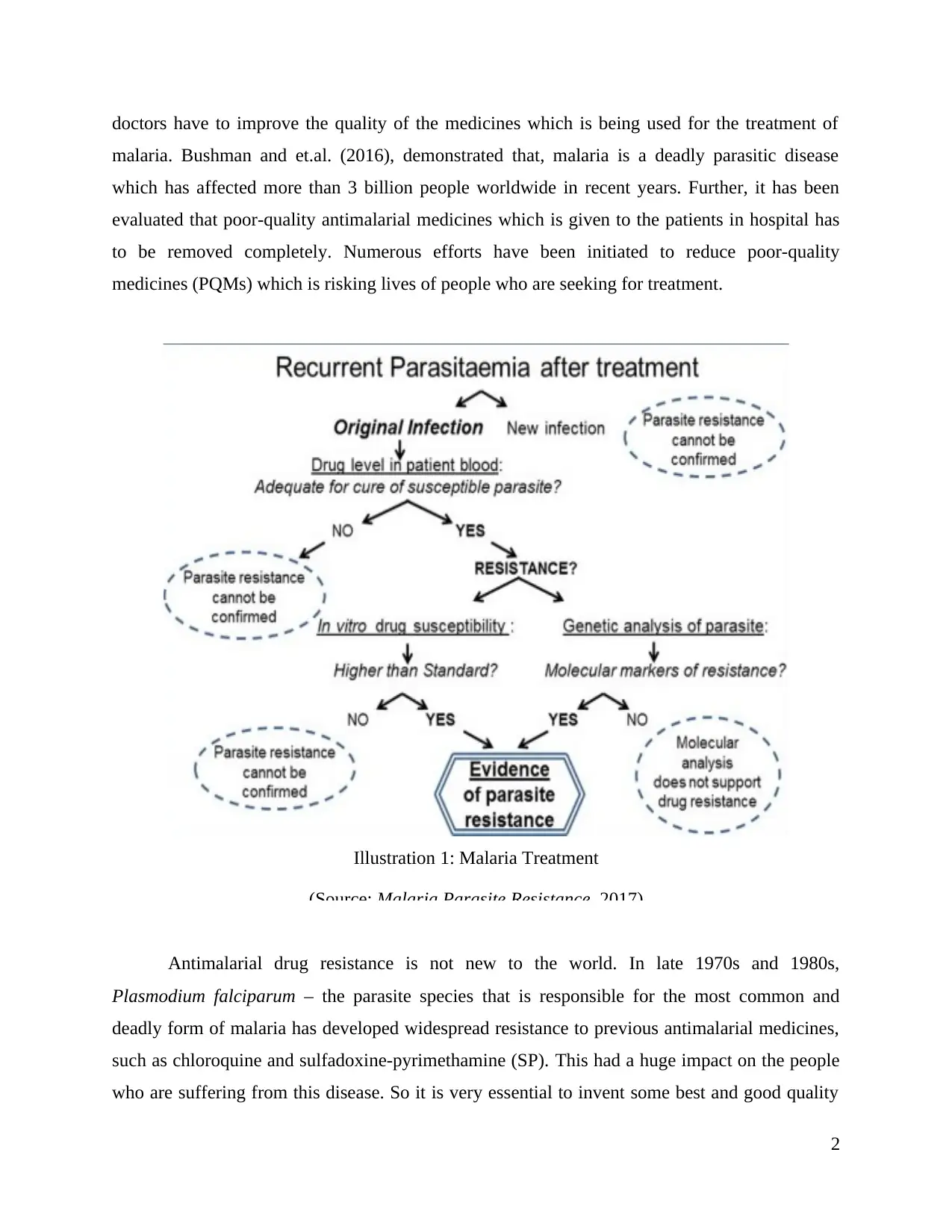
Illustration 1: Malaria Treatment
(Source: Malaria Parasite Resistance, 2017)
malaria. Bushman and et.al. (2016), demonstrated that, malaria is a deadly parasitic disease
which has affected more than 3 billion people worldwide in recent years. Further, it has been
evaluated that poor-quality antimalarial medicines which is given to the patients in hospital has
to be removed completely. Numerous efforts have been initiated to reduce poor-quality
medicines (PQMs) which is risking lives of people who are seeking for treatment.
Antimalarial drug resistance is not new to the world. In late 1970s and 1980s,
Plasmodium falciparum – the parasite species that is responsible for the most common and
deadly form of malaria has developed widespread resistance to previous antimalarial medicines,
such as chloroquine and sulfadoxine-pyrimethamine (SP). This had a huge impact on the people
who are suffering from this disease. So it is very essential to invent some best and good quality
2
Illustration 1: Malaria Treatment
(Source: Malaria Parasite Resistance, 2017)
⊘ This is a preview!⊘
Do you want full access?
Subscribe today to unlock all pages.
Trusted by 1+ million students worldwide
medicines. As per the view of Mok and et.al. (2014), doctors have to visualise drug resistance
data very carefully which can help in reducing the impact of malarial parasite on human being.
Malaria control and prevention efforts need to be designed for the specific environment in which
they will take into account the local epidemiology of malaria in which they develop. This process
will help them in understanding the nature and impact of this disease.
Malaria parasites drug resistance plays an essential role in the study of this disease.
According to Boni, White and Baird, (2016). In most countries, the recommended treatment is
antimalarial drugs (i.e., chloroquine or sulfadoxine-pyrimethamine) which not an
effectivemedication. The effects of resistance on morbidity and mortality are usually
underestimated by people. Pelleau and et.al. (2015), argued that resistance has already developed
3
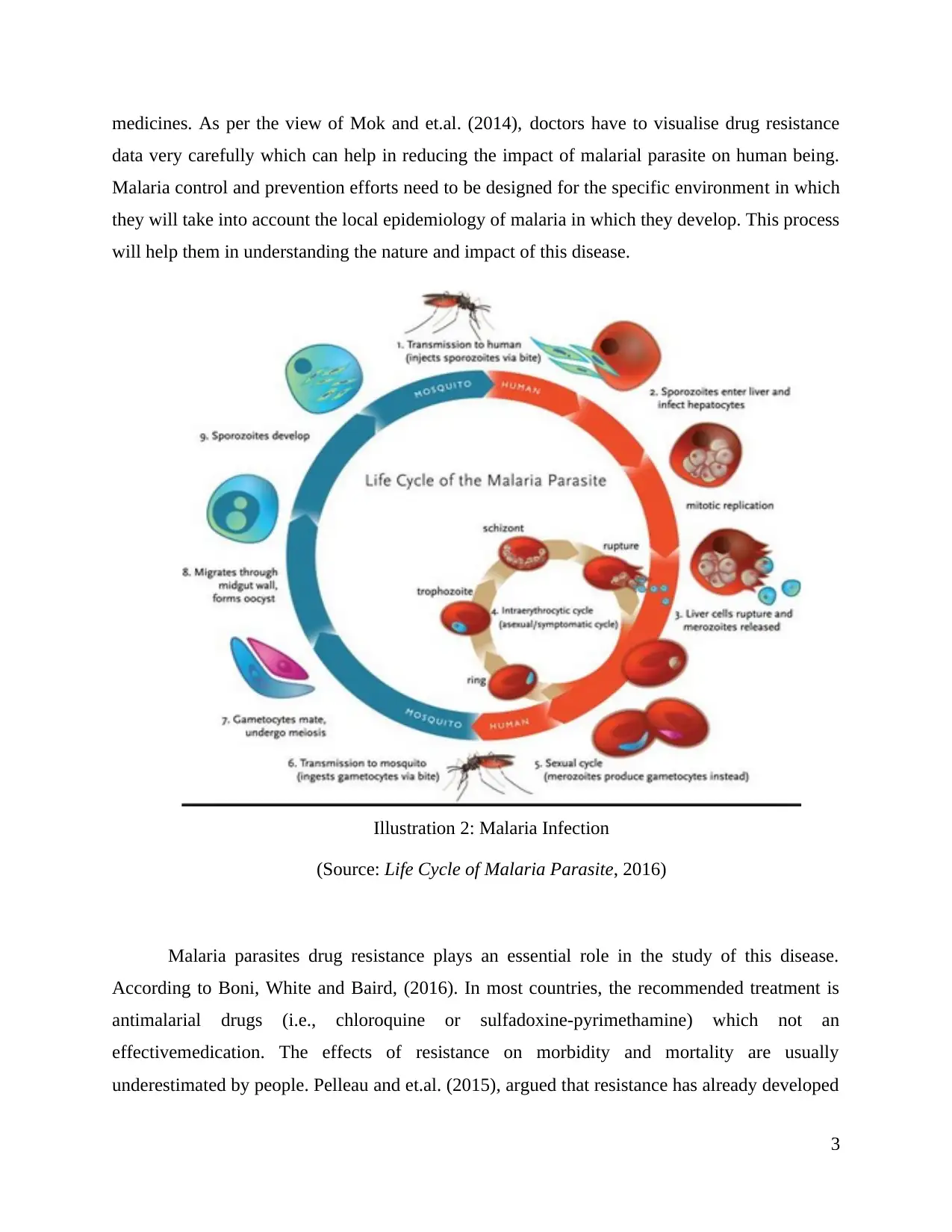
Illustration 2: Malaria Infection
(Source: Life Cycle of Malaria Parasite, 2016)
data very carefully which can help in reducing the impact of malarial parasite on human being.
Malaria control and prevention efforts need to be designed for the specific environment in which
they will take into account the local epidemiology of malaria in which they develop. This process
will help them in understanding the nature and impact of this disease.
Malaria parasites drug resistance plays an essential role in the study of this disease.
According to Boni, White and Baird, (2016). In most countries, the recommended treatment is
antimalarial drugs (i.e., chloroquine or sulfadoxine-pyrimethamine) which not an
effectivemedication. The effects of resistance on morbidity and mortality are usually
underestimated by people. Pelleau and et.al. (2015), argued that resistance has already developed
3
Illustration 2: Malaria Infection
(Source: Life Cycle of Malaria Parasite, 2016)
Paraphrase This Document
Need a fresh take? Get an instant paraphrase of this document with our AI Paraphraser
to all the antimalarial drug. Artemisinins is an essential drug for treating malaria disease. Some
common diagnostic malaria infections are uncomplicated and manifest, for example, fever,
chills, malaise, abdominal discomfort, mild anaemia, etc. All these factors looks like a normal
symptom but can lead to severe infection. Artemisinins an antimalarial lactone can be used in
making effective medicines and vaccines to treat malaria and eliminate fake drugs
According to Boni, White and Baird (2016), there are various methods which can be used
in manufacturing effective drugs and vaccines which can be used in treating this disease, such as,
pooled sequencing and rare variant association tests for the identification of the determinants of
emerging drug resistance in malaria parasites. This process will identify selective sweeps and
will perform all the testes on that sweep to come to a solution. This can be a great technique as
pooled sequencing helps in rapidly narrowing down the genome regions of interest. On the
contrary note, White, (2017), has demonstrated that spread of such drug resistance parasites
through malaria parasite populations has produced various key examples of evolution in action,
including both hard and soft selective sweeps. Drug resistance alleles consist of drugs like,
chloroquine, mefloquine, and sulphadoxine–pyrimethamine (SP), which plays an important role
in fighting against with these malaria parasites.
Malaria parasites drug resistance is defined as the ability of a parasite strain to survive
and/or multiply despite the administration and absorption of a drug in doses equal to or higher
than those usually. Due to this issue there are various problems which can arise and can affect
the overall treatment of malaria disease. To check the resistance power of the parasite, methods
like, characterize the enzyme, the cloning of plasmodial DHFR-TS genes, chromosomal mapping
studies of these genes by pulsed-field gel electrophoresis, etc. plays a crucial role in medical
field (Multi-drug-resistant malaria parasite causing high rates of treatment failure, 2017). On
the other hand, according to Mok and et.al. (2014), this situation can be deal by inventing new
and improved drugs which has some different composition as compared to the earlier drugs. This
will help in breaking the drug resistant quality for malaria parasite as this will include entirely a
new composition of chemical which will be totally new to them. Parasite for malaria which is
known as P. falciparum, has developed drug resistance to nearly all the available antimalarial
drugs, such as sulfadoxine/ pyrimethamine, mefloquine, quinine, etc.
4
common diagnostic malaria infections are uncomplicated and manifest, for example, fever,
chills, malaise, abdominal discomfort, mild anaemia, etc. All these factors looks like a normal
symptom but can lead to severe infection. Artemisinins an antimalarial lactone can be used in
making effective medicines and vaccines to treat malaria and eliminate fake drugs
According to Boni, White and Baird (2016), there are various methods which can be used
in manufacturing effective drugs and vaccines which can be used in treating this disease, such as,
pooled sequencing and rare variant association tests for the identification of the determinants of
emerging drug resistance in malaria parasites. This process will identify selective sweeps and
will perform all the testes on that sweep to come to a solution. This can be a great technique as
pooled sequencing helps in rapidly narrowing down the genome regions of interest. On the
contrary note, White, (2017), has demonstrated that spread of such drug resistance parasites
through malaria parasite populations has produced various key examples of evolution in action,
including both hard and soft selective sweeps. Drug resistance alleles consist of drugs like,
chloroquine, mefloquine, and sulphadoxine–pyrimethamine (SP), which plays an important role
in fighting against with these malaria parasites.
Malaria parasites drug resistance is defined as the ability of a parasite strain to survive
and/or multiply despite the administration and absorption of a drug in doses equal to or higher
than those usually. Due to this issue there are various problems which can arise and can affect
the overall treatment of malaria disease. To check the resistance power of the parasite, methods
like, characterize the enzyme, the cloning of plasmodial DHFR-TS genes, chromosomal mapping
studies of these genes by pulsed-field gel electrophoresis, etc. plays a crucial role in medical
field (Multi-drug-resistant malaria parasite causing high rates of treatment failure, 2017). On
the other hand, according to Mok and et.al. (2014), this situation can be deal by inventing new
and improved drugs which has some different composition as compared to the earlier drugs. This
will help in breaking the drug resistant quality for malaria parasite as this will include entirely a
new composition of chemical which will be totally new to them. Parasite for malaria which is
known as P. falciparum, has developed drug resistance to nearly all the available antimalarial
drugs, such as sulfadoxine/ pyrimethamine, mefloquine, quinine, etc.
4
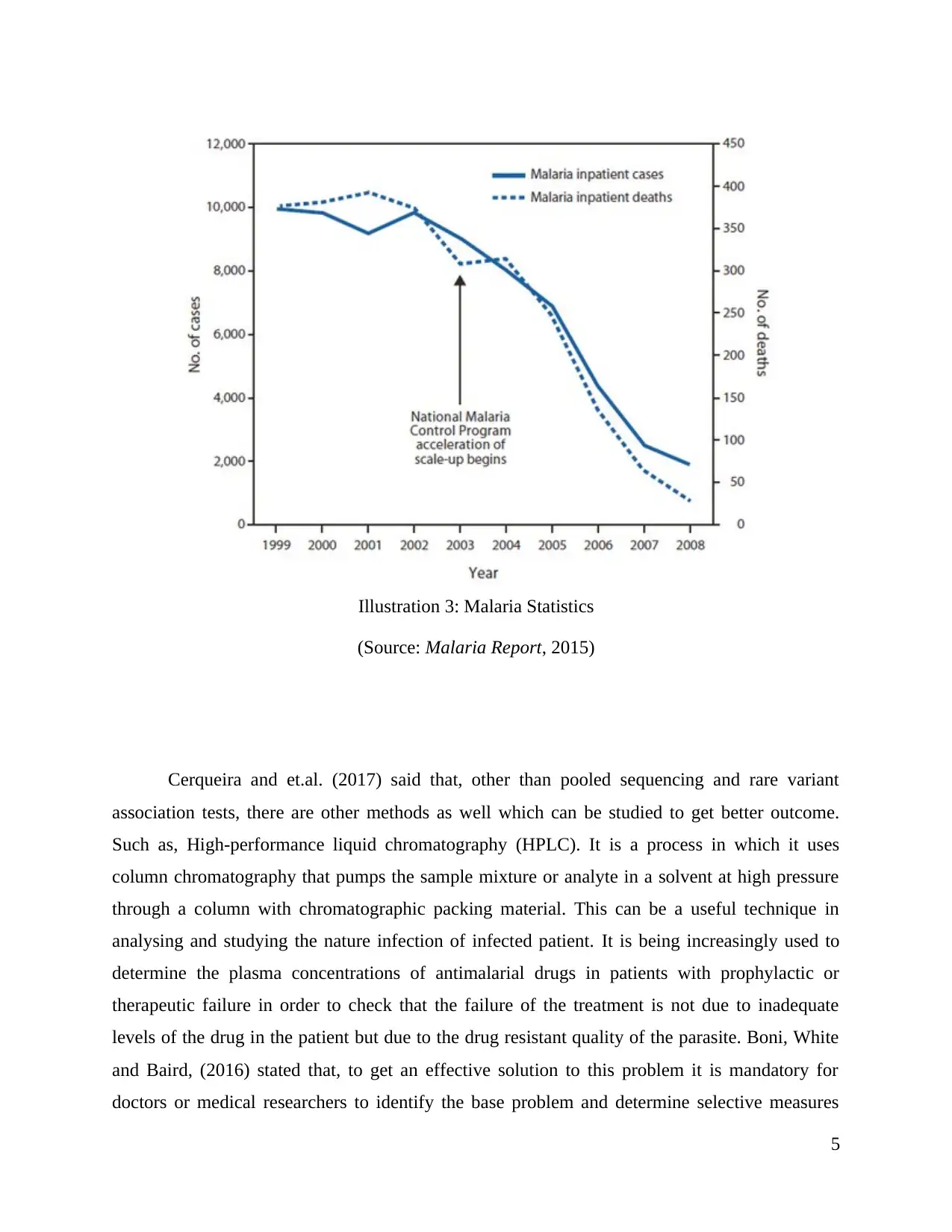
Cerqueira and et.al. (2017) said that, other than pooled sequencing and rare variant
association tests, there are other methods as well which can be studied to get better outcome.
Such as, High-performance liquid chromatography (HPLC). It is a process in which it uses
column chromatography that pumps the sample mixture or analyte in a solvent at high pressure
through a column with chromatographic packing material. This can be a useful technique in
analysing and studying the nature infection of infected patient. It is being increasingly used to
determine the plasma concentrations of antimalarial drugs in patients with prophylactic or
therapeutic failure in order to check that the failure of the treatment is not due to inadequate
levels of the drug in the patient but due to the drug resistant quality of the parasite. Boni, White
and Baird, (2016) stated that, to get an effective solution to this problem it is mandatory for
doctors or medical researchers to identify the base problem and determine selective measures
5
Illustration 3: Malaria Statistics
(Source: Malaria Report, 2015)
association tests, there are other methods as well which can be studied to get better outcome.
Such as, High-performance liquid chromatography (HPLC). It is a process in which it uses
column chromatography that pumps the sample mixture or analyte in a solvent at high pressure
through a column with chromatographic packing material. This can be a useful technique in
analysing and studying the nature infection of infected patient. It is being increasingly used to
determine the plasma concentrations of antimalarial drugs in patients with prophylactic or
therapeutic failure in order to check that the failure of the treatment is not due to inadequate
levels of the drug in the patient but due to the drug resistant quality of the parasite. Boni, White
and Baird, (2016) stated that, to get an effective solution to this problem it is mandatory for
doctors or medical researchers to identify the base problem and determine selective measures
5
Illustration 3: Malaria Statistics
(Source: Malaria Report, 2015)
⊘ This is a preview!⊘
Do you want full access?
Subscribe today to unlock all pages.
Trusted by 1+ million students worldwide
which can help them in making these malaria parasites to get affected with these drugs. For this
they can use rationale for combination chemotherapy for malaria which can be an important step
towards treating this disease with effectiveness as resistance play a crucial factor in deciding the
useful lifespan of antimalarial drugs that are being used for the treatment of malaria.
Fake Malaria Drugs
Yadav and Rawal (2016) stated that, there are large cases of malaria in recent years. It is
due to the factors like, malaria parasites have become drug resistant and development of fake
malaria drugs in market. These two factors has so much impact on the overall development of
the drugs for this disease. Research on the medicine industry has discovered that one reason for
malaria’s continued virulence is the manufacturing of ineffective medicine. According to the
view of, Tanner and et.al., (2016), this practising of developing fake medicines or drugs for
malaria is performed due to various issues, for example, to earn a good revenue from this
business. These are basically manufacturing two types of common antimalarial medicines:
quinines and artemisins. These two chemicals are the crucial part for developing an effective
malarial drug or vaccine.
As per the view of Tabernero and et.al. (2014), Artemisinin derivatives like Artesunate is
an essential part of the malaria control and treatment due to its fast antimalarial effects and good
tolerance over the infection. There is a wide spread of fake malaria drugs in countries like, Africa
and South East Asia. Passi (2018) argued that, it is very essential to control the fake anti malarial
drug as soon as possible as it can affect the health of various people. This can be achieved by
studying the issue thoroughly. The counterfeit drugs are the main issue and is very dangerous to
the malaria patients and it can even lead to the development of drug resistance in their body.
There is a need to build strict laws and the implication of these laws at the grass roots level. The
role of surveillance is also important and may help in controlling this problem of spurious drugs.
The companies involved in making fake drugs should be blacklisted.
According to Cheeseman, I.H. and et.al. (2015), patients financial status is also an
important in the enhancement of fake drugs of malaria. Patients who unwillingly purchase
ineffective anti-malarial drugs as they don't have enough money to buy expensive drugs for their
treatment. This has also led to increase the number of fake drugs and vaccines worldwide. To
control this problem of fake and substandard malaria drugs, organizations like, World Health
Organization, etc. has developed guidelines with respect to the acquisition of malaria medicines
6
they can use rationale for combination chemotherapy for malaria which can be an important step
towards treating this disease with effectiveness as resistance play a crucial factor in deciding the
useful lifespan of antimalarial drugs that are being used for the treatment of malaria.
Fake Malaria Drugs
Yadav and Rawal (2016) stated that, there are large cases of malaria in recent years. It is
due to the factors like, malaria parasites have become drug resistant and development of fake
malaria drugs in market. These two factors has so much impact on the overall development of
the drugs for this disease. Research on the medicine industry has discovered that one reason for
malaria’s continued virulence is the manufacturing of ineffective medicine. According to the
view of, Tanner and et.al., (2016), this practising of developing fake medicines or drugs for
malaria is performed due to various issues, for example, to earn a good revenue from this
business. These are basically manufacturing two types of common antimalarial medicines:
quinines and artemisins. These two chemicals are the crucial part for developing an effective
malarial drug or vaccine.
As per the view of Tabernero and et.al. (2014), Artemisinin derivatives like Artesunate is
an essential part of the malaria control and treatment due to its fast antimalarial effects and good
tolerance over the infection. There is a wide spread of fake malaria drugs in countries like, Africa
and South East Asia. Passi (2018) argued that, it is very essential to control the fake anti malarial
drug as soon as possible as it can affect the health of various people. This can be achieved by
studying the issue thoroughly. The counterfeit drugs are the main issue and is very dangerous to
the malaria patients and it can even lead to the development of drug resistance in their body.
There is a need to build strict laws and the implication of these laws at the grass roots level. The
role of surveillance is also important and may help in controlling this problem of spurious drugs.
The companies involved in making fake drugs should be blacklisted.
According to Cheeseman, I.H. and et.al. (2015), patients financial status is also an
important in the enhancement of fake drugs of malaria. Patients who unwillingly purchase
ineffective anti-malarial drugs as they don't have enough money to buy expensive drugs for their
treatment. This has also led to increase the number of fake drugs and vaccines worldwide. To
control this problem of fake and substandard malaria drugs, organizations like, World Health
Organization, etc. has developed guidelines with respect to the acquisition of malaria medicines
6
Paraphrase This Document
Need a fresh take? Get an instant paraphrase of this document with our AI Paraphraser
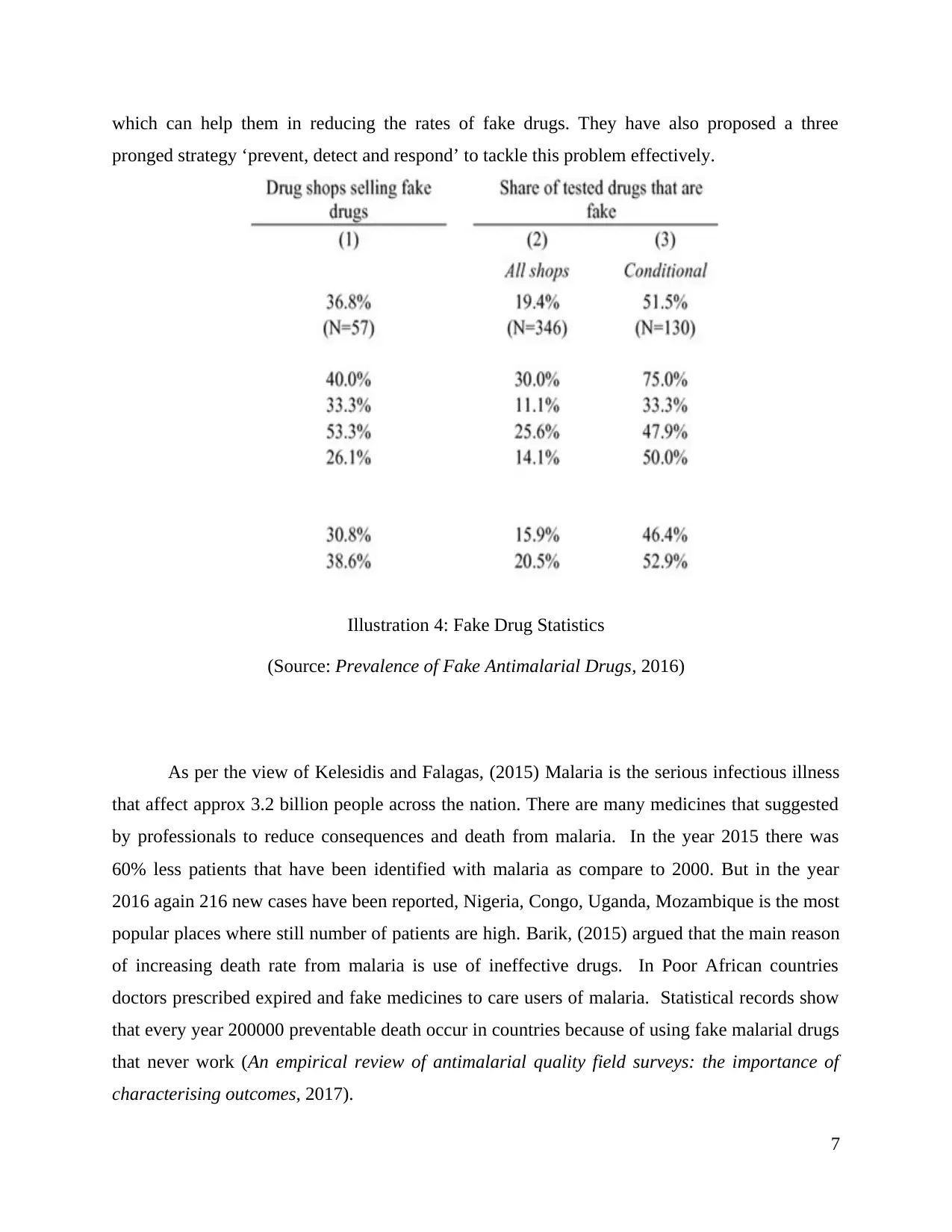
which can help them in reducing the rates of fake drugs. They have also proposed a three
pronged strategy ‘prevent, detect and respond’ to tackle this problem effectively.
As per the view of Kelesidis and Falagas, (2015) Malaria is the serious infectious illness
that affect approx 3.2 billion people across the nation. There are many medicines that suggested
by professionals to reduce consequences and death from malaria. In the year 2015 there was
60% less patients that have been identified with malaria as compare to 2000. But in the year
2016 again 216 new cases have been reported, Nigeria, Congo, Uganda, Mozambique is the most
popular places where still number of patients are high. Barik, (2015) argued that the main reason
of increasing death rate from malaria is use of ineffective drugs. In Poor African countries
doctors prescribed expired and fake medicines to care users of malaria. Statistical records show
that every year 200000 preventable death occur in countries because of using fake malarial drugs
that never work (An empirical review of antimalarial quality field surveys: the importance of
characterising outcomes, 2017).
7
Illustration 4: Fake Drug Statistics
(Source: Prevalence of Fake Antimalarial Drugs, 2016)
pronged strategy ‘prevent, detect and respond’ to tackle this problem effectively.
As per the view of Kelesidis and Falagas, (2015) Malaria is the serious infectious illness
that affect approx 3.2 billion people across the nation. There are many medicines that suggested
by professionals to reduce consequences and death from malaria. In the year 2015 there was
60% less patients that have been identified with malaria as compare to 2000. But in the year
2016 again 216 new cases have been reported, Nigeria, Congo, Uganda, Mozambique is the most
popular places where still number of patients are high. Barik, (2015) argued that the main reason
of increasing death rate from malaria is use of ineffective drugs. In Poor African countries
doctors prescribed expired and fake medicines to care users of malaria. Statistical records show
that every year 200000 preventable death occur in countries because of using fake malarial drugs
that never work (An empirical review of antimalarial quality field surveys: the importance of
characterising outcomes, 2017).
7
Illustration 4: Fake Drug Statistics
(Source: Prevalence of Fake Antimalarial Drugs, 2016)
According to Strickland, (2017) US national Institutes of health has given report in the
year 2012 and has stated that one third of anti malarial medicines that are distributed in market
are of poor quality. Many pharmaceutical companies have prepared fake versions of these
medicines and are suggesting to patients when they suffer from such illness. Government of the
nation has no oversight on these matters. Malaria is deadly disease, though professionals are
providing advance level treatment to users so that their health can be recovered soon but still
many pharmaceutical companies prepare fake drugs and distributed it to market that increases
risk of death. Such types of medicines have been dispersed for gaining monetary benefits. All
these drugs contains incorrect amount of ingredients and are of poor quality that affect body of
human being badly. Gurney, Amundson and Boumediene, (2016) stated that 4.92% of anti-
malarial drugs are of poor quality, this clearly shows that population is in massive risk and
danger is increasing day-to-day. It is essential to take immediate action to reduce manufacturing
of such types of drugs and its distribution (Fake drugs are one reason malaria still kills so many,
2018).
8
year 2012 and has stated that one third of anti malarial medicines that are distributed in market
are of poor quality. Many pharmaceutical companies have prepared fake versions of these
medicines and are suggesting to patients when they suffer from such illness. Government of the
nation has no oversight on these matters. Malaria is deadly disease, though professionals are
providing advance level treatment to users so that their health can be recovered soon but still
many pharmaceutical companies prepare fake drugs and distributed it to market that increases
risk of death. Such types of medicines have been dispersed for gaining monetary benefits. All
these drugs contains incorrect amount of ingredients and are of poor quality that affect body of
human being badly. Gurney, Amundson and Boumediene, (2016) stated that 4.92% of anti-
malarial drugs are of poor quality, this clearly shows that population is in massive risk and
danger is increasing day-to-day. It is essential to take immediate action to reduce manufacturing
of such types of drugs and its distribution (Fake drugs are one reason malaria still kills so many,
2018).
8
⊘ This is a preview!⊘
Do you want full access?
Subscribe today to unlock all pages.
Trusted by 1+ million students worldwide

1 out of 17


Related Documents


Your All-in-One AI-Powered Toolkit for Academic Success.
+13062052269
info@desklib.com
Available 24*7 on WhatsApp / Email
![[object Object]](/_next/static/media/star-bottom.7253800d.svg)
Unlock your academic potential
Copyright © 2020–2026 A2Z Services. All Rights Reserved. Developed and managed by ZUCOL.