ECN70104: Malaysia's Challenges in Escaping the Middle Income Trap
VerifiedAdded on 2023/04/11
|21
|6816
|104
Report
AI Summary
This report examines Malaysia's persistent struggle with the middle-income trap, a situation where the country has been unable to transition from middle-income to high-income status despite decades of economic development. It reviews the background of Malaysia’s economy, defines the Middle Income Trap (MIT), identifies factors contributing to Malaysia's entrapment, such as stagnating Total Factor Productivity (TFP) growth and a reliance on labor-intensive industries, and explores potential strategies for escaping it. The analysis covers Malaysia's economic evolution from a commodity-based economy to a service-oriented one, the impact of economic policies like the New Economic Policy (NEP) and New Economic Model (NEM), and the challenges in achieving higher income levels due to factors like slow wage growth and the need for deeper industrialization and technological advancement. The report concludes by emphasizing the need for Malaysia to transform its economic strategies to achieve high-income status.
ECN70104: - MALAYSIA IN A MIDDLE INCOME TRAP
MALAYSIA IN A MIDDLE INCOME TRAP
Abstract: -
Malaysia continues to struggle in addressing the identified challenges that are preventing or
delaying the country’s shift from middle income to high-income status. Malaysia progressed
from lower middle to upper middle income status in 1992 and has been stagnating in a middle
income-status for 55 years since 1960. Malaysia is caught in the middle trap right now and
getting it out is going to be challenging. The term ‘middle-income trap’ was first brought to
attention by Gill and Kharas (2007), to highlight growth slowdowns in many East Asian
economies. These countries experienced rapid growth, enabling them to reach the middle
income status but have not been able to catch up with developed countries and achieve high
income status. (Gill and Kharas, 2007). The paper conducts a review on the existing
literature on the background of Malaysia’s economy, the definition on Middle Income Trap
(MIT), factors which lead Malaysia to fall into the middle income trap and suggested ways
and method to escape from the middle income Trap.
Keywords:-
Submitted by: Anand Sharvanandan (0337677) Page 1
MALAYSIA IN A MIDDLE INCOME TRAP
Abstract: -
Malaysia continues to struggle in addressing the identified challenges that are preventing or
delaying the country’s shift from middle income to high-income status. Malaysia progressed
from lower middle to upper middle income status in 1992 and has been stagnating in a middle
income-status for 55 years since 1960. Malaysia is caught in the middle trap right now and
getting it out is going to be challenging. The term ‘middle-income trap’ was first brought to
attention by Gill and Kharas (2007), to highlight growth slowdowns in many East Asian
economies. These countries experienced rapid growth, enabling them to reach the middle
income status but have not been able to catch up with developed countries and achieve high
income status. (Gill and Kharas, 2007). The paper conducts a review on the existing
literature on the background of Malaysia’s economy, the definition on Middle Income Trap
(MIT), factors which lead Malaysia to fall into the middle income trap and suggested ways
and method to escape from the middle income Trap.
Keywords:-
Submitted by: Anand Sharvanandan (0337677) Page 1

Paraphrase This Document
Need a fresh take? Get an instant paraphrase of this document with our AI Paraphraser
ECN70104: - MALAYSIA IN A MIDDLE INCOME TRAP
1. INTRODUCTION
Before independence, Malaya's economy (before Malaysia was formed) largely
depended on rubber and tin exports as the main source of income and Malaya was third,
after Japan and Singapore in terms of prosperity (Sukirno, 2004). Since independence
till now, Malaysia has enjoyed relative prosperity, initially as a commodity exporter
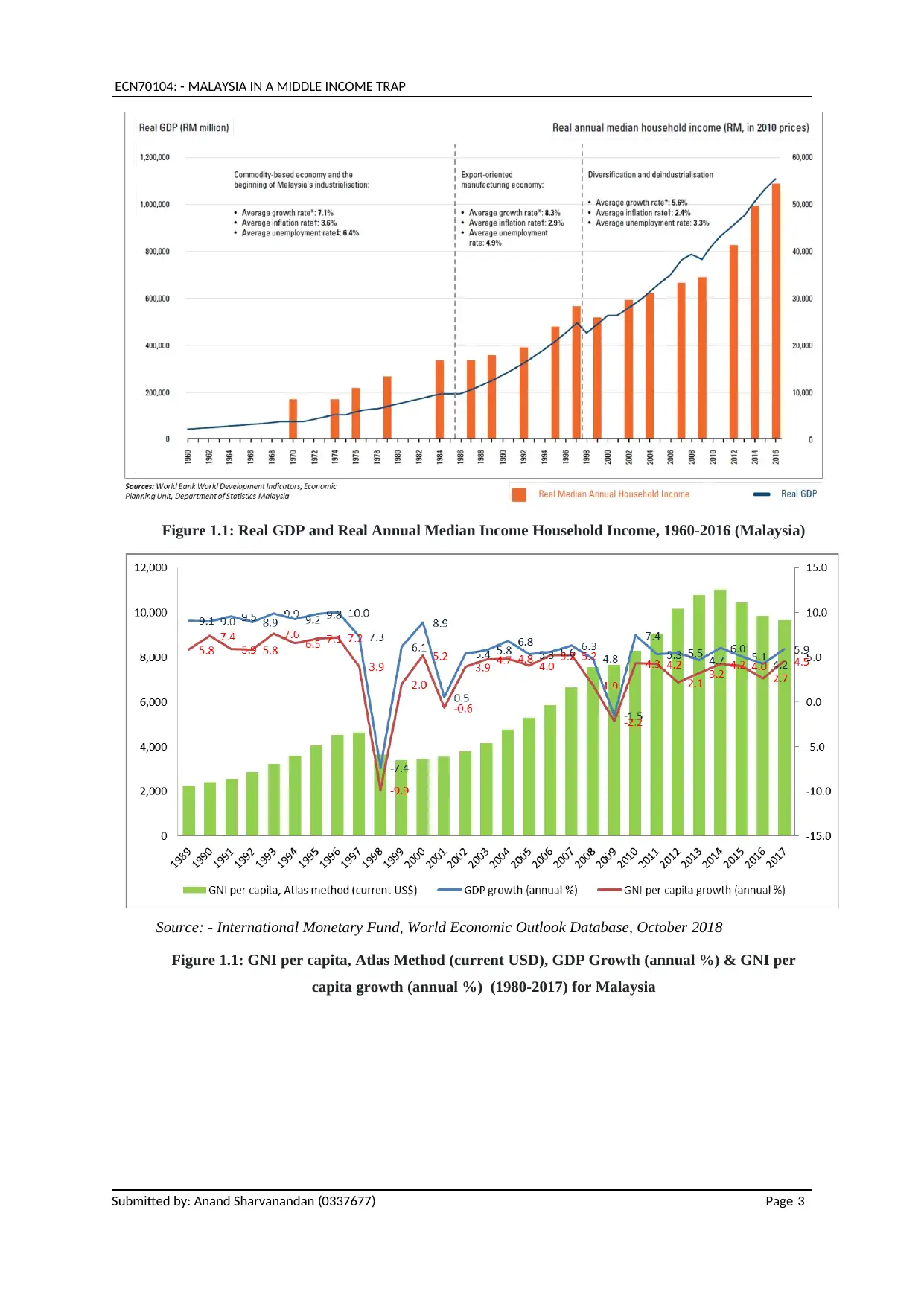
(rubber, tin, palm oil and petroleum) to a services-oriented economy. Figure 1.1 below
shows the economic growth experience by Malaysia under different periods of time.
1960- 1985:- Commodity based economy that gradually began to modernise
and industrialise, commencing with import –substitution which then evolved
into export-oriented. Further to that, The New Economic Policy (NEP) was
introduced in 1971 with a goal to eradicate poverty and restructure economy
while aiming to eliminate the identification of ethnicity with economic function
(New Straits Times, 2006).
1986- 1998:- Manufacturing based economy geared for trade cantered growth.
The Passage for Promotion of Investments Act of 1986 bolstered Malaysia’s
position as an attractive location for overseas investments (Murtada, 2019).
Malaysia had turned into a manufacturing oriented country which produces
electronic and electrical goods, iron, car and cement.
1998 till present: - After going through two major financial crisis, Asian
Financial Crisis and Global Financial Crisis, the economy underwent major
reform to increase resilience and robustness of its existing sector. Malaysia had
become a service-oriented country. Under this sector, it contains of tourism,
finance and education. The percentage of GDP had the biggest share since year
1985. The economic growth of this sector is around 7% and the employment
rate has been more than 50% since year 1985. Malaysia continued to enjoy
good economic growth and in 2010, New Economic Model (NEM) was
unveiled by the then government to propel Malaysia into the high income
category by year 2020 (Chin, 2010). The goal of NEM was to improve
worker productivity across all sectors while tying it closely to sustainability,
(Star, 2010) besides empowering the private sector and to reduce the financial
disparity between the poor and wealthy Malaysians (Bernama, 2010).
Submitted by: Anand Sharvanandan (0337677) Page 2
1. INTRODUCTION
Before independence, Malaya's economy (before Malaysia was formed) largely
depended on rubber and tin exports as the main source of income and Malaya was third,
after Japan and Singapore in terms of prosperity (Sukirno, 2004). Since independence
till now, Malaysia has enjoyed relative prosperity, initially as a commodity exporter
(rubber, tin, palm oil and petroleum) to a services-oriented economy. Figure 1.1 below
shows the economic growth experience by Malaysia under different periods of time.
1960- 1985:- Commodity based economy that gradually began to modernise
and industrialise, commencing with import –substitution which then evolved
into export-oriented. Further to that, The New Economic Policy (NEP) was
introduced in 1971 with a goal to eradicate poverty and restructure economy
while aiming to eliminate the identification of ethnicity with economic function
(New Straits Times, 2006).
1986- 1998:- Manufacturing based economy geared for trade cantered growth.
The Passage for Promotion of Investments Act of 1986 bolstered Malaysia’s
position as an attractive location for overseas investments (Murtada, 2019).
Malaysia had turned into a manufacturing oriented country which produces
electronic and electrical goods, iron, car and cement.
1998 till present: - After going through two major financial crisis, Asian
Financial Crisis and Global Financial Crisis, the economy underwent major
reform to increase resilience and robustness of its existing sector. Malaysia had
become a service-oriented country. Under this sector, it contains of tourism,
finance and education. The percentage of GDP had the biggest share since year
1985. The economic growth of this sector is around 7% and the employment
rate has been more than 50% since year 1985. Malaysia continued to enjoy
good economic growth and in 2010, New Economic Model (NEM) was
unveiled by the then government to propel Malaysia into the high income
category by year 2020 (Chin, 2010). The goal of NEM was to improve
worker productivity across all sectors while tying it closely to sustainability,
(Star, 2010) besides empowering the private sector and to reduce the financial
disparity between the poor and wealthy Malaysians (Bernama, 2010).
Submitted by: Anand Sharvanandan (0337677) Page 2
ECN70104: - MALAYSIA IN A MIDDLE INCOME TRAP
Figure 1.1: Real GDP and Real Annual Median Income Household Income, 1960-2016 (Malaysia)
Source: - International Monetary Fund, World Economic Outlook Database, October 2018
Figure 1.1: GNI per capita, Atlas Method (current USD), GDP Growth (annual %) & GNI per
capita growth (annual %) (1980-2017) for Malaysia
Submitted by: Anand Sharvanandan (0337677) Page 3
Figure 1.1: Real GDP and Real Annual Median Income Household Income, 1960-2016 (Malaysia)
Source: - International Monetary Fund, World Economic Outlook Database, October 2018
Figure 1.1: GNI per capita, Atlas Method (current USD), GDP Growth (annual %) & GNI per
capita growth (annual %) (1980-2017) for Malaysia
Submitted by: Anand Sharvanandan (0337677) Page 3
⊘ This is a preview!⊘
Do you want full access?
Subscribe today to unlock all pages.

Trusted by 1+ million students worldwide
ECN70104: - MALAYSIA IN A MIDDLE INCOME TRAP
In 1989, the World Bank (Datahelpdesk.worldbank.org, 2019) began categorising
countries as low, lower middle, upper middle and high income countries based on their
capita gross national income (GNI) as per Table 1.1 below.
GNI per Capita (USD) Classification
Less than $1025 Low Income
Between $ 1026 and $ 4035 Lower Middle Income
Between $ 4036 and $ 12, 475 Upper Middle Income
More Than $ 12,476 High Income
Source: - World Bank
Table 1.1: World Bank Country Classifications by Income level
According to World Bank’s classification, Malaysia progressed from lower middle to
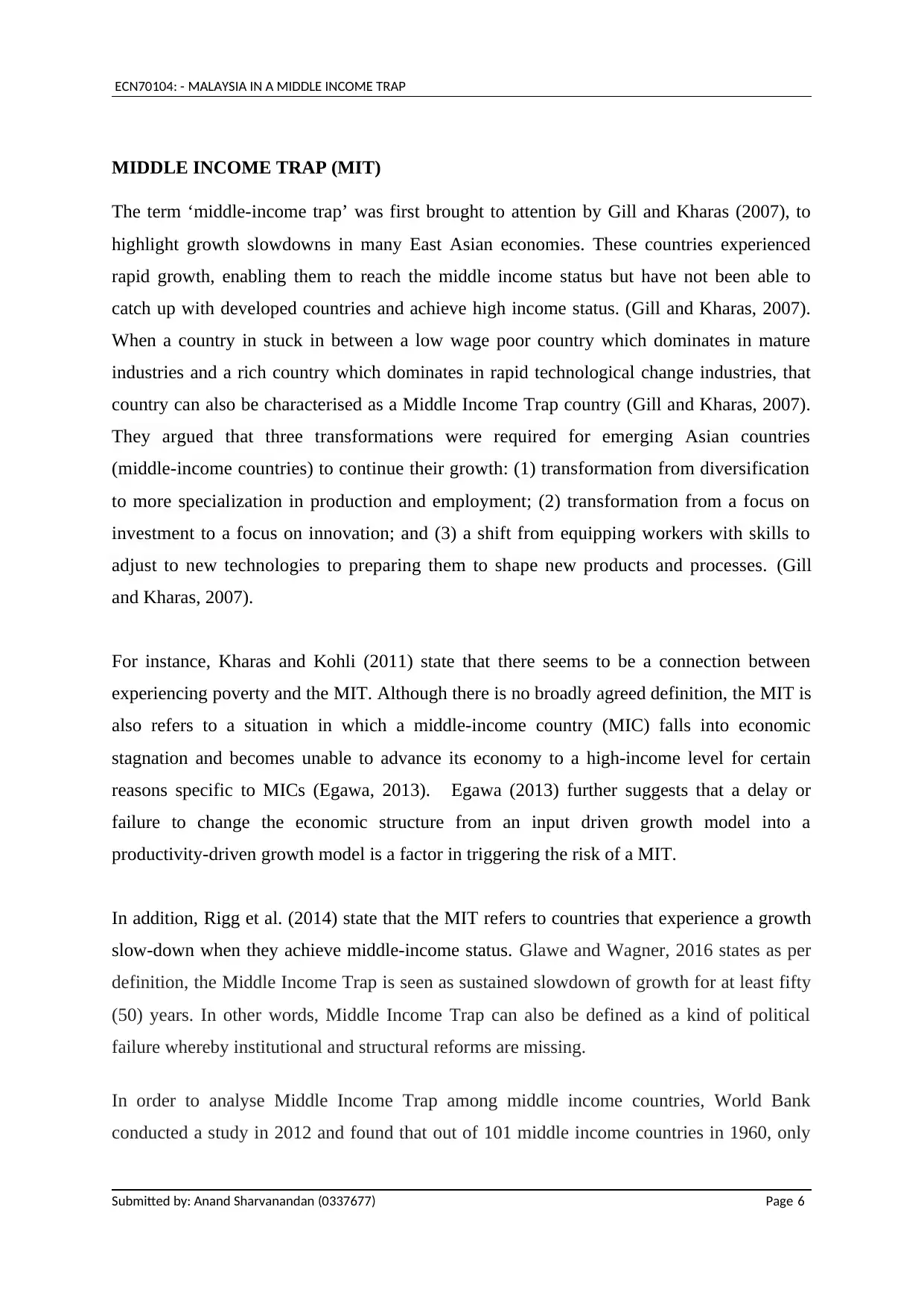
upper middle income status in 1992. Its per capita gross national income (GNI) reached
USD 10,570 in 2015 (Refer Figure 1.2) or 15 percent short of the high income threshold
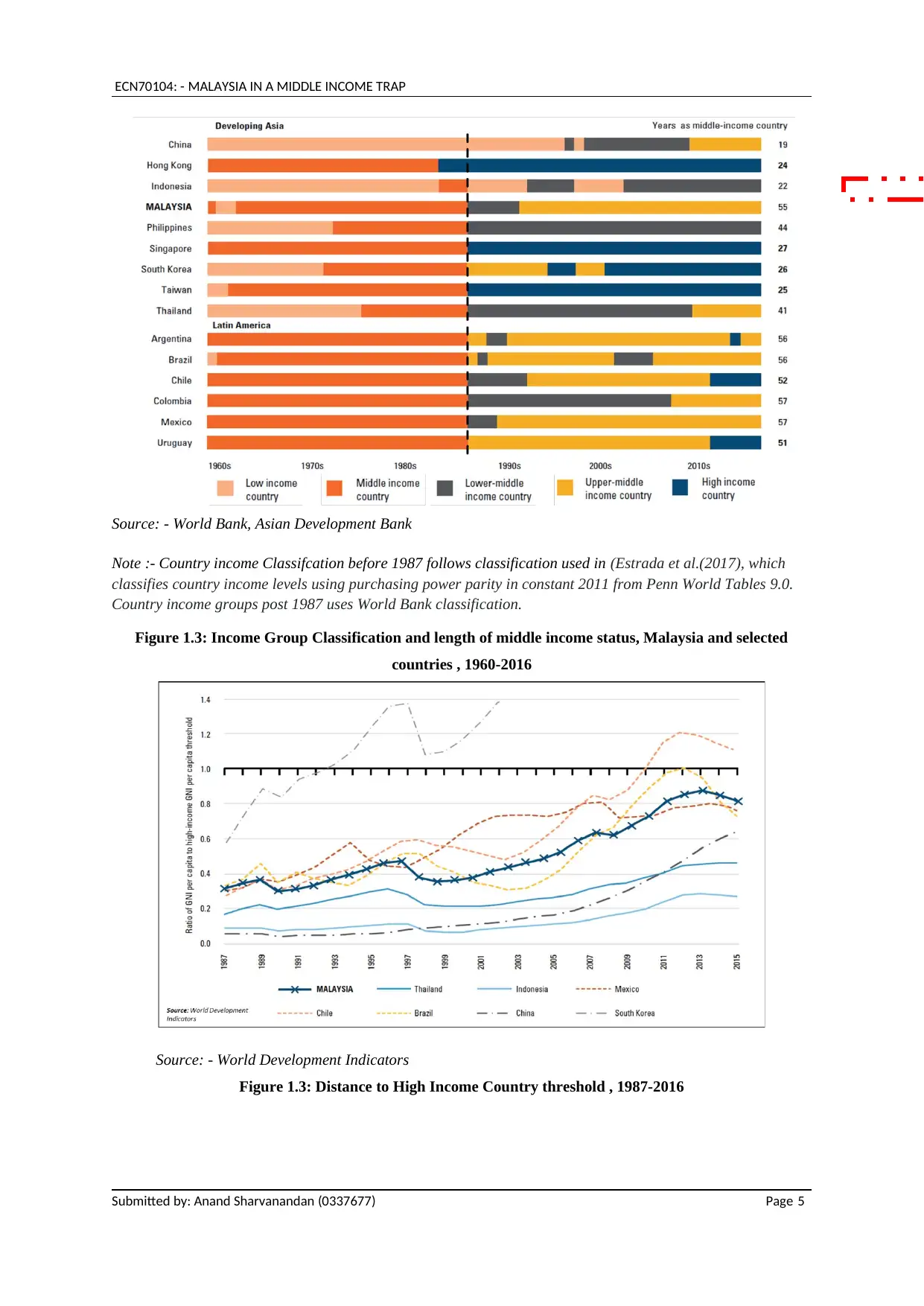
of USD 12,475. According to a study by Asian Development Bank, Malaysia has been
stagnating in a middle income-status for 55 years between 1960 to 2017. (Estrada et al.,
2017) as indicated in Figure 1.3 which is a common phenomenon for many developing
countries. Figure 1.4 shows that Malaysia is slowly approaching the threshold for a high
income country
Submitted by: Anand Sharvanandan (0337677) Page 4
In 1989, the World Bank (Datahelpdesk.worldbank.org, 2019) began categorising
countries as low, lower middle, upper middle and high income countries based on their
capita gross national income (GNI) as per Table 1.1 below.
GNI per Capita (USD) Classification
Less than $1025 Low Income
Between $ 1026 and $ 4035 Lower Middle Income
Between $ 4036 and $ 12, 475 Upper Middle Income
More Than $ 12,476 High Income
Source: - World Bank
Table 1.1: World Bank Country Classifications by Income level
According to World Bank’s classification, Malaysia progressed from lower middle to
upper middle income status in 1992. Its per capita gross national income (GNI) reached
USD 10,570 in 2015 (Refer Figure 1.2) or 15 percent short of the high income threshold
of USD 12,475. According to a study by Asian Development Bank, Malaysia has been
stagnating in a middle income-status for 55 years between 1960 to 2017. (Estrada et al.,
2017) as indicated in Figure 1.3 which is a common phenomenon for many developing
countries. Figure 1.4 shows that Malaysia is slowly approaching the threshold for a high
income country
Submitted by: Anand Sharvanandan (0337677) Page 4
Paraphrase This Document
Need a fresh take? Get an instant paraphrase of this document with our AI Paraphraser
ECN70104: - MALAYSIA IN A MIDDLE INCOME TRAP
Source: - World Bank, Asian Development Bank
Note :- Country income Classifcation before 1987 follows classification used in (Estrada et al.(2017), which
classifies country income levels using purchasing power parity in constant 2011 from Penn World Tables 9.0.
Country income groups post 1987 uses World Bank classification.
Figure 1.3: Income Group Classification and length of middle income status, Malaysia and selected
countries , 1960-2016
Source: - World Development Indicators
Figure 1.3: Distance to High Income Country threshold , 1987-2016
Submitted by: Anand Sharvanandan (0337677) Page 5
Source: - World Bank, Asian Development Bank
Note :- Country income Classifcation before 1987 follows classification used in (Estrada et al.(2017), which
classifies country income levels using purchasing power parity in constant 2011 from Penn World Tables 9.0.
Country income groups post 1987 uses World Bank classification.
Figure 1.3: Income Group Classification and length of middle income status, Malaysia and selected
countries , 1960-2016
Source: - World Development Indicators
Figure 1.3: Distance to High Income Country threshold , 1987-2016
Submitted by: Anand Sharvanandan (0337677) Page 5
ECN70104: - MALAYSIA IN A MIDDLE INCOME TRAP
MIDDLE INCOME TRAP (MIT)
The term ‘middle-income trap’ was first brought to attention by Gill and Kharas (2007), to
highlight growth slowdowns in many East Asian economies. These countries experienced
rapid growth, enabling them to reach the middle income status but have not been able to
catch up with developed countries and achieve high income status. (Gill and Kharas, 2007).
When a country in stuck in between a low wage poor country which dominates in mature
industries and a rich country which dominates in rapid technological change industries, that
country can also be characterised as a Middle Income Trap country (Gill and Kharas, 2007).
They argued that three transformations were required for emerging Asian countries
(middle-income countries) to continue their growth: (1) transformation from diversification
to more specialization in production and employment; (2) transformation from a focus on
investment to a focus on innovation; and (3) a shift from equipping workers with skills to
adjust to new technologies to preparing them to shape new products and processes. (Gill
and Kharas, 2007).
For instance, Kharas and Kohli (2011) state that there seems to be a connection between
experiencing poverty and the MIT. Although there is no broadly agreed definition, the MIT is
also refers to a situation in which a middle-income country (MIC) falls into economic
stagnation and becomes unable to advance its economy to a high-income level for certain
reasons specific to MICs (Egawa, 2013). Egawa (2013) further suggests that a delay or
failure to change the economic structure from an input driven growth model into a
productivity-driven growth model is a factor in triggering the risk of a MIT.
In addition, Rigg et al. (2014) state that the MIT refers to countries that experience a growth
slow-down when they achieve middle-income status. Glawe and Wagner, 2016 states as per
definition, the Middle Income Trap is seen as sustained slowdown of growth for at least fifty
(50) years. In other words, Middle Income Trap can also be defined as a kind of political
failure whereby institutional and structural reforms are missing.
In order to analyse Middle Income Trap among middle income countries, World Bank
conducted a study in 2012 and found that out of 101 middle income countries in 1960, only
Submitted by: Anand Sharvanandan (0337677) Page 6
MIDDLE INCOME TRAP (MIT)
The term ‘middle-income trap’ was first brought to attention by Gill and Kharas (2007), to
highlight growth slowdowns in many East Asian economies. These countries experienced
rapid growth, enabling them to reach the middle income status but have not been able to
catch up with developed countries and achieve high income status. (Gill and Kharas, 2007).
When a country in stuck in between a low wage poor country which dominates in mature
industries and a rich country which dominates in rapid technological change industries, that
country can also be characterised as a Middle Income Trap country (Gill and Kharas, 2007).
They argued that three transformations were required for emerging Asian countries
(middle-income countries) to continue their growth: (1) transformation from diversification
to more specialization in production and employment; (2) transformation from a focus on
investment to a focus on innovation; and (3) a shift from equipping workers with skills to
adjust to new technologies to preparing them to shape new products and processes. (Gill
and Kharas, 2007).
For instance, Kharas and Kohli (2011) state that there seems to be a connection between
experiencing poverty and the MIT. Although there is no broadly agreed definition, the MIT is
also refers to a situation in which a middle-income country (MIC) falls into economic
stagnation and becomes unable to advance its economy to a high-income level for certain
reasons specific to MICs (Egawa, 2013). Egawa (2013) further suggests that a delay or
failure to change the economic structure from an input driven growth model into a
productivity-driven growth model is a factor in triggering the risk of a MIT.
In addition, Rigg et al. (2014) state that the MIT refers to countries that experience a growth
slow-down when they achieve middle-income status. Glawe and Wagner, 2016 states as per
definition, the Middle Income Trap is seen as sustained slowdown of growth for at least fifty
(50) years. In other words, Middle Income Trap can also be defined as a kind of political
failure whereby institutional and structural reforms are missing.
In order to analyse Middle Income Trap among middle income countries, World Bank
conducted a study in 2012 and found that out of 101 middle income countries in 1960, only
Submitted by: Anand Sharvanandan (0337677) Page 6
⊘ This is a preview!⊘
Do you want full access?
Subscribe today to unlock all pages.
Trusted by 1+ million students worldwide
ECN70104: - MALAYSIA IN A MIDDLE INCOME TRAP
13 were able to achieve high income status by 2008. This phenomenon primarily hit East
Asian and Latin American countries and Malaysia is one of them.
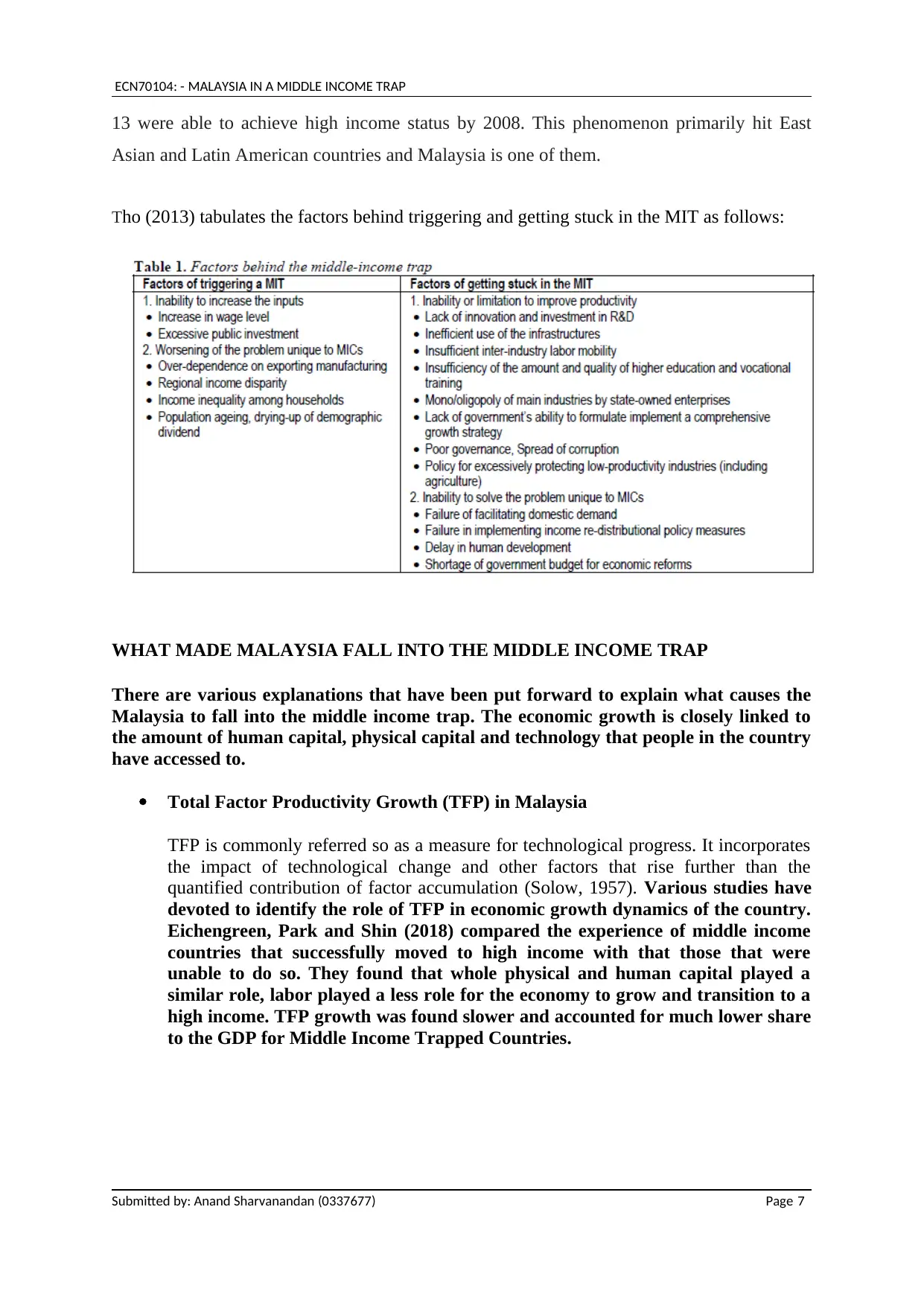
Tho (2013) tabulates the factors behind triggering and getting stuck in the MIT as follows:
WHAT MADE MALAYSIA FALL INTO THE MIDDLE INCOME TRAP
There are various explanations that have been put forward to explain what causes the
Malaysia to fall into the middle income trap. The economic growth is closely linked to
the amount of human capital, physical capital and technology that people in the country
have accessed to.
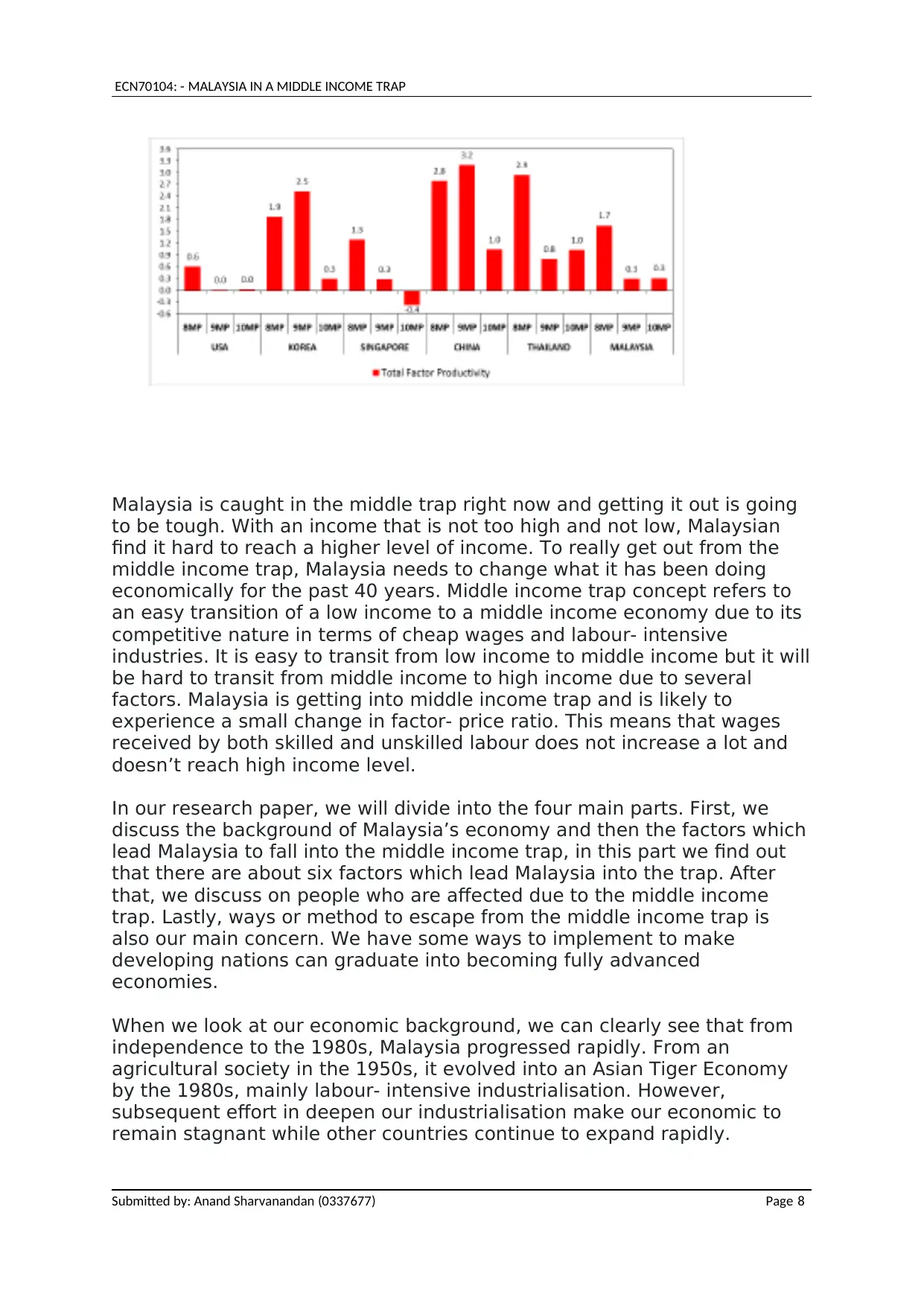
Total Factor Productivity Growth (TFP) in Malaysia
TFP is commonly referred so as a measure for technological progress. It incorporates
the impact of technological change and other factors that rise further than the
quantified contribution of factor accumulation (Solow, 1957). Various studies have
devoted to identify the role of TFP in economic growth dynamics of the country.
Eichengreen, Park and Shin (2018) compared the experience of middle income
countries that successfully moved to high income with that those that were
unable to do so. They found that whole physical and human capital played a
similar role, labor played a less role for the economy to grow and transition to a
high income. TFP growth was found slower and accounted for much lower share
to the GDP for Middle Income Trapped Countries.
Submitted by: Anand Sharvanandan (0337677) Page 7
13 were able to achieve high income status by 2008. This phenomenon primarily hit East
Asian and Latin American countries and Malaysia is one of them.
Tho (2013) tabulates the factors behind triggering and getting stuck in the MIT as follows:
WHAT MADE MALAYSIA FALL INTO THE MIDDLE INCOME TRAP
There are various explanations that have been put forward to explain what causes the
Malaysia to fall into the middle income trap. The economic growth is closely linked to
the amount of human capital, physical capital and technology that people in the country
have accessed to.
Total Factor Productivity Growth (TFP) in Malaysia
TFP is commonly referred so as a measure for technological progress. It incorporates
the impact of technological change and other factors that rise further than the
quantified contribution of factor accumulation (Solow, 1957). Various studies have
devoted to identify the role of TFP in economic growth dynamics of the country.
Eichengreen, Park and Shin (2018) compared the experience of middle income
countries that successfully moved to high income with that those that were
unable to do so. They found that whole physical and human capital played a
similar role, labor played a less role for the economy to grow and transition to a
high income. TFP growth was found slower and accounted for much lower share
to the GDP for Middle Income Trapped Countries.
Submitted by: Anand Sharvanandan (0337677) Page 7
Paraphrase This Document
Need a fresh take? Get an instant paraphrase of this document with our AI Paraphraser
ECN70104: - MALAYSIA IN A MIDDLE INCOME TRAP
Malaysia is caught in the middle trap right now and getting it out is going
to be tough. With an income that is not too high and not low, Malaysian
find it hard to reach a higher level of income. To really get out from the
middle income trap, Malaysia needs to change what it has been doing
economically for the past 40 years. Middle income trap concept refers to
an easy transition of a low income to a middle income economy due to its
competitive nature in terms of cheap wages and labour- intensive
industries. It is easy to transit from low income to middle income but it will
be hard to transit from middle income to high income due to several
factors. Malaysia is getting into middle income trap and is likely to
experience a small change in factor- price ratio. This means that wages
received by both skilled and unskilled labour does not increase a lot and
doesn’t reach high income level.
In our research paper, we will divide into the four main parts. First, we
discuss the background of Malaysia’s economy and then the factors which
lead Malaysia to fall into the middle income trap, in this part we find out
that there are about six factors which lead Malaysia into the trap. After
that, we discuss on people who are affected due to the middle income
trap. Lastly, ways or method to escape from the middle income trap is
also our main concern. We have some ways to implement to make
developing nations can graduate into becoming fully advanced
economies.
When we look at our economic background, we can clearly see that from
independence to the 1980s, Malaysia progressed rapidly. From an
agricultural society in the 1950s, it evolved into an Asian Tiger Economy
by the 1980s, mainly labour- intensive industrialisation. However,
subsequent effort in deepen our industrialisation make our economic to
remain stagnant while other countries continue to expand rapidly.
Submitted by: Anand Sharvanandan (0337677) Page 8
Malaysia is caught in the middle trap right now and getting it out is going
to be tough. With an income that is not too high and not low, Malaysian
find it hard to reach a higher level of income. To really get out from the
middle income trap, Malaysia needs to change what it has been doing
economically for the past 40 years. Middle income trap concept refers to
an easy transition of a low income to a middle income economy due to its
competitive nature in terms of cheap wages and labour- intensive
industries. It is easy to transit from low income to middle income but it will
be hard to transit from middle income to high income due to several
factors. Malaysia is getting into middle income trap and is likely to
experience a small change in factor- price ratio. This means that wages
received by both skilled and unskilled labour does not increase a lot and
doesn’t reach high income level.
In our research paper, we will divide into the four main parts. First, we
discuss the background of Malaysia’s economy and then the factors which
lead Malaysia to fall into the middle income trap, in this part we find out
that there are about six factors which lead Malaysia into the trap. After
that, we discuss on people who are affected due to the middle income
trap. Lastly, ways or method to escape from the middle income trap is
also our main concern. We have some ways to implement to make
developing nations can graduate into becoming fully advanced
economies.
When we look at our economic background, we can clearly see that from
independence to the 1980s, Malaysia progressed rapidly. From an
agricultural society in the 1950s, it evolved into an Asian Tiger Economy
by the 1980s, mainly labour- intensive industrialisation. However,
subsequent effort in deepen our industrialisation make our economic to
remain stagnant while other countries continue to expand rapidly.
Submitted by: Anand Sharvanandan (0337677) Page 8
ECN70104: - MALAYSIA IN A MIDDLE INCOME TRAP
Recently, country’s performance has been disappointing with GDP growth
rate declining to 5.5 percent in 2002 to 2008 from 9.1 percent in 1990-
1997. In the past 1970, about 50% of Malaysian live in absolute poverty
but now decrease to less than 4%. However, Malaysian feels that they are
stuck from increasing where GDP growth has slowed up. However, when
we look at other countries for example Korea, they are at one time the
poorest country in the world but they are growing both economic and
politic. Reason that their economic can grow is because they have higher
purchasing power compared to Malaysia. This is because they receive
averagely higher income and with higher income they will have more
spending power which will boost their economy. Countries such as
Cambodia and Vietnam have very low wages while Malaysia traps in the
middle ground.
How to get into middle income trap
One of the factors Malaysia trapped into the middle income is due to over
dependence on FDI and lack of doing research and development (R&D).
Multinational companies will only provide instant of capital, expertise and
technology into Malaysia but they will not develop or improving Malaysia’s
product. Malaysia’s businessmen seem to be satisfied in making profit by
serving the MNCs and maintaining their original, assembly- based
business models. Besides, labour productivity is growing quite slow than
in the 1990s. Manufacturing in Malaysia has a low value added and had
spent a very low R&D spending. For example, Malaysia had spent only
0.6% of GDP in R&D compared to South Korea which is 3.5%. South Korea
is probably the best example of a developing country which shifts to a
advance country. Companies in Korea like Samsung and LG dominates in
the market. Taiwan is also not far behind. China’s policymakers are aware
that they need to suit with the changes in market if the labor costs rise.
With a low tech manufacturing industries and lack of skilled labour
compared to country such as Singapore, the production in Malaysia is less
competitive and thus less profit which means lower wages paid to the
workers.
Migrant workers which depress wages also one of the factors which cause
Malaysia to fall into the middle income trap. It is a mistake in letting
migrant workers to overflow in Malaysia and depresses wages. This will
limit the improvements of the productivity. Malaysia has too huge amount
of foreign workers which is reportedly has 1.9 million registered workers
and another 600000 unregistered ones accounting for nearly one- fifth of
the working population. These workers are not confined to the so- called
3D jobs where the jobs are difficult, dirty and dangerous that the locals
are unwilling to do those kinds of jobs. Too many of unskilled labour will
lead to low value added in the productivity. Malaysian worker are forced
to receive low wages since competition with the migrant workers are keen
because the migrant workers are willing to accept lower wages and longer
Submitted by: Anand Sharvanandan (0337677) Page 9
Recently, country’s performance has been disappointing with GDP growth
rate declining to 5.5 percent in 2002 to 2008 from 9.1 percent in 1990-
1997. In the past 1970, about 50% of Malaysian live in absolute poverty
but now decrease to less than 4%. However, Malaysian feels that they are
stuck from increasing where GDP growth has slowed up. However, when
we look at other countries for example Korea, they are at one time the
poorest country in the world but they are growing both economic and
politic. Reason that their economic can grow is because they have higher
purchasing power compared to Malaysia. This is because they receive
averagely higher income and with higher income they will have more
spending power which will boost their economy. Countries such as
Cambodia and Vietnam have very low wages while Malaysia traps in the
middle ground.
How to get into middle income trap
One of the factors Malaysia trapped into the middle income is due to over
dependence on FDI and lack of doing research and development (R&D).
Multinational companies will only provide instant of capital, expertise and
technology into Malaysia but they will not develop or improving Malaysia’s
product. Malaysia’s businessmen seem to be satisfied in making profit by
serving the MNCs and maintaining their original, assembly- based
business models. Besides, labour productivity is growing quite slow than
in the 1990s. Manufacturing in Malaysia has a low value added and had
spent a very low R&D spending. For example, Malaysia had spent only
0.6% of GDP in R&D compared to South Korea which is 3.5%. South Korea
is probably the best example of a developing country which shifts to a
advance country. Companies in Korea like Samsung and LG dominates in
the market. Taiwan is also not far behind. China’s policymakers are aware
that they need to suit with the changes in market if the labor costs rise.
With a low tech manufacturing industries and lack of skilled labour
compared to country such as Singapore, the production in Malaysia is less
competitive and thus less profit which means lower wages paid to the
workers.
Migrant workers which depress wages also one of the factors which cause
Malaysia to fall into the middle income trap. It is a mistake in letting
migrant workers to overflow in Malaysia and depresses wages. This will
limit the improvements of the productivity. Malaysia has too huge amount
of foreign workers which is reportedly has 1.9 million registered workers
and another 600000 unregistered ones accounting for nearly one- fifth of
the working population. These workers are not confined to the so- called
3D jobs where the jobs are difficult, dirty and dangerous that the locals
are unwilling to do those kinds of jobs. Too many of unskilled labour will
lead to low value added in the productivity. Malaysian worker are forced
to receive low wages since competition with the migrant workers are keen
because the migrant workers are willing to accept lower wages and longer
Submitted by: Anand Sharvanandan (0337677) Page 9
⊘ This is a preview!⊘
Do you want full access?
Subscribe today to unlock all pages.
Trusted by 1+ million students worldwide
ECN70104: - MALAYSIA IN A MIDDLE INCOME TRAP
hours of working. Besides, when we take account the negative
externalities which associates with the excessive presence of migrant
workers, we found that migrant worker is a burden to Malaysia’s economy
as the migrant workforce turns out to be a costly affair. There are cases
where the migrant workers cause social problem in Malaysia and there
were also cases where the migrant workers are abused by their employer.
They are also forced to receive low wages since there is no law to protect
their rights. It is not denied that Malaysia needs the services of foreign
workers, both skilled and unskilled but government need to ensure that
they are well treated and wages should be increased align to the local
wages so that Malaysian wages can be raised higher. In the case of
Malaysia, high wage need not mean high labour costs if an increase of
wages are backed by an increase in productivity. In the other words, low
wages does not mean lower labour costs if the productivity declines.
Apart from that, over subsidies of the subsidised item leads to middle
income trap. Subsidy was implemented in 1961 under the Control Act
1961 and subsidised items include petrol, sugar, gas, rice, salt and other
basic items. Subsidy of these items has made the Government spending
to increase and it is too heavy for government to continue to bear the
cost. For example, the oil price in 1970s was under US$12 per barrel.
However, it increases to almost US$75 per barrel which causes a cost that
is unbearable to the government. Moreover, over subsidies in local
industries for example proton is a burden to the government spending. If
compared to South Korea, such industry had do the same thing in the
beginning but they were weaned off from the government subsidy much
earlier and where Proton is still now subsidised. The high cost of subsidies
restrains the government ability to upgrade infrastructures and involve in
more research and development which increase the productivity and
competitiveness in order to become a high income country.
Price control has been one of the major causes of falling into middle
income trap. The policy where government enforced price control in
Malaya to avoid hardships after World war2 holds until today. Price control
items include basic necessities such as rice, flour, sugar, milk and even
taxi fares. Price of commodities in Malaysia is much cheaper because of
the controls compared to other countries. The problem with the price
control is that workers’ annual pay raises are linked to the nation’s CPI
which is consumer price index. This mean that with a low CPI, the salary
received by the worker remain low and a shift to a higher income will be
very hard. Since 1980s, Malaysian wages have fallen behind wages of the
rest of the world. For an example, a graduate policeman earn at RM 2300
per month compared to RM4400 in Singapore. Apart from restraining
Malaysian wages, price controls also sternly distort domestic economic
factor proportions which cause many factories ending up in inefficient
economic production processes. When we compared through GDP, South
Korea has a GDP per capita of US$16450, Singapore US$34,346, while
Submitted by: Anand Sharvanandan (0337677) Page
10
hours of working. Besides, when we take account the negative
externalities which associates with the excessive presence of migrant
workers, we found that migrant worker is a burden to Malaysia’s economy
as the migrant workforce turns out to be a costly affair. There are cases
where the migrant workers cause social problem in Malaysia and there
were also cases where the migrant workers are abused by their employer.
They are also forced to receive low wages since there is no law to protect
their rights. It is not denied that Malaysia needs the services of foreign
workers, both skilled and unskilled but government need to ensure that
they are well treated and wages should be increased align to the local
wages so that Malaysian wages can be raised higher. In the case of
Malaysia, high wage need not mean high labour costs if an increase of
wages are backed by an increase in productivity. In the other words, low
wages does not mean lower labour costs if the productivity declines.
Apart from that, over subsidies of the subsidised item leads to middle
income trap. Subsidy was implemented in 1961 under the Control Act
1961 and subsidised items include petrol, sugar, gas, rice, salt and other
basic items. Subsidy of these items has made the Government spending
to increase and it is too heavy for government to continue to bear the
cost. For example, the oil price in 1970s was under US$12 per barrel.
However, it increases to almost US$75 per barrel which causes a cost that
is unbearable to the government. Moreover, over subsidies in local
industries for example proton is a burden to the government spending. If
compared to South Korea, such industry had do the same thing in the
beginning but they were weaned off from the government subsidy much
earlier and where Proton is still now subsidised. The high cost of subsidies
restrains the government ability to upgrade infrastructures and involve in
more research and development which increase the productivity and
competitiveness in order to become a high income country.
Price control has been one of the major causes of falling into middle
income trap. The policy where government enforced price control in
Malaya to avoid hardships after World war2 holds until today. Price control
items include basic necessities such as rice, flour, sugar, milk and even
taxi fares. Price of commodities in Malaysia is much cheaper because of
the controls compared to other countries. The problem with the price
control is that workers’ annual pay raises are linked to the nation’s CPI
which is consumer price index. This mean that with a low CPI, the salary
received by the worker remain low and a shift to a higher income will be
very hard. Since 1980s, Malaysian wages have fallen behind wages of the
rest of the world. For an example, a graduate policeman earn at RM 2300
per month compared to RM4400 in Singapore. Apart from restraining
Malaysian wages, price controls also sternly distort domestic economic
factor proportions which cause many factories ending up in inefficient
economic production processes. When we compared through GDP, South
Korea has a GDP per capita of US$16450, Singapore US$34,346, while
Submitted by: Anand Sharvanandan (0337677) Page
10
Paraphrase This Document
Need a fresh take? Get an instant paraphrase of this document with our AI Paraphraser
ECN70104: - MALAYSIA IN A MIDDLE INCOME TRAP
Malaysia still remain at US$7469. The table below shows that the
breakdown weightage allocated for the different categories of items
consumed on a daily basis. For example, “Food and non- alcoholic
beverages” and “Housing, water, electricity, gas and fuels” make up over
52.8% of the weightage. We can see that most of the items are heavily
subsidised or price controlled. Apart from the raw materials, value added
items such cooked food and beverages are always levied at the market
price but not captured in the CPI. Besides, transport which contribute
15.9% of the weightage does not include hire purchase for cars and
motorcycle or the cost of imported spare part for repairing. Some
construction materials such cement and clinker maybe price controlled
but for certain price of rental are determined at market rate.
http://greglopez.files.wordpress.com/2010/06/n5-1.jpg?w=300
Low inflation rate causes wages to be artificially suppressed and it creates
a wide gap between Malaysian working domestically and those workers
who work abroad. With low wages, we will be unable to attract talent from
other countries even though our product and services are relatively
cheaper. Moreover, low or middle income creates a technology gap
making Malaysia to be uncompetitive. Technology goods and services
have become more expensive for Malaysian to purchase including items
such as Iphone, laptop which it is common nowadays. With a cheap
currency, we find it difficult to purchase the most advanced technology to
improve productivity.
Malaysia was emphasizing on agriculture sector in the early 1950s but
when Malaysia’s economic had shift from agriculture sector to
manufacturing sector, agriculture sector had became a drag to the
economy. The dominance of oil palm and rubber in the agriculture sector
is unfortunately a significant drag and had caused the nation’s to cease
from shifting to a high income economy. Those plantation terrain, paddy
harvesting and rubber tapping are not easily mechanised and remaining
done by manual. Agriculture sector with high technology and mechanised
makes more profit by having much efficient and more productivity. Until
today, agriculture with manual worker still remain as low wage activities
and most of the agriculture depend a lot on foreign labour. For example,
textile industry hires most of the workers from Bangladesh since the local
workers are not willing to work in this sector because of the low wages.
The mobility of the foreign workers in plantation is also easy and they
move from estates to factories which mean it is hard for government to
disallow the foreign workers to work in the non- plantation sector. The
cumulative effect is that there are now about 2.3 million low- skill foreign
workers in Malaysia, making up about 20% of the workforce. They are in
the manufacturing, petroleum, construction and domestic- help sectors.
Lately, they are also involving in retailing, food and beverage, tourism and
hotel industries. Such a massive inflow of foreign workers into those
Submitted by: Anand Sharvanandan (0337677) Page
11
Malaysia still remain at US$7469. The table below shows that the
breakdown weightage allocated for the different categories of items
consumed on a daily basis. For example, “Food and non- alcoholic
beverages” and “Housing, water, electricity, gas and fuels” make up over
52.8% of the weightage. We can see that most of the items are heavily
subsidised or price controlled. Apart from the raw materials, value added
items such cooked food and beverages are always levied at the market
price but not captured in the CPI. Besides, transport which contribute
15.9% of the weightage does not include hire purchase for cars and
motorcycle or the cost of imported spare part for repairing. Some
construction materials such cement and clinker maybe price controlled
but for certain price of rental are determined at market rate.
http://greglopez.files.wordpress.com/2010/06/n5-1.jpg?w=300
Low inflation rate causes wages to be artificially suppressed and it creates
a wide gap between Malaysian working domestically and those workers
who work abroad. With low wages, we will be unable to attract talent from
other countries even though our product and services are relatively
cheaper. Moreover, low or middle income creates a technology gap
making Malaysia to be uncompetitive. Technology goods and services
have become more expensive for Malaysian to purchase including items
such as Iphone, laptop which it is common nowadays. With a cheap
currency, we find it difficult to purchase the most advanced technology to
improve productivity.
Malaysia was emphasizing on agriculture sector in the early 1950s but
when Malaysia’s economic had shift from agriculture sector to
manufacturing sector, agriculture sector had became a drag to the
economy. The dominance of oil palm and rubber in the agriculture sector
is unfortunately a significant drag and had caused the nation’s to cease
from shifting to a high income economy. Those plantation terrain, paddy
harvesting and rubber tapping are not easily mechanised and remaining
done by manual. Agriculture sector with high technology and mechanised
makes more profit by having much efficient and more productivity. Until
today, agriculture with manual worker still remain as low wage activities
and most of the agriculture depend a lot on foreign labour. For example,
textile industry hires most of the workers from Bangladesh since the local
workers are not willing to work in this sector because of the low wages.
The mobility of the foreign workers in plantation is also easy and they
move from estates to factories which mean it is hard for government to
disallow the foreign workers to work in the non- plantation sector. The
cumulative effect is that there are now about 2.3 million low- skill foreign
workers in Malaysia, making up about 20% of the workforce. They are in
the manufacturing, petroleum, construction and domestic- help sectors.
Lately, they are also involving in retailing, food and beverage, tourism and
hotel industries. Such a massive inflow of foreign workers into those
Submitted by: Anand Sharvanandan (0337677) Page
11
ECN70104: - MALAYSIA IN A MIDDLE INCOME TRAP
industries will therefore suppress wages in Malaysia and causes middle
income trap.
Effects of the Middle Income Trap
Malaysia’s caught in the “middle-income trap” right now give awareness
to our policymakers that the export-led growth strategy, according to
some, is no longer an optimal development strategy for developing
countries especially Malaysia. Continued emphasis on export-led growth
will, among other things, increase the reliance of developing countries on
the developed world and dampen domestic market growth. Many export-
dependent developing countries started tweaking their growth strategies
especially after external demand for their exports dried up on account of
the current global financial and economic crisis. Though Malaysia’s growth
strategy had started emphasizing domestic demand since about a decade
back, it still remains largely dependent on external demand for its
economic growth (Quah, 2009). Ex-World Bank chief economist and
Brookings Institution’s Wolfensohn Centre for Development, Global
Economy and Development’s senior fellow, Homi J. Kharas, said there was
an impetus for change and rethinking on policies and strategies in
Malaysia every 10 years based on economic developments. “Malaysia has
been very successful as an exporting nation but has also been very export
dependent. About 90% (of products) are being exported to the United
States, Europe and Japan,” he said, adding that Malaysia needed to
diversify its exports (Malaysia needs to be high-income economy, 2009).
However, the main challenge is domestic market of Malaysia is too limited
due to only 28 million of populations. That’s why we are facing the
dilemma of the exploration of external and domestic market. However,
2010 GDP performance sets strong momentum for a robust 2011. Given
the marked improvement in economic growth in the first half of the year,
domestic demand was clearly the chief momentum driver for the
recovery. Moving forward, the country is anticipated to register a robust
GDP growth of 5.6% in 2011, with domestic demand once again acting as
the back-bone for momentum (RAM Rating Services, 2011).
Besides, middle-income trap also lead to declining private investments.
The old growth model provided three decades of outstanding
performance, permitting Malaysia to provide for the health and education
of its people, largely eradicate poverty, build a world-class infrastructure
and become a major exporter globally. But the progress we have made
over the past half-century has slowed and economic growth prospects
have weakened considerably. We are caught in a middle income trap.
Malaysia has been susceptible to external shocks, as seen during the past
crises. Increases in international commodity prices, like fuel or food, have
direct impact on domestic prices. Similarly, unless production costs and
productivity in Malaysia can keep pace with those abroad, exports are
Submitted by: Anand Sharvanandan (0337677) Page
12
industries will therefore suppress wages in Malaysia and causes middle
income trap.
Effects of the Middle Income Trap
Malaysia’s caught in the “middle-income trap” right now give awareness
to our policymakers that the export-led growth strategy, according to
some, is no longer an optimal development strategy for developing
countries especially Malaysia. Continued emphasis on export-led growth
will, among other things, increase the reliance of developing countries on
the developed world and dampen domestic market growth. Many export-
dependent developing countries started tweaking their growth strategies
especially after external demand for their exports dried up on account of
the current global financial and economic crisis. Though Malaysia’s growth
strategy had started emphasizing domestic demand since about a decade
back, it still remains largely dependent on external demand for its
economic growth (Quah, 2009). Ex-World Bank chief economist and
Brookings Institution’s Wolfensohn Centre for Development, Global
Economy and Development’s senior fellow, Homi J. Kharas, said there was
an impetus for change and rethinking on policies and strategies in
Malaysia every 10 years based on economic developments. “Malaysia has
been very successful as an exporting nation but has also been very export
dependent. About 90% (of products) are being exported to the United
States, Europe and Japan,” he said, adding that Malaysia needed to
diversify its exports (Malaysia needs to be high-income economy, 2009).
However, the main challenge is domestic market of Malaysia is too limited
due to only 28 million of populations. That’s why we are facing the
dilemma of the exploration of external and domestic market. However,
2010 GDP performance sets strong momentum for a robust 2011. Given
the marked improvement in economic growth in the first half of the year,
domestic demand was clearly the chief momentum driver for the
recovery. Moving forward, the country is anticipated to register a robust
GDP growth of 5.6% in 2011, with domestic demand once again acting as
the back-bone for momentum (RAM Rating Services, 2011).
Besides, middle-income trap also lead to declining private investments.
The old growth model provided three decades of outstanding
performance, permitting Malaysia to provide for the health and education
of its people, largely eradicate poverty, build a world-class infrastructure
and become a major exporter globally. But the progress we have made
over the past half-century has slowed and economic growth prospects
have weakened considerably. We are caught in a middle income trap.
Malaysia has been susceptible to external shocks, as seen during the past
crises. Increases in international commodity prices, like fuel or food, have
direct impact on domestic prices. Similarly, unless production costs and
productivity in Malaysia can keep pace with those abroad, exports are
Submitted by: Anand Sharvanandan (0337677) Page
12
⊘ This is a preview!⊘
Do you want full access?
Subscribe today to unlock all pages.
Trusted by 1+ million students worldwide

1 out of 21


Your All-in-One AI-Powered Toolkit for Academic Success.
+13062052269
info@desklib.com
Available 24*7 on WhatsApp / Email
![[object Object]](/_next/static/media/star-bottom.7253800d.svg)
Unlock your academic potential
Copyright © 2020–2026 A2Z Services. All Rights Reserved. Developed and managed by ZUCOL.