BH 101 Property Taxation: Regulations, Exemptions, and Penalties
VerifiedAdded on 2023/06/03
|11
|2859
|324
Report
AI Summary
This report provides an overview of property taxation in Malaysia, focusing on stamp duty and real capital gains tax. It discusses the nature of stamp duty under the Stamp Duty Act 1949 and Real Property Gains Tax Act 1976, highlighting key concepts such as chargeable persons, disposal price, and permitted expenses. The report also delves into the principles of taxation, including fairness, clarity, convenience, efficiency, and neutrality. Tax calculation examples for stamp duty and real property gains tax are provided to illustrate the practical application of these concepts. Finally, the report outlines various exemptions and penalties associated with both stamp duty and real property gains tax, offering a comprehensive understanding of the Malaysian property tax landscape.

PROPERTY TAX
TABLE OF CONTENT
TABLE OF CONTENT

Paraphrase This Document
Need a fresh take? Get an instant paraphrase of this document with our AI Paraphraser
S
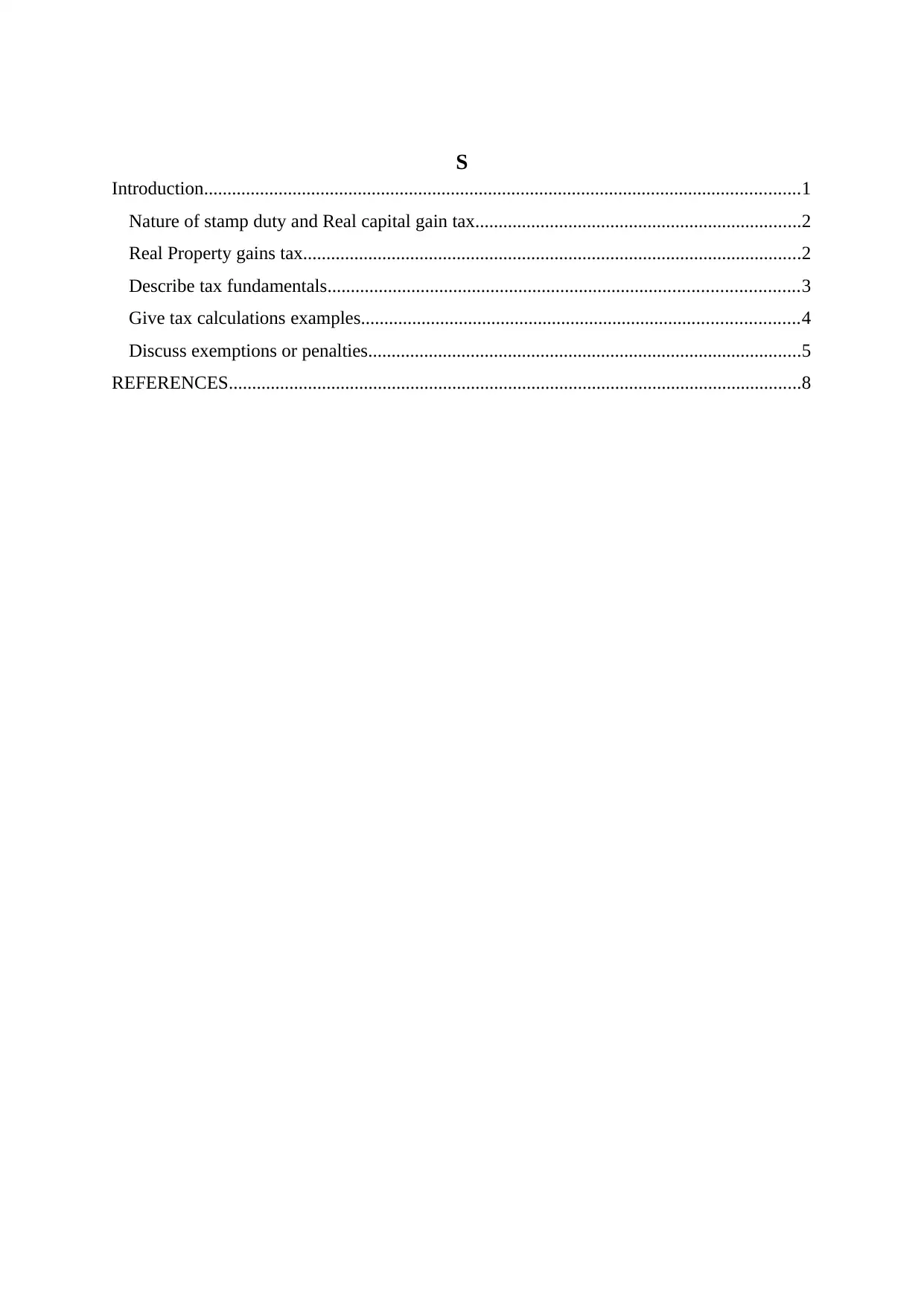
Introduction................................................................................................................................1
Nature of stamp duty and Real capital gain tax......................................................................2
Real Property gains tax...........................................................................................................2
Describe tax fundamentals.....................................................................................................3
Give tax calculations examples..............................................................................................4
Discuss exemptions or penalties.............................................................................................5
REFERENCES...........................................................................................................................8
Introduction................................................................................................................................1
Nature of stamp duty and Real capital gain tax......................................................................2
Real Property gains tax...........................................................................................................2
Describe tax fundamentals.....................................................................................................3
Give tax calculations examples..............................................................................................4
Discuss exemptions or penalties.............................................................................................5
REFERENCES...........................................................................................................................8
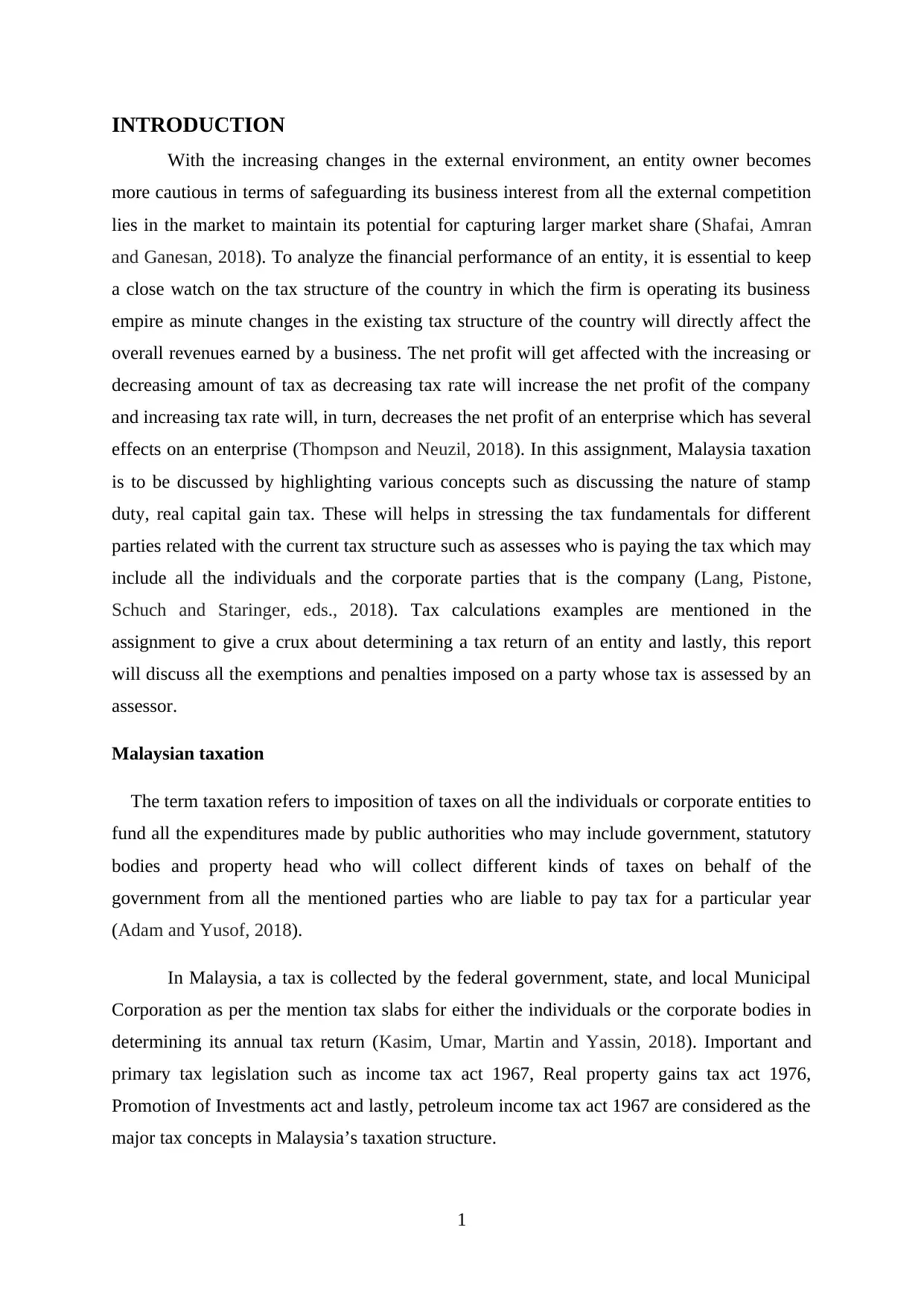
INTRODUCTION
With the increasing changes in the external environment, an entity owner becomes
more cautious in terms of safeguarding its business interest from all the external competition
lies in the market to maintain its potential for capturing larger market share (Shafai, Amran
and Ganesan, 2018). To analyze the financial performance of an entity, it is essential to keep
a close watch on the tax structure of the country in which the firm is operating its business
empire as minute changes in the existing tax structure of the country will directly affect the
overall revenues earned by a business. The net profit will get affected with the increasing or
decreasing amount of tax as decreasing tax rate will increase the net profit of the company
and increasing tax rate will, in turn, decreases the net profit of an enterprise which has several
effects on an enterprise (Thompson and Neuzil, 2018). In this assignment, Malaysia taxation
is to be discussed by highlighting various concepts such as discussing the nature of stamp
duty, real capital gain tax. These will helps in stressing the tax fundamentals for different
parties related with the current tax structure such as assesses who is paying the tax which may
include all the individuals and the corporate parties that is the company (Lang, Pistone,
Schuch and Staringer, eds., 2018). Tax calculations examples are mentioned in the
assignment to give a crux about determining a tax return of an entity and lastly, this report
will discuss all the exemptions and penalties imposed on a party whose tax is assessed by an
assessor.
Malaysian taxation
The term taxation refers to imposition of taxes on all the individuals or corporate entities to
fund all the expenditures made by public authorities who may include government, statutory
bodies and property head who will collect different kinds of taxes on behalf of the
government from all the mentioned parties who are liable to pay tax for a particular year
(Adam and Yusof, 2018).
In Malaysia, a tax is collected by the federal government, state, and local Municipal
Corporation as per the mention tax slabs for either the individuals or the corporate bodies in
determining its annual tax return (Kasim, Umar, Martin and Yassin, 2018). Important and
primary tax legislation such as income tax act 1967, Real property gains tax act 1976,
Promotion of Investments act and lastly, petroleum income tax act 1967 are considered as the
major tax concepts in Malaysia’s taxation structure.
1
With the increasing changes in the external environment, an entity owner becomes
more cautious in terms of safeguarding its business interest from all the external competition
lies in the market to maintain its potential for capturing larger market share (Shafai, Amran
and Ganesan, 2018). To analyze the financial performance of an entity, it is essential to keep
a close watch on the tax structure of the country in which the firm is operating its business
empire as minute changes in the existing tax structure of the country will directly affect the
overall revenues earned by a business. The net profit will get affected with the increasing or
decreasing amount of tax as decreasing tax rate will increase the net profit of the company
and increasing tax rate will, in turn, decreases the net profit of an enterprise which has several
effects on an enterprise (Thompson and Neuzil, 2018). In this assignment, Malaysia taxation
is to be discussed by highlighting various concepts such as discussing the nature of stamp
duty, real capital gain tax. These will helps in stressing the tax fundamentals for different
parties related with the current tax structure such as assesses who is paying the tax which may
include all the individuals and the corporate parties that is the company (Lang, Pistone,
Schuch and Staringer, eds., 2018). Tax calculations examples are mentioned in the
assignment to give a crux about determining a tax return of an entity and lastly, this report
will discuss all the exemptions and penalties imposed on a party whose tax is assessed by an
assessor.
Malaysian taxation
The term taxation refers to imposition of taxes on all the individuals or corporate entities to
fund all the expenditures made by public authorities who may include government, statutory
bodies and property head who will collect different kinds of taxes on behalf of the
government from all the mentioned parties who are liable to pay tax for a particular year
(Adam and Yusof, 2018).
In Malaysia, a tax is collected by the federal government, state, and local Municipal
Corporation as per the mention tax slabs for either the individuals or the corporate bodies in
determining its annual tax return (Kasim, Umar, Martin and Yassin, 2018). Important and
primary tax legislation such as income tax act 1967, Real property gains tax act 1976,
Promotion of Investments act and lastly, petroleum income tax act 1967 are considered as the
major tax concepts in Malaysia’s taxation structure.
1
⊘ This is a preview!⊘
Do you want full access?
Subscribe today to unlock all pages.

Trusted by 1+ million students worldwide
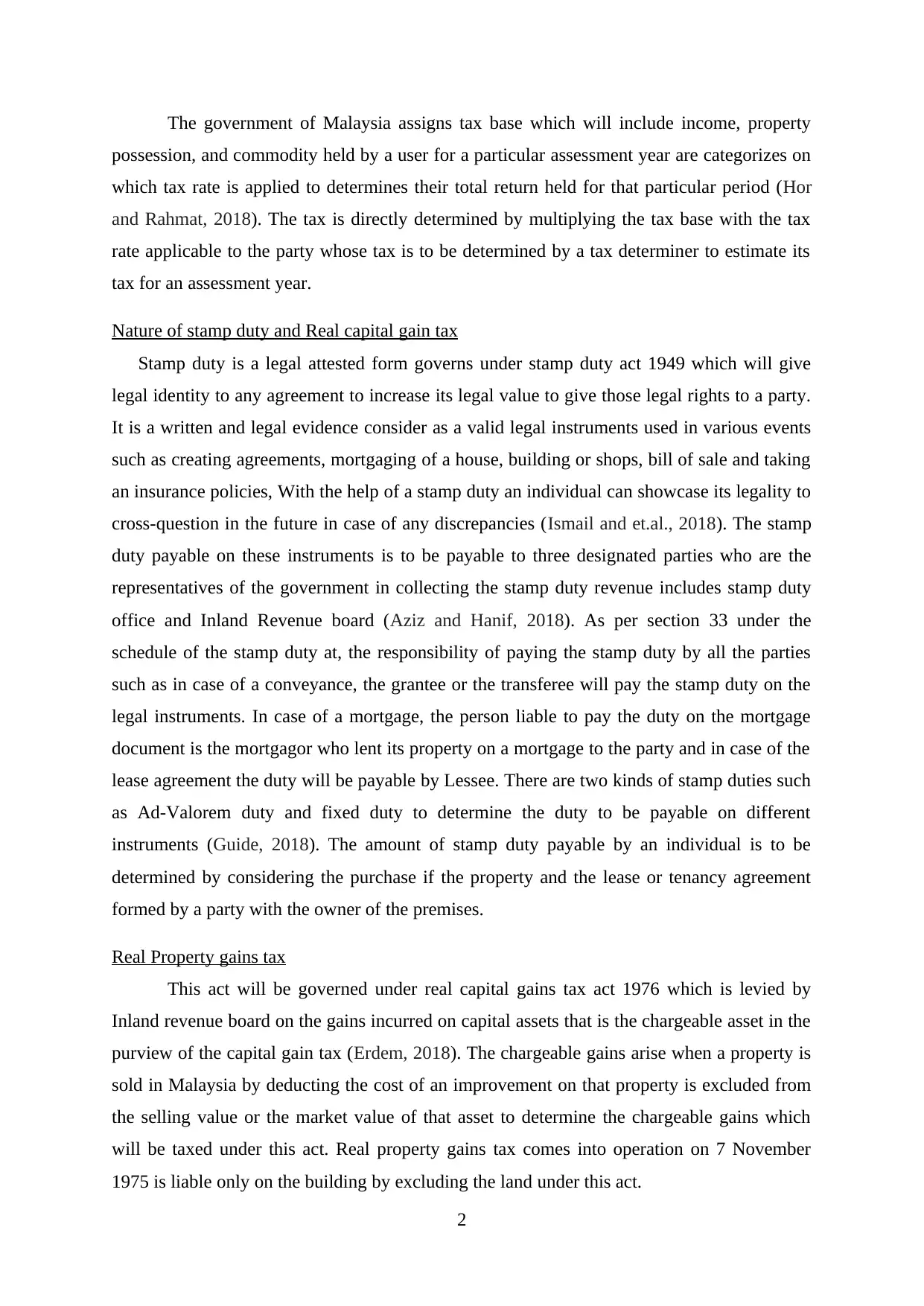
The government of Malaysia assigns tax base which will include income, property
possession, and commodity held by a user for a particular assessment year are categorizes on
which tax rate is applied to determines their total return held for that particular period (Hor
and Rahmat, 2018). The tax is directly determined by multiplying the tax base with the tax
rate applicable to the party whose tax is to be determined by a tax determiner to estimate its
tax for an assessment year.
Nature of stamp duty and Real capital gain tax
Stamp duty is a legal attested form governs under stamp duty act 1949 which will give
legal identity to any agreement to increase its legal value to give those legal rights to a party.
It is a written and legal evidence consider as a valid legal instruments used in various events
such as creating agreements, mortgaging of a house, building or shops, bill of sale and taking
an insurance policies, With the help of a stamp duty an individual can showcase its legality to
cross-question in the future in case of any discrepancies (Ismail and et.al., 2018). The stamp
duty payable on these instruments is to be payable to three designated parties who are the
representatives of the government in collecting the stamp duty revenue includes stamp duty
office and Inland Revenue board (Aziz and Hanif, 2018). As per section 33 under the
schedule of the stamp duty at, the responsibility of paying the stamp duty by all the parties
such as in case of a conveyance, the grantee or the transferee will pay the stamp duty on the
legal instruments. In case of a mortgage, the person liable to pay the duty on the mortgage
document is the mortgagor who lent its property on a mortgage to the party and in case of the
lease agreement the duty will be payable by Lessee. There are two kinds of stamp duties such
as Ad-Valorem duty and fixed duty to determine the duty to be payable on different
instruments (Guide, 2018). The amount of stamp duty payable by an individual is to be
determined by considering the purchase if the property and the lease or tenancy agreement
formed by a party with the owner of the premises.
Real Property gains tax
This act will be governed under real capital gains tax act 1976 which is levied by
Inland revenue board on the gains incurred on capital assets that is the chargeable asset in the
purview of the capital gain tax (Erdem, 2018). The chargeable gains arise when a property is
sold in Malaysia by deducting the cost of an improvement on that property is excluded from
the selling value or the market value of that asset to determine the chargeable gains which
will be taxed under this act. Real property gains tax comes into operation on 7 November
1975 is liable only on the building by excluding the land under this act.
2
possession, and commodity held by a user for a particular assessment year are categorizes on
which tax rate is applied to determines their total return held for that particular period (Hor
and Rahmat, 2018). The tax is directly determined by multiplying the tax base with the tax
rate applicable to the party whose tax is to be determined by a tax determiner to estimate its
tax for an assessment year.
Nature of stamp duty and Real capital gain tax
Stamp duty is a legal attested form governs under stamp duty act 1949 which will give
legal identity to any agreement to increase its legal value to give those legal rights to a party.
It is a written and legal evidence consider as a valid legal instruments used in various events
such as creating agreements, mortgaging of a house, building or shops, bill of sale and taking
an insurance policies, With the help of a stamp duty an individual can showcase its legality to
cross-question in the future in case of any discrepancies (Ismail and et.al., 2018). The stamp
duty payable on these instruments is to be payable to three designated parties who are the
representatives of the government in collecting the stamp duty revenue includes stamp duty
office and Inland Revenue board (Aziz and Hanif, 2018). As per section 33 under the
schedule of the stamp duty at, the responsibility of paying the stamp duty by all the parties
such as in case of a conveyance, the grantee or the transferee will pay the stamp duty on the
legal instruments. In case of a mortgage, the person liable to pay the duty on the mortgage
document is the mortgagor who lent its property on a mortgage to the party and in case of the
lease agreement the duty will be payable by Lessee. There are two kinds of stamp duties such
as Ad-Valorem duty and fixed duty to determine the duty to be payable on different
instruments (Guide, 2018). The amount of stamp duty payable by an individual is to be
determined by considering the purchase if the property and the lease or tenancy agreement
formed by a party with the owner of the premises.
Real Property gains tax
This act will be governed under real capital gains tax act 1976 which is levied by
Inland revenue board on the gains incurred on capital assets that is the chargeable asset in the
purview of the capital gain tax (Erdem, 2018). The chargeable gains arise when a property is
sold in Malaysia by deducting the cost of an improvement on that property is excluded from
the selling value or the market value of that asset to determine the chargeable gains which
will be taxed under this act. Real property gains tax comes into operation on 7 November
1975 is liable only on the building by excluding the land under this act.
2
Paraphrase This Document
Need a fresh take? Get an instant paraphrase of this document with our AI Paraphraser
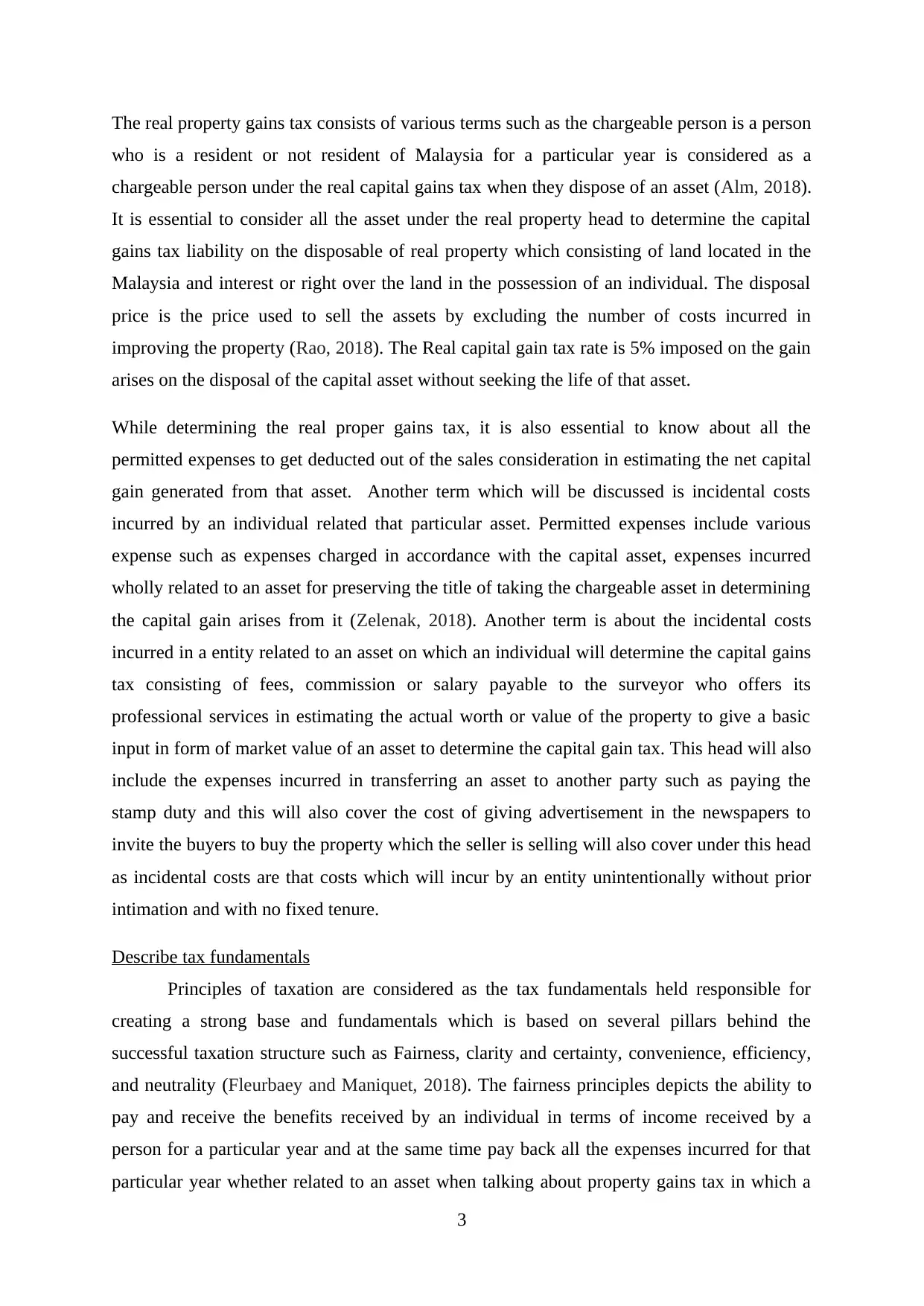
The real property gains tax consists of various terms such as the chargeable person is a person
who is a resident or not resident of Malaysia for a particular year is considered as a
chargeable person under the real capital gains tax when they dispose of an asset (Alm, 2018).
It is essential to consider all the asset under the real property head to determine the capital
gains tax liability on the disposable of real property which consisting of land located in the
Malaysia and interest or right over the land in the possession of an individual. The disposal
price is the price used to sell the assets by excluding the number of costs incurred in
improving the property (Rao, 2018). The Real capital gain tax rate is 5% imposed on the gain
arises on the disposal of the capital asset without seeking the life of that asset.
While determining the real proper gains tax, it is also essential to know about all the
permitted expenses to get deducted out of the sales consideration in estimating the net capital
gain generated from that asset. Another term which will be discussed is incidental costs
incurred by an individual related that particular asset. Permitted expenses include various
expense such as expenses charged in accordance with the capital asset, expenses incurred
wholly related to an asset for preserving the title of taking the chargeable asset in determining
the capital gain arises from it (Zelenak, 2018). Another term is about the incidental costs
incurred in a entity related to an asset on which an individual will determine the capital gains
tax consisting of fees, commission or salary payable to the surveyor who offers its
professional services in estimating the actual worth or value of the property to give a basic
input in form of market value of an asset to determine the capital gain tax. This head will also
include the expenses incurred in transferring an asset to another party such as paying the
stamp duty and this will also cover the cost of giving advertisement in the newspapers to
invite the buyers to buy the property which the seller is selling will also cover under this head
as incidental costs are that costs which will incur by an entity unintentionally without prior
intimation and with no fixed tenure.
Describe tax fundamentals
Principles of taxation are considered as the tax fundamentals held responsible for
creating a strong base and fundamentals which is based on several pillars behind the
successful taxation structure such as Fairness, clarity and certainty, convenience, efficiency,
and neutrality (Fleurbaey and Maniquet, 2018). The fairness principles depicts the ability to
pay and receive the benefits received by an individual in terms of income received by a
person for a particular year and at the same time pay back all the expenses incurred for that
particular year whether related to an asset when talking about property gains tax in which a
3
who is a resident or not resident of Malaysia for a particular year is considered as a
chargeable person under the real capital gains tax when they dispose of an asset (Alm, 2018).
It is essential to consider all the asset under the real property head to determine the capital
gains tax liability on the disposable of real property which consisting of land located in the
Malaysia and interest or right over the land in the possession of an individual. The disposal
price is the price used to sell the assets by excluding the number of costs incurred in
improving the property (Rao, 2018). The Real capital gain tax rate is 5% imposed on the gain
arises on the disposal of the capital asset without seeking the life of that asset.
While determining the real proper gains tax, it is also essential to know about all the
permitted expenses to get deducted out of the sales consideration in estimating the net capital
gain generated from that asset. Another term which will be discussed is incidental costs
incurred by an individual related that particular asset. Permitted expenses include various
expense such as expenses charged in accordance with the capital asset, expenses incurred
wholly related to an asset for preserving the title of taking the chargeable asset in determining
the capital gain arises from it (Zelenak, 2018). Another term is about the incidental costs
incurred in a entity related to an asset on which an individual will determine the capital gains
tax consisting of fees, commission or salary payable to the surveyor who offers its
professional services in estimating the actual worth or value of the property to give a basic
input in form of market value of an asset to determine the capital gain tax. This head will also
include the expenses incurred in transferring an asset to another party such as paying the
stamp duty and this will also cover the cost of giving advertisement in the newspapers to
invite the buyers to buy the property which the seller is selling will also cover under this head
as incidental costs are that costs which will incur by an entity unintentionally without prior
intimation and with no fixed tenure.
Describe tax fundamentals
Principles of taxation are considered as the tax fundamentals held responsible for
creating a strong base and fundamentals which is based on several pillars behind the
successful taxation structure such as Fairness, clarity and certainty, convenience, efficiency,
and neutrality (Fleurbaey and Maniquet, 2018). The fairness principles depicts the ability to
pay and receive the benefits received by an individual in terms of income received by a
person for a particular year and at the same time pay back all the expenses incurred for that
particular year whether related to an asset when talking about property gains tax in which a
3
particular asset is disposed whole gain arises from that asset is to be generated after deducting
all the expenses arises from it (Söllner, 2018). Thus principles depict the honest and fairness
maintained by an individual or an entity by maintaining the dignity of the entire taxation
structure. Another principle is clarity and certainty which shows the clear taxation rules
maintained by an individual for determining the income tax return or capital gain tax earned
on an asset for a particular year. It is essential to use a convenience principle in which an
individual will be easy to calculate the tax return by using different methods according to its
preference and the knowledge as for the sake of all the taxpayers the taxation structure
develops various methods to give the extra method for all the individuals. The efficiency
principle says that taxation administers efficiently and economically handles the taxation
system to determine the overall tax return different from one party to another. The last
principle, neutrality depicts that the action of an individual or an entity should not be
offended as this will not affect the behaviour of other people like the tax returns calculated by
an entity should be as per the taxation rules prepare by an entity (Du Preez, 2018).
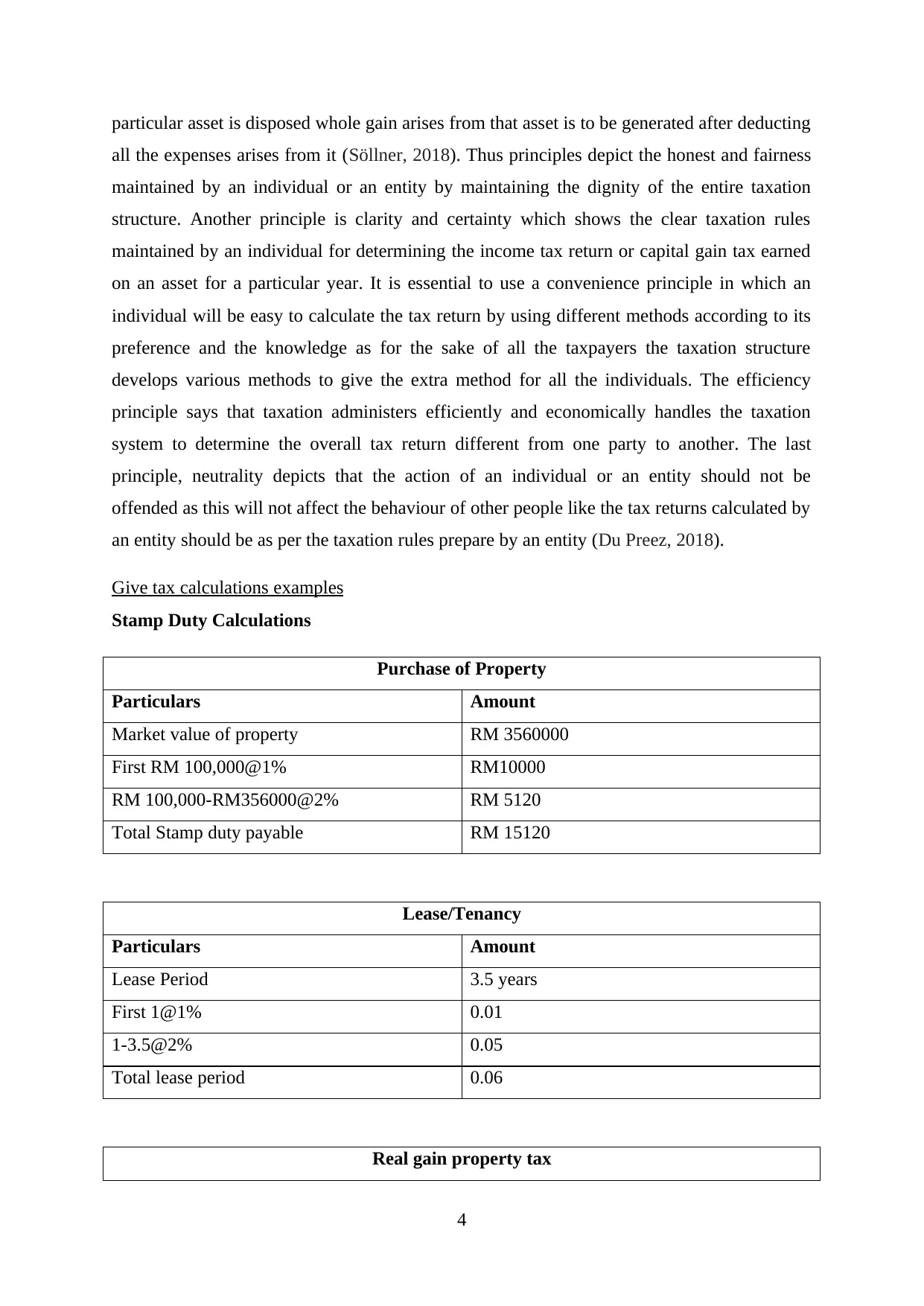
Give tax calculations examples
Stamp Duty Calculations
Purchase of Property
Particulars Amount
Market value of property RM 3560000
First RM 100,000@1% RM10000
RM 100,000-RM356000@2% RM 5120
Total Stamp duty payable RM 15120
Lease/Tenancy
Particulars Amount
Lease Period 3.5 years
First 1@1% 0.01
1-3.5@2% 0.05
Total lease period 0.06
Real gain property tax
4
all the expenses arises from it (Söllner, 2018). Thus principles depict the honest and fairness
maintained by an individual or an entity by maintaining the dignity of the entire taxation
structure. Another principle is clarity and certainty which shows the clear taxation rules
maintained by an individual for determining the income tax return or capital gain tax earned
on an asset for a particular year. It is essential to use a convenience principle in which an
individual will be easy to calculate the tax return by using different methods according to its
preference and the knowledge as for the sake of all the taxpayers the taxation structure
develops various methods to give the extra method for all the individuals. The efficiency
principle says that taxation administers efficiently and economically handles the taxation
system to determine the overall tax return different from one party to another. The last
principle, neutrality depicts that the action of an individual or an entity should not be
offended as this will not affect the behaviour of other people like the tax returns calculated by
an entity should be as per the taxation rules prepare by an entity (Du Preez, 2018).
Give tax calculations examples
Stamp Duty Calculations
Purchase of Property
Particulars Amount
Market value of property RM 3560000
First RM 100,000@1% RM10000
RM 100,000-RM356000@2% RM 5120
Total Stamp duty payable RM 15120
Lease/Tenancy
Particulars Amount
Lease Period 3.5 years
First 1@1% 0.01
1-3.5@2% 0.05
Total lease period 0.06
Real gain property tax
4
⊘ This is a preview!⊘
Do you want full access?
Subscribe today to unlock all pages.
Trusted by 1+ million students worldwide
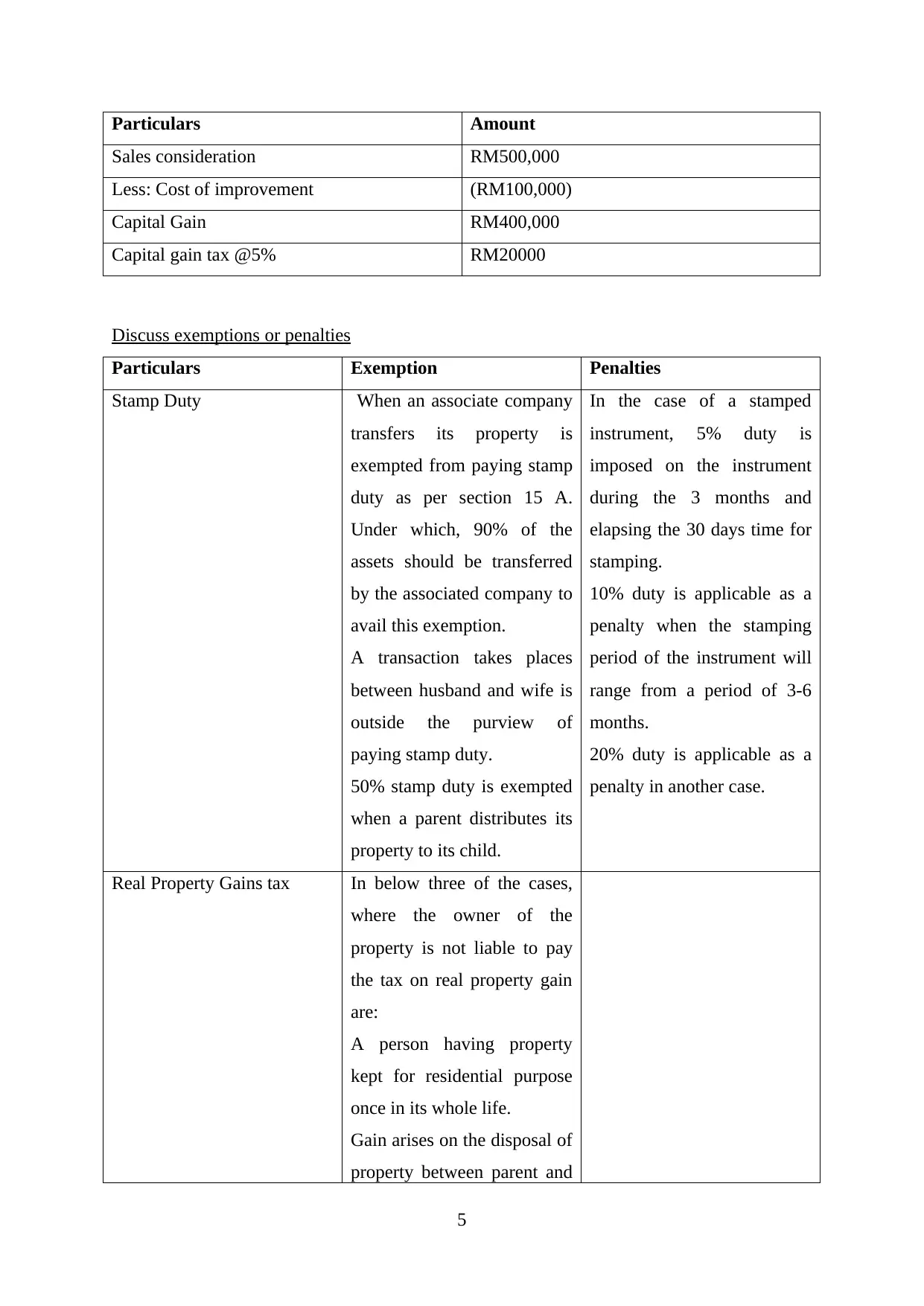
Particulars Amount
Sales consideration RM500,000
Less: Cost of improvement (RM100,000)
Capital Gain RM400,000
Capital gain tax @5% RM20000
Discuss exemptions or penalties
Particulars Exemption Penalties
Stamp Duty When an associate company
transfers its property is
exempted from paying stamp
duty as per section 15 A.
Under which, 90% of the
assets should be transferred
by the associated company to
avail this exemption.
A transaction takes places
between husband and wife is
outside the purview of
paying stamp duty.
50% stamp duty is exempted
when a parent distributes its
property to its child.
In the case of a stamped
instrument, 5% duty is
imposed on the instrument
during the 3 months and
elapsing the 30 days time for
stamping.
10% duty is applicable as a
penalty when the stamping
period of the instrument will
range from a period of 3-6
months.
20% duty is applicable as a
penalty in another case.
Real Property Gains tax In below three of the cases,
where the owner of the
property is not liable to pay
the tax on real property gain
are:
A person having property
kept for residential purpose
once in its whole life.
Gain arises on the disposal of
property between parent and
5
Sales consideration RM500,000
Less: Cost of improvement (RM100,000)
Capital Gain RM400,000
Capital gain tax @5% RM20000
Discuss exemptions or penalties
Particulars Exemption Penalties
Stamp Duty When an associate company
transfers its property is
exempted from paying stamp
duty as per section 15 A.
Under which, 90% of the
assets should be transferred
by the associated company to
avail this exemption.
A transaction takes places
between husband and wife is
outside the purview of
paying stamp duty.
50% stamp duty is exempted
when a parent distributes its
property to its child.
In the case of a stamped
instrument, 5% duty is
imposed on the instrument
during the 3 months and
elapsing the 30 days time for
stamping.
10% duty is applicable as a
penalty when the stamping
period of the instrument will
range from a period of 3-6
months.
20% duty is applicable as a
penalty in another case.
Real Property Gains tax In below three of the cases,
where the owner of the
property is not liable to pay
the tax on real property gain
are:
A person having property
kept for residential purpose
once in its whole life.
Gain arises on the disposal of
property between parent and
5
Paraphrase This Document
Need a fresh take? Get an instant paraphrase of this document with our AI Paraphraser
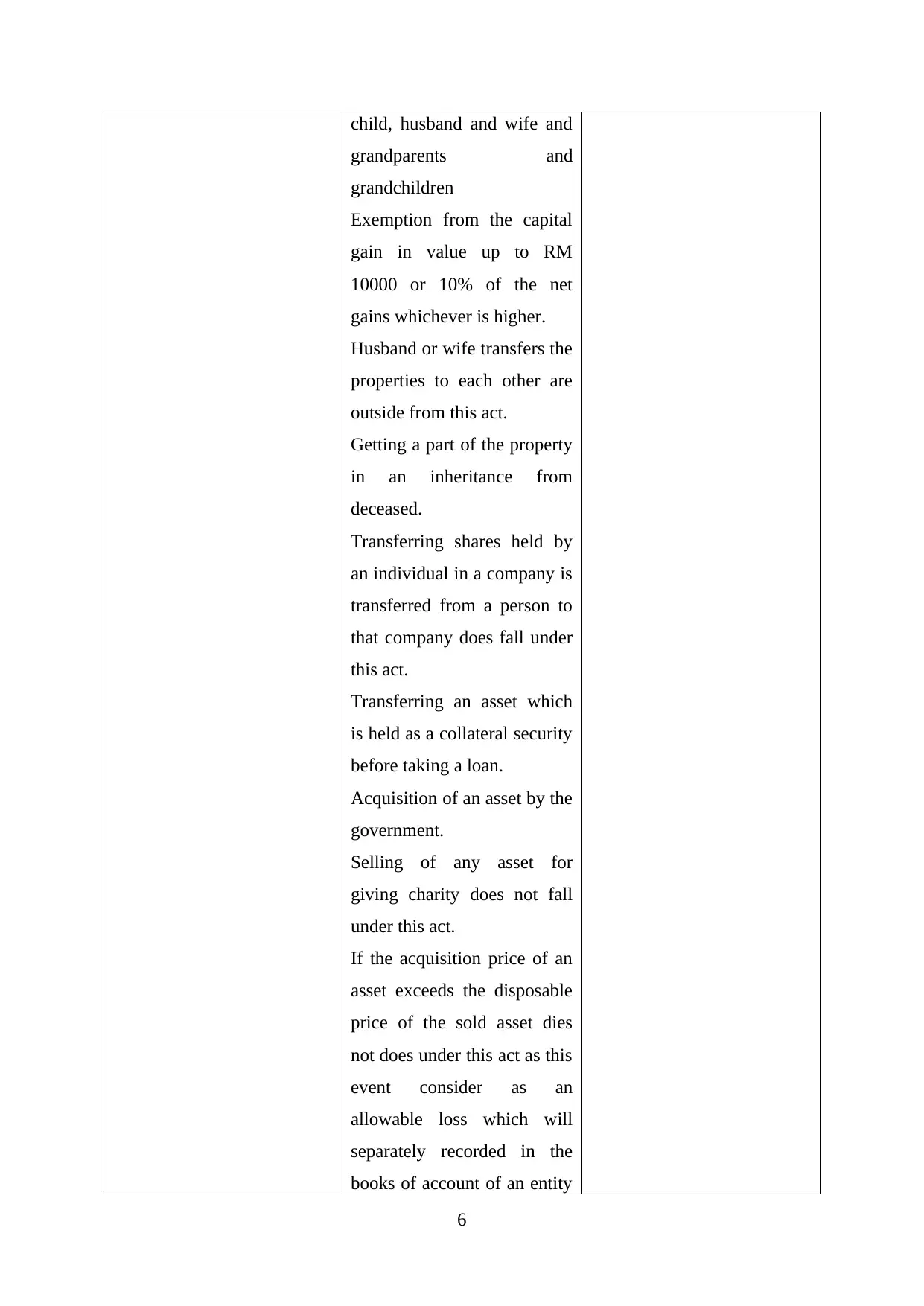
child, husband and wife and
grandparents and
grandchildren
Exemption from the capital
gain in value up to RM
10000 or 10% of the net
gains whichever is higher.
Husband or wife transfers the
properties to each other are
outside from this act.
Getting a part of the property
in an inheritance from
deceased.
Transferring shares held by
an individual in a company is
transferred from a person to
that company does fall under
this act.
Transferring an asset which
is held as a collateral security
before taking a loan.
Acquisition of an asset by the
government.
Selling of any asset for
giving charity does not fall
under this act.
If the acquisition price of an
asset exceeds the disposable
price of the sold asset dies
not does under this act as this
event consider as an
allowable loss which will
separately recorded in the
books of account of an entity
6
grandparents and
grandchildren
Exemption from the capital
gain in value up to RM
10000 or 10% of the net
gains whichever is higher.
Husband or wife transfers the
properties to each other are
outside from this act.
Getting a part of the property
in an inheritance from
deceased.
Transferring shares held by
an individual in a company is
transferred from a person to
that company does fall under
this act.
Transferring an asset which
is held as a collateral security
before taking a loan.
Acquisition of an asset by the
government.
Selling of any asset for
giving charity does not fall
under this act.
If the acquisition price of an
asset exceeds the disposable
price of the sold asset dies
not does under this act as this
event consider as an
allowable loss which will
separately recorded in the
books of account of an entity
6
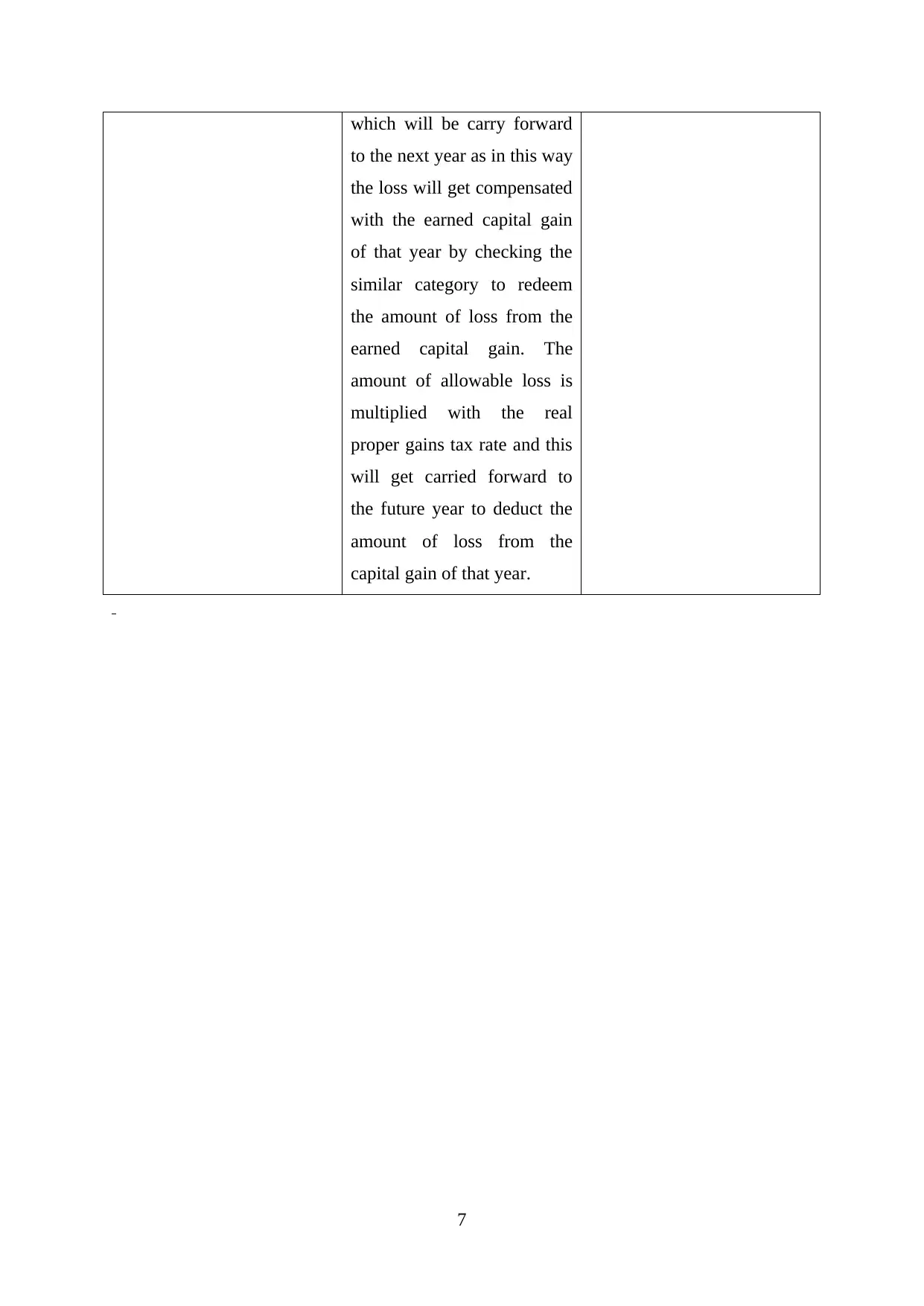
which will be carry forward
to the next year as in this way
the loss will get compensated
with the earned capital gain
of that year by checking the
similar category to redeem
the amount of loss from the
earned capital gain. The
amount of allowable loss is
multiplied with the real
proper gains tax rate and this
will get carried forward to
the future year to deduct the
amount of loss from the
capital gain of that year.
7
to the next year as in this way
the loss will get compensated
with the earned capital gain
of that year by checking the
similar category to redeem
the amount of loss from the
earned capital gain. The
amount of allowable loss is
multiplied with the real
proper gains tax rate and this
will get carried forward to
the future year to deduct the
amount of loss from the
capital gain of that year.
7
⊘ This is a preview!⊘
Do you want full access?
Subscribe today to unlock all pages.
Trusted by 1+ million students worldwide
REFERENCES
Adam, M. N. H. and Yusof, N. A. M., 2018. A Comparative Study on the Burden of Tax
Compliance Costs amongst GST Registered Companies in Malaysia and Abroad. Journal of
Science, Technology and Innovation Policy. 3(2).
Alm, J., 2018. What are the Costs of a New Tax Administration? The Case of a Personal
Income Tax in Kuwait(No. 1804).
Aziz, W. N. A. W. A. and Hanif, N. R., 2018. Housing policy in Malaysia: bridging the
affordability gap for medium-income households. In Housing Policy, Wellbeing and Social
Development in Asia (pp. 141-156). Routledge.
Du Preez, H., 2018. Constructing the Fundamental Principles of Taxation through
Triangulation. Journal of Legal Tax Research.
Erdem, N., 2018. The need for re-engineering in the real estate appraisal system in
Turkey. Survey Review, pp.1-13.
Fleurbaey, M. and Maniquet, F., 2018. Optimal income taxation theory and principles of
fairness. Journal of Economic Literature. 56(3). pp.1029-79.
Guide, G. P., 2018. Property in Malaysia| Malaysian Real Estate Investment.
Hor, K. and Rahmat, M. K., 2018. Analysis and recommendations for building energy
efficiency financing in Malaysia. Energy Efficiency. 11(1). pp.79-95.
Ismail, R., and et.al., 2018. Consumers Basic Right to Housing: The Role of Institutional
Frameworks in Malaysia. International Journal of Asian Social Science. 8(8). pp.501-508.
Kasim, R., Umar, M. A., Martin, D. and Yassin, A. M., 2018. Public Goods Delivery as a
Contributing Factor to the Property Tax Revenue Generation in Malaysian Local
Governments. Advanced Science Letters. 24(6). pp.4674-4678.
Lang, M., Pistone, P., Schuch, J. and Staringer, C. eds., 2018. Introduction to European tax
law on direct taxation. Linde Verlag GmbH.
Rao, S., 2018. Country notes: Coverage of OECD Multilateral Instrument on India and Its
Top 10 Tax Treaty Partners in Terms of Foreign Direct Investment. Intertax. 46(5). pp.434-
449.
8
Adam, M. N. H. and Yusof, N. A. M., 2018. A Comparative Study on the Burden of Tax
Compliance Costs amongst GST Registered Companies in Malaysia and Abroad. Journal of
Science, Technology and Innovation Policy. 3(2).
Alm, J., 2018. What are the Costs of a New Tax Administration? The Case of a Personal
Income Tax in Kuwait(No. 1804).
Aziz, W. N. A. W. A. and Hanif, N. R., 2018. Housing policy in Malaysia: bridging the
affordability gap for medium-income households. In Housing Policy, Wellbeing and Social
Development in Asia (pp. 141-156). Routledge.
Du Preez, H., 2018. Constructing the Fundamental Principles of Taxation through
Triangulation. Journal of Legal Tax Research.
Erdem, N., 2018. The need for re-engineering in the real estate appraisal system in
Turkey. Survey Review, pp.1-13.
Fleurbaey, M. and Maniquet, F., 2018. Optimal income taxation theory and principles of
fairness. Journal of Economic Literature. 56(3). pp.1029-79.
Guide, G. P., 2018. Property in Malaysia| Malaysian Real Estate Investment.
Hor, K. and Rahmat, M. K., 2018. Analysis and recommendations for building energy
efficiency financing in Malaysia. Energy Efficiency. 11(1). pp.79-95.
Ismail, R., and et.al., 2018. Consumers Basic Right to Housing: The Role of Institutional
Frameworks in Malaysia. International Journal of Asian Social Science. 8(8). pp.501-508.
Kasim, R., Umar, M. A., Martin, D. and Yassin, A. M., 2018. Public Goods Delivery as a
Contributing Factor to the Property Tax Revenue Generation in Malaysian Local
Governments. Advanced Science Letters. 24(6). pp.4674-4678.
Lang, M., Pistone, P., Schuch, J. and Staringer, C. eds., 2018. Introduction to European tax
law on direct taxation. Linde Verlag GmbH.
Rao, S., 2018. Country notes: Coverage of OECD Multilateral Instrument on India and Its
Top 10 Tax Treaty Partners in Terms of Foreign Direct Investment. Intertax. 46(5). pp.434-
449.
8
Paraphrase This Document
Need a fresh take? Get an instant paraphrase of this document with our AI Paraphraser
Shafai, N. A. B., Amran, A. B. and Ganesan, Y., 2018. Earnings Management, Tax
Avoidance and Corporate Social Responsibility: Malaysia Evidence. Management. 5(3).
pp.41-56.
Söllner, F., 2018. Road traffic taxation in Germany: the present system, its problems and a
proposal for reform. Journal of Tax Reform. 4(1). pp.57-72.
Thompson, J. and Neuzil, D., 2018. Valuing Bonus Depreciation Under the New Tax
Law. Business Valuation Review. 37(1). pp.15-19.
Zelenak, L. A., 2018. Leaving it up to Treasury: Congressional Abdication on Major Policy
Issues in the Early Years of the Income Tax. Law and Contemporary Problems. 81(2).
pp.137-165.
9
Avoidance and Corporate Social Responsibility: Malaysia Evidence. Management. 5(3).
pp.41-56.
Söllner, F., 2018. Road traffic taxation in Germany: the present system, its problems and a
proposal for reform. Journal of Tax Reform. 4(1). pp.57-72.
Thompson, J. and Neuzil, D., 2018. Valuing Bonus Depreciation Under the New Tax
Law. Business Valuation Review. 37(1). pp.15-19.
Zelenak, L. A., 2018. Leaving it up to Treasury: Congressional Abdication on Major Policy
Issues in the Early Years of the Income Tax. Law and Contemporary Problems. 81(2).
pp.137-165.
9

1 out of 11


Related Documents


Your All-in-One AI-Powered Toolkit for Academic Success.
+13062052269
info@desklib.com
Available 24*7 on WhatsApp / Email
![[object Object]](/_next/static/media/star-bottom.7253800d.svg)
Unlock your academic potential
Copyright © 2020–2025 A2Z Services. All Rights Reserved. Developed and managed by ZUCOL.