BSBMKG603 Project: Strategic Management of Marketing Process
VerifiedAdded on 2023/06/18
|28
|9867
|229
Project
AI Summary
This assignment provides a comprehensive solution to a BSBMKG603 project focused on managing the marketing process and marketing personnel. It includes a written question section covering trends impacting marketing, and a project section involving developing a marketing plan, identifying personnel roles, creating a communication strategy, and participating in role-play scenarios for coaching and counselling. The project culminates in evaluating marketing outcomes and writing a report. The document also includes general assessment information, guidelines on plagiarism, and support resources, making it a useful resource for students studying marketing.
ASSESSMENT
GUIDE
Student
BSBMKG603 Manage the marketing
process
GUIDE
Student
BSBMKG603 Manage the marketing
process

Paraphrase This Document
Need a fresh take? Get an instant paraphrase of this document with our AI Paraphraser
BSBMKG603 Manage the marketing process
UNIT OVERVIEW
BSBMKG603 Manage the marketing process
This unit describes the skills and knowledge required to strategically manage the marketing
process and marketing personnel within an organisation.
It applies to senior personnel who are responsible for managing the overall marketing process of
an organisation, and for managing marketing personnel. Typically they manage a portfolio of
products or services across the organisation, rather than a single product or a few products.
No licensing, legislative or certification requirements apply to this unit at the time of publication.
Elements
To achieve competency in this unit students must demonstrate their ability to:
1. Manage marketing performance
2. Manage marketing personnel
3. Evaluate and improve strategic marketing performance
Performance Evidence
Evidence of the ability to:
monitor marketing performance across an organisation by comparing performance against
key performance indicators
effectively communicate marketing objectives to relevant personnel in accordance with
organisation requirements
provide feedback, mentoring and coaching to staff
capitalise on over-performance or minimise under-performance against marketing
objectives.
Note: If a specific volume or frequency is not stated, then evidence must be provided at least once.
Knowledge Evidence
To complete the unit requirements safely and effectively, the individual must:
summarise economic, social and industry directions, trends and practices
outline different organisational structures, roles, responsibilities and policies
describe own/relevant industry product and service knowledge
explain principles of marketing, strategic analysis and strategic management
summarise statistical and data evaluation techniques to measure marketing performance.
Student Assessment Guide v 1 January 2019 Page 2 of 28
UNIT OVERVIEW
BSBMKG603 Manage the marketing process
This unit describes the skills and knowledge required to strategically manage the marketing
process and marketing personnel within an organisation.
It applies to senior personnel who are responsible for managing the overall marketing process of
an organisation, and for managing marketing personnel. Typically they manage a portfolio of
products or services across the organisation, rather than a single product or a few products.
No licensing, legislative or certification requirements apply to this unit at the time of publication.
Elements
To achieve competency in this unit students must demonstrate their ability to:
1. Manage marketing performance
2. Manage marketing personnel
3. Evaluate and improve strategic marketing performance
Performance Evidence
Evidence of the ability to:
monitor marketing performance across an organisation by comparing performance against
key performance indicators
effectively communicate marketing objectives to relevant personnel in accordance with
organisation requirements
provide feedback, mentoring and coaching to staff
capitalise on over-performance or minimise under-performance against marketing
objectives.
Note: If a specific volume or frequency is not stated, then evidence must be provided at least once.
Knowledge Evidence
To complete the unit requirements safely and effectively, the individual must:
summarise economic, social and industry directions, trends and practices
outline different organisational structures, roles, responsibilities and policies
describe own/relevant industry product and service knowledge
explain principles of marketing, strategic analysis and strategic management
summarise statistical and data evaluation techniques to measure marketing performance.
Student Assessment Guide v 1 January 2019 Page 2 of 28
BSBMKG603 Manage the marketing process
INFORMATION FOR STUDENTS
General Assessment Information
This information is designed to provide you with a full overview of the tasks you need to
successfully complete to be deemed competent in this unit.
You must achieve a satisfactory performance in each of the assessment tasks in order to be
deemed competent in the relevant unit. Where necessary, the assessment tasks are divided into
parts or steps. These are designed to take you through a step by step approach to completing the
activities.
Instructions
First and foremost, please contact your assessor to discuss any necessary adjustments that may
need to be made prior to completing these tasks. The instructions for each of the assessment
tasks are logically sequenced. If you have any questions, contact your assessor immediately. If
there is a practical component to your assessment, you will need to discuss the arrangements for
its completion with your assessor in advance.
Assessment Cover Sheet
Once you have completed all of the tasks, complete the Assessment Cover Sheet, sign the
declaration and forward along with your documentation to your assessor. It should be uploaded
along with the assessment on to the RTO manager.
Submitting Assessment Tasks
All written assessment tasks must be typed and submitted with the provided cover sheet.
Your trainer/assessor will tell you when assessments are due. It is your responsibility to ensure
that assessment tasks are submitted on or before their due date.
Extensions for individual assessment tasks may be negotiated with your trainer in specific
circumstances. You must request this prior to the due date, and extensions due to illness will
require a medical certificate. Extensions will be confirmed by your trainer/assessor.
Where assessment tasks are submitted following the conclusion of the unit of competency without
a medical certificate or extension, a late submission fee for each assessment task will be charged.
Assessment Outcomes
There are two outcomes of assessment tasks: S = Satisfactory and NS = Not Satisfactory (requires
more training and experience).
You will be awarded C = Competent on completion of the unit when you have achieved S for all
completed assessment tasks and by meeting all the performance criteria. If you fail to meet this
requirement, you will receive the result NYC = Not Yet Competent and will be eligible to be re-
assessed according to George Brown College policy.
If you are deemed Not Competent by your assessor and require re-assessment, you will be
informed of the process. A fee may be charged according to George Brown College policy.
If all assessment tasks are not completed for a qualification, a certificate will not be awarded. A
Statement of Attainment for completed units of competency will be provided.
Student Assessment Guide v 1 January 2019 Page 3 of 28
INFORMATION FOR STUDENTS
General Assessment Information
This information is designed to provide you with a full overview of the tasks you need to
successfully complete to be deemed competent in this unit.
You must achieve a satisfactory performance in each of the assessment tasks in order to be
deemed competent in the relevant unit. Where necessary, the assessment tasks are divided into
parts or steps. These are designed to take you through a step by step approach to completing the
activities.
Instructions
First and foremost, please contact your assessor to discuss any necessary adjustments that may
need to be made prior to completing these tasks. The instructions for each of the assessment
tasks are logically sequenced. If you have any questions, contact your assessor immediately. If
there is a practical component to your assessment, you will need to discuss the arrangements for
its completion with your assessor in advance.
Assessment Cover Sheet
Once you have completed all of the tasks, complete the Assessment Cover Sheet, sign the
declaration and forward along with your documentation to your assessor. It should be uploaded
along with the assessment on to the RTO manager.
Submitting Assessment Tasks
All written assessment tasks must be typed and submitted with the provided cover sheet.
Your trainer/assessor will tell you when assessments are due. It is your responsibility to ensure
that assessment tasks are submitted on or before their due date.
Extensions for individual assessment tasks may be negotiated with your trainer in specific
circumstances. You must request this prior to the due date, and extensions due to illness will
require a medical certificate. Extensions will be confirmed by your trainer/assessor.
Where assessment tasks are submitted following the conclusion of the unit of competency without
a medical certificate or extension, a late submission fee for each assessment task will be charged.
Assessment Outcomes
There are two outcomes of assessment tasks: S = Satisfactory and NS = Not Satisfactory (requires
more training and experience).
You will be awarded C = Competent on completion of the unit when you have achieved S for all
completed assessment tasks and by meeting all the performance criteria. If you fail to meet this
requirement, you will receive the result NYC = Not Yet Competent and will be eligible to be re-
assessed according to George Brown College policy.
If you are deemed Not Competent by your assessor and require re-assessment, you will be
informed of the process. A fee may be charged according to George Brown College policy.
If all assessment tasks are not completed for a qualification, a certificate will not be awarded. A
Statement of Attainment for completed units of competency will be provided.
Student Assessment Guide v 1 January 2019 Page 3 of 28
⊘ This is a preview!⊘
Do you want full access?
Subscribe today to unlock all pages.

Trusted by 1+ million students worldwide
BSBMKG603 Manage the marketing process
Your Results
Your assessor is committed to providing you with detailed feedback on the outcomes of the
assessment and will provide guidance on areas for improvement. In most instances, you should
only need to complete the sections of the assessment that were deemed not satisfactory.
However, it is important to remember that depending on the task, it may be necessary to repeat the
whole task (for example presentations or the delivery of a training session).
You are entitled to view your results at any time by viewing them once they are uploaded on
RTOManager.
Reasonable Adjustment
George Brown College supports individual differences in the learning environment and provides
‘reasonable adjustment’ in training and assessment activities to support every learner. If you have
any special needs that make it difficult for you to complete your learning or assessments, you
should discuss this with your assessor beforehand and will be provided with reasonable
alternatives to assist you to complete the required tasks such as completing tests verbally or using
an interpreter.
What happens if you do not agree with the assessment result?
If you do not think the assessment process is valid, or disagree with the decision once it is made,
or believe that you have been treated unfairly, you can appeal. The first step is to discuss the
matter with your trainer.
If you still do not agree with the results, refer to the GBC Complaints and Appeals Policy and speak
to the Student Services Team.
Support
While we may not be in a position to assist you with language training or specific LLN training, our
assessors will work with you to ensure that you are supported throughout your qualification. If you
require individual tutoring this may attract an additional fee (see Student Handbook). Support may
be offered by your assessor, or for more specialist support you may need to contact GBC
administration.
A Note on Plagiarism and Referencing
Plagiarism is a form of theft where the work, ideas, inventions etc. of other people are presented as
your own. Information, ideas etc. quoted or paraphrased from another source such as the Internet,
must be acknowledged with “quotation marks” around the relevant words/sentences or ideas and
the source listed in brackets. You must also list the sources at the end of your assessment.
Sources of information, ideas etc. must be provided in alphabetical order by author’s surname
(including author’s full name, name of document/ book / internet etc. and year and place of
publishing) or may be included in brackets in the text.
As a general rule it is advisable to never copy another person’s work. Should it appear that a
student’s work has been copied or does not appear to be authentic, you will be asked to speak to
your Course Coordinator and required to re-submit it. A fee may be charged according to George
Brown College policy.
Contacting the RTO
If you should need further support or assistance please do not hesitate to contact The Student
Services Team.
Student Assessment Guide v 1 January 2019 Page 4 of 28
Your Results
Your assessor is committed to providing you with detailed feedback on the outcomes of the
assessment and will provide guidance on areas for improvement. In most instances, you should
only need to complete the sections of the assessment that were deemed not satisfactory.
However, it is important to remember that depending on the task, it may be necessary to repeat the
whole task (for example presentations or the delivery of a training session).
You are entitled to view your results at any time by viewing them once they are uploaded on
RTOManager.
Reasonable Adjustment
George Brown College supports individual differences in the learning environment and provides
‘reasonable adjustment’ in training and assessment activities to support every learner. If you have
any special needs that make it difficult for you to complete your learning or assessments, you
should discuss this with your assessor beforehand and will be provided with reasonable
alternatives to assist you to complete the required tasks such as completing tests verbally or using
an interpreter.
What happens if you do not agree with the assessment result?
If you do not think the assessment process is valid, or disagree with the decision once it is made,
or believe that you have been treated unfairly, you can appeal. The first step is to discuss the
matter with your trainer.
If you still do not agree with the results, refer to the GBC Complaints and Appeals Policy and speak
to the Student Services Team.
Support
While we may not be in a position to assist you with language training or specific LLN training, our
assessors will work with you to ensure that you are supported throughout your qualification. If you
require individual tutoring this may attract an additional fee (see Student Handbook). Support may
be offered by your assessor, or for more specialist support you may need to contact GBC
administration.
A Note on Plagiarism and Referencing
Plagiarism is a form of theft where the work, ideas, inventions etc. of other people are presented as
your own. Information, ideas etc. quoted or paraphrased from another source such as the Internet,
must be acknowledged with “quotation marks” around the relevant words/sentences or ideas and
the source listed in brackets. You must also list the sources at the end of your assessment.
Sources of information, ideas etc. must be provided in alphabetical order by author’s surname
(including author’s full name, name of document/ book / internet etc. and year and place of
publishing) or may be included in brackets in the text.
As a general rule it is advisable to never copy another person’s work. Should it appear that a
student’s work has been copied or does not appear to be authentic, you will be asked to speak to
your Course Coordinator and required to re-submit it. A fee may be charged according to George
Brown College policy.
Contacting the RTO
If you should need further support or assistance please do not hesitate to contact The Student
Services Team.
Student Assessment Guide v 1 January 2019 Page 4 of 28
Paraphrase This Document
Need a fresh take? Get an instant paraphrase of this document with our AI Paraphraser
BSBMKG603 Manage the marketing process
ASSESSMENT
BSBMKG603 Manage the marketing process
There are two assessments for this unit:
1. Written Questions
For this assessment, you are to read the questions and respond in writing with the most suitable
answer. There are ten questions, all of which must be completed. Most questions require short
answers although some questions require a more detailed response. You may use various sources
of information including workbooks, internet and other documents, but must list and reference your
sources if other than your learning materials. Your assessor will advise you when this is due.
2. Project
For this assessment you are required to strategically manage the marketing process and marketing
personnel within an organisation. It is based on a business scenario of a chain of fashion stores.
There are three parts in this assessment. You must complete them all.
Part A:– requires you to develop a marketing plan for the marketing activities, with clear
strategies and actions for the achievement of marketing objectives.
Part B: – you are to identify personnel and allocate roles for implementing the marketing
activities, and to develop a communication strategy. You are also required to participate in
two role plays: one is a coaching session and the other a counselling interview .
For the coaching session, you will play the role of the marketing manager and another staff
member from the college will play the part of the other person. Your assessor will organise
this. The coaching session will take 8 – 10 minutes.
In the counselling interview, your assessor will play the role of the other party, with you
acting as manager. Roles are included in the assessment instructions.
This counselling interview will also take 8 - 10 minutes.
Your assessor will advise you when each of these role plays will take place.
There are role play observation checklists.
Part C:- requires you to evaluate marketing outcomes based on additional business
scenario information, and to write it up in a report.
Your assessor will advise when this is due.
Assessment Schedule
Assessment Due Date
1. Written Questions
2. Project
Student Assessment Guide v 1 January 2019 Page 5 of 28
ASSESSMENT
BSBMKG603 Manage the marketing process
There are two assessments for this unit:
1. Written Questions
For this assessment, you are to read the questions and respond in writing with the most suitable
answer. There are ten questions, all of which must be completed. Most questions require short
answers although some questions require a more detailed response. You may use various sources
of information including workbooks, internet and other documents, but must list and reference your
sources if other than your learning materials. Your assessor will advise you when this is due.
2. Project
For this assessment you are required to strategically manage the marketing process and marketing
personnel within an organisation. It is based on a business scenario of a chain of fashion stores.
There are three parts in this assessment. You must complete them all.
Part A:– requires you to develop a marketing plan for the marketing activities, with clear
strategies and actions for the achievement of marketing objectives.
Part B: – you are to identify personnel and allocate roles for implementing the marketing
activities, and to develop a communication strategy. You are also required to participate in
two role plays: one is a coaching session and the other a counselling interview .
For the coaching session, you will play the role of the marketing manager and another staff
member from the college will play the part of the other person. Your assessor will organise
this. The coaching session will take 8 – 10 minutes.
In the counselling interview, your assessor will play the role of the other party, with you
acting as manager. Roles are included in the assessment instructions.
This counselling interview will also take 8 - 10 minutes.
Your assessor will advise you when each of these role plays will take place.
There are role play observation checklists.
Part C:- requires you to evaluate marketing outcomes based on additional business
scenario information, and to write it up in a report.
Your assessor will advise when this is due.
Assessment Schedule
Assessment Due Date
1. Written Questions
2. Project
Student Assessment Guide v 1 January 2019 Page 5 of 28
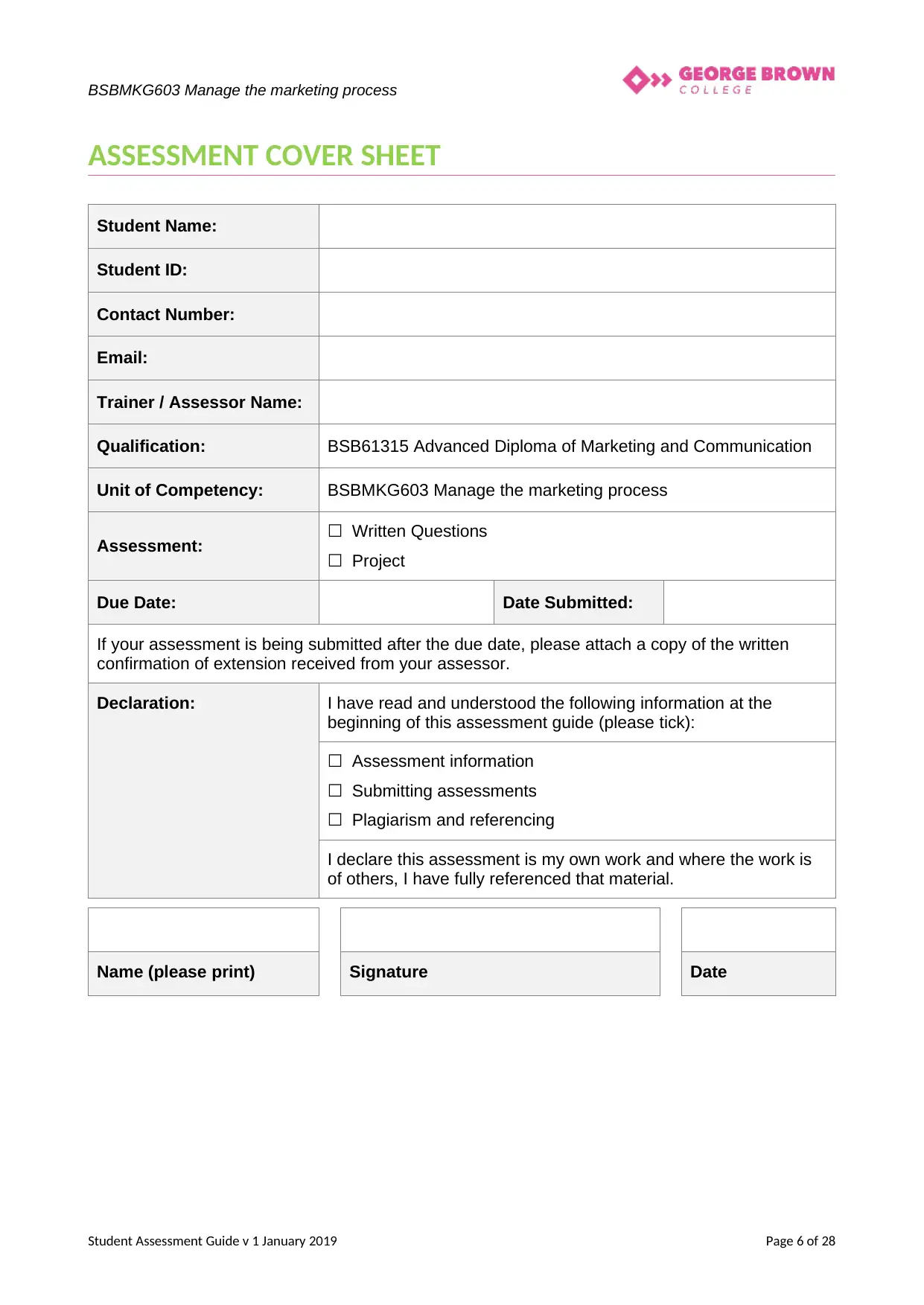
BSBMKG603 Manage the marketing process
ASSESSMENT COVER SHEET
Student Name:
Student ID:
Contact Number:
Email:
Trainer / Assessor Name:
Qualification: BSB61315 Advanced Diploma of Marketing and Communication
Unit of Competency: BSBMKG603 Manage the marketing process
Assessment: ☐ Written Questions
☐ Project
Due Date: Date Submitted:
If your assessment is being submitted after the due date, please attach a copy of the written
confirmation of extension received from your assessor.
Declaration: I have read and understood the following information at the
beginning of this assessment guide (please tick):
☐ Assessment information
☐ Submitting assessments
☐ Plagiarism and referencing
I declare this assessment is my own work and where the work is
of others, I have fully referenced that material.
Name (please print) Signature Date
Student Assessment Guide v 1 January 2019 Page 6 of 28
ASSESSMENT COVER SHEET
Student Name:
Student ID:
Contact Number:
Email:
Trainer / Assessor Name:
Qualification: BSB61315 Advanced Diploma of Marketing and Communication
Unit of Competency: BSBMKG603 Manage the marketing process
Assessment: ☐ Written Questions
☐ Project
Due Date: Date Submitted:
If your assessment is being submitted after the due date, please attach a copy of the written
confirmation of extension received from your assessor.
Declaration: I have read and understood the following information at the
beginning of this assessment guide (please tick):
☐ Assessment information
☐ Submitting assessments
☐ Plagiarism and referencing
I declare this assessment is my own work and where the work is
of others, I have fully referenced that material.
Name (please print) Signature Date
Student Assessment Guide v 1 January 2019 Page 6 of 28
⊘ This is a preview!⊘
Do you want full access?
Subscribe today to unlock all pages.
Trusted by 1+ million students worldwide
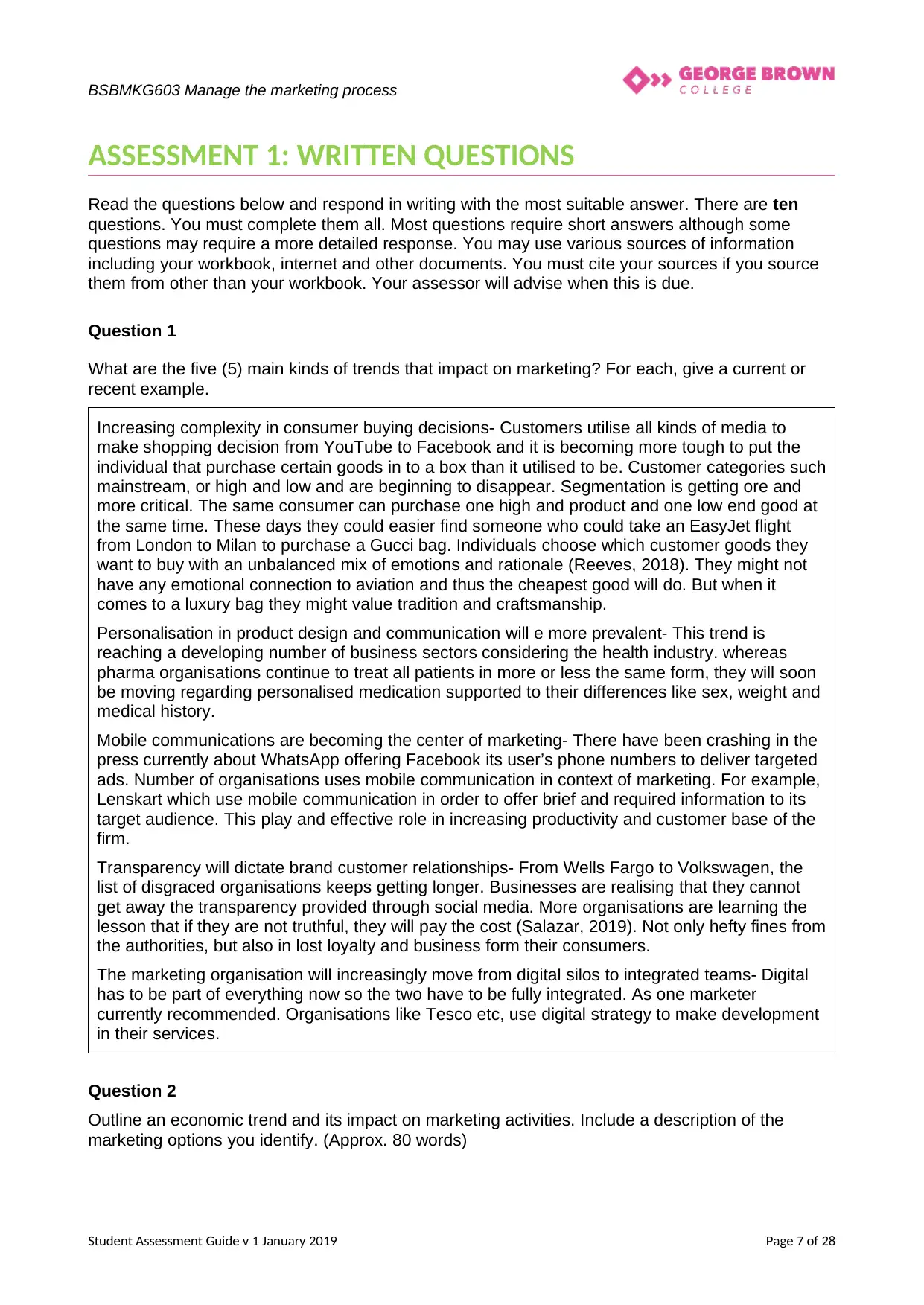
BSBMKG603 Manage the marketing process
ASSESSMENT 1: WRITTEN QUESTIONS
Read the questions below and respond in writing with the most suitable answer. There are ten
questions. You must complete them all. Most questions require short answers although some
questions may require a more detailed response. You may use various sources of information
including your workbook, internet and other documents. You must cite your sources if you source
them from other than your workbook. Your assessor will advise when this is due.
Question 1
What are the five (5) main kinds of trends that impact on marketing? For each, give a current or
recent example.
Increasing complexity in consumer buying decisions- Customers utilise all kinds of media to
make shopping decision from YouTube to Facebook and it is becoming more tough to put the
individual that purchase certain goods in to a box than it utilised to be. Customer categories such
mainstream, or high and low and are beginning to disappear. Segmentation is getting ore and
more critical. The same consumer can purchase one high and product and one low end good at
the same time. These days they could easier find someone who could take an EasyJet flight
from London to Milan to purchase a Gucci bag. Individuals choose which customer goods they
want to buy with an unbalanced mix of emotions and rationale (Reeves, 2018). They might not
have any emotional connection to aviation and thus the cheapest good will do. But when it
comes to a luxury bag they might value tradition and craftsmanship.
Personalisation in product design and communication will e more prevalent- This trend is
reaching a developing number of business sectors considering the health industry. whereas
pharma organisations continue to treat all patients in more or less the same form, they will soon
be moving regarding personalised medication supported to their differences like sex, weight and
medical history.
Mobile communications are becoming the center of marketing- There have been crashing in the
press currently about WhatsApp offering Facebook its user’s phone numbers to deliver targeted
ads. Number of organisations uses mobile communication in context of marketing. For example,
Lenskart which use mobile communication in order to offer brief and required information to its
target audience. This play and effective role in increasing productivity and customer base of the
firm.
Transparency will dictate brand customer relationships- From Wells Fargo to Volkswagen, the
list of disgraced organisations keeps getting longer. Businesses are realising that they cannot
get away the transparency provided through social media. More organisations are learning the
lesson that if they are not truthful, they will pay the cost (Salazar, 2019). Not only hefty fines from
the authorities, but also in lost loyalty and business form their consumers.
The marketing organisation will increasingly move from digital silos to integrated teams- Digital
has to be part of everything now so the two have to be fully integrated. As one marketer
currently recommended. Organisations like Tesco etc, use digital strategy to make development
in their services.
Question 2
Outline an economic trend and its impact on marketing activities. Include a description of the
marketing options you identify. (Approx. 80 words)
Student Assessment Guide v 1 January 2019 Page 7 of 28
ASSESSMENT 1: WRITTEN QUESTIONS
Read the questions below and respond in writing with the most suitable answer. There are ten
questions. You must complete them all. Most questions require short answers although some
questions may require a more detailed response. You may use various sources of information
including your workbook, internet and other documents. You must cite your sources if you source
them from other than your workbook. Your assessor will advise when this is due.
Question 1
What are the five (5) main kinds of trends that impact on marketing? For each, give a current or
recent example.
Increasing complexity in consumer buying decisions- Customers utilise all kinds of media to
make shopping decision from YouTube to Facebook and it is becoming more tough to put the
individual that purchase certain goods in to a box than it utilised to be. Customer categories such
mainstream, or high and low and are beginning to disappear. Segmentation is getting ore and
more critical. The same consumer can purchase one high and product and one low end good at
the same time. These days they could easier find someone who could take an EasyJet flight
from London to Milan to purchase a Gucci bag. Individuals choose which customer goods they
want to buy with an unbalanced mix of emotions and rationale (Reeves, 2018). They might not
have any emotional connection to aviation and thus the cheapest good will do. But when it
comes to a luxury bag they might value tradition and craftsmanship.
Personalisation in product design and communication will e more prevalent- This trend is
reaching a developing number of business sectors considering the health industry. whereas
pharma organisations continue to treat all patients in more or less the same form, they will soon
be moving regarding personalised medication supported to their differences like sex, weight and
medical history.
Mobile communications are becoming the center of marketing- There have been crashing in the
press currently about WhatsApp offering Facebook its user’s phone numbers to deliver targeted
ads. Number of organisations uses mobile communication in context of marketing. For example,
Lenskart which use mobile communication in order to offer brief and required information to its
target audience. This play and effective role in increasing productivity and customer base of the
firm.
Transparency will dictate brand customer relationships- From Wells Fargo to Volkswagen, the
list of disgraced organisations keeps getting longer. Businesses are realising that they cannot
get away the transparency provided through social media. More organisations are learning the
lesson that if they are not truthful, they will pay the cost (Salazar, 2019). Not only hefty fines from
the authorities, but also in lost loyalty and business form their consumers.
The marketing organisation will increasingly move from digital silos to integrated teams- Digital
has to be part of everything now so the two have to be fully integrated. As one marketer
currently recommended. Organisations like Tesco etc, use digital strategy to make development
in their services.
Question 2
Outline an economic trend and its impact on marketing activities. Include a description of the
marketing options you identify. (Approx. 80 words)
Student Assessment Guide v 1 January 2019 Page 7 of 28
Paraphrase This Document
Need a fresh take? Get an instant paraphrase of this document with our AI Paraphraser
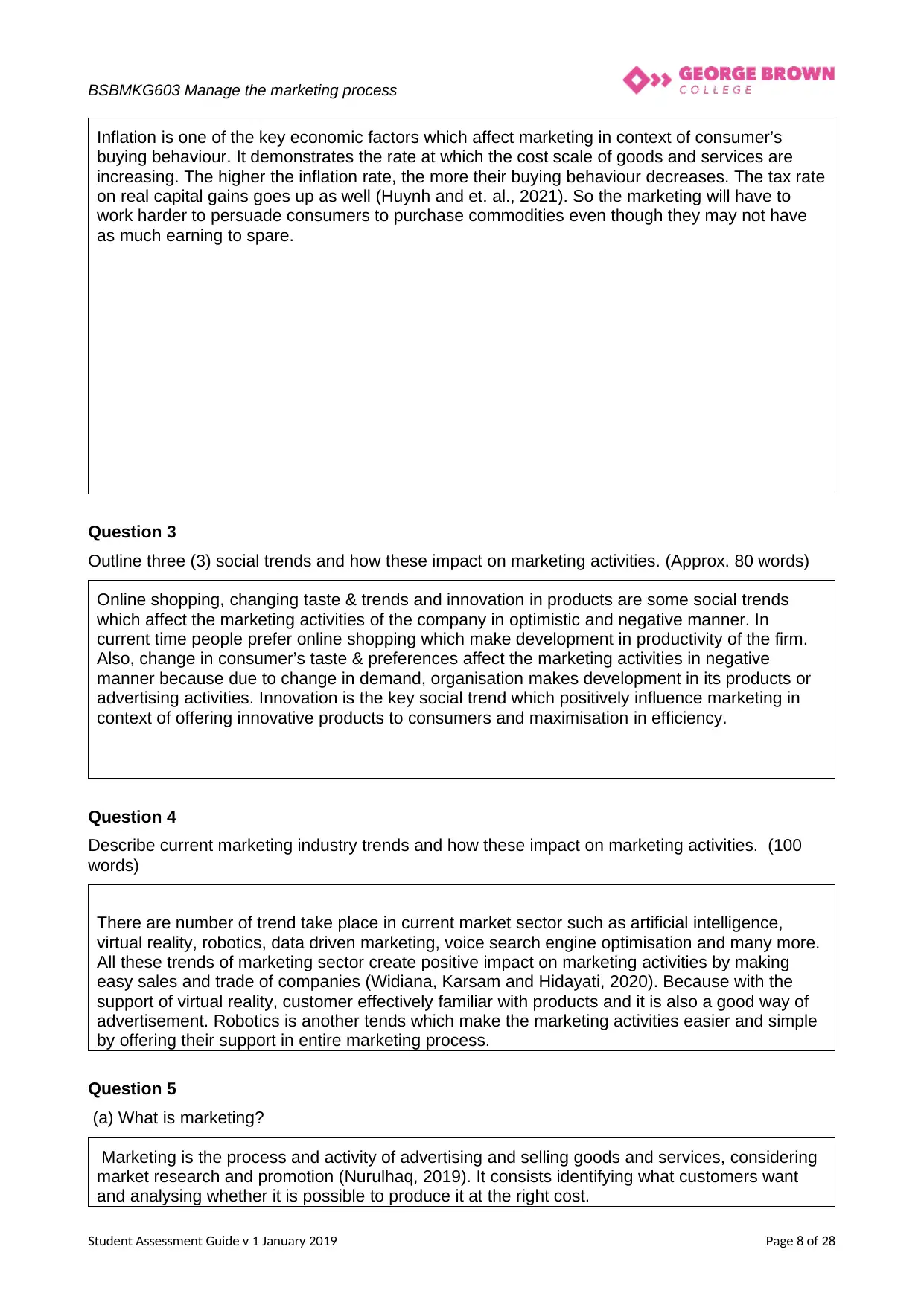
BSBMKG603 Manage the marketing process
Inflation is one of the key economic factors which affect marketing in context of consumer’s
buying behaviour. It demonstrates the rate at which the cost scale of goods and services are
increasing. The higher the inflation rate, the more their buying behaviour decreases. The tax rate
on real capital gains goes up as well (Huynh and et. al., 2021). So the marketing will have to
work harder to persuade consumers to purchase commodities even though they may not have
as much earning to spare.
Question 3
Outline three (3) social trends and how these impact on marketing activities. (Approx. 80 words)
Online shopping, changing taste & trends and innovation in products are some social trends
which affect the marketing activities of the company in optimistic and negative manner. In
current time people prefer online shopping which make development in productivity of the firm.
Also, change in consumer’s taste & preferences affect the marketing activities in negative
manner because due to change in demand, organisation makes development in its products or
advertising activities. Innovation is the key social trend which positively influence marketing in
context of offering innovative products to consumers and maximisation in efficiency.
Question 4
Describe current marketing industry trends and how these impact on marketing activities. (100
words)
There are number of trend take place in current market sector such as artificial intelligence,
virtual reality, robotics, data driven marketing, voice search engine optimisation and many more.
All these trends of marketing sector create positive impact on marketing activities by making
easy sales and trade of companies (Widiana, Karsam and Hidayati, 2020). Because with the
support of virtual reality, customer effectively familiar with products and it is also a good way of
advertisement. Robotics is another tends which make the marketing activities easier and simple
by offering their support in entire marketing process.
Question 5
(a) What is marketing?
Marketing is the process and activity of advertising and selling goods and services, considering
market research and promotion (Nurulhaq, 2019). It consists identifying what customers want
and analysing whether it is possible to produce it at the right cost.
Student Assessment Guide v 1 January 2019 Page 8 of 28
Inflation is one of the key economic factors which affect marketing in context of consumer’s
buying behaviour. It demonstrates the rate at which the cost scale of goods and services are
increasing. The higher the inflation rate, the more their buying behaviour decreases. The tax rate
on real capital gains goes up as well (Huynh and et. al., 2021). So the marketing will have to
work harder to persuade consumers to purchase commodities even though they may not have
as much earning to spare.
Question 3
Outline three (3) social trends and how these impact on marketing activities. (Approx. 80 words)
Online shopping, changing taste & trends and innovation in products are some social trends
which affect the marketing activities of the company in optimistic and negative manner. In
current time people prefer online shopping which make development in productivity of the firm.
Also, change in consumer’s taste & preferences affect the marketing activities in negative
manner because due to change in demand, organisation makes development in its products or
advertising activities. Innovation is the key social trend which positively influence marketing in
context of offering innovative products to consumers and maximisation in efficiency.
Question 4
Describe current marketing industry trends and how these impact on marketing activities. (100
words)
There are number of trend take place in current market sector such as artificial intelligence,
virtual reality, robotics, data driven marketing, voice search engine optimisation and many more.
All these trends of marketing sector create positive impact on marketing activities by making
easy sales and trade of companies (Widiana, Karsam and Hidayati, 2020). Because with the
support of virtual reality, customer effectively familiar with products and it is also a good way of
advertisement. Robotics is another tends which make the marketing activities easier and simple
by offering their support in entire marketing process.
Question 5
(a) What is marketing?
Marketing is the process and activity of advertising and selling goods and services, considering
market research and promotion (Nurulhaq, 2019). It consists identifying what customers want
and analysing whether it is possible to produce it at the right cost.
Student Assessment Guide v 1 January 2019 Page 8 of 28
BSBMKG603 Manage the marketing process
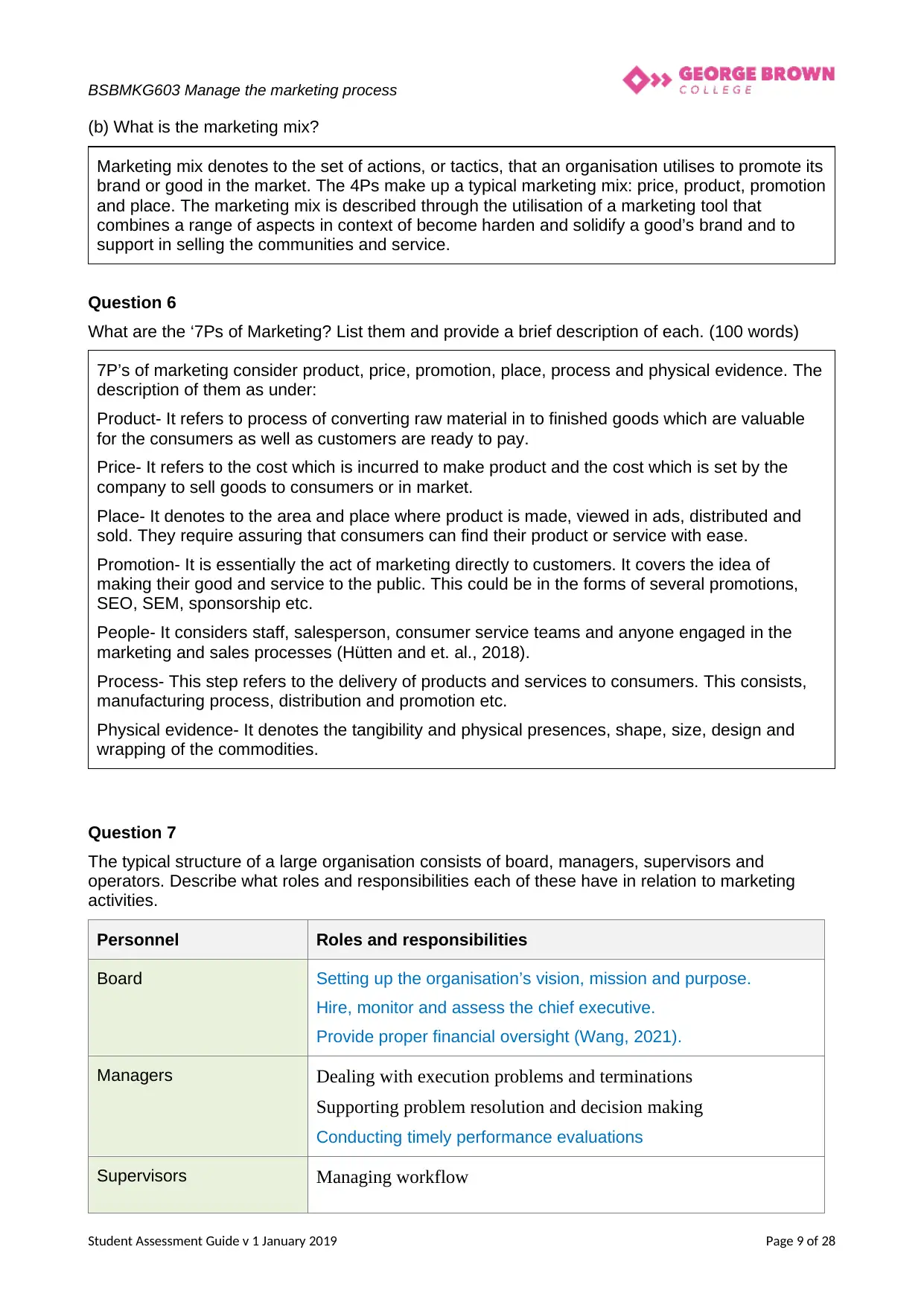
(b) What is the marketing mix?
Marketing mix denotes to the set of actions, or tactics, that an organisation utilises to promote its
brand or good in the market. The 4Ps make up a typical marketing mix: price, product, promotion
and place. The marketing mix is described through the utilisation of a marketing tool that
combines a range of aspects in context of become harden and solidify a good’s brand and to
support in selling the communities and service.
Question 6
What are the ‘7Ps of Marketing? List them and provide a brief description of each. (100 words)
7P’s of marketing consider product, price, promotion, place, process and physical evidence. The
description of them as under:
Product- It refers to process of converting raw material in to finished goods which are valuable
for the consumers as well as customers are ready to pay.
Price- It refers to the cost which is incurred to make product and the cost which is set by the
company to sell goods to consumers or in market.
Place- It denotes to the area and place where product is made, viewed in ads, distributed and
sold. They require assuring that consumers can find their product or service with ease.
Promotion- It is essentially the act of marketing directly to customers. It covers the idea of
making their good and service to the public. This could be in the forms of several promotions,
SEO, SEM, sponsorship etc.
People- It considers staff, salesperson, consumer service teams and anyone engaged in the
marketing and sales processes (Hütten and et. al., 2018).
Process- This step refers to the delivery of products and services to consumers. This consists,
manufacturing process, distribution and promotion etc.
Physical evidence- It denotes the tangibility and physical presences, shape, size, design and
wrapping of the commodities.
Question 7
The typical structure of a large organisation consists of board, managers, supervisors and
operators. Describe what roles and responsibilities each of these have in relation to marketing
activities.
Personnel Roles and responsibilities
Board Setting up the organisation’s vision, mission and purpose.
Hire, monitor and assess the chief executive.
Provide proper financial oversight (Wang, 2021).
Managers Dealing with execution problems and terminations
Supporting problem resolution and decision making
Conducting timely performance evaluations
Supervisors Managing workflow
Student Assessment Guide v 1 January 2019 Page 9 of 28
(b) What is the marketing mix?
Marketing mix denotes to the set of actions, or tactics, that an organisation utilises to promote its
brand or good in the market. The 4Ps make up a typical marketing mix: price, product, promotion
and place. The marketing mix is described through the utilisation of a marketing tool that
combines a range of aspects in context of become harden and solidify a good’s brand and to
support in selling the communities and service.
Question 6
What are the ‘7Ps of Marketing? List them and provide a brief description of each. (100 words)
7P’s of marketing consider product, price, promotion, place, process and physical evidence. The
description of them as under:
Product- It refers to process of converting raw material in to finished goods which are valuable
for the consumers as well as customers are ready to pay.
Price- It refers to the cost which is incurred to make product and the cost which is set by the
company to sell goods to consumers or in market.
Place- It denotes to the area and place where product is made, viewed in ads, distributed and
sold. They require assuring that consumers can find their product or service with ease.
Promotion- It is essentially the act of marketing directly to customers. It covers the idea of
making their good and service to the public. This could be in the forms of several promotions,
SEO, SEM, sponsorship etc.
People- It considers staff, salesperson, consumer service teams and anyone engaged in the
marketing and sales processes (Hütten and et. al., 2018).
Process- This step refers to the delivery of products and services to consumers. This consists,
manufacturing process, distribution and promotion etc.
Physical evidence- It denotes the tangibility and physical presences, shape, size, design and
wrapping of the commodities.
Question 7
The typical structure of a large organisation consists of board, managers, supervisors and
operators. Describe what roles and responsibilities each of these have in relation to marketing
activities.
Personnel Roles and responsibilities
Board Setting up the organisation’s vision, mission and purpose.
Hire, monitor and assess the chief executive.
Provide proper financial oversight (Wang, 2021).
Managers Dealing with execution problems and terminations
Supporting problem resolution and decision making
Conducting timely performance evaluations
Supervisors Managing workflow
Student Assessment Guide v 1 January 2019 Page 9 of 28
⊘ This is a preview!⊘
Do you want full access?
Subscribe today to unlock all pages.
Trusted by 1+ million students worldwide
BSBMKG603 Manage the marketing process
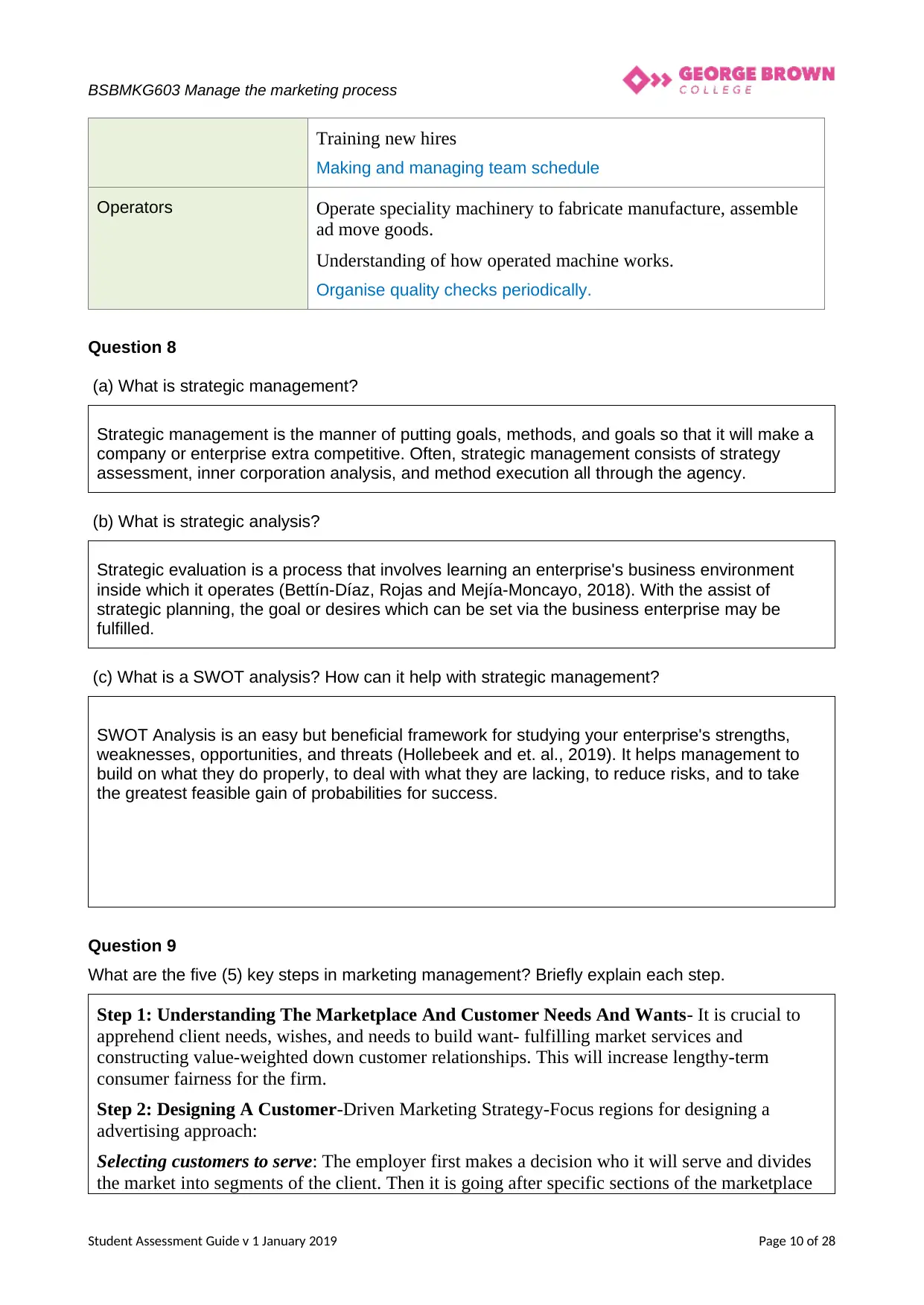
Training new hires
Making and managing team schedule
Operators Operate speciality machinery to fabricate manufacture, assemble
ad move goods.
Understanding of how operated machine works.
Organise quality checks periodically.
Question 8
(a) What is strategic management?
Strategic management is the manner of putting goals, methods, and goals so that it will make a
company or enterprise extra competitive. Often, strategic management consists of strategy
assessment, inner corporation analysis, and method execution all through the agency.
(b) What is strategic analysis?
Strategic evaluation is a process that involves learning an enterprise's business environment
inside which it operates (Bettín-Díaz, Rojas and Mejía-Moncayo, 2018). With the assist of
strategic planning, the goal or desires which can be set via the business enterprise may be
fulfilled.
(c) What is a SWOT analysis? How can it help with strategic management?
SWOT Analysis is an easy but beneficial framework for studying your enterprise's strengths,
weaknesses, opportunities, and threats (Hollebeek and et. al., 2019). It helps management to
build on what they do properly, to deal with what they are lacking, to reduce risks, and to take
the greatest feasible gain of probabilities for success.
Question 9
What are the five (5) key steps in marketing management? Briefly explain each step.
Step 1: Understanding The Marketplace And Customer Needs And Wants- It is crucial to
apprehend client needs, wishes, and needs to build want- fulfilling market services and
constructing value-weighted down customer relationships. This will increase lengthy-term
consumer fairness for the firm.
Step 2: Designing A Customer-Driven Marketing Strategy-Focus regions for designing a
advertising approach:
Selecting customers to serve: The employer first makes a decision who it will serve and divides
the market into segments of the client. Then it is going after specific sections of the marketplace
Student Assessment Guide v 1 January 2019 Page 10 of 28
Training new hires
Making and managing team schedule
Operators Operate speciality machinery to fabricate manufacture, assemble
ad move goods.
Understanding of how operated machine works.
Organise quality checks periodically.
Question 8
(a) What is strategic management?
Strategic management is the manner of putting goals, methods, and goals so that it will make a
company or enterprise extra competitive. Often, strategic management consists of strategy
assessment, inner corporation analysis, and method execution all through the agency.
(b) What is strategic analysis?
Strategic evaluation is a process that involves learning an enterprise's business environment
inside which it operates (Bettín-Díaz, Rojas and Mejía-Moncayo, 2018). With the assist of
strategic planning, the goal or desires which can be set via the business enterprise may be
fulfilled.
(c) What is a SWOT analysis? How can it help with strategic management?
SWOT Analysis is an easy but beneficial framework for studying your enterprise's strengths,
weaknesses, opportunities, and threats (Hollebeek and et. al., 2019). It helps management to
build on what they do properly, to deal with what they are lacking, to reduce risks, and to take
the greatest feasible gain of probabilities for success.
Question 9
What are the five (5) key steps in marketing management? Briefly explain each step.
Step 1: Understanding The Marketplace And Customer Needs And Wants- It is crucial to
apprehend client needs, wishes, and needs to build want- fulfilling market services and
constructing value-weighted down customer relationships. This will increase lengthy-term
consumer fairness for the firm.
Step 2: Designing A Customer-Driven Marketing Strategy-Focus regions for designing a
advertising approach:
Selecting customers to serve: The employer first makes a decision who it will serve and divides
the market into segments of the client. Then it is going after specific sections of the marketplace
Student Assessment Guide v 1 January 2019 Page 10 of 28
Paraphrase This Document
Need a fresh take? Get an instant paraphrase of this document with our AI Paraphraser
BSBMKG603 Manage the marketing process
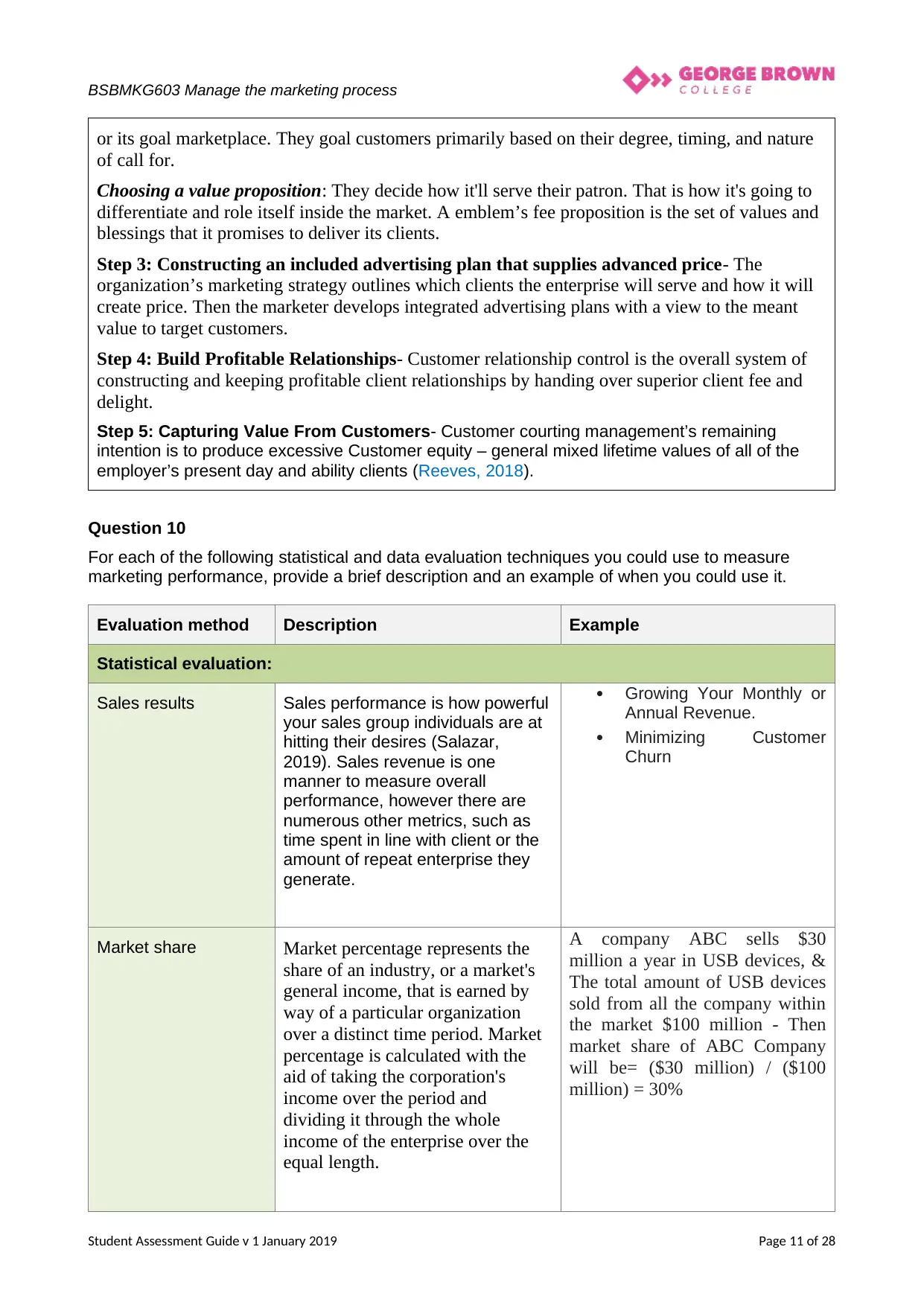
or its goal marketplace. They goal customers primarily based on their degree, timing, and nature
of call for.
Choosing a value proposition: They decide how it'll serve their patron. That is how it's going to
differentiate and role itself inside the market. A emblem’s fee proposition is the set of values and
blessings that it promises to deliver its clients.
Step 3: Constructing an included advertising plan that supplies advanced price- The
organization’s marketing strategy outlines which clients the enterprise will serve and how it will
create price. Then the marketer develops integrated advertising plans with a view to the meant
value to target customers.
Step 4: Build Profitable Relationships- Customer relationship control is the overall system of
constructing and keeping profitable client relationships by handing over superior client fee and
delight.
Step 5: Capturing Value From Customers- Customer courting management’s remaining
intention is to produce excessive Customer equity – general mixed lifetime values of all of the
employer’s present day and ability clients (Reeves, 2018).
Question 10
For each of the following statistical and data evaluation techniques you could use to measure
marketing performance, provide a brief description and an example of when you could use it.
Evaluation method Description Example
Statistical evaluation:
Sales results Sales performance is how powerful
your sales group individuals are at
hitting their desires (Salazar,
2019). Sales revenue is one
manner to measure overall
performance, however there are
numerous other metrics, such as
time spent in line with client or the
amount of repeat enterprise they
generate.
Growing Your Monthly or
Annual Revenue.
Minimizing Customer
Churn
Market share Market percentage represents the
share of an industry, or a market's
general income, that is earned by
way of a particular organization
over a distinct time period. Market
percentage is calculated with the
aid of taking the corporation's
income over the period and
dividing it through the whole
income of the enterprise over the
equal length.
A company ABC sells $30
million a year in USB devices, &
The total amount of USB devices
sold from all the company within
the market $100 million - Then
market share of ABC Company
will be= ($30 million) / ($100
million) = 30%
Student Assessment Guide v 1 January 2019 Page 11 of 28
or its goal marketplace. They goal customers primarily based on their degree, timing, and nature
of call for.
Choosing a value proposition: They decide how it'll serve their patron. That is how it's going to
differentiate and role itself inside the market. A emblem’s fee proposition is the set of values and
blessings that it promises to deliver its clients.
Step 3: Constructing an included advertising plan that supplies advanced price- The
organization’s marketing strategy outlines which clients the enterprise will serve and how it will
create price. Then the marketer develops integrated advertising plans with a view to the meant
value to target customers.
Step 4: Build Profitable Relationships- Customer relationship control is the overall system of
constructing and keeping profitable client relationships by handing over superior client fee and
delight.
Step 5: Capturing Value From Customers- Customer courting management’s remaining
intention is to produce excessive Customer equity – general mixed lifetime values of all of the
employer’s present day and ability clients (Reeves, 2018).
Question 10
For each of the following statistical and data evaluation techniques you could use to measure
marketing performance, provide a brief description and an example of when you could use it.
Evaluation method Description Example
Statistical evaluation:
Sales results Sales performance is how powerful
your sales group individuals are at
hitting their desires (Salazar,
2019). Sales revenue is one
manner to measure overall
performance, however there are
numerous other metrics, such as
time spent in line with client or the
amount of repeat enterprise they
generate.
Growing Your Monthly or
Annual Revenue.
Minimizing Customer
Churn
Market share Market percentage represents the
share of an industry, or a market's
general income, that is earned by
way of a particular organization
over a distinct time period. Market
percentage is calculated with the
aid of taking the corporation's
income over the period and
dividing it through the whole
income of the enterprise over the
equal length.
A company ABC sells $30
million a year in USB devices, &
The total amount of USB devices
sold from all the company within
the market $100 million - Then
market share of ABC Company
will be= ($30 million) / ($100
million) = 30%
Student Assessment Guide v 1 January 2019 Page 11 of 28
BSBMKG603 Manage the marketing process
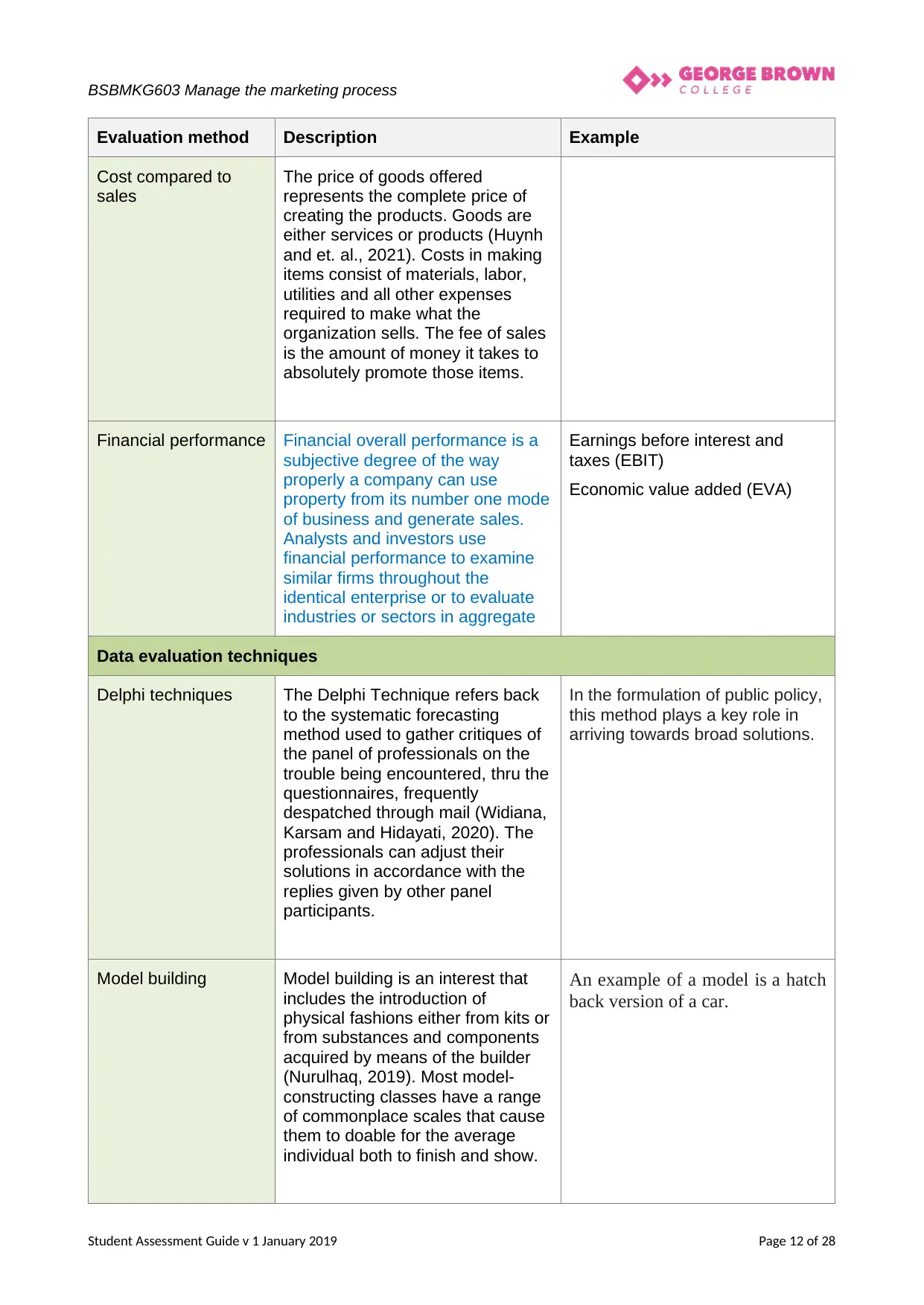
Evaluation method Description Example
Cost compared to
sales
The price of goods offered
represents the complete price of
creating the products. Goods are
either services or products (Huynh
and et. al., 2021). Costs in making
items consist of materials, labor,
utilities and all other expenses
required to make what the
organization sells. The fee of sales
is the amount of money it takes to
absolutely promote those items.
Financial performance Financial overall performance is a
subjective degree of the way
properly a company can use
property from its number one mode
of business and generate sales.
Analysts and investors use
financial performance to examine
similar firms throughout the
identical enterprise or to evaluate
industries or sectors in aggregate
Earnings before interest and
taxes (EBIT)
Economic value added (EVA)
Data evaluation techniques
Delphi techniques The Delphi Technique refers back
to the systematic forecasting
method used to gather critiques of
the panel of professionals on the
trouble being encountered, thru the
questionnaires, frequently
despatched through mail (Widiana,
Karsam and Hidayati, 2020). The
professionals can adjust their
solutions in accordance with the
replies given by other panel
participants.
In the formulation of public policy,
this method plays a key role in
arriving towards broad solutions.
Model building Model building is an interest that
includes the introduction of
physical fashions either from kits or
from substances and components
acquired by means of the builder
(Nurulhaq, 2019). Most model-
constructing classes have a range
of commonplace scales that cause
them to doable for the average
individual both to finish and show.
An example of a model is a hatch
back version of a car.
Student Assessment Guide v 1 January 2019 Page 12 of 28
Evaluation method Description Example
Cost compared to
sales
The price of goods offered
represents the complete price of
creating the products. Goods are
either services or products (Huynh
and et. al., 2021). Costs in making
items consist of materials, labor,
utilities and all other expenses
required to make what the
organization sells. The fee of sales
is the amount of money it takes to
absolutely promote those items.
Financial performance Financial overall performance is a
subjective degree of the way
properly a company can use
property from its number one mode
of business and generate sales.
Analysts and investors use
financial performance to examine
similar firms throughout the
identical enterprise or to evaluate
industries or sectors in aggregate
Earnings before interest and
taxes (EBIT)
Economic value added (EVA)
Data evaluation techniques
Delphi techniques The Delphi Technique refers back
to the systematic forecasting
method used to gather critiques of
the panel of professionals on the
trouble being encountered, thru the
questionnaires, frequently
despatched through mail (Widiana,
Karsam and Hidayati, 2020). The
professionals can adjust their
solutions in accordance with the
replies given by other panel
participants.
In the formulation of public policy,
this method plays a key role in
arriving towards broad solutions.
Model building Model building is an interest that
includes the introduction of
physical fashions either from kits or
from substances and components
acquired by means of the builder
(Nurulhaq, 2019). Most model-
constructing classes have a range
of commonplace scales that cause
them to doable for the average
individual both to finish and show.
An example of a model is a hatch
back version of a car.
Student Assessment Guide v 1 January 2019 Page 12 of 28
⊘ This is a preview!⊘
Do you want full access?
Subscribe today to unlock all pages.
Trusted by 1+ million students worldwide

1 out of 28


Related Documents


Your All-in-One AI-Powered Toolkit for Academic Success.
+13062052269
info@desklib.com
Available 24*7 on WhatsApp / Email
![[object Object]](/_next/static/media/star-bottom.7253800d.svg)
Unlock your academic potential
Copyright © 2020–2026 A2Z Services. All Rights Reserved. Developed and managed by ZUCOL.