CPPDSM4056: Conflict & Dispute Management in Property - Case Studies

Verified

Added on  2023/06/14

|7
|1604
|185
Case Study
AI Summary
This assignment presents two case studies related to conflict and dispute management in the property industry. The first case involves a property manager who instructs a receptionist to hold cash rent payments, discussing the risks and proposing safer alternatives like bank alliances and direct deposits. The second case focuses on a tenant requesting repairs, specifically curtain replacement, and suggests solutions like rent adjustments, cost-sharing, or alternative options like blinds to resolve the conflict between the tenant and landlord while acting in the best interest of all parties. The conclusion emphasizes mutual responsibility and the importance of conflict avoidance to prevent tenant turnover and income loss, highlighting that Desklib provides access to similar solved assignments and study resources.
Document Page
CPPDSM4056 Manage conflicts and disputes in the property industry - Assessment Tasks
V1.2 and/or Submission/s
Please copy and paste into a word processing document to complete your answers:
CPPDSM4056 Manage conflicts and disputes in the property industry
NSW Assessment Tasks
Student Name :
By submitting this work I confirm that I agree to the College policy on original
submissions. The work submitted herewith is my own work and original.
Please complete all the assessment tasks below. Questions can be copied and pasted
into a word processing document. Completed assignment can be submitted to the website
or emailed to the College for assessment. Assessment of your work is usually completed
within 48 hours of submission to the website.
To make a submission, check your result and the Assessor’s feedback, please access
the ‘assignment’ section of your course.
ASSESSMENT TASK 3 - Case studies
Case Study 1
Fred is the manager of an agency and a few of his tenants still like to come in and pay their rent
in cash. Because there aren’t many, he tells the receptionist to leave the cash in the bottom draw
until there is enough to bank.
Discuss what he is doing and what he should do.
ANSWER:
tabler-icon-diamond-filled.svg

Paraphrase This Document

Need a fresh take? Get an instant paraphrase of this document with our AI Paraphraser
Document Page
Answer to the case study 1
Introduction
Property disputes are common in case of tenants living on rental basis. Disputes may vary
according to type of ownership whether be a tenancy in common or joint. Below are some of the
case studies discussed in relevance to the property disputes and certain conflicts that might arise
in case of rental property (Alavi, 2017).
What he is doing?
As per the case, Fred who is the manager of the agency instructs his receptionist to keep the cash
in the bottom drawer until he reaches a limit of a particular amount in total. There are lot of
tenants who like to pay their rent via cash. This in turn will save the time of Fred as he would not
be required to deposit money every now and then. Once he collects a particular lump sum
amount from all the cash paying tenants he can deposit it all together. For example he has set up
a certain limit of $500 from each and every tenant. The number of tenants is 60. After acquiring
the lump sum $300000 he can deposit the same in the bank account. Also it helps in recovering
the cost of operating expenses quickly.
What he should do?
In line with the case as mentioned above he should not opt the existing method of the keeping the
cash in the bottom drawer due to lot of factors.
There is a huge risk of the occurrence of the theft either by receptionist or by tenants or
by both. To avoid such kind of risk he shall keep the cash at some safe place.
Document Page
It becomes time consuming to check balance every time, as Fred would require counting
the entire bundle of notes every now and then. Also he needs to maintain a cash book to
record each transaction.
Maintenance of cash vouchers to keep a track of the same can be hassle at times and
cumbersome in nature (Martin, Hulse and Pawson 2018).
At times the tenants and receptionist may embezzle the cash easily. For example the cash
received from one tenant, the receptionist would enter the transaction in name of the
other tenant.
Therefore, Fred shall form certain schemes which can resolve this equation.
Fred shall form strategic alliances with the bank where bank can send the respective
person to collect cash at the end of every month (Gurran and Bramley, 2017).
He can deposit the cash in drop box machine weekly.
Instead of receiving rent as cash in hand, he can convince the tenants to deposit the same
through the help of other co-tenants.
He can also convince the tenants to deposit directly into his bank account and can
reimburse their expenses or can adjust from rent. This way it will save his time and at a
broader level the money will be safe in relation to the cost incurred (Hickman, Kemp,
Reeve and Wilson 2017).
Document Page
Case Study 2
Joanne has a busy job in the city and loves her inner city apartment. But when the rent was put
up, she decided to insist that some repairs were carried out on the property. Replacement of worn
curtains that are over 20 years old was one request. The landlord refuses. As the managing agent,
you have to act in the best interests of your landlord, but you agree that Joanne has a case and
that the curtains should be replaced. Joanne is determined to go ahead with her demands and a
conflict is likely.
How would you handle the situation?
Answer to the Case Study 2
Joanne as a tenant residing in the apartment raised her request with regard to the replacement of
the worn curtains which were over 20 years old. The landlord of the apartment shoots up the
price of the rent but disagreed to replace the curtains. Joanne insisted that some repairs were
carried out and she was firm to go with her demands which can create a sense of conflict
between two. Though it’s the responsibility of the landlord to maintain the exterior and interior
of the house as per the law and ensuring the maintenance and safety but in order to avoid any
kind of hassle and conflict some steps can be taken (Brown, Portman and Rosenquest 2017).
How to handle?
While acting as the managing agent and to avoid the conflict which is likely, the situation can be
handled in following ways.
The landlord if wants to shoot up the price he shall use that amount to adjust for the
repairs and replacement (Flomenhoft, 2017).
The curtains are already twenty years old whose maintenance cost will be more rather
than its original cost. As an asset gets depreciated after its use. Therefore, it’s better to get
the curtains changed via mutual agreements to bear the cost.
tabler-icon-diamond-filled.svg

Paraphrase This Document

Need a fresh take? Get an instant paraphrase of this document with our AI Paraphraser
Document Page
The landlord and Joanne can bear the expenses of replacement in a mutually agreed ratio.
This could subsidise the cost to Joanne. Further the landlord also is not required to pay
the entire liability (Morris, 2018).
The landlord can give a relaxation to Joanne to make the payment of the replacement
expenses not in one go rather in lump sum after few months. She can collect the funds by
the time and would not have to bear the cost immediately (Newell, 2018).
Instead of curtains the landlord can put up the blinds which are not only cost effective but
are also available easily. This will also save the high maintenance cost to bear for the
curtains.
Conclusion
This way the tenant would be satisfied, the conflicts can be avoided and there will be less
risk of the tenants leaving the apartment which will ultimately relate to loss of major
income. It can be concluded that it’s the responsibility of both the tenant as well as the
landlord.
Document Page
Bibliography
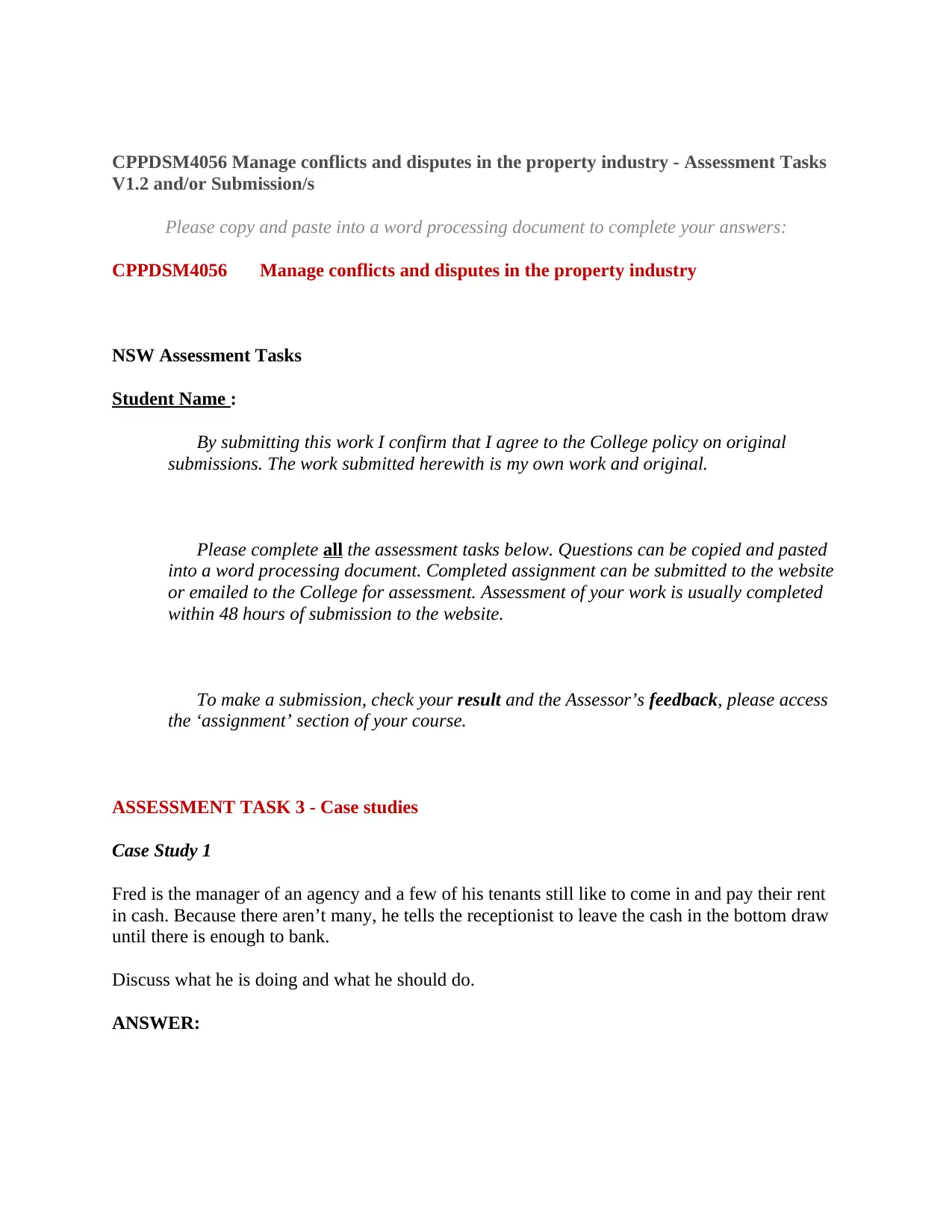
Alavi, H. (2017) Resolving Intellectual Property Disputes. LeXonomica, 8(1), pp.65-76.
Brown, D., Portman, J., and Rosenquest, N. (2017) The California Landlord's Law Book: Rights
& Responsibilities. California: Nolo.
Flomenhoft, G. (2017) Total Economic Rents of Australia as a Source for Basic Income.
In Financing Basic Income (pp. 77-100). London: Palgrave Macmillan.
Gurran, N., and Bramley, G. (2017) Housing, Property Politics and Planning in Australia.
In Urban Planning and the Housing Market (pp. 259-290). London: Palgrave Macmillan.
Hickman, P., Kemp, P.A., Reeve, K., and Wilson, I. (2017) The impact of the direct payment of
housing benefit: evidence from Great Britain. Housing Studies, 32(8), pp.1105-1126.
Martin, C., Hulse, K., and Pawson, H. (2018) The changing institutions of private rental
housing: an international review. [online] Available from:
https://papers.ssrn.com/sol3/Papers.cfm?abstract_id=3108291 [Accessed on 13 April 2018]
Morris, K. (2018) The Residualisation of Social Housing in Australia and Its Impacts on Older
Tenants. In Social Capital and Enterprise in the Modern State (pp. 45-59). London: Palgrave
Macmillan.
Newell, C. (2018) Landlord disputes extent of costs and expenses incurred by property
manager. REIQ Journal, (Feb 2018), p.42. [online] Available from:
Document Page
https://search.informit.com.au/documentSummary;dn=450538003058738;res=IELAPA
[Accessed on 13 April 2018]
chevron_up_icon
1 out of 7
circle_padding
hide_on_mobile
zoom_out_icon
[object Object]