BSBHRM509: Detailed Report on Managing Rehabilitation & RTW Program
VerifiedAdded on 2023/06/10
|15
|4228
|98
Report
AI Summary
This report provides a detailed analysis of managing rehabilitation and return to work programs, focusing on key activities such as encouraging regular feedback, organizing support between providers and employees, identifying breaches in the program, and modifying the program for better outcomes. It also discusses strategies for conflict resolution, the importance of communication, and the legal obligations related to workers' compensation. The report evaluates the effectiveness of return to work plans and recommends improvements for future performance, emphasizing collaboration and ethical behavior. It adheres to organizational processes for handling employee rehabilitation, including maintaining insurance policies and processing claims according to legal requirements.

Running Head: REHABILIATION PROGRAM 0
Manage Rehabilitation
(student name)
9-13-2018
Manage Rehabilitation
(student name)
9-13-2018

Paraphrase This Document
Need a fresh take? Get an instant paraphrase of this document with our AI Paraphraser
REHABILIATION PROGRAM 1
Contents
Activity 3A......................................................................................................................................2
Activity 3B.......................................................................................................................................2
Activity 3C.......................................................................................................................................3
Activity 3D......................................................................................................................................4
Activity 3E.......................................................................................................................................5
Activity 3F.......................................................................................................................................5
Skills and Knowledge Activity........................................................................................................7
Major Activity.................................................................................................................................9
References......................................................................................................................................13
Contents
Activity 3A......................................................................................................................................2
Activity 3B.......................................................................................................................................2
Activity 3C.......................................................................................................................................3
Activity 3D......................................................................................................................................4
Activity 3E.......................................................................................................................................5
Activity 3F.......................................................................................................................................5
Skills and Knowledge Activity........................................................................................................7
Major Activity.................................................................................................................................9
References......................................................................................................................................13
REHABILIATION PROGRAM 2
Activity 3A: Encourage regular feedback/communication between provider, supervising
manager, and employee
Question 1- feedback and communication importance in the return to work process?
One of the most important aspects of feedback and communication is alleviated stress level by
providing support to an injured employee with two-way communication where feedback not only
is given to the person but also receive from another way. Another importance is to encourage a
return to work for employees through feedback from providers and managers. It is the
responsibility of a manager to motivate their employees to convey information. For example-
With the help of feedback, the employee will be able to enhance its ability to positively
contribute to their return to work or rehabilitation. Support is an important part of the
rehabilitation process of an injured person (Holmgren, 2007).
Question2- Role of negotiation in resolving conflicts among stakeholders in rehabilitation
Conflicts between different stakeholders can arise in various ways like interpersonal conflicts
and intergroup conflict. Negotiation plays an important in conflict handling. It ensures to take
appropriate action in case of conflict. The most positive aspect of negotiation in this regard is
that parties involved in the conflict have a feel of the contribution of success in conflict.
Integrative method of negotiation is useful for a return to work program purpose, where all the
parties involve wins something. An injured employee can have a legitimate argument from
his/her point. If they feel, they are not receiving respect, or not acknowledged, then they can also
cause conflicts. For negotiator, it is important to acknowledge all parties viewpoint initially,
share information and equal opportunity to let other parties realize their perspective. A problem
cannot be solved without cooperation. In the end, a solution must be found that can offer both
parties a chance to voice their perspective on what they want (Johnston, 2015).
Activity 3B: Organize regular contact and support between provider and employee
Question 3- Ways to ensure regular contact and support between employee and provider
Build an effective work relationship, for this one must treat all parties with due respect,
empathy, and integrity (Nazzal, 2017).
Activity 3A: Encourage regular feedback/communication between provider, supervising
manager, and employee
Question 1- feedback and communication importance in the return to work process?
One of the most important aspects of feedback and communication is alleviated stress level by
providing support to an injured employee with two-way communication where feedback not only
is given to the person but also receive from another way. Another importance is to encourage a
return to work for employees through feedback from providers and managers. It is the
responsibility of a manager to motivate their employees to convey information. For example-
With the help of feedback, the employee will be able to enhance its ability to positively
contribute to their return to work or rehabilitation. Support is an important part of the
rehabilitation process of an injured person (Holmgren, 2007).
Question2- Role of negotiation in resolving conflicts among stakeholders in rehabilitation
Conflicts between different stakeholders can arise in various ways like interpersonal conflicts
and intergroup conflict. Negotiation plays an important in conflict handling. It ensures to take
appropriate action in case of conflict. The most positive aspect of negotiation in this regard is
that parties involved in the conflict have a feel of the contribution of success in conflict.
Integrative method of negotiation is useful for a return to work program purpose, where all the
parties involve wins something. An injured employee can have a legitimate argument from
his/her point. If they feel, they are not receiving respect, or not acknowledged, then they can also
cause conflicts. For negotiator, it is important to acknowledge all parties viewpoint initially,
share information and equal opportunity to let other parties realize their perspective. A problem
cannot be solved without cooperation. In the end, a solution must be found that can offer both
parties a chance to voice their perspective on what they want (Johnston, 2015).
Activity 3B: Organize regular contact and support between provider and employee
Question 3- Ways to ensure regular contact and support between employee and provider
Build an effective work relationship, for this one must treat all parties with due respect,
empathy, and integrity (Nazzal, 2017).
⊘ This is a preview!⊘
Do you want full access?
Subscribe today to unlock all pages.

Trusted by 1+ million students worldwide
REHABILIATION PROGRAM 3
Ensure to maintain trust, the confidence and trust of both, the employee and the provider
are significant in return to work plan to become successful.
Ensure open communication lines between injured employees, and the provider, with this
the relationship between the parties will improve and chances of arising conflicts will be
minimized.
Creditability with both the parties must be maintained while setting standards.
To maintain a positive relationship, one must ensure that all the parties are honest, expect
and show respect, trust, fair, reliable, treat everyone equally (Converse, 2018).
A positive role model must be reflected, this will counteract all negativity, for this one
need to show respect, be co-operative, have a sense of humor, hardworking, positive
attitude, and be loyal.
A high degree of ethical behavior must be demonstrated, it means, “doing the right
thing.” For this, one must protect the interests of employer and employee within the range
of law.
Maintain both parties confidentiality, as an employee, it is important not to disclose any
confidential information of your customers or client without a formal authorization.
Unless an identity is verified, information should not pass on telephone or fax.
Maintain duty of care, it means that the priority must be for the employer, and don does
not abuse your position by providing access to private information to the competitors.
Maintain conflict of interests, this involves avoidance of those discussions that are not in
the interest of employers.
Maintain ethical, business, and social standards of an organization, this will be an
explanation that how team members and work colleagues should act (Englund, 2017).
Activity 3C: Identify breaches of the return to work program and take remedial action
promptly
Question4- recommended strategies for managers to take remedial action for breaches by the
injured person.
Suspension steps should not be prompt if injured employees are unable to give an
appropriate reason for lack of participation, only then suspension must be considered.
Ensure to maintain trust, the confidence and trust of both, the employee and the provider
are significant in return to work plan to become successful.
Ensure open communication lines between injured employees, and the provider, with this
the relationship between the parties will improve and chances of arising conflicts will be
minimized.
Creditability with both the parties must be maintained while setting standards.
To maintain a positive relationship, one must ensure that all the parties are honest, expect
and show respect, trust, fair, reliable, treat everyone equally (Converse, 2018).
A positive role model must be reflected, this will counteract all negativity, for this one
need to show respect, be co-operative, have a sense of humor, hardworking, positive
attitude, and be loyal.
A high degree of ethical behavior must be demonstrated, it means, “doing the right
thing.” For this, one must protect the interests of employer and employee within the range
of law.
Maintain both parties confidentiality, as an employee, it is important not to disclose any
confidential information of your customers or client without a formal authorization.
Unless an identity is verified, information should not pass on telephone or fax.
Maintain duty of care, it means that the priority must be for the employer, and don does
not abuse your position by providing access to private information to the competitors.
Maintain conflict of interests, this involves avoidance of those discussions that are not in
the interest of employers.
Maintain ethical, business, and social standards of an organization, this will be an
explanation that how team members and work colleagues should act (Englund, 2017).
Activity 3C: Identify breaches of the return to work program and take remedial action
promptly
Question4- recommended strategies for managers to take remedial action for breaches by the
injured person.
Suspension steps should not be prompt if injured employees are unable to give an
appropriate reason for lack of participation, only then suspension must be considered.
Paraphrase This Document
Need a fresh take? Get an instant paraphrase of this document with our AI Paraphraser
REHABILIATION PROGRAM 4
Warnings must be given to actively work for their liable responsibilities; with this
rehabilitation program, significance can be reconfirmed.
Meeting legal obligations, one needs to ensure that the HR practitioner provides a letter
to the employee for providing him or her opportunity to justify the causes of their non-
compliance. Impact of the failure of the employee to justify non- compliance with
suitable evidence, must be clearly mentioned in the letter.
Conflict resolution strategies can be implemented; these strategies include
accommodation, compromise, avoidance, forcing, and collaboration. With these
strategies, conflicts can be resolved. Among these strategies, the most suitable and
recommended strategy would be collaboration, because it will be according to benefit of
both the parties involved in the conflict (Folger, 2017).
Negotiation skills must be applied to this situation. To obtain an outcome that is most
acceptable by all the parties involved.
Establish a relationship with trust and openness, where up to date information is provided
to all the parties constantly, then a quick solution to the problem can be negotiated
(Volker, 2015).
Activity 3D: Refer return to work program to workers compensation authorities where
breaches occur
Quetion5- when a breach of return to work program must be referring to employee compensation
authority.
As per Section 41 of the SRC Act of compensation authorities, the injured employee has
to participate actively in the plan. He/she can be suspended in a situation when they fail
or refuse to participate without any justified reason.
When an employee fails with this legislation to comply, in that case, they are liable for
their failure. For such case, a national WHS, and Compliance and Enforcement Policy
(the National Policy) that make sure that they are approachable in regulating compliance
based on all circumstances (Howe, 2015).
Under Sections 114, 116 and 120 of the SRC Act, one must report any change that can
affect the decision making of a manager and can influence required support by the injured
worker.
Warnings must be given to actively work for their liable responsibilities; with this
rehabilitation program, significance can be reconfirmed.
Meeting legal obligations, one needs to ensure that the HR practitioner provides a letter
to the employee for providing him or her opportunity to justify the causes of their non-
compliance. Impact of the failure of the employee to justify non- compliance with
suitable evidence, must be clearly mentioned in the letter.
Conflict resolution strategies can be implemented; these strategies include
accommodation, compromise, avoidance, forcing, and collaboration. With these
strategies, conflicts can be resolved. Among these strategies, the most suitable and
recommended strategy would be collaboration, because it will be according to benefit of
both the parties involved in the conflict (Folger, 2017).
Negotiation skills must be applied to this situation. To obtain an outcome that is most
acceptable by all the parties involved.
Establish a relationship with trust and openness, where up to date information is provided
to all the parties constantly, then a quick solution to the problem can be negotiated
(Volker, 2015).
Activity 3D: Refer return to work program to workers compensation authorities where
breaches occur
Quetion5- when a breach of return to work program must be referring to employee compensation
authority.
As per Section 41 of the SRC Act of compensation authorities, the injured employee has
to participate actively in the plan. He/she can be suspended in a situation when they fail
or refuse to participate without any justified reason.
When an employee fails with this legislation to comply, in that case, they are liable for
their failure. For such case, a national WHS, and Compliance and Enforcement Policy
(the National Policy) that make sure that they are approachable in regulating compliance
based on all circumstances (Howe, 2015).
Under Sections 114, 116 and 120 of the SRC Act, one must report any change that can
affect the decision making of a manager and can influence required support by the injured
worker.
REHABILIATION PROGRAM 5
Activity 3E: Modify return to work program where appropriate if it is not delivering the
required outcomes
Quetion6- steps that could be taken to modify the return to work plan program.
For monitoring programs, the initial step involves ‘Monitoring,’ it is an important step to
modify the program. If the organization is unable to accomplish set goals and objectives
and not attaining your desired outcome then the need for a review of the plan is indulge.
To review plan, the next step is a review of duties that include suitability of employment.
One needs to be creative and constructive while maintaining cooperation among
supervisors and senior management commitment.
For the above-mentioned point, one must be sure that the managers and supervisors are
maintained their employer responsibility as per organization return to work policy.
Further, issues are addressed regarding the ability to search suitable duties in the next
step to modification. This means redesigning or redeployment job part to make sure
whether the employee is capable of specific performance and make sure that the role is
suitable.
At this level, the rehabilitation officer, or the case manager, medical practitioner and
employee could also be consulted to ensure the appropriate course of action.
In the next step, human resource is asked for any vacancies for the injured employee to
perform, if available.
Other duties in another department can also be considered.
Employee itself can be asked for any known duty that he/she is suitable for doing within
the organization.
Next step is to contact the claim manager.
Next, different alternatives are seen, as if the work trial to conclude if the desired
outcomes could be achieved.
In order to redeploy injured employees to an appropriate department, retraining is
provided to them (Burak, 2016).
Activity 3E: Modify return to work program where appropriate if it is not delivering the
required outcomes
Quetion6- steps that could be taken to modify the return to work plan program.
For monitoring programs, the initial step involves ‘Monitoring,’ it is an important step to
modify the program. If the organization is unable to accomplish set goals and objectives
and not attaining your desired outcome then the need for a review of the plan is indulge.
To review plan, the next step is a review of duties that include suitability of employment.
One needs to be creative and constructive while maintaining cooperation among
supervisors and senior management commitment.
For the above-mentioned point, one must be sure that the managers and supervisors are
maintained their employer responsibility as per organization return to work policy.
Further, issues are addressed regarding the ability to search suitable duties in the next
step to modification. This means redesigning or redeployment job part to make sure
whether the employee is capable of specific performance and make sure that the role is
suitable.
At this level, the rehabilitation officer, or the case manager, medical practitioner and
employee could also be consulted to ensure the appropriate course of action.
In the next step, human resource is asked for any vacancies for the injured employee to
perform, if available.
Other duties in another department can also be considered.
Employee itself can be asked for any known duty that he/she is suitable for doing within
the organization.
Next step is to contact the claim manager.
Next, different alternatives are seen, as if the work trial to conclude if the desired
outcomes could be achieved.
In order to redeploy injured employees to an appropriate department, retraining is
provided to them (Burak, 2016).
⊘ This is a preview!⊘
Do you want full access?
Subscribe today to unlock all pages.
Trusted by 1+ million students worldwide
REHABILIATION PROGRAM 6
Activity 3F: Evaluate each rehabilitation/return to work program at its conclusion and
implement recommendations for system improvement where appropriate
Question7- Outcomes that should be used to measure WRP performance are as follow.
1. Returns to work rate- the number of injured employees that return to work plan is
measured.
2. Rehabilitation program cost- the efficiency of the provider and the level of success are
determined (Bardos, 2015).
3. Returns to work durability- after the rehabilitation program, retained employees work
thirteen weeks are measured.
Question8- Effectiveness of return to work plan is evaluated.
Evaluation allows:
Practice is evaluated and refined.
To find different ways to improve your performance, the working relationship of a
person with other stakeholders is evaluated (Gross, 2018).
Alternative ways in which policy and procedures can be improved within the
organization are evaluated.
Positive practice can be benchmarked and highlighted so that it can be used in near
future for evaluating outcomes.
Identify weakness through the review process and find a way to improve them.
Find different method to minimize injury prevention.
Question9- Effectiveness and use of recommendations regarding conflict resolution strategies, to
improve future performance are as follow:
Among conflict resolution strategies, the first strategy that is avoidance is useful to an
extent. The action that is leading to the conflicting situation, or it is not as per the interest
of the employer, could be avoided or not done (Hillman, 2014).
The second strategy is accommodation; this is less effective compared to others.
Third, forcing, this strategy is not effective at all in this program because one party
cannot be compromised over another. This will lead to more conflict arise (Gilin, 2015).
Activity 3F: Evaluate each rehabilitation/return to work program at its conclusion and
implement recommendations for system improvement where appropriate
Question7- Outcomes that should be used to measure WRP performance are as follow.
1. Returns to work rate- the number of injured employees that return to work plan is
measured.
2. Rehabilitation program cost- the efficiency of the provider and the level of success are
determined (Bardos, 2015).
3. Returns to work durability- after the rehabilitation program, retained employees work
thirteen weeks are measured.
Question8- Effectiveness of return to work plan is evaluated.
Evaluation allows:
Practice is evaluated and refined.
To find different ways to improve your performance, the working relationship of a
person with other stakeholders is evaluated (Gross, 2018).
Alternative ways in which policy and procedures can be improved within the
organization are evaluated.
Positive practice can be benchmarked and highlighted so that it can be used in near
future for evaluating outcomes.
Identify weakness through the review process and find a way to improve them.
Find different method to minimize injury prevention.
Question9- Effectiveness and use of recommendations regarding conflict resolution strategies, to
improve future performance are as follow:
Among conflict resolution strategies, the first strategy that is avoidance is useful to an
extent. The action that is leading to the conflicting situation, or it is not as per the interest
of the employer, could be avoided or not done (Hillman, 2014).
The second strategy is accommodation; this is less effective compared to others.
Third, forcing, this strategy is not effective at all in this program because one party
cannot be compromised over another. This will lead to more conflict arise (Gilin, 2015).
Paraphrase This Document
Need a fresh take? Get an instant paraphrase of this document with our AI Paraphraser
REHABILIATION PROGRAM 7
Compromise is yet effective in the near future. All parties involved are asked to give up
or compromise on something. However, this strategy is only used when only two parties
are involved in the negotiation.
Collaboration, as mentioned above, is the most effective and suitable strategy, since the
solution consists of a win-win position for all the parties involved in the negotiation.
Skills and Knowledge Activity
Following the Organisation’s process for handling the employee’s rehabilitation, includes:
Firstly, ensuring that a current workers insurance policy has been maintained by the
organization as needed and according to applicable legislation- this includes ‘the safety,
rehabilitation, and compensation act 1988’, it provides safety and insurance and also
gives power to the employer to undertake a rehabilitation program (Mann, 2018).
Then claims are processed according to organizational policies and insurance legal
requirements. While processing claims state requires that the employer must make an
immediate report of workplace disease or injury. This means that there must be a current
record of injuries in the register suffered by employees in the workplace, irrespective of
claim would be done or not at the end. It is vital to ensure that employees understand
their obligations in relative to Workers’ Compensation. Employers’ must safeguard their
workers by ensuring that the workplace is deprived of risk to the health and safety of its
workers (Yanar, 2018).
Next is to check if the claims are according to organizational guidelines and criteria. If a
claim is not acknowledged, personnel have the right to demand the claim through the
proper dispute resolution authorities in their Territory. In the case of Comcare, if
someone believes that the claim is not right, then one can make an appeal for
reconsideration by somebody who was not indulged in the decision (Watt, 2018).
Next step is to notify the provider of rehabilitation according to the organizational
procedure. Health professionals are someone who is an expert to become providers of
workplace rehabilitation. These providers need to be available, effective and offer
services for a justified cost. Standards are set out under Section 34 of the SRC Act. A
Compromise is yet effective in the near future. All parties involved are asked to give up
or compromise on something. However, this strategy is only used when only two parties
are involved in the negotiation.
Collaboration, as mentioned above, is the most effective and suitable strategy, since the
solution consists of a win-win position for all the parties involved in the negotiation.
Skills and Knowledge Activity
Following the Organisation’s process for handling the employee’s rehabilitation, includes:
Firstly, ensuring that a current workers insurance policy has been maintained by the
organization as needed and according to applicable legislation- this includes ‘the safety,
rehabilitation, and compensation act 1988’, it provides safety and insurance and also
gives power to the employer to undertake a rehabilitation program (Mann, 2018).
Then claims are processed according to organizational policies and insurance legal
requirements. While processing claims state requires that the employer must make an
immediate report of workplace disease or injury. This means that there must be a current
record of injuries in the register suffered by employees in the workplace, irrespective of
claim would be done or not at the end. It is vital to ensure that employees understand
their obligations in relative to Workers’ Compensation. Employers’ must safeguard their
workers by ensuring that the workplace is deprived of risk to the health and safety of its
workers (Yanar, 2018).
Next is to check if the claims are according to organizational guidelines and criteria. If a
claim is not acknowledged, personnel have the right to demand the claim through the
proper dispute resolution authorities in their Territory. In the case of Comcare, if
someone believes that the claim is not right, then one can make an appeal for
reconsideration by somebody who was not indulged in the decision (Watt, 2018).
Next step is to notify the provider of rehabilitation according to the organizational
procedure. Health professionals are someone who is an expert to become providers of
workplace rehabilitation. These providers need to be available, effective and offer
services for a justified cost. Standards are set out under Section 34 of the SRC Act. A
REHABILIATION PROGRAM 8
supervisor must actively monitor their worker's personal rehabilitation program. The
main responsibility of provider is to assist to the employer and injured worker in the
return to work plan. These experts can report the knowledge and psychological
requirements to remove barriers that might prevent injured employee in a rehabilitation
program.
Consulting provider and treating doctor. This step includes the link between the providers
and treating officer is a significant aspect of any employer’s rehabilitation policy. For a
supervisor, it is crucial to make sure that both the parties are working in the consultation
to work while ensuring that the injured employee returns to work on time.
Job redesigning and alternative responsibilities for the injured member must be
considered in this step. It involves changing of role, being a supervisor; it is his duty to
determine that the duties an injured employee can perform. Hierarchy of preferences for
your rehabilitation outcomes and may comprise of the following hierarchy:
Next step is to obtain approval for a rehabilitation program, many managers must be
involved to approve and consider if the work objective is met depending on various
factors like the size of the organization.
supervisor must actively monitor their worker's personal rehabilitation program. The
main responsibility of provider is to assist to the employer and injured worker in the
return to work plan. These experts can report the knowledge and psychological
requirements to remove barriers that might prevent injured employee in a rehabilitation
program.
Consulting provider and treating doctor. This step includes the link between the providers
and treating officer is a significant aspect of any employer’s rehabilitation policy. For a
supervisor, it is crucial to make sure that both the parties are working in the consultation
to work while ensuring that the injured employee returns to work on time.
Job redesigning and alternative responsibilities for the injured member must be
considered in this step. It involves changing of role, being a supervisor; it is his duty to
determine that the duties an injured employee can perform. Hierarchy of preferences for
your rehabilitation outcomes and may comprise of the following hierarchy:
Next step is to obtain approval for a rehabilitation program, many managers must be
involved to approve and consider if the work objective is met depending on various
factors like the size of the organization.
⊘ This is a preview!⊘
Do you want full access?
Subscribe today to unlock all pages.
Trusted by 1+ million students worldwide
REHABILIATION PROGRAM 9
Then Connect with the worker about the plan, the employee is the main party involved in
the program so the communication with the employee about the plan is essential as an
employee also have some rights.
Risk analysis must be done, problem, consequences and the risk involved must be studied
carefully. So that the action to mitigate those risk can be taken.
Feedback must be taken from the provider, the worker, and their manager. Due action to
improve the program can be taken by gathering feedback from the parties.
Identify any breaches in the return to work program, there were many strategies
recommended for managers to follow the remedial action for breaches by the injured
person.
Evaluation of the effectiveness of the rehabilitation program and the process. This
involves evaluation of each aspect of the program and appliance recommendations for
structure improvement where appropriate.
Major Activity
A worker from the operational department was injured in the workplace, a return to work
program is to be developed and to be implemented for him. The process includes the following:
1. Checking the Worker’s compensation insurance policy, A National Model of Workers’
Compensation survives that will support the organization’s maintenance of their
Workers’ Compensation Insurance Policy. According to this, all States/Territories in
Australia have legislation that is dependable with a single model
2. Processing the claim, in this, an immediate report of the injury is prepared by the
supervisor. Workers’ compensation may consist of:
Payments to employees who are not able to work
The cost of health treatment and rehabilitation.
A medical certificate ought to be submitted in maximum circumstances. The medical
practitioner might be necessary to mention how long they think that their patient will be
unable to work. Then, an injury claim form must be submitted for claims. The faster you
submit the form, the faster a decision whether the employer is liable for the worker’s
injury can be made (Hunt, 2017).
Then Connect with the worker about the plan, the employee is the main party involved in
the program so the communication with the employee about the plan is essential as an
employee also have some rights.
Risk analysis must be done, problem, consequences and the risk involved must be studied
carefully. So that the action to mitigate those risk can be taken.
Feedback must be taken from the provider, the worker, and their manager. Due action to
improve the program can be taken by gathering feedback from the parties.
Identify any breaches in the return to work program, there were many strategies
recommended for managers to follow the remedial action for breaches by the injured
person.
Evaluation of the effectiveness of the rehabilitation program and the process. This
involves evaluation of each aspect of the program and appliance recommendations for
structure improvement where appropriate.
Major Activity
A worker from the operational department was injured in the workplace, a return to work
program is to be developed and to be implemented for him. The process includes the following:
1. Checking the Worker’s compensation insurance policy, A National Model of Workers’
Compensation survives that will support the organization’s maintenance of their
Workers’ Compensation Insurance Policy. According to this, all States/Territories in
Australia have legislation that is dependable with a single model
2. Processing the claim, in this, an immediate report of the injury is prepared by the
supervisor. Workers’ compensation may consist of:
Payments to employees who are not able to work
The cost of health treatment and rehabilitation.
A medical certificate ought to be submitted in maximum circumstances. The medical
practitioner might be necessary to mention how long they think that their patient will be
unable to work. Then, an injury claim form must be submitted for claims. The faster you
submit the form, the faster a decision whether the employer is liable for the worker’s
injury can be made (Hunt, 2017).
Paraphrase This Document
Need a fresh take? Get an instant paraphrase of this document with our AI Paraphraser
REHABILIATION PROGRAM 10
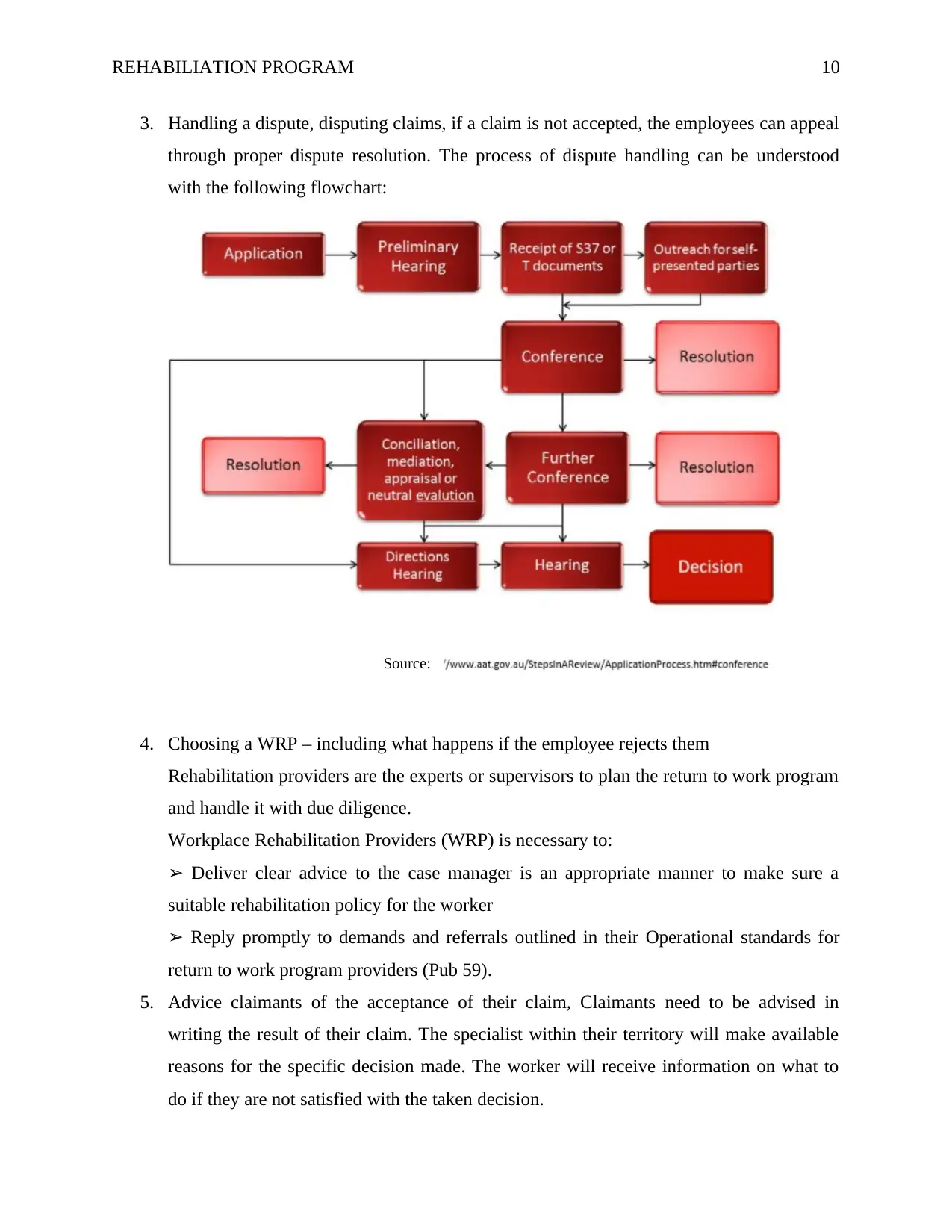
3. Handling a dispute, disputing claims, if a claim is not accepted, the employees can appeal
through proper dispute resolution. The process of dispute handling can be understood
with the following flowchart:
4. Choosing a WRP – including what happens if the employee rejects them
Rehabilitation providers are the experts or supervisors to plan the return to work program
and handle it with due diligence.
Workplace Rehabilitation Providers (WRP) is necessary to:
➢ Deliver clear advice to the case manager is an appropriate manner to make sure a
suitable rehabilitation policy for the worker
➢ Reply promptly to demands and referrals outlined in their Operational standards for
return to work program providers (Pub 59).
5. Advice claimants of the acceptance of their claim, Claimants need to be advised in
writing the result of their claim. The specialist within their territory will make available
reasons for the specific decision made. The worker will receive information on what to
do if they are not satisfied with the taken decision.
Source:
3. Handling a dispute, disputing claims, if a claim is not accepted, the employees can appeal
through proper dispute resolution. The process of dispute handling can be understood
with the following flowchart:
4. Choosing a WRP – including what happens if the employee rejects them
Rehabilitation providers are the experts or supervisors to plan the return to work program
and handle it with due diligence.
Workplace Rehabilitation Providers (WRP) is necessary to:
➢ Deliver clear advice to the case manager is an appropriate manner to make sure a
suitable rehabilitation policy for the worker
➢ Reply promptly to demands and referrals outlined in their Operational standards for
return to work program providers (Pub 59).
5. Advice claimants of the acceptance of their claim, Claimants need to be advised in
writing the result of their claim. The specialist within their territory will make available
reasons for the specific decision made. The worker will receive information on what to
do if they are not satisfied with the taken decision.
Source:
REHABILIATION PROGRAM 11
6. Analysing claims, Employers require to provide the injured worker with their benefits.
The level of benefits that a worker is allowed to claim will vary according to The type of
injury, The severity of the injury, The nature of the injury.
7. For determining the period of absence and the length of time that a worker shall be absent
from work, one will work in close consultation with: a rehabilitation provider, the
worker’s doctor (Durand, 2014).
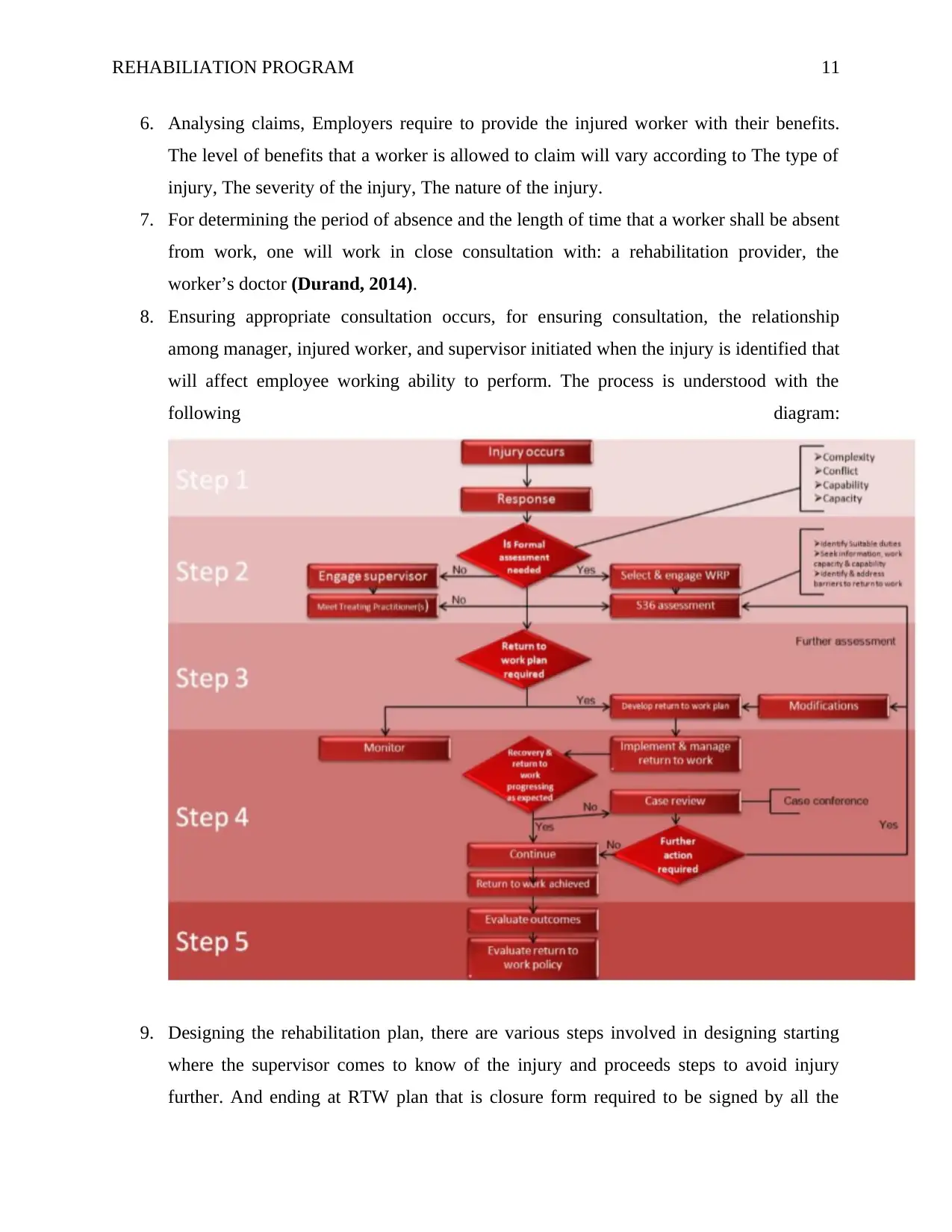
8. Ensuring appropriate consultation occurs, for ensuring consultation, the relationship
among manager, injured worker, and supervisor initiated when the injury is identified that
will affect employee working ability to perform. The process is understood with the
following diagram:
9. Designing the rehabilitation plan, there are various steps involved in designing starting
where the supervisor comes to know of the injury and proceeds steps to avoid injury
further. And ending at RTW plan that is closure form required to be signed by all the
6. Analysing claims, Employers require to provide the injured worker with their benefits.
The level of benefits that a worker is allowed to claim will vary according to The type of
injury, The severity of the injury, The nature of the injury.
7. For determining the period of absence and the length of time that a worker shall be absent
from work, one will work in close consultation with: a rehabilitation provider, the
worker’s doctor (Durand, 2014).
8. Ensuring appropriate consultation occurs, for ensuring consultation, the relationship
among manager, injured worker, and supervisor initiated when the injury is identified that
will affect employee working ability to perform. The process is understood with the
following diagram:
9. Designing the rehabilitation plan, there are various steps involved in designing starting
where the supervisor comes to know of the injury and proceeds steps to avoid injury
further. And ending at RTW plan that is closure form required to be signed by all the
⊘ This is a preview!⊘
Do you want full access?
Subscribe today to unlock all pages.
Trusted by 1+ million students worldwide

1 out of 15


Related Documents


Your All-in-One AI-Powered Toolkit for Academic Success.
+13062052269
info@desklib.com
Available 24*7 on WhatsApp / Email
![[object Object]](/_next/static/media/star-bottom.7253800d.svg)
Unlock your academic potential
Copyright © 2020–2026 A2Z Services. All Rights Reserved. Developed and managed by ZUCOL.