Financial Decision Making: Ratio Analysis and Performance Evaluation
VerifiedAdded on 2022/12/02
|14
|4307
|469
Report
AI Summary
This report provides a comprehensive analysis of financial decision-making, focusing on SKANSKA PLC. It begins with an introduction to the company and its operations, followed by an in-depth exploration of management accounting techniques, including financial planning, financial statement analysis, cost accounting, cash flow analysis, decision-making processes, budgetary control, and marginal costing. A critical analysis of these techniques is also presented, evaluating their impact on planning, controlling, and decision-making within the company, along with their limitations. The second part of the report delves into the calculation and interpretation of various financial ratios, such as Return on Capital Employed (ROCE), net profit margin, current ratio, debtor collection period, and creditor collection period, for the years 2018 and 2019. The analysis compares these ratios to assess SKANSKA PLC's financial performance, offering insights into its efficiency, profitability, and potential areas for improvement, with recommendations based on the findings.

FINNACIAL DECISION
MAKING
MAKING

Paraphrase This Document
Need a fresh take? Get an instant paraphrase of this document with our AI Paraphraser
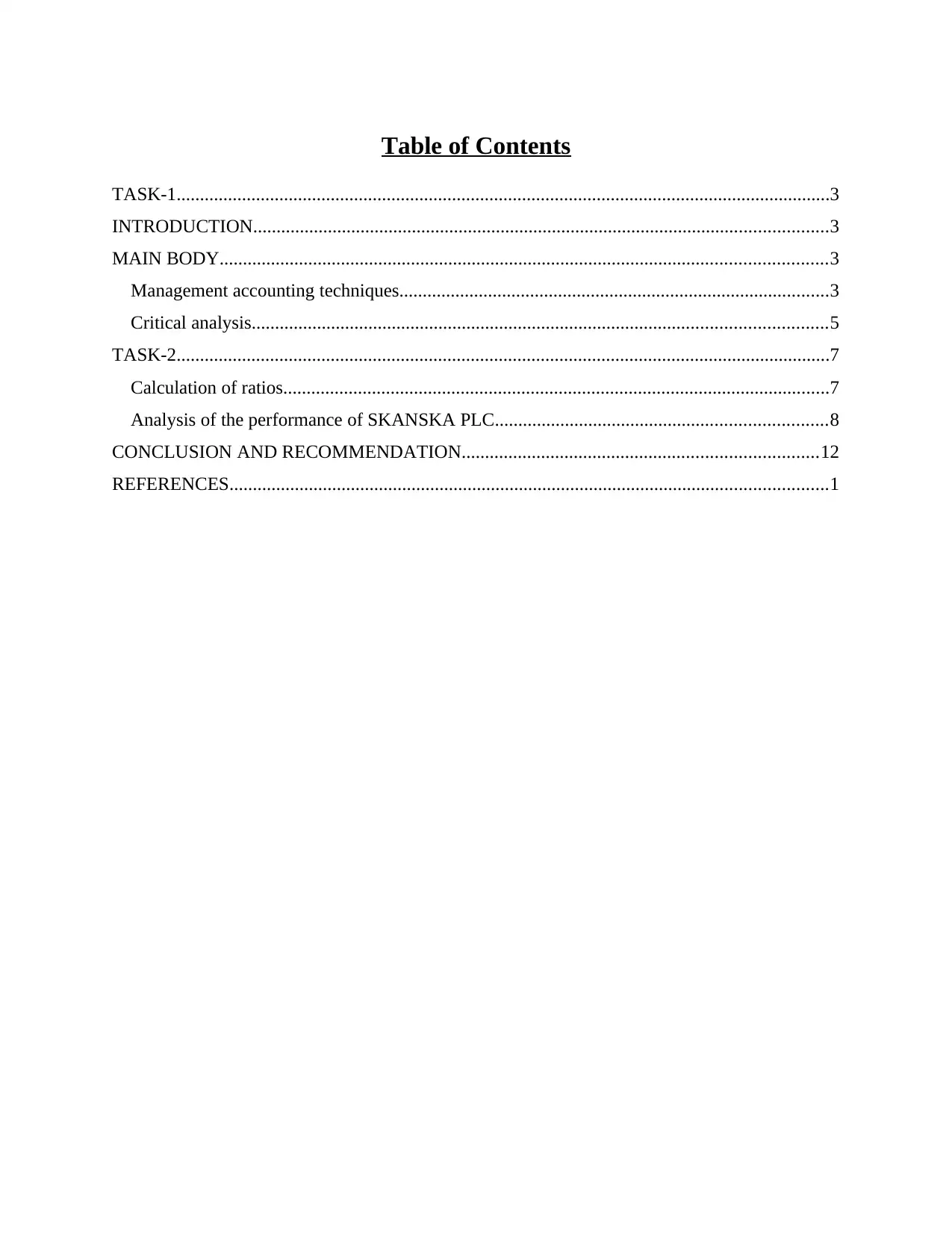
Table of Contents
TASK-1............................................................................................................................................3
INTRODUCTION...........................................................................................................................3
MAIN BODY..................................................................................................................................3
Management accounting techniques............................................................................................3
Critical analysis...........................................................................................................................5
TASK-2............................................................................................................................................7
Calculation of ratios.....................................................................................................................7
Analysis of the performance of SKANSKA PLC.......................................................................8
CONCLUSION AND RECOMMENDATION............................................................................12
REFERENCES................................................................................................................................1
TASK-1............................................................................................................................................3
INTRODUCTION...........................................................................................................................3
MAIN BODY..................................................................................................................................3
Management accounting techniques............................................................................................3
Critical analysis...........................................................................................................................5
TASK-2............................................................................................................................................7
Calculation of ratios.....................................................................................................................7
Analysis of the performance of SKANSKA PLC.......................................................................8
CONCLUSION AND RECOMMENDATION............................................................................12
REFERENCES................................................................................................................................1
TASK-1
INTRODUCTION
SKANSKA PLC is one of the famous and well known construction company of the entire
world including UK. It performs and execute various famous construction projects across the
globe. It was founded in 1984. It renders its services in many countries including Poland,
Romania, Nordic region, Hungary, Slovakia and many more. The current number of employees
are 32463. The revenue share of the company is SEK 158.6 bn (Skanska in brief, 2021). It is
counted as top construction company of the UK which is famous for its timely constructed
projects.
In every company including SKANSKA PLC accounting and finance functions plays an
important role. Accounting function would enable the company to have a recording of all the
financial transactions along with preparing of financial statement. Likewise, finance function
also assist the company to have an adequate availability of finance in the company so that its
business operation would not be suffer due to shortage of funds (Cockcroft and Russell, 2018).
Along with recording and preparation of financial statements, accounting also enable the
company to have an analysis of its own financial and business performance. These functions are
considered as a base on which financial decisions of the company are made.
This report will discuss about the concept of management accounting which is also an
important concept and part of accounting system. An analysis of the various management
accounting techniques along with their implication and role with regard to the company’s
decision making, controlling, and planning is also presented in the report. Lastly, a critical
evaluation of implementation of management accounting and the concerned techniques are also
included in the report.
However, the second part of the report is all related with the calculation of ratios including
current ratio, ROCE, Net profit, debtor and creditor collection period along with their
interpretation. This part also followed up by recommendation on the basis of analysis of financial
performance.
MAIN BODY
Management accounting techniques
Management accounting:
INTRODUCTION
SKANSKA PLC is one of the famous and well known construction company of the entire
world including UK. It performs and execute various famous construction projects across the
globe. It was founded in 1984. It renders its services in many countries including Poland,
Romania, Nordic region, Hungary, Slovakia and many more. The current number of employees
are 32463. The revenue share of the company is SEK 158.6 bn (Skanska in brief, 2021). It is
counted as top construction company of the UK which is famous for its timely constructed
projects.
In every company including SKANSKA PLC accounting and finance functions plays an
important role. Accounting function would enable the company to have a recording of all the
financial transactions along with preparing of financial statement. Likewise, finance function
also assist the company to have an adequate availability of finance in the company so that its
business operation would not be suffer due to shortage of funds (Cockcroft and Russell, 2018).
Along with recording and preparation of financial statements, accounting also enable the
company to have an analysis of its own financial and business performance. These functions are
considered as a base on which financial decisions of the company are made.
This report will discuss about the concept of management accounting which is also an
important concept and part of accounting system. An analysis of the various management
accounting techniques along with their implication and role with regard to the company’s
decision making, controlling, and planning is also presented in the report. Lastly, a critical
evaluation of implementation of management accounting and the concerned techniques are also
included in the report.
However, the second part of the report is all related with the calculation of ratios including
current ratio, ROCE, Net profit, debtor and creditor collection period along with their
interpretation. This part also followed up by recommendation on the basis of analysis of financial
performance.
MAIN BODY
Management accounting techniques
Management accounting:
⊘ This is a preview!⊘
Do you want full access?
Subscribe today to unlock all pages.

Trusted by 1+ million students worldwide
It is an important part of the accounting system that is concerned with the management
and used for the internal purpose. As it is comprised of two words that includes management and
accounting which clearly define its meaning that the accounting that is being used by the
management of the company is known as management accounting (Abdusalomova, 2019). It is
mainly used for the internal purpose and for decision making.
Techniques:
Financial planning:
It is the first and the important technique and tool concerning with managerial
accounting. Since the main objective of every company is to raise and generate profits so by
assisting the financial planning management accounting enable the SKANSKA PLC to grab its
objectives (Ameen, Ahmed and Abd Hafez, 2018).
Analysis of financial statement:
Profit and loss, cash flow statement, balance sheet are counted as an important financial
statement of the company. Analysis of these statement and taking decisions accordingly would
enable the company to raise their financial and company’s performance (Robinson, 2020). This
will assist the SKANSKA PLC towards the growth. As for example SKANSKA PLC also
prepares its financial statement at the end of the years so that the managers of the company will
take the adequate and appropriate decision in respect of the company in terms of betterment.
Likewise, as per the analysis of the financial statement of SKANSKA PLC if managers found
that any activity is leading loss then they take adequate and appropriate steps.
Cost accounting:
It is also an important tool and technique of the management accounting on the basis of
which management will determine best decision with respect to company. As per this technique
both the historical and standard costing is to be included. Historical costing refers to the cost that
is associated with the company’s product or the service (Pagare, 2020). However, standard cost
refers to the estimated cost on the basis of experiments and historical cost. By having a
comparison of the actual incurred cost with the standard cost, management can determine the
cause and take the adequate decision of improvement with regard to any deviation of cost in
concern with SKANSKA PLC.
Cash flow analysis:
and used for the internal purpose. As it is comprised of two words that includes management and
accounting which clearly define its meaning that the accounting that is being used by the
management of the company is known as management accounting (Abdusalomova, 2019). It is
mainly used for the internal purpose and for decision making.
Techniques:
Financial planning:
It is the first and the important technique and tool concerning with managerial
accounting. Since the main objective of every company is to raise and generate profits so by
assisting the financial planning management accounting enable the SKANSKA PLC to grab its
objectives (Ameen, Ahmed and Abd Hafez, 2018).
Analysis of financial statement:
Profit and loss, cash flow statement, balance sheet are counted as an important financial
statement of the company. Analysis of these statement and taking decisions accordingly would
enable the company to raise their financial and company’s performance (Robinson, 2020). This
will assist the SKANSKA PLC towards the growth. As for example SKANSKA PLC also
prepares its financial statement at the end of the years so that the managers of the company will
take the adequate and appropriate decision in respect of the company in terms of betterment.
Likewise, as per the analysis of the financial statement of SKANSKA PLC if managers found
that any activity is leading loss then they take adequate and appropriate steps.
Cost accounting:
It is also an important tool and technique of the management accounting on the basis of
which management will determine best decision with respect to company. As per this technique
both the historical and standard costing is to be included. Historical costing refers to the cost that
is associated with the company’s product or the service (Pagare, 2020). However, standard cost
refers to the estimated cost on the basis of experiments and historical cost. By having a
comparison of the actual incurred cost with the standard cost, management can determine the
cause and take the adequate decision of improvement with regard to any deviation of cost in
concern with SKANSKA PLC.
Cash flow analysis:
Paraphrase This Document
Need a fresh take? Get an instant paraphrase of this document with our AI Paraphraser
Under this analysis management can take the decision with respect to cash. As this
statement enable the company to have to an analysis of the movement of cash that in and out
from the company (Soboleva and et.al., 2018). This statement also enables the management to
determine and implement the best practice so that the cash will be management by the
SKANSKA PLC.
Decision making:
As the occurrence of problems with regard to the business is quite common but
determination of the best solution with regard to the business and the problem is associated with
the management accounting (Weygandt and et.al., 2018). With the help of decision making
approach and the technique the best decision with regard to the SKANSKA PLC’s betterment is
to be taken by the management.
Budgetary control:
It is also an important and beneficial technique associated with the management
accounting of SKANSKA PLC. As per this technique and estimated budgets concerning the
expected income and expenses are to be made and prepared (Mohd Ali, 2021). After that the
actual performance of the company is being measured and analysed again the budgeted
statement. Occurrence of any deviation would be corrected by taking adequate decisions and
implementing adequate technique so that the loopholes will be corrected.
Marginal costing:
It is also an important technique related with management accounting. As per this
technique sales prices with regard to the products are to be determined by keeping an adequate
share of profit for the company (Nan, 2019). Here determination of selling prices is to be done
by keeping an adequate margin for the SKANSKA PLC’s operating cost and profit share.
Critical analysis
From the above techniques concerning the management accounting it can be analysed that
it plays an important role with regard to planning, controlling and decision making. Since plans
refers to a roadmap that guides the company towards the direction of its objectives. So by having
an analysis of the financial statement and making of financial plans the company including the
SKANSKA PLC can determine their future plan. along with determination of plan it will also
assist the company to grab their objective with regard to growth and development. Likewise, by
statement enable the company to have to an analysis of the movement of cash that in and out
from the company (Soboleva and et.al., 2018). This statement also enables the management to
determine and implement the best practice so that the cash will be management by the
SKANSKA PLC.
Decision making:
As the occurrence of problems with regard to the business is quite common but
determination of the best solution with regard to the business and the problem is associated with
the management accounting (Weygandt and et.al., 2018). With the help of decision making
approach and the technique the best decision with regard to the SKANSKA PLC’s betterment is
to be taken by the management.
Budgetary control:
It is also an important and beneficial technique associated with the management
accounting of SKANSKA PLC. As per this technique and estimated budgets concerning the
expected income and expenses are to be made and prepared (Mohd Ali, 2021). After that the
actual performance of the company is being measured and analysed again the budgeted
statement. Occurrence of any deviation would be corrected by taking adequate decisions and
implementing adequate technique so that the loopholes will be corrected.
Marginal costing:
It is also an important technique related with management accounting. As per this
technique sales prices with regard to the products are to be determined by keeping an adequate
share of profit for the company (Nan, 2019). Here determination of selling prices is to be done
by keeping an adequate margin for the SKANSKA PLC’s operating cost and profit share.
Critical analysis
From the above techniques concerning the management accounting it can be analysed that
it plays an important role with regard to planning, controlling and decision making. Since plans
refers to a roadmap that guides the company towards the direction of its objectives. So by having
an analysis of the financial statement and making of financial plans the company including the
SKANSKA PLC can determine their future plan. along with determination of plan it will also
assist the company to grab their objective with regard to growth and development. Likewise, by
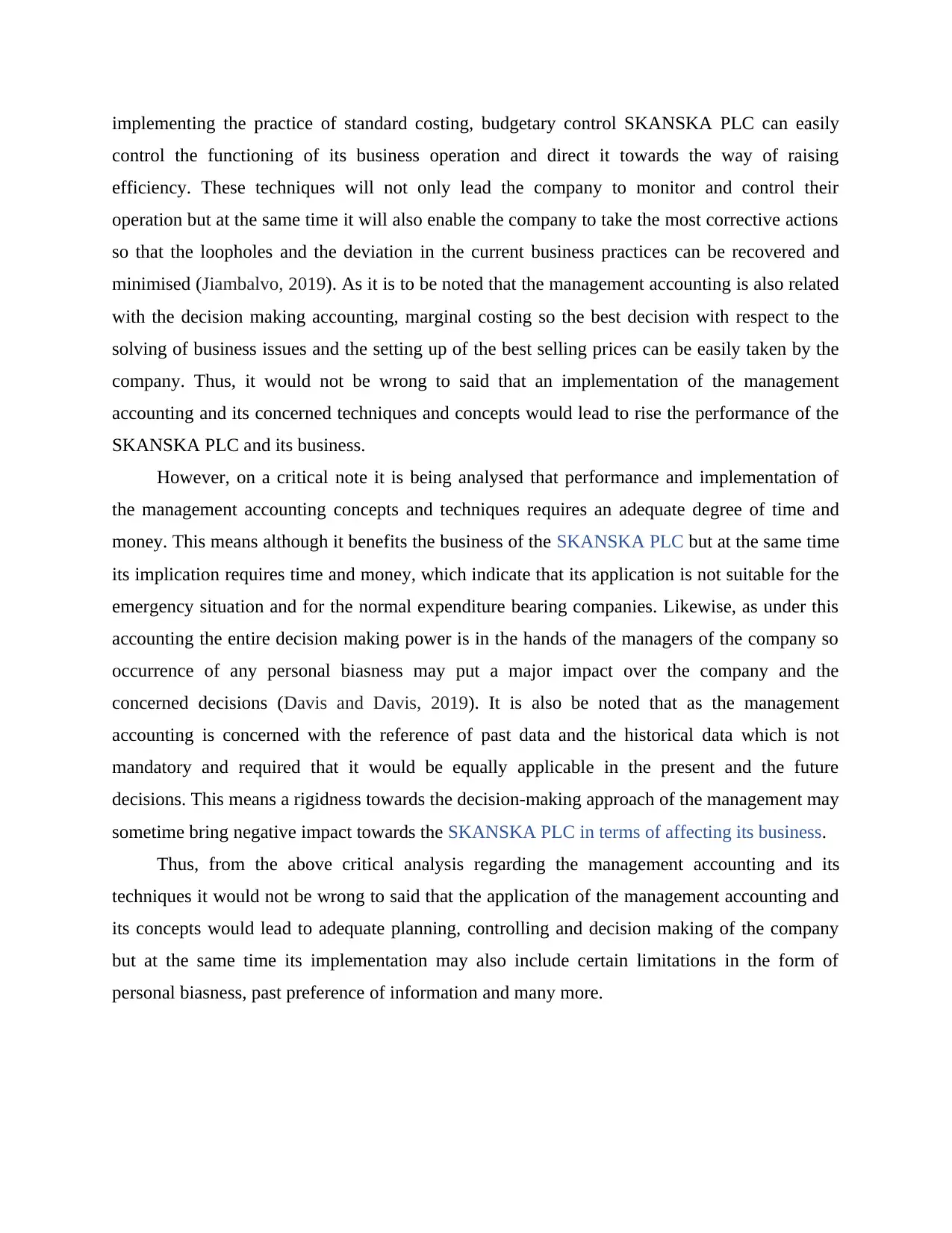
implementing the practice of standard costing, budgetary control SKANSKA PLC can easily
control the functioning of its business operation and direct it towards the way of raising
efficiency. These techniques will not only lead the company to monitor and control their
operation but at the same time it will also enable the company to take the most corrective actions
so that the loopholes and the deviation in the current business practices can be recovered and
minimised (Jiambalvo, 2019). As it is to be noted that the management accounting is also related
with the decision making accounting, marginal costing so the best decision with respect to the
solving of business issues and the setting up of the best selling prices can be easily taken by the
company. Thus, it would not be wrong to said that an implementation of the management
accounting and its concerned techniques and concepts would lead to rise the performance of the
SKANSKA PLC and its business.
However, on a critical note it is being analysed that performance and implementation of
the management accounting concepts and techniques requires an adequate degree of time and
money. This means although it benefits the business of the SKANSKA PLC but at the same time
its implication requires time and money, which indicate that its application is not suitable for the
emergency situation and for the normal expenditure bearing companies. Likewise, as under this
accounting the entire decision making power is in the hands of the managers of the company so
occurrence of any personal biasness may put a major impact over the company and the
concerned decisions (Davis and Davis, 2019). It is also be noted that as the management
accounting is concerned with the reference of past data and the historical data which is not
mandatory and required that it would be equally applicable in the present and the future
decisions. This means a rigidness towards the decision-making approach of the management may
sometime bring negative impact towards the SKANSKA PLC in terms of affecting its business.
Thus, from the above critical analysis regarding the management accounting and its
techniques it would not be wrong to said that the application of the management accounting and
its concepts would lead to adequate planning, controlling and decision making of the company
but at the same time its implementation may also include certain limitations in the form of
personal biasness, past preference of information and many more.
control the functioning of its business operation and direct it towards the way of raising
efficiency. These techniques will not only lead the company to monitor and control their
operation but at the same time it will also enable the company to take the most corrective actions
so that the loopholes and the deviation in the current business practices can be recovered and
minimised (Jiambalvo, 2019). As it is to be noted that the management accounting is also related
with the decision making accounting, marginal costing so the best decision with respect to the
solving of business issues and the setting up of the best selling prices can be easily taken by the
company. Thus, it would not be wrong to said that an implementation of the management
accounting and its concerned techniques and concepts would lead to rise the performance of the
SKANSKA PLC and its business.
However, on a critical note it is being analysed that performance and implementation of
the management accounting concepts and techniques requires an adequate degree of time and
money. This means although it benefits the business of the SKANSKA PLC but at the same time
its implication requires time and money, which indicate that its application is not suitable for the
emergency situation and for the normal expenditure bearing companies. Likewise, as under this
accounting the entire decision making power is in the hands of the managers of the company so
occurrence of any personal biasness may put a major impact over the company and the
concerned decisions (Davis and Davis, 2019). It is also be noted that as the management
accounting is concerned with the reference of past data and the historical data which is not
mandatory and required that it would be equally applicable in the present and the future
decisions. This means a rigidness towards the decision-making approach of the management may
sometime bring negative impact towards the SKANSKA PLC in terms of affecting its business.
Thus, from the above critical analysis regarding the management accounting and its
techniques it would not be wrong to said that the application of the management accounting and
its concepts would lead to adequate planning, controlling and decision making of the company
but at the same time its implementation may also include certain limitations in the form of
personal biasness, past preference of information and many more.
⊘ This is a preview!⊘
Do you want full access?
Subscribe today to unlock all pages.
Trusted by 1+ million students worldwide
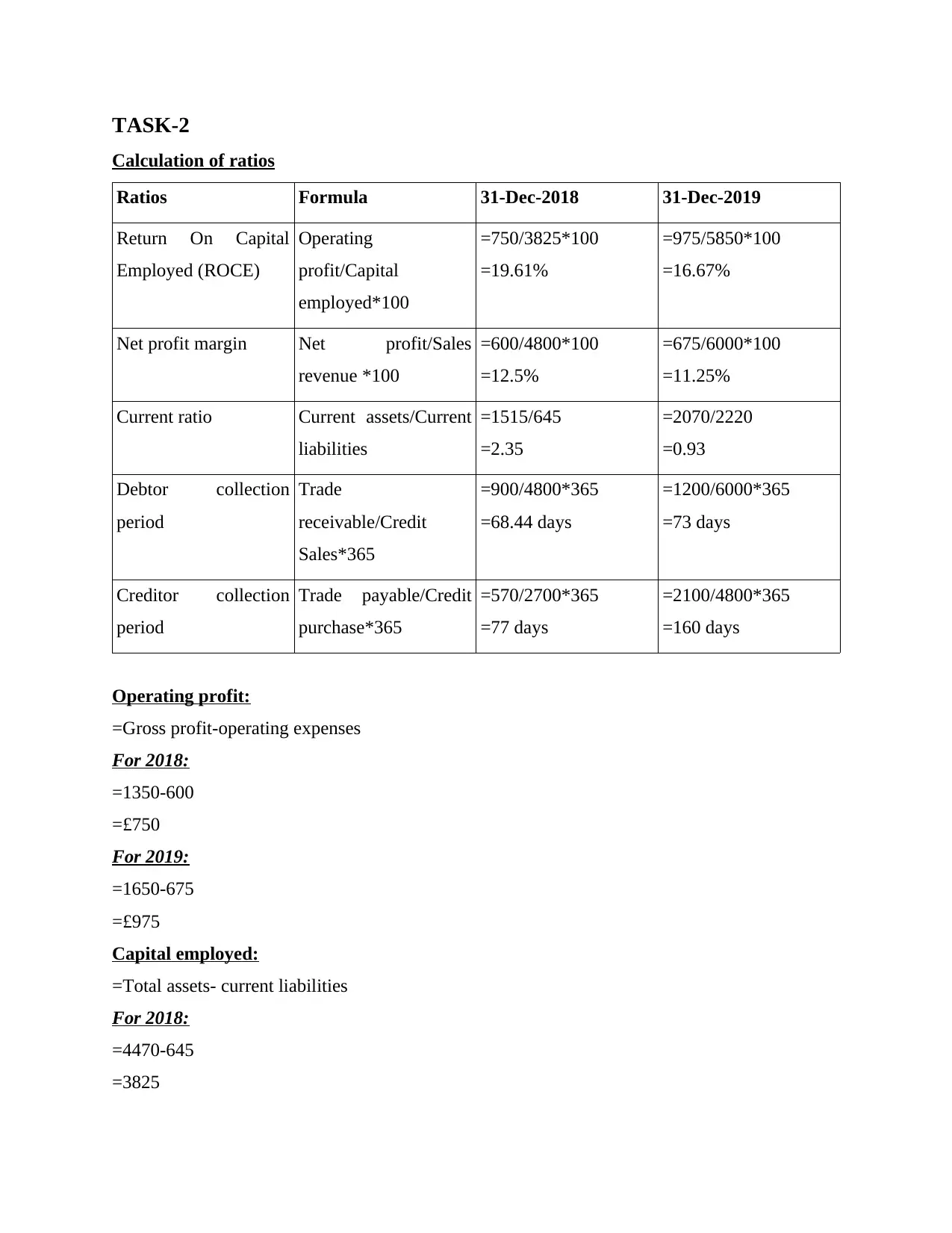
TASK-2
Calculation of ratios
Ratios Formula 31-Dec-2018 31-Dec-2019
Return On Capital
Employed (ROCE)
Operating
profit/Capital
employed*100
=750/3825*100
=19.61%
=975/5850*100
=16.67%
Net profit margin Net profit/Sales
revenue *100
=600/4800*100
=12.5%
=675/6000*100
=11.25%
Current ratio Current assets/Current
liabilities
=1515/645
=2.35
=2070/2220
=0.93
Debtor collection
period
Trade
receivable/Credit
Sales*365
=900/4800*365
=68.44 days
=1200/6000*365
=73 days
Creditor collection
period
Trade payable/Credit
purchase*365
=570/2700*365
=77 days
=2100/4800*365
=160 days
Operating profit:
=Gross profit-operating expenses
For 2018:
=1350-600
=£750
For 2019:
=1650-675
=£975
Capital employed:
=Total assets- current liabilities
For 2018:
=4470-645
=3825
Calculation of ratios
Ratios Formula 31-Dec-2018 31-Dec-2019
Return On Capital
Employed (ROCE)
Operating
profit/Capital
employed*100
=750/3825*100
=19.61%
=975/5850*100
=16.67%
Net profit margin Net profit/Sales
revenue *100
=600/4800*100
=12.5%
=675/6000*100
=11.25%
Current ratio Current assets/Current
liabilities
=1515/645
=2.35
=2070/2220
=0.93
Debtor collection
period
Trade
receivable/Credit
Sales*365
=900/4800*365
=68.44 days
=1200/6000*365
=73 days
Creditor collection
period
Trade payable/Credit
purchase*365
=570/2700*365
=77 days
=2100/4800*365
=160 days
Operating profit:
=Gross profit-operating expenses
For 2018:
=1350-600
=£750
For 2019:
=1650-675
=£975
Capital employed:
=Total assets- current liabilities
For 2018:
=4470-645
=3825
Paraphrase This Document
Need a fresh take? Get an instant paraphrase of this document with our AI Paraphraser
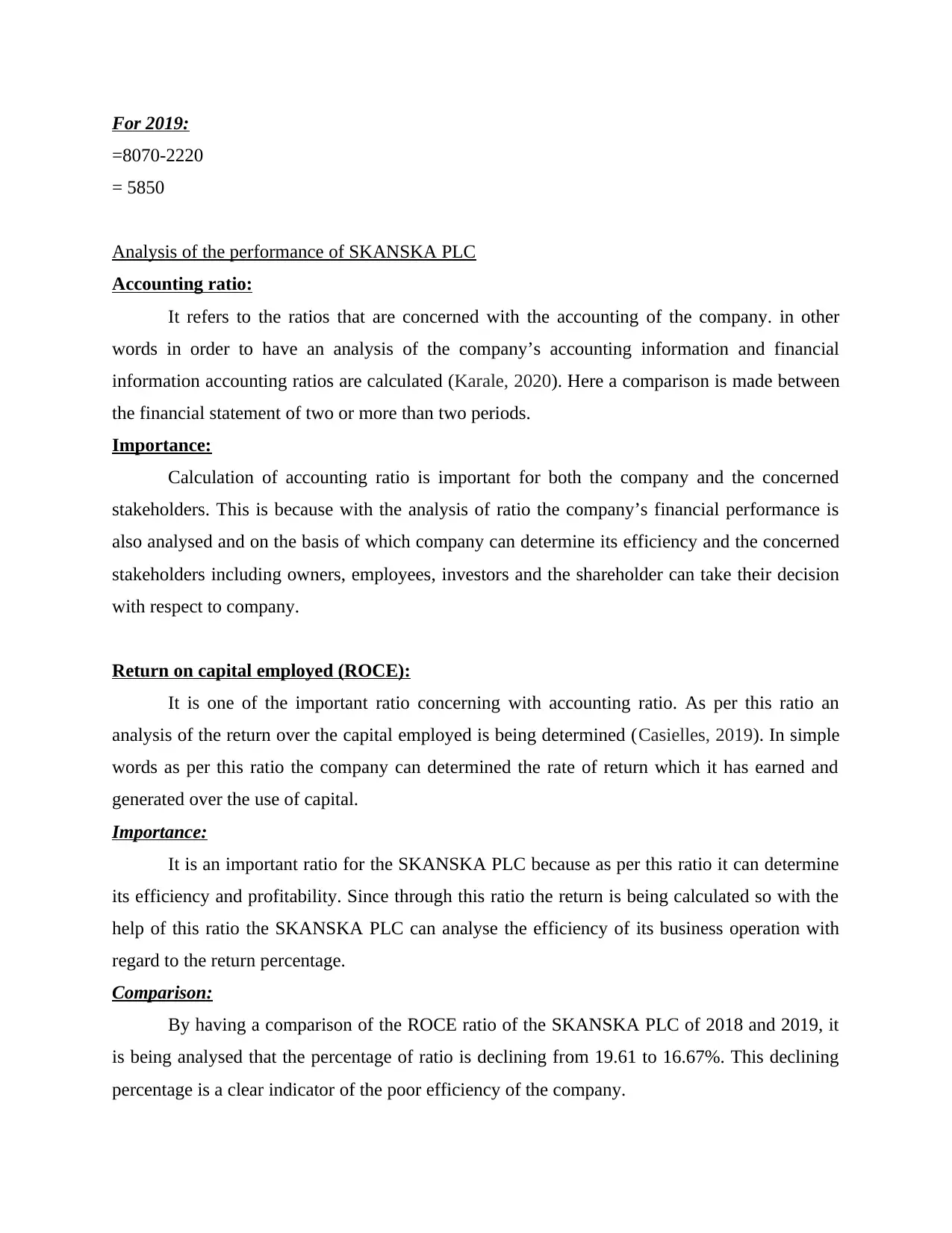
For 2019:
=8070-2220
= 5850
Analysis of the performance of SKANSKA PLC
Accounting ratio:
It refers to the ratios that are concerned with the accounting of the company. in other
words in order to have an analysis of the company’s accounting information and financial
information accounting ratios are calculated (Karale, 2020). Here a comparison is made between
the financial statement of two or more than two periods.
Importance:
Calculation of accounting ratio is important for both the company and the concerned
stakeholders. This is because with the analysis of ratio the company’s financial performance is
also analysed and on the basis of which company can determine its efficiency and the concerned
stakeholders including owners, employees, investors and the shareholder can take their decision
with respect to company.
Return on capital employed (ROCE):
It is one of the important ratio concerning with accounting ratio. As per this ratio an
analysis of the return over the capital employed is being determined (Casielles, 2019). In simple
words as per this ratio the company can determined the rate of return which it has earned and
generated over the use of capital.
Importance:
It is an important ratio for the SKANSKA PLC because as per this ratio it can determine
its efficiency and profitability. Since through this ratio the return is being calculated so with the
help of this ratio the SKANSKA PLC can analyse the efficiency of its business operation with
regard to the return percentage.
Comparison:
By having a comparison of the ROCE ratio of the SKANSKA PLC of 2018 and 2019, it
is being analysed that the percentage of ratio is declining from 19.61 to 16.67%. This declining
percentage is a clear indicator of the poor efficiency of the company.
=8070-2220
= 5850
Analysis of the performance of SKANSKA PLC
Accounting ratio:
It refers to the ratios that are concerned with the accounting of the company. in other
words in order to have an analysis of the company’s accounting information and financial
information accounting ratios are calculated (Karale, 2020). Here a comparison is made between
the financial statement of two or more than two periods.
Importance:
Calculation of accounting ratio is important for both the company and the concerned
stakeholders. This is because with the analysis of ratio the company’s financial performance is
also analysed and on the basis of which company can determine its efficiency and the concerned
stakeholders including owners, employees, investors and the shareholder can take their decision
with respect to company.
Return on capital employed (ROCE):
It is one of the important ratio concerning with accounting ratio. As per this ratio an
analysis of the return over the capital employed is being determined (Casielles, 2019). In simple
words as per this ratio the company can determined the rate of return which it has earned and
generated over the use of capital.
Importance:
It is an important ratio for the SKANSKA PLC because as per this ratio it can determine
its efficiency and profitability. Since through this ratio the return is being calculated so with the
help of this ratio the SKANSKA PLC can analyse the efficiency of its business operation with
regard to the return percentage.
Comparison:
By having a comparison of the ROCE ratio of the SKANSKA PLC of 2018 and 2019, it
is being analysed that the percentage of ratio is declining from 19.61 to 16.67%. This declining
percentage is a clear indicator of the poor efficiency of the company.
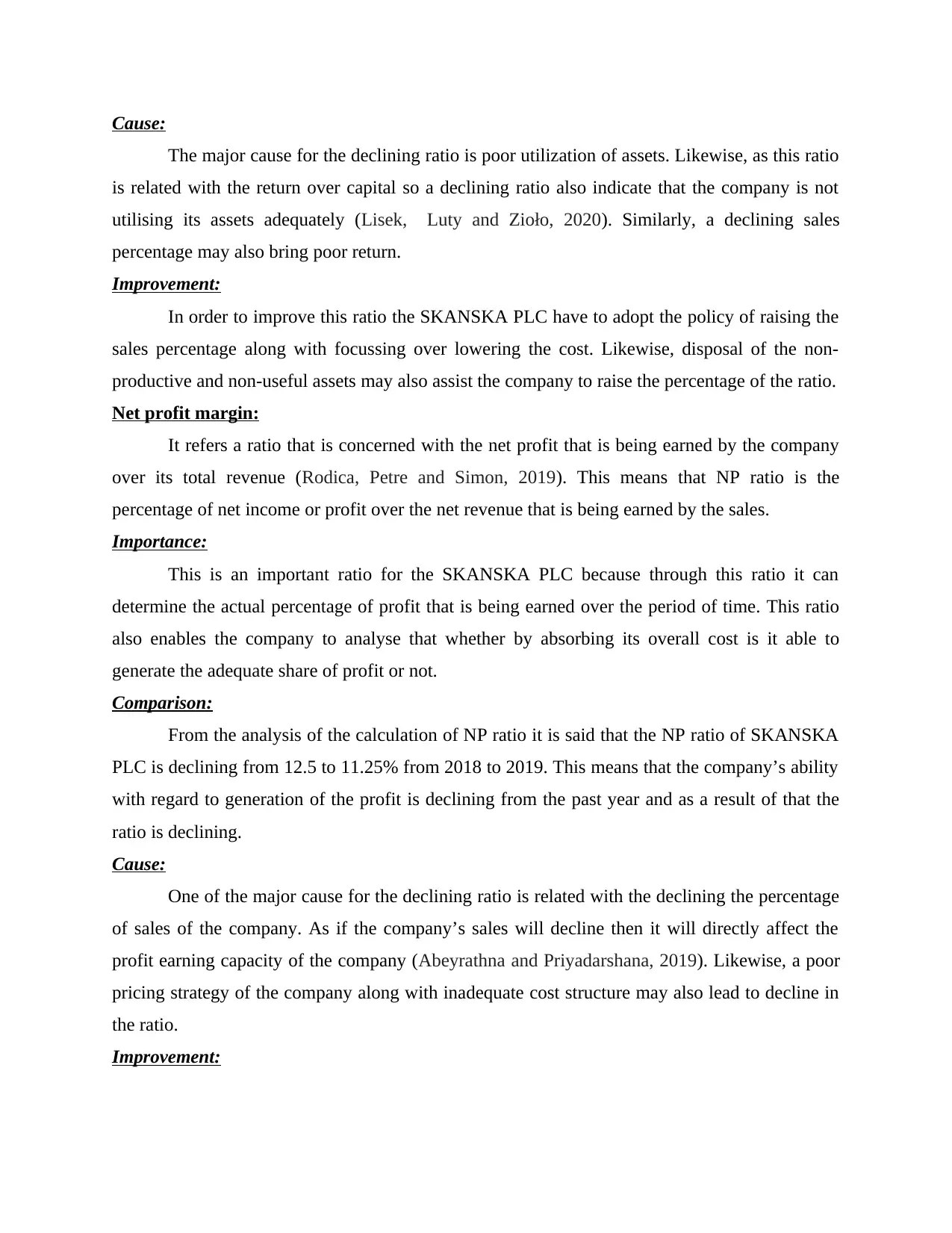
Cause:
The major cause for the declining ratio is poor utilization of assets. Likewise, as this ratio
is related with the return over capital so a declining ratio also indicate that the company is not
utilising its assets adequately (Lisek, Luty and Zioło, 2020). Similarly, a declining sales
percentage may also bring poor return.
Improvement:
In order to improve this ratio the SKANSKA PLC have to adopt the policy of raising the
sales percentage along with focussing over lowering the cost. Likewise, disposal of the non-
productive and non-useful assets may also assist the company to raise the percentage of the ratio.
Net profit margin:
It refers a ratio that is concerned with the net profit that is being earned by the company
over its total revenue (Rodica, Petre and Simon, 2019). This means that NP ratio is the
percentage of net income or profit over the net revenue that is being earned by the sales.
Importance:
This is an important ratio for the SKANSKA PLC because through this ratio it can
determine the actual percentage of profit that is being earned over the period of time. This ratio
also enables the company to analyse that whether by absorbing its overall cost is it able to
generate the adequate share of profit or not.
Comparison:
From the analysis of the calculation of NP ratio it is said that the NP ratio of SKANSKA
PLC is declining from 12.5 to 11.25% from 2018 to 2019. This means that the company’s ability
with regard to generation of the profit is declining from the past year and as a result of that the
ratio is declining.
Cause:
One of the major cause for the declining ratio is related with the declining the percentage
of sales of the company. As if the company’s sales will decline then it will directly affect the
profit earning capacity of the company (Abeyrathna and Priyadarshana, 2019). Likewise, a poor
pricing strategy of the company along with inadequate cost structure may also lead to decline in
the ratio.
Improvement:
The major cause for the declining ratio is poor utilization of assets. Likewise, as this ratio
is related with the return over capital so a declining ratio also indicate that the company is not
utilising its assets adequately (Lisek, Luty and Zioło, 2020). Similarly, a declining sales
percentage may also bring poor return.
Improvement:
In order to improve this ratio the SKANSKA PLC have to adopt the policy of raising the
sales percentage along with focussing over lowering the cost. Likewise, disposal of the non-
productive and non-useful assets may also assist the company to raise the percentage of the ratio.
Net profit margin:
It refers a ratio that is concerned with the net profit that is being earned by the company
over its total revenue (Rodica, Petre and Simon, 2019). This means that NP ratio is the
percentage of net income or profit over the net revenue that is being earned by the sales.
Importance:
This is an important ratio for the SKANSKA PLC because through this ratio it can
determine the actual percentage of profit that is being earned over the period of time. This ratio
also enables the company to analyse that whether by absorbing its overall cost is it able to
generate the adequate share of profit or not.
Comparison:
From the analysis of the calculation of NP ratio it is said that the NP ratio of SKANSKA
PLC is declining from 12.5 to 11.25% from 2018 to 2019. This means that the company’s ability
with regard to generation of the profit is declining from the past year and as a result of that the
ratio is declining.
Cause:
One of the major cause for the declining ratio is related with the declining the percentage
of sales of the company. As if the company’s sales will decline then it will directly affect the
profit earning capacity of the company (Abeyrathna and Priyadarshana, 2019). Likewise, a poor
pricing strategy of the company along with inadequate cost structure may also lead to decline in
the ratio.
Improvement:
⊘ This is a preview!⊘
Do you want full access?
Subscribe today to unlock all pages.
Trusted by 1+ million students worldwide
In order to improve the ratio SKANSKA PLC can adopt the method of reducing the cost
of operation so that the company can save its cost and raise the profit margin. In the same way it
can also work towards the direction of raising the percentage of sales so that with high sales,
profit will raise. Likewise, selling of its projects at high selling price may also bring more profit.
Current ratio:
The another name of this ratio is liquidity ratio. As per this ratio the company’s liquidity
position can be analysed and measured (ANGADI, 2020). It is the ratio of current asset to current
liabilities. The ideal ratio is 2:1.
Importance:
It is an important ratio for the SKANSKA PLC because through this ratio it can
determine its liquidity position and thereby analyse that whether it is able to pay its short term
debts and obligations or not. This means that with the help of current ratio, investors can also
determine that whether the company is in the position of repaying its short term debts or not.
Comparison:
By having a comparison of the current ratio of 2018 and 2019 of SKANSKA PLC it is
analysed that the current ratio is declining from 2.35 to 0.93. This declining ratio directly means
that the company is not efficient in terms of making repayment of its short term obligations and
current liabilities.
Causes:
Over-accumulation of current liabilities due to non-payment, shortage of cash, shortage
of funds, non-capacity of the company, following the practice of late payment and various other
are considered as a major reason of the declining percentage of current ratio (Chasanah and
Sucipto, 2019).
Improvement:
However, it can be improved with the adoption of faster conversion cycle in which faster
recovers from debtors may lead to raising of current assets. Likewise, paying off current
liabilities, selling of non-useful assets are all such methods that can improve the current ratio.
Debtor collection period:
It refers to a period that is concerned with the time which is required by the company in
order to collect the due debts from the market (Mithare, 2020). In simple words it is the period
concerning with the collection of due amount of debtors.
of operation so that the company can save its cost and raise the profit margin. In the same way it
can also work towards the direction of raising the percentage of sales so that with high sales,
profit will raise. Likewise, selling of its projects at high selling price may also bring more profit.
Current ratio:
The another name of this ratio is liquidity ratio. As per this ratio the company’s liquidity
position can be analysed and measured (ANGADI, 2020). It is the ratio of current asset to current
liabilities. The ideal ratio is 2:1.
Importance:
It is an important ratio for the SKANSKA PLC because through this ratio it can
determine its liquidity position and thereby analyse that whether it is able to pay its short term
debts and obligations or not. This means that with the help of current ratio, investors can also
determine that whether the company is in the position of repaying its short term debts or not.
Comparison:
By having a comparison of the current ratio of 2018 and 2019 of SKANSKA PLC it is
analysed that the current ratio is declining from 2.35 to 0.93. This declining ratio directly means
that the company is not efficient in terms of making repayment of its short term obligations and
current liabilities.
Causes:
Over-accumulation of current liabilities due to non-payment, shortage of cash, shortage
of funds, non-capacity of the company, following the practice of late payment and various other
are considered as a major reason of the declining percentage of current ratio (Chasanah and
Sucipto, 2019).
Improvement:
However, it can be improved with the adoption of faster conversion cycle in which faster
recovers from debtors may lead to raising of current assets. Likewise, paying off current
liabilities, selling of non-useful assets are all such methods that can improve the current ratio.
Debtor collection period:
It refers to a period that is concerned with the time which is required by the company in
order to collect the due debts from the market (Mithare, 2020). In simple words it is the period
concerning with the collection of due amount of debtors.
Paraphrase This Document
Need a fresh take? Get an instant paraphrase of this document with our AI Paraphraser
Importance:
This is an important ratio for the SKANSKA PLC because through this ratio it can
determine the actual time which is being required in order to collect the due amount from
debtors. It will also enable the company to not have shortage of funds because of the timely
collection of debts.
Comparison:
By having an analysis of the debtor collection period with regard to SKANSKA PLC of
2018 and 2019 it is found that the period is increasing from 68 to 73 days. Though. It is a short
increase but it is an indicator of the poor company’s policy with regard to debtors.
Cause:
Non-payment of debtors on time, carelessness of company with regard to due collection,
poor collection policy. Are all counted as a reason of high debtor collection period. Availing
sales of projects more on credit basis is also a major cause of high ratio.
Improvement:
In order to improve the ratio the company can adopt the policy of giving rewards and
discounts on timely repayment. Likewise, adoption of the policy of flexible repayment, low
focus over the credit sales may also improve the ratio.
Creditors collection period:
It is concerned with the period that is related with the payment of creditors by the
company. Since, no business can survive without the credit, so with the help of this ratio an
analysis of the credit period taken by the company is determined (Kenton, 2019).
Important:
More lower the ratio more brighter the image of the company would be. This is because
if the company will make timely repayment to its creditors then it can anytime avail credit from
the market. Likewise, its image in the market may also improve if the period would be low.
Comparison:
By comparing the creditor collection period of SKANSKA PLC of 2018 and 2019, it is
analysed that the credit period is raised from 77 to 160 days, which is a very high rise. This
raising period clearly denotes that the company’s credit policy in terms of repayment is not good.
Cause:
This is an important ratio for the SKANSKA PLC because through this ratio it can
determine the actual time which is being required in order to collect the due amount from
debtors. It will also enable the company to not have shortage of funds because of the timely
collection of debts.
Comparison:
By having an analysis of the debtor collection period with regard to SKANSKA PLC of
2018 and 2019 it is found that the period is increasing from 68 to 73 days. Though. It is a short
increase but it is an indicator of the poor company’s policy with regard to debtors.
Cause:
Non-payment of debtors on time, carelessness of company with regard to due collection,
poor collection policy. Are all counted as a reason of high debtor collection period. Availing
sales of projects more on credit basis is also a major cause of high ratio.
Improvement:
In order to improve the ratio the company can adopt the policy of giving rewards and
discounts on timely repayment. Likewise, adoption of the policy of flexible repayment, low
focus over the credit sales may also improve the ratio.
Creditors collection period:
It is concerned with the period that is related with the payment of creditors by the
company. Since, no business can survive without the credit, so with the help of this ratio an
analysis of the credit period taken by the company is determined (Kenton, 2019).
Important:
More lower the ratio more brighter the image of the company would be. This is because
if the company will make timely repayment to its creditors then it can anytime avail credit from
the market. Likewise, its image in the market may also improve if the period would be low.
Comparison:
By comparing the creditor collection period of SKANSKA PLC of 2018 and 2019, it is
analysed that the credit period is raised from 77 to 160 days, which is a very high rise. This
raising period clearly denotes that the company’s credit policy in terms of repayment is not good.
Cause:
The main cause of the high credit period includes shortage of funds with the company
with regard to repayment. Poor strategies of the company with regard to credit repayment. Delay
payment policy may also be counted as a cause.
Improvement:
It can be improved if the company will make negotiation with the suppliers at the time of
the assignment so that it can make payment on time. Adoption of automatic credit payment up-
dation policy, timely repayment of creditors, are some of the methods of improvement.
CONCLUSION AND RECOMMENDATION
From the task-1 of above report it is concluded that the management accounting plays an
important role in the functioning of the company including the SKANSKA PLC. It enables the
company to take the adequate decisions along with establishing controlling measures.
Management accounting and its implication of techniques will lead the company towards the
direction of success and growth. From the report it is also understood that management
accounting is solely used and concerned for the purpose of internal use and by the management
of the company. it enables them to take the most suitable and adequate decisions for the
company and for raising the performance of business operation of the company. Likewise, it is
also understood that management accounting also plays an important role in the financial
decision making by the investors because as it is concerned with enhancing the company’s
performance and efficiency will directly attract the investors to take the decision regarding
making of investment in the company.
From the task-2 concerning calculation and the analysis of the above ratio it is concluded
that the financial performance of the company is declining while having a comparison from 2018
to 2019. Major ratios including the profit ratio, return on capital employed ratio, current ratio are
showing a declining stage. This means that the company performance with regard to its efficient
operation of business is not good. Likewise, a raise in the debtors and creditors collection period
also shows that the company is facing a situation of shortage of funds and is not in the condition
of making repayment to its creditors. Thus, it would be recommended that making an investment
in the company is not said to be a right decision from the investor’s perspective because of the
poor and declining financial performance of the SKANSKA PLC.
with regard to repayment. Poor strategies of the company with regard to credit repayment. Delay
payment policy may also be counted as a cause.
Improvement:
It can be improved if the company will make negotiation with the suppliers at the time of
the assignment so that it can make payment on time. Adoption of automatic credit payment up-
dation policy, timely repayment of creditors, are some of the methods of improvement.
CONCLUSION AND RECOMMENDATION
From the task-1 of above report it is concluded that the management accounting plays an
important role in the functioning of the company including the SKANSKA PLC. It enables the
company to take the adequate decisions along with establishing controlling measures.
Management accounting and its implication of techniques will lead the company towards the
direction of success and growth. From the report it is also understood that management
accounting is solely used and concerned for the purpose of internal use and by the management
of the company. it enables them to take the most suitable and adequate decisions for the
company and for raising the performance of business operation of the company. Likewise, it is
also understood that management accounting also plays an important role in the financial
decision making by the investors because as it is concerned with enhancing the company’s
performance and efficiency will directly attract the investors to take the decision regarding
making of investment in the company.
From the task-2 concerning calculation and the analysis of the above ratio it is concluded
that the financial performance of the company is declining while having a comparison from 2018
to 2019. Major ratios including the profit ratio, return on capital employed ratio, current ratio are
showing a declining stage. This means that the company performance with regard to its efficient
operation of business is not good. Likewise, a raise in the debtors and creditors collection period
also shows that the company is facing a situation of shortage of funds and is not in the condition
of making repayment to its creditors. Thus, it would be recommended that making an investment
in the company is not said to be a right decision from the investor’s perspective because of the
poor and declining financial performance of the SKANSKA PLC.
⊘ This is a preview!⊘
Do you want full access?
Subscribe today to unlock all pages.
Trusted by 1+ million students worldwide

1 out of 14


Related Documents


Your All-in-One AI-Powered Toolkit for Academic Success.
+13062052269
info@desklib.com
Available 24*7 on WhatsApp / Email
![[object Object]](/_next/static/media/star-bottom.7253800d.svg)
Unlock your academic potential
Copyright © 2020–2026 A2Z Services. All Rights Reserved. Developed and managed by ZUCOL.