Management Accounting Report: Budgetary Control and Cost Analysis
VerifiedAdded on 2020/06/03
|16
|4006
|37
Report
AI Summary
This report provides a comprehensive overview of management accounting principles and their application within a company, specifically focusing on X PLC. It delves into key concepts such as management accounting systems, types of reporting, and the benefits of implementing these systems to maximize profitability and enhance efficiency. The report includes a detailed analysis of marginal and absorption costing methods, demonstrated through income statements, and explores different planning tools for budgetary control, including capital and operating budgets. Furthermore, it examines the use of these tools in preparing and forecasting budgets, with a specific focus on sales budgets. The report concludes by evaluating how management accounting systems respond to financial problems and lead organizations to sustainable success, supported by case studies and financial data.
MANAGEMENT
ACCOUNTING
ACCOUNTING

Paraphrase This Document
Need a fresh take? Get an instant paraphrase of this document with our AI Paraphraser
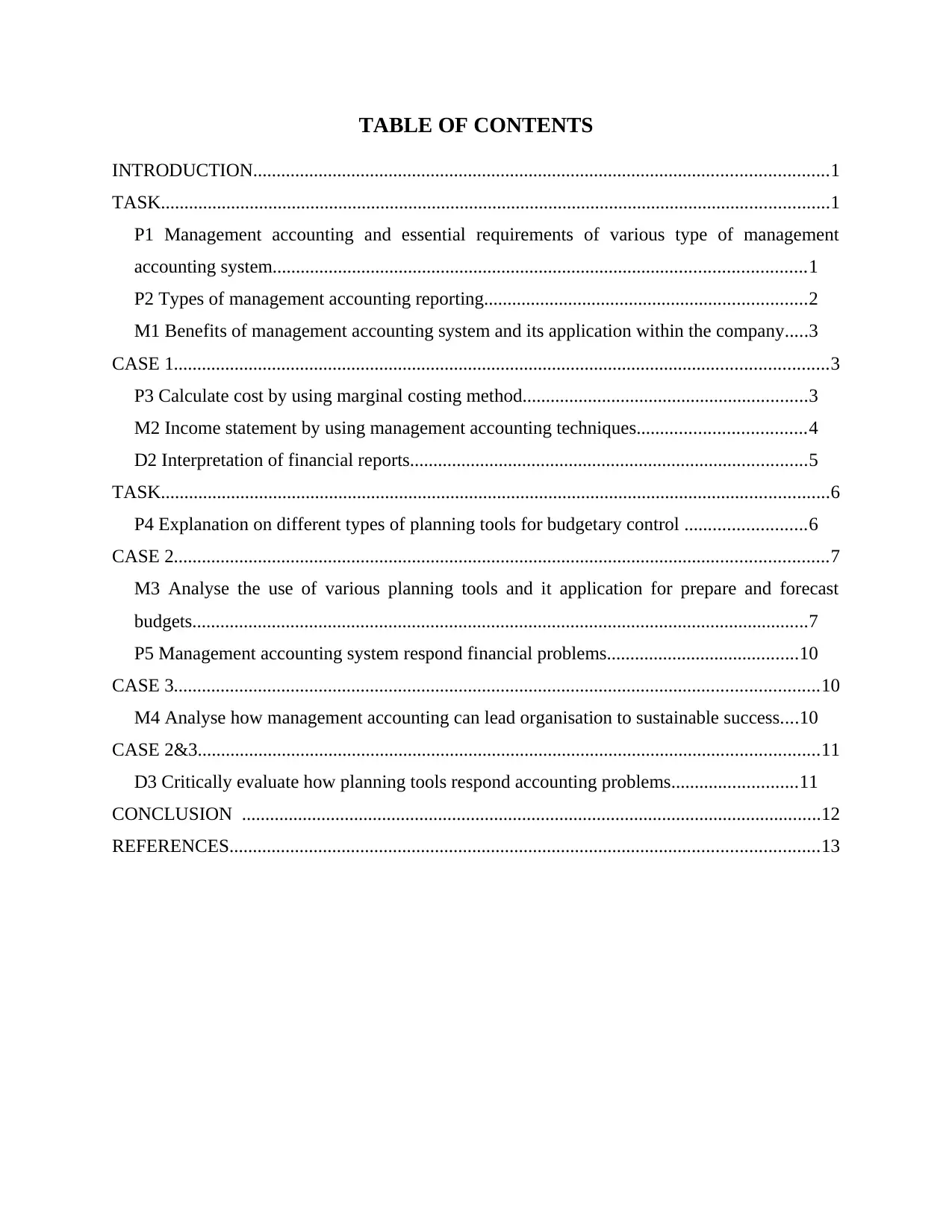
TABLE OF CONTENTS
INTRODUCTION...........................................................................................................................1
TASK...............................................................................................................................................1
P1 Management accounting and essential requirements of various type of management
accounting system..................................................................................................................1
P2 Types of management accounting reporting.....................................................................2
M1 Benefits of management accounting system and its application within the company.....3
CASE 1............................................................................................................................................3
P3 Calculate cost by using marginal costing method.............................................................3
M2 Income statement by using management accounting techniques....................................4
D2 Interpretation of financial reports.....................................................................................5
TASK...............................................................................................................................................6
P4 Explanation on different types of planning tools for budgetary control ..........................6
CASE 2............................................................................................................................................7
M3 Analyse the use of various planning tools and it application for prepare and forecast
budgets....................................................................................................................................7
P5 Management accounting system respond financial problems.........................................10
CASE 3..........................................................................................................................................10
M4 Analyse how management accounting can lead organisation to sustainable success....10
CASE 2&3.....................................................................................................................................11
D3 Critically evaluate how planning tools respond accounting problems...........................11
CONCLUSION ............................................................................................................................12
REFERENCES..............................................................................................................................13
INTRODUCTION...........................................................................................................................1
TASK...............................................................................................................................................1
P1 Management accounting and essential requirements of various type of management
accounting system..................................................................................................................1
P2 Types of management accounting reporting.....................................................................2
M1 Benefits of management accounting system and its application within the company.....3
CASE 1............................................................................................................................................3
P3 Calculate cost by using marginal costing method.............................................................3
M2 Income statement by using management accounting techniques....................................4
D2 Interpretation of financial reports.....................................................................................5
TASK...............................................................................................................................................6
P4 Explanation on different types of planning tools for budgetary control ..........................6
CASE 2............................................................................................................................................7
M3 Analyse the use of various planning tools and it application for prepare and forecast
budgets....................................................................................................................................7
P5 Management accounting system respond financial problems.........................................10
CASE 3..........................................................................................................................................10
M4 Analyse how management accounting can lead organisation to sustainable success....10
CASE 2&3.....................................................................................................................................11
D3 Critically evaluate how planning tools respond accounting problems...........................11
CONCLUSION ............................................................................................................................12
REFERENCES..............................................................................................................................13
INTRODUCTION
Management Accounting is an application that assist the manager in formulation of
company's strategy, provide an accurate financial and statistical data to take short-term decisions.
It is the process that produced management reports on weekly or monthly basis to internal
stakeholders. The present report will be discussed on management costing techniques to prepare
financial reports (Tucker and Schaltegger,2016). The assignment covering all the aspects of
management accounting system and apply within the organisation. There will be also study on
the various types of planning tool that is adopted by company for budgetary control.
TASK
P1 Management accounting and essential requirements of various type of management
accounting system
Management accounting is a branch of accounting that identifying, measuring, analysing
and interpreting the financial and statistical data for the aim of achieving organisation's goals.
The information is used by manager of a firm to establish the dynamic solution to enhance the
business performance. The management accounting system is a collection of financial
information acquired from business operations. It involves fluctuation in cost of raw material,
shift in inventory and sales data that will be turned into management report. It is necessary to
integrate an accounting system within the company as it will assist the manager to take the
effective decisions. The Company has adopted different types of management accounting system
that will be described as follows:-
Throughput accounting system:- It is an approach of management accounting that
supports the managers by provide them essential information for the improvement in
entity profitability. It is mainly focused on cash and not consider cost of products or
services at the time of its selling (Dulleck and et. al., 2016). It has applied by Company to
determine the theory of constraints that helps them to maximize profits by reducing cost.
Cost accounting system:- It is a framework used by organisation for the purpose of
profitability analysis, control cost and inventory valuation through determine cost of
products. It indicated which products gives profitability or not and it has ascertained
accurate product cost. It helps the management accountant to provided a detailed
information of cost that able to operate business function effectively.
Difference between management accounting and financial accounting
1
Management Accounting is an application that assist the manager in formulation of
company's strategy, provide an accurate financial and statistical data to take short-term decisions.
It is the process that produced management reports on weekly or monthly basis to internal
stakeholders. The present report will be discussed on management costing techniques to prepare
financial reports (Tucker and Schaltegger,2016). The assignment covering all the aspects of
management accounting system and apply within the organisation. There will be also study on
the various types of planning tool that is adopted by company for budgetary control.
TASK
P1 Management accounting and essential requirements of various type of management
accounting system
Management accounting is a branch of accounting that identifying, measuring, analysing
and interpreting the financial and statistical data for the aim of achieving organisation's goals.
The information is used by manager of a firm to establish the dynamic solution to enhance the
business performance. The management accounting system is a collection of financial
information acquired from business operations. It involves fluctuation in cost of raw material,
shift in inventory and sales data that will be turned into management report. It is necessary to
integrate an accounting system within the company as it will assist the manager to take the
effective decisions. The Company has adopted different types of management accounting system
that will be described as follows:-
Throughput accounting system:- It is an approach of management accounting that
supports the managers by provide them essential information for the improvement in
entity profitability. It is mainly focused on cash and not consider cost of products or
services at the time of its selling (Dulleck and et. al., 2016). It has applied by Company to
determine the theory of constraints that helps them to maximize profits by reducing cost.
Cost accounting system:- It is a framework used by organisation for the purpose of
profitability analysis, control cost and inventory valuation through determine cost of
products. It indicated which products gives profitability or not and it has ascertained
accurate product cost. It helps the management accountant to provided a detailed
information of cost that able to operate business function effectively.
Difference between management accounting and financial accounting
1
⊘ This is a preview!⊘
Do you want full access?
Subscribe today to unlock all pages.

Trusted by 1+ million students worldwide
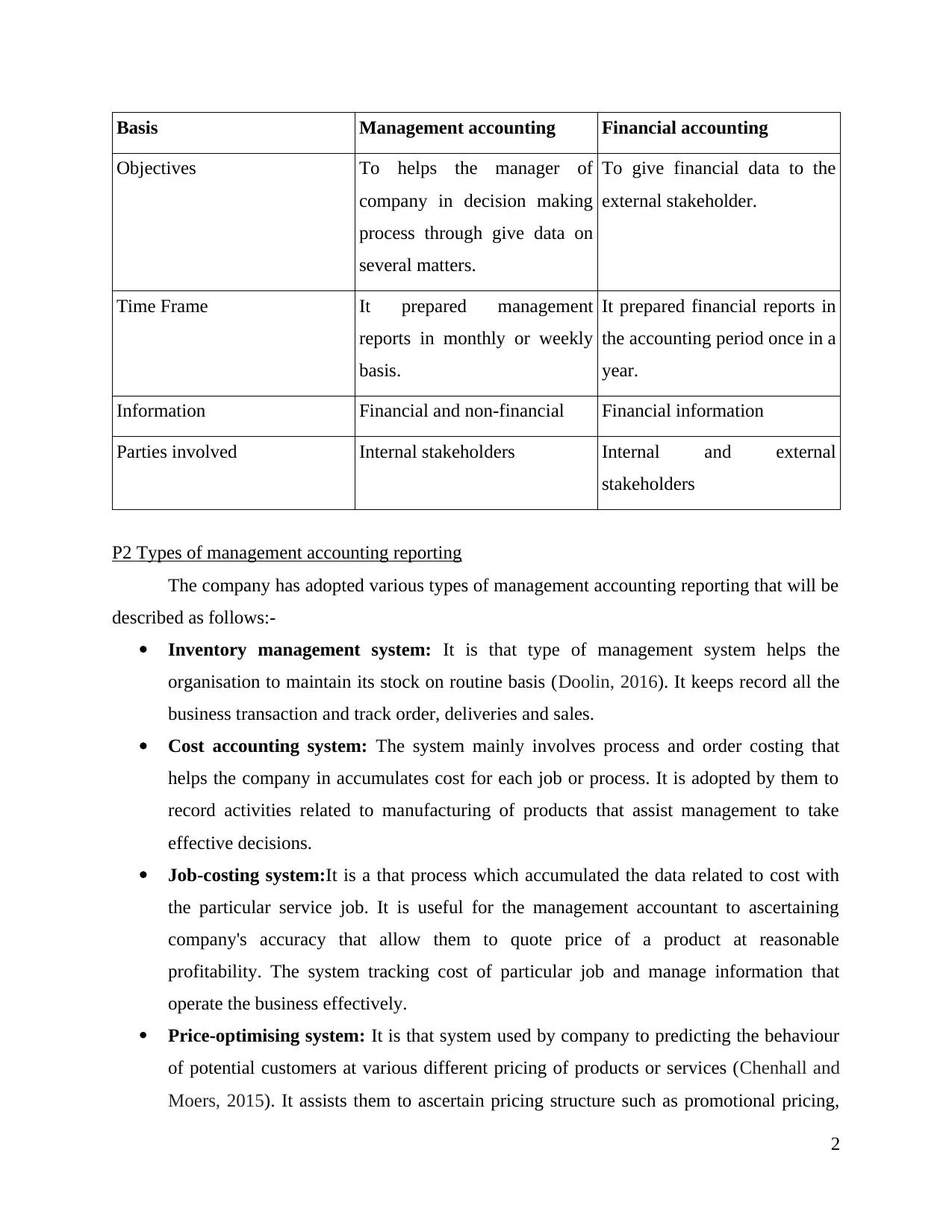
Basis Management accounting Financial accounting
Objectives To helps the manager of
company in decision making
process through give data on
several matters.
To give financial data to the
external stakeholder.
Time Frame It prepared management
reports in monthly or weekly
basis.
It prepared financial reports in
the accounting period once in a
year.
Information Financial and non-financial Financial information
Parties involved Internal stakeholders Internal and external
stakeholders
P2 Types of management accounting reporting
The company has adopted various types of management accounting reporting that will be
described as follows:-
Inventory management system: It is that type of management system helps the
organisation to maintain its stock on routine basis (Doolin, 2016). It keeps record all the
business transaction and track order, deliveries and sales.
Cost accounting system: The system mainly involves process and order costing that
helps the company in accumulates cost for each job or process. It is adopted by them to
record activities related to manufacturing of products that assist management to take
effective decisions.
Job-costing system:It is a that process which accumulated the data related to cost with
the particular service job. It is useful for the management accountant to ascertaining
company's accuracy that allow them to quote price of a product at reasonable
profitability. The system tracking cost of particular job and manage information that
operate the business effectively.
Price-optimising system: It is that system used by company to predicting the behaviour
of potential customers at various different pricing of products or services (Chenhall and
Moers, 2015). It assists them to ascertain pricing structure such as promotional pricing,
2
Objectives To helps the manager of
company in decision making
process through give data on
several matters.
To give financial data to the
external stakeholder.
Time Frame It prepared management
reports in monthly or weekly
basis.
It prepared financial reports in
the accounting period once in a
year.
Information Financial and non-financial Financial information
Parties involved Internal stakeholders Internal and external
stakeholders
P2 Types of management accounting reporting
The company has adopted various types of management accounting reporting that will be
described as follows:-
Inventory management system: It is that type of management system helps the
organisation to maintain its stock on routine basis (Doolin, 2016). It keeps record all the
business transaction and track order, deliveries and sales.
Cost accounting system: The system mainly involves process and order costing that
helps the company in accumulates cost for each job or process. It is adopted by them to
record activities related to manufacturing of products that assist management to take
effective decisions.
Job-costing system:It is a that process which accumulated the data related to cost with
the particular service job. It is useful for the management accountant to ascertaining
company's accuracy that allow them to quote price of a product at reasonable
profitability. The system tracking cost of particular job and manage information that
operate the business effectively.
Price-optimising system: It is that system used by company to predicting the behaviour
of potential customers at various different pricing of products or services (Chenhall and
Moers, 2015). It assists them to ascertain pricing structure such as promotional pricing,
2
Paraphrase This Document
Need a fresh take? Get an instant paraphrase of this document with our AI Paraphraser
discount pricing and initial pricing. The system is adopted to evaluate the price of
products for various customer segments by together the data about cost as well as
inventory levels.
M1 Benefits of management accounting system and its application within the company
The management accounting system is used by company for some purpose as it provide
various benefits by applying within the organisation. It will be further described as follows:-
Benefits
Maximizing profitability: The system involves budgetary control and capital budgeting
techniques which is used by Company for the purpose of minimizing expenditures
(Houtsma and van Veen, 2015). Thereafter, it also assists firm to minimize their price
through which they will get super profits.
Enhance efficiency: The company adopt management accounting system to take the
promotional decision by finding out deviation through comparison of employee
performance. For this, they motivate the individuals by offer them a reward for its
performance that will increase firm's efficiency.
Application
Keep record: It is applied by company for the purpose of recording business transaction
and ascertaining outcomes of financial changes. It is used to prepared the internal reports
and projecting financial impacts from the future transactions (Choi, 2016).
Decision making: The firm used the management accounting system for take effective
decision related to marketing, pricing and capital investment. The reason for applicability
of this system in a company assist them in evaluating product profitability and formulate
strategies.
CASE 1
P3 Calculate cost by using marginal costing method
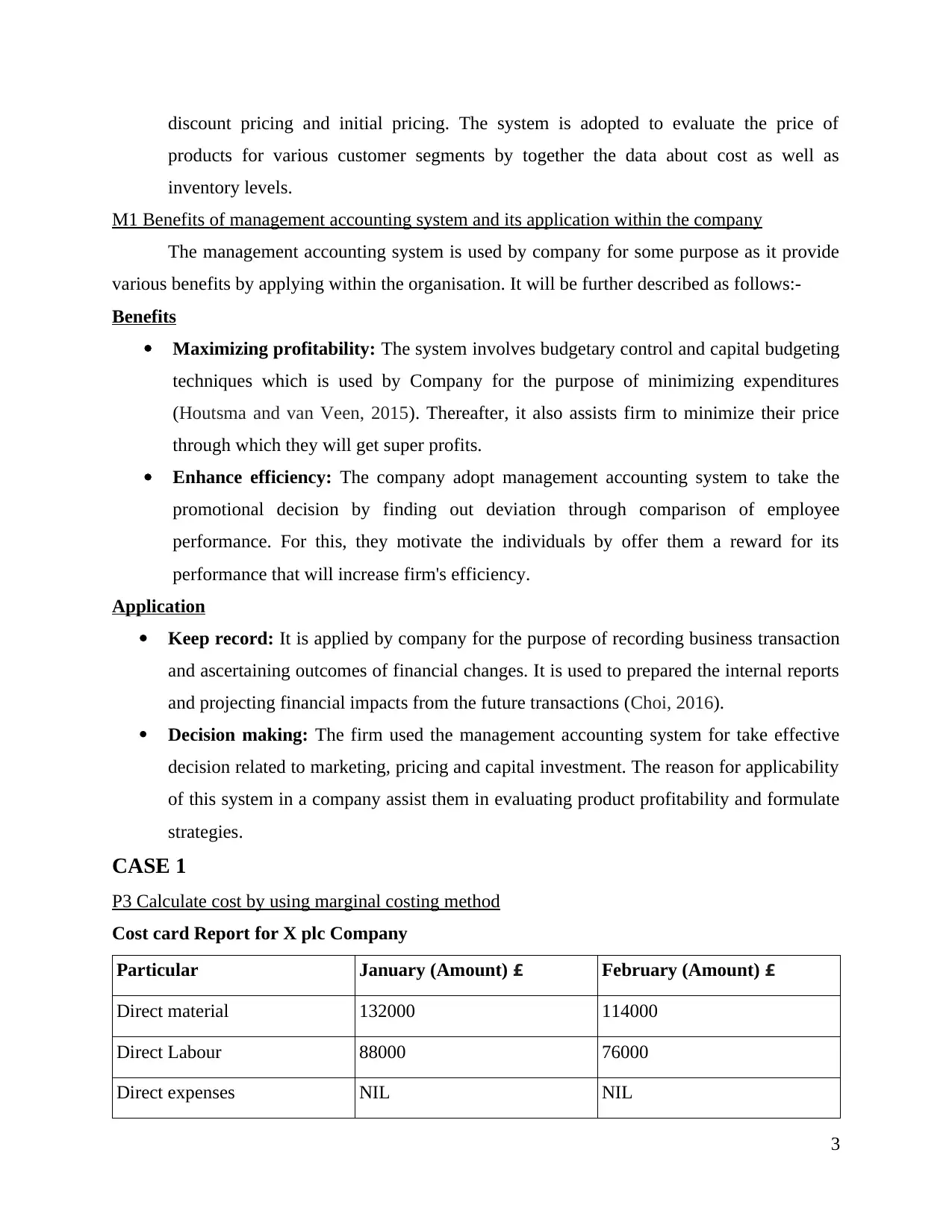
Cost card Report for X plc Company
Particular January (Amount) £ February (Amount) £
Direct material 132000 114000
Direct Labour 88000 76000
Direct expenses NIL NIL
3
products for various customer segments by together the data about cost as well as
inventory levels.
M1 Benefits of management accounting system and its application within the company
The management accounting system is used by company for some purpose as it provide
various benefits by applying within the organisation. It will be further described as follows:-
Benefits
Maximizing profitability: The system involves budgetary control and capital budgeting
techniques which is used by Company for the purpose of minimizing expenditures
(Houtsma and van Veen, 2015). Thereafter, it also assists firm to minimize their price
through which they will get super profits.
Enhance efficiency: The company adopt management accounting system to take the
promotional decision by finding out deviation through comparison of employee
performance. For this, they motivate the individuals by offer them a reward for its
performance that will increase firm's efficiency.
Application
Keep record: It is applied by company for the purpose of recording business transaction
and ascertaining outcomes of financial changes. It is used to prepared the internal reports
and projecting financial impacts from the future transactions (Choi, 2016).
Decision making: The firm used the management accounting system for take effective
decision related to marketing, pricing and capital investment. The reason for applicability
of this system in a company assist them in evaluating product profitability and formulate
strategies.
CASE 1
P3 Calculate cost by using marginal costing method
Cost card Report for X plc Company
Particular January (Amount) £ February (Amount) £
Direct material 132000 114000
Direct Labour 88000 76000
Direct expenses NIL NIL
3
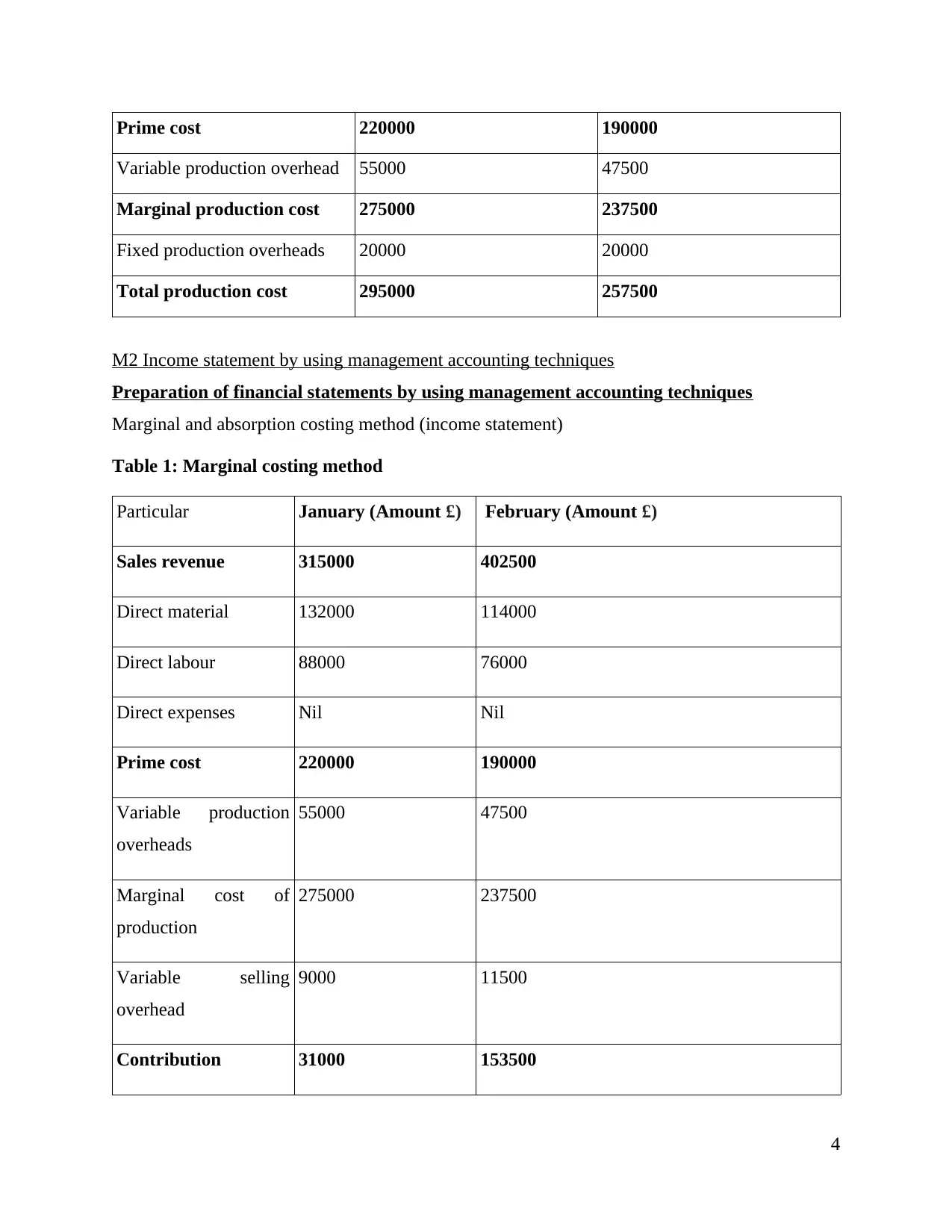
Prime cost 220000 190000
Variable production overhead 55000 47500
Marginal production cost 275000 237500
Fixed production overheads 20000 20000
Total production cost 295000 257500
M2 Income statement by using management accounting techniques
Preparation of financial statements by using management accounting techniques
Marginal and absorption costing method (income statement)
Table 1: Marginal costing method
Particular January (Amount £) February (Amount £)
Sales revenue 315000 402500
Direct material 132000 114000
Direct labour 88000 76000
Direct expenses Nil Nil
Prime cost 220000 190000
Variable production
overheads
55000 47500
Marginal cost of
production
275000 237500
Variable selling
overhead
9000 11500
Contribution 31000 153500
4
Variable production overhead 55000 47500
Marginal production cost 275000 237500
Fixed production overheads 20000 20000
Total production cost 295000 257500
M2 Income statement by using management accounting techniques
Preparation of financial statements by using management accounting techniques
Marginal and absorption costing method (income statement)
Table 1: Marginal costing method
Particular January (Amount £) February (Amount £)
Sales revenue 315000 402500
Direct material 132000 114000
Direct labour 88000 76000
Direct expenses Nil Nil
Prime cost 220000 190000
Variable production
overheads
55000 47500
Marginal cost of
production
275000 237500
Variable selling
overhead
9000 11500
Contribution 31000 153500
4
⊘ This is a preview!⊘
Do you want full access?
Subscribe today to unlock all pages.
Trusted by 1+ million students worldwide
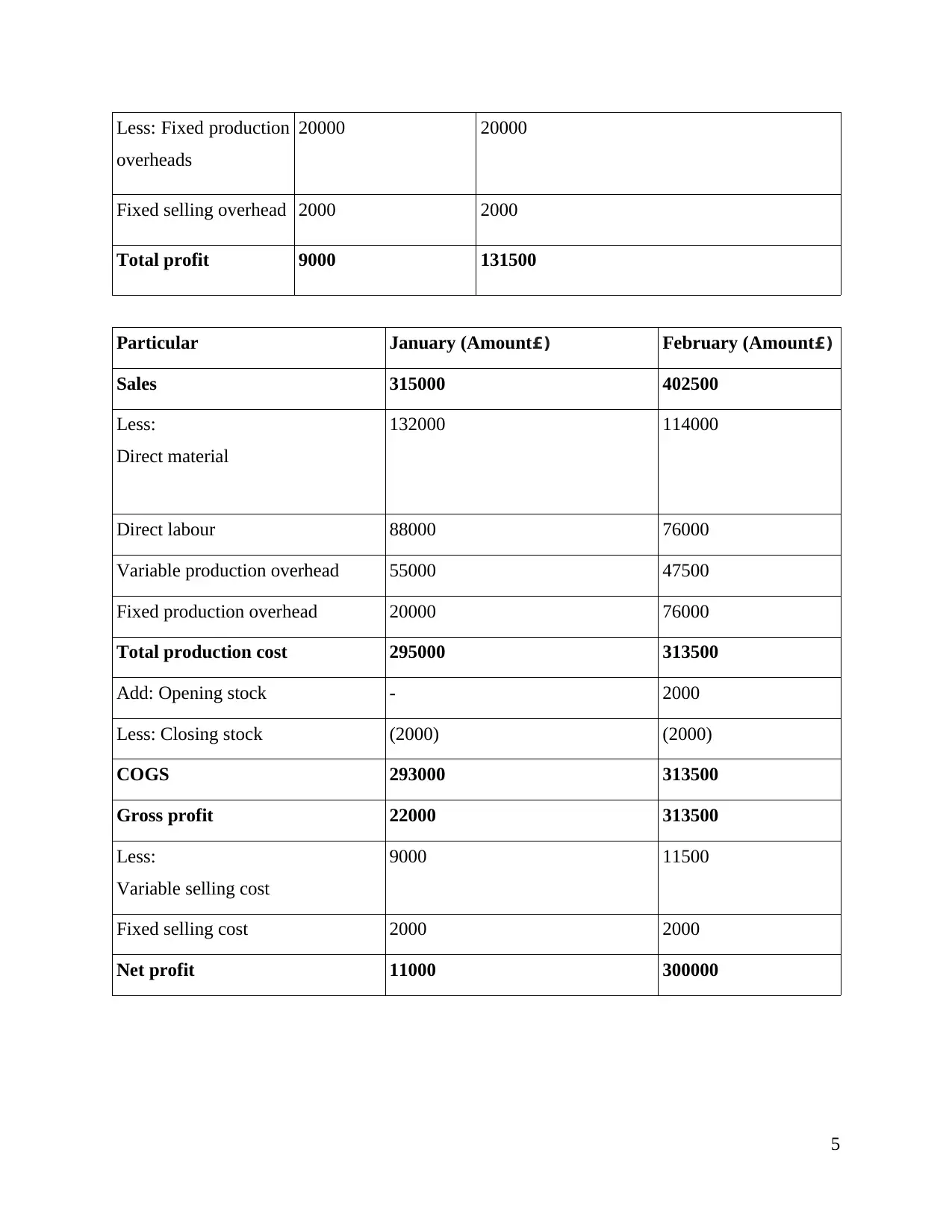
Less: Fixed production
overheads
20000 20000
Fixed selling overhead 2000 2000
Total profit 9000 131500
Particular January (Amount£) February (Amount£)
Sales 315000 402500
Less:
Direct material
132000 114000
Direct labour 88000 76000
Variable production overhead 55000 47500
Fixed production overhead 20000 76000
Total production cost 295000 313500
Add: Opening stock - 2000
Less: Closing stock (2000) (2000)
COGS 293000 313500
Gross profit 22000 313500
Less:
Variable selling cost
9000 11500
Fixed selling cost 2000 2000
Net profit 11000 300000
5
overheads
20000 20000
Fixed selling overhead 2000 2000
Total profit 9000 131500
Particular January (Amount£) February (Amount£)
Sales 315000 402500
Less:
Direct material
132000 114000
Direct labour 88000 76000
Variable production overhead 55000 47500
Fixed production overhead 20000 76000
Total production cost 295000 313500
Add: Opening stock - 2000
Less: Closing stock (2000) (2000)
COGS 293000 313500
Gross profit 22000 313500
Less:
Variable selling cost
9000 11500
Fixed selling cost 2000 2000
Net profit 11000 300000
5
Paraphrase This Document
Need a fresh take? Get an instant paraphrase of this document with our AI Paraphraser
D2 Interpretation of financial reports
Marginal costing techniques:- It is that type of management accounting method in
which there is an increase in opportunity cost by producing an additional unit. Therefore, at the
time of determining net profit company charged only variable expenses and fixed cost is already.
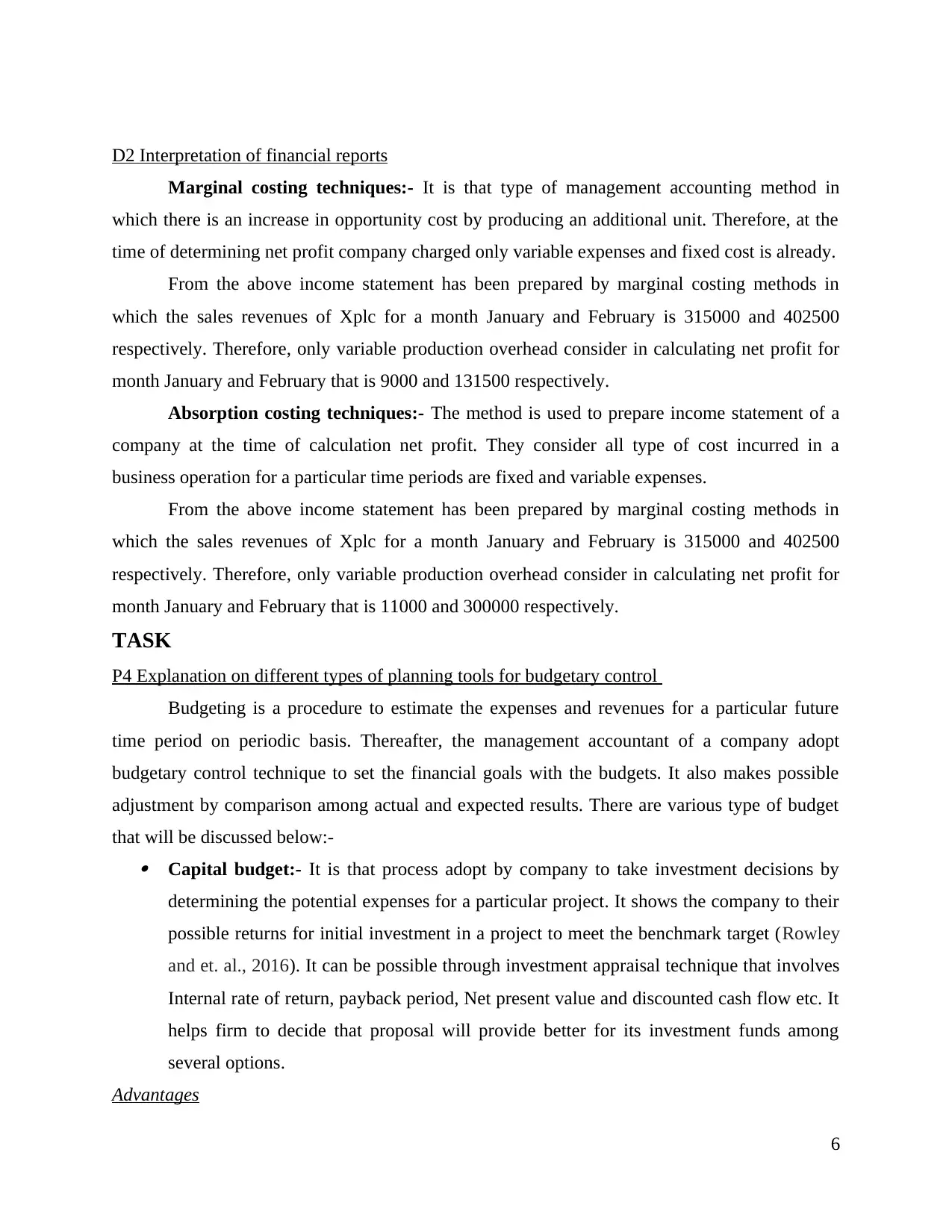
From the above income statement has been prepared by marginal costing methods in
which the sales revenues of Xplc for a month January and February is 315000 and 402500
respectively. Therefore, only variable production overhead consider in calculating net profit for
month January and February that is 9000 and 131500 respectively.
Absorption costing techniques:- The method is used to prepare income statement of a
company at the time of calculation net profit. They consider all type of cost incurred in a
business operation for a particular time periods are fixed and variable expenses.
From the above income statement has been prepared by marginal costing methods in
which the sales revenues of Xplc for a month January and February is 315000 and 402500
respectively. Therefore, only variable production overhead consider in calculating net profit for
month January and February that is 11000 and 300000 respectively.
TASK
P4 Explanation on different types of planning tools for budgetary control
Budgeting is a procedure to estimate the expenses and revenues for a particular future
time period on periodic basis. Thereafter, the management accountant of a company adopt
budgetary control technique to set the financial goals with the budgets. It also makes possible
adjustment by comparison among actual and expected results. There are various type of budget
that will be discussed below:- Capital budget:- It is that process adopt by company to take investment decisions by
determining the potential expenses for a particular project. It shows the company to their
possible returns for initial investment in a project to meet the benchmark target (Rowley
and et. al., 2016). It can be possible through investment appraisal technique that involves
Internal rate of return, payback period, Net present value and discounted cash flow etc. It
helps firm to decide that proposal will provide better for its investment funds among
several options.
Advantages
6
Marginal costing techniques:- It is that type of management accounting method in
which there is an increase in opportunity cost by producing an additional unit. Therefore, at the
time of determining net profit company charged only variable expenses and fixed cost is already.
From the above income statement has been prepared by marginal costing methods in
which the sales revenues of Xplc for a month January and February is 315000 and 402500
respectively. Therefore, only variable production overhead consider in calculating net profit for
month January and February that is 9000 and 131500 respectively.
Absorption costing techniques:- The method is used to prepare income statement of a
company at the time of calculation net profit. They consider all type of cost incurred in a
business operation for a particular time periods are fixed and variable expenses.
From the above income statement has been prepared by marginal costing methods in
which the sales revenues of Xplc for a month January and February is 315000 and 402500
respectively. Therefore, only variable production overhead consider in calculating net profit for
month January and February that is 11000 and 300000 respectively.
TASK
P4 Explanation on different types of planning tools for budgetary control
Budgeting is a procedure to estimate the expenses and revenues for a particular future
time period on periodic basis. Thereafter, the management accountant of a company adopt
budgetary control technique to set the financial goals with the budgets. It also makes possible
adjustment by comparison among actual and expected results. There are various type of budget
that will be discussed below:- Capital budget:- It is that process adopt by company to take investment decisions by
determining the potential expenses for a particular project. It shows the company to their
possible returns for initial investment in a project to meet the benchmark target (Rowley
and et. al., 2016). It can be possible through investment appraisal technique that involves
Internal rate of return, payback period, Net present value and discounted cash flow etc. It
helps firm to decide that proposal will provide better for its investment funds among
several options.
Advantages
6
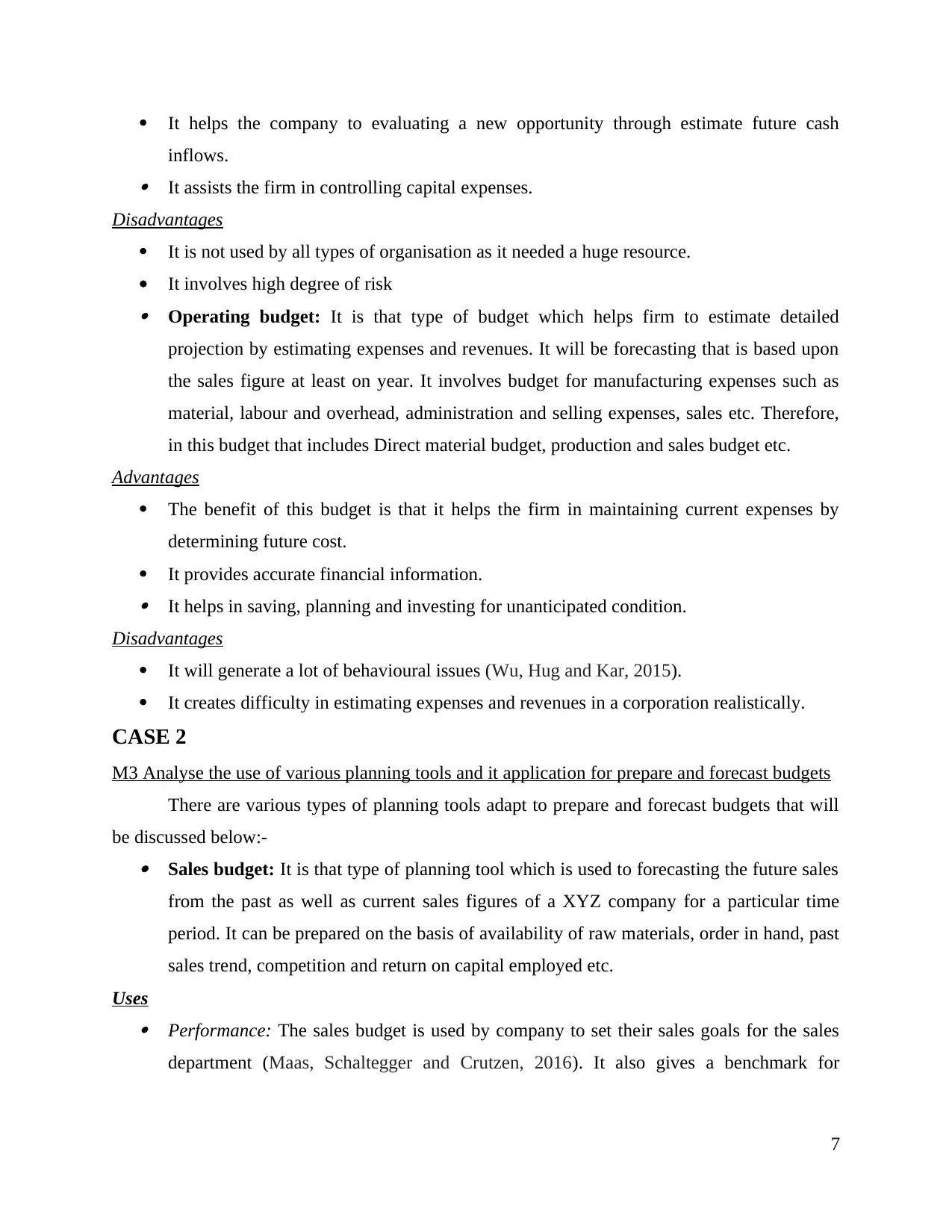
It helps the company to evaluating a new opportunity through estimate future cash
inflows. It assists the firm in controlling capital expenses.
Disadvantages
It is not used by all types of organisation as it needed a huge resource.
It involves high degree of risk Operating budget: It is that type of budget which helps firm to estimate detailed
projection by estimating expenses and revenues. It will be forecasting that is based upon
the sales figure at least on year. It involves budget for manufacturing expenses such as
material, labour and overhead, administration and selling expenses, sales etc. Therefore,
in this budget that includes Direct material budget, production and sales budget etc.
Advantages
The benefit of this budget is that it helps the firm in maintaining current expenses by
determining future cost.
It provides accurate financial information. It helps in saving, planning and investing for unanticipated condition.
Disadvantages
It will generate a lot of behavioural issues (Wu, Hug and Kar, 2015).
It creates difficulty in estimating expenses and revenues in a corporation realistically.
CASE 2
M3 Analyse the use of various planning tools and it application for prepare and forecast budgets
There are various types of planning tools adapt to prepare and forecast budgets that will
be discussed below:- Sales budget: It is that type of planning tool which is used to forecasting the future sales
from the past as well as current sales figures of a XYZ company for a particular time
period. It can be prepared on the basis of availability of raw materials, order in hand, past
sales trend, competition and return on capital employed etc.
Uses Performance: The sales budget is used by company to set their sales goals for the sales
department (Maas, Schaltegger and Crutzen, 2016). It also gives a benchmark for
7
inflows. It assists the firm in controlling capital expenses.
Disadvantages
It is not used by all types of organisation as it needed a huge resource.
It involves high degree of risk Operating budget: It is that type of budget which helps firm to estimate detailed
projection by estimating expenses and revenues. It will be forecasting that is based upon
the sales figure at least on year. It involves budget for manufacturing expenses such as
material, labour and overhead, administration and selling expenses, sales etc. Therefore,
in this budget that includes Direct material budget, production and sales budget etc.
Advantages
The benefit of this budget is that it helps the firm in maintaining current expenses by
determining future cost.
It provides accurate financial information. It helps in saving, planning and investing for unanticipated condition.
Disadvantages
It will generate a lot of behavioural issues (Wu, Hug and Kar, 2015).
It creates difficulty in estimating expenses and revenues in a corporation realistically.
CASE 2
M3 Analyse the use of various planning tools and it application for prepare and forecast budgets
There are various types of planning tools adapt to prepare and forecast budgets that will
be discussed below:- Sales budget: It is that type of planning tool which is used to forecasting the future sales
from the past as well as current sales figures of a XYZ company for a particular time
period. It can be prepared on the basis of availability of raw materials, order in hand, past
sales trend, competition and return on capital employed etc.
Uses Performance: The sales budget is used by company to set their sales goals for the sales
department (Maas, Schaltegger and Crutzen, 2016). It also gives a benchmark for
7
⊘ This is a preview!⊘
Do you want full access?
Subscribe today to unlock all pages.
Trusted by 1+ million students worldwide
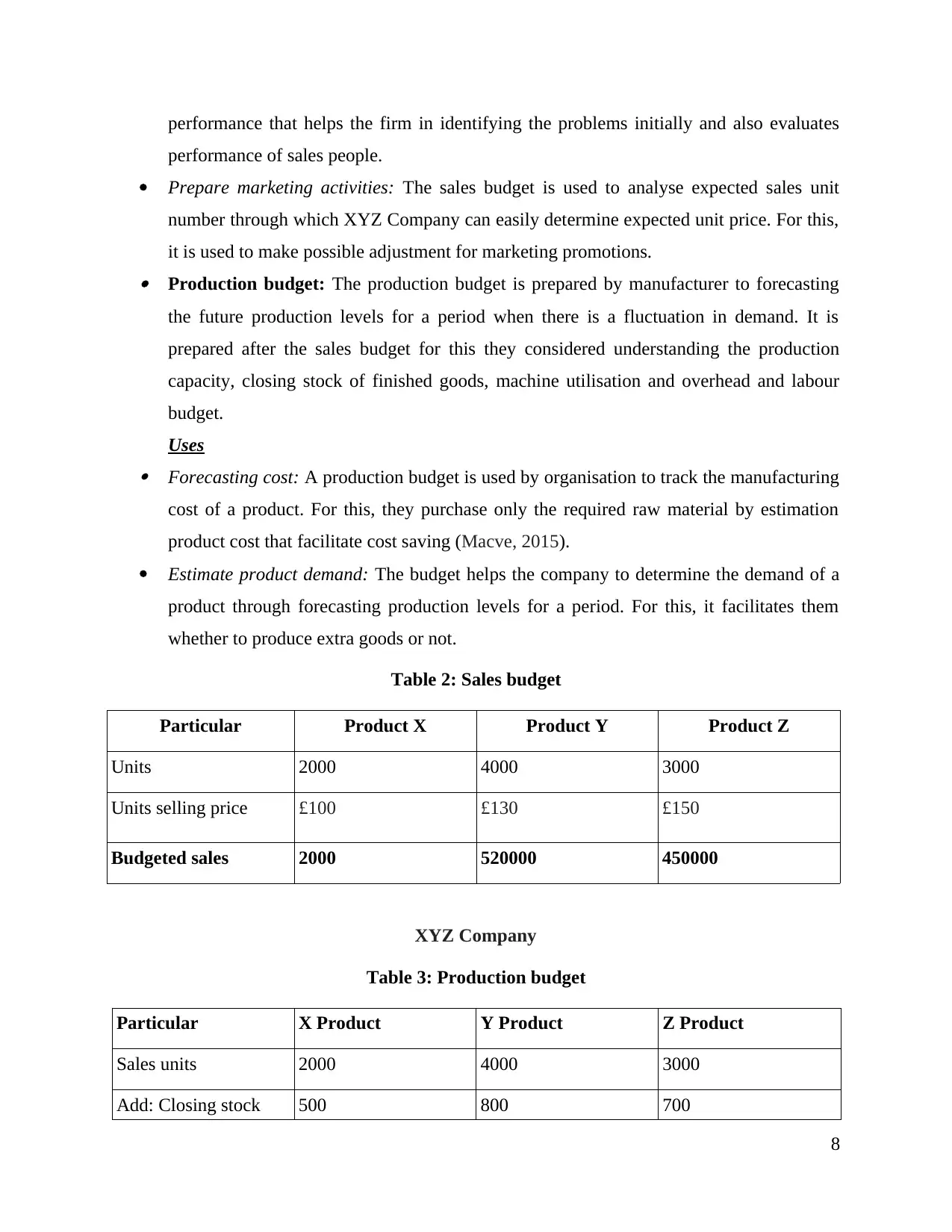
performance that helps the firm in identifying the problems initially and also evaluates
performance of sales people.
Prepare marketing activities: The sales budget is used to analyse expected sales unit
number through which XYZ Company can easily determine expected unit price. For this,
it is used to make possible adjustment for marketing promotions. Production budget: The production budget is prepared by manufacturer to forecasting
the future production levels for a period when there is a fluctuation in demand. It is
prepared after the sales budget for this they considered understanding the production
capacity, closing stock of finished goods, machine utilisation and overhead and labour
budget.
Uses Forecasting cost: A production budget is used by organisation to track the manufacturing
cost of a product. For this, they purchase only the required raw material by estimation
product cost that facilitate cost saving (Macve, 2015).
Estimate product demand: The budget helps the company to determine the demand of a
product through forecasting production levels for a period. For this, it facilitates them
whether to produce extra goods or not.
Table 2: Sales budget
Particular Product X Product Y Product Z
Units 2000 4000 3000
Units selling price £100 £130 £150
Budgeted sales 2000 520000 450000
XYZ Company
Table 3: Production budget
Particular X Product Y Product Z Product
Sales units 2000 4000 3000
Add: Closing stock 500 800 700
8
performance of sales people.
Prepare marketing activities: The sales budget is used to analyse expected sales unit
number through which XYZ Company can easily determine expected unit price. For this,
it is used to make possible adjustment for marketing promotions. Production budget: The production budget is prepared by manufacturer to forecasting
the future production levels for a period when there is a fluctuation in demand. It is
prepared after the sales budget for this they considered understanding the production
capacity, closing stock of finished goods, machine utilisation and overhead and labour
budget.
Uses Forecasting cost: A production budget is used by organisation to track the manufacturing
cost of a product. For this, they purchase only the required raw material by estimation
product cost that facilitate cost saving (Macve, 2015).
Estimate product demand: The budget helps the company to determine the demand of a
product through forecasting production levels for a period. For this, it facilitates them
whether to produce extra goods or not.
Table 2: Sales budget
Particular Product X Product Y Product Z
Units 2000 4000 3000
Units selling price £100 £130 £150
Budgeted sales 2000 520000 450000
XYZ Company
Table 3: Production budget
Particular X Product Y Product Z Product
Sales units 2000 4000 3000
Add: Closing stock 500 800 700
8
Paraphrase This Document
Need a fresh take? Get an instant paraphrase of this document with our AI Paraphraser
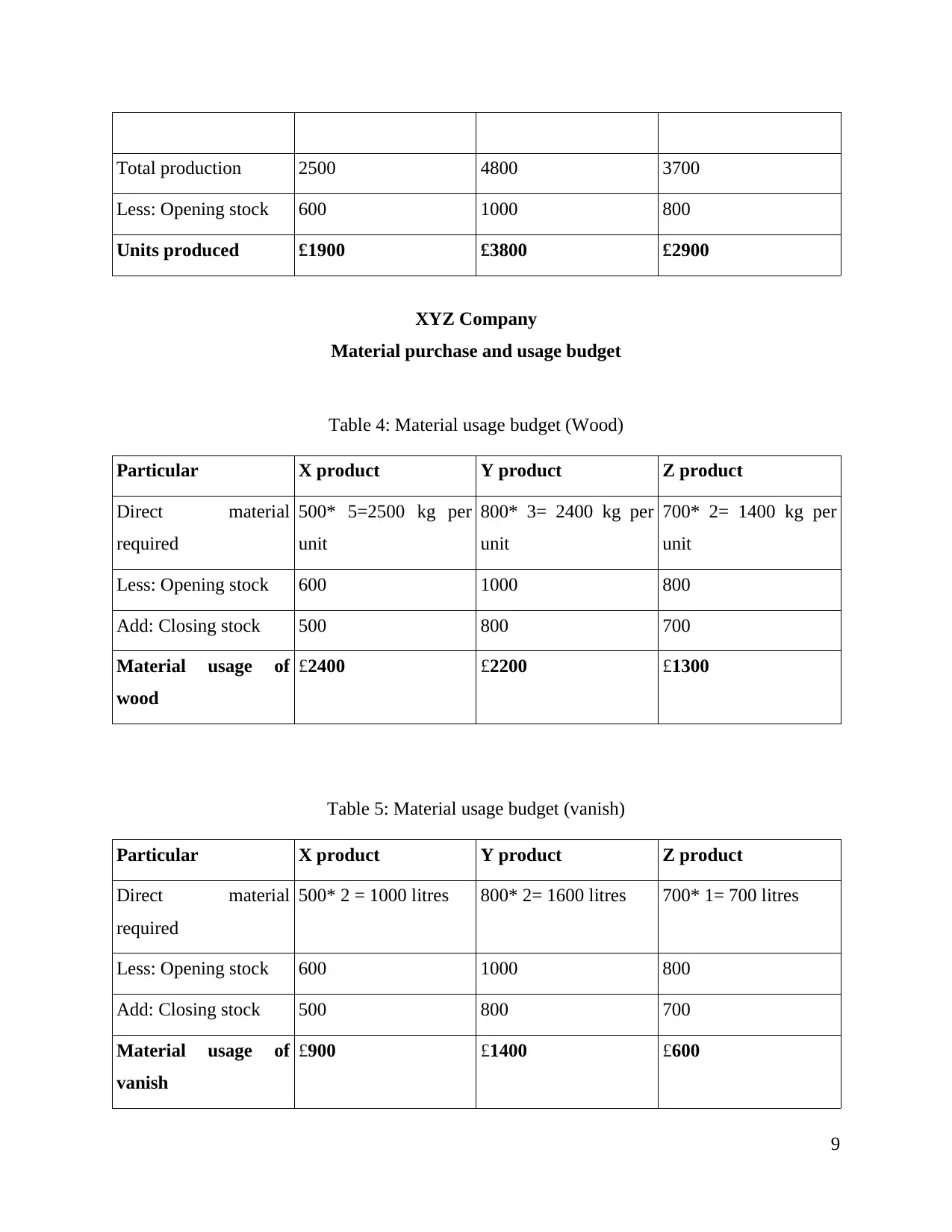
Total production 2500 4800 3700
Less: Opening stock 600 1000 800
Units produced £1900 £3800 £2900
XYZ Company
Material purchase and usage budget
Table 4: Material usage budget (Wood)
Particular X product Y product Z product
Direct material
required
500* 5=2500 kg per
unit
800* 3= 2400 kg per
unit
700* 2= 1400 kg per
unit
Less: Opening stock 600 1000 800
Add: Closing stock 500 800 700
Material usage of
wood
£2400 £2200 £1300
Table 5: Material usage budget (vanish)
Particular X product Y product Z product
Direct material
required
500* 2 = 1000 litres 800* 2= 1600 litres 700* 1= 700 litres
Less: Opening stock 600 1000 800
Add: Closing stock 500 800 700
Material usage of
vanish
£900 £1400 £600
9
Less: Opening stock 600 1000 800
Units produced £1900 £3800 £2900
XYZ Company
Material purchase and usage budget
Table 4: Material usage budget (Wood)
Particular X product Y product Z product
Direct material
required
500* 5=2500 kg per
unit
800* 3= 2400 kg per
unit
700* 2= 1400 kg per
unit
Less: Opening stock 600 1000 800
Add: Closing stock 500 800 700
Material usage of
wood
£2400 £2200 £1300
Table 5: Material usage budget (vanish)
Particular X product Y product Z product
Direct material
required
500* 2 = 1000 litres 800* 2= 1600 litres 700* 1= 700 litres
Less: Opening stock 600 1000 800
Add: Closing stock 500 800 700
Material usage of
vanish
£900 £1400 £600
9
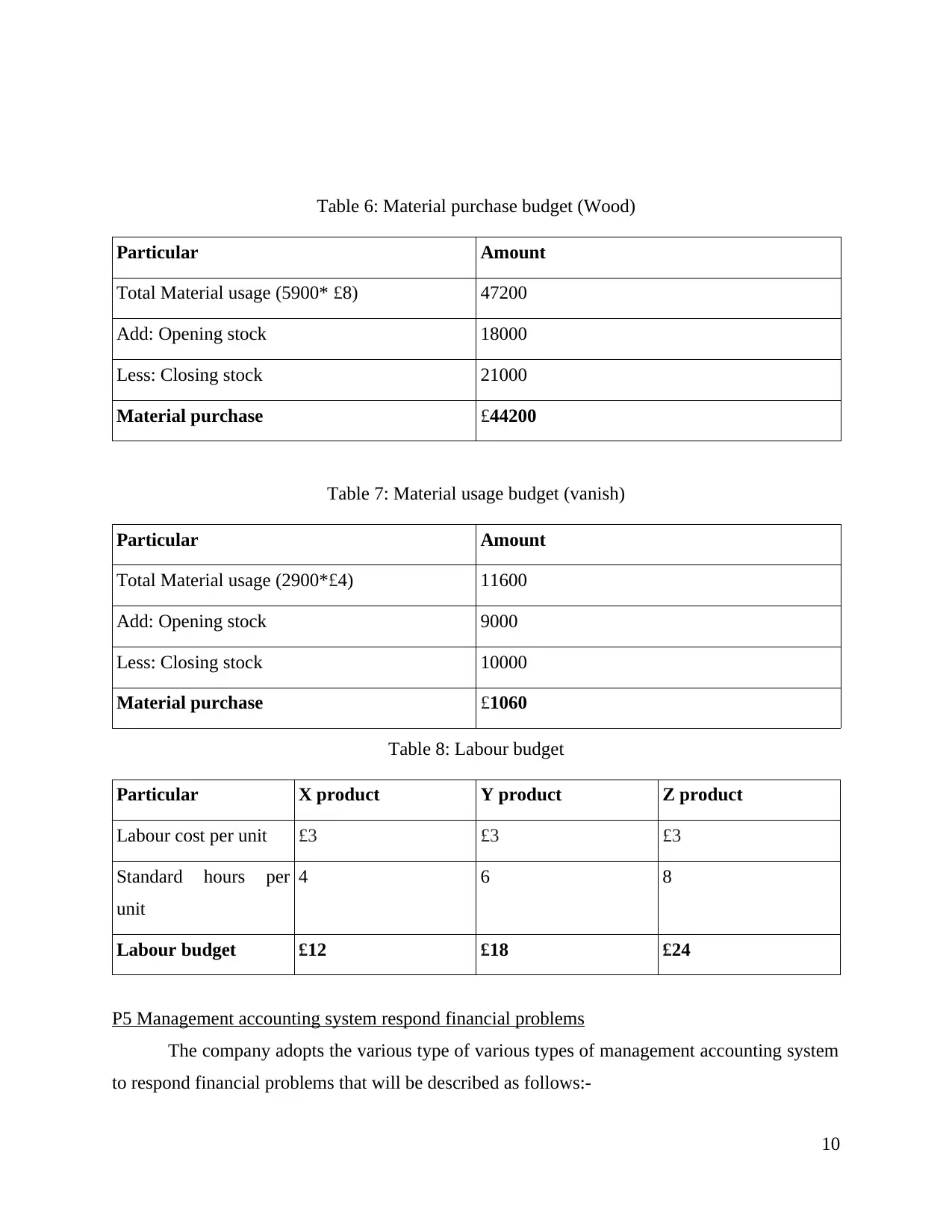
Table 6: Material purchase budget (Wood)
Particular Amount
Total Material usage (5900* £8) 47200
Add: Opening stock 18000
Less: Closing stock 21000
Material purchase £44200
Table 7: Material usage budget (vanish)
Particular Amount
Total Material usage (2900*£4) 11600
Add: Opening stock 9000
Less: Closing stock 10000
Material purchase £1060
Table 8: Labour budget
Particular X product Y product Z product
Labour cost per unit £3 £3 £3
Standard hours per
unit
4 6 8
Labour budget £12 £18 £24
P5 Management accounting system respond financial problems
The company adopts the various type of various types of management accounting system
to respond financial problems that will be described as follows:-
10
Particular Amount
Total Material usage (5900* £8) 47200
Add: Opening stock 18000
Less: Closing stock 21000
Material purchase £44200
Table 7: Material usage budget (vanish)
Particular Amount
Total Material usage (2900*£4) 11600
Add: Opening stock 9000
Less: Closing stock 10000
Material purchase £1060
Table 8: Labour budget
Particular X product Y product Z product
Labour cost per unit £3 £3 £3
Standard hours per
unit
4 6 8
Labour budget £12 £18 £24
P5 Management accounting system respond financial problems
The company adopts the various type of various types of management accounting system
to respond financial problems that will be described as follows:-
10
⊘ This is a preview!⊘
Do you want full access?
Subscribe today to unlock all pages.
Trusted by 1+ million students worldwide

1 out of 16


Related Documents


Your All-in-One AI-Powered Toolkit for Academic Success.
+13062052269
info@desklib.com
Available 24*7 on WhatsApp / Email
![[object Object]](/_next/static/media/star-bottom.7253800d.svg)
Unlock your academic potential
Copyright © 2020–2026 A2Z Services. All Rights Reserved. Developed and managed by ZUCOL.