University Management Accounting Assignment: Cost Analysis and Methods

Verified

Added on  2020/03/01

|15
|1629
|61
Homework Assignment
AI Summary
This document presents a comprehensive solution to a management accounting assignment. It begins by defining management accounting and its role in business decision-making, including the use of various reports like profit and loss statements, accounts receivable aging reports, and operating budgets. The assignment then explores the control function in management accounting and its importance in monitoring and evaluating business operations, emphasizing the use of variance analysis to identify and correct issues. It further delves into product costing, outlining its four key purposes, and provides detailed solutions to specific questions related to labor cost recording, including the treatment of overtime. The solution also covers activity-based costing (ABC), discussing its advantages over traditional costing methods, such as improved cost accuracy and better decision-making, while also acknowledging its disadvantages, like the complexity and resource requirements. Finally, the assignment addresses different cost allocation methods, including direct, step, and reciprocal services methods, providing a detailed breakdown of each approach.
Document Page
Running head: MANAGEMENT ACCOUNTING
Management Accounting
Name of the Student:
Name of the University:
Author’s Note:
tabler-icon-diamond-filled.svg

Paraphrase This Document

Need a fresh take? Get an instant paraphrase of this document with our AI Paraphraser
Document Page
1MANAGEMENT ACCOUNTING
Table of Contents
Answer to Question 1:.....................................................................................................................3
Answer to Question 2:.....................................................................................................................3
Answer to Question 3:.....................................................................................................................4
Answer to Question 4:.....................................................................................................................4
Answer to Question 5:.....................................................................................................................5
Requirement a:.............................................................................................................................5
Requirement b:.............................................................................................................................6
Answer to Question 6:.....................................................................................................................6
Answer to Question 7:.....................................................................................................................7
Answer to Question 8:.....................................................................................................................7
Requirement a:.............................................................................................................................7
Requirement b:.............................................................................................................................8
Requirement c:.............................................................................................................................8
Answer to Question 9:.....................................................................................................................9
Introduction:................................................................................................................................9
Advantages of activity based costing:.........................................................................................9
Disadvantages of activity based costing:...................................................................................10
Conclusion:................................................................................................................................10
Answer to Question 10:.................................................................................................................11
Document Page
2MANAGEMENT ACCOUNTING
a) Direct Method:.......................................................................................................................11
b) Step Method:.........................................................................................................................11
c) Reciprocal Services Method:-...............................................................................................11
Reference & Bibliography:............................................................................................................14
Document Page
3MANAGEMENT ACCOUNTING
Answer to Question 1:
Management accounting is a form of accounting process, which helps the management to
analyze the performance of the operations for business decision-making objectives. For the
analysis, the management accountants require various types of information, which are generally
collected from different forms of financial and non-financial reports. Different reports are used
for different objectives. The purposes of some mostly used managerial reports are described
below:
a) Profit & Loss Statement: Profit & loss statement is mainly used for determining the profit
earning and return generating capacities of any business firm.
b) Accounts Receivable Aging Report: Ageing receivable aging report helps to determine the
total amount owed from debtors. It is also helpful for ascertaining the credit collection period of
the firm and identifying the older debts.
c) Operating Budget: Operating budget is prepared for estimating various operating expenses, to
be incurred for achieving the revenue target. The firms can raise the necessary fund, required for
the future operation, in advance with the help of this report (DRURY, 2013).
Answer to Question 2:
Control is one of the main four functions of management accounting. It can be described
as methods of monitoring and evaluating the business operation and taking corrective measures
to revise the actual outcomes to achieve the firm’s objectives.
tabler-icon-diamond-filled.svg

Paraphrase This Document

Need a fresh take? Get an instant paraphrase of this document with our AI Paraphraser
Document Page
4MANAGEMENT ACCOUNTING
The control function in management accounting helps to prepare the performance reports
and control reports, which can be used for measuring the variances between the projected and
actual performances. The management uses these variances to identify the factors, which are
causing issues in achieving the target and take remedial actions for such factors.
Thus, the control function helps to identify the issues in the operations and to eliminate or
reduce the negative issues to enhance the performances of the business operation (Lanen, 2016).
Answer to Question 3:
The four purposes of product costing are as follows:
- To accumulate the relative production costs
- To assign the production costs to the unit of products
- To determine more production costs with more accuracy for multiple numbers of nearly
identical products
- Better control over the production costs (Edmonds et al., 2016)
Answer to Question 4:
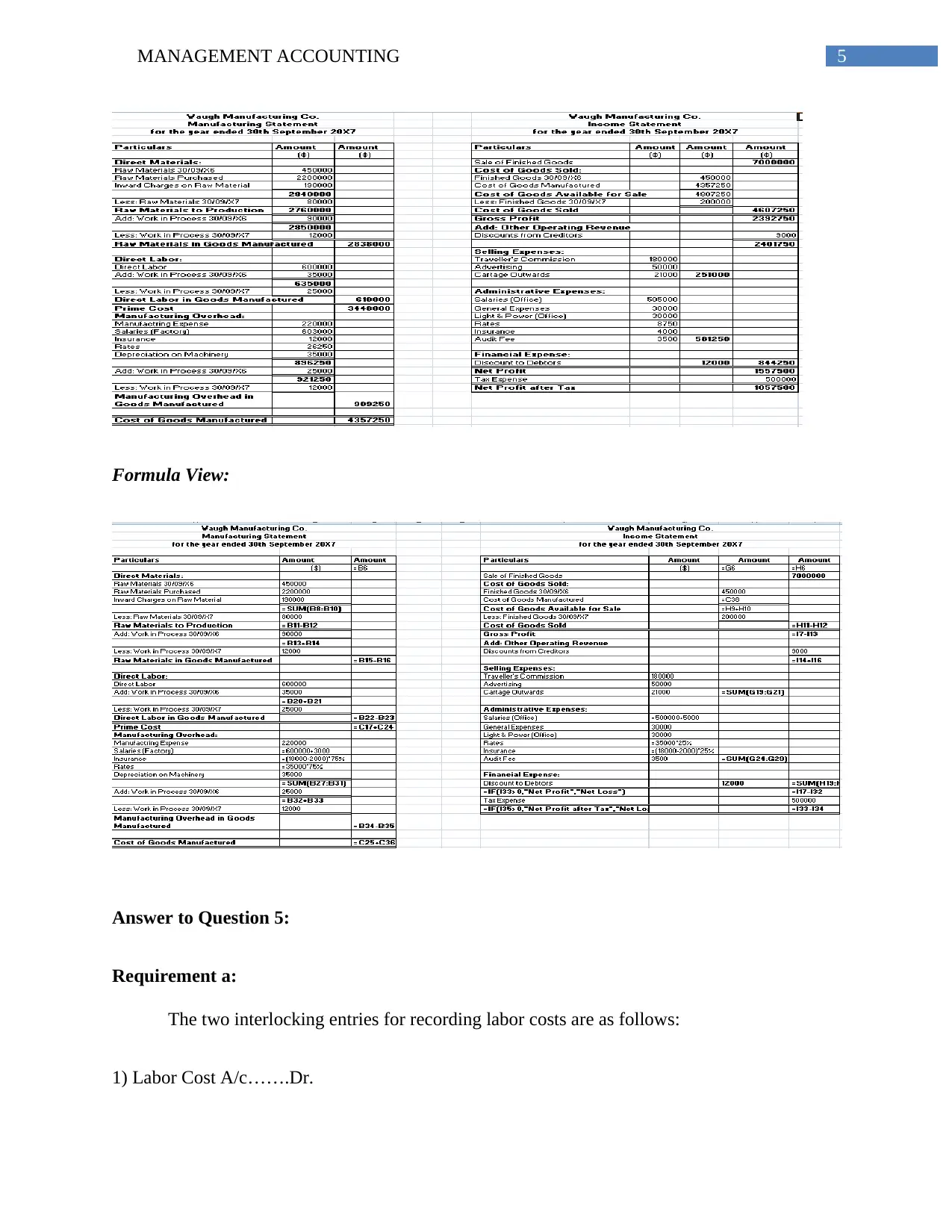
Normal View:
Document Page
5MANAGEMENT ACCOUNTING
Formula View:
Answer to Question 5:
Requirement a:
The two interlocking entries for recording labor costs are as follows:
1) Labor Cost A/c…….Dr.
Document Page
6MANAGEMENT ACCOUNTING
To, Bank A/c. / Accrued Payroll A/c.
2) Work-in-Progress A/c……Dr.
To, Labor Cost A/c.
The first entry is recorded for the payment, incurred for labor cost. If, the payment is due
then the cost should be debited to accrued payroll account. Otherwise, the cost would be debited
to bank account, to record the cash outflow. The next entry is recorded to exhibit the amount of
labor, used for production purpose.
Both the transactions are interlocked as the labors of the employees or the workers cannot
be stored for future consumption. If any worker is paid for a certain period, then his labor should
be utilized for production purpose within the period, except for advance payment. On the other
hand, if workers are used for production for a certain period, then they must be paid within a
certain timeline after the production period. Hence, it can be stated both the entries are related
with each other and each entry is the consequence of the other entry (Balakrishnan et al., 2014).
Requirement b:
Overtime payment is not directly related with the production. Hence, it should be treated
as an overhead expenses.
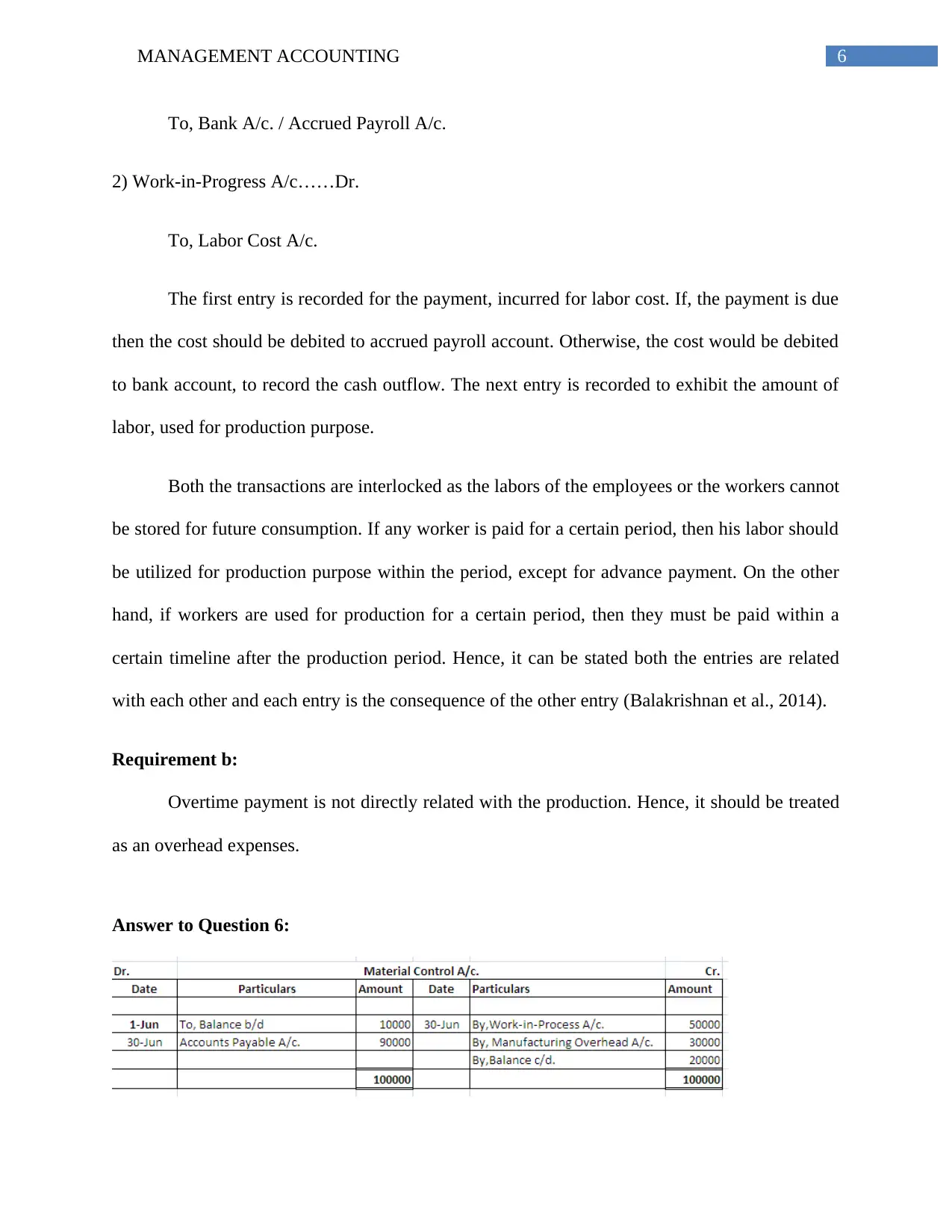
Answer to Question 6:
tabler-icon-diamond-filled.svg

Paraphrase This Document

Need a fresh take? Get an instant paraphrase of this document with our AI Paraphraser
Document Page
7MANAGEMENT ACCOUNTING
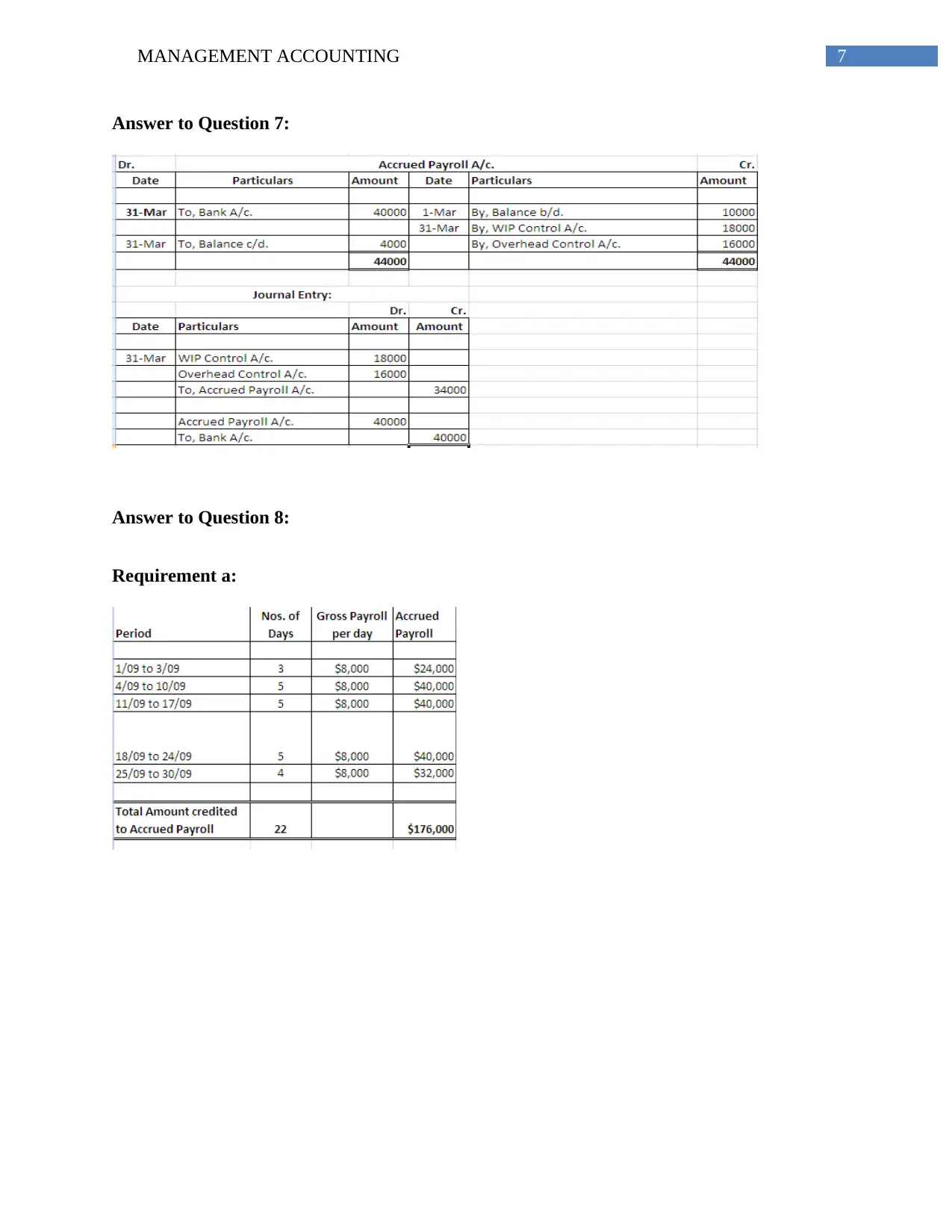
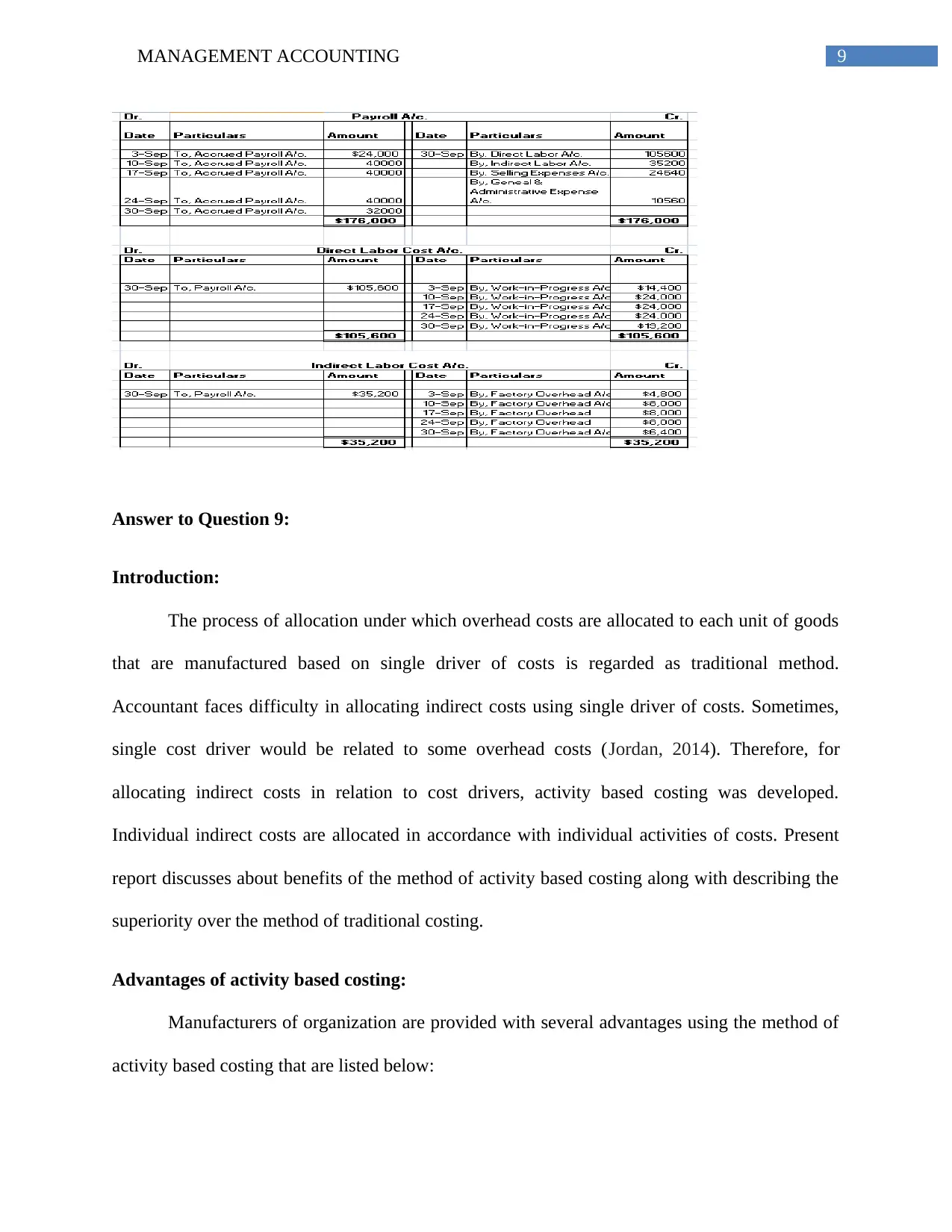
Answer to Question 7:
Answer to Question 8:
Requirement a:
Document Page
8MANAGEMENT ACCOUNTING
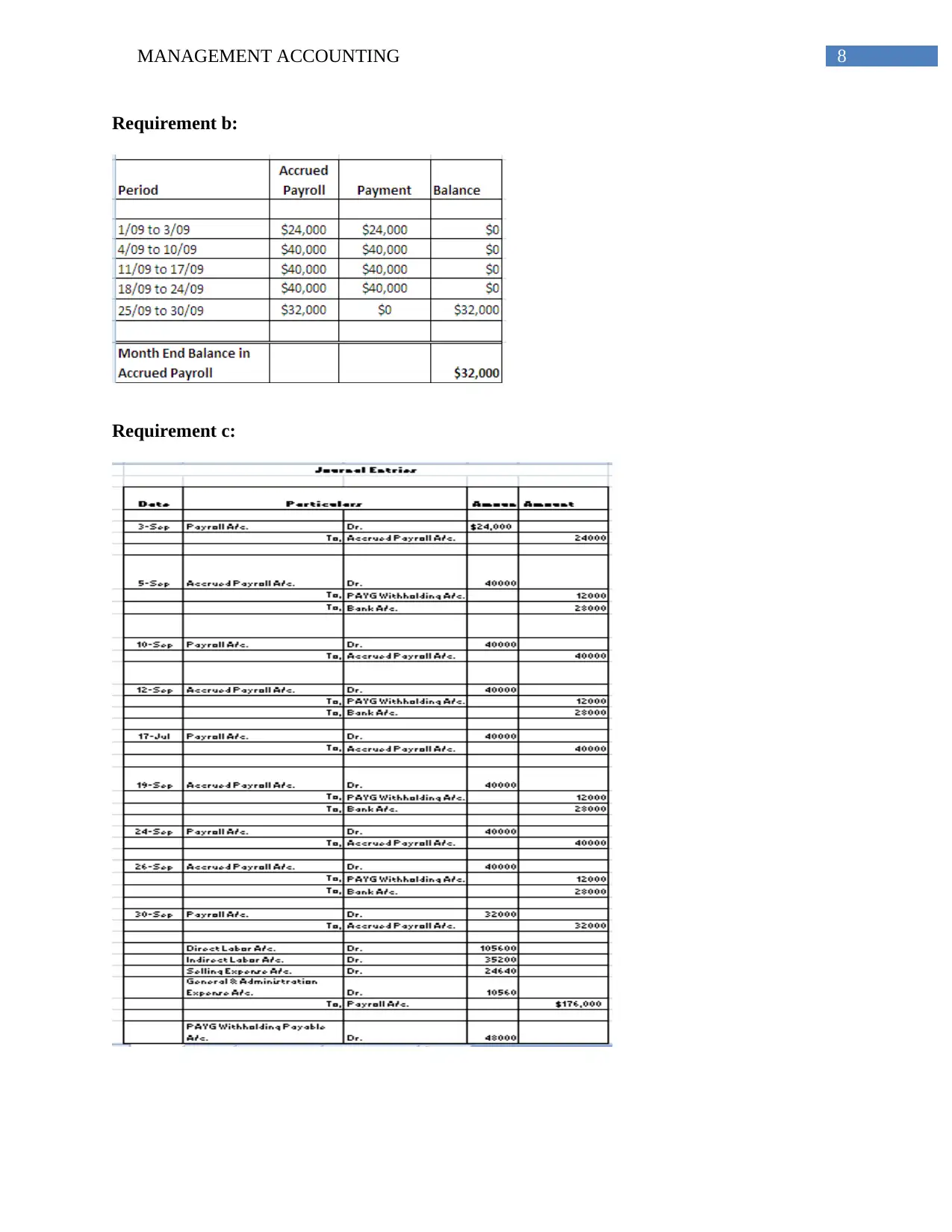
Requirement b:
Requirement c:
Document Page
9MANAGEMENT ACCOUNTING
Answer to Question 9:
Introduction:
The process of allocation under which overhead costs are allocated to each unit of goods
that are manufactured based on single driver of costs is regarded as traditional method.
Accountant faces difficulty in allocating indirect costs using single driver of costs. Sometimes,
single cost driver would be related to some overhead costs (Jordan, 2014). Therefore, for
allocating indirect costs in relation to cost drivers, activity based costing was developed.
Individual indirect costs are allocated in accordance with individual activities of costs. Present
report discusses about benefits of the method of activity based costing along with describing the
superiority over the method of traditional costing.
Advantages of activity based costing:
Manufacturers of organization are provided with several advantages using the method of
activity based costing that are listed below:
tabler-icon-diamond-filled.svg

Paraphrase This Document

Need a fresh take? Get an instant paraphrase of this document with our AI Paraphraser
Document Page
10MANAGEMENT ACCOUNTING
The cost of production is determined by selecting the cost of such activities using the
method of activity based costing.
Method make use of relevant cost driver by allocating very individual that would use the
process of allocation that are more accurate and relevant.
The production costs concerning finished goods are ascertained using the method that
helps management in making relevant decisions (Petty et al., 2015).
Disadvantages of activity based costing:
The allocation of indirect costs under this method is not possible using single driver
method for using the advanced cost of productions.
ABC avoids the method of using single drivers and does not take into account any other
drivers. The reason is that it may not be accountable for all types of costs.
There is inappropriate cost of production is the result of improper allocation of costs and
this is the reason that leads the management to take decisions regarding cost of control
and pricing system (Brigham &Ehrhardt, 2013).
Conclusion:
Manufacturers are enforced to reduce the cost of production because of increasing
competitiveness in the world. In comparison to traditional method, a proper cost of production is
provide by the method of activity based costing. From the above discussion, it can be said that
manufacturers are able to gain competitive advantage over their competitors using the method of
activity based costing. For employment of this method, substantial resources are required the
business and the organization having limited funds are not capable to employ this methods.
Document Page
11MANAGEMENT ACCOUNTING
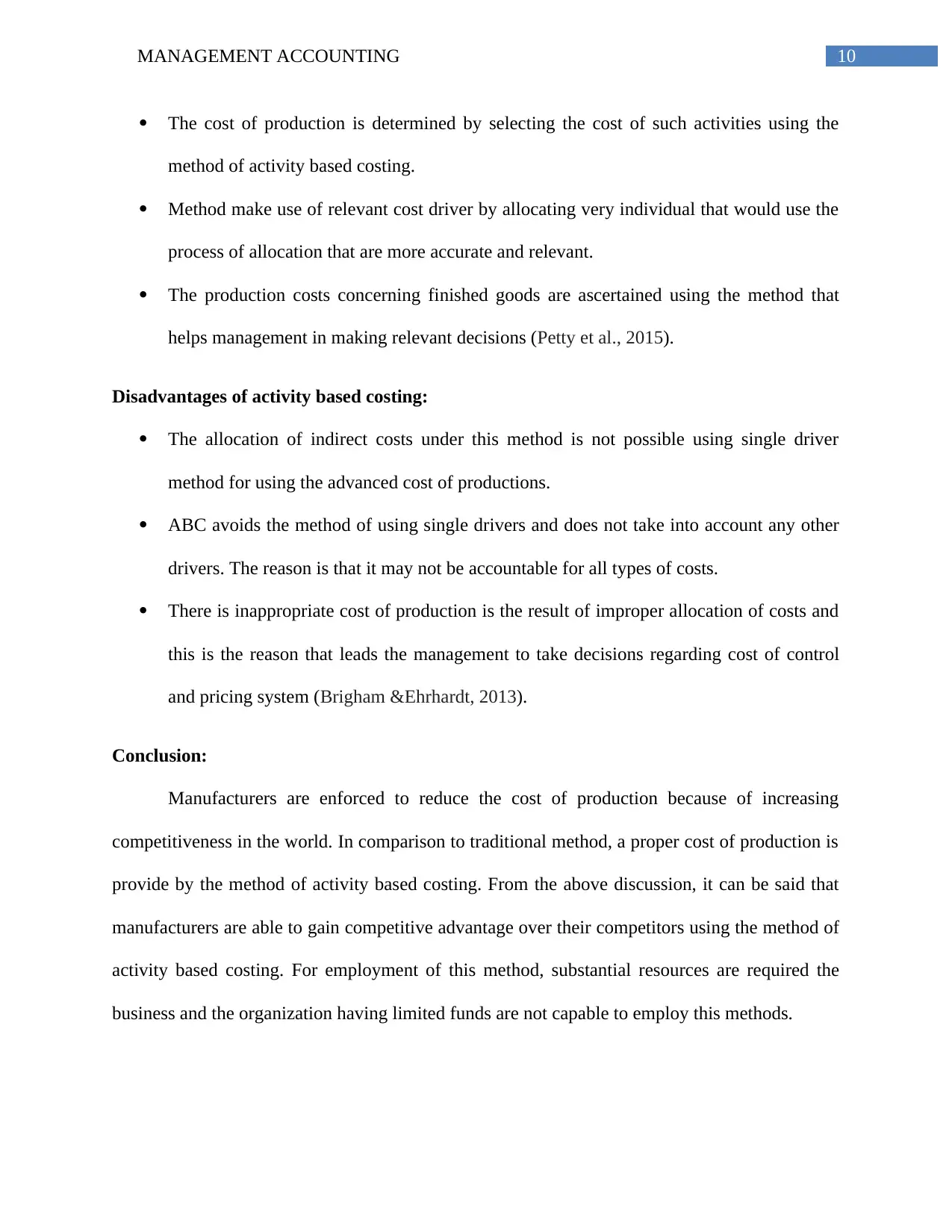
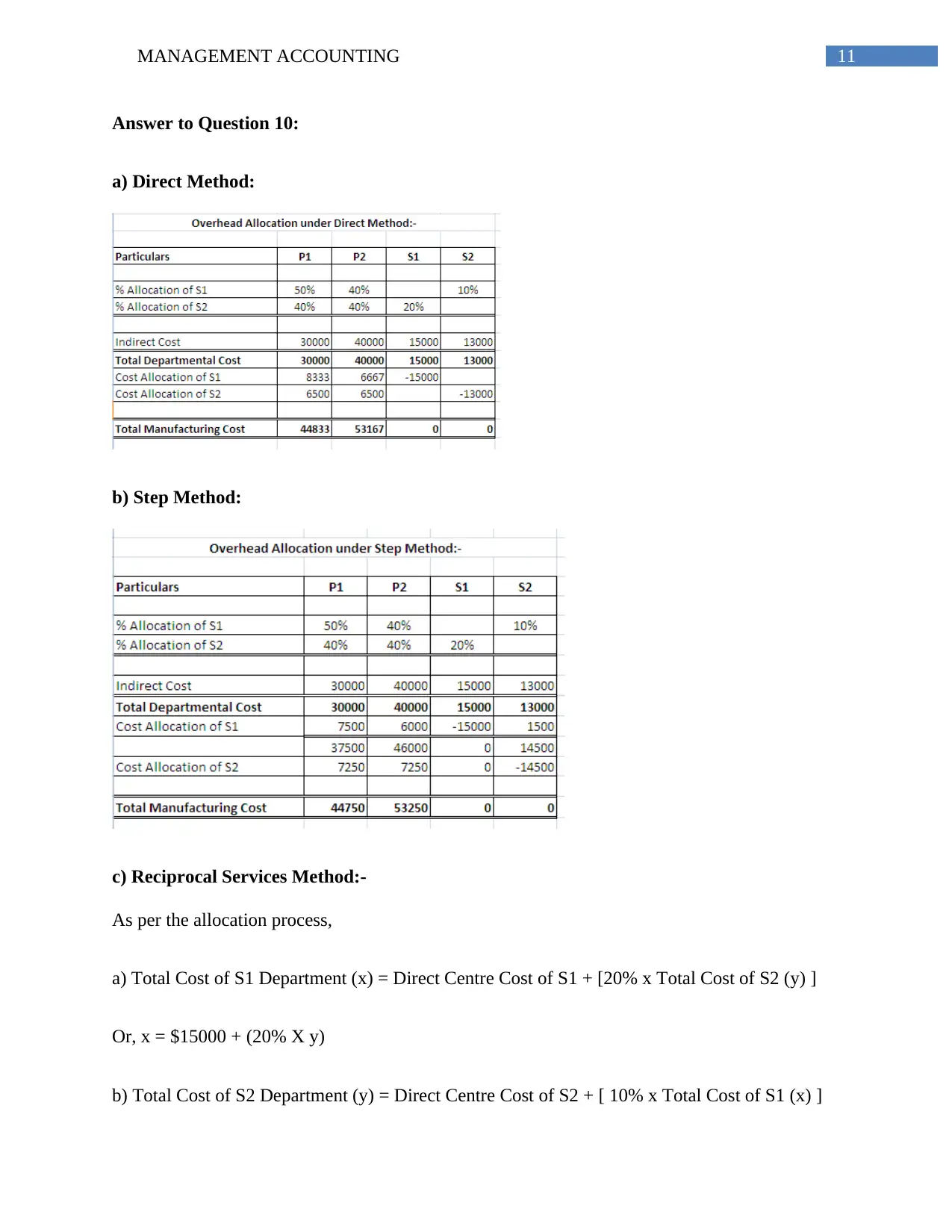
Answer to Question 10:
a) Direct Method:
b) Step Method:
c) Reciprocal Services Method:-
As per the allocation process,
a) Total Cost of S1 Department (x) = Direct Centre Cost of S1 + [20% x Total Cost of S2 (y) ]
Or, x = $15000 + (20% X y)
b) Total Cost of S2 Department (y) = Direct Centre Cost of S2 + [ 10% x Total Cost of S1 (x) ]
chevron_up_icon
1 out of 15
circle_padding
hide_on_mobile
zoom_out_icon
[object Object]