Management Accounting Assignment: Process Costing, CVP, ABC
VerifiedAdded on 2021/06/16
|17
|1872
|15
Homework Assignment
AI Summary
This management accounting assignment solution provides detailed answers to five key questions. Question 1 explores process costing systems, calculating the cost of goods transferred and work-in-process. Question 2 delves into accounting for sustainability, discussing sustainability reports, key indicators, legal environments, and staff encouragement. Question 3 examines cost behavior, including the high-low method and least square regression. Question 4 focuses on cost-volume-profit (CVP) analysis, calculating break-even points, profit projections, and the impact of changes in sales price and variable costs. Finally, Question 5 covers activity-based costing (ABC) and management, analyzing product profitability and recommending strategic decisions. The assignment utilizes various financial concepts to analyze the provided financial information.
Running head: MANAGEMENT ACCOUNTING
Management Accounting
Name of the Student:
Name of the University:
Author’s Note:
Course ID:
Management Accounting
Name of the Student:
Name of the University:
Author’s Note:
Course ID:

Paraphrase This Document
Need a fresh take? Get an instant paraphrase of this document with our AI Paraphraser
1MANAGEMENT ACCOUNTING
Table of Contents
Question 1: Process Costing Systems..............................................................................................3
Part 1:...........................................................................................................................................3
(a) Cost of units transferred to finished goods inventory during August:...............................3
(b) Cost of the Finishing Department's work in process inventory on 31 August:..................3
Part 2:...........................................................................................................................................3
Question 2: Accounting for sustainability.......................................................................................4
Part 1:...........................................................................................................................................4
Part 2:...........................................................................................................................................4
Part 3:...........................................................................................................................................5
Part 4:...........................................................................................................................................5
Question 3: Cost behaviour.............................................................................................................6
Part 1:...........................................................................................................................................6
Part 2:...........................................................................................................................................6
Part 4:...........................................................................................................................................7
Part 5:...........................................................................................................................................7
Part 6:...........................................................................................................................................7
Part 7:...........................................................................................................................................8
Question 4: Cost-volume-profit analysis.........................................................................................8
Table of Contents
Question 1: Process Costing Systems..............................................................................................3
Part 1:...........................................................................................................................................3
(a) Cost of units transferred to finished goods inventory during August:...............................3
(b) Cost of the Finishing Department's work in process inventory on 31 August:..................3
Part 2:...........................................................................................................................................3
Question 2: Accounting for sustainability.......................................................................................4
Part 1:...........................................................................................................................................4
Part 2:...........................................................................................................................................4
Part 3:...........................................................................................................................................5
Part 4:...........................................................................................................................................5
Question 3: Cost behaviour.............................................................................................................6
Part 1:...........................................................................................................................................6
Part 2:...........................................................................................................................................6
Part 4:...........................................................................................................................................7
Part 5:...........................................................................................................................................7
Part 6:...........................................................................................................................................7
Part 7:...........................................................................................................................................8
Question 4: Cost-volume-profit analysis.........................................................................................8
2MANAGEMENT ACCOUNTING
Part 1:...........................................................................................................................................8
Part 2:...........................................................................................................................................9
Part 3:.........................................................................................................................................10
Part 4:.........................................................................................................................................10
Part 5:.........................................................................................................................................11
Part 6:.........................................................................................................................................13
Question 5: Activity-based costing and management...................................................................14
Part 1:.........................................................................................................................................14
Part 2:.........................................................................................................................................14
Part 3:.........................................................................................................................................14
Part 5:.........................................................................................................................................15
Part 6:.........................................................................................................................................16
Part 7:.........................................................................................................................................16
Part 8:.........................................................................................................................................17
References......................................................................................................................................18
Part 1:...........................................................................................................................................8
Part 2:...........................................................................................................................................9
Part 3:.........................................................................................................................................10
Part 4:.........................................................................................................................................10
Part 5:.........................................................................................................................................11
Part 6:.........................................................................................................................................13
Question 5: Activity-based costing and management...................................................................14
Part 1:.........................................................................................................................................14
Part 2:.........................................................................................................................................14
Part 3:.........................................................................................................................................14
Part 5:.........................................................................................................................................15
Part 6:.........................................................................................................................................16
Part 7:.........................................................................................................................................16
Part 8:.........................................................................................................................................17
References......................................................................................................................................18
⊘ This is a preview!⊘
Do you want full access?
Subscribe today to unlock all pages.

Trusted by 1+ million students worldwide
3MANAGEMENT ACCOUNTING
Question 1: Process Costing Systems
Part 1:
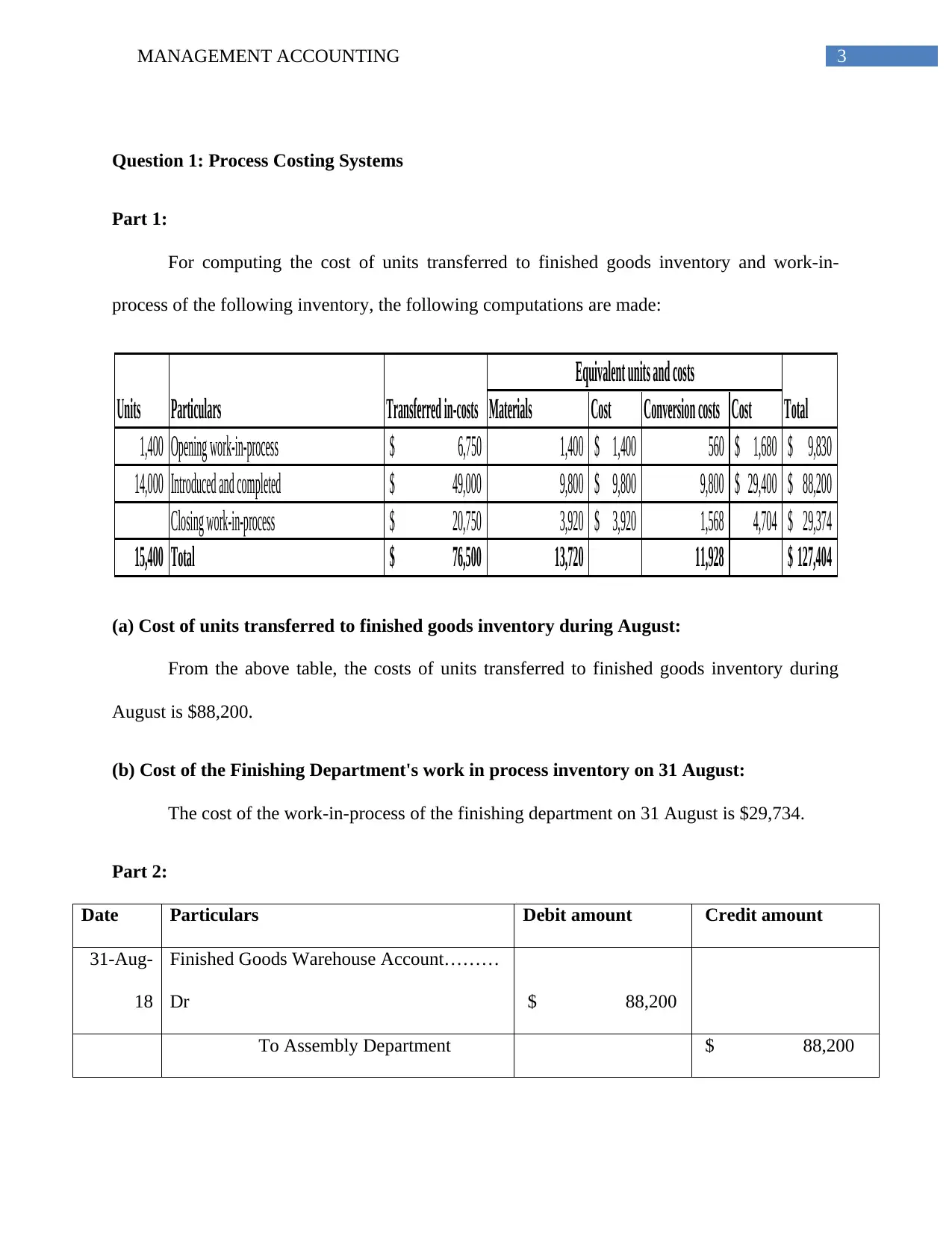
For computing the cost of units transferred to finished goods inventory and work-in-
process of the following inventory, the following computations are made:
Materials Cost Conversion costs Cost
1,400 Opening work-in-process 6,750$ 1,400 1,400$ 560 1,680$ 9,830$
14,000 Introduced and completed 49,000$ 9,800 9,800$ 9,800 29,400$ 88,200$
Closing work-in-process 20,750$ 3,920 3,920$ 1,568 4,704 29,374$
15,400 Total 76,500$ 13,720 11,928 127,404$
Particulars Transferred in-costs
Equivalent units and costs
TotalUnits
(a) Cost of units transferred to finished goods inventory during August:
From the above table, the costs of units transferred to finished goods inventory during
August is $88,200.
(b) Cost of the Finishing Department's work in process inventory on 31 August:
The cost of the work-in-process of the finishing department on 31 August is $29,734.
Part 2:
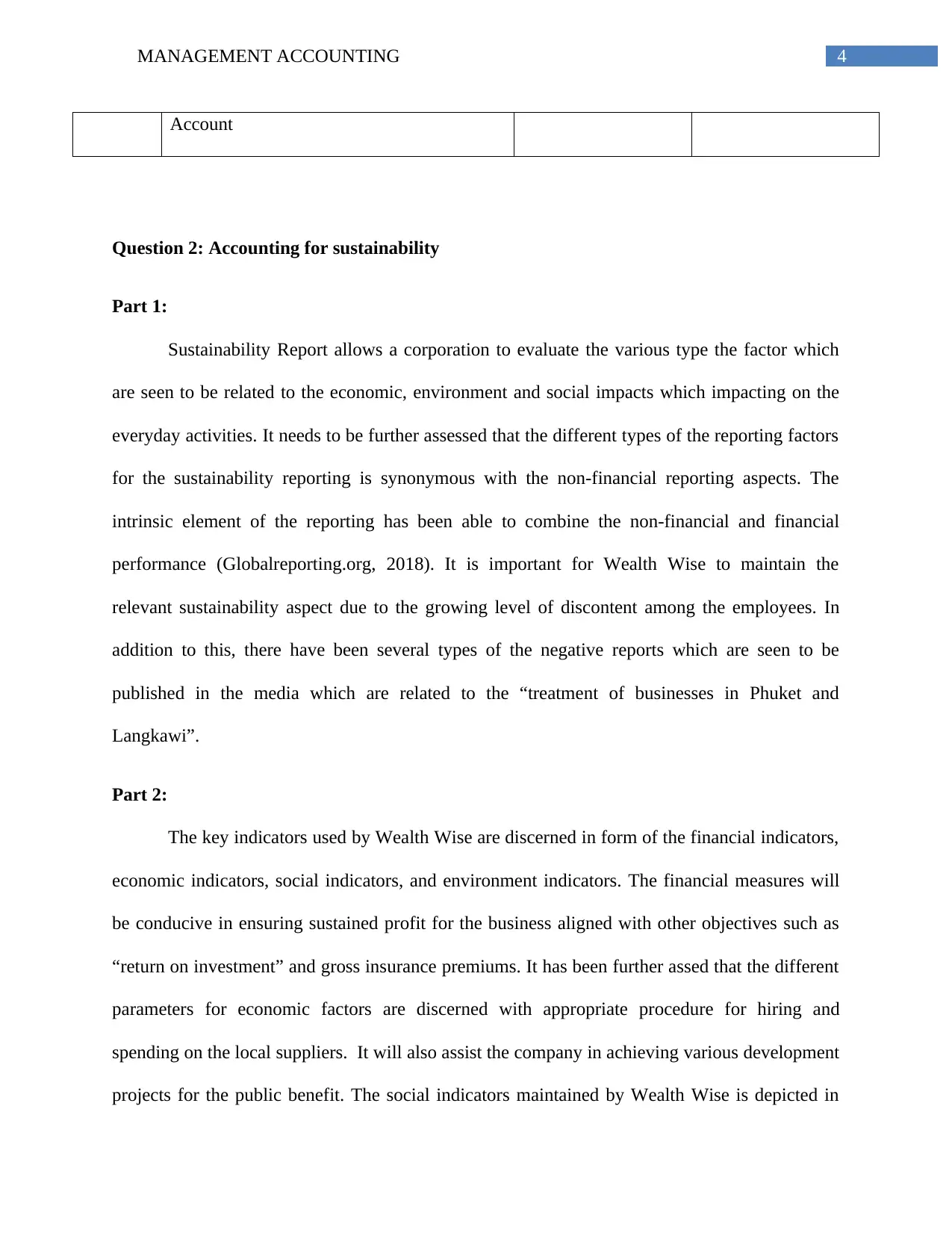
Date Particulars Debit amount Credit amount
31-Aug-
18
Finished Goods Warehouse Account………
Dr $ 88,200
To Assembly Department $ 88,200
Question 1: Process Costing Systems
Part 1:
For computing the cost of units transferred to finished goods inventory and work-in-
process of the following inventory, the following computations are made:
Materials Cost Conversion costs Cost
1,400 Opening work-in-process 6,750$ 1,400 1,400$ 560 1,680$ 9,830$
14,000 Introduced and completed 49,000$ 9,800 9,800$ 9,800 29,400$ 88,200$
Closing work-in-process 20,750$ 3,920 3,920$ 1,568 4,704 29,374$
15,400 Total 76,500$ 13,720 11,928 127,404$
Particulars Transferred in-costs
Equivalent units and costs
TotalUnits
(a) Cost of units transferred to finished goods inventory during August:
From the above table, the costs of units transferred to finished goods inventory during
August is $88,200.
(b) Cost of the Finishing Department's work in process inventory on 31 August:
The cost of the work-in-process of the finishing department on 31 August is $29,734.
Part 2:
Date Particulars Debit amount Credit amount
31-Aug-
18
Finished Goods Warehouse Account………
Dr $ 88,200
To Assembly Department $ 88,200
Paraphrase This Document
Need a fresh take? Get an instant paraphrase of this document with our AI Paraphraser
4MANAGEMENT ACCOUNTING
Account
Question 2: Accounting for sustainability
Part 1:
Sustainability Report allows a corporation to evaluate the various type the factor which
are seen to be related to the economic, environment and social impacts which impacting on the
everyday activities. It needs to be further assessed that the different types of the reporting factors
for the sustainability reporting is synonymous with the non-financial reporting aspects. The
intrinsic element of the reporting has been able to combine the non-financial and financial
performance (Globalreporting.org, 2018). It is important for Wealth Wise to maintain the
relevant sustainability aspect due to the growing level of discontent among the employees. In
addition to this, there have been several types of the negative reports which are seen to be
published in the media which are related to the “treatment of businesses in Phuket and
Langkawi”.
Part 2:
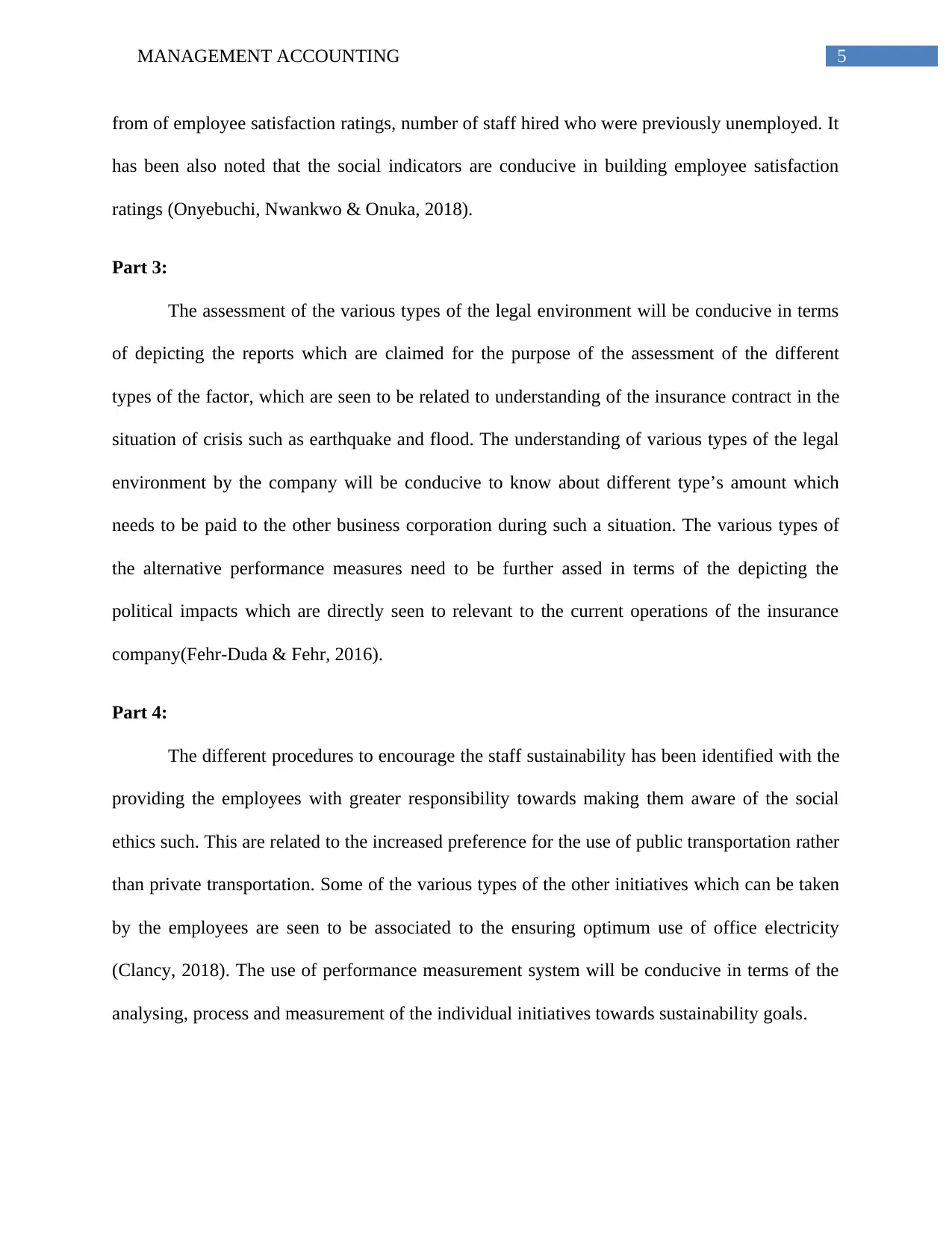
The key indicators used by Wealth Wise are discerned in form of the financial indicators,
economic indicators, social indicators, and environment indicators. The financial measures will
be conducive in ensuring sustained profit for the business aligned with other objectives such as
“return on investment” and gross insurance premiums. It has been further assed that the different
parameters for economic factors are discerned with appropriate procedure for hiring and
spending on the local suppliers. It will also assist the company in achieving various development
projects for the public benefit. The social indicators maintained by Wealth Wise is depicted in
Account
Question 2: Accounting for sustainability
Part 1:
Sustainability Report allows a corporation to evaluate the various type the factor which
are seen to be related to the economic, environment and social impacts which impacting on the
everyday activities. It needs to be further assessed that the different types of the reporting factors
for the sustainability reporting is synonymous with the non-financial reporting aspects. The
intrinsic element of the reporting has been able to combine the non-financial and financial
performance (Globalreporting.org, 2018). It is important for Wealth Wise to maintain the
relevant sustainability aspect due to the growing level of discontent among the employees. In
addition to this, there have been several types of the negative reports which are seen to be
published in the media which are related to the “treatment of businesses in Phuket and
Langkawi”.
Part 2:
The key indicators used by Wealth Wise are discerned in form of the financial indicators,
economic indicators, social indicators, and environment indicators. The financial measures will
be conducive in ensuring sustained profit for the business aligned with other objectives such as
“return on investment” and gross insurance premiums. It has been further assed that the different
parameters for economic factors are discerned with appropriate procedure for hiring and
spending on the local suppliers. It will also assist the company in achieving various development
projects for the public benefit. The social indicators maintained by Wealth Wise is depicted in
5MANAGEMENT ACCOUNTING
from of employee satisfaction ratings, number of staff hired who were previously unemployed. It
has been also noted that the social indicators are conducive in building employee satisfaction
ratings (Onyebuchi, Nwankwo & Onuka, 2018).
Part 3:
The assessment of the various types of the legal environment will be conducive in terms
of depicting the reports which are claimed for the purpose of the assessment of the different
types of the factor, which are seen to be related to understanding of the insurance contract in the
situation of crisis such as earthquake and flood. The understanding of various types of the legal
environment by the company will be conducive to know about different type’s amount which
needs to be paid to the other business corporation during such a situation. The various types of
the alternative performance measures need to be further assed in terms of the depicting the
political impacts which are directly seen to relevant to the current operations of the insurance
company(Fehr-Duda & Fehr, 2016).
Part 4:
The different procedures to encourage the staff sustainability has been identified with the
providing the employees with greater responsibility towards making them aware of the social
ethics such. This are related to the increased preference for the use of public transportation rather
than private transportation. Some of the various types of the other initiatives which can be taken
by the employees are seen to be associated to the ensuring optimum use of office electricity
(Clancy, 2018). The use of performance measurement system will be conducive in terms of the
analysing, process and measurement of the individual initiatives towards sustainability goals.
from of employee satisfaction ratings, number of staff hired who were previously unemployed. It
has been also noted that the social indicators are conducive in building employee satisfaction
ratings (Onyebuchi, Nwankwo & Onuka, 2018).
Part 3:
The assessment of the various types of the legal environment will be conducive in terms
of depicting the reports which are claimed for the purpose of the assessment of the different
types of the factor, which are seen to be related to understanding of the insurance contract in the
situation of crisis such as earthquake and flood. The understanding of various types of the legal
environment by the company will be conducive to know about different type’s amount which
needs to be paid to the other business corporation during such a situation. The various types of
the alternative performance measures need to be further assed in terms of the depicting the
political impacts which are directly seen to relevant to the current operations of the insurance
company(Fehr-Duda & Fehr, 2016).
Part 4:
The different procedures to encourage the staff sustainability has been identified with the
providing the employees with greater responsibility towards making them aware of the social
ethics such. This are related to the increased preference for the use of public transportation rather
than private transportation. Some of the various types of the other initiatives which can be taken
by the employees are seen to be associated to the ensuring optimum use of office electricity
(Clancy, 2018). The use of performance measurement system will be conducive in terms of the
analysing, process and measurement of the individual initiatives towards sustainability goals.
⊘ This is a preview!⊘
Do you want full access?
Subscribe today to unlock all pages.
Trusted by 1+ million students worldwide
6MANAGEMENT ACCOUNTING
Question 3: Cost behaviour
Part 1:
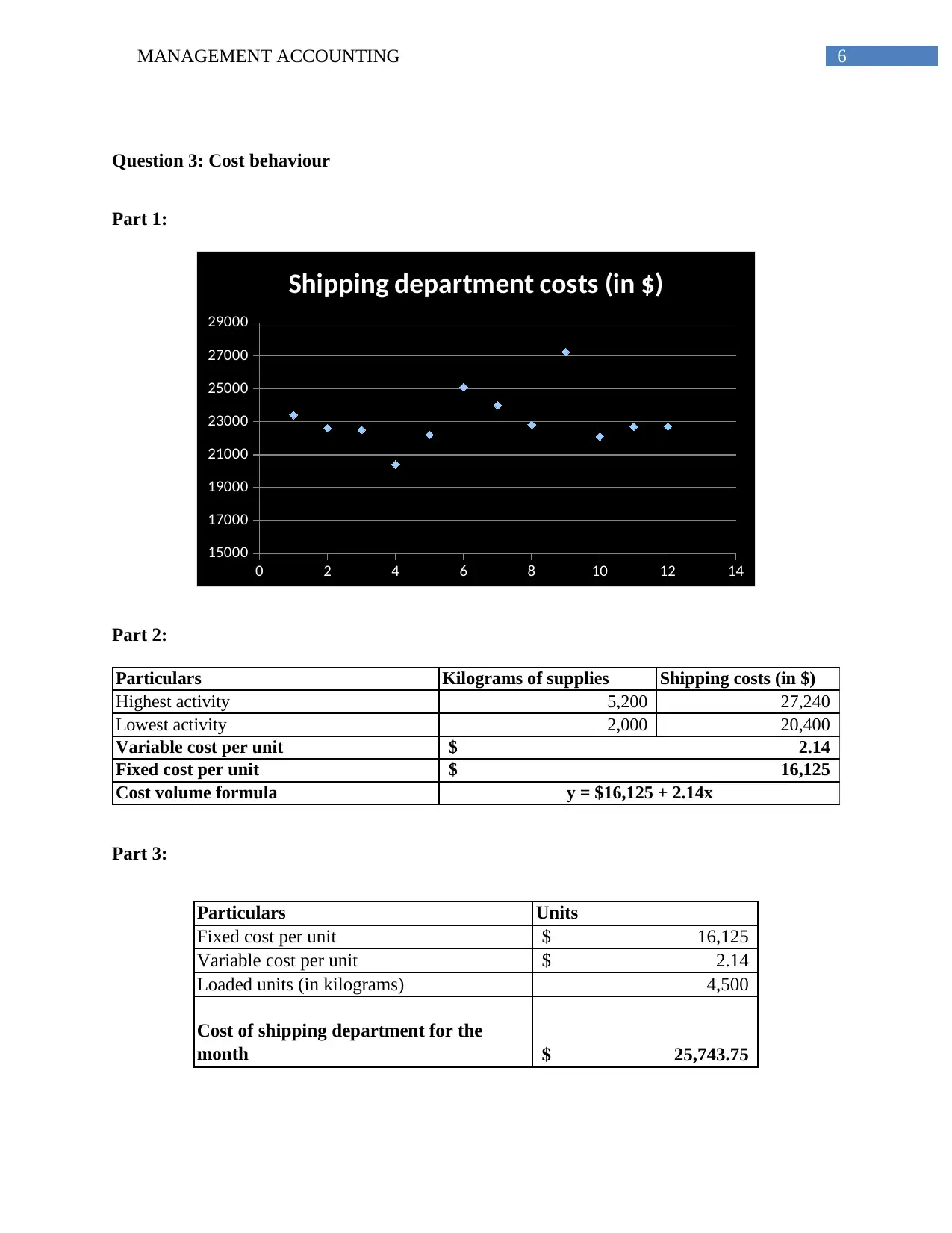
0 2 4 6 8 10 12 14
15000
17000
19000
21000
23000
25000
27000
29000
Shipping department costs (in $)
Part 2:
Particulars Kilograms of supplies Shipping costs (in $)
Highest activity 5,200 27,240
Lowest activity 2,000 20,400
Variable cost per unit
Fixed cost per unit
Cost volume formula
2.14$
16,125$
y = $16,125 + 2.14x
Part 3:
Particulars Units
Fixed cost per unit 16,125$
Variable cost per unit 2.14$
Loaded units (in kilograms) 4,500
Cost of shipping department for the
month 25,743.75$
Question 3: Cost behaviour
Part 1:
0 2 4 6 8 10 12 14
15000
17000
19000
21000
23000
25000
27000
29000
Shipping department costs (in $)
Part 2:
Particulars Kilograms of supplies Shipping costs (in $)
Highest activity 5,200 27,240
Lowest activity 2,000 20,400
Variable cost per unit
Fixed cost per unit
Cost volume formula
2.14$
16,125$
y = $16,125 + 2.14x
Part 3:
Particulars Units
Fixed cost per unit 16,125$
Variable cost per unit 2.14$
Loaded units (in kilograms) 4,500
Cost of shipping department for the
month 25,743.75$
Paraphrase This Document
Need a fresh take? Get an instant paraphrase of this document with our AI Paraphraser
7MANAGEMENT ACCOUNTING
Part 4:
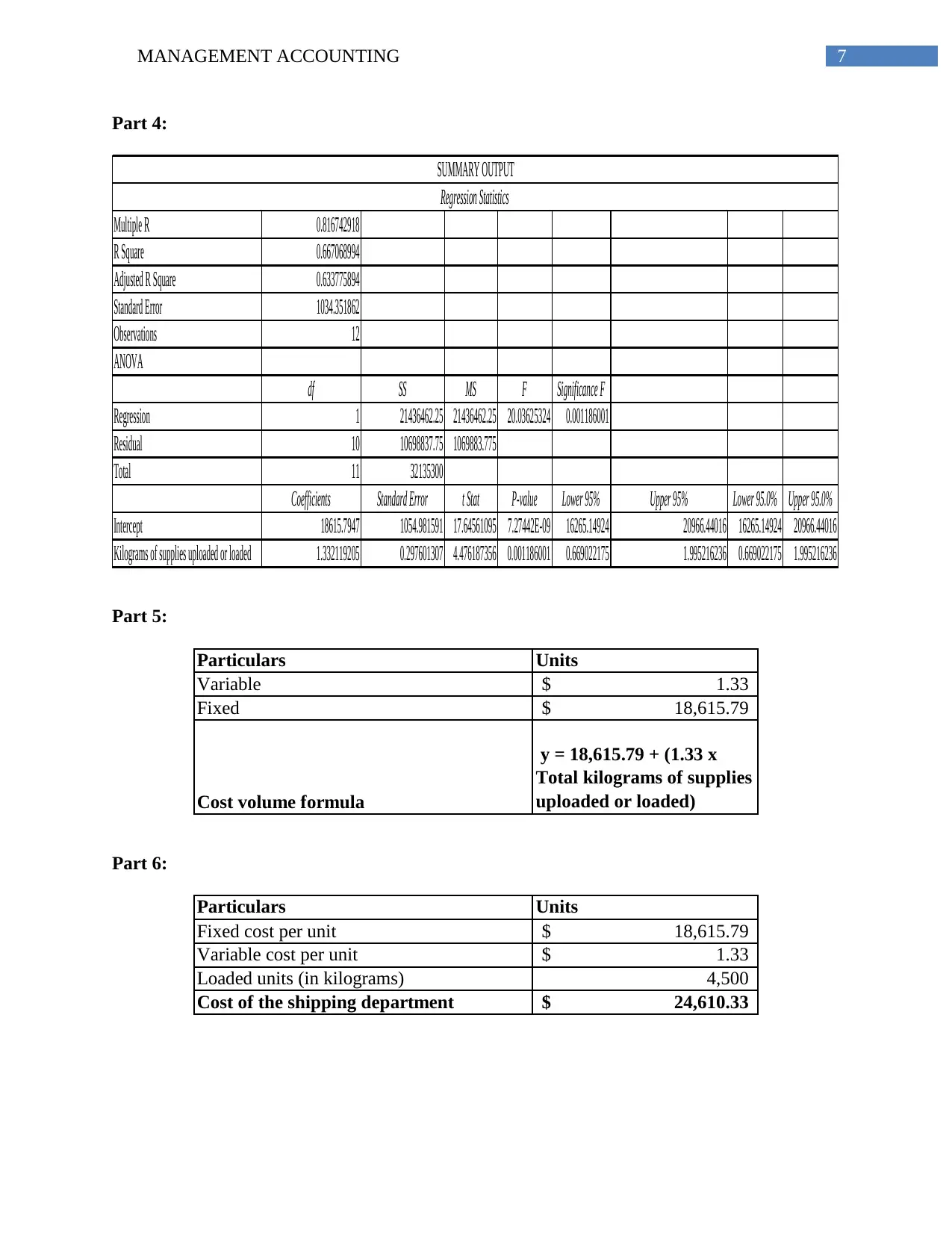
Multiple R 0.816742918
R Square 0.667068994
Adjusted R Square 0.633775894
Standard Error 1034.351862
Observations 12
ANOVA
df SS MS F Significance F
Regression 1 21436462.25 21436462.25 20.03625324 0.001186001
Residual 10 10698837.75 1069883.775
Total 11 32135300
Coefficients Standard Error t Stat P-value Lower 95% Upper 95% Lower 95.0% Upper 95.0%
Intercept 18615.7947 1054.981591 17.64561095 7.27442E-09 16265.14924 20966.44016 16265.14924 20966.44016
Kilograms of supplies uploaded or loaded 1.332119205 0.297601307 4.476187356 0.001186001 0.669022175 1.995216236 0.669022175 1.995216236
Regression Statistics
SUMMARY OUTPUT
Part 5:
Particulars Units
Variable 1.33$
Fixed 18,615.79$
Cost volume formula
y = 18,615.79 + (1.33 x
Total kilograms of supplies
uploaded or loaded)
Part 6:
Particulars Units
Fixed cost per unit 18,615.79$
Variable cost per unit 1.33$
Loaded units (in kilograms) 4,500
Cost of the shipping department 24,610.33$
Part 4:
Multiple R 0.816742918
R Square 0.667068994
Adjusted R Square 0.633775894
Standard Error 1034.351862
Observations 12
ANOVA
df SS MS F Significance F
Regression 1 21436462.25 21436462.25 20.03625324 0.001186001
Residual 10 10698837.75 1069883.775
Total 11 32135300
Coefficients Standard Error t Stat P-value Lower 95% Upper 95% Lower 95.0% Upper 95.0%
Intercept 18615.7947 1054.981591 17.64561095 7.27442E-09 16265.14924 20966.44016 16265.14924 20966.44016
Kilograms of supplies uploaded or loaded 1.332119205 0.297601307 4.476187356 0.001186001 0.669022175 1.995216236 0.669022175 1.995216236
Regression Statistics
SUMMARY OUTPUT
Part 5:
Particulars Units
Variable 1.33$
Fixed 18,615.79$
Cost volume formula
y = 18,615.79 + (1.33 x
Total kilograms of supplies
uploaded or loaded)
Part 6:
Particulars Units
Fixed cost per unit 18,615.79$
Variable cost per unit 1.33$
Loaded units (in kilograms) 4,500
Cost of the shipping department 24,610.33$
8MANAGEMENT ACCOUNTING
Part 7:
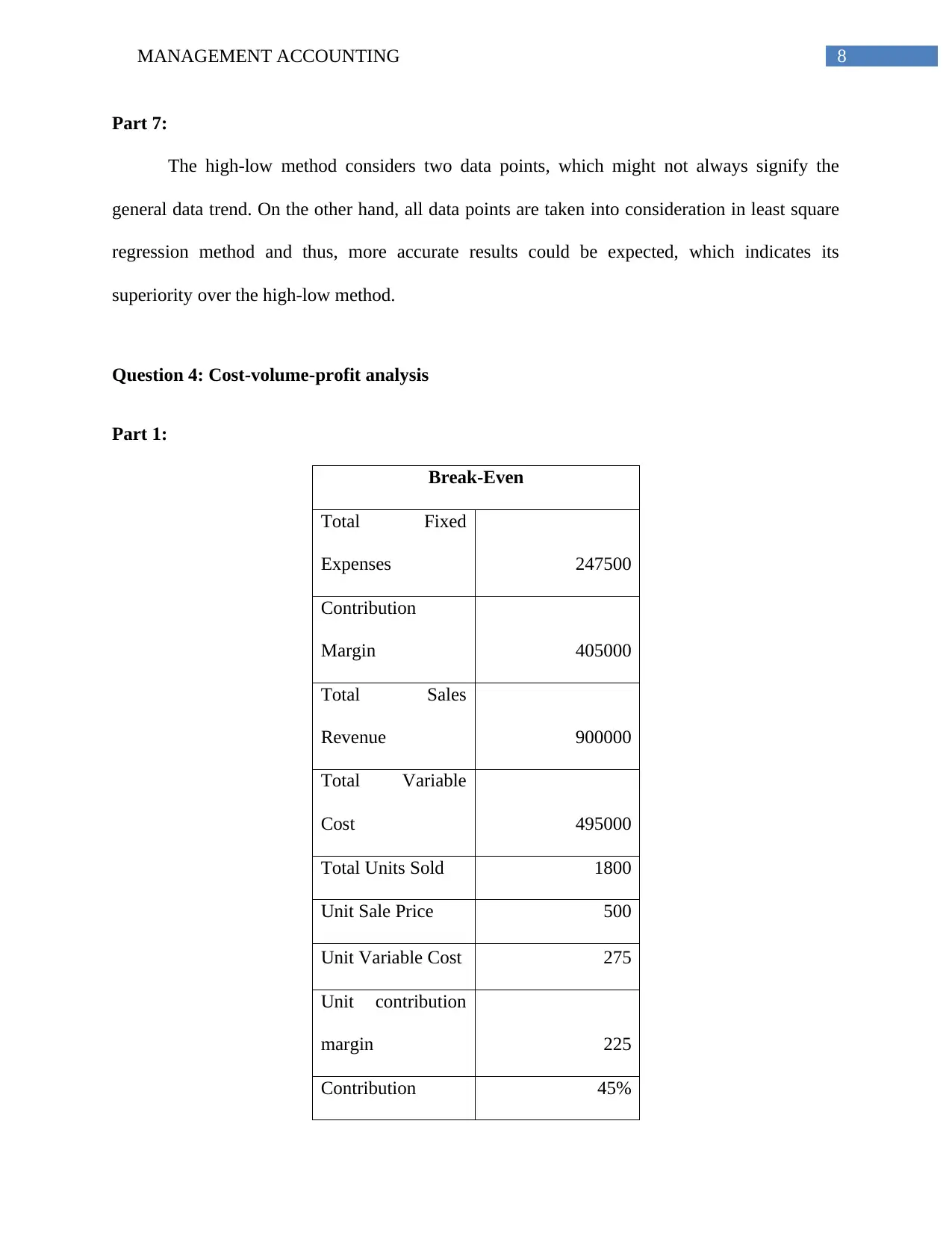
The high-low method considers two data points, which might not always signify the
general data trend. On the other hand, all data points are taken into consideration in least square
regression method and thus, more accurate results could be expected, which indicates its
superiority over the high-low method.
Question 4: Cost-volume-profit analysis
Part 1:
Break-Even
Total Fixed
Expenses 247500
Contribution
Margin 405000
Total Sales
Revenue 900000
Total Variable
Cost 495000
Total Units Sold 1800
Unit Sale Price 500
Unit Variable Cost 275
Unit contribution
margin 225
Contribution 45%
Part 7:
The high-low method considers two data points, which might not always signify the
general data trend. On the other hand, all data points are taken into consideration in least square
regression method and thus, more accurate results could be expected, which indicates its
superiority over the high-low method.
Question 4: Cost-volume-profit analysis
Part 1:
Break-Even
Total Fixed
Expenses 247500
Contribution
Margin 405000
Total Sales
Revenue 900000
Total Variable
Cost 495000
Total Units Sold 1800
Unit Sale Price 500
Unit Variable Cost 275
Unit contribution
margin 225
Contribution 45%
⊘ This is a preview!⊘
Do you want full access?
Subscribe today to unlock all pages.
Trusted by 1+ million students worldwide
9MANAGEMENT ACCOUNTING
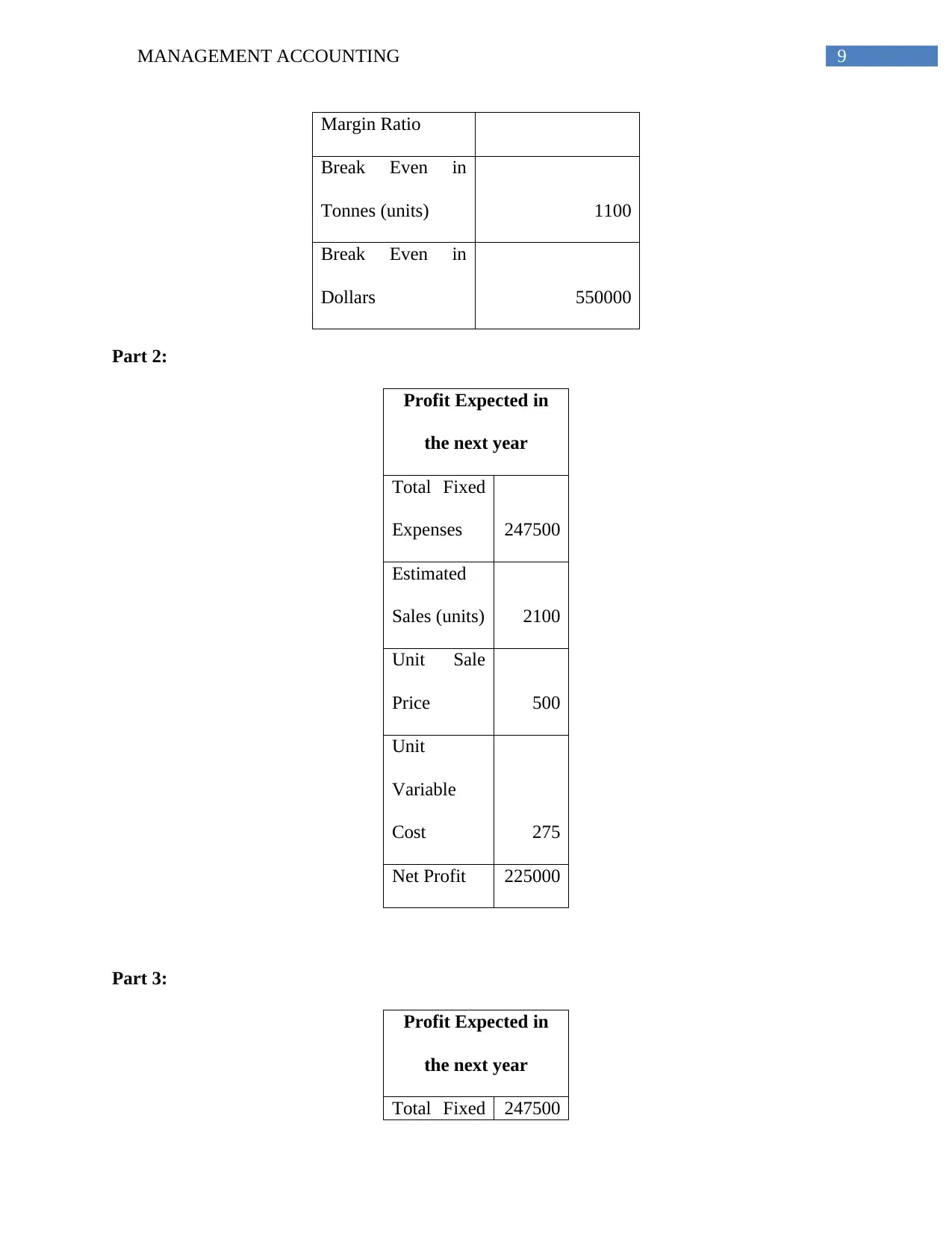
Margin Ratio
Break Even in
Tonnes (units) 1100
Break Even in
Dollars 550000
Part 2:
Profit Expected in
the next year
Total Fixed
Expenses 247500
Estimated
Sales (units) 2100
Unit Sale
Price 500
Unit
Variable
Cost 275
Net Profit 225000
Part 3:
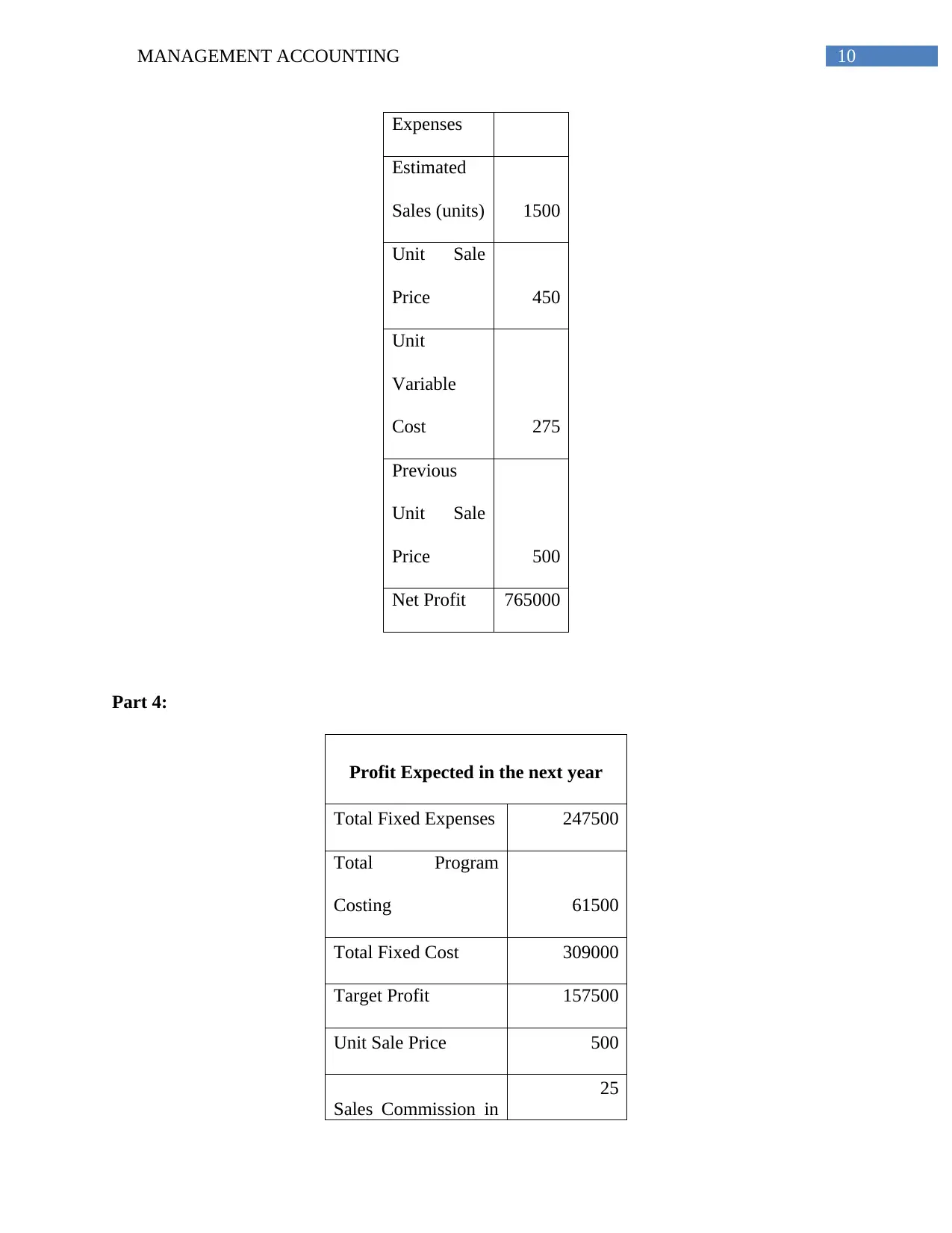
Profit Expected in
the next year
Total Fixed 247500
Margin Ratio
Break Even in
Tonnes (units) 1100
Break Even in
Dollars 550000
Part 2:
Profit Expected in
the next year
Total Fixed
Expenses 247500
Estimated
Sales (units) 2100
Unit Sale
Price 500
Unit
Variable
Cost 275
Net Profit 225000
Part 3:
Profit Expected in
the next year
Total Fixed 247500
Paraphrase This Document
Need a fresh take? Get an instant paraphrase of this document with our AI Paraphraser
10MANAGEMENT ACCOUNTING
Expenses
Estimated
Sales (units) 1500
Unit Sale
Price 450
Unit
Variable
Cost 275
Previous
Unit Sale
Price 500
Net Profit 765000
Part 4:
Profit Expected in the next year
Total Fixed Expenses 247500
Total Program
Costing 61500
Total Fixed Cost 309000
Target Profit 157500
Unit Sale Price 500
Sales Commission in
25
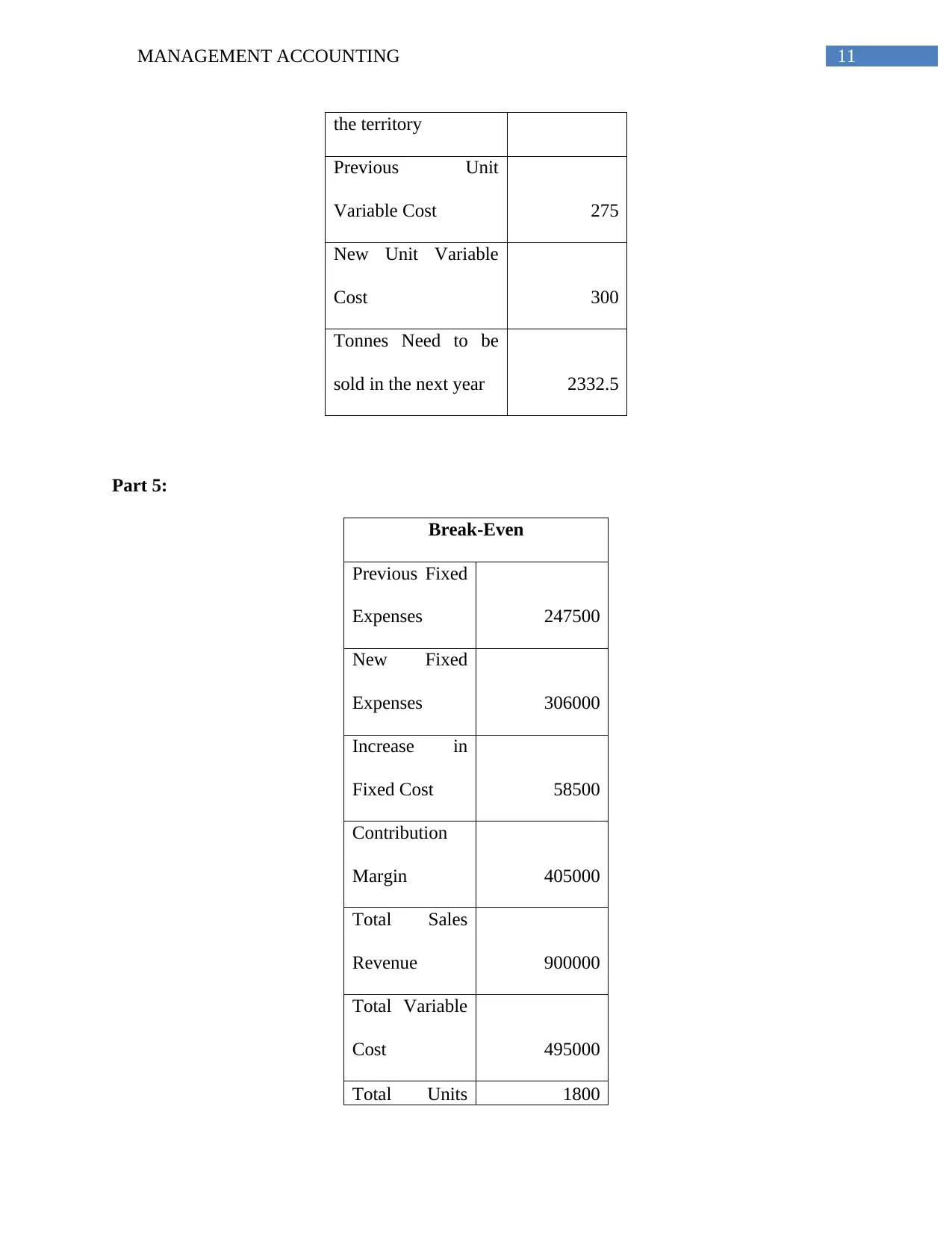
Expenses
Estimated
Sales (units) 1500
Unit Sale
Price 450
Unit
Variable
Cost 275
Previous
Unit Sale
Price 500
Net Profit 765000
Part 4:
Profit Expected in the next year
Total Fixed Expenses 247500
Total Program
Costing 61500
Total Fixed Cost 309000
Target Profit 157500
Unit Sale Price 500
Sales Commission in
25
11MANAGEMENT ACCOUNTING
the territory
Previous Unit
Variable Cost 275
New Unit Variable
Cost 300
Tonnes Need to be
sold in the next year 2332.5
Part 5:
Break-Even
Previous Fixed
Expenses 247500
New Fixed
Expenses 306000
Increase in
Fixed Cost 58500
Contribution
Margin 405000
Total Sales
Revenue 900000
Total Variable
Cost 495000
Total Units 1800
the territory
Previous Unit
Variable Cost 275
New Unit Variable
Cost 300
Tonnes Need to be
sold in the next year 2332.5
Part 5:
Break-Even
Previous Fixed
Expenses 247500
New Fixed
Expenses 306000
Increase in
Fixed Cost 58500
Contribution
Margin 405000
Total Sales
Revenue 900000
Total Variable
Cost 495000
Total Units 1800
⊘ This is a preview!⊘
Do you want full access?
Subscribe today to unlock all pages.
Trusted by 1+ million students worldwide

1 out of 17


Related Documents


Your All-in-One AI-Powered Toolkit for Academic Success.
+13062052269
info@desklib.com
Available 24*7 on WhatsApp / Email
![[object Object]](/_next/static/media/star-bottom.7253800d.svg)
Unlock your academic potential
Copyright © 2020–2026 A2Z Services. All Rights Reserved. Developed and managed by ZUCOL.