Management Accounting Report: Cost Analysis for Jeffrey and Son's Ltd
VerifiedAdded on 2020/02/14
|24
|6619
|45
Report
AI Summary
This management accounting report analyzes the case scenario of Jeffrey and Son’s manufacturing company. It covers various aspects of management accounting, including different types of cost classification based on elements, nature, function, and behavior. The report demonstrates the calculation of unit costs using the unit costing method and absorption costing, providing detailed calculations for a specific job. It also includes the preparation and analysis of a cost report for September, variance analysis, and identification of potential areas for improvement using performance indicators. Furthermore, it explores ways to reduce costs, enhance value and quality, and explains the purpose and nature of the budgeting process for the company, including the preparation of production, material, and cash budgets. Finally, the report calculates variances, identifies possible causes, recommends corrective actions, and presents operating statements with both budgeted and actual results, along with a discussion of responsibility centers.
Management Accounting
1
1

Paraphrase This Document
Need a fresh take? Get an instant paraphrase of this document with our AI Paraphraser
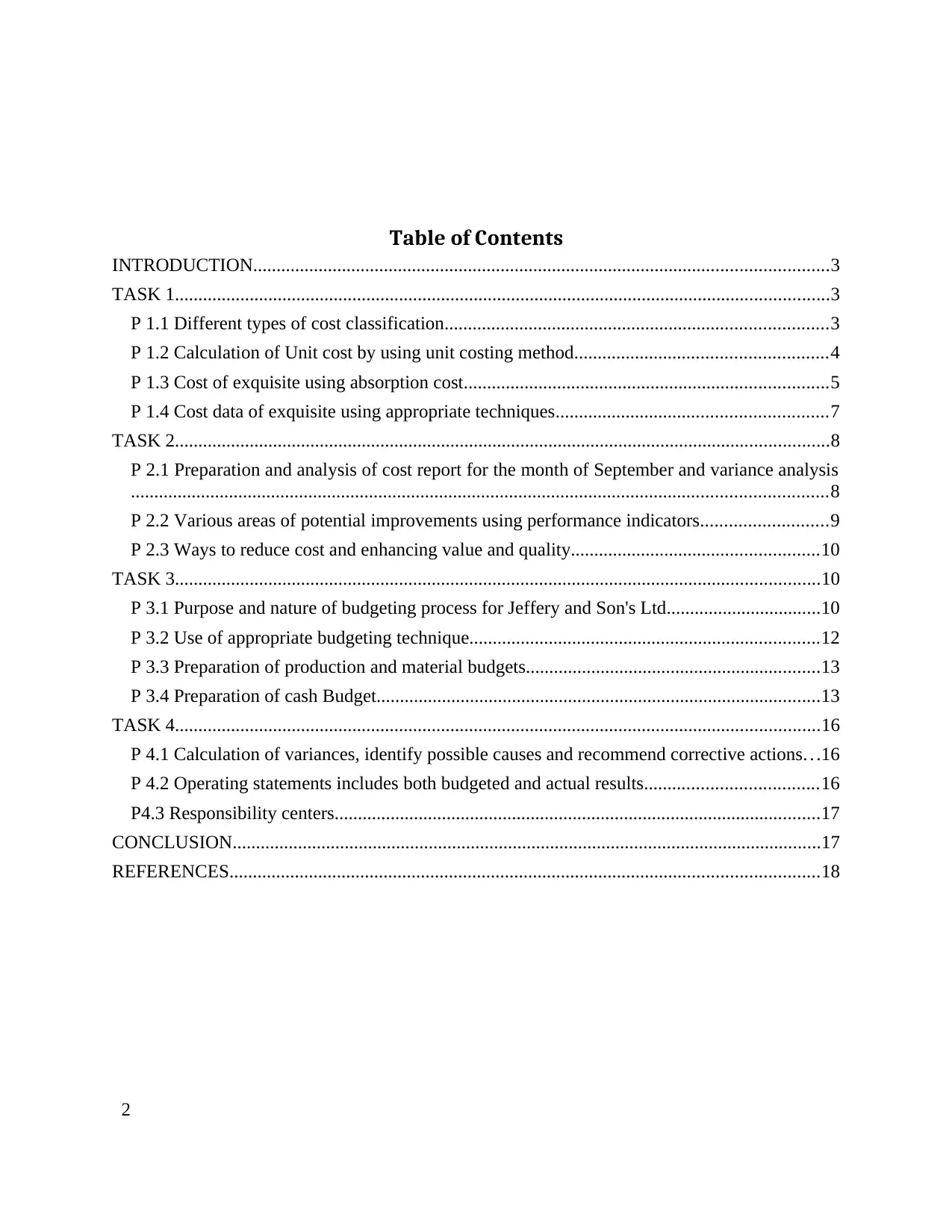
Table of Contents
INTRODUCTION...........................................................................................................................3
TASK 1............................................................................................................................................3
P 1.1 Different types of cost classification..................................................................................3
P 1.2 Calculation of Unit cost by using unit costing method......................................................4
P 1.3 Cost of exquisite using absorption cost..............................................................................5
P 1.4 Cost data of exquisite using appropriate techniques..........................................................7
TASK 2............................................................................................................................................8
P 2.1 Preparation and analysis of cost report for the month of September and variance analysis
.....................................................................................................................................................8
P 2.2 Various areas of potential improvements using performance indicators...........................9
P 2.3 Ways to reduce cost and enhancing value and quality.....................................................10
TASK 3..........................................................................................................................................10
P 3.1 Purpose and nature of budgeting process for Jeffery and Son's Ltd.................................10
P 3.2 Use of appropriate budgeting technique...........................................................................12
P 3.3 Preparation of production and material budgets...............................................................13
P 3.4 Preparation of cash Budget...............................................................................................13
TASK 4..........................................................................................................................................16
P 4.1 Calculation of variances, identify possible causes and recommend corrective actions. . .16
P 4.2 Operating statements includes both budgeted and actual results.....................................16
P4.3 Responsibility centers........................................................................................................17
CONCLUSION..............................................................................................................................17
REFERENCES..............................................................................................................................18
2
INTRODUCTION...........................................................................................................................3
TASK 1............................................................................................................................................3
P 1.1 Different types of cost classification..................................................................................3
P 1.2 Calculation of Unit cost by using unit costing method......................................................4
P 1.3 Cost of exquisite using absorption cost..............................................................................5
P 1.4 Cost data of exquisite using appropriate techniques..........................................................7
TASK 2............................................................................................................................................8
P 2.1 Preparation and analysis of cost report for the month of September and variance analysis
.....................................................................................................................................................8
P 2.2 Various areas of potential improvements using performance indicators...........................9
P 2.3 Ways to reduce cost and enhancing value and quality.....................................................10
TASK 3..........................................................................................................................................10
P 3.1 Purpose and nature of budgeting process for Jeffery and Son's Ltd.................................10
P 3.2 Use of appropriate budgeting technique...........................................................................12
P 3.3 Preparation of production and material budgets...............................................................13
P 3.4 Preparation of cash Budget...............................................................................................13
TASK 4..........................................................................................................................................16
P 4.1 Calculation of variances, identify possible causes and recommend corrective actions. . .16
P 4.2 Operating statements includes both budgeted and actual results.....................................16
P4.3 Responsibility centers........................................................................................................17
CONCLUSION..............................................................................................................................17
REFERENCES..............................................................................................................................18
2
INTRODUCTION
Management accounting is also termed as managerial accounting that combines norms
which are related to costing and budgeting. This unit of accounting is significantly used by the
managers in order to collect data for making a good use of accounting information for decision
making (Ward, 2012). From past few decades, management accounting is being used in
corporate world to decide financial matters within the organization. The case scenario of Jeffrey
and Son’s manufacturing company is taken into consideration for making present report.
Furthermore, cost report is prepared for a manufacturing unit while using various performance
indicators to find out the areas of potential improvements. The purpose as well as the nature of
the budgeting process is explained to the budget holders of Jeffery and Son’s Ltd. In this respect,
different kinds of budgets such as a production budget in units; materials purchases budget and a
cash budget are prepared. At the end of the report, variance in budget is identified along with
possible causes and recommended corrective actions.
TASK 1
P 1.1 Different types of cost classification
Manufacturing company bears expenses at the time of production of goods and services,
which is generally known as “Cost”. Nonetheless, there are various cost incurred during the
production process that are further classified into various categories. In general form, the cost is
classified on the basis elements; namely behaviors, nature and function. Following points will
explain the cost classification:
Elements of cost: The cost includes three major elements which are Material, Labor and
Expenses. Material is used to produce finished goods, labor put efficiency in production and
expenses are occurred in whole process. However, these elements are further divided into direct
and indirect forms such as direct material and indirect material (Zimmerman and Yahya-Zadeh,
2011).
Nature of Expense: On the basis of nature of cost, it is divided into material, labor and
expenses. Within the manufacturing company, the remuneration paid to workforce is considered
as labor cost. Material cost, on the other hand, is paid against the purchase of raw material that is
3
Management accounting is also termed as managerial accounting that combines norms
which are related to costing and budgeting. This unit of accounting is significantly used by the
managers in order to collect data for making a good use of accounting information for decision
making (Ward, 2012). From past few decades, management accounting is being used in
corporate world to decide financial matters within the organization. The case scenario of Jeffrey
and Son’s manufacturing company is taken into consideration for making present report.
Furthermore, cost report is prepared for a manufacturing unit while using various performance
indicators to find out the areas of potential improvements. The purpose as well as the nature of
the budgeting process is explained to the budget holders of Jeffery and Son’s Ltd. In this respect,
different kinds of budgets such as a production budget in units; materials purchases budget and a
cash budget are prepared. At the end of the report, variance in budget is identified along with
possible causes and recommended corrective actions.
TASK 1
P 1.1 Different types of cost classification
Manufacturing company bears expenses at the time of production of goods and services,
which is generally known as “Cost”. Nonetheless, there are various cost incurred during the
production process that are further classified into various categories. In general form, the cost is
classified on the basis elements; namely behaviors, nature and function. Following points will
explain the cost classification:
Elements of cost: The cost includes three major elements which are Material, Labor and
Expenses. Material is used to produce finished goods, labor put efficiency in production and
expenses are occurred in whole process. However, these elements are further divided into direct
and indirect forms such as direct material and indirect material (Zimmerman and Yahya-Zadeh,
2011).
Nature of Expense: On the basis of nature of cost, it is divided into material, labor and
expenses. Within the manufacturing company, the remuneration paid to workforce is considered
as labor cost. Material cost, on the other hand, is paid against the purchase of raw material that is
3
⊘ This is a preview!⊘
Do you want full access?
Subscribe today to unlock all pages.

Trusted by 1+ million students worldwide
used by the company for successful accomplishment of manufacturing process. All the expenses
made for providing services are expenses for a manufacturing unit (Nørreklit, 2010).
Functions/Activities: According to the functions of different departments of business,
the cost is classified as per the expenses made by respective departments. For example:
Production cost, Selling cost, Administration cost, Marketing cost, Distribution cost and R&D
cost are included in function based cost.
Behavior of Cost: Volume is the base of deciding behavior of cost. On the other hand,
the cost which is based on the volume of production is categorized into behavioral category. Cost
of production changes as per the production volume of a specific time span. According to the
behavior, cost is classified into three major categories such as Fixed cost, Variable cost and Semi
variable cost (McGowan, 2010). Fixed cost does not modify at any level of production or
remains same at any production volume. However, variable cost has a nature of change due to
alteration in production volume. Semi-variable cost has characteristics of both fixed and variable
cost. It can be said that to a specific level that a cost remains fixed and after this level, it leads to
change. This kind of cost which occur in production process is called as semi-variable cost.
P 1.2 Calculation of Unit cost by using unit costing method
In general phenomenon, Job costing is referred as a method that is used by an
organization to compute cost for a job which is different and unique in nature and is to be
performed as per specific requirements of customers. The use of such costing methods allows
manufacturers to consider direct and indirect cost of the job at a same time. In respect with
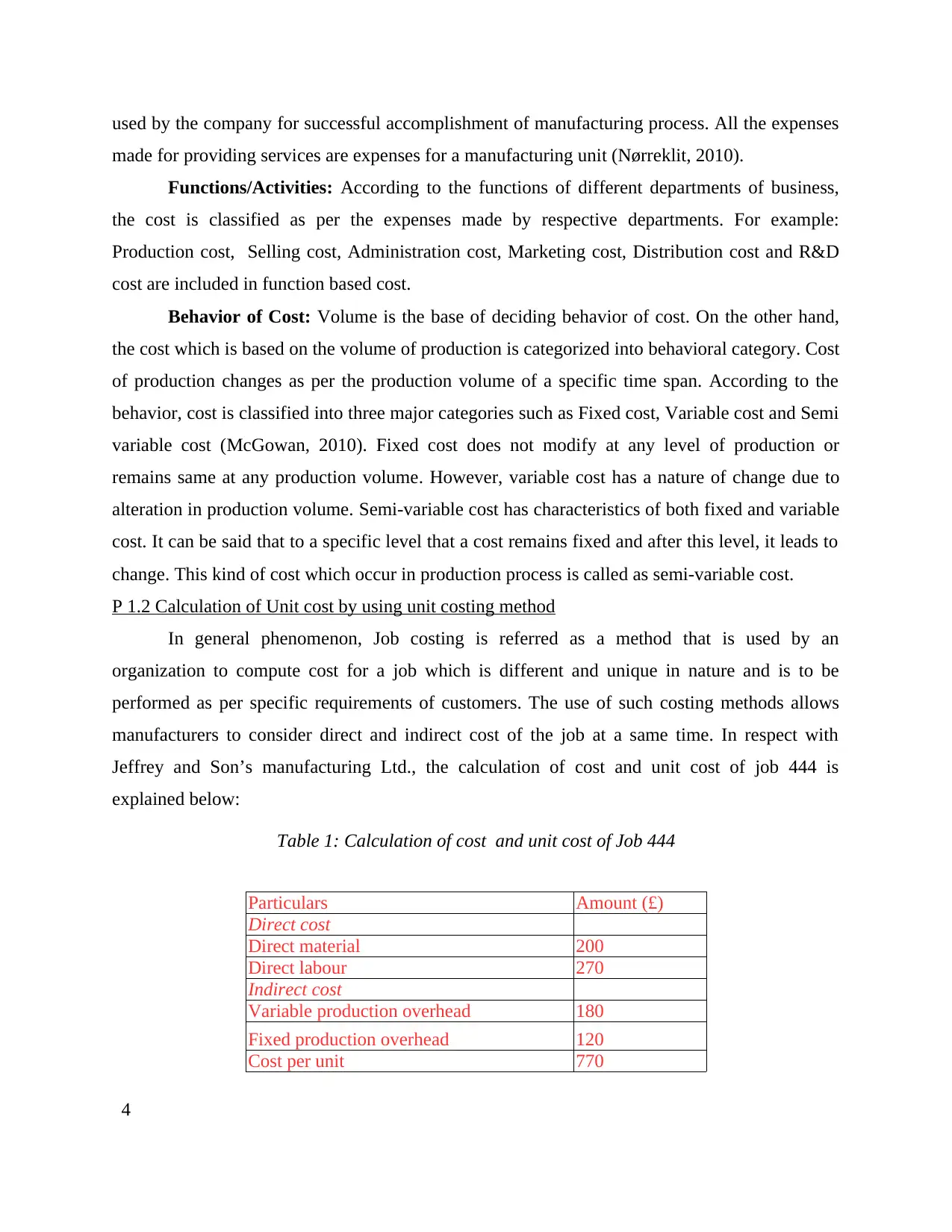
Jeffrey and Son’s manufacturing Ltd., the calculation of cost and unit cost of job 444 is
explained below:
Table 1: Calculation of cost and unit cost of Job 444
Particulars Amount (£)
Direct cost
Direct material 200
Direct labour 270
Indirect cost
Variable production overhead 180
Fixed production overhead 120
Cost per unit 770
4
made for providing services are expenses for a manufacturing unit (Nørreklit, 2010).
Functions/Activities: According to the functions of different departments of business,
the cost is classified as per the expenses made by respective departments. For example:
Production cost, Selling cost, Administration cost, Marketing cost, Distribution cost and R&D
cost are included in function based cost.
Behavior of Cost: Volume is the base of deciding behavior of cost. On the other hand,
the cost which is based on the volume of production is categorized into behavioral category. Cost
of production changes as per the production volume of a specific time span. According to the
behavior, cost is classified into three major categories such as Fixed cost, Variable cost and Semi
variable cost (McGowan, 2010). Fixed cost does not modify at any level of production or
remains same at any production volume. However, variable cost has a nature of change due to
alteration in production volume. Semi-variable cost has characteristics of both fixed and variable
cost. It can be said that to a specific level that a cost remains fixed and after this level, it leads to
change. This kind of cost which occur in production process is called as semi-variable cost.
P 1.2 Calculation of Unit cost by using unit costing method
In general phenomenon, Job costing is referred as a method that is used by an
organization to compute cost for a job which is different and unique in nature and is to be
performed as per specific requirements of customers. The use of such costing methods allows
manufacturers to consider direct and indirect cost of the job at a same time. In respect with
Jeffrey and Son’s manufacturing Ltd., the calculation of cost and unit cost of job 444 is
explained below:
Table 1: Calculation of cost and unit cost of Job 444
Particulars Amount (£)
Direct cost
Direct material 200
Direct labour 270
Indirect cost
Variable production overhead 180
Fixed production overhead 120
Cost per unit 770
4
Paraphrase This Document
Need a fresh take? Get an instant paraphrase of this document with our AI Paraphraser
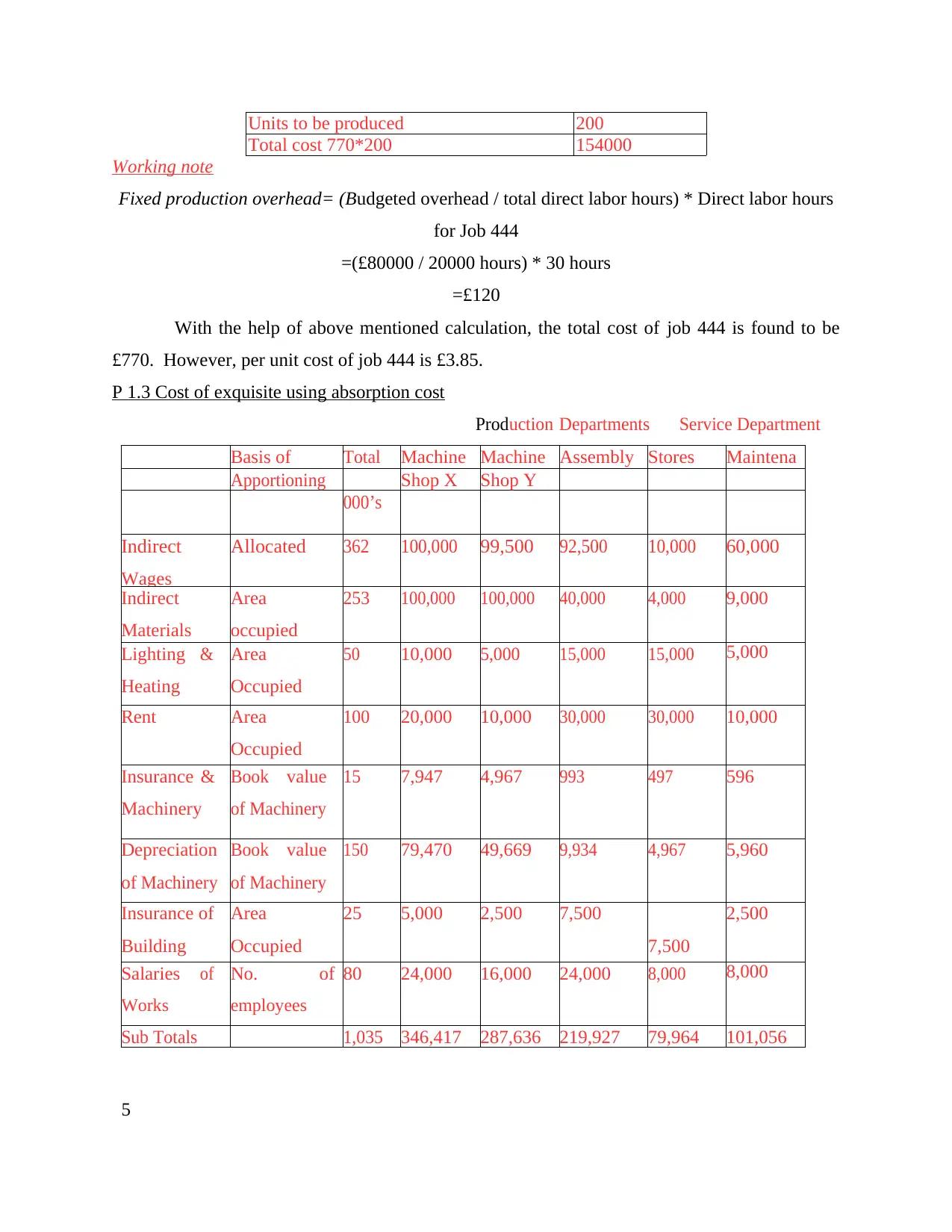
Units to be produced 200
Total cost 770*200 154000
Working note
Fixed production overhead= (Budgeted overhead / total direct labor hours) * Direct labor hours
for Job 444
=(£80000 / 20000 hours) * 30 hours
=£120
With the help of above mentioned calculation, the total cost of job 444 is found to be
£770. However, per unit cost of job 444 is £3.85.
P 1.3 Cost of exquisite using absorption cost
Production Departments Service Department
Basis of Total Machine Machine Assembly Stores Maintena
nceApportioning Shop X Shop Y
000’s
Indirect
Wages
Allocated 362 100,000 99,500 92,500 10,000 60,000
Indirect
Materials
Area
occupied
253 100,000 100,000 40,000 4,000 9,000
Lighting
Heating
& Area
Occupied
50 10,000 5,000 15,000 15,000 5,000
Rent Area
Occupied
100 20,000 10,000 30,000 30,000 10,000
Insurance &
Machinery
Book value
of Machinery
15 7,947 4,967 993 497 596
Depreciation
of Machinery
Book value
of Machinery
150 79,470 49,669 9,934 4,967 5,960
Insurance of
Building
Area
Occupied
25 5,000 2,500 7,500
7,500
2,500
Salaries
Works
of No.
employees
of 80 24,000 16,000 24,000 8,000 8,000
Sub Totals 1,035 346,417 287,636 219,927 79,964 101,056
5
Total cost 770*200 154000
Working note
Fixed production overhead= (Budgeted overhead / total direct labor hours) * Direct labor hours
for Job 444
=(£80000 / 20000 hours) * 30 hours
=£120
With the help of above mentioned calculation, the total cost of job 444 is found to be
£770. However, per unit cost of job 444 is £3.85.
P 1.3 Cost of exquisite using absorption cost
Production Departments Service Department
Basis of Total Machine Machine Assembly Stores Maintena
nceApportioning Shop X Shop Y
000’s
Indirect
Wages
Allocated 362 100,000 99,500 92,500 10,000 60,000
Indirect
Materials
Area
occupied
253 100,000 100,000 40,000 4,000 9,000
Lighting
Heating
& Area
Occupied
50 10,000 5,000 15,000 15,000 5,000
Rent Area
Occupied
100 20,000 10,000 30,000 30,000 10,000
Insurance &
Machinery
Book value
of Machinery
15 7,947 4,967 993 497 596
Depreciation
of Machinery
Book value
of Machinery
150 79,470 49,669 9,934 4,967 5,960
Insurance of
Building
Area
Occupied
25 5,000 2,500 7,500
7,500
2,500
Salaries
Works
of No.
employees
of 80 24,000 16,000 24,000 8,000 8,000
Sub Totals 1,035 346,417 287,636 219,927 79,964 101,056
5
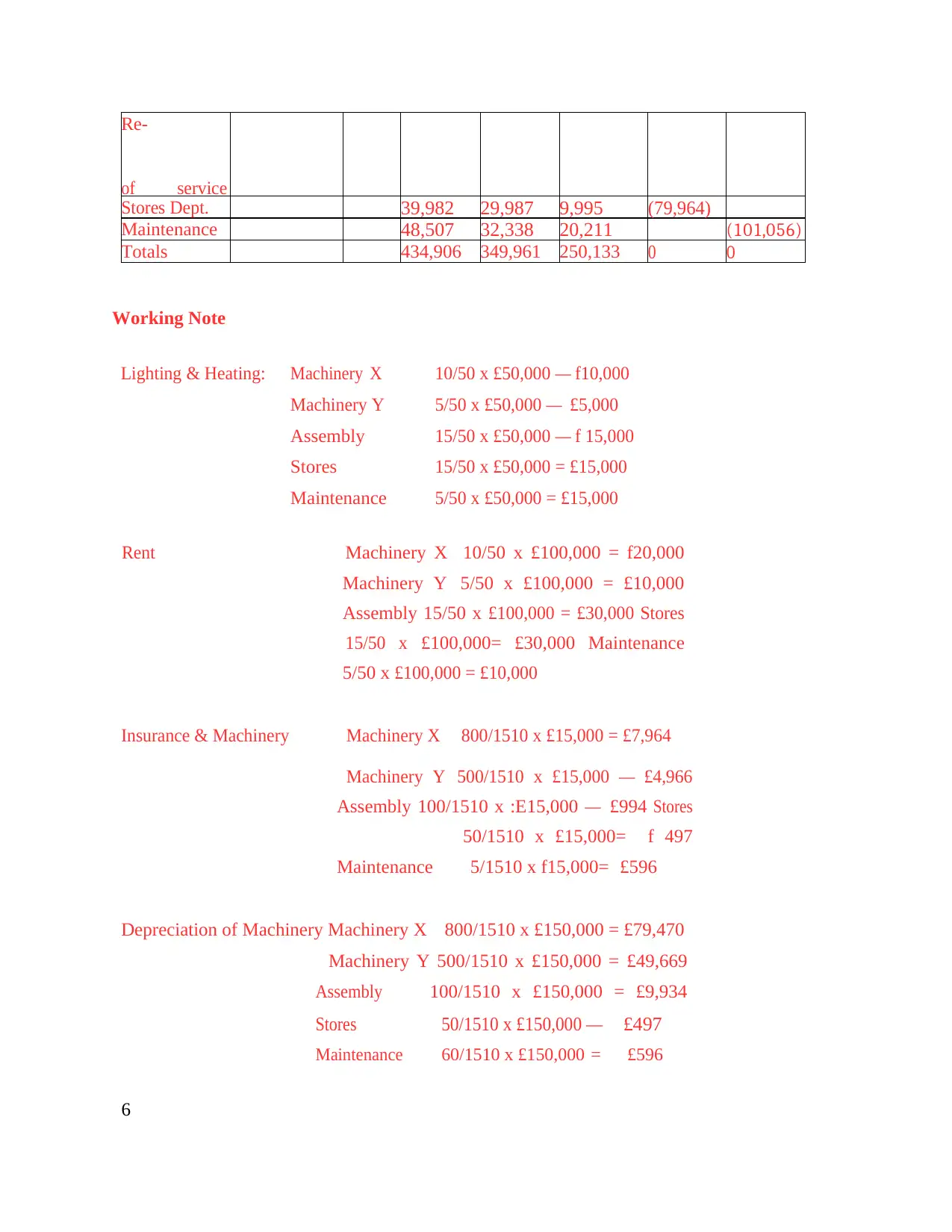
Re-
of service
Stores Dept. 39,982 29,987 9,995 (79,964)
Maintenance 48,507 32,338 20,211 (101,056)
Totals 434,906 349,961 250,133 0 0
Working Note
Lighting & Heating: Machinery X 10/50 x £50,000 — f10,000
Machinery Y 5/50 x £50,000 — £5,000
Assembly 15/50 x £50,000 — f 15,000
Stores 15/50 x £50,000 = £15,000
Maintenance 5/50 x £50,000 = £15,000
Rent Machinery X 10/50 x £100,000 = f20,000
Machinery Y 5/50 x £100,000 = £10,000
Assembly 15/50 x £100,000 = £30,000 Stores
15/50 x £100,000= £30,000 Maintenance
5/50 x £100,000 = £10,000
Insurance & Machinery Machinery X 800/1510 x £15,000 = £7,964
Machinery Y 500/1510 x £15,000 — £4,966
Assembly 100/1510 x :E15,000 — £994 Stores
50/1510 x £15,000= f 497
Maintenance 5/1510 x f15,000= £596
Depreciation of Machinery Machinery X 800/1510 x £150,000 = £79,470
Machinery Y 500/1510 x £150,000 = £49,669
Assembly 100/1510 x £150,000 = £9,934
Stores 50/1510 x £150,000 — £497
Maintenance 60/1510 x £150,000 = £596
6
of service
Stores Dept. 39,982 29,987 9,995 (79,964)
Maintenance 48,507 32,338 20,211 (101,056)
Totals 434,906 349,961 250,133 0 0
Working Note
Lighting & Heating: Machinery X 10/50 x £50,000 — f10,000
Machinery Y 5/50 x £50,000 — £5,000
Assembly 15/50 x £50,000 — f 15,000
Stores 15/50 x £50,000 = £15,000
Maintenance 5/50 x £50,000 = £15,000
Rent Machinery X 10/50 x £100,000 = f20,000
Machinery Y 5/50 x £100,000 = £10,000
Assembly 15/50 x £100,000 = £30,000 Stores
15/50 x £100,000= £30,000 Maintenance
5/50 x £100,000 = £10,000
Insurance & Machinery Machinery X 800/1510 x £15,000 = £7,964
Machinery Y 500/1510 x £15,000 — £4,966
Assembly 100/1510 x :E15,000 — £994 Stores
50/1510 x £15,000= f 497
Maintenance 5/1510 x f15,000= £596
Depreciation of Machinery Machinery X 800/1510 x £150,000 = £79,470
Machinery Y 500/1510 x £150,000 = £49,669
Assembly 100/1510 x £150,000 = £9,934
Stores 50/1510 x £150,000 — £497
Maintenance 60/1510 x £150,000 = £596
6
⊘ This is a preview!⊘
Do you want full access?
Subscribe today to unlock all pages.
Trusted by 1+ million students worldwide
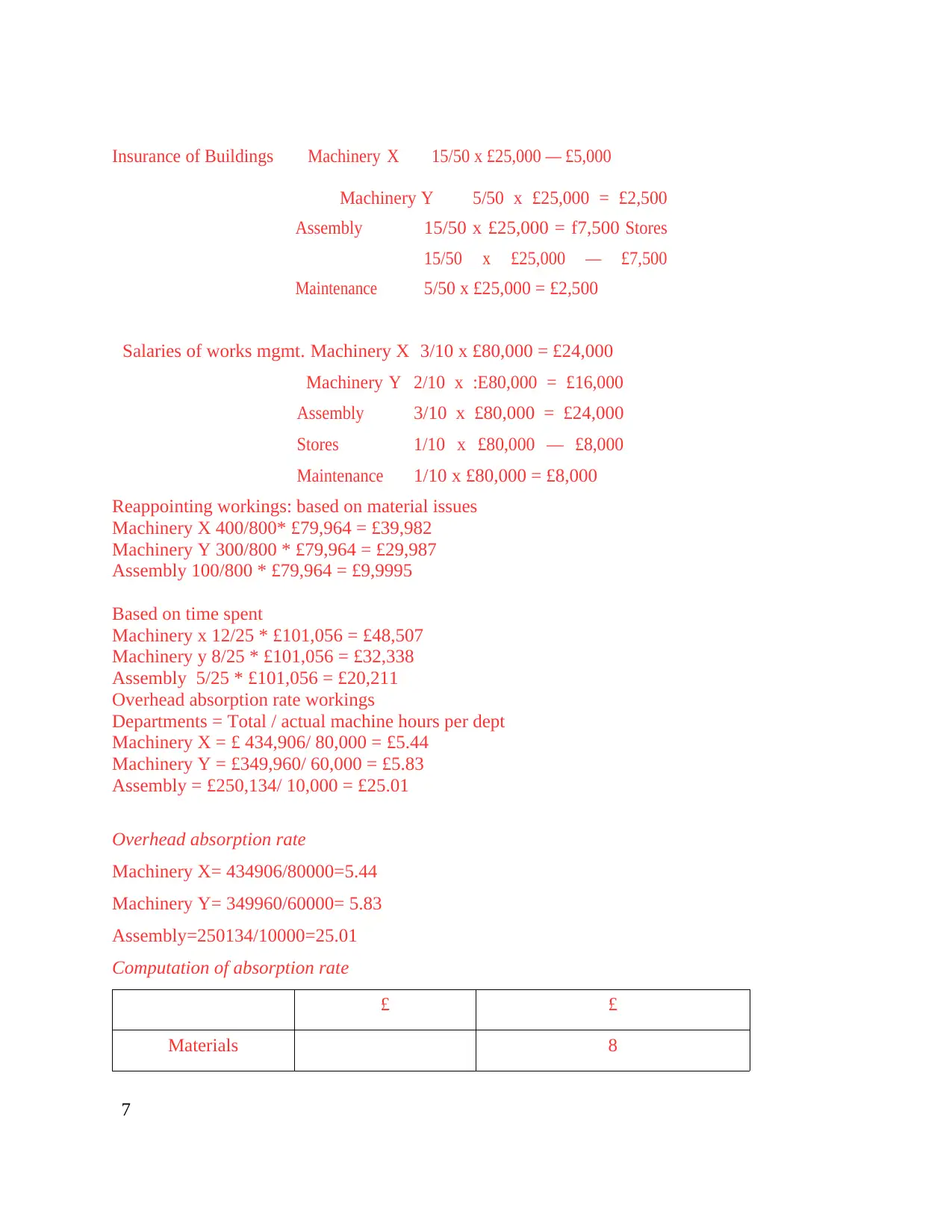
Insurance of Buildings Machinery X 15/50 x £25,000 — £5,000
Machinery Y 5/50 x £25,000 = £2,500
Assembly 15/50 x £25,000 = f7,500 Stores
15/50 x £25,000 — £7,500
Maintenance 5/50 x £25,000 = £2,500
Salaries of works mgmt. Machinery X 3/10 x £80,000 = £24,000
Machinery Y 2/10 x :E80,000 = £16,000
Assembly 3/10 x £80,000 = £24,000
Stores 1/10 x £80,000 — £8,000
Maintenance 1/10 x £80,000 = £8,000
Reappointing workings: based on material issues
Machinery X 400/800* £79,964 = £39,982
Machinery Y 300/800 * £79,964 = £29,987
Assembly 100/800 * £79,964 = £9,9995
Based on time spent
Machinery x 12/25 * £101,056 = £48,507
Machinery y 8/25 * £101,056 = £32,338
Assembly 5/25 * £101,056 = £20,211
Overhead absorption rate workings
Departments = Total / actual machine hours per dept
Machinery X = £ 434,906/ 80,000 = £5.44
Machinery Y = £349,960/ 60,000 = £5.83
Assembly = £250,134/ 10,000 = £25.01
Overhead absorption rate
Machinery X= 434906/80000=5.44
Machinery Y= 349960/60000= 5.83
Assembly=250134/10000=25.01
Computation of absorption rate
£ £
Materials 8
7
Machinery Y 5/50 x £25,000 = £2,500
Assembly 15/50 x £25,000 = f7,500 Stores
15/50 x £25,000 — £7,500
Maintenance 5/50 x £25,000 = £2,500
Salaries of works mgmt. Machinery X 3/10 x £80,000 = £24,000
Machinery Y 2/10 x :E80,000 = £16,000
Assembly 3/10 x £80,000 = £24,000
Stores 1/10 x £80,000 — £8,000
Maintenance 1/10 x £80,000 = £8,000
Reappointing workings: based on material issues
Machinery X 400/800* £79,964 = £39,982
Machinery Y 300/800 * £79,964 = £29,987
Assembly 100/800 * £79,964 = £9,9995
Based on time spent
Machinery x 12/25 * £101,056 = £48,507
Machinery y 8/25 * £101,056 = £32,338
Assembly 5/25 * £101,056 = £20,211
Overhead absorption rate workings
Departments = Total / actual machine hours per dept
Machinery X = £ 434,906/ 80,000 = £5.44
Machinery Y = £349,960/ 60,000 = £5.83
Assembly = £250,134/ 10,000 = £25.01
Overhead absorption rate
Machinery X= 434906/80000=5.44
Machinery Y= 349960/60000= 5.83
Assembly=250134/10000=25.01
Computation of absorption rate
£ £
Materials 8
7
Paraphrase This Document
Need a fresh take? Get an instant paraphrase of this document with our AI Paraphraser
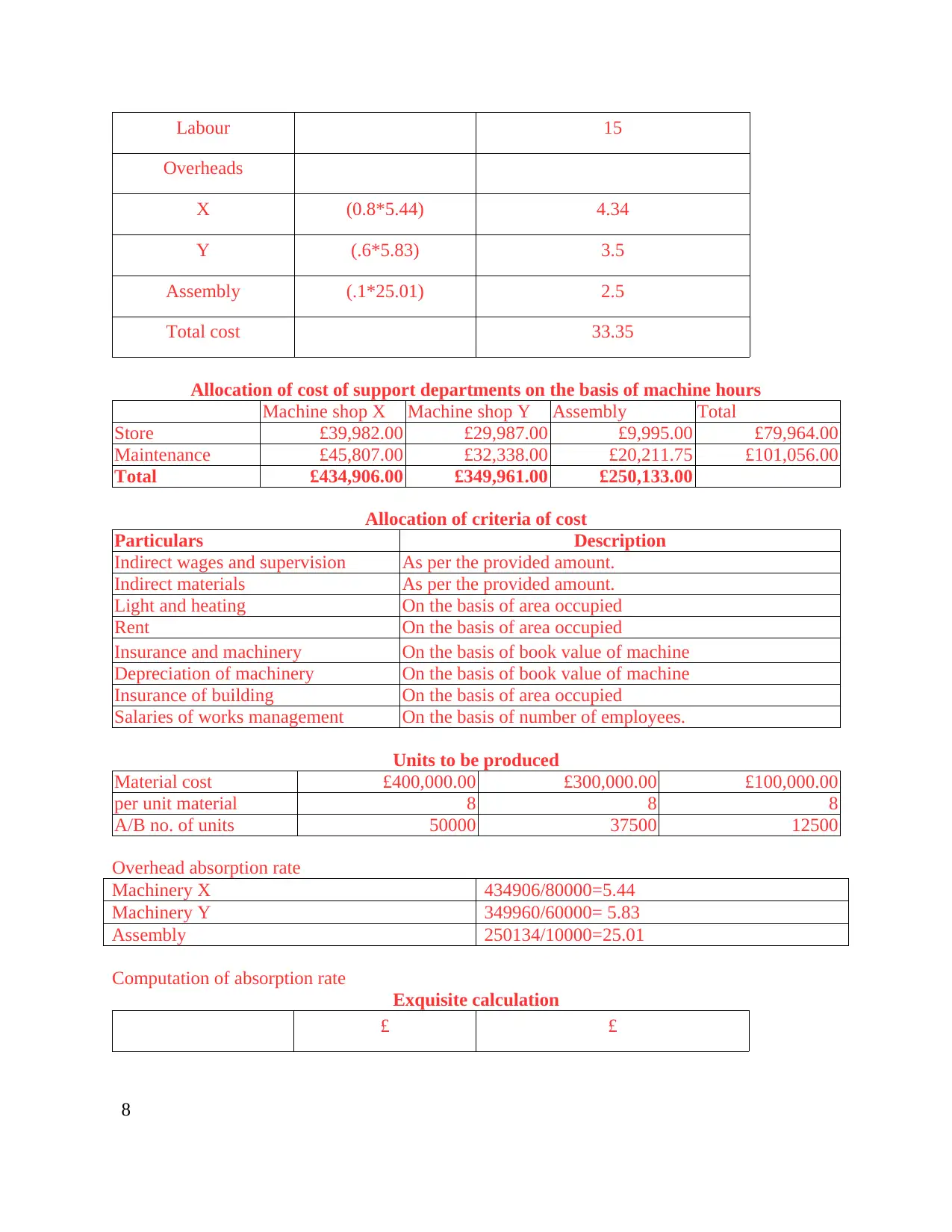
Labour 15
Overheads
X (0.8*5.44) 4.34
Y (.6*5.83) 3.5
Assembly (.1*25.01) 2.5
Total cost 33.35
Allocation of cost of support departments on the basis of machine hours
Machine shop X Machine shop Y Assembly Total
Store £39,982.00 £29,987.00 £9,995.00 £79,964.00
Maintenance £45,807.00 £32,338.00 £20,211.75 £101,056.00
Total £434,906.00 £349,961.00 £250,133.00
Allocation of criteria of cost
Particulars Description
Indirect wages and supervision As per the provided amount.
Indirect materials As per the provided amount.
Light and heating On the basis of area occupied
Rent On the basis of area occupied
Insurance and machinery On the basis of book value of machine
Depreciation of machinery On the basis of book value of machine
Insurance of building On the basis of area occupied
Salaries of works management On the basis of number of employees.
Units to be produced
Material cost £400,000.00 £300,000.00 £100,000.00
per unit material 8 8 8
A/B no. of units 50000 37500 12500
Overhead absorption rate
Machinery X 434906/80000=5.44
Machinery Y 349960/60000= 5.83
Assembly 250134/10000=25.01
Computation of absorption rate
Exquisite calculation
£ £
8
Overheads
X (0.8*5.44) 4.34
Y (.6*5.83) 3.5
Assembly (.1*25.01) 2.5
Total cost 33.35
Allocation of cost of support departments on the basis of machine hours
Machine shop X Machine shop Y Assembly Total
Store £39,982.00 £29,987.00 £9,995.00 £79,964.00
Maintenance £45,807.00 £32,338.00 £20,211.75 £101,056.00
Total £434,906.00 £349,961.00 £250,133.00
Allocation of criteria of cost
Particulars Description
Indirect wages and supervision As per the provided amount.
Indirect materials As per the provided amount.
Light and heating On the basis of area occupied
Rent On the basis of area occupied
Insurance and machinery On the basis of book value of machine
Depreciation of machinery On the basis of book value of machine
Insurance of building On the basis of area occupied
Salaries of works management On the basis of number of employees.
Units to be produced
Material cost £400,000.00 £300,000.00 £100,000.00
per unit material 8 8 8
A/B no. of units 50000 37500 12500
Overhead absorption rate
Machinery X 434906/80000=5.44
Machinery Y 349960/60000= 5.83
Assembly 250134/10000=25.01
Computation of absorption rate
Exquisite calculation
£ £
8
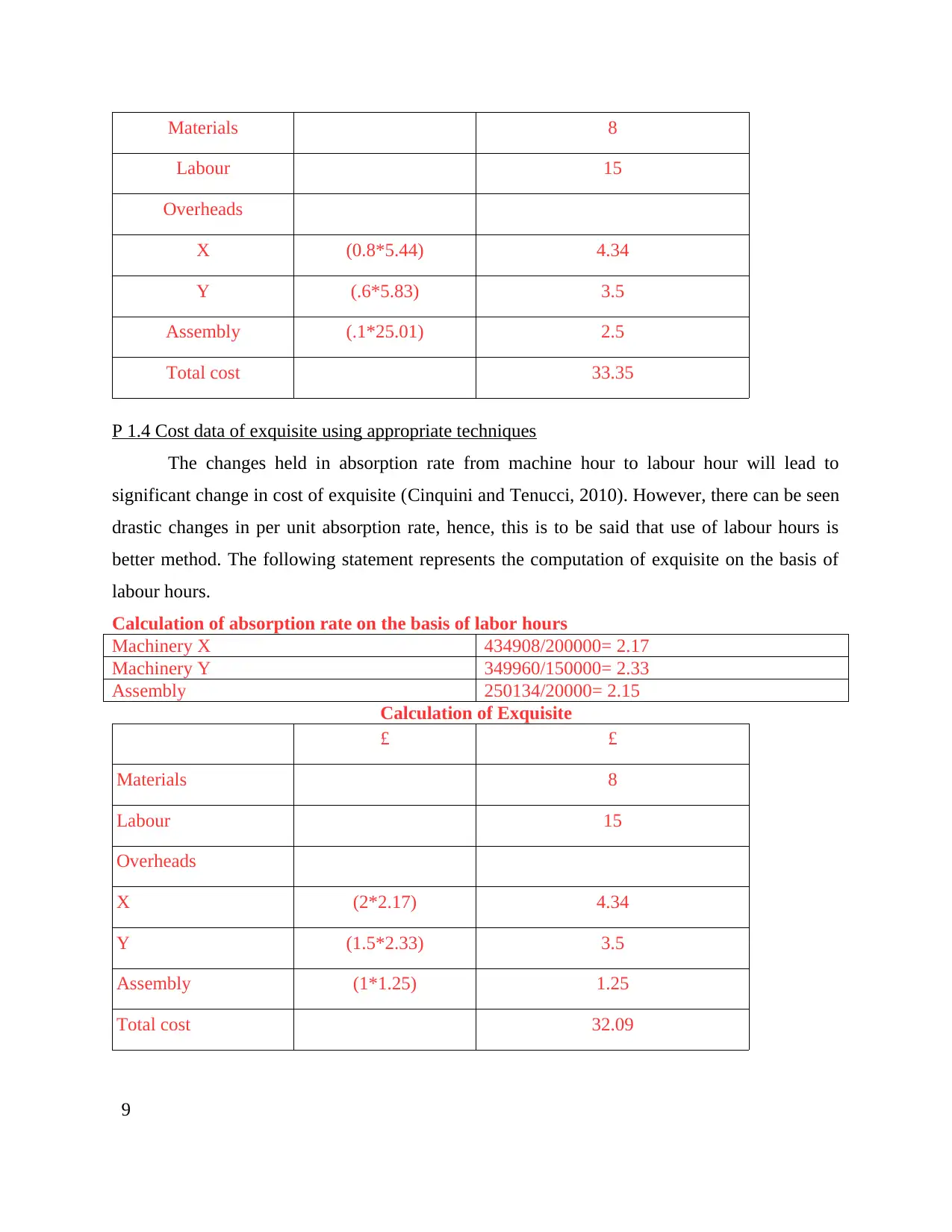
Materials 8
Labour 15
Overheads
X (0.8*5.44) 4.34
Y (.6*5.83) 3.5
Assembly (.1*25.01) 2.5
Total cost 33.35
P 1.4 Cost data of exquisite using appropriate techniques
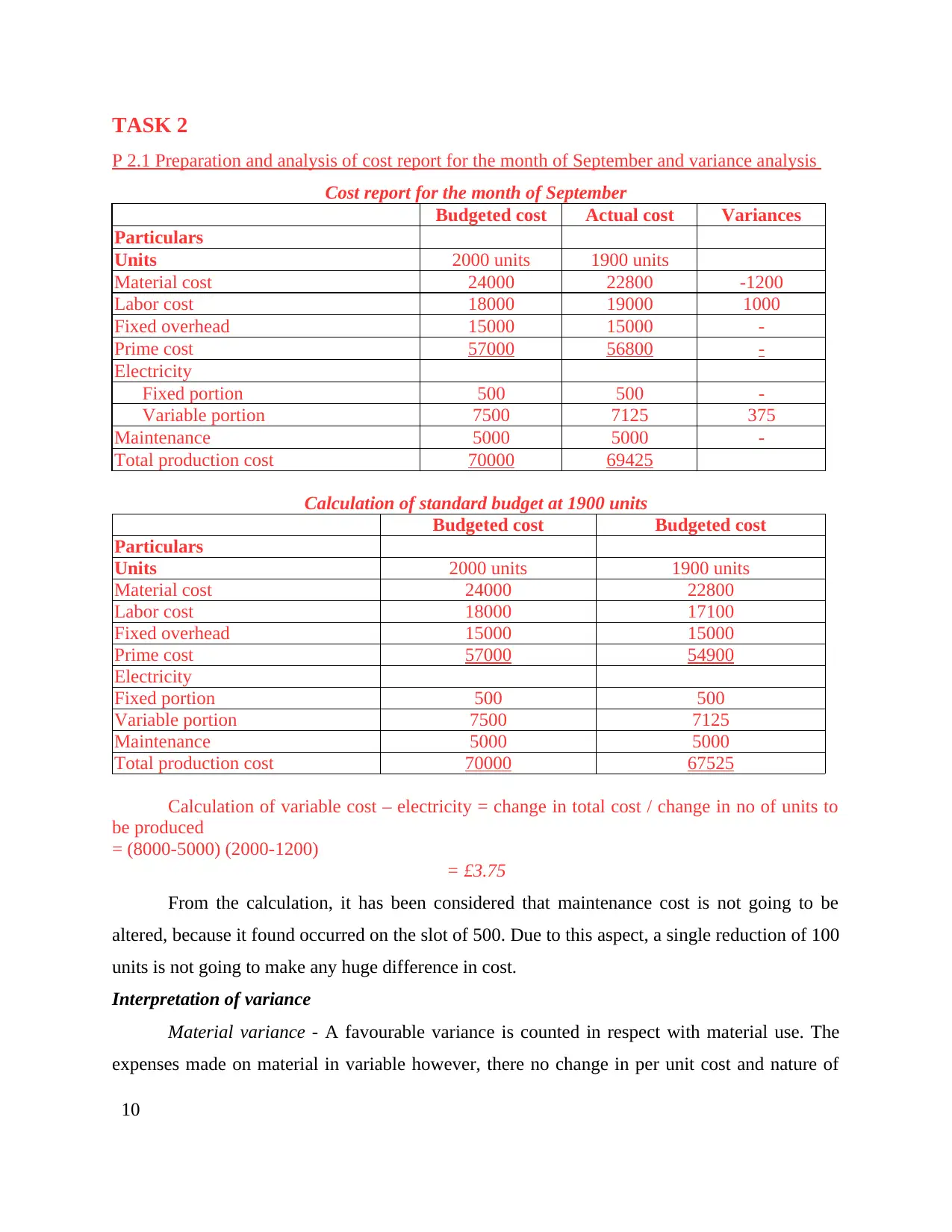
The changes held in absorption rate from machine hour to labour hour will lead to
significant change in cost of exquisite (Cinquini and Tenucci, 2010). However, there can be seen
drastic changes in per unit absorption rate, hence, this is to be said that use of labour hours is
better method. The following statement represents the computation of exquisite on the basis of
labour hours.
Calculation of absorption rate on the basis of labor hours
Machinery X 434908/200000= 2.17
Machinery Y 349960/150000= 2.33
Assembly 250134/20000= 2.15
Calculation of Exquisite
£ £
Materials 8
Labour 15
Overheads
X (2*2.17) 4.34
Y (1.5*2.33) 3.5
Assembly (1*1.25) 1.25
Total cost 32.09
9
Labour 15
Overheads
X (0.8*5.44) 4.34
Y (.6*5.83) 3.5
Assembly (.1*25.01) 2.5
Total cost 33.35
P 1.4 Cost data of exquisite using appropriate techniques
The changes held in absorption rate from machine hour to labour hour will lead to
significant change in cost of exquisite (Cinquini and Tenucci, 2010). However, there can be seen
drastic changes in per unit absorption rate, hence, this is to be said that use of labour hours is
better method. The following statement represents the computation of exquisite on the basis of
labour hours.
Calculation of absorption rate on the basis of labor hours
Machinery X 434908/200000= 2.17
Machinery Y 349960/150000= 2.33
Assembly 250134/20000= 2.15
Calculation of Exquisite
£ £
Materials 8
Labour 15
Overheads
X (2*2.17) 4.34
Y (1.5*2.33) 3.5
Assembly (1*1.25) 1.25
Total cost 32.09
9
⊘ This is a preview!⊘
Do you want full access?
Subscribe today to unlock all pages.
Trusted by 1+ million students worldwide
TASK 2
P 2.1 Preparation and analysis of cost report for the month of September and variance analysis
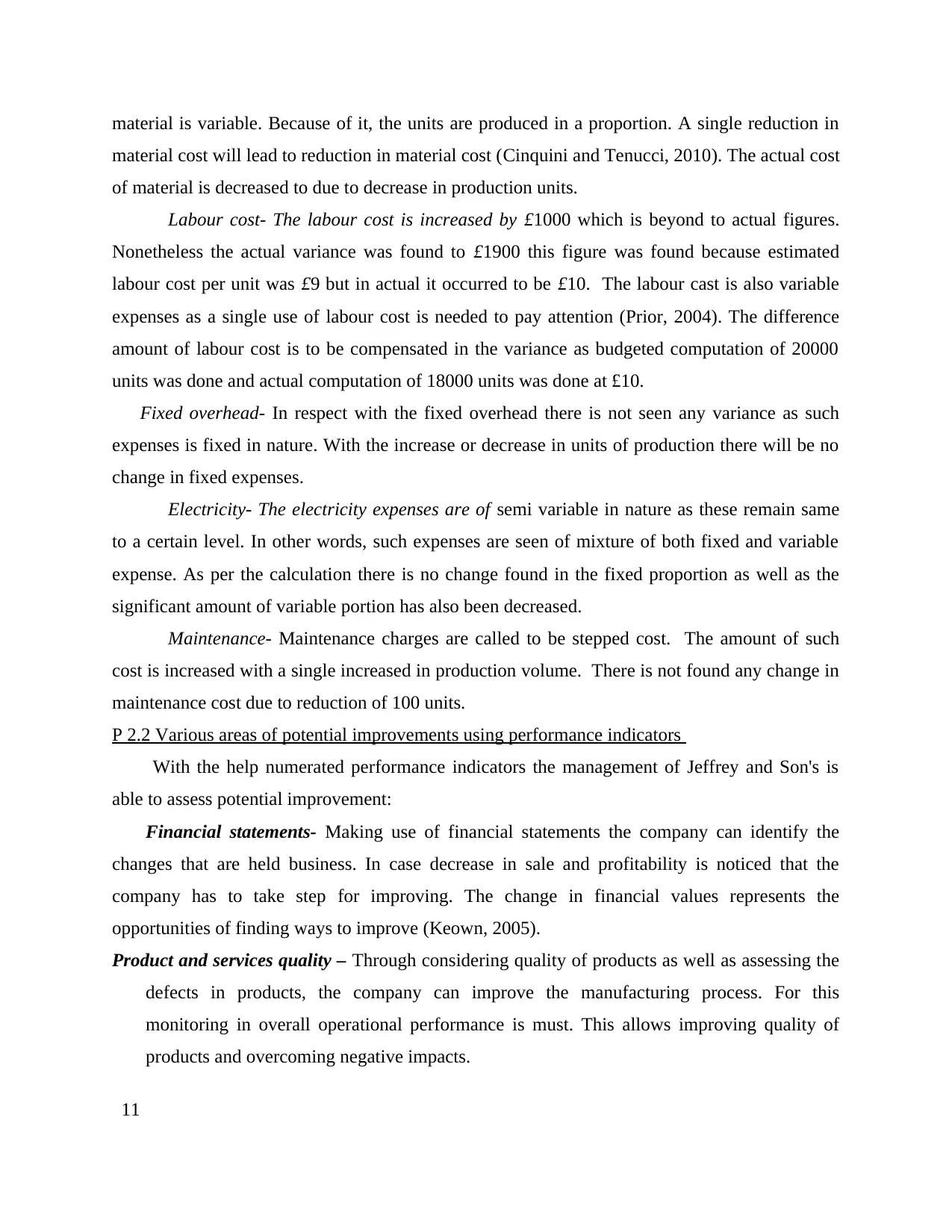
Cost report for the month of September
Budgeted cost Actual cost Variances
Particulars
Units 2000 units 1900 units
Material cost 24000 22800 -1200
Labor cost 18000 19000 1000
Fixed overhead 15000 15000 -
Prime cost 57000 56800 -
Electricity
Fixed portion 500 500 -
Variable portion 7500 7125 375
Maintenance 5000 5000 -
Total production cost 70000 69425
Calculation of standard budget at 1900 units
Budgeted cost Budgeted cost
Particulars
Units 2000 units 1900 units
Material cost 24000 22800
Labor cost 18000 17100
Fixed overhead 15000 15000
Prime cost 57000 54900
Electricity
Fixed portion 500 500
Variable portion 7500 7125
Maintenance 5000 5000
Total production cost 70000 67525
Calculation of variable cost – electricity = change in total cost / change in no of units to
be produced
= (8000-5000) (2000-1200)
= £3.75
From the calculation, it has been considered that maintenance cost is not going to be
altered, because it found occurred on the slot of 500. Due to this aspect, a single reduction of 100
units is not going to make any huge difference in cost.
Interpretation of variance
Material variance - A favourable variance is counted in respect with material use. The
expenses made on material in variable however, there no change in per unit cost and nature of
10
P 2.1 Preparation and analysis of cost report for the month of September and variance analysis
Cost report for the month of September
Budgeted cost Actual cost Variances
Particulars
Units 2000 units 1900 units
Material cost 24000 22800 -1200
Labor cost 18000 19000 1000
Fixed overhead 15000 15000 -
Prime cost 57000 56800 -
Electricity
Fixed portion 500 500 -
Variable portion 7500 7125 375
Maintenance 5000 5000 -
Total production cost 70000 69425
Calculation of standard budget at 1900 units
Budgeted cost Budgeted cost
Particulars
Units 2000 units 1900 units
Material cost 24000 22800
Labor cost 18000 17100
Fixed overhead 15000 15000
Prime cost 57000 54900
Electricity
Fixed portion 500 500
Variable portion 7500 7125
Maintenance 5000 5000
Total production cost 70000 67525
Calculation of variable cost – electricity = change in total cost / change in no of units to
be produced
= (8000-5000) (2000-1200)
= £3.75
From the calculation, it has been considered that maintenance cost is not going to be
altered, because it found occurred on the slot of 500. Due to this aspect, a single reduction of 100
units is not going to make any huge difference in cost.
Interpretation of variance
Material variance - A favourable variance is counted in respect with material use. The
expenses made on material in variable however, there no change in per unit cost and nature of
10
Paraphrase This Document
Need a fresh take? Get an instant paraphrase of this document with our AI Paraphraser
material is variable. Because of it, the units are produced in a proportion. A single reduction in
material cost will lead to reduction in material cost (Cinquini and Tenucci, 2010). The actual cost
of material is decreased to due to decrease in production units.
Labour cost- The labour cost is increased by £1000 which is beyond to actual figures.
Nonetheless the actual variance was found to £1900 this figure was found because estimated
labour cost per unit was £9 but in actual it occurred to be £10. The labour cast is also variable
expenses as a single use of labour cost is needed to pay attention (Prior, 2004). The difference
amount of labour cost is to be compensated in the variance as budgeted computation of 20000
units was done and actual computation of 18000 units was done at £10.
Fixed overhead- In respect with the fixed overhead there is not seen any variance as such
expenses is fixed in nature. With the increase or decrease in units of production there will be no
change in fixed expenses.
Electricity- The electricity expenses are of semi variable in nature as these remain same
to a certain level. In other words, such expenses are seen of mixture of both fixed and variable
expense. As per the calculation there is no change found in the fixed proportion as well as the
significant amount of variable portion has also been decreased.
Maintenance- Maintenance charges are called to be stepped cost. The amount of such
cost is increased with a single increased in production volume. There is not found any change in
maintenance cost due to reduction of 100 units.
P 2.2 Various areas of potential improvements using performance indicators
With the help numerated performance indicators the management of Jeffrey and Son's is
able to assess potential improvement:
Financial statements- Making use of financial statements the company can identify the
changes that are held business. In case decrease in sale and profitability is noticed that the
company has to take step for improving. The change in financial values represents the
opportunities of finding ways to improve (Keown, 2005).
Product and services quality – Through considering quality of products as well as assessing the
defects in products, the company can improve the manufacturing process. For this
monitoring in overall operational performance is must. This allows improving quality of
products and overcoming negative impacts.
11
material cost will lead to reduction in material cost (Cinquini and Tenucci, 2010). The actual cost
of material is decreased to due to decrease in production units.
Labour cost- The labour cost is increased by £1000 which is beyond to actual figures.
Nonetheless the actual variance was found to £1900 this figure was found because estimated
labour cost per unit was £9 but in actual it occurred to be £10. The labour cast is also variable
expenses as a single use of labour cost is needed to pay attention (Prior, 2004). The difference
amount of labour cost is to be compensated in the variance as budgeted computation of 20000
units was done and actual computation of 18000 units was done at £10.
Fixed overhead- In respect with the fixed overhead there is not seen any variance as such
expenses is fixed in nature. With the increase or decrease in units of production there will be no
change in fixed expenses.
Electricity- The electricity expenses are of semi variable in nature as these remain same
to a certain level. In other words, such expenses are seen of mixture of both fixed and variable
expense. As per the calculation there is no change found in the fixed proportion as well as the
significant amount of variable portion has also been decreased.
Maintenance- Maintenance charges are called to be stepped cost. The amount of such
cost is increased with a single increased in production volume. There is not found any change in
maintenance cost due to reduction of 100 units.
P 2.2 Various areas of potential improvements using performance indicators
With the help numerated performance indicators the management of Jeffrey and Son's is
able to assess potential improvement:
Financial statements- Making use of financial statements the company can identify the
changes that are held business. In case decrease in sale and profitability is noticed that the
company has to take step for improving. The change in financial values represents the
opportunities of finding ways to improve (Keown, 2005).
Product and services quality – Through considering quality of products as well as assessing the
defects in products, the company can improve the manufacturing process. For this
monitoring in overall operational performance is must. This allows improving quality of
products and overcoming negative impacts.
11
Customer satisfaction- Through assessing the satisfaction level of customer’s improvements can
be made in existing products. Through considering, feedbacks and complaints of customer’s
areas of improvements can be identified (Burns and Scapens, 2000).
P 2.3 Ways to reduce cost and enhancing value and quality
Different ways are present with the help of which Jeffrey and Son's can raise quality of
its services and can reduce overall cost. Such ways are:
Total quality management: It is regarded as one of the most effective method through
which business can enhance quality. Through this tool it is possible for business to determine the
major areas where cost can be reduced and in turn quality can be enhanced easily (Bhimani and
Bromwich, 2009).
Management audit: Through this method it is possible for business to monitor internal
operations within the workplace and it is possible to bring changes where improvement is
possible. This will influence staff members to carry out standard performance with the aim to
accomplish quality work.
TASK 3
P 3.1 Purpose and nature of budgeting process for Jeffery and Son's Ltd
The general definition of budgeting process is explained as a plan of making future
expenses. In other words, budget is referred to as a monetary plan that is used by managers to
determine possible expenditures and income of business (Kaplan and Atkinson, 2015). Many
authors indicated that purpose of budget includes estimation of probable income and expenditure
for a business entity for a specific period of time. The points below represent the various
purposes of budget:
The main purpose of budget is to estimate future income and expenditure
To determine the expected profitability of the company (DRURY, 2013)
It purposes at providing financial framework to the managers that could help in
decision making
To compare estimated output with actual performance (Banks, 2008).
Here, in the case of Jeffrey & Son’s manufacturing Ltd, the prepared budget purposes at
finding out incomes and expenditures for a specific time span.
12
be made in existing products. Through considering, feedbacks and complaints of customer’s
areas of improvements can be identified (Burns and Scapens, 2000).
P 2.3 Ways to reduce cost and enhancing value and quality
Different ways are present with the help of which Jeffrey and Son's can raise quality of
its services and can reduce overall cost. Such ways are:
Total quality management: It is regarded as one of the most effective method through
which business can enhance quality. Through this tool it is possible for business to determine the
major areas where cost can be reduced and in turn quality can be enhanced easily (Bhimani and
Bromwich, 2009).
Management audit: Through this method it is possible for business to monitor internal
operations within the workplace and it is possible to bring changes where improvement is
possible. This will influence staff members to carry out standard performance with the aim to
accomplish quality work.
TASK 3
P 3.1 Purpose and nature of budgeting process for Jeffery and Son's Ltd
The general definition of budgeting process is explained as a plan of making future
expenses. In other words, budget is referred to as a monetary plan that is used by managers to
determine possible expenditures and income of business (Kaplan and Atkinson, 2015). Many
authors indicated that purpose of budget includes estimation of probable income and expenditure
for a business entity for a specific period of time. The points below represent the various
purposes of budget:
The main purpose of budget is to estimate future income and expenditure
To determine the expected profitability of the company (DRURY, 2013)
It purposes at providing financial framework to the managers that could help in
decision making
To compare estimated output with actual performance (Banks, 2008).
Here, in the case of Jeffrey & Son’s manufacturing Ltd, the prepared budget purposes at
finding out incomes and expenditures for a specific time span.
12
⊘ This is a preview!⊘
Do you want full access?
Subscribe today to unlock all pages.
Trusted by 1+ million students worldwide

1 out of 24


Related Documents


Your All-in-One AI-Powered Toolkit for Academic Success.
+13062052269
info@desklib.com
Available 24*7 on WhatsApp / Email
![[object Object]](/_next/static/media/star-bottom.7253800d.svg)
Unlock your academic potential
Copyright © 2020–2026 A2Z Services. All Rights Reserved. Developed and managed by ZUCOL.