Management Accounting for Decision Makers: Concepts and Techniques
VerifiedAdded on 2023/01/03
|14
|3748
|93
Report
AI Summary
This report provides an overview of management accounting concepts and techniques for decision-makers. It begins with an introduction to management accounting, emphasizing its role in internal financial reporting and decision-making. The main body is divided into parts. Part 1 explains the management accounting system, detailing various systems such as cost accounting, cost-volume-profit analysis, budgetary control, marginal costing, absorption costing, inventory management, job costing, and price optimization. It also discusses different methods used in management accounting, including cost reports, cash budgets, and performance reports. Part 2 compares how organizations adapt management accounting systems to address financial problems and discusses producing financial reports. The report also outlines the advantages and disadvantages of planning tools used for budgetary control, such as profit maximization and improved financial management, while acknowledging the uncertainty of the future. The report aims to equip students with the skills to present financial statements and assist senior managers in financial planning. The report underscores the significance of management accounting in monitoring company performance and aiding in effective financial decision-making.
MANAGEMENT ACCOUNTING
CONCEPTS AND TECHNIQUES
FOR DECISION MAKERS
CONCEPTS AND TECHNIQUES
FOR DECISION MAKERS

Paraphrase This Document
Need a fresh take? Get an instant paraphrase of this document with our AI Paraphraser
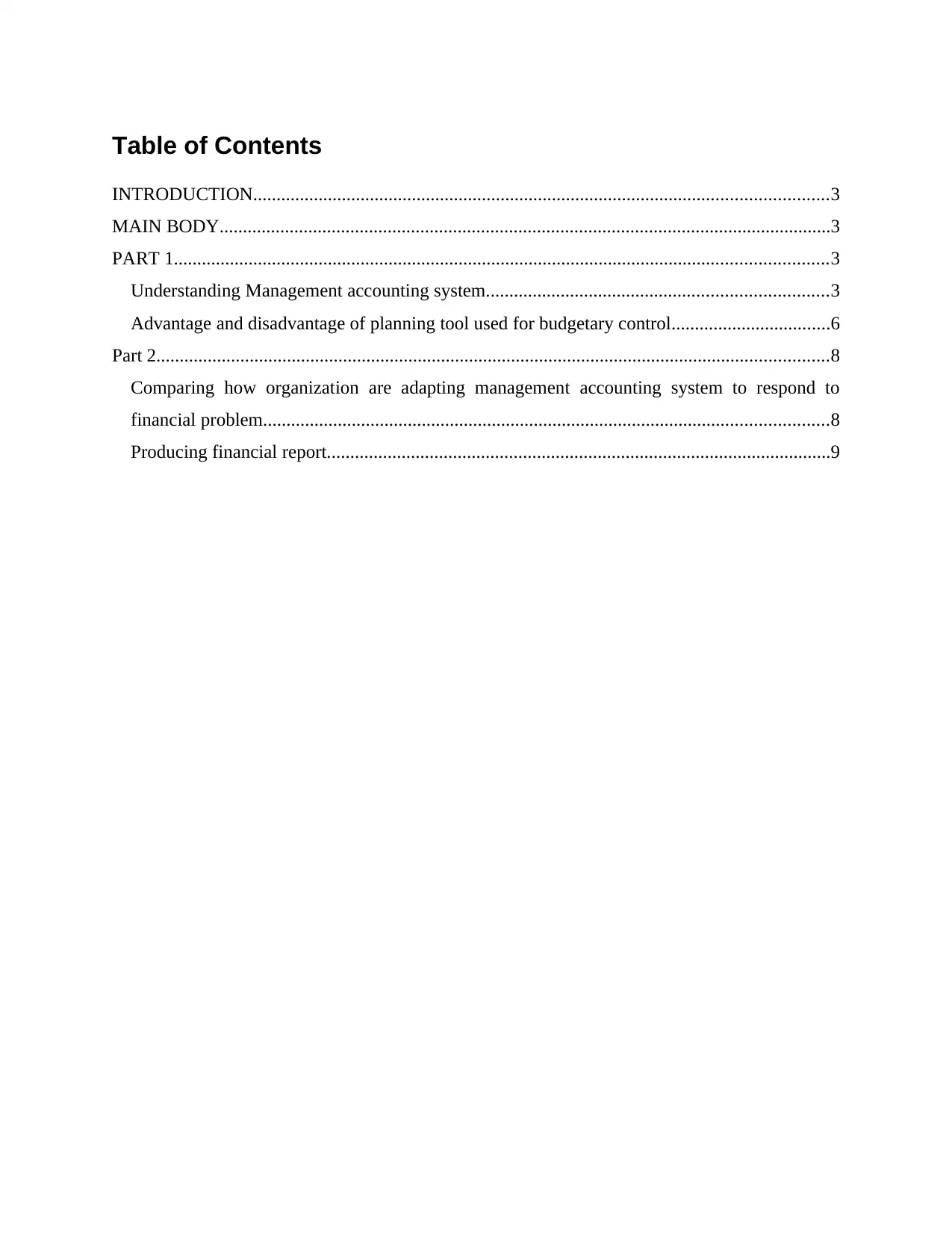
Table of Contents
INTRODUCTION...........................................................................................................................3
MAIN BODY...................................................................................................................................3
PART 1............................................................................................................................................3
Understanding Management accounting system.........................................................................3
Advantage and disadvantage of planning tool used for budgetary control..................................6
Part 2................................................................................................................................................8
Comparing how organization are adapting management accounting system to respond to
financial problem.........................................................................................................................8
Producing financial report............................................................................................................9
INTRODUCTION...........................................................................................................................3
MAIN BODY...................................................................................................................................3
PART 1............................................................................................................................................3
Understanding Management accounting system.........................................................................3
Advantage and disadvantage of planning tool used for budgetary control..................................6
Part 2................................................................................................................................................8
Comparing how organization are adapting management accounting system to respond to
financial problem.........................................................................................................................8
Producing financial report............................................................................................................9

INTRODUCTION
Management accounting is process of making report of the business activity operation
that help the mangers to make short term and long term decision by identifying, measuring, and
analysis the information by the mangers (Amara, Benelifa, 2017). This report highlight the
management accounting fundamentals that involve the business environment and their operation
in the environment. The report of how management accounting applies financial information and
data ton assist in planning decision, monitoring the finance of the company. By successful
completion, students shall ready to present the financial statement and help the senior manager
involve in financial planning. Whereas, they also learn the fundamental skills and knowledge in
the field. Management accounting assist the manager and owner to monitor the company's
performance and prepared throughout the year. Manager or owner can also request report for
weekly, monthly or quarterly depends on the nature of the company.
MAIN BODY
PART 1
Understanding Management accounting system.
It is also known as the managerial accounting system. Management accounting helps in
to provide the financial information and data to managers of the company for the decision-
making purpose. Its only involved the internal management team of the firm which make it
different from the financial accounting. Management accounting gives the financial data to
assist, monitors, planning and decision-making and manages the financial management of the
firm. Management accounting is a process where measures the data, identify, interpret and
anglicizing the financial information of the data to achieve the target goal of the company
(Hamamura, 2019). The process of preparing the management accounts are offer on time,
accurate statistical financial information needed by the management to complete day to day task
of the firms. They show the report which are prepared to fulfil the requirements of the
management. Accounting shows the data which are measures, identify and interpreted the
economical data for the decision. Management accounting system applications varies in the data.
Every management accounting system gives various information based on the requirements of
the firm's management. There are various kinds of management accounting system with their
various objectives and functions where all the elements creates the standardized context of the
data to analysis and communicate the data in accounting system.
Management accounting is process of making report of the business activity operation
that help the mangers to make short term and long term decision by identifying, measuring, and
analysis the information by the mangers (Amara, Benelifa, 2017). This report highlight the
management accounting fundamentals that involve the business environment and their operation
in the environment. The report of how management accounting applies financial information and
data ton assist in planning decision, monitoring the finance of the company. By successful
completion, students shall ready to present the financial statement and help the senior manager
involve in financial planning. Whereas, they also learn the fundamental skills and knowledge in
the field. Management accounting assist the manager and owner to monitor the company's
performance and prepared throughout the year. Manager or owner can also request report for
weekly, monthly or quarterly depends on the nature of the company.
MAIN BODY
PART 1
Understanding Management accounting system.
It is also known as the managerial accounting system. Management accounting helps in
to provide the financial information and data to managers of the company for the decision-
making purpose. Its only involved the internal management team of the firm which make it
different from the financial accounting. Management accounting gives the financial data to
assist, monitors, planning and decision-making and manages the financial management of the
firm. Management accounting is a process where measures the data, identify, interpret and
anglicizing the financial information of the data to achieve the target goal of the company
(Hamamura, 2019). The process of preparing the management accounts are offer on time,
accurate statistical financial information needed by the management to complete day to day task
of the firms. They show the report which are prepared to fulfil the requirements of the
management. Accounting shows the data which are measures, identify and interpreted the
economical data for the decision. Management accounting system applications varies in the data.
Every management accounting system gives various information based on the requirements of
the firm's management. There are various kinds of management accounting system with their
various objectives and functions where all the elements creates the standardized context of the
data to analysis and communicate the data in accounting system.
⊘ This is a preview!⊘
Do you want full access?
Subscribe today to unlock all pages.

Trusted by 1+ million students worldwide
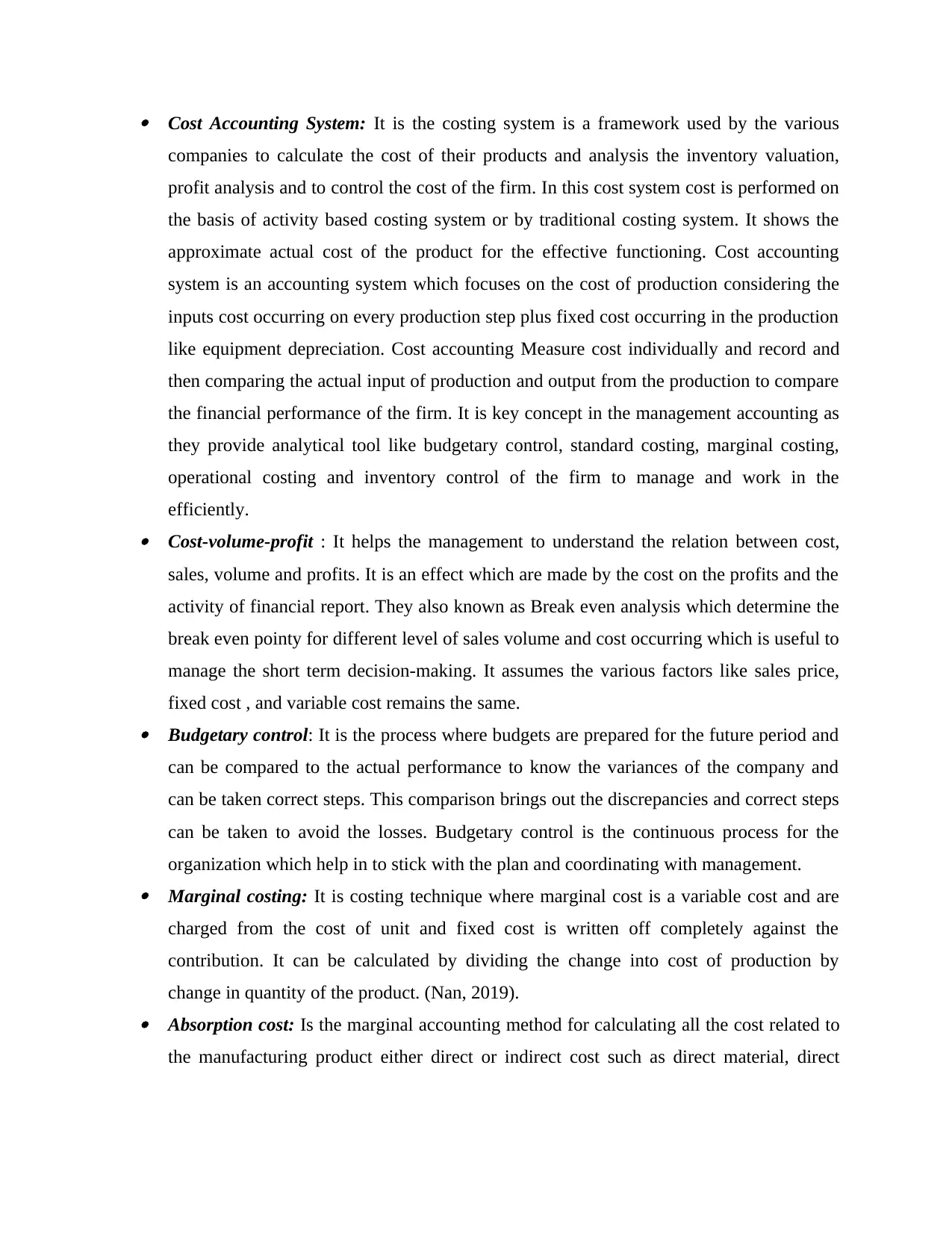
Cost Accounting System: It is the costing system is a framework used by the various
companies to calculate the cost of their products and analysis the inventory valuation,
profit analysis and to control the cost of the firm. In this cost system cost is performed on
the basis of activity based costing system or by traditional costing system. It shows the
approximate actual cost of the product for the effective functioning. Cost accounting
system is an accounting system which focuses on the cost of production considering the
inputs cost occurring on every production step plus fixed cost occurring in the production
like equipment depreciation. Cost accounting Measure cost individually and record and
then comparing the actual input of production and output from the production to compare
the financial performance of the firm. It is key concept in the management accounting as
they provide analytical tool like budgetary control, standard costing, marginal costing,
operational costing and inventory control of the firm to manage and work in the
efficiently. Cost-volume-profit : It helps the management to understand the relation between cost,
sales, volume and profits. It is an effect which are made by the cost on the profits and the
activity of financial report. They also known as Break even analysis which determine the
break even pointy for different level of sales volume and cost occurring which is useful to
manage the short term decision-making. It assumes the various factors like sales price,
fixed cost , and variable cost remains the same. Budgetary control: It is the process where budgets are prepared for the future period and
can be compared to the actual performance to know the variances of the company and
can be taken correct steps. This comparison brings out the discrepancies and correct steps
can be taken to avoid the losses. Budgetary control is the continuous process for the
organization which help in to stick with the plan and coordinating with management. Marginal costing: It is costing technique where marginal cost is a variable cost and are
charged from the cost of unit and fixed cost is written off completely against the
contribution. It can be calculated by dividing the change into cost of production by
change in quantity of the product. (Nan, 2019). Absorption cost: Is the marginal accounting method for calculating all the cost related to
the manufacturing product either direct or indirect cost such as direct material, direct
companies to calculate the cost of their products and analysis the inventory valuation,
profit analysis and to control the cost of the firm. In this cost system cost is performed on
the basis of activity based costing system or by traditional costing system. It shows the
approximate actual cost of the product for the effective functioning. Cost accounting
system is an accounting system which focuses on the cost of production considering the
inputs cost occurring on every production step plus fixed cost occurring in the production
like equipment depreciation. Cost accounting Measure cost individually and record and
then comparing the actual input of production and output from the production to compare
the financial performance of the firm. It is key concept in the management accounting as
they provide analytical tool like budgetary control, standard costing, marginal costing,
operational costing and inventory control of the firm to manage and work in the
efficiently. Cost-volume-profit : It helps the management to understand the relation between cost,
sales, volume and profits. It is an effect which are made by the cost on the profits and the
activity of financial report. They also known as Break even analysis which determine the
break even pointy for different level of sales volume and cost occurring which is useful to
manage the short term decision-making. It assumes the various factors like sales price,
fixed cost , and variable cost remains the same. Budgetary control: It is the process where budgets are prepared for the future period and
can be compared to the actual performance to know the variances of the company and
can be taken correct steps. This comparison brings out the discrepancies and correct steps
can be taken to avoid the losses. Budgetary control is the continuous process for the
organization which help in to stick with the plan and coordinating with management. Marginal costing: It is costing technique where marginal cost is a variable cost and are
charged from the cost of unit and fixed cost is written off completely against the
contribution. It can be calculated by dividing the change into cost of production by
change in quantity of the product. (Nan, 2019). Absorption cost: Is the marginal accounting method for calculating all the cost related to
the manufacturing product either direct or indirect cost such as direct material, direct
Paraphrase This Document
Need a fresh take? Get an instant paraphrase of this document with our AI Paraphraser
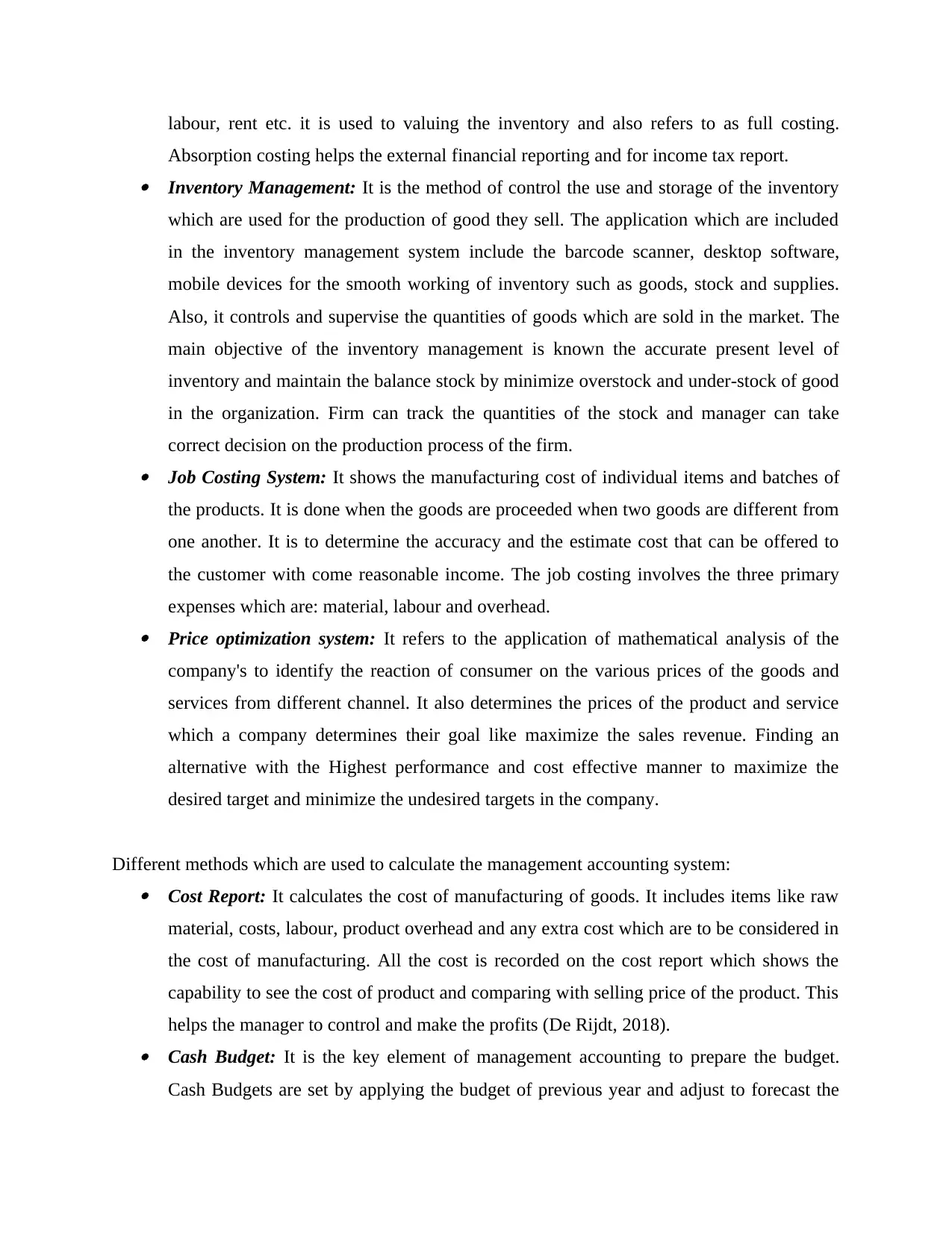
labour, rent etc. it is used to valuing the inventory and also refers to as full costing.
Absorption costing helps the external financial reporting and for income tax report. Inventory Management: It is the method of control the use and storage of the inventory
which are used for the production of good they sell. The application which are included
in the inventory management system include the barcode scanner, desktop software,
mobile devices for the smooth working of inventory such as goods, stock and supplies.
Also, it controls and supervise the quantities of goods which are sold in the market. The
main objective of the inventory management is known the accurate present level of
inventory and maintain the balance stock by minimize overstock and under-stock of good
in the organization. Firm can track the quantities of the stock and manager can take
correct decision on the production process of the firm. Job Costing System: It shows the manufacturing cost of individual items and batches of
the products. It is done when the goods are proceeded when two goods are different from
one another. It is to determine the accuracy and the estimate cost that can be offered to
the customer with come reasonable income. The job costing involves the three primary
expenses which are: material, labour and overhead. Price optimization system: It refers to the application of mathematical analysis of the
company's to identify the reaction of consumer on the various prices of the goods and
services from different channel. It also determines the prices of the product and service
which a company determines their goal like maximize the sales revenue. Finding an
alternative with the Highest performance and cost effective manner to maximize the
desired target and minimize the undesired targets in the company.
Different methods which are used to calculate the management accounting system: Cost Report: It calculates the cost of manufacturing of goods. It includes items like raw
material, costs, labour, product overhead and any extra cost which are to be considered in
the cost of manufacturing. All the cost is recorded on the cost report which shows the
capability to see the cost of product and comparing with selling price of the product. This
helps the manager to control and make the profits (De Rijdt, 2018). Cash Budget: It is the key element of management accounting to prepare the budget.
Cash Budgets are set by applying the budget of previous year and adjust to forecast the
Absorption costing helps the external financial reporting and for income tax report. Inventory Management: It is the method of control the use and storage of the inventory
which are used for the production of good they sell. The application which are included
in the inventory management system include the barcode scanner, desktop software,
mobile devices for the smooth working of inventory such as goods, stock and supplies.
Also, it controls and supervise the quantities of goods which are sold in the market. The
main objective of the inventory management is known the accurate present level of
inventory and maintain the balance stock by minimize overstock and under-stock of good
in the organization. Firm can track the quantities of the stock and manager can take
correct decision on the production process of the firm. Job Costing System: It shows the manufacturing cost of individual items and batches of
the products. It is done when the goods are proceeded when two goods are different from
one another. It is to determine the accuracy and the estimate cost that can be offered to
the customer with come reasonable income. The job costing involves the three primary
expenses which are: material, labour and overhead. Price optimization system: It refers to the application of mathematical analysis of the
company's to identify the reaction of consumer on the various prices of the goods and
services from different channel. It also determines the prices of the product and service
which a company determines their goal like maximize the sales revenue. Finding an
alternative with the Highest performance and cost effective manner to maximize the
desired target and minimize the undesired targets in the company.
Different methods which are used to calculate the management accounting system: Cost Report: It calculates the cost of manufacturing of goods. It includes items like raw
material, costs, labour, product overhead and any extra cost which are to be considered in
the cost of manufacturing. All the cost is recorded on the cost report which shows the
capability to see the cost of product and comparing with selling price of the product. This
helps the manager to control and make the profits (De Rijdt, 2018). Cash Budget: It is the key element of management accounting to prepare the budget.
Cash Budgets are set by applying the budget of previous year and adjust to forecast the
future. This includes inflow and outflow of expenses and revenue source. It helps the
company to attain the objective goal within the budgeted amount of the company.
However, it is the estimation of future company's cash position
Performance report : budgets are made to compare the actual revenue and expenditure to
the budget amount. This report is calculated each year by quarterly and half-yearly that
help the manger to plan the future demand of the product and fulfil the demand of the
market.
Advantage and disadvantage of planning tool used for budgetary control
Planning tools are the guidance for the company in order to plan different financial
concerns of the organization. Budgetary control means the process where budgets are arranged
for the future and can be compared with the actual result to find out the variances. This
comparison with the actual amount will help the management to find out the variances and
correct steps are taken to overcome. In case of budgetary control planning tools are the
supporting factors that can lead the organization to conduct the best level of financial planning.
Advantages of planning tools
Following are the different advantages associated with the budgetary planning that can
lead towards the best level of financial planning in favour of the organization. All these points
indicate all different advantages entertained against the financial planning.
Maximization of profit: Profit maximization is a key factor that support the company in
form of budgetary control. Planning tool guide company to utilize its financial stability in
the best way possible. Profit maximization is also considered as among the key objective
part of the business functions entertained by the organization (Nasrin, 2016). Planning
tools guide company in direct direction where organization can deliver the bes use of
company's financial resources. This is the significant advantage planning tool provide in
the overall objectives of the organization to channelizes business functions.
Improve financial management: Budgetary control is about to assess the needs and
requirements of the specific functional activity to control the financial requirements of
the company. All the planning tools allow company to analysis the financial requirements
associated with the specific functional area in order to achieve the best level of financial
stability in favour of the organization. Financial management is the key advantage that
budgetary control tools allocate to the organization (Rizqi, 2018). All these tools guide
company to attain the objective goal within the budgeted amount of the company.
However, it is the estimation of future company's cash position
Performance report : budgets are made to compare the actual revenue and expenditure to
the budget amount. This report is calculated each year by quarterly and half-yearly that
help the manger to plan the future demand of the product and fulfil the demand of the
market.
Advantage and disadvantage of planning tool used for budgetary control
Planning tools are the guidance for the company in order to plan different financial
concerns of the organization. Budgetary control means the process where budgets are arranged
for the future and can be compared with the actual result to find out the variances. This
comparison with the actual amount will help the management to find out the variances and
correct steps are taken to overcome. In case of budgetary control planning tools are the
supporting factors that can lead the organization to conduct the best level of financial planning.
Advantages of planning tools
Following are the different advantages associated with the budgetary planning that can
lead towards the best level of financial planning in favour of the organization. All these points
indicate all different advantages entertained against the financial planning.
Maximization of profit: Profit maximization is a key factor that support the company in
form of budgetary control. Planning tool guide company to utilize its financial stability in
the best way possible. Profit maximization is also considered as among the key objective
part of the business functions entertained by the organization (Nasrin, 2016). Planning
tools guide company in direct direction where organization can deliver the bes use of
company's financial resources. This is the significant advantage planning tool provide in
the overall objectives of the organization to channelizes business functions.
Improve financial management: Budgetary control is about to assess the needs and
requirements of the specific functional activity to control the financial requirements of
the company. All the planning tools allow company to analysis the financial requirements
associated with the specific functional area in order to achieve the best level of financial
stability in favour of the organization. Financial management is the key advantage that
budgetary control tools allocate to the organization (Rizqi, 2018). All these tools guide
⊘ This is a preview!⊘
Do you want full access?
Subscribe today to unlock all pages.
Trusted by 1+ million students worldwide
company to only allocate the required funds for every single functional activity based on
the needs and demand of every single operation which resist on behalf of the company in
blocking company's financial resources in form of excessive allocation of financial
resources to company.
Reduces cost of operations: Planning tools used for budgetary control allow the
organization to reduce the overall cost involved in conducting operations. All these tools
also support the company in controlling overall cost required to deliver the specific
services. Cost controlling is among the significant advantage these planning tools deliver
to the company. These tools highlight all significant areas that containing extra cost
which further reduce the overall cost of delivering the function. Reducing cost of
operation further allow company to maximize its overall profitability in order to
channelize business operations of organization (Makrygiannak, Jack, 2016).
Profit maximization: Profit maximization is among the key benefit planning tool
provide to the company. All these tools guide company to control the cost of delivering
the functional activity. Profit maximization can only be done by controlling the overall
cost to allocate the functional activity of organization. These tools make the operations
economical that in long run maximizes the overall profitability involved in delivering the
business operations. The above mentioned points indicate about the key benefits
associated with the planning tool in order to utilize them for delivering the business
objective and to achieve the best level of financial management.
Disadvantage of planning tool
Following are the points demonstrate the disadvantages associated with the planning tools for
conducting financial management.
Future is uncertain: All the planning tools used for conducting financial management
contain limitation in form of uncertainty. All these planning tool assume the specific
certainty about the future. The critical analysis of these tools indicate that future is not
certain and situation can change any time that will directly influence the overall cost
required to deliver the operations. Due to the uncertainty results of these planing tool
mislead company in most of the time. Uncertainty in relation to future activity is a key
disadvantage associated with the planning tool as those uncertainties will completely
restricts the financial planing outcomes of company. Many times company and
the needs and demand of every single operation which resist on behalf of the company in
blocking company's financial resources in form of excessive allocation of financial
resources to company.
Reduces cost of operations: Planning tools used for budgetary control allow the
organization to reduce the overall cost involved in conducting operations. All these tools
also support the company in controlling overall cost required to deliver the specific
services. Cost controlling is among the significant advantage these planning tools deliver
to the company. These tools highlight all significant areas that containing extra cost
which further reduce the overall cost of delivering the function. Reducing cost of
operation further allow company to maximize its overall profitability in order to
channelize business operations of organization (Makrygiannak, Jack, 2016).
Profit maximization: Profit maximization is among the key benefit planning tool
provide to the company. All these tools guide company to control the cost of delivering
the functional activity. Profit maximization can only be done by controlling the overall
cost to allocate the functional activity of organization. These tools make the operations
economical that in long run maximizes the overall profitability involved in delivering the
business operations. The above mentioned points indicate about the key benefits
associated with the planning tool in order to utilize them for delivering the business
objective and to achieve the best level of financial management.
Disadvantage of planning tool
Following are the points demonstrate the disadvantages associated with the planning tools for
conducting financial management.
Future is uncertain: All the planning tools used for conducting financial management
contain limitation in form of uncertainty. All these planning tool assume the specific
certainty about the future. The critical analysis of these tools indicate that future is not
certain and situation can change any time that will directly influence the overall cost
required to deliver the operations. Due to the uncertainty results of these planing tool
mislead company in most of the time. Uncertainty in relation to future activity is a key
disadvantage associated with the planning tool as those uncertainties will completely
restricts the financial planing outcomes of company. Many times company and
Paraphrase This Document
Need a fresh take? Get an instant paraphrase of this document with our AI Paraphraser
management remain in certain delusion that the future activity will exactly the same as
company is expecting which is not a real fact in any situation.
Extra cost incurred: Budgetary control requires extra cost to be incurred in conduction
of planning for all the budgetary requirements of company. The planning process always
create extra financial pressure over the resources of company. IT also consume plenty of
time in analysing the financial requirements and to plan the same. Extra cost uncured
over the planning price make the practice more burdensome over the financial stability of
the organization.
The above mentioned disadvantages are the key barrier part of the budgetary tools and
planning. All the above mentioned points generate the specific limitations in respect to establish
financial stability in the organization.
Part 2
Comparing how organization are adapting management accounting system to respond to
financial problem.
Companies encourage how they adopt their business models, strategies to be used,
producer to be followed to respond the environment and social challenges and maintain the value
of their stakeholder and sound financially strong in the market. Few companies accept the
challenges and confident to accept with required skills in sustainable economy. Some companies
are missed out the valuable analysis and fails to take the advantage set by the management
accounting. It makes the business scenario to analysis and sustain the effect of social
environmental factors on the organization performance.
Following managerial accounting ways that can be used to respond to financial problems:
Identifying financial issues by using budgetary target, key performing indicators either
financial or can be non financial and benchmarking to know the problems and variances and
solve them on time without any delay to surfer lose (Kaluzi, 2017). Financial governance of the
company should have knowledge about the governance and prevent it from the financial issue.
Company can be used this as a monitoring strategy of financial governance. Manager and
company should have the effective and efficient managerial skills to avoid the grievances on
management accounting. Also, with skills they can apply to prevent or deal with grievances such
as misappropriation of resources which help the company to grow. Whereas, effective strategy
system for the development and strategies that take time and gives the effective reporting such as
company is expecting which is not a real fact in any situation.
Extra cost incurred: Budgetary control requires extra cost to be incurred in conduction
of planning for all the budgetary requirements of company. The planning process always
create extra financial pressure over the resources of company. IT also consume plenty of
time in analysing the financial requirements and to plan the same. Extra cost uncured
over the planning price make the practice more burdensome over the financial stability of
the organization.
The above mentioned disadvantages are the key barrier part of the budgetary tools and
planning. All the above mentioned points generate the specific limitations in respect to establish
financial stability in the organization.
Part 2
Comparing how organization are adapting management accounting system to respond to
financial problem.
Companies encourage how they adopt their business models, strategies to be used,
producer to be followed to respond the environment and social challenges and maintain the value
of their stakeholder and sound financially strong in the market. Few companies accept the
challenges and confident to accept with required skills in sustainable economy. Some companies
are missed out the valuable analysis and fails to take the advantage set by the management
accounting. It makes the business scenario to analysis and sustain the effect of social
environmental factors on the organization performance.
Following managerial accounting ways that can be used to respond to financial problems:
Identifying financial issues by using budgetary target, key performing indicators either
financial or can be non financial and benchmarking to know the problems and variances and
solve them on time without any delay to surfer lose (Kaluzi, 2017). Financial governance of the
company should have knowledge about the governance and prevent it from the financial issue.
Company can be used this as a monitoring strategy of financial governance. Manager and
company should have the effective and efficient managerial skills to avoid the grievances on
management accounting. Also, with skills they can apply to prevent or deal with grievances such
as misappropriation of resources which help the company to grow. Whereas, effective strategy
system for the development and strategies that take time and gives the effective reporting such as
full disclosure of finical statement which is owned and make by the companies. To sustain the
business management accountant may guide the company with the report:
Finding the social and environmental trend which will affect the company to maintain the
value over the time.
Preparing the report on the impact of sustainability issue with comparing how and when
they will affect the company in future and what are the consequences.
Relate with the sustainable challenges with the strategies of the companies, performance
outlook of the company and with business model.
Key performance indicator (KPI) is the critical indicator of the progress toward the set
goal by the company. KPI can be established in the comp0any to support the sustainable
and strategic goal of the company.
Management accounting tools and techniques can be applied like availability of natural
resources, life cycle costing to guide incorporate sustainability into the process of
decision-making.
Creating the report which will affect the sustainability on pricing and budgeting decision
and strategic planning and investment decision (Schmitz, 2020).
Implementing the reporting strategy which result in sustainability matter to ensure the
non financial and financial data revealed. Example: The international incorporated
reporting framework established by IIRC.
Producing financial report.
Income statement as per Marginal Costing
Particulars May June
Sales Revenue (100 * 250) 25000 (75 * 250) 18750
Marginal Cost of Sales
Direct Materials (100 * 60) 6000 (80 * 60) 4800
Direct Labour (100 * 40) 4000 (80 * 40) 3200
Variable sales commission (25000 * 2) 500 (18750 * 2 ) 375
Variable Production Overheads (100 * 20) 2000 (80 * 20) 1600
12500 9975
business management accountant may guide the company with the report:
Finding the social and environmental trend which will affect the company to maintain the
value over the time.
Preparing the report on the impact of sustainability issue with comparing how and when
they will affect the company in future and what are the consequences.
Relate with the sustainable challenges with the strategies of the companies, performance
outlook of the company and with business model.
Key performance indicator (KPI) is the critical indicator of the progress toward the set
goal by the company. KPI can be established in the comp0any to support the sustainable
and strategic goal of the company.
Management accounting tools and techniques can be applied like availability of natural
resources, life cycle costing to guide incorporate sustainability into the process of
decision-making.
Creating the report which will affect the sustainability on pricing and budgeting decision
and strategic planning and investment decision (Schmitz, 2020).
Implementing the reporting strategy which result in sustainability matter to ensure the
non financial and financial data revealed. Example: The international incorporated
reporting framework established by IIRC.
Producing financial report.
Income statement as per Marginal Costing
Particulars May June
Sales Revenue (100 * 250) 25000 (75 * 250) 18750
Marginal Cost of Sales
Direct Materials (100 * 60) 6000 (80 * 60) 4800
Direct Labour (100 * 40) 4000 (80 * 40) 3200
Variable sales commission (25000 * 2) 500 (18750 * 2 ) 375
Variable Production Overheads (100 * 20) 2000 (80 * 20) 1600
12500 9975
⊘ This is a preview!⊘
Do you want full access?
Subscribe today to unlock all pages.
Trusted by 1+ million students worldwide
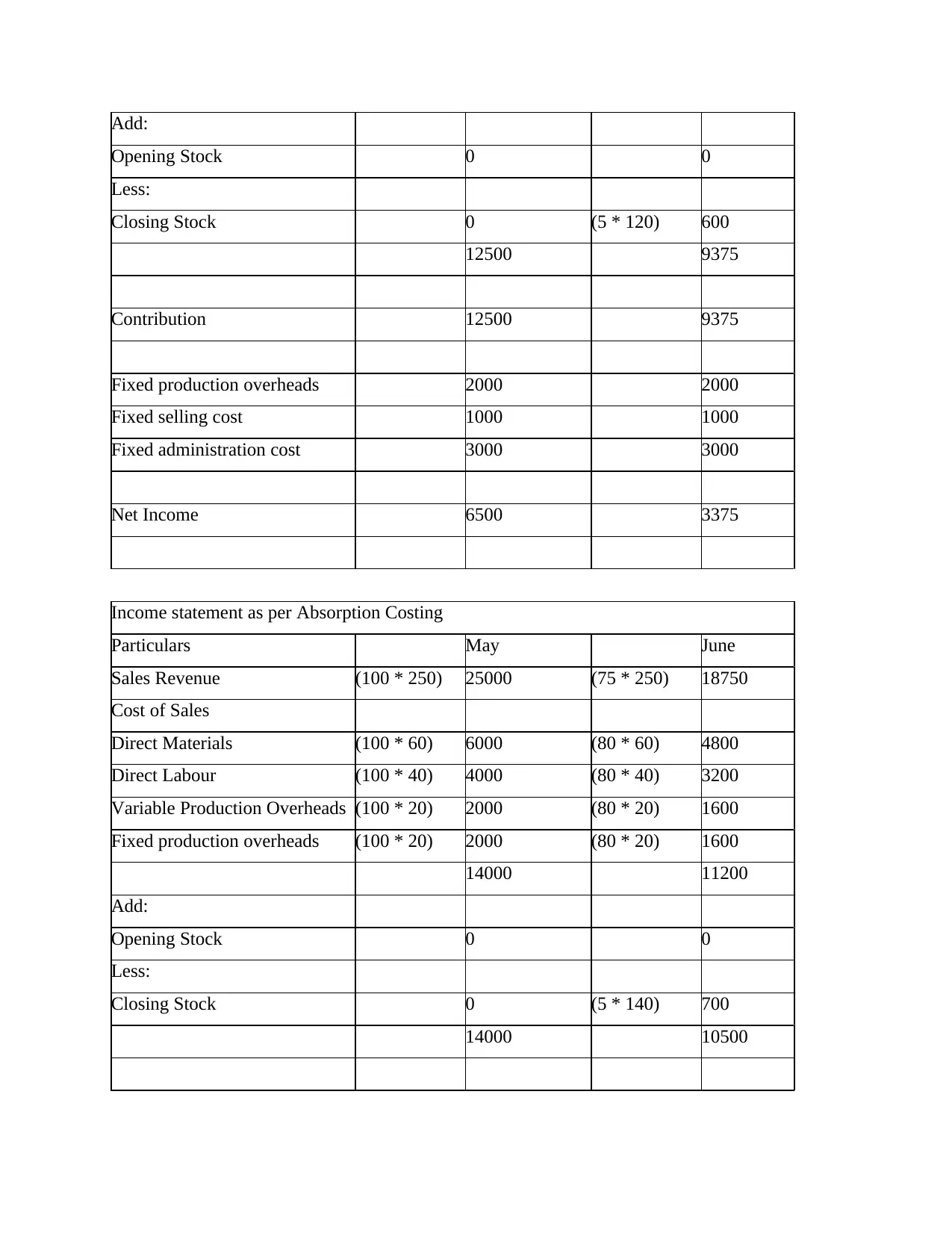
Add:
Opening Stock 0 0
Less:
Closing Stock 0 (5 * 120) 600
12500 9375
Contribution 12500 9375
Fixed production overheads 2000 2000
Fixed selling cost 1000 1000
Fixed administration cost 3000 3000
Net Income 6500 3375
Income statement as per Absorption Costing
Particulars May June
Sales Revenue (100 * 250) 25000 (75 * 250) 18750
Cost of Sales
Direct Materials (100 * 60) 6000 (80 * 60) 4800
Direct Labour (100 * 40) 4000 (80 * 40) 3200
Variable Production Overheads (100 * 20) 2000 (80 * 20) 1600
Fixed production overheads (100 * 20) 2000 (80 * 20) 1600
14000 11200
Add:
Opening Stock 0 0
Less:
Closing Stock 0 (5 * 140) 700
14000 10500
Opening Stock 0 0
Less:
Closing Stock 0 (5 * 120) 600
12500 9375
Contribution 12500 9375
Fixed production overheads 2000 2000
Fixed selling cost 1000 1000
Fixed administration cost 3000 3000
Net Income 6500 3375
Income statement as per Absorption Costing
Particulars May June
Sales Revenue (100 * 250) 25000 (75 * 250) 18750
Cost of Sales
Direct Materials (100 * 60) 6000 (80 * 60) 4800
Direct Labour (100 * 40) 4000 (80 * 40) 3200
Variable Production Overheads (100 * 20) 2000 (80 * 20) 1600
Fixed production overheads (100 * 20) 2000 (80 * 20) 1600
14000 11200
Add:
Opening Stock 0 0
Less:
Closing Stock 0 (5 * 140) 700
14000 10500
Paraphrase This Document
Need a fresh take? Get an instant paraphrase of this document with our AI Paraphraser
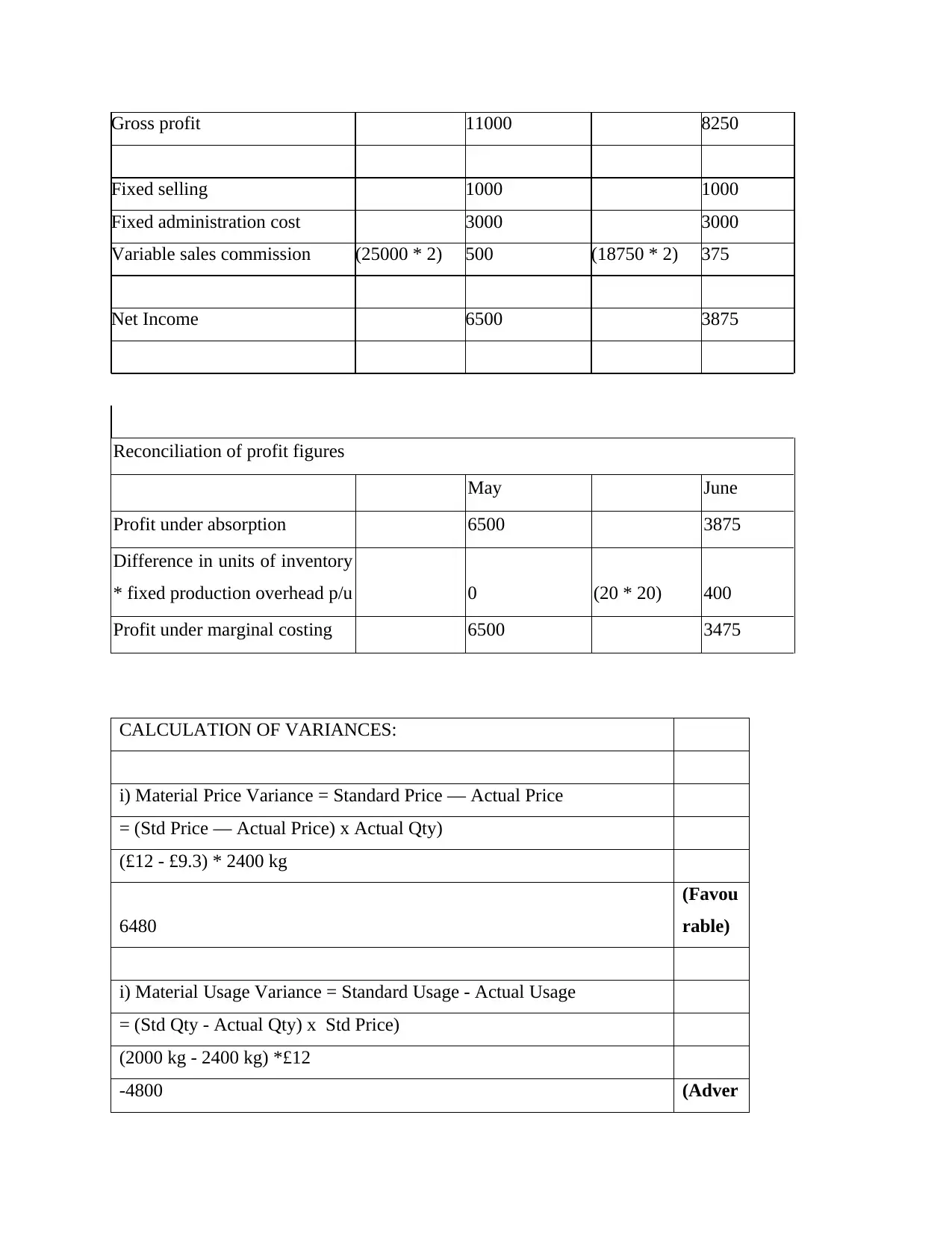
Gross profit 11000 8250
Fixed selling 1000 1000
Fixed administration cost 3000 3000
Variable sales commission (25000 * 2) 500 (18750 * 2) 375
Net Income 6500 3875
Reconciliation of profit figures
May June
Profit under absorption 6500 3875
Difference in units of inventory
* fixed production overhead p/u 0 (20 * 20) 400
Profit under marginal costing 6500 3475
CALCULATION OF VARIANCES:
i) Material Price Variance = Standard Price — Actual Price
= (Std Price — Actual Price) x Actual Qty)
(£12 - £9.3) * 2400 kg
6480
(Favou
rable)
i) Material Usage Variance = Standard Usage - Actual Usage
= (Std Qty - Actual Qty) x Std Price)
(2000 kg - 2400 kg) *£12
-4800 (Adver
Fixed selling 1000 1000
Fixed administration cost 3000 3000
Variable sales commission (25000 * 2) 500 (18750 * 2) 375
Net Income 6500 3875
Reconciliation of profit figures
May June
Profit under absorption 6500 3875
Difference in units of inventory
* fixed production overhead p/u 0 (20 * 20) 400
Profit under marginal costing 6500 3475
CALCULATION OF VARIANCES:
i) Material Price Variance = Standard Price — Actual Price
= (Std Price — Actual Price) x Actual Qty)
(£12 - £9.3) * 2400 kg
6480
(Favou
rable)
i) Material Usage Variance = Standard Usage - Actual Usage
= (Std Qty - Actual Qty) x Std Price)
(2000 kg - 2400 kg) *£12
-4800 (Adver
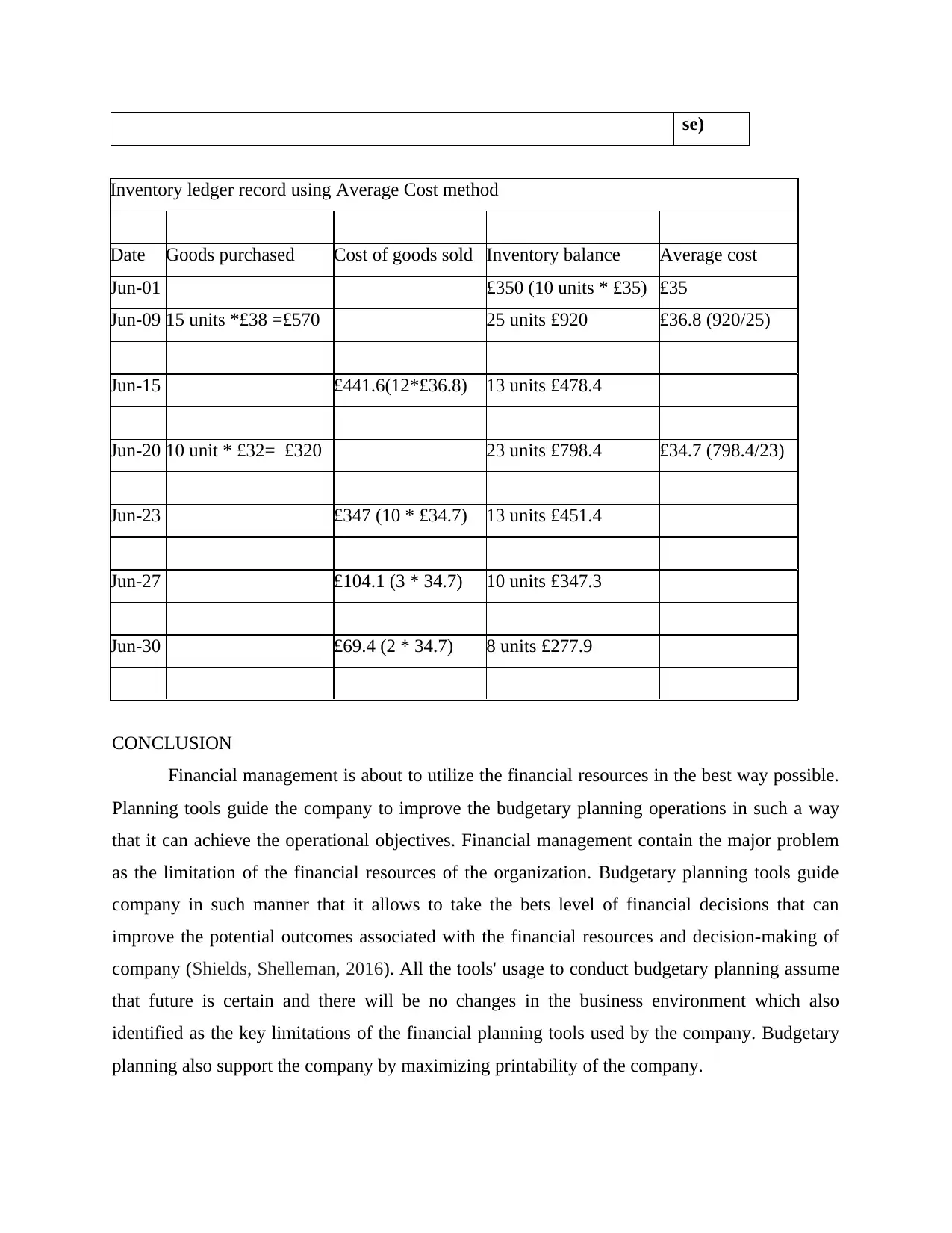
se)
Inventory ledger record using Average Cost method
Date Goods purchased Cost of goods sold Inventory balance Average cost
Jun-01 £350 (10 units * £35) £35
Jun-09 15 units *£38 =£570 25 units £920 £36.8 (920/25)
Jun-15 £441.6(12*£36.8) 13 units £478.4
Jun-20 10 unit * £32= £320 23 units £798.4 £34.7 (798.4/23)
Jun-23 £347 (10 * £34.7) 13 units £451.4
Jun-27 £104.1 (3 * 34.7) 10 units £347.3
Jun-30 £69.4 (2 * 34.7) 8 units £277.9
CONCLUSION
Financial management is about to utilize the financial resources in the best way possible.
Planning tools guide the company to improve the budgetary planning operations in such a way
that it can achieve the operational objectives. Financial management contain the major problem
as the limitation of the financial resources of the organization. Budgetary planning tools guide
company in such manner that it allows to take the bets level of financial decisions that can
improve the potential outcomes associated with the financial resources and decision-making of
company (Shields, Shelleman, 2016). All the tools' usage to conduct budgetary planning assume
that future is certain and there will be no changes in the business environment which also
identified as the key limitations of the financial planning tools used by the company. Budgetary
planning also support the company by maximizing printability of the company.
Inventory ledger record using Average Cost method
Date Goods purchased Cost of goods sold Inventory balance Average cost
Jun-01 £350 (10 units * £35) £35
Jun-09 15 units *£38 =£570 25 units £920 £36.8 (920/25)
Jun-15 £441.6(12*£36.8) 13 units £478.4
Jun-20 10 unit * £32= £320 23 units £798.4 £34.7 (798.4/23)
Jun-23 £347 (10 * £34.7) 13 units £451.4
Jun-27 £104.1 (3 * 34.7) 10 units £347.3
Jun-30 £69.4 (2 * 34.7) 8 units £277.9
CONCLUSION
Financial management is about to utilize the financial resources in the best way possible.
Planning tools guide the company to improve the budgetary planning operations in such a way
that it can achieve the operational objectives. Financial management contain the major problem
as the limitation of the financial resources of the organization. Budgetary planning tools guide
company in such manner that it allows to take the bets level of financial decisions that can
improve the potential outcomes associated with the financial resources and decision-making of
company (Shields, Shelleman, 2016). All the tools' usage to conduct budgetary planning assume
that future is certain and there will be no changes in the business environment which also
identified as the key limitations of the financial planning tools used by the company. Budgetary
planning also support the company by maximizing printability of the company.
⊘ This is a preview!⊘
Do you want full access?
Subscribe today to unlock all pages.
Trusted by 1+ million students worldwide

1 out of 14


Related Documents


Your All-in-One AI-Powered Toolkit for Academic Success.
+13062052269
info@desklib.com
Available 24*7 on WhatsApp / Email
![[object Object]](/_next/static/media/star-bottom.7253800d.svg)
Unlock your academic potential
Copyright © 2020–2026 A2Z Services. All Rights Reserved. Developed and managed by ZUCOL.