BTEC Higher National Diploma Management Accounting Report - Unit 5
VerifiedAdded on 2022/12/29
|24
|5855
|2
Report
AI Summary
This report provides a comprehensive overview of management accounting, its tools, and techniques, with a focus on their practical application within organizations, specifically Connect Catering Services. The report begins by defining management accounting and outlining its essential requirements, emphasizing its role in evaluating organizational performance, resource allocation, and financial statement presentation. It then explores various management accounting reporting methods, including budgeting, cost schedules, and variance analysis. The report evaluates the benefits of management accounting systems, such as improved decision-making, efficient resource utilization, and enhanced communication, while also examining how these systems integrate within organizational processes. The analysis extends to cost calculation using marginal and absorption costing techniques, including the preparation of income statements. The report provides a detailed analysis of financial reporting documents and their application. The report also uses financial data to perform calculations and create financial statements for Connect Catering Services. The report concludes by critically evaluating how management accounting systems and reporting are integrated within organizational processes, emphasizing the importance of these systems for effective financial management and decision-making.
Management
Accounting
Accounting

Paraphrase This Document
Need a fresh take? Get an instant paraphrase of this document with our AI Paraphraser
INTRODUCTION
This report is based on the Management accounting system their tools and techniques and
applicability in the working of the organisation. It is the branch of accounting that evaluates the
performance of the organisation and is only for the internal use by the management only. It also
comprises of the income statement computation using two ways of costing, i.e., absorption
costing and marginal costing. It is prepared with the professional skills and focuses on the fully
and effectively utilizing the resources, safeguarding them and enhancing operational efficiency
(Armitage, 2020). It helps in evaluation of the key areas that are have huge impact on the
organisation’s performance.
This report is concerned with the Connect Catering Services, which is the one of the best
organisations of UK. It has the headquarters in Oxfordshire, and started its operations in 1989, by
John Herring. A comparison is made with the similar organisation in using the accounting
system for solving the financial problems faced by them.
TASK 1
P1 Explain management accounting and give the essential requirements of different types of
management accounting systems.
Management accounting is also termed as managerial accounting that deals with the
public and private enterprises that helps the organisation to achieve its objectives and goals by
classifying, measuring, illuminating and communicating commercial information at internal
terms. It is the clear view of statistical data and its information and activities that refers the
finance and business policies that assist the planning and controlling operations of the enterprise.
Measurement of presentation: It assist the enterprise in evaluating the workers
completion and their level of efficiency that compiles the acute and standardized
presentation which fits the divergence by it essential plan of actions can be implemented
(Bakhtiari, 2020). It may also formulate the policies that evolves that worker performance
as compare to other individuals in the organisation.
Categorisation of risk: Another advantage of management accounting or managerial
accounting is recognising the risk element in the organisation by which it can be reduce
This report is based on the Management accounting system their tools and techniques and
applicability in the working of the organisation. It is the branch of accounting that evaluates the
performance of the organisation and is only for the internal use by the management only. It also
comprises of the income statement computation using two ways of costing, i.e., absorption
costing and marginal costing. It is prepared with the professional skills and focuses on the fully
and effectively utilizing the resources, safeguarding them and enhancing operational efficiency
(Armitage, 2020). It helps in evaluation of the key areas that are have huge impact on the
organisation’s performance.
This report is concerned with the Connect Catering Services, which is the one of the best
organisations of UK. It has the headquarters in Oxfordshire, and started its operations in 1989, by
John Herring. A comparison is made with the similar organisation in using the accounting
system for solving the financial problems faced by them.
TASK 1
P1 Explain management accounting and give the essential requirements of different types of
management accounting systems.
Management accounting is also termed as managerial accounting that deals with the
public and private enterprises that helps the organisation to achieve its objectives and goals by
classifying, measuring, illuminating and communicating commercial information at internal
terms. It is the clear view of statistical data and its information and activities that refers the
finance and business policies that assist the planning and controlling operations of the enterprise.
Measurement of presentation: It assist the enterprise in evaluating the workers
completion and their level of efficiency that compiles the acute and standardized
presentation which fits the divergence by it essential plan of actions can be implemented
(Bakhtiari, 2020). It may also formulate the policies that evolves that worker performance
as compare to other individuals in the organisation.
Categorisation of risk: Another advantage of management accounting or managerial
accounting is recognising the risk element in the organisation by which it can be reduce
the organisational risk handling practices that dominate the employee presentation.
Accounting
Allotment of resources: Enterprise is sufficiently capable to achieve the utilisation of
resources with efficiency that helps the various sections to have the distinct point of view
for every section and figures in the organisation (Farazdaghi, 2020). It also includes the
summarizing, analysing and coverage the resources that supervise the financial
information.
Financial statement presentation: Management accounting submits the accurate
presentation of the business financial position that helps the statistical statements in
regards with information and data. The various factors that affect cost and financial
activities to overlooked it more reliably in the organization as for fundamental decision
making.
P2 Explain different methods used for management accounting reporting.
Management accounting is the method of communicating the sources of statistical
statements and information that serves the changes in the organizational complexities to make it
more specialized factors that indicates the proper accounting and audit.
Budget: A budget is the total calculation of cost and income as it is a microeconomics
concept for particular time interval that follows the administrative body, governing body,
group of individuals, a business, and the list will continue. The process starts with set up
the assumptions for the future coming budget outcome in the financial year as it is a
financial program for particular interval that generally raise the occurrence of commercial
project.
Cost Schedules: A cost schedule is the overall production of cost at various levels of
product and by which average cost and marginal cost can be measured and the curve of
cost schedule will draw. It is assumed that the organisation has prepare the short run cost
schedule and long run cost schedule individually (Gray, 2020). According to the
organisation it can assumed that the production with the out-dated or obsoleted
technology and methods surely involves the high monetary value.
Variance analysis: It is the part of fund control activity in which a budget for income,
revenue and expenses is differentiate with the actual report of the enterprise and the
Accounting
Allotment of resources: Enterprise is sufficiently capable to achieve the utilisation of
resources with efficiency that helps the various sections to have the distinct point of view
for every section and figures in the organisation (Farazdaghi, 2020). It also includes the
summarizing, analysing and coverage the resources that supervise the financial
information.
Financial statement presentation: Management accounting submits the accurate
presentation of the business financial position that helps the statistical statements in
regards with information and data. The various factors that affect cost and financial
activities to overlooked it more reliably in the organization as for fundamental decision
making.
P2 Explain different methods used for management accounting reporting.
Management accounting is the method of communicating the sources of statistical
statements and information that serves the changes in the organizational complexities to make it
more specialized factors that indicates the proper accounting and audit.
Budget: A budget is the total calculation of cost and income as it is a microeconomics
concept for particular time interval that follows the administrative body, governing body,
group of individuals, a business, and the list will continue. The process starts with set up
the assumptions for the future coming budget outcome in the financial year as it is a
financial program for particular interval that generally raise the occurrence of commercial
project.
Cost Schedules: A cost schedule is the overall production of cost at various levels of
product and by which average cost and marginal cost can be measured and the curve of
cost schedule will draw. It is assumed that the organisation has prepare the short run cost
schedule and long run cost schedule individually (Gray, 2020). According to the
organisation it can assumed that the production with the out-dated or obsoleted
technology and methods surely involves the high monetary value.
Variance analysis: It is the part of fund control activity in which a budget for income,
revenue and expenses is differentiate with the actual report of the enterprise and the
⊘ This is a preview!⊘
Do you want full access?
Subscribe today to unlock all pages.

Trusted by 1+ million students worldwide
statement usually carry forward to classify the enterprise presentation in respect of the
plan and policies that ensures by the management.
M1 Evaluate the benefits of management accounting systems and their application within an
organizational context.
Management accounting is a process to determine, examine and conveys all important
information to managers which is helpful to make decisions and having knowledge about the
cost of accounting to achieve goals of organization in effective manner. Management accounting
is beneficial for every organization to plan all activities sequentially for effective operations.
There are various type budgets and accounts are prepared which are divided in various form such
as department and product. Actual performance is compared with standard set and if there are
some variances raised mangers find out reasons behind and take actions to solve them.
Management accounting explains responsibilities of executives and their area of working so
there is no confusion regarding work; everything is done in well-organized manner (Haslam,
2020). It Manages and coordinate all finance, production, and personal activities of an
organization to achieve objectives. It also removes all wastage and unnecessary activities which
saves time to perform activities and also improves efficiency of organization.
There is two-way communication in preparation management accounting like if there
some modifications are required in accounts than these information send to top management
which helps them to take decision and responsibilities of work and their assignment
communicate to lower level for their smooth working. Data provided by these accounts is quite
accurate and reliable which is helpful in maximization of profit. In an organization various
application are implemented such as measuring performance and efficiency of employees by
comparing their estimated and actual performance; if there is some deviation exist necessary
steps would be taken to correct them. Resources are allocated in all level of department and
divisions of an organization by the help of management accounting so employees can use these
resources optimally (Indrani, 2020). It gives exact financial position of an enterprise with
important data which helps managers to make policies and take effective and profitable decisions
for organization.
plan and policies that ensures by the management.
M1 Evaluate the benefits of management accounting systems and their application within an
organizational context.
Management accounting is a process to determine, examine and conveys all important
information to managers which is helpful to make decisions and having knowledge about the
cost of accounting to achieve goals of organization in effective manner. Management accounting
is beneficial for every organization to plan all activities sequentially for effective operations.
There are various type budgets and accounts are prepared which are divided in various form such
as department and product. Actual performance is compared with standard set and if there are
some variances raised mangers find out reasons behind and take actions to solve them.
Management accounting explains responsibilities of executives and their area of working so
there is no confusion regarding work; everything is done in well-organized manner (Haslam,
2020). It Manages and coordinate all finance, production, and personal activities of an
organization to achieve objectives. It also removes all wastage and unnecessary activities which
saves time to perform activities and also improves efficiency of organization.
There is two-way communication in preparation management accounting like if there
some modifications are required in accounts than these information send to top management
which helps them to take decision and responsibilities of work and their assignment
communicate to lower level for their smooth working. Data provided by these accounts is quite
accurate and reliable which is helpful in maximization of profit. In an organization various
application are implemented such as measuring performance and efficiency of employees by
comparing their estimated and actual performance; if there is some deviation exist necessary
steps would be taken to correct them. Resources are allocated in all level of department and
divisions of an organization by the help of management accounting so employees can use these
resources optimally (Indrani, 2020). It gives exact financial position of an enterprise with
important data which helps managers to make policies and take effective and profitable decisions
for organization.
Paraphrase This Document
Need a fresh take? Get an instant paraphrase of this document with our AI Paraphraser
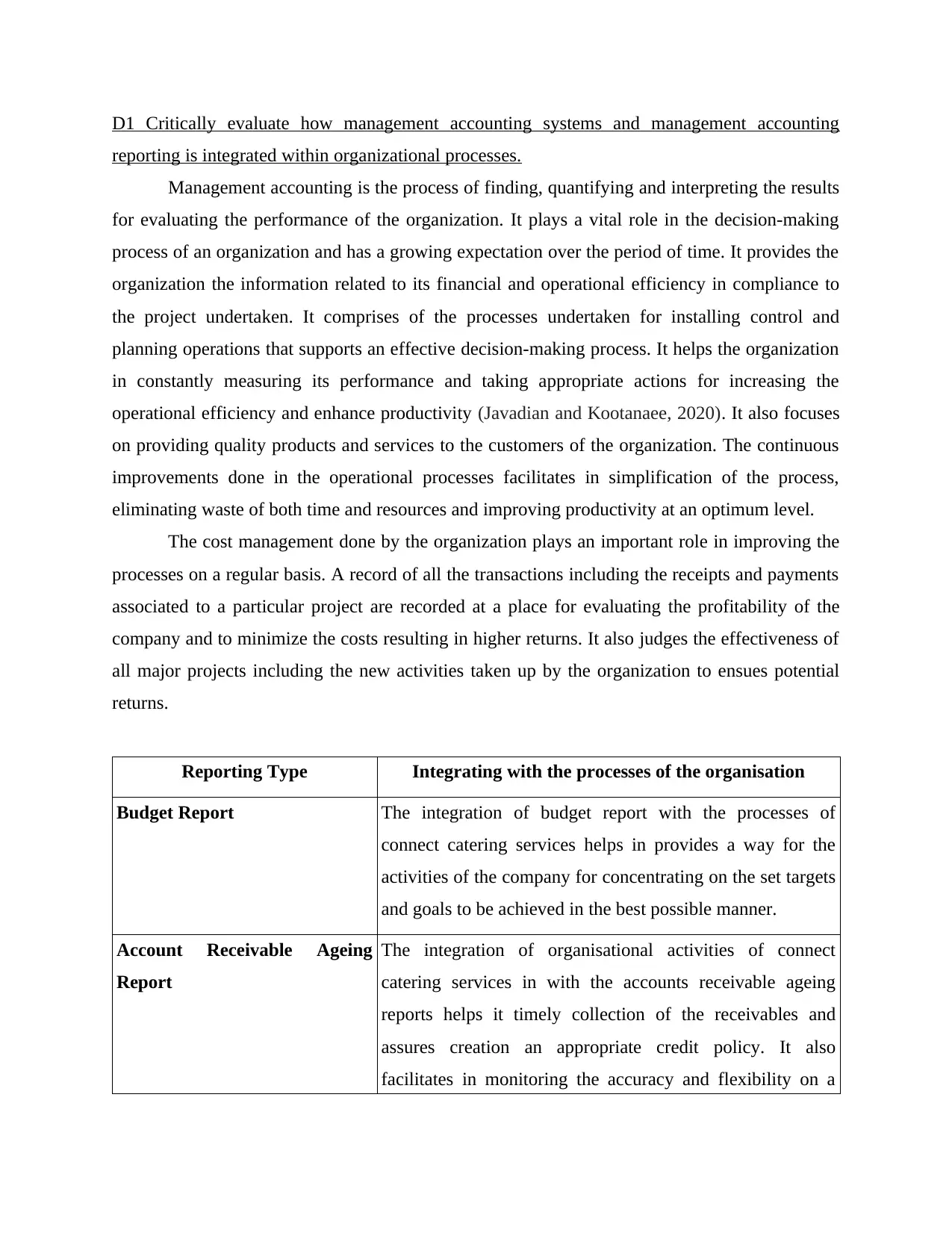
D1 Critically evaluate how management accounting systems and management accounting
reporting is integrated within organizational processes.
Management accounting is the process of finding, quantifying and interpreting the results
for evaluating the performance of the organization. It plays a vital role in the decision-making
process of an organization and has a growing expectation over the period of time. It provides the
organization the information related to its financial and operational efficiency in compliance to
the project undertaken. It comprises of the processes undertaken for installing control and
planning operations that supports an effective decision-making process. It helps the organization
in constantly measuring its performance and taking appropriate actions for increasing the
operational efficiency and enhance productivity (Javadian and Kootanaee, 2020). It also focuses
on providing quality products and services to the customers of the organization. The continuous
improvements done in the operational processes facilitates in simplification of the process,
eliminating waste of both time and resources and improving productivity at an optimum level.
The cost management done by the organization plays an important role in improving the
processes on a regular basis. A record of all the transactions including the receipts and payments
associated to a particular project are recorded at a place for evaluating the profitability of the
company and to minimize the costs resulting in higher returns. It also judges the effectiveness of
all major projects including the new activities taken up by the organization to ensues potential
returns.
Reporting Type Integrating with the processes of the organisation
Budget Report The integration of budget report with the processes of
connect catering services helps in provides a way for the
activities of the company for concentrating on the set targets
and goals to be achieved in the best possible manner.
Account Receivable Ageing
Report
The integration of organisational activities of connect
catering services in with the accounts receivable ageing
reports helps it timely collection of the receivables and
assures creation an appropriate credit policy. It also
facilitates in monitoring the accuracy and flexibility on a
reporting is integrated within organizational processes.
Management accounting is the process of finding, quantifying and interpreting the results
for evaluating the performance of the organization. It plays a vital role in the decision-making
process of an organization and has a growing expectation over the period of time. It provides the
organization the information related to its financial and operational efficiency in compliance to
the project undertaken. It comprises of the processes undertaken for installing control and
planning operations that supports an effective decision-making process. It helps the organization
in constantly measuring its performance and taking appropriate actions for increasing the
operational efficiency and enhance productivity (Javadian and Kootanaee, 2020). It also focuses
on providing quality products and services to the customers of the organization. The continuous
improvements done in the operational processes facilitates in simplification of the process,
eliminating waste of both time and resources and improving productivity at an optimum level.
The cost management done by the organization plays an important role in improving the
processes on a regular basis. A record of all the transactions including the receipts and payments
associated to a particular project are recorded at a place for evaluating the profitability of the
company and to minimize the costs resulting in higher returns. It also judges the effectiveness of
all major projects including the new activities taken up by the organization to ensues potential
returns.
Reporting Type Integrating with the processes of the organisation
Budget Report The integration of budget report with the processes of
connect catering services helps in provides a way for the
activities of the company for concentrating on the set targets
and goals to be achieved in the best possible manner.
Account Receivable Ageing
Report
The integration of organisational activities of connect
catering services in with the accounts receivable ageing
reports helps it timely collection of the receivables and
assures creation an appropriate credit policy. It also
facilitates in monitoring the accuracy and flexibility on a
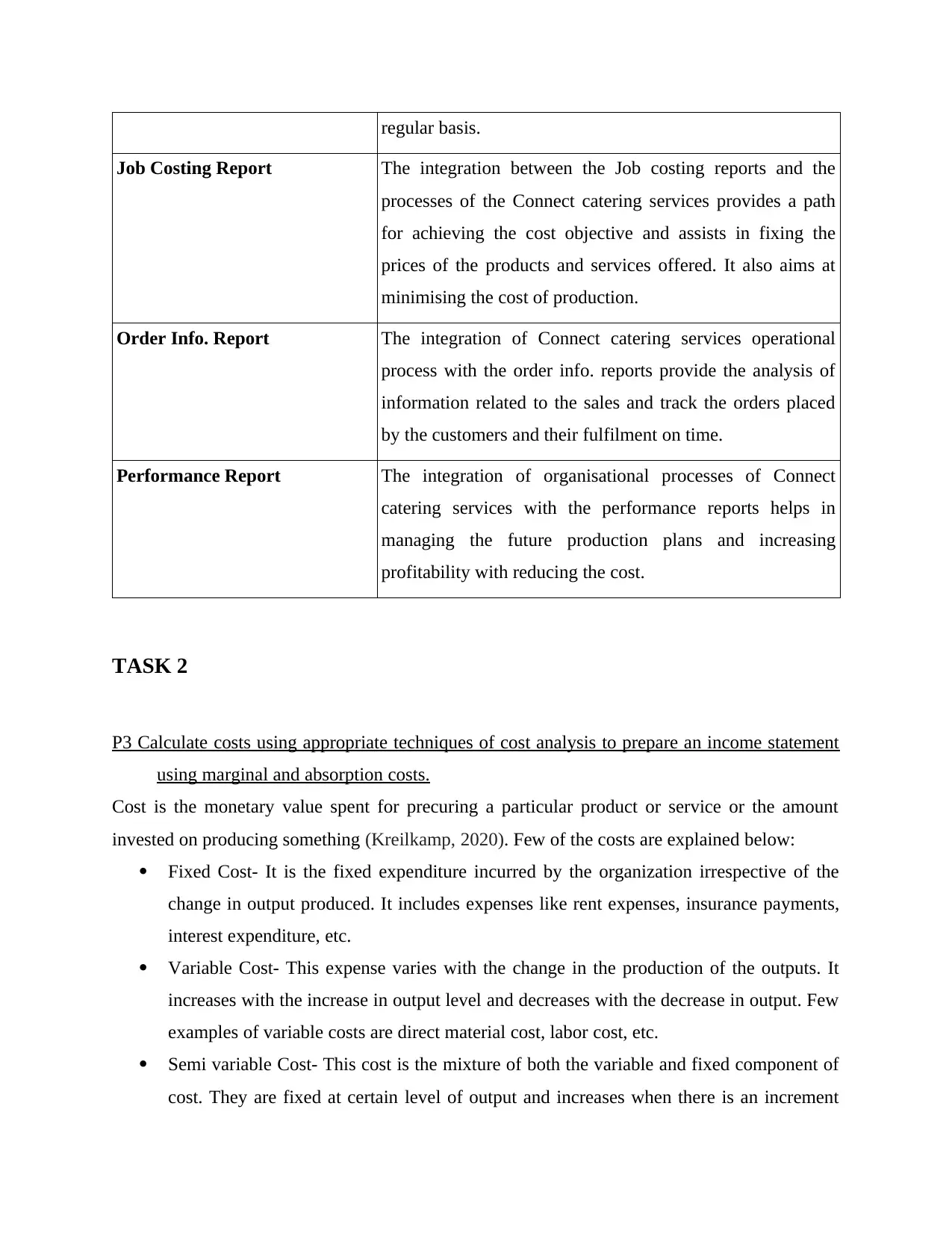
regular basis.
Job Costing Report The integration between the Job costing reports and the
processes of the Connect catering services provides a path
for achieving the cost objective and assists in fixing the
prices of the products and services offered. It also aims at
minimising the cost of production.
Order Info. Report The integration of Connect catering services operational
process with the order info. reports provide the analysis of
information related to the sales and track the orders placed
by the customers and their fulfilment on time.
Performance Report The integration of organisational processes of Connect
catering services with the performance reports helps in
managing the future production plans and increasing
profitability with reducing the cost.
TASK 2
P3 Calculate costs using appropriate techniques of cost analysis to prepare an income statement
using marginal and absorption costs.
Cost is the monetary value spent for precuring a particular product or service or the amount
invested on producing something (Kreilkamp, 2020). Few of the costs are explained below:
Fixed Cost- It is the fixed expenditure incurred by the organization irrespective of the
change in output produced. It includes expenses like rent expenses, insurance payments,
interest expenditure, etc.
Variable Cost- This expense varies with the change in the production of the outputs. It
increases with the increase in output level and decreases with the decrease in output. Few
examples of variable costs are direct material cost, labor cost, etc.
Semi variable Cost- This cost is the mixture of both the variable and fixed component of
cost. They are fixed at certain level of output and increases when there is an increment
Job Costing Report The integration between the Job costing reports and the
processes of the Connect catering services provides a path
for achieving the cost objective and assists in fixing the
prices of the products and services offered. It also aims at
minimising the cost of production.
Order Info. Report The integration of Connect catering services operational
process with the order info. reports provide the analysis of
information related to the sales and track the orders placed
by the customers and their fulfilment on time.
Performance Report The integration of organisational processes of Connect
catering services with the performance reports helps in
managing the future production plans and increasing
profitability with reducing the cost.
TASK 2
P3 Calculate costs using appropriate techniques of cost analysis to prepare an income statement
using marginal and absorption costs.
Cost is the monetary value spent for precuring a particular product or service or the amount
invested on producing something (Kreilkamp, 2020). Few of the costs are explained below:
Fixed Cost- It is the fixed expenditure incurred by the organization irrespective of the
change in output produced. It includes expenses like rent expenses, insurance payments,
interest expenditure, etc.
Variable Cost- This expense varies with the change in the production of the outputs. It
increases with the increase in output level and decreases with the decrease in output. Few
examples of variable costs are direct material cost, labor cost, etc.
Semi variable Cost- This cost is the mixture of both the variable and fixed component of
cost. They are fixed at certain level of output and increases when there is an increment
⊘ This is a preview!⊘
Do you want full access?
Subscribe today to unlock all pages.
Trusted by 1+ million students worldwide
done above the certain limit. The example of such cost are electricity expenses, telephone
charges, etc.
Opportunity Cost- It is the cost of forgiven benefit that an organization could have earned
by not investing in the other available option. In simple words, it is referred as the return
that can be earned from the next best opportunity available while a company is making a
decision for undertaking a particular product.
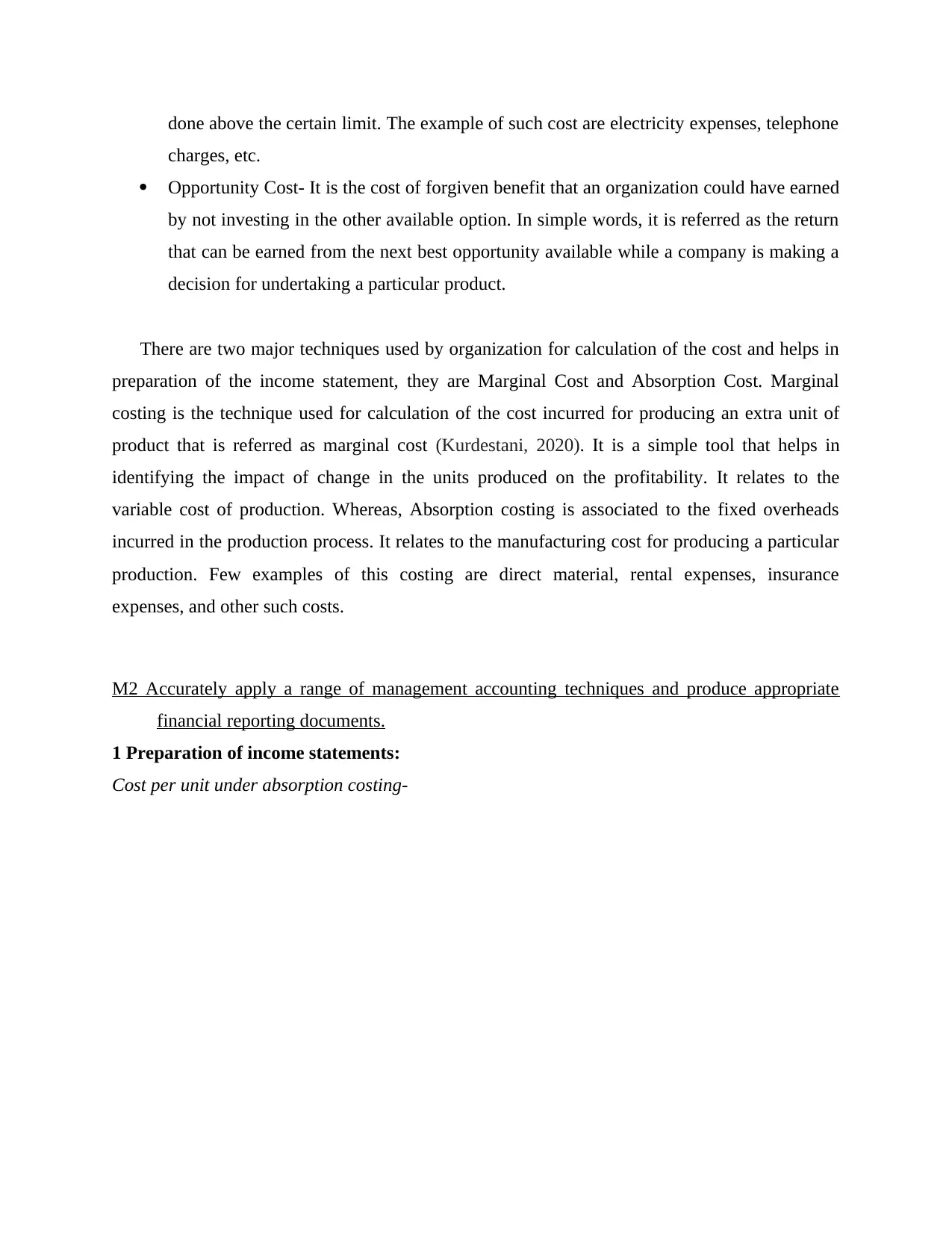
There are two major techniques used by organization for calculation of the cost and helps in
preparation of the income statement, they are Marginal Cost and Absorption Cost. Marginal
costing is the technique used for calculation of the cost incurred for producing an extra unit of
product that is referred as marginal cost (Kurdestani, 2020). It is a simple tool that helps in
identifying the impact of change in the units produced on the profitability. It relates to the
variable cost of production. Whereas, Absorption costing is associated to the fixed overheads
incurred in the production process. It relates to the manufacturing cost for producing a particular
production. Few examples of this costing are direct material, rental expenses, insurance
expenses, and other such costs.
M2 Accurately apply a range of management accounting techniques and produce appropriate
financial reporting documents.
1 Preparation of income statements:
Cost per unit under absorption costing-
charges, etc.
Opportunity Cost- It is the cost of forgiven benefit that an organization could have earned
by not investing in the other available option. In simple words, it is referred as the return
that can be earned from the next best opportunity available while a company is making a
decision for undertaking a particular product.
There are two major techniques used by organization for calculation of the cost and helps in
preparation of the income statement, they are Marginal Cost and Absorption Cost. Marginal
costing is the technique used for calculation of the cost incurred for producing an extra unit of
product that is referred as marginal cost (Kurdestani, 2020). It is a simple tool that helps in
identifying the impact of change in the units produced on the profitability. It relates to the
variable cost of production. Whereas, Absorption costing is associated to the fixed overheads
incurred in the production process. It relates to the manufacturing cost for producing a particular
production. Few examples of this costing are direct material, rental expenses, insurance
expenses, and other such costs.
M2 Accurately apply a range of management accounting techniques and produce appropriate
financial reporting documents.
1 Preparation of income statements:
Cost per unit under absorption costing-
Paraphrase This Document
Need a fresh take? Get an instant paraphrase of this document with our AI Paraphraser
M2 Accurately apply a range of management accounting techniques and produce appropriate
financial reporting documents.
1 Preparation of income statements:
Cost per unit under absorption costing-
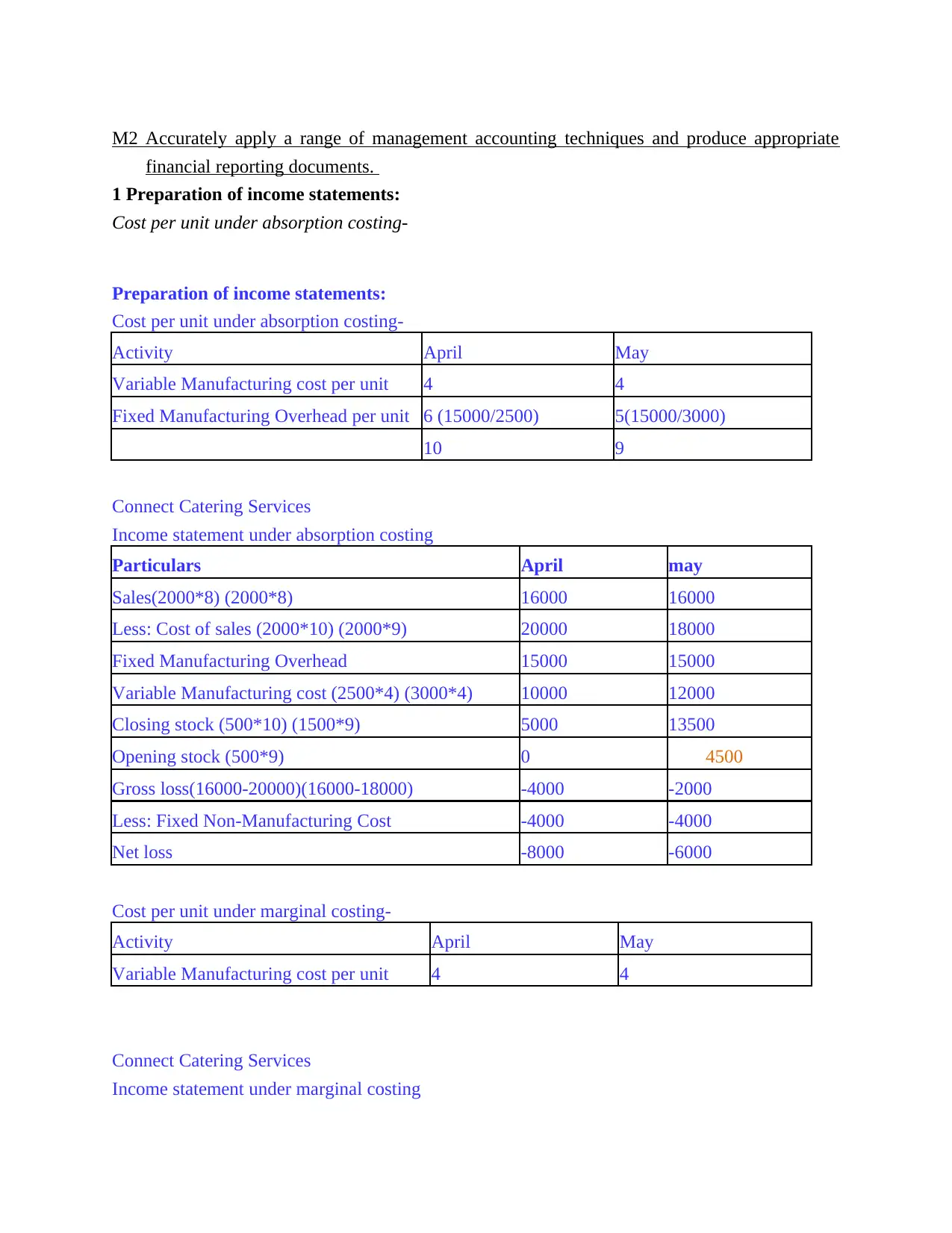
Preparation of income statements:
Cost per unit under absorption costing-
Activity April May
Variable Manufacturing cost per unit 4 4
Fixed Manufacturing Overhead per unit 6 (15000/2500) 5(15000/3000)
10 9
Connect Catering Services
Income statement under absorption costing
Particulars April may
Sales(2000*8) (2000*8) 16000 16000
Less: Cost of sales (2000*10) (2000*9) 20000 18000
Fixed Manufacturing Overhead 15000 15000
Variable Manufacturing cost (2500*4) (3000*4) 10000 12000
Closing stock (500*10) (1500*9) 5000 13500
Opening stock (500*9) 0 4500
Gross loss(16000-20000)(16000-18000) -4000 -2000
Less: Fixed Non-Manufacturing Cost -4000 -4000
Net loss -8000 -6000
Cost per unit under marginal costing-
Activity April May
Variable Manufacturing cost per unit 4 4
Connect Catering Services
Income statement under marginal costing
financial reporting documents.
1 Preparation of income statements:
Cost per unit under absorption costing-
Preparation of income statements:
Cost per unit under absorption costing-
Activity April May
Variable Manufacturing cost per unit 4 4
Fixed Manufacturing Overhead per unit 6 (15000/2500) 5(15000/3000)
10 9
Connect Catering Services
Income statement under absorption costing
Particulars April may
Sales(2000*8) (2000*8) 16000 16000
Less: Cost of sales (2000*10) (2000*9) 20000 18000
Fixed Manufacturing Overhead 15000 15000
Variable Manufacturing cost (2500*4) (3000*4) 10000 12000
Closing stock (500*10) (1500*9) 5000 13500
Opening stock (500*9) 0 4500
Gross loss(16000-20000)(16000-18000) -4000 -2000
Less: Fixed Non-Manufacturing Cost -4000 -4000
Net loss -8000 -6000
Cost per unit under marginal costing-
Activity April May
Variable Manufacturing cost per unit 4 4
Connect Catering Services
Income statement under marginal costing
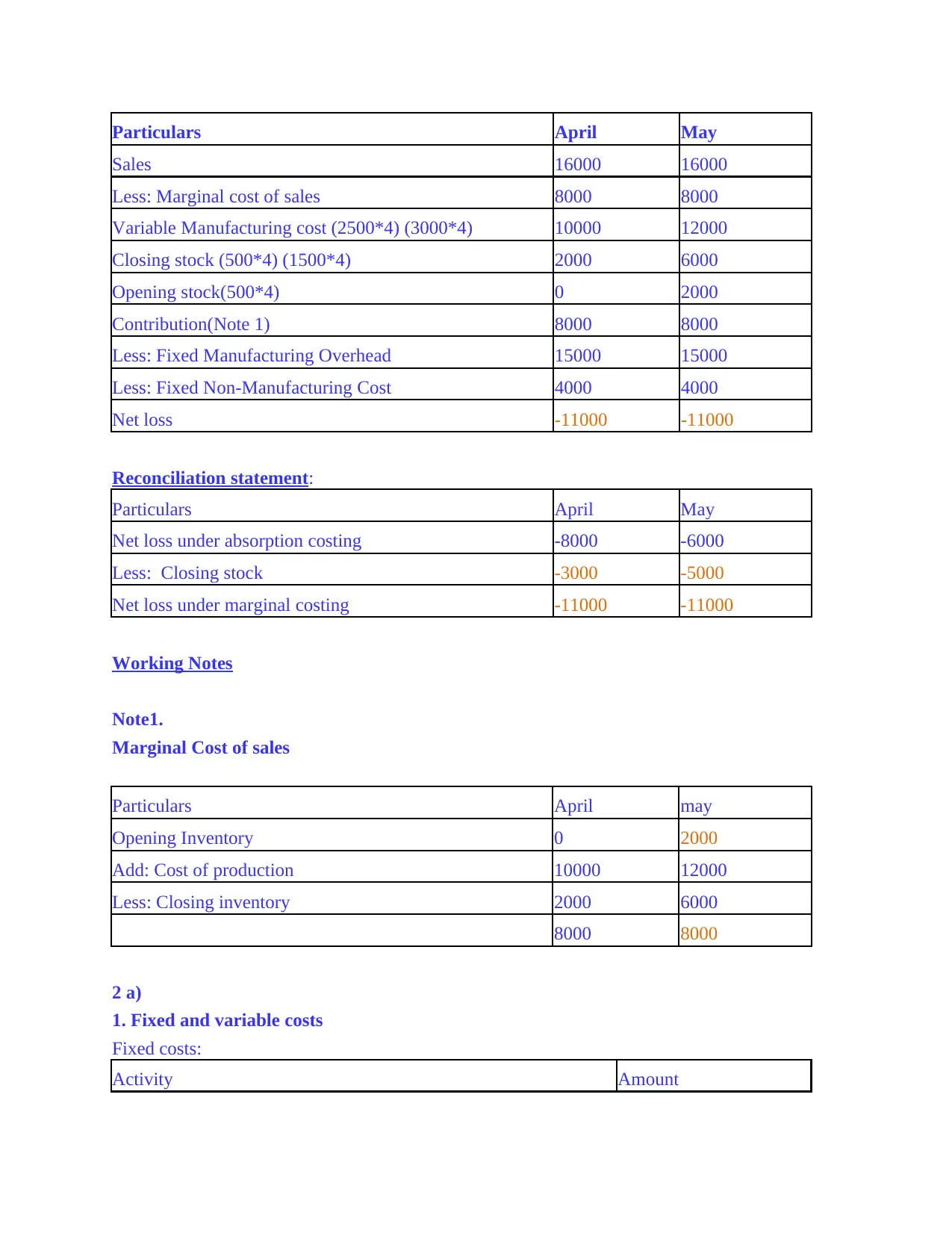
Particulars April May
Sales 16000 16000
Less: Marginal cost of sales 8000 8000
Variable Manufacturing cost (2500*4) (3000*4) 10000 12000
Closing stock (500*4) (1500*4) 2000 6000
Opening stock(500*4) 0 2000
Contribution(Note 1) 8000 8000
Less: Fixed Manufacturing Overhead 15000 15000
Less: Fixed Non-Manufacturing Cost 4000 4000
Net loss -11000 -11000
Reconciliation statement:
Particulars April May
Net loss under absorption costing -8000 -6000
Less: Closing stock -3000 -5000
Net loss under marginal costing -11000 -11000
Working Notes
Note1.
Marginal Cost of sales
Particulars April may
Opening Inventory 0 2000
Add: Cost of production 10000 12000
Less: Closing inventory 2000 6000
8000 8000
2 a)
1. Fixed and variable costs
Fixed costs:
Activity Amount
Sales 16000 16000
Less: Marginal cost of sales 8000 8000
Variable Manufacturing cost (2500*4) (3000*4) 10000 12000
Closing stock (500*4) (1500*4) 2000 6000
Opening stock(500*4) 0 2000
Contribution(Note 1) 8000 8000
Less: Fixed Manufacturing Overhead 15000 15000
Less: Fixed Non-Manufacturing Cost 4000 4000
Net loss -11000 -11000
Reconciliation statement:
Particulars April May
Net loss under absorption costing -8000 -6000
Less: Closing stock -3000 -5000
Net loss under marginal costing -11000 -11000
Working Notes
Note1.
Marginal Cost of sales
Particulars April may
Opening Inventory 0 2000
Add: Cost of production 10000 12000
Less: Closing inventory 2000 6000
8000 8000
2 a)
1. Fixed and variable costs
Fixed costs:
Activity Amount
⊘ This is a preview!⊘
Do you want full access?
Subscribe today to unlock all pages.
Trusted by 1+ million students worldwide
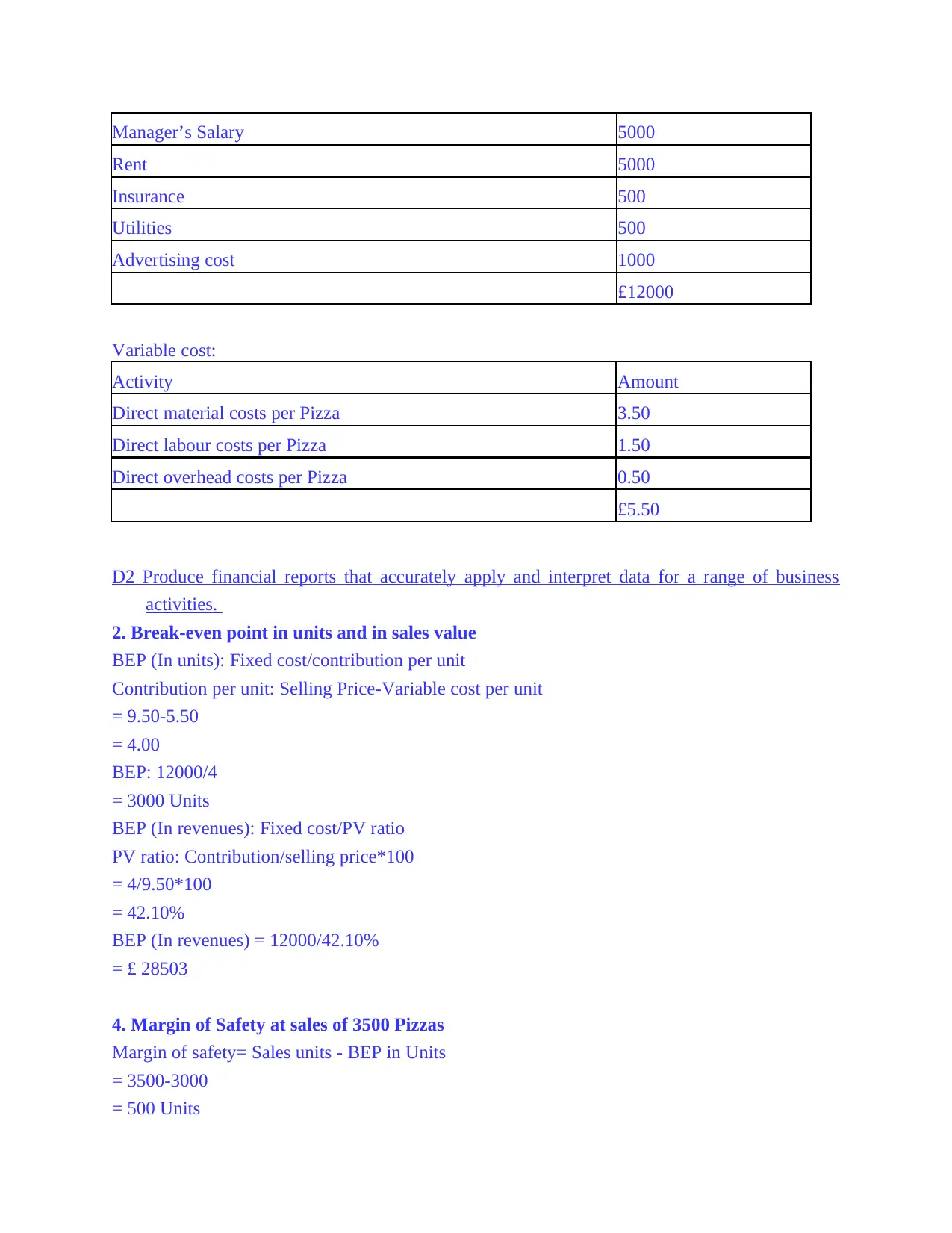
Manager’s Salary 5000
Rent 5000
Insurance 500
Utilities 500
Advertising cost 1000
£12000
Variable cost:
Activity Amount
Direct material costs per Pizza 3.50
Direct labour costs per Pizza 1.50
Direct overhead costs per Pizza 0.50
£5.50
D2 Produce financial reports that accurately apply and interpret data for a range of business
activities.
2. Break-even point in units and in sales value
BEP (In units): Fixed cost/contribution per unit
Contribution per unit: Selling Price-Variable cost per unit
= 9.50-5.50
= 4.00
BEP: 12000/4
= 3000 Units
BEP (In revenues): Fixed cost/PV ratio
PV ratio: Contribution/selling price*100
= 4/9.50*100
= 42.10%
BEP (In revenues) = 12000/42.10%
= £ 28503
4. Margin of Safety at sales of 3500 Pizzas
Margin of safety= Sales units - BEP in Units
= 3500-3000
= 500 Units
Rent 5000
Insurance 500
Utilities 500
Advertising cost 1000
£12000
Variable cost:
Activity Amount
Direct material costs per Pizza 3.50
Direct labour costs per Pizza 1.50
Direct overhead costs per Pizza 0.50
£5.50
D2 Produce financial reports that accurately apply and interpret data for a range of business
activities.
2. Break-even point in units and in sales value
BEP (In units): Fixed cost/contribution per unit
Contribution per unit: Selling Price-Variable cost per unit
= 9.50-5.50
= 4.00
BEP: 12000/4
= 3000 Units
BEP (In revenues): Fixed cost/PV ratio
PV ratio: Contribution/selling price*100
= 4/9.50*100
= 42.10%
BEP (In revenues) = 12000/42.10%
= £ 28503
4. Margin of Safety at sales of 3500 Pizzas
Margin of safety= Sales units - BEP in Units
= 3500-3000
= 500 Units
Paraphrase This Document
Need a fresh take? Get an instant paraphrase of this document with our AI Paraphraser
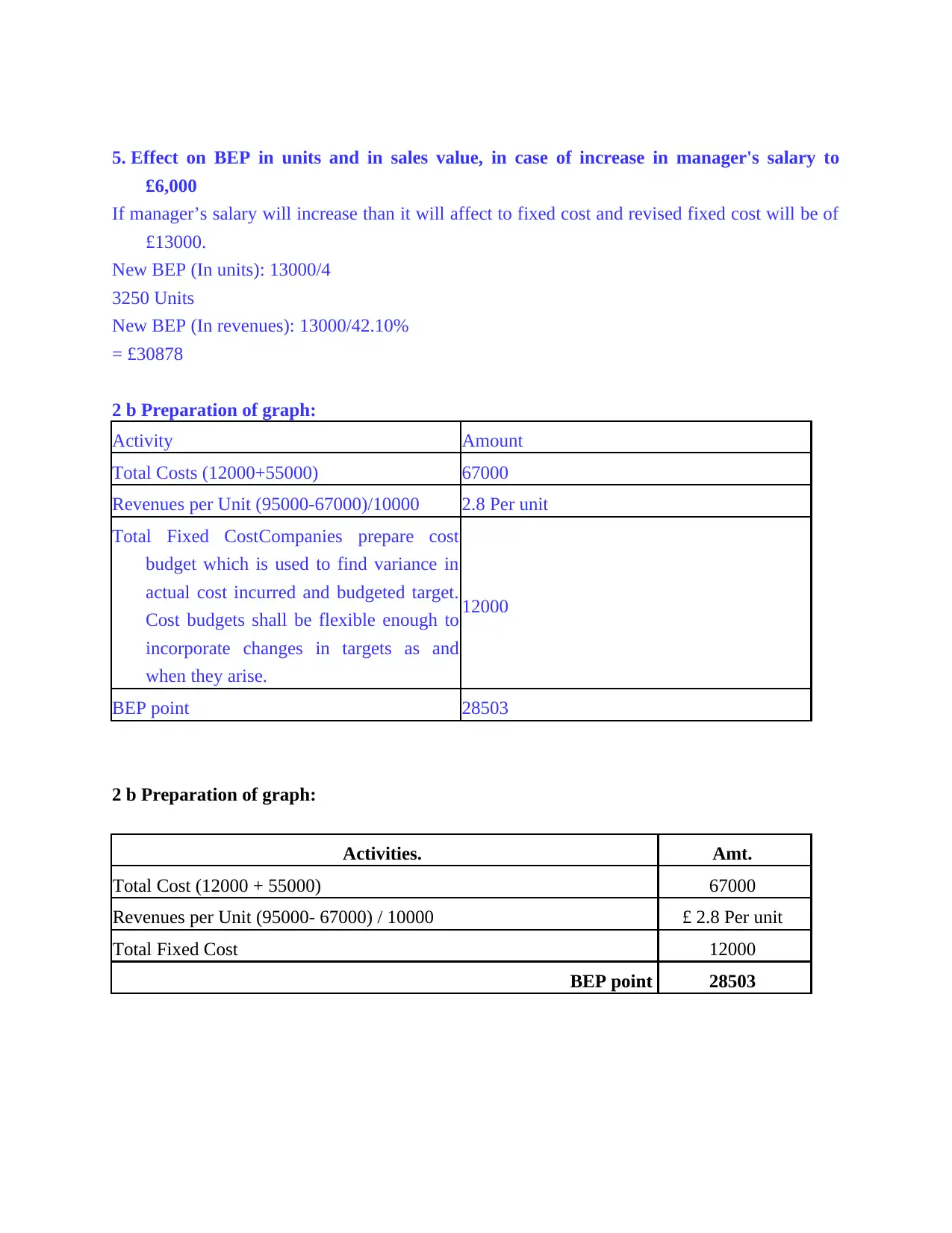
5. Effect on BEP in units and in sales value, in case of increase in manager's salary to
£6,000
If manager’s salary will increase than it will affect to fixed cost and revised fixed cost will be of
£13000.
New BEP (In units): 13000/4
3250 Units
New BEP (In revenues): 13000/42.10%
= £30878
2 b Preparation of graph:
Activity Amount
Total Costs (12000+55000) 67000
Revenues per Unit (95000-67000)/10000 2.8 Per unit
Total Fixed CostCompanies prepare cost
budget which is used to find variance in
actual cost incurred and budgeted target.
Cost budgets shall be flexible enough to
incorporate changes in targets as and
when they arise.
12000
BEP point 28503
2 b Preparation of graph:
Activities. Amt.
Total Cost (12000 + 55000) 67000
Revenues per Unit (95000- 67000) / 10000 £ 2.8 Per unit
Total Fixed Cost 12000
BEP point 28503
£6,000
If manager’s salary will increase than it will affect to fixed cost and revised fixed cost will be of
£13000.
New BEP (In units): 13000/4
3250 Units
New BEP (In revenues): 13000/42.10%
= £30878
2 b Preparation of graph:
Activity Amount
Total Costs (12000+55000) 67000
Revenues per Unit (95000-67000)/10000 2.8 Per unit
Total Fixed CostCompanies prepare cost
budget which is used to find variance in
actual cost incurred and budgeted target.
Cost budgets shall be flexible enough to
incorporate changes in targets as and
when they arise.
12000
BEP point 28503
2 b Preparation of graph:
Activities. Amt.
Total Cost (12000 + 55000) 67000
Revenues per Unit (95000- 67000) / 10000 £ 2.8 Per unit
Total Fixed Cost 12000
BEP point 28503
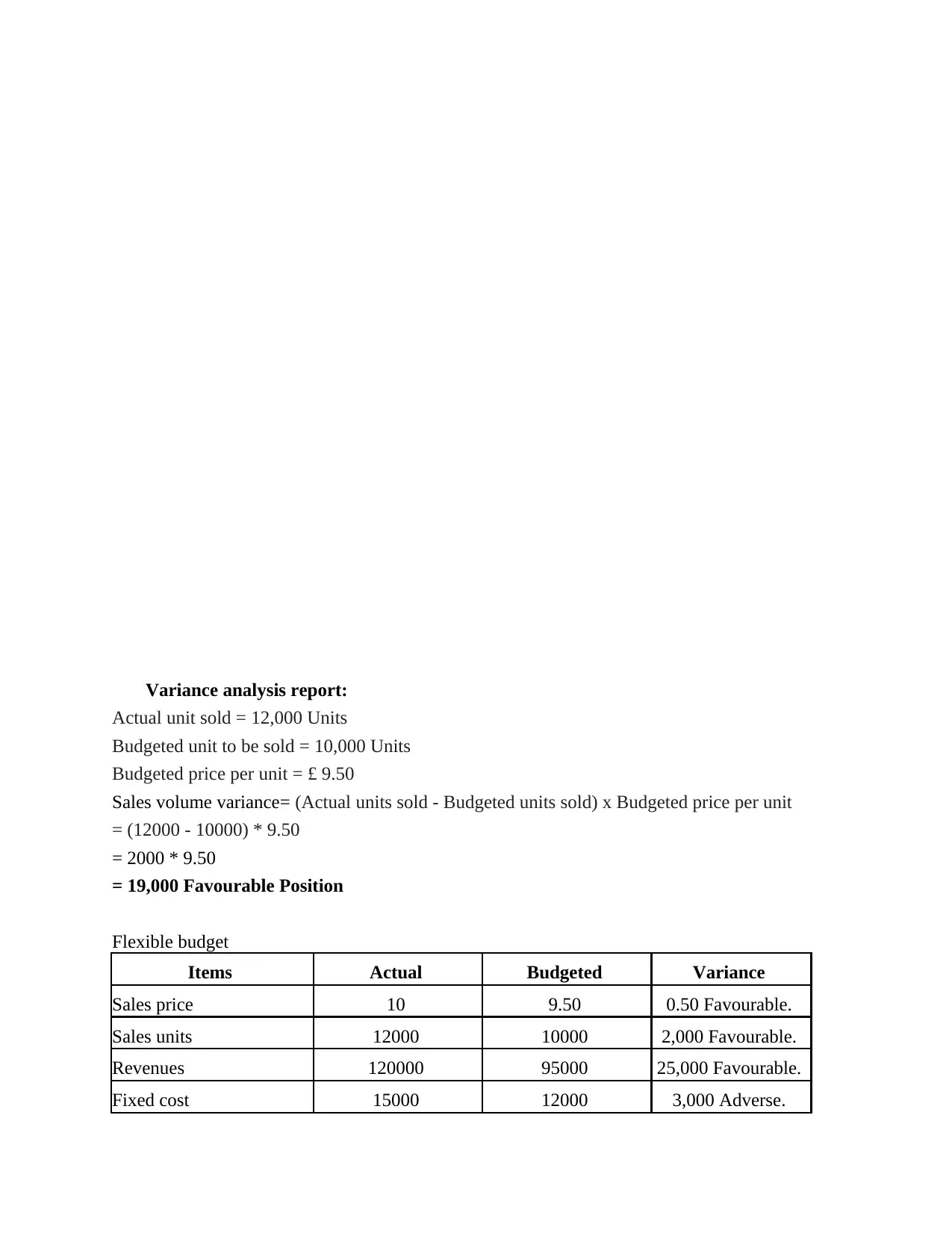
Variance analysis report:
Actual unit sold = 12,000 Units
Budgeted unit to be sold = 10,000 Units
Budgeted price per unit = £ 9.50
Sales volume variance= (Actual units sold - Budgeted units sold) x Budgeted price per unit
= (12000 - 10000) * 9.50
= 2000 * 9.50
= 19,000 Favourable Position
Flexible budget
Items Actual Budgeted Variance
Sales price 10 9.50 0.50 Favourable.
Sales units 12000 10000 2,000 Favourable.
Revenues 120000 95000 25,000 Favourable.
Fixed cost 15000 12000 3,000 Adverse.
Actual unit sold = 12,000 Units
Budgeted unit to be sold = 10,000 Units
Budgeted price per unit = £ 9.50
Sales volume variance= (Actual units sold - Budgeted units sold) x Budgeted price per unit
= (12000 - 10000) * 9.50
= 2000 * 9.50
= 19,000 Favourable Position
Flexible budget
Items Actual Budgeted Variance
Sales price 10 9.50 0.50 Favourable.
Sales units 12000 10000 2,000 Favourable.
Revenues 120000 95000 25,000 Favourable.
Fixed cost 15000 12000 3,000 Adverse.
⊘ This is a preview!⊘
Do you want full access?
Subscribe today to unlock all pages.
Trusted by 1+ million students worldwide

1 out of 24


Related Documents


Your All-in-One AI-Powered Toolkit for Academic Success.
+13062052269
info@desklib.com
Available 24*7 on WhatsApp / Email
![[object Object]](/_next/static/media/star-bottom.7253800d.svg)
Unlock your academic potential
Copyright © 2020–2026 A2Z Services. All Rights Reserved. Developed and managed by ZUCOL.