Management Accounting for Costs & Control
VerifiedAdded on 2020/02/24
|10
|1673
|49
Report
AI Summary
This report covers various aspects of management accounting, including cost concepts, control mechanisms, and financial performance measurement. It discusses techniques such as activity-based costing, standard costing, and budgetary analysis, providing insights into how these methods can enhance business efficiency and decision-making. The report also includes practical examples and references to key literature in the field.
Accounting and Finance
Management Accounting for Costs & Control
1 | P a g e
Management Accounting for Costs & Control
1 | P a g e

Paraphrase This Document
Need a fresh take? Get an instant paraphrase of this document with our AI Paraphraser
Accounting and Finance
Contents
Solution 1 - Management accounting..............................................................................................3
Solution 2 - Control.........................................................................................................................3
Solution 3 – Cost Concepts..............................................................................................................4
Solution 4 - Manufacturing statement and income statement.........................................................4
Solution 5 - Labour cost concepts...................................................................................................6
Solution 6 - Understanding the entries in the Materials Control account........................................6
Solution 7 - Understanding the entries in the Accrued Payroll account..........................................6
Solution 8 - Payroll entries..............................................................................................................7
Solution 9 - Activity Based Costing................................................................................................7
Solution 10 - Service department cost allocation............................................................................8
References......................................................................................................................................11
2 | P a g e
Contents
Solution 1 - Management accounting..............................................................................................3
Solution 2 - Control.........................................................................................................................3
Solution 3 – Cost Concepts..............................................................................................................4
Solution 4 - Manufacturing statement and income statement.........................................................4
Solution 5 - Labour cost concepts...................................................................................................6
Solution 6 - Understanding the entries in the Materials Control account........................................6
Solution 7 - Understanding the entries in the Accrued Payroll account..........................................6
Solution 8 - Payroll entries..............................................................................................................7
Solution 9 - Activity Based Costing................................................................................................7
Solution 10 - Service department cost allocation............................................................................8
References......................................................................................................................................11
2 | P a g e
Accounting and Finance
Solution 1 - Management accounting
The term Management Accounting has been coined in the recent past by the American Council
of productivity. The current Complex situations of the business enterprise created a huge
requirement of the concept of Management Accounting for the overall purpose of planning,
coordination other controlling function of business management. Management Accounting helps
in working out the detailed managerial aspect of accounting. The basic purpose of preparing the
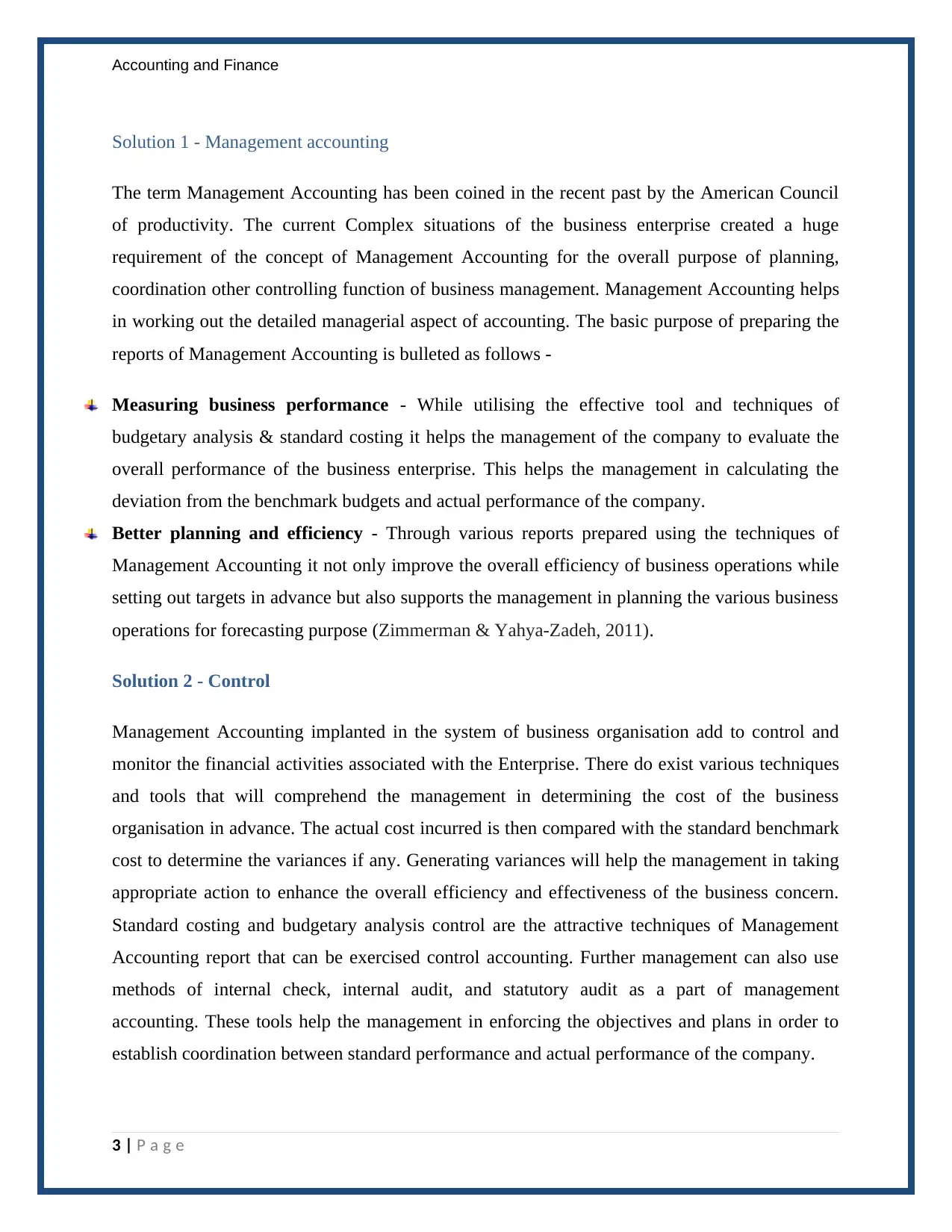
reports of Management Accounting is bulleted as follows -
Measuring business performance - While utilising the effective tool and techniques of
budgetary analysis & standard costing it helps the management of the company to evaluate the
overall performance of the business enterprise. This helps the management in calculating the
deviation from the benchmark budgets and actual performance of the company.
Better planning and efficiency - Through various reports prepared using the techniques of
Management Accounting it not only improve the overall efficiency of business operations while
setting out targets in advance but also supports the management in planning the various business
operations for forecasting purpose (Zimmerman & Yahya-Zadeh, 2011).
Solution 2 - Control
Management Accounting implanted in the system of business organisation add to control and
monitor the financial activities associated with the Enterprise. There do exist various techniques
and tools that will comprehend the management in determining the cost of the business
organisation in advance. The actual cost incurred is then compared with the standard benchmark
cost to determine the variances if any. Generating variances will help the management in taking
appropriate action to enhance the overall efficiency and effectiveness of the business concern.
Standard costing and budgetary analysis control are the attractive techniques of Management
Accounting report that can be exercised control accounting. Further management can also use
methods of internal check, internal audit, and statutory audit as a part of management
accounting. These tools help the management in enforcing the objectives and plans in order to
establish coordination between standard performance and actual performance of the company.
3 | P a g e
Solution 1 - Management accounting
The term Management Accounting has been coined in the recent past by the American Council
of productivity. The current Complex situations of the business enterprise created a huge
requirement of the concept of Management Accounting for the overall purpose of planning,
coordination other controlling function of business management. Management Accounting helps
in working out the detailed managerial aspect of accounting. The basic purpose of preparing the
reports of Management Accounting is bulleted as follows -
Measuring business performance - While utilising the effective tool and techniques of
budgetary analysis & standard costing it helps the management of the company to evaluate the
overall performance of the business enterprise. This helps the management in calculating the
deviation from the benchmark budgets and actual performance of the company.
Better planning and efficiency - Through various reports prepared using the techniques of
Management Accounting it not only improve the overall efficiency of business operations while
setting out targets in advance but also supports the management in planning the various business
operations for forecasting purpose (Zimmerman & Yahya-Zadeh, 2011).
Solution 2 - Control
Management Accounting implanted in the system of business organisation add to control and
monitor the financial activities associated with the Enterprise. There do exist various techniques
and tools that will comprehend the management in determining the cost of the business
organisation in advance. The actual cost incurred is then compared with the standard benchmark
cost to determine the variances if any. Generating variances will help the management in taking
appropriate action to enhance the overall efficiency and effectiveness of the business concern.
Standard costing and budgetary analysis control are the attractive techniques of Management
Accounting report that can be exercised control accounting. Further management can also use
methods of internal check, internal audit, and statutory audit as a part of management
accounting. These tools help the management in enforcing the objectives and plans in order to
establish coordination between standard performance and actual performance of the company.
3 | P a g e
⊘ This is a preview!⊘
Do you want full access?
Subscribe today to unlock all pages.

Trusted by 1+ million students worldwide
Accounting and Finance
Solution 3 – Cost Concepts
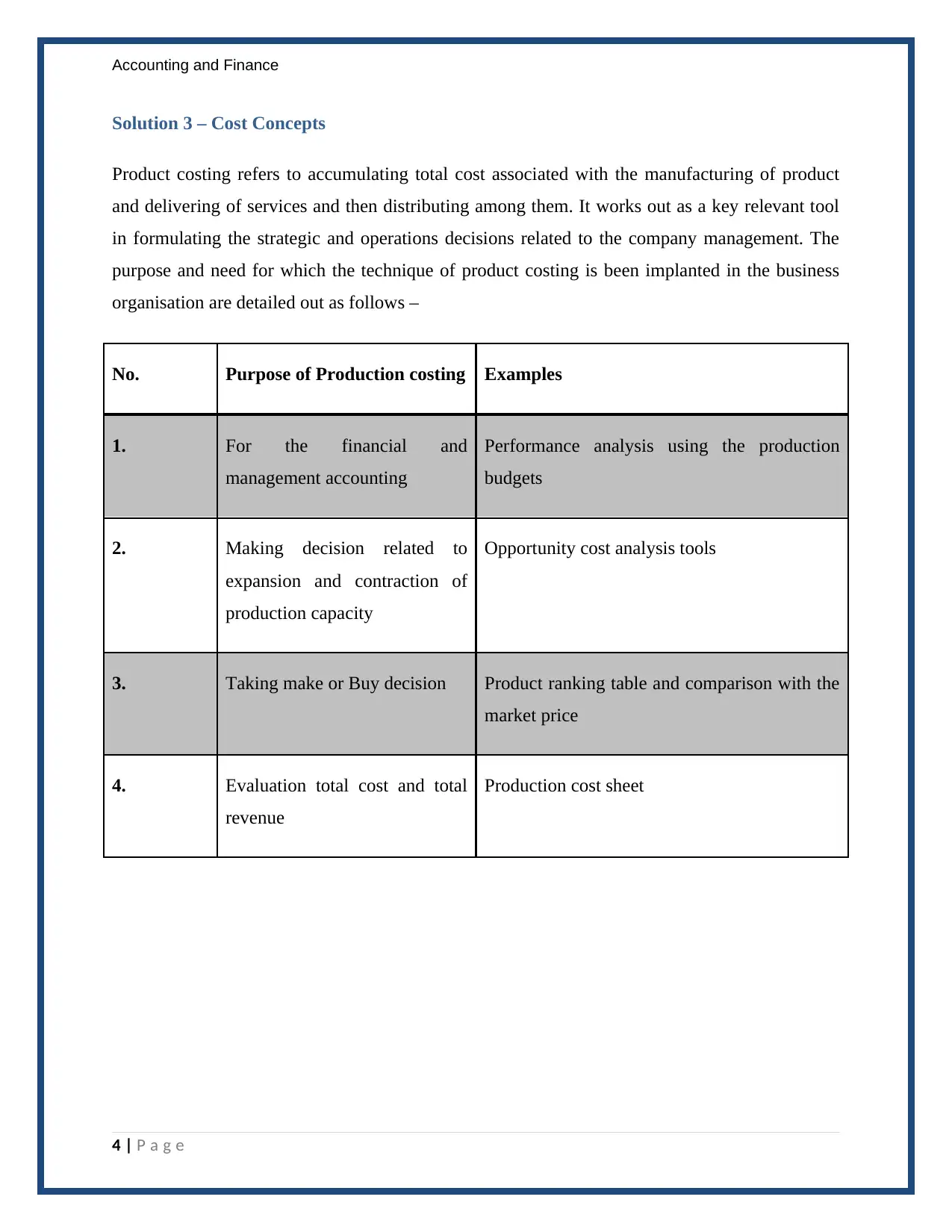
Product costing refers to accumulating total cost associated with the manufacturing of product
and delivering of services and then distributing among them. It works out as a key relevant tool
in formulating the strategic and operations decisions related to the company management. The
purpose and need for which the technique of product costing is been implanted in the business
organisation are detailed out as follows –
No. Purpose of Production costing Examples
1. For the financial and
management accounting
Performance analysis using the production
budgets
2. Making decision related to
expansion and contraction of
production capacity
Opportunity cost analysis tools
3. Taking make or Buy decision Product ranking table and comparison with the
market price
4. Evaluation total cost and total
revenue
Production cost sheet
4 | P a g e
Solution 3 – Cost Concepts
Product costing refers to accumulating total cost associated with the manufacturing of product
and delivering of services and then distributing among them. It works out as a key relevant tool
in formulating the strategic and operations decisions related to the company management. The
purpose and need for which the technique of product costing is been implanted in the business
organisation are detailed out as follows –
No. Purpose of Production costing Examples
1. For the financial and
management accounting
Performance analysis using the production
budgets
2. Making decision related to
expansion and contraction of
production capacity
Opportunity cost analysis tools
3. Taking make or Buy decision Product ranking table and comparison with the
market price
4. Evaluation total cost and total
revenue
Production cost sheet
4 | P a g e
Paraphrase This Document
Need a fresh take? Get an instant paraphrase of this document with our AI Paraphraser
Accounting and Finance
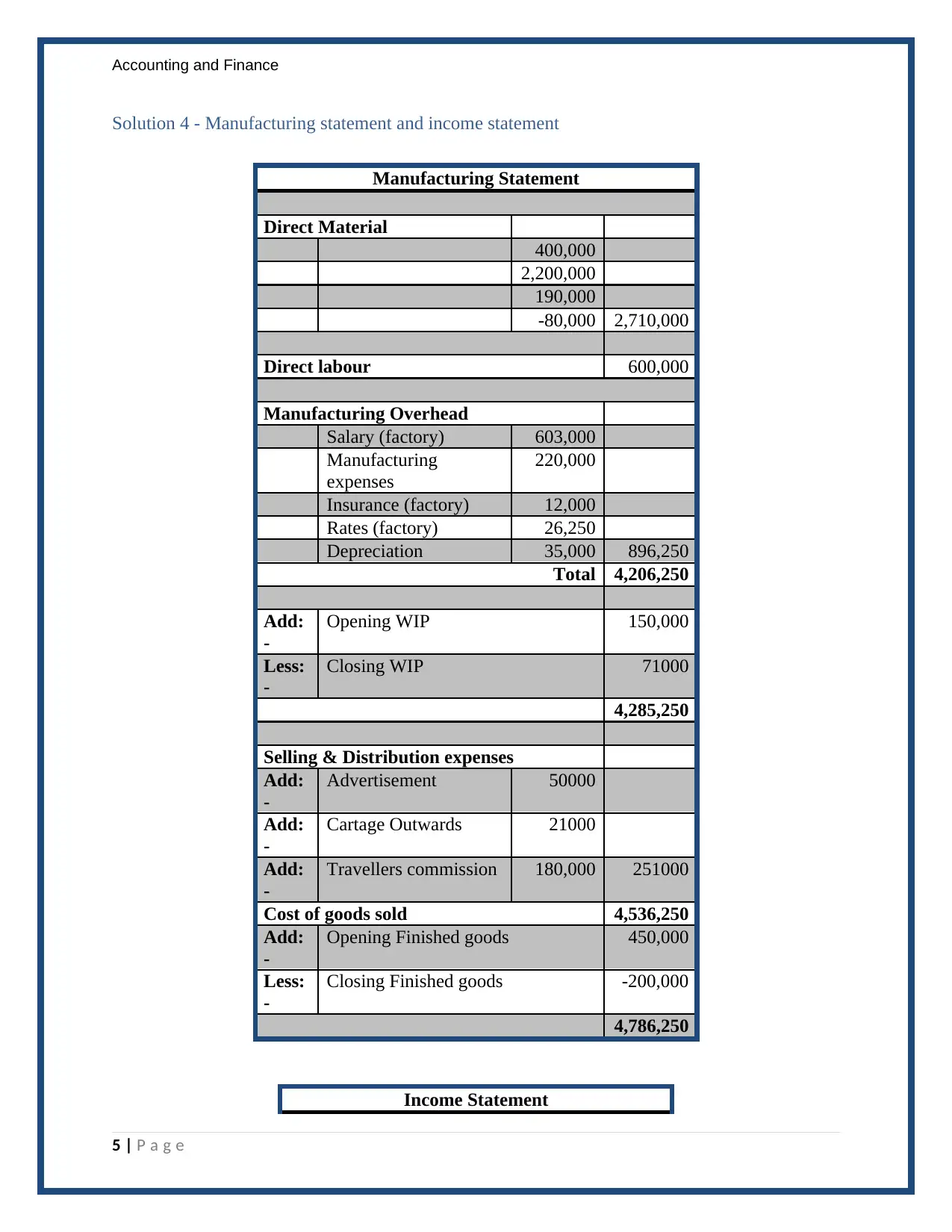
Solution 4 - Manufacturing statement and income statement
Income Statement
5 | P a g e
Manufacturing Statement
Direct Material
400,000
2,200,000
190,000
-80,000 2,710,000
Direct labour 600,000
Manufacturing Overhead
Salary (factory) 603,000
Manufacturing
expenses
220,000
Insurance (factory) 12,000
Rates (factory) 26,250
Depreciation 35,000 896,250
Total 4,206,250
Add:
-
Opening WIP 150,000
Less:
-
Closing WIP 71000
4,285,250
Selling & Distribution expenses
Add:
-
Advertisement 50000
Add:
-
Cartage Outwards 21000
Add:
-
Travellers commission 180,000 251000
Cost of goods sold 4,536,250
Add:
-
Opening Finished goods 450,000
Less:
-
Closing Finished goods -200,000
4,786,250
Solution 4 - Manufacturing statement and income statement
Income Statement
5 | P a g e
Manufacturing Statement
Direct Material
400,000
2,200,000
190,000
-80,000 2,710,000
Direct labour 600,000
Manufacturing Overhead
Salary (factory) 603,000
Manufacturing
expenses
220,000
Insurance (factory) 12,000
Rates (factory) 26,250
Depreciation 35,000 896,250
Total 4,206,250
Add:
-
Opening WIP 150,000
Less:
-
Closing WIP 71000
4,285,250
Selling & Distribution expenses
Add:
-
Advertisement 50000
Add:
-
Cartage Outwards 21000
Add:
-
Travellers commission 180,000 251000
Cost of goods sold 4,536,250
Add:
-
Opening Finished goods 450,000
Less:
-
Closing Finished goods -200,000
4,786,250
Accounting and Finance
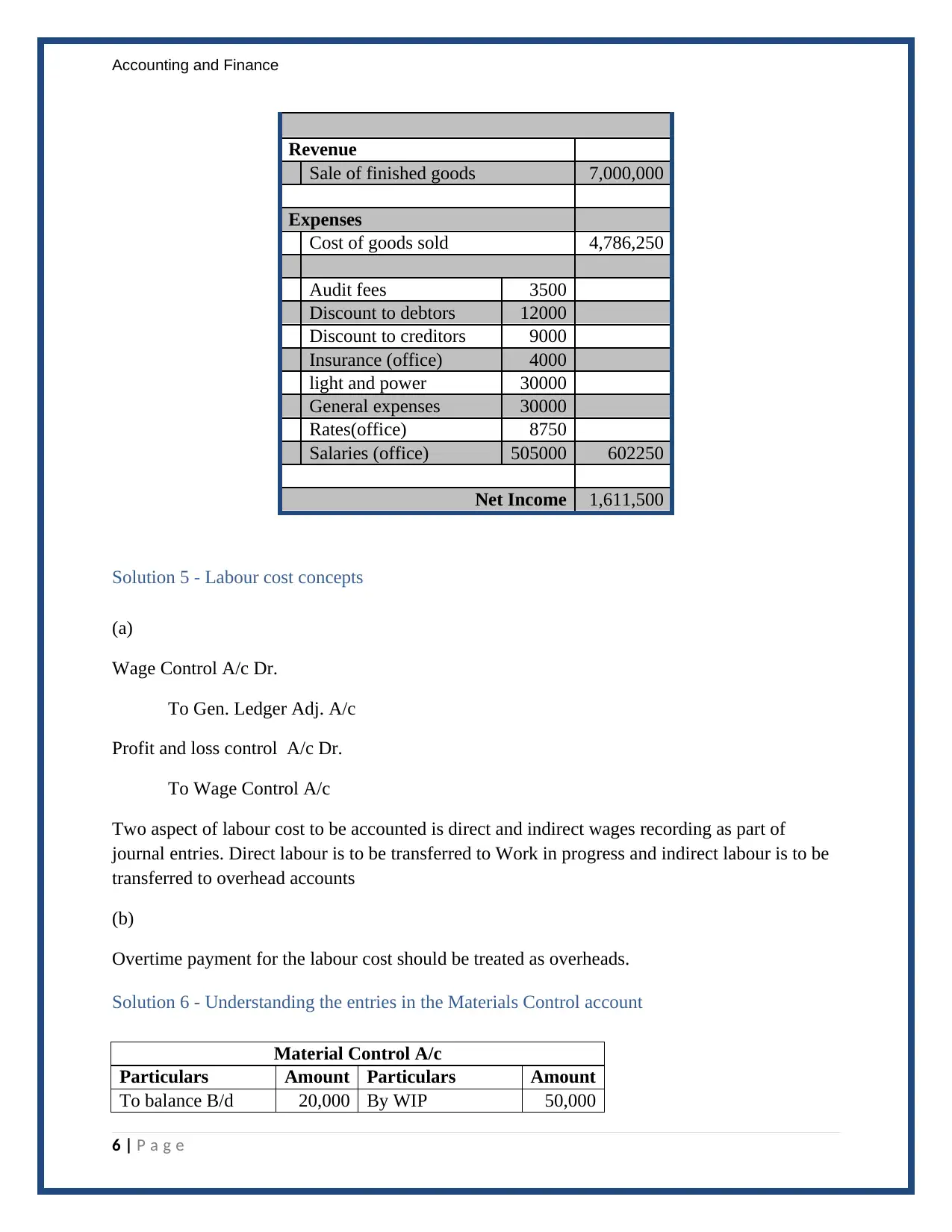
Revenue
Sale of finished goods 7,000,000
Expenses
Cost of goods sold 4,786,250
Audit fees 3500
Discount to debtors 12000
Discount to creditors 9000
Insurance (office) 4000
light and power 30000
General expenses 30000
Rates(office) 8750
Salaries (office) 505000 602250
Net Income 1,611,500
Solution 5 - Labour cost concepts
(a)
Wage Control A/c Dr.
To Gen. Ledger Adj. A/c
Profit and loss control A/c Dr.
To Wage Control A/c
Two aspect of labour cost to be accounted is direct and indirect wages recording as part of
journal entries. Direct labour is to be transferred to Work in progress and indirect labour is to be
transferred to overhead accounts
(b)
Overtime payment for the labour cost should be treated as overheads.
Solution 6 - Understanding the entries in the Materials Control account
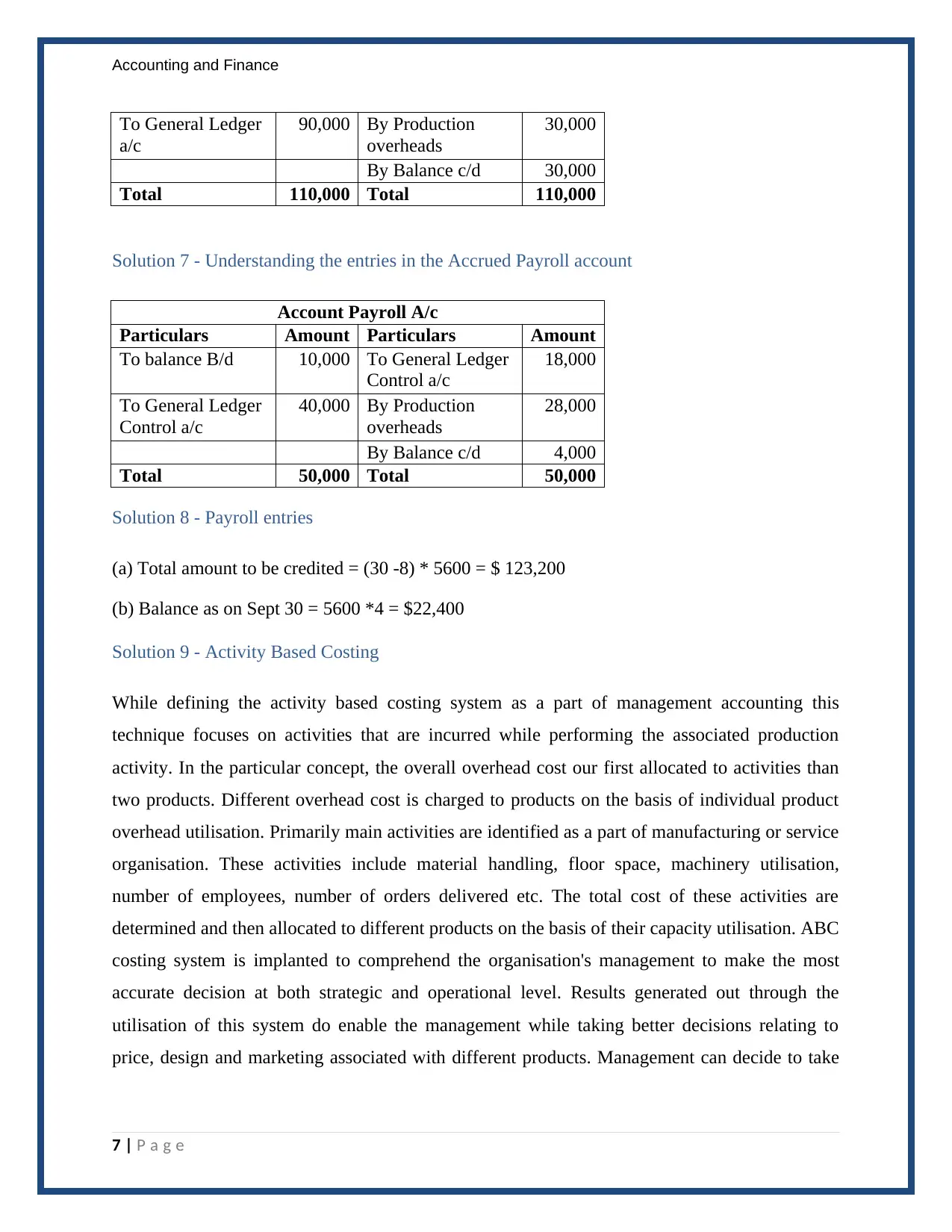
Material Control A/c
Particulars Amount Particulars Amount
To balance B/d 20,000 By WIP 50,000
6 | P a g e
Revenue
Sale of finished goods 7,000,000
Expenses
Cost of goods sold 4,786,250
Audit fees 3500
Discount to debtors 12000
Discount to creditors 9000
Insurance (office) 4000
light and power 30000
General expenses 30000
Rates(office) 8750
Salaries (office) 505000 602250
Net Income 1,611,500
Solution 5 - Labour cost concepts
(a)
Wage Control A/c Dr.
To Gen. Ledger Adj. A/c
Profit and loss control A/c Dr.
To Wage Control A/c
Two aspect of labour cost to be accounted is direct and indirect wages recording as part of
journal entries. Direct labour is to be transferred to Work in progress and indirect labour is to be
transferred to overhead accounts
(b)
Overtime payment for the labour cost should be treated as overheads.
Solution 6 - Understanding the entries in the Materials Control account
Material Control A/c
Particulars Amount Particulars Amount
To balance B/d 20,000 By WIP 50,000
6 | P a g e
⊘ This is a preview!⊘
Do you want full access?
Subscribe today to unlock all pages.
Trusted by 1+ million students worldwide
Accounting and Finance
To General Ledger
a/c
90,000 By Production
overheads
30,000
By Balance c/d 30,000
Total 110,000 Total 110,000
Solution 7 - Understanding the entries in the Accrued Payroll account
Account Payroll A/c
Particulars Amount Particulars Amount
To balance B/d 10,000 To General Ledger
Control a/c
18,000
To General Ledger
Control a/c
40,000 By Production
overheads
28,000
By Balance c/d 4,000
Total 50,000 Total 50,000
Solution 8 - Payroll entries
(a) Total amount to be credited = (30 -8) * 5600 = $ 123,200
(b) Balance as on Sept 30 = 5600 *4 = $22,400
Solution 9 - Activity Based Costing
While defining the activity based costing system as a part of management accounting this
technique focuses on activities that are incurred while performing the associated production
activity. In the particular concept, the overall overhead cost our first allocated to activities than
two products. Different overhead cost is charged to products on the basis of individual product
overhead utilisation. Primarily main activities are identified as a part of manufacturing or service
organisation. These activities include material handling, floor space, machinery utilisation,
number of employees, number of orders delivered etc. The total cost of these activities are
determined and then allocated to different products on the basis of their capacity utilisation. ABC
costing system is implanted to comprehend the organisation's management to make the most
accurate decision at both strategic and operational level. Results generated out through the
utilisation of this system do enable the management while taking better decisions relating to
price, design and marketing associated with different products. Management can decide to take
7 | P a g e
To General Ledger
a/c
90,000 By Production
overheads
30,000
By Balance c/d 30,000
Total 110,000 Total 110,000
Solution 7 - Understanding the entries in the Accrued Payroll account
Account Payroll A/c
Particulars Amount Particulars Amount
To balance B/d 10,000 To General Ledger
Control a/c
18,000
To General Ledger
Control a/c
40,000 By Production
overheads
28,000
By Balance c/d 4,000
Total 50,000 Total 50,000
Solution 8 - Payroll entries
(a) Total amount to be credited = (30 -8) * 5600 = $ 123,200
(b) Balance as on Sept 30 = 5600 *4 = $22,400
Solution 9 - Activity Based Costing
While defining the activity based costing system as a part of management accounting this
technique focuses on activities that are incurred while performing the associated production
activity. In the particular concept, the overall overhead cost our first allocated to activities than
two products. Different overhead cost is charged to products on the basis of individual product
overhead utilisation. Primarily main activities are identified as a part of manufacturing or service
organisation. These activities include material handling, floor space, machinery utilisation,
number of employees, number of orders delivered etc. The total cost of these activities are
determined and then allocated to different products on the basis of their capacity utilisation. ABC
costing system is implanted to comprehend the organisation's management to make the most
accurate decision at both strategic and operational level. Results generated out through the
utilisation of this system do enable the management while taking better decisions relating to
price, design and marketing associated with different products. Management can decide to take
7 | P a g e
Paraphrase This Document
Need a fresh take? Get an instant paraphrase of this document with our AI Paraphraser
Accounting and Finance
bold decisions against the non-performing divisions of the business organisation (Garrison, et.
al., 2010).
While discussing the traditional costing system, it was basically utilised when the companies in
the manufacturing and service industry what dealing in a small range of products and services.
Overhead costing does not play a major role in the production and Service Delivery process.
Materials and labour cost which was direct in nature were the measure inputs of the overall
process. Due to these factors, the single overhead recovery rate is to be applied to determine and
allocate cost to the products. With the growth and development of activities over the span of time
the complete production and Service Delivery process has been changed. Now the business
organisations are dealing out with multiple products and services further the overhead cost plays
a major role and cost cannot be simply allocated the basis of machine hours for labour hours.
Non-production or indirect cost accumulate a major part in the overall cost apportionment
process. The needs and requirement of distribution of cost on the basis of activities is been
emerged out on a higher part. Instead of the single stage cost allocation process, ABC costing
utilise two stage processes for cost allocation.
Solution 10 - Service department cost allocation
(a)
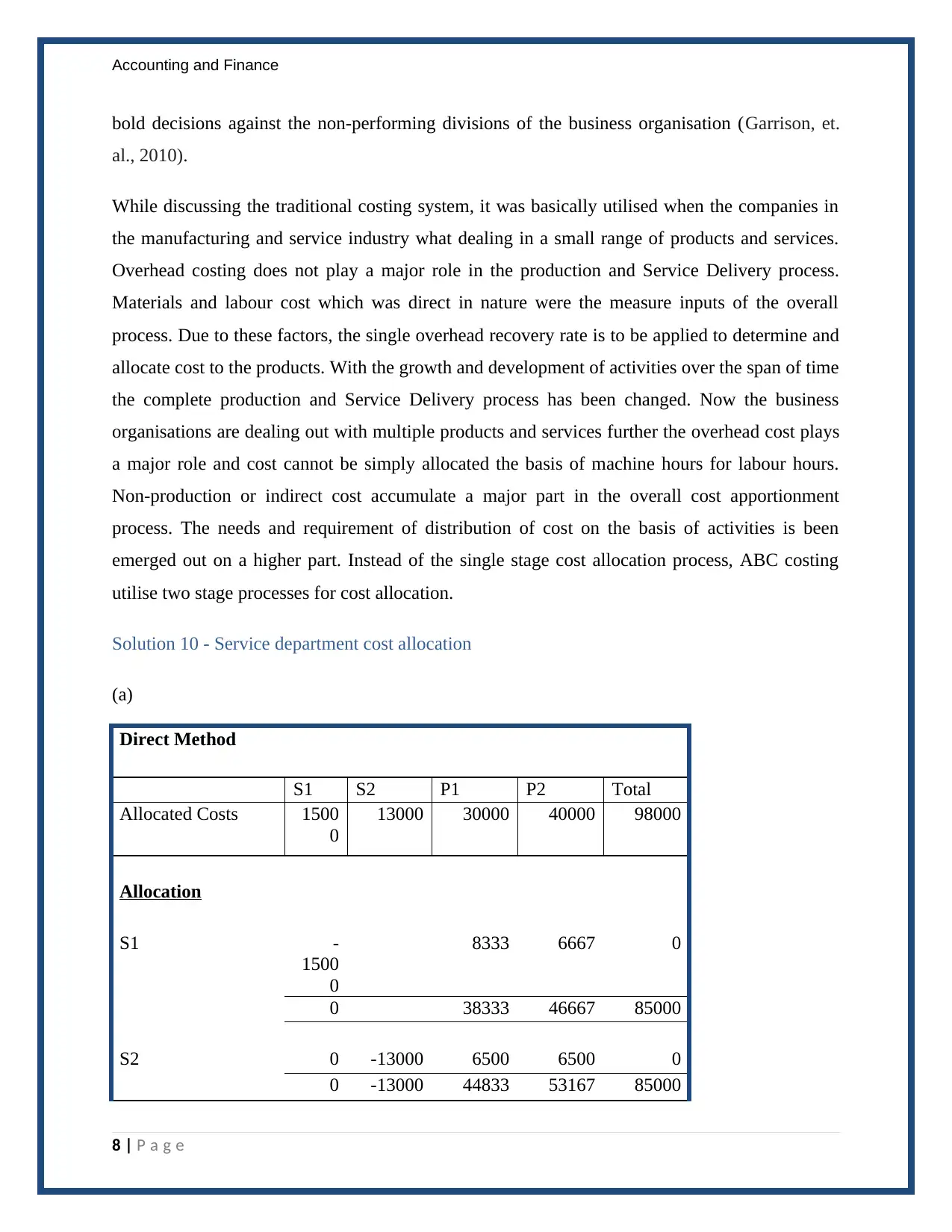
Direct Method
S1 S2 P1 P2 Total
Allocated Costs 1500
0
13000 30000 40000 98000
Allocation
S1 -
1500
0
8333 6667 0
0 38333 46667 85000
S2 0 -13000 6500 6500 0
0 -13000 44833 53167 85000
8 | P a g e
bold decisions against the non-performing divisions of the business organisation (Garrison, et.
al., 2010).
While discussing the traditional costing system, it was basically utilised when the companies in
the manufacturing and service industry what dealing in a small range of products and services.
Overhead costing does not play a major role in the production and Service Delivery process.
Materials and labour cost which was direct in nature were the measure inputs of the overall
process. Due to these factors, the single overhead recovery rate is to be applied to determine and
allocate cost to the products. With the growth and development of activities over the span of time
the complete production and Service Delivery process has been changed. Now the business
organisations are dealing out with multiple products and services further the overhead cost plays
a major role and cost cannot be simply allocated the basis of machine hours for labour hours.
Non-production or indirect cost accumulate a major part in the overall cost apportionment
process. The needs and requirement of distribution of cost on the basis of activities is been
emerged out on a higher part. Instead of the single stage cost allocation process, ABC costing
utilise two stage processes for cost allocation.
Solution 10 - Service department cost allocation
(a)
Direct Method
S1 S2 P1 P2 Total
Allocated Costs 1500
0
13000 30000 40000 98000
Allocation
S1 -
1500
0
8333 6667 0
0 38333 46667 85000
S2 0 -13000 6500 6500 0
0 -13000 44833 53167 85000
8 | P a g e
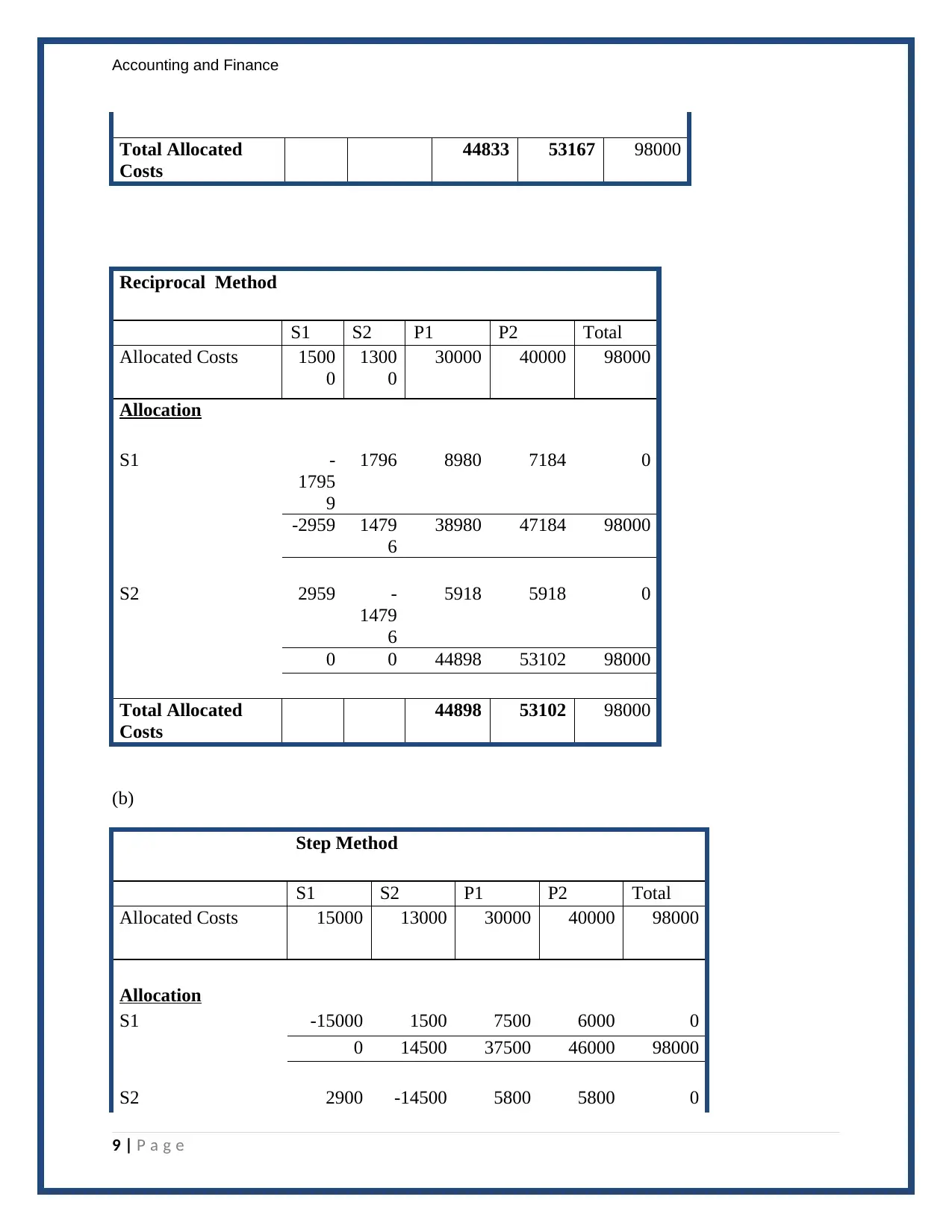
Accounting and Finance
Total Allocated
Costs
44833 53167 98000
Reciprocal Method
S1 S2 P1 P2 Total
Allocated Costs 1500
0
1300
0
30000 40000 98000
Allocation
S1 -
1795
9
1796 8980 7184 0
-2959 1479
6
38980 47184 98000
S2 2959 -
1479
6
5918 5918 0
0 0 44898 53102 98000
Total Allocated
Costs
44898 53102 98000
(b)
Step Method
S1 S2 P1 P2 Total
Allocated Costs 15000 13000 30000 40000 98000
Allocation
S1 -15000 1500 7500 6000 0
0 14500 37500 46000 98000
S2 2900 -14500 5800 5800 0
9 | P a g e
Total Allocated
Costs
44833 53167 98000
Reciprocal Method
S1 S2 P1 P2 Total
Allocated Costs 1500
0
1300
0
30000 40000 98000
Allocation
S1 -
1795
9
1796 8980 7184 0
-2959 1479
6
38980 47184 98000
S2 2959 -
1479
6
5918 5918 0
0 0 44898 53102 98000
Total Allocated
Costs
44898 53102 98000
(b)
Step Method
S1 S2 P1 P2 Total
Allocated Costs 15000 13000 30000 40000 98000
Allocation
S1 -15000 1500 7500 6000 0
0 14500 37500 46000 98000
S2 2900 -14500 5800 5800 0
9 | P a g e
⊘ This is a preview!⊘
Do you want full access?
Subscribe today to unlock all pages.
Trusted by 1+ million students worldwide
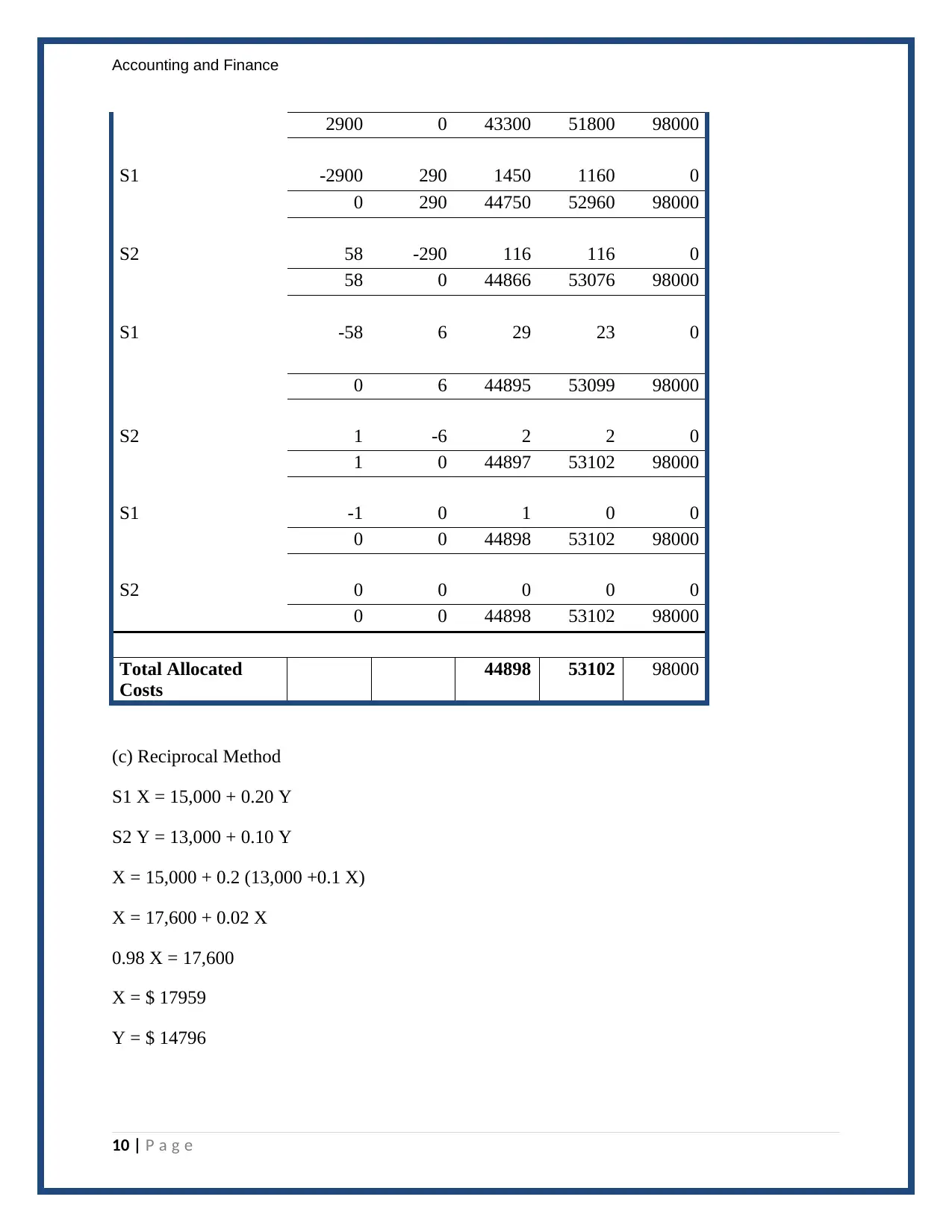
Accounting and Finance
2900 0 43300 51800 98000
S1 -2900 290 1450 1160 0
0 290 44750 52960 98000
S2 58 -290 116 116 0
58 0 44866 53076 98000
S1 -58 6 29 23 0
0 6 44895 53099 98000
S2 1 -6 2 2 0
1 0 44897 53102 98000
S1 -1 0 1 0 0
0 0 44898 53102 98000
S2 0 0 0 0 0
0 0 44898 53102 98000
Total Allocated
Costs
44898 53102 98000
(c) Reciprocal Method
S1 X = 15,000 + 0.20 Y
S2 Y = 13,000 + 0.10 Y
X = 15,000 + 0.2 (13,000 +0.1 X)
X = 17,600 + 0.02 X
0.98 X = 17,600
X = $ 17959
Y = $ 14796
10 | P a g e
2900 0 43300 51800 98000
S1 -2900 290 1450 1160 0
0 290 44750 52960 98000
S2 58 -290 116 116 0
58 0 44866 53076 98000
S1 -58 6 29 23 0
0 6 44895 53099 98000
S2 1 -6 2 2 0
1 0 44897 53102 98000
S1 -1 0 1 0 0
0 0 44898 53102 98000
S2 0 0 0 0 0
0 0 44898 53102 98000
Total Allocated
Costs
44898 53102 98000
(c) Reciprocal Method
S1 X = 15,000 + 0.20 Y
S2 Y = 13,000 + 0.10 Y
X = 15,000 + 0.2 (13,000 +0.1 X)
X = 17,600 + 0.02 X
0.98 X = 17,600
X = $ 17959
Y = $ 14796
10 | P a g e

1 out of 10


Related Documents


Your All-in-One AI-Powered Toolkit for Academic Success.
+13062052269
info@desklib.com
Available 24*7 on WhatsApp / Email
![[object Object]](/_next/static/media/star-bottom.7253800d.svg)
Unlock your academic potential
Copyright © 2020–2026 A2Z Services. All Rights Reserved. Developed and managed by ZUCOL.