Management Accounting Report: Cost Analysis and Methods
VerifiedAdded on 2023/01/12
|11
|2304
|93
Report
AI Summary
This report delves into the realm of management accounting, exploring its fundamental concepts and practical applications within a business context. It begins by defining management accounting and outlining its essential requirements, differentiating it from financial accounting and highlighting various management accounting systems such as job costing, price optimizing, cost accounting, and inventory management. The report then examines different management accounting reporting methods, including budgeting reports, accounts receivable aging, job cost reports, and performance reports, emphasizing their benefits for informed decision-making. A key focus is the calculation of costs using cost analysis techniques to prepare income statements, utilizing both marginal and absorption costing methods for two hypothetical projects, X and Y. Through detailed calculations and interpretations, the report illustrates the impact of these costing methods on profitability and provides insights into their strategic implications. The report concludes by summarizing the importance of management accounting systems for organizational planning and performance evaluation, emphasizing the roles of marginal and absorption costing in financial reporting and strategic decision-making.
B11362
MANAGEMENT
ACCOUNTING
MANAGEMENT
ACCOUNTING

Paraphrase This Document
Need a fresh take? Get an instant paraphrase of this document with our AI Paraphraser
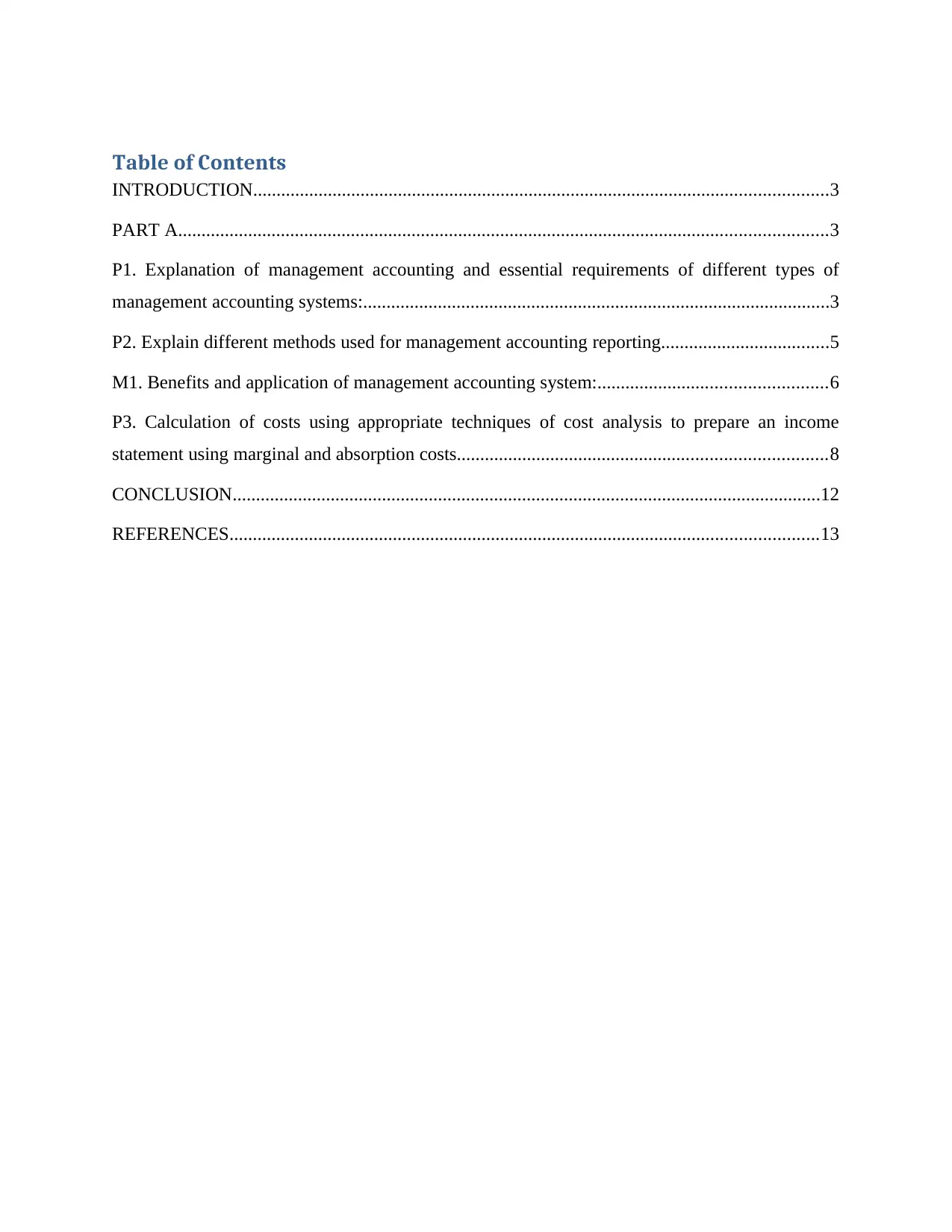
Table of Contents
INTRODUCTION...........................................................................................................................3
PART A...........................................................................................................................................3
P1. Explanation of management accounting and essential requirements of different types of
management accounting systems:....................................................................................................3
P2. Explain different methods used for management accounting reporting....................................5
M1. Benefits and application of management accounting system:.................................................6
P3. Calculation of costs using appropriate techniques of cost analysis to prepare an income
statement using marginal and absorption costs...............................................................................8
CONCLUSION..............................................................................................................................12
REFERENCES..............................................................................................................................13
INTRODUCTION...........................................................................................................................3
PART A...........................................................................................................................................3
P1. Explanation of management accounting and essential requirements of different types of
management accounting systems:....................................................................................................3
P2. Explain different methods used for management accounting reporting....................................5
M1. Benefits and application of management accounting system:.................................................6
P3. Calculation of costs using appropriate techniques of cost analysis to prepare an income
statement using marginal and absorption costs...............................................................................8
CONCLUSION..............................................................................................................................12
REFERENCES..............................................................................................................................13
INTRODUCTION
Management accounting system involves process of creating and organizing goals of a
firm through identifying, measuring, analyzing, interpreting and communicating data to
each department heads. It generally focuses on information management system; it
differs from financial accountant, as accounts shows reports and figures but managerial
accounting attach some meaning to it for making it understandable by other project
heads. Seeing a figure is not enough for strategic managerial to make some conclusion
due to missing of accounting knowledge; but if report generated based on data provided
by accountant than mangers could easily reach to proper conclusion and make strategy
accordingly.
This project report will discuss how different accounting method of managerial
accounting system affects overall earnings of company. Report covers two parts; Part A
and B, where part A will discuss about measurement of outcomes of different applied
strategies through managerial accounting tools.
PART A
P1. Explanation of management accounting and essential
requirements of different types of management accounting
systems:
Management Accounting: Management accounting or managerial accounting
involves internal systems which help organization in measuring, evaluating and
analyzing process of management of the business structure. The major
components of managerial accounting are budgets, internal performance reports,
financial reports of income statement and balance sheet, reports on return on
investment and earnings per share and trend analyses. It also uses cost of goods
Management accounting system involves process of creating and organizing goals of a
firm through identifying, measuring, analyzing, interpreting and communicating data to
each department heads. It generally focuses on information management system; it
differs from financial accountant, as accounts shows reports and figures but managerial
accounting attach some meaning to it for making it understandable by other project
heads. Seeing a figure is not enough for strategic managerial to make some conclusion
due to missing of accounting knowledge; but if report generated based on data provided
by accountant than mangers could easily reach to proper conclusion and make strategy
accordingly.
This project report will discuss how different accounting method of managerial
accounting system affects overall earnings of company. Report covers two parts; Part A
and B, where part A will discuss about measurement of outcomes of different applied
strategies through managerial accounting tools.
PART A
P1. Explanation of management accounting and essential
requirements of different types of management accounting
systems:
Management Accounting: Management accounting or managerial accounting
involves internal systems which help organization in measuring, evaluating and
analyzing process of management of the business structure. The major
components of managerial accounting are budgets, internal performance reports,
financial reports of income statement and balance sheet, reports on return on
investment and earnings per share and trend analyses. It also uses cost of goods
⊘ This is a preview!⊘
Do you want full access?
Subscribe today to unlock all pages.

Trusted by 1+ million students worldwide
sold and activity-based cost analyses for making proper product pricing strategies
(Oliver, 2018).
Different types of management accounting system:
Job costing system: Cost bookkeeping framework that gathers producing costs
independently for each assignment. It is the process of assigning cost according to
the type of job or activity. This practice helps management in knowing which jobs
having much cost and how much value it is added to production process
(Hoggett, and et. al., 2018).
Price optimizing system: Each market is different and the thing that is beneficial
for one market may be the same opposite for another market. Mimicking goals in
different markets can disrupt your performance or even cause losses beyond
profit. User price, competition, and cost of goods sold may vary by location, so
these variations must be taken into account when identifying performance goals.
Lastly, although it is good to have a stable goal, but if you see real results, do not
hesitate to revise your performance goals. (Pratt, 2016).
Cost accounting system:
Cost accounting generates concern so that investigations can be continued on
operations aimed at maximizing the benefits and efficiency of the concern. In
contrast, the financial day traces the financial results for the accounting period and
the position of assets and liabilities on the last day of the accounting period. There
is no comparison between these two as they are equally important to users. This
article presents you the difference between cost accounting and financial
accounting in tabular form (Flower, 2016).
Cost Accounting can be additionally partitioned into two sections; Job request
costing and Process costing.
Inventory management system: The importance of inventory management,
especially for ecommerce and online retail brands, cannot be stressed enough
(Oliver, 2018).
Different types of management accounting system:
Job costing system: Cost bookkeeping framework that gathers producing costs
independently for each assignment. It is the process of assigning cost according to
the type of job or activity. This practice helps management in knowing which jobs
having much cost and how much value it is added to production process
(Hoggett, and et. al., 2018).
Price optimizing system: Each market is different and the thing that is beneficial
for one market may be the same opposite for another market. Mimicking goals in
different markets can disrupt your performance or even cause losses beyond
profit. User price, competition, and cost of goods sold may vary by location, so
these variations must be taken into account when identifying performance goals.
Lastly, although it is good to have a stable goal, but if you see real results, do not
hesitate to revise your performance goals. (Pratt, 2016).
Cost accounting system:
Cost accounting generates concern so that investigations can be continued on
operations aimed at maximizing the benefits and efficiency of the concern. In
contrast, the financial day traces the financial results for the accounting period and
the position of assets and liabilities on the last day of the accounting period. There
is no comparison between these two as they are equally important to users. This
article presents you the difference between cost accounting and financial
accounting in tabular form (Flower, 2016).
Cost Accounting can be additionally partitioned into two sections; Job request
costing and Process costing.
Inventory management system: The importance of inventory management,
especially for ecommerce and online retail brands, cannot be stressed enough
Paraphrase This Document
Need a fresh take? Get an instant paraphrase of this document with our AI Paraphraser
(equipment and programming). Precise inventory tracking only allows brands to
complete orders on time and correctly. Inventory management in businesses
should grow as the company expands (Maynard, 2017).
Essential requirements of different accounting systems are:
It is used by entities to keep track of their financial transactions. Financial
accounting and management accounting are two branches of accounting. Financial
accounting emphasizes giving a fair and unbiased view of the company's financial
position to various parties (Bromwich and Bhimani, 2005). Different management
accounting systems are essentially required for business because:
It requires improving the efficiency of business operations.
It facilitates control to translate available objectives and strategy into
specific goals.
Provides accounting information’s and data interoperated in simple
language.
Provides liaison between top managers and accountants.
Helps in taking critical decisions for business expansion and risk
undertakings (Hansen, Mowen and Guan, 2007).
P2. Explain different methods used for management accounting
reporting
Different types of management accounting reports help management in
preparation of financial statement and forecasting past data’s to critically evaluate
its impact on overall performance of organization. It supports managers by
providing accurate and genuine data and information for helping in decision
making (Clatworthy, 2005). The various types of reports and their benefits are
discussed below:
Budgeting Reports: The budget is a plan made for the future, which is made by
estimating the revenue and other income and expenses for the whole year. In
which the financial minister, after estimating his expenditure before the
complete orders on time and correctly. Inventory management in businesses
should grow as the company expands (Maynard, 2017).
Essential requirements of different accounting systems are:
It is used by entities to keep track of their financial transactions. Financial
accounting and management accounting are two branches of accounting. Financial
accounting emphasizes giving a fair and unbiased view of the company's financial
position to various parties (Bromwich and Bhimani, 2005). Different management
accounting systems are essentially required for business because:
It requires improving the efficiency of business operations.
It facilitates control to translate available objectives and strategy into
specific goals.
Provides accounting information’s and data interoperated in simple
language.
Provides liaison between top managers and accountants.
Helps in taking critical decisions for business expansion and risk
undertakings (Hansen, Mowen and Guan, 2007).
P2. Explain different methods used for management accounting
reporting
Different types of management accounting reports help management in
preparation of financial statement and forecasting past data’s to critically evaluate
its impact on overall performance of organization. It supports managers by
providing accurate and genuine data and information for helping in decision
making (Clatworthy, 2005). The various types of reports and their benefits are
discussed below:
Budgeting Reports: The budget is a plan made for the future, which is made by
estimating the revenue and other income and expenses for the whole year. In
which the financial minister, after estimating his expenditure before the
government, makes several plans for the coming year and presents it to the public
during every financial year (Bratton and Gold, 2017).
Accounts Receivable Aging:
Recipients are ranked higher on the property list because of their ability to convert
to cash. Account receivables are shown on the company's balance sheet, as the
outstanding amounts are treated as assets as soon as they are paid - we hope - they
become cash (Flower and Ebbers, 2018).
Job Costs Reports: A order-specific costing technique is used when each product
is tailor-made and customized to the customer's needs. Job costs include direct
and indirect costs in one account. In addition, both types of costs are related to
each other (a job involves a substantial amount of labor and material that requires
close monitoring of power, machine time, inspection time, and moreover).
Performance reports: These reports show difference between actual
performance and budgeted performance; it shows the deviation between two
figures either in percentage form or in amount. This analysis helps managers to
take initiate step to control these variances at prime stage (Kaplan and Atkinson,
2015).
M1. Benefits and application of management accounting system:
Benefits:
Management accounting offers better Services to Customers. Management
accounting means the presentation of accounting information to assist in the
management of management accounting policy formulation and assist in the day-
to-day operations of the undertaking affect functions, benefits, and limitations of
management accounting. Thus, it deals with the use of consolidated accounting
data with the help of financial accounting and cost accounting for the purpose of
planning, planning, control and decision making by management. Management
accounting links with accounting as any accounting information required to make
during every financial year (Bratton and Gold, 2017).
Accounts Receivable Aging:
Recipients are ranked higher on the property list because of their ability to convert
to cash. Account receivables are shown on the company's balance sheet, as the
outstanding amounts are treated as assets as soon as they are paid - we hope - they
become cash (Flower and Ebbers, 2018).
Job Costs Reports: A order-specific costing technique is used when each product
is tailor-made and customized to the customer's needs. Job costs include direct
and indirect costs in one account. In addition, both types of costs are related to
each other (a job involves a substantial amount of labor and material that requires
close monitoring of power, machine time, inspection time, and moreover).
Performance reports: These reports show difference between actual
performance and budgeted performance; it shows the deviation between two
figures either in percentage form or in amount. This analysis helps managers to
take initiate step to control these variances at prime stage (Kaplan and Atkinson,
2015).
M1. Benefits and application of management accounting system:
Benefits:
Management accounting offers better Services to Customers. Management
accounting means the presentation of accounting information to assist in the
management of management accounting policy formulation and assist in the day-
to-day operations of the undertaking affect functions, benefits, and limitations of
management accounting. Thus, it deals with the use of consolidated accounting
data with the help of financial accounting and cost accounting for the purpose of
planning, planning, control and decision making by management. Management
accounting links with accounting as any accounting information required to make
⊘ This is a preview!⊘
Do you want full access?
Subscribe today to unlock all pages.
Trusted by 1+ million students worldwide
management managerial decisions is the subject of management accounting
(Narayanaswamy, 2017).
Applications:
Measurement of performance: Management accounting system applied for
measuring the actual performance with budgeted one and analyzing factors that
impact actual performance and increases variations. It also supports organization
in analyzing difference between standard and actual performance sets out of
deviations on which necessary steps should be taken and implemented.
Assessment of risk: Another application of different management accounting
method is assessing future risks and their impact on overall business. Through
analyzing and evaluating various risk factors management accounting system
helps organization in building responsive attitude towards any miss happening in
business. For instance; analyzing past information a managerial accountant finds
that sales are moving downwards. Hence if not response at initial stage could
increase the risk of collapse of business and will not survive in long run.
Managerial reports shows which part of business needs maintenance and
improvement to boost overall sales of company.
Allocation of resources: Organizations can apply management accounting
system to achieve desired objectives through efficiency and effectively utilization
of its current resources in maximization of profit. Management accounting
systems method named cost analyses helps firm in identifying the movement of its
fund on different expenses; also it shows the way by which these expenses could
be minimized permanently or for long period of time (Quinn and Strauss, 2017).
Financial statement presentation: Management accounting provides proper
presentation of financial position of organization with necessary information and
data. Many different cost and financial information simplifies present good and
financial reports which provides key advantage to strategic department of firm.
(Narayanaswamy, 2017).
Applications:
Measurement of performance: Management accounting system applied for
measuring the actual performance with budgeted one and analyzing factors that
impact actual performance and increases variations. It also supports organization
in analyzing difference between standard and actual performance sets out of
deviations on which necessary steps should be taken and implemented.
Assessment of risk: Another application of different management accounting
method is assessing future risks and their impact on overall business. Through
analyzing and evaluating various risk factors management accounting system
helps organization in building responsive attitude towards any miss happening in
business. For instance; analyzing past information a managerial accountant finds
that sales are moving downwards. Hence if not response at initial stage could
increase the risk of collapse of business and will not survive in long run.
Managerial reports shows which part of business needs maintenance and
improvement to boost overall sales of company.
Allocation of resources: Organizations can apply management accounting
system to achieve desired objectives through efficiency and effectively utilization
of its current resources in maximization of profit. Management accounting
systems method named cost analyses helps firm in identifying the movement of its
fund on different expenses; also it shows the way by which these expenses could
be minimized permanently or for long period of time (Quinn and Strauss, 2017).
Financial statement presentation: Management accounting provides proper
presentation of financial position of organization with necessary information and
data. Many different cost and financial information simplifies present good and
financial reports which provides key advantage to strategic department of firm.
Paraphrase This Document
Need a fresh take? Get an instant paraphrase of this document with our AI Paraphraser
P3. Calculation of costs using appropriate techniques of cost
analysis to prepare an income statement using marginal and
absorption costs
Calculation of Income statement for both the Projects X and Y through marginal
costing and absorption costing methods:
analysis to prepare an income statement using marginal and
absorption costs
Calculation of Income statement for both the Projects X and Y through marginal
costing and absorption costing methods:
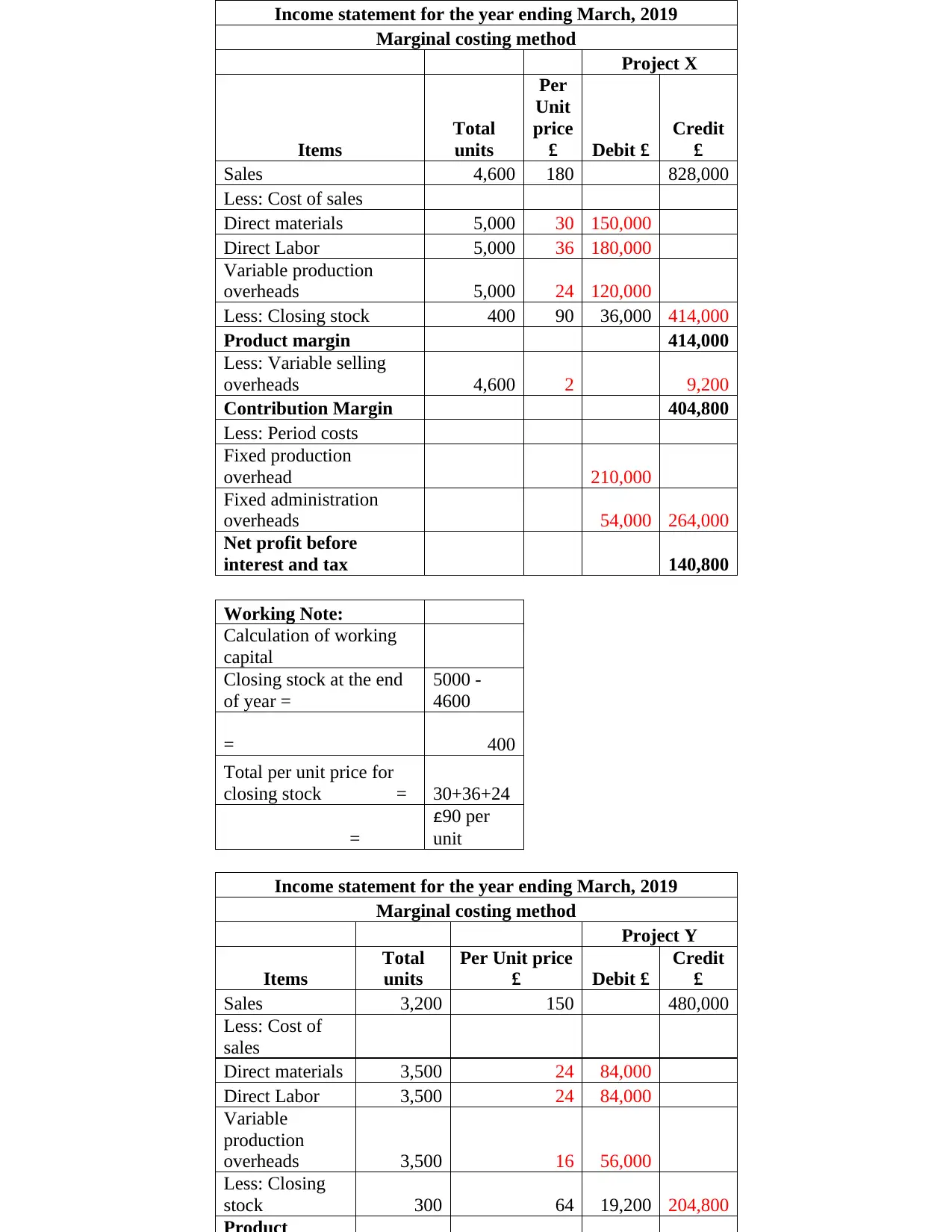
Income statement for the year ending March, 2019
Marginal costing method
Project X
Items
Total
units
Per
Unit
price
£ Debit £
Credit
£
Sales 4,600 180 828,000
Less: Cost of sales
Direct materials 5,000 30 150,000
Direct Labor 5,000 36 180,000
Variable production
overheads 5,000 24 120,000
Less: Closing stock 400 90 36,000 414,000
Product margin 414,000
Less: Variable selling
overheads 4,600 2 9,200
Contribution Margin 404,800
Less: Period costs
Fixed production
overhead 210,000
Fixed administration
overheads 54,000 264,000
Net profit before
interest and tax 140,800
Working Note:
Calculation of working
capital
Closing stock at the end
of year =
5000 -
4600
= 400
Total per unit price for
closing stock = 30+36+24
=
£90 per
unit
Income statement for the year ending March, 2019
Marginal costing method
Project Y
Items
Total
units
Per Unit price
£ Debit £
Credit
£
Sales 3,200 150 480,000
Less: Cost of
sales
Direct materials 3,500 24 84,000
Direct Labor 3,500 24 84,000
Variable
production
overheads 3,500 16 56,000
Less: Closing
stock 300 64 19,200 204,800
Marginal costing method
Project X
Items
Total
units
Per
Unit
price
£ Debit £
Credit
£
Sales 4,600 180 828,000
Less: Cost of sales
Direct materials 5,000 30 150,000
Direct Labor 5,000 36 180,000
Variable production
overheads 5,000 24 120,000
Less: Closing stock 400 90 36,000 414,000
Product margin 414,000
Less: Variable selling
overheads 4,600 2 9,200
Contribution Margin 404,800
Less: Period costs
Fixed production
overhead 210,000
Fixed administration
overheads 54,000 264,000
Net profit before
interest and tax 140,800
Working Note:
Calculation of working
capital
Closing stock at the end
of year =
5000 -
4600
= 400
Total per unit price for
closing stock = 30+36+24
=
£90 per
unit
Income statement for the year ending March, 2019
Marginal costing method
Project Y
Items
Total
units
Per Unit price
£ Debit £
Credit
£
Sales 3,200 150 480,000
Less: Cost of
sales
Direct materials 3,500 24 84,000
Direct Labor 3,500 24 84,000
Variable
production
overheads 3,500 16 56,000
Less: Closing
stock 300 64 19,200 204,800
⊘ This is a preview!⊘
Do you want full access?
Subscribe today to unlock all pages.
Trusted by 1+ million students worldwide
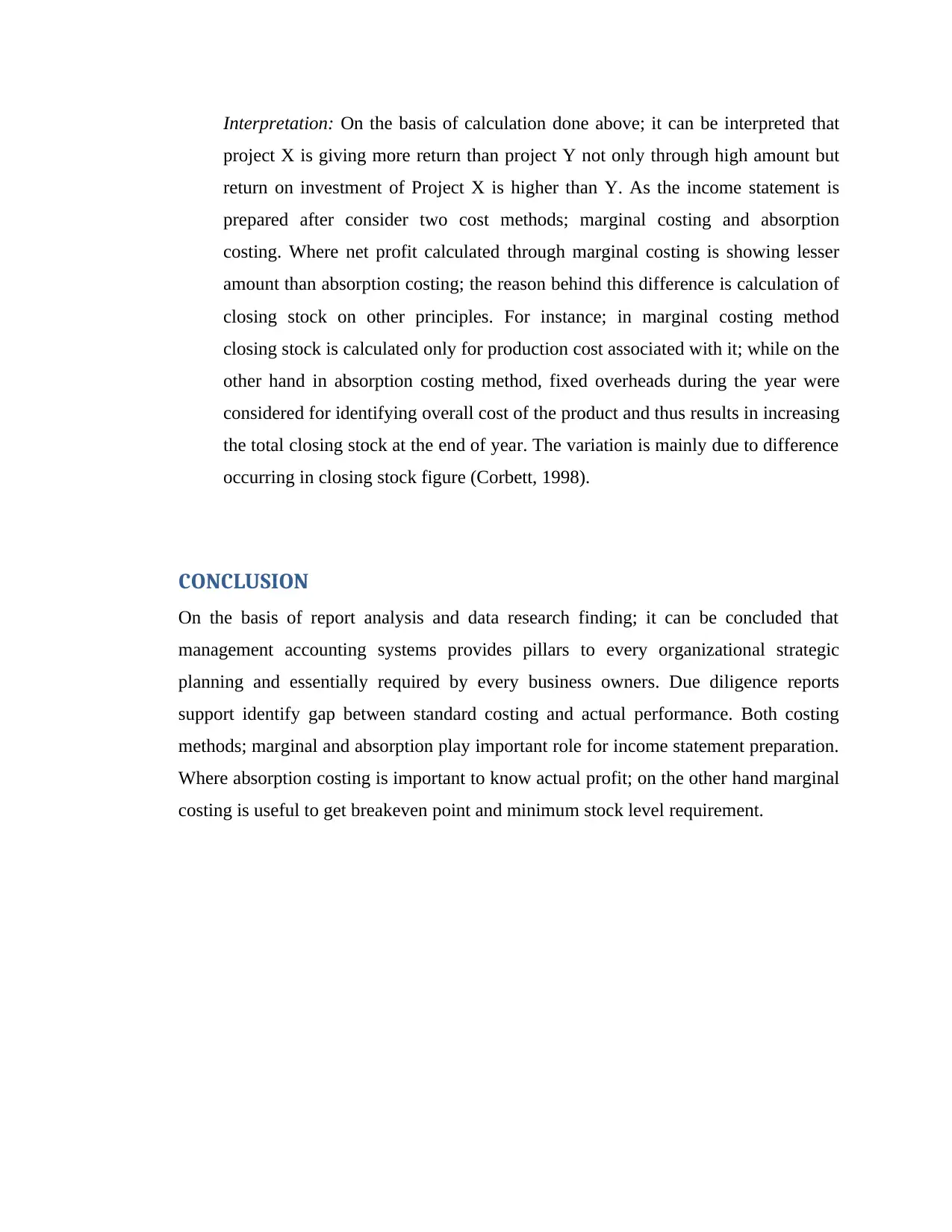
Interpretation: On the basis of calculation done above; it can be interpreted that
project X is giving more return than project Y not only through high amount but
return on investment of Project X is higher than Y. As the income statement is
prepared after consider two cost methods; marginal costing and absorption
costing. Where net profit calculated through marginal costing is showing lesser
amount than absorption costing; the reason behind this difference is calculation of
closing stock on other principles. For instance; in marginal costing method
closing stock is calculated only for production cost associated with it; while on the
other hand in absorption costing method, fixed overheads during the year were
considered for identifying overall cost of the product and thus results in increasing
the total closing stock at the end of year. The variation is mainly due to difference
occurring in closing stock figure (Corbett, 1998).
CONCLUSION
On the basis of report analysis and data research finding; it can be concluded that
management accounting systems provides pillars to every organizational strategic
planning and essentially required by every business owners. Due diligence reports
support identify gap between standard costing and actual performance. Both costing
methods; marginal and absorption play important role for income statement preparation.
Where absorption costing is important to know actual profit; on the other hand marginal
costing is useful to get breakeven point and minimum stock level requirement.
project X is giving more return than project Y not only through high amount but
return on investment of Project X is higher than Y. As the income statement is
prepared after consider two cost methods; marginal costing and absorption
costing. Where net profit calculated through marginal costing is showing lesser
amount than absorption costing; the reason behind this difference is calculation of
closing stock on other principles. For instance; in marginal costing method
closing stock is calculated only for production cost associated with it; while on the
other hand in absorption costing method, fixed overheads during the year were
considered for identifying overall cost of the product and thus results in increasing
the total closing stock at the end of year. The variation is mainly due to difference
occurring in closing stock figure (Corbett, 1998).
CONCLUSION
On the basis of report analysis and data research finding; it can be concluded that
management accounting systems provides pillars to every organizational strategic
planning and essentially required by every business owners. Due diligence reports
support identify gap between standard costing and actual performance. Both costing
methods; marginal and absorption play important role for income statement preparation.
Where absorption costing is important to know actual profit; on the other hand marginal
costing is useful to get breakeven point and minimum stock level requirement.
Paraphrase This Document
Need a fresh take? Get an instant paraphrase of this document with our AI Paraphraser
REFERENCES
Books and Journals
Bratton, J. and Gold, J., 2017. Human resource management: theory and practice. Palgrave.
Bromwich, M. and Bhimani, A., 2005. Management accounting: Pathways to progress. Cima
publishing.
Clatworthy, M., 2005. Transnational equity analysis. John Wiley & Sons.
Corbett, T., 1998. Throughput accounting: TOC's management accounting system (pp. 41-80).
Great Barrington: North river press.
Flower, J. and Ebbers, G., 2018. Global financial reporting. Macmillan International Higher
Education.
Flower, J., 2016. European financial reporting: adapting to a changing world. Springer.
Hansen, D., Mowen, M. and Guan, L., 2007. Cost management: accounting and control.
Cengage Learning.
Hoggett, J., and et. al., 2018. Financial accounting. Wiley.
Kaplan, R.S. and Atkinson, A.A., 2015. Advanced management accounting. PHI Learning.
Maynard, J., 2017. Financial accounting, reporting, and analysis. Oxford University Press.
Narayanaswamy, R., 2017. Financial accounting: a managerial perspective. PHI Learning Pvt.
Ltd..
Oliver, G.R., 2018. Managerial Accountant’s Compass: Research Genesis and Development.
Routledge.
Pratt, J., 2016. Financial accounting in an economic context. John Wiley & Sons.
Quinn, M. and Strauss, E., 2017. The Routledge Companion to Accounting Information Systems.
Routledge.
Books and Journals
Bratton, J. and Gold, J., 2017. Human resource management: theory and practice. Palgrave.
Bromwich, M. and Bhimani, A., 2005. Management accounting: Pathways to progress. Cima
publishing.
Clatworthy, M., 2005. Transnational equity analysis. John Wiley & Sons.
Corbett, T., 1998. Throughput accounting: TOC's management accounting system (pp. 41-80).
Great Barrington: North river press.
Flower, J. and Ebbers, G., 2018. Global financial reporting. Macmillan International Higher
Education.
Flower, J., 2016. European financial reporting: adapting to a changing world. Springer.
Hansen, D., Mowen, M. and Guan, L., 2007. Cost management: accounting and control.
Cengage Learning.
Hoggett, J., and et. al., 2018. Financial accounting. Wiley.
Kaplan, R.S. and Atkinson, A.A., 2015. Advanced management accounting. PHI Learning.
Maynard, J., 2017. Financial accounting, reporting, and analysis. Oxford University Press.
Narayanaswamy, R., 2017. Financial accounting: a managerial perspective. PHI Learning Pvt.
Ltd..
Oliver, G.R., 2018. Managerial Accountant’s Compass: Research Genesis and Development.
Routledge.
Pratt, J., 2016. Financial accounting in an economic context. John Wiley & Sons.
Quinn, M. and Strauss, E., 2017. The Routledge Companion to Accounting Information Systems.
Routledge.

1 out of 11


Related Documents


Your All-in-One AI-Powered Toolkit for Academic Success.
+13062052269
info@desklib.com
Available 24*7 on WhatsApp / Email
![[object Object]](/_next/static/media/star-bottom.7253800d.svg)
Unlock your academic potential
Copyright © 2020–2026 A2Z Services. All Rights Reserved. Developed and managed by ZUCOL.