Management Accounting: Costing, Budgeting, and Reporting Analysis
VerifiedAdded on 2020/07/23
|19
|4946
|24
Report
AI Summary
This report offers a detailed analysis of management accounting practices within Mwambi Ltd, a manufacturer of aerospace parts. The report begins by distinguishing between financial and management accounting, exploring various management accounting systems such as cost accounting, inventory management, job costing, and price optimization, along with their benefits. It then delves into costing techniques, including absorption and marginal costing, standard costing, and variance analysis. The report includes the preparation of income statements, calculation of unit costs, and variance analysis. Finally, the report critically analyzes budgetary planning tools, including the budgeting process, different budget types, and their advantages and disadvantages, along with recommendations for improvement. The report integrates various management accounting systems to generate crucial reports for effective decision-making, such as budgeting, job cost, and inventory reports.
Management accounting

Paraphrase This Document
Need a fresh take? Get an instant paraphrase of this document with our AI Paraphraser
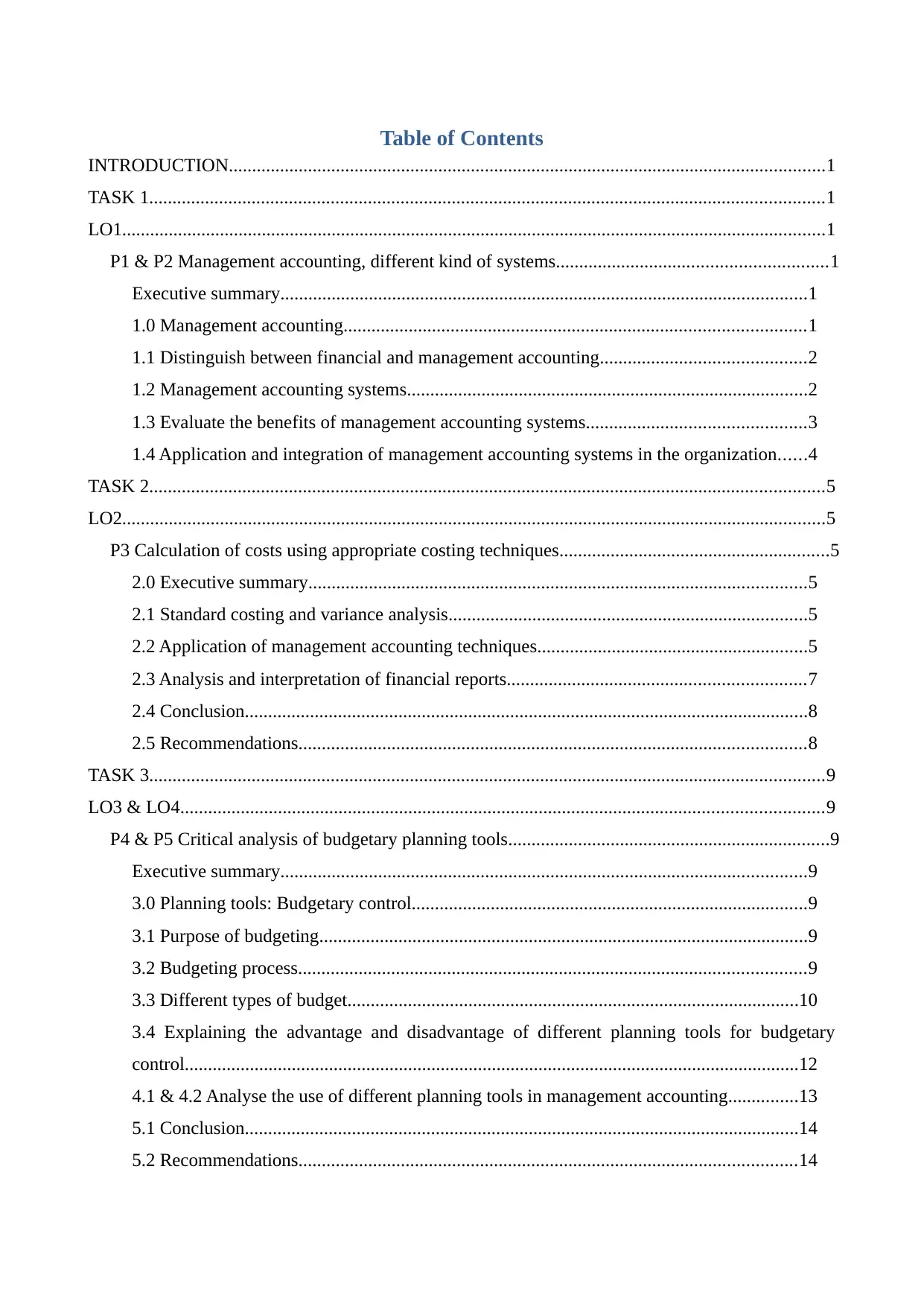
Table of Contents
INTRODUCTION................................................................................................................................1
TASK 1.................................................................................................................................................1
LO1.......................................................................................................................................................1
P1 & P2 Management accounting, different kind of systems..........................................................1
Executive summary.................................................................................................................1
1.0 Management accounting...................................................................................................1
1.1 Distinguish between financial and management accounting............................................2
1.2 Management accounting systems......................................................................................2
1.3 Evaluate the benefits of management accounting systems...............................................3
1.4 Application and integration of management accounting systems in the organization......4
TASK 2.................................................................................................................................................5
LO2.......................................................................................................................................................5
P3 Calculation of costs using appropriate costing techniques..........................................................5
2.0 Executive summary...........................................................................................................5
2.1 Standard costing and variance analysis.............................................................................5
2.2 Application of management accounting techniques..........................................................5
2.3 Analysis and interpretation of financial reports................................................................7
2.4 Conclusion.........................................................................................................................8
2.5 Recommendations.............................................................................................................8
TASK 3.................................................................................................................................................9
LO3 & LO4..........................................................................................................................................9
P4 & P5 Critical analysis of budgetary planning tools.....................................................................9
Executive summary.................................................................................................................9
3.0 Planning tools: Budgetary control.....................................................................................9
3.1 Purpose of budgeting.........................................................................................................9
3.2 Budgeting process.............................................................................................................9
3.3 Different types of budget.................................................................................................10
3.4 Explaining the advantage and disadvantage of different planning tools for budgetary
control....................................................................................................................................12
4.1 & 4.2 Analyse the use of different planning tools in management accounting...............13
5.1 Conclusion.......................................................................................................................14
5.2 Recommendations...........................................................................................................14
INTRODUCTION................................................................................................................................1
TASK 1.................................................................................................................................................1
LO1.......................................................................................................................................................1
P1 & P2 Management accounting, different kind of systems..........................................................1
Executive summary.................................................................................................................1
1.0 Management accounting...................................................................................................1
1.1 Distinguish between financial and management accounting............................................2
1.2 Management accounting systems......................................................................................2
1.3 Evaluate the benefits of management accounting systems...............................................3
1.4 Application and integration of management accounting systems in the organization......4
TASK 2.................................................................................................................................................5
LO2.......................................................................................................................................................5
P3 Calculation of costs using appropriate costing techniques..........................................................5
2.0 Executive summary...........................................................................................................5
2.1 Standard costing and variance analysis.............................................................................5
2.2 Application of management accounting techniques..........................................................5
2.3 Analysis and interpretation of financial reports................................................................7
2.4 Conclusion.........................................................................................................................8
2.5 Recommendations.............................................................................................................8
TASK 3.................................................................................................................................................9
LO3 & LO4..........................................................................................................................................9
P4 & P5 Critical analysis of budgetary planning tools.....................................................................9
Executive summary.................................................................................................................9
3.0 Planning tools: Budgetary control.....................................................................................9
3.1 Purpose of budgeting.........................................................................................................9
3.2 Budgeting process.............................................................................................................9
3.3 Different types of budget.................................................................................................10
3.4 Explaining the advantage and disadvantage of different planning tools for budgetary
control....................................................................................................................................12
4.1 & 4.2 Analyse the use of different planning tools in management accounting...............13
5.1 Conclusion.......................................................................................................................14
5.2 Recommendations...........................................................................................................14

CONCLUSION..................................................................................................................................14
REFERENCES...................................................................................................................................16
REFERENCES...................................................................................................................................16
⊘ This is a preview!⊘
Do you want full access?
Subscribe today to unlock all pages.

Trusted by 1+ million students worldwide
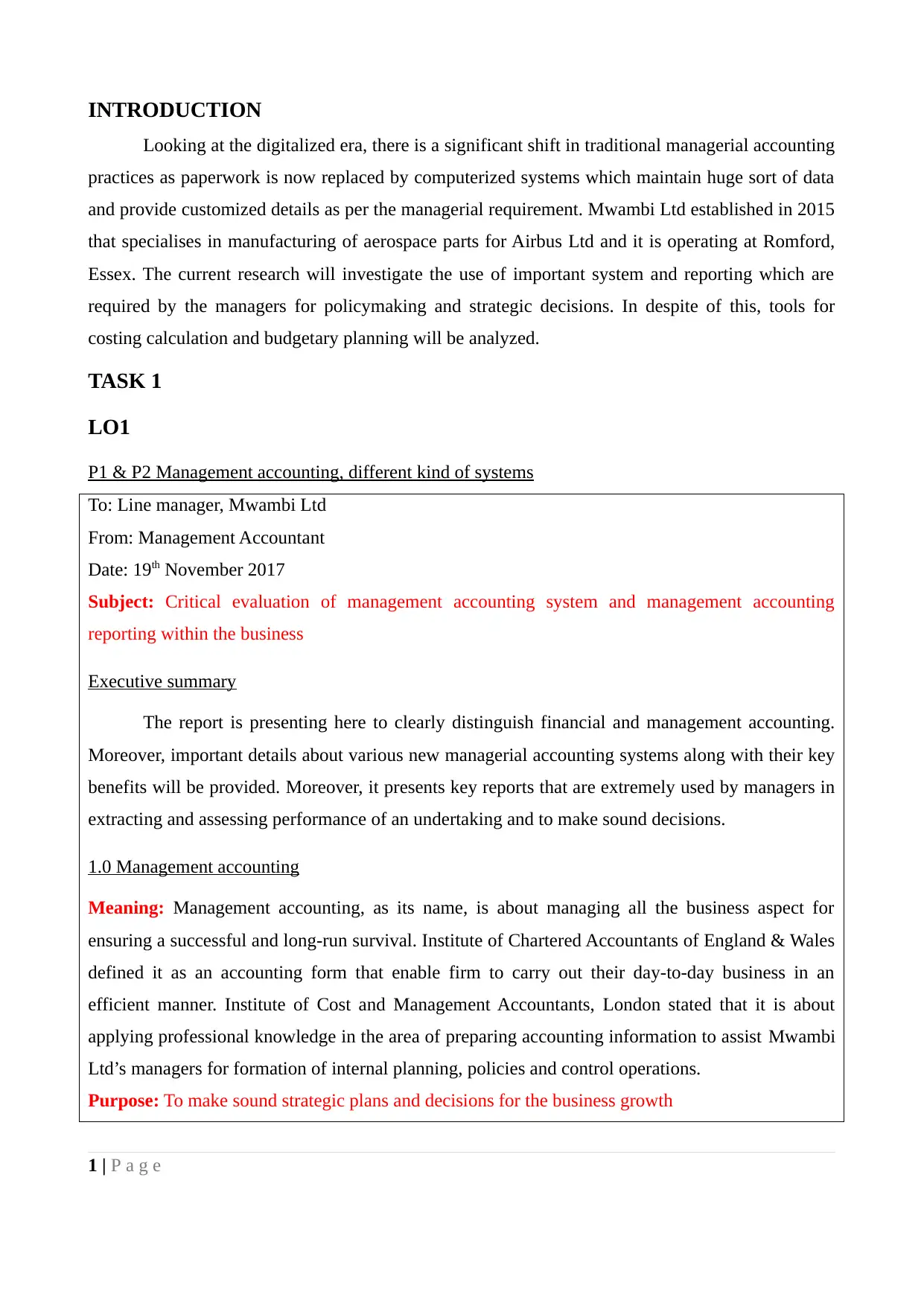
INTRODUCTION
Looking at the digitalized era, there is a significant shift in traditional managerial accounting
practices as paperwork is now replaced by computerized systems which maintain huge sort of data
and provide customized details as per the managerial requirement. Mwambi Ltd established in 2015
that specialises in manufacturing of aerospace parts for Airbus Ltd and it is operating at Romford,
Essex. The current research will investigate the use of important system and reporting which are
required by the managers for policymaking and strategic decisions. In despite of this, tools for
costing calculation and budgetary planning will be analyzed.
TASK 1
LO1
P1 & P2 Management accounting, different kind of systems
To: Line manager, Mwambi Ltd
From: Management Accountant
Date: 19th November 2017
Subject: Critical evaluation of management accounting system and management accounting
reporting within the business
Executive summary
The report is presenting here to clearly distinguish financial and management accounting.
Moreover, important details about various new managerial accounting systems along with their key
benefits will be provided. Moreover, it presents key reports that are extremely used by managers in
extracting and assessing performance of an undertaking and to make sound decisions.
1.0 Management accounting
Meaning: Management accounting, as its name, is about managing all the business aspect for
ensuring a successful and long-run survival. Institute of Chartered Accountants of England & Wales
defined it as an accounting form that enable firm to carry out their day-to-day business in an
efficient manner. Institute of Cost and Management Accountants, London stated that it is about
applying professional knowledge in the area of preparing accounting information to assist Mwambi
Ltd’s managers for formation of internal planning, policies and control operations.
Purpose: To make sound strategic plans and decisions for the business growth
1 | P a g e
Looking at the digitalized era, there is a significant shift in traditional managerial accounting
practices as paperwork is now replaced by computerized systems which maintain huge sort of data
and provide customized details as per the managerial requirement. Mwambi Ltd established in 2015
that specialises in manufacturing of aerospace parts for Airbus Ltd and it is operating at Romford,
Essex. The current research will investigate the use of important system and reporting which are
required by the managers for policymaking and strategic decisions. In despite of this, tools for
costing calculation and budgetary planning will be analyzed.
TASK 1
LO1
P1 & P2 Management accounting, different kind of systems
To: Line manager, Mwambi Ltd
From: Management Accountant
Date: 19th November 2017
Subject: Critical evaluation of management accounting system and management accounting
reporting within the business
Executive summary
The report is presenting here to clearly distinguish financial and management accounting.
Moreover, important details about various new managerial accounting systems along with their key
benefits will be provided. Moreover, it presents key reports that are extremely used by managers in
extracting and assessing performance of an undertaking and to make sound decisions.
1.0 Management accounting
Meaning: Management accounting, as its name, is about managing all the business aspect for
ensuring a successful and long-run survival. Institute of Chartered Accountants of England & Wales
defined it as an accounting form that enable firm to carry out their day-to-day business in an
efficient manner. Institute of Cost and Management Accountants, London stated that it is about
applying professional knowledge in the area of preparing accounting information to assist Mwambi
Ltd’s managers for formation of internal planning, policies and control operations.
Purpose: To make sound strategic plans and decisions for the business growth
1 | P a g e
Paraphrase This Document
Need a fresh take? Get an instant paraphrase of this document with our AI Paraphraser
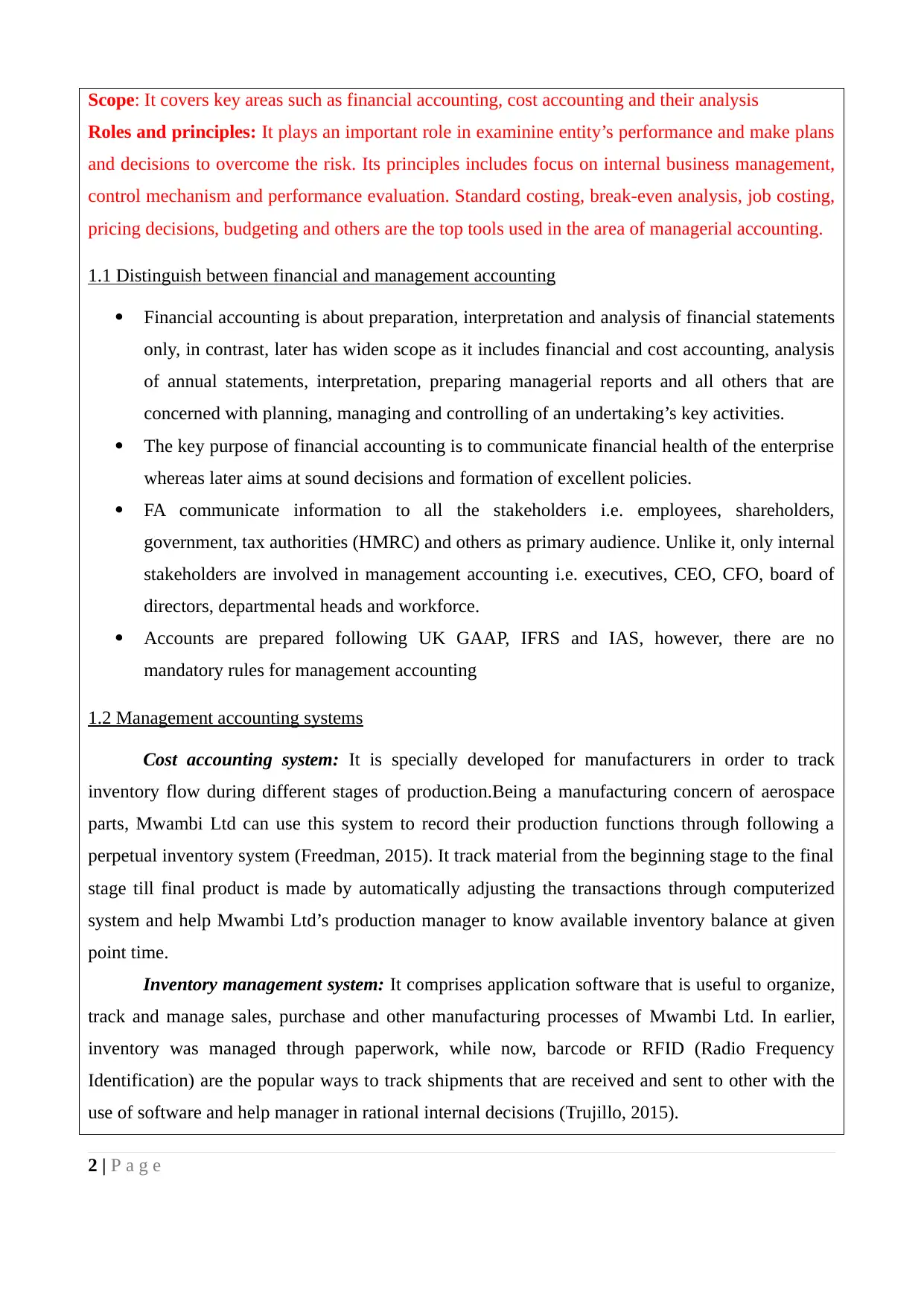
Scope: It covers key areas such as financial accounting, cost accounting and their analysis
Roles and principles: It plays an important role in examinine entity’s performance and make plans
and decisions to overcome the risk. Its principles includes focus on internal business management,
control mechanism and performance evaluation. Standard costing, break-even analysis, job costing,
pricing decisions, budgeting and others are the top tools used in the area of managerial accounting.
1.1 Distinguish between financial and management accounting
Financial accounting is about preparation, interpretation and analysis of financial statements
only, in contrast, later has widen scope as it includes financial and cost accounting, analysis
of annual statements, interpretation, preparing managerial reports and all others that are
concerned with planning, managing and controlling of an undertaking’s key activities.
The key purpose of financial accounting is to communicate financial health of the enterprise
whereas later aims at sound decisions and formation of excellent policies.
FA communicate information to all the stakeholders i.e. employees, shareholders,
government, tax authorities (HMRC) and others as primary audience. Unlike it, only internal
stakeholders are involved in management accounting i.e. executives, CEO, CFO, board of
directors, departmental heads and workforce.
Accounts are prepared following UK GAAP, IFRS and IAS, however, there are no
mandatory rules for management accounting
1.2 Management accounting systems
Cost accounting system: It is specially developed for manufacturers in order to track
inventory flow during different stages of production.Being a manufacturing concern of aerospace
parts, Mwambi Ltd can use this system to record their production functions through following a
perpetual inventory system (Freedman, 2015). It track material from the beginning stage to the final
stage till final product is made by automatically adjusting the transactions through computerized
system and help Mwambi Ltd’s production manager to know available inventory balance at given
point time.
Inventory management system: It comprises application software that is useful to organize,
track and manage sales, purchase and other manufacturing processes of Mwambi Ltd. In earlier,
inventory was managed through paperwork, while now, barcode or RFID (Radio Frequency
Identification) are the popular ways to track shipments that are received and sent to other with the
use of software and help manager in rational internal decisions (Trujillo, 2015).
2 | P a g e
Roles and principles: It plays an important role in examinine entity’s performance and make plans
and decisions to overcome the risk. Its principles includes focus on internal business management,
control mechanism and performance evaluation. Standard costing, break-even analysis, job costing,
pricing decisions, budgeting and others are the top tools used in the area of managerial accounting.
1.1 Distinguish between financial and management accounting
Financial accounting is about preparation, interpretation and analysis of financial statements
only, in contrast, later has widen scope as it includes financial and cost accounting, analysis
of annual statements, interpretation, preparing managerial reports and all others that are
concerned with planning, managing and controlling of an undertaking’s key activities.
The key purpose of financial accounting is to communicate financial health of the enterprise
whereas later aims at sound decisions and formation of excellent policies.
FA communicate information to all the stakeholders i.e. employees, shareholders,
government, tax authorities (HMRC) and others as primary audience. Unlike it, only internal
stakeholders are involved in management accounting i.e. executives, CEO, CFO, board of
directors, departmental heads and workforce.
Accounts are prepared following UK GAAP, IFRS and IAS, however, there are no
mandatory rules for management accounting
1.2 Management accounting systems
Cost accounting system: It is specially developed for manufacturers in order to track
inventory flow during different stages of production.Being a manufacturing concern of aerospace
parts, Mwambi Ltd can use this system to record their production functions through following a
perpetual inventory system (Freedman, 2015). It track material from the beginning stage to the final
stage till final product is made by automatically adjusting the transactions through computerized
system and help Mwambi Ltd’s production manager to know available inventory balance at given
point time.
Inventory management system: It comprises application software that is useful to organize,
track and manage sales, purchase and other manufacturing processes of Mwambi Ltd. In earlier,
inventory was managed through paperwork, while now, barcode or RFID (Radio Frequency
Identification) are the popular ways to track shipments that are received and sent to other with the
use of software and help manager in rational internal decisions (Trujillo, 2015).
2 | P a g e
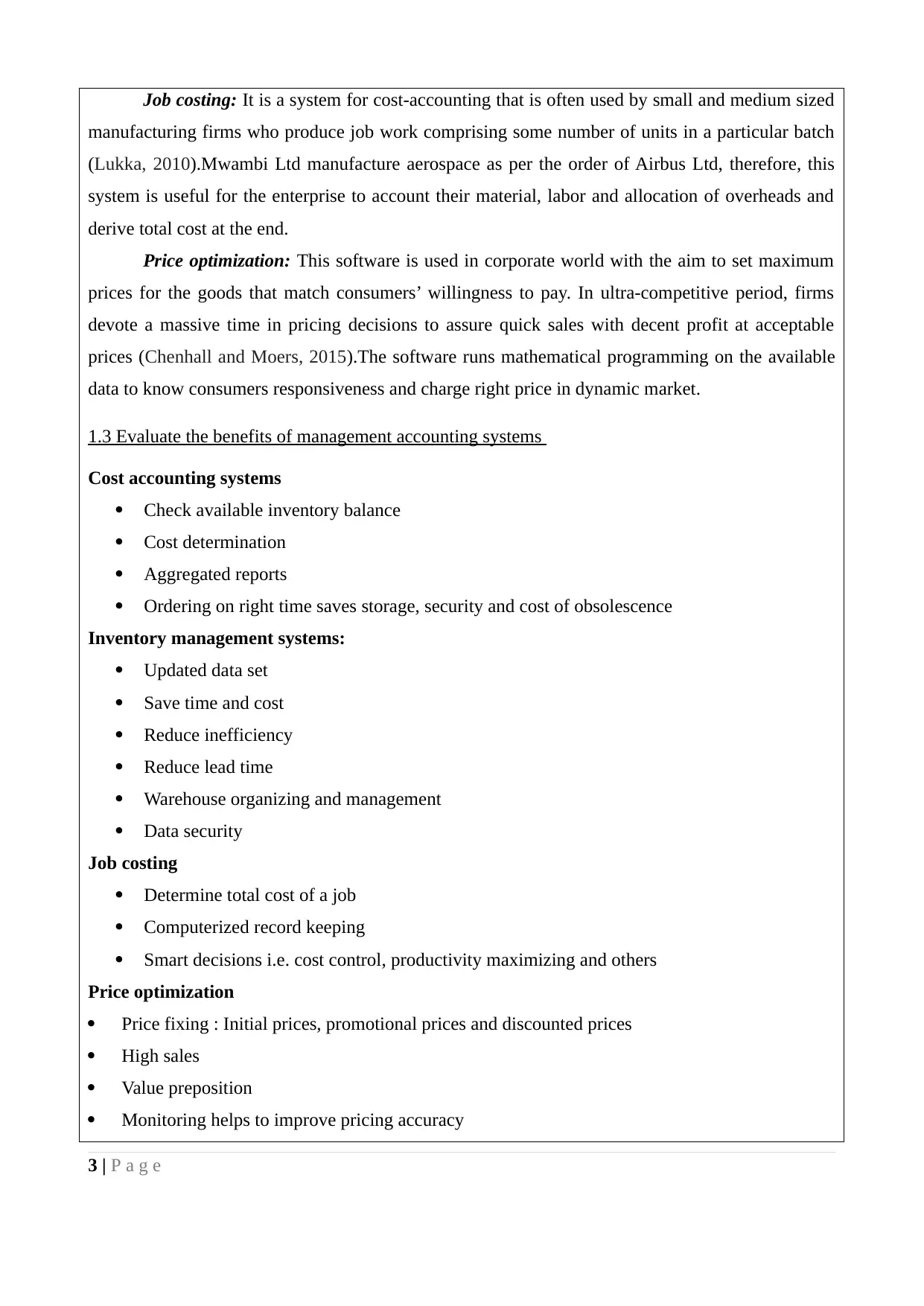
Job costing: It is a system for cost-accounting that is often used by small and medium sized
manufacturing firms who produce job work comprising some number of units in a particular batch
(Lukka, 2010).Mwambi Ltd manufacture aerospace as per the order of Airbus Ltd, therefore, this
system is useful for the enterprise to account their material, labor and allocation of overheads and
derive total cost at the end.
Price optimization: This software is used in corporate world with the aim to set maximum
prices for the goods that match consumers’ willingness to pay. In ultra-competitive period, firms
devote a massive time in pricing decisions to assure quick sales with decent profit at acceptable
prices (Chenhall and Moers, 2015).The software runs mathematical programming on the available
data to know consumers responsiveness and charge right price in dynamic market.
1.3 Evaluate the benefits of management accounting systems
Cost accounting systems
Check available inventory balance
Cost determination
Aggregated reports
Ordering on right time saves storage, security and cost of obsolescence
Inventory management systems:
Updated data set
Save time and cost
Reduce inefficiency
Reduce lead time
Warehouse organizing and management
Data security
Job costing
Determine total cost of a job
Computerized record keeping
Smart decisions i.e. cost control, productivity maximizing and others
Price optimization
Price fixing : Initial prices, promotional prices and discounted prices
High sales
Value preposition
Monitoring helps to improve pricing accuracy
3 | P a g e
manufacturing firms who produce job work comprising some number of units in a particular batch
(Lukka, 2010).Mwambi Ltd manufacture aerospace as per the order of Airbus Ltd, therefore, this
system is useful for the enterprise to account their material, labor and allocation of overheads and
derive total cost at the end.
Price optimization: This software is used in corporate world with the aim to set maximum
prices for the goods that match consumers’ willingness to pay. In ultra-competitive period, firms
devote a massive time in pricing decisions to assure quick sales with decent profit at acceptable
prices (Chenhall and Moers, 2015).The software runs mathematical programming on the available
data to know consumers responsiveness and charge right price in dynamic market.
1.3 Evaluate the benefits of management accounting systems
Cost accounting systems
Check available inventory balance
Cost determination
Aggregated reports
Ordering on right time saves storage, security and cost of obsolescence
Inventory management systems:
Updated data set
Save time and cost
Reduce inefficiency
Reduce lead time
Warehouse organizing and management
Data security
Job costing
Determine total cost of a job
Computerized record keeping
Smart decisions i.e. cost control, productivity maximizing and others
Price optimization
Price fixing : Initial prices, promotional prices and discounted prices
High sales
Value preposition
Monitoring helps to improve pricing accuracy
3 | P a g e
⊘ This is a preview!⊘
Do you want full access?
Subscribe today to unlock all pages.
Trusted by 1+ million students worldwide
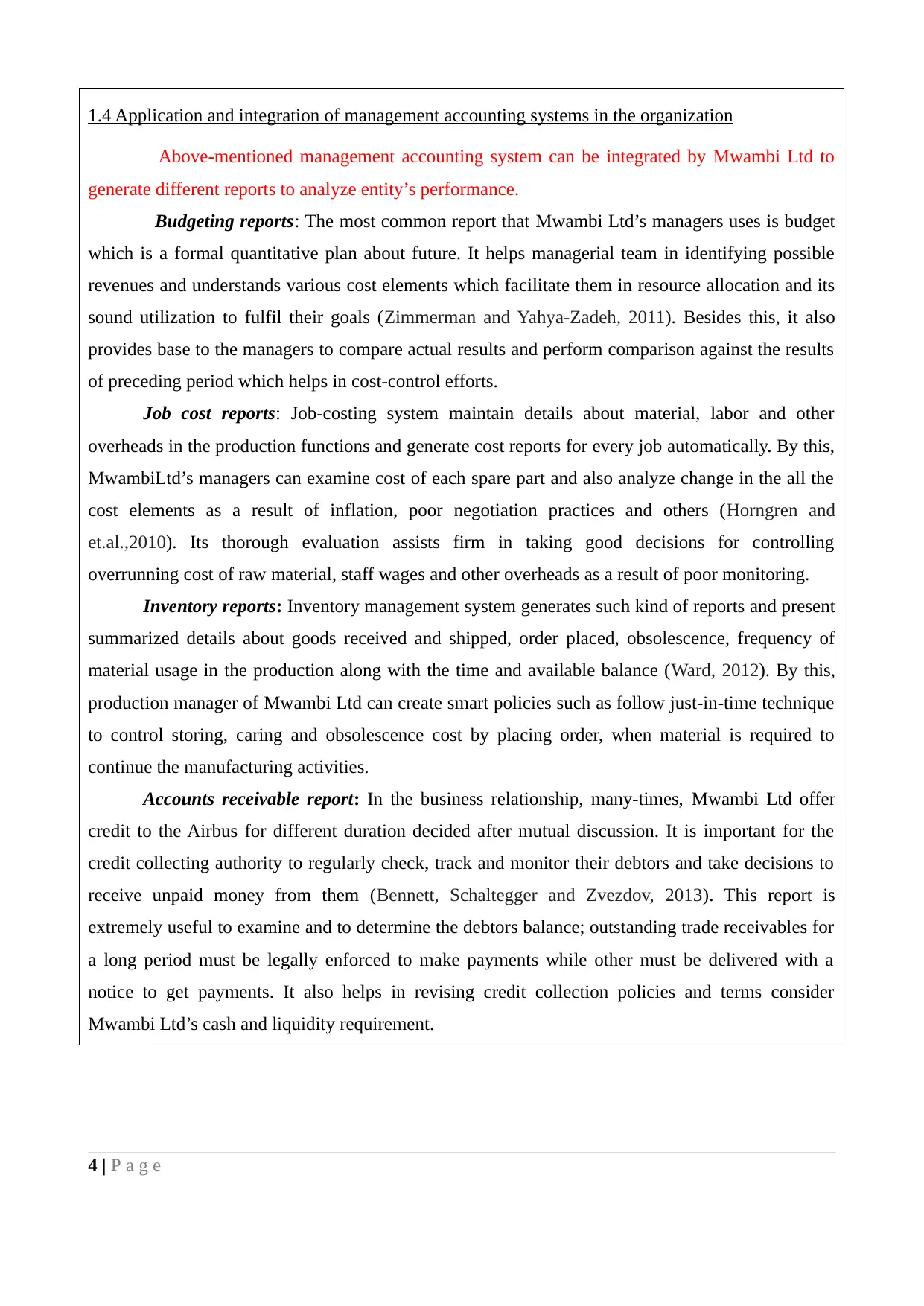
1.4 Application and integration of management accounting systems in the organization
Above-mentioned management accounting system can be integrated by Mwambi Ltd to
generate different reports to analyze entity’s performance.
Budgeting reports: The most common report that Mwambi Ltd’s managers uses is budget
which is a formal quantitative plan about future. It helps managerial team in identifying possible
revenues and understands various cost elements which facilitate them in resource allocation and its
sound utilization to fulfil their goals (Zimmerman and Yahya-Zadeh, 2011). Besides this, it also
provides base to the managers to compare actual results and perform comparison against the results
of preceding period which helps in cost-control efforts.
Job cost reports: Job-costing system maintain details about material, labor and other
overheads in the production functions and generate cost reports for every job automatically. By this,
MwambiLtd’s managers can examine cost of each spare part and also analyze change in the all the
cost elements as a result of inflation, poor negotiation practices and others (Horngren and
et.al.,2010). Its thorough evaluation assists firm in taking good decisions for controlling
overrunning cost of raw material, staff wages and other overheads as a result of poor monitoring.
Inventory reports: Inventory management system generates such kind of reports and present
summarized details about goods received and shipped, order placed, obsolescence, frequency of
material usage in the production along with the time and available balance (Ward, 2012). By this,
production manager of Mwambi Ltd can create smart policies such as follow just-in-time technique
to control storing, caring and obsolescence cost by placing order, when material is required to
continue the manufacturing activities.
Accounts receivable report: In the business relationship, many-times, Mwambi Ltd offer
credit to the Airbus for different duration decided after mutual discussion. It is important for the
credit collecting authority to regularly check, track and monitor their debtors and take decisions to
receive unpaid money from them (Bennett, Schaltegger and Zvezdov, 2013). This report is
extremely useful to examine and to determine the debtors balance; outstanding trade receivables for
a long period must be legally enforced to make payments while other must be delivered with a
notice to get payments. It also helps in revising credit collection policies and terms consider
Mwambi Ltd’s cash and liquidity requirement.
4 | P a g e
Above-mentioned management accounting system can be integrated by Mwambi Ltd to
generate different reports to analyze entity’s performance.
Budgeting reports: The most common report that Mwambi Ltd’s managers uses is budget
which is a formal quantitative plan about future. It helps managerial team in identifying possible
revenues and understands various cost elements which facilitate them in resource allocation and its
sound utilization to fulfil their goals (Zimmerman and Yahya-Zadeh, 2011). Besides this, it also
provides base to the managers to compare actual results and perform comparison against the results
of preceding period which helps in cost-control efforts.
Job cost reports: Job-costing system maintain details about material, labor and other
overheads in the production functions and generate cost reports for every job automatically. By this,
MwambiLtd’s managers can examine cost of each spare part and also analyze change in the all the
cost elements as a result of inflation, poor negotiation practices and others (Horngren and
et.al.,2010). Its thorough evaluation assists firm in taking good decisions for controlling
overrunning cost of raw material, staff wages and other overheads as a result of poor monitoring.
Inventory reports: Inventory management system generates such kind of reports and present
summarized details about goods received and shipped, order placed, obsolescence, frequency of
material usage in the production along with the time and available balance (Ward, 2012). By this,
production manager of Mwambi Ltd can create smart policies such as follow just-in-time technique
to control storing, caring and obsolescence cost by placing order, when material is required to
continue the manufacturing activities.
Accounts receivable report: In the business relationship, many-times, Mwambi Ltd offer
credit to the Airbus for different duration decided after mutual discussion. It is important for the
credit collecting authority to regularly check, track and monitor their debtors and take decisions to
receive unpaid money from them (Bennett, Schaltegger and Zvezdov, 2013). This report is
extremely useful to examine and to determine the debtors balance; outstanding trade receivables for
a long period must be legally enforced to make payments while other must be delivered with a
notice to get payments. It also helps in revising credit collection policies and terms consider
Mwambi Ltd’s cash and liquidity requirement.
4 | P a g e
Paraphrase This Document
Need a fresh take? Get an instant paraphrase of this document with our AI Paraphraser
TASK 2
LO2
P3 Calculation of costs using appropriate costing techniques
To: Line manager, Mwambi Ltd
From: Management Accountant
Date: 19th November 2017
Subject: Cost calculation techniques, break-event point and variance
2.0 Executive summary
This report presents how cost can be determined by an undertaking using marginal and
absorption costing technique.
2.1 Standard costing and variance analysis
Standard costing is the process wherein budgets are set earlier and afterwards, actual
analysis is undertaken by finding out deviation between actual and forecasted results, also called
variance. It may be of different types like material cost variance, labor cost variance and overhead
variance as well. Analysis variance is useful to know that what the reasons behind the variances
were and facilitate Mwambi Ltd’s managerial team to frame good decisions.
2.2 Application of management accounting techniques
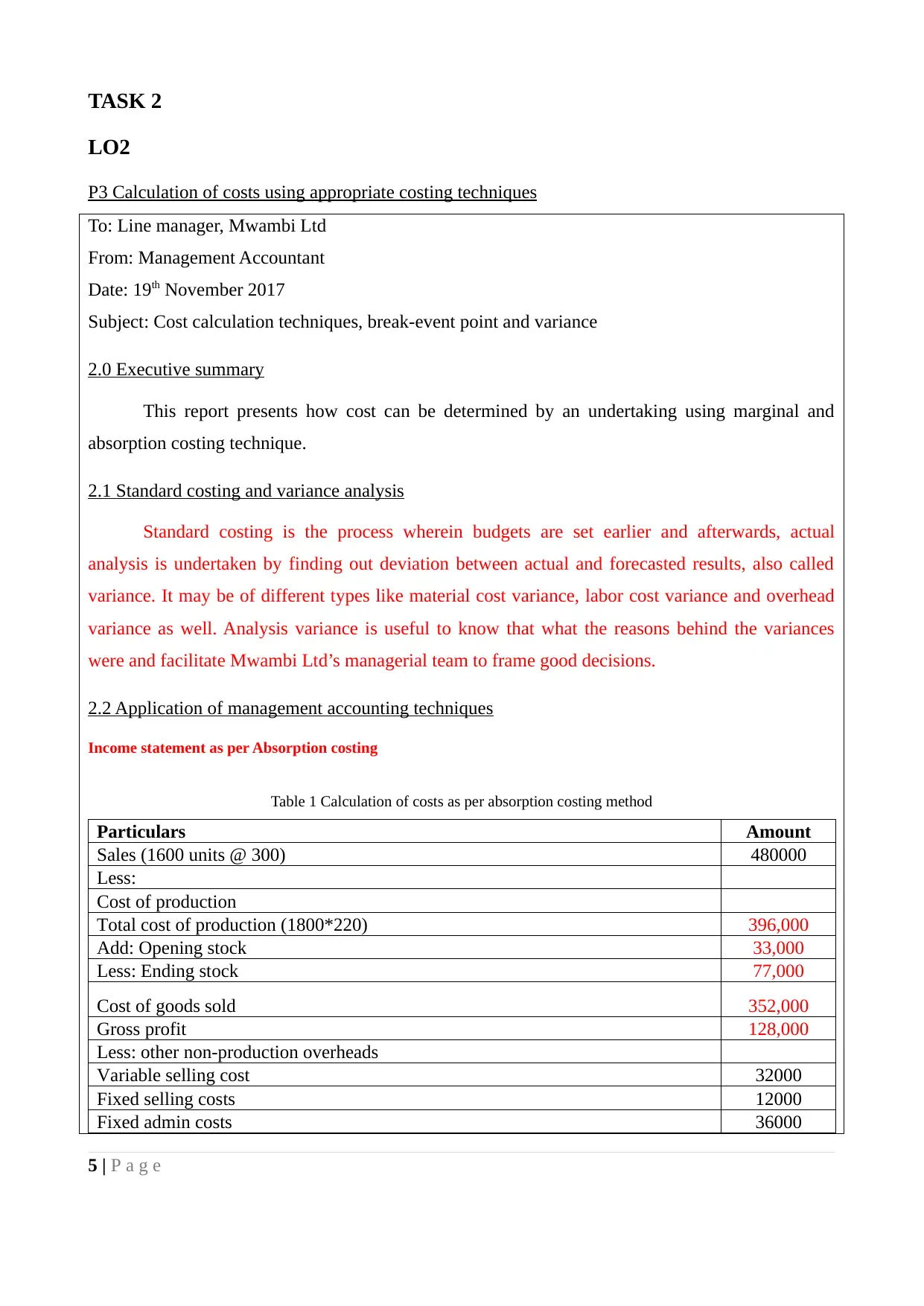
Income statement as per Absorption costing
Table 1 Calculation of costs as per absorption costing method
Particulars Amount
Sales (1600 units @ 300) 480000
Less:
Cost of production
Total cost of production (1800*220) 396,000
Add: Opening stock 33,000
Less: Ending stock 77,000
Cost of goods sold 352,000
Gross profit 128,000
Less: other non-production overheads
Variable selling cost 32000
Fixed selling costs 12000
Fixed admin costs 36000
5 | P a g e
LO2
P3 Calculation of costs using appropriate costing techniques
To: Line manager, Mwambi Ltd
From: Management Accountant
Date: 19th November 2017
Subject: Cost calculation techniques, break-event point and variance
2.0 Executive summary
This report presents how cost can be determined by an undertaking using marginal and
absorption costing technique.
2.1 Standard costing and variance analysis
Standard costing is the process wherein budgets are set earlier and afterwards, actual
analysis is undertaken by finding out deviation between actual and forecasted results, also called
variance. It may be of different types like material cost variance, labor cost variance and overhead
variance as well. Analysis variance is useful to know that what the reasons behind the variances
were and facilitate Mwambi Ltd’s managerial team to frame good decisions.
2.2 Application of management accounting techniques
Income statement as per Absorption costing
Table 1 Calculation of costs as per absorption costing method
Particulars Amount
Sales (1600 units @ 300) 480000
Less:
Cost of production
Total cost of production (1800*220) 396,000
Add: Opening stock 33,000
Less: Ending stock 77,000
Cost of goods sold 352,000
Gross profit 128,000
Less: other non-production overheads
Variable selling cost 32000
Fixed selling costs 12000
Fixed admin costs 36000
5 | P a g e
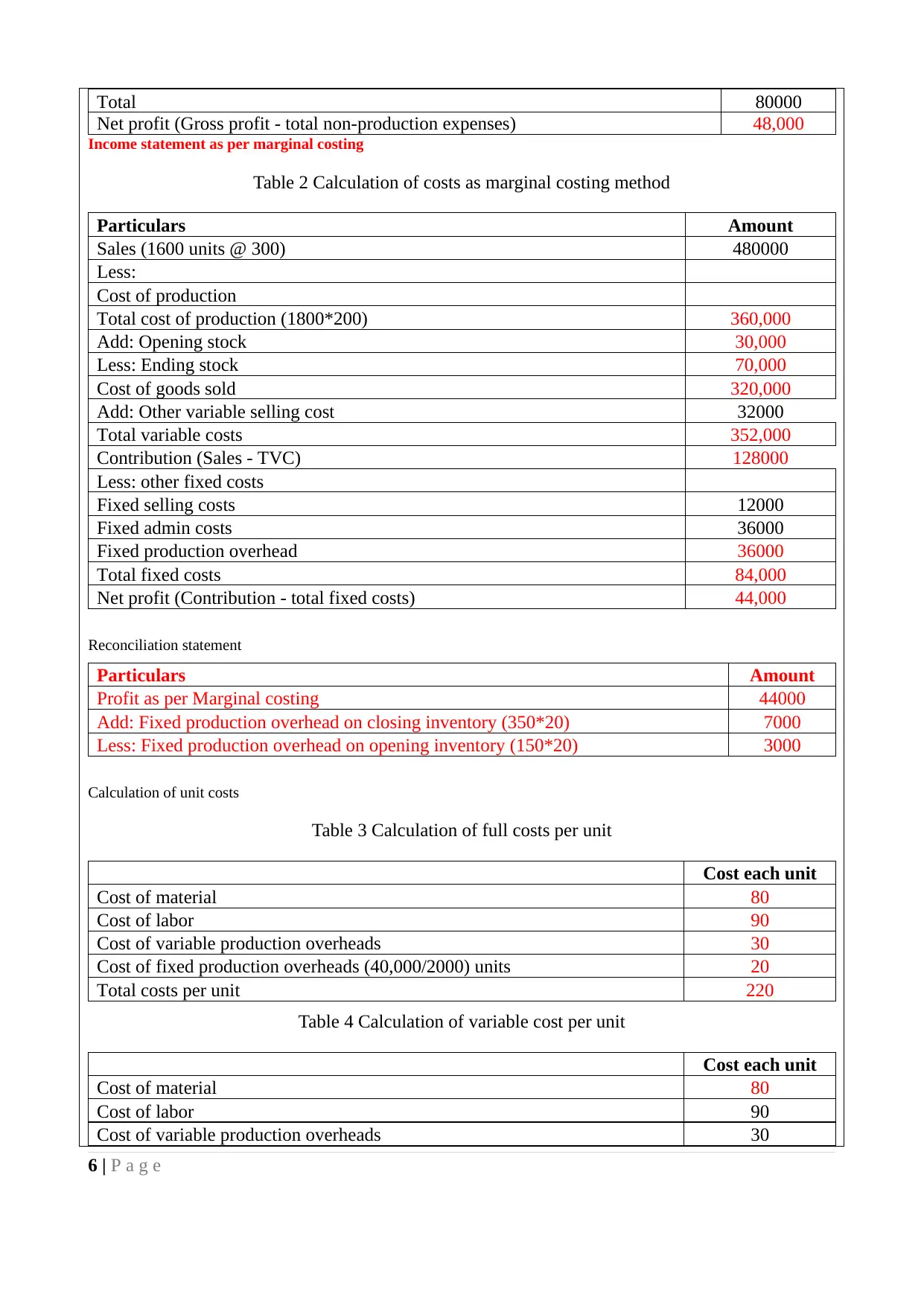
Total 80000
Net profit (Gross profit - total non-production expenses) 48,000
Income statement as per marginal costing
Table 2 Calculation of costs as marginal costing method
Particulars Amount
Sales (1600 units @ 300) 480000
Less:
Cost of production
Total cost of production (1800*200) 360,000
Add: Opening stock 30,000
Less: Ending stock 70,000
Cost of goods sold 320,000
Add: Other variable selling cost 32000
Total variable costs 352,000
Contribution (Sales - TVC) 128000
Less: other fixed costs
Fixed selling costs 12000
Fixed admin costs 36000
Fixed production overhead 36000
Total fixed costs 84,000
Net profit (Contribution - total fixed costs) 44,000
Reconciliation statement
Particulars Amount
Profit as per Marginal costing 44000
Add: Fixed production overhead on closing inventory (350*20) 7000
Less: Fixed production overhead on opening inventory (150*20) 3000
Calculation of unit costs
Table 3 Calculation of full costs per unit
Cost each unit
Cost of material 80
Cost of labor 90
Cost of variable production overheads 30
Cost of fixed production overheads (40,000/2000) units 20
Total costs per unit 220
Table 4 Calculation of variable cost per unit
Cost each unit
Cost of material 80
Cost of labor 90
Cost of variable production overheads 30
6 | P a g e
Net profit (Gross profit - total non-production expenses) 48,000
Income statement as per marginal costing
Table 2 Calculation of costs as marginal costing method
Particulars Amount
Sales (1600 units @ 300) 480000
Less:
Cost of production
Total cost of production (1800*200) 360,000
Add: Opening stock 30,000
Less: Ending stock 70,000
Cost of goods sold 320,000
Add: Other variable selling cost 32000
Total variable costs 352,000
Contribution (Sales - TVC) 128000
Less: other fixed costs
Fixed selling costs 12000
Fixed admin costs 36000
Fixed production overhead 36000
Total fixed costs 84,000
Net profit (Contribution - total fixed costs) 44,000
Reconciliation statement
Particulars Amount
Profit as per Marginal costing 44000
Add: Fixed production overhead on closing inventory (350*20) 7000
Less: Fixed production overhead on opening inventory (150*20) 3000
Calculation of unit costs
Table 3 Calculation of full costs per unit
Cost each unit
Cost of material 80
Cost of labor 90
Cost of variable production overheads 30
Cost of fixed production overheads (40,000/2000) units 20
Total costs per unit 220
Table 4 Calculation of variable cost per unit
Cost each unit
Cost of material 80
Cost of labor 90
Cost of variable production overheads 30
6 | P a g e
⊘ This is a preview!⊘
Do you want full access?
Subscribe today to unlock all pages.
Trusted by 1+ million students worldwide
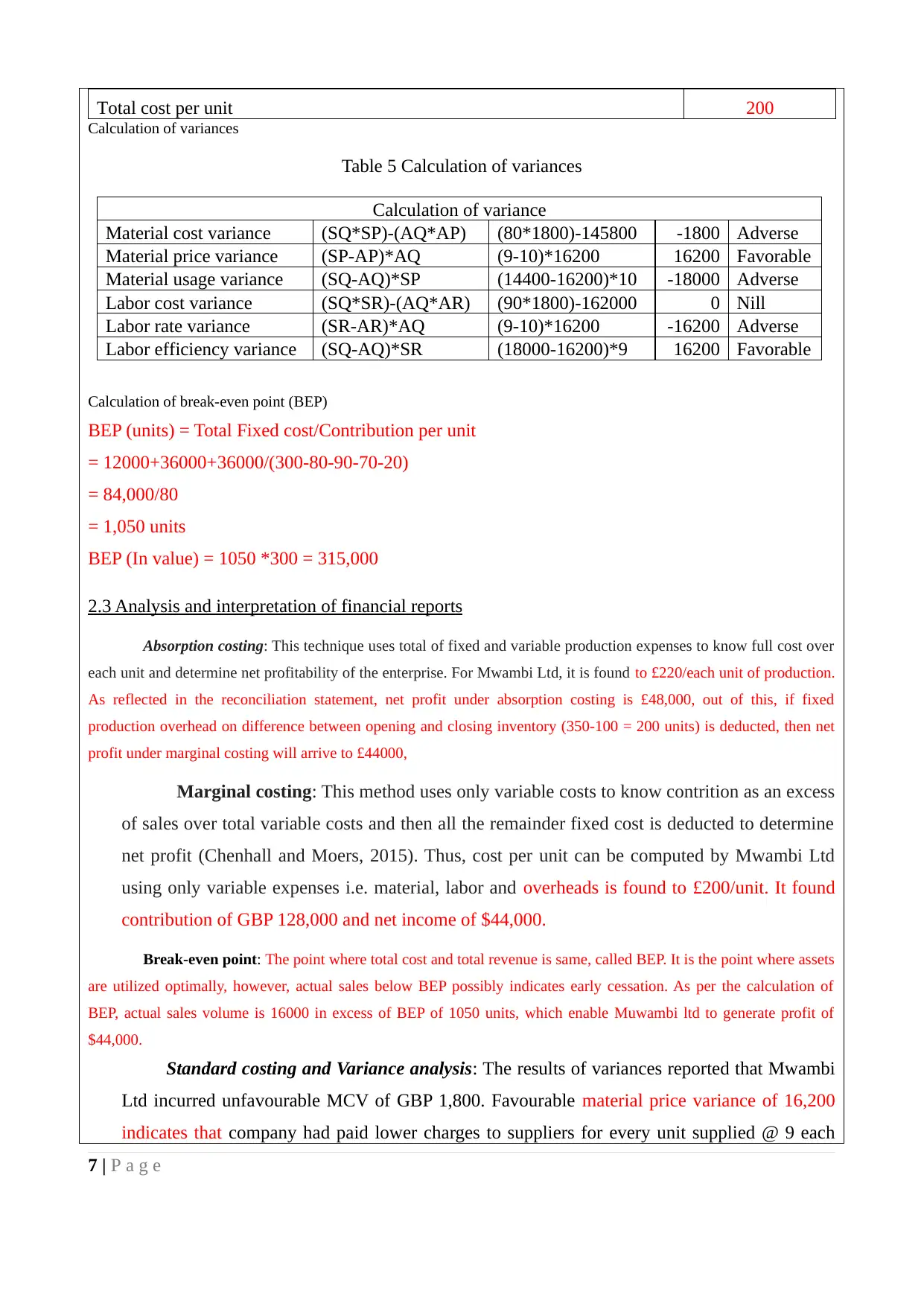
Total cost per unit 200
Calculation of variances
Table 5 Calculation of variances
Calculation of variance
Material cost variance (SQ*SP)-(AQ*AP) (80*1800)-145800 -1800 Adverse
Material price variance (SP-AP)*AQ (9-10)*16200 16200 Favorable
Material usage variance (SQ-AQ)*SP (14400-16200)*10 -18000 Adverse
Labor cost variance (SQ*SR)-(AQ*AR) (90*1800)-162000 0 Nill
Labor rate variance (SR-AR)*AQ (9-10)*16200 -16200 Adverse
Labor efficiency variance (SQ-AQ)*SR (18000-16200)*9 16200 Favorable
Calculation of break-even point (BEP)
BEP (units) = Total Fixed cost/Contribution per unit
= 12000+36000+36000/(300-80-90-70-20)
= 84,000/80
= 1,050 units
BEP (In value) = 1050 *300 = 315,000
2.3 Analysis and interpretation of financial reports
Absorption costing: This technique uses total of fixed and variable production expenses to know full cost over
each unit and determine net profitability of the enterprise. For Mwambi Ltd, it is found to £220/each unit of production.
As reflected in the reconciliation statement, net profit under absorption costing is £48,000, out of this, if fixed
production overhead on difference between opening and closing inventory (350-100 = 200 units) is deducted, then net
profit under marginal costing will arrive to £44000,
Marginal costing: This method uses only variable costs to know contrition as an excess
of sales over total variable costs and then all the remainder fixed cost is deducted to determine
net profit (Chenhall and Moers, 2015). Thus, cost per unit can be computed by Mwambi Ltd
using only variable expenses i.e. material, labor and overheads is found to £200/unit. It found
contribution of GBP 128,000 and net income of $44,000.
Break-even point: The point where total cost and total revenue is same, called BEP. It is the point where assets
are utilized optimally, however, actual sales below BEP possibly indicates early cessation. As per the calculation of
BEP, actual sales volume is 16000 in excess of BEP of 1050 units, which enable Muwambi ltd to generate profit of
$44,000.
Standard costing and Variance analysis: The results of variances reported that Mwambi
Ltd incurred unfavourable MCV of GBP 1,800. Favourable material price variance of 16,200
indicates that company had paid lower charges to suppliers for every unit supplied @ 9 each
7 | P a g e
Calculation of variances
Table 5 Calculation of variances
Calculation of variance
Material cost variance (SQ*SP)-(AQ*AP) (80*1800)-145800 -1800 Adverse
Material price variance (SP-AP)*AQ (9-10)*16200 16200 Favorable
Material usage variance (SQ-AQ)*SP (14400-16200)*10 -18000 Adverse
Labor cost variance (SQ*SR)-(AQ*AR) (90*1800)-162000 0 Nill
Labor rate variance (SR-AR)*AQ (9-10)*16200 -16200 Adverse
Labor efficiency variance (SQ-AQ)*SR (18000-16200)*9 16200 Favorable
Calculation of break-even point (BEP)
BEP (units) = Total Fixed cost/Contribution per unit
= 12000+36000+36000/(300-80-90-70-20)
= 84,000/80
= 1,050 units
BEP (In value) = 1050 *300 = 315,000
2.3 Analysis and interpretation of financial reports
Absorption costing: This technique uses total of fixed and variable production expenses to know full cost over
each unit and determine net profitability of the enterprise. For Mwambi Ltd, it is found to £220/each unit of production.
As reflected in the reconciliation statement, net profit under absorption costing is £48,000, out of this, if fixed
production overhead on difference between opening and closing inventory (350-100 = 200 units) is deducted, then net
profit under marginal costing will arrive to £44000,
Marginal costing: This method uses only variable costs to know contrition as an excess
of sales over total variable costs and then all the remainder fixed cost is deducted to determine
net profit (Chenhall and Moers, 2015). Thus, cost per unit can be computed by Mwambi Ltd
using only variable expenses i.e. material, labor and overheads is found to £200/unit. It found
contribution of GBP 128,000 and net income of $44,000.
Break-even point: The point where total cost and total revenue is same, called BEP. It is the point where assets
are utilized optimally, however, actual sales below BEP possibly indicates early cessation. As per the calculation of
BEP, actual sales volume is 16000 in excess of BEP of 1050 units, which enable Muwambi ltd to generate profit of
$44,000.
Standard costing and Variance analysis: The results of variances reported that Mwambi
Ltd incurred unfavourable MCV of GBP 1,800. Favourable material price variance of 16,200
indicates that company had paid lower charges to suppliers for every unit supplied @ 9 each
7 | P a g e
Paraphrase This Document
Need a fresh take? Get an instant paraphrase of this document with our AI Paraphraser
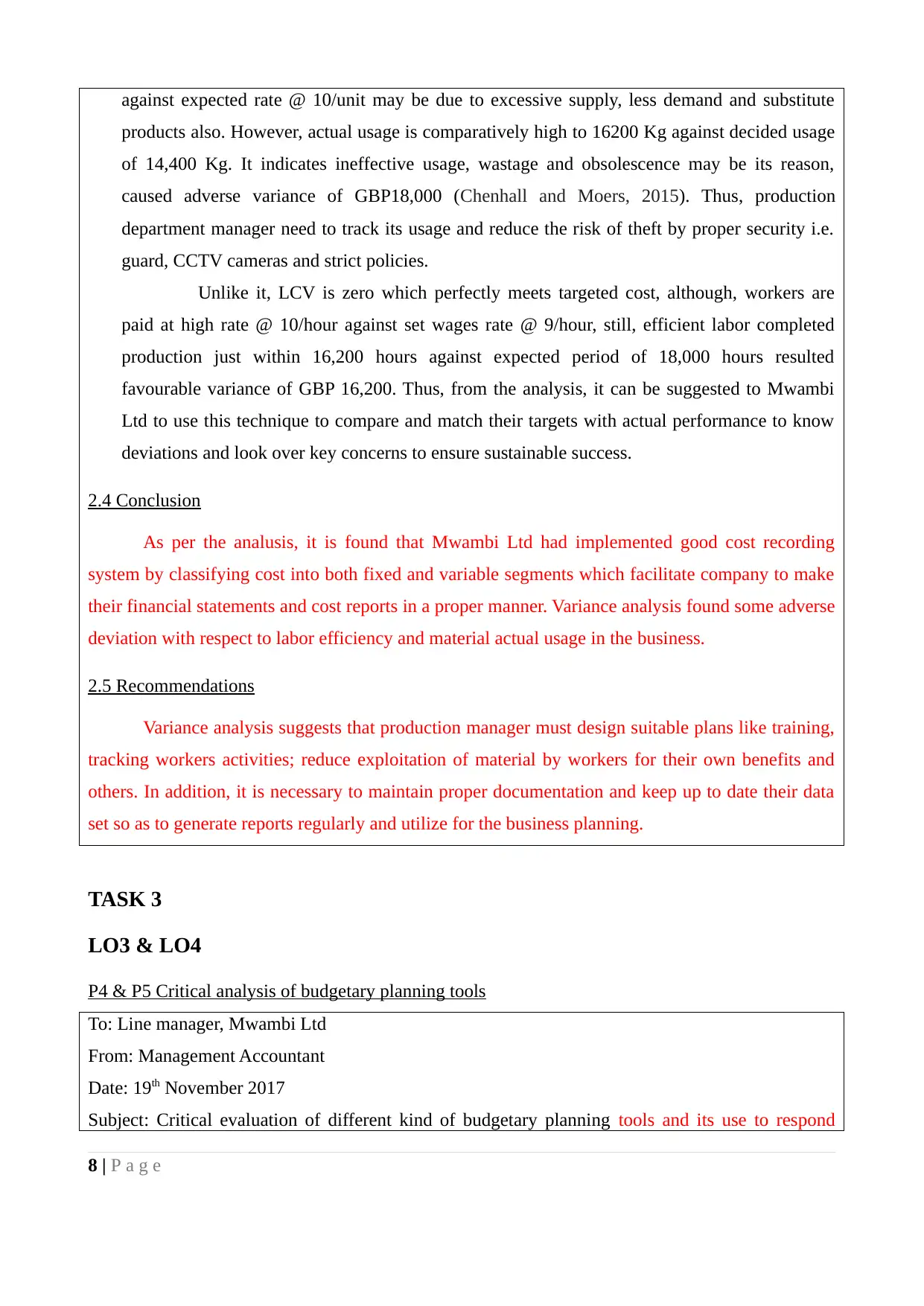
against expected rate @ 10/unit may be due to excessive supply, less demand and substitute
products also. However, actual usage is comparatively high to 16200 Kg against decided usage
of 14,400 Kg. It indicates ineffective usage, wastage and obsolescence may be its reason,
caused adverse variance of GBP18,000 (Chenhall and Moers, 2015). Thus, production
department manager need to track its usage and reduce the risk of theft by proper security i.e.
guard, CCTV cameras and strict policies.
Unlike it, LCV is zero which perfectly meets targeted cost, although, workers are
paid at high rate @ 10/hour against set wages rate @ 9/hour, still, efficient labor completed
production just within 16,200 hours against expected period of 18,000 hours resulted
favourable variance of GBP 16,200. Thus, from the analysis, it can be suggested to Mwambi
Ltd to use this technique to compare and match their targets with actual performance to know
deviations and look over key concerns to ensure sustainable success.
2.4 Conclusion
As per the analusis, it is found that Mwambi Ltd had implemented good cost recording
system by classifying cost into both fixed and variable segments which facilitate company to make
their financial statements and cost reports in a proper manner. Variance analysis found some adverse
deviation with respect to labor efficiency and material actual usage in the business.
2.5 Recommendations
Variance analysis suggests that production manager must design suitable plans like training,
tracking workers activities; reduce exploitation of material by workers for their own benefits and
others. In addition, it is necessary to maintain proper documentation and keep up to date their data
set so as to generate reports regularly and utilize for the business planning.
TASK 3
LO3 & LO4
P4 & P5 Critical analysis of budgetary planning tools
To: Line manager, Mwambi Ltd
From: Management Accountant
Date: 19th November 2017
Subject: Critical evaluation of different kind of budgetary planning tools and its use to respond
8 | P a g e
products also. However, actual usage is comparatively high to 16200 Kg against decided usage
of 14,400 Kg. It indicates ineffective usage, wastage and obsolescence may be its reason,
caused adverse variance of GBP18,000 (Chenhall and Moers, 2015). Thus, production
department manager need to track its usage and reduce the risk of theft by proper security i.e.
guard, CCTV cameras and strict policies.
Unlike it, LCV is zero which perfectly meets targeted cost, although, workers are
paid at high rate @ 10/hour against set wages rate @ 9/hour, still, efficient labor completed
production just within 16,200 hours against expected period of 18,000 hours resulted
favourable variance of GBP 16,200. Thus, from the analysis, it can be suggested to Mwambi
Ltd to use this technique to compare and match their targets with actual performance to know
deviations and look over key concerns to ensure sustainable success.
2.4 Conclusion
As per the analusis, it is found that Mwambi Ltd had implemented good cost recording
system by classifying cost into both fixed and variable segments which facilitate company to make
their financial statements and cost reports in a proper manner. Variance analysis found some adverse
deviation with respect to labor efficiency and material actual usage in the business.
2.5 Recommendations
Variance analysis suggests that production manager must design suitable plans like training,
tracking workers activities; reduce exploitation of material by workers for their own benefits and
others. In addition, it is necessary to maintain proper documentation and keep up to date their data
set so as to generate reports regularly and utilize for the business planning.
TASK 3
LO3 & LO4
P4 & P5 Critical analysis of budgetary planning tools
To: Line manager, Mwambi Ltd
From: Management Accountant
Date: 19th November 2017
Subject: Critical evaluation of different kind of budgetary planning tools and its use to respond
8 | P a g e
financial problems
Executive summary
This report discusses details about importance of budgetary planning as a tool of decisions
making for Mwambi Ltd. Along with this, different kind of budgets will be examined critically with
their strength and benefits associated. Moreover, various tools that business can use to take
decisions and overcome financial problems will be highlighted and studied thoroughly.
3.0 Planning tools: Budgetary control
Budgeting is a fundamental tool that every company makes regardless their sizes. It is used
as an integral tool to forecast financial plan for a specified time, includes sales projection, resource
requirement, cost, cash flows and others (Macintosh and Quattrone, 2010). It is used to express
strategic plan in measurable or quantifiable terms.
3.1 Purpose of budgeting
To determine expenditures and income for a specified period of time
To know net availability of cash in the business enterprise
To monitor performance of an undertakings by matching actual financial outcome against
the set targets
3.2 Budgeting process
1. Setting business plans and goals
2. Projecting future revenues
3. Projection of fixed and variable cost
4. Presenting budget to the board for approval
5. Budget review
6. Finding out variances between actual and budgeted figures
7. Reporting to the boards
8. Corrective actions and its implementation
3.3 Different types of budget
Fixed budgets: As its name, budget prepared following this method can’t be flexed or
adjusted in line with the actual production level.
Benefits
9 | P a g e
Executive summary
This report discusses details about importance of budgetary planning as a tool of decisions
making for Mwambi Ltd. Along with this, different kind of budgets will be examined critically with
their strength and benefits associated. Moreover, various tools that business can use to take
decisions and overcome financial problems will be highlighted and studied thoroughly.
3.0 Planning tools: Budgetary control
Budgeting is a fundamental tool that every company makes regardless their sizes. It is used
as an integral tool to forecast financial plan for a specified time, includes sales projection, resource
requirement, cost, cash flows and others (Macintosh and Quattrone, 2010). It is used to express
strategic plan in measurable or quantifiable terms.
3.1 Purpose of budgeting
To determine expenditures and income for a specified period of time
To know net availability of cash in the business enterprise
To monitor performance of an undertakings by matching actual financial outcome against
the set targets
3.2 Budgeting process
1. Setting business plans and goals
2. Projecting future revenues
3. Projection of fixed and variable cost
4. Presenting budget to the board for approval
5. Budget review
6. Finding out variances between actual and budgeted figures
7. Reporting to the boards
8. Corrective actions and its implementation
3.3 Different types of budget
Fixed budgets: As its name, budget prepared following this method can’t be flexed or
adjusted in line with the actual production level.
Benefits
9 | P a g e
⊘ This is a preview!⊘
Do you want full access?
Subscribe today to unlock all pages.
Trusted by 1+ million students worldwide

1 out of 19


Related Documents


Your All-in-One AI-Powered Toolkit for Academic Success.
+13062052269
info@desklib.com
Available 24*7 on WhatsApp / Email
![[object Object]](/_next/static/media/star-bottom.7253800d.svg)
Unlock your academic potential
Copyright © 2020–2026 A2Z Services. All Rights Reserved. Developed and managed by ZUCOL.