Management Accounting Report: Cost Analysis and Tools
VerifiedAdded on 2023/01/06
|12
|3256
|36
Report
AI Summary
This report, prepared for Prime Furniture, a developing furniture company, delves into management accounting principles. It begins with an introduction to management accounting and its role in strategic planning and financial control. The main body of the report includes detailed cost analysis, differentiating between direct and indirect costs, and fixed and variable costs, with a focus on inventory costs. It examines marginal and absorption costing methods, providing income statements and a reconciliation statement to illustrate their differences. The report further explores various management accounting tools, such as cash budgets, sales budgets, and capital budgeting, highlighting their advantages and disadvantages. Finally, it addresses financial problems like sales decline and rising raw material costs, suggesting solutions through financial governance, benchmarking, key performance indicators, and budgetary targets. The report emphasizes the importance of management accounting in making informed decisions and formulating effective strategies for business growth and financial stability.
Management Accounting
1
1

Paraphrase This Document
Need a fresh take? Get an instant paraphrase of this document with our AI Paraphraser
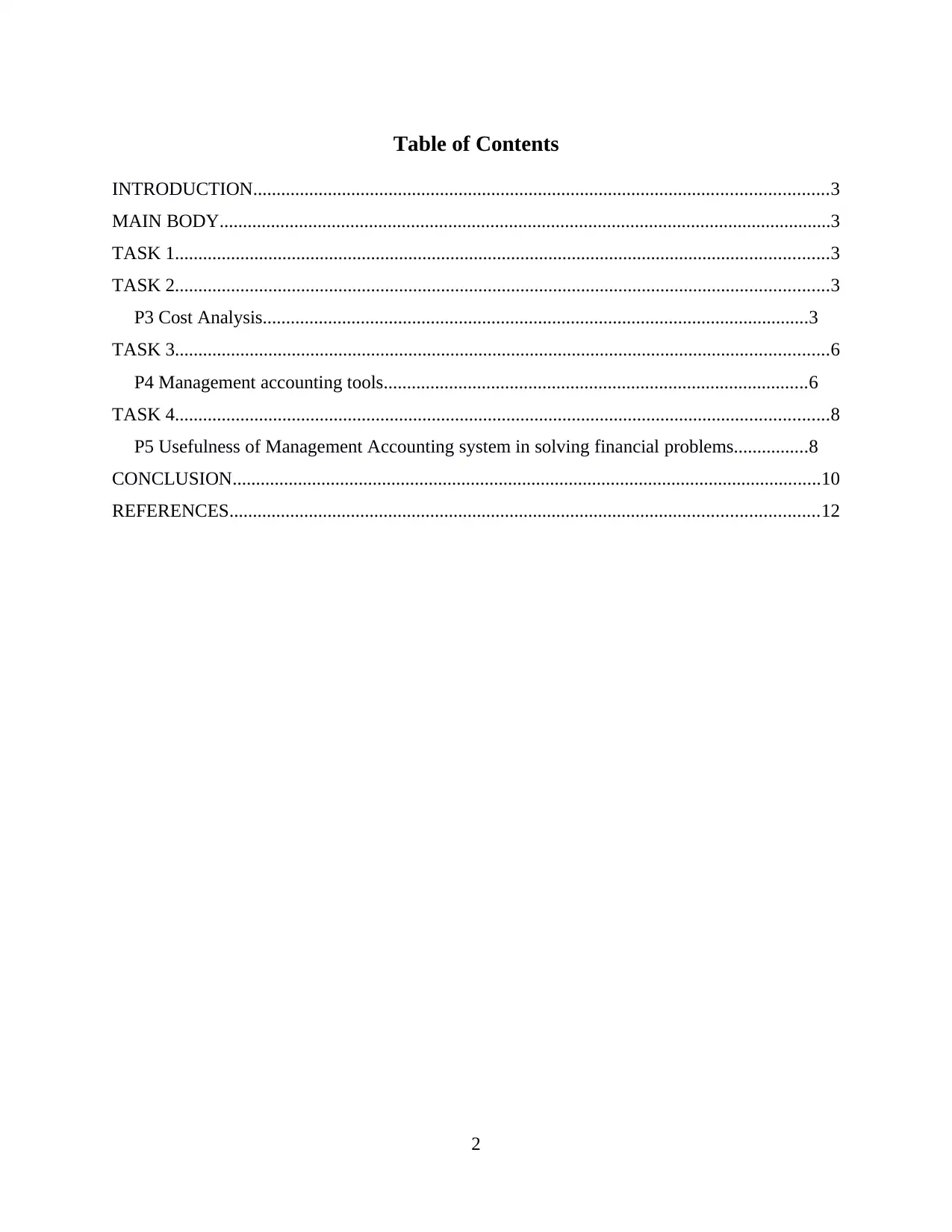
Table of Contents
INTRODUCTION...........................................................................................................................3
MAIN BODY...................................................................................................................................3
TASK 1............................................................................................................................................3
TASK 2............................................................................................................................................3
P3 Cost Analysis.....................................................................................................................3
TASK 3............................................................................................................................................6
P4 Management accounting tools...........................................................................................6
TASK 4............................................................................................................................................8
P5 Usefulness of Management Accounting system in solving financial problems................8
CONCLUSION..............................................................................................................................10
REFERENCES..............................................................................................................................12
2
INTRODUCTION...........................................................................................................................3
MAIN BODY...................................................................................................................................3
TASK 1............................................................................................................................................3
TASK 2............................................................................................................................................3
P3 Cost Analysis.....................................................................................................................3
TASK 3............................................................................................................................................6
P4 Management accounting tools...........................................................................................6
TASK 4............................................................................................................................................8
P5 Usefulness of Management Accounting system in solving financial problems................8
CONCLUSION..............................................................................................................................10
REFERENCES..............................................................................................................................12
2
INTRODUCTION
Management accounting is a branch of knowledge of Accounting. This consists of
various inspection tools and techniques that help in assisting management to plan for future
course of actions (Biddle, Ma and Song, 2020). This branch of accounting helps in monitoring
and control of finance within organization. Management accounting helps in analysing results of
financial accounting so that a detailed statement which consists useful information can be
prepared so that management of organization can take suitable decisions. In this report, main
focus is on operations of prime furniture, which is dealing in all types of furniture for homes and
offices. It is a developing East London based company. Therefore, in its development phase, it is
important that it formulate effective strategies, so that they can succeed in future. This report is
prepared by the junior management accountant of company keeping focus on topics like
management accounting systems, management accounting reporting methods, link between
MAS and organizational operations.
MAIN BODY
TASK 1
(covered in PPT)
TASK 2
P3 Cost Analysis
Cost is the value incurred to the company in order to produce its products and services.
Cost is the value without mark up. Accounting with the purpose of ascertaining cost and its
relationship with profit is called cost-accounting (Bobryshev and et.al., 2015). In cost-
accounting, cost is classified into various types such as direct and indirect cost, fixed and
variable cost, operating and opportunity cost, controllable and uncontrollable cost, sunk cost, etc.
Most important classifications are direct and indirect cost and fixed and variable cost.
Inventory Cost
Inventory cost is the cost that is incurred to a company for managing its inventory. It can be
broken down to three categories:
3
Management accounting is a branch of knowledge of Accounting. This consists of
various inspection tools and techniques that help in assisting management to plan for future
course of actions (Biddle, Ma and Song, 2020). This branch of accounting helps in monitoring
and control of finance within organization. Management accounting helps in analysing results of
financial accounting so that a detailed statement which consists useful information can be
prepared so that management of organization can take suitable decisions. In this report, main
focus is on operations of prime furniture, which is dealing in all types of furniture for homes and
offices. It is a developing East London based company. Therefore, in its development phase, it is
important that it formulate effective strategies, so that they can succeed in future. This report is
prepared by the junior management accountant of company keeping focus on topics like
management accounting systems, management accounting reporting methods, link between
MAS and organizational operations.
MAIN BODY
TASK 1
(covered in PPT)
TASK 2
P3 Cost Analysis
Cost is the value incurred to the company in order to produce its products and services.
Cost is the value without mark up. Accounting with the purpose of ascertaining cost and its
relationship with profit is called cost-accounting (Bobryshev and et.al., 2015). In cost-
accounting, cost is classified into various types such as direct and indirect cost, fixed and
variable cost, operating and opportunity cost, controllable and uncontrollable cost, sunk cost, etc.
Most important classifications are direct and indirect cost and fixed and variable cost.
Inventory Cost
Inventory cost is the cost that is incurred to a company for managing its inventory. It can be
broken down to three categories:
3
⊘ This is a preview!⊘
Do you want full access?
Subscribe today to unlock all pages.

Trusted by 1+ million students worldwide
Ordering cost – It is the cost that is incurred to business for preparing and purchasing
inventory orders. Also, the cost incurred in receiving and inspecting the arrived materials
is also included in it.
Carrying cost – These are the costs that are incurred to a business for keeping inventory
in stock. It includes factors such as rent cost, power cost, storage cost, etc. forms part of
carrying cost. Interest fees paid for financing the inventory is also included in it.
Shortage cost – This is the cost incurred by the business if it sees over and under stocking
of inventory. For example, if raw material is in shortage, production will be halted which
will result in opportunity cost and other losses in the business.
Cost Analysis
Cost analysis determines the relation of cost and output. It is taking the value of input
factors such as labour, material, etc. and quantifying it in monetary terms for the decided level of
production. At different level of operations, businesses have different volume of production and
varied levels of costs. Determining the relation between costs level and volume with operational
profit of company is called cost-volume-profit analysis. Companies use different types of method
to check on the cost-volume-profit analysis such as budgetary method, marginal costing method,
absorption costing method, etc. (Shapiro and Hanouna, 2019)
Marginal Costing – It is a costing technique wherein only marginal cost is considered
while calculating profit/loss. Marginal cost is the cost of producing one extra unit of the product.
In this process, variable cost is taken as charge of units of products and fixed cost is considered
as the cost of the whole period taken. That's why only variable cost is considered while taking
marginal cost.
Absorption Costing – It is a type of costing technique which undertakes all types of
costs - both fixed and variable attributable to particular product while calculating profit/loss. It is
generally used for managerial accounting purposes.
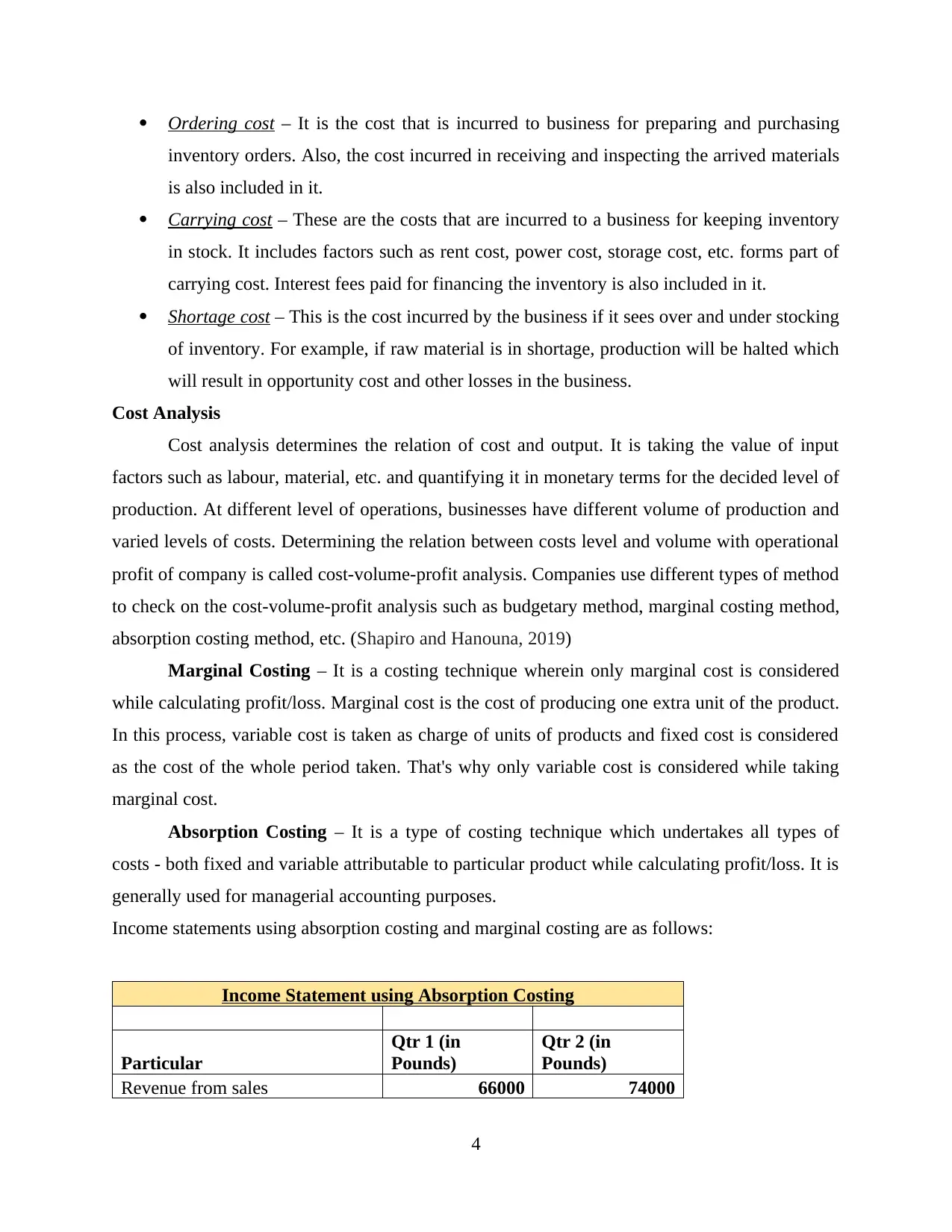
Income statements using absorption costing and marginal costing are as follows:
Income Statement using Absorption Costing
Particular
Qtr 1 (in
Pounds)
Qtr 2 (in
Pounds)
Revenue from sales 66000 74000
4
inventory orders. Also, the cost incurred in receiving and inspecting the arrived materials
is also included in it.
Carrying cost – These are the costs that are incurred to a business for keeping inventory
in stock. It includes factors such as rent cost, power cost, storage cost, etc. forms part of
carrying cost. Interest fees paid for financing the inventory is also included in it.
Shortage cost – This is the cost incurred by the business if it sees over and under stocking
of inventory. For example, if raw material is in shortage, production will be halted which
will result in opportunity cost and other losses in the business.
Cost Analysis
Cost analysis determines the relation of cost and output. It is taking the value of input
factors such as labour, material, etc. and quantifying it in monetary terms for the decided level of
production. At different level of operations, businesses have different volume of production and
varied levels of costs. Determining the relation between costs level and volume with operational
profit of company is called cost-volume-profit analysis. Companies use different types of method
to check on the cost-volume-profit analysis such as budgetary method, marginal costing method,
absorption costing method, etc. (Shapiro and Hanouna, 2019)
Marginal Costing – It is a costing technique wherein only marginal cost is considered
while calculating profit/loss. Marginal cost is the cost of producing one extra unit of the product.
In this process, variable cost is taken as charge of units of products and fixed cost is considered
as the cost of the whole period taken. That's why only variable cost is considered while taking
marginal cost.
Absorption Costing – It is a type of costing technique which undertakes all types of
costs - both fixed and variable attributable to particular product while calculating profit/loss. It is
generally used for managerial accounting purposes.
Income statements using absorption costing and marginal costing are as follows:
Income Statement using Absorption Costing
Particular
Qtr 1 (in
Pounds)
Qtr 2 (in
Pounds)
Revenue from sales 66000 74000
4
Paraphrase This Document
Need a fresh take? Get an instant paraphrase of this document with our AI Paraphraser
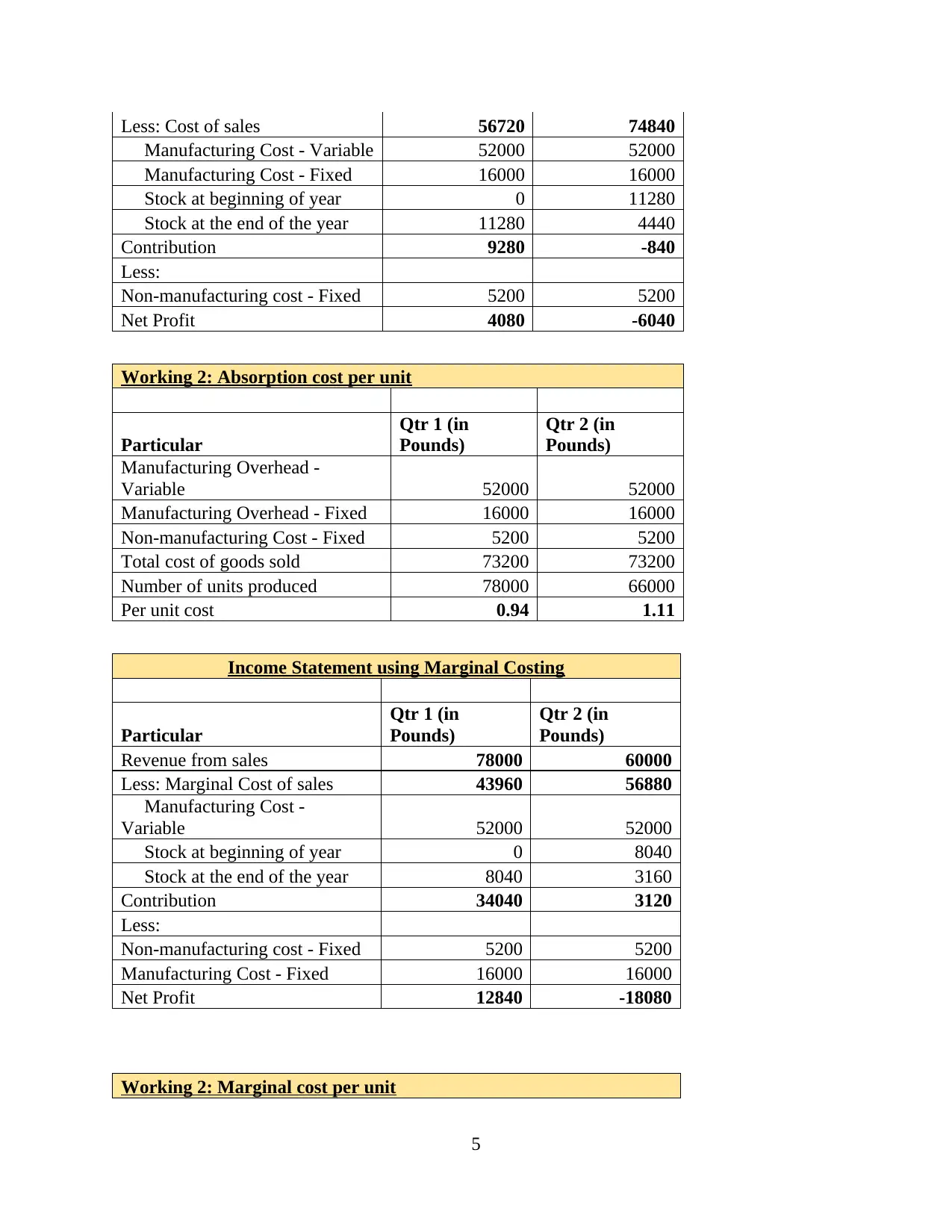
Less: Cost of sales 56720 74840
Manufacturing Cost - Variable 52000 52000
Manufacturing Cost - Fixed 16000 16000
Stock at beginning of year 0 11280
Stock at the end of the year 11280 4440
Contribution 9280 -840
Less:
Non-manufacturing cost - Fixed 5200 5200
Net Profit 4080 -6040
Working 2: Absorption cost per unit
Particular
Qtr 1 (in
Pounds)
Qtr 2 (in
Pounds)
Manufacturing Overhead -
Variable 52000 52000
Manufacturing Overhead - Fixed 16000 16000
Non-manufacturing Cost - Fixed 5200 5200
Total cost of goods sold 73200 73200
Number of units produced 78000 66000
Per unit cost 0.94 1.11
Income Statement using Marginal Costing
Particular
Qtr 1 (in
Pounds)
Qtr 2 (in
Pounds)
Revenue from sales 78000 60000
Less: Marginal Cost of sales 43960 56880
Manufacturing Cost -
Variable 52000 52000
Stock at beginning of year 0 8040
Stock at the end of the year 8040 3160
Contribution 34040 3120
Less:
Non-manufacturing cost - Fixed 5200 5200
Manufacturing Cost - Fixed 16000 16000
Net Profit 12840 -18080
Working 2: Marginal cost per unit
5
Manufacturing Cost - Variable 52000 52000
Manufacturing Cost - Fixed 16000 16000
Stock at beginning of year 0 11280
Stock at the end of the year 11280 4440
Contribution 9280 -840
Less:
Non-manufacturing cost - Fixed 5200 5200
Net Profit 4080 -6040
Working 2: Absorption cost per unit
Particular
Qtr 1 (in
Pounds)
Qtr 2 (in
Pounds)
Manufacturing Overhead -
Variable 52000 52000
Manufacturing Overhead - Fixed 16000 16000
Non-manufacturing Cost - Fixed 5200 5200
Total cost of goods sold 73200 73200
Number of units produced 78000 66000
Per unit cost 0.94 1.11
Income Statement using Marginal Costing
Particular
Qtr 1 (in
Pounds)
Qtr 2 (in
Pounds)
Revenue from sales 78000 60000
Less: Marginal Cost of sales 43960 56880
Manufacturing Cost -
Variable 52000 52000
Stock at beginning of year 0 8040
Stock at the end of the year 8040 3160
Contribution 34040 3120
Less:
Non-manufacturing cost - Fixed 5200 5200
Manufacturing Cost - Fixed 16000 16000
Net Profit 12840 -18080
Working 2: Marginal cost per unit
5
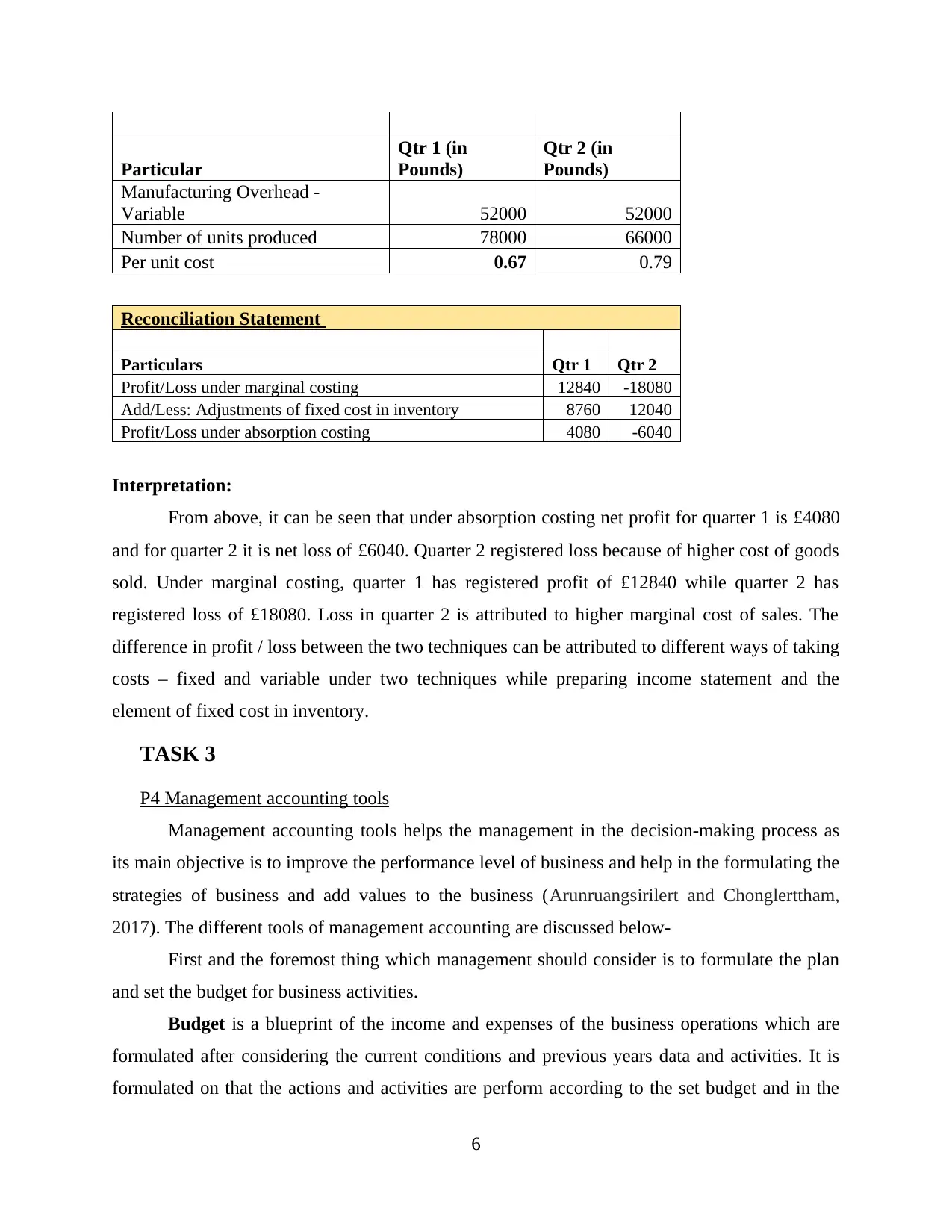
Particular
Qtr 1 (in
Pounds)
Qtr 2 (in
Pounds)
Manufacturing Overhead -
Variable 52000 52000
Number of units produced 78000 66000
Per unit cost 0.67 0.79
Reconciliation Statement
Particulars Qtr 1 Qtr 2
Profit/Loss under marginal costing 12840 -18080
Add/Less: Adjustments of fixed cost in inventory 8760 12040
Profit/Loss under absorption costing 4080 -6040
Interpretation:
From above, it can be seen that under absorption costing net profit for quarter 1 is £4080
and for quarter 2 it is net loss of £6040. Quarter 2 registered loss because of higher cost of goods
sold. Under marginal costing, quarter 1 has registered profit of £12840 while quarter 2 has
registered loss of £18080. Loss in quarter 2 is attributed to higher marginal cost of sales. The
difference in profit / loss between the two techniques can be attributed to different ways of taking
costs – fixed and variable under two techniques while preparing income statement and the
element of fixed cost in inventory.
TASK 3
P4 Management accounting tools
Management accounting tools helps the management in the decision-making process as
its main objective is to improve the performance level of business and help in the formulating the
strategies of business and add values to the business (Arunruangsirilert and Chonglerttham,
2017). The different tools of management accounting are discussed below-
First and the foremost thing which management should consider is to formulate the plan
and set the budget for business activities.
Budget is a blueprint of the income and expenses of the business operations which are
formulated after considering the current conditions and previous years data and activities. It is
formulated on that the actions and activities are perform according to the set budget and in the
6
Qtr 1 (in
Pounds)
Qtr 2 (in
Pounds)
Manufacturing Overhead -
Variable 52000 52000
Number of units produced 78000 66000
Per unit cost 0.67 0.79
Reconciliation Statement
Particulars Qtr 1 Qtr 2
Profit/Loss under marginal costing 12840 -18080
Add/Less: Adjustments of fixed cost in inventory 8760 12040
Profit/Loss under absorption costing 4080 -6040
Interpretation:
From above, it can be seen that under absorption costing net profit for quarter 1 is £4080
and for quarter 2 it is net loss of £6040. Quarter 2 registered loss because of higher cost of goods
sold. Under marginal costing, quarter 1 has registered profit of £12840 while quarter 2 has
registered loss of £18080. Loss in quarter 2 is attributed to higher marginal cost of sales. The
difference in profit / loss between the two techniques can be attributed to different ways of taking
costs – fixed and variable under two techniques while preparing income statement and the
element of fixed cost in inventory.
TASK 3
P4 Management accounting tools
Management accounting tools helps the management in the decision-making process as
its main objective is to improve the performance level of business and help in the formulating the
strategies of business and add values to the business (Arunruangsirilert and Chonglerttham,
2017). The different tools of management accounting are discussed below-
First and the foremost thing which management should consider is to formulate the plan
and set the budget for business activities.
Budget is a blueprint of the income and expenses of the business operations which are
formulated after considering the current conditions and previous years data and activities. It is
formulated on that the actions and activities are perform according to the set budget and in the
6
⊘ This is a preview!⊘
Do you want full access?
Subscribe today to unlock all pages.
Trusted by 1+ million students worldwide
last the obtain results are measured with the desired results. Here is different type of budgets
which the management of Prime Furniture can use in its operational activities.
Cash Budget
Cash budget is the blueprint of all the cash related activities that is it contains the inflow
and outflow of cash and cash equivalents. In context of Prime Furniture, the managers with the
use of cash budget identifies the cash availability and allocation of cash in the business activities.
Advantages- It provide support to the company in handling the situations of liquidations
that is under or over liquidation problems.
Disadvantages- Cash budgets are the estimations that is don't outline the exact budget
that is ups and downs can take place according to environment and lead to rigidity.
Sales Budgets
The tool is used in determining and forecasting the sales activities of the particular year.
In context of Prime Furniture, the management use this method in organizing and scheduling its
production activities (Carlsson-Wall, Kraus and Lind, 2015).
Advantages- It helps in the formulation of master budget as sales budget is one of the
important aspects which determines the overall profitability of business for that
particular year.
Disadvantages- One of the major disadvantages is that market is uncertain that is
changes in the market trends are frequent so there are chances of formulation of
inaccurate sales forecasts.
Capital Budgeting
It is the process with the help of which company identifies and analysis the various
options that are available for financing the new investment and business expansion projects. In
context of Prime Furniture, the management use this option to analyse the various available
options and select the most desirable and beneficial option (Chenhall and Moers, 2015). When a
firm is presented with a capital budgeting decision, one of its first tasks is to determine whether
or not the project will prove to be profitable. The payback period (PB), internal rate of return
(IRR) and net present value (NPV) methods are the most common approaches to project
selection.
Although an ideal capital budgeting solution is such that all three metrics will indicate the
same decision, these approaches will often produce contradictory results. Depending on
7
which the management of Prime Furniture can use in its operational activities.
Cash Budget
Cash budget is the blueprint of all the cash related activities that is it contains the inflow
and outflow of cash and cash equivalents. In context of Prime Furniture, the managers with the
use of cash budget identifies the cash availability and allocation of cash in the business activities.
Advantages- It provide support to the company in handling the situations of liquidations
that is under or over liquidation problems.
Disadvantages- Cash budgets are the estimations that is don't outline the exact budget
that is ups and downs can take place according to environment and lead to rigidity.
Sales Budgets
The tool is used in determining and forecasting the sales activities of the particular year.
In context of Prime Furniture, the management use this method in organizing and scheduling its
production activities (Carlsson-Wall, Kraus and Lind, 2015).
Advantages- It helps in the formulation of master budget as sales budget is one of the
important aspects which determines the overall profitability of business for that
particular year.
Disadvantages- One of the major disadvantages is that market is uncertain that is
changes in the market trends are frequent so there are chances of formulation of
inaccurate sales forecasts.
Capital Budgeting
It is the process with the help of which company identifies and analysis the various
options that are available for financing the new investment and business expansion projects. In
context of Prime Furniture, the management use this option to analyse the various available
options and select the most desirable and beneficial option (Chenhall and Moers, 2015). When a
firm is presented with a capital budgeting decision, one of its first tasks is to determine whether
or not the project will prove to be profitable. The payback period (PB), internal rate of return
(IRR) and net present value (NPV) methods are the most common approaches to project
selection.
Although an ideal capital budgeting solution is such that all three metrics will indicate the
same decision, these approaches will often produce contradictory results. Depending on
7
Paraphrase This Document
Need a fresh take? Get an instant paraphrase of this document with our AI Paraphraser
management's preferences and selection criteria, more emphasis will be put on one approach
over another. Nonetheless, there are common advantages and disadvantages associated with
these widely used valuation methods.
Advantages- The capital budgeting tools helps in choosing the right direction and helps
in minimising the risk of wrong investment.
Disadvantages- It is based on the predictions so any wrong prediction can lead to
problems and business need to suffer due to wrong decisions.
TASK 4
P5 Usefulness of Management Accounting system in solving financial problems
Financial problems: Every business is facing various problems and risks while working
in a business environment. In case when management fails to foresee problems and predicting
possible solutions to these issues, company is confronted by several problems like reduction in
sales, increased expenses, downfall in growth opportunities, etc. Two major problems are
discussed below:
Sales downfall: Every product undergoes a cycle which includes four stages,
introduction, growth, maturity and decline. These four stages have different sales volume of
product. If proper strategies are not adopted, then product can be confronted with a decline in
sales volume. This downfall can have various possible reasons like better marketing policies of
competitors, harsh business environment, uncertainties in trade laws, dynamic taste and
preferences of customers, etc. Decline is sales volume puts a direct impact on revenue and
growth of company.
Increasing costs of raw materials: This risk can be posed due to several factors like
increase in cost of transportation, increase in bargaining power of supplier, increase in tax rates,
etc. This will lead to increase in operating expenditures and hence, decreased profit margins.
This increase in cost will result into ultimate rise in final price and thus, can put a negative
impact on sales of company.
Financial governance: It refers to a systematic setup of monitoring and controlling financial
information of a company. The main motive of this process in to track financial transactions in
interest of all stakeholders. If any risk is identified earlier than they can devise suitable strategy
8
over another. Nonetheless, there are common advantages and disadvantages associated with
these widely used valuation methods.
Advantages- The capital budgeting tools helps in choosing the right direction and helps
in minimising the risk of wrong investment.
Disadvantages- It is based on the predictions so any wrong prediction can lead to
problems and business need to suffer due to wrong decisions.
TASK 4
P5 Usefulness of Management Accounting system in solving financial problems
Financial problems: Every business is facing various problems and risks while working
in a business environment. In case when management fails to foresee problems and predicting
possible solutions to these issues, company is confronted by several problems like reduction in
sales, increased expenses, downfall in growth opportunities, etc. Two major problems are
discussed below:
Sales downfall: Every product undergoes a cycle which includes four stages,
introduction, growth, maturity and decline. These four stages have different sales volume of
product. If proper strategies are not adopted, then product can be confronted with a decline in
sales volume. This downfall can have various possible reasons like better marketing policies of
competitors, harsh business environment, uncertainties in trade laws, dynamic taste and
preferences of customers, etc. Decline is sales volume puts a direct impact on revenue and
growth of company.
Increasing costs of raw materials: This risk can be posed due to several factors like
increase in cost of transportation, increase in bargaining power of supplier, increase in tax rates,
etc. This will lead to increase in operating expenditures and hence, decreased profit margins.
This increase in cost will result into ultimate rise in final price and thus, can put a negative
impact on sales of company.
Financial governance: It refers to a systematic setup of monitoring and controlling financial
information of a company. The main motive of this process in to track financial transactions in
interest of all stakeholders. If any risk is identified earlier than they can devise suitable strategy
8
so that loss can be mitigated. Proper governance with monitoring and control allows an
organization to identify the risk coming its way faster.
Benchmarking- This acts as a performance indicator which compares performance of a
company with that of its competitors in the same industry. While doing this comparison,
performance of one company is marked as average performance or termed as benchmark. This
tool is used by managers to identify weak areas and strong areas. This will help in determining
the areas that requires management’s attention (Schaltegger and et.al., 2015,).
Key performance indicators: This process helps in determining those aspects which
affects the performance of business. These aspects can relate to financial and non-
financial factors matters both. For example, financial matters include, profits, liabilities,
etc. non-financial factors include external environmental factors such as technological
factors, legal factors, etc.
Budgetary targets: This is a process of setting targets and then calculating deviations of
actual performance from that of targets. These targets are termed as budgets (Nishimura, 2019).
Comparison:
Base for comparison Prime Furnitures London Furniture Outlet
Financial Issue Company's revenue is constant
yet its profitability is
decreasing on a regular basis.
Even after introducing new
furniture range, sales and
market share are not picking
pace. This means, problem
relates with the marketing
department as they are not able
to establish relation with the
targeted market.
Technique used to identify and
resolve issue
With the help of budgetary
analysis, it is identified that
operational cost has increased
many folds, this in turn results
in decrease in profitability of
company. This determination
With the use of benchmarking
technique, it can be elucidated,
that company is not able to
generate enough market share
as compared to its competitors,
therefore, it is determined that
9
organization to identify the risk coming its way faster.
Benchmarking- This acts as a performance indicator which compares performance of a
company with that of its competitors in the same industry. While doing this comparison,
performance of one company is marked as average performance or termed as benchmark. This
tool is used by managers to identify weak areas and strong areas. This will help in determining
the areas that requires management’s attention (Schaltegger and et.al., 2015,).
Key performance indicators: This process helps in determining those aspects which
affects the performance of business. These aspects can relate to financial and non-
financial factors matters both. For example, financial matters include, profits, liabilities,
etc. non-financial factors include external environmental factors such as technological
factors, legal factors, etc.
Budgetary targets: This is a process of setting targets and then calculating deviations of
actual performance from that of targets. These targets are termed as budgets (Nishimura, 2019).
Comparison:
Base for comparison Prime Furnitures London Furniture Outlet
Financial Issue Company's revenue is constant
yet its profitability is
decreasing on a regular basis.
Even after introducing new
furniture range, sales and
market share are not picking
pace. This means, problem
relates with the marketing
department as they are not able
to establish relation with the
targeted market.
Technique used to identify and
resolve issue
With the help of budgetary
analysis, it is identified that
operational cost has increased
many folds, this in turn results
in decrease in profitability of
company. This determination
With the use of benchmarking
technique, it can be elucidated,
that company is not able to
generate enough market share
as compared to its competitors,
therefore, it is determined that
9
⊘ This is a preview!⊘
Do you want full access?
Subscribe today to unlock all pages.
Trusted by 1+ million students worldwide
is done by comparing actual
performance of company with
budgeted one. Budgeted cost
and actual cost differed.
management need to focus
more upon their marketing
strategies so that they can
reach to a wider market area.
MAS Cost accounting system – this
is a system which is applied to
analyse the cost which is
already occurred. Under this
system, those areas are
identified which have cost
occurred more than what is
actually needed. Therefore,
now company can take
required corrective measures
to control and monitor costs
(Hsu and Lin, 2016).
Differential pricing system – in
this system, company now
properly determines the
targeted market and do proper
segmenting within the target
market. This segmentation
helps in setting prices
according to the affordability
of each segment.
Management accounting system to solve financial problems
Management accountants help senior management in planning and decision-making
tasks. They possess the combination of leadership and managerial expertise. They use techniques
like absorption costing, break even analysis etc. to identify significant factors affecting financial
health of the organization. Then, using various techniques of MAS, senior management prepares
strategies and policies to improve business of organization. above table shows how different
management accounting systems helps in solving financial problems in time so that maximum
profitability can be generated (Ponisciakova, Gogolova, and Ivankova, 2015). The report
proposes many ways in which management accountants may guide their company’s towards the
sustainable success of the business:
Identify the social and environmental trends which will impact on the organization’s
capability to build value over the time.
Liking sustainable corporate challenges to the strategy of the company, performance
outlook, business model and license to function.
10
performance of company with
budgeted one. Budgeted cost
and actual cost differed.
management need to focus
more upon their marketing
strategies so that they can
reach to a wider market area.
MAS Cost accounting system – this
is a system which is applied to
analyse the cost which is
already occurred. Under this
system, those areas are
identified which have cost
occurred more than what is
actually needed. Therefore,
now company can take
required corrective measures
to control and monitor costs
(Hsu and Lin, 2016).
Differential pricing system – in
this system, company now
properly determines the
targeted market and do proper
segmenting within the target
market. This segmentation
helps in setting prices
according to the affordability
of each segment.
Management accounting system to solve financial problems
Management accountants help senior management in planning and decision-making
tasks. They possess the combination of leadership and managerial expertise. They use techniques
like absorption costing, break even analysis etc. to identify significant factors affecting financial
health of the organization. Then, using various techniques of MAS, senior management prepares
strategies and policies to improve business of organization. above table shows how different
management accounting systems helps in solving financial problems in time so that maximum
profitability can be generated (Ponisciakova, Gogolova, and Ivankova, 2015). The report
proposes many ways in which management accountants may guide their company’s towards the
sustainable success of the business:
Identify the social and environmental trends which will impact on the organization’s
capability to build value over the time.
Liking sustainable corporate challenges to the strategy of the company, performance
outlook, business model and license to function.
10
Paraphrase This Document
Need a fresh take? Get an instant paraphrase of this document with our AI Paraphraser
Describe the impact of the sustainability issues in strong business terms comprising of
how and when they would affect the company.
Establish KPIs which support sustainable and strategic goals.
Apply tools and techniques of management accounting like natural resource availability
scenario planning, carbon foot-printing and lifecycle costing to assist incorporate
sustainability issues into the process of decision-making.
Generate reports which include information on sustainability effects to inform pricing
and budgeting decisions, strategic planning and investment appraisals.
CONCLUSION
Management accounting system helps in assisting management to plan for future actions
and implement suitable controlling tools. These all activities are directed towards one objective
and that is to achieve maximum profitability. This objective can be achieved by using various
techniques like budgetary control, break – even analysis, etc. Management accounting reports
assist in providing complete details so that no vital information is omitted in course of planning.
One important conclusion of this report is that branch of management accounting along with
related tools and techniques helps managers to address financial issues and also aid in taking
corrective actions in time (Dimitropoulos, Leventis and Dedoulis, 2016).
11
how and when they would affect the company.
Establish KPIs which support sustainable and strategic goals.
Apply tools and techniques of management accounting like natural resource availability
scenario planning, carbon foot-printing and lifecycle costing to assist incorporate
sustainability issues into the process of decision-making.
Generate reports which include information on sustainability effects to inform pricing
and budgeting decisions, strategic planning and investment appraisals.
CONCLUSION
Management accounting system helps in assisting management to plan for future actions
and implement suitable controlling tools. These all activities are directed towards one objective
and that is to achieve maximum profitability. This objective can be achieved by using various
techniques like budgetary control, break – even analysis, etc. Management accounting reports
assist in providing complete details so that no vital information is omitted in course of planning.
One important conclusion of this report is that branch of management accounting along with
related tools and techniques helps managers to address financial issues and also aid in taking
corrective actions in time (Dimitropoulos, Leventis and Dedoulis, 2016).
11
REFERENCES
Books and Journals
Arunruangsirilert, T. and Chonglerttham, S., 2017. Effect of corporate governance
characteristics on strategic management accounting in Thailand. Asian Review of
Accounting.
Bobryshev, A.N. and et.al., 2015. The concept of management accounting in crisis conditions.
Journal of Advanced Research in Law and Economics. 6(3 (13)). p.520.
Carlsson-Wall, M., Kraus, K. and Lind, J., 2015. Strategic management accounting in close
inter-organisational relationships. Accounting and Business Research. 45(1). pp.27-54.
Chenhall, R.H. and Moers, F., 2015. The role of innovation in the evolution of management
accounting and its integration into management control. Accounting, organizations and
society. 47. pp.1-13.
Shapiro, A.C. and Hanouna, P., 2019. Multinational financial management. John Wiley & Sons.
Biddle, G.C., Ma, M.L. and Song, F.M., 2020. Accounting conservatism and bankruptcy
risk. Journal of Accounting, Auditing and Finance, Forthcoming.
Schaltegger, S and et.al., 2015. Management roles and sustainability information. Exploring
corporate practice. Australian Accounting Review.25(4) pp.328-345.
Nishimura, A., 2019. Comprehensive Opportunity and Lost Opportunity Control Model and
Enterprise Risk Management. In Management, Uncertainty, and Accounting (pp. 185-
213). Palgrave Macmillan, Singapore.
Hsu, P.H. and Lin, Y.R., 2016. Fair value accounting and Earnings Management. Eurasian
Journal of Business and Management. 4(2). pp.41-54.
Ponisciakova, O., Gogolova, M. and Ivankova, K., 2015. The use of accounting information
system for the management of business costs. Procedia Economics and Finance. 26.
pp.418-422.
Dimitropoulos, P., Leventis, S. and Dedoulis, E., 2016. Managing the European football
industry: UEFA’s regulatory intervention and the impact on accounting
quality. European Sport Management Quarterly. 16(4). pp.459-486.
12
Books and Journals
Arunruangsirilert, T. and Chonglerttham, S., 2017. Effect of corporate governance
characteristics on strategic management accounting in Thailand. Asian Review of
Accounting.
Bobryshev, A.N. and et.al., 2015. The concept of management accounting in crisis conditions.
Journal of Advanced Research in Law and Economics. 6(3 (13)). p.520.
Carlsson-Wall, M., Kraus, K. and Lind, J., 2015. Strategic management accounting in close
inter-organisational relationships. Accounting and Business Research. 45(1). pp.27-54.
Chenhall, R.H. and Moers, F., 2015. The role of innovation in the evolution of management
accounting and its integration into management control. Accounting, organizations and
society. 47. pp.1-13.
Shapiro, A.C. and Hanouna, P., 2019. Multinational financial management. John Wiley & Sons.
Biddle, G.C., Ma, M.L. and Song, F.M., 2020. Accounting conservatism and bankruptcy
risk. Journal of Accounting, Auditing and Finance, Forthcoming.
Schaltegger, S and et.al., 2015. Management roles and sustainability information. Exploring
corporate practice. Australian Accounting Review.25(4) pp.328-345.
Nishimura, A., 2019. Comprehensive Opportunity and Lost Opportunity Control Model and
Enterprise Risk Management. In Management, Uncertainty, and Accounting (pp. 185-
213). Palgrave Macmillan, Singapore.
Hsu, P.H. and Lin, Y.R., 2016. Fair value accounting and Earnings Management. Eurasian
Journal of Business and Management. 4(2). pp.41-54.
Ponisciakova, O., Gogolova, M. and Ivankova, K., 2015. The use of accounting information
system for the management of business costs. Procedia Economics and Finance. 26.
pp.418-422.
Dimitropoulos, P., Leventis, S. and Dedoulis, E., 2016. Managing the European football
industry: UEFA’s regulatory intervention and the impact on accounting
quality. European Sport Management Quarterly. 16(4). pp.459-486.
12
⊘ This is a preview!⊘
Do you want full access?
Subscribe today to unlock all pages.
Trusted by 1+ million students worldwide

1 out of 12


Related Documents


Your All-in-One AI-Powered Toolkit for Academic Success.
+13062052269
info@desklib.com
Available 24*7 on WhatsApp / Email
![[object Object]](/_next/static/media/star-bottom.7253800d.svg)
Unlock your academic potential
Copyright © 2020–2026 A2Z Services. All Rights Reserved. Developed and managed by ZUCOL.