Management Accounting: Cost Analysis and Financial Reporting Methods
VerifiedAdded on 2024/06/07
|26
|4705
|379
Report
AI Summary
This report serves as a comprehensive analysis of management accounting principles, focusing on cost analysis and financial reporting techniques. It begins by explaining management accounting and its essential requirements, including inventory management, cost management, and price optimization systems. The report evaluates the benefits of these systems within an organizational context, emphasizing planning, performance review, and departmental communication. Different management accounting reporting methods, such as demand, performance, and budget reports, are discussed. The integration of management accounting systems and reporting within organizational processes is critically evaluated. The report includes detailed calculations using marginal and absorption costing to prepare income statements under different scenarios, including variance analysis for labor and material costs. The document concludes with a reconciliation of profits under both costing methods and an interpretation of data for business activities.
Management Accounting
1
1

Paraphrase This Document
Need a fresh take? Get an instant paraphrase of this document with our AI Paraphraser
Table of Contents
Introduction..................................................................................................................................3
Task 1.............................................................................................................................................4
P1................................................................................................................................................4
M1................................................................................................................................................8
P2................................................................................................................................................9
D1..............................................................................................................................................10
Task 2...........................................................................................................................................11
P3..............................................................................................................................................11
M2..............................................................................................................................................13
D2..............................................................................................................................................16
P4..............................................................................................................................................17
M3..............................................................................................................................................19
P5..............................................................................................................................................20
M4..............................................................................................................................................22
D3..............................................................................................................................................23
Conclusion..................................................................................................................................24
References..................................................................................................................................25
2
Introduction..................................................................................................................................3
Task 1.............................................................................................................................................4
P1................................................................................................................................................4
M1................................................................................................................................................8
P2................................................................................................................................................9
D1..............................................................................................................................................10
Task 2...........................................................................................................................................11
P3..............................................................................................................................................11
M2..............................................................................................................................................13
D2..............................................................................................................................................16
P4..............................................................................................................................................17
M3..............................................................................................................................................19
P5..............................................................................................................................................20
M4..............................................................................................................................................22
D3..............................................................................................................................................23
Conclusion..................................................................................................................................24
References..................................................................................................................................25
2

3
⊘ This is a preview!⊘
Do you want full access?
Subscribe today to unlock all pages.

Trusted by 1+ million students worldwide
Introduction
Being the management accountant in a business, the report includes the different
management accounting system of the business and their essential requirements. It
includes the benefits of the different management accounting system and its
application. Different management accounting tools will be explained such as marginal
and absorption which helps in determining the cost of the business. Different planning
tools which are used in the management accounting will also explain and how it
integrates with the business activities. The report also states the advantages and
disadvantages of the different budgetary control system and different planning tools
which helps in preparing the forecasting budget. In this report, the different
management accounting tools are adapted to respond to the financial problem of the
business.
4
Being the management accountant in a business, the report includes the different
management accounting system of the business and their essential requirements. It
includes the benefits of the different management accounting system and its
application. Different management accounting tools will be explained such as marginal
and absorption which helps in determining the cost of the business. Different planning
tools which are used in the management accounting will also explain and how it
integrates with the business activities. The report also states the advantages and
disadvantages of the different budgetary control system and different planning tools
which helps in preparing the forecasting budget. In this report, the different
management accounting tools are adapted to respond to the financial problem of the
business.
4
Paraphrase This Document
Need a fresh take? Get an instant paraphrase of this document with our AI Paraphraser
Task 1
P1. Explanation the management accounting and the essential requirements of
management accounting system.
Management accounting is a framework of management practices which are applied
within an organization to ensure the support to the top level managers in their work so
that they can take gainful decisions which will generate advantage for the business and
investors. Management accounting has wide meant and application of management
system not only improves the quality of budgeting but also enhances the overall
performance of the business.
Role of management accounting:
Management accounting is very important for the businesses and behaves like an
intelligent support for the managers. It improves the complete process of management
from planning to monitor and aids to gain profitable future (Butterfield, 2016).
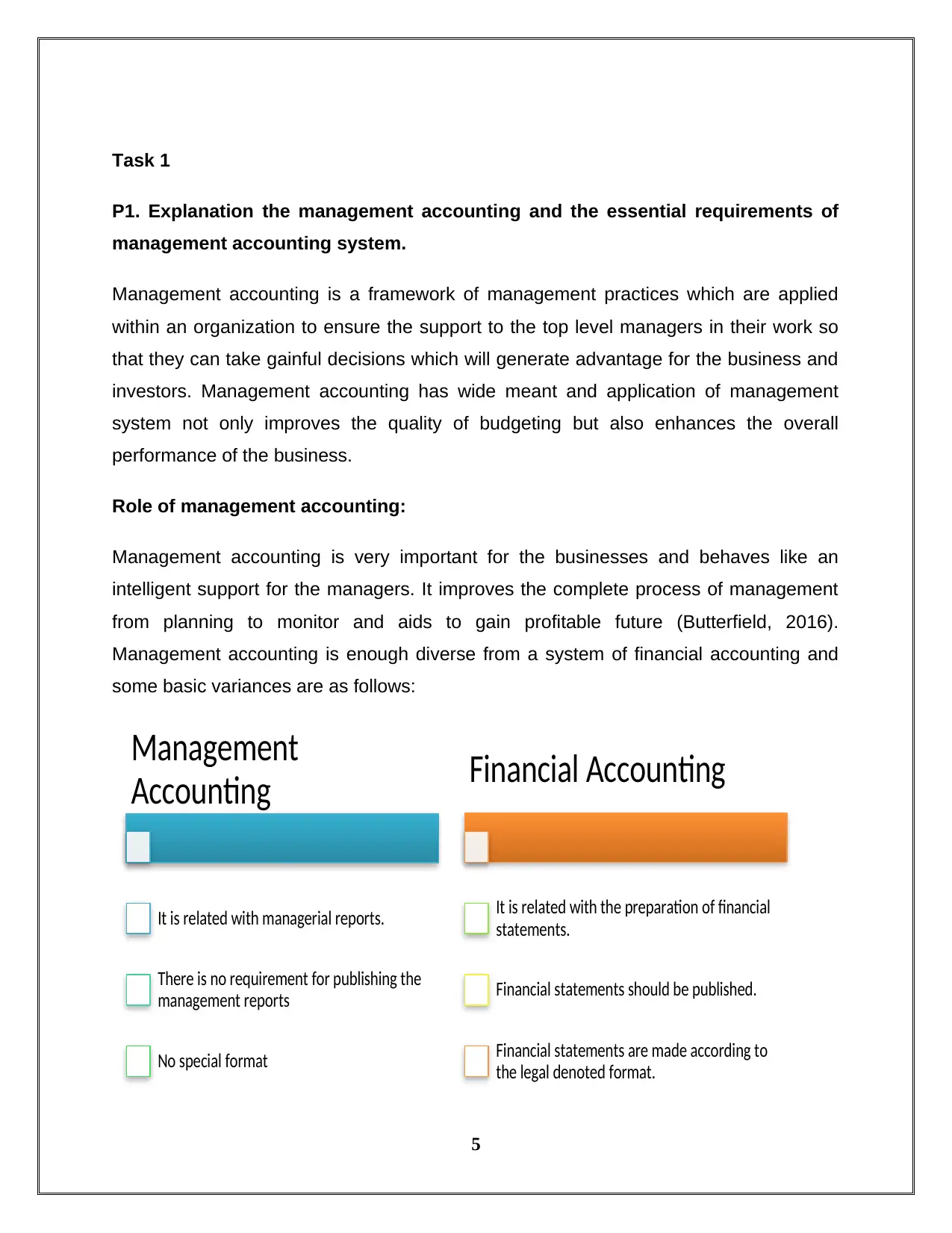
Management accounting is enough diverse from a system of financial accounting and
some basic variances are as follows:
5
Management
Accounting
It is related with managerial reports.
There is no requirement for publishing the
management reports
No special format
Financial Accounting
It is related with the preparation of financial
statements.
Financial statements should be published.
Financial statements are made according to
the legal denoted format.
P1. Explanation the management accounting and the essential requirements of
management accounting system.
Management accounting is a framework of management practices which are applied
within an organization to ensure the support to the top level managers in their work so
that they can take gainful decisions which will generate advantage for the business and
investors. Management accounting has wide meant and application of management
system not only improves the quality of budgeting but also enhances the overall
performance of the business.
Role of management accounting:
Management accounting is very important for the businesses and behaves like an
intelligent support for the managers. It improves the complete process of management
from planning to monitor and aids to gain profitable future (Butterfield, 2016).
Management accounting is enough diverse from a system of financial accounting and
some basic variances are as follows:
5
Management
Accounting
It is related with managerial reports.
There is no requirement for publishing the
management reports
No special format
Financial Accounting
It is related with the preparation of financial
statements.
Financial statements should be published.
Financial statements are made according to
the legal denoted format.
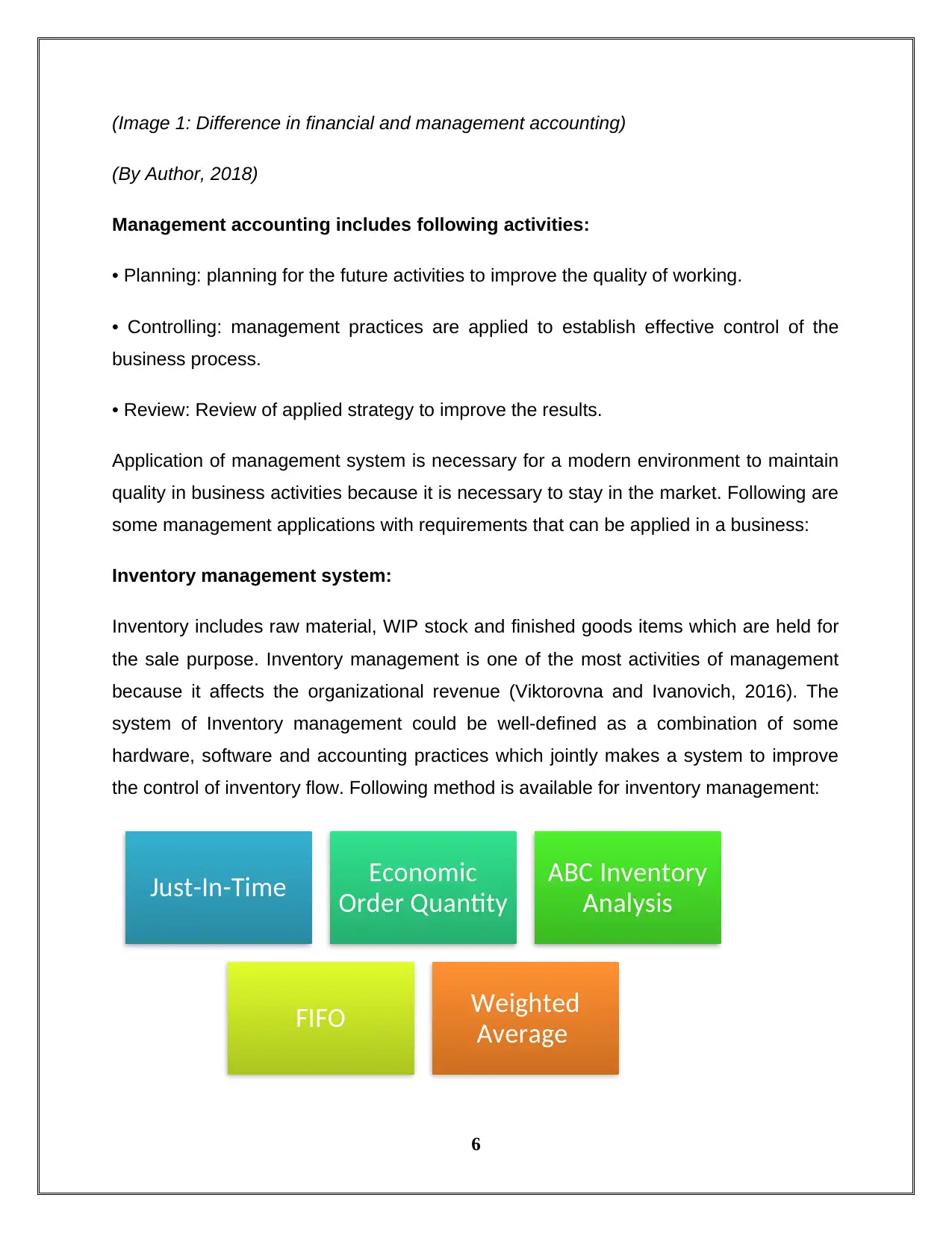
(Image 1: Difference in financial and management accounting)
(By Author, 2018)
Management accounting includes following activities:
• Planning: planning for the future activities to improve the quality of working.
• Controlling: management practices are applied to establish effective control of the
business process.
• Review: Review of applied strategy to improve the results.
Application of management system is necessary for a modern environment to maintain
quality in business activities because it is necessary to stay in the market. Following are
some management applications with requirements that can be applied in a business:
Inventory management system:
Inventory includes raw material, WIP stock and finished goods items which are held for
the sale purpose. Inventory management is one of the most activities of management
because it affects the organizational revenue (Viktorovna and Ivanovich, 2016). The
system of Inventory management could be well-defined as a combination of some
hardware, software and accounting practices which jointly makes a system to improve
the control of inventory flow. Following method is available for inventory management:
6
Just-In-Time Economic
Order Quantity
ABC Inventory
Analysis
FIFO Weighted
Average
(By Author, 2018)
Management accounting includes following activities:
• Planning: planning for the future activities to improve the quality of working.
• Controlling: management practices are applied to establish effective control of the
business process.
• Review: Review of applied strategy to improve the results.
Application of management system is necessary for a modern environment to maintain
quality in business activities because it is necessary to stay in the market. Following are
some management applications with requirements that can be applied in a business:
Inventory management system:
Inventory includes raw material, WIP stock and finished goods items which are held for
the sale purpose. Inventory management is one of the most activities of management
because it affects the organizational revenue (Viktorovna and Ivanovich, 2016). The
system of Inventory management could be well-defined as a combination of some
hardware, software and accounting practices which jointly makes a system to improve
the control of inventory flow. Following method is available for inventory management:
6
Just-In-Time Economic
Order Quantity
ABC Inventory
Analysis
FIFO Weighted
Average
⊘ This is a preview!⊘
Do you want full access?
Subscribe today to unlock all pages.
Trusted by 1+ million students worldwide
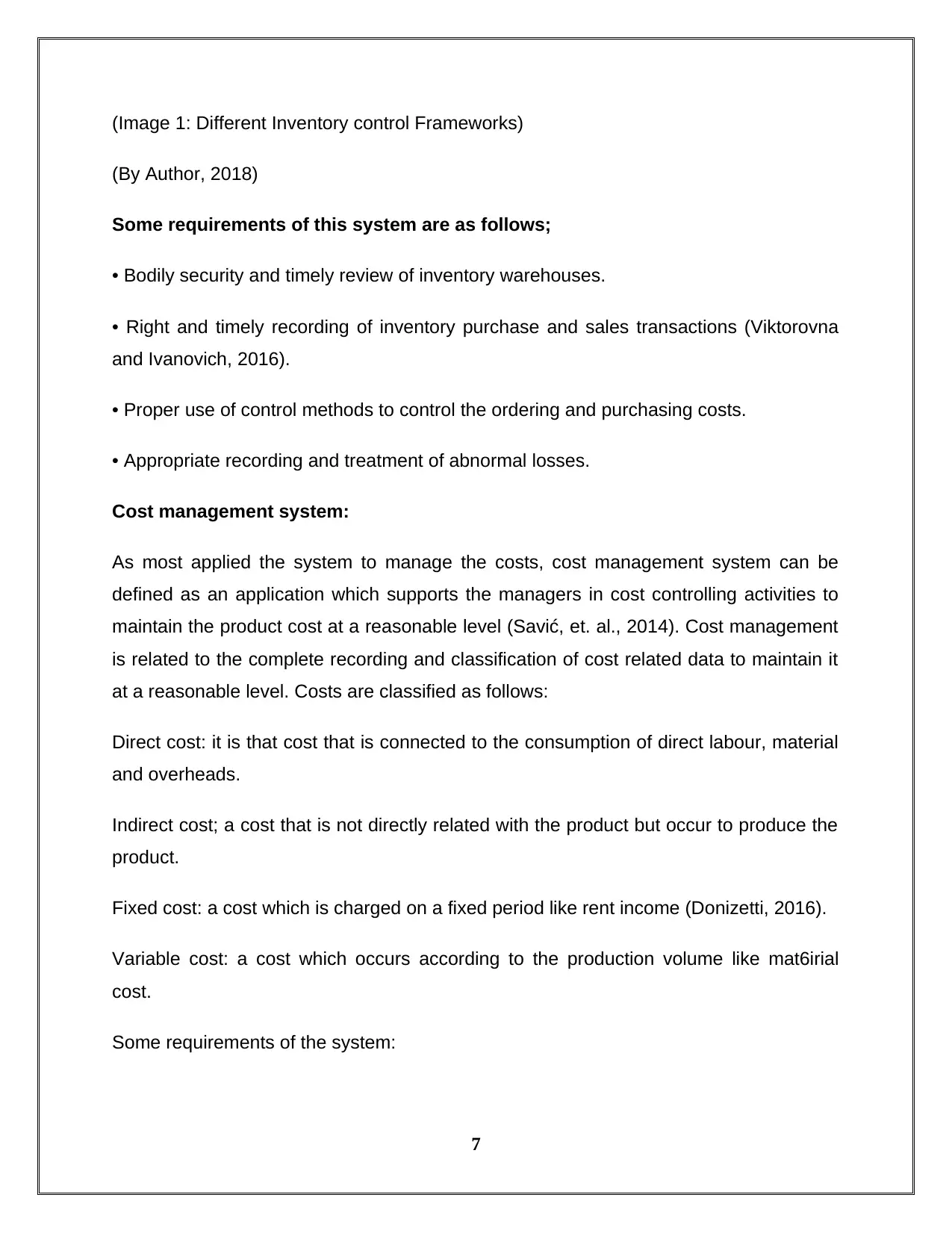
(Image 1: Different Inventory control Frameworks)
(By Author, 2018)
Some requirements of this system are as follows;
• Bodily security and timely review of inventory warehouses.
• Right and timely recording of inventory purchase and sales transactions (Viktorovna
and Ivanovich, 2016).
• Proper use of control methods to control the ordering and purchasing costs.
• Appropriate recording and treatment of abnormal losses.
Cost management system:
As most applied the system to manage the costs, cost management system can be
defined as an application which supports the managers in cost controlling activities to
maintain the product cost at a reasonable level (Savić, et. al., 2014). Cost management
is related to the complete recording and classification of cost related data to maintain it
at a reasonable level. Costs are classified as follows:
Direct cost: it is that cost that is connected to the consumption of direct labour, material
and overheads.
Indirect cost; a cost that is not directly related with the product but occur to produce the
product.
Fixed cost: a cost which is charged on a fixed period like rent income (Donizetti, 2016).
Variable cost: a cost which occurs according to the production volume like mat6irial
cost.
Some requirements of the system:
7
(By Author, 2018)
Some requirements of this system are as follows;
• Bodily security and timely review of inventory warehouses.
• Right and timely recording of inventory purchase and sales transactions (Viktorovna
and Ivanovich, 2016).
• Proper use of control methods to control the ordering and purchasing costs.
• Appropriate recording and treatment of abnormal losses.
Cost management system:
As most applied the system to manage the costs, cost management system can be
defined as an application which supports the managers in cost controlling activities to
maintain the product cost at a reasonable level (Savić, et. al., 2014). Cost management
is related to the complete recording and classification of cost related data to maintain it
at a reasonable level. Costs are classified as follows:
Direct cost: it is that cost that is connected to the consumption of direct labour, material
and overheads.
Indirect cost; a cost that is not directly related with the product but occur to produce the
product.
Fixed cost: a cost which is charged on a fixed period like rent income (Donizetti, 2016).
Variable cost: a cost which occurs according to the production volume like mat6irial
cost.
Some requirements of the system:
7
Paraphrase This Document
Need a fresh take? Get an instant paraphrase of this document with our AI Paraphraser
• Cost accounting system requires correct classification and recording of different costs
to ascertain the right cost of the product.
• If a company is engaged in the production of the product in batches separate
recording of costs as per batches.
Price optimization system:
POS is a tool of management which is used to be applied with an organization to study
the customer reaction for the prices so that management can understand the
purchasing acceptance of the product and set a reasonable price level (Yuan, et. al.,
2014). Price optimization system is applied to find a level of the price at which, sales
and revenue will be maximum.
Some requirements of this system;
• Historical data on sales and prices.
• If an organization prepares fact reports management can use those reports also.
• The report which shows product acceptance and popularity of the product.
• Trend analysis report.
8
to ascertain the right cost of the product.
• If a company is engaged in the production of the product in batches separate
recording of costs as per batches.
Price optimization system:
POS is a tool of management which is used to be applied with an organization to study
the customer reaction for the prices so that management can understand the
purchasing acceptance of the product and set a reasonable price level (Yuan, et. al.,
2014). Price optimization system is applied to find a level of the price at which, sales
and revenue will be maximum.
Some requirements of this system;
• Historical data on sales and prices.
• If an organization prepares fact reports management can use those reports also.
• The report which shows product acceptance and popularity of the product.
• Trend analysis report.
8
M1. Evaluate the benefits of management accounting systems and their
application within an organisational context
Applications of Management accounting is very useful for the businesses because it
works as an intelligent supporter for business activities from the stage of planning to
monitor. List of a management system for a business is very long and some of them are
as follows;
The superiority of planning: Super planning is must be stable in the current market
because every business is facing heavy competition and a good planning for a future
business activity helps to reduce the expenses and improve profits (Matambele, 2014).
By doing this, an organization can improve the flexibility of activities which will provide a
competitive advantage.
Review of staff performance: performance review is another benefit of the
management system. Performance reports which are made under management
reporting give complete and accurate information about the performance of each
department. Departmental performance report shows the individual efficiency of staff.
By using these tools, company management can evaluate the performance of staff and
take corrective action.
Departmental Communication and coordination: Flow of information and
coordination is necessary between different departments because it aids the
department managers to understand the current requirement of entity, for example, if a
company facing trouble in achieving the sales targets, production department should
understand the reasons because it is possible that the same problems are arising due
to quality issues (Matambele, 2014).
9
application within an organisational context
Applications of Management accounting is very useful for the businesses because it
works as an intelligent supporter for business activities from the stage of planning to
monitor. List of a management system for a business is very long and some of them are
as follows;
The superiority of planning: Super planning is must be stable in the current market
because every business is facing heavy competition and a good planning for a future
business activity helps to reduce the expenses and improve profits (Matambele, 2014).
By doing this, an organization can improve the flexibility of activities which will provide a
competitive advantage.
Review of staff performance: performance review is another benefit of the
management system. Performance reports which are made under management
reporting give complete and accurate information about the performance of each
department. Departmental performance report shows the individual efficiency of staff.
By using these tools, company management can evaluate the performance of staff and
take corrective action.
Departmental Communication and coordination: Flow of information and
coordination is necessary between different departments because it aids the
department managers to understand the current requirement of entity, for example, if a
company facing trouble in achieving the sales targets, production department should
understand the reasons because it is possible that the same problems are arising due
to quality issues (Matambele, 2014).
9
⊘ This is a preview!⊘
Do you want full access?
Subscribe today to unlock all pages.
Trusted by 1+ million students worldwide
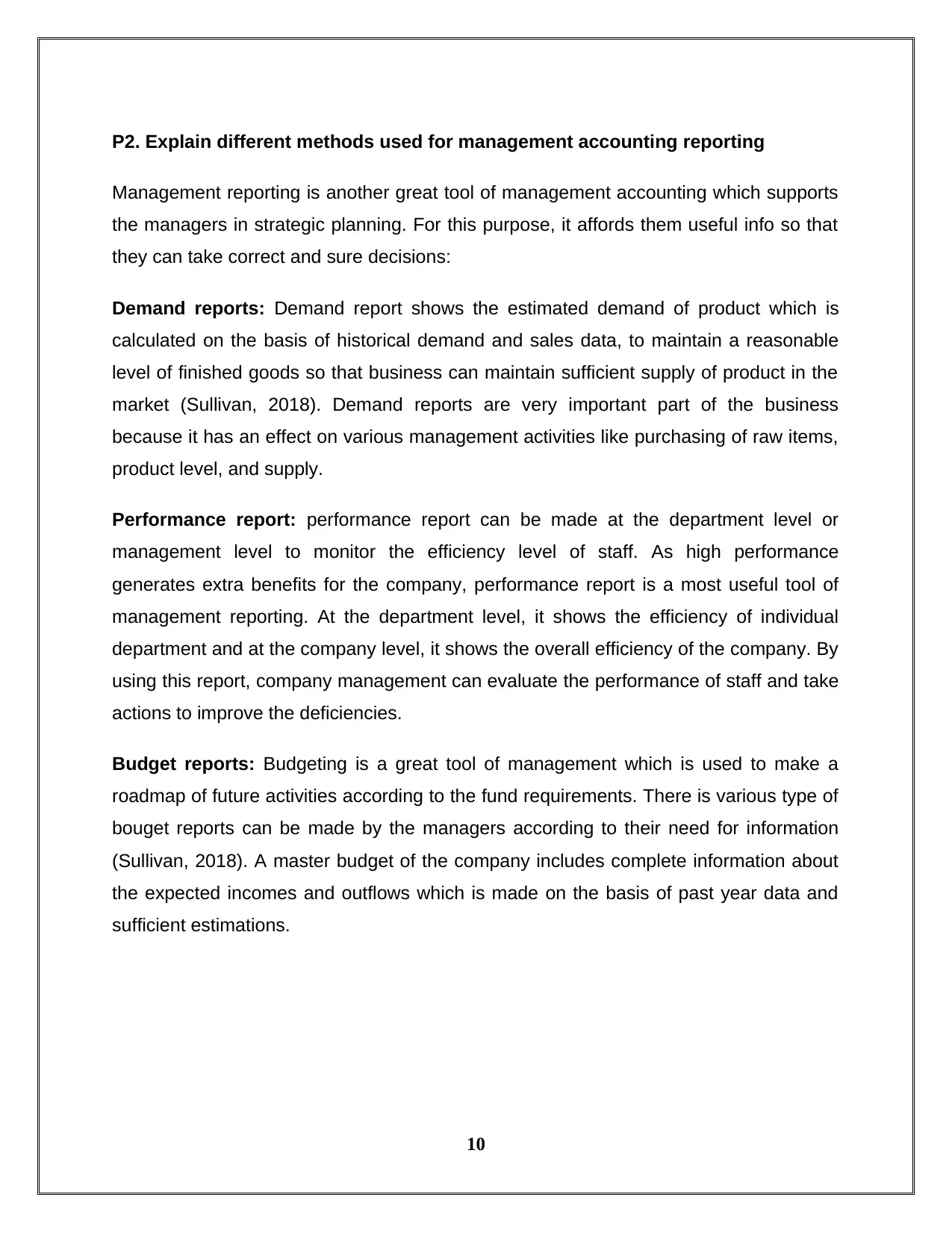
P2. Explain different methods used for management accounting reporting
Management reporting is another great tool of management accounting which supports
the managers in strategic planning. For this purpose, it affords them useful info so that
they can take correct and sure decisions:
Demand reports: Demand report shows the estimated demand of product which is
calculated on the basis of historical demand and sales data, to maintain a reasonable
level of finished goods so that business can maintain sufficient supply of product in the
market (Sullivan, 2018). Demand reports are very important part of the business
because it has an effect on various management activities like purchasing of raw items,
product level, and supply.
Performance report: performance report can be made at the department level or
management level to monitor the efficiency level of staff. As high performance
generates extra benefits for the company, performance report is a most useful tool of
management reporting. At the department level, it shows the efficiency of individual
department and at the company level, it shows the overall efficiency of the company. By
using this report, company management can evaluate the performance of staff and take
actions to improve the deficiencies.
Budget reports: Budgeting is a great tool of management which is used to make a
roadmap of future activities according to the fund requirements. There is various type of
bouget reports can be made by the managers according to their need for information
(Sullivan, 2018). A master budget of the company includes complete information about
the expected incomes and outflows which is made on the basis of past year data and
sufficient estimations.
10
Management reporting is another great tool of management accounting which supports
the managers in strategic planning. For this purpose, it affords them useful info so that
they can take correct and sure decisions:
Demand reports: Demand report shows the estimated demand of product which is
calculated on the basis of historical demand and sales data, to maintain a reasonable
level of finished goods so that business can maintain sufficient supply of product in the
market (Sullivan, 2018). Demand reports are very important part of the business
because it has an effect on various management activities like purchasing of raw items,
product level, and supply.
Performance report: performance report can be made at the department level or
management level to monitor the efficiency level of staff. As high performance
generates extra benefits for the company, performance report is a most useful tool of
management reporting. At the department level, it shows the efficiency of individual
department and at the company level, it shows the overall efficiency of the company. By
using this report, company management can evaluate the performance of staff and take
actions to improve the deficiencies.
Budget reports: Budgeting is a great tool of management which is used to make a
roadmap of future activities according to the fund requirements. There is various type of
bouget reports can be made by the managers according to their need for information
(Sullivan, 2018). A master budget of the company includes complete information about
the expected incomes and outflows which is made on the basis of past year data and
sufficient estimations.
10
Paraphrase This Document
Need a fresh take? Get an instant paraphrase of this document with our AI Paraphraser
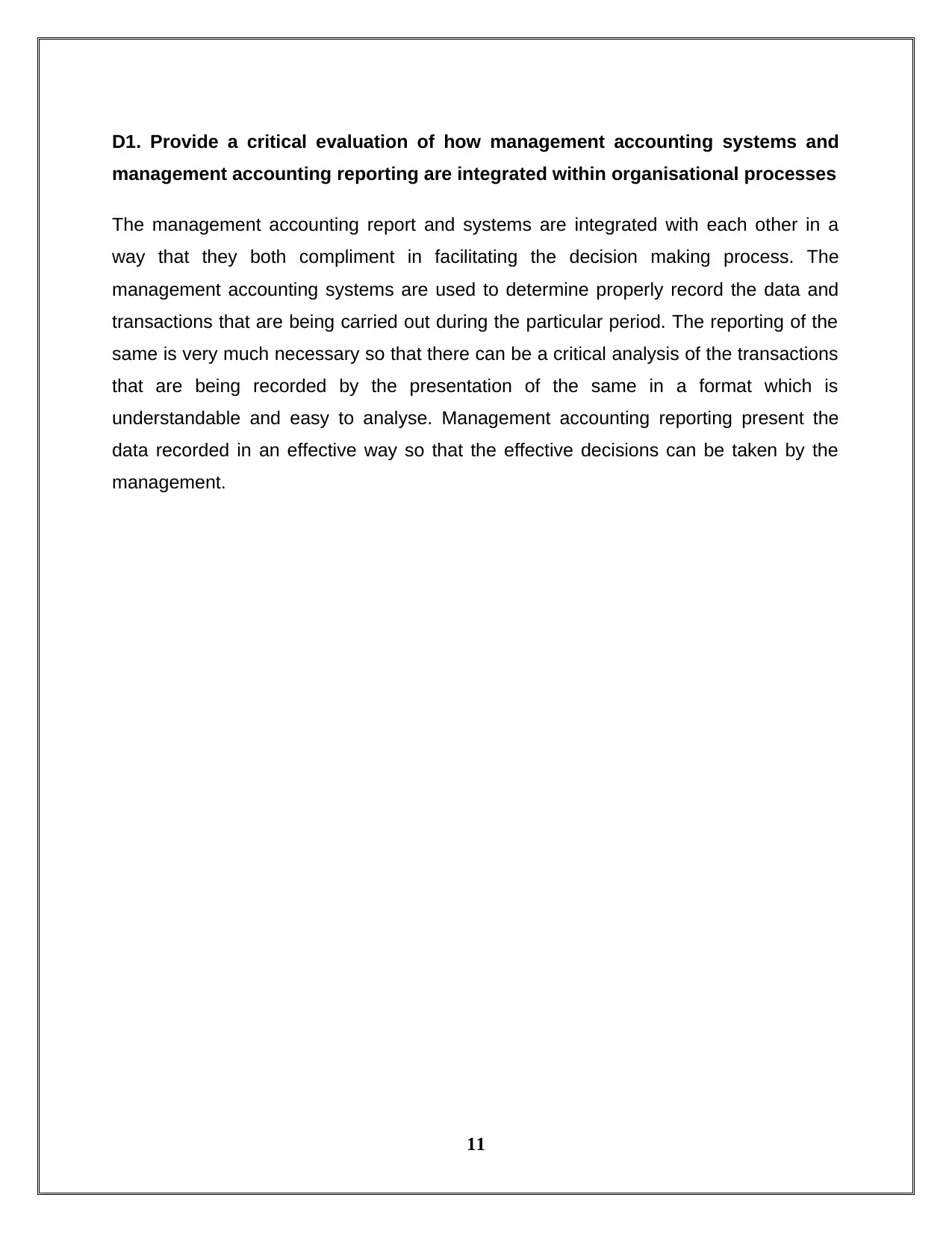
D1. Provide a critical evaluation of how management accounting systems and
management accounting reporting are integrated within organisational processes
The management accounting report and systems are integrated with each other in a
way that they both compliment in facilitating the decision making process. The
management accounting systems are used to determine properly record the data and
transactions that are being carried out during the particular period. The reporting of the
same is very much necessary so that there can be a critical analysis of the transactions
that are being recorded by the presentation of the same in a format which is
understandable and easy to analyse. Management accounting reporting present the
data recorded in an effective way so that the effective decisions can be taken by the
management.
11
management accounting reporting are integrated within organisational processes
The management accounting report and systems are integrated with each other in a
way that they both compliment in facilitating the decision making process. The
management accounting systems are used to determine properly record the data and
transactions that are being carried out during the particular period. The reporting of the
same is very much necessary so that there can be a critical analysis of the transactions
that are being recorded by the presentation of the same in a format which is
understandable and easy to analyse. Management accounting reporting present the
data recorded in an effective way so that the effective decisions can be taken by the
management.
11
Task 2
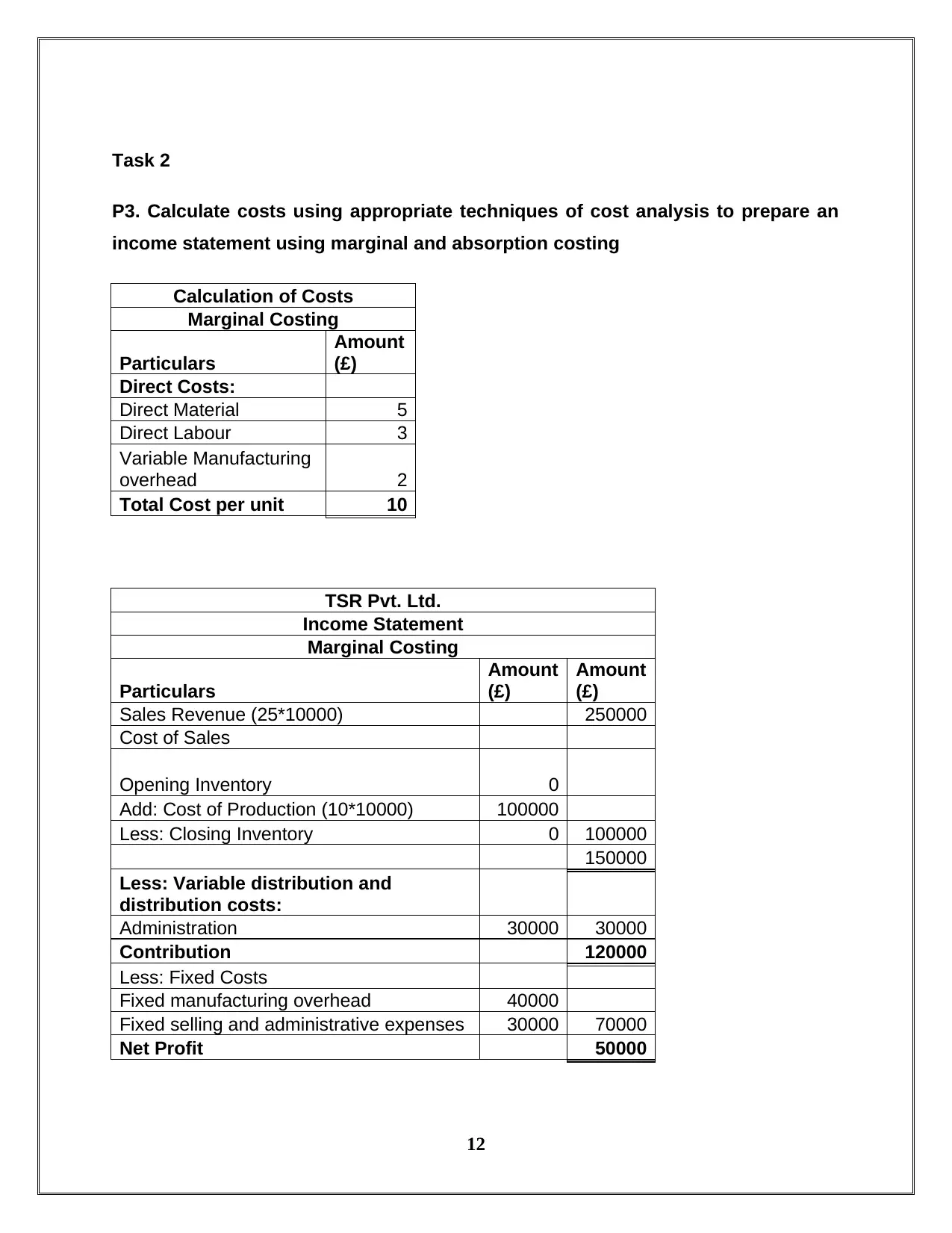
P3. Calculate costs using appropriate techniques of cost analysis to prepare an
income statement using marginal and absorption costing
Calculation of Costs
Marginal Costing
Particulars
Amount
(£)
Direct Costs:
Direct Material 5
Direct Labour 3
Variable Manufacturing
overhead 2
Total Cost per unit 10
TSR Pvt. Ltd.
Income Statement
Marginal Costing
Particulars
Amount
(£)
Amount
(£)
Sales Revenue (25*10000) 250000
Cost of Sales
Opening Inventory 0
Add: Cost of Production (10*10000) 100000
Less: Closing Inventory 0 100000
150000
Less: Variable distribution and
distribution costs:
Administration 30000 30000
Contribution 120000
Less: Fixed Costs
Fixed manufacturing overhead 40000
Fixed selling and administrative expenses 30000 70000
Net Profit 50000
12
P3. Calculate costs using appropriate techniques of cost analysis to prepare an
income statement using marginal and absorption costing
Calculation of Costs
Marginal Costing
Particulars
Amount
(£)
Direct Costs:
Direct Material 5
Direct Labour 3
Variable Manufacturing
overhead 2
Total Cost per unit 10
TSR Pvt. Ltd.
Income Statement
Marginal Costing
Particulars
Amount
(£)
Amount
(£)
Sales Revenue (25*10000) 250000
Cost of Sales
Opening Inventory 0
Add: Cost of Production (10*10000) 100000
Less: Closing Inventory 0 100000
150000
Less: Variable distribution and
distribution costs:
Administration 30000 30000
Contribution 120000
Less: Fixed Costs
Fixed manufacturing overhead 40000
Fixed selling and administrative expenses 30000 70000
Net Profit 50000
12
⊘ This is a preview!⊘
Do you want full access?
Subscribe today to unlock all pages.
Trusted by 1+ million students worldwide

1 out of 26


Related Documents


Your All-in-One AI-Powered Toolkit for Academic Success.
+13062052269
info@desklib.com
Available 24*7 on WhatsApp / Email
![[object Object]](/_next/static/media/star-bottom.7253800d.svg)
Unlock your academic potential
Copyright © 2020–2026 A2Z Services. All Rights Reserved. Developed and managed by ZUCOL.