Management Accounting Systems and Techniques: Atex Media Analysis
VerifiedAdded on 2020/12/10
|16
|4052
|252
Report
AI Summary
This report provides a comprehensive overview of management accounting systems and techniques. It begins with an introduction to management accounting, emphasizing its significance in organizational growth and the need for appropriate systems. The report then delves into various management accounting methods, including cost accounting, actual costing, normal costing, and standard costing, with a focus on their application within Atex Media. Inventory management systems, including perpetual and periodic inventory methods, as well as FIFO, LIFO, and Just-in-Time approaches, are also discussed. Furthermore, the report examines job costing systems and the different types of management accounting reports, such as cost accounting reports, budget reports, and accounts receivable reports, highlighting their importance in decision-making and providing transparent information. The report also differentiates between marginal costing and absorption costing, including a detailed comparison of their characteristics and impacts on profitability, supported by numerical examples. Finally, the report explores the advantages and disadvantages of planning tools used for budgetary control and compares the management accounting systems adopted by Atex Media and its competitor, Wolfram Research, in response to financial challenges, providing a well-rounded understanding of the subject.
Management Accounting
Systems & Techniques
Systems & Techniques

Paraphrase This Document
Need a fresh take? Get an instant paraphrase of this document with our AI Paraphraser
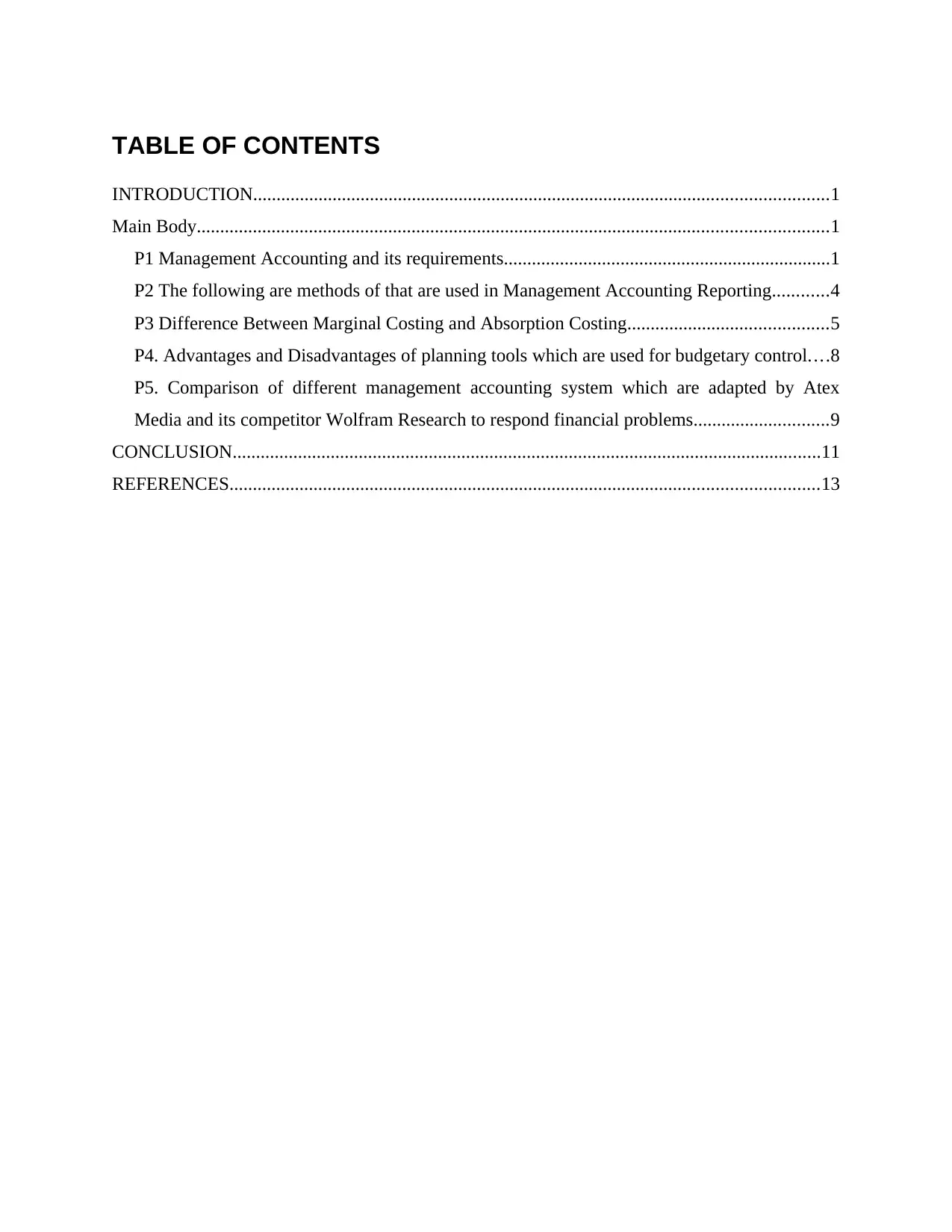
TABLE OF CONTENTS
INTRODUCTION...........................................................................................................................1
Main Body.......................................................................................................................................1
P1 Management Accounting and its requirements......................................................................1
P2 The following are methods of that are used in Management Accounting Reporting............4
P3 Difference Between Marginal Costing and Absorption Costing...........................................5
P4. Advantages and Disadvantages of planning tools which are used for budgetary control....8
P5. Comparison of different management accounting system which are adapted by Atex
Media and its competitor Wolfram Research to respond financial problems.............................9
CONCLUSION..............................................................................................................................11
REFERENCES..............................................................................................................................13
INTRODUCTION...........................................................................................................................1
Main Body.......................................................................................................................................1
P1 Management Accounting and its requirements......................................................................1
P2 The following are methods of that are used in Management Accounting Reporting............4
P3 Difference Between Marginal Costing and Absorption Costing...........................................5
P4. Advantages and Disadvantages of planning tools which are used for budgetary control....8
P5. Comparison of different management accounting system which are adapted by Atex
Media and its competitor Wolfram Research to respond financial problems.............................9
CONCLUSION..............................................................................................................................11
REFERENCES..............................................................................................................................13
INTRODUCTION
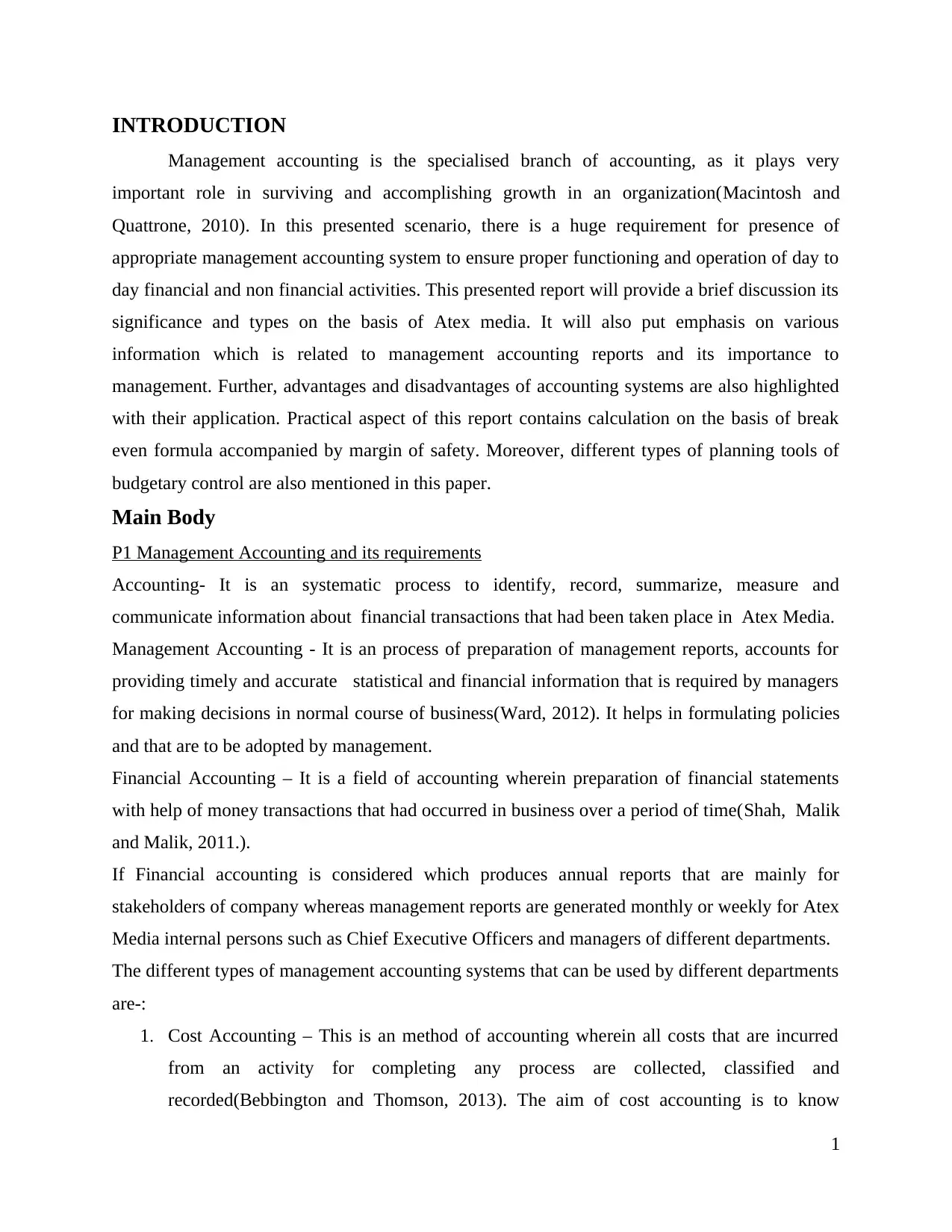
Management accounting is the specialised branch of accounting, as it plays very
important role in surviving and accomplishing growth in an organization(Macintosh and
Quattrone, 2010). In this presented scenario, there is a huge requirement for presence of
appropriate management accounting system to ensure proper functioning and operation of day to
day financial and non financial activities. This presented report will provide a brief discussion its
significance and types on the basis of Atex media. It will also put emphasis on various
information which is related to management accounting reports and its importance to
management. Further, advantages and disadvantages of accounting systems are also highlighted
with their application. Practical aspect of this report contains calculation on the basis of break
even formula accompanied by margin of safety. Moreover, different types of planning tools of
budgetary control are also mentioned in this paper.
Main Body
P1 Management Accounting and its requirements
Accounting- It is an systematic process to identify, record, summarize, measure and
communicate information about financial transactions that had been taken place in Atex Media.
Management Accounting - It is an process of preparation of management reports, accounts for
providing timely and accurate statistical and financial information that is required by managers
for making decisions in normal course of business(Ward, 2012). It helps in formulating policies
and that are to be adopted by management.
Financial Accounting – It is a field of accounting wherein preparation of financial statements
with help of money transactions that had occurred in business over a period of time(Shah, Malik
and Malik, 2011.).
If Financial accounting is considered which produces annual reports that are mainly for
stakeholders of company whereas management reports are generated monthly or weekly for Atex
Media internal persons such as Chief Executive Officers and managers of different departments.
The different types of management accounting systems that can be used by different departments
are-:
1. Cost Accounting – This is an method of accounting wherein all costs that are incurred
from an activity for completing any process are collected, classified and
recorded(Bebbington and Thomson, 2013). The aim of cost accounting is to know
1
Management accounting is the specialised branch of accounting, as it plays very
important role in surviving and accomplishing growth in an organization(Macintosh and
Quattrone, 2010). In this presented scenario, there is a huge requirement for presence of
appropriate management accounting system to ensure proper functioning and operation of day to
day financial and non financial activities. This presented report will provide a brief discussion its
significance and types on the basis of Atex media. It will also put emphasis on various
information which is related to management accounting reports and its importance to
management. Further, advantages and disadvantages of accounting systems are also highlighted
with their application. Practical aspect of this report contains calculation on the basis of break
even formula accompanied by margin of safety. Moreover, different types of planning tools of
budgetary control are also mentioned in this paper.
Main Body
P1 Management Accounting and its requirements
Accounting- It is an systematic process to identify, record, summarize, measure and
communicate information about financial transactions that had been taken place in Atex Media.
Management Accounting - It is an process of preparation of management reports, accounts for
providing timely and accurate statistical and financial information that is required by managers
for making decisions in normal course of business(Ward, 2012). It helps in formulating policies
and that are to be adopted by management.
Financial Accounting – It is a field of accounting wherein preparation of financial statements
with help of money transactions that had occurred in business over a period of time(Shah, Malik
and Malik, 2011.).
If Financial accounting is considered which produces annual reports that are mainly for
stakeholders of company whereas management reports are generated monthly or weekly for Atex
Media internal persons such as Chief Executive Officers and managers of different departments.
The different types of management accounting systems that can be used by different departments
are-:
1. Cost Accounting – This is an method of accounting wherein all costs that are incurred
from an activity for completing any process are collected, classified and
recorded(Bebbington and Thomson, 2013). The aim of cost accounting is to know
1
⊘ This is a preview!⊘
Do you want full access?
Subscribe today to unlock all pages.

Trusted by 1+ million students worldwide
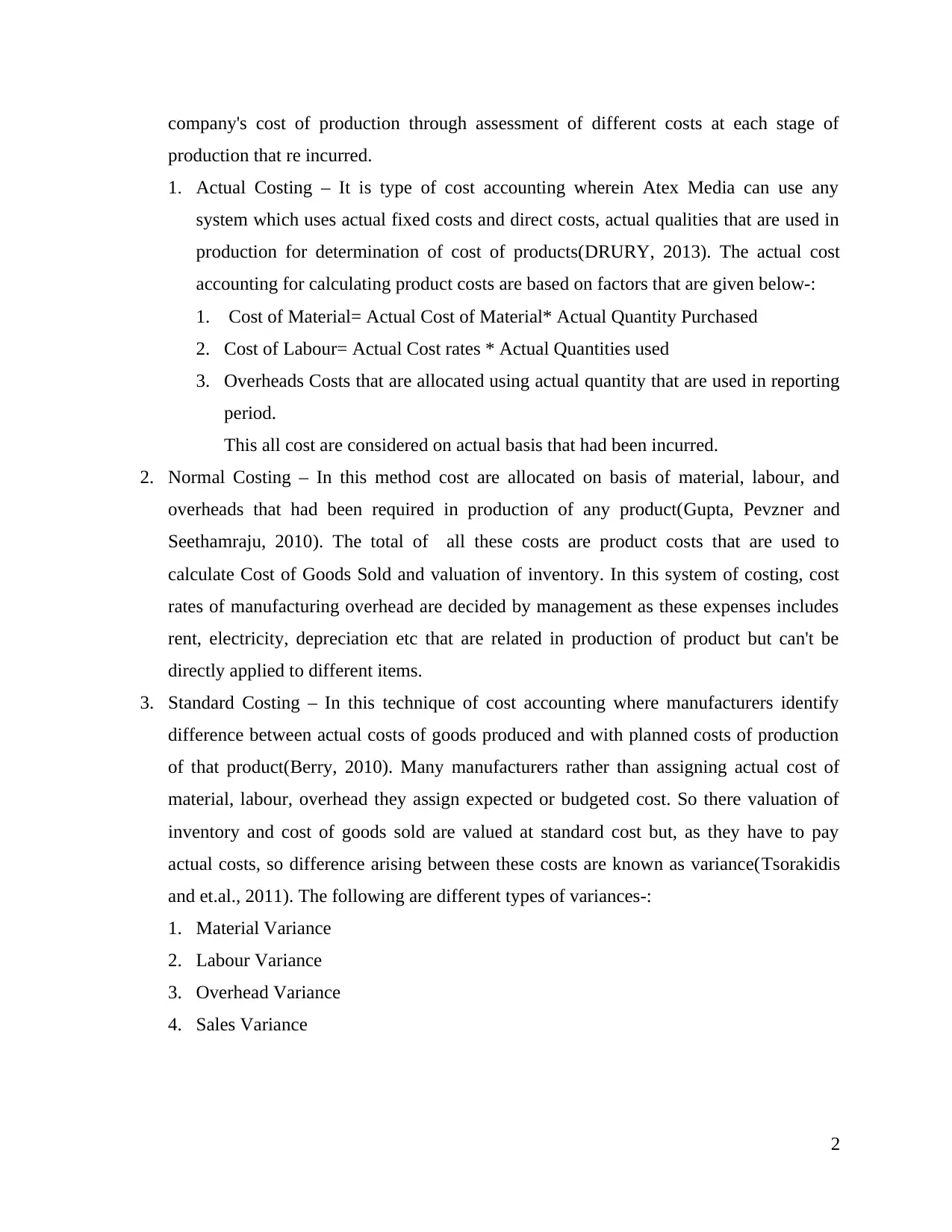
company's cost of production through assessment of different costs at each stage of
production that re incurred.
1. Actual Costing – It is type of cost accounting wherein Atex Media can use any
system which uses actual fixed costs and direct costs, actual qualities that are used in
production for determination of cost of products(DRURY, 2013). The actual cost
accounting for calculating product costs are based on factors that are given below-:
1. Cost of Material= Actual Cost of Material* Actual Quantity Purchased
2. Cost of Labour= Actual Cost rates * Actual Quantities used
3. Overheads Costs that are allocated using actual quantity that are used in reporting
period.
This all cost are considered on actual basis that had been incurred.
2. Normal Costing – In this method cost are allocated on basis of material, labour, and
overheads that had been required in production of any product(Gupta, Pevzner and
Seethamraju, 2010). The total of all these costs are product costs that are used to
calculate Cost of Goods Sold and valuation of inventory. In this system of costing, cost
rates of manufacturing overhead are decided by management as these expenses includes
rent, electricity, depreciation etc that are related in production of product but can't be
directly applied to different items.
3. Standard Costing – In this technique of cost accounting where manufacturers identify
difference between actual costs of goods produced and with planned costs of production
of that product(Berry, 2010). Many manufacturers rather than assigning actual cost of
material, labour, overhead they assign expected or budgeted cost. So there valuation of
inventory and cost of goods sold are valued at standard cost but, as they have to pay
actual costs, so difference arising between these costs are known as variance(Tsorakidis
and et.al., 2011). The following are different types of variances-:
1. Material Variance
2. Labour Variance
3. Overhead Variance
4. Sales Variance
2
production that re incurred.
1. Actual Costing – It is type of cost accounting wherein Atex Media can use any
system which uses actual fixed costs and direct costs, actual qualities that are used in
production for determination of cost of products(DRURY, 2013). The actual cost
accounting for calculating product costs are based on factors that are given below-:
1. Cost of Material= Actual Cost of Material* Actual Quantity Purchased
2. Cost of Labour= Actual Cost rates * Actual Quantities used
3. Overheads Costs that are allocated using actual quantity that are used in reporting
period.
This all cost are considered on actual basis that had been incurred.
2. Normal Costing – In this method cost are allocated on basis of material, labour, and
overheads that had been required in production of any product(Gupta, Pevzner and
Seethamraju, 2010). The total of all these costs are product costs that are used to
calculate Cost of Goods Sold and valuation of inventory. In this system of costing, cost
rates of manufacturing overhead are decided by management as these expenses includes
rent, electricity, depreciation etc that are related in production of product but can't be
directly applied to different items.
3. Standard Costing – In this technique of cost accounting where manufacturers identify
difference between actual costs of goods produced and with planned costs of production
of that product(Berry, 2010). Many manufacturers rather than assigning actual cost of
material, labour, overhead they assign expected or budgeted cost. So there valuation of
inventory and cost of goods sold are valued at standard cost but, as they have to pay
actual costs, so difference arising between these costs are known as variance(Tsorakidis
and et.al., 2011). The following are different types of variances-:
1. Material Variance
2. Labour Variance
3. Overhead Variance
4. Sales Variance
2
Paraphrase This Document
Need a fresh take? Get an instant paraphrase of this document with our AI Paraphraser
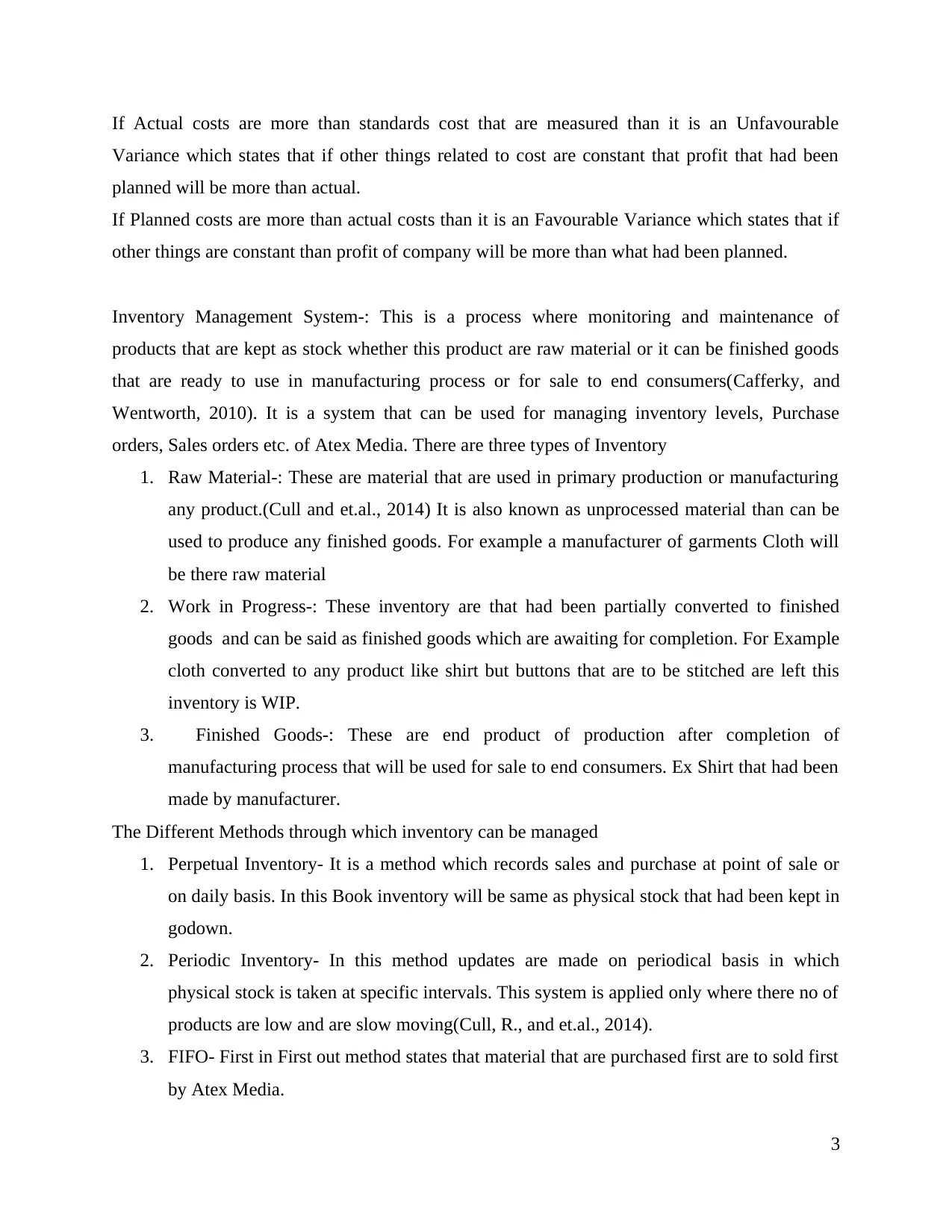
If Actual costs are more than standards cost that are measured than it is an Unfavourable
Variance which states that if other things related to cost are constant that profit that had been
planned will be more than actual.
If Planned costs are more than actual costs than it is an Favourable Variance which states that if
other things are constant than profit of company will be more than what had been planned.
Inventory Management System-: This is a process where monitoring and maintenance of
products that are kept as stock whether this product are raw material or it can be finished goods
that are ready to use in manufacturing process or for sale to end consumers(Cafferky, and
Wentworth, 2010). It is a system that can be used for managing inventory levels, Purchase
orders, Sales orders etc. of Atex Media. There are three types of Inventory
1. Raw Material-: These are material that are used in primary production or manufacturing
any product.(Cull and et.al., 2014) It is also known as unprocessed material than can be
used to produce any finished goods. For example a manufacturer of garments Cloth will
be there raw material
2. Work in Progress-: These inventory are that had been partially converted to finished
goods and can be said as finished goods which are awaiting for completion. For Example
cloth converted to any product like shirt but buttons that are to be stitched are left this
inventory is WIP.
3. Finished Goods-: These are end product of production after completion of
manufacturing process that will be used for sale to end consumers. Ex Shirt that had been
made by manufacturer.
The Different Methods through which inventory can be managed
1. Perpetual Inventory- It is a method which records sales and purchase at point of sale or
on daily basis. In this Book inventory will be same as physical stock that had been kept in
godown.
2. Periodic Inventory- In this method updates are made on periodical basis in which
physical stock is taken at specific intervals. This system is applied only where there no of
products are low and are slow moving(Cull, R., and et.al., 2014).
3. FIFO- First in First out method states that material that are purchased first are to sold first
by Atex Media.
3
Variance which states that if other things related to cost are constant that profit that had been
planned will be more than actual.
If Planned costs are more than actual costs than it is an Favourable Variance which states that if
other things are constant than profit of company will be more than what had been planned.
Inventory Management System-: This is a process where monitoring and maintenance of
products that are kept as stock whether this product are raw material or it can be finished goods
that are ready to use in manufacturing process or for sale to end consumers(Cafferky, and
Wentworth, 2010). It is a system that can be used for managing inventory levels, Purchase
orders, Sales orders etc. of Atex Media. There are three types of Inventory
1. Raw Material-: These are material that are used in primary production or manufacturing
any product.(Cull and et.al., 2014) It is also known as unprocessed material than can be
used to produce any finished goods. For example a manufacturer of garments Cloth will
be there raw material
2. Work in Progress-: These inventory are that had been partially converted to finished
goods and can be said as finished goods which are awaiting for completion. For Example
cloth converted to any product like shirt but buttons that are to be stitched are left this
inventory is WIP.
3. Finished Goods-: These are end product of production after completion of
manufacturing process that will be used for sale to end consumers. Ex Shirt that had been
made by manufacturer.
The Different Methods through which inventory can be managed
1. Perpetual Inventory- It is a method which records sales and purchase at point of sale or
on daily basis. In this Book inventory will be same as physical stock that had been kept in
godown.
2. Periodic Inventory- In this method updates are made on periodical basis in which
physical stock is taken at specific intervals. This system is applied only where there no of
products are low and are slow moving(Cull, R., and et.al., 2014).
3. FIFO- First in First out method states that material that are purchased first are to sold first
by Atex Media.
3
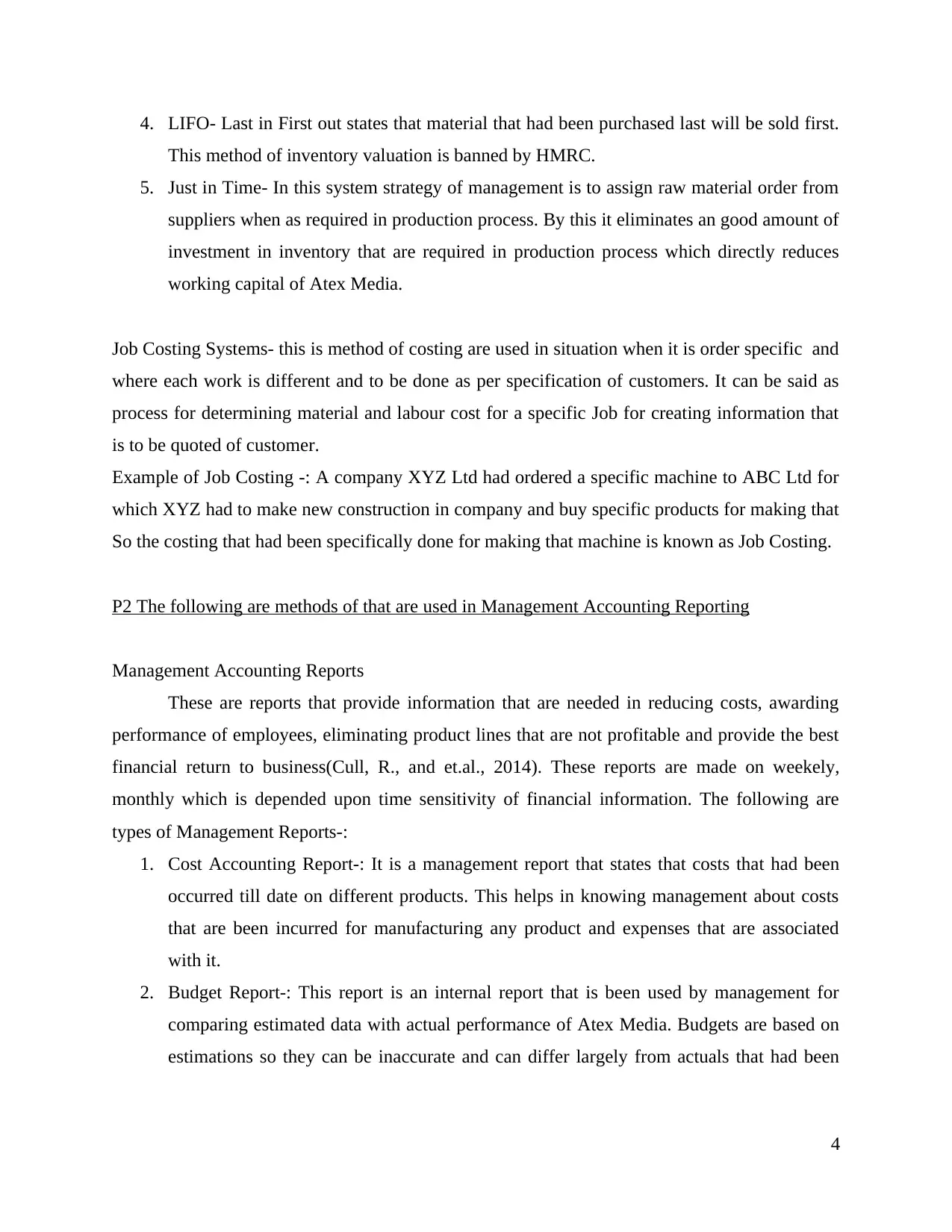
4. LIFO- Last in First out states that material that had been purchased last will be sold first.
This method of inventory valuation is banned by HMRC.
5. Just in Time- In this system strategy of management is to assign raw material order from
suppliers when as required in production process. By this it eliminates an good amount of
investment in inventory that are required in production process which directly reduces
working capital of Atex Media.
Job Costing Systems- this is method of costing are used in situation when it is order specific and
where each work is different and to be done as per specification of customers. It can be said as
process for determining material and labour cost for a specific Job for creating information that
is to be quoted of customer.
Example of Job Costing -: A company XYZ Ltd had ordered a specific machine to ABC Ltd for
which XYZ had to make new construction in company and buy specific products for making that
So the costing that had been specifically done for making that machine is known as Job Costing.
P2 The following are methods of that are used in Management Accounting Reporting
Management Accounting Reports
These are reports that provide information that are needed in reducing costs, awarding
performance of employees, eliminating product lines that are not profitable and provide the best
financial return to business(Cull, R., and et.al., 2014). These reports are made on weekely,
monthly which is depended upon time sensitivity of financial information. The following are
types of Management Reports-:
1. Cost Accounting Report-: It is a management report that states that costs that had been
occurred till date on different products. This helps in knowing management about costs
that are been incurred for manufacturing any product and expenses that are associated
with it.
2. Budget Report-: This report is an internal report that is been used by management for
comparing estimated data with actual performance of Atex Media. Budgets are based on
estimations so they can be inaccurate and can differ largely from actuals that had been
4
This method of inventory valuation is banned by HMRC.
5. Just in Time- In this system strategy of management is to assign raw material order from
suppliers when as required in production process. By this it eliminates an good amount of
investment in inventory that are required in production process which directly reduces
working capital of Atex Media.
Job Costing Systems- this is method of costing are used in situation when it is order specific and
where each work is different and to be done as per specification of customers. It can be said as
process for determining material and labour cost for a specific Job for creating information that
is to be quoted of customer.
Example of Job Costing -: A company XYZ Ltd had ordered a specific machine to ABC Ltd for
which XYZ had to make new construction in company and buy specific products for making that
So the costing that had been specifically done for making that machine is known as Job Costing.
P2 The following are methods of that are used in Management Accounting Reporting
Management Accounting Reports
These are reports that provide information that are needed in reducing costs, awarding
performance of employees, eliminating product lines that are not profitable and provide the best
financial return to business(Cull, R., and et.al., 2014). These reports are made on weekely,
monthly which is depended upon time sensitivity of financial information. The following are
types of Management Reports-:
1. Cost Accounting Report-: It is a management report that states that costs that had been
occurred till date on different products. This helps in knowing management about costs
that are been incurred for manufacturing any product and expenses that are associated
with it.
2. Budget Report-: This report is an internal report that is been used by management for
comparing estimated data with actual performance of Atex Media. Budgets are based on
estimations so they can be inaccurate and can differ largely from actuals that had been
4
⊘ This is a preview!⊘
Do you want full access?
Subscribe today to unlock all pages.
Trusted by 1+ million students worldwide
occurred. So for finding estimations that are made are going in correct manner budget
reports are formed.
3. Account Receivable Report-:This reports provides lists of unpaid amount of debtors. This
report are mostly used by collection department for determining invoices which are due
for payment and name of parties from whom payment is due(Parmenter, 2015).
The Following are importance of such reports-:
1. It helps In decision making-: This management reports helps in decision making of Atex
Media as through this they will know how work is going on in there organisation and
make changes according to it.
2. Helps in speeding up there process and can save time of Atex Media
3. Management reports helps in providing transparent and reliable information to users for
whom they are mane
4. Through these reports' clarification part of managers reduces so as everything is
presented in data form.
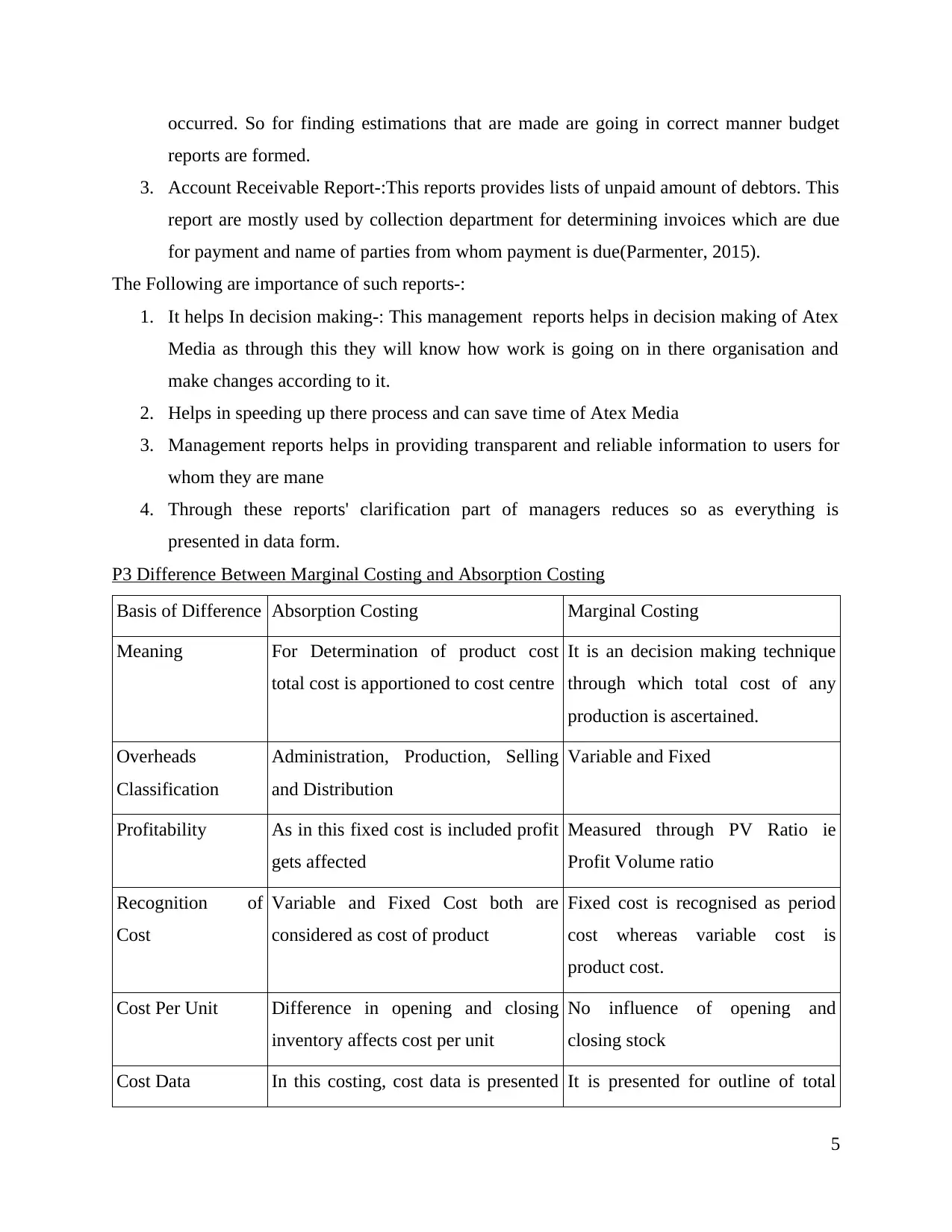
P3 Difference Between Marginal Costing and Absorption Costing
Basis of Difference Absorption Costing Marginal Costing
Meaning For Determination of product cost
total cost is apportioned to cost centre
It is an decision making technique
through which total cost of any
production is ascertained.
Overheads
Classification
Administration, Production, Selling
and Distribution
Variable and Fixed
Profitability As in this fixed cost is included profit
gets affected
Measured through PV Ratio ie
Profit Volume ratio
Recognition of
Cost
Variable and Fixed Cost both are
considered as cost of product
Fixed cost is recognised as period
cost whereas variable cost is
product cost.
Cost Per Unit Difference in opening and closing
inventory affects cost per unit
No influence of opening and
closing stock
Cost Data In this costing, cost data is presented It is presented for outline of total
5
reports are formed.
3. Account Receivable Report-:This reports provides lists of unpaid amount of debtors. This
report are mostly used by collection department for determining invoices which are due
for payment and name of parties from whom payment is due(Parmenter, 2015).
The Following are importance of such reports-:
1. It helps In decision making-: This management reports helps in decision making of Atex
Media as through this they will know how work is going on in there organisation and
make changes according to it.
2. Helps in speeding up there process and can save time of Atex Media
3. Management reports helps in providing transparent and reliable information to users for
whom they are mane
4. Through these reports' clarification part of managers reduces so as everything is
presented in data form.
P3 Difference Between Marginal Costing and Absorption Costing
Basis of Difference Absorption Costing Marginal Costing
Meaning For Determination of product cost
total cost is apportioned to cost centre
It is an decision making technique
through which total cost of any
production is ascertained.
Overheads
Classification
Administration, Production, Selling
and Distribution
Variable and Fixed
Profitability As in this fixed cost is included profit
gets affected
Measured through PV Ratio ie
Profit Volume ratio
Recognition of
Cost
Variable and Fixed Cost both are
considered as cost of product
Fixed cost is recognised as period
cost whereas variable cost is
product cost.
Cost Per Unit Difference in opening and closing
inventory affects cost per unit
No influence of opening and
closing stock
Cost Data In this costing, cost data is presented It is presented for outline of total
5
Paraphrase This Document
Need a fresh take? Get an instant paraphrase of this document with our AI Paraphraser
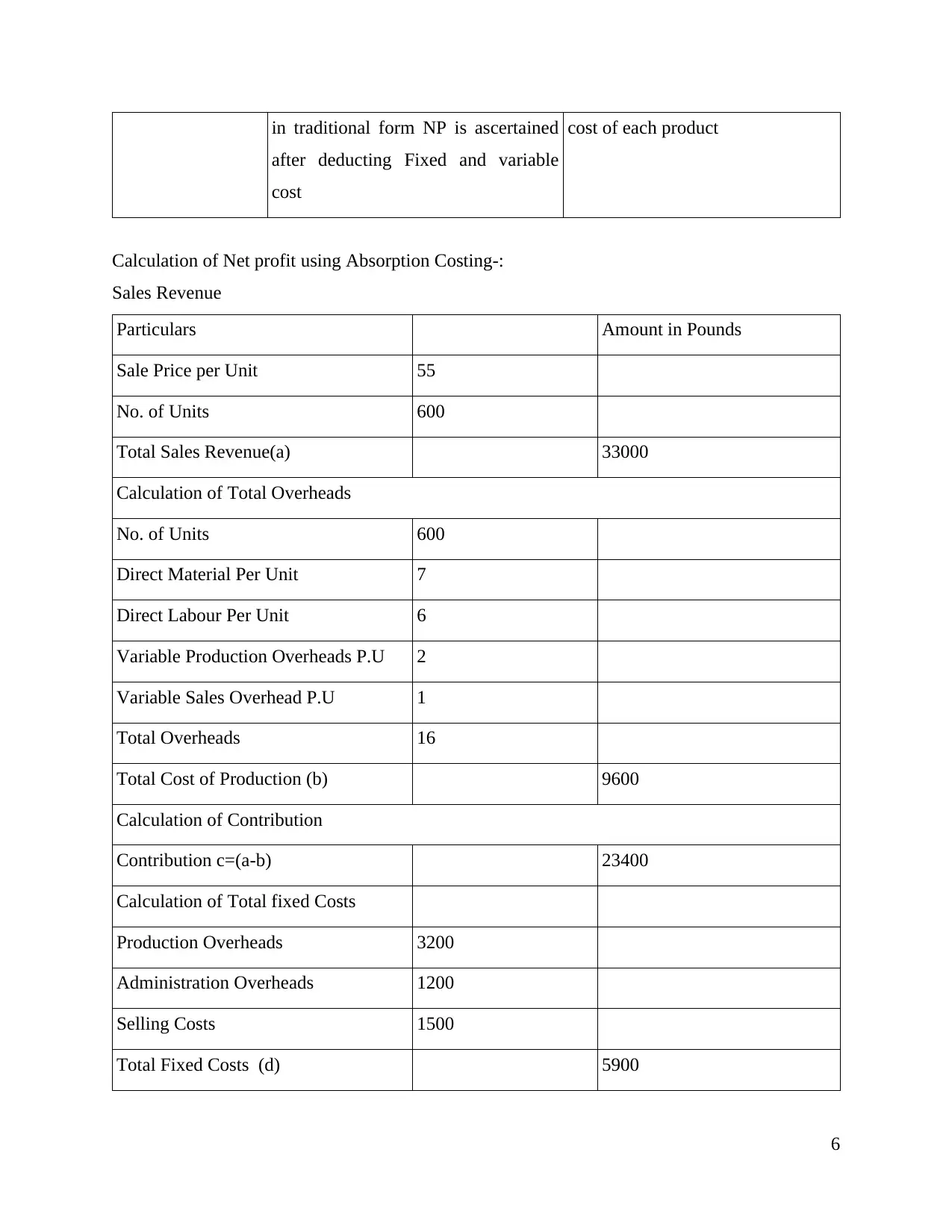
in traditional form NP is ascertained
after deducting Fixed and variable
cost
cost of each product
Calculation of Net profit using Absorption Costing-:
Sales Revenue
Particulars Amount in Pounds
Sale Price per Unit 55
No. of Units 600
Total Sales Revenue(a) 33000
Calculation of Total Overheads
No. of Units 600
Direct Material Per Unit 7
Direct Labour Per Unit 6
Variable Production Overheads P.U 2
Variable Sales Overhead P.U 1
Total Overheads 16
Total Cost of Production (b) 9600
Calculation of Contribution
Contribution c=(a-b) 23400
Calculation of Total fixed Costs
Production Overheads 3200
Administration Overheads 1200
Selling Costs 1500
Total Fixed Costs (d) 5900
6
after deducting Fixed and variable
cost
cost of each product
Calculation of Net profit using Absorption Costing-:
Sales Revenue
Particulars Amount in Pounds
Sale Price per Unit 55
No. of Units 600
Total Sales Revenue(a) 33000
Calculation of Total Overheads
No. of Units 600
Direct Material Per Unit 7
Direct Labour Per Unit 6
Variable Production Overheads P.U 2
Variable Sales Overhead P.U 1
Total Overheads 16
Total Cost of Production (b) 9600
Calculation of Contribution
Contribution c=(a-b) 23400
Calculation of Total fixed Costs
Production Overheads 3200
Administration Overheads 1200
Selling Costs 1500
Total Fixed Costs (d) 5900
6
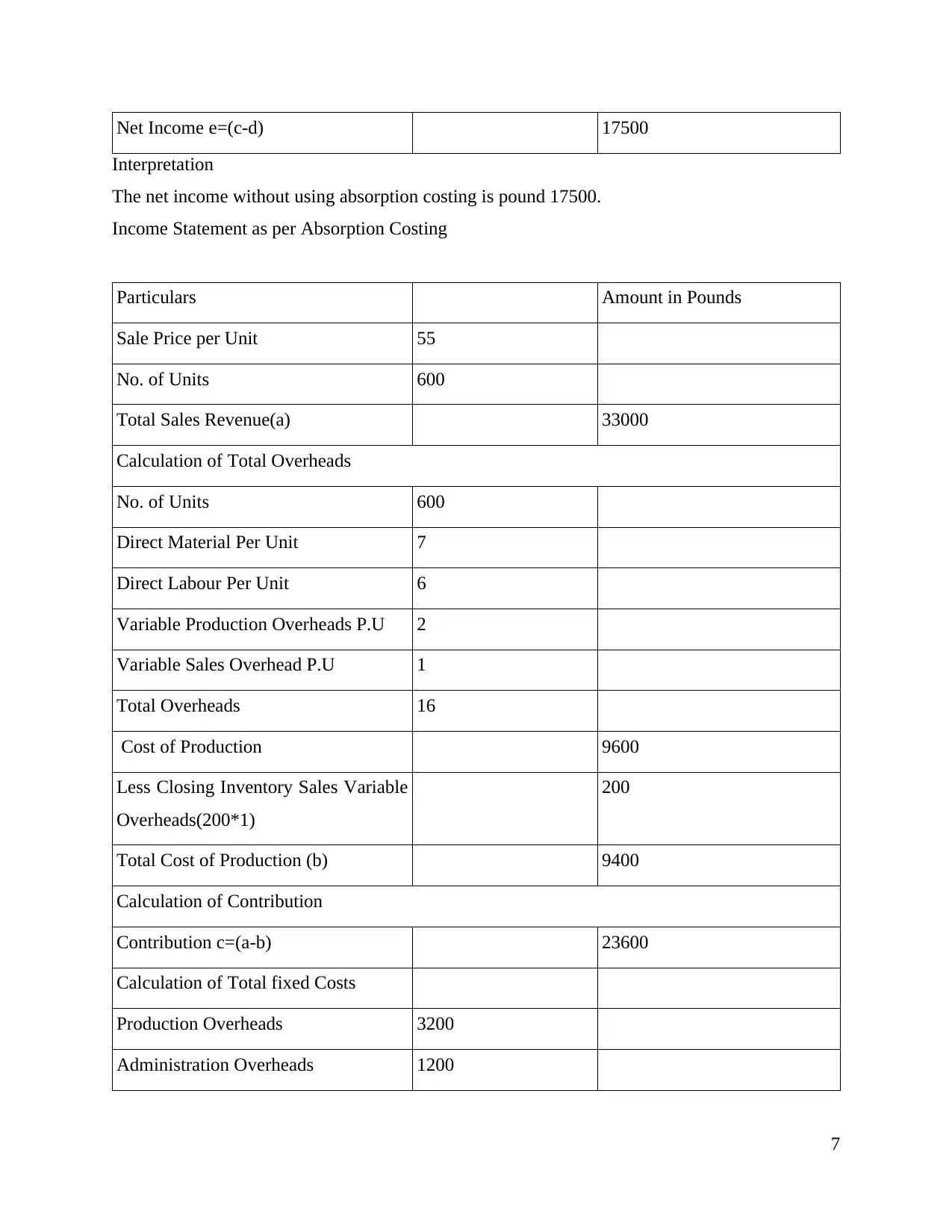
Net Income e=(c-d) 17500
Interpretation
The net income without using absorption costing is pound 17500.
Income Statement as per Absorption Costing
Particulars Amount in Pounds
Sale Price per Unit 55
No. of Units 600
Total Sales Revenue(a) 33000
Calculation of Total Overheads
No. of Units 600
Direct Material Per Unit 7
Direct Labour Per Unit 6
Variable Production Overheads P.U 2
Variable Sales Overhead P.U 1
Total Overheads 16
Cost of Production 9600
Less Closing Inventory Sales Variable
Overheads(200*1)
200
Total Cost of Production (b) 9400
Calculation of Contribution
Contribution c=(a-b) 23600
Calculation of Total fixed Costs
Production Overheads 3200
Administration Overheads 1200
7
Interpretation
The net income without using absorption costing is pound 17500.
Income Statement as per Absorption Costing
Particulars Amount in Pounds
Sale Price per Unit 55
No. of Units 600
Total Sales Revenue(a) 33000
Calculation of Total Overheads
No. of Units 600
Direct Material Per Unit 7
Direct Labour Per Unit 6
Variable Production Overheads P.U 2
Variable Sales Overhead P.U 1
Total Overheads 16
Cost of Production 9600
Less Closing Inventory Sales Variable
Overheads(200*1)
200
Total Cost of Production (b) 9400
Calculation of Contribution
Contribution c=(a-b) 23600
Calculation of Total fixed Costs
Production Overheads 3200
Administration Overheads 1200
7
⊘ This is a preview!⊘
Do you want full access?
Subscribe today to unlock all pages.
Trusted by 1+ million students worldwide
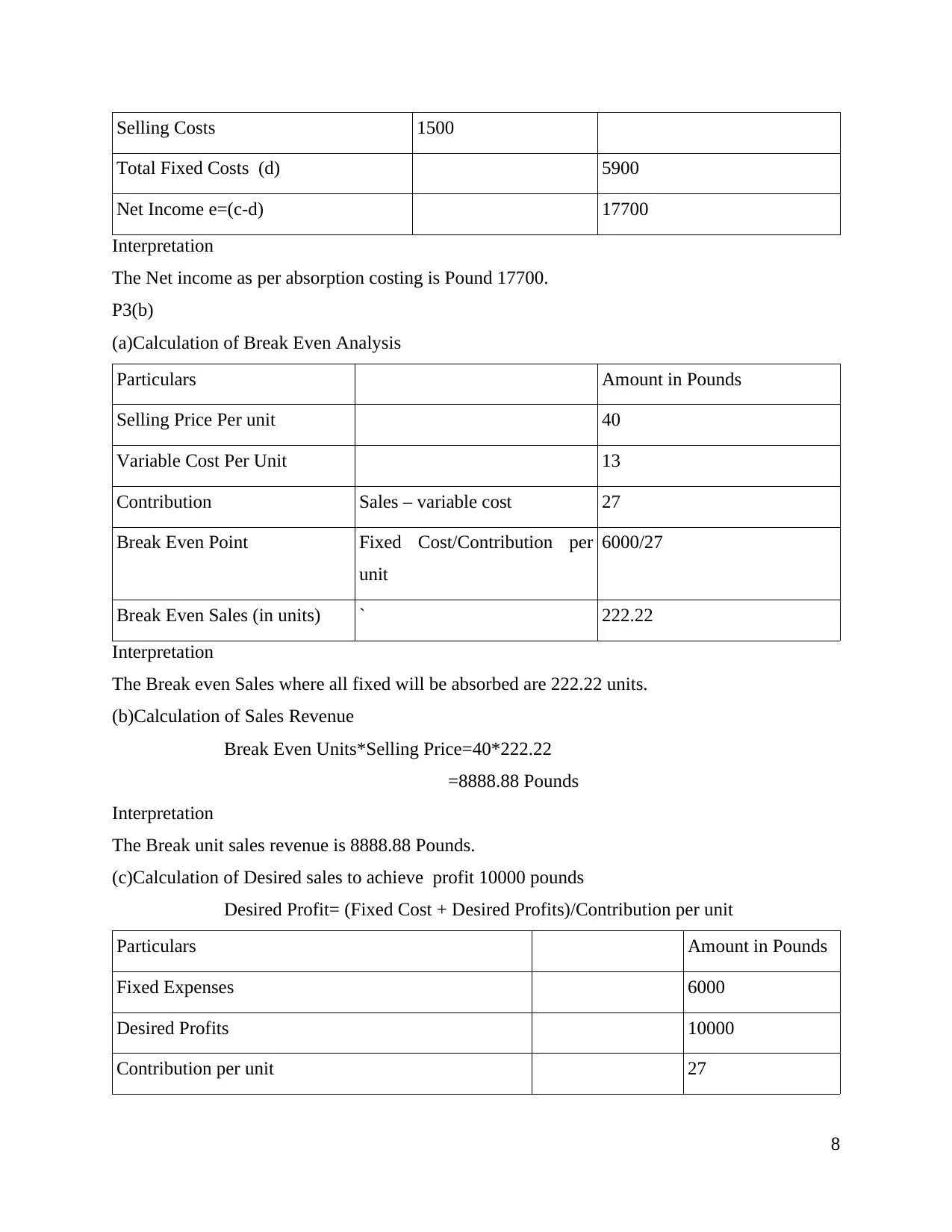
Selling Costs 1500
Total Fixed Costs (d) 5900
Net Income e=(c-d) 17700
Interpretation
The Net income as per absorption costing is Pound 17700.
P3(b)
(a)Calculation of Break Even Analysis
Particulars Amount in Pounds
Selling Price Per unit 40
Variable Cost Per Unit 13
Contribution Sales – variable cost 27
Break Even Point Fixed Cost/Contribution per
unit
6000/27
Break Even Sales (in units) ` 222.22
Interpretation
The Break even Sales where all fixed will be absorbed are 222.22 units.
(b)Calculation of Sales Revenue
Break Even Units*Selling Price=40*222.22
=8888.88 Pounds
Interpretation
The Break unit sales revenue is 8888.88 Pounds.
(c)Calculation of Desired sales to achieve profit 10000 pounds
Desired Profit= (Fixed Cost + Desired Profits)/Contribution per unit
Particulars Amount in Pounds
Fixed Expenses 6000
Desired Profits 10000
Contribution per unit 27
8
Total Fixed Costs (d) 5900
Net Income e=(c-d) 17700
Interpretation
The Net income as per absorption costing is Pound 17700.
P3(b)
(a)Calculation of Break Even Analysis
Particulars Amount in Pounds
Selling Price Per unit 40
Variable Cost Per Unit 13
Contribution Sales – variable cost 27
Break Even Point Fixed Cost/Contribution per
unit
6000/27
Break Even Sales (in units) ` 222.22
Interpretation
The Break even Sales where all fixed will be absorbed are 222.22 units.
(b)Calculation of Sales Revenue
Break Even Units*Selling Price=40*222.22
=8888.88 Pounds
Interpretation
The Break unit sales revenue is 8888.88 Pounds.
(c)Calculation of Desired sales to achieve profit 10000 pounds
Desired Profit= (Fixed Cost + Desired Profits)/Contribution per unit
Particulars Amount in Pounds
Fixed Expenses 6000
Desired Profits 10000
Contribution per unit 27
8
Paraphrase This Document
Need a fresh take? Get an instant paraphrase of this document with our AI Paraphraser
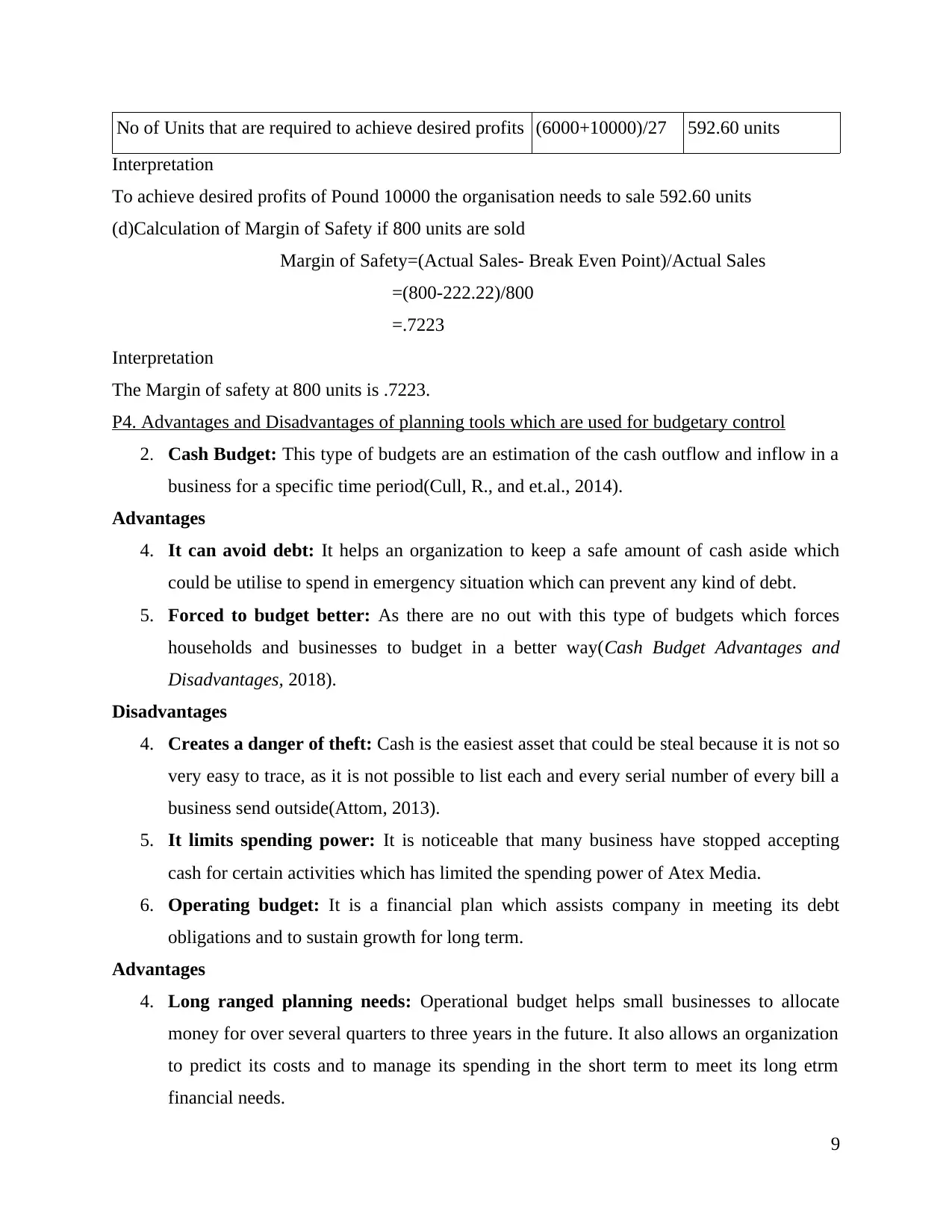
No of Units that are required to achieve desired profits (6000+10000)/27 592.60 units
Interpretation
To achieve desired profits of Pound 10000 the organisation needs to sale 592.60 units
(d)Calculation of Margin of Safety if 800 units are sold
Margin of Safety=(Actual Sales- Break Even Point)/Actual Sales
=(800-222.22)/800
=.7223
Interpretation
The Margin of safety at 800 units is .7223.
P4. Advantages and Disadvantages of planning tools which are used for budgetary control
2. Cash Budget: This type of budgets are an estimation of the cash outflow and inflow in a
business for a specific time period(Cull, R., and et.al., 2014).
Advantages
4. It can avoid debt: It helps an organization to keep a safe amount of cash aside which
could be utilise to spend in emergency situation which can prevent any kind of debt.
5. Forced to budget better: As there are no out with this type of budgets which forces
households and businesses to budget in a better way(Cash Budget Advantages and
Disadvantages, 2018).
Disadvantages
4. Creates a danger of theft: Cash is the easiest asset that could be steal because it is not so
very easy to trace, as it is not possible to list each and every serial number of every bill a
business send outside(Attom, 2013).
5. It limits spending power: It is noticeable that many business have stopped accepting
cash for certain activities which has limited the spending power of Atex Media.
6. Operating budget: It is a financial plan which assists company in meeting its debt
obligations and to sustain growth for long term.
Advantages
4. Long ranged planning needs: Operational budget helps small businesses to allocate
money for over several quarters to three years in the future. It also allows an organization
to predict its costs and to manage its spending in the short term to meet its long etrm
financial needs.
9
Interpretation
To achieve desired profits of Pound 10000 the organisation needs to sale 592.60 units
(d)Calculation of Margin of Safety if 800 units are sold
Margin of Safety=(Actual Sales- Break Even Point)/Actual Sales
=(800-222.22)/800
=.7223
Interpretation
The Margin of safety at 800 units is .7223.
P4. Advantages and Disadvantages of planning tools which are used for budgetary control
2. Cash Budget: This type of budgets are an estimation of the cash outflow and inflow in a
business for a specific time period(Cull, R., and et.al., 2014).
Advantages
4. It can avoid debt: It helps an organization to keep a safe amount of cash aside which
could be utilise to spend in emergency situation which can prevent any kind of debt.
5. Forced to budget better: As there are no out with this type of budgets which forces
households and businesses to budget in a better way(Cash Budget Advantages and
Disadvantages, 2018).
Disadvantages
4. Creates a danger of theft: Cash is the easiest asset that could be steal because it is not so
very easy to trace, as it is not possible to list each and every serial number of every bill a
business send outside(Attom, 2013).
5. It limits spending power: It is noticeable that many business have stopped accepting
cash for certain activities which has limited the spending power of Atex Media.
6. Operating budget: It is a financial plan which assists company in meeting its debt
obligations and to sustain growth for long term.
Advantages
4. Long ranged planning needs: Operational budget helps small businesses to allocate
money for over several quarters to three years in the future. It also allows an organization
to predict its costs and to manage its spending in the short term to meet its long etrm
financial needs.
9
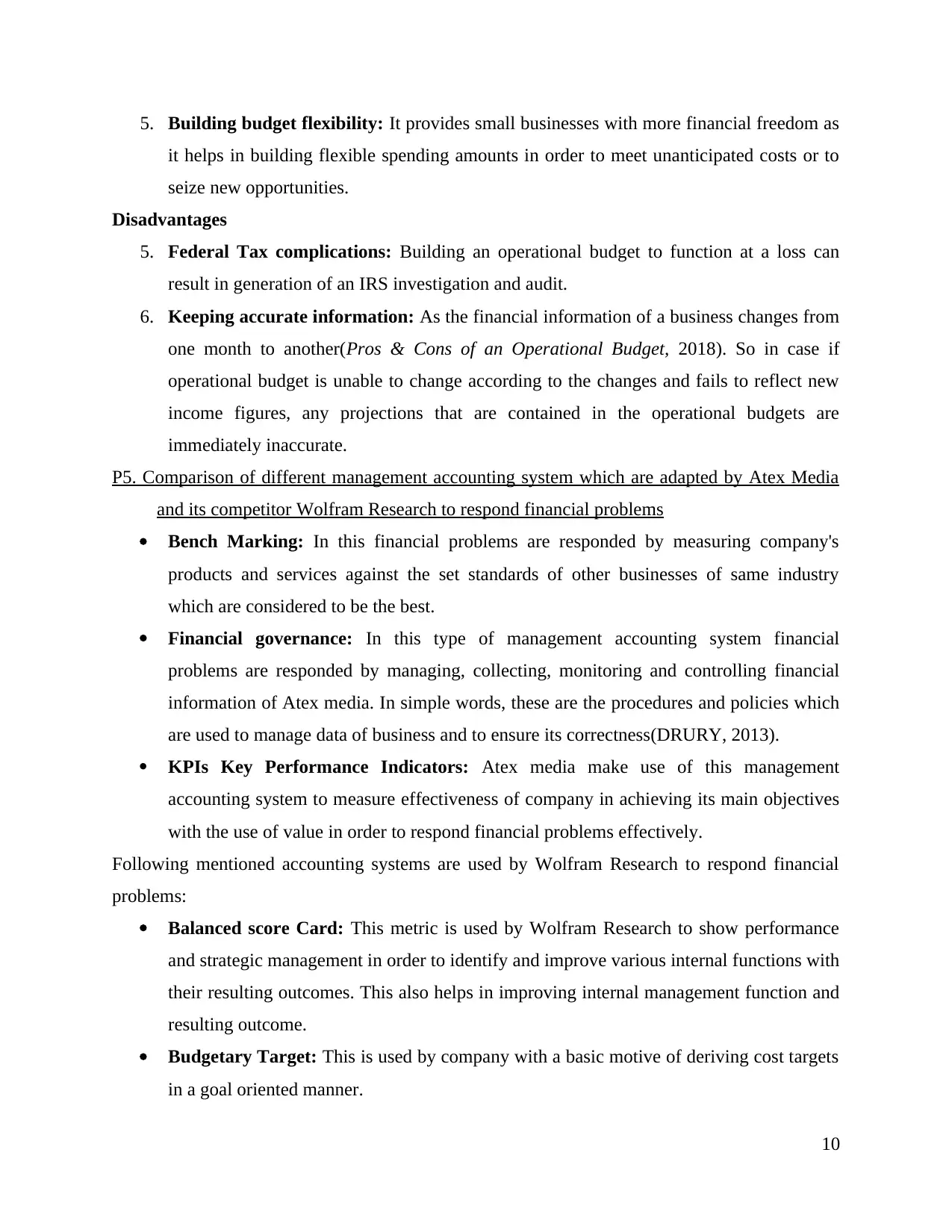
5. Building budget flexibility: It provides small businesses with more financial freedom as
it helps in building flexible spending amounts in order to meet unanticipated costs or to
seize new opportunities.
Disadvantages
5. Federal Tax complications: Building an operational budget to function at a loss can
result in generation of an IRS investigation and audit.
6. Keeping accurate information: As the financial information of a business changes from
one month to another(Pros & Cons of an Operational Budget, 2018). So in case if
operational budget is unable to change according to the changes and fails to reflect new
income figures, any projections that are contained in the operational budgets are
immediately inaccurate.
P5. Comparison of different management accounting system which are adapted by Atex Media
and its competitor Wolfram Research to respond financial problems
Bench Marking: In this financial problems are responded by measuring company's
products and services against the set standards of other businesses of same industry
which are considered to be the best.
Financial governance: In this type of management accounting system financial
problems are responded by managing, collecting, monitoring and controlling financial
information of Atex media. In simple words, these are the procedures and policies which
are used to manage data of business and to ensure its correctness(DRURY, 2013).
KPIs Key Performance Indicators: Atex media make use of this management
accounting system to measure effectiveness of company in achieving its main objectives
with the use of value in order to respond financial problems effectively.
Following mentioned accounting systems are used by Wolfram Research to respond financial
problems:
Balanced score Card: This metric is used by Wolfram Research to show performance
and strategic management in order to identify and improve various internal functions with
their resulting outcomes. This also helps in improving internal management function and
resulting outcome.
Budgetary Target: This is used by company with a basic motive of deriving cost targets
in a goal oriented manner.
10
it helps in building flexible spending amounts in order to meet unanticipated costs or to
seize new opportunities.
Disadvantages
5. Federal Tax complications: Building an operational budget to function at a loss can
result in generation of an IRS investigation and audit.
6. Keeping accurate information: As the financial information of a business changes from
one month to another(Pros & Cons of an Operational Budget, 2018). So in case if
operational budget is unable to change according to the changes and fails to reflect new
income figures, any projections that are contained in the operational budgets are
immediately inaccurate.
P5. Comparison of different management accounting system which are adapted by Atex Media
and its competitor Wolfram Research to respond financial problems
Bench Marking: In this financial problems are responded by measuring company's
products and services against the set standards of other businesses of same industry
which are considered to be the best.
Financial governance: In this type of management accounting system financial
problems are responded by managing, collecting, monitoring and controlling financial
information of Atex media. In simple words, these are the procedures and policies which
are used to manage data of business and to ensure its correctness(DRURY, 2013).
KPIs Key Performance Indicators: Atex media make use of this management
accounting system to measure effectiveness of company in achieving its main objectives
with the use of value in order to respond financial problems effectively.
Following mentioned accounting systems are used by Wolfram Research to respond financial
problems:
Balanced score Card: This metric is used by Wolfram Research to show performance
and strategic management in order to identify and improve various internal functions with
their resulting outcomes. This also helps in improving internal management function and
resulting outcome.
Budgetary Target: This is used by company with a basic motive of deriving cost targets
in a goal oriented manner.
10
⊘ This is a preview!⊘
Do you want full access?
Subscribe today to unlock all pages.
Trusted by 1+ million students worldwide

1 out of 16


Related Documents


Your All-in-One AI-Powered Toolkit for Academic Success.
+13062052269
info@desklib.com
Available 24*7 on WhatsApp / Email
![[object Object]](/_next/static/media/star-bottom.7253800d.svg)
Unlock your academic potential
Copyright © 2020–2026 A2Z Services. All Rights Reserved. Developed and managed by ZUCOL.