Unit 5 Management Accounting Report: Costing Techniques and Reporting
VerifiedAdded on 2020/06/03
|17
|4362
|44
Report
AI Summary
This report, prepared for a General Manager (GM), delves into the principles of management accounting, emphasizing its importance for internal decision-making within an organization. It explores various management accounting systems and highlights the differences between financial and managerial accounting. The report examines different reporting methods, including job cost reports, inventory management reports, operating budget reports, and product/service profitability reports. It provides detailed calculations and comparisons of marginal and absorption costing techniques, including income statements for each method. Furthermore, it analyzes the advantages and disadvantages of planning tools used for budgetary control and discusses how organizations adapt management accounting systems to address financial challenges. The report concludes by summarizing key findings and providing a comprehensive overview of the topics discussed.
Unit 5
Management Accounting
Management Accounting

Paraphrase This Document
Need a fresh take? Get an instant paraphrase of this document with our AI Paraphraser
Table of Contents
Introduction...........................................................................................................................................3
P1: Explaining Management Accounting and Providing Essential Requirements of Different types
of Management Accounting System..................................................................................................4
P2: Explaining Different Methods Used for Management Accounting Reporting..............................5
Task 2.....................................................................................................................................................9
P3: Calculation of Costs Using Appropriate Techniques of Cost Analysis for Preparing an Income
Statement Using Marginal and Absorption Costs..............................................................................9
Task 3...................................................................................................................................................11
P4: Explaining the Advantages and Disadvantages of Different Types of Planning Tools Used for
Budgetary Control............................................................................................................................11
Task 4...................................................................................................................................................13
P5: Comparing How Organisations are Adapting Management Accounting Systems to Respond to
Financial Problems...........................................................................................................................13
Conclusion...........................................................................................................................................15
References...........................................................................................................................................16
REPORT
Introduction...........................................................................................................................................3
P1: Explaining Management Accounting and Providing Essential Requirements of Different types
of Management Accounting System..................................................................................................4
P2: Explaining Different Methods Used for Management Accounting Reporting..............................5
Task 2.....................................................................................................................................................9
P3: Calculation of Costs Using Appropriate Techniques of Cost Analysis for Preparing an Income
Statement Using Marginal and Absorption Costs..............................................................................9
Task 3...................................................................................................................................................11
P4: Explaining the Advantages and Disadvantages of Different Types of Planning Tools Used for
Budgetary Control............................................................................................................................11
Task 4...................................................................................................................................................13
P5: Comparing How Organisations are Adapting Management Accounting Systems to Respond to
Financial Problems...........................................................................................................................13
Conclusion...........................................................................................................................................15
References...........................................................................................................................................16
REPORT
From: MAO
To: GM
Subject: To write a report to GM covering management accounting and
management accounting system together with different costing techniques
and reporting to enable the organization implement them.
Introduction
In general that report is widely used across the world market which is known as financial
accounting. In any annual report of a certain company we can get financial statements of that
company, financial statements includes different five methods of performance those are
income statement, balance sheet, cash flow statement, changes in stockholder’s equity and
equity statement. Financial accounting is prepared for publishing in the public market, apart
from market publication there is an internal side. Managerial Accounting plays an important
role for internal stakeholders. Managerial accounting is the base ground of all financial
statements which determines the production volume and revenue of the entire company.
There are some advantages and disadvantages of different methods of management
accounting systems. Management can follow any of several tools for calculation of net profit
in the aspect of management accounting.
To: GM
Subject: To write a report to GM covering management accounting and
management accounting system together with different costing techniques
and reporting to enable the organization implement them.
Introduction
In general that report is widely used across the world market which is known as financial
accounting. In any annual report of a certain company we can get financial statements of that
company, financial statements includes different five methods of performance those are
income statement, balance sheet, cash flow statement, changes in stockholder’s equity and
equity statement. Financial accounting is prepared for publishing in the public market, apart
from market publication there is an internal side. Managerial Accounting plays an important
role for internal stakeholders. Managerial accounting is the base ground of all financial
statements which determines the production volume and revenue of the entire company.
There are some advantages and disadvantages of different methods of management
accounting systems. Management can follow any of several tools for calculation of net profit
in the aspect of management accounting.
⊘ This is a preview!⊘
Do you want full access?
Subscribe today to unlock all pages.

Trusted by 1+ million students worldwide
P1
Management Accounting:The aim of management accounting is to provide necessary
information and to help managers for taking day to day decisions. Basically management
accounting is prepared solely for internal purposes. The crucial difference between financial
accounting and management accounting is financial accounting is prepared for outside of the
organisation such as for shareholders, public and tax authority on the other hand managerial
accounting is prepared for internal organisation such as managers and employees. Financial
accounting follows formal procedures where managerial accounting doesn’t need to go
through the all steps of financial accounting; it only fulfils the some essential criteria.
Management accounting is too mandatory for operation managers; they are helpless without
management accounting. Operational managers take day to day decision from management
accounting. For example management accounting provides the information of how many
units need to be produced, what is the current margin, margin ratio, we can find out break-
even point by using the tools of managerial accounting (Britton and Waterston, 2013). After
producing in which level our production cost will compensate the total revenue and in which
stage variable cost is lowest. It is the process of identifying, measuring, analysing and
communicating all the essential information of organisation transaction. In this definition
identifying is generally known as journal, measuring is known to all as ledger, analysing
means to preparing trial balances and communicating indicates showing the outcomes in the
income statement and balance sheet. Management accounting accumulates the revenue, cash
flow, production unit, variable cost per unit and fixed cost of total production process.
Management accounting is too concerned about raw materials, sales revenue, production cost,
labour cost, manufacturing cost and other overhead cost (Christensen, Cottrell and Budd,
2016).
Management Accounting System: The goal of management accounting system is to provide
the best tools for the managers and to attain best performance for organisation. The system of
management accounting gives the path for solving day to day manufacturing related problems
and run the business activities easily. There is break down of management accounting such as
margin analysis, constraint analysis, capital budgeting, trend analysis and forecasting, product
valuation and costing and so on. Managers have some necessary responsibilities, among them
most important responsibilities are planning, directing and controlling. These are the role of
management accounting, planning, organising, controlling and decision taking. Managerial
accounting is viewed as internal accounting most of the times. Management accounting
system gathers different financial data from the operations like sales information; raw
materials data and inventory related data then analyse these sorts of data for preparing output
which help to make decision for better performances (Acikerisim.deu.edu.tr, 2017).
Managers who are responsible for managing the function of management accounting look
after the existing data of organisation and then start to analyse the previous shortcomings.
They give priorities on comparison between cost budget and actual budget. They prepare
different types of report and include several methodologies in those reports. Sales report,
Management Accounting:The aim of management accounting is to provide necessary
information and to help managers for taking day to day decisions. Basically management
accounting is prepared solely for internal purposes. The crucial difference between financial
accounting and management accounting is financial accounting is prepared for outside of the
organisation such as for shareholders, public and tax authority on the other hand managerial
accounting is prepared for internal organisation such as managers and employees. Financial
accounting follows formal procedures where managerial accounting doesn’t need to go
through the all steps of financial accounting; it only fulfils the some essential criteria.
Management accounting is too mandatory for operation managers; they are helpless without
management accounting. Operational managers take day to day decision from management
accounting. For example management accounting provides the information of how many
units need to be produced, what is the current margin, margin ratio, we can find out break-
even point by using the tools of managerial accounting (Britton and Waterston, 2013). After
producing in which level our production cost will compensate the total revenue and in which
stage variable cost is lowest. It is the process of identifying, measuring, analysing and
communicating all the essential information of organisation transaction. In this definition
identifying is generally known as journal, measuring is known to all as ledger, analysing
means to preparing trial balances and communicating indicates showing the outcomes in the
income statement and balance sheet. Management accounting accumulates the revenue, cash
flow, production unit, variable cost per unit and fixed cost of total production process.
Management accounting is too concerned about raw materials, sales revenue, production cost,
labour cost, manufacturing cost and other overhead cost (Christensen, Cottrell and Budd,
2016).
Management Accounting System: The goal of management accounting system is to provide
the best tools for the managers and to attain best performance for organisation. The system of
management accounting gives the path for solving day to day manufacturing related problems
and run the business activities easily. There is break down of management accounting such as
margin analysis, constraint analysis, capital budgeting, trend analysis and forecasting, product
valuation and costing and so on. Managers have some necessary responsibilities, among them
most important responsibilities are planning, directing and controlling. These are the role of
management accounting, planning, organising, controlling and decision taking. Managerial
accounting is viewed as internal accounting most of the times. Management accounting
system gathers different financial data from the operations like sales information; raw
materials data and inventory related data then analyse these sorts of data for preparing output
which help to make decision for better performances (Acikerisim.deu.edu.tr, 2017).
Managers who are responsible for managing the function of management accounting look
after the existing data of organisation and then start to analyse the previous shortcomings.
They give priorities on comparison between cost budget and actual budget. They prepare
different types of report and include several methodologies in those reports. Sales report,
Paraphrase This Document
Need a fresh take? Get an instant paraphrase of this document with our AI Paraphraser
expense report and budget report are among them. They understand the real scenario when
they compare budgeted expenses and actual expenses (Crosson and Needles, 2014).
In this particular organisation management accounting will have its own benefits. As this
organisation is into production and produces different products so management accounting
will be beneficial in analysing the cost of production and also the margin that each product
yields. Further zero based budgeting techniques that are based on management accounting
principles would be beneficial for preparing the budgets. There are several products that are
being manufactured and therefore it is important to understand the contribution of each
product. Further, management accounting also ensures that the overhead costs are calculated
separately and as such the management can focus on lowering the overheads. Management
accounting will also be beneficial for analysing each product and products which are not
performing well can be modified or can be stopped. The profitability of the organisation will
enhance when management accounting principles are implemented within this organisation
P2
Management accounting uses various forms of reporting and in this section four such reports
will be discussed. The following are four types of reporting that are used for management
accounting reporting
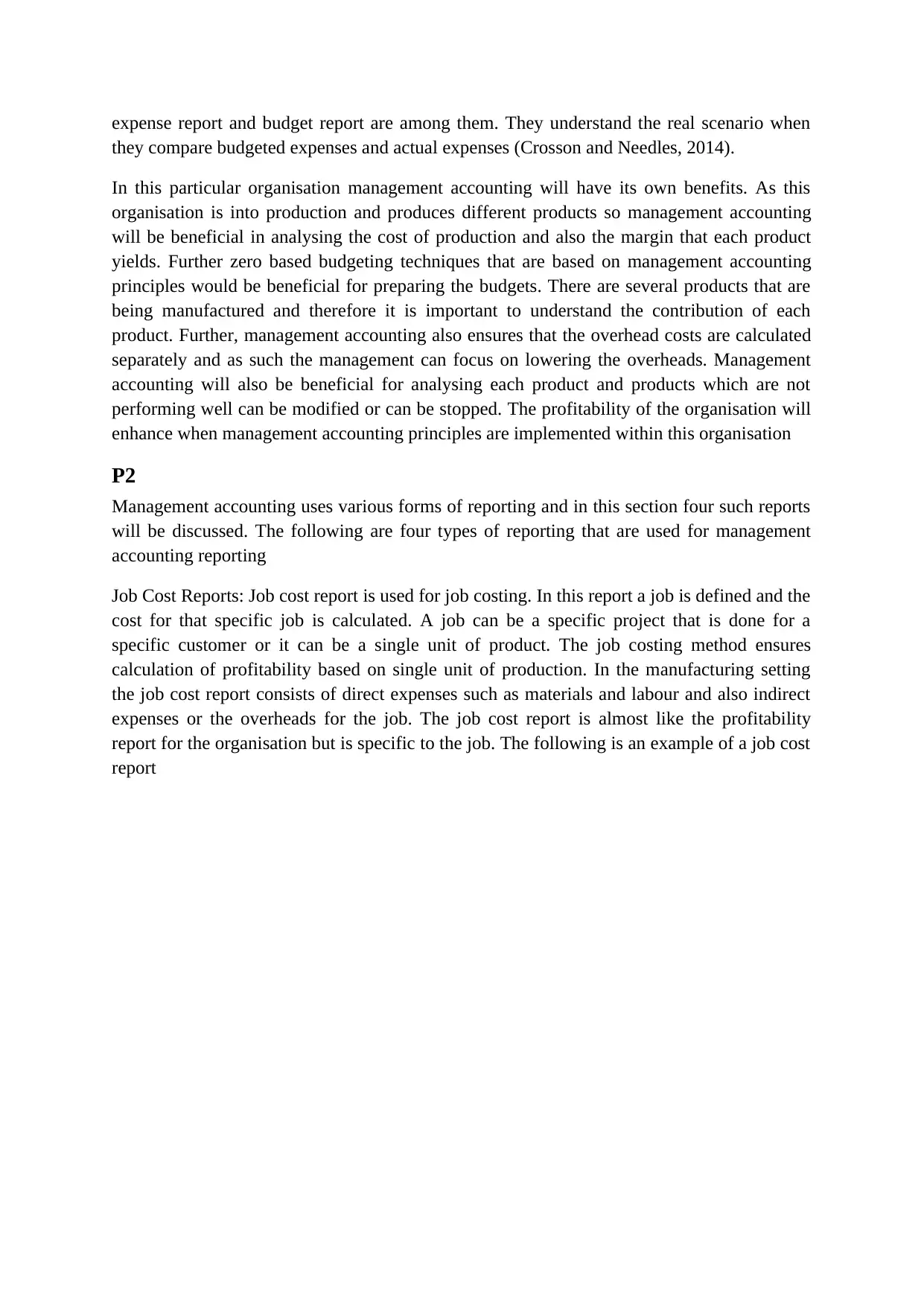
Job Cost Reports: Job cost report is used for job costing. In this report a job is defined and the
cost for that specific job is calculated. A job can be a specific project that is done for a
specific customer or it can be a single unit of product. The job costing method ensures
calculation of profitability based on single unit of production. In the manufacturing setting
the job cost report consists of direct expenses such as materials and labour and also indirect
expenses or the overheads for the job. The job cost report is almost like the profitability
report for the organisation but is specific to the job. The following is an example of a job cost
report
they compare budgeted expenses and actual expenses (Crosson and Needles, 2014).
In this particular organisation management accounting will have its own benefits. As this
organisation is into production and produces different products so management accounting
will be beneficial in analysing the cost of production and also the margin that each product
yields. Further zero based budgeting techniques that are based on management accounting
principles would be beneficial for preparing the budgets. There are several products that are
being manufactured and therefore it is important to understand the contribution of each
product. Further, management accounting also ensures that the overhead costs are calculated
separately and as such the management can focus on lowering the overheads. Management
accounting will also be beneficial for analysing each product and products which are not
performing well can be modified or can be stopped. The profitability of the organisation will
enhance when management accounting principles are implemented within this organisation
P2
Management accounting uses various forms of reporting and in this section four such reports
will be discussed. The following are four types of reporting that are used for management
accounting reporting
Job Cost Reports: Job cost report is used for job costing. In this report a job is defined and the
cost for that specific job is calculated. A job can be a specific project that is done for a
specific customer or it can be a single unit of product. The job costing method ensures
calculation of profitability based on single unit of production. In the manufacturing setting
the job cost report consists of direct expenses such as materials and labour and also indirect
expenses or the overheads for the job. The job cost report is almost like the profitability
report for the organisation but is specific to the job. The following is an example of a job cost
report
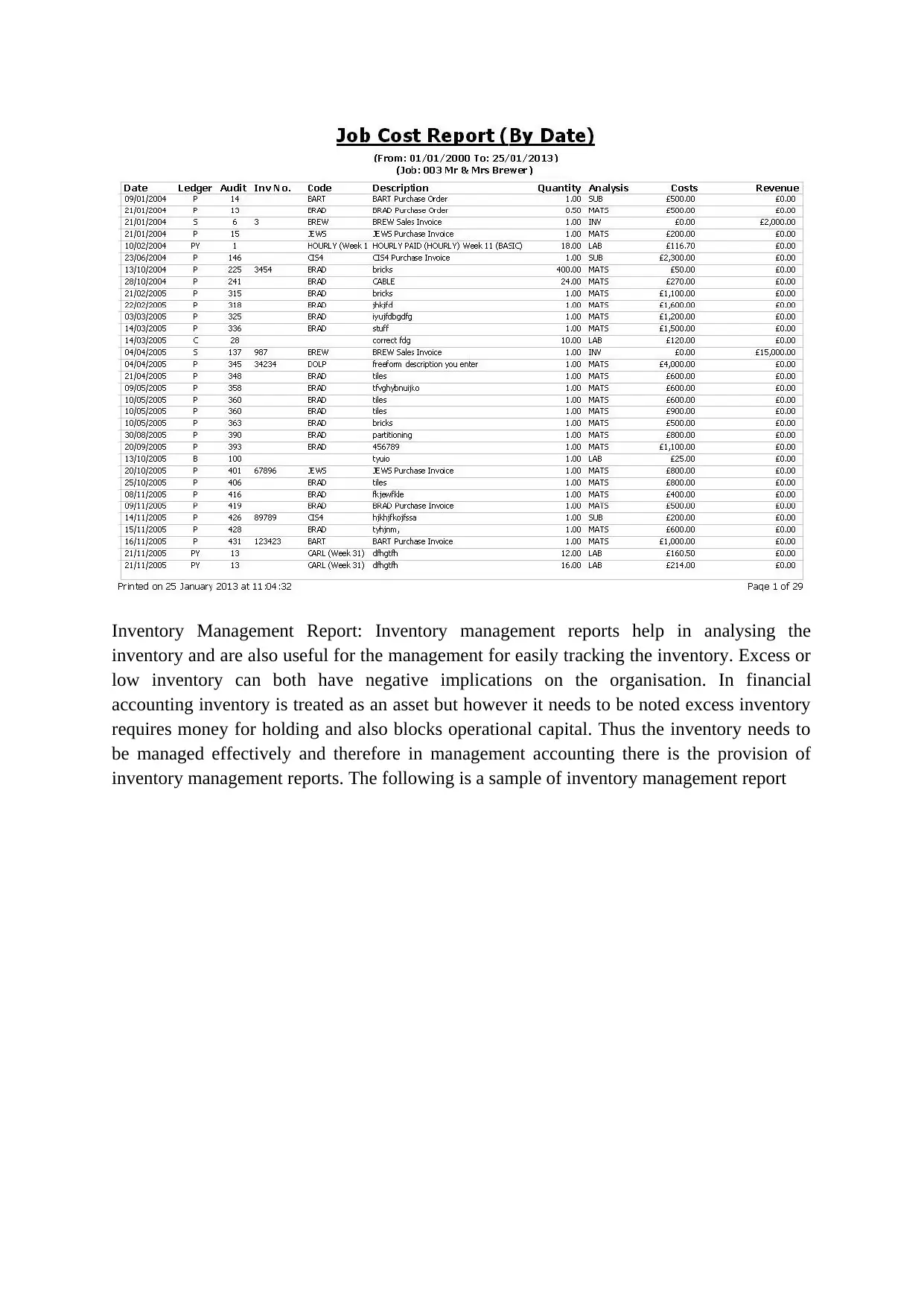
Inventory Management Report: Inventory management reports help in analysing the
inventory and are also useful for the management for easily tracking the inventory. Excess or
low inventory can both have negative implications on the organisation. In financial
accounting inventory is treated as an asset but however it needs to be noted excess inventory
requires money for holding and also blocks operational capital. Thus the inventory needs to
be managed effectively and therefore in management accounting there is the provision of
inventory management reports. The following is a sample of inventory management report
inventory and are also useful for the management for easily tracking the inventory. Excess or
low inventory can both have negative implications on the organisation. In financial
accounting inventory is treated as an asset but however it needs to be noted excess inventory
requires money for holding and also blocks operational capital. Thus the inventory needs to
be managed effectively and therefore in management accounting there is the provision of
inventory management reports. The following is a sample of inventory management report
⊘ This is a preview!⊘
Do you want full access?
Subscribe today to unlock all pages.
Trusted by 1+ million students worldwide
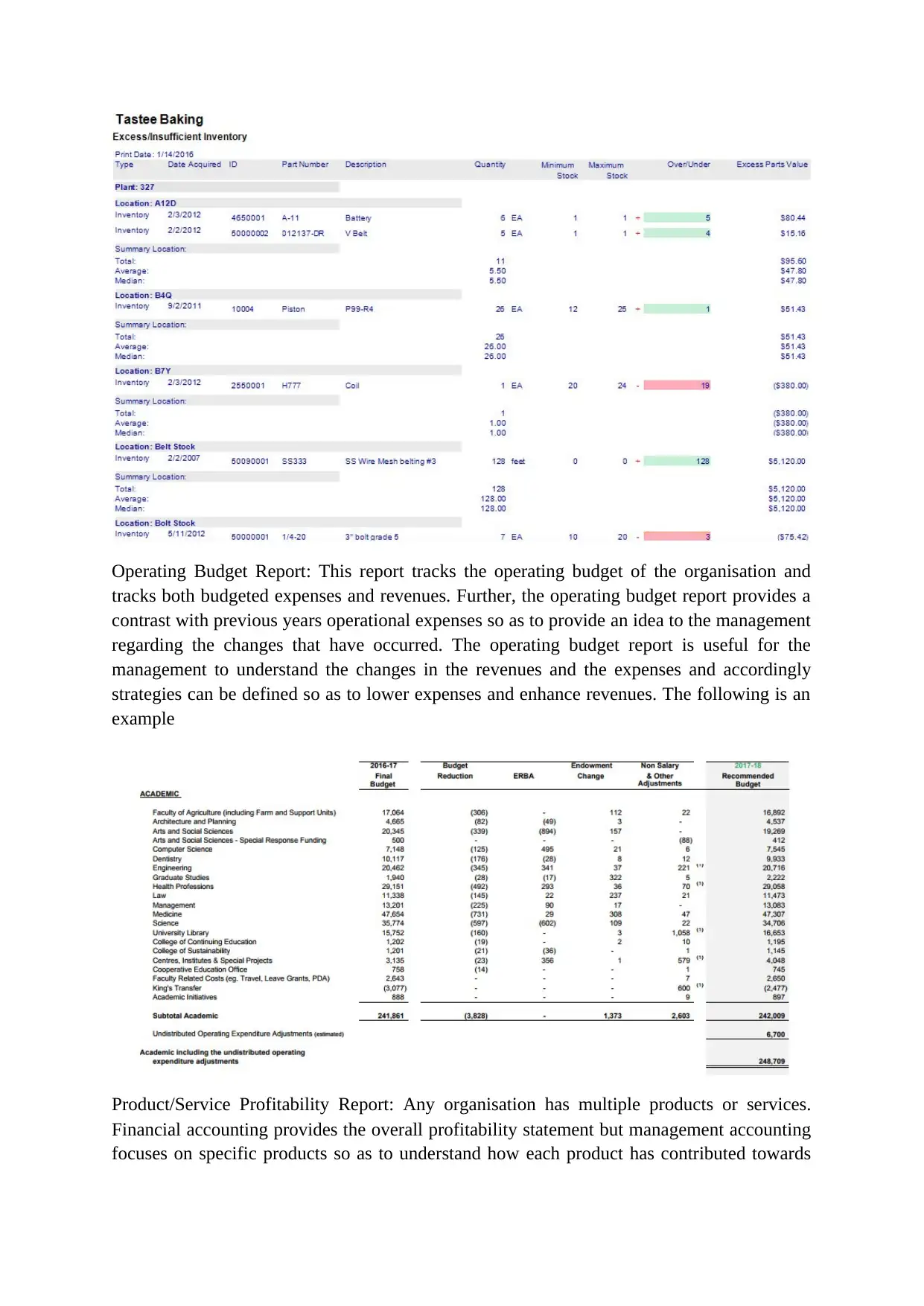
Operating Budget Report: This report tracks the operating budget of the organisation and
tracks both budgeted expenses and revenues. Further, the operating budget report provides a
contrast with previous years operational expenses so as to provide an idea to the management
regarding the changes that have occurred. The operating budget report is useful for the
management to understand the changes in the revenues and the expenses and accordingly
strategies can be defined so as to lower expenses and enhance revenues. The following is an
example
Product/Service Profitability Report: Any organisation has multiple products or services.
Financial accounting provides the overall profitability statement but management accounting
focuses on specific products so as to understand how each product has contributed towards
tracks both budgeted expenses and revenues. Further, the operating budget report provides a
contrast with previous years operational expenses so as to provide an idea to the management
regarding the changes that have occurred. The operating budget report is useful for the
management to understand the changes in the revenues and the expenses and accordingly
strategies can be defined so as to lower expenses and enhance revenues. The following is an
example
Product/Service Profitability Report: Any organisation has multiple products or services.
Financial accounting provides the overall profitability statement but management accounting
focuses on specific products so as to understand how each product has contributed towards
Paraphrase This Document
Need a fresh take? Get an instant paraphrase of this document with our AI Paraphraser
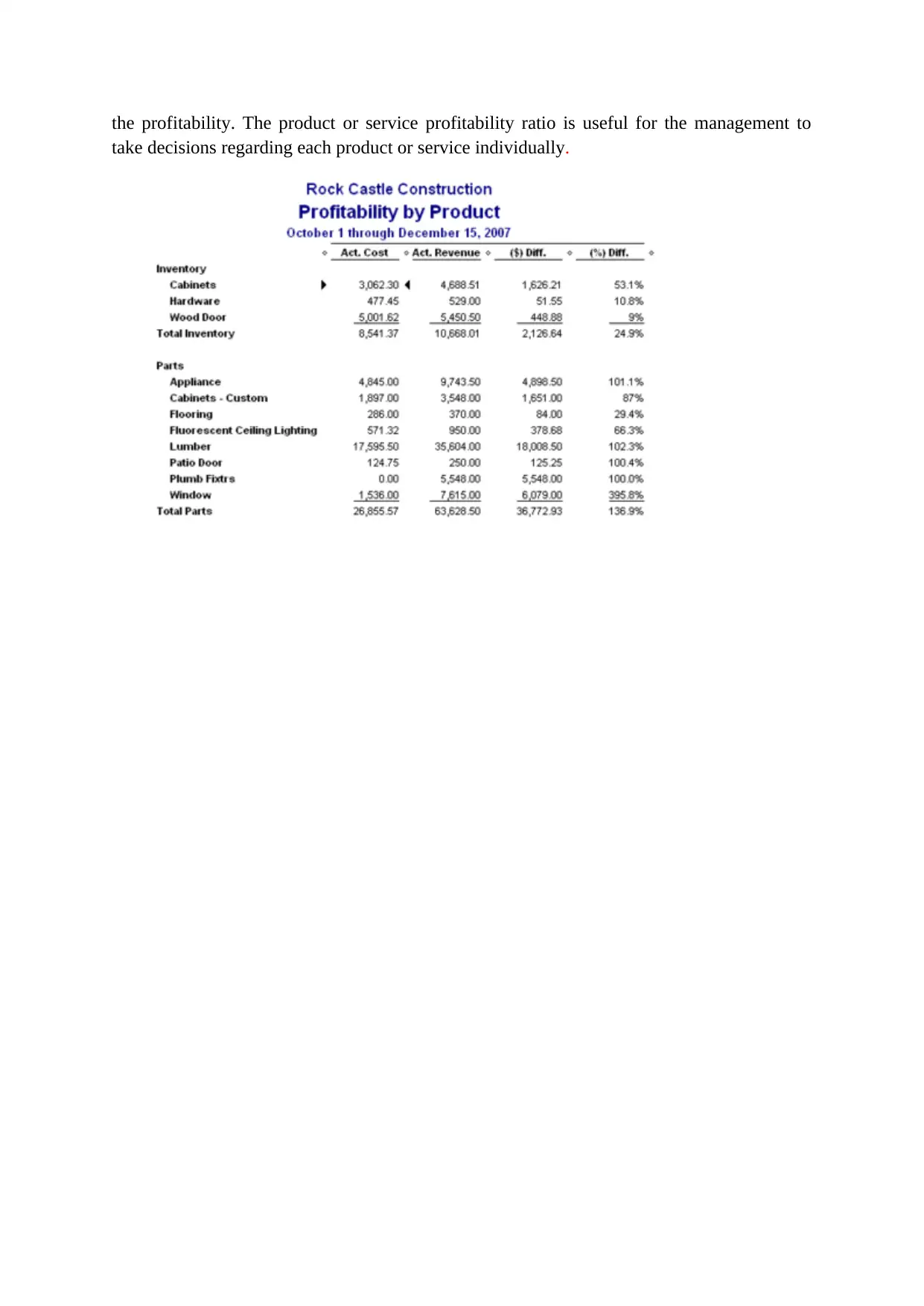
the profitability. The product or service profitability ratio is useful for the management to
take decisions regarding each product or service individually.
take decisions regarding each product or service individually.
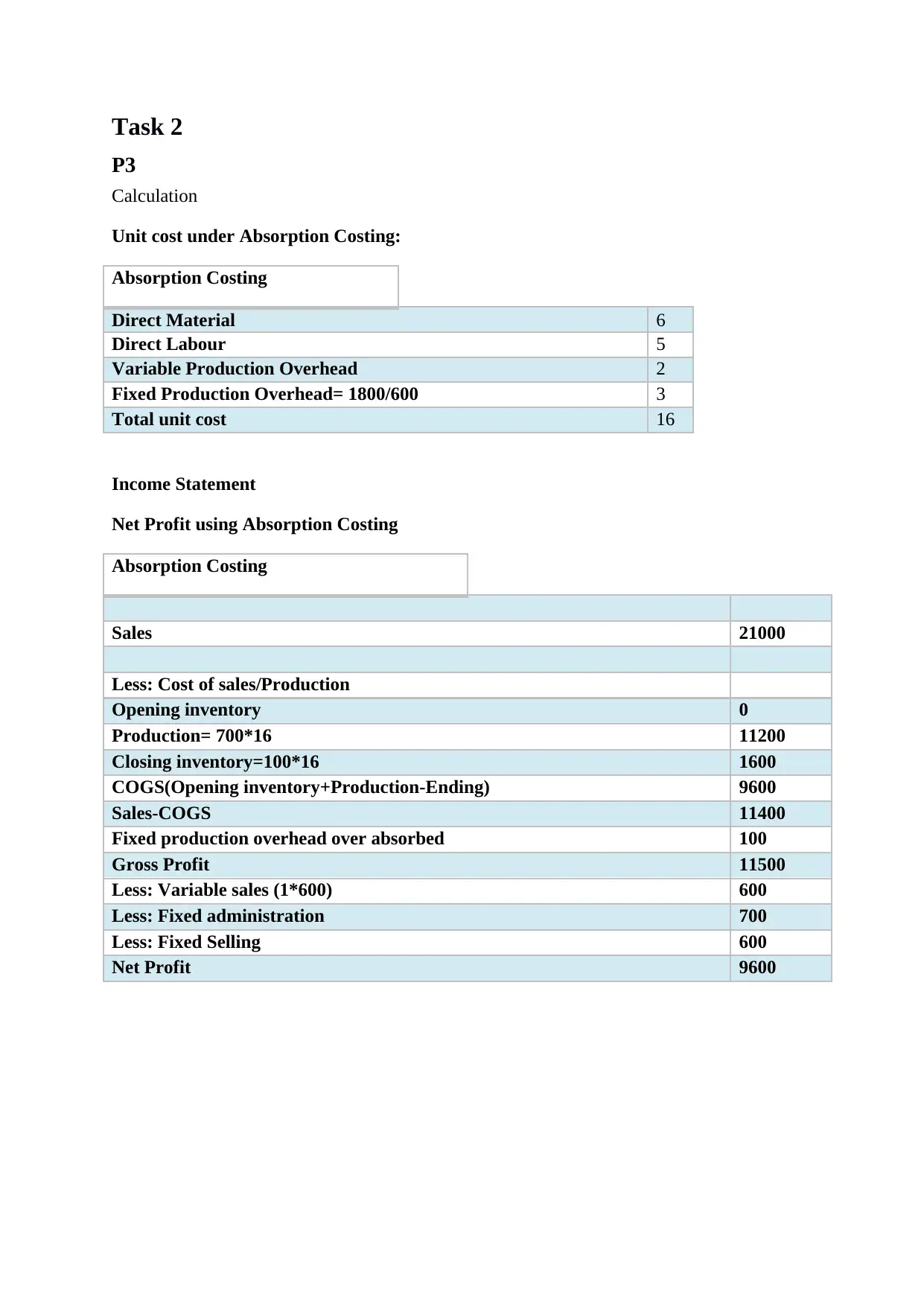
Task 2
P3
Calculation
Unit cost under Absorption Costing:
Absorption Costing
Direct Material 6
Direct Labour 5
Variable Production Overhead 2
Fixed Production Overhead= 1800/600 3
Total unit cost 16
Income Statement
Net Profit using Absorption Costing
Absorption Costing
Sales 21000
Less: Cost of sales/Production
Opening inventory 0
Production= 700*16 11200
Closing inventory=100*16 1600
COGS(Opening inventory+Production-Ending) 9600
Sales-COGS 11400
Fixed production overhead over absorbed 100
Gross Profit 11500
Less: Variable sales (1*600) 600
Less: Fixed administration 700
Less: Fixed Selling 600
Net Profit 9600
P3
Calculation
Unit cost under Absorption Costing:
Absorption Costing
Direct Material 6
Direct Labour 5
Variable Production Overhead 2
Fixed Production Overhead= 1800/600 3
Total unit cost 16
Income Statement
Net Profit using Absorption Costing
Absorption Costing
Sales 21000
Less: Cost of sales/Production
Opening inventory 0
Production= 700*16 11200
Closing inventory=100*16 1600
COGS(Opening inventory+Production-Ending) 9600
Sales-COGS 11400
Fixed production overhead over absorbed 100
Gross Profit 11500
Less: Variable sales (1*600) 600
Less: Fixed administration 700
Less: Fixed Selling 600
Net Profit 9600
⊘ This is a preview!⊘
Do you want full access?
Subscribe today to unlock all pages.
Trusted by 1+ million students worldwide
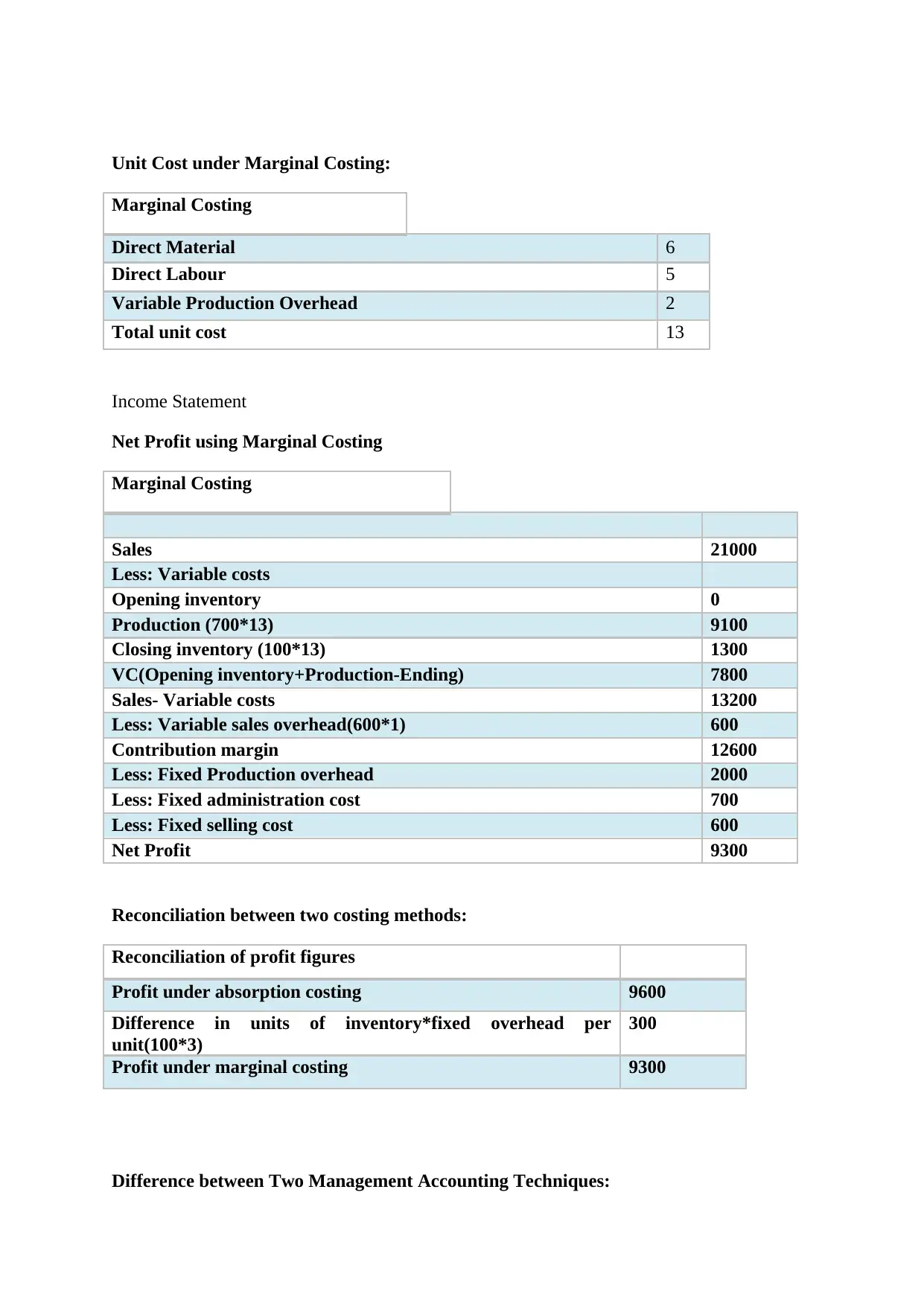
Unit Cost under Marginal Costing:
Marginal Costing
Direct Material 6
Direct Labour 5
Variable Production Overhead 2
Total unit cost 13
Income Statement
Net Profit using Marginal Costing
Marginal Costing
Sales 21000
Less: Variable costs
Opening inventory 0
Production (700*13) 9100
Closing inventory (100*13) 1300
VC(Opening inventory+Production-Ending) 7800
Sales- Variable costs 13200
Less: Variable sales overhead(600*1) 600
Contribution margin 12600
Less: Fixed Production overhead 2000
Less: Fixed administration cost 700
Less: Fixed selling cost 600
Net Profit 9300
Reconciliation between two costing methods:
Reconciliation of profit figures
Profit under absorption costing 9600
Difference in units of inventory*fixed overhead per
unit(100*3)
300
Profit under marginal costing 9300
Difference between Two Management Accounting Techniques:
Marginal Costing
Direct Material 6
Direct Labour 5
Variable Production Overhead 2
Total unit cost 13
Income Statement
Net Profit using Marginal Costing
Marginal Costing
Sales 21000
Less: Variable costs
Opening inventory 0
Production (700*13) 9100
Closing inventory (100*13) 1300
VC(Opening inventory+Production-Ending) 7800
Sales- Variable costs 13200
Less: Variable sales overhead(600*1) 600
Contribution margin 12600
Less: Fixed Production overhead 2000
Less: Fixed administration cost 700
Less: Fixed selling cost 600
Net Profit 9300
Reconciliation between two costing methods:
Reconciliation of profit figures
Profit under absorption costing 9600
Difference in units of inventory*fixed overhead per
unit(100*3)
300
Profit under marginal costing 9300
Difference between Two Management Accounting Techniques:
Paraphrase This Document
Need a fresh take? Get an instant paraphrase of this document with our AI Paraphraser
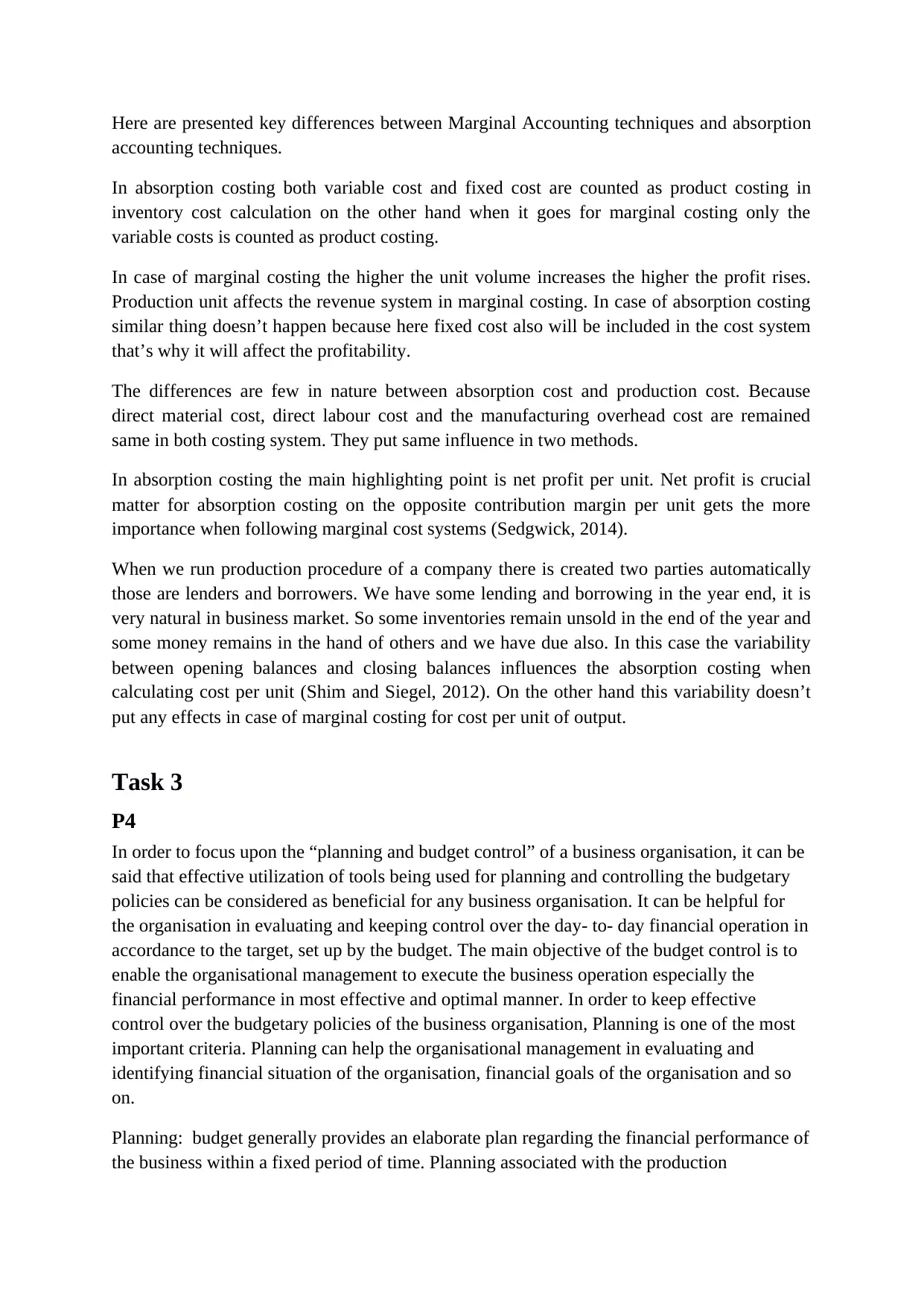
Here are presented key differences between Marginal Accounting techniques and absorption
accounting techniques.
In absorption costing both variable cost and fixed cost are counted as product costing in
inventory cost calculation on the other hand when it goes for marginal costing only the
variable costs is counted as product costing.
In case of marginal costing the higher the unit volume increases the higher the profit rises.
Production unit affects the revenue system in marginal costing. In case of absorption costing
similar thing doesn’t happen because here fixed cost also will be included in the cost system
that’s why it will affect the profitability.
The differences are few in nature between absorption cost and production cost. Because
direct material cost, direct labour cost and the manufacturing overhead cost are remained
same in both costing system. They put same influence in two methods.
In absorption costing the main highlighting point is net profit per unit. Net profit is crucial
matter for absorption costing on the opposite contribution margin per unit gets the more
importance when following marginal cost systems (Sedgwick, 2014).
When we run production procedure of a company there is created two parties automatically
those are lenders and borrowers. We have some lending and borrowing in the year end, it is
very natural in business market. So some inventories remain unsold in the end of the year and
some money remains in the hand of others and we have due also. In this case the variability
between opening balances and closing balances influences the absorption costing when
calculating cost per unit (Shim and Siegel, 2012). On the other hand this variability doesn’t
put any effects in case of marginal costing for cost per unit of output.
Task 3
P4
In order to focus upon the “planning and budget control” of a business organisation, it can be
said that effective utilization of tools being used for planning and controlling the budgetary
policies can be considered as beneficial for any business organisation. It can be helpful for
the organisation in evaluating and keeping control over the day- to- day financial operation in
accordance to the target, set up by the budget. The main objective of the budget control is to
enable the organisational management to execute the business operation especially the
financial performance in most effective and optimal manner. In order to keep effective
control over the budgetary policies of the business organisation, Planning is one of the most
important criteria. Planning can help the organisational management in evaluating and
identifying financial situation of the organisation, financial goals of the organisation and so
on.
Planning: budget generally provides an elaborate plan regarding the financial performance of
the business within a fixed period of time. Planning associated with the production
accounting techniques.
In absorption costing both variable cost and fixed cost are counted as product costing in
inventory cost calculation on the other hand when it goes for marginal costing only the
variable costs is counted as product costing.
In case of marginal costing the higher the unit volume increases the higher the profit rises.
Production unit affects the revenue system in marginal costing. In case of absorption costing
similar thing doesn’t happen because here fixed cost also will be included in the cost system
that’s why it will affect the profitability.
The differences are few in nature between absorption cost and production cost. Because
direct material cost, direct labour cost and the manufacturing overhead cost are remained
same in both costing system. They put same influence in two methods.
In absorption costing the main highlighting point is net profit per unit. Net profit is crucial
matter for absorption costing on the opposite contribution margin per unit gets the more
importance when following marginal cost systems (Sedgwick, 2014).
When we run production procedure of a company there is created two parties automatically
those are lenders and borrowers. We have some lending and borrowing in the year end, it is
very natural in business market. So some inventories remain unsold in the end of the year and
some money remains in the hand of others and we have due also. In this case the variability
between opening balances and closing balances influences the absorption costing when
calculating cost per unit (Shim and Siegel, 2012). On the other hand this variability doesn’t
put any effects in case of marginal costing for cost per unit of output.
Task 3
P4
In order to focus upon the “planning and budget control” of a business organisation, it can be
said that effective utilization of tools being used for planning and controlling the budgetary
policies can be considered as beneficial for any business organisation. It can be helpful for
the organisation in evaluating and keeping control over the day- to- day financial operation in
accordance to the target, set up by the budget. The main objective of the budget control is to
enable the organisational management to execute the business operation especially the
financial performance in most effective and optimal manner. In order to keep effective
control over the budgetary policies of the business organisation, Planning is one of the most
important criteria. Planning can help the organisational management in evaluating and
identifying financial situation of the organisation, financial goals of the organisation and so
on.
Planning: budget generally provides an elaborate plan regarding the financial performance of
the business within a fixed period of time. Planning associated with the production
procedures, sales promotion, optimal utilization of resources, advertisements, developmental
activities and so on that can generate the economical benefits for the organisation. Proper
planning can be effective way out for any business organisation by which any anticipated
condition can be created for avoiding business emergencies especially financial downfalls.
There are different types of budgetary control in the organisation which are master budget,
operating budget, cash flow budget, financial budget and static budget. Now let’s look the
key differences among them in the planning tools of budgetary control.
There are different types of budgetary control in the organisation which are master budget,
operating budget, cash flow budget, financial budget and static budget. Now let’s look the
key differences among them in the planning tools of budgetary control.
Budget for a business organisation can be classified in different types, like:
Cash budget: most important and effective budgetary tool for any business
organisation. By adopting such tool, an organisational management can focuses upon
the elaborated estimation of the money being receipt from every possible source and
the cash payments for several purposes. It also sheds light on the resultant or
remaining case balance all through the budget period. It also allows the organisational
management to keep effective control and coordination over the financial setup of the
organisation so that the organisation cannot face any economical downfall or
bankruptcy in the future.
Advantages- This helps in determining whether cash balances remain sufficient to full fill
regular obligations and its minimum liquidity and cash balance requirements. It also helps in
company to determine whether too much cash is retained that could be otherwise used in
production.
Disadvantages- They may cause distortions. Cash inflows do not rely to profit. Cash inflows
results from security deposits, fines, the sale of capital assets, non sustainability of funds.
Production cost budget: this budget focuses upon the estimated expenditure required
for the production purposes. The advantageous aspect of this budgetary tool is that, it
can shed light over the predictable cost or expenses required to execute the production
process of the organisation. It is beneficial as it can enable the organisational
management to provide maximum importance on the financial performance for
production process by which they can maintain the cost effectiveness of the
production expenditure. Apart from the advantageous it also have some basic
disadvantage, like: by maintain cost effectiveness of the production process, the
organisational management can negotiate with the quality of the raw materials being
used for the manufacturing process.
activities and so on that can generate the economical benefits for the organisation. Proper
planning can be effective way out for any business organisation by which any anticipated
condition can be created for avoiding business emergencies especially financial downfalls.
There are different types of budgetary control in the organisation which are master budget,
operating budget, cash flow budget, financial budget and static budget. Now let’s look the
key differences among them in the planning tools of budgetary control.
There are different types of budgetary control in the organisation which are master budget,
operating budget, cash flow budget, financial budget and static budget. Now let’s look the
key differences among them in the planning tools of budgetary control.
Budget for a business organisation can be classified in different types, like:
Cash budget: most important and effective budgetary tool for any business
organisation. By adopting such tool, an organisational management can focuses upon
the elaborated estimation of the money being receipt from every possible source and
the cash payments for several purposes. It also sheds light on the resultant or
remaining case balance all through the budget period. It also allows the organisational
management to keep effective control and coordination over the financial setup of the
organisation so that the organisation cannot face any economical downfall or
bankruptcy in the future.
Advantages- This helps in determining whether cash balances remain sufficient to full fill
regular obligations and its minimum liquidity and cash balance requirements. It also helps in
company to determine whether too much cash is retained that could be otherwise used in
production.
Disadvantages- They may cause distortions. Cash inflows do not rely to profit. Cash inflows
results from security deposits, fines, the sale of capital assets, non sustainability of funds.
Production cost budget: this budget focuses upon the estimated expenditure required
for the production purposes. The advantageous aspect of this budgetary tool is that, it
can shed light over the predictable cost or expenses required to execute the production
process of the organisation. It is beneficial as it can enable the organisational
management to provide maximum importance on the financial performance for
production process by which they can maintain the cost effectiveness of the
production expenditure. Apart from the advantageous it also have some basic
disadvantage, like: by maintain cost effectiveness of the production process, the
organisational management can negotiate with the quality of the raw materials being
used for the manufacturing process.
⊘ This is a preview!⊘
Do you want full access?
Subscribe today to unlock all pages.
Trusted by 1+ million students worldwide

1 out of 17


Related Documents


Your All-in-One AI-Powered Toolkit for Academic Success.
+13062052269
info@desklib.com
Available 24*7 on WhatsApp / Email
![[object Object]](/_next/static/media/star-bottom.7253800d.svg)
Unlock your academic potential
Copyright © 2020–2026 A2Z Services. All Rights Reserved. Developed and managed by ZUCOL.