Management Accounting Report: Grange Aggregates Company Analysis
VerifiedAdded on 2021/02/21
|18
|6205
|571
Report
AI Summary
This report provides a detailed overview of management accounting, focusing on its functions, systems, and applications within a business context. It begins by defining management accounting and differentiating it from financial accounting, emphasizing its role in internal decision-making. The report then explores various management accounting systems, including price optimization, cost accounting, inventory management, and job costing systems, illustrating their practical application with examples from Grange Aggregates Company. It further discusses the presentation of financial information, different types of management accounting reports (performance, budget, and inventory management), and the crucial role of management accounting in strategic planning and resource management. The report also covers cost analysis techniques, including direct vs. indirect costs, fixed vs. variable costs, and absorption costing, to analyze cost behavior and improve profitability.
UNIT 5:
MANAGEMENT
ACCOUNTING
MANAGEMENT
ACCOUNTING

Paraphrase This Document
Need a fresh take? Get an instant paraphrase of this document with our AI Paraphraser
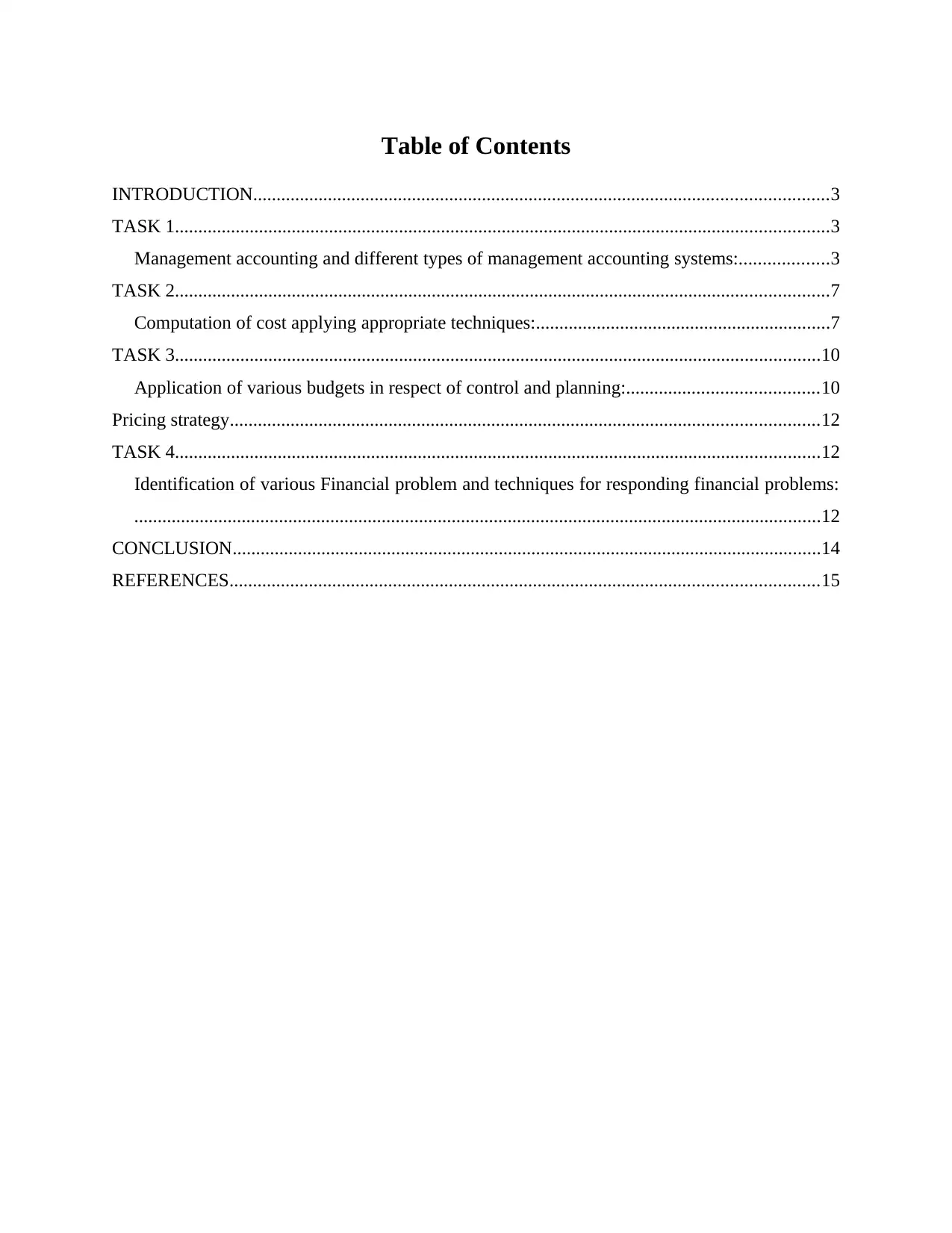
Table of Contents
INTRODUCTION...........................................................................................................................3
TASK 1............................................................................................................................................3
Management accounting and different types of management accounting systems:...................3
TASK 2............................................................................................................................................7
Computation of cost applying appropriate techniques:...............................................................7
TASK 3..........................................................................................................................................10
Application of various budgets in respect of control and planning:.........................................10
Pricing strategy..............................................................................................................................12
TASK 4..........................................................................................................................................12
Identification of various Financial problem and techniques for responding financial problems:
...................................................................................................................................................12
CONCLUSION..............................................................................................................................14
REFERENCES..............................................................................................................................15
INTRODUCTION...........................................................................................................................3
TASK 1............................................................................................................................................3
Management accounting and different types of management accounting systems:...................3
TASK 2............................................................................................................................................7
Computation of cost applying appropriate techniques:...............................................................7
TASK 3..........................................................................................................................................10
Application of various budgets in respect of control and planning:.........................................10
Pricing strategy..............................................................................................................................12
TASK 4..........................................................................................................................................12
Identification of various Financial problem and techniques for responding financial problems:
...................................................................................................................................................12
CONCLUSION..............................................................................................................................14
REFERENCES..............................................................................................................................15
INTRODUCTION
In business term management accounting contains functions and tasks directly or
indirectly connected with collecting and transferring financial information within entity to
provide assistance in decision making processes. It is adopted by business entities to manage
their functions in structured way to attain predetermined targets or objectives. It provides
smoothness in process of implementation of strategies and formulation of plans (Astuty, 2019).
In establishing of internal control and check systems at different level within an entity,
management accounting plays a significant role. In this context, this report provides a detailed
explanation about different elements of management accounting system, reporting methods of
management accounting, advantages of different systems of management accounting and
application of planning tools in context of Grange Aggregates Company. It is UK based
company and engaged in manufacturing of construction material like cement, concrete and other
construction aggregates. Report also includes a comparison of two organisations which are
adapting systems of management accounting in order to responding financial problems.
TASK 1
1 Management accounting and different types of management accounting systems:
In a business entity there are various function and activities which generates numerous
kind information of information, some of them may be irrelevant for management. Management
accounting system provides relevant information which assist management in process of taking
decisions for achieving business objectives. It includes function such as systematic classification
of information, entering information, measuring whether information is valuable for business
organisation and at last communicate them for conducting process of taking decision effectively.
There are various systems of management accounting that covers different aspects of an
enterprise's business. Following is discussion about different management accounting systems,
as follows:
Price optimisation system- Every organisation put their efforts to make expansion in
market but due to high competition and large number of competitors they are forced to put down
price of product. In this system clients or customers’ response is used to analyse the relationship
of demand and price of product (Barnard and Mostert, 2015). Under price optimisation system a
particular price is identified by business organisation at which demand is of product is high and
In business term management accounting contains functions and tasks directly or
indirectly connected with collecting and transferring financial information within entity to
provide assistance in decision making processes. It is adopted by business entities to manage
their functions in structured way to attain predetermined targets or objectives. It provides
smoothness in process of implementation of strategies and formulation of plans (Astuty, 2019).
In establishing of internal control and check systems at different level within an entity,
management accounting plays a significant role. In this context, this report provides a detailed
explanation about different elements of management accounting system, reporting methods of
management accounting, advantages of different systems of management accounting and
application of planning tools in context of Grange Aggregates Company. It is UK based
company and engaged in manufacturing of construction material like cement, concrete and other
construction aggregates. Report also includes a comparison of two organisations which are
adapting systems of management accounting in order to responding financial problems.
TASK 1
1 Management accounting and different types of management accounting systems:
In a business entity there are various function and activities which generates numerous
kind information of information, some of them may be irrelevant for management. Management
accounting system provides relevant information which assist management in process of taking
decisions for achieving business objectives. It includes function such as systematic classification
of information, entering information, measuring whether information is valuable for business
organisation and at last communicate them for conducting process of taking decision effectively.
There are various systems of management accounting that covers different aspects of an
enterprise's business. Following is discussion about different management accounting systems,
as follows:
Price optimisation system- Every organisation put their efforts to make expansion in
market but due to high competition and large number of competitors they are forced to put down
price of product. In this system clients or customers’ response is used to analyse the relationship
of demand and price of product (Barnard and Mostert, 2015). Under price optimisation system a
particular price is identified by business organisation at which demand is of product is high and
⊘ This is a preview!⊘
Do you want full access?
Subscribe today to unlock all pages.

Trusted by 1+ million students worldwide
also company is gaining competitive advantages. In Grange Aggregates Company this system
helps to fix a price of its construction material equal to or below the competitive brand to take
competitive benefits. It also helps to increase the demand of product by setting a specific price of
its various construction materials.
Cost Accounting System: This is cost focused management accounting system because
this system combines activities related to recording, summarising, classifying, controlling and
monitoring of costs and expenses within a business enterprise. In manufacturing concern like
Grange Aggregates Company apply this system help in controlling costs and reducing them to
increase operating profits of company (Bedford and Speklé, 2018). For instance, in production of
construction material like cement, concentrate and other aggregates, it is hard for company to
analyse reason of increase in cost among large number of production processes so management
with help of this system identifies the main cause of excessive costs.
Inventory management system: in organisation like Grange Aggregates Company,
there are large variety of products are produced by company and there are numerous kind of
inventories such as finished goods, unprocessed goods, finished inventories etc. Inventory
management system help in organising different inventories by combining activities like
classification of inventories, inventory recording and monitoring inventories to manage
inventories in efficient way (Bolt-Lee and Monte Swain, 2016). In Grange, it is applied by
manufacturing and process heads to control the movement of stock and optimise inventory costs
like handling or storage to increase per unit profit, it also assists in ensuring availability of
inventories in warehouse for manufacturing process. Following are two most common methods
of inventory valuation used by company, as follows:
LIFO – In this method inventories are managed with assumption that last or recently
purchased inventories are sold first.
FIFO – In this method inventories are managed with assumption that inventory
purchased in first would be sold first.
AVOC – Under this method inventories are valued at average of cost of inventories
purchased at different price and date.
Job costing system – In organisations that have products which are totally unrelated, this
system of costing is adopted. This system purely focused on classification of products as a task
and assign different cost to such job. In Grange Aggregates Company, this system is used to
helps to fix a price of its construction material equal to or below the competitive brand to take
competitive benefits. It also helps to increase the demand of product by setting a specific price of
its various construction materials.
Cost Accounting System: This is cost focused management accounting system because
this system combines activities related to recording, summarising, classifying, controlling and
monitoring of costs and expenses within a business enterprise. In manufacturing concern like
Grange Aggregates Company apply this system help in controlling costs and reducing them to
increase operating profits of company (Bedford and Speklé, 2018). For instance, in production of
construction material like cement, concentrate and other aggregates, it is hard for company to
analyse reason of increase in cost among large number of production processes so management
with help of this system identifies the main cause of excessive costs.
Inventory management system: in organisation like Grange Aggregates Company,
there are large variety of products are produced by company and there are numerous kind of
inventories such as finished goods, unprocessed goods, finished inventories etc. Inventory
management system help in organising different inventories by combining activities like
classification of inventories, inventory recording and monitoring inventories to manage
inventories in efficient way (Bolt-Lee and Monte Swain, 2016). In Grange, it is applied by
manufacturing and process heads to control the movement of stock and optimise inventory costs
like handling or storage to increase per unit profit, it also assists in ensuring availability of
inventories in warehouse for manufacturing process. Following are two most common methods
of inventory valuation used by company, as follows:
LIFO – In this method inventories are managed with assumption that last or recently
purchased inventories are sold first.
FIFO – In this method inventories are managed with assumption that inventory
purchased in first would be sold first.
AVOC – Under this method inventories are valued at average of cost of inventories
purchased at different price and date.
Job costing system – In organisations that have products which are totally unrelated, this
system of costing is adopted. This system purely focused on classification of products as a task
and assign different cost to such job. In Grange Aggregates Company, this system is used to
Paraphrase This Document
Need a fresh take? Get an instant paraphrase of this document with our AI Paraphraser
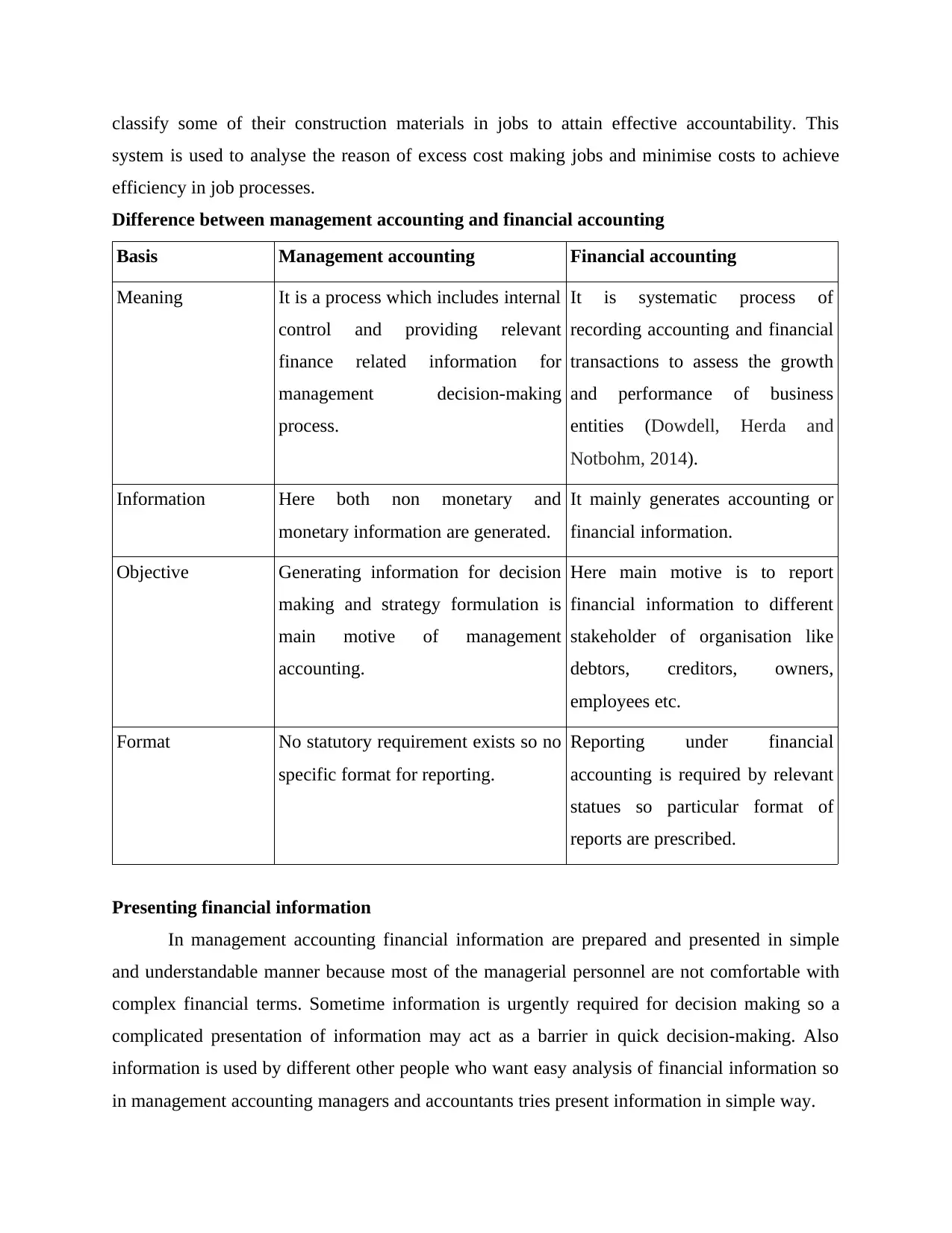
classify some of their construction materials in jobs to attain effective accountability. This
system is used to analyse the reason of excess cost making jobs and minimise costs to achieve
efficiency in job processes.
Difference between management accounting and financial accounting
Basis Management accounting Financial accounting
Meaning It is a process which includes internal
control and providing relevant
finance related information for
management decision-making
process.
It is systematic process of
recording accounting and financial
transactions to assess the growth
and performance of business
entities (Dowdell, Herda and
Notbohm, 2014).
Information Here both non monetary and
monetary information are generated.
It mainly generates accounting or
financial information.
Objective Generating information for decision
making and strategy formulation is
main motive of management
accounting.
Here main motive is to report
financial information to different
stakeholder of organisation like
debtors, creditors, owners,
employees etc.
Format No statutory requirement exists so no
specific format for reporting.
Reporting under financial
accounting is required by relevant
statues so particular format of
reports are prescribed.
Presenting financial information
In management accounting financial information are prepared and presented in simple
and understandable manner because most of the managerial personnel are not comfortable with
complex financial terms. Sometime information is urgently required for decision making so a
complicated presentation of information may act as a barrier in quick decision-making. Also
information is used by different other people who want easy analysis of financial information so
in management accounting managers and accountants tries present information in simple way.
system is used to analyse the reason of excess cost making jobs and minimise costs to achieve
efficiency in job processes.
Difference between management accounting and financial accounting
Basis Management accounting Financial accounting
Meaning It is a process which includes internal
control and providing relevant
finance related information for
management decision-making
process.
It is systematic process of
recording accounting and financial
transactions to assess the growth
and performance of business
entities (Dowdell, Herda and
Notbohm, 2014).
Information Here both non monetary and
monetary information are generated.
It mainly generates accounting or
financial information.
Objective Generating information for decision
making and strategy formulation is
main motive of management
accounting.
Here main motive is to report
financial information to different
stakeholder of organisation like
debtors, creditors, owners,
employees etc.
Format No statutory requirement exists so no
specific format for reporting.
Reporting under financial
accounting is required by relevant
statues so particular format of
reports are prescribed.
Presenting financial information
In management accounting financial information are prepared and presented in simple
and understandable manner because most of the managerial personnel are not comfortable with
complex financial terms. Sometime information is urgently required for decision making so a
complicated presentation of information may act as a barrier in quick decision-making. Also
information is used by different other people who want easy analysis of financial information so
in management accounting managers and accountants tries present information in simple way.
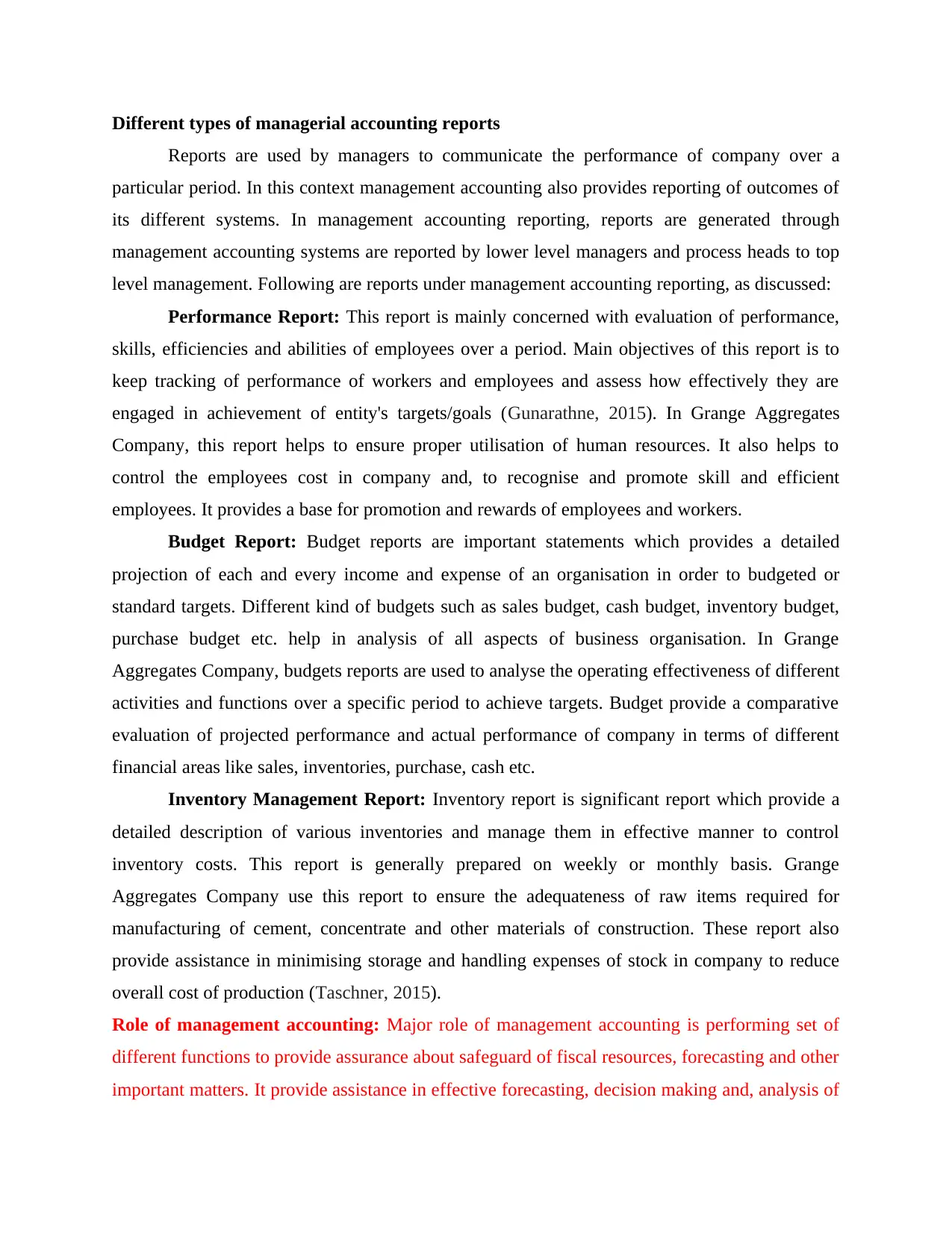
Different types of managerial accounting reports
Reports are used by managers to communicate the performance of company over a
particular period. In this context management accounting also provides reporting of outcomes of
its different systems. In management accounting reporting, reports are generated through
management accounting systems are reported by lower level managers and process heads to top
level management. Following are reports under management accounting reporting, as discussed:
Performance Report: This report is mainly concerned with evaluation of performance,
skills, efficiencies and abilities of employees over a period. Main objectives of this report is to
keep tracking of performance of workers and employees and assess how effectively they are
engaged in achievement of entity's targets/goals (Gunarathne, 2015). In Grange Aggregates
Company, this report helps to ensure proper utilisation of human resources. It also helps to
control the employees cost in company and, to recognise and promote skill and efficient
employees. It provides a base for promotion and rewards of employees and workers.
Budget Report: Budget reports are important statements which provides a detailed
projection of each and every income and expense of an organisation in order to budgeted or
standard targets. Different kind of budgets such as sales budget, cash budget, inventory budget,
purchase budget etc. help in analysis of all aspects of business organisation. In Grange
Aggregates Company, budgets reports are used to analyse the operating effectiveness of different
activities and functions over a specific period to achieve targets. Budget provide a comparative
evaluation of projected performance and actual performance of company in terms of different
financial areas like sales, inventories, purchase, cash etc.
Inventory Management Report: Inventory report is significant report which provide a
detailed description of various inventories and manage them in effective manner to control
inventory costs. This report is generally prepared on weekly or monthly basis. Grange
Aggregates Company use this report to ensure the adequateness of raw items required for
manufacturing of cement, concentrate and other materials of construction. These report also
provide assistance in minimising storage and handling expenses of stock in company to reduce
overall cost of production (Taschner, 2015).
Role of management accounting: Major role of management accounting is performing set of
different functions to provide assurance about safeguard of fiscal resources, forecasting and other
important matters. It provide assistance in effective forecasting, decision making and, analysis of
Reports are used by managers to communicate the performance of company over a
particular period. In this context management accounting also provides reporting of outcomes of
its different systems. In management accounting reporting, reports are generated through
management accounting systems are reported by lower level managers and process heads to top
level management. Following are reports under management accounting reporting, as discussed:
Performance Report: This report is mainly concerned with evaluation of performance,
skills, efficiencies and abilities of employees over a period. Main objectives of this report is to
keep tracking of performance of workers and employees and assess how effectively they are
engaged in achievement of entity's targets/goals (Gunarathne, 2015). In Grange Aggregates
Company, this report helps to ensure proper utilisation of human resources. It also helps to
control the employees cost in company and, to recognise and promote skill and efficient
employees. It provides a base for promotion and rewards of employees and workers.
Budget Report: Budget reports are important statements which provides a detailed
projection of each and every income and expense of an organisation in order to budgeted or
standard targets. Different kind of budgets such as sales budget, cash budget, inventory budget,
purchase budget etc. help in analysis of all aspects of business organisation. In Grange
Aggregates Company, budgets reports are used to analyse the operating effectiveness of different
activities and functions over a specific period to achieve targets. Budget provide a comparative
evaluation of projected performance and actual performance of company in terms of different
financial areas like sales, inventories, purchase, cash etc.
Inventory Management Report: Inventory report is significant report which provide a
detailed description of various inventories and manage them in effective manner to control
inventory costs. This report is generally prepared on weekly or monthly basis. Grange
Aggregates Company use this report to ensure the adequateness of raw items required for
manufacturing of cement, concentrate and other materials of construction. These report also
provide assistance in minimising storage and handling expenses of stock in company to reduce
overall cost of production (Taschner, 2015).
Role of management accounting: Major role of management accounting is performing set of
different functions to provide assurance about safeguard of fiscal resources, forecasting and other
important matters. It provide assistance in effective forecasting, decision making and, analysis of
⊘ This is a preview!⊘
Do you want full access?
Subscribe today to unlock all pages.
Trusted by 1+ million students worldwide
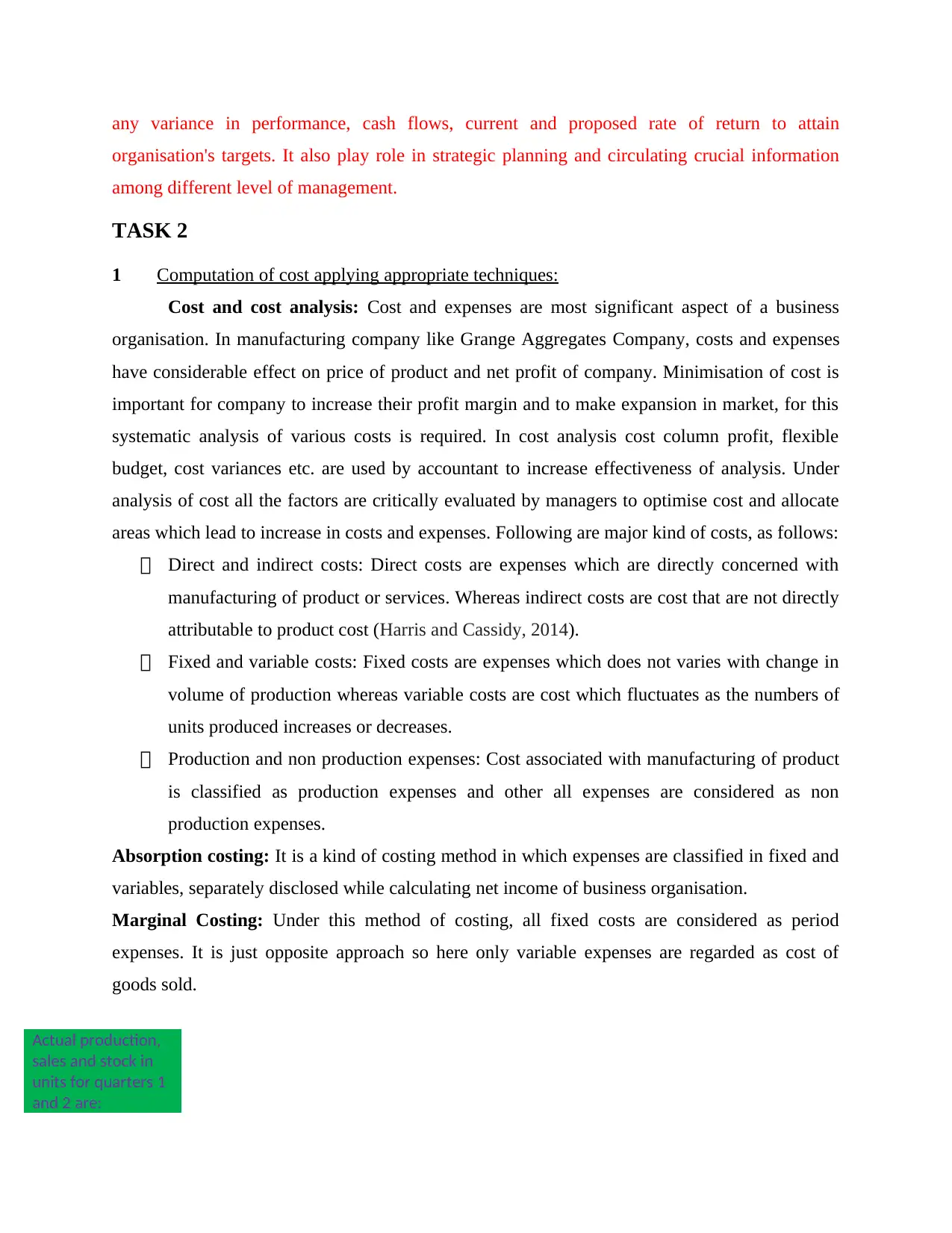
any variance in performance, cash flows, current and proposed rate of return to attain
organisation's targets. It also play role in strategic planning and circulating crucial information
among different level of management.
TASK 2
1 Computation of cost applying appropriate techniques:
Cost and cost analysis: Cost and expenses are most significant aspect of a business
organisation. In manufacturing company like Grange Aggregates Company, costs and expenses
have considerable effect on price of product and net profit of company. Minimisation of cost is
important for company to increase their profit margin and to make expansion in market, for this
systematic analysis of various costs is required. In cost analysis cost column profit, flexible
budget, cost variances etc. are used by accountant to increase effectiveness of analysis. Under
analysis of cost all the factors are critically evaluated by managers to optimise cost and allocate
areas which lead to increase in costs and expenses. Following are major kind of costs, as follows:
Direct and indirect costs: Direct costs are expenses which are directly concerned with
manufacturing of product or services. Whereas indirect costs are cost that are not directly
attributable to product cost (Harris and Cassidy, 2014).
Fixed and variable costs: Fixed costs are expenses which does not varies with change in
volume of production whereas variable costs are cost which fluctuates as the numbers of
units produced increases or decreases.
Production and non production expenses: Cost associated with manufacturing of product
is classified as production expenses and other all expenses are considered as non
production expenses.
Absorption costing: It is a kind of costing method in which expenses are classified in fixed and
variables, separately disclosed while calculating net income of business organisation.
Marginal Costing: Under this method of costing, all fixed costs are considered as period
expenses. It is just opposite approach so here only variable expenses are regarded as cost of
goods sold.
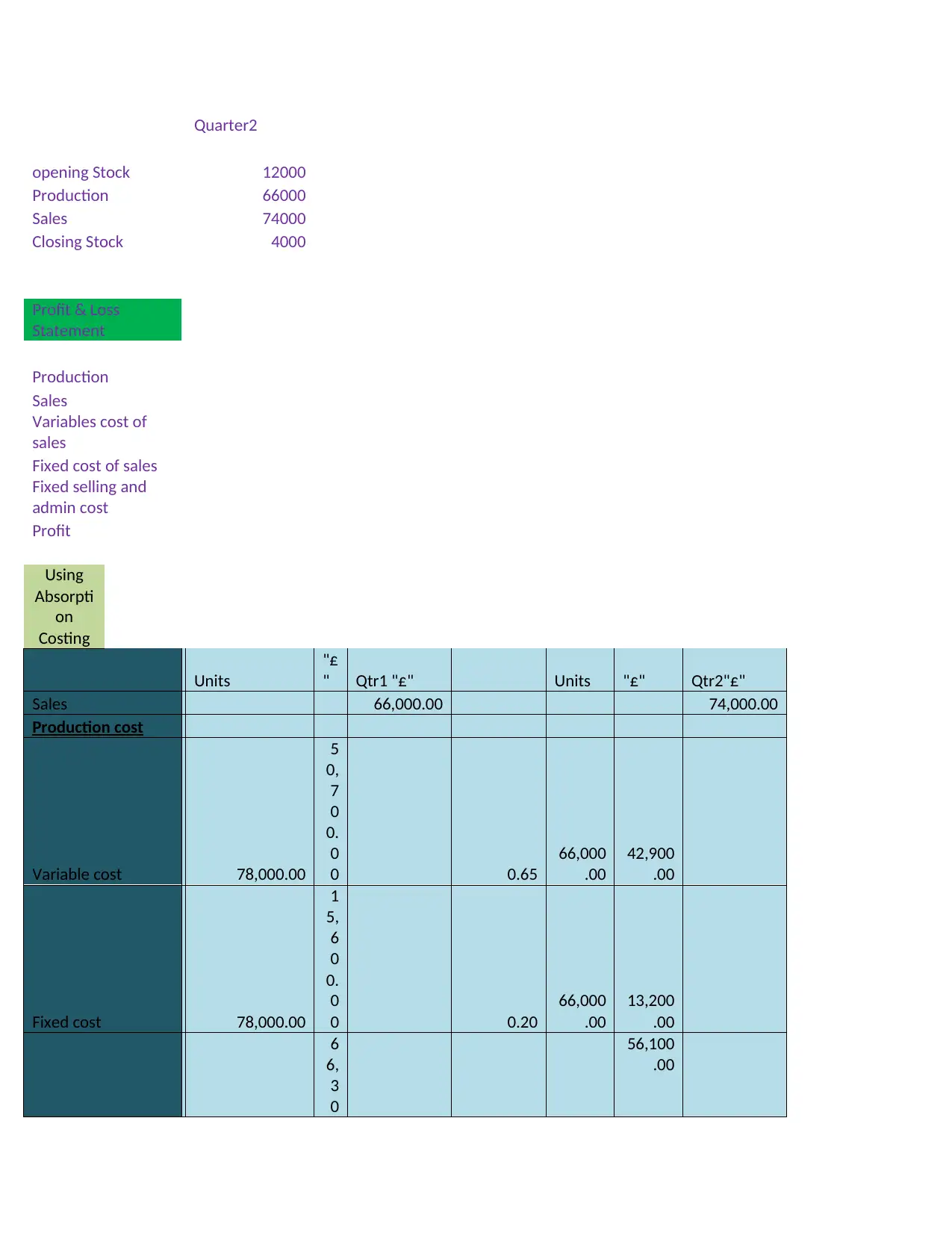
Actual production,
sales and stock in
units for quarters 1
and 2 are:
organisation's targets. It also play role in strategic planning and circulating crucial information
among different level of management.
TASK 2
1 Computation of cost applying appropriate techniques:
Cost and cost analysis: Cost and expenses are most significant aspect of a business
organisation. In manufacturing company like Grange Aggregates Company, costs and expenses
have considerable effect on price of product and net profit of company. Minimisation of cost is
important for company to increase their profit margin and to make expansion in market, for this
systematic analysis of various costs is required. In cost analysis cost column profit, flexible
budget, cost variances etc. are used by accountant to increase effectiveness of analysis. Under
analysis of cost all the factors are critically evaluated by managers to optimise cost and allocate
areas which lead to increase in costs and expenses. Following are major kind of costs, as follows:
Direct and indirect costs: Direct costs are expenses which are directly concerned with
manufacturing of product or services. Whereas indirect costs are cost that are not directly
attributable to product cost (Harris and Cassidy, 2014).
Fixed and variable costs: Fixed costs are expenses which does not varies with change in
volume of production whereas variable costs are cost which fluctuates as the numbers of
units produced increases or decreases.
Production and non production expenses: Cost associated with manufacturing of product
is classified as production expenses and other all expenses are considered as non
production expenses.
Absorption costing: It is a kind of costing method in which expenses are classified in fixed and
variables, separately disclosed while calculating net income of business organisation.
Marginal Costing: Under this method of costing, all fixed costs are considered as period
expenses. It is just opposite approach so here only variable expenses are regarded as cost of
goods sold.
Actual production,
sales and stock in
units for quarters 1
and 2 are:
Paraphrase This Document
Need a fresh take? Get an instant paraphrase of this document with our AI Paraphraser
Quarter2
opening Stock 12000
Production 66000
Sales 74000
Closing Stock 4000
Profit & Loss
Statement
Production
Sales
Variables cost of
sales
Fixed cost of sales
Fixed selling and
admin cost
Profit
Using
Absorpti
on
Costing
Units
"£
" Qtr1 "£" Units "£" Qtr2"£"
Sales 66,000.00 74,000.00
Production cost
Variable cost 78,000.00
5
0,
7
0
0.
0
0 0.65
66,000
.00
42,900
.00
Fixed cost 78,000.00
1
5,
6
0
0.
0
0 0.20
66,000
.00
13,200
.00
6
6,
3
0
56,100
.00
opening Stock 12000
Production 66000
Sales 74000
Closing Stock 4000
Profit & Loss
Statement
Production
Sales
Variables cost of
sales
Fixed cost of sales
Fixed selling and
admin cost
Profit
Using
Absorpti
on
Costing
Units
"£
" Qtr1 "£" Units "£" Qtr2"£"
Sales 66,000.00 74,000.00
Production cost
Variable cost 78,000.00
5
0,
7
0
0.
0
0 0.65
66,000
.00
42,900
.00
Fixed cost 78,000.00
1
5,
6
0
0.
0
0 0.20
66,000
.00
13,200
.00
6
6,
3
0
56,100
.00
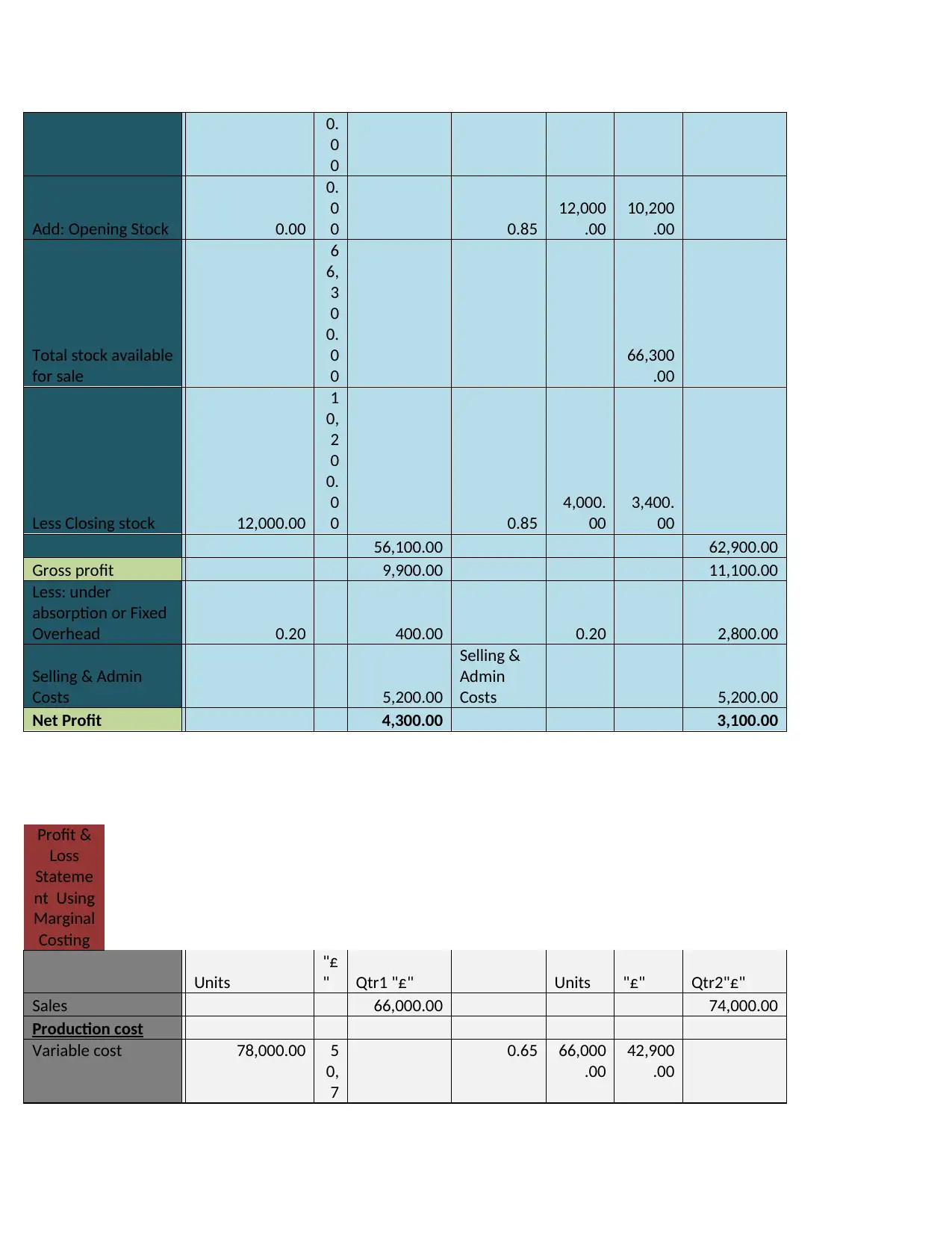
0.
0
0
Add: Opening Stock 0.00
0.
0
0 0.85
12,000
.00
10,200
.00
Total stock available
for sale
6
6,
3
0
0.
0
0
66,300
.00
Less Closing stock 12,000.00
1
0,
2
0
0.
0
0 0.85
4,000.
00
3,400.
00
56,100.00 62,900.00
Gross profit 9,900.00 11,100.00
Less: under
absorption or Fixed
Overhead 0.20 400.00 0.20 2,800.00
Selling & Admin
Costs 5,200.00
Selling &
Admin
Costs 5,200.00
Net Profit 4,300.00 3,100.00
Profit &
Loss
Stateme
nt Using
Marginal
Costing
Units
"£
" Qtr1 "£" Units "£" Qtr2"£"
Sales 66,000.00 74,000.00
Production cost
Variable cost 78,000.00 5
0,
7
0.65 66,000
.00
42,900
.00
0
0
Add: Opening Stock 0.00
0.
0
0 0.85
12,000
.00
10,200
.00
Total stock available
for sale
6
6,
3
0
0.
0
0
66,300
.00
Less Closing stock 12,000.00
1
0,
2
0
0.
0
0 0.85
4,000.
00
3,400.
00
56,100.00 62,900.00
Gross profit 9,900.00 11,100.00
Less: under
absorption or Fixed
Overhead 0.20 400.00 0.20 2,800.00
Selling & Admin
Costs 5,200.00
Selling &
Admin
Costs 5,200.00
Net Profit 4,300.00 3,100.00
Profit &
Loss
Stateme
nt Using
Marginal
Costing
Units
"£
" Qtr1 "£" Units "£" Qtr2"£"
Sales 66,000.00 74,000.00
Production cost
Variable cost 78,000.00 5
0,
7
0.65 66,000
.00
42,900
.00
⊘ This is a preview!⊘
Do you want full access?
Subscribe today to unlock all pages.
Trusted by 1+ million students worldwide
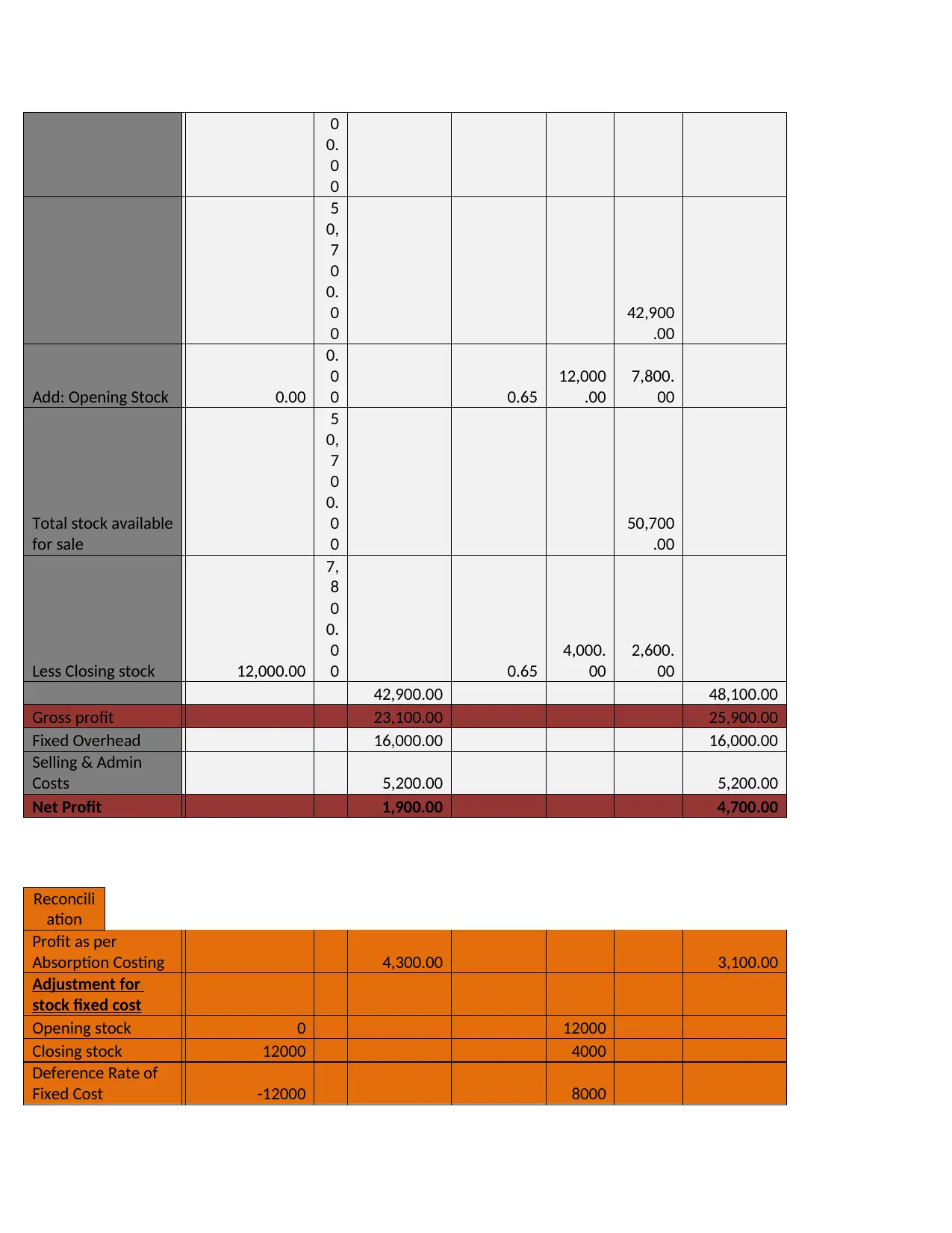
0
0.
0
0
5
0,
7
0
0.
0
0
42,900
.00
Add: Opening Stock 0.00
0.
0
0 0.65
12,000
.00
7,800.
00
Total stock available
for sale
5
0,
7
0
0.
0
0
50,700
.00
Less Closing stock 12,000.00
7,
8
0
0.
0
0 0.65
4,000.
00
2,600.
00
42,900.00 48,100.00
Gross profit 23,100.00 25,900.00
Fixed Overhead 16,000.00 16,000.00
Selling & Admin
Costs 5,200.00 5,200.00
Net Profit 1,900.00 4,700.00
Reconcili
ation
Profit as per
Absorption Costing 4,300.00 3,100.00
Adjustment for
stock fixed cost
Opening stock 0 12000
Closing stock 12000 4000
Deference Rate of
Fixed Cost -12000 8000
0.
0
0
5
0,
7
0
0.
0
0
42,900
.00
Add: Opening Stock 0.00
0.
0
0 0.65
12,000
.00
7,800.
00
Total stock available
for sale
5
0,
7
0
0.
0
0
50,700
.00
Less Closing stock 12,000.00
7,
8
0
0.
0
0 0.65
4,000.
00
2,600.
00
42,900.00 48,100.00
Gross profit 23,100.00 25,900.00
Fixed Overhead 16,000.00 16,000.00
Selling & Admin
Costs 5,200.00 5,200.00
Net Profit 1,900.00 4,700.00
Reconcili
ation
Profit as per
Absorption Costing 4,300.00 3,100.00
Adjustment for
stock fixed cost
Opening stock 0 12000
Closing stock 12000 4000
Deference Rate of
Fixed Cost -12000 8000
Paraphrase This Document
Need a fresh take? Get an instant paraphrase of this document with our AI Paraphraser
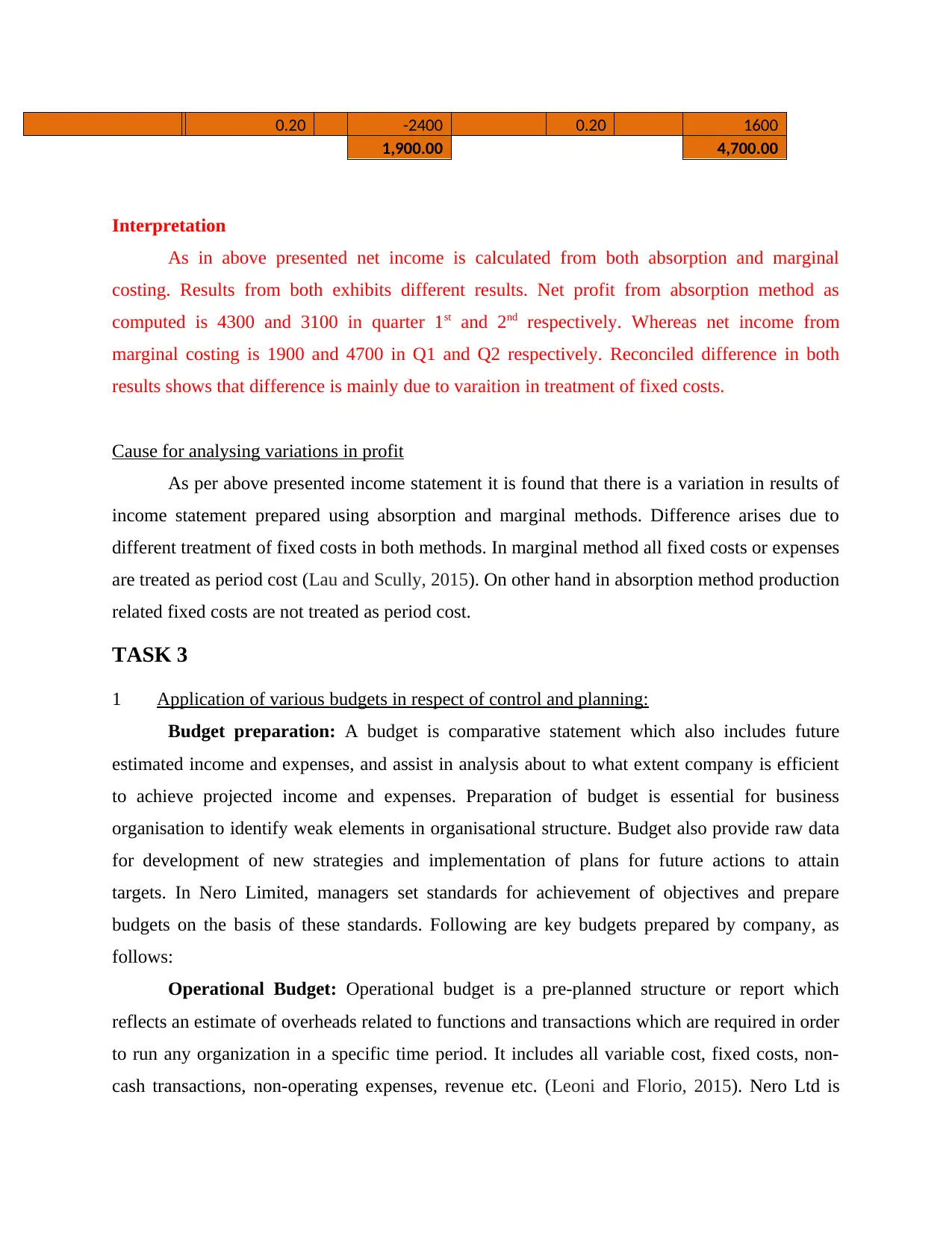
0.20 -2400 0.20 1600
1,900.00 4,700.00
Interpretation
As in above presented net income is calculated from both absorption and marginal
costing. Results from both exhibits different results. Net profit from absorption method as
computed is 4300 and 3100 in quarter 1st and 2nd respectively. Whereas net income from
marginal costing is 1900 and 4700 in Q1 and Q2 respectively. Reconciled difference in both
results shows that difference is mainly due to varaition in treatment of fixed costs.
Cause for analysing variations in profit
As per above presented income statement it is found that there is a variation in results of
income statement prepared using absorption and marginal methods. Difference arises due to
different treatment of fixed costs in both methods. In marginal method all fixed costs or expenses
are treated as period cost (Lau and Scully, 2015). On other hand in absorption method production
related fixed costs are not treated as period cost.
TASK 3
1 Application of various budgets in respect of control and planning:
Budget preparation: A budget is comparative statement which also includes future
estimated income and expenses, and assist in analysis about to what extent company is efficient
to achieve projected income and expenses. Preparation of budget is essential for business
organisation to identify weak elements in organisational structure. Budget also provide raw data
for development of new strategies and implementation of plans for future actions to attain
targets. In Nero Limited, managers set standards for achievement of objectives and prepare
budgets on the basis of these standards. Following are key budgets prepared by company, as
follows:
Operational Budget: Operational budget is a pre-planned structure or report which
reflects an estimate of overheads related to functions and transactions which are required in order
to run any organization in a specific time period. It includes all variable cost, fixed costs, non-
cash transactions, non-operating expenses, revenue etc. (Leoni and Florio, 2015). Nero Ltd is
1,900.00 4,700.00
Interpretation
As in above presented net income is calculated from both absorption and marginal
costing. Results from both exhibits different results. Net profit from absorption method as
computed is 4300 and 3100 in quarter 1st and 2nd respectively. Whereas net income from
marginal costing is 1900 and 4700 in Q1 and Q2 respectively. Reconciled difference in both
results shows that difference is mainly due to varaition in treatment of fixed costs.
Cause for analysing variations in profit
As per above presented income statement it is found that there is a variation in results of
income statement prepared using absorption and marginal methods. Difference arises due to
different treatment of fixed costs in both methods. In marginal method all fixed costs or expenses
are treated as period cost (Lau and Scully, 2015). On other hand in absorption method production
related fixed costs are not treated as period cost.
TASK 3
1 Application of various budgets in respect of control and planning:
Budget preparation: A budget is comparative statement which also includes future
estimated income and expenses, and assist in analysis about to what extent company is efficient
to achieve projected income and expenses. Preparation of budget is essential for business
organisation to identify weak elements in organisational structure. Budget also provide raw data
for development of new strategies and implementation of plans for future actions to attain
targets. In Nero Limited, managers set standards for achievement of objectives and prepare
budgets on the basis of these standards. Following are key budgets prepared by company, as
follows:
Operational Budget: Operational budget is a pre-planned structure or report which
reflects an estimate of overheads related to functions and transactions which are required in order
to run any organization in a specific time period. It includes all variable cost, fixed costs, non-
cash transactions, non-operating expenses, revenue etc. (Leoni and Florio, 2015). Nero Ltd is
involved in manufacturing of cement and concrete material and has to prepare operational budget
so that it can measure the efficiency needed to complete the projects, maintain a proper record of
operations in order to make appropriate future decisions and planning and calculate and control
the variances.
Advantages: It is a short term budget so in Nero Ltd, it facilitates management of routine
operations and activities in company.
Disadvantage: Preparation of an operational budget is complex and time taking task and
some time it provides ambiguous results.
Master Budget: Master budget is an expected summary of all the subsidiary budgets
which are prepared for the different departments and different projects within a specific time (Li,
Tseng and Chen, 2016). It includes major information about sales budget, purchase budget, cash
budget, capital budget, production and manufacturing budget etc. Nero Ltd prepares the master
budget because it helps in taking the financial decisions and provides a brief about all
departments in one go. It helps the management of the company to fairly allocate the financial
resources available in organization among various departments. Further this budget assists the
management to measure performance of the selected company.
Advantages: A master budget provides a complete and true picture of company's
performance in quickly manner.
Disadvantage: As financial statements of company also provides a complete analysis of
organisation's performance so preparation of master budget is not so much useful for
reporting purpose.
Zero Based Budget: Zero based budgeting is a new approach of budgeting emerging
now a day in organizations. This budget includes an estimation of costs which calculates
expenses on the basis of its need in upcoming period without considering the previous budget
valuations. It re-evaluates and justify the expenses to be incurred (Qiang and et.al, 2014). Nero
Ltd. management has started to prepare zero based budgets for efficient and accurate calculation
of costs. This method helps the management to eliminate unproductive and inefficient activities
and expenses. Management of the selected firm also includes the employees in order to prepare
this budget which improves better communication and co-ordination in the firm.
Advantage: it provides more future oriented results for decision-making purpose as it
does not emphasise on previous results of company.
so that it can measure the efficiency needed to complete the projects, maintain a proper record of
operations in order to make appropriate future decisions and planning and calculate and control
the variances.
Advantages: It is a short term budget so in Nero Ltd, it facilitates management of routine
operations and activities in company.
Disadvantage: Preparation of an operational budget is complex and time taking task and
some time it provides ambiguous results.
Master Budget: Master budget is an expected summary of all the subsidiary budgets
which are prepared for the different departments and different projects within a specific time (Li,
Tseng and Chen, 2016). It includes major information about sales budget, purchase budget, cash
budget, capital budget, production and manufacturing budget etc. Nero Ltd prepares the master
budget because it helps in taking the financial decisions and provides a brief about all
departments in one go. It helps the management of the company to fairly allocate the financial
resources available in organization among various departments. Further this budget assists the
management to measure performance of the selected company.
Advantages: A master budget provides a complete and true picture of company's
performance in quickly manner.
Disadvantage: As financial statements of company also provides a complete analysis of
organisation's performance so preparation of master budget is not so much useful for
reporting purpose.
Zero Based Budget: Zero based budgeting is a new approach of budgeting emerging
now a day in organizations. This budget includes an estimation of costs which calculates
expenses on the basis of its need in upcoming period without considering the previous budget
valuations. It re-evaluates and justify the expenses to be incurred (Qiang and et.al, 2014). Nero
Ltd. management has started to prepare zero based budgets for efficient and accurate calculation
of costs. This method helps the management to eliminate unproductive and inefficient activities
and expenses. Management of the selected firm also includes the employees in order to prepare
this budget which improves better communication and co-ordination in the firm.
Advantage: it provides more future oriented results for decision-making purpose as it
does not emphasise on previous results of company.
⊘ This is a preview!⊘
Do you want full access?
Subscribe today to unlock all pages.
Trusted by 1+ million students worldwide

1 out of 18


Related Documents


Your All-in-One AI-Powered Toolkit for Academic Success.
+13062052269
info@desklib.com
Available 24*7 on WhatsApp / Email
![[object Object]](/_next/static/media/star-bottom.7253800d.svg)
Unlock your academic potential
Copyright © 2020–2026 A2Z Services. All Rights Reserved. Developed and managed by ZUCOL.