Management Accounting Techniques and Systems: Lion Hudson Plc Report
VerifiedAdded on 2023/01/20
|18
|5399
|64
Report
AI Summary
This report provides a comprehensive analysis of the management accounting system at Lion Hudson Plc, a book publishing company. It explores the differences between financial and management accounting, detailing the role and principles of the latter. The report delves into various management accounting systems, including inventory management, cost accounting, job costing, and price optimization, highlighting their advantages and disadvantages. It examines different management accounting techniques such as marginal costing, absorption costing, cost volume profit analysis, and flexible budgeting. Furthermore, the report discusses planning tools used for budgetary control and management accounting systems employed to identify financial problems. The report concludes by summarizing key findings and the practical application of management accounting principles within the context of Lion Hudson Plc.
MANAGEMENT
ACCOUNTING
ACCOUNTING

Paraphrase This Document
Need a fresh take? Get an instant paraphrase of this document with our AI Paraphraser
Table of Contents
INTRODUCTION...........................................................................................................................1
TASK 1............................................................................................................................................1
Characteristics of good Management accounting System:..........................................................3
TASK 2............................................................................................................................................4
Profit and cost calculation by different management accounting techniques:.............................6
TASK 3 ...........................................................................................................................................9
Planning tools used for budgetary control:..................................................................................9
TASK 4..........................................................................................................................................13
Management accounting systems used to identify financial problems:.....................................13
CONCLUSION..............................................................................................................................15
INTRODUCTION...........................................................................................................................1
TASK 1............................................................................................................................................1
Characteristics of good Management accounting System:..........................................................3
TASK 2............................................................................................................................................4
Profit and cost calculation by different management accounting techniques:.............................6
TASK 3 ...........................................................................................................................................9
Planning tools used for budgetary control:..................................................................................9
TASK 4..........................................................................................................................................13
Management accounting systems used to identify financial problems:.....................................13
CONCLUSION..............................................................................................................................15
INTRODUCTION
In today's business environment, management accounting plays a key role in creating
plans and hence it is crucial for management personnel’s in the organization that they must
have efficient knowledge of creating and using management accounting subject matter. Now a
day, businessmen want to track execution of information that goes beyond just the cost and
profit information provided by traditional financial accounting information thus management
accounting system has been evolved (Management accounting, 2019).
For the better understanding of managerial accounting system, a trainee management
accountant of Cogneesol limited is presenting report on the management accounting system of
Lion Hudson Plc which is a book publisher company deriving its business in Oxford, UK since
2003 by the merger of Lion Publishing and Hudson International.
This report covers detailed information about management accounting system, different
types of reporting that help in dealing with various financial problems. In this report several
costing techniques are used to calculate net profit for the year. In Addition, advantages and
disadvantages of planning tool and benefits of management accounting in are defined in detail.
TASK 1
Management Accounting and its systems:
Management Accounting: Managerial accounting can be defined as the tools and
techniques that prepare and present available data in a professional manner which support
management in planning and decisions in an effective manner so that efficiency and
performance can be attempt at its fullest (Abbasi, Zamani and Valmohammadi, 2014).
Origin, Role and Principles of Management Accounting: Private and large
organizations felt the necessity of a procedure that can effectively measure and control over
various centres of production that help in survive in economy. A significant role is played by
management accounting to ensure proper execution of commercial operations as this procedure
is associated with four principles that are worth, relevancy, credibility and influence.
Difference between Financial and Managerial Accounting:
Financial accounting: The accounting branch that deals with summarising, analysing
addition to reporting financial activities all relevant with business. This accounting type
engrosses preparing financial statement for public consumption. In Lion Hudson Plc, financial
1
In today's business environment, management accounting plays a key role in creating
plans and hence it is crucial for management personnel’s in the organization that they must
have efficient knowledge of creating and using management accounting subject matter. Now a
day, businessmen want to track execution of information that goes beyond just the cost and
profit information provided by traditional financial accounting information thus management
accounting system has been evolved (Management accounting, 2019).
For the better understanding of managerial accounting system, a trainee management
accountant of Cogneesol limited is presenting report on the management accounting system of
Lion Hudson Plc which is a book publisher company deriving its business in Oxford, UK since
2003 by the merger of Lion Publishing and Hudson International.
This report covers detailed information about management accounting system, different
types of reporting that help in dealing with various financial problems. In this report several
costing techniques are used to calculate net profit for the year. In Addition, advantages and
disadvantages of planning tool and benefits of management accounting in are defined in detail.
TASK 1
Management Accounting and its systems:
Management Accounting: Managerial accounting can be defined as the tools and
techniques that prepare and present available data in a professional manner which support
management in planning and decisions in an effective manner so that efficiency and
performance can be attempt at its fullest (Abbasi, Zamani and Valmohammadi, 2014).
Origin, Role and Principles of Management Accounting: Private and large
organizations felt the necessity of a procedure that can effectively measure and control over
various centres of production that help in survive in economy. A significant role is played by
management accounting to ensure proper execution of commercial operations as this procedure
is associated with four principles that are worth, relevancy, credibility and influence.
Difference between Financial and Managerial Accounting:
Financial accounting: The accounting branch that deals with summarising, analysing
addition to reporting financial activities all relevant with business. This accounting type
engrosses preparing financial statement for public consumption. In Lion Hudson Plc, financial
1
⊘ This is a preview!⊘
Do you want full access?
Subscribe today to unlock all pages.

Trusted by 1+ million students worldwide
accounting is used for reporting financial outcomes of operations and performance of business.
Financial accounts are prepared to provide information to external stakeholders. This approach
only covers funds and money related data and information.
In contrary, Management accounting is the accounting kind that is termed as provision
of monetary data together with advice to entity for development of business. The accounting
type generally deals with preparing management reports along with accounts in accurate,
timely and statistical manner so that administrators can make effective decisions. In Lion
Hudson Plc, management accounting is used to evaluate sales trends, financial planning,
performance management and many more. Managerial accounts are creates to help the internal
users, especially management. Monetary as well as non-monetary material is included in this
accounting process.
Management Accounting System: Management accounting system is a procedure od
gather, record, classify, summarise and presenting financial and non-financial meaningful
content in order to help the administration in determining, planning and organising its policies
and procedures. Each and every material statement is prepared in Lion Hudson Plc so that the
management can estimate budgets properly and make decisions accordingly. Various has been
adopted by respective firm which are described as under:
Inventory Management System: It is the most essential system for any company that is
involve in retail operation as inventory is the main source of revenue in such firms. This system
helps to keep record of all materials that are hold by enterprise during a specific period of time.
Further support in estimate the materials require to ensure effective production of goods.
Mainly this system is adopt by managers to maintain a record of raw material to warehousing
of finished goods. With this system, Lion Hudson Plc ensure timely ordering of all products
and materials require to fulfil needs of customers.
Advantages: It enhance administration’s efficiency and ensure implementation of all operations
in an cost effective manner.
Disadvantage: The items cannot be grouped and ordered at a time.
Cost Accounting System: It has been found that in order to effectively producing profit
from business activities, it is required to know the cost allocated with the specific activity. It
includes events founded on accepting, recording, analysing, grouping and summarizing costs
2
Financial accounts are prepared to provide information to external stakeholders. This approach
only covers funds and money related data and information.
In contrary, Management accounting is the accounting kind that is termed as provision
of monetary data together with advice to entity for development of business. The accounting
type generally deals with preparing management reports along with accounts in accurate,
timely and statistical manner so that administrators can make effective decisions. In Lion
Hudson Plc, management accounting is used to evaluate sales trends, financial planning,
performance management and many more. Managerial accounts are creates to help the internal
users, especially management. Monetary as well as non-monetary material is included in this
accounting process.
Management Accounting System: Management accounting system is a procedure od
gather, record, classify, summarise and presenting financial and non-financial meaningful
content in order to help the administration in determining, planning and organising its policies
and procedures. Each and every material statement is prepared in Lion Hudson Plc so that the
management can estimate budgets properly and make decisions accordingly. Various has been
adopted by respective firm which are described as under:
Inventory Management System: It is the most essential system for any company that is
involve in retail operation as inventory is the main source of revenue in such firms. This system
helps to keep record of all materials that are hold by enterprise during a specific period of time.
Further support in estimate the materials require to ensure effective production of goods.
Mainly this system is adopt by managers to maintain a record of raw material to warehousing
of finished goods. With this system, Lion Hudson Plc ensure timely ordering of all products
and materials require to fulfil needs of customers.
Advantages: It enhance administration’s efficiency and ensure implementation of all operations
in an cost effective manner.
Disadvantage: The items cannot be grouped and ordered at a time.
Cost Accounting System: It has been found that in order to effectively producing profit
from business activities, it is required to know the cost allocated with the specific activity. It
includes events founded on accepting, recording, analysing, grouping and summarizing costs
2
Paraphrase This Document
Need a fresh take? Get an instant paraphrase of this document with our AI Paraphraser
related with valuable goods and services (Barnard and Mostert, 2015). In Lion Hudson Plc,
cost accounting system is useful to compute the cost included in running various production
operation, cost incurred of manpower and other assorted cost.
Advantages: This help Lion Hudson Plc in identify the cost associated with every product and
modify price to maintain the quality.
Disadvantage: In Lion Hudson Plc, this uses previous data to make future decisions which is
irrelevant.
Job Costing Systems: This system is evolving to calculate the expenses of specific task
or unit. This system is effective as this help in specify the expenditures concerns with specific
job involve in manufacturing activity and other division. Lion Hudson Plc creates job costing
system to find out the cost of specific inventory which immediately send to the customer with
evaluating in inventory management or cost accounting systems.
Advantages: It gives advantage to Lion Hudson Plc of being able to keep track of individuals'
and teams' performance.
Disadvantage: A lot of paper work take place in this costing system.
Price Optimisation System: This system is a mathematical one that aids in analysing
the perception and behaviour of customers regarding the price of different products offer by
company. With the help of this method, Lion Hudson Plc prepares cost module as well as price
module. Further a set of optimum price is generated according to the minimum cost with
maximum profit margin combination. Respective firm opt this system to fix the best price in
order to provide optimum customer satisfaction.
Advantages: This support managers of Lion Hudson Plc in enhance the profits of company by
set an optimum price for the product.
Disadvantage: Both good and bad products may be sold at the same time.
Characteristics of good Management accounting System:
Accuracy: It is very essential that system of accounting should include all the
substantial content and factors so that it can help in making effectual decision.
Reliability: Data rendered by the management system should be trustworthy and
conformable. Inadequate system results in weak determination in planning.
Up-to-date: Managerial system require to comply with updates in policies and
information’s on time to as effective decisions may be taken on time.
3
cost accounting system is useful to compute the cost included in running various production
operation, cost incurred of manpower and other assorted cost.
Advantages: This help Lion Hudson Plc in identify the cost associated with every product and
modify price to maintain the quality.
Disadvantage: In Lion Hudson Plc, this uses previous data to make future decisions which is
irrelevant.
Job Costing Systems: This system is evolving to calculate the expenses of specific task
or unit. This system is effective as this help in specify the expenditures concerns with specific
job involve in manufacturing activity and other division. Lion Hudson Plc creates job costing
system to find out the cost of specific inventory which immediately send to the customer with
evaluating in inventory management or cost accounting systems.
Advantages: It gives advantage to Lion Hudson Plc of being able to keep track of individuals'
and teams' performance.
Disadvantage: A lot of paper work take place in this costing system.
Price Optimisation System: This system is a mathematical one that aids in analysing
the perception and behaviour of customers regarding the price of different products offer by
company. With the help of this method, Lion Hudson Plc prepares cost module as well as price
module. Further a set of optimum price is generated according to the minimum cost with
maximum profit margin combination. Respective firm opt this system to fix the best price in
order to provide optimum customer satisfaction.
Advantages: This support managers of Lion Hudson Plc in enhance the profits of company by
set an optimum price for the product.
Disadvantage: Both good and bad products may be sold at the same time.
Characteristics of good Management accounting System:
Accuracy: It is very essential that system of accounting should include all the
substantial content and factors so that it can help in making effectual decision.
Reliability: Data rendered by the management system should be trustworthy and
conformable. Inadequate system results in weak determination in planning.
Up-to-date: Managerial system require to comply with updates in policies and
information’s on time to as effective decisions may be taken on time.
3
System of accounting is use by companies to assists the organisation in examining &
performing day to day functions in organization and planning & making decisions for
upcoming period of time. Essential requirement of management accounting system is that it
should be effective and easy to use so that planning process could be done by management in
an efficient manner (Cassell, Myers and Seidel, 2015).
Management Accounting Reporting: This is known as a procedures which is employ
by management to form different kind of reports to estimate income, cost, expense for a
specific accounting period. This support manager in examine employee’s performance. Lion
Hudson Plc can keep an idea about the effectiveness of its commercial activities and can
determine the areas of improvement. All this support in eliminate the issues and variances
included in process of management accounting reporting.
Inventory Management Report: This is another type of report which consists
information about all the activities related with inventory. Mainly this report contains data
about purchase of raw materials and also contain information about finish goods. It is important
for manager of every enterprise to create and maintain a record of all materials available.
Further, this report offers data about the cost and quality of goods. Further, this support in
choose an appropriate method for carry out valuation of products.
Accounts receivable aging report: Payment that remain due from retailers or customers
is known as receivable. This is a report that indicate the name of unpaid customers and also
highlight the amount due from them. Further, this report highlight the receivable dates, offer
contact details of creditors and also shows the essential information about the organisation. All
this help Lion Hudson Plc in formulate strong credit policies for organisation (Cattarino and
others, 2016).
Performance report: This is a statement that information about the performance of
employees which help in carry out their appraisals and also help in motivate them. By offer
rewards to employees, company can motivate them to work well. One of the major benefit that
Lion Hudson Plc experiences with this report is that it helps in identify training needs of
employees which improve overall profits of company.
TASK 2
Management Accounting Techniques:
4
performing day to day functions in organization and planning & making decisions for
upcoming period of time. Essential requirement of management accounting system is that it
should be effective and easy to use so that planning process could be done by management in
an efficient manner (Cassell, Myers and Seidel, 2015).
Management Accounting Reporting: This is known as a procedures which is employ
by management to form different kind of reports to estimate income, cost, expense for a
specific accounting period. This support manager in examine employee’s performance. Lion
Hudson Plc can keep an idea about the effectiveness of its commercial activities and can
determine the areas of improvement. All this support in eliminate the issues and variances
included in process of management accounting reporting.
Inventory Management Report: This is another type of report which consists
information about all the activities related with inventory. Mainly this report contains data
about purchase of raw materials and also contain information about finish goods. It is important
for manager of every enterprise to create and maintain a record of all materials available.
Further, this report offers data about the cost and quality of goods. Further, this support in
choose an appropriate method for carry out valuation of products.
Accounts receivable aging report: Payment that remain due from retailers or customers
is known as receivable. This is a report that indicate the name of unpaid customers and also
highlight the amount due from them. Further, this report highlight the receivable dates, offer
contact details of creditors and also shows the essential information about the organisation. All
this help Lion Hudson Plc in formulate strong credit policies for organisation (Cattarino and
others, 2016).
Performance report: This is a statement that information about the performance of
employees which help in carry out their appraisals and also help in motivate them. By offer
rewards to employees, company can motivate them to work well. One of the major benefit that
Lion Hudson Plc experiences with this report is that it helps in identify training needs of
employees which improve overall profits of company.
TASK 2
Management Accounting Techniques:
4
⊘ This is a preview!⊘
Do you want full access?
Subscribe today to unlock all pages.
Trusted by 1+ million students worldwide
Cost is an economic rate that an enterprise like Lion Hudson Plc spends in order to
produce something valuable such as inventory. Analysis of cost refers to the process of identify
and calculate the expenditure done by company on process of manufacturing. Different type of
cost are incurred during production of goods and services that could be understand by
following points:
Direct cost: Cost that can be determine easily during manufacturing of goods such as
cost of labour and raw material is come under the category of direct cost.
Indirect cost: Expenses done by Lion Hudson Plc in production of goods that could not
de determine is known as indirect cost. Depreciation, rent and electricity bill is all come
in this.
Cost volume profit: This is a analysis that is done by enterprise to determine how variation in
volume and cost of products affect overall profitability of company. But during this analysis, it
is very essential that variable per unit and sales per unit should remain constant.
Flexible budgeting: This is another type of budget that is used by Lion Hudson Plc in situation
when frim remain unable to predict its production level of future. In that scenario, management
formulate a budget for future for more than one production volume as this assist in adopt right
Profit and cost calculation by different management accounting techniques:
Marginal costing- It is a tool and technique which is utilised by the company to identify the
break even point so that needed stock of merchandise and required profitability can be derived.
Absorption costing- It is another technique of management accounting technique that is
utilised by the organisations for the allocation of the monetary value that is reliable or not.
Within it, all the fixed costs are engrossed through a fixed improvement rate.
Fixed cost- It is the cost which is refereed as expenditures that do not alter as a utility
of the activity of a business concern, within the applicable time frame. These kind of cost may
be obtained by Lion Hudson Plc in past and will be received in forthcoming time but
indebtedness of which is monitored in past. Rent expense and supervisory salary are some
example of these kind of costs.
Variable costs- These monetary values are business firm expenditures that modifies in
dimension to produce results. These are the costs which are reliable in all option course of
action and it exploit in total with maximise in magnitude of manufacturing.
5
produce something valuable such as inventory. Analysis of cost refers to the process of identify
and calculate the expenditure done by company on process of manufacturing. Different type of
cost are incurred during production of goods and services that could be understand by
following points:
Direct cost: Cost that can be determine easily during manufacturing of goods such as
cost of labour and raw material is come under the category of direct cost.
Indirect cost: Expenses done by Lion Hudson Plc in production of goods that could not
de determine is known as indirect cost. Depreciation, rent and electricity bill is all come
in this.
Cost volume profit: This is a analysis that is done by enterprise to determine how variation in
volume and cost of products affect overall profitability of company. But during this analysis, it
is very essential that variable per unit and sales per unit should remain constant.
Flexible budgeting: This is another type of budget that is used by Lion Hudson Plc in situation
when frim remain unable to predict its production level of future. In that scenario, management
formulate a budget for future for more than one production volume as this assist in adopt right
Profit and cost calculation by different management accounting techniques:
Marginal costing- It is a tool and technique which is utilised by the company to identify the
break even point so that needed stock of merchandise and required profitability can be derived.
Absorption costing- It is another technique of management accounting technique that is
utilised by the organisations for the allocation of the monetary value that is reliable or not.
Within it, all the fixed costs are engrossed through a fixed improvement rate.
Fixed cost- It is the cost which is refereed as expenditures that do not alter as a utility
of the activity of a business concern, within the applicable time frame. These kind of cost may
be obtained by Lion Hudson Plc in past and will be received in forthcoming time but
indebtedness of which is monitored in past. Rent expense and supervisory salary are some
example of these kind of costs.
Variable costs- These monetary values are business firm expenditures that modifies in
dimension to produce results. These are the costs which are reliable in all option course of
action and it exploit in total with maximise in magnitude of manufacturing.
5
Paraphrase This Document
Need a fresh take? Get an instant paraphrase of this document with our AI Paraphraser
Cost allocation- It is the activity of distinguishing, aggregating and allotting costs to
fiscal value purpose. A cost object is process for which the company separately measure the
costs. Goods, a investigation report, a consumer, a sales region and division are some example
of a cost object and for which the management of the organisation allocate cost to running their
cost base activities.
Normal costing- It is a way of cost accounting which is utilised the deriving of cost. In
these kind of costing, basically the real information is utilised in order to gain the monitory
value for a good with the exclusion of manufacturing expense rate whereas in standard costing,
the reimbursement utilized are all preplanned i. e. monetary fund expenditures.
Standard costing- It is the activity of substituting an anticipated cost for an existent
cost in the accountancy records. It is a technique of cost accounting which is used by the
management of the company to compare with standard cost to find out the information about
the weaknesses in manufacturing activity.
Activity costing- It is a costing method that finds out actions in a company and allots
the monitory value of each and every activity to all commodities and services as per the
actualized ingestion by each. In the company, the monitory funds and resources are assigned to
the management as per cost objects based on ingestion calculation.
Inventory costing- It is the cost which is connected with the acquisition, retention and
administration of stock list. It consists costs like ordering cost, carrying cost, warehouse
cost/rent, stock/ shortage out costs.
Overhead cost- It refers to that cost which is invested or expand by the company all
non-labour expenditure that needed to operating the business operations and activities of the
company. In the company, indirect cost and fixed expenses of operating business that are
affiliated to the production of the goods and services and delivery of them and monitory value
which is invested within these activities are the overhead cost.
6
fiscal value purpose. A cost object is process for which the company separately measure the
costs. Goods, a investigation report, a consumer, a sales region and division are some example
of a cost object and for which the management of the organisation allocate cost to running their
cost base activities.
Normal costing- It is a way of cost accounting which is utilised the deriving of cost. In
these kind of costing, basically the real information is utilised in order to gain the monitory
value for a good with the exclusion of manufacturing expense rate whereas in standard costing,
the reimbursement utilized are all preplanned i. e. monetary fund expenditures.
Standard costing- It is the activity of substituting an anticipated cost for an existent
cost in the accountancy records. It is a technique of cost accounting which is used by the
management of the company to compare with standard cost to find out the information about
the weaknesses in manufacturing activity.
Activity costing- It is a costing method that finds out actions in a company and allots
the monitory value of each and every activity to all commodities and services as per the
actualized ingestion by each. In the company, the monitory funds and resources are assigned to
the management as per cost objects based on ingestion calculation.
Inventory costing- It is the cost which is connected with the acquisition, retention and
administration of stock list. It consists costs like ordering cost, carrying cost, warehouse
cost/rent, stock/ shortage out costs.
Overhead cost- It refers to that cost which is invested or expand by the company all
non-labour expenditure that needed to operating the business operations and activities of the
company. In the company, indirect cost and fixed expenses of operating business that are
affiliated to the production of the goods and services and delivery of them and monitory value
which is invested within these activities are the overhead cost.
6
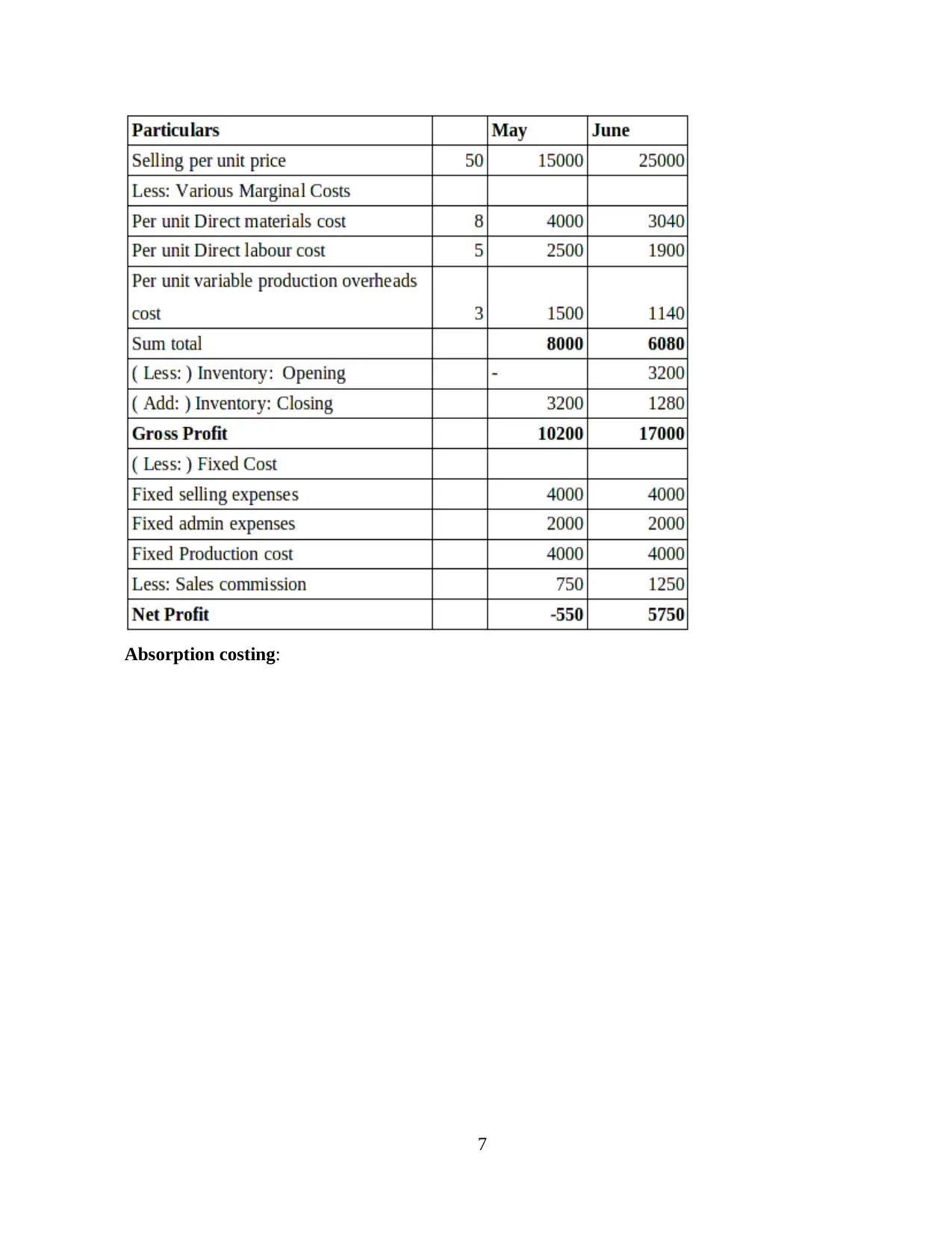
Absorption costing:
7
7
⊘ This is a preview!⊘
Do you want full access?
Subscribe today to unlock all pages.
Trusted by 1+ million students worldwide
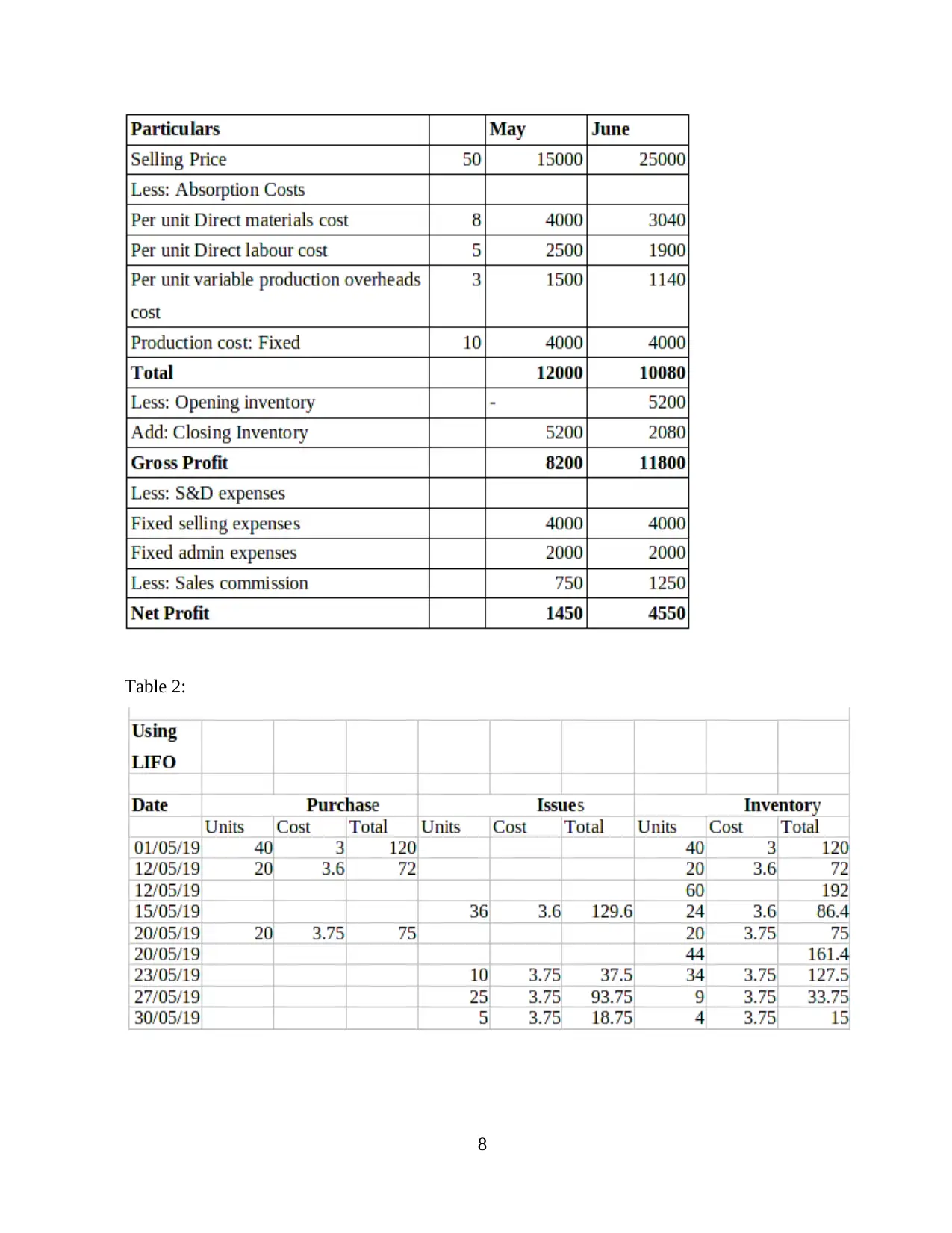
Table 2:
8
8
Paraphrase This Document
Need a fresh take? Get an instant paraphrase of this document with our AI Paraphraser
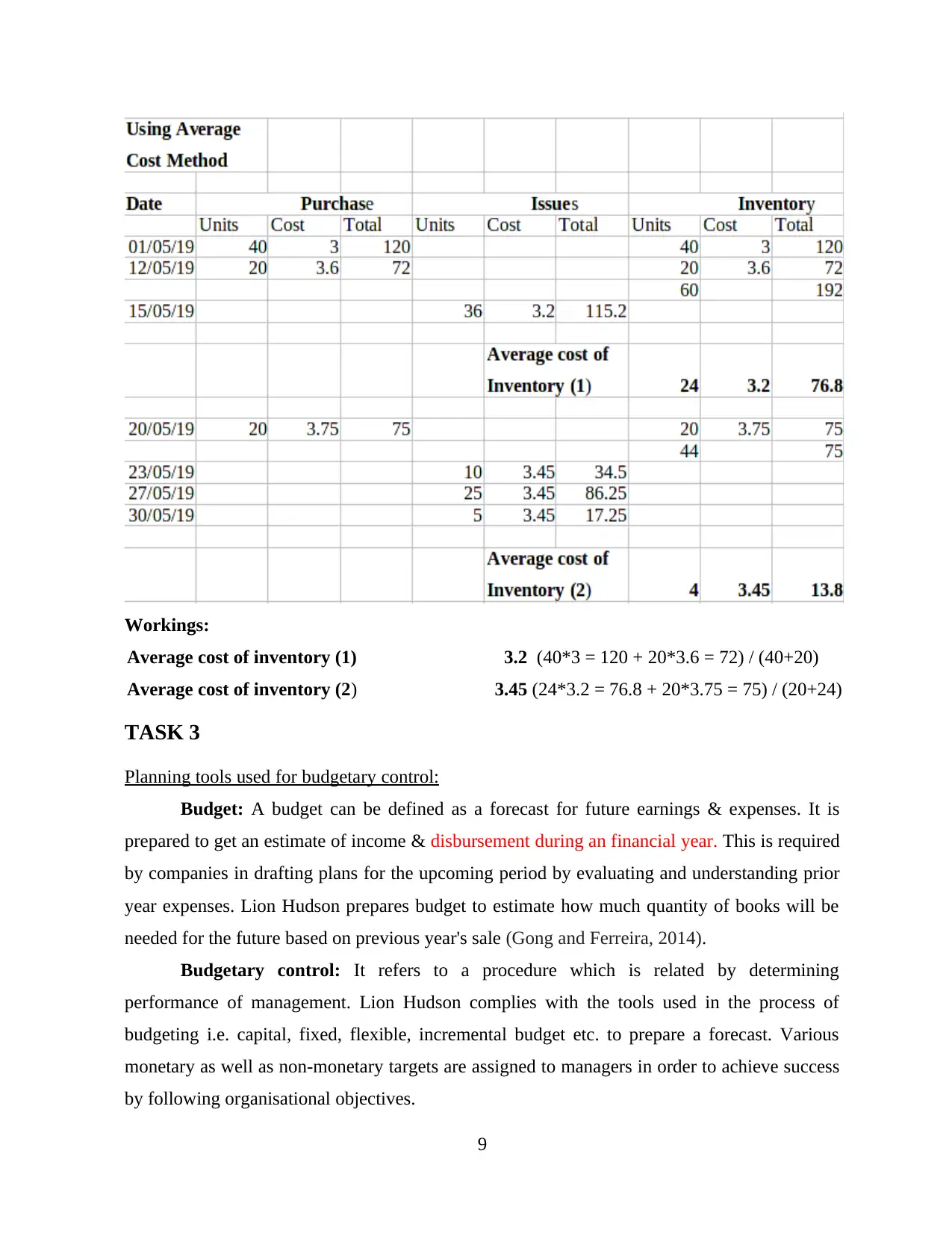
Workings:
Average cost of inventory (1) 3.2 (40*3 = 120 + 20*3.6 = 72) / (40+20)
Average cost of inventory (2) 3.45 (24*3.2 = 76.8 + 20*3.75 = 75) / (20+24)
TASK 3
Planning tools used for budgetary control:
Budget: A budget can be defined as a forecast for future earnings & expenses. It is
prepared to get an estimate of income & disbursement during an financial year. This is required
by companies in drafting plans for the upcoming period by evaluating and understanding prior
year expenses. Lion Hudson prepares budget to estimate how much quantity of books will be
needed for the future based on previous year's sale (Gong and Ferreira, 2014).
Budgetary control: It refers to a procedure which is related by determining
performance of management. Lion Hudson complies with the tools used in the process of
budgeting i.e. capital, fixed, flexible, incremental budget etc. to prepare a forecast. Various
monetary as well as non-monetary targets are assigned to managers in order to achieve success
by following organisational objectives.
9
Average cost of inventory (1) 3.2 (40*3 = 120 + 20*3.6 = 72) / (40+20)
Average cost of inventory (2) 3.45 (24*3.2 = 76.8 + 20*3.75 = 75) / (20+24)
TASK 3
Planning tools used for budgetary control:
Budget: A budget can be defined as a forecast for future earnings & expenses. It is
prepared to get an estimate of income & disbursement during an financial year. This is required
by companies in drafting plans for the upcoming period by evaluating and understanding prior
year expenses. Lion Hudson prepares budget to estimate how much quantity of books will be
needed for the future based on previous year's sale (Gong and Ferreira, 2014).
Budgetary control: It refers to a procedure which is related by determining
performance of management. Lion Hudson complies with the tools used in the process of
budgeting i.e. capital, fixed, flexible, incremental budget etc. to prepare a forecast. Various
monetary as well as non-monetary targets are assigned to managers in order to achieve success
by following organisational objectives.
9
The process of budgeting involves certain steps to be followed that include identifying
business objectives, potential strategies, choosing alternative course of action, implementing
long-term plan, measurement of actual results with budgeted figures, preparing a draft and
getting it checked by the higher authorities i.e. board of directors.
Different types of budget: There are different types of budgetary techniques implied
by business enterprises which are mentioned below:
Capital budget: This is a budget which is used to ascertain how much funding is
required by an organisation to perform its long term investments which include purchase of
machinery, research & development projects, new products etc. It consists of capital receipts
and payments that are used in a business on a day-to-day basis (Guffey and Harp, 2016). This
budget is prepared by Lion Hudson with the help of various capital budgeting techniques like
internal rate of return, net present value, payback period etc. which help the company to
analyse position of their earnings.
Advantages:
It helps in decision making of any investment opportunities that may arise in a business
by using NPV, IRR, ARR etc. Lion Hudson calculates its cash flows with the help of
capital budgeting techniques.
Disadvantages:
It leads to uncertain risks and incorrect applicability of resources if any wrong
budgeting technique is used.
Operating Budget: It involves a detailed projection of income and expenditure which
are based on forecasted revenue during a period of time. This is a statement that involves
estimation of all expenses which are used on a daily basis by following operations of a
business. It is a short term budget which excludes the effect of capital payment as they are
long-term costs. Lion Hudson prepared operating budget by keeping a track over its earnings
and expenditure.
Advantages:
It considers different variables in a business by setting aside some amount from
earnings for repair, maintenance etc. of typewriters or computers used by Lion Hudson
to draft and print books.
Disadvantages:
10
business objectives, potential strategies, choosing alternative course of action, implementing
long-term plan, measurement of actual results with budgeted figures, preparing a draft and
getting it checked by the higher authorities i.e. board of directors.
Different types of budget: There are different types of budgetary techniques implied
by business enterprises which are mentioned below:
Capital budget: This is a budget which is used to ascertain how much funding is
required by an organisation to perform its long term investments which include purchase of
machinery, research & development projects, new products etc. It consists of capital receipts
and payments that are used in a business on a day-to-day basis (Guffey and Harp, 2016). This
budget is prepared by Lion Hudson with the help of various capital budgeting techniques like
internal rate of return, net present value, payback period etc. which help the company to
analyse position of their earnings.
Advantages:
It helps in decision making of any investment opportunities that may arise in a business
by using NPV, IRR, ARR etc. Lion Hudson calculates its cash flows with the help of
capital budgeting techniques.
Disadvantages:
It leads to uncertain risks and incorrect applicability of resources if any wrong
budgeting technique is used.
Operating Budget: It involves a detailed projection of income and expenditure which
are based on forecasted revenue during a period of time. This is a statement that involves
estimation of all expenses which are used on a daily basis by following operations of a
business. It is a short term budget which excludes the effect of capital payment as they are
long-term costs. Lion Hudson prepared operating budget by keeping a track over its earnings
and expenditure.
Advantages:
It considers different variables in a business by setting aside some amount from
earnings for repair, maintenance etc. of typewriters or computers used by Lion Hudson
to draft and print books.
Disadvantages:
10
⊘ This is a preview!⊘
Do you want full access?
Subscribe today to unlock all pages.
Trusted by 1+ million students worldwide

1 out of 18


Related Documents


Your All-in-One AI-Powered Toolkit for Academic Success.
+13062052269
info@desklib.com
Available 24*7 on WhatsApp / Email
![[object Object]](/_next/static/media/star-bottom.7253800d.svg)
Unlock your academic potential
Copyright © 2020–2026 A2Z Services. All Rights Reserved. Developed and managed by ZUCOL.