Management Accounting Report: Essential Requirements and Methods
VerifiedAdded on 2020/06/04
|16
|5423
|104
Report
AI Summary
This report provides a comprehensive overview of management accounting, detailing its essential requirements and various methods used for reporting and analysis. It covers key aspects such as inventory management systems, job costing systems, price optimization, and cost accounting systems, emphasizing their roles in planning, monitoring, and controlling business activities. The report explores the use of both marginal and absorption costing methods to create income statements, highlighting their differences and applications. It also discusses the advantages and disadvantages of planning tools used for budgetary control, and how management accounting is utilized to solve financial problems. The report emphasizes the importance of management accounting in providing financial and statistical information for effective decision-making, and its integration with accounting, finance, and management to improve business understanding. The report concludes with a discussion on the benefits of these management accounting techniques for business performance.
Management
Accounting
Accounting

Paraphrase This Document
Need a fresh take? Get an instant paraphrase of this document with our AI Paraphraser
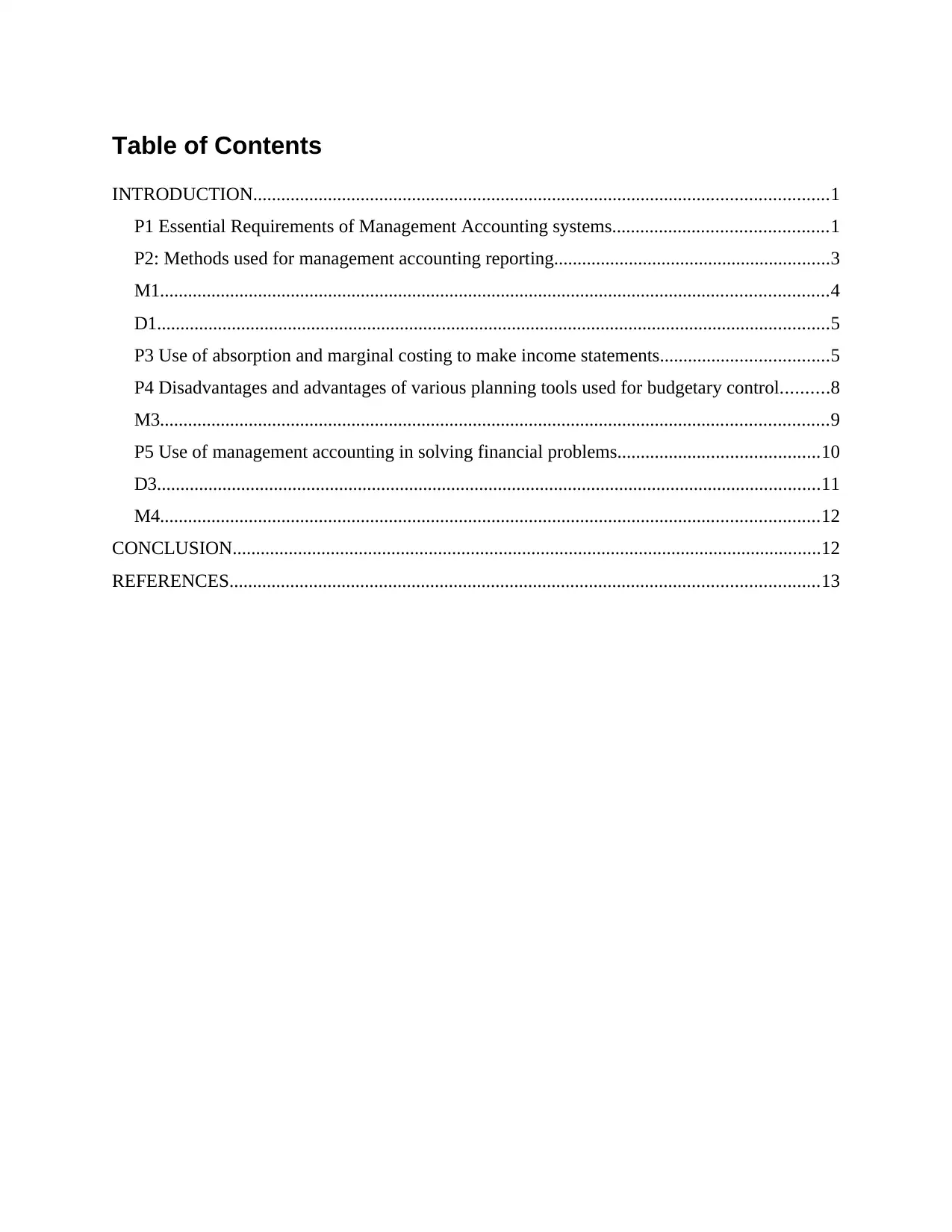
Table of Contents
INTRODUCTION...........................................................................................................................1
P1 Essential Requirements of Management Accounting systems..............................................1
P2: Methods used for management accounting reporting...........................................................3
M1...............................................................................................................................................4
D1................................................................................................................................................5
P3 Use of absorption and marginal costing to make income statements....................................5
P4 Disadvantages and advantages of various planning tools used for budgetary control..........8
M3...............................................................................................................................................9
P5 Use of management accounting in solving financial problems...........................................10
D3..............................................................................................................................................11
M4.............................................................................................................................................12
CONCLUSION..............................................................................................................................12
REFERENCES..............................................................................................................................13
INTRODUCTION...........................................................................................................................1
P1 Essential Requirements of Management Accounting systems..............................................1
P2: Methods used for management accounting reporting...........................................................3
M1...............................................................................................................................................4
D1................................................................................................................................................5
P3 Use of absorption and marginal costing to make income statements....................................5
P4 Disadvantages and advantages of various planning tools used for budgetary control..........8
M3...............................................................................................................................................9
P5 Use of management accounting in solving financial problems...........................................10
D3..............................................................................................................................................11
M4.............................................................................................................................................12
CONCLUSION..............................................................................................................................12
REFERENCES..............................................................................................................................13
INTRODUCTION
Management Accounting is a statement carrying the financial and statistical information
of the company necessary for the purpose of decision making (Macintosh and Quattrone, 2010).
This process is an integration of accounting, finance and management to develop a better
understanding of the business activities. Planning for the organisation is dependent on this report.
The information gathered is further utilised to perform monitoring and controlling functions by
the management. It is a process which involves analysis, interpretation and presentation of the
information gathered in financial accounting. The activities conducted in this process are carried
out in an efficient manner and information is collected should be the best of knowledge so that
the decisions taken works for the benefit of the company. Management accounting is different
from cost accounting in which reports are only prepared for the stakeholders. The report consist
of information such as available cash, sales revenue, current assets and liabilities of the
organisation. The report is kept strictly confidential and can be accessed by only the internal
member of the company. The various tools and techniques used in this process are mentioned
and along with a planning strategy for the coming period.
P1 Essential Requirements of Management Accounting systems
Management accounting is process which obtains, identifies, analyses and interprets the
information for the planning, monitoring and controlling of the business activities. It is an
amalgamation of accounts, finance and management for the welfare of the business. The report
which is formulated after this process is being sent to the top management which helps them in
formulating policies and deciding the future course of action. The data collected is revenue, cash
flows and debts of the company (Baldvinsdottir, Mitchell and Nørreklit, 2010). The financial and
non financial information obtained is combined to get a better view of the circumstances. This
process is utilized in all the organisation be it public or private limited company.
Management accounting system however is a system responsible for gathering of
financial data across various business operations such as sales, revenue, inventory costs and
prices of raw materials and converting into reports.
The following are the types of management accounting system.
Inventory Management System:
This system is the most preferred accounting system used for tracking inventory levels,
sales and deliveries. The most common technique used in this system is Bar code tracking. This
1
Management Accounting is a statement carrying the financial and statistical information
of the company necessary for the purpose of decision making (Macintosh and Quattrone, 2010).
This process is an integration of accounting, finance and management to develop a better
understanding of the business activities. Planning for the organisation is dependent on this report.
The information gathered is further utilised to perform monitoring and controlling functions by
the management. It is a process which involves analysis, interpretation and presentation of the
information gathered in financial accounting. The activities conducted in this process are carried
out in an efficient manner and information is collected should be the best of knowledge so that
the decisions taken works for the benefit of the company. Management accounting is different
from cost accounting in which reports are only prepared for the stakeholders. The report consist
of information such as available cash, sales revenue, current assets and liabilities of the
organisation. The report is kept strictly confidential and can be accessed by only the internal
member of the company. The various tools and techniques used in this process are mentioned
and along with a planning strategy for the coming period.
P1 Essential Requirements of Management Accounting systems
Management accounting is process which obtains, identifies, analyses and interprets the
information for the planning, monitoring and controlling of the business activities. It is an
amalgamation of accounts, finance and management for the welfare of the business. The report
which is formulated after this process is being sent to the top management which helps them in
formulating policies and deciding the future course of action. The data collected is revenue, cash
flows and debts of the company (Baldvinsdottir, Mitchell and Nørreklit, 2010). The financial and
non financial information obtained is combined to get a better view of the circumstances. This
process is utilized in all the organisation be it public or private limited company.
Management accounting system however is a system responsible for gathering of
financial data across various business operations such as sales, revenue, inventory costs and
prices of raw materials and converting into reports.
The following are the types of management accounting system.
Inventory Management System:
This system is the most preferred accounting system used for tracking inventory levels,
sales and deliveries. The most common technique used in this system is Bar code tracking. This
1
⊘ This is a preview!⊘
Do you want full access?
Subscribe today to unlock all pages.

Trusted by 1+ million students worldwide
technique helps in tracking the inventories. Each inventory is provided with a bar code . The bar
codes are scanned whenever the inventories move in or out of the facility or can be used for
moving the inventory within the storage facility as well. The another common tool used is RFID.
This tool has a feature of advanced bar coding as every item consists a device which emits signal
any movement of the same can be tracked in no time. Both the tools help in maintaining
inventories at a appropriate level so that the company does not have to bear extra costs for
storing the same.
Job costing system
This accounting system focuses on accumulation of manufacturing cost independently for
each job. This system is beneficial in the company producing diversified products or niche
commodities (Lukka and Modell, 2010). The costs are categorised into overhead, direct and
indirect costs and lastly labour cost. The sole purpose of this system is to control the
manufacturing costs for each unit and enhancing the profitability.
Price Optimisation system
As the name suggests this system focuses on optimising the cost incurred by the company
on producing a product. This system helps a company by increasing the level of profitability.
The price charged from the consumers need to be maintained at a profitable level so that there is
an increase in the per product margin of the company. The crucial part is the price is to be
decided keeping in mind the competition, market and the purchasing power of the consumers so
that they are able to afford the product.
Cost accounting system
Cost accounting system is a tool used by the business houses to estimate the cost of
pricing of products for profitability analysis and cost control. This system is used to identify
what products are profitable for the company and which one are incurring losses. The various
elements which are involved in cost are to analysed while calculation of cost and ensuring that
problems shall not arise due to the non performing elements. This ensures the company that the
goals will be achieved in an effortless manner.
The essential requirement of Management accounting which are to be fulfilled by managers are: Traditional accounting techniques: these techniques are often used enterprises which
operate at a small or medium scale due to the less finance. The technique takes into
account the cost and profit on the forecasting basis. The need of management accounting
2
codes are scanned whenever the inventories move in or out of the facility or can be used for
moving the inventory within the storage facility as well. The another common tool used is RFID.
This tool has a feature of advanced bar coding as every item consists a device which emits signal
any movement of the same can be tracked in no time. Both the tools help in maintaining
inventories at a appropriate level so that the company does not have to bear extra costs for
storing the same.
Job costing system
This accounting system focuses on accumulation of manufacturing cost independently for
each job. This system is beneficial in the company producing diversified products or niche
commodities (Lukka and Modell, 2010). The costs are categorised into overhead, direct and
indirect costs and lastly labour cost. The sole purpose of this system is to control the
manufacturing costs for each unit and enhancing the profitability.
Price Optimisation system
As the name suggests this system focuses on optimising the cost incurred by the company
on producing a product. This system helps a company by increasing the level of profitability.
The price charged from the consumers need to be maintained at a profitable level so that there is
an increase in the per product margin of the company. The crucial part is the price is to be
decided keeping in mind the competition, market and the purchasing power of the consumers so
that they are able to afford the product.
Cost accounting system
Cost accounting system is a tool used by the business houses to estimate the cost of
pricing of products for profitability analysis and cost control. This system is used to identify
what products are profitable for the company and which one are incurring losses. The various
elements which are involved in cost are to analysed while calculation of cost and ensuring that
problems shall not arise due to the non performing elements. This ensures the company that the
goals will be achieved in an effortless manner.
The essential requirement of Management accounting which are to be fulfilled by managers are: Traditional accounting techniques: these techniques are often used enterprises which
operate at a small or medium scale due to the less finance. The technique takes into
account the cost and profit on the forecasting basis. The need of management accounting
2
Paraphrase This Document
Need a fresh take? Get an instant paraphrase of this document with our AI Paraphraser
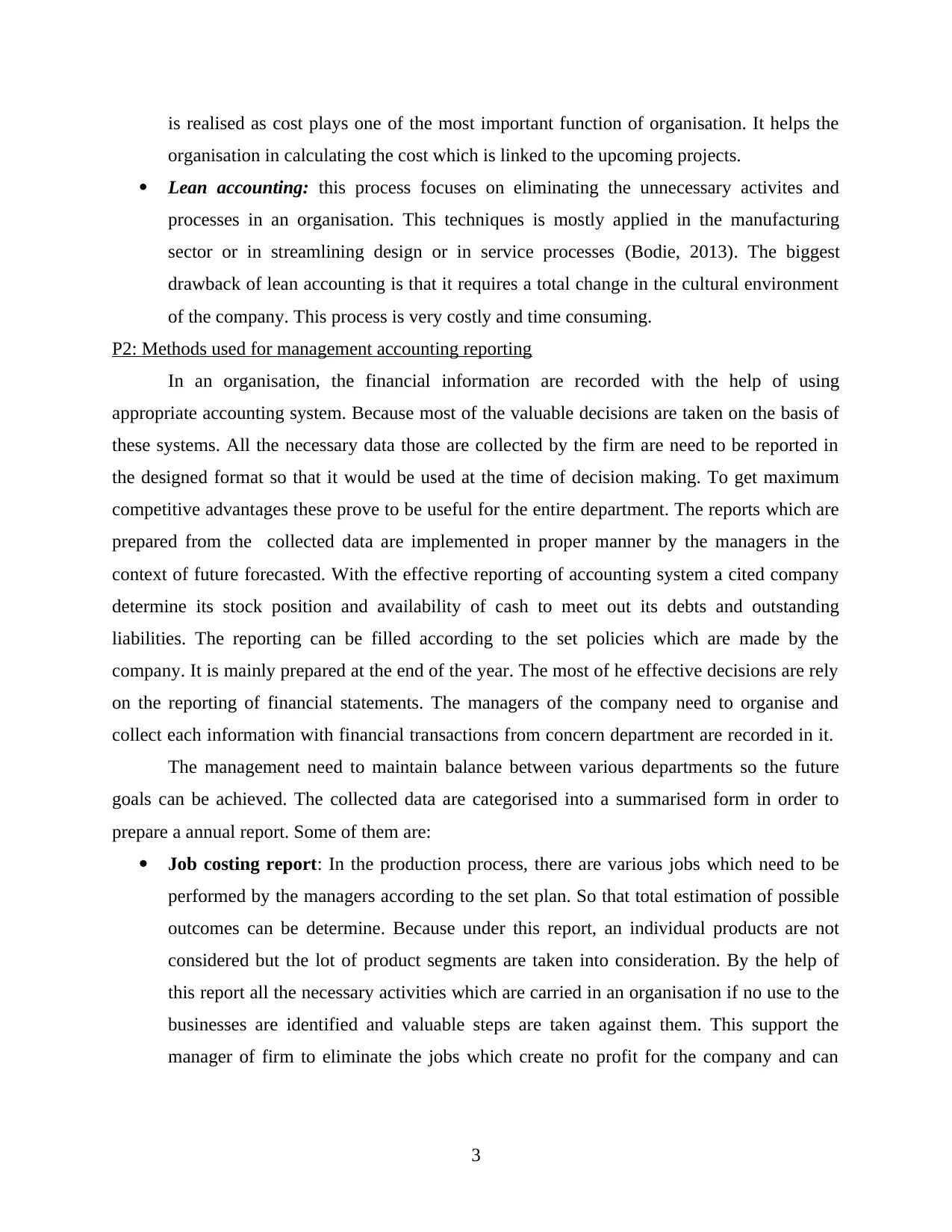
is realised as cost plays one of the most important function of organisation. It helps the
organisation in calculating the cost which is linked to the upcoming projects.
Lean accounting: this process focuses on eliminating the unnecessary activites and
processes in an organisation. This techniques is mostly applied in the manufacturing
sector or in streamlining design or in service processes (Bodie, 2013). The biggest
drawback of lean accounting is that it requires a total change in the cultural environment
of the company. This process is very costly and time consuming.
P2: Methods used for management accounting reporting
In an organisation, the financial information are recorded with the help of using
appropriate accounting system. Because most of the valuable decisions are taken on the basis of
these systems. All the necessary data those are collected by the firm are need to be reported in
the designed format so that it would be used at the time of decision making. To get maximum
competitive advantages these prove to be useful for the entire department. The reports which are
prepared from the collected data are implemented in proper manner by the managers in the
context of future forecasted. With the effective reporting of accounting system a cited company
determine its stock position and availability of cash to meet out its debts and outstanding
liabilities. The reporting can be filled according to the set policies which are made by the
company. It is mainly prepared at the end of the year. The most of he effective decisions are rely
on the reporting of financial statements. The managers of the company need to organise and
collect each information with financial transactions from concern department are recorded in it.
The management need to maintain balance between various departments so the future
goals can be achieved. The collected data are categorised into a summarised form in order to
prepare a annual report. Some of them are:
Job costing report: In the production process, there are various jobs which need to be
performed by the managers according to the set plan. So that total estimation of possible
outcomes can be determine. Because under this report, an individual products are not
considered but the lot of product segments are taken into consideration. By the help of
this report all the necessary activities which are carried in an organisation if no use to the
businesses are identified and valuable steps are taken against them. This support the
manager of firm to eliminate the jobs which create no profit for the company and can
3
organisation in calculating the cost which is linked to the upcoming projects.
Lean accounting: this process focuses on eliminating the unnecessary activites and
processes in an organisation. This techniques is mostly applied in the manufacturing
sector or in streamlining design or in service processes (Bodie, 2013). The biggest
drawback of lean accounting is that it requires a total change in the cultural environment
of the company. This process is very costly and time consuming.
P2: Methods used for management accounting reporting
In an organisation, the financial information are recorded with the help of using
appropriate accounting system. Because most of the valuable decisions are taken on the basis of
these systems. All the necessary data those are collected by the firm are need to be reported in
the designed format so that it would be used at the time of decision making. To get maximum
competitive advantages these prove to be useful for the entire department. The reports which are
prepared from the collected data are implemented in proper manner by the managers in the
context of future forecasted. With the effective reporting of accounting system a cited company
determine its stock position and availability of cash to meet out its debts and outstanding
liabilities. The reporting can be filled according to the set policies which are made by the
company. It is mainly prepared at the end of the year. The most of he effective decisions are rely
on the reporting of financial statements. The managers of the company need to organise and
collect each information with financial transactions from concern department are recorded in it.
The management need to maintain balance between various departments so the future
goals can be achieved. The collected data are categorised into a summarised form in order to
prepare a annual report. Some of them are:
Job costing report: In the production process, there are various jobs which need to be
performed by the managers according to the set plan. So that total estimation of possible
outcomes can be determine. Because under this report, an individual products are not
considered but the lot of product segments are taken into consideration. By the help of
this report all the necessary activities which are carried in an organisation if no use to the
businesses are identified and valuable steps are taken against them. This support the
manager of firm to eliminate the jobs which create no profit for the company and can
3
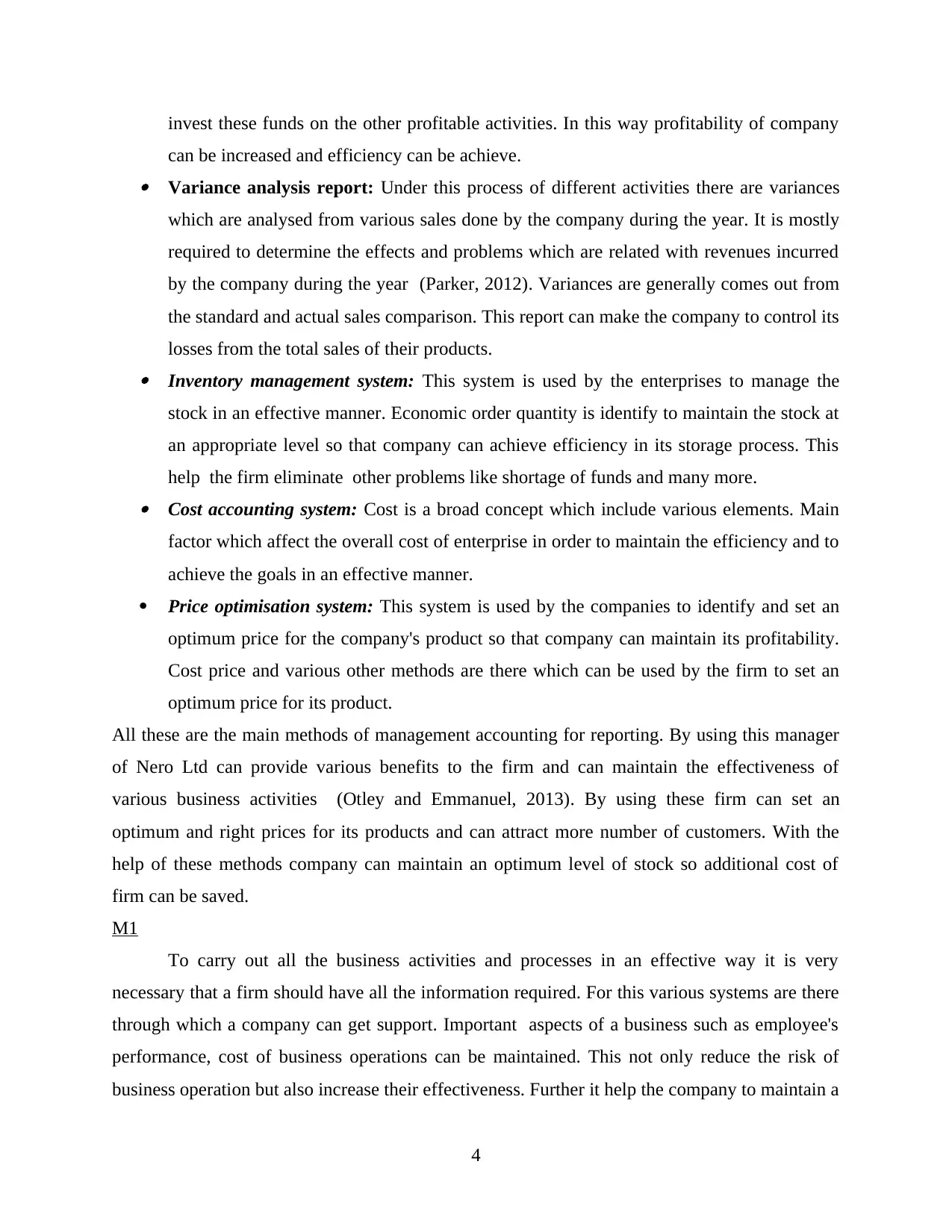
invest these funds on the other profitable activities. In this way profitability of company
can be increased and efficiency can be achieve. Variance analysis report: Under this process of different activities there are variances
which are analysed from various sales done by the company during the year. It is mostly
required to determine the effects and problems which are related with revenues incurred
by the company during the year (Parker, 2012). Variances are generally comes out from
the standard and actual sales comparison. This report can make the company to control its
losses from the total sales of their products. Inventory management system: This system is used by the enterprises to manage the
stock in an effective manner. Economic order quantity is identify to maintain the stock at
an appropriate level so that company can achieve efficiency in its storage process. This
help the firm eliminate other problems like shortage of funds and many more. Cost accounting system: Cost is a broad concept which include various elements. Main
factor which affect the overall cost of enterprise in order to maintain the efficiency and to
achieve the goals in an effective manner.
Price optimisation system: This system is used by the companies to identify and set an
optimum price for the company's product so that company can maintain its profitability.
Cost price and various other methods are there which can be used by the firm to set an
optimum price for its product.
All these are the main methods of management accounting for reporting. By using this manager
of Nero Ltd can provide various benefits to the firm and can maintain the effectiveness of
various business activities (Otley and Emmanuel, 2013). By using these firm can set an
optimum and right prices for its products and can attract more number of customers. With the
help of these methods company can maintain an optimum level of stock so additional cost of
firm can be saved.
M1
To carry out all the business activities and processes in an effective way it is very
necessary that a firm should have all the information required. For this various systems are there
through which a company can get support. Important aspects of a business such as employee's
performance, cost of business operations can be maintained. This not only reduce the risk of
business operation but also increase their effectiveness. Further it help the company to maintain a
4
can be increased and efficiency can be achieve. Variance analysis report: Under this process of different activities there are variances
which are analysed from various sales done by the company during the year. It is mostly
required to determine the effects and problems which are related with revenues incurred
by the company during the year (Parker, 2012). Variances are generally comes out from
the standard and actual sales comparison. This report can make the company to control its
losses from the total sales of their products. Inventory management system: This system is used by the enterprises to manage the
stock in an effective manner. Economic order quantity is identify to maintain the stock at
an appropriate level so that company can achieve efficiency in its storage process. This
help the firm eliminate other problems like shortage of funds and many more. Cost accounting system: Cost is a broad concept which include various elements. Main
factor which affect the overall cost of enterprise in order to maintain the efficiency and to
achieve the goals in an effective manner.
Price optimisation system: This system is used by the companies to identify and set an
optimum price for the company's product so that company can maintain its profitability.
Cost price and various other methods are there which can be used by the firm to set an
optimum price for its product.
All these are the main methods of management accounting for reporting. By using this manager
of Nero Ltd can provide various benefits to the firm and can maintain the effectiveness of
various business activities (Otley and Emmanuel, 2013). By using these firm can set an
optimum and right prices for its products and can attract more number of customers. With the
help of these methods company can maintain an optimum level of stock so additional cost of
firm can be saved.
M1
To carry out all the business activities and processes in an effective way it is very
necessary that a firm should have all the information required. For this various systems are there
through which a company can get support. Important aspects of a business such as employee's
performance, cost of business operations can be maintained. This not only reduce the risk of
business operation but also increase their effectiveness. Further it help the company to maintain a
4
⊘ This is a preview!⊘
Do you want full access?
Subscribe today to unlock all pages.
Trusted by 1+ million students worldwide
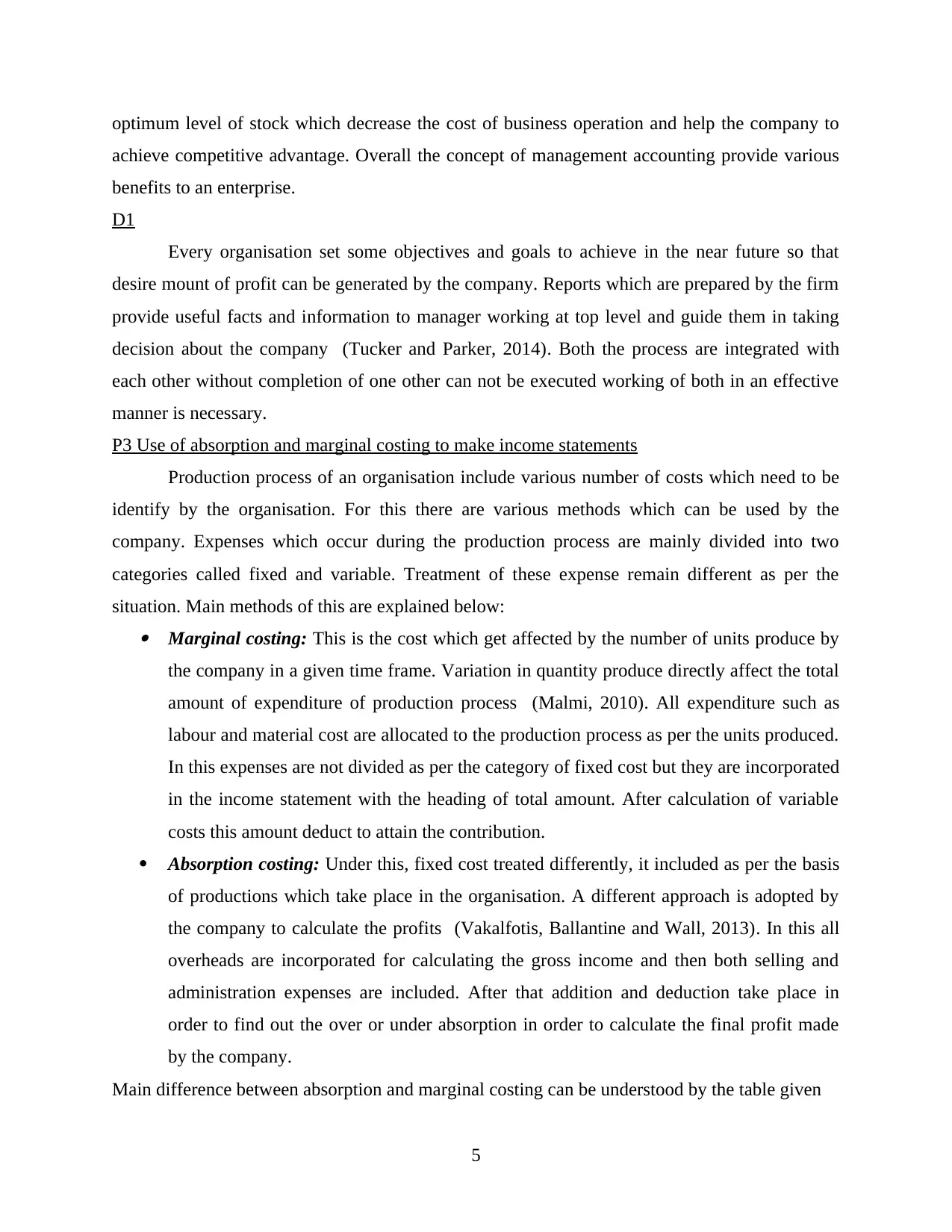
optimum level of stock which decrease the cost of business operation and help the company to
achieve competitive advantage. Overall the concept of management accounting provide various
benefits to an enterprise.
D1
Every organisation set some objectives and goals to achieve in the near future so that
desire mount of profit can be generated by the company. Reports which are prepared by the firm
provide useful facts and information to manager working at top level and guide them in taking
decision about the company (Tucker and Parker, 2014). Both the process are integrated with
each other without completion of one other can not be executed working of both in an effective
manner is necessary.
P3 Use of absorption and marginal costing to make income statements
Production process of an organisation include various number of costs which need to be
identify by the organisation. For this there are various methods which can be used by the
company. Expenses which occur during the production process are mainly divided into two
categories called fixed and variable. Treatment of these expense remain different as per the
situation. Main methods of this are explained below: Marginal costing: This is the cost which get affected by the number of units produce by
the company in a given time frame. Variation in quantity produce directly affect the total
amount of expenditure of production process (Malmi, 2010). All expenditure such as
labour and material cost are allocated to the production process as per the units produced.
In this expenses are not divided as per the category of fixed cost but they are incorporated
in the income statement with the heading of total amount. After calculation of variable
costs this amount deduct to attain the contribution.
Absorption costing: Under this, fixed cost treated differently, it included as per the basis
of productions which take place in the organisation. A different approach is adopted by
the company to calculate the profits (Vakalfotis, Ballantine and Wall, 2013). In this all
overheads are incorporated for calculating the gross income and then both selling and
administration expenses are included. After that addition and deduction take place in
order to find out the over or under absorption in order to calculate the final profit made
by the company.
Main difference between absorption and marginal costing can be understood by the table given
5
achieve competitive advantage. Overall the concept of management accounting provide various
benefits to an enterprise.
D1
Every organisation set some objectives and goals to achieve in the near future so that
desire mount of profit can be generated by the company. Reports which are prepared by the firm
provide useful facts and information to manager working at top level and guide them in taking
decision about the company (Tucker and Parker, 2014). Both the process are integrated with
each other without completion of one other can not be executed working of both in an effective
manner is necessary.
P3 Use of absorption and marginal costing to make income statements
Production process of an organisation include various number of costs which need to be
identify by the organisation. For this there are various methods which can be used by the
company. Expenses which occur during the production process are mainly divided into two
categories called fixed and variable. Treatment of these expense remain different as per the
situation. Main methods of this are explained below: Marginal costing: This is the cost which get affected by the number of units produce by
the company in a given time frame. Variation in quantity produce directly affect the total
amount of expenditure of production process (Malmi, 2010). All expenditure such as
labour and material cost are allocated to the production process as per the units produced.
In this expenses are not divided as per the category of fixed cost but they are incorporated
in the income statement with the heading of total amount. After calculation of variable
costs this amount deduct to attain the contribution.
Absorption costing: Under this, fixed cost treated differently, it included as per the basis
of productions which take place in the organisation. A different approach is adopted by
the company to calculate the profits (Vakalfotis, Ballantine and Wall, 2013). In this all
overheads are incorporated for calculating the gross income and then both selling and
administration expenses are included. After that addition and deduction take place in
order to find out the over or under absorption in order to calculate the final profit made
by the company.
Main difference between absorption and marginal costing can be understood by the table given
5
Paraphrase This Document
Need a fresh take? Get an instant paraphrase of this document with our AI Paraphraser
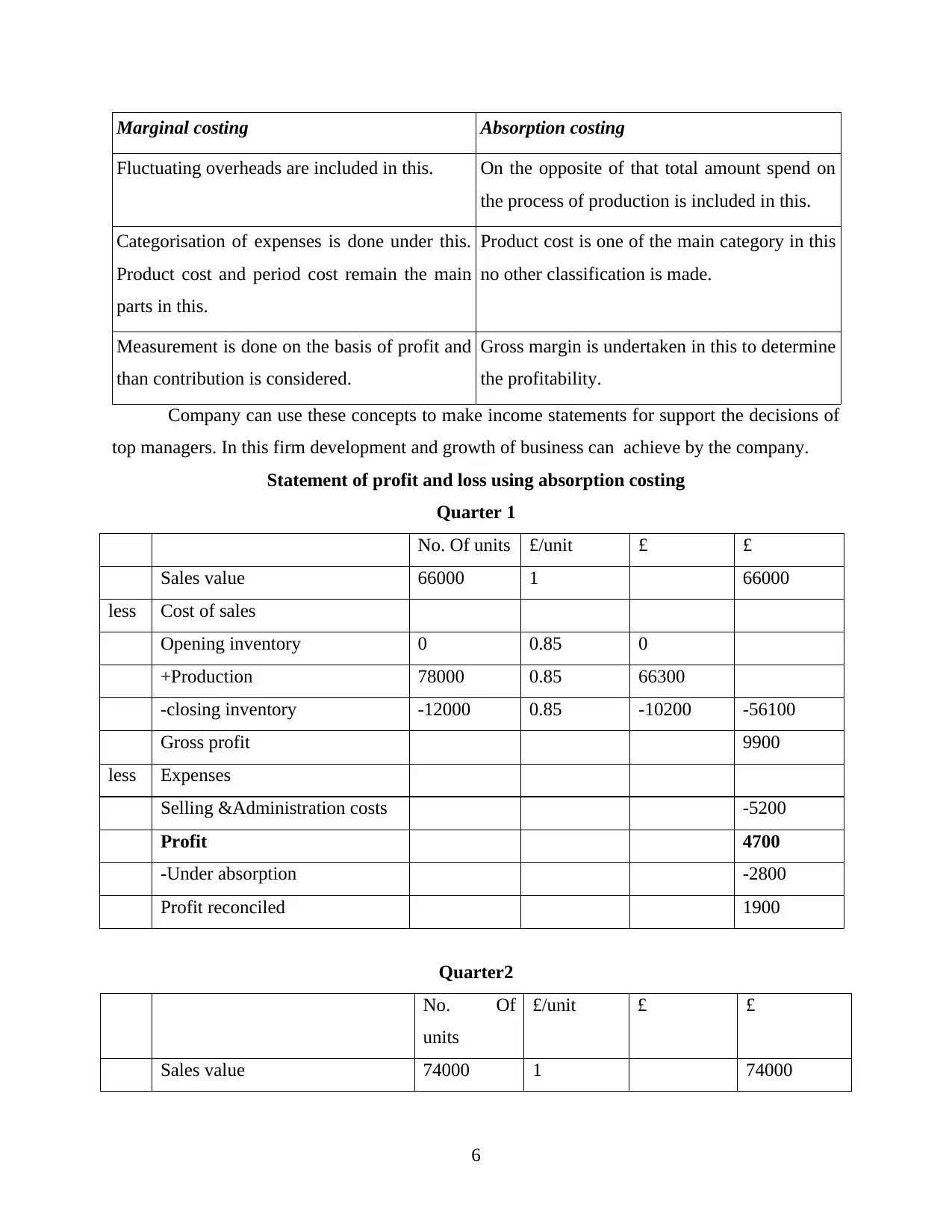
Marginal costing Absorption costing
Fluctuating overheads are included in this. On the opposite of that total amount spend on
the process of production is included in this.
Categorisation of expenses is done under this.
Product cost and period cost remain the main
parts in this.
Product cost is one of the main category in this
no other classification is made.
Measurement is done on the basis of profit and
than contribution is considered.
Gross margin is undertaken in this to determine
the profitability.
Company can use these concepts to make income statements for support the decisions of
top managers. In this firm development and growth of business can achieve by the company.
Statement of profit and loss using absorption costing
Quarter 1
No. Of units £/unit £ £
Sales value 66000 1 66000
less Cost of sales
Opening inventory 0 0.85 0
+Production 78000 0.85 66300
-closing inventory -12000 0.85 -10200 -56100
Gross profit 9900
less Expenses
Selling &Administration costs -5200
Profit 4700
-Under absorption -2800
Profit reconciled 1900
Quarter2
No. Of
units
£/unit £ £
Sales value 74000 1 74000
6
Fluctuating overheads are included in this. On the opposite of that total amount spend on
the process of production is included in this.
Categorisation of expenses is done under this.
Product cost and period cost remain the main
parts in this.
Product cost is one of the main category in this
no other classification is made.
Measurement is done on the basis of profit and
than contribution is considered.
Gross margin is undertaken in this to determine
the profitability.
Company can use these concepts to make income statements for support the decisions of
top managers. In this firm development and growth of business can achieve by the company.
Statement of profit and loss using absorption costing
Quarter 1
No. Of units £/unit £ £
Sales value 66000 1 66000
less Cost of sales
Opening inventory 0 0.85 0
+Production 78000 0.85 66300
-closing inventory -12000 0.85 -10200 -56100
Gross profit 9900
less Expenses
Selling &Administration costs -5200
Profit 4700
-Under absorption -2800
Profit reconciled 1900
Quarter2
No. Of
units
£/unit £ £
Sales value 74000 1 74000
6
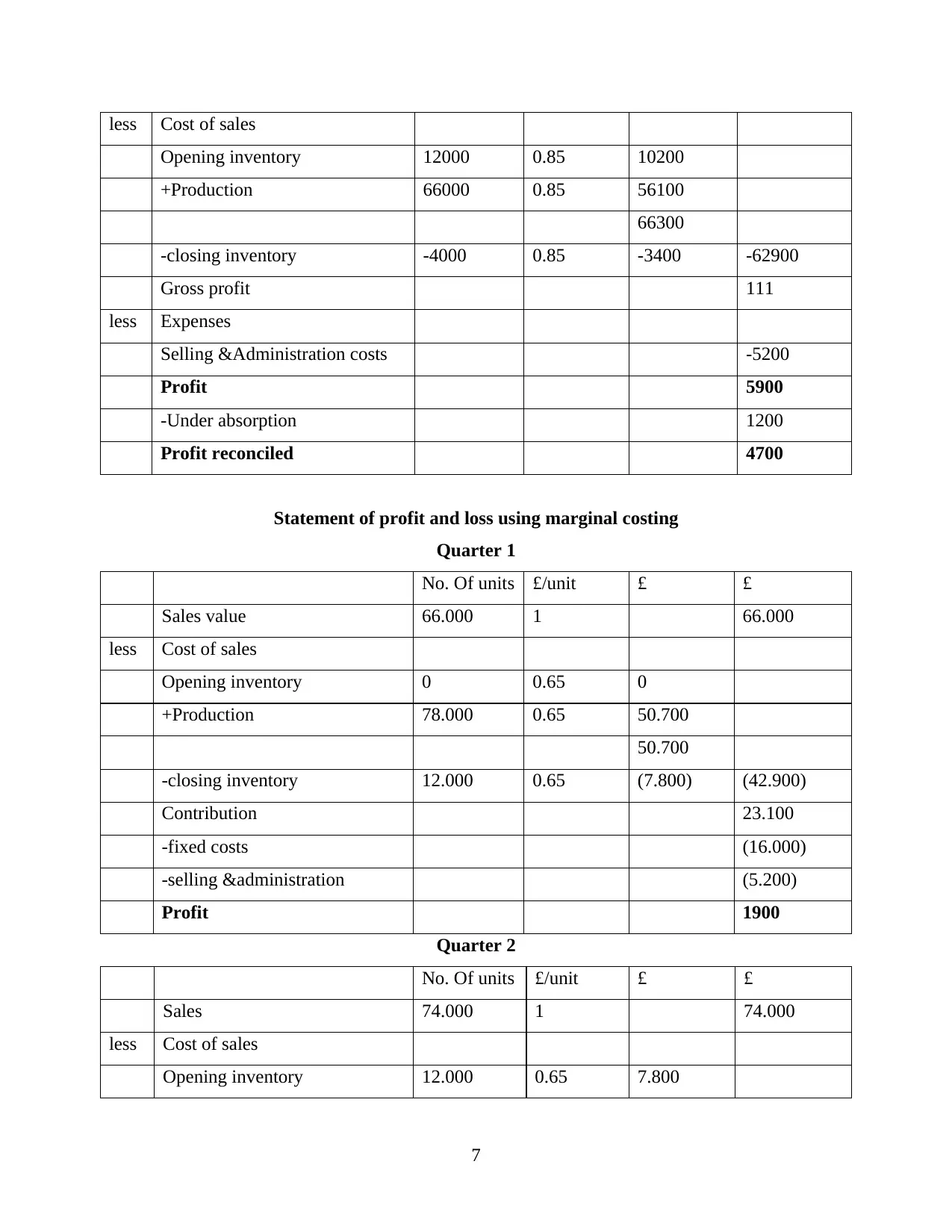
less Cost of sales
Opening inventory 12000 0.85 10200
+Production 66000 0.85 56100
66300
-closing inventory -4000 0.85 -3400 -62900
Gross profit 111
less Expenses
Selling &Administration costs -5200
Profit 5900
-Under absorption 1200
Profit reconciled 4700
Statement of profit and loss using marginal costing
Quarter 1
No. Of units £/unit £ £
Sales value 66.000 1 66.000
less Cost of sales
Opening inventory 0 0.65 0
+Production 78.000 0.65 50.700
50.700
-closing inventory 12.000 0.65 (7.800) (42.900)
Contribution 23.100
-fixed costs (16.000)
-selling &administration (5.200)
Profit 1900
Quarter 2
No. Of units £/unit £ £
Sales 74.000 1 74.000
less Cost of sales
Opening inventory 12.000 0.65 7.800
7
Opening inventory 12000 0.85 10200
+Production 66000 0.85 56100
66300
-closing inventory -4000 0.85 -3400 -62900
Gross profit 111
less Expenses
Selling &Administration costs -5200
Profit 5900
-Under absorption 1200
Profit reconciled 4700
Statement of profit and loss using marginal costing
Quarter 1
No. Of units £/unit £ £
Sales value 66.000 1 66.000
less Cost of sales
Opening inventory 0 0.65 0
+Production 78.000 0.65 50.700
50.700
-closing inventory 12.000 0.65 (7.800) (42.900)
Contribution 23.100
-fixed costs (16.000)
-selling &administration (5.200)
Profit 1900
Quarter 2
No. Of units £/unit £ £
Sales 74.000 1 74.000
less Cost of sales
Opening inventory 12.000 0.65 7.800
7
⊘ This is a preview!⊘
Do you want full access?
Subscribe today to unlock all pages.
Trusted by 1+ million students worldwide
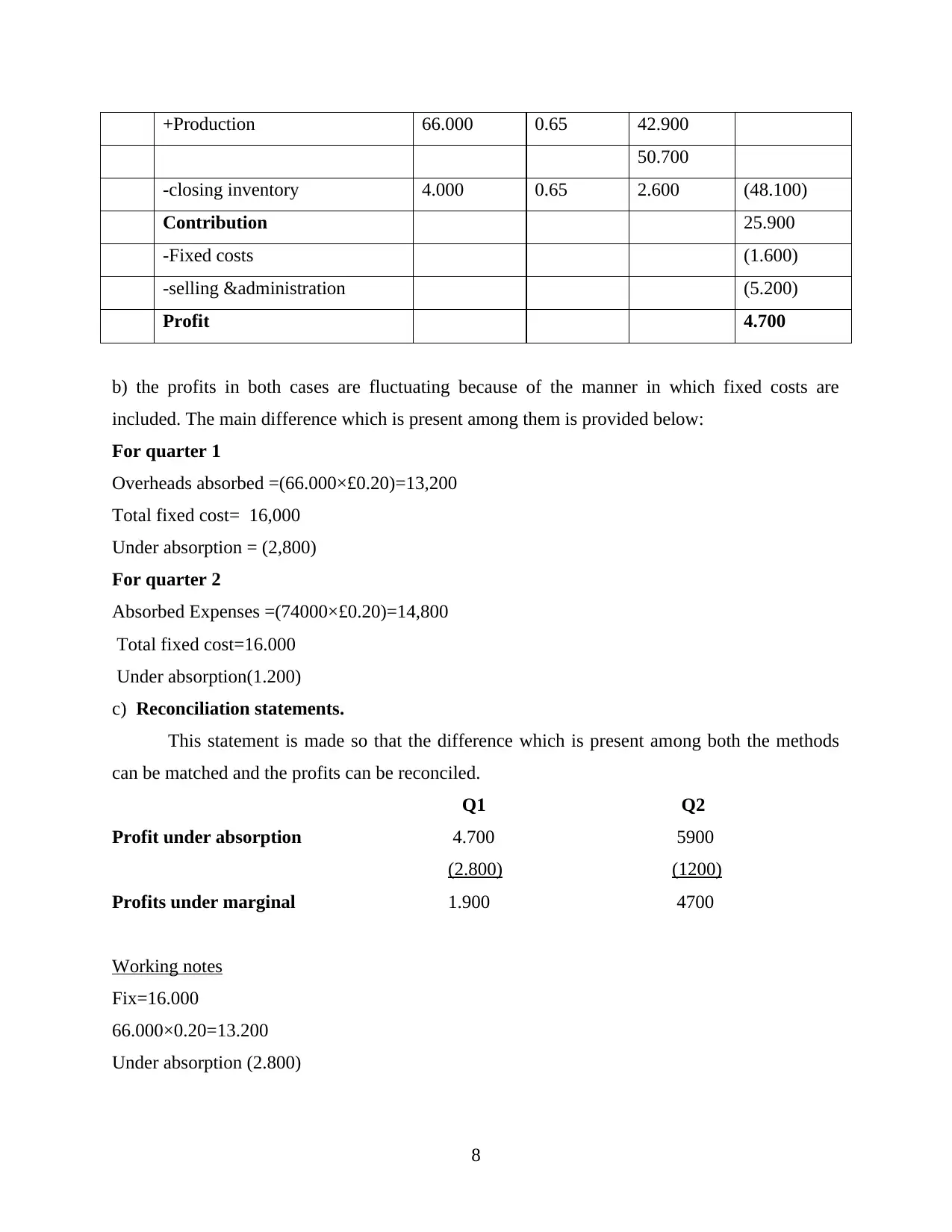
+Production 66.000 0.65 42.900
50.700
-closing inventory 4.000 0.65 2.600 (48.100)
Contribution 25.900
-Fixed costs (1.600)
-selling &administration (5.200)
Profit 4.700
b) the profits in both cases are fluctuating because of the manner in which fixed costs are
included. The main difference which is present among them is provided below:
For quarter 1
Overheads absorbed =(66.000×£0.20)=13,200
Total fixed cost= 16,000
Under absorption = (2,800)
For quarter 2
Absorbed Expenses =(74000×£0.20)=14,800
Total fixed cost=16.000
Under absorption(1.200)
c) Reconciliation statements.
This statement is made so that the difference which is present among both the methods
can be matched and the profits can be reconciled.
Q1 Q2
Profit under absorption 4.700 5900
(2.800) (1200)
Profits under marginal 1.900 4700
Working notes
Fix=16.000
66.000×0.20=13.200
Under absorption (2.800)
8
50.700
-closing inventory 4.000 0.65 2.600 (48.100)
Contribution 25.900
-Fixed costs (1.600)
-selling &administration (5.200)
Profit 4.700
b) the profits in both cases are fluctuating because of the manner in which fixed costs are
included. The main difference which is present among them is provided below:
For quarter 1
Overheads absorbed =(66.000×£0.20)=13,200
Total fixed cost= 16,000
Under absorption = (2,800)
For quarter 2
Absorbed Expenses =(74000×£0.20)=14,800
Total fixed cost=16.000
Under absorption(1.200)
c) Reconciliation statements.
This statement is made so that the difference which is present among both the methods
can be matched and the profits can be reconciled.
Q1 Q2
Profit under absorption 4.700 5900
(2.800) (1200)
Profits under marginal 1.900 4700
Working notes
Fix=16.000
66.000×0.20=13.200
Under absorption (2.800)
8
Paraphrase This Document
Need a fresh take? Get an instant paraphrase of this document with our AI Paraphraser
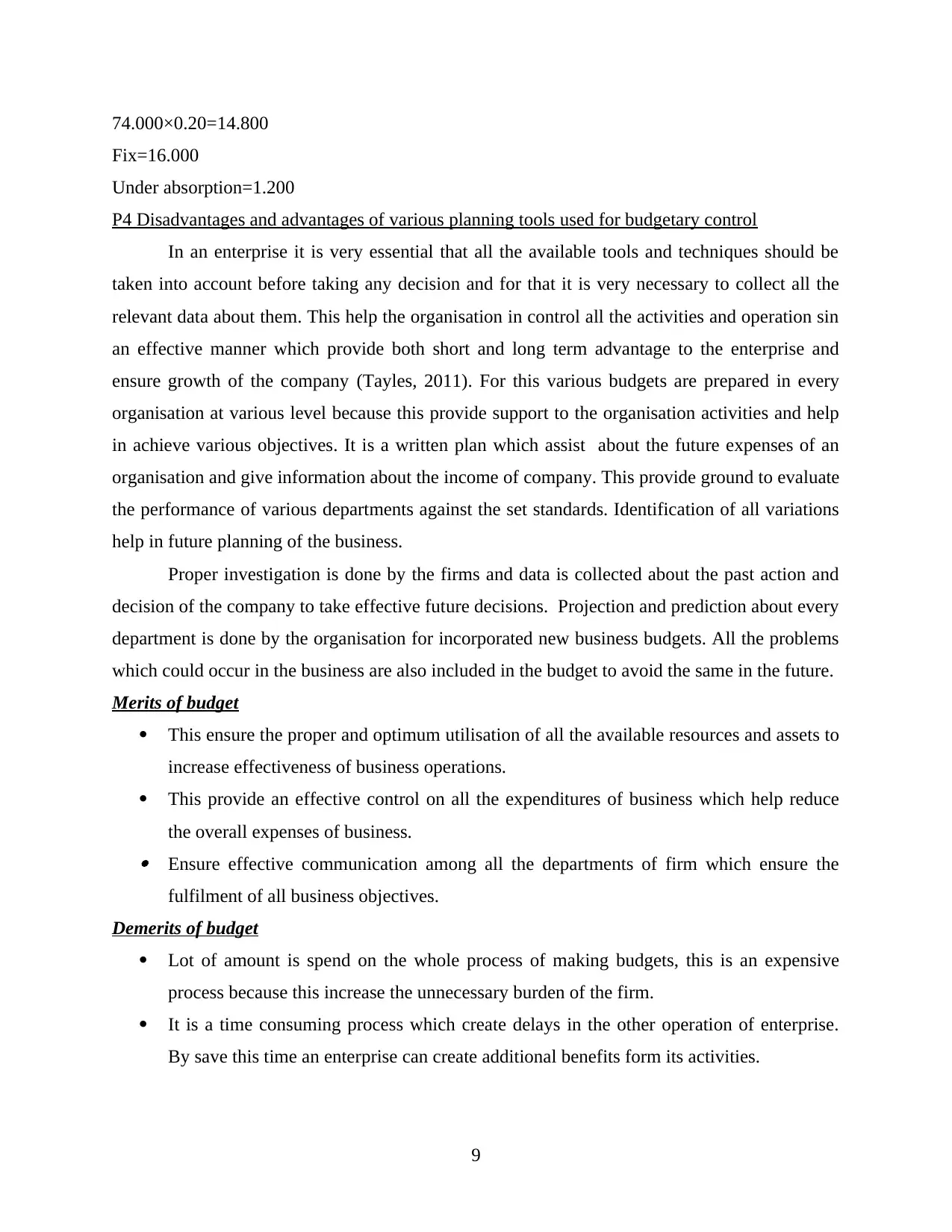
74.000×0.20=14.800
Fix=16.000
Under absorption=1.200
P4 Disadvantages and advantages of various planning tools used for budgetary control
In an enterprise it is very essential that all the available tools and techniques should be
taken into account before taking any decision and for that it is very necessary to collect all the
relevant data about them. This help the organisation in control all the activities and operation sin
an effective manner which provide both short and long term advantage to the enterprise and
ensure growth of the company (Tayles, 2011). For this various budgets are prepared in every
organisation at various level because this provide support to the organisation activities and help
in achieve various objectives. It is a written plan which assist about the future expenses of an
organisation and give information about the income of company. This provide ground to evaluate
the performance of various departments against the set standards. Identification of all variations
help in future planning of the business.
Proper investigation is done by the firms and data is collected about the past action and
decision of the company to take effective future decisions. Projection and prediction about every
department is done by the organisation for incorporated new business budgets. All the problems
which could occur in the business are also included in the budget to avoid the same in the future.
Merits of budget
This ensure the proper and optimum utilisation of all the available resources and assets to
increase effectiveness of business operations.
This provide an effective control on all the expenditures of business which help reduce
the overall expenses of business. Ensure effective communication among all the departments of firm which ensure the
fulfilment of all business objectives.
Demerits of budget
Lot of amount is spend on the whole process of making budgets, this is an expensive
process because this increase the unnecessary burden of the firm.
It is a time consuming process which create delays in the other operation of enterprise.
By save this time an enterprise can create additional benefits form its activities.
9
Fix=16.000
Under absorption=1.200
P4 Disadvantages and advantages of various planning tools used for budgetary control
In an enterprise it is very essential that all the available tools and techniques should be
taken into account before taking any decision and for that it is very necessary to collect all the
relevant data about them. This help the organisation in control all the activities and operation sin
an effective manner which provide both short and long term advantage to the enterprise and
ensure growth of the company (Tayles, 2011). For this various budgets are prepared in every
organisation at various level because this provide support to the organisation activities and help
in achieve various objectives. It is a written plan which assist about the future expenses of an
organisation and give information about the income of company. This provide ground to evaluate
the performance of various departments against the set standards. Identification of all variations
help in future planning of the business.
Proper investigation is done by the firms and data is collected about the past action and
decision of the company to take effective future decisions. Projection and prediction about every
department is done by the organisation for incorporated new business budgets. All the problems
which could occur in the business are also included in the budget to avoid the same in the future.
Merits of budget
This ensure the proper and optimum utilisation of all the available resources and assets to
increase effectiveness of business operations.
This provide an effective control on all the expenditures of business which help reduce
the overall expenses of business. Ensure effective communication among all the departments of firm which ensure the
fulfilment of all business objectives.
Demerits of budget
Lot of amount is spend on the whole process of making budgets, this is an expensive
process because this increase the unnecessary burden of the firm.
It is a time consuming process which create delays in the other operation of enterprise.
By save this time an enterprise can create additional benefits form its activities.
9
As whole process is based on the estimation and prediction and it is not necessary that all
the prediction proof right and in this a business enterprise fail to achieve the set results.
Cash budget: Under this budget, all the activities of business which undertaken with the
help of cash, are included in this (Lukka and Vinnari, 2014). This provide an opportunity to the
organisation to manage the funds effectively in a proper manner which leads and improve the
financial position of a company. This budget aids effectiveness in the planning activity of a
manager and assist him to collect all the funds required to execute the activities.
Operation budget: This budget is made by thee organisations to specify the way in which
all the operation of company will be executed (Tappura and et. al., 2015). This ensure effective
implementation of all the activities and help the company to achieve the set criteria. This budget
help in implemented all the complex tasks of a business firm.
M3
It is very necessary for a business manager to first identify the problems and issues exist
in the business environment. This can be done by him by evaluating the financial statements of
the company. In this way efficiency and effectiveness in all the business operation can be
managed and enhanced. Various methods are and tools are are available to an enterprise for this.
Estimation help the business managers to identify the issues and problems which can rise in
future and also recommend the effective ways for completing the business operations. Further it
help the top manager to make effective budgets for all the department and utilise all the available
resources of the company.
P5 Use of management accounting in solving financial problems
There can be numerous problems which can arise in business over a period of time. But a
organisation have to solve them in order to achieve the objectives smoothly. For instance a
business is having problems with communication so the business have to formulate policies in
such a manner that the hurdle should be crossed and ensures coordination among the employees.
The formulated policies should be cross examined so that there are no loopholes during the
course of strategy formulation (Quinn, 2011). This ensures that the business conducts its
operations in a effective manner and the finance saved can be utilised further in business.
Key performance Indicators
KPI is a value that clearly shows how effectively a business is fulfilling its goals. They
help in measuring the effectiveness of a function in an organisation. It demonstrates how the core
10
the prediction proof right and in this a business enterprise fail to achieve the set results.
Cash budget: Under this budget, all the activities of business which undertaken with the
help of cash, are included in this (Lukka and Vinnari, 2014). This provide an opportunity to the
organisation to manage the funds effectively in a proper manner which leads and improve the
financial position of a company. This budget aids effectiveness in the planning activity of a
manager and assist him to collect all the funds required to execute the activities.
Operation budget: This budget is made by thee organisations to specify the way in which
all the operation of company will be executed (Tappura and et. al., 2015). This ensure effective
implementation of all the activities and help the company to achieve the set criteria. This budget
help in implemented all the complex tasks of a business firm.
M3
It is very necessary for a business manager to first identify the problems and issues exist
in the business environment. This can be done by him by evaluating the financial statements of
the company. In this way efficiency and effectiveness in all the business operation can be
managed and enhanced. Various methods are and tools are are available to an enterprise for this.
Estimation help the business managers to identify the issues and problems which can rise in
future and also recommend the effective ways for completing the business operations. Further it
help the top manager to make effective budgets for all the department and utilise all the available
resources of the company.
P5 Use of management accounting in solving financial problems
There can be numerous problems which can arise in business over a period of time. But a
organisation have to solve them in order to achieve the objectives smoothly. For instance a
business is having problems with communication so the business have to formulate policies in
such a manner that the hurdle should be crossed and ensures coordination among the employees.
The formulated policies should be cross examined so that there are no loopholes during the
course of strategy formulation (Quinn, 2011). This ensures that the business conducts its
operations in a effective manner and the finance saved can be utilised further in business.
Key performance Indicators
KPI is a value that clearly shows how effectively a business is fulfilling its goals. They
help in measuring the effectiveness of a function in an organisation. It demonstrates how the core
10
⊘ This is a preview!⊘
Do you want full access?
Subscribe today to unlock all pages.
Trusted by 1+ million students worldwide

1 out of 16


Related Documents


Your All-in-One AI-Powered Toolkit for Academic Success.
+13062052269
info@desklib.com
Available 24*7 on WhatsApp / Email
![[object Object]](/_next/static/media/star-bottom.7253800d.svg)
Unlock your academic potential
Copyright © 2020–2026 A2Z Services. All Rights Reserved. Developed and managed by ZUCOL.