Management Accounting Report: Continental Clothing Ltd Analysis
VerifiedAdded on 2023/01/19
|19
|3611
|82
Report
AI Summary
This report delves into the application of management accounting principles within Continental Clothing Ltd. It begins by defining management accounting and its role in financial decision-making, then outlines various management accounting systems (MAS) such as stock management, cost accounting, and price optimization. The report explores different types of financial reports, including budget reports, and assesses their benefits. It then analyzes costing techniques, specifically absorption and marginal costing, using financial data from the company. The report includes profit and loss statements and reconciliation statements to compare these costing methods. Furthermore, it examines budgetary control tools like cash and master budgets and their advantages and disadvantages, with examples of sales, production, and material purchase budgets. Finally, the report calculates variances between actual and flexible budgets to assess performance.
Management accounting

Paraphrase This Document
Need a fresh take? Get an instant paraphrase of this document with our AI Paraphraser
Table of Contents
INTRODUCTION...........................................................................................................................3
TASK 1............................................................................................................................................3
P1.................................................................................................................................................3
P2.................................................................................................................................................4
M1................................................................................................................................................4
D1.................................................................................................................................................5
TASK 2............................................................................................................................................5
P3.................................................................................................................................................5
M2................................................................................................................................................9
D2.................................................................................................................................................9
TASK 3............................................................................................................................................9
P4.................................................................................................................................................9
M3..............................................................................................................................................13
TASK 4..........................................................................................................................................13
P5...............................................................................................................................................13
M4..............................................................................................................................................15
D3. .............................................................................................................................................15
CONCLUSION..............................................................................................................................15
REFERENCES..............................................................................................................................16
INTRODUCTION...........................................................................................................................3
TASK 1............................................................................................................................................3
P1.................................................................................................................................................3
P2.................................................................................................................................................4
M1................................................................................................................................................4
D1.................................................................................................................................................5
TASK 2............................................................................................................................................5
P3.................................................................................................................................................5
M2................................................................................................................................................9
D2.................................................................................................................................................9
TASK 3............................................................................................................................................9
P4.................................................................................................................................................9
M3..............................................................................................................................................13
TASK 4..........................................................................................................................................13
P5...............................................................................................................................................13
M4..............................................................................................................................................15
D3. .............................................................................................................................................15
CONCLUSION..............................................................................................................................15
REFERENCES..............................................................................................................................16
INTRODUCTION
Management accounting (MA) is defined as the particular process which includes the
certain process such as identifying, analysing, processing, measuring the financial data and
information in order to make the futuristic decision by the management of the business
organisation. It manages the financial performance of the by setting up new objects and plan in
the business. For the better understanding of this particular topic company continental clothing
Ltd. is selected that is engaged in fabrication of the clothing at the various location of UK. The
reports content the various topic such as management accounting system (MAS), reporting,
different problem established in the business, various budgeting techniques and control that used
by business as planning tools (Schaltegger, Burritt, and Petersen, 2017).
TASK 1.
P1
Management accounting includes the different kind of accounting tools that devising the
plan and object of the business in respect to providing the expertise in the financial statement and
reporting and assist the manager regarding formulation the business strategies and objectives and
implement it into business for earn more profit in future. Here, the different kind of management
accounting are mentioned as under:
Stock management system: It is also called inventory method that related with the
handle the overall cost of the product at processing unit of business. It manages the inflow and
outflow of the stock at warehouses. The company continental clothing Ltd is using this method
to ensure the stock at the warehouse.
Cost accounting system: This is the system that is defined as the overall cost that incur
at the different level of the manufacturing the goods. It consists the the total cost from stage of
raw material to finished goods. Continental clothing uses this method in the business to know the
overall cost at the time of manufacture.
Price optimisation system (POS)- In the method, business sets the price to its products
at the certain level. It is totally based on the cost of production and the review of the customers.
In respect to selected company, management are applying particular system to set the amount to
its products.
Management accounting (MA) is defined as the particular process which includes the
certain process such as identifying, analysing, processing, measuring the financial data and
information in order to make the futuristic decision by the management of the business
organisation. It manages the financial performance of the by setting up new objects and plan in
the business. For the better understanding of this particular topic company continental clothing
Ltd. is selected that is engaged in fabrication of the clothing at the various location of UK. The
reports content the various topic such as management accounting system (MAS), reporting,
different problem established in the business, various budgeting techniques and control that used
by business as planning tools (Schaltegger, Burritt, and Petersen, 2017).
TASK 1.
P1
Management accounting includes the different kind of accounting tools that devising the
plan and object of the business in respect to providing the expertise in the financial statement and
reporting and assist the manager regarding formulation the business strategies and objectives and
implement it into business for earn more profit in future. Here, the different kind of management
accounting are mentioned as under:
Stock management system: It is also called inventory method that related with the
handle the overall cost of the product at processing unit of business. It manages the inflow and
outflow of the stock at warehouses. The company continental clothing Ltd is using this method
to ensure the stock at the warehouse.
Cost accounting system: This is the system that is defined as the overall cost that incur
at the different level of the manufacturing the goods. It consists the the total cost from stage of
raw material to finished goods. Continental clothing uses this method in the business to know the
overall cost at the time of manufacture.
Price optimisation system (POS)- In the method, business sets the price to its products
at the certain level. It is totally based on the cost of production and the review of the customers.
In respect to selected company, management are applying particular system to set the amount to
its products.
⊘ This is a preview!⊘
Do you want full access?
Subscribe today to unlock all pages.

Trusted by 1+ million students worldwide
Job costing system- This is the method that is defined as the transfer the cost to its
particular products and job. It measure the cost incurred from direct material, labour and
overhead. Company is using this tool to make effective decision in the business regarding
allocation of the cost to its projects and job.
P2
These reports are the basic statement of the business that represent the monetary item in
the statement to its management of the company. The main object behind it to provides all the
detail regarding the business to make the internal planning and policy. The different kind of
reports are as follows:
Budget reports: This is the reports that is defined as the statements of the future income
and expenditure at the different level of manufacturing. This report play a major role in analysing
the standard data with actual performance. Continental clothing company is using this tool of
MAR in the business to identify the cost at various level of the production (Santini, 2013).
Account receivable ageing report- In this report, it show the total amount due with the
debtors. This reports is only for those business which deal in the credit to its customers. The
management creates this reports to know the balance amount with the customers. In the company
continental clothing business uses this reports to know the credit business transaction with
customer.
Cost accounting report- This is the report that is accompanying the information
regarding the overall cost of the manufacturing the goods and product. It covers the various cost
of production such as direct material, certain overhead like fix and variable cost. The company,
continental clothing Ltd is making this particular reports in the business to measure the
incurring in their operation.
Performance report- This reports is all about the measuring the specified business
activities and operation in concern with the business performance and employee contribution
towards the business organisation. Company is using this report to make analysation in the
business regards the whole performance of the business.
M1
Every management system have its own role and function in the business that play a
major role in handling the business activities. Here, some of the benefit are as under :
particular products and job. It measure the cost incurred from direct material, labour and
overhead. Company is using this tool to make effective decision in the business regarding
allocation of the cost to its projects and job.
P2
These reports are the basic statement of the business that represent the monetary item in
the statement to its management of the company. The main object behind it to provides all the
detail regarding the business to make the internal planning and policy. The different kind of
reports are as follows:
Budget reports: This is the reports that is defined as the statements of the future income
and expenditure at the different level of manufacturing. This report play a major role in analysing
the standard data with actual performance. Continental clothing company is using this tool of
MAR in the business to identify the cost at various level of the production (Santini, 2013).
Account receivable ageing report- In this report, it show the total amount due with the
debtors. This reports is only for those business which deal in the credit to its customers. The
management creates this reports to know the balance amount with the customers. In the company
continental clothing business uses this reports to know the credit business transaction with
customer.
Cost accounting report- This is the report that is accompanying the information
regarding the overall cost of the manufacturing the goods and product. It covers the various cost
of production such as direct material, certain overhead like fix and variable cost. The company,
continental clothing Ltd is making this particular reports in the business to measure the
incurring in their operation.
Performance report- This reports is all about the measuring the specified business
activities and operation in concern with the business performance and employee contribution
towards the business organisation. Company is using this report to make analysation in the
business regards the whole performance of the business.
M1
Every management system have its own role and function in the business that play a
major role in handling the business activities. Here, some of the benefit are as under :
Paraphrase This Document
Need a fresh take? Get an instant paraphrase of this document with our AI Paraphraser
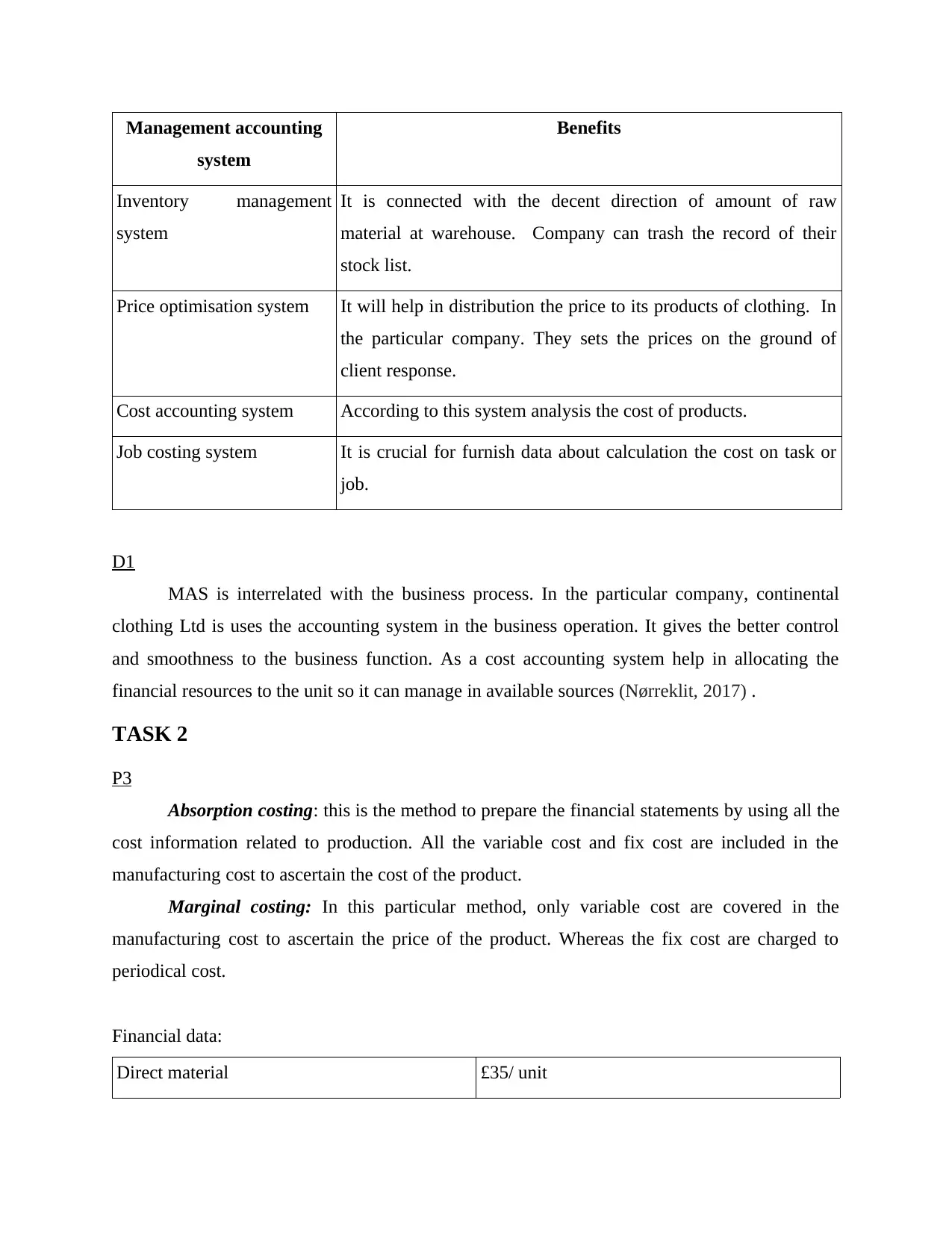
Management accounting
system
Benefits
Inventory management
system
It is connected with the decent direction of amount of raw
material at warehouse. Company can trash the record of their
stock list.
Price optimisation system It will help in distribution the price to its products of clothing. In
the particular company. They sets the prices on the ground of
client response.
Cost accounting system According to this system analysis the cost of products.
Job costing system It is crucial for furnish data about calculation the cost on task or
job.
D1
MAS is interrelated with the business process. In the particular company, continental
clothing Ltd is uses the accounting system in the business operation. It gives the better control
and smoothness to the business function. As a cost accounting system help in allocating the
financial resources to the unit so it can manage in available sources (Nørreklit, 2017) .
TASK 2
P3
Absorption costing: this is the method to prepare the financial statements by using all the
cost information related to production. All the variable cost and fix cost are included in the
manufacturing cost to ascertain the cost of the product.
Marginal costing: In this particular method, only variable cost are covered in the
manufacturing cost to ascertain the price of the product. Whereas the fix cost are charged to
periodical cost.
Financial data:
Direct material £35/ unit
system
Benefits
Inventory management
system
It is connected with the decent direction of amount of raw
material at warehouse. Company can trash the record of their
stock list.
Price optimisation system It will help in distribution the price to its products of clothing. In
the particular company. They sets the prices on the ground of
client response.
Cost accounting system According to this system analysis the cost of products.
Job costing system It is crucial for furnish data about calculation the cost on task or
job.
D1
MAS is interrelated with the business process. In the particular company, continental
clothing Ltd is uses the accounting system in the business operation. It gives the better control
and smoothness to the business function. As a cost accounting system help in allocating the
financial resources to the unit so it can manage in available sources (Nørreklit, 2017) .
TASK 2
P3
Absorption costing: this is the method to prepare the financial statements by using all the
cost information related to production. All the variable cost and fix cost are included in the
manufacturing cost to ascertain the cost of the product.
Marginal costing: In this particular method, only variable cost are covered in the
manufacturing cost to ascertain the price of the product. Whereas the fix cost are charged to
periodical cost.
Financial data:
Direct material £35/ unit
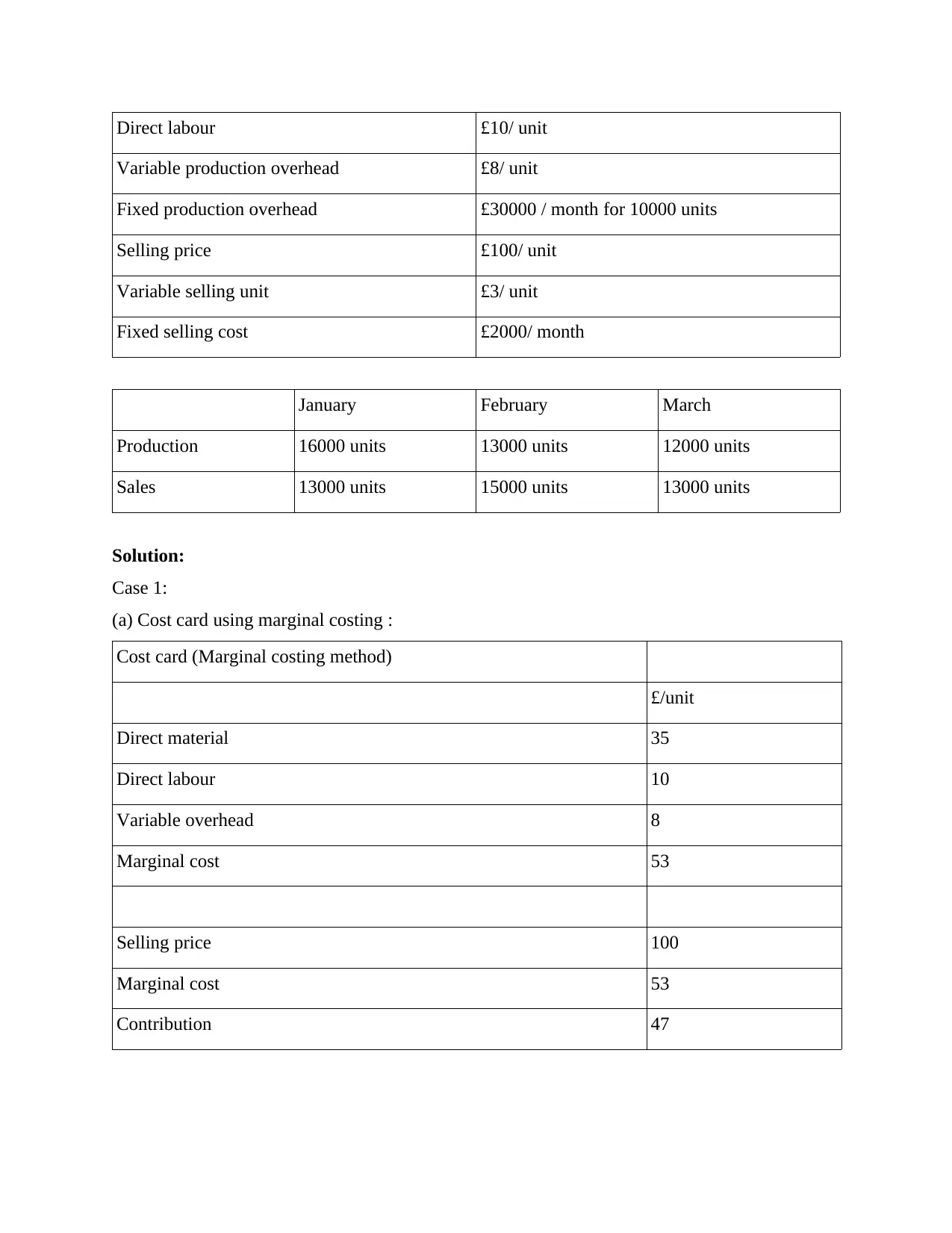
Direct labour £10/ unit
Variable production overhead £8/ unit
Fixed production overhead £30000 / month for 10000 units
Selling price £100/ unit
Variable selling unit £3/ unit
Fixed selling cost £2000/ month
January February March
Production 16000 units 13000 units 12000 units
Sales 13000 units 15000 units 13000 units
Solution:
Case 1:
(a) Cost card using marginal costing :
Cost card (Marginal costing method)
£/unit
Direct material 35
Direct labour 10
Variable overhead 8
Marginal cost 53
Selling price 100
Marginal cost 53
Contribution 47
Variable production overhead £8/ unit
Fixed production overhead £30000 / month for 10000 units
Selling price £100/ unit
Variable selling unit £3/ unit
Fixed selling cost £2000/ month
January February March
Production 16000 units 13000 units 12000 units
Sales 13000 units 15000 units 13000 units
Solution:
Case 1:
(a) Cost card using marginal costing :
Cost card (Marginal costing method)
£/unit
Direct material 35
Direct labour 10
Variable overhead 8
Marginal cost 53
Selling price 100
Marginal cost 53
Contribution 47
⊘ This is a preview!⊘
Do you want full access?
Subscribe today to unlock all pages.
Trusted by 1+ million students worldwide
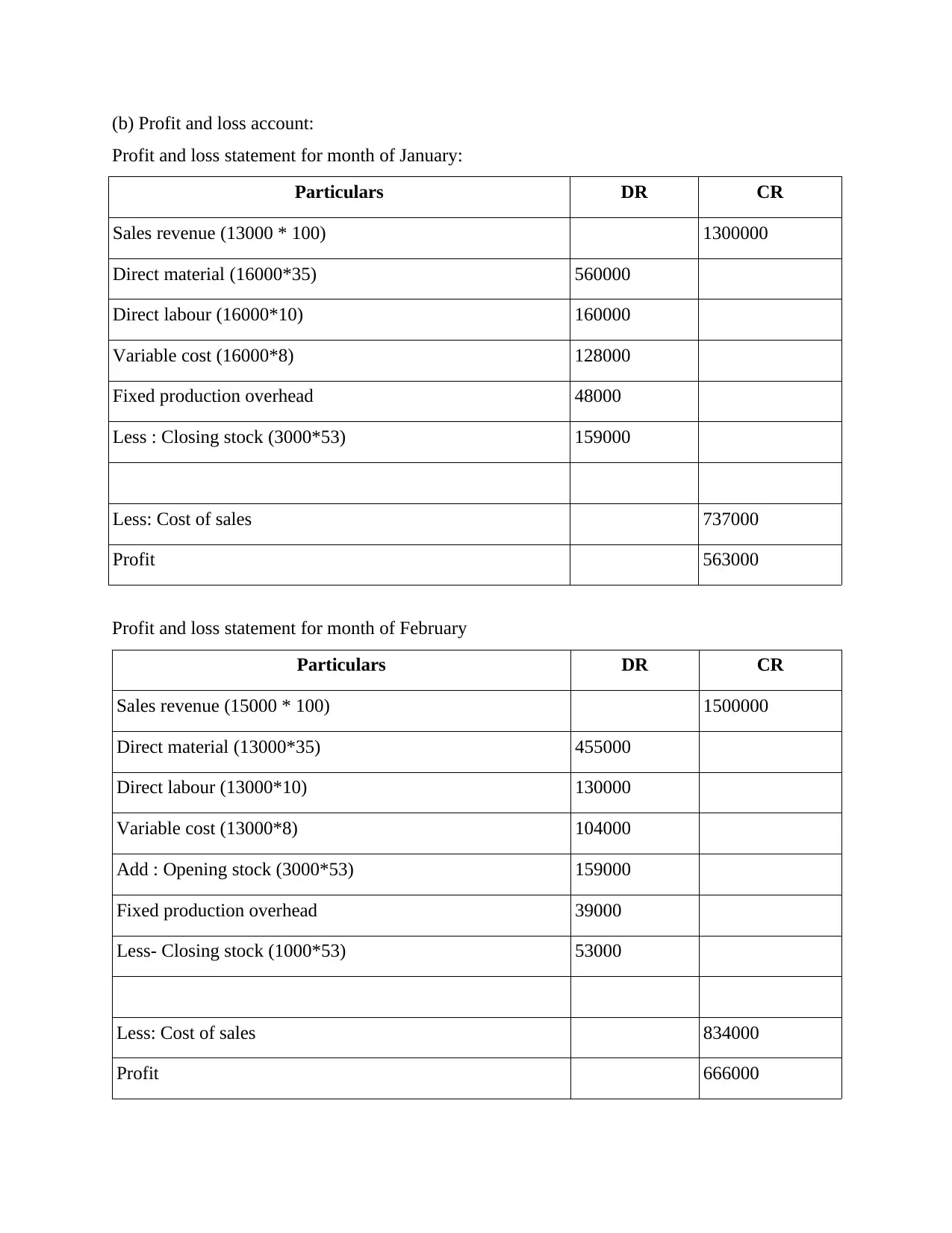
(b) Profit and loss account:
Profit and loss statement for month of January:
Particulars DR CR
Sales revenue (13000 * 100) 1300000
Direct material (16000*35) 560000
Direct labour (16000*10) 160000
Variable cost (16000*8) 128000
Fixed production overhead 48000
Less : Closing stock (3000*53) 159000
Less: Cost of sales 737000
Profit 563000
Profit and loss statement for month of February
Particulars DR CR
Sales revenue (15000 * 100) 1500000
Direct material (13000*35) 455000
Direct labour (13000*10) 130000
Variable cost (13000*8) 104000
Add : Opening stock (3000*53) 159000
Fixed production overhead 39000
Less- Closing stock (1000*53) 53000
Less: Cost of sales 834000
Profit 666000
Profit and loss statement for month of January:
Particulars DR CR
Sales revenue (13000 * 100) 1300000
Direct material (16000*35) 560000
Direct labour (16000*10) 160000
Variable cost (16000*8) 128000
Fixed production overhead 48000
Less : Closing stock (3000*53) 159000
Less: Cost of sales 737000
Profit 563000
Profit and loss statement for month of February
Particulars DR CR
Sales revenue (15000 * 100) 1500000
Direct material (13000*35) 455000
Direct labour (13000*10) 130000
Variable cost (13000*8) 104000
Add : Opening stock (3000*53) 159000
Fixed production overhead 39000
Less- Closing stock (1000*53) 53000
Less: Cost of sales 834000
Profit 666000
Paraphrase This Document
Need a fresh take? Get an instant paraphrase of this document with our AI Paraphraser
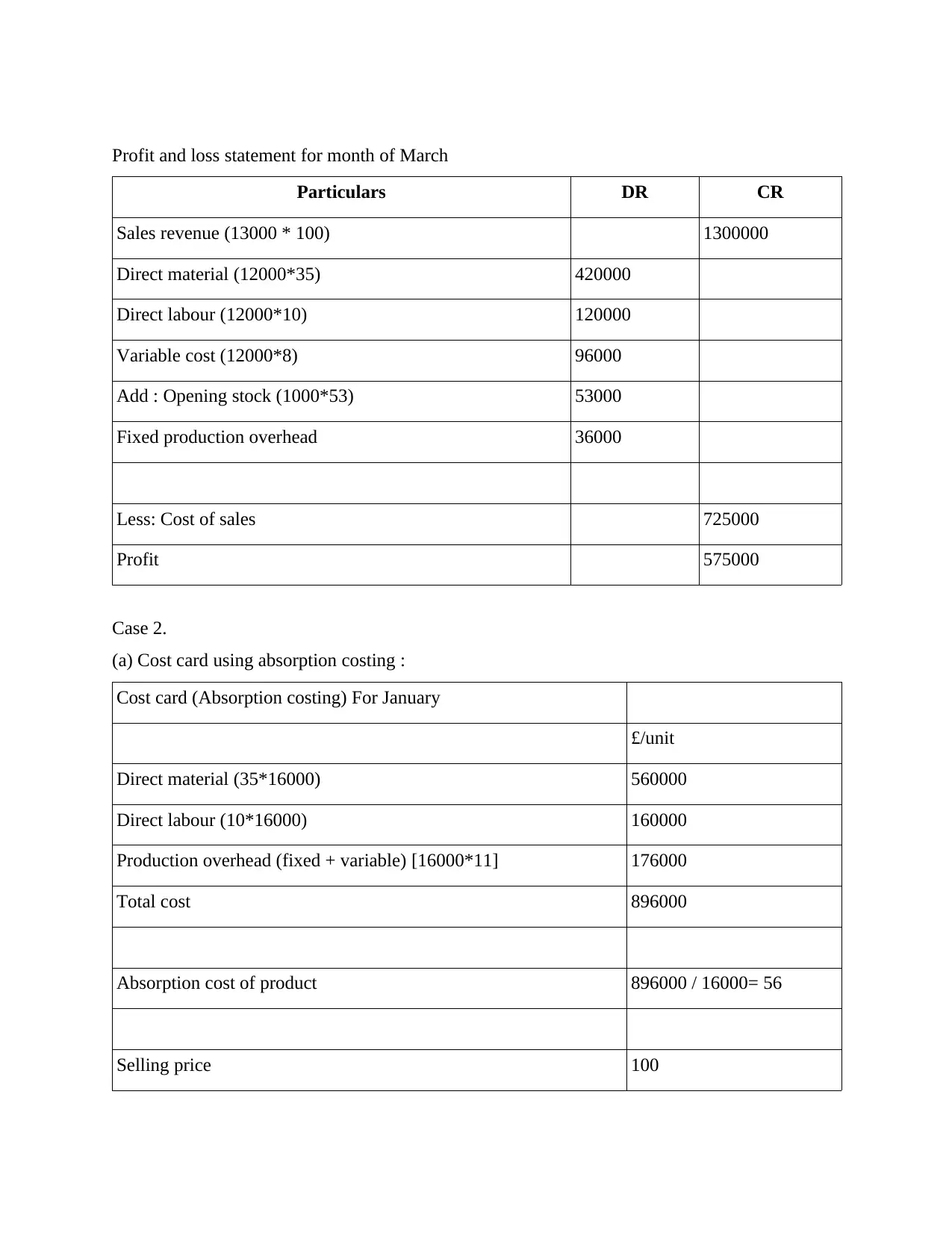
Profit and loss statement for month of March
Particulars DR CR
Sales revenue (13000 * 100) 1300000
Direct material (12000*35) 420000
Direct labour (12000*10) 120000
Variable cost (12000*8) 96000
Add : Opening stock (1000*53) 53000
Fixed production overhead 36000
Less: Cost of sales 725000
Profit 575000
Case 2.
(a) Cost card using absorption costing :
Cost card (Absorption costing) For January
£/unit
Direct material (35*16000) 560000
Direct labour (10*16000) 160000
Production overhead (fixed + variable) [16000*11] 176000
Total cost 896000
Absorption cost of product 896000 / 16000= 56
Selling price 100
Particulars DR CR
Sales revenue (13000 * 100) 1300000
Direct material (12000*35) 420000
Direct labour (12000*10) 120000
Variable cost (12000*8) 96000
Add : Opening stock (1000*53) 53000
Fixed production overhead 36000
Less: Cost of sales 725000
Profit 575000
Case 2.
(a) Cost card using absorption costing :
Cost card (Absorption costing) For January
£/unit
Direct material (35*16000) 560000
Direct labour (10*16000) 160000
Production overhead (fixed + variable) [16000*11] 176000
Total cost 896000
Absorption cost of product 896000 / 16000= 56
Selling price 100
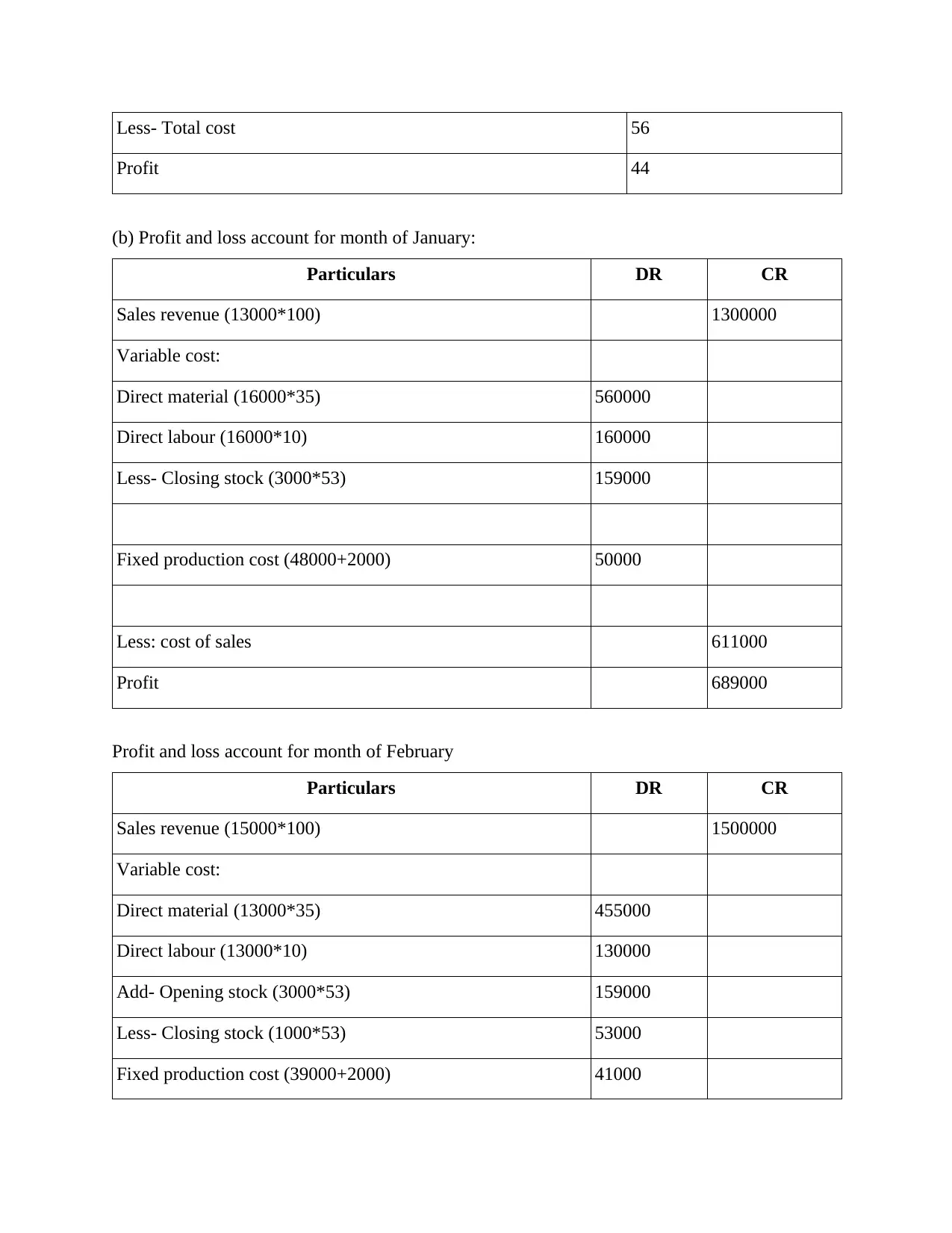
Less- Total cost 56
Profit 44
(b) Profit and loss account for month of January:
Particulars DR CR
Sales revenue (13000*100) 1300000
Variable cost:
Direct material (16000*35) 560000
Direct labour (16000*10) 160000
Less- Closing stock (3000*53) 159000
Fixed production cost (48000+2000) 50000
Less: cost of sales 611000
Profit 689000
Profit and loss account for month of February
Particulars DR CR
Sales revenue (15000*100) 1500000
Variable cost:
Direct material (13000*35) 455000
Direct labour (13000*10) 130000
Add- Opening stock (3000*53) 159000
Less- Closing stock (1000*53) 53000
Fixed production cost (39000+2000) 41000
Profit 44
(b) Profit and loss account for month of January:
Particulars DR CR
Sales revenue (13000*100) 1300000
Variable cost:
Direct material (16000*35) 560000
Direct labour (16000*10) 160000
Less- Closing stock (3000*53) 159000
Fixed production cost (48000+2000) 50000
Less: cost of sales 611000
Profit 689000
Profit and loss account for month of February
Particulars DR CR
Sales revenue (15000*100) 1500000
Variable cost:
Direct material (13000*35) 455000
Direct labour (13000*10) 130000
Add- Opening stock (3000*53) 159000
Less- Closing stock (1000*53) 53000
Fixed production cost (39000+2000) 41000
⊘ This is a preview!⊘
Do you want full access?
Subscribe today to unlock all pages.
Trusted by 1+ million students worldwide
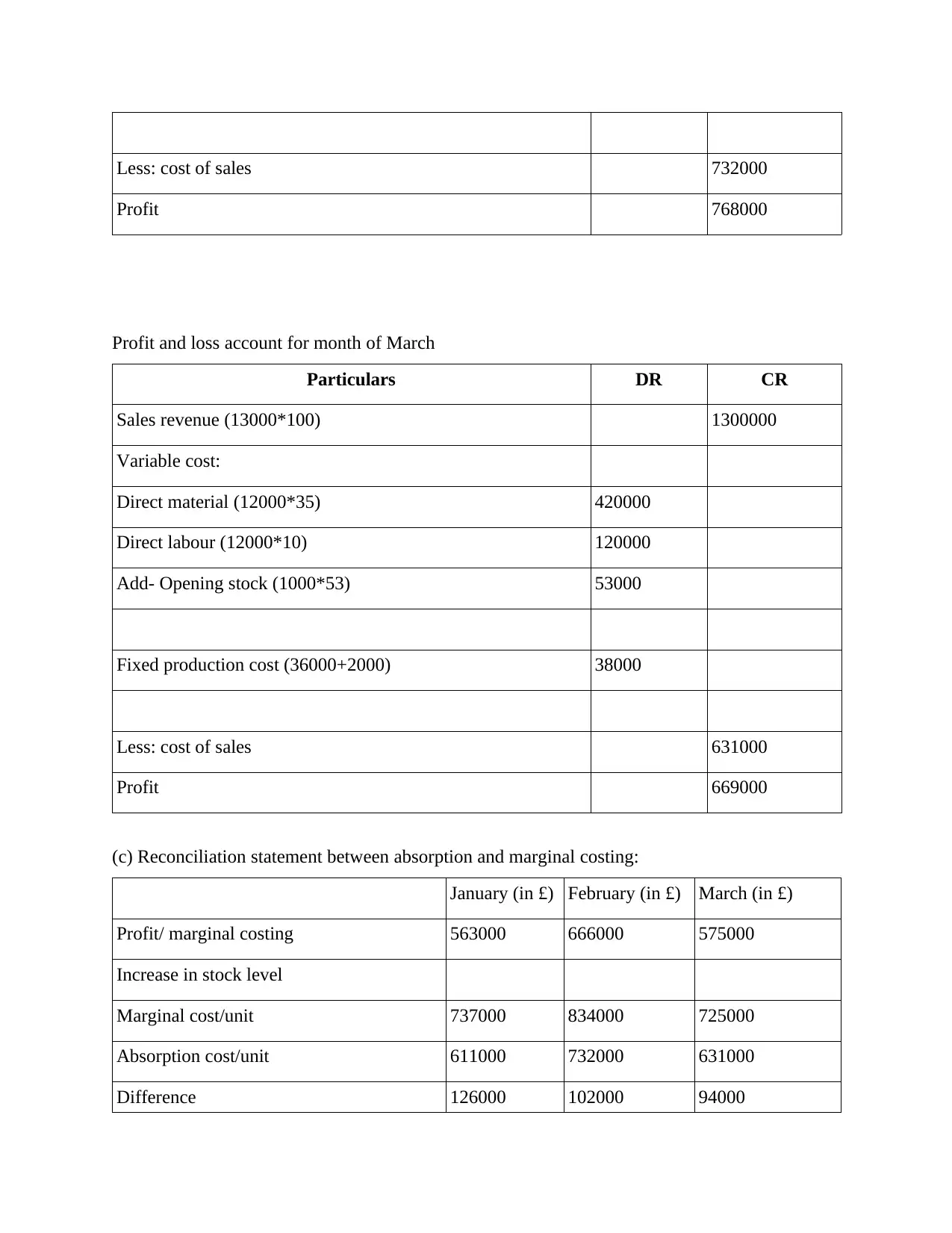
Less: cost of sales 732000
Profit 768000
Profit and loss account for month of March
Particulars DR CR
Sales revenue (13000*100) 1300000
Variable cost:
Direct material (12000*35) 420000
Direct labour (12000*10) 120000
Add- Opening stock (1000*53) 53000
Fixed production cost (36000+2000) 38000
Less: cost of sales 631000
Profit 669000
(c) Reconciliation statement between absorption and marginal costing:
January (in £) February (in £) March (in £)
Profit/ marginal costing 563000 666000 575000
Increase in stock level
Marginal cost/unit 737000 834000 725000
Absorption cost/unit 611000 732000 631000
Difference 126000 102000 94000
Profit 768000
Profit and loss account for month of March
Particulars DR CR
Sales revenue (13000*100) 1300000
Variable cost:
Direct material (12000*35) 420000
Direct labour (12000*10) 120000
Add- Opening stock (1000*53) 53000
Fixed production cost (36000+2000) 38000
Less: cost of sales 631000
Profit 669000
(c) Reconciliation statement between absorption and marginal costing:
January (in £) February (in £) March (in £)
Profit/ marginal costing 563000 666000 575000
Increase in stock level
Marginal cost/unit 737000 834000 725000
Absorption cost/unit 611000 732000 631000
Difference 126000 102000 94000
Paraphrase This Document
Need a fresh take? Get an instant paraphrase of this document with our AI Paraphraser
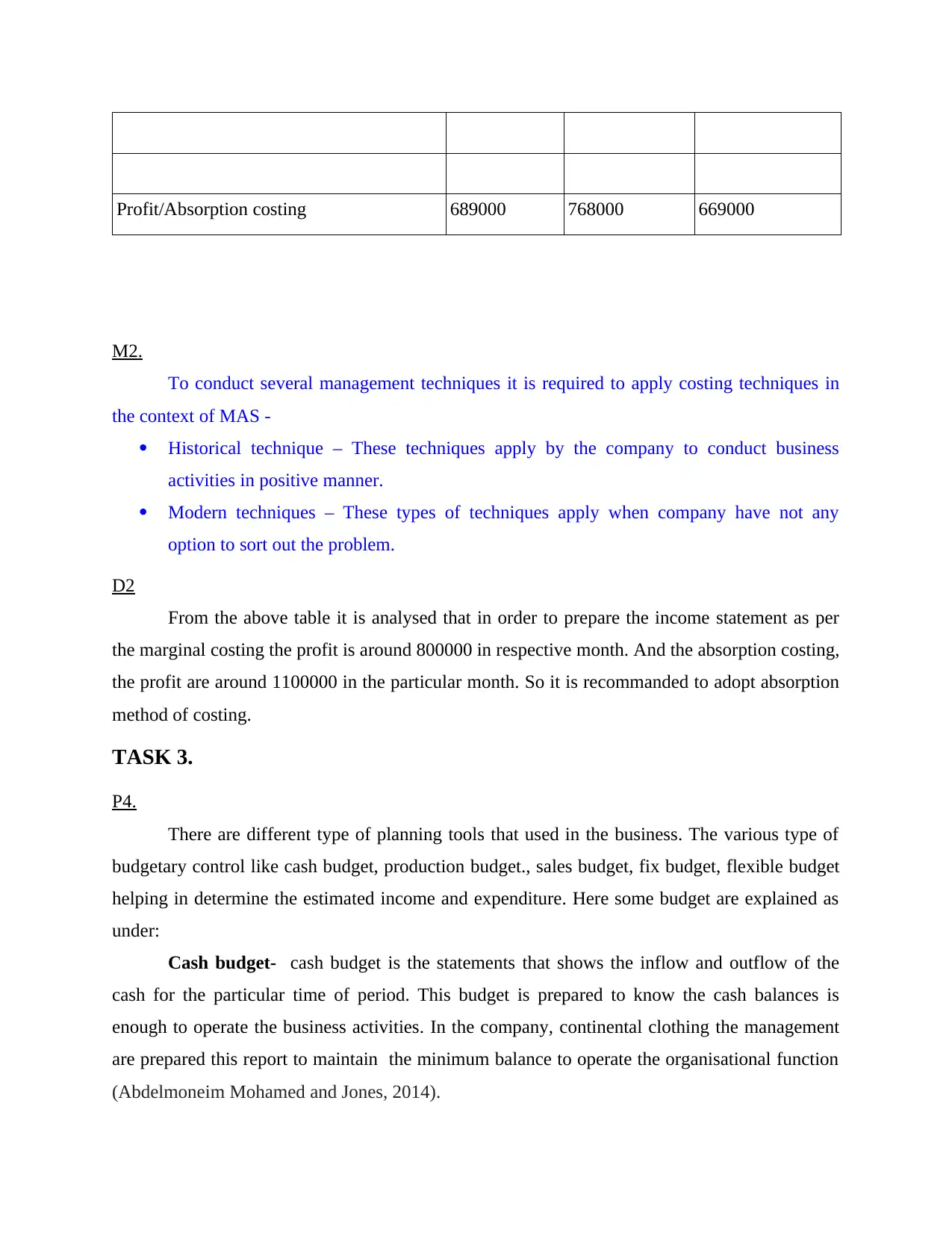
Profit/Absorption costing 689000 768000 669000
M2.
To conduct several management techniques it is required to apply costing techniques in
the context of MAS -
Historical technique – These techniques apply by the company to conduct business
activities in positive manner.
Modern techniques – These types of techniques apply when company have not any
option to sort out the problem.
D2
From the above table it is analysed that in order to prepare the income statement as per
the marginal costing the profit is around 800000 in respective month. And the absorption costing,
the profit are around 1100000 in the particular month. So it is recommanded to adopt absorption
method of costing.
TASK 3.
P4.
There are different type of planning tools that used in the business. The various type of
budgetary control like cash budget, production budget., sales budget, fix budget, flexible budget
helping in determine the estimated income and expenditure. Here some budget are explained as
under:
Cash budget- cash budget is the statements that shows the inflow and outflow of the
cash for the particular time of period. This budget is prepared to know the cash balances is
enough to operate the business activities. In the company, continental clothing the management
are prepared this report to maintain the minimum balance to operate the organisational function
(Abdelmoneim Mohamed and Jones, 2014).
M2.
To conduct several management techniques it is required to apply costing techniques in
the context of MAS -
Historical technique – These techniques apply by the company to conduct business
activities in positive manner.
Modern techniques – These types of techniques apply when company have not any
option to sort out the problem.
D2
From the above table it is analysed that in order to prepare the income statement as per
the marginal costing the profit is around 800000 in respective month. And the absorption costing,
the profit are around 1100000 in the particular month. So it is recommanded to adopt absorption
method of costing.
TASK 3.
P4.
There are different type of planning tools that used in the business. The various type of
budgetary control like cash budget, production budget., sales budget, fix budget, flexible budget
helping in determine the estimated income and expenditure. Here some budget are explained as
under:
Cash budget- cash budget is the statements that shows the inflow and outflow of the
cash for the particular time of period. This budget is prepared to know the cash balances is
enough to operate the business activities. In the company, continental clothing the management
are prepared this report to maintain the minimum balance to operate the organisational function
(Abdelmoneim Mohamed and Jones, 2014).
Advantage:
It maintain the control over the processing unit by allocating the required cash balance.
And expenses are categorized as per the object of expenses.
Disadvantage:
It limits the disbursement power of the business. It is totally based on forecasting that
may true or not.
Master budget- This is the budget that is defined as consist the all budget that are
prepared by the business entity. This is the strategies plan for future that comprises of the
different budget like sales budget, production budget, manufacturing budget at the certain level
the production and sales.
Advantage:
It provides effective planning in the business unit by assembling all the budget formate
and identify the the particular function.
Disadvantage:
It is difficult to read and understand as it increases the complexity.
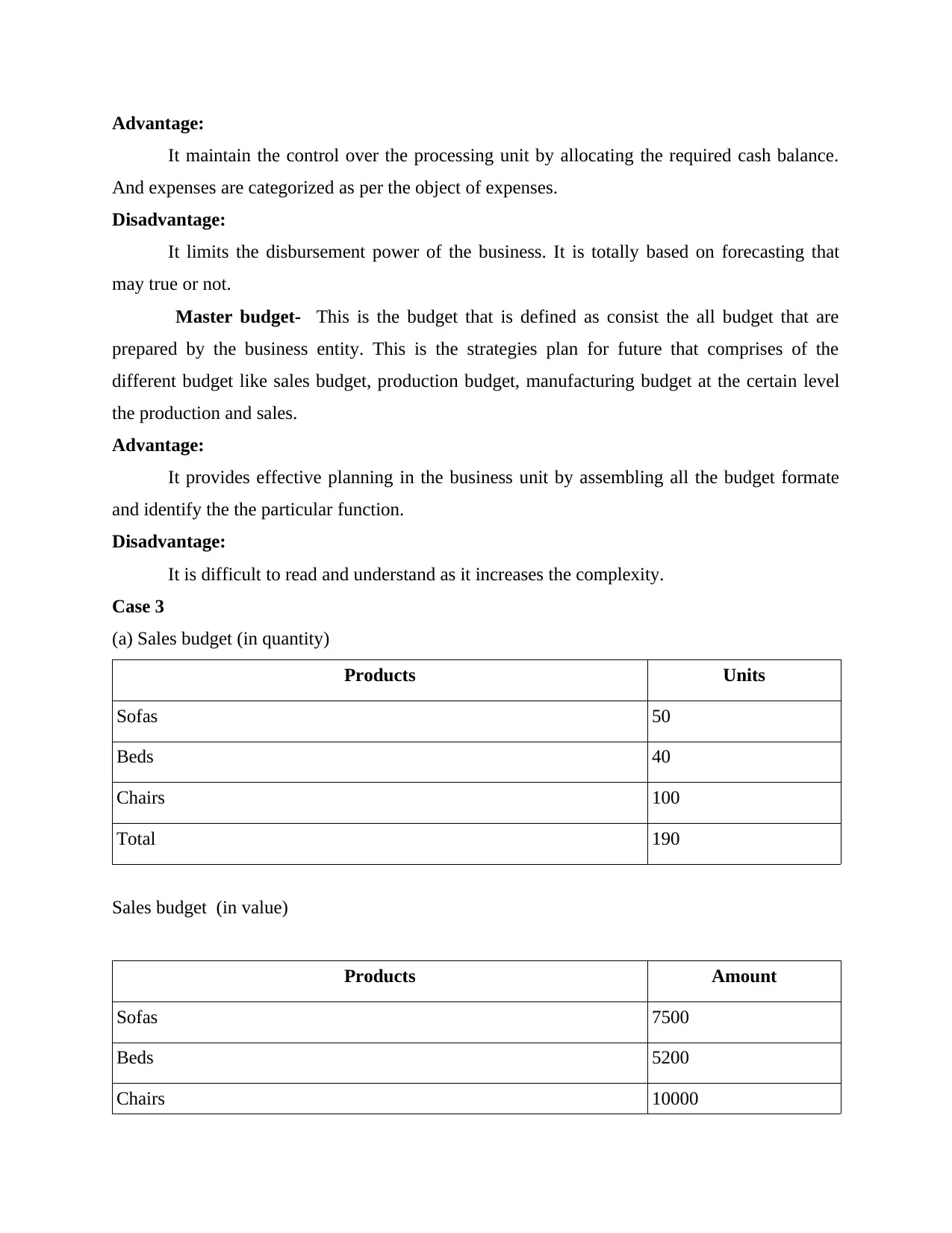
Case 3
(a) Sales budget (in quantity)
Products Units
Sofas 50
Beds 40
Chairs 100
Total 190
Sales budget (in value)
Products Amount
Sofas 7500
Beds 5200
Chairs 10000
It maintain the control over the processing unit by allocating the required cash balance.
And expenses are categorized as per the object of expenses.
Disadvantage:
It limits the disbursement power of the business. It is totally based on forecasting that
may true or not.
Master budget- This is the budget that is defined as consist the all budget that are
prepared by the business entity. This is the strategies plan for future that comprises of the
different budget like sales budget, production budget, manufacturing budget at the certain level
the production and sales.
Advantage:
It provides effective planning in the business unit by assembling all the budget formate
and identify the the particular function.
Disadvantage:
It is difficult to read and understand as it increases the complexity.
Case 3
(a) Sales budget (in quantity)
Products Units
Sofas 50
Beds 40
Chairs 100
Total 190
Sales budget (in value)
Products Amount
Sofas 7500
Beds 5200
Chairs 10000
⊘ This is a preview!⊘
Do you want full access?
Subscribe today to unlock all pages.
Trusted by 1+ million students worldwide

1 out of 19


Related Documents


Your All-in-One AI-Powered Toolkit for Academic Success.
+13062052269
info@desklib.com
Available 24*7 on WhatsApp / Email
![[object Object]](/_next/static/media/star-bottom.7253800d.svg)
Unlock your academic potential
Copyright © 2020–2026 A2Z Services. All Rights Reserved. Developed and managed by ZUCOL.