Management Accounting Report: IKEA Financial Performance Analysis
VerifiedAdded on 2022/12/26
|16
|4191
|83
Report
AI Summary
This report provides a comprehensive overview of management accounting, focusing on its principles, techniques, and practical applications within an organizational context. The report begins by defining management accounting and its importance in strategic decision-making, emphasizing its role in resource allocation and performance improvement. It then explores different types of accounting systems, including cost accounting, inventory management, and job order costing, highlighting their features, advantages, and disadvantages. The report delves into the principles of management accounting, such as influence, relevance, value, and credibility, and explains how these principles guide the application of various techniques. Furthermore, the report analyzes management accounting reporting and implementation, covering budget reporting, accounts receivables reporting, job costing reporting, and performance reporting. It also includes a detailed comparison of marginal and absorption costing methods, using financial data from Marwa Limited to illustrate their impact on profit calculation. The report concludes by discussing how organizations adapt management accounting systems to address financial problems, making it a valuable resource for students and professionals seeking to understand and apply management accounting principles.
Management Accounting

Paraphrase This Document
Need a fresh take? Get an instant paraphrase of this document with our AI Paraphraser
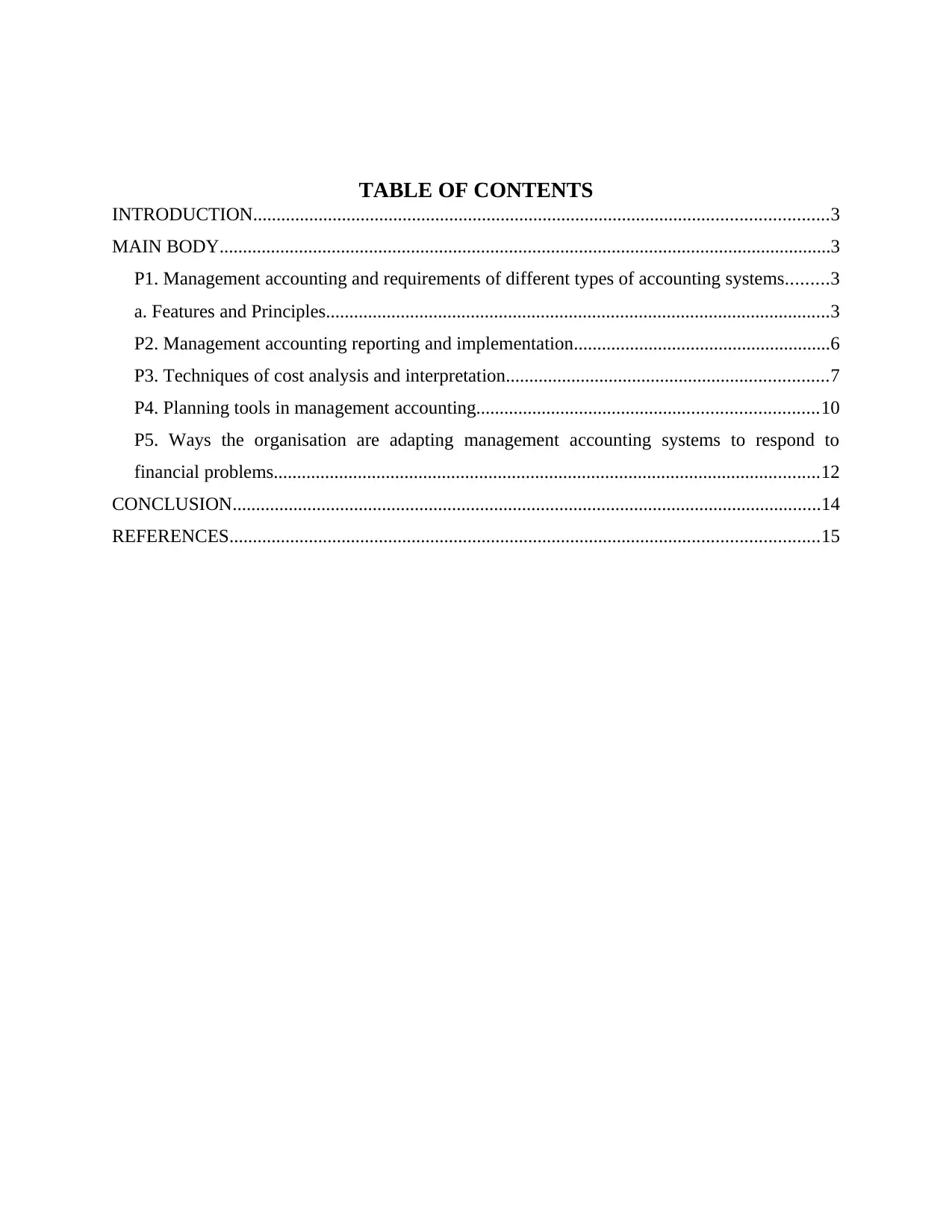
TABLE OF CONTENTS
INTRODUCTION...........................................................................................................................3
MAIN BODY...................................................................................................................................3
P1. Management accounting and requirements of different types of accounting systems.........3
a. Features and Principles............................................................................................................3
P2. Management accounting reporting and implementation.......................................................6
P3. Techniques of cost analysis and interpretation.....................................................................7
P4. Planning tools in management accounting.........................................................................10
P5. Ways the organisation are adapting management accounting systems to respond to
financial problems.....................................................................................................................12
CONCLUSION..............................................................................................................................14
REFERENCES..............................................................................................................................15
INTRODUCTION...........................................................................................................................3
MAIN BODY...................................................................................................................................3
P1. Management accounting and requirements of different types of accounting systems.........3
a. Features and Principles............................................................................................................3
P2. Management accounting reporting and implementation.......................................................6
P3. Techniques of cost analysis and interpretation.....................................................................7
P4. Planning tools in management accounting.........................................................................10
P5. Ways the organisation are adapting management accounting systems to respond to
financial problems.....................................................................................................................12
CONCLUSION..............................................................................................................................14
REFERENCES..............................................................................................................................15
INTRODUCTION
Management accounting is an important element that helps in the managers to take
strategic decisions. The methods and techniques that forms management accounting and the
usage and implementation of it is popular among the management of the organisations. The use
of financial instruments of the management accounting helps in the improvement of the
organisation's performance. It aims for the efficient use and allocation of the resources within the
process by keeping the cost drivers low (Nørreklit, H. ed., 2017). The report highlights the
analysis of the financial information of the company IKEA a producer of children’s scooters
which started operations on 1st January 2019. The marginal costing approach and absorption
costing approach is being introduced to find out the valuation of the stocks. Further in this report
the advantages and disadvantages of the various planning and budgetary tools are highlighted. At
the end of the report the use of management accounting in solving financial problems is outlined.
MAIN BODY
P1. Management accounting and requirements of different types of accounting systems
Management accounting is the execution of strategic planning and resource allocation in
such a way that it provide maximum productivity (Collis and Hussey, 2017).
Management accounting provides important information of costs of the various functions of the
business to helps in cost control and the preparation of budgets to track the performance and
proper allocation of the resources (Drury, 2018). The effective implementation of the methods
and systems by the managers of the IKEA helps in the improvement of the output and hence
increase the performance of the organisation.
a. Features and Principles
The management accounting systems provides information related to finance to the managers of
the company. It shows the analysis of costs that affects the operation and revenue of the
organisation. Use of different tools like marginal costing, absorption costing, ratio analysis, etc.
that uses accounting data. Management accounting helps in forecasting and setting of standards
that helps in improving efficiency of the organisation.
There are 4 basic principles that adopted in management accounting that are as follows:
Influence
Management accounting is an important element that helps in the managers to take
strategic decisions. The methods and techniques that forms management accounting and the
usage and implementation of it is popular among the management of the organisations. The use
of financial instruments of the management accounting helps in the improvement of the
organisation's performance. It aims for the efficient use and allocation of the resources within the
process by keeping the cost drivers low (Nørreklit, H. ed., 2017). The report highlights the
analysis of the financial information of the company IKEA a producer of children’s scooters
which started operations on 1st January 2019. The marginal costing approach and absorption
costing approach is being introduced to find out the valuation of the stocks. Further in this report
the advantages and disadvantages of the various planning and budgetary tools are highlighted. At
the end of the report the use of management accounting in solving financial problems is outlined.
MAIN BODY
P1. Management accounting and requirements of different types of accounting systems
Management accounting is the execution of strategic planning and resource allocation in
such a way that it provide maximum productivity (Collis and Hussey, 2017).
Management accounting provides important information of costs of the various functions of the
business to helps in cost control and the preparation of budgets to track the performance and
proper allocation of the resources (Drury, 2018). The effective implementation of the methods
and systems by the managers of the IKEA helps in the improvement of the output and hence
increase the performance of the organisation.
a. Features and Principles
The management accounting systems provides information related to finance to the managers of
the company. It shows the analysis of costs that affects the operation and revenue of the
organisation. Use of different tools like marginal costing, absorption costing, ratio analysis, etc.
that uses accounting data. Management accounting helps in forecasting and setting of standards
that helps in improving efficiency of the organisation.
There are 4 basic principles that adopted in management accounting that are as follows:
Influence
⊘ This is a preview!⊘
Do you want full access?
Subscribe today to unlock all pages.

Trusted by 1+ million students worldwide
Management accounting helps in to find out the impact of various activities of the organisation
on each other. By analysis of different types of costs managers will be able to influence the
overall costs.
Relevance
Management accounting use past and present data for the analysis of the effect of costs and
results in future estimations.
Value
Management accounting helps in identification of the unnecessary activities in the production
process and through budgeting managers are able to establish reasonable pricing of the products
and services.
Credibility
Management accounting helps in the taking informed decision based on critical analysis and
ethical practices. It generates credibility for the stakeholders of the organisation.
Types of management accounting systems
Cost Accounting
In this method of accounting Several costs are calculated viz. variable costs, fixed cost
and Semi-variable costs. These costs arises in the production process and the estimation of these
cost required helps to ascertain the profit and per unit contribution (Wang and et.al, 2020). The
methods and techniques helps IKEA to find out how much cost is incurred in the production
process and helps the managers to device strategies that reduce the cost of production. Example:
Cost accounting calculate both specific and overall cost. That will help to reduce costs
Advantages of cost accounting
The cost accounting method will be adopted easily and helps the IKEA's management to
find the total cost of the production and the overheads that can be controlled to maximize the
revenue of the company.
Disadvantages of cost accounting
For the adoption of the cost accounting, managers have the knowledge of the system.
What are the constraints used and understanding of the accounting methods.
Inventory Management
Management of the inventory also incur costs. Effective management of the stocks of the
company IKEA is done with the help of different methods of inventory systems viz. First In First
on each other. By analysis of different types of costs managers will be able to influence the
overall costs.
Relevance
Management accounting use past and present data for the analysis of the effect of costs and
results in future estimations.
Value
Management accounting helps in identification of the unnecessary activities in the production
process and through budgeting managers are able to establish reasonable pricing of the products
and services.
Credibility
Management accounting helps in the taking informed decision based on critical analysis and
ethical practices. It generates credibility for the stakeholders of the organisation.
Types of management accounting systems
Cost Accounting
In this method of accounting Several costs are calculated viz. variable costs, fixed cost
and Semi-variable costs. These costs arises in the production process and the estimation of these
cost required helps to ascertain the profit and per unit contribution (Wang and et.al, 2020). The
methods and techniques helps IKEA to find out how much cost is incurred in the production
process and helps the managers to device strategies that reduce the cost of production. Example:
Cost accounting calculate both specific and overall cost. That will help to reduce costs
Advantages of cost accounting
The cost accounting method will be adopted easily and helps the IKEA's management to
find the total cost of the production and the overheads that can be controlled to maximize the
revenue of the company.
Disadvantages of cost accounting
For the adoption of the cost accounting, managers have the knowledge of the system.
What are the constraints used and understanding of the accounting methods.
Inventory Management
Management of the inventory also incur costs. Effective management of the stocks of the
company IKEA is done with the help of different methods of inventory systems viz. First In First
Paraphrase This Document
Need a fresh take? Get an instant paraphrase of this document with our AI Paraphraser
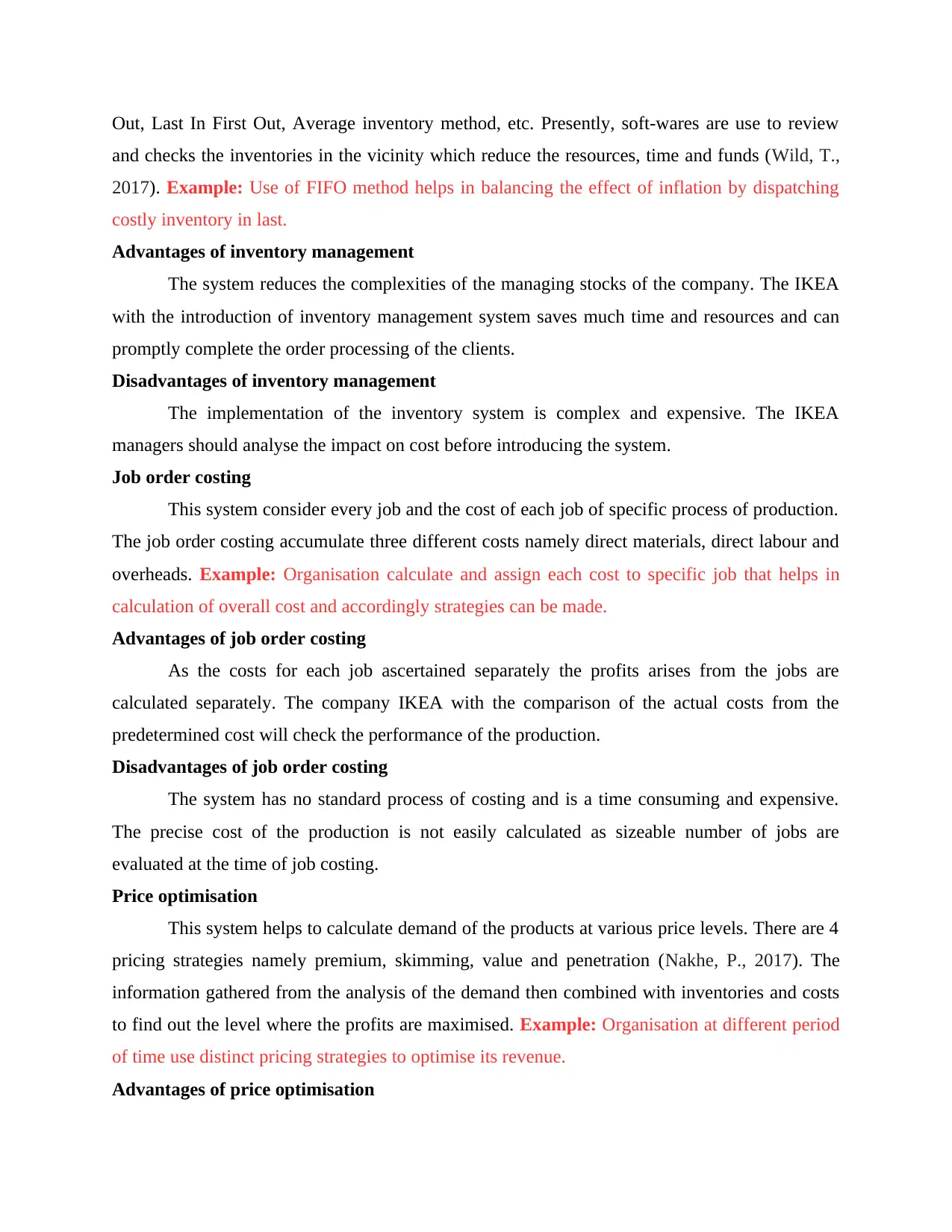
Out, Last In First Out, Average inventory method, etc. Presently, soft-wares are use to review
and checks the inventories in the vicinity which reduce the resources, time and funds (Wild, T.,
2017). Example: Use of FIFO method helps in balancing the effect of inflation by dispatching
costly inventory in last.
Advantages of inventory management
The system reduces the complexities of the managing stocks of the company. The IKEA
with the introduction of inventory management system saves much time and resources and can
promptly complete the order processing of the clients.
Disadvantages of inventory management
The implementation of the inventory system is complex and expensive. The IKEA
managers should analyse the impact on cost before introducing the system.
Job order costing
This system consider every job and the cost of each job of specific process of production.
The job order costing accumulate three different costs namely direct materials, direct labour and
overheads. Example: Organisation calculate and assign each cost to specific job that helps in
calculation of overall cost and accordingly strategies can be made.
Advantages of job order costing
As the costs for each job ascertained separately the profits arises from the jobs are
calculated separately. The company IKEA with the comparison of the actual costs from the
predetermined cost will check the performance of the production.
Disadvantages of job order costing
The system has no standard process of costing and is a time consuming and expensive.
The precise cost of the production is not easily calculated as sizeable number of jobs are
evaluated at the time of job costing.
Price optimisation
This system helps to calculate demand of the products at various price levels. There are 4
pricing strategies namely premium, skimming, value and penetration (Nakhe, P., 2017). The
information gathered from the analysis of the demand then combined with inventories and costs
to find out the level where the profits are maximised. Example: Organisation at different period
of time use distinct pricing strategies to optimise its revenue.
Advantages of price optimisation
and checks the inventories in the vicinity which reduce the resources, time and funds (Wild, T.,
2017). Example: Use of FIFO method helps in balancing the effect of inflation by dispatching
costly inventory in last.
Advantages of inventory management
The system reduces the complexities of the managing stocks of the company. The IKEA
with the introduction of inventory management system saves much time and resources and can
promptly complete the order processing of the clients.
Disadvantages of inventory management
The implementation of the inventory system is complex and expensive. The IKEA
managers should analyse the impact on cost before introducing the system.
Job order costing
This system consider every job and the cost of each job of specific process of production.
The job order costing accumulate three different costs namely direct materials, direct labour and
overheads. Example: Organisation calculate and assign each cost to specific job that helps in
calculation of overall cost and accordingly strategies can be made.
Advantages of job order costing
As the costs for each job ascertained separately the profits arises from the jobs are
calculated separately. The company IKEA with the comparison of the actual costs from the
predetermined cost will check the performance of the production.
Disadvantages of job order costing
The system has no standard process of costing and is a time consuming and expensive.
The precise cost of the production is not easily calculated as sizeable number of jobs are
evaluated at the time of job costing.
Price optimisation
This system helps to calculate demand of the products at various price levels. There are 4
pricing strategies namely premium, skimming, value and penetration (Nakhe, P., 2017). The
information gathered from the analysis of the demand then combined with inventories and costs
to find out the level where the profits are maximised. Example: Organisation at different period
of time use distinct pricing strategies to optimise its revenue.
Advantages of price optimisation
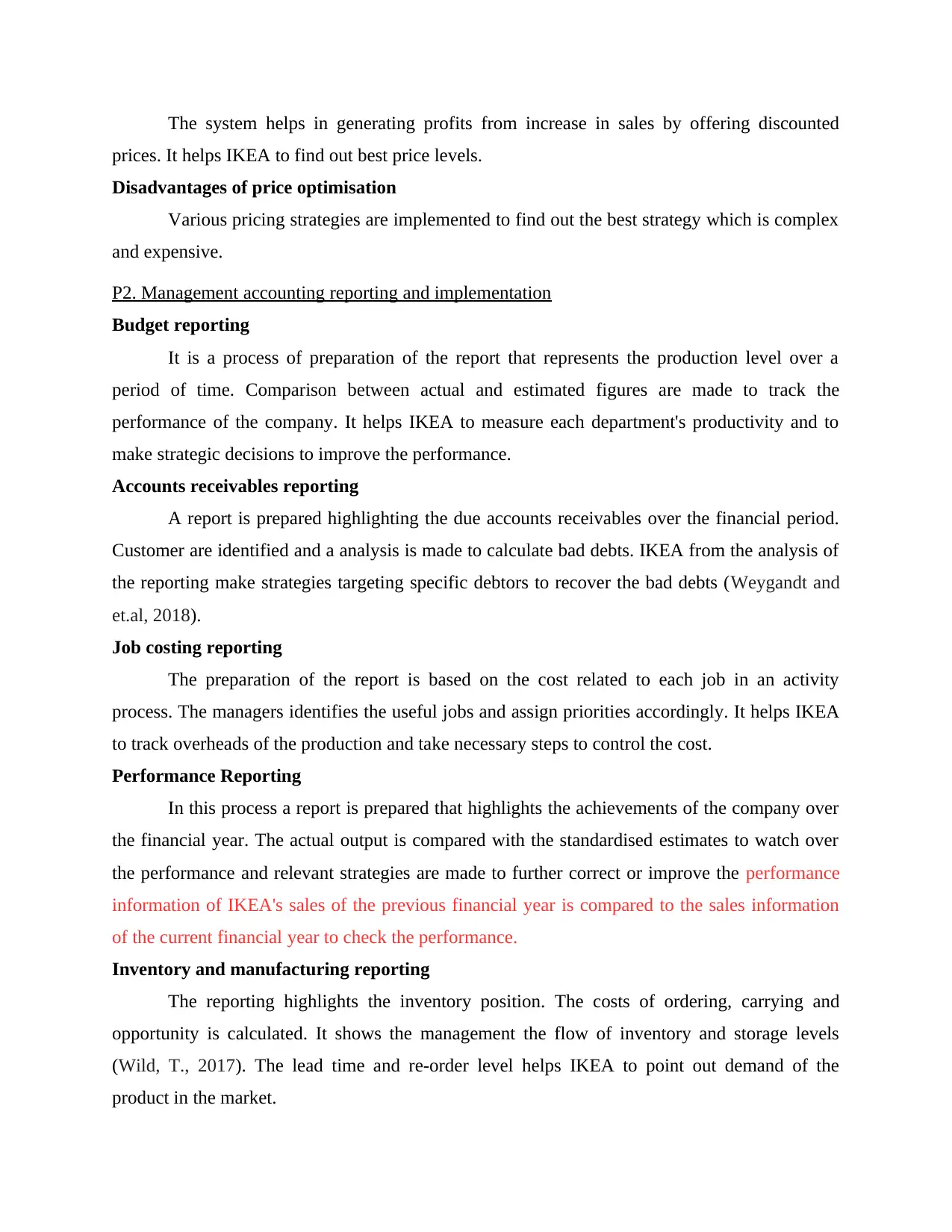
The system helps in generating profits from increase in sales by offering discounted
prices. It helps IKEA to find out best price levels.
Disadvantages of price optimisation
Various pricing strategies are implemented to find out the best strategy which is complex
and expensive.
P2. Management accounting reporting and implementation
Budget reporting
It is a process of preparation of the report that represents the production level over a
period of time. Comparison between actual and estimated figures are made to track the
performance of the company. It helps IKEA to measure each department's productivity and to
make strategic decisions to improve the performance.
Accounts receivables reporting
A report is prepared highlighting the due accounts receivables over the financial period.
Customer are identified and a analysis is made to calculate bad debts. IKEA from the analysis of
the reporting make strategies targeting specific debtors to recover the bad debts (Weygandt and
et.al, 2018).
Job costing reporting
The preparation of the report is based on the cost related to each job in an activity
process. The managers identifies the useful jobs and assign priorities accordingly. It helps IKEA
to track overheads of the production and take necessary steps to control the cost.
Performance Reporting
In this process a report is prepared that highlights the achievements of the company over
the financial year. The actual output is compared with the standardised estimates to watch over
the performance and relevant strategies are made to further correct or improve the performance
information of IKEA's sales of the previous financial year is compared to the sales information
of the current financial year to check the performance.
Inventory and manufacturing reporting
The reporting highlights the inventory position. The costs of ordering, carrying and
opportunity is calculated. It shows the management the flow of inventory and storage levels
(Wild, T., 2017). The lead time and re-order level helps IKEA to point out demand of the
product in the market.
prices. It helps IKEA to find out best price levels.
Disadvantages of price optimisation
Various pricing strategies are implemented to find out the best strategy which is complex
and expensive.
P2. Management accounting reporting and implementation
Budget reporting
It is a process of preparation of the report that represents the production level over a
period of time. Comparison between actual and estimated figures are made to track the
performance of the company. It helps IKEA to measure each department's productivity and to
make strategic decisions to improve the performance.
Accounts receivables reporting
A report is prepared highlighting the due accounts receivables over the financial period.
Customer are identified and a analysis is made to calculate bad debts. IKEA from the analysis of
the reporting make strategies targeting specific debtors to recover the bad debts (Weygandt and
et.al, 2018).
Job costing reporting
The preparation of the report is based on the cost related to each job in an activity
process. The managers identifies the useful jobs and assign priorities accordingly. It helps IKEA
to track overheads of the production and take necessary steps to control the cost.
Performance Reporting
In this process a report is prepared that highlights the achievements of the company over
the financial year. The actual output is compared with the standardised estimates to watch over
the performance and relevant strategies are made to further correct or improve the performance
information of IKEA's sales of the previous financial year is compared to the sales information
of the current financial year to check the performance.
Inventory and manufacturing reporting
The reporting highlights the inventory position. The costs of ordering, carrying and
opportunity is calculated. It shows the management the flow of inventory and storage levels
(Wild, T., 2017). The lead time and re-order level helps IKEA to point out demand of the
product in the market.
⊘ This is a preview!⊘
Do you want full access?
Subscribe today to unlock all pages.
Trusted by 1+ million students worldwide
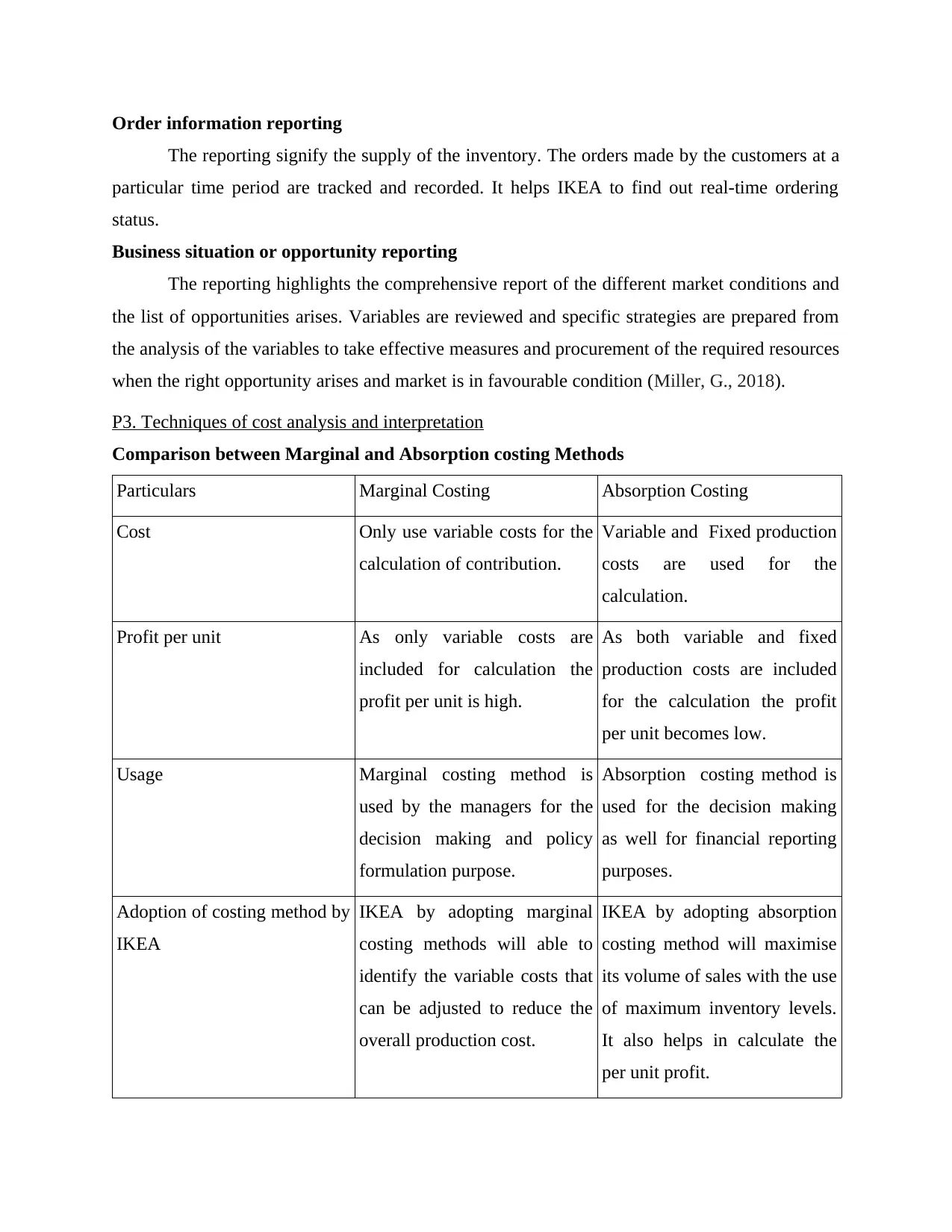
Order information reporting
The reporting signify the supply of the inventory. The orders made by the customers at a
particular time period are tracked and recorded. It helps IKEA to find out real-time ordering
status.
Business situation or opportunity reporting
The reporting highlights the comprehensive report of the different market conditions and
the list of opportunities arises. Variables are reviewed and specific strategies are prepared from
the analysis of the variables to take effective measures and procurement of the required resources
when the right opportunity arises and market is in favourable condition (Miller, G., 2018).
P3. Techniques of cost analysis and interpretation
Comparison between Marginal and Absorption costing Methods
Particulars Marginal Costing Absorption Costing
Cost Only use variable costs for the
calculation of contribution.
Variable and Fixed production
costs are used for the
calculation.
Profit per unit As only variable costs are
included for calculation the
profit per unit is high.
As both variable and fixed
production costs are included
for the calculation the profit
per unit becomes low.
Usage Marginal costing method is
used by the managers for the
decision making and policy
formulation purpose.
Absorption costing method is
used for the decision making
as well for financial reporting
purposes.
Adoption of costing method by
IKEA
IKEA by adopting marginal
costing methods will able to
identify the variable costs that
can be adjusted to reduce the
overall production cost.
IKEA by adopting absorption
costing method will maximise
its volume of sales with the use
of maximum inventory levels.
It also helps in calculate the
per unit profit.
The reporting signify the supply of the inventory. The orders made by the customers at a
particular time period are tracked and recorded. It helps IKEA to find out real-time ordering
status.
Business situation or opportunity reporting
The reporting highlights the comprehensive report of the different market conditions and
the list of opportunities arises. Variables are reviewed and specific strategies are prepared from
the analysis of the variables to take effective measures and procurement of the required resources
when the right opportunity arises and market is in favourable condition (Miller, G., 2018).
P3. Techniques of cost analysis and interpretation
Comparison between Marginal and Absorption costing Methods
Particulars Marginal Costing Absorption Costing
Cost Only use variable costs for the
calculation of contribution.
Variable and Fixed production
costs are used for the
calculation.
Profit per unit As only variable costs are
included for calculation the
profit per unit is high.
As both variable and fixed
production costs are included
for the calculation the profit
per unit becomes low.
Usage Marginal costing method is
used by the managers for the
decision making and policy
formulation purpose.
Absorption costing method is
used for the decision making
as well for financial reporting
purposes.
Adoption of costing method by
IKEA
IKEA by adopting marginal
costing methods will able to
identify the variable costs that
can be adjusted to reduce the
overall production cost.
IKEA by adopting absorption
costing method will maximise
its volume of sales with the use
of maximum inventory levels.
It also helps in calculate the
per unit profit.
Paraphrase This Document
Need a fresh take? Get an instant paraphrase of this document with our AI Paraphraser
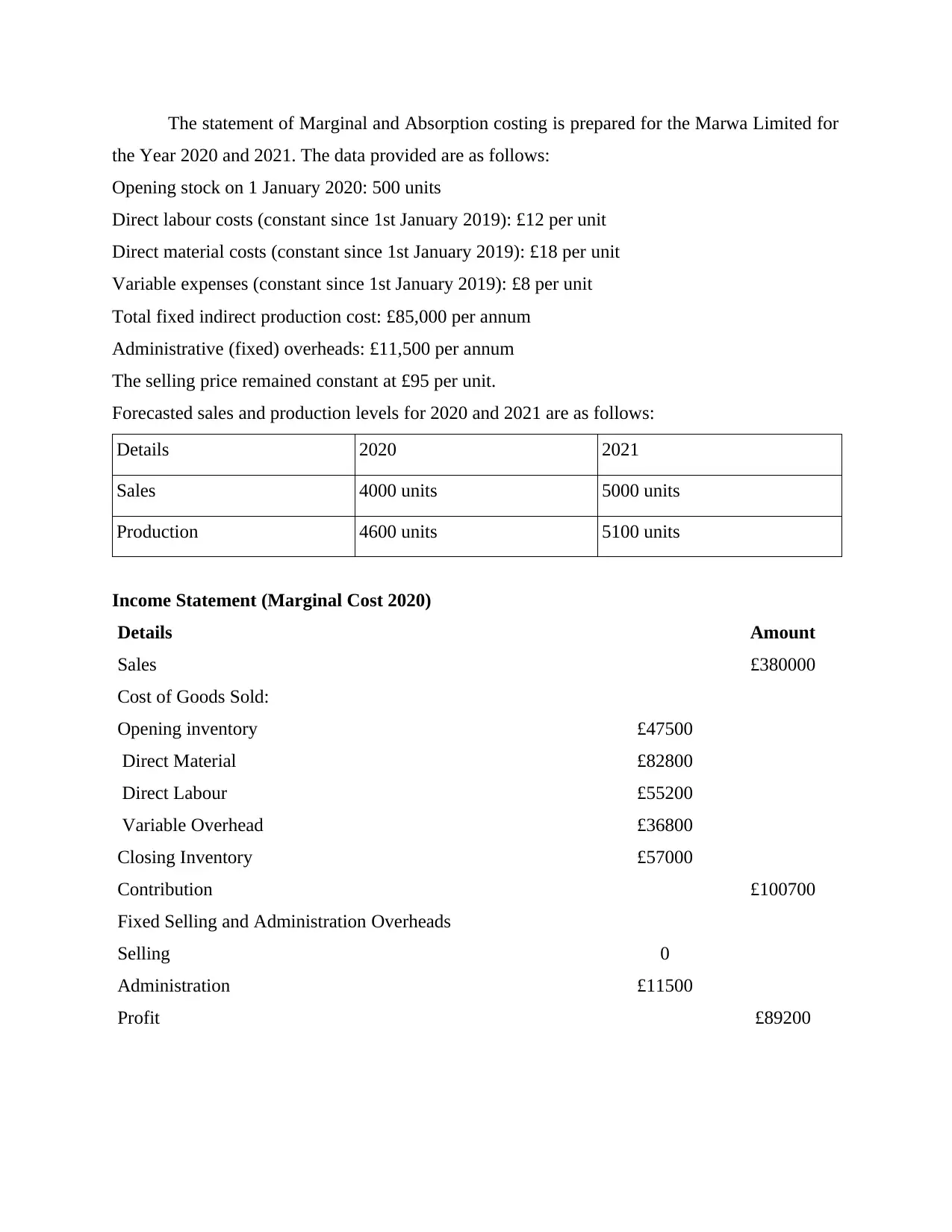
The statement of Marginal and Absorption costing is prepared for the Marwa Limited for
the Year 2020 and 2021. The data provided are as follows:
Opening stock on 1 January 2020: 500 units
Direct labour costs (constant since 1st January 2019): £12 per unit
Direct material costs (constant since 1st January 2019): £18 per unit
Variable expenses (constant since 1st January 2019): £8 per unit
Total fixed indirect production cost: £85,000 per annum
Administrative (fixed) overheads: £11,500 per annum
The selling price remained constant at £95 per unit.
Forecasted sales and production levels for 2020 and 2021 are as follows:
Details 2020 2021
Sales 4000 units 5000 units
Production 4600 units 5100 units
Income Statement (Marginal Cost 2020)
Details Amount
Sales £380000
Cost of Goods Sold:
Opening inventory £47500
Direct Material £82800
Direct Labour £55200
Variable Overhead £36800
Closing Inventory £57000
Contribution £100700
Fixed Selling and Administration Overheads
Selling 0
Administration £11500
Profit £89200
the Year 2020 and 2021. The data provided are as follows:
Opening stock on 1 January 2020: 500 units
Direct labour costs (constant since 1st January 2019): £12 per unit
Direct material costs (constant since 1st January 2019): £18 per unit
Variable expenses (constant since 1st January 2019): £8 per unit
Total fixed indirect production cost: £85,000 per annum
Administrative (fixed) overheads: £11,500 per annum
The selling price remained constant at £95 per unit.
Forecasted sales and production levels for 2020 and 2021 are as follows:
Details 2020 2021
Sales 4000 units 5000 units
Production 4600 units 5100 units
Income Statement (Marginal Cost 2020)
Details Amount
Sales £380000
Cost of Goods Sold:
Opening inventory £47500
Direct Material £82800
Direct Labour £55200
Variable Overhead £36800
Closing Inventory £57000
Contribution £100700
Fixed Selling and Administration Overheads
Selling 0
Administration £11500
Profit £89200
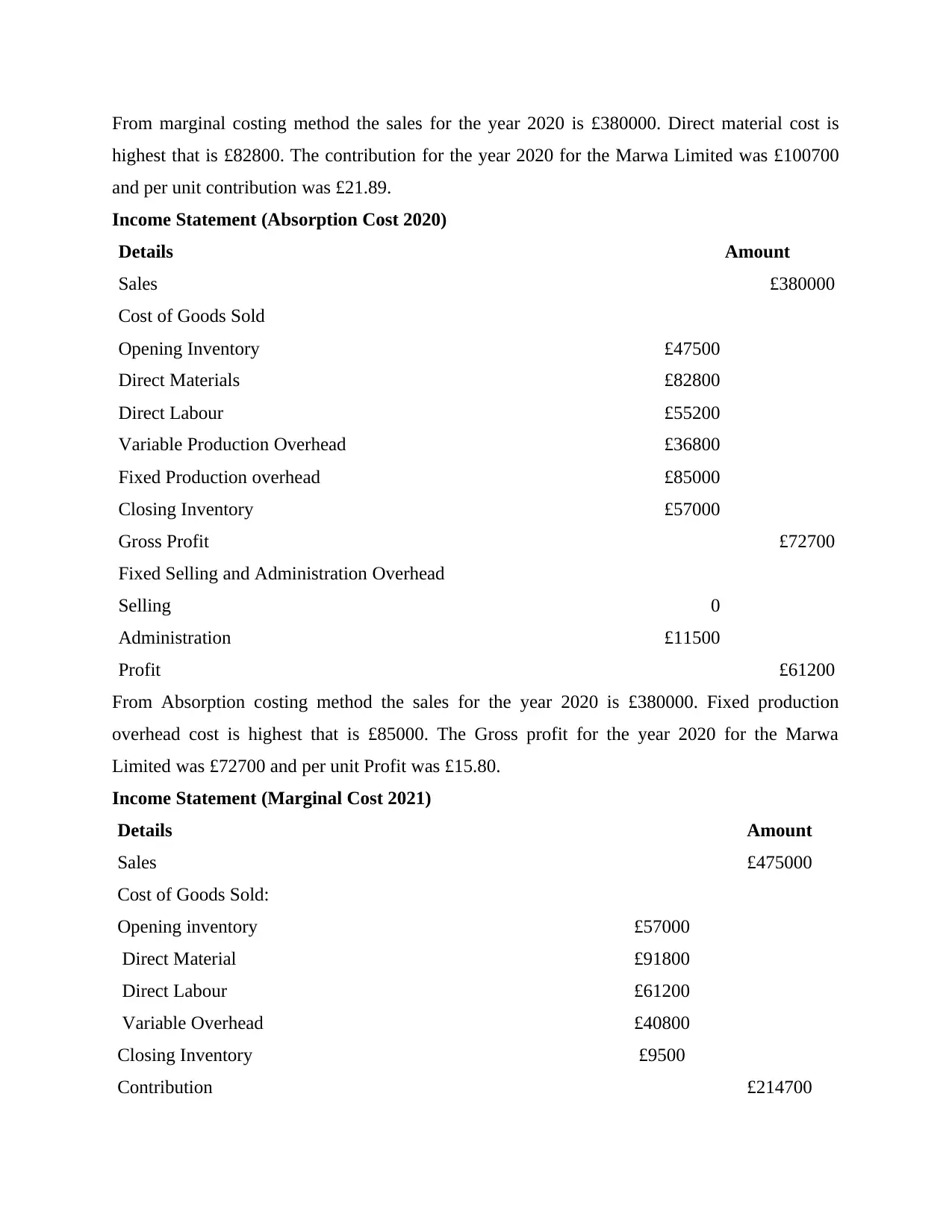
From marginal costing method the sales for the year 2020 is £380000. Direct material cost is
highest that is £82800. The contribution for the year 2020 for the Marwa Limited was £100700
and per unit contribution was £21.89.
Income Statement (Absorption Cost 2020)
Details Amount
Sales £380000
Cost of Goods Sold
Opening Inventory £47500
Direct Materials £82800
Direct Labour £55200
Variable Production Overhead £36800
Fixed Production overhead £85000
Closing Inventory £57000
Gross Profit £72700
Fixed Selling and Administration Overhead
Selling 0
Administration £11500
Profit £61200
From Absorption costing method the sales for the year 2020 is £380000. Fixed production
overhead cost is highest that is £85000. The Gross profit for the year 2020 for the Marwa
Limited was £72700 and per unit Profit was £15.80.
Income Statement (Marginal Cost 2021)
Details Amount
Sales £475000
Cost of Goods Sold:
Opening inventory £57000
Direct Material £91800
Direct Labour £61200
Variable Overhead £40800
Closing Inventory £9500
Contribution £214700
highest that is £82800. The contribution for the year 2020 for the Marwa Limited was £100700
and per unit contribution was £21.89.
Income Statement (Absorption Cost 2020)
Details Amount
Sales £380000
Cost of Goods Sold
Opening Inventory £47500
Direct Materials £82800
Direct Labour £55200
Variable Production Overhead £36800
Fixed Production overhead £85000
Closing Inventory £57000
Gross Profit £72700
Fixed Selling and Administration Overhead
Selling 0
Administration £11500
Profit £61200
From Absorption costing method the sales for the year 2020 is £380000. Fixed production
overhead cost is highest that is £85000. The Gross profit for the year 2020 for the Marwa
Limited was £72700 and per unit Profit was £15.80.
Income Statement (Marginal Cost 2021)
Details Amount
Sales £475000
Cost of Goods Sold:
Opening inventory £57000
Direct Material £91800
Direct Labour £61200
Variable Overhead £40800
Closing Inventory £9500
Contribution £214700
⊘ This is a preview!⊘
Do you want full access?
Subscribe today to unlock all pages.
Trusted by 1+ million students worldwide
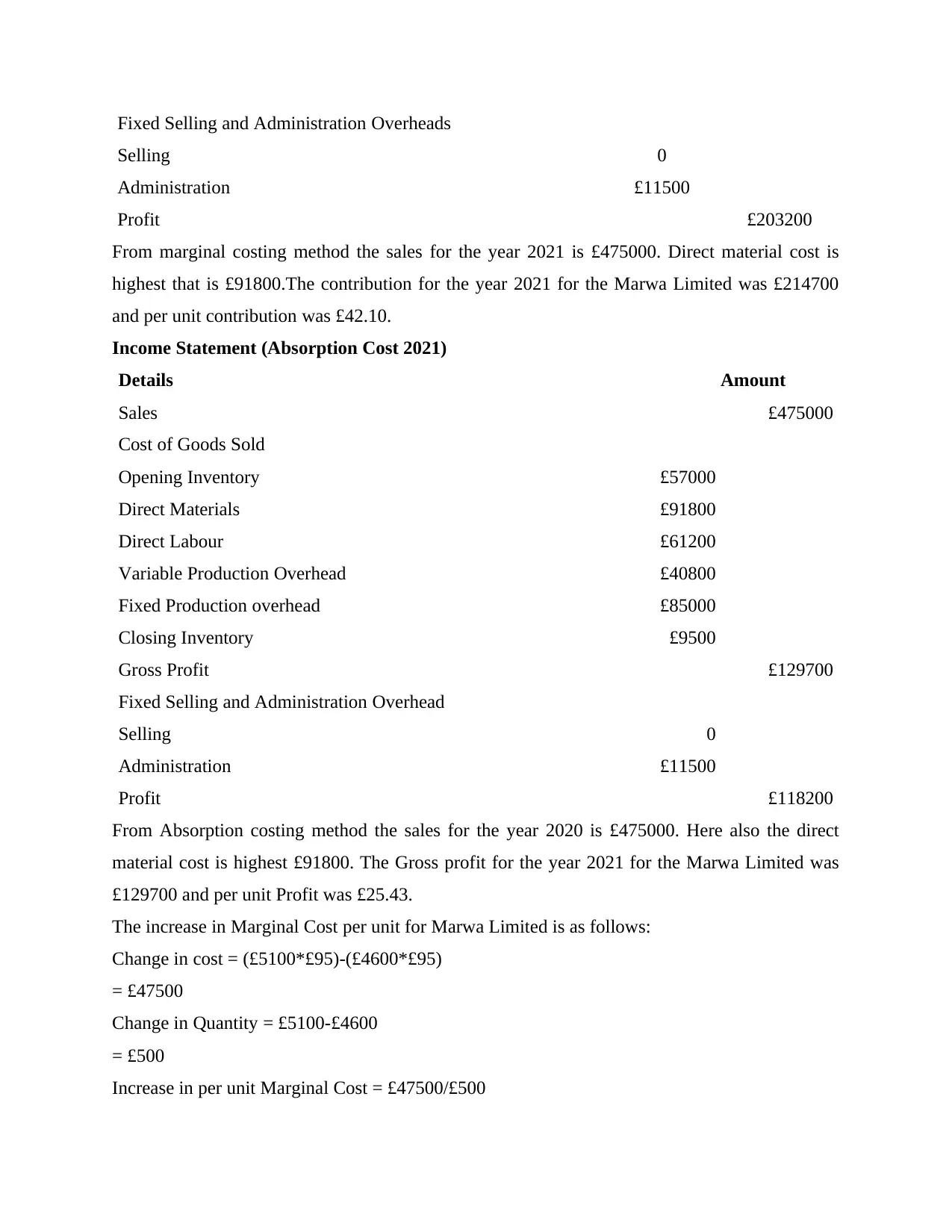
Fixed Selling and Administration Overheads
Selling 0
Administration £11500
Profit £203200
From marginal costing method the sales for the year 2021 is £475000. Direct material cost is
highest that is £91800.The contribution for the year 2021 for the Marwa Limited was £214700
and per unit contribution was £42.10.
Income Statement (Absorption Cost 2021)
Details Amount
Sales £475000
Cost of Goods Sold
Opening Inventory £57000
Direct Materials £91800
Direct Labour £61200
Variable Production Overhead £40800
Fixed Production overhead £85000
Closing Inventory £9500
Gross Profit £129700
Fixed Selling and Administration Overhead
Selling 0
Administration £11500
Profit £118200
From Absorption costing method the sales for the year 2020 is £475000. Here also the direct
material cost is highest £91800. The Gross profit for the year 2021 for the Marwa Limited was
£129700 and per unit Profit was £25.43.
The increase in Marginal Cost per unit for Marwa Limited is as follows:
Change in cost = (£5100*£95)-(£4600*£95)
= £47500
Change in Quantity = £5100-£4600
= £500
Increase in per unit Marginal Cost = £47500/£500
Selling 0
Administration £11500
Profit £203200
From marginal costing method the sales for the year 2021 is £475000. Direct material cost is
highest that is £91800.The contribution for the year 2021 for the Marwa Limited was £214700
and per unit contribution was £42.10.
Income Statement (Absorption Cost 2021)
Details Amount
Sales £475000
Cost of Goods Sold
Opening Inventory £57000
Direct Materials £91800
Direct Labour £61200
Variable Production Overhead £40800
Fixed Production overhead £85000
Closing Inventory £9500
Gross Profit £129700
Fixed Selling and Administration Overhead
Selling 0
Administration £11500
Profit £118200
From Absorption costing method the sales for the year 2020 is £475000. Here also the direct
material cost is highest £91800. The Gross profit for the year 2021 for the Marwa Limited was
£129700 and per unit Profit was £25.43.
The increase in Marginal Cost per unit for Marwa Limited is as follows:
Change in cost = (£5100*£95)-(£4600*£95)
= £47500
Change in Quantity = £5100-£4600
= £500
Increase in per unit Marginal Cost = £47500/£500
Paraphrase This Document
Need a fresh take? Get an instant paraphrase of this document with our AI Paraphraser
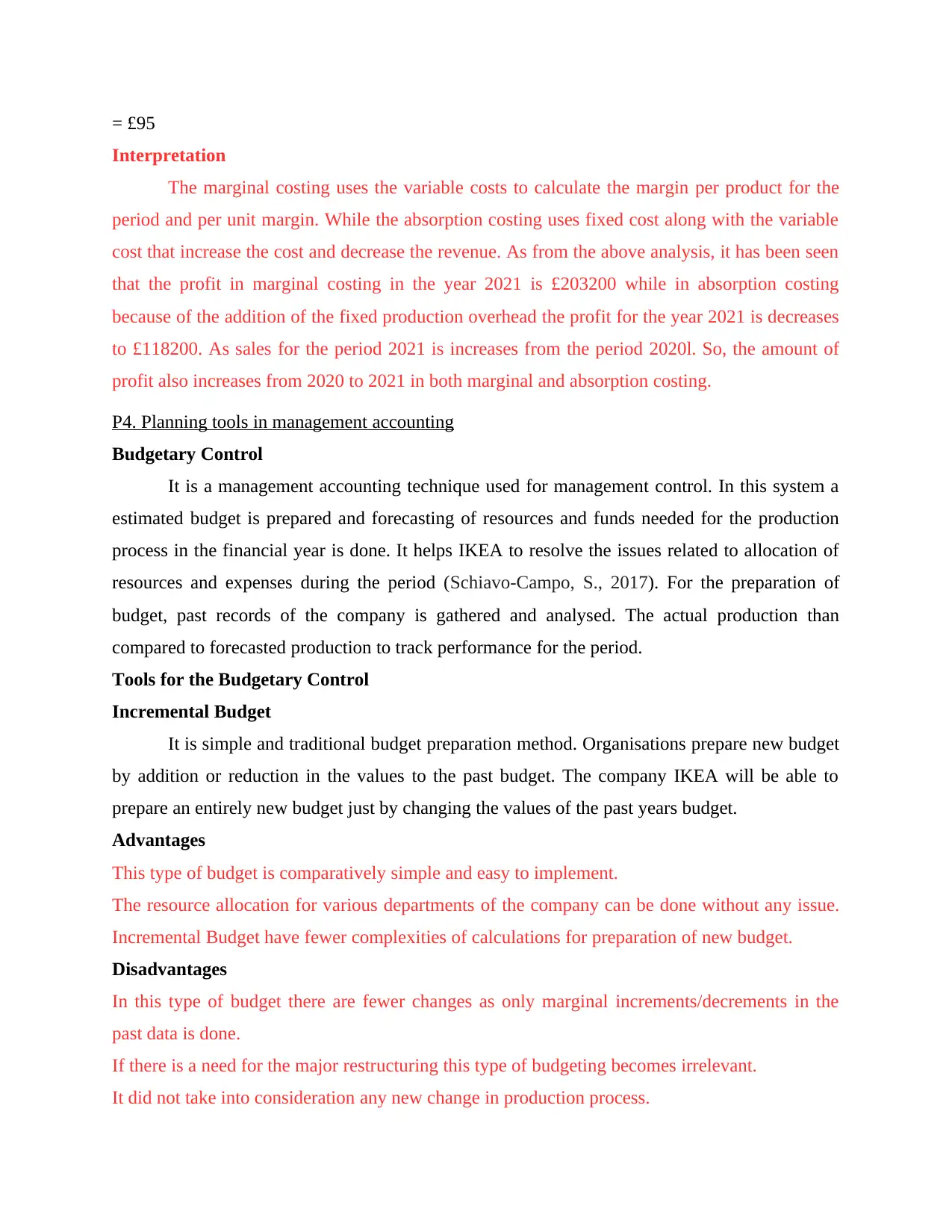
= £95
Interpretation
The marginal costing uses the variable costs to calculate the margin per product for the
period and per unit margin. While the absorption costing uses fixed cost along with the variable
cost that increase the cost and decrease the revenue. As from the above analysis, it has been seen
that the profit in marginal costing in the year 2021 is £203200 while in absorption costing
because of the addition of the fixed production overhead the profit for the year 2021 is decreases
to £118200. As sales for the period 2021 is increases from the period 2020l. So, the amount of
profit also increases from 2020 to 2021 in both marginal and absorption costing.
P4. Planning tools in management accounting
Budgetary Control
It is a management accounting technique used for management control. In this system a
estimated budget is prepared and forecasting of resources and funds needed for the production
process in the financial year is done. It helps IKEA to resolve the issues related to allocation of
resources and expenses during the period (Schiavo-Campo, S., 2017). For the preparation of
budget, past records of the company is gathered and analysed. The actual production than
compared to forecasted production to track performance for the period.
Tools for the Budgetary Control
Incremental Budget
It is simple and traditional budget preparation method. Organisations prepare new budget
by addition or reduction in the values to the past budget. The company IKEA will be able to
prepare an entirely new budget just by changing the values of the past years budget.
Advantages
This type of budget is comparatively simple and easy to implement.
The resource allocation for various departments of the company can be done without any issue.
Incremental Budget have fewer complexities of calculations for preparation of new budget.
Disadvantages
In this type of budget there are fewer changes as only marginal increments/decrements in the
past data is done.
If there is a need for the major restructuring this type of budgeting becomes irrelevant.
It did not take into consideration any new change in production process.
Interpretation
The marginal costing uses the variable costs to calculate the margin per product for the
period and per unit margin. While the absorption costing uses fixed cost along with the variable
cost that increase the cost and decrease the revenue. As from the above analysis, it has been seen
that the profit in marginal costing in the year 2021 is £203200 while in absorption costing
because of the addition of the fixed production overhead the profit for the year 2021 is decreases
to £118200. As sales for the period 2021 is increases from the period 2020l. So, the amount of
profit also increases from 2020 to 2021 in both marginal and absorption costing.
P4. Planning tools in management accounting
Budgetary Control
It is a management accounting technique used for management control. In this system a
estimated budget is prepared and forecasting of resources and funds needed for the production
process in the financial year is done. It helps IKEA to resolve the issues related to allocation of
resources and expenses during the period (Schiavo-Campo, S., 2017). For the preparation of
budget, past records of the company is gathered and analysed. The actual production than
compared to forecasted production to track performance for the period.
Tools for the Budgetary Control
Incremental Budget
It is simple and traditional budget preparation method. Organisations prepare new budget
by addition or reduction in the values to the past budget. The company IKEA will be able to
prepare an entirely new budget just by changing the values of the past years budget.
Advantages
This type of budget is comparatively simple and easy to implement.
The resource allocation for various departments of the company can be done without any issue.
Incremental Budget have fewer complexities of calculations for preparation of new budget.
Disadvantages
In this type of budget there are fewer changes as only marginal increments/decrements in the
past data is done.
If there is a need for the major restructuring this type of budgeting becomes irrelevant.
It did not take into consideration any new change in production process.
Activity-Based Budgeting
For the preparation of the budget and analysis is made and those activities are identified
which are costly. Each process of the activity is monitored and cost is identified. Steps are taken
to reduce the overall cost and achieve efficiency.
Advantages
For the preparation of this type of budget each activity of the operational process is evaluated.
By breaking down of the costs IKEA can identified which costs are influencing the production
process.
Each activity can be identified individually.
Disadvantages
The preparation of this type of budget is much more costly.
It is a time-consuming process.
Further a detailed understanding of the business process is required by the management.
Value Proposition Budgeting
A budget is prepared on the basis of the conviction on how the company generate value
so the potential customers are persuaded to buy IKEA products and services (Barnes and et.al,
2017).
Advantages
The budget report is prepared considering value which helps IKEA to avoid time and resources
by disposing that activities which are not relevant.
Helps in identification of jobs that possess not much value.
Quality production can be achieved.
Disadvantages
It increases the overall production cost.
The budgeting takes into consideration those activities that provides value to the customers other
activities are neglected.
The cost analysis of the relevant activities must be done by IKEA whether the preparation of the
budget by this method is feasible or not which is time-consuming.
Zero Based Budgeting
This budgeting method prepares on the approach that the values generated by production
process is zero. All the activities are evaluated from the nil. The activities added in the budget
For the preparation of the budget and analysis is made and those activities are identified
which are costly. Each process of the activity is monitored and cost is identified. Steps are taken
to reduce the overall cost and achieve efficiency.
Advantages
For the preparation of this type of budget each activity of the operational process is evaluated.
By breaking down of the costs IKEA can identified which costs are influencing the production
process.
Each activity can be identified individually.
Disadvantages
The preparation of this type of budget is much more costly.
It is a time-consuming process.
Further a detailed understanding of the business process is required by the management.
Value Proposition Budgeting
A budget is prepared on the basis of the conviction on how the company generate value
so the potential customers are persuaded to buy IKEA products and services (Barnes and et.al,
2017).
Advantages
The budget report is prepared considering value which helps IKEA to avoid time and resources
by disposing that activities which are not relevant.
Helps in identification of jobs that possess not much value.
Quality production can be achieved.
Disadvantages
It increases the overall production cost.
The budgeting takes into consideration those activities that provides value to the customers other
activities are neglected.
The cost analysis of the relevant activities must be done by IKEA whether the preparation of the
budget by this method is feasible or not which is time-consuming.
Zero Based Budgeting
This budgeting method prepares on the approach that the values generated by production
process is zero. All the activities are evaluated from the nil. The activities added in the budget
⊘ This is a preview!⊘
Do you want full access?
Subscribe today to unlock all pages.
Trusted by 1+ million students worldwide

1 out of 16


Related Documents


Your All-in-One AI-Powered Toolkit for Academic Success.
+13062052269
info@desklib.com
Available 24*7 on WhatsApp / Email
![[object Object]](/_next/static/media/star-bottom.7253800d.svg)
Unlock your academic potential
Copyright © 2020–2026 A2Z Services. All Rights Reserved. Developed and managed by ZUCOL.