Management Accounting Report: Techniques and Methods for Zylla
VerifiedAdded on 2020/06/05
|12
|4108
|46
Report
AI Summary
This report provides a comprehensive overview of management accounting, focusing on its role in business decision-making. It explores various aspects, including different types of management accounting systems like inventory management, job costing, price optimization, and cost accounting systems. The report delves into the methods used for management accounting reporting, such as budget reporting, account receivable reporting, job cost reports, inventory reporting, and performance reporting. Furthermore, it provides a detailed comparison between marginal and absorption costing methods, illustrating the calculation of net profit under each approach. The report also discusses the advantages and disadvantages of planning tools used in budgetary control and examines how organizations utilize management accounting to address financial problems. Overall, the report offers valuable insights into the practical application of management accounting principles and techniques.
MANAGEMENT
ACCOUNTING
ACCOUNTING

Paraphrase This Document
Need a fresh take? Get an instant paraphrase of this document with our AI Paraphraser
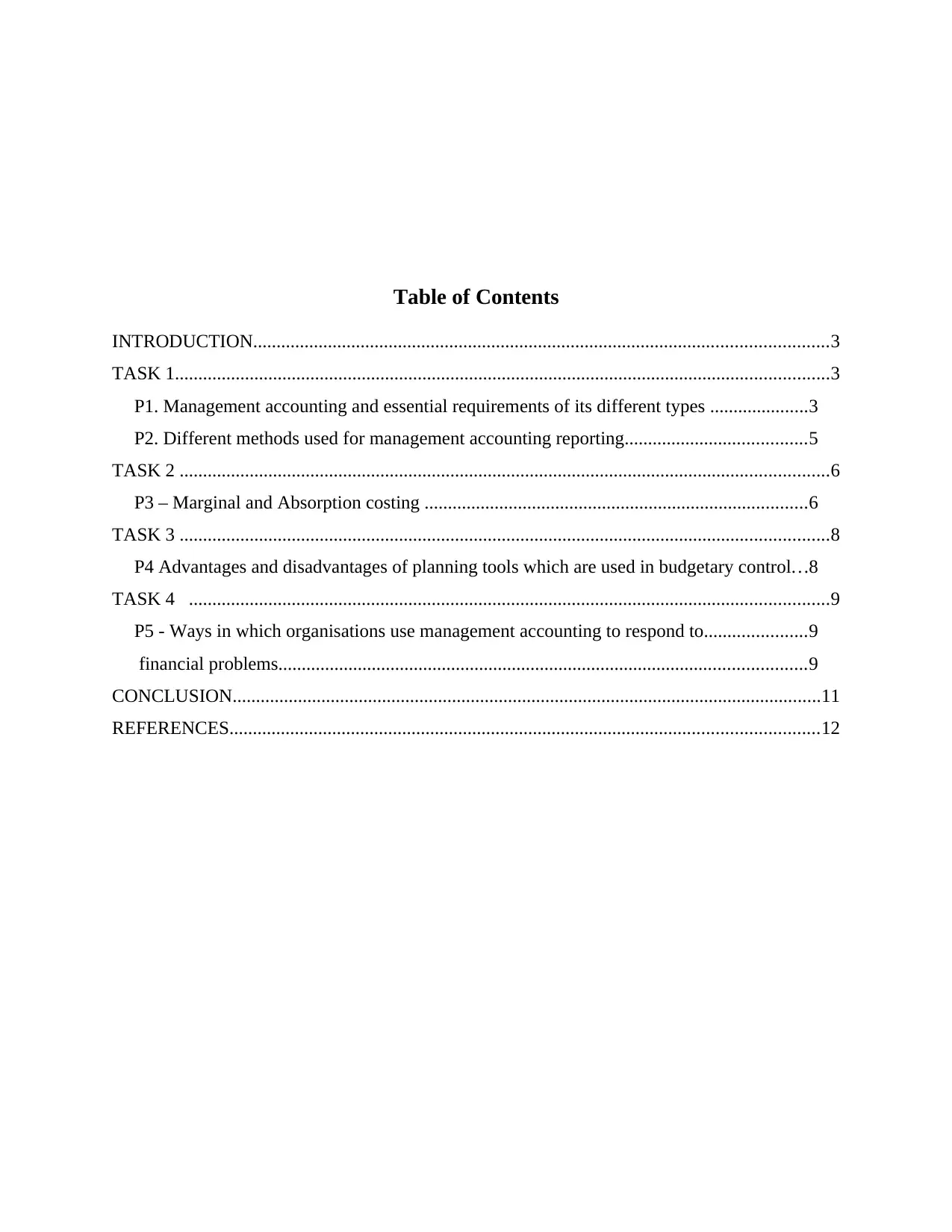
Table of Contents
INTRODUCTION...........................................................................................................................3
TASK 1............................................................................................................................................3
P1. Management accounting and essential requirements of its different types .....................3
P2. Different methods used for management accounting reporting.......................................5
TASK 2 ...........................................................................................................................................6
P3 – Marginal and Absorption costing ..................................................................................6
TASK 3 ...........................................................................................................................................8
P4 Advantages and disadvantages of planning tools which are used in budgetary control...8
TASK 4 .........................................................................................................................................9
P5 - Ways in which organisations use management accounting to respond to......................9
financial problems.................................................................................................................9
CONCLUSION..............................................................................................................................11
REFERENCES..............................................................................................................................12
INTRODUCTION...........................................................................................................................3
TASK 1............................................................................................................................................3
P1. Management accounting and essential requirements of its different types .....................3
P2. Different methods used for management accounting reporting.......................................5
TASK 2 ...........................................................................................................................................6
P3 – Marginal and Absorption costing ..................................................................................6
TASK 3 ...........................................................................................................................................8
P4 Advantages and disadvantages of planning tools which are used in budgetary control...8
TASK 4 .........................................................................................................................................9
P5 - Ways in which organisations use management accounting to respond to......................9
financial problems.................................................................................................................9
CONCLUSION..............................................................................................................................11
REFERENCES..............................................................................................................................12
INTRODUCTION
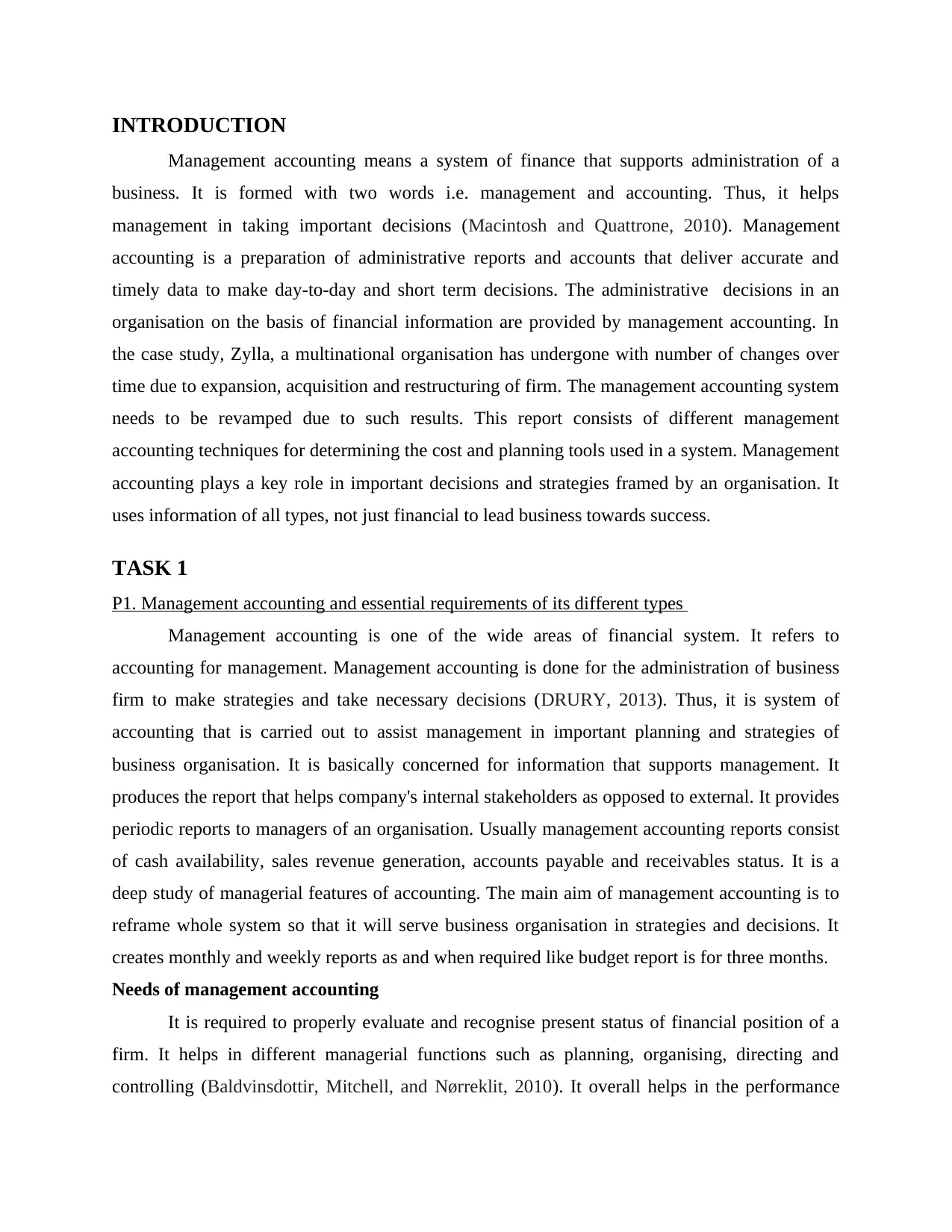
Management accounting means a system of finance that supports administration of a
business. It is formed with two words i.e. management and accounting. Thus, it helps
management in taking important decisions (Macintosh and Quattrone, 2010). Management
accounting is a preparation of administrative reports and accounts that deliver accurate and
timely data to make day-to-day and short term decisions. The administrative decisions in an
organisation on the basis of financial information are provided by management accounting. In
the case study, Zylla, a multinational organisation has undergone with number of changes over
time due to expansion, acquisition and restructuring of firm. The management accounting system
needs to be revamped due to such results. This report consists of different management
accounting techniques for determining the cost and planning tools used in a system. Management
accounting plays a key role in important decisions and strategies framed by an organisation. It
uses information of all types, not just financial to lead business towards success.
TASK 1
P1. Management accounting and essential requirements of its different types
Management accounting is one of the wide areas of financial system. It refers to
accounting for management. Management accounting is done for the administration of business
firm to make strategies and take necessary decisions (DRURY, 2013). Thus, it is system of
accounting that is carried out to assist management in important planning and strategies of
business organisation. It is basically concerned for information that supports management. It
produces the report that helps company's internal stakeholders as opposed to external. It provides
periodic reports to managers of an organisation. Usually management accounting reports consist
of cash availability, sales revenue generation, accounts payable and receivables status. It is a
deep study of managerial features of accounting. The main aim of management accounting is to
reframe whole system so that it will serve business organisation in strategies and decisions. It
creates monthly and weekly reports as and when required like budget report is for three months.
Needs of management accounting
It is required to properly evaluate and recognise present status of financial position of a
firm. It helps in different managerial functions such as planning, organising, directing and
controlling (Baldvinsdottir, Mitchell, and Nørreklit, 2010). It overall helps in the performance
Management accounting means a system of finance that supports administration of a
business. It is formed with two words i.e. management and accounting. Thus, it helps
management in taking important decisions (Macintosh and Quattrone, 2010). Management
accounting is a preparation of administrative reports and accounts that deliver accurate and
timely data to make day-to-day and short term decisions. The administrative decisions in an
organisation on the basis of financial information are provided by management accounting. In
the case study, Zylla, a multinational organisation has undergone with number of changes over
time due to expansion, acquisition and restructuring of firm. The management accounting system
needs to be revamped due to such results. This report consists of different management
accounting techniques for determining the cost and planning tools used in a system. Management
accounting plays a key role in important decisions and strategies framed by an organisation. It
uses information of all types, not just financial to lead business towards success.
TASK 1
P1. Management accounting and essential requirements of its different types
Management accounting is one of the wide areas of financial system. It refers to
accounting for management. Management accounting is done for the administration of business
firm to make strategies and take necessary decisions (DRURY, 2013). Thus, it is system of
accounting that is carried out to assist management in important planning and strategies of
business organisation. It is basically concerned for information that supports management. It
produces the report that helps company's internal stakeholders as opposed to external. It provides
periodic reports to managers of an organisation. Usually management accounting reports consist
of cash availability, sales revenue generation, accounts payable and receivables status. It is a
deep study of managerial features of accounting. The main aim of management accounting is to
reframe whole system so that it will serve business organisation in strategies and decisions. It
creates monthly and weekly reports as and when required like budget report is for three months.
Needs of management accounting
It is required to properly evaluate and recognise present status of financial position of a
firm. It helps in different managerial functions such as planning, organising, directing and
controlling (Baldvinsdottir, Mitchell, and Nørreklit, 2010). It overall helps in the performance
⊘ This is a preview!⊘
Do you want full access?
Subscribe today to unlock all pages.

Trusted by 1+ million students worldwide
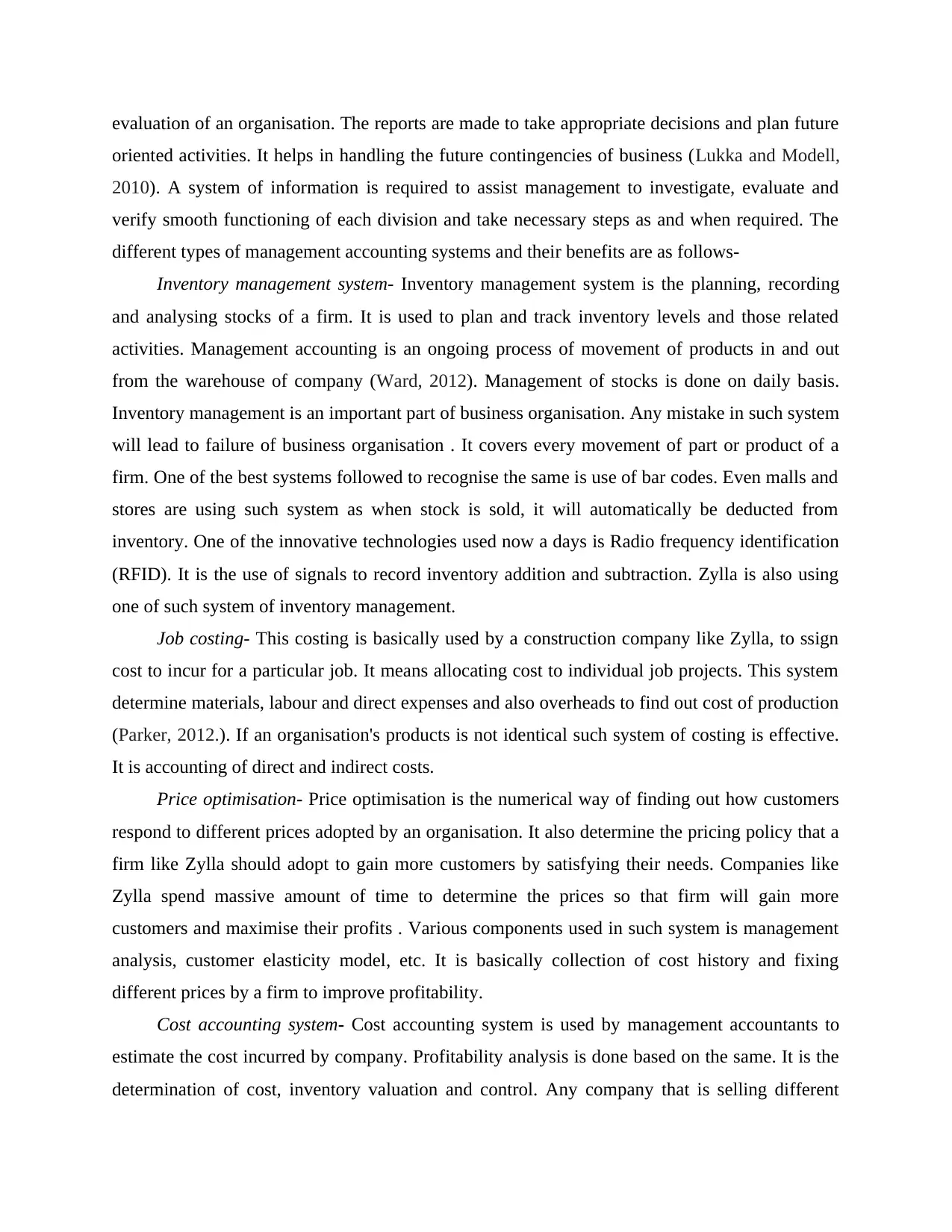
evaluation of an organisation. The reports are made to take appropriate decisions and plan future
oriented activities. It helps in handling the future contingencies of business (Lukka and Modell,
2010). A system of information is required to assist management to investigate, evaluate and
verify smooth functioning of each division and take necessary steps as and when required. The
different types of management accounting systems and their benefits are as follows-
Inventory management system- Inventory management system is the planning, recording
and analysing stocks of a firm. It is used to plan and track inventory levels and those related
activities. Management accounting is an ongoing process of movement of products in and out
from the warehouse of company (Ward, 2012). Management of stocks is done on daily basis.
Inventory management is an important part of business organisation. Any mistake in such system
will lead to failure of business organisation . It covers every movement of part or product of a
firm. One of the best systems followed to recognise the same is use of bar codes. Even malls and
stores are using such system as when stock is sold, it will automatically be deducted from
inventory. One of the innovative technologies used now a days is Radio frequency identification
(RFID). It is the use of signals to record inventory addition and subtraction. Zylla is also using
one of such system of inventory management.
Job costing- This costing is basically used by a construction company like Zylla, to ssign
cost to incur for a particular job. It means allocating cost to individual job projects. This system
determine materials, labour and direct expenses and also overheads to find out cost of production
(Parker, 2012.). If an organisation's products is not identical such system of costing is effective.
It is accounting of direct and indirect costs.
Price optimisation- Price optimisation is the numerical way of finding out how customers
respond to different prices adopted by an organisation. It also determine the pricing policy that a
firm like Zylla should adopt to gain more customers by satisfying their needs. Companies like
Zylla spend massive amount of time to determine the prices so that firm will gain more
customers and maximise their profits . Various components used in such system is management
analysis, customer elasticity model, etc. It is basically collection of cost history and fixing
different prices by a firm to improve profitability.
Cost accounting system- Cost accounting system is used by management accountants to
estimate the cost incurred by company. Profitability analysis is done based on the same. It is the
determination of cost, inventory valuation and control. Any company that is selling different
oriented activities. It helps in handling the future contingencies of business (Lukka and Modell,
2010). A system of information is required to assist management to investigate, evaluate and
verify smooth functioning of each division and take necessary steps as and when required. The
different types of management accounting systems and their benefits are as follows-
Inventory management system- Inventory management system is the planning, recording
and analysing stocks of a firm. It is used to plan and track inventory levels and those related
activities. Management accounting is an ongoing process of movement of products in and out
from the warehouse of company (Ward, 2012). Management of stocks is done on daily basis.
Inventory management is an important part of business organisation. Any mistake in such system
will lead to failure of business organisation . It covers every movement of part or product of a
firm. One of the best systems followed to recognise the same is use of bar codes. Even malls and
stores are using such system as when stock is sold, it will automatically be deducted from
inventory. One of the innovative technologies used now a days is Radio frequency identification
(RFID). It is the use of signals to record inventory addition and subtraction. Zylla is also using
one of such system of inventory management.
Job costing- This costing is basically used by a construction company like Zylla, to ssign
cost to incur for a particular job. It means allocating cost to individual job projects. This system
determine materials, labour and direct expenses and also overheads to find out cost of production
(Parker, 2012.). If an organisation's products is not identical such system of costing is effective.
It is accounting of direct and indirect costs.
Price optimisation- Price optimisation is the numerical way of finding out how customers
respond to different prices adopted by an organisation. It also determine the pricing policy that a
firm like Zylla should adopt to gain more customers by satisfying their needs. Companies like
Zylla spend massive amount of time to determine the prices so that firm will gain more
customers and maximise their profits . Various components used in such system is management
analysis, customer elasticity model, etc. It is basically collection of cost history and fixing
different prices by a firm to improve profitability.
Cost accounting system- Cost accounting system is used by management accountants to
estimate the cost incurred by company. Profitability analysis is done based on the same. It is the
determination of cost, inventory valuation and control. Any company that is selling different
Paraphrase This Document
Need a fresh take? Get an instant paraphrase of this document with our AI Paraphraser
products must know their cost and profit generated per unit. The determination of cost is
essential for any organisation . It is a critical task to estimate the profitability of a firm. Cost
accounting aims at capturing the cost of production including input as well as overall production
cost.
P2. Different methods used for management accounting reporting
Managerial reporting helps the managers of an organisation to monitor firm's
performance and usually prepared frequently to provide suitable information. Depending on the
project kind and information required, reports are asked from management accountants. It may
be prepared daily, weekly, monthly or quarterly basis based on requirement of an organisation.
There are various types of reports prepared by management accountants to monitor the
performance. The different methods of management accounting reports are as follows-
Budget reporting – Budgets are prepared to know where company has to spend more
and where not. For a construction company like Zylla, Budget is the most important. It helps in
analysing company's performance and cost control. Different types of budgets such as sales
budget, purchase budget and cash budget are prepared by company to control the cost (Parker,
2012). For providing incentives to employees, sometimes budgets are prepared. Usually, by
analysing the cost incurred in prior years, budget are prepared.
Account Receivable reporting – Any business organisation who is providing credit
facilities to customers should prepare such report. It also determines credit policies adopted by
business firm. It usually provides an overview of credit balances from 30 to 90 days. It helps in
recovering from debtors of an organisation. It is one of the tool to manage cash recovery of a
firm. The issues and problems occurring in cash collection can be sort out. The report is being
prepared based on prior history of debtors (Ward, 2012).
Job cost report – This report is prepared to shoe cost incurred on a single project and
revenue generated from the same. This type of report focuses on each job and work assigned to
them. How quickly tasks has been completed to improve profitability of a firm. Company can
easily able to analyse single job and task assigned (DRURY, 2013). This helps in finding highly
revenue generated areas and focusing more on the same.
essential for any organisation . It is a critical task to estimate the profitability of a firm. Cost
accounting aims at capturing the cost of production including input as well as overall production
cost.
P2. Different methods used for management accounting reporting
Managerial reporting helps the managers of an organisation to monitor firm's
performance and usually prepared frequently to provide suitable information. Depending on the
project kind and information required, reports are asked from management accountants. It may
be prepared daily, weekly, monthly or quarterly basis based on requirement of an organisation.
There are various types of reports prepared by management accountants to monitor the
performance. The different methods of management accounting reports are as follows-
Budget reporting – Budgets are prepared to know where company has to spend more
and where not. For a construction company like Zylla, Budget is the most important. It helps in
analysing company's performance and cost control. Different types of budgets such as sales
budget, purchase budget and cash budget are prepared by company to control the cost (Parker,
2012). For providing incentives to employees, sometimes budgets are prepared. Usually, by
analysing the cost incurred in prior years, budget are prepared.
Account Receivable reporting – Any business organisation who is providing credit
facilities to customers should prepare such report. It also determines credit policies adopted by
business firm. It usually provides an overview of credit balances from 30 to 90 days. It helps in
recovering from debtors of an organisation. It is one of the tool to manage cash recovery of a
firm. The issues and problems occurring in cash collection can be sort out. The report is being
prepared based on prior history of debtors (Ward, 2012).
Job cost report – This report is prepared to shoe cost incurred on a single project and
revenue generated from the same. This type of report focuses on each job and work assigned to
them. How quickly tasks has been completed to improve profitability of a firm. Company can
easily able to analyse single job and task assigned (DRURY, 2013). This helps in finding highly
revenue generated areas and focusing more on the same.
Inventory Reporting – These reports generally include material, labour cost as well as
overhead expenses. The per unit cost can be determined based on same (Banerjee, 2010).
Manufacturing industry usually have more advantages from such reports and thus, helps in
strategies and decisions. This report shows the problems of over or under stocking. This report
help manager in finding the right quantity of goods that should be kept in warehouse. Techniques
like EOQ can be used for resolving the problems which are identified through inventory report.
This report also contain the data of stock which is currently present in the company.
Performance reporting – Performance reporting is way of finding performances
expected from business firm in a specific period of time. The analysis has done to find suitable
information for investors and creditors of an organisation (Caglio and Ditillo, 2012). This report
is made for analysing the performance of employees or division. It shows the mistakes which
they have done and the areas where improvement can be done. This right is mainly used for
setting future goals for workers of various department of the company.
TASK 2
P3 – Marginal and Absorption costing
There are two methods available with an organisation for valuation of stock. These are
Marginal and Absorption costing. The marginal costing and absorption costing can be explained
as follows-
Marginal Costing – This is also known as variable costing. Ascertainment of fixed and
variable cost is done under this method to make appropriate decision of production. It determines
marginal cost of products and their influence on profit for the change in output. Marginal costing
is determined on the basis of fixed and variable cost (Banerjee, 2010). The profitability is
evaluated based on profit-volume ratio of a firm. It can be said as changes in total cost of
production by producing one additional unit. In such costing, fixed cost are of less relevance as
compare to variable cost. It is one of the decision making techniques. It helps management to
focus on changes occurring due to marginal cost of production.
Absorption Costing – Absorption costing is a method of inventory valuation where cost
are grouped into cost centres to determine total cost of production. In such costing, both fixed
and variable cost are of relevance. Such system of costing is one of traditional method also called
overhead expenses. The per unit cost can be determined based on same (Banerjee, 2010).
Manufacturing industry usually have more advantages from such reports and thus, helps in
strategies and decisions. This report shows the problems of over or under stocking. This report
help manager in finding the right quantity of goods that should be kept in warehouse. Techniques
like EOQ can be used for resolving the problems which are identified through inventory report.
This report also contain the data of stock which is currently present in the company.
Performance reporting – Performance reporting is way of finding performances
expected from business firm in a specific period of time. The analysis has done to find suitable
information for investors and creditors of an organisation (Caglio and Ditillo, 2012). This report
is made for analysing the performance of employees or division. It shows the mistakes which
they have done and the areas where improvement can be done. This right is mainly used for
setting future goals for workers of various department of the company.
TASK 2
P3 – Marginal and Absorption costing
There are two methods available with an organisation for valuation of stock. These are
Marginal and Absorption costing. The marginal costing and absorption costing can be explained
as follows-
Marginal Costing – This is also known as variable costing. Ascertainment of fixed and
variable cost is done under this method to make appropriate decision of production. It determines
marginal cost of products and their influence on profit for the change in output. Marginal costing
is determined on the basis of fixed and variable cost (Banerjee, 2010). The profitability is
evaluated based on profit-volume ratio of a firm. It can be said as changes in total cost of
production by producing one additional unit. In such costing, fixed cost are of less relevance as
compare to variable cost. It is one of the decision making techniques. It helps management to
focus on changes occurring due to marginal cost of production.
Absorption Costing – Absorption costing is a method of inventory valuation where cost
are grouped into cost centres to determine total cost of production. In such costing, both fixed
and variable cost are of relevance. Such system of costing is one of traditional method also called
⊘ This is a preview!⊘
Do you want full access?
Subscribe today to unlock all pages.
Trusted by 1+ million students worldwide
as full absorption method. The cost are grouped into different overheads such as production,
administration and selling and distribution overheads. This is mainly used in reporting purposes.
The profitability will be affected by the inclusion of fixed cost. In small organisation, it is ideal
way to find out job cost and their effect on profitability. Imaginary data has been taken to
calculate Net profit under two methods.
Net profit using absorption Costing $ $
Sales 25000
(-)Cost of sales
Opening stock 0
Manufacturing 10000
Closing stock 5000 -15000
GROSS PROFIT 10000
(-)Expenses
Variable sales expenditure 1000
Fixed administrative expenses 2000
Selling Expenses 2000 -5000
Net profit using absorption Costing 5000
Net profit using Marginal Costing $ $
Sales 25000
Less: Variable Costs
Opening stock 0
Manufacturing 10000
Variable Production expenses 500
Selling costs 2000
Closing stock 5000
17500
Contribution 7500
Less: Fixed Administration cost expenses 2000
administration and selling and distribution overheads. This is mainly used in reporting purposes.
The profitability will be affected by the inclusion of fixed cost. In small organisation, it is ideal
way to find out job cost and their effect on profitability. Imaginary data has been taken to
calculate Net profit under two methods.
Net profit using absorption Costing $ $
Sales 25000
(-)Cost of sales
Opening stock 0
Manufacturing 10000
Closing stock 5000 -15000
GROSS PROFIT 10000
(-)Expenses
Variable sales expenditure 1000
Fixed administrative expenses 2000
Selling Expenses 2000 -5000
Net profit using absorption Costing 5000
Net profit using Marginal Costing $ $
Sales 25000
Less: Variable Costs
Opening stock 0
Manufacturing 10000
Variable Production expenses 500
Selling costs 2000
Closing stock 5000
17500
Contribution 7500
Less: Fixed Administration cost expenses 2000
Paraphrase This Document
Need a fresh take? Get an instant paraphrase of this document with our AI Paraphraser
Net profit 5500
Interpretation -
On the basis of above calculation it can be concluded that Net profit in marginal costing
is more than absorption costing methods net profit. The difference is 500$, this variance is due to
nature of accounting treatment by both methods. As in absorption costing all expenses either
fixed or variable are included but marginal costing only calculates costs on the basis of variable
cost per unit.
TASK 3
P4 Advantages and disadvantages of planning tools which are used in budgetary control
The budgetary is the process of preparation of various budget for future course of time
based on the history of such component. Actual performance will be compared with the planned
performance, differences if arise, will be sort out (Caglio and Ditillo, 2012). This helps
management to take necessary steps at appropriate time for smooth functioning of business
organisation. Budgets usually fixes targets for each department and it should be accomplished
within a given period of time. But organisation has to spend massive time to prepare such
budgets. Preparation of budgets can be done for units, division, departments or whole enterprise.
An organisation may use number of budgets that are classified as follows-
Master Budget – It is a comprehensive budget involves different aspects of firm in a
budgeted time frame. It usually consist of cash flow, budgeted Statement and Budgeted balance
sheet. This type of budget interrelates with different divisions and thus, an important planning
tool used in budgetary control. Manger use such type of budgets to plan and set performance
objectives. Organisation like Zylla uses such type of budget to get picture view of different
components of business. Thus, large firms usually prepare such type of budgets.
Operational Budget - Operational budget are prepared based on different operations of
business. It usually covers expenses and revenues associated with operational aspects of firm.
Revenue and expenses, also different overheads are considered which are directly related to
manufacturing of products. Such type of budgets are prepared weekly, monthly or quarterly
based on reporting periods. Managers also compare actual performance with planned one to find
out derivates, if any.
Interpretation -
On the basis of above calculation it can be concluded that Net profit in marginal costing
is more than absorption costing methods net profit. The difference is 500$, this variance is due to
nature of accounting treatment by both methods. As in absorption costing all expenses either
fixed or variable are included but marginal costing only calculates costs on the basis of variable
cost per unit.
TASK 3
P4 Advantages and disadvantages of planning tools which are used in budgetary control
The budgetary is the process of preparation of various budget for future course of time
based on the history of such component. Actual performance will be compared with the planned
performance, differences if arise, will be sort out (Caglio and Ditillo, 2012). This helps
management to take necessary steps at appropriate time for smooth functioning of business
organisation. Budgets usually fixes targets for each department and it should be accomplished
within a given period of time. But organisation has to spend massive time to prepare such
budgets. Preparation of budgets can be done for units, division, departments or whole enterprise.
An organisation may use number of budgets that are classified as follows-
Master Budget – It is a comprehensive budget involves different aspects of firm in a
budgeted time frame. It usually consist of cash flow, budgeted Statement and Budgeted balance
sheet. This type of budget interrelates with different divisions and thus, an important planning
tool used in budgetary control. Manger use such type of budgets to plan and set performance
objectives. Organisation like Zylla uses such type of budget to get picture view of different
components of business. Thus, large firms usually prepare such type of budgets.
Operational Budget - Operational budget are prepared based on different operations of
business. It usually covers expenses and revenues associated with operational aspects of firm.
Revenue and expenses, also different overheads are considered which are directly related to
manufacturing of products. Such type of budgets are prepared weekly, monthly or quarterly
based on reporting periods. Managers also compare actual performance with planned one to find
out derivates, if any.
Cash flow Budget –The budget that show inflow and outflow of cash during some
specified period is known as cash flow budget. Managers monitors such budgets to pinpoint
shortfalls. The cash management is necessary for any business organisation. Large organisations
such as Zylla need effective monitoring of cash flow during a specified period, so that cash will
always be available for firm.
Financial Budget – Such budget plays a vital role for an organisation considering how
an organisation spend and receive money including revenue from different operations as well as
cost from capital expenditures (ter Bogt, and van Helden, 2012). Management of fixed assets
such as land and building, inventory, major equipment always influence performance of business
organisation. Such budget are used to leverage performance of business and value company for
mergers and public offerings.
Static Budget – Such budget consist of components where expenditures remains constant
with changes in levels of sales. Cost of overhead can be one of kind of such budgets. Managers
have to see each division of business organisation and plan budgets accordingly. Some divisions
have fixed amount to spend so budgets are prepared keeping it in mind. If in case expenses are
going above, it will surely make business functioning ineffective.
Capital budgeting – taking decisions relating to investment is not an easy task. Capital
budget is the estimation of future fixed expenditure and income. Techniques like IRR and NPV
is used in formation of this budget. NPV shows the present value of a future investment. If NPV
is more than current cost then company should invest in particular product and if it is less then
they should. Internal rate of return shows the amount of return which company will get on
investment. It depicts the time period in which amount can be recovered.
TASK 4
P5 - Ways in which organisations use management accounting to respond to
financial problems
Firms are using problems of adaption of their strategies, and practices to respond to
dynamic environment. The ways in which organisation respond to dynamic environment
describes whether business will lead to success or failure. Management accounting plays a key
role today by providing firm with essential information needed to achieve its goals and
objectives (Fullerton, Kennedy and Widener, 2013). Decision makers of an organisation should
specified period is known as cash flow budget. Managers monitors such budgets to pinpoint
shortfalls. The cash management is necessary for any business organisation. Large organisations
such as Zylla need effective monitoring of cash flow during a specified period, so that cash will
always be available for firm.
Financial Budget – Such budget plays a vital role for an organisation considering how
an organisation spend and receive money including revenue from different operations as well as
cost from capital expenditures (ter Bogt, and van Helden, 2012). Management of fixed assets
such as land and building, inventory, major equipment always influence performance of business
organisation. Such budget are used to leverage performance of business and value company for
mergers and public offerings.
Static Budget – Such budget consist of components where expenditures remains constant
with changes in levels of sales. Cost of overhead can be one of kind of such budgets. Managers
have to see each division of business organisation and plan budgets accordingly. Some divisions
have fixed amount to spend so budgets are prepared keeping it in mind. If in case expenses are
going above, it will surely make business functioning ineffective.
Capital budgeting – taking decisions relating to investment is not an easy task. Capital
budget is the estimation of future fixed expenditure and income. Techniques like IRR and NPV
is used in formation of this budget. NPV shows the present value of a future investment. If NPV
is more than current cost then company should invest in particular product and if it is less then
they should. Internal rate of return shows the amount of return which company will get on
investment. It depicts the time period in which amount can be recovered.
TASK 4
P5 - Ways in which organisations use management accounting to respond to
financial problems
Firms are using problems of adaption of their strategies, and practices to respond to
dynamic environment. The ways in which organisation respond to dynamic environment
describes whether business will lead to success or failure. Management accounting plays a key
role today by providing firm with essential information needed to achieve its goals and
objectives (Fullerton, Kennedy and Widener, 2013). Decision makers of an organisation should
⊘ This is a preview!⊘
Do you want full access?
Subscribe today to unlock all pages.
Trusted by 1+ million students worldwide
know how information should be used to make their firm recognizable. In a dynamic business
environment, organisation have to properly analyse their cost incurred in various components
and plan accordingly to make firm effective and profitable. Good management accounting
depends on using information in an effective way and use different techniques as marginal
accounting, ratio analysis, cost- volume profit analysis etc. to determine planned targets and
accomplish same within specified time. Following are some of the financial troubles which can
be solved by using management accounting systems:
Management of cash – The importance of liquid assets has always remained high because
it is considered as the backbone of a company. Management accounting techniques help in right
allocation of liquid asset. Cash budget shows the right amount of cash which is needed in a
particular time. This reduces the wastage of cash and mainly liquidity in the organisation.
Timely payment – An organisation can fail to make or receive payment because of
various reasons. This issue can be solved by making account receivable and payment report.
These report contain systematic details about debtors and creditors of the company.
Management accounting is of utmost importance of any organisation. However such
system of accounting undergone different changes over the years. Earlier traditional method of
management accounting was followed however, now innovative modern method has been in
role. Management accountants plays key role in business organisation devoted resources to
make an enterprise best among others. Traditionally management accountants have less options
to use, but now they have plenty of options to provide administration with number of useful
information. The modern system of accounting uses Key performance indicators, Bench marking
and financial governance which make an organisation profitable. Earlier such components were
not available (Schaltegger, Gibassier, and Zvezdov, 2013). Thus, we can say that management
accounting will lead business towards sustainable success.
Key performance indicators – It identifies how effectively a firm achieve
predetermined targets. Selecting right KPIs is an important task as it depend on which industry
business is operating. It helps managers of an organisation to identify effectiveness of different
functions. It is one of kind of performance measurement. SMART objectives has to set by the
firm for resolving financial troubles. They should set specific goals like decrease the cost of
business by 15%, their targets should be measurable like from last year and they should be time
environment, organisation have to properly analyse their cost incurred in various components
and plan accordingly to make firm effective and profitable. Good management accounting
depends on using information in an effective way and use different techniques as marginal
accounting, ratio analysis, cost- volume profit analysis etc. to determine planned targets and
accomplish same within specified time. Following are some of the financial troubles which can
be solved by using management accounting systems:
Management of cash – The importance of liquid assets has always remained high because
it is considered as the backbone of a company. Management accounting techniques help in right
allocation of liquid asset. Cash budget shows the right amount of cash which is needed in a
particular time. This reduces the wastage of cash and mainly liquidity in the organisation.
Timely payment – An organisation can fail to make or receive payment because of
various reasons. This issue can be solved by making account receivable and payment report.
These report contain systematic details about debtors and creditors of the company.
Management accounting is of utmost importance of any organisation. However such
system of accounting undergone different changes over the years. Earlier traditional method of
management accounting was followed however, now innovative modern method has been in
role. Management accountants plays key role in business organisation devoted resources to
make an enterprise best among others. Traditionally management accountants have less options
to use, but now they have plenty of options to provide administration with number of useful
information. The modern system of accounting uses Key performance indicators, Bench marking
and financial governance which make an organisation profitable. Earlier such components were
not available (Schaltegger, Gibassier, and Zvezdov, 2013). Thus, we can say that management
accounting will lead business towards sustainable success.
Key performance indicators – It identifies how effectively a firm achieve
predetermined targets. Selecting right KPIs is an important task as it depend on which industry
business is operating. It helps managers of an organisation to identify effectiveness of different
functions. It is one of kind of performance measurement. SMART objectives has to set by the
firm for resolving financial troubles. They should set specific goals like decrease the cost of
business by 15%, their targets should be measurable like from last year and they should be time
Paraphrase This Document
Need a fresh take? Get an instant paraphrase of this document with our AI Paraphraser
bounded. Targets should be attainable and realistic so employee do not feel demotivated if they
fail to attain them.
Bench marking – It is measurement of performance of organisational products and
strategies in comparison with standard one. The main aim of such system is to find out
improving areas and analyse how information is used in a best way. To achieve greater success
by improvement in different functional areas is main motive (Ferreira, Moulang, and Hendro,
2010). It also focuses on how others use information and accomplish their targets. Management
accountants compare own operations with those of competitors.
Financial Governance – Financial governance is process of ensuring that financial
processes are governed effectively. It involves everything from internal control to auditing of
different components. By conducting internal audit and providing more power to audit company,
many financials issues can be resolved at the place of their generation. If a problem in identified
in internal audit then it can be resolved in right time and the damage can be minimised.
CONCLUSION
By this report, it has been concluded that management accounting is an integral part of
any business organisation. It is one of the system that provide management with the useful
information. This information is helpful in framing strategies and taking appropriate decisions at
the right time. Management accounting is a preparation of administrative reports and accounts
that deliver accurate and timely data to make day-to-day and short term decisions. Management
accounting provides administration different tools and techniques required to plan different
strategies and work accordingly. Ratio analysis, Cash flow statement, Fund flow statement,
Marginal Costing, Cost- Volume profit analysis, Budgeting are all components of such
accounting system and helps organisation with useful informations to take right decisions. It
analyses business cost and operations to prepare financial reports and records. It helps in future
forecasting activities. Thus, helps in achievement of organisational goals.
fail to attain them.
Bench marking – It is measurement of performance of organisational products and
strategies in comparison with standard one. The main aim of such system is to find out
improving areas and analyse how information is used in a best way. To achieve greater success
by improvement in different functional areas is main motive (Ferreira, Moulang, and Hendro,
2010). It also focuses on how others use information and accomplish their targets. Management
accountants compare own operations with those of competitors.
Financial Governance – Financial governance is process of ensuring that financial
processes are governed effectively. It involves everything from internal control to auditing of
different components. By conducting internal audit and providing more power to audit company,
many financials issues can be resolved at the place of their generation. If a problem in identified
in internal audit then it can be resolved in right time and the damage can be minimised.
CONCLUSION
By this report, it has been concluded that management accounting is an integral part of
any business organisation. It is one of the system that provide management with the useful
information. This information is helpful in framing strategies and taking appropriate decisions at
the right time. Management accounting is a preparation of administrative reports and accounts
that deliver accurate and timely data to make day-to-day and short term decisions. Management
accounting provides administration different tools and techniques required to plan different
strategies and work accordingly. Ratio analysis, Cash flow statement, Fund flow statement,
Marginal Costing, Cost- Volume profit analysis, Budgeting are all components of such
accounting system and helps organisation with useful informations to take right decisions. It
analyses business cost and operations to prepare financial reports and records. It helps in future
forecasting activities. Thus, helps in achievement of organisational goals.
REFERENCES
Books and Journals
Macintosh, N.B. and Quattrone, P., 2010. Management accounting and control systems: An
organizational and sociological approach. John Wiley & Sons.
DRURY, C.M., 2013. Management and cost accounting. Springer.
Baldvinsdottir, G., Mitchell, F. and Nørreklit, H., 2010. Issues in the relationship between theory
and practice in management accounting. Management Accounting Research. 21(2).
pp.79-82.
Lukka, K. and Modell, S., 2010. Validation in interpretive management accounting
research. Accounting, Organizations and Society. 35(4). pp.462-477.
Ward, K., 2012. Strategic management accounting. Routledge.
Parker, L.D., 2012. Qualitative management accounting research: Assessing deliverables and
relevance. Critical perspectives on accounting. 23(1). pp.54-70.
Ferreira, A., Moulang, C. and Hendro, B., 2010. Environmental management accounting and
innovation: an exploratory analysis. Accounting, Auditing & Accountability
Journal. 23(7). pp.920-948.
Schaltegger, S., Gibassier, D. and Zvezdov, D., 2013. Is environmental management accounting
a discipline? A bibliometric literature review. Meditari Accountancy Research. 21(1).
pp.4-31.
Cinquini, L. and Tenucci, A., 2010. Strategic management accounting and business strategy: a
loose coupling?. Journal of Accounting & organizational change. 6(2). pp.228-259.
Renz, D.O., 2016. The Jossey-Bass handbook of nonprofit leadership and management. John
Wiley & Sons.
Scapens, R.W. and Bromwich, M., 2010. Management accounting research: 20 years on.
Fullerton, R.R., Kennedy, F.A. and Widener, S.K., 2013. Management accounting and control
practices in a lean manufacturing environment. Accounting, Organizations and
Society. 38(1). pp.50-71.
ter Bogt, H. and van Helden, J., 2012. The practical relevance of management accounting
research and the role of qualitative methods therein: The debate continues. Qualitative
Research in Accounting & Management. 9(3). pp.265-273.
Caglio, A. and Ditillo, A., 2012. Opening the black box of management accounting information
exchanges in buyer–supplier relationships. Management Accounting Research. 23(2).
pp.61-78.
Banerjee, B., 2010. Financial policy and management accounting. PHI Learning Pvt. Ltd..
Online
management accounting. 2017. [online]. Available through
<http://www.mbacrystalball.com/blog/accounting/management-accounting> [Accessed
on 13th November 2017].
Books and Journals
Macintosh, N.B. and Quattrone, P., 2010. Management accounting and control systems: An
organizational and sociological approach. John Wiley & Sons.
DRURY, C.M., 2013. Management and cost accounting. Springer.
Baldvinsdottir, G., Mitchell, F. and Nørreklit, H., 2010. Issues in the relationship between theory
and practice in management accounting. Management Accounting Research. 21(2).
pp.79-82.
Lukka, K. and Modell, S., 2010. Validation in interpretive management accounting
research. Accounting, Organizations and Society. 35(4). pp.462-477.
Ward, K., 2012. Strategic management accounting. Routledge.
Parker, L.D., 2012. Qualitative management accounting research: Assessing deliverables and
relevance. Critical perspectives on accounting. 23(1). pp.54-70.
Ferreira, A., Moulang, C. and Hendro, B., 2010. Environmental management accounting and
innovation: an exploratory analysis. Accounting, Auditing & Accountability
Journal. 23(7). pp.920-948.
Schaltegger, S., Gibassier, D. and Zvezdov, D., 2013. Is environmental management accounting
a discipline? A bibliometric literature review. Meditari Accountancy Research. 21(1).
pp.4-31.
Cinquini, L. and Tenucci, A., 2010. Strategic management accounting and business strategy: a
loose coupling?. Journal of Accounting & organizational change. 6(2). pp.228-259.
Renz, D.O., 2016. The Jossey-Bass handbook of nonprofit leadership and management. John
Wiley & Sons.
Scapens, R.W. and Bromwich, M., 2010. Management accounting research: 20 years on.
Fullerton, R.R., Kennedy, F.A. and Widener, S.K., 2013. Management accounting and control
practices in a lean manufacturing environment. Accounting, Organizations and
Society. 38(1). pp.50-71.
ter Bogt, H. and van Helden, J., 2012. The practical relevance of management accounting
research and the role of qualitative methods therein: The debate continues. Qualitative
Research in Accounting & Management. 9(3). pp.265-273.
Caglio, A. and Ditillo, A., 2012. Opening the black box of management accounting information
exchanges in buyer–supplier relationships. Management Accounting Research. 23(2).
pp.61-78.
Banerjee, B., 2010. Financial policy and management accounting. PHI Learning Pvt. Ltd..
Online
management accounting. 2017. [online]. Available through
<http://www.mbacrystalball.com/blog/accounting/management-accounting> [Accessed
on 13th November 2017].
⊘ This is a preview!⊘
Do you want full access?
Subscribe today to unlock all pages.
Trusted by 1+ million students worldwide

1 out of 12


Related Documents


Your All-in-One AI-Powered Toolkit for Academic Success.
+13062052269
info@desklib.com
Available 24*7 on WhatsApp / Email
![[object Object]](/_next/static/media/star-bottom.7253800d.svg)
Unlock your academic potential
Copyright © 2020–2026 A2Z Services. All Rights Reserved. Developed and managed by ZUCOL.