Examining Management Accounting Techniques in SMEs
VerifiedAdded on 2020/06/03
|16
|5502
|130
AI Summary
The text analyzes the use of management accounting techniques within small and medium-sized enterprises (SMEs), focusing on how these businesses apply financial strategies to improve efficiency and sustainability. Key themes include the implementation of environmental management accounting tools, which are crucial for fostering innovation and addressing ecological concerns. Several academic studies, such as those by Ferreira et al., Grabner and Moers, and Papaspyropoulos et al., provide empirical evidence on current practices and challenges faced by SMEs in adopting these techniques. The analysis highlights the gap between theoretical frameworks and practical applications, suggesting areas for further research to enhance the effectiveness of management accounting within smaller business contexts.
Management Accounting

Paraphrase This Document
Need a fresh take? Get an instant paraphrase of this document with our AI Paraphraser
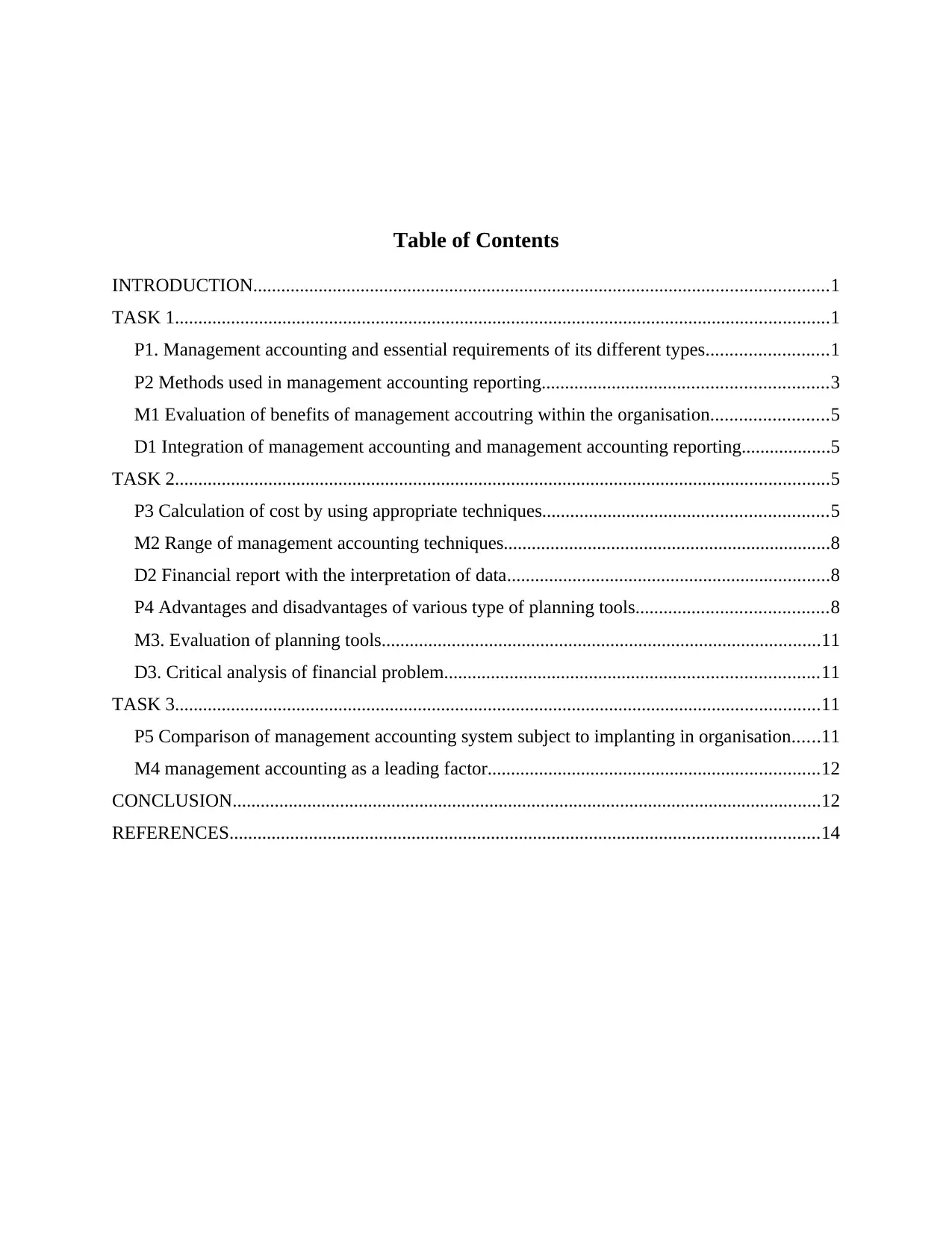
Table of Contents
INTRODUCTION...........................................................................................................................1
TASK 1............................................................................................................................................1
P1. Management accounting and essential requirements of its different types..........................1
P2 Methods used in management accounting reporting.............................................................3
M1 Evaluation of benefits of management accoutring within the organisation.........................5
D1 Integration of management accounting and management accounting reporting...................5
TASK 2............................................................................................................................................5
P3 Calculation of cost by using appropriate techniques.............................................................5
M2 Range of management accounting techniques......................................................................8
D2 Financial report with the interpretation of data.....................................................................8
P4 Advantages and disadvantages of various type of planning tools.........................................8
M3. Evaluation of planning tools..............................................................................................11
D3. Critical analysis of financial problem................................................................................11
TASK 3..........................................................................................................................................11
P5 Comparison of management accounting system subject to implanting in organisation......11
M4 management accounting as a leading factor.......................................................................12
CONCLUSION..............................................................................................................................12
REFERENCES..............................................................................................................................14
INTRODUCTION...........................................................................................................................1
TASK 1............................................................................................................................................1
P1. Management accounting and essential requirements of its different types..........................1
P2 Methods used in management accounting reporting.............................................................3
M1 Evaluation of benefits of management accoutring within the organisation.........................5
D1 Integration of management accounting and management accounting reporting...................5
TASK 2............................................................................................................................................5
P3 Calculation of cost by using appropriate techniques.............................................................5
M2 Range of management accounting techniques......................................................................8
D2 Financial report with the interpretation of data.....................................................................8
P4 Advantages and disadvantages of various type of planning tools.........................................8
M3. Evaluation of planning tools..............................................................................................11
D3. Critical analysis of financial problem................................................................................11
TASK 3..........................................................................................................................................11
P5 Comparison of management accounting system subject to implanting in organisation......11
M4 management accounting as a leading factor.......................................................................12
CONCLUSION..............................................................................................................................12
REFERENCES..............................................................................................................................14
INTRODUCTION
Management accounting is one of the branches of accounting process used by managers
and senior level management of company (Otley and Emmanuel, 2013). This is the management
system which contains principles, standards, rules and guidelines in respect of managing
divisions and departments of an organisation. This report is made around management and
accounting process subject to small scale industry. Aspen travel and hospitality industry is the
chosen organisation in report to describe the meaning and scope of management accounting.
Different types of management accounting systems, methods and principles are used in
management accounting process elaborated briefly. Cost accounting process and systems are
discussed for reducing cost of company by applying absorption and marginal costing.
Advantages and disadvantages of various types of planning tools are used with respect to
budgetary control as well. There is a comparison made in respect of adapting management
accounting system in organisation.
TASK 1
P1. Management accounting and essential requirements of its different types
Management accounting
This is an accounting system used to provide information and data to managers and
senior authorises. Management accounting also considered as managerial account. Information
and data provided under this accounting system are useful for decision making process and
strategic planning. It is one of the practical approaches that is widely used in management and
operations (Papaspyropoulos and et. al., 2012). It works as a bridge to flow the information and
data in a systematic manner. Making plans, budgets, growth model and forecasting are the main
fields in which management accounting concept is used. To grab new growth opportunities and
adopting new techniques for better operations are the main objectives of organisation. Various
definitions are given with respect to management accounting. According to Institute of
Management Accountants (IMA), management accounting is a professional way to represent
accounting and financial details to the managers. It includes partnering in management decision
making, developing plans, performance analysis and management, financial reporting as well as
summarised report, implementation and formulation of organisation's strategy.
1
Management accounting is one of the branches of accounting process used by managers
and senior level management of company (Otley and Emmanuel, 2013). This is the management
system which contains principles, standards, rules and guidelines in respect of managing
divisions and departments of an organisation. This report is made around management and
accounting process subject to small scale industry. Aspen travel and hospitality industry is the
chosen organisation in report to describe the meaning and scope of management accounting.
Different types of management accounting systems, methods and principles are used in
management accounting process elaborated briefly. Cost accounting process and systems are
discussed for reducing cost of company by applying absorption and marginal costing.
Advantages and disadvantages of various types of planning tools are used with respect to
budgetary control as well. There is a comparison made in respect of adapting management
accounting system in organisation.
TASK 1
P1. Management accounting and essential requirements of its different types
Management accounting
This is an accounting system used to provide information and data to managers and
senior authorises. Management accounting also considered as managerial account. Information
and data provided under this accounting system are useful for decision making process and
strategic planning. It is one of the practical approaches that is widely used in management and
operations (Papaspyropoulos and et. al., 2012). It works as a bridge to flow the information and
data in a systematic manner. Making plans, budgets, growth model and forecasting are the main
fields in which management accounting concept is used. To grab new growth opportunities and
adopting new techniques for better operations are the main objectives of organisation. Various
definitions are given with respect to management accounting. According to Institute of
Management Accountants (IMA), management accounting is a professional way to represent
accounting and financial details to the managers. It includes partnering in management decision
making, developing plans, performance analysis and management, financial reporting as well as
summarised report, implementation and formulation of organisation's strategy.
1
⊘ This is a preview!⊘
Do you want full access?
Subscribe today to unlock all pages.

Trusted by 1+ million students worldwide
As per the American Institute of Certified Public Accounts (AICPA), management
accounting works in three major areas such as strategic management, performance management
and risk management. It helps the organisation as a supporter to manage the operations and play
a role of a partner to make strategies and plans. It improves the process of decision making and
enhance credibility of financial statements and financial reports. It assists accountants and
managers to analyse the risk and forecasting of future opportunities. It is a way to produce
information for financial decisions and decision oriented information to make policies and
accounting compliance structure of company.
Person who manage all the accounting records are considered as value creators.
Knowledge and experience of management accounting can be obtained by management of
treasury, efficient and accurate auditing process, marketing and valuation of assets, analysis of
risk management, pricing and logistic and information system.
Different type of management accounting systems
Governmental accounting: accounting of legislations, legal rules and keeping legal
records are the main key work fields managed under this accounting system. This accounting
system also considered as federal accounting and public accounting system (Renz, 2016).
Governmental accounting system was implemented to separate accounting for public and private
sector. Determine aims and objective of private and public sector was the main reason to
introduce governmental accounting system in organisational context. This accounting tool is
beneficial to ascertain public and private organisation's financial position and performance and
bifurcate the rules and regulation are the
Financial accounting: Finance is a major requirement of any type and nature of
business. Finance is one of the sources which helps to execute the functions and operations in
smooth way. This is another branch of accounting helps to manage the requirement of finance in
organisation. Find out best option to generate finance and proper allocation and utilisation
examined in this accounting system. Financial statements, financial reports are made under this
accounting system to analyse the financial strength of company.
Tax accounting: payment of tax and calculate the amount of tax liability is one of the
major field of accounting system. Rules, standards, provisions and regulations are made in
respect of tax accounting. In large organisation there is a specific branch of accounting found in
which team of accountants works as charted accountants, company secretary and cost
2
accounting works in three major areas such as strategic management, performance management
and risk management. It helps the organisation as a supporter to manage the operations and play
a role of a partner to make strategies and plans. It improves the process of decision making and
enhance credibility of financial statements and financial reports. It assists accountants and
managers to analyse the risk and forecasting of future opportunities. It is a way to produce
information for financial decisions and decision oriented information to make policies and
accounting compliance structure of company.
Person who manage all the accounting records are considered as value creators.
Knowledge and experience of management accounting can be obtained by management of
treasury, efficient and accurate auditing process, marketing and valuation of assets, analysis of
risk management, pricing and logistic and information system.
Different type of management accounting systems
Governmental accounting: accounting of legislations, legal rules and keeping legal
records are the main key work fields managed under this accounting system. This accounting
system also considered as federal accounting and public accounting system (Renz, 2016).
Governmental accounting system was implemented to separate accounting for public and private
sector. Determine aims and objective of private and public sector was the main reason to
introduce governmental accounting system in organisational context. This accounting tool is
beneficial to ascertain public and private organisation's financial position and performance and
bifurcate the rules and regulation are the
Financial accounting: Finance is a major requirement of any type and nature of
business. Finance is one of the sources which helps to execute the functions and operations in
smooth way. This is another branch of accounting helps to manage the requirement of finance in
organisation. Find out best option to generate finance and proper allocation and utilisation
examined in this accounting system. Financial statements, financial reports are made under this
accounting system to analyse the financial strength of company.
Tax accounting: payment of tax and calculate the amount of tax liability is one of the
major field of accounting system. Rules, standards, provisions and regulations are made in
respect of tax accounting. In large organisation there is a specific branch of accounting found in
which team of accountants works as charted accountants, company secretary and cost
2
Paraphrase This Document
Need a fresh take? Get an instant paraphrase of this document with our AI Paraphraser
accountants. They keep monitoring the legal actions and activities in respect of changing tax
rates. They follow the rules and standards given by GAAP which is known as Generally
Accepted Accounting Rules and analyse records to calculate tax liabilities or make provision for
taxation.
Forensic accounting: managing records of criminal disputes, contingent liabilities,
physical verification and valuation of assets and liabilities, fair and clean representation of
financial statements and reports are considered in forensic accounting system (Kotas, 2014).
Reports, informations and sources in this accounting system are considered as evidence and
witnesses proofs in disputes and fraud cases.
Project accounting: this accounting tool is used to measure future opportunities and
advantages for sustainable growth of company. Supervision of tasks and projects, accounting for
construction contracts and venture capital accounting are done in this accounting system. This
accounting system is know as forecasting system. Making financial budget, resources
management and analyse project requirement are the key factors analyse in project accounting
system.
Social accounting: Accounting of corporate social responsibilities, accounting for
research and development departments are the main aspects considered in this accounting
system. This is also known as ethical accounting system to analyse the environment and
geographical structure of organisation. There is an annual report is published by the auditors in
which the details of consumption of natural resources defined in report briefly.
P2 Methods used in management accounting reporting
Management accounting reporting
Accounting report are the essential part of making certain and accurate information
regarding functions and operations of business. These are the informations are used to produce
information and making effective strategies management for decision making (Lavia López and
Hiebl, 2014). Accounting reports provide an analysation report of performance, efficiency of
operations and functional department apart from it the financial strength also can be measured by
accounting management and reporting. There is a specific time duration is set to produce
accounting reports. Comprehensive accounting report is prepared specifically for critical
analysation of performance and efficiency level of organisation. These reports are prepared
3
rates. They follow the rules and standards given by GAAP which is known as Generally
Accepted Accounting Rules and analyse records to calculate tax liabilities or make provision for
taxation.
Forensic accounting: managing records of criminal disputes, contingent liabilities,
physical verification and valuation of assets and liabilities, fair and clean representation of
financial statements and reports are considered in forensic accounting system (Kotas, 2014).
Reports, informations and sources in this accounting system are considered as evidence and
witnesses proofs in disputes and fraud cases.
Project accounting: this accounting tool is used to measure future opportunities and
advantages for sustainable growth of company. Supervision of tasks and projects, accounting for
construction contracts and venture capital accounting are done in this accounting system. This
accounting system is know as forecasting system. Making financial budget, resources
management and analyse project requirement are the key factors analyse in project accounting
system.
Social accounting: Accounting of corporate social responsibilities, accounting for
research and development departments are the main aspects considered in this accounting
system. This is also known as ethical accounting system to analyse the environment and
geographical structure of organisation. There is an annual report is published by the auditors in
which the details of consumption of natural resources defined in report briefly.
P2 Methods used in management accounting reporting
Management accounting reporting
Accounting report are the essential part of making certain and accurate information
regarding functions and operations of business. These are the informations are used to produce
information and making effective strategies management for decision making (Lavia López and
Hiebl, 2014). Accounting reports provide an analysation report of performance, efficiency of
operations and functional department apart from it the financial strength also can be measured by
accounting management and reporting. There is a specific time duration is set to produce
accounting reports. Comprehensive accounting report is prepared specifically for critical
analysation of performance and efficiency level of organisation. These reports are prepared
3
quarterly, half yearly to analyse finance requirement in organisation. Below are type of
accounting report defined in respect of management accounting;
Budget reports: these reports are considered as fundamental reports helps to ascertain
further requirement of resources within the organisation. It is useful to business owners to
understand and control the cost of operations and management. Business structure is made of
multiple layers and levels (Morales and Lambert, 2013). Budget reports are helpful for small
scale organisation, analysation of performance of company. It is an estimation of information on
the basis of previous records and information. Actual expenses and incomes are considered while
making budget reports. Some fractional changes and adjustments are included in these reports as
inflation rates, increased rate of labour, material and overheads etc. budgets reports indicates
towards forecasting speciality and strength of company in respect of upcoming years. Budget
reports are considered as predetermined structure of operations which reduce the work load and
pressure from the shoulders of managers.
Job cost reports: large business structures operate multiple functions and job sectors. To
maintain accounting and financing records of particular job is considered in this repost. For
example an manufacturing company has three job departments such as casting, moulding and
designing. There is a separate accounts and measurement system are used to record informations
and transaction for every batch (Tucker and Lowe, 2014). Cost accountant provides all the
relevant informations from all the job departments and produce a summarised report to
managers. These reports help to understand the progress and status of a particular job or project.
It bifurcate the higher earning areas and helps to make separate accounting structure.
Accounts receivable reports: this is an analysis of collection from debtors, account
receivables, bills receivable and collection of cheque payments. These reports are prepared by
those organisations which deals in physical goods and products. There is a business cycle is
found in manufacturing industries. Calculation of operating cycle and cash conversion cycle are
the method which are used to analyse payback period of collection from debtors and account
receivables. These are the main informations used to frame accounts receivable reports for an
organisation. It defines the fluctuation of cash inflows and outflows in organisation. It helps to
set the calling period of getting cash from debtors. There are invoices maintained for 30 days, 90
days and 6 days.
4
accounting report defined in respect of management accounting;
Budget reports: these reports are considered as fundamental reports helps to ascertain
further requirement of resources within the organisation. It is useful to business owners to
understand and control the cost of operations and management. Business structure is made of
multiple layers and levels (Morales and Lambert, 2013). Budget reports are helpful for small
scale organisation, analysation of performance of company. It is an estimation of information on
the basis of previous records and information. Actual expenses and incomes are considered while
making budget reports. Some fractional changes and adjustments are included in these reports as
inflation rates, increased rate of labour, material and overheads etc. budgets reports indicates
towards forecasting speciality and strength of company in respect of upcoming years. Budget
reports are considered as predetermined structure of operations which reduce the work load and
pressure from the shoulders of managers.
Job cost reports: large business structures operate multiple functions and job sectors. To
maintain accounting and financing records of particular job is considered in this repost. For
example an manufacturing company has three job departments such as casting, moulding and
designing. There is a separate accounts and measurement system are used to record informations
and transaction for every batch (Tucker and Lowe, 2014). Cost accountant provides all the
relevant informations from all the job departments and produce a summarised report to
managers. These reports help to understand the progress and status of a particular job or project.
It bifurcate the higher earning areas and helps to make separate accounting structure.
Accounts receivable reports: this is an analysis of collection from debtors, account
receivables, bills receivable and collection of cheque payments. These reports are prepared by
those organisations which deals in physical goods and products. There is a business cycle is
found in manufacturing industries. Calculation of operating cycle and cash conversion cycle are
the method which are used to analyse payback period of collection from debtors and account
receivables. These are the main informations used to frame accounts receivable reports for an
organisation. It defines the fluctuation of cash inflows and outflows in organisation. It helps to
set the calling period of getting cash from debtors. There are invoices maintained for 30 days, 90
days and 6 days.
4
⊘ This is a preview!⊘
Do you want full access?
Subscribe today to unlock all pages.
Trusted by 1+ million students worldwide
Inventory and manufacturing reports: these reports also used in manufacturing and
retail industries. Management of inventories and stock is one of the essential requirement for
manufacturing and production organisation (van der Steen, 2011.). To manage the requirement
of raw material, labour and resources subject to manufacturing process, inventory and
manufacturing reports are prepared. Payment rates to labour, rates of wastage, cost per unit by
including overheads are the major factors which are considered in this report. It helps to
assemble the manufacturing departments related to producing different type of goods and
products. Managers would able to consolidate separate departmental and sectional informations
in single structure.
Other subquery reports: All other reports such as administrative reports, managing,
operating expenses and office charges reports, are considered in subsidiary reports. There is a
apart accounting system is used by organisations to record small expenses, records of
administrative and operating expenses. Subsidiary reports provides a conclusive reports of
various informations from small divisions and departments of company.
M1 Evaluation of benefits of management accoutring within the organisation
Decision making on of the scenario in which management accounting system plays vital
role (Lennox, Francis and Wang, 2011). Planning, forecasting, cost analyse, performance
management and analysation, making compliance strategies, consideration of incremental,
evaluation of opportunity and sunk cost are the types of scenarios in which management
accounting concepts are used widely.
D1 Integration of management accounting and management accounting reporting
Management of organisation depends upon management of accounting records, financial
informations, resources management (Grabner and Moers, 2013). Accounting is a process which
helps to record each and every transaction in structural format and helps to summarise the
information. Whereas accounting report is prepared on the basis of accounting records and
financial informations. These reports remain essential to senior level of management and
authorities.
TASK 2
P3 Calculation of cost by using appropriate techniques
There are various cost techniques are found in organisational context
5
retail industries. Management of inventories and stock is one of the essential requirement for
manufacturing and production organisation (van der Steen, 2011.). To manage the requirement
of raw material, labour and resources subject to manufacturing process, inventory and
manufacturing reports are prepared. Payment rates to labour, rates of wastage, cost per unit by
including overheads are the major factors which are considered in this report. It helps to
assemble the manufacturing departments related to producing different type of goods and
products. Managers would able to consolidate separate departmental and sectional informations
in single structure.
Other subquery reports: All other reports such as administrative reports, managing,
operating expenses and office charges reports, are considered in subsidiary reports. There is a
apart accounting system is used by organisations to record small expenses, records of
administrative and operating expenses. Subsidiary reports provides a conclusive reports of
various informations from small divisions and departments of company.
M1 Evaluation of benefits of management accoutring within the organisation
Decision making on of the scenario in which management accounting system plays vital
role (Lennox, Francis and Wang, 2011). Planning, forecasting, cost analyse, performance
management and analysation, making compliance strategies, consideration of incremental,
evaluation of opportunity and sunk cost are the types of scenarios in which management
accounting concepts are used widely.
D1 Integration of management accounting and management accounting reporting
Management of organisation depends upon management of accounting records, financial
informations, resources management (Grabner and Moers, 2013). Accounting is a process which
helps to record each and every transaction in structural format and helps to summarise the
information. Whereas accounting report is prepared on the basis of accounting records and
financial informations. These reports remain essential to senior level of management and
authorities.
TASK 2
P3 Calculation of cost by using appropriate techniques
There are various cost techniques are found in organisational context
5
Paraphrase This Document
Need a fresh take? Get an instant paraphrase of this document with our AI Paraphraser
Uniform costing: this is the costing techniques is the application of the same accounting
and costing principle, procedures and methods applied in same type of business industry. This is
the technique which used usual accounting methods and principles to make accounting
informations approachable to managers and senior level management. It is a set of multiple
principles and procedures to calculate cost, targets and profitability of organisation. As per
CIMA, London technology elaborate the definition of uniform costing as common system of
evaluating cost of multiple sections and departments.
Marginal costing: this is one of the common cost evaluating technique used
manufacturing and production companies. This is the method which is used to calculate the cost
on per unit produced in organisation. This is the cost method help to ascertain the cost by
increasing and decreasing the volume of product. Analysation of cost is based upon variation of
production units. This cost method contains all the variable cost which incurred in manufacturing
and production process. Labour, raw material, overheads and direct expenses are the types of
variable cost considered in while calculating cost per unit.
Standard costing: It is considered as a practice to analyse the cost records for making a
projected report of production and sales units. There is a difference evaluated between actual
cost and expected cost under this cost evaluation method. Expected cost also known as cost
budgeted cost. Variance analysation is one of the factor which is analysed in respect of variation
in labour cost, direct material cost, finished goods cost and variances of production overheads.
This method is used to compare the difference between predicted cost and actual cost of product.
Historical costing: Measurement of cost based upon historical cost. This costing system
is basically used to record the assets in books on the amount when it was acquired in the
organisation (DRURY, 2013). Organisations use the guidelines and rules given by GAAP
regarding evaluating the cost of assets.
Direct costing: All the direct factors are considered in this accounting system to analyse
the cost of products. These are the cost directly incurred in manufacturing and production
process. This costing system is also used in decision making and strategic planning process.
Absorption costing: this is also one of the cost calculating techniques which helps to
evaluate overall production and manufacturing cost of product in organisation. This method is
considered relevant and appropriate to calculate the cost by considering variable and fixed cost.
This method is also known as full costing or overall evaluation of costing method. This method
6
and costing principle, procedures and methods applied in same type of business industry. This is
the technique which used usual accounting methods and principles to make accounting
informations approachable to managers and senior level management. It is a set of multiple
principles and procedures to calculate cost, targets and profitability of organisation. As per
CIMA, London technology elaborate the definition of uniform costing as common system of
evaluating cost of multiple sections and departments.
Marginal costing: this is one of the common cost evaluating technique used
manufacturing and production companies. This is the method which is used to calculate the cost
on per unit produced in organisation. This is the cost method help to ascertain the cost by
increasing and decreasing the volume of product. Analysation of cost is based upon variation of
production units. This cost method contains all the variable cost which incurred in manufacturing
and production process. Labour, raw material, overheads and direct expenses are the types of
variable cost considered in while calculating cost per unit.
Standard costing: It is considered as a practice to analyse the cost records for making a
projected report of production and sales units. There is a difference evaluated between actual
cost and expected cost under this cost evaluation method. Expected cost also known as cost
budgeted cost. Variance analysation is one of the factor which is analysed in respect of variation
in labour cost, direct material cost, finished goods cost and variances of production overheads.
This method is used to compare the difference between predicted cost and actual cost of product.
Historical costing: Measurement of cost based upon historical cost. This costing system
is basically used to record the assets in books on the amount when it was acquired in the
organisation (DRURY, 2013). Organisations use the guidelines and rules given by GAAP
regarding evaluating the cost of assets.
Direct costing: All the direct factors are considered in this accounting system to analyse
the cost of products. These are the cost directly incurred in manufacturing and production
process. This costing system is also used in decision making and strategic planning process.
Absorption costing: this is also one of the cost calculating techniques which helps to
evaluate overall production and manufacturing cost of product in organisation. This method is
considered relevant and appropriate to calculate the cost by considering variable and fixed cost.
This method is also known as full costing or overall evaluation of costing method. This method
6
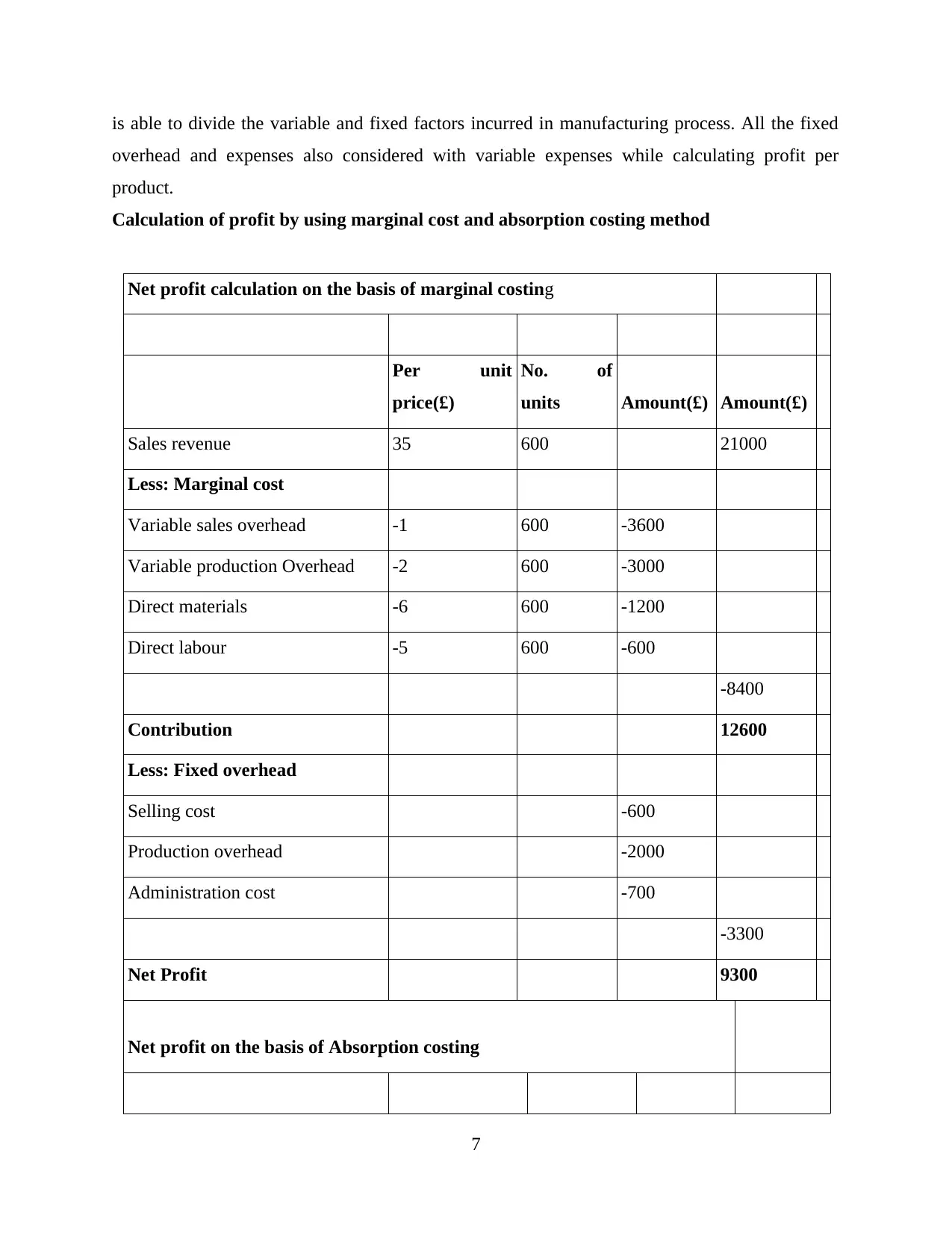
is able to divide the variable and fixed factors incurred in manufacturing process. All the fixed
overhead and expenses also considered with variable expenses while calculating profit per
product.
Calculation of profit by using marginal cost and absorption costing method
Net profit calculation on the basis of marginal costing
Per unit
price(£)
No. of
units Amount(£) Amount(£)
Sales revenue 35 600 21000
Less: Marginal cost
Variable sales overhead -1 600 -3600
Variable production Overhead -2 600 -3000
Direct materials -6 600 -1200
Direct labour -5 600 -600
-8400
Contribution 12600
Less: Fixed overhead
Selling cost -600
Production overhead -2000
Administration cost -700
-3300
Net Profit 9300
Net profit on the basis of Absorption costing
7
overhead and expenses also considered with variable expenses while calculating profit per
product.
Calculation of profit by using marginal cost and absorption costing method
Net profit calculation on the basis of marginal costing
Per unit
price(£)
No. of
units Amount(£) Amount(£)
Sales revenue 35 600 21000
Less: Marginal cost
Variable sales overhead -1 600 -3600
Variable production Overhead -2 600 -3000
Direct materials -6 600 -1200
Direct labour -5 600 -600
-8400
Contribution 12600
Less: Fixed overhead
Selling cost -600
Production overhead -2000
Administration cost -700
-3300
Net Profit 9300
Net profit on the basis of Absorption costing
7
⊘ This is a preview!⊘
Do you want full access?
Subscribe today to unlock all pages.
Trusted by 1+ million students worldwide
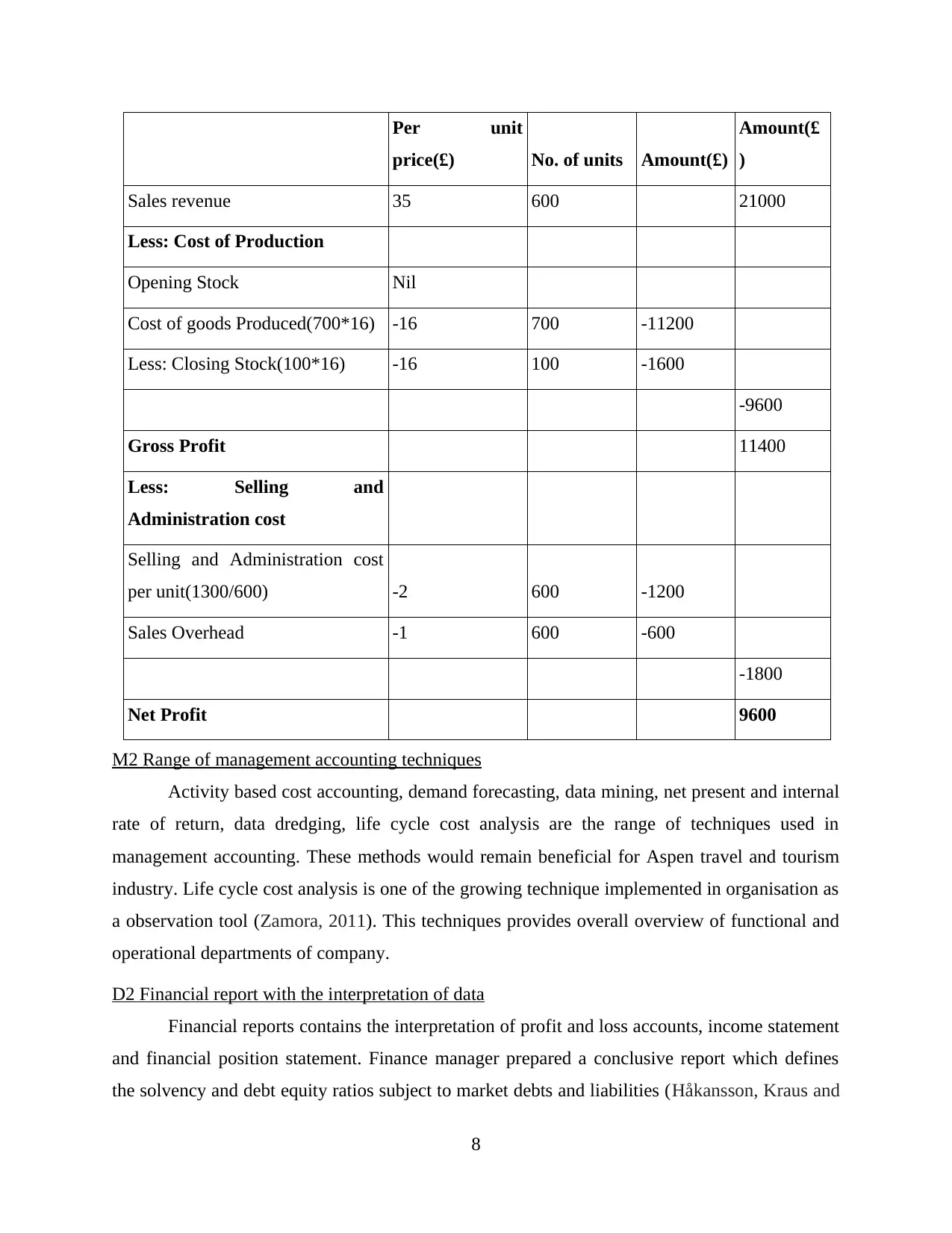
Per unit
price(£) No. of units Amount(£)
Amount(£
)
Sales revenue 35 600 21000
Less: Cost of Production
Opening Stock Nil
Cost of goods Produced(700*16) -16 700 -11200
Less: Closing Stock(100*16) -16 100 -1600
-9600
Gross Profit 11400
Less: Selling and
Administration cost
Selling and Administration cost
per unit(1300/600) -2 600 -1200
Sales Overhead -1 600 -600
-1800
Net Profit 9600
M2 Range of management accounting techniques
Activity based cost accounting, demand forecasting, data mining, net present and internal
rate of return, data dredging, life cycle cost analysis are the range of techniques used in
management accounting. These methods would remain beneficial for Aspen travel and tourism
industry. Life cycle cost analysis is one of the growing technique implemented in organisation as
a observation tool (Zamora, 2011). This techniques provides overall overview of functional and
operational departments of company.
D2 Financial report with the interpretation of data
Financial reports contains the interpretation of profit and loss accounts, income statement
and financial position statement. Finance manager prepared a conclusive report which defines
the solvency and debt equity ratios subject to market debts and liabilities (Håkansson, Kraus and
8
price(£) No. of units Amount(£)
Amount(£
)
Sales revenue 35 600 21000
Less: Cost of Production
Opening Stock Nil
Cost of goods Produced(700*16) -16 700 -11200
Less: Closing Stock(100*16) -16 100 -1600
-9600
Gross Profit 11400
Less: Selling and
Administration cost
Selling and Administration cost
per unit(1300/600) -2 600 -1200
Sales Overhead -1 600 -600
-1800
Net Profit 9600
M2 Range of management accounting techniques
Activity based cost accounting, demand forecasting, data mining, net present and internal
rate of return, data dredging, life cycle cost analysis are the range of techniques used in
management accounting. These methods would remain beneficial for Aspen travel and tourism
industry. Life cycle cost analysis is one of the growing technique implemented in organisation as
a observation tool (Zamora, 2011). This techniques provides overall overview of functional and
operational departments of company.
D2 Financial report with the interpretation of data
Financial reports contains the interpretation of profit and loss accounts, income statement
and financial position statement. Finance manager prepared a conclusive report which defines
the solvency and debt equity ratios subject to market debts and liabilities (Håkansson, Kraus and
8
Paraphrase This Document
Need a fresh take? Get an instant paraphrase of this document with our AI Paraphraser
Lind, eds., 2010). This report also published in annual reports and remain helpful for
shareholders, stakeholders and investors.
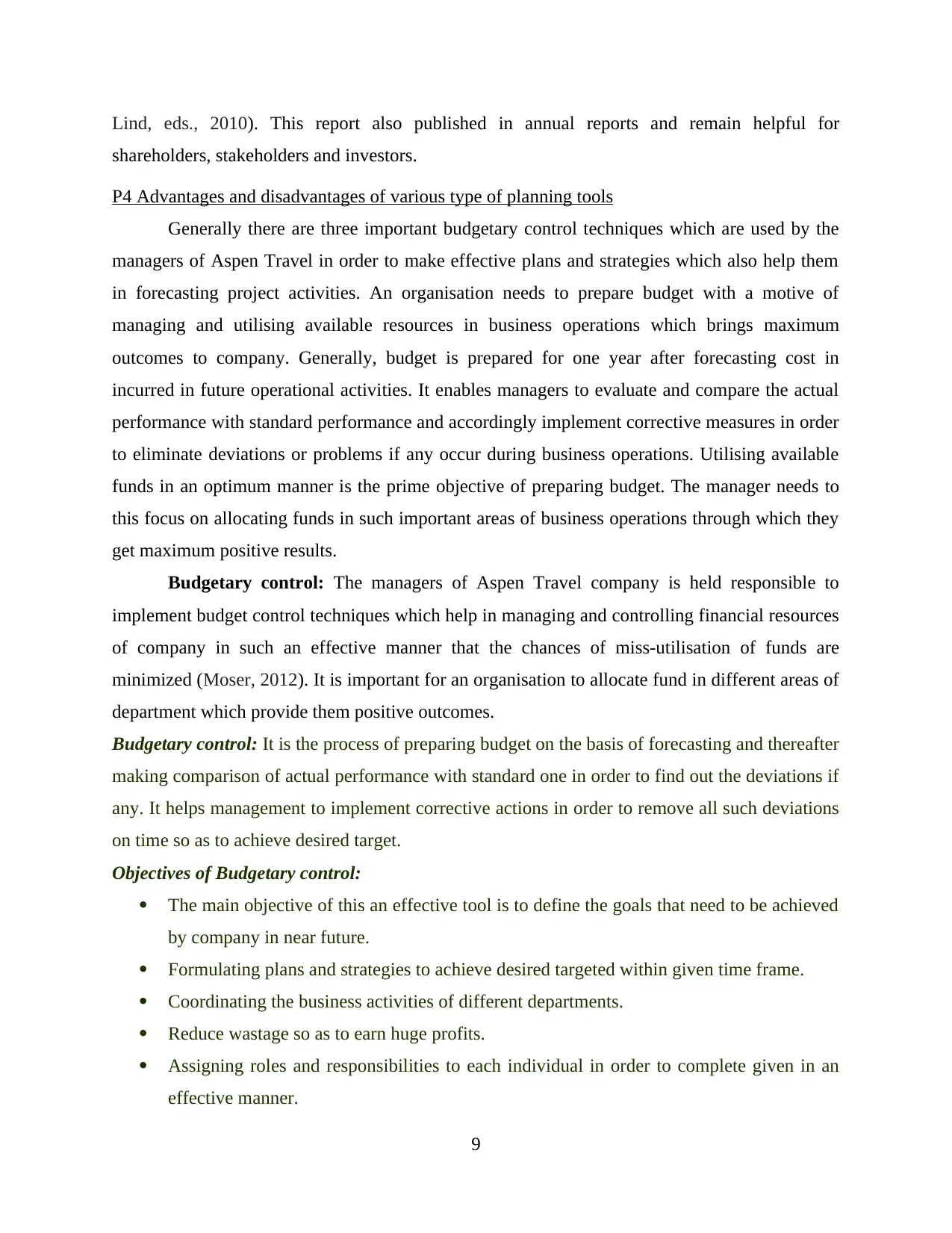
P4 Advantages and disadvantages of various type of planning tools
Generally there are three important budgetary control techniques which are used by the
managers of Aspen Travel in order to make effective plans and strategies which also help them
in forecasting project activities. An organisation needs to prepare budget with a motive of
managing and utilising available resources in business operations which brings maximum
outcomes to company. Generally, budget is prepared for one year after forecasting cost in
incurred in future operational activities. It enables managers to evaluate and compare the actual
performance with standard performance and accordingly implement corrective measures in order
to eliminate deviations or problems if any occur during business operations. Utilising available
funds in an optimum manner is the prime objective of preparing budget. The manager needs to
this focus on allocating funds in such important areas of business operations through which they
get maximum positive results.
Budgetary control: The managers of Aspen Travel company is held responsible to
implement budget control techniques which help in managing and controlling financial resources
of company in such an effective manner that the chances of miss-utilisation of funds are
minimized (Moser, 2012). It is important for an organisation to allocate fund in different areas of
department which provide them positive outcomes.
Budgetary control: It is the process of preparing budget on the basis of forecasting and thereafter
making comparison of actual performance with standard one in order to find out the deviations if
any. It helps management to implement corrective actions in order to remove all such deviations
on time so as to achieve desired target.
Objectives of Budgetary control:
The main objective of this an effective tool is to define the goals that need to be achieved
by company in near future.
Formulating plans and strategies to achieve desired targeted within given time frame.
Coordinating the business activities of different departments.
Reduce wastage so as to earn huge profits.
Assigning roles and responsibilities to each individual in order to complete given in an
effective manner.
9
shareholders, stakeholders and investors.
P4 Advantages and disadvantages of various type of planning tools
Generally there are three important budgetary control techniques which are used by the
managers of Aspen Travel in order to make effective plans and strategies which also help them
in forecasting project activities. An organisation needs to prepare budget with a motive of
managing and utilising available resources in business operations which brings maximum
outcomes to company. Generally, budget is prepared for one year after forecasting cost in
incurred in future operational activities. It enables managers to evaluate and compare the actual
performance with standard performance and accordingly implement corrective measures in order
to eliminate deviations or problems if any occur during business operations. Utilising available
funds in an optimum manner is the prime objective of preparing budget. The manager needs to
this focus on allocating funds in such important areas of business operations through which they
get maximum positive results.
Budgetary control: The managers of Aspen Travel company is held responsible to
implement budget control techniques which help in managing and controlling financial resources
of company in such an effective manner that the chances of miss-utilisation of funds are
minimized (Moser, 2012). It is important for an organisation to allocate fund in different areas of
department which provide them positive outcomes.
Budgetary control: It is the process of preparing budget on the basis of forecasting and thereafter
making comparison of actual performance with standard one in order to find out the deviations if
any. It helps management to implement corrective actions in order to remove all such deviations
on time so as to achieve desired target.
Objectives of Budgetary control:
The main objective of this an effective tool is to define the goals that need to be achieved
by company in near future.
Formulating plans and strategies to achieve desired targeted within given time frame.
Coordinating the business activities of different departments.
Reduce wastage so as to earn huge profits.
Assigning roles and responsibilities to each individual in order to complete given in an
effective manner.
9
It also focuses on correcting variances from set standards and also concentrate on
centralising the control system.
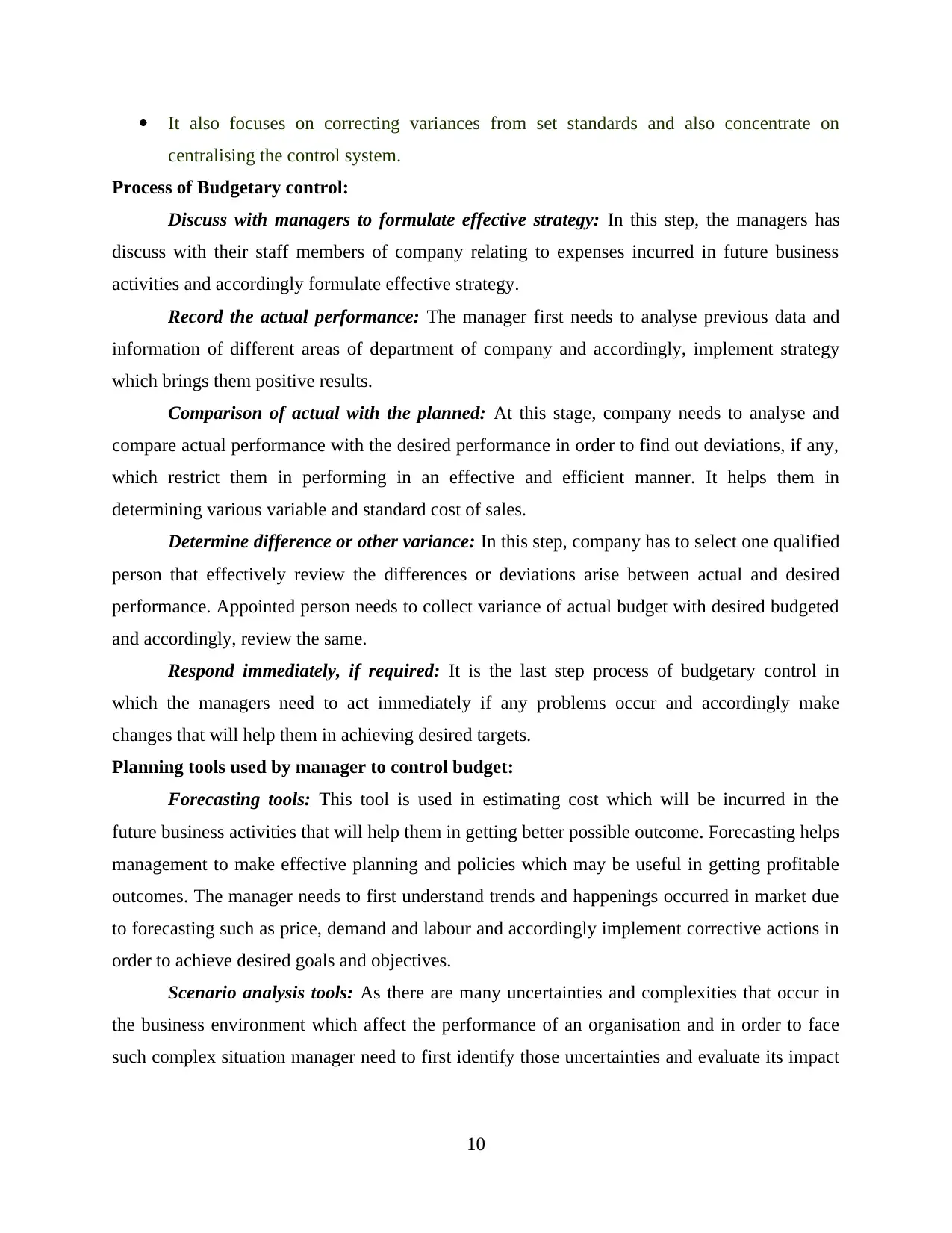
Process of Budgetary control:
Discuss with managers to formulate effective strategy: In this step, the managers has
discuss with their staff members of company relating to expenses incurred in future business
activities and accordingly formulate effective strategy.
Record the actual performance: The manager first needs to analyse previous data and
information of different areas of department of company and accordingly, implement strategy
which brings them positive results.
Comparison of actual with the planned: At this stage, company needs to analyse and
compare actual performance with the desired performance in order to find out deviations, if any,
which restrict them in performing in an effective and efficient manner. It helps them in
determining various variable and standard cost of sales.
Determine difference or other variance: In this step, company has to select one qualified
person that effectively review the differences or deviations arise between actual and desired
performance. Appointed person needs to collect variance of actual budget with desired budgeted
and accordingly, review the same.
Respond immediately, if required: It is the last step process of budgetary control in
which the managers need to act immediately if any problems occur and accordingly make
changes that will help them in achieving desired targets.
Planning tools used by manager to control budget:
Forecasting tools: This tool is used in estimating cost which will be incurred in the
future business activities that will help them in getting better possible outcome. Forecasting helps
management to make effective planning and policies which may be useful in getting profitable
outcomes. The manager needs to first understand trends and happenings occurred in market due
to forecasting such as price, demand and labour and accordingly implement corrective actions in
order to achieve desired goals and objectives.
Scenario analysis tools: As there are many uncertainties and complexities that occur in
the business environment which affect the performance of an organisation and in order to face
such complex situation manager need to first identify those uncertainties and evaluate its impact
10
centralising the control system.
Process of Budgetary control:
Discuss with managers to formulate effective strategy: In this step, the managers has
discuss with their staff members of company relating to expenses incurred in future business
activities and accordingly formulate effective strategy.
Record the actual performance: The manager first needs to analyse previous data and
information of different areas of department of company and accordingly, implement strategy
which brings them positive results.
Comparison of actual with the planned: At this stage, company needs to analyse and
compare actual performance with the desired performance in order to find out deviations, if any,
which restrict them in performing in an effective and efficient manner. It helps them in
determining various variable and standard cost of sales.
Determine difference or other variance: In this step, company has to select one qualified
person that effectively review the differences or deviations arise between actual and desired
performance. Appointed person needs to collect variance of actual budget with desired budgeted
and accordingly, review the same.
Respond immediately, if required: It is the last step process of budgetary control in
which the managers need to act immediately if any problems occur and accordingly make
changes that will help them in achieving desired targets.
Planning tools used by manager to control budget:
Forecasting tools: This tool is used in estimating cost which will be incurred in the
future business activities that will help them in getting better possible outcome. Forecasting helps
management to make effective planning and policies which may be useful in getting profitable
outcomes. The manager needs to first understand trends and happenings occurred in market due
to forecasting such as price, demand and labour and accordingly implement corrective actions in
order to achieve desired goals and objectives.
Scenario analysis tools: As there are many uncertainties and complexities that occur in
the business environment which affect the performance of an organisation and in order to face
such complex situation manager need to first identify those uncertainties and evaluate its impact
10
⊘ This is a preview!⊘
Do you want full access?
Subscribe today to unlock all pages.
Trusted by 1+ million students worldwide

1 out of 16


Related Documents


Your All-in-One AI-Powered Toolkit for Academic Success.
+13062052269
info@desklib.com
Available 24*7 on WhatsApp / Email
![[object Object]](/_next/static/media/star-bottom.7253800d.svg)
Unlock your academic potential
Copyright © 2020–2026 A2Z Services. All Rights Reserved. Developed and managed by ZUCOL.