Comprehensive Management Accounting Report: Techniques and Analysis
VerifiedAdded on 2022/12/26
|26
|4956
|78
Report
AI Summary
This report provides a detailed overview of management accounting principles and techniques. It explores various aspects, including managerial accounting, inventory management systems, job costing, and price optimization. The report delves into the application of absorption costing and marginal costing, along with the preparation of income statements and financial reporting documents. Budgeting, including flexible budget preparation, is also discussed. Furthermore, the report analyzes the integration of management accounting systems and their significance for organizational success, emphasizing the importance of variance analysis and its types. The report uses financial reporting documents to evaluate data for business activities and the formulation of marginal costing techniques. It also discusses the purpose of a budget, budget preparation, and the comparison of organizations in response to financial problems using management accounting.
MANAGEMENT
ACCOUNTING
ACCOUNTING

Paraphrase This Document
Need a fresh take? Get an instant paraphrase of this document with our AI Paraphraser
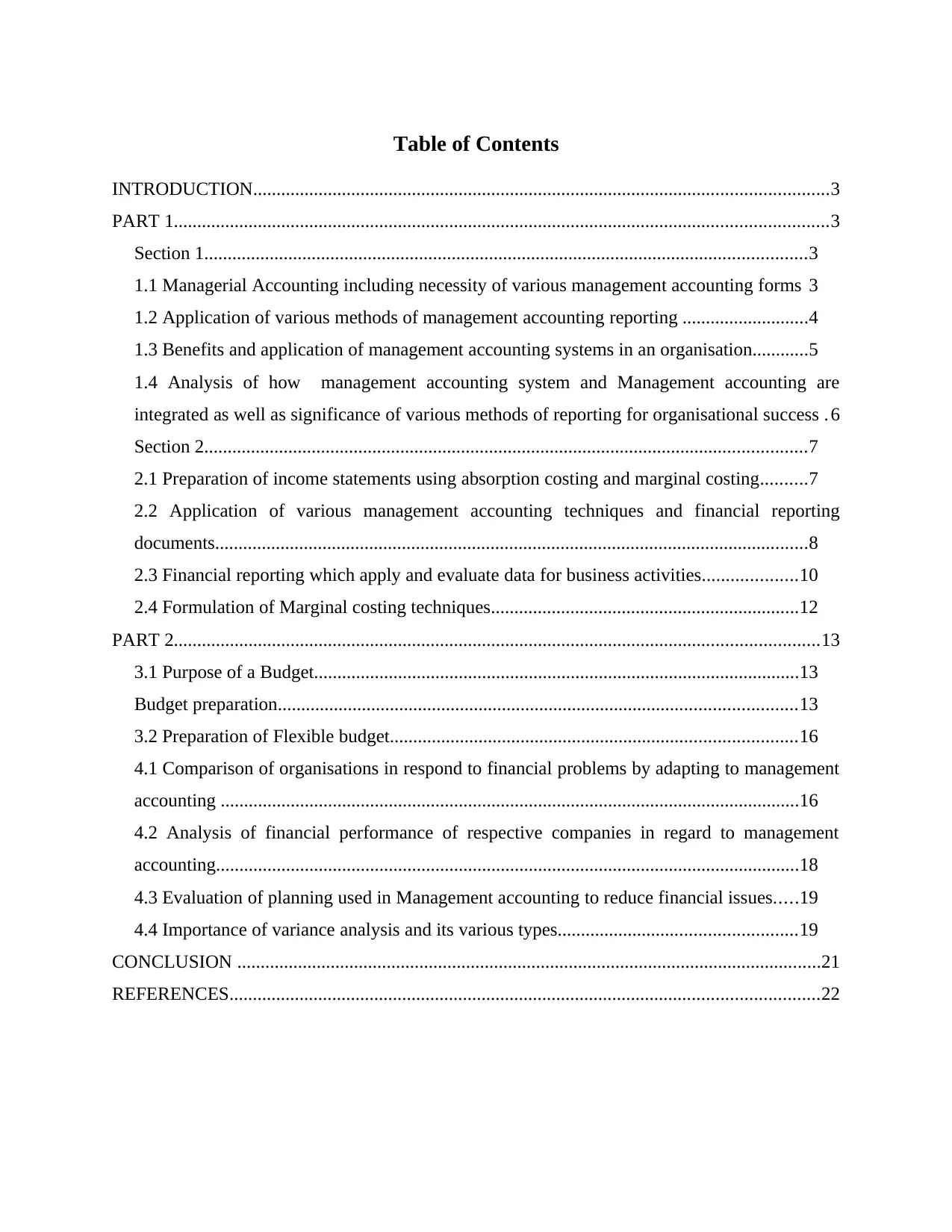
Table of Contents
INTRODUCTION...........................................................................................................................3
PART 1............................................................................................................................................3
Section 1.................................................................................................................................3
1.1 Managerial Accounting including necessity of various management accounting forms 3
1.2 Application of various methods of management accounting reporting ...........................4
1.3 Benefits and application of management accounting systems in an organisation............5
1.4 Analysis of how management accounting system and Management accounting are
integrated as well as significance of various methods of reporting for organisational success . 6
Section 2.................................................................................................................................7
2.1 Preparation of income statements using absorption costing and marginal costing..........7
2.2 Application of various management accounting techniques and financial reporting
documents...............................................................................................................................8
2.3 Financial reporting which apply and evaluate data for business activities....................10
2.4 Formulation of Marginal costing techniques..................................................................12
PART 2..........................................................................................................................................13
3.1 Purpose of a Budget........................................................................................................13
Budget preparation...............................................................................................................13
3.2 Preparation of Flexible budget.......................................................................................16
4.1 Comparison of organisations in respond to financial problems by adapting to management
accounting ............................................................................................................................16
4.2 Analysis of financial performance of respective companies in regard to management
accounting.............................................................................................................................18
4.3 Evaluation of planning used in Management accounting to reduce financial issues.....19
4.4 Importance of variance analysis and its various types...................................................19
CONCLUSION .............................................................................................................................21
REFERENCES..............................................................................................................................22
INTRODUCTION...........................................................................................................................3
PART 1............................................................................................................................................3
Section 1.................................................................................................................................3
1.1 Managerial Accounting including necessity of various management accounting forms 3
1.2 Application of various methods of management accounting reporting ...........................4
1.3 Benefits and application of management accounting systems in an organisation............5
1.4 Analysis of how management accounting system and Management accounting are
integrated as well as significance of various methods of reporting for organisational success . 6
Section 2.................................................................................................................................7
2.1 Preparation of income statements using absorption costing and marginal costing..........7
2.2 Application of various management accounting techniques and financial reporting
documents...............................................................................................................................8
2.3 Financial reporting which apply and evaluate data for business activities....................10
2.4 Formulation of Marginal costing techniques..................................................................12
PART 2..........................................................................................................................................13
3.1 Purpose of a Budget........................................................................................................13
Budget preparation...............................................................................................................13
3.2 Preparation of Flexible budget.......................................................................................16
4.1 Comparison of organisations in respond to financial problems by adapting to management
accounting ............................................................................................................................16
4.2 Analysis of financial performance of respective companies in regard to management
accounting.............................................................................................................................18
4.3 Evaluation of planning used in Management accounting to reduce financial issues.....19
4.4 Importance of variance analysis and its various types...................................................19
CONCLUSION .............................................................................................................................21
REFERENCES..............................................................................................................................22
INTRODUCTION
Management accounting is a wide concept which covers preparation of different forms of
statements in relevance to managerial decision-making. It is usually utilised by internal staff in
order to evaluate financial information for preparation of reports which will ultimately help in
decision making. In this report, several factors of management accounting will be used in order
to evaluate financial position of company. These factors will include inventory management
system, marginal costing, absorption costing, fixed and variable costs, etc. Such statements will
ultimately help manager in decision-making which is significant for organisational growth and
success in the long term.
PART 1
Section 1
1.1 Managerial Accounting including necessity of various management accounting forms
Management accounting is defined as procedure where financial data is being provided to
the managers so that optimum decision-making can be made for respective organisation. It is
ultimate determination, measurement, aggregation, analysis, formulation and communication of
financial data which will assist in satisfaction of organisational objectives. Managerial
accounting has various aspects of finance which intent to improve quality of data which is being
delivered to management in regard to business operations (Kyriakopoulos and et. al., 2020). This
is mainly centralized at internal management reporting in context to produce decisions by
managers.
Managerial management mostly concerned with budgeting of weekly or monthly data in
order to analyse actual efficiency and effectiveness of company's respective operations which
will aid managers in decision-making. In case of high competitive environment, usually business
entity is required to cope with its competitors in order to sustain in the market for long period.
Therefore it emphasises over future aspects of a business which needs to be pre-determined
through preparation of strategic plans so that company's position and finances stays unaffected in
the market.
Management accounting is a wide concept which covers preparation of different forms of
statements in relevance to managerial decision-making. It is usually utilised by internal staff in
order to evaluate financial information for preparation of reports which will ultimately help in
decision making. In this report, several factors of management accounting will be used in order
to evaluate financial position of company. These factors will include inventory management
system, marginal costing, absorption costing, fixed and variable costs, etc. Such statements will
ultimately help manager in decision-making which is significant for organisational growth and
success in the long term.
PART 1
Section 1
1.1 Managerial Accounting including necessity of various management accounting forms
Management accounting is defined as procedure where financial data is being provided to
the managers so that optimum decision-making can be made for respective organisation. It is
ultimate determination, measurement, aggregation, analysis, formulation and communication of
financial data which will assist in satisfaction of organisational objectives. Managerial
accounting has various aspects of finance which intent to improve quality of data which is being
delivered to management in regard to business operations (Kyriakopoulos and et. al., 2020). This
is mainly centralized at internal management reporting in context to produce decisions by
managers.
Managerial management mostly concerned with budgeting of weekly or monthly data in
order to analyse actual efficiency and effectiveness of company's respective operations which
will aid managers in decision-making. In case of high competitive environment, usually business
entity is required to cope with its competitors in order to sustain in the market for long period.
Therefore it emphasises over future aspects of a business which needs to be pre-determined
through preparation of strategic plans so that company's position and finances stays unaffected in
the market.
⊘ This is a preview!⊘
Do you want full access?
Subscribe today to unlock all pages.

Trusted by 1+ million students worldwide
1.2 Application of various methods of management accounting reporting
Management accounting is an effective branch of finance which include flow of decisions
on basis identification, evaluation and communication of produced financial information by
management (Ardiansah and Anisykurlillah, 2020). This financial data is being prepared through
implementation of various management accounting techniques which can be stated as follows:
Inventory management system: It is considered as significant part of management
accounting which is used to keep track of inventory in entire supply chain system. It starts from
purchases of raw material, manufacturing, production of finished goods and ultimately sale of
feasible products. It is convenient approach which helps in overall management of goods from
initial stage till its ultimate sale. This system is helpful for business organisation in order to
achieve its pre-determined profitability in a systematic manner. In this approach various sub
factors are included such as First in first out(FIFO), Last in first out(LIFO) and average cost
method. These methods can be described as follows:
FIFO: This is relevant flow of inventory from initial stage till its final delivery. In this
process, product which is produced first will be first one to be delivered or sold out.
LIFO: This system is connected with the current rate of particular product. It considers
current purchase unit to be sold first which is vice versa of LIFO method.
AVCO: This is unique system of inventory management where average of all inventories
are being calculated in order to reach average cost of per unit of inventory.
Job costing System: This is unit of management accounting where costing method is
used to ascertain cost of specific job or unit in an organisation which is being performed for
ultimate satisfaction of consumers. Through this procedure, value of each individual unit is being
measured so that their respective profits and losses are identified in order to modify effectiveness
and efficiency of operations as per the requirement. It is used to record individual cost to its
particular head in order to reveal relevant profitability so that it could be compared with
budgeted estimates. This way accuracy of jobs can be maintained and necessary modification
could be made in regard to future requirements. Timely records, internal controls, detection of
frauds and errors are also its relevant outcomes which plays significant role in organisational
growth (Schaltegger, 2020). Several documents being in job order costing are manufacturing
order, cost sheet, payrolls, etc. Also it provides detailed structure of material, labour and
overheads costs for each individual job.
Management accounting is an effective branch of finance which include flow of decisions
on basis identification, evaluation and communication of produced financial information by
management (Ardiansah and Anisykurlillah, 2020). This financial data is being prepared through
implementation of various management accounting techniques which can be stated as follows:
Inventory management system: It is considered as significant part of management
accounting which is used to keep track of inventory in entire supply chain system. It starts from
purchases of raw material, manufacturing, production of finished goods and ultimately sale of
feasible products. It is convenient approach which helps in overall management of goods from
initial stage till its ultimate sale. This system is helpful for business organisation in order to
achieve its pre-determined profitability in a systematic manner. In this approach various sub
factors are included such as First in first out(FIFO), Last in first out(LIFO) and average cost
method. These methods can be described as follows:
FIFO: This is relevant flow of inventory from initial stage till its final delivery. In this
process, product which is produced first will be first one to be delivered or sold out.
LIFO: This system is connected with the current rate of particular product. It considers
current purchase unit to be sold first which is vice versa of LIFO method.
AVCO: This is unique system of inventory management where average of all inventories
are being calculated in order to reach average cost of per unit of inventory.
Job costing System: This is unit of management accounting where costing method is
used to ascertain cost of specific job or unit in an organisation which is being performed for
ultimate satisfaction of consumers. Through this procedure, value of each individual unit is being
measured so that their respective profits and losses are identified in order to modify effectiveness
and efficiency of operations as per the requirement. It is used to record individual cost to its
particular head in order to reveal relevant profitability so that it could be compared with
budgeted estimates. This way accuracy of jobs can be maintained and necessary modification
could be made in regard to future requirements. Timely records, internal controls, detection of
frauds and errors are also its relevant outcomes which plays significant role in organisational
growth (Schaltegger, 2020). Several documents being in job order costing are manufacturing
order, cost sheet, payrolls, etc. Also it provides detailed structure of material, labour and
overheads costs for each individual job.
Paraphrase This Document
Need a fresh take? Get an instant paraphrase of this document with our AI Paraphraser
Though it has various advantages, it is expensive approach which mandate elaborated
clerical job which may reflect certain errors due to increased and detailed work. This system
required effective operating structure without which its formulation is of no use. Also it uses
historical approach of cost determination which may not reflect actual costs.
Price optimization System: It refers to a mathematical tool which is used to identify
customer's response in regard to differing prices for receptive goods and services by various
channels (Tirkolaee and et. al., 2020). By analysing market trends, it becomes easier for a
company to conclude best suitable price for their respective products and services that will
enhance their profitability and to meet organisational objectives in the long term. Useful data in
such system is collected through market surveys, related inventories, sales, operating costs and
so on. Such data is used to analyse behaviour of customer base in regard to various goods &
services. Price-optimization technique is helpful in the long term for increasing company's
overall profitability. It includes various data such as raw data, leveraged data, etc. It signifies
relevant variables which actually affect price of a particular product and service which could lead
to affected sales, production and profitability.
1.3 Benefits and application of management accounting systems in an organisation
Inventory management System: This process is helpful by reducing inaccuracies in its
relevant operations which will result in enhanced productivity. Through adoption of such
approach, more emphasis is given over the cost of a product in order to promote cost effective
procedures (Alam and et. al., 2019). By reduction of inaccuracies and cost, company will be able
to earn maximum profits in the long term.
Such system is being adopted by production, retail, warehouses based companies in order
to maintain their respective goods in more effective manner. This procedure helps organisations
to implement systematic approach towards management of their inventories in order to avoid any
deviations, errors and frauds which could result in intense losses.
Job costing System: This system assists in producing adequate level of profits through
allotment of respective cost to their jobs. This way performance could be modified as per the
requirement of company. It is also considered as flexible approach and accuracy if maintained
through screening each task appropriately (Chamberlin and et. al., 2018).
clerical job which may reflect certain errors due to increased and detailed work. This system
required effective operating structure without which its formulation is of no use. Also it uses
historical approach of cost determination which may not reflect actual costs.
Price optimization System: It refers to a mathematical tool which is used to identify
customer's response in regard to differing prices for receptive goods and services by various
channels (Tirkolaee and et. al., 2020). By analysing market trends, it becomes easier for a
company to conclude best suitable price for their respective products and services that will
enhance their profitability and to meet organisational objectives in the long term. Useful data in
such system is collected through market surveys, related inventories, sales, operating costs and
so on. Such data is used to analyse behaviour of customer base in regard to various goods &
services. Price-optimization technique is helpful in the long term for increasing company's
overall profitability. It includes various data such as raw data, leveraged data, etc. It signifies
relevant variables which actually affect price of a particular product and service which could lead
to affected sales, production and profitability.
1.3 Benefits and application of management accounting systems in an organisation
Inventory management System: This process is helpful by reducing inaccuracies in its
relevant operations which will result in enhanced productivity. Through adoption of such
approach, more emphasis is given over the cost of a product in order to promote cost effective
procedures (Alam and et. al., 2019). By reduction of inaccuracies and cost, company will be able
to earn maximum profits in the long term.
Such system is being adopted by production, retail, warehouses based companies in order
to maintain their respective goods in more effective manner. This procedure helps organisations
to implement systematic approach towards management of their inventories in order to avoid any
deviations, errors and frauds which could result in intense losses.
Job costing System: This system assists in producing adequate level of profits through
allotment of respective cost to their jobs. This way performance could be modified as per the
requirement of company. It is also considered as flexible approach and accuracy if maintained
through screening each task appropriately (Chamberlin and et. al., 2018).
This system is used by various organisations in order to know that respective profits and
losses being reflected by different heads so that required modifications could be made in such
respect by the company.
Price optimization System: This is a beneficial system which helps to understand
customer's behaviour in reference to various products and services in the marketplace (Pagel and
Westerfelhaus, 2019). It helps in price regulation and controlling price based decisions in regard
to each product category. In sort of approach, company's are required to conduct market survey
in order to understand customer's needs and preferences in order to deliver potential results.
This approach is adopted by each company being operating in market in order to identify
impact of prices over consumer behaviour. Companies needs to formulate such policies
effectively in order to generate maximum profits and sustainability in the market (Muller, 2019).
1.4 Analysis of how management accounting system and Management accounting are integrated
as well as significance of various methods of reporting for organisational success
Management accounting comprises of significant systems which is a base of effective
managerial decision-making (Bakhodirovna, 2019). Such techniques are used in various
operations of an organisation in order to produce effective outcomes. Management accounting
systems is an integral part of management accounting which provides detailed structure of
manner in which operations of a company is being carried away in order to produce effective
decisions. Manager of an organisation plays key role decision-making by evaluating respective
various reports in this concern. These reports can be discussed as follows:
Budget report: Budget is an intrinsic report which is used by management in order to
compare estimated projections with actual performance of a company. It is significant practice
being formulated by companies in order to measure company's overall financial and non-
financial performance (Selvakumar and et. al., 2019). Its is key element in managerial decisions
which are being guided through budgets in regard to cost- effectiveness, optimum incentives,
cope with contingencies, modification in policies related to supply and purchase and so on.
Various forms of budgets such as production budget, master budget, operating budget are used
considering company's relevant activities in this regard. This reflects summary of each
department related costing to make better evaluation of individual performance in order to
produce optimum profits.
losses being reflected by different heads so that required modifications could be made in such
respect by the company.
Price optimization System: This is a beneficial system which helps to understand
customer's behaviour in reference to various products and services in the marketplace (Pagel and
Westerfelhaus, 2019). It helps in price regulation and controlling price based decisions in regard
to each product category. In sort of approach, company's are required to conduct market survey
in order to understand customer's needs and preferences in order to deliver potential results.
This approach is adopted by each company being operating in market in order to identify
impact of prices over consumer behaviour. Companies needs to formulate such policies
effectively in order to generate maximum profits and sustainability in the market (Muller, 2019).
1.4 Analysis of how management accounting system and Management accounting are integrated
as well as significance of various methods of reporting for organisational success
Management accounting comprises of significant systems which is a base of effective
managerial decision-making (Bakhodirovna, 2019). Such techniques are used in various
operations of an organisation in order to produce effective outcomes. Management accounting
systems is an integral part of management accounting which provides detailed structure of
manner in which operations of a company is being carried away in order to produce effective
decisions. Manager of an organisation plays key role decision-making by evaluating respective
various reports in this concern. These reports can be discussed as follows:
Budget report: Budget is an intrinsic report which is used by management in order to
compare estimated projections with actual performance of a company. It is significant practice
being formulated by companies in order to measure company's overall financial and non-
financial performance (Selvakumar and et. al., 2019). Its is key element in managerial decisions
which are being guided through budgets in regard to cost- effectiveness, optimum incentives,
cope with contingencies, modification in policies related to supply and purchase and so on.
Various forms of budgets such as production budget, master budget, operating budget are used
considering company's relevant activities in this regard. This reflects summary of each
department related costing to make better evaluation of individual performance in order to
produce optimum profits.
⊘ This is a preview!⊘
Do you want full access?
Subscribe today to unlock all pages.
Trusted by 1+ million students worldwide
Performance report: Performance is an ultimate factor at which company looks up to.
Performance evaluation must be given adequate preference in order to promote overall
sustainability of a company. The performance of a company is been evaluated to conclude a
report in this regard. This report is used by managers of a company to provide required decisions
in overall growth or modification in performance segment. Employees are usually encouraged or
compensated for their respective contribution in company's overall success. It suggests
formulation of accuracy measure in an organisation in order to maintain standard of performance
in an organisation over long period (Brown and et. al., 2017).
Section 2
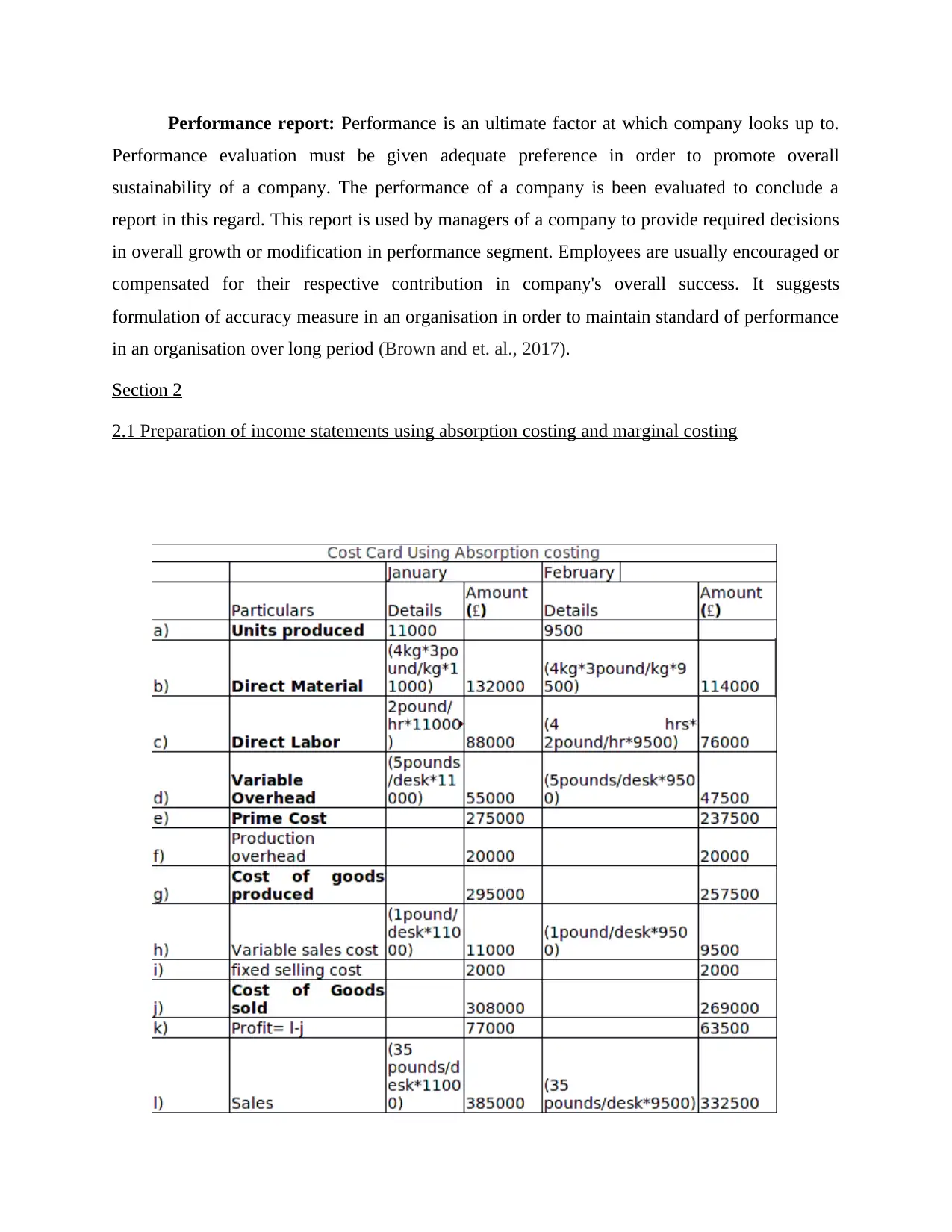
2.1 Preparation of income statements using absorption costing and marginal costing
Performance evaluation must be given adequate preference in order to promote overall
sustainability of a company. The performance of a company is been evaluated to conclude a
report in this regard. This report is used by managers of a company to provide required decisions
in overall growth or modification in performance segment. Employees are usually encouraged or
compensated for their respective contribution in company's overall success. It suggests
formulation of accuracy measure in an organisation in order to maintain standard of performance
in an organisation over long period (Brown and et. al., 2017).
Section 2
2.1 Preparation of income statements using absorption costing and marginal costing
Paraphrase This Document
Need a fresh take? Get an instant paraphrase of this document with our AI Paraphraser
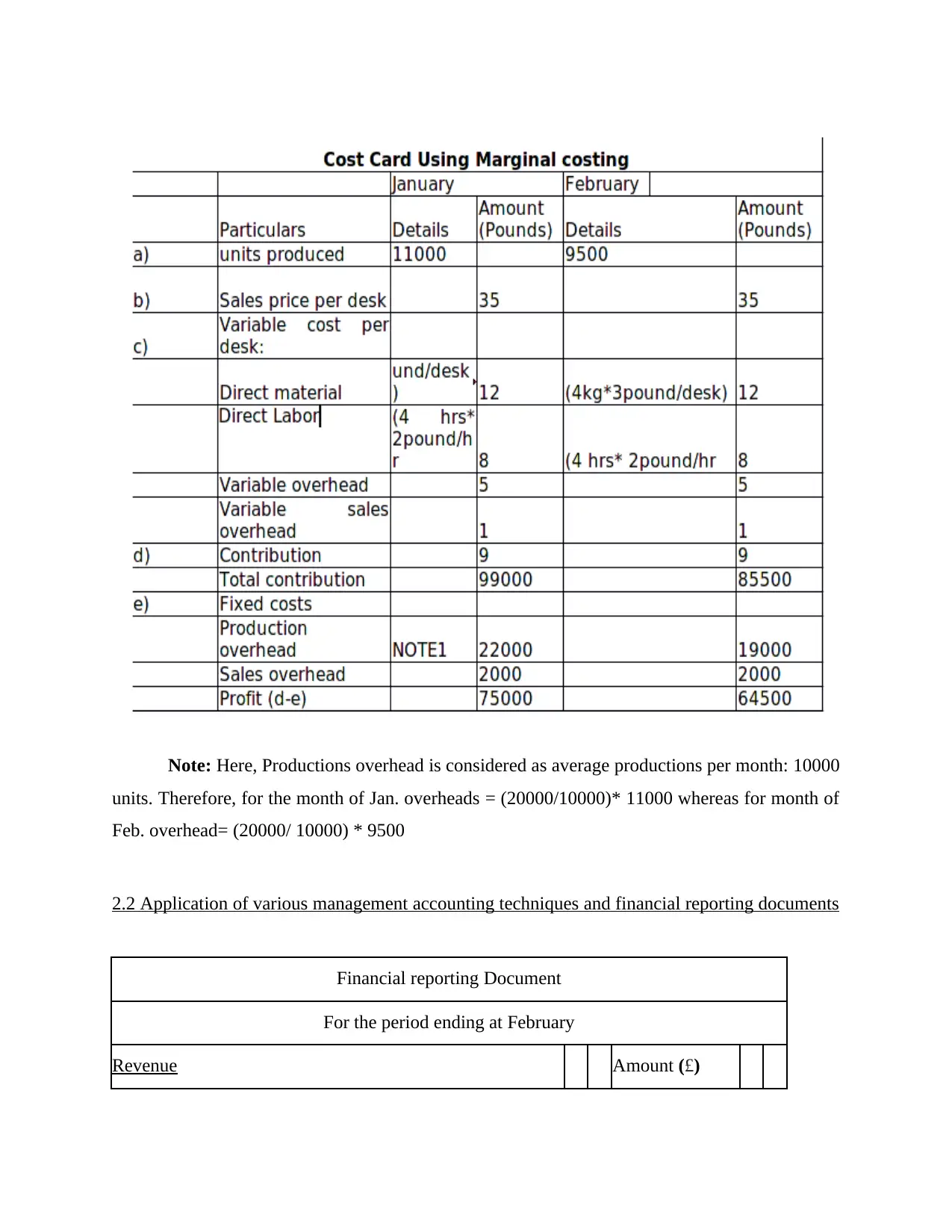
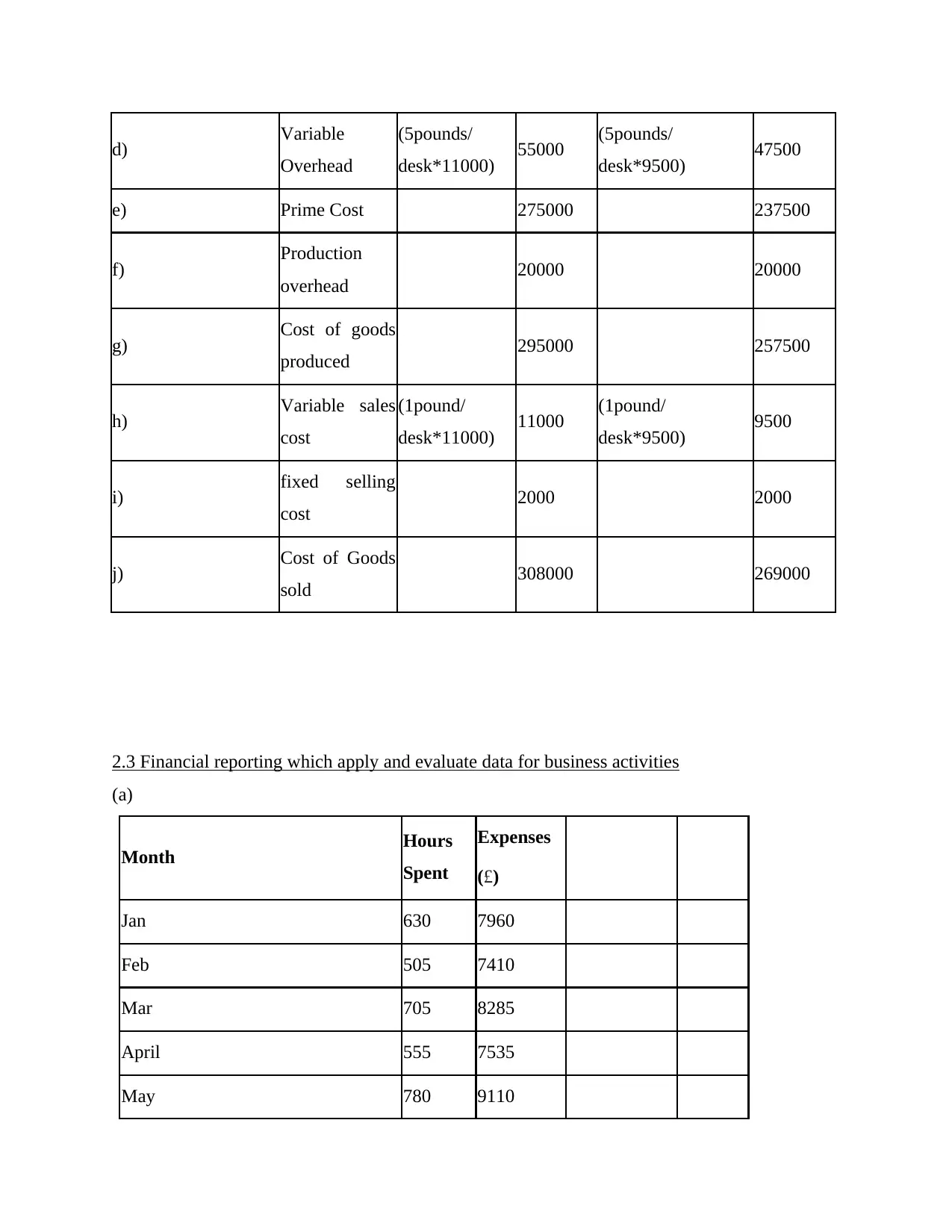
Note: Here, Productions overhead is considered as average productions per month: 10000
units. Therefore, for the month of Jan. overheads = (20000/10000)* 11000 whereas for month of
Feb. overhead= (20000/ 10000) * 9500
2.2 Application of various management accounting techniques and financial reporting documents
Financial reporting Document
For the period ending at February
Revenue Amount (£)
units. Therefore, for the month of Jan. overheads = (20000/10000)* 11000 whereas for month of
Feb. overhead= (20000/ 10000) * 9500
2.2 Application of various management accounting techniques and financial reporting documents
Financial reporting Document
For the period ending at February
Revenue Amount (£)
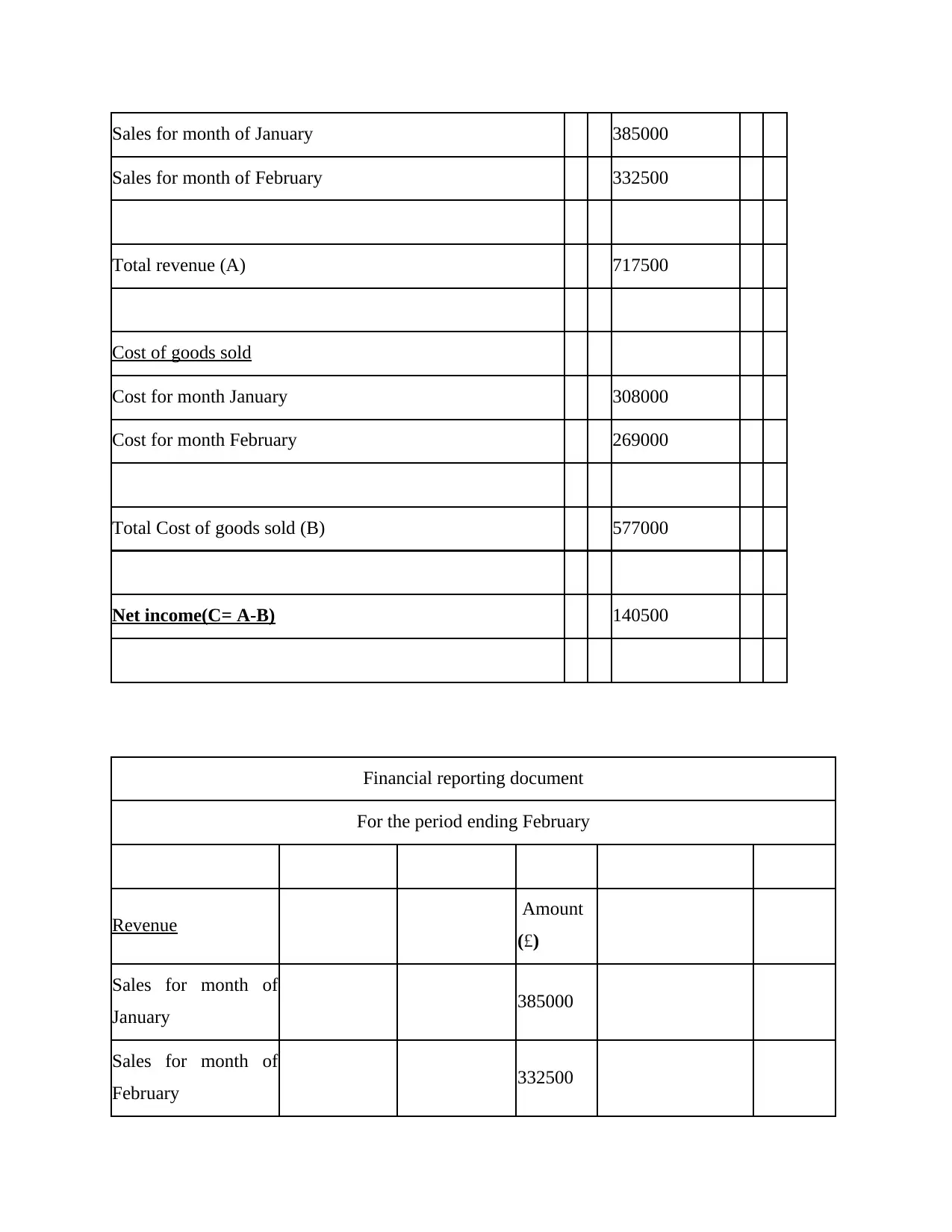
Sales for month of January 385000
Sales for month of February 332500
Total revenue (A) 717500
Cost of goods sold
Cost for month January 308000
Cost for month February 269000
Total Cost of goods sold (B) 577000
Net income(C= A-B) 140500
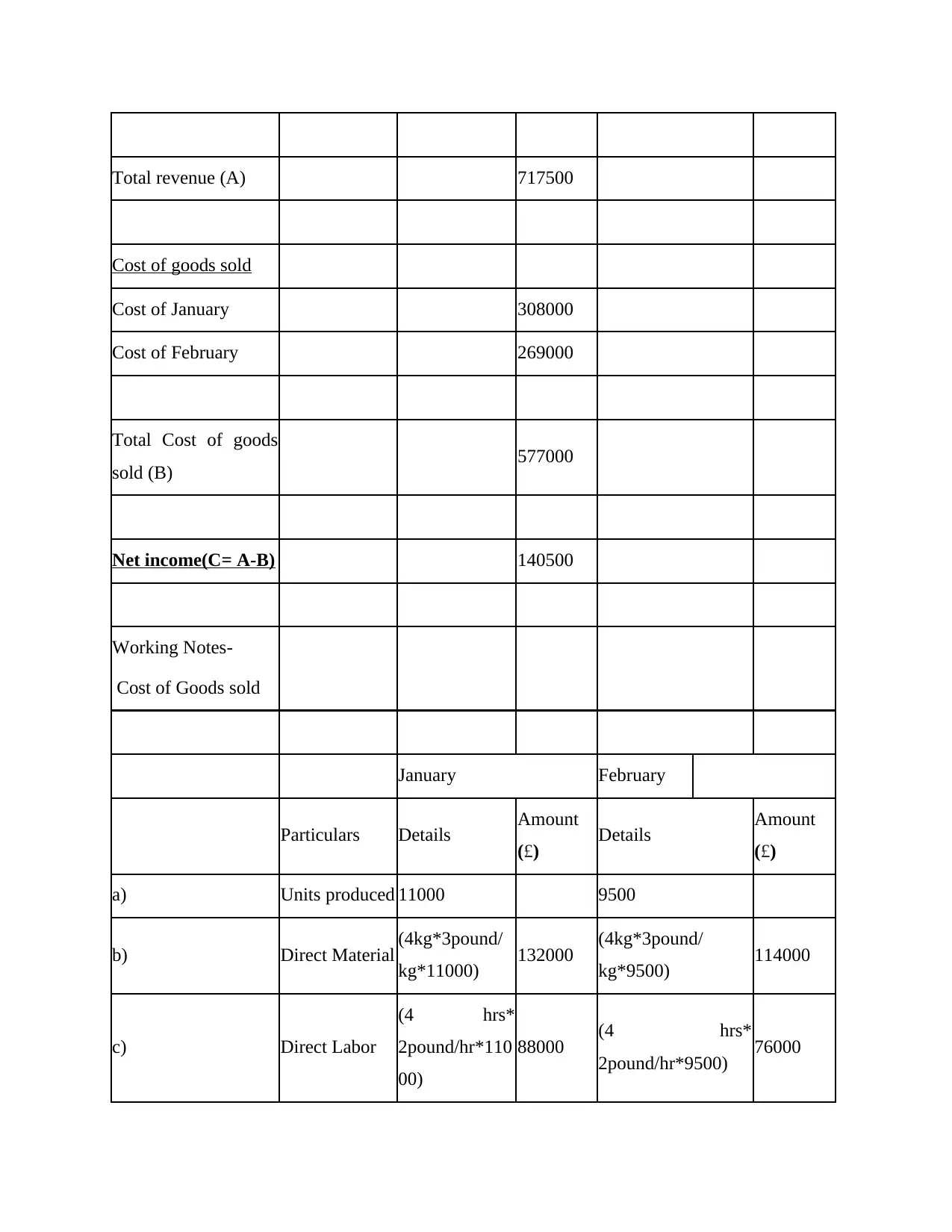
Financial reporting document
For the period ending February
Revenue Amount
(£)
Sales for month of
January 385000
Sales for month of
February 332500
Sales for month of February 332500
Total revenue (A) 717500
Cost of goods sold
Cost for month January 308000
Cost for month February 269000
Total Cost of goods sold (B) 577000
Net income(C= A-B) 140500
Financial reporting document
For the period ending February
Revenue Amount
(£)
Sales for month of
January 385000
Sales for month of
February 332500
⊘ This is a preview!⊘
Do you want full access?
Subscribe today to unlock all pages.
Trusted by 1+ million students worldwide
Total revenue (A) 717500
Cost of goods sold
Cost of January 308000
Cost of February 269000
Total Cost of goods
sold (B) 577000
Net income(C= A-B) 140500
Working Notes-
Cost of Goods sold
January February
Particulars Details Amount
(£) Details Amount
(£)
a) Units produced 11000 9500
b) Direct Material (4kg*3pound/
kg*11000) 132000 (4kg*3pound/
kg*9500) 114000
c) Direct Labor
(4 hrs*
2pound/hr*110
00)
88000 (4 hrs*
2pound/hr*9500) 76000
Cost of goods sold
Cost of January 308000
Cost of February 269000
Total Cost of goods
sold (B) 577000
Net income(C= A-B) 140500
Working Notes-
Cost of Goods sold
January February
Particulars Details Amount
(£) Details Amount
(£)
a) Units produced 11000 9500
b) Direct Material (4kg*3pound/
kg*11000) 132000 (4kg*3pound/
kg*9500) 114000
c) Direct Labor
(4 hrs*
2pound/hr*110
00)
88000 (4 hrs*
2pound/hr*9500) 76000
Paraphrase This Document
Need a fresh take? Get an instant paraphrase of this document with our AI Paraphraser
d) Variable
Overhead
(5pounds/
desk*11000) 55000 (5pounds/
desk*9500) 47500
e) Prime Cost 275000 237500
f) Production
overhead 20000 20000
g) Cost of goods
produced 295000 257500
h) Variable sales
cost
(1pound/
desk*11000) 11000 (1pound/
desk*9500) 9500
i) fixed selling
cost 2000 2000
j) Cost of Goods
sold 308000 269000
2.3 Financial reporting which apply and evaluate data for business activities
(a)
Month Hours
Spent
Expenses
(£)
Jan 630 7960
Feb 505 7410
Mar 705 8285
April 555 7535
May 780 9110
Overhead
(5pounds/
desk*11000) 55000 (5pounds/
desk*9500) 47500
e) Prime Cost 275000 237500
f) Production
overhead 20000 20000
g) Cost of goods
produced 295000 257500
h) Variable sales
cost
(1pound/
desk*11000) 11000 (1pound/
desk*9500) 9500
i) fixed selling
cost 2000 2000
j) Cost of Goods
sold 308000 269000
2.3 Financial reporting which apply and evaluate data for business activities
(a)
Month Hours
Spent
Expenses
(£)
Jan 630 7960
Feb 505 7410
Mar 705 8285
April 555 7535
May 780 9110
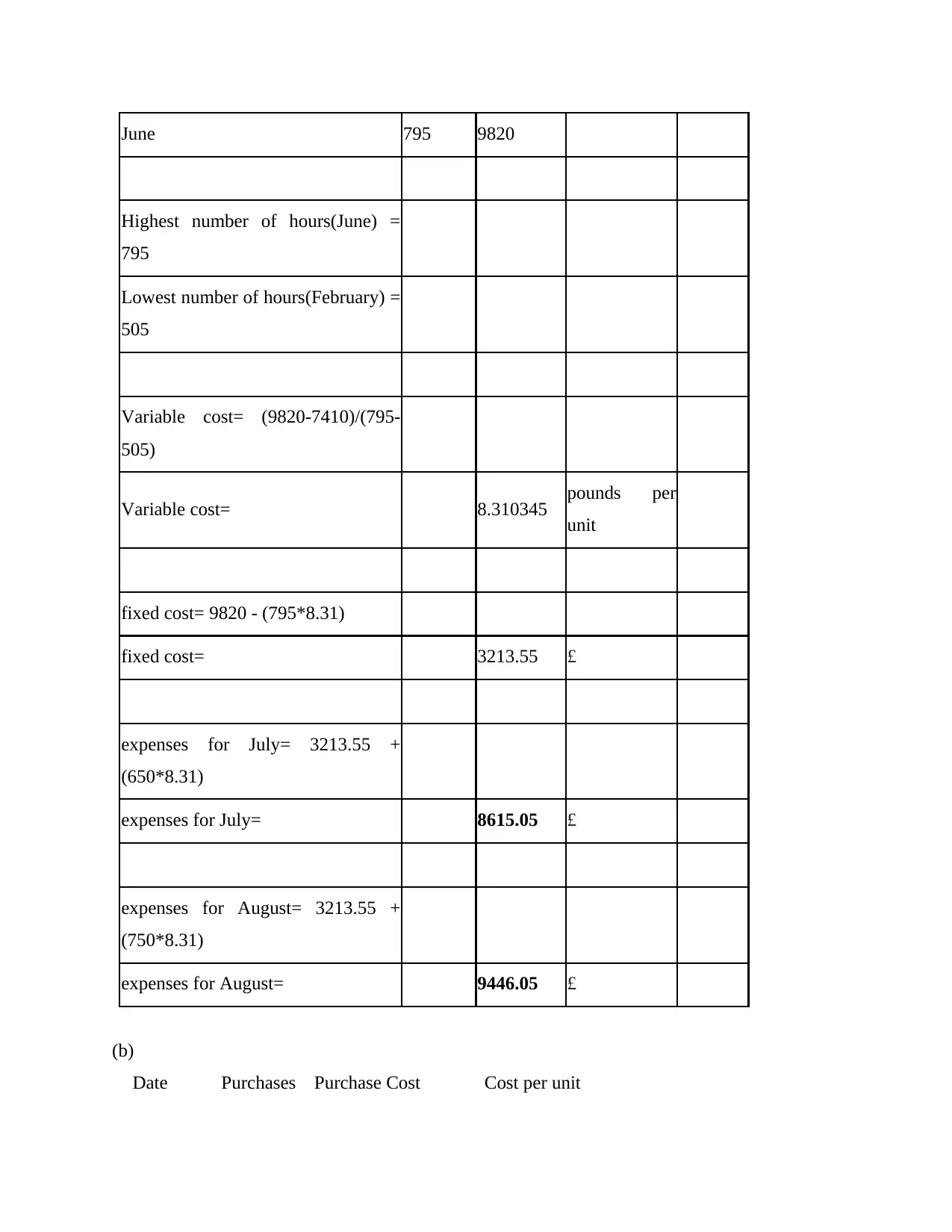
June 795 9820
Highest number of hours(June) =
795
Lowest number of hours(February) =
505
Variable cost= (9820-7410)/(795-
505)
Variable cost= 8.310345 pounds per
unit
fixed cost= 9820 - (795*8.31)
fixed cost= 3213.55 £
expenses for July= 3213.55 +
(650*8.31)
expenses for July= 8615.05 £
expenses for August= 3213.55 +
(750*8.31)
expenses for August= 9446.05 £
(b)
Date Purchases Purchase Cost Cost per unit
Highest number of hours(June) =
795
Lowest number of hours(February) =
505
Variable cost= (9820-7410)/(795-
505)
Variable cost= 8.310345 pounds per
unit
fixed cost= 9820 - (795*8.31)
fixed cost= 3213.55 £
expenses for July= 3213.55 +
(650*8.31)
expenses for July= 8615.05 £
expenses for August= 3213.55 +
(750*8.31)
expenses for August= 9446.05 £
(b)
Date Purchases Purchase Cost Cost per unit
⊘ This is a preview!⊘
Do you want full access?
Subscribe today to unlock all pages.
Trusted by 1+ million students worldwide

1 out of 26


Related Documents


Your All-in-One AI-Powered Toolkit for Academic Success.
+13062052269
info@desklib.com
Available 24*7 on WhatsApp / Email
![[object Object]](/_next/static/media/star-bottom.7253800d.svg)
Unlock your academic potential
Copyright © 2020–2026 A2Z Services. All Rights Reserved. Developed and managed by ZUCOL.