Analysis of Management Accounting Theory and Its Implications
VerifiedAdded on 2020/01/23
|10
|2918
|187
Report
AI Summary
This report provides a comprehensive analysis of management accounting theory, focusing on a journal article by Thomas Ahrens and Christopher S. Chapman. It explores various management accounting theories, including contingency, agency, and market and hierarchies, and their implications within an organizational context, specifically using a restaurant as a case study. The report critically evaluates the strengths and weaknesses of these theories, discussing their applications in practice, such as in costing, budgeting, and employee performance. It also touches upon financial accounting theory and the accounting profession, highlighting the importance of accurate financial data and its impact on decision-making. The conclusion emphasizes the significance of management accounting in effective business operations, emphasizing the application of various tools and techniques for managing and improving organizational performance.
Management Accounting
Theory
Theory

Paraphrase This Document
Need a fresh take? Get an instant paraphrase of this document with our AI Paraphraser
Table of Contents
INTRODUCTION................................................................................................................................3
Summery of article......................................................................................................................3
Critical evaluation on management accounting theory...............................................................4
CONCLUSION....................................................................................................................................6
REFERENCES.....................................................................................................................................7
INTRODUCTION................................................................................................................................3
Summery of article......................................................................................................................3
Critical evaluation on management accounting theory...............................................................4
CONCLUSION....................................................................................................................................6
REFERENCES.....................................................................................................................................7
INTRODUCTION
Management accounting is tool of business in calculating day to day operations of business.
It is the provision of financial data and advice to company for use in the organisation and
development of company. In this report a journal published "Management Accounting as a practice"
by Thomas Ahrens and Christopher S. Chapman has been discussed. A critical Analysis has made of
the selected article published in accounting journal. Its analysis and critic is included. Strength and
weakness. Implications of Accounting profession, Relevance of the unit and financial accounting
theory have concluded.
Summery of article
This article is all about "management accounting as practice" written by Thomas Ahrens
and Christopher S. Chapman in Accounting Organisation and society at sciencedirect.com on 2007.
In this article distinctive theory approaches have been taken to understand role of management in
organisation is explained. Various management theories and principals have been made by various
authors and journals and books. Objectives of the organisation and learning for organisation
structure of restaurant is guided to employees and directors of restaurant so as proper
implementation of management accounting can be understood (Bonin, 2013). This article stats that
historical and contemporary studies of accounting have shed lights on diverse way in which
accounting has been and is being implicated. Accounting and organisational objectives are
interdependent in the sense that objectives are are influenced by knowledge of potential accounting.
Contingency theory have discussed and it shows analysis of fit between context and accounting are
supported through questionnaires that collect the aggregate information about organisation and
subsystems. The idea of social order and as a direct outcome of activities is not now in the
accounting literature and has given a various specific notions of practice. In particular government
studies have developed a complex practice of accounting raised from historical systematic study of
power of knowledge. Accounting remained a potential in more generally all organisation practice
were described as successive design of policies, system and architecture that sought to act upon
organisational members who were mare user and their activities were never described. Actor
Networking theory (ANT) have been summarised that explains that ANT sought to replace
notations of social structure entities and level etc. with the concept of heterogeneous network of
human and non human.
The studies have given support to those who drew notion of cognition in practice to question
the idea of transferable skills. Key to understanding cognition in practice is that it is distributed over
environment outside of the actor and that element of it take place outside there heads through
meaningful interaction between charts, images, gestures, or in relation to this article or management
Management accounting is tool of business in calculating day to day operations of business.
It is the provision of financial data and advice to company for use in the organisation and
development of company. In this report a journal published "Management Accounting as a practice"
by Thomas Ahrens and Christopher S. Chapman has been discussed. A critical Analysis has made of
the selected article published in accounting journal. Its analysis and critic is included. Strength and
weakness. Implications of Accounting profession, Relevance of the unit and financial accounting
theory have concluded.
Summery of article
This article is all about "management accounting as practice" written by Thomas Ahrens
and Christopher S. Chapman in Accounting Organisation and society at sciencedirect.com on 2007.
In this article distinctive theory approaches have been taken to understand role of management in
organisation is explained. Various management theories and principals have been made by various
authors and journals and books. Objectives of the organisation and learning for organisation
structure of restaurant is guided to employees and directors of restaurant so as proper
implementation of management accounting can be understood (Bonin, 2013). This article stats that
historical and contemporary studies of accounting have shed lights on diverse way in which
accounting has been and is being implicated. Accounting and organisational objectives are
interdependent in the sense that objectives are are influenced by knowledge of potential accounting.
Contingency theory have discussed and it shows analysis of fit between context and accounting are
supported through questionnaires that collect the aggregate information about organisation and
subsystems. The idea of social order and as a direct outcome of activities is not now in the
accounting literature and has given a various specific notions of practice. In particular government
studies have developed a complex practice of accounting raised from historical systematic study of
power of knowledge. Accounting remained a potential in more generally all organisation practice
were described as successive design of policies, system and architecture that sought to act upon
organisational members who were mare user and their activities were never described. Actor
Networking theory (ANT) have been summarised that explains that ANT sought to replace
notations of social structure entities and level etc. with the concept of heterogeneous network of
human and non human.
The studies have given support to those who drew notion of cognition in practice to question
the idea of transferable skills. Key to understanding cognition in practice is that it is distributed over
environment outside of the actor and that element of it take place outside there heads through
meaningful interaction between charts, images, gestures, or in relation to this article or management
⊘ This is a preview!⊘
Do you want full access?
Subscribe today to unlock all pages.

Trusted by 1+ million students worldwide
control system. Field study of restaurant has made. Restaurant is one of the largest full service chain
restaurant in the UK. Restaurant were wholly owned by company and were run by salaried manager.
Restaurant division has given substantial result of sales return over period of years. This growth has
been attend by acquisition of small chains but by addition of new unit. More then 200 restaurant
were organised as profit. So this article is all about management theories. Field studies management
structure, menu design, management control practice, senior manager practice and discussions have
been made regarding restaurant. Management accounting provides an understanding of government
accounting that is useful for fund allocation and economic stability effectively (Freeman and et.al.,
2014).
Limitations of article
As per detailed study, it has been analysed that information provided under article is having
various limitations. Various advanced working and concepts in regard to management accounting
were not presented in the article. Along with this, by having an application of measures the issues
can be resolved in management accounting but in article the proper information is not presented.
Language used in the article in not clear which creates an obstacles in understanding. Moreover,
information about methods is also not properly presented which impacts the effectiveness of overall
article outcomes.
Critical evaluation on management accounting theory
Strength of management accounting:- Management accounting is multidisciplinary
approach that is helpful for management of overall business operations and enhancing quality
services of organization. In this regard, several tools and techniques are applied for forecasting and
decision making for further business activities. Including this, actual performance of entity is
presented through analysing financial and non-monetary tools (Rutherford, 2016). However, several
ideas are created for adopting changes and improving quality services of firm. Moreover, it is
valuable for effectiveness of company and sustaining its good reputation in market for long time
periodicity. In accordance to this, management accountant of organization analyses financial
performance as per which costing and budgeting is implemented. Through costing method, price of
goods and services to be produced is determined. Similarly, effective price determination leads to
prepare income statement for showing off economic structure of restaurant. Along with this,
management accountant of organization recognizes performance of employees of the firm and
further prepares strategy to increasing their working efficiencies. It encourages them for better
quality work and contributing effectively for working in team. Including this, management
accounting is helpful for taxation as well making decisions for effective fund and increasing
revenue for public welfare (Biondi and et.al., 2013).
restaurant in the UK. Restaurant were wholly owned by company and were run by salaried manager.
Restaurant division has given substantial result of sales return over period of years. This growth has
been attend by acquisition of small chains but by addition of new unit. More then 200 restaurant
were organised as profit. So this article is all about management theories. Field studies management
structure, menu design, management control practice, senior manager practice and discussions have
been made regarding restaurant. Management accounting provides an understanding of government
accounting that is useful for fund allocation and economic stability effectively (Freeman and et.al.,
2014).
Limitations of article
As per detailed study, it has been analysed that information provided under article is having
various limitations. Various advanced working and concepts in regard to management accounting
were not presented in the article. Along with this, by having an application of measures the issues
can be resolved in management accounting but in article the proper information is not presented.
Language used in the article in not clear which creates an obstacles in understanding. Moreover,
information about methods is also not properly presented which impacts the effectiveness of overall
article outcomes.
Critical evaluation on management accounting theory
Strength of management accounting:- Management accounting is multidisciplinary
approach that is helpful for management of overall business operations and enhancing quality
services of organization. In this regard, several tools and techniques are applied for forecasting and
decision making for further business activities. Including this, actual performance of entity is
presented through analysing financial and non-monetary tools (Rutherford, 2016). However, several
ideas are created for adopting changes and improving quality services of firm. Moreover, it is
valuable for effectiveness of company and sustaining its good reputation in market for long time
periodicity. In accordance to this, management accountant of organization analyses financial
performance as per which costing and budgeting is implemented. Through costing method, price of
goods and services to be produced is determined. Similarly, effective price determination leads to
prepare income statement for showing off economic structure of restaurant. Along with this,
management accountant of organization recognizes performance of employees of the firm and
further prepares strategy to increasing their working efficiencies. It encourages them for better
quality work and contributing effectively for working in team. Including this, management
accounting is helpful for taxation as well making decisions for effective fund and increasing
revenue for public welfare (Biondi and et.al., 2013).
Paraphrase This Document
Need a fresh take? Get an instant paraphrase of this document with our AI Paraphraser
Management accounting theories including contingency, agency, market and hierarchies,
MAS implications, summary and conclusions and so on are useful to measure organizational
behaviour, economic factors and different effects.
contingency theory: It provides company's technology, environment and managerial
process. In this process, internal and external environmental factors as well their impact on
organization's performance is created. It presents relationship between entity's environment,
structure and technologies for operating business activities. Through using this management
accounting theory, proper idea and systematic steps are provided for implementing changes
according to fluctuations in environmental factors (Li, 2014). It is related to accepting changes as
well improving strategies for better quality services of organization at high level. There are several
rules and regulations are determined for getting information and creating plans for better
performance at large scale.
Agency theory:- Management accounting is related to establishing good relationship
among contract parties. Under this system, agreement between agent and principal is presented
including risk, incentives, pay off, skills and effort, agents motivation and so on (Miller and Power,
2013). Therefore, for maintaining understanding among workers of restaurant is effective through
applying this theory that is valuable for good quality of work. Agency theory is applied for risk
preferences, new assumptions about time discounting as well trade-off between intrinsic and
extrinsic motivation (Pepper and Gore, 2015). Including this, information are obtained for
determining shares of risks and pay-off. Therefore, considerable resistance is obtained though
agency theory for maintaining contract between principal and agents.
Market and hierarchies:- An important theory of management accounting is termed as
market and hierarchies under which rules and regulations for determining prices and allocation of
restaurant's labour is presented. In this process, various plans and information are presented related
to accountabilities and setting various aspects related to workers' salary and information
implications. However, by using market and hierarchies theory of management accounting is useful
for solving out problems occurred for labour market. Along with this, different ideas and tools are
obtained for labour management as well implementing strategies for better work performance.
Through following on rules and regulations of accounting theory, it is beneficial for making
decisions and controlling over uncontrollable variables. In this regard, allocation of resources and
fund can be gained efficiently that affects efficiency of restaurant at high level. Management
accountant of organization recognizes market value of firm as well incurred expenses and gained
revenue impacts on market and hierarchies (Quinn, 2014). Therefore, economic income of net cash
flow and change in present market value is determined.
MAS implications, summary and conclusions and so on are useful to measure organizational
behaviour, economic factors and different effects.
contingency theory: It provides company's technology, environment and managerial
process. In this process, internal and external environmental factors as well their impact on
organization's performance is created. It presents relationship between entity's environment,
structure and technologies for operating business activities. Through using this management
accounting theory, proper idea and systematic steps are provided for implementing changes
according to fluctuations in environmental factors (Li, 2014). It is related to accepting changes as
well improving strategies for better quality services of organization at high level. There are several
rules and regulations are determined for getting information and creating plans for better
performance at large scale.
Agency theory:- Management accounting is related to establishing good relationship
among contract parties. Under this system, agreement between agent and principal is presented
including risk, incentives, pay off, skills and effort, agents motivation and so on (Miller and Power,
2013). Therefore, for maintaining understanding among workers of restaurant is effective through
applying this theory that is valuable for good quality of work. Agency theory is applied for risk
preferences, new assumptions about time discounting as well trade-off between intrinsic and
extrinsic motivation (Pepper and Gore, 2015). Including this, information are obtained for
determining shares of risks and pay-off. Therefore, considerable resistance is obtained though
agency theory for maintaining contract between principal and agents.
Market and hierarchies:- An important theory of management accounting is termed as
market and hierarchies under which rules and regulations for determining prices and allocation of
restaurant's labour is presented. In this process, various plans and information are presented related
to accountabilities and setting various aspects related to workers' salary and information
implications. However, by using market and hierarchies theory of management accounting is useful
for solving out problems occurred for labour market. Along with this, different ideas and tools are
obtained for labour management as well implementing strategies for better work performance.
Through following on rules and regulations of accounting theory, it is beneficial for making
decisions and controlling over uncontrollable variables. In this regard, allocation of resources and
fund can be gained efficiently that affects efficiency of restaurant at high level. Management
accountant of organization recognizes market value of firm as well incurred expenses and gained
revenue impacts on market and hierarchies (Quinn, 2014). Therefore, economic income of net cash
flow and change in present market value is determined.
MAS implications:- Above mentioned all three management accounting theories get
managed by which trust is build up for selection and socialization. However, overall terms related to
organizational structure, environment, contract between principal and agents is created. In this
process, MAS is related to controlling over excess of material and funds are monitored effectively.
Apart from this, various development and control mechanisms are presented for effectiveness of
restaurant (Miller and Power, 2013). Therefore, planning procedure and decision making tools are
applied for better work performance and enhancing quality services at high level. It is interlinked
with strategic and risk management is obtained for carrying on entity. It influences good
relationship among labours of the organization also remains able for creating structural framework
that presents performance of company also appropriate for decision making to operating business
activities in future time. It influences overall expansion of enterprise and improves product services
that are liable for adequate allocation of resources and fund.
Management accountant of organization implements set strategies according to planning
procedure. It is able to create structure of entity to present performance that generates several ideas
for effectiveness. In this process, overall business operations are get managed that are useful for
labour management and following on rules and regulations agreed for creating contract. However,
relationship among all workers can be build up that is interrelated with efficiencies of restaurant. By
preparing and implementing strategies, proper management of all business operations can be gained
efficiently (Messner, 2016).
Drawbacks of management accounting theory:- Wrong interpretation of organization's
performance is unable to make decisions for further business operations. In this regard, it is difficult
to analyse entire business operations and following on rules and regulations provided in
management accounting theories. In this process, lack of coordination among labours of restaurant
is unable to encourage them for better services as well uncertain changes in environmental factors
are not able to getting adjustment (Beattie and Smith, 2013). Therefore, it is required for
management accountant of organization to analyse all business operations critically on the basis of
which different strategies are prepared for better performance as well encouraging workers for
improving their skills.
Financial accounting theory:- Following on financial accounting theory is beneficial for
economic stability and improving profit earning capacity of organization. Under this system,
management accountant of entity analyses all economic tools as income statement, balance sheet
and different aspects (Fullerton, Kennedy and Widener, 2014). It creates several ideas for financial
development that affects entire business operations. In this process, records are also prepared and
maintained that affects on organization's performance also able to enhance efficiencies at high level.
managed by which trust is build up for selection and socialization. However, overall terms related to
organizational structure, environment, contract between principal and agents is created. In this
process, MAS is related to controlling over excess of material and funds are monitored effectively.
Apart from this, various development and control mechanisms are presented for effectiveness of
restaurant (Miller and Power, 2013). Therefore, planning procedure and decision making tools are
applied for better work performance and enhancing quality services at high level. It is interlinked
with strategic and risk management is obtained for carrying on entity. It influences good
relationship among labours of the organization also remains able for creating structural framework
that presents performance of company also appropriate for decision making to operating business
activities in future time. It influences overall expansion of enterprise and improves product services
that are liable for adequate allocation of resources and fund.
Management accountant of organization implements set strategies according to planning
procedure. It is able to create structure of entity to present performance that generates several ideas
for effectiveness. In this process, overall business operations are get managed that are useful for
labour management and following on rules and regulations agreed for creating contract. However,
relationship among all workers can be build up that is interrelated with efficiencies of restaurant. By
preparing and implementing strategies, proper management of all business operations can be gained
efficiently (Messner, 2016).
Drawbacks of management accounting theory:- Wrong interpretation of organization's
performance is unable to make decisions for further business operations. In this regard, it is difficult
to analyse entire business operations and following on rules and regulations provided in
management accounting theories. In this process, lack of coordination among labours of restaurant
is unable to encourage them for better services as well uncertain changes in environmental factors
are not able to getting adjustment (Beattie and Smith, 2013). Therefore, it is required for
management accountant of organization to analyse all business operations critically on the basis of
which different strategies are prepared for better performance as well encouraging workers for
improving their skills.
Financial accounting theory:- Following on financial accounting theory is beneficial for
economic stability and improving profit earning capacity of organization. Under this system,
management accountant of entity analyses all economic tools as income statement, balance sheet
and different aspects (Fullerton, Kennedy and Widener, 2014). It creates several ideas for financial
development that affects entire business operations. In this process, records are also prepared and
maintained that affects on organization's performance also able to enhance efficiencies at high level.
⊘ This is a preview!⊘
Do you want full access?
Subscribe today to unlock all pages.
Trusted by 1+ million students worldwide
Accounting profession:- It is an approach for preparing journal, ledger, income statement
and different financial statements for presenting economic performance organization. However,
accounting profession is related to preparing and maintaining accounts that leads to make decisions
for further business operations. It has positive and negative aspects can be expressed as:-
Advantages of accounting profession:- It is useful for preparing and maintaining records of
business operations and further making decisions for increasing efficiencies. It is related to
presenting financial performance of organizations that proceed to operating further business
activities.
Implications of accounting profession:- Wrong predictions and calculation to prepare
financial tools. However, wrong decisions on the basis of presented inaccurate ledger is difficult for
making further decisions. Moreover, wrong predictions over future business operations are difficult
for sustainability of firm that affects its competitive strategies. Along with this, inefficient resources
and managing all business operations is quite challenging according to analysing financial tools.
Therefore, inaccuracy in accounting profession is unable to improve business and competitive
strategies.
CONCLUSION
The report is concluded that management accounting theories are essential for following on
all rules and regulations related to managing all business operations. In accordance to this, several
accounting theories are described including contingency, agency and MAS that is effective for
enhancing efficiencies of restaurant. However, ideas and tools are obtained for labour management
and implementing quality services of organization at large scale. In addition to this, significance of
management accounting theories is presented through this assignment. Moreover, Thomas Ahrens
and Christopher S. Chapman views on management accounting as practice is understood that affects
on entire business operations' management. Thus, various tools and techniques for management
accounting is identified through this report.
RECOMMENDATION
In this regard, it is necessary for management accountant of organization to analyse all
business operations critically as well preparing strategies for adequate management. Including this,
it will be benefited for effectiveness of organization and accounting practices. However, proper
recommendations for effective management and business operations are effective for implementing
action plans. In addition to this, preparing and maintain all accounts that presents income and
expenditure are useful for accounting standard. Moreover, it will be liable for organization to
prepare strategies and making decision for improving efficiencies and recording all business
and different financial statements for presenting economic performance organization. However,
accounting profession is related to preparing and maintaining accounts that leads to make decisions
for further business operations. It has positive and negative aspects can be expressed as:-
Advantages of accounting profession:- It is useful for preparing and maintaining records of
business operations and further making decisions for increasing efficiencies. It is related to
presenting financial performance of organizations that proceed to operating further business
activities.
Implications of accounting profession:- Wrong predictions and calculation to prepare
financial tools. However, wrong decisions on the basis of presented inaccurate ledger is difficult for
making further decisions. Moreover, wrong predictions over future business operations are difficult
for sustainability of firm that affects its competitive strategies. Along with this, inefficient resources
and managing all business operations is quite challenging according to analysing financial tools.
Therefore, inaccuracy in accounting profession is unable to improve business and competitive
strategies.
CONCLUSION
The report is concluded that management accounting theories are essential for following on
all rules and regulations related to managing all business operations. In accordance to this, several
accounting theories are described including contingency, agency and MAS that is effective for
enhancing efficiencies of restaurant. However, ideas and tools are obtained for labour management
and implementing quality services of organization at large scale. In addition to this, significance of
management accounting theories is presented through this assignment. Moreover, Thomas Ahrens
and Christopher S. Chapman views on management accounting as practice is understood that affects
on entire business operations' management. Thus, various tools and techniques for management
accounting is identified through this report.
RECOMMENDATION
In this regard, it is necessary for management accountant of organization to analyse all
business operations critically as well preparing strategies for adequate management. Including this,
it will be benefited for effectiveness of organization and accounting practices. However, proper
recommendations for effective management and business operations are effective for implementing
action plans. In addition to this, preparing and maintain all accounts that presents income and
expenditure are useful for accounting standard. Moreover, it will be liable for organization to
prepare strategies and making decision for improving efficiencies and recording all business
Paraphrase This Document
Need a fresh take? Get an instant paraphrase of this document with our AI Paraphraser
transactions effectively. In accordance to this, systematic knowledge related to entity's business
activities can be recognized that impacts on firm's effectiveness. Thus, preparing and maintain
balance of income and expenses should be done in systematic manner so that proper management of
all operations can be gained that affects business and marketing strategies at high level. Thus, it is
required for management accountant of organization to apply different kinds of theories for
recording and reporting data for production and distribution of goods and services are implemented
for organization's effectiveness.
activities can be recognized that impacts on firm's effectiveness. Thus, preparing and maintain
balance of income and expenses should be done in systematic manner so that proper management of
all operations can be gained that affects business and marketing strategies at high level. Thus, it is
required for management accountant of organization to apply different kinds of theories for
recording and reporting data for production and distribution of goods and services are implemented
for organization's effectiveness.
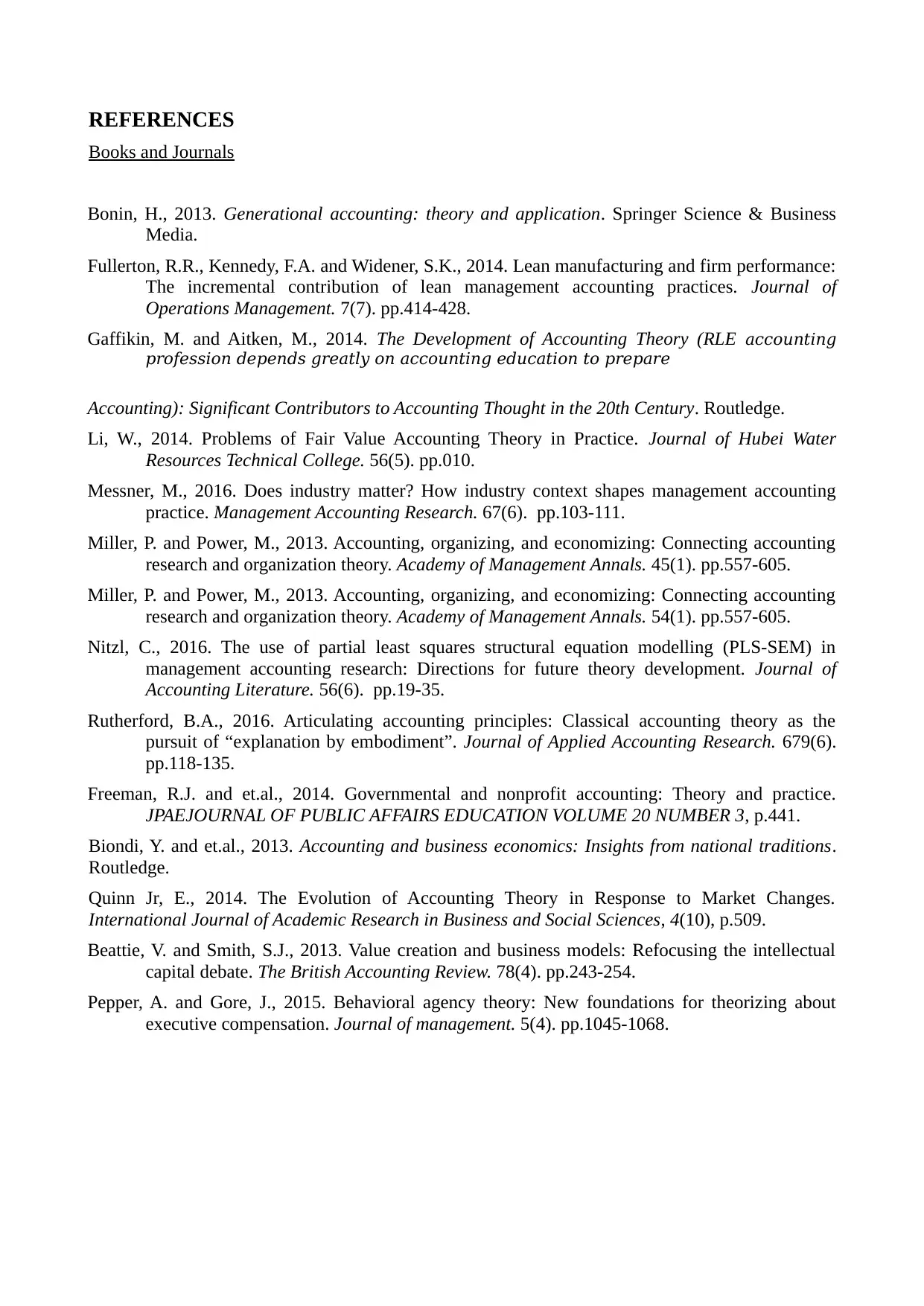
REFERENCES
Books and Journals
Bonin, H., 2013. Generational accounting: theory and application. Springer Science & Business
Media.
Fullerton, R.R., Kennedy, F.A. and Widener, S.K., 2014. Lean manufacturing and firm performance:
The incremental contribution of lean management accounting practices. Journal of
Operations Management. 7(7). pp.414-428.
Gaffikin, M. and Aitken, M., 2014. The Development of Accounting Theory (RLE accounting
profession depends greatly on accounting education to prepare
Accounting): Significant Contributors to Accounting Thought in the 20th Century. Routledge.
Li, W., 2014. Problems of Fair Value Accounting Theory in Practice. Journal of Hubei Water
Resources Technical College. 56(5). pp.010.
Messner, M., 2016. Does industry matter? How industry context shapes management accounting
practice. Management Accounting Research. 67(6). pp.103-111.
Miller, P. and Power, M., 2013. Accounting, organizing, and economizing: Connecting accounting
research and organization theory. Academy of Management Annals. 45(1). pp.557-605.
Miller, P. and Power, M., 2013. Accounting, organizing, and economizing: Connecting accounting
research and organization theory. Academy of Management Annals. 54(1). pp.557-605.
Nitzl, C., 2016. The use of partial least squares structural equation modelling (PLS-SEM) in
management accounting research: Directions for future theory development. Journal of
Accounting Literature. 56(6). pp.19-35.
Rutherford, B.A., 2016. Articulating accounting principles: Classical accounting theory as the
pursuit of “explanation by embodiment”. Journal of Applied Accounting Research. 679(6).
pp.118-135.
Freeman, R.J. and et.al., 2014. Governmental and nonprofit accounting: Theory and practice.
JPAEJOURNAL OF PUBLIC AFFAIRS EDUCATION VOLUME 20 NUMBER 3, p.441.
Biondi, Y. and et.al., 2013. Accounting and business economics: Insights from national traditions.
Routledge.
Quinn Jr, E., 2014. The Evolution of Accounting Theory in Response to Market Changes.
International Journal of Academic Research in Business and Social Sciences, 4(10), p.509.
Beattie, V. and Smith, S.J., 2013. Value creation and business models: Refocusing the intellectual
capital debate. The British Accounting Review. 78(4). pp.243-254.
Pepper, A. and Gore, J., 2015. Behavioral agency theory: New foundations for theorizing about
executive compensation. Journal of management. 5(4). pp.1045-1068.
Books and Journals
Bonin, H., 2013. Generational accounting: theory and application. Springer Science & Business
Media.
Fullerton, R.R., Kennedy, F.A. and Widener, S.K., 2014. Lean manufacturing and firm performance:
The incremental contribution of lean management accounting practices. Journal of
Operations Management. 7(7). pp.414-428.
Gaffikin, M. and Aitken, M., 2014. The Development of Accounting Theory (RLE accounting
profession depends greatly on accounting education to prepare
Accounting): Significant Contributors to Accounting Thought in the 20th Century. Routledge.
Li, W., 2014. Problems of Fair Value Accounting Theory in Practice. Journal of Hubei Water
Resources Technical College. 56(5). pp.010.
Messner, M., 2016. Does industry matter? How industry context shapes management accounting
practice. Management Accounting Research. 67(6). pp.103-111.
Miller, P. and Power, M., 2013. Accounting, organizing, and economizing: Connecting accounting
research and organization theory. Academy of Management Annals. 45(1). pp.557-605.
Miller, P. and Power, M., 2013. Accounting, organizing, and economizing: Connecting accounting
research and organization theory. Academy of Management Annals. 54(1). pp.557-605.
Nitzl, C., 2016. The use of partial least squares structural equation modelling (PLS-SEM) in
management accounting research: Directions for future theory development. Journal of
Accounting Literature. 56(6). pp.19-35.
Rutherford, B.A., 2016. Articulating accounting principles: Classical accounting theory as the
pursuit of “explanation by embodiment”. Journal of Applied Accounting Research. 679(6).
pp.118-135.
Freeman, R.J. and et.al., 2014. Governmental and nonprofit accounting: Theory and practice.
JPAEJOURNAL OF PUBLIC AFFAIRS EDUCATION VOLUME 20 NUMBER 3, p.441.
Biondi, Y. and et.al., 2013. Accounting and business economics: Insights from national traditions.
Routledge.
Quinn Jr, E., 2014. The Evolution of Accounting Theory in Response to Market Changes.
International Journal of Academic Research in Business and Social Sciences, 4(10), p.509.
Beattie, V. and Smith, S.J., 2013. Value creation and business models: Refocusing the intellectual
capital debate. The British Accounting Review. 78(4). pp.243-254.
Pepper, A. and Gore, J., 2015. Behavioral agency theory: New foundations for theorizing about
executive compensation. Journal of management. 5(4). pp.1045-1068.
⊘ This is a preview!⊘
Do you want full access?
Subscribe today to unlock all pages.
Trusted by 1+ million students worldwide


1 out of 10


Your All-in-One AI-Powered Toolkit for Academic Success.
+13062052269
info@desklib.com
Available 24*7 on WhatsApp / Email
![[object Object]](/_next/static/media/star-bottom.7253800d.svg)
Unlock your academic potential
Copyright © 2020–2026 A2Z Services. All Rights Reserved. Developed and managed by ZUCOL.