Management Accounting Report: Variance Analysis for XLG plc (LCBB5002)
VerifiedAdded on 2023/01/07
|14
|3250
|75
Report
AI Summary
This report, prepared for a management accounting course (LCBB5002), delves into variance analysis and its application within a business context. It begins with an introduction to management accounting and the importance of variance analysis, a technique used to compare actual data with financial projections. The main body of the report is divided into two parts. Part A focuses on the computation of various variances, including sales price, sales volume contribution, material price planning, and operational variances. Part B examines the make-or-buy decision, presenting a case study on XLG plc and its choice regarding the production of a cleaning material, Fama Q. The report analyzes the costs and benefits associated with in-house manufacturing versus purchasing from an external supplier. The report concludes with a discussion of the merits and demerits of variance analysis in assessing managerial performance and offering recommendations for decision-making. References are included to support the analysis and findings presented.
LCBB5002
MANAGEMENT
ACCOUNTING – 2
MANAGEMENT
ACCOUNTING – 2

Paraphrase This Document
Need a fresh take? Get an instant paraphrase of this document with our AI Paraphraser
Contents
INTRODUCTION.....................................................................................................................................3
MAIN BODY.............................................................................................................................................3
Part A......................................................................................................................................................3
Part B.....................................................................................................................................................10
CONCLUSION........................................................................................................................................13
REFERENCES........................................................................................................................................14
INTRODUCTION.....................................................................................................................................3
MAIN BODY.............................................................................................................................................3
Part A......................................................................................................................................................3
Part B.....................................................................................................................................................10
CONCLUSION........................................................................................................................................13
REFERENCES........................................................................................................................................14
INTRODUCTION
The management accounting (MA) is known as a form of accounting that is associated to
handling monetary and non-monetary resources in a manner so that corrective actions can be
carried out for decision making (Cescon, Costantini and Grassetti, 2019). This accounting
contains a range of techniques and variance analysis is considered as one of the key approach
which is connected to compare actual data with financial projections. Majority of executive of
companies, rely on this method in order to take viable financial judgments. In the report a case
study has been discussed which is based on calculation of variances and suggesting a suitable
alternative to XLG plc. The project report is based on two tasks which are A and B. The part A
contains information related to calculation of different kinds of variables have been done. While
in part B, detailed information regarding to selection of an alternative has been done by using
appropriate methods.
MAIN BODY
Part A
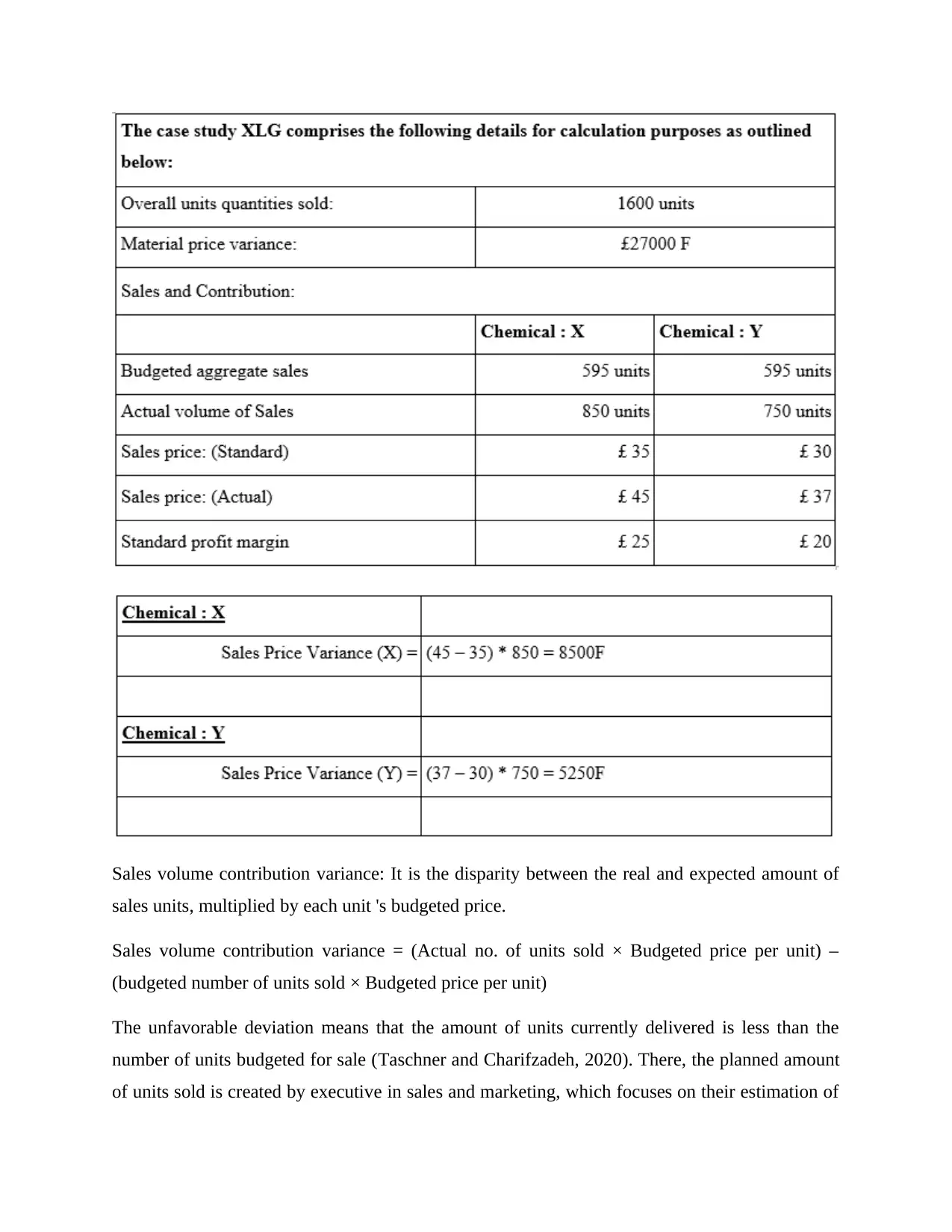
(i) Computation of the Sales price variances and sales volume contribution variances:
Sales price variance: The variance in the selling price means a discrepancy between real and
expected sales arising from a change in commodity price (Labrador and Olmo, 2019).
Sales price variance = (Actual Price – Standard Price) * Actual Unit
The value of negative variance indicates that actual price is shorter as compared to projected
prices. On the other hands, positive variance shows that actual prices are more than estimated
prices (Dai, Free and Gendron, 2019). By help of this variance, it becomes easier for companies
to know about level of price on which they can sell their items.
The management accounting (MA) is known as a form of accounting that is associated to
handling monetary and non-monetary resources in a manner so that corrective actions can be
carried out for decision making (Cescon, Costantini and Grassetti, 2019). This accounting
contains a range of techniques and variance analysis is considered as one of the key approach
which is connected to compare actual data with financial projections. Majority of executive of
companies, rely on this method in order to take viable financial judgments. In the report a case
study has been discussed which is based on calculation of variances and suggesting a suitable
alternative to XLG plc. The project report is based on two tasks which are A and B. The part A
contains information related to calculation of different kinds of variables have been done. While
in part B, detailed information regarding to selection of an alternative has been done by using
appropriate methods.
MAIN BODY
Part A
(i) Computation of the Sales price variances and sales volume contribution variances:
Sales price variance: The variance in the selling price means a discrepancy between real and
expected sales arising from a change in commodity price (Labrador and Olmo, 2019).
Sales price variance = (Actual Price – Standard Price) * Actual Unit
The value of negative variance indicates that actual price is shorter as compared to projected
prices. On the other hands, positive variance shows that actual prices are more than estimated
prices (Dai, Free and Gendron, 2019). By help of this variance, it becomes easier for companies
to know about level of price on which they can sell their items.
⊘ This is a preview!⊘
Do you want full access?
Subscribe today to unlock all pages.

Trusted by 1+ million students worldwide
Sales volume contribution variance: It is the disparity between the real and expected amount of
sales units, multiplied by each unit 's budgeted price.
Sales volume contribution variance = (Actual no. of units sold × Budgeted price per unit) –
(budgeted number of units sold × Budgeted price per unit)
The unfavorable deviation means that the amount of units currently delivered is less than the
number of units budgeted for sale (Taschner and Charifzadeh, 2020). There, the planned amount
of units sold is created by executive in sales and marketing, which focuses on their estimation of
sales units, multiplied by each unit 's budgeted price.
Sales volume contribution variance = (Actual no. of units sold × Budgeted price per unit) –
(budgeted number of units sold × Budgeted price per unit)
The unfavorable deviation means that the amount of units currently delivered is less than the
number of units budgeted for sale (Taschner and Charifzadeh, 2020). There, the planned amount
of units sold is created by executive in sales and marketing, which focuses on their estimation of
Paraphrase This Document
Need a fresh take? Get an instant paraphrase of this document with our AI Paraphraser
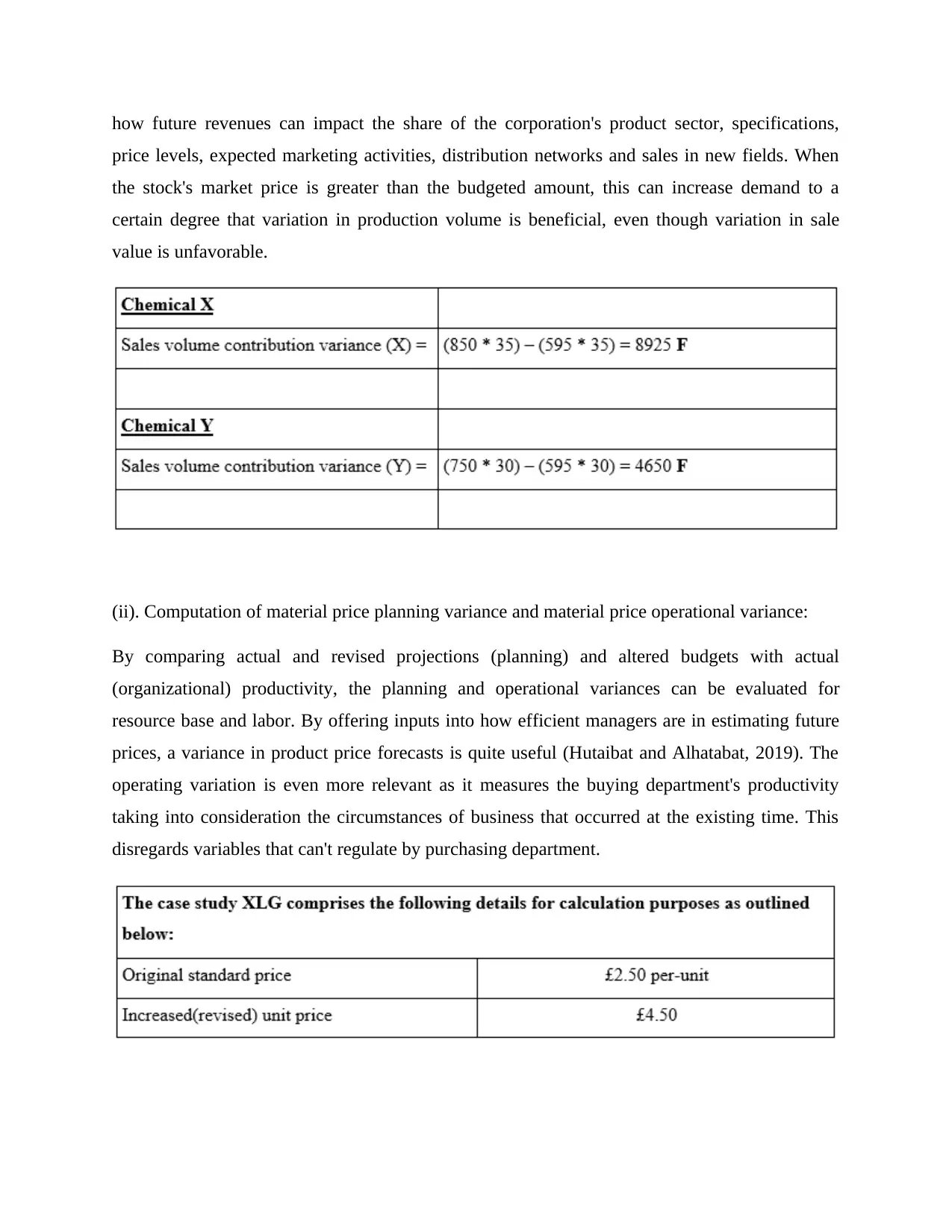
how future revenues can impact the share of the corporation's product sector, specifications,
price levels, expected marketing activities, distribution networks and sales in new fields. When
the stock's market price is greater than the budgeted amount, this can increase demand to a
certain degree that variation in production volume is beneficial, even though variation in sale
value is unfavorable.
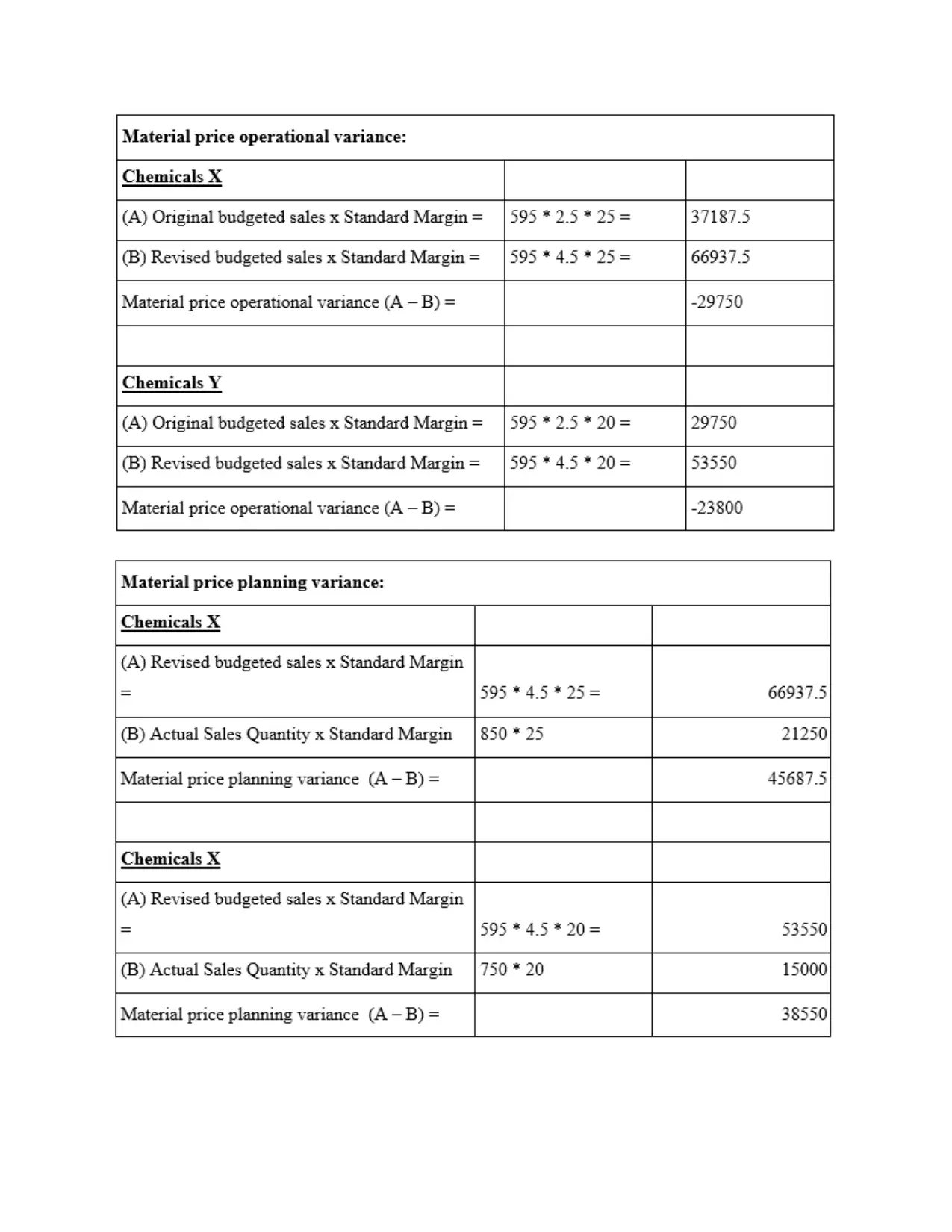
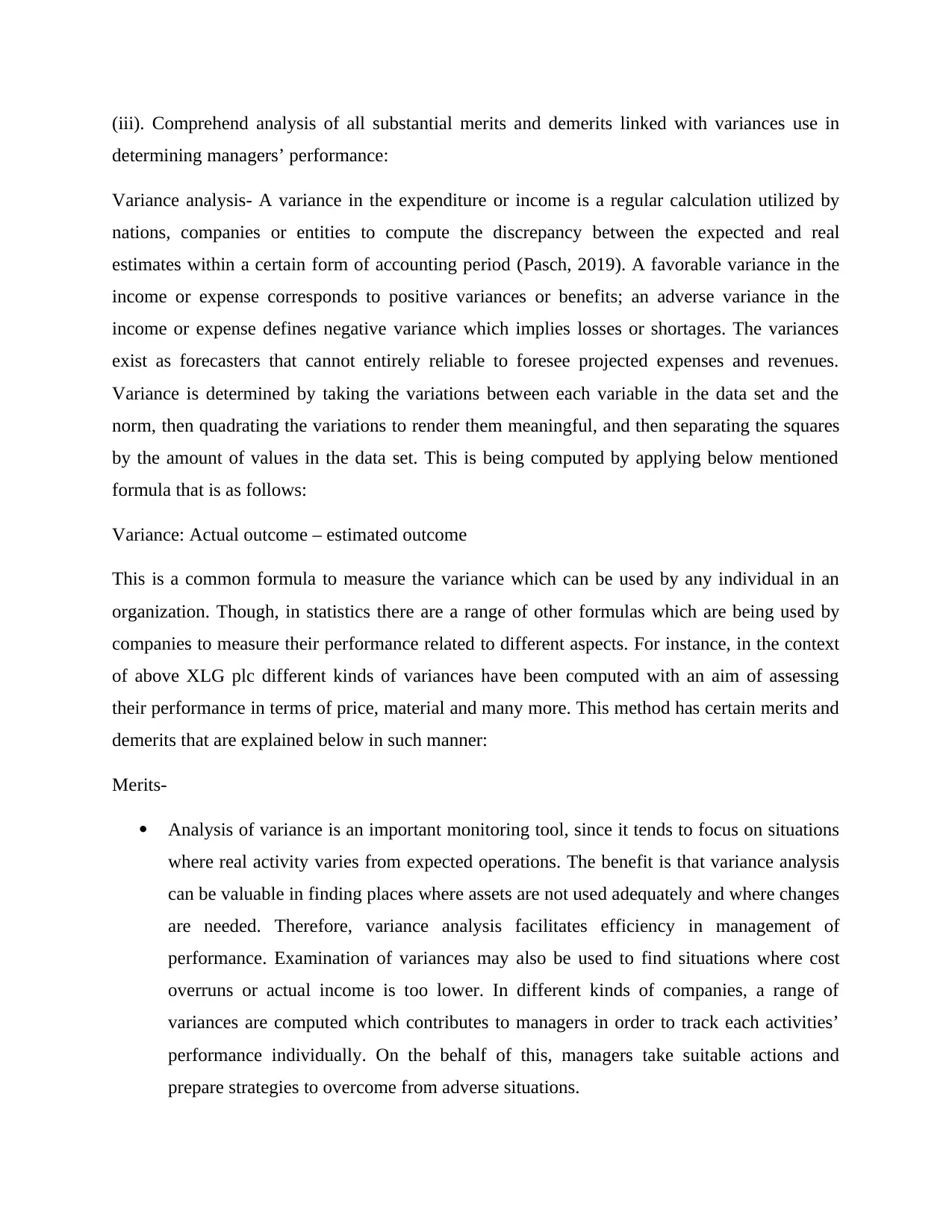
(ii). Computation of material price planning variance and material price operational variance:
By comparing actual and revised projections (planning) and altered budgets with actual
(organizational) productivity, the planning and operational variances can be evaluated for
resource base and labor. By offering inputs into how efficient managers are in estimating future
prices, a variance in product price forecasts is quite useful (Hutaibat and Alhatabat, 2019). The
operating variation is even more relevant as it measures the buying department's productivity
taking into consideration the circumstances of business that occurred at the existing time. This
disregards variables that can't regulate by purchasing department.
price levels, expected marketing activities, distribution networks and sales in new fields. When
the stock's market price is greater than the budgeted amount, this can increase demand to a
certain degree that variation in production volume is beneficial, even though variation in sale
value is unfavorable.
(ii). Computation of material price planning variance and material price operational variance:
By comparing actual and revised projections (planning) and altered budgets with actual
(organizational) productivity, the planning and operational variances can be evaluated for
resource base and labor. By offering inputs into how efficient managers are in estimating future
prices, a variance in product price forecasts is quite useful (Hutaibat and Alhatabat, 2019). The
operating variation is even more relevant as it measures the buying department's productivity
taking into consideration the circumstances of business that occurred at the existing time. This
disregards variables that can't regulate by purchasing department.
⊘ This is a preview!⊘
Do you want full access?
Subscribe today to unlock all pages.
Trusted by 1+ million students worldwide
(iii). Comprehend analysis of all substantial merits and demerits linked with variances use in
determining managers’ performance:
Variance analysis- A variance in the expenditure or income is a regular calculation utilized by
nations, companies or entities to compute the discrepancy between the expected and real
estimates within a certain form of accounting period (Pasch, 2019). A favorable variance in the
income or expense corresponds to positive variances or benefits; an adverse variance in the
income or expense defines negative variance which implies losses or shortages. The variances
exist as forecasters that cannot entirely reliable to foresee projected expenses and revenues.
Variance is determined by taking the variations between each variable in the data set and the
norm, then quadrating the variations to render them meaningful, and then separating the squares
by the amount of values in the data set. This is being computed by applying below mentioned
formula that is as follows:
Variance: Actual outcome – estimated outcome
This is a common formula to measure the variance which can be used by any individual in an
organization. Though, in statistics there are a range of other formulas which are being used by
companies to measure their performance related to different aspects. For instance, in the context
of above XLG plc different kinds of variances have been computed with an aim of assessing
their performance in terms of price, material and many more. This method has certain merits and
demerits that are explained below in such manner:
Merits-
Analysis of variance is an important monitoring tool, since it tends to focus on situations
where real activity varies from expected operations. The benefit is that variance analysis
can be valuable in finding places where assets are not used adequately and where changes
are needed. Therefore, variance analysis facilitates efficiency in management of
performance. Examination of variances may also be used to find situations where cost
overruns or actual income is too lower. In different kinds of companies, a range of
variances are computed which contributes to managers in order to track each activities’
performance individually. On the behalf of this, managers take suitable actions and
prepare strategies to overcome from adverse situations.
determining managers’ performance:
Variance analysis- A variance in the expenditure or income is a regular calculation utilized by
nations, companies or entities to compute the discrepancy between the expected and real
estimates within a certain form of accounting period (Pasch, 2019). A favorable variance in the
income or expense corresponds to positive variances or benefits; an adverse variance in the
income or expense defines negative variance which implies losses or shortages. The variances
exist as forecasters that cannot entirely reliable to foresee projected expenses and revenues.
Variance is determined by taking the variations between each variable in the data set and the
norm, then quadrating the variations to render them meaningful, and then separating the squares
by the amount of values in the data set. This is being computed by applying below mentioned
formula that is as follows:
Variance: Actual outcome – estimated outcome
This is a common formula to measure the variance which can be used by any individual in an
organization. Though, in statistics there are a range of other formulas which are being used by
companies to measure their performance related to different aspects. For instance, in the context
of above XLG plc different kinds of variances have been computed with an aim of assessing
their performance in terms of price, material and many more. This method has certain merits and
demerits that are explained below in such manner:
Merits-
Analysis of variance is an important monitoring tool, since it tends to focus on situations
where real activity varies from expected operations. The benefit is that variance analysis
can be valuable in finding places where assets are not used adequately and where changes
are needed. Therefore, variance analysis facilitates efficiency in management of
performance. Examination of variances may also be used to find situations where cost
overruns or actual income is too lower. In different kinds of companies, a range of
variances are computed which contributes to managers in order to track each activities’
performance individually. On the behalf of this, managers take suitable actions and
prepare strategies to overcome from adverse situations.
Paraphrase This Document
Need a fresh take? Get an instant paraphrase of this document with our AI Paraphraser
Analysis of variances leads to encourage the transfer of liability and activates monitoring
structures on divisions where they are needed. For instance, if labor performance
variation is seen as undesirable or raw material cost variance is undesirable then
companies can enhance control of such departments to improve output. Such as in the
context of above XLG plc, their performance is too lower as some variances are
producing unfavorable outcome then the managers can apply suitable framework in order
to deal with financial issues in an effective manner. This technique helps to prevent
negative impact on companies’ performance.
Variance analysis may even often offer way about how effectively an enterprise can be
handled. In the case of purchases, for example, the inability to negotiate product price or
to secure competitive tenders could imply organizational challenges within the
purchasing department (Tekathen, 2019). Furthermore, poor sales may also be a sign that
sales departments’ employees are not well trained or have lack inspiration. These all
aspects are useful for companies in order to deduct poor performance of any particular or
specific department. On the behalf of gathered information, managers can prepare
effective policies and plans to deal with raised issues.
The finance departments collect information that they need to grasp the explanations for
uncontrollable external variances, utilizing variance analysis. If they become informed of
these variation, then they can enforce strategies to minimize these uncertainties resulting
from these variances. Eventually, by help of variance analysis it becomes feasible for
managers to know about all unfavorable conditions. Mainly, the variance analysis is
useful for finance department as they can gather key details about different kinds of
activities which are resulting as higher expense or producing lower revenues as compared
to estimation.
Demerits:
In majority of situations, the variances are not visible in accounting reports, and due to
which accounting managers need to look over documents such as work routings,
inventory payments, and recorded overtime to ascertain the causes for these variances.
These add-on operation is cost-effective only when the management has been able to
structures on divisions where they are needed. For instance, if labor performance
variation is seen as undesirable or raw material cost variance is undesirable then
companies can enhance control of such departments to improve output. Such as in the
context of above XLG plc, their performance is too lower as some variances are
producing unfavorable outcome then the managers can apply suitable framework in order
to deal with financial issues in an effective manner. This technique helps to prevent
negative impact on companies’ performance.
Variance analysis may even often offer way about how effectively an enterprise can be
handled. In the case of purchases, for example, the inability to negotiate product price or
to secure competitive tenders could imply organizational challenges within the
purchasing department (Tekathen, 2019). Furthermore, poor sales may also be a sign that
sales departments’ employees are not well trained or have lack inspiration. These all
aspects are useful for companies in order to deduct poor performance of any particular or
specific department. On the behalf of gathered information, managers can prepare
effective policies and plans to deal with raised issues.
The finance departments collect information that they need to grasp the explanations for
uncontrollable external variances, utilizing variance analysis. If they become informed of
these variation, then they can enforce strategies to minimize these uncertainties resulting
from these variances. Eventually, by help of variance analysis it becomes feasible for
managers to know about all unfavorable conditions. Mainly, the variance analysis is
useful for finance department as they can gather key details about different kinds of
activities which are resulting as higher expense or producing lower revenues as compared
to estimation.
Demerits:
In majority of situations, the variances are not visible in accounting reports, and due to
which accounting managers need to look over documents such as work routings,
inventory payments, and recorded overtime to ascertain the causes for these variances.
These add-on operation is cost-effective only when the management has been able to
effectively address issues based on the knowledge provided. On the other hands, this may
lead to higher consumption of cost along with time. As well as it is necessary for
managers to get information in less time so that they can prepare strategies to beat their
competitors but in variance analysis needed information is offered in more time.
Evaluation of variance as an operation is focused on annual statements, which are
published far longer after quarterly closure; there could be a time delay that might have
an effect on remedial action to a certain degree (Zandi, Khalid and Islam, 2019). In this
competitive environment, only those companies can sustain who prepare their strategies
and policies in less time with higher effectiveness. Due to higher reliability on variances,
there can be lot of delay in process of managing different kinds of activities and
operations. Basically, it is one of the main issue of this technique as companies cannot
bear lose due to delay in strategy formulation.
The another drawback of variance analysis is that under it, calculations are done in
accordance of standard data related to income and expenses. These standard data are
prepared on the basis of assumptions of managers. Due to this, the provided outcome
under each variance become less reliable and effective. As well as in each company, this
assumption of income and expenses is done in accordance of own knowledge and skills
of managers. As a result, it becomes difficult to make comparison between performance
of two companies by help of this method.
In addition to this, the variance analysis is not suitable for those companies which are
involved in service sector. It is so because of higher number of overheads as compared to
direct expenses. Eventually, the variances can be computed only if there is complete
information about various kinds of expenses. While in service organizations, there are
lack of data about direct expenses (Ahmad and Al-Shbiel, 2019). Due to these causes,
variance analysis is not suitable for small companies and for those that are involved in
service sector instead of product manufacturing.
So these are some merits and demerits of variance analysis which are faced by companies that
apply it as a performance measurement tool.
lead to higher consumption of cost along with time. As well as it is necessary for
managers to get information in less time so that they can prepare strategies to beat their
competitors but in variance analysis needed information is offered in more time.
Evaluation of variance as an operation is focused on annual statements, which are
published far longer after quarterly closure; there could be a time delay that might have
an effect on remedial action to a certain degree (Zandi, Khalid and Islam, 2019). In this
competitive environment, only those companies can sustain who prepare their strategies
and policies in less time with higher effectiveness. Due to higher reliability on variances,
there can be lot of delay in process of managing different kinds of activities and
operations. Basically, it is one of the main issue of this technique as companies cannot
bear lose due to delay in strategy formulation.
The another drawback of variance analysis is that under it, calculations are done in
accordance of standard data related to income and expenses. These standard data are
prepared on the basis of assumptions of managers. Due to this, the provided outcome
under each variance become less reliable and effective. As well as in each company, this
assumption of income and expenses is done in accordance of own knowledge and skills
of managers. As a result, it becomes difficult to make comparison between performance
of two companies by help of this method.
In addition to this, the variance analysis is not suitable for those companies which are
involved in service sector. It is so because of higher number of overheads as compared to
direct expenses. Eventually, the variances can be computed only if there is complete
information about various kinds of expenses. While in service organizations, there are
lack of data about direct expenses (Ahmad and Al-Shbiel, 2019). Due to these causes,
variance analysis is not suitable for small companies and for those that are involved in
service sector instead of product manufacturing.
So these are some merits and demerits of variance analysis which are faced by companies that
apply it as a performance measurement tool.
⊘ This is a preview!⊘
Do you want full access?
Subscribe today to unlock all pages.
Trusted by 1+ million students worldwide
Part B
Make-or - buy decisions is a mechanism whereby an organization opts for in-house
manufacturing or the purchasing of a commodity (Łada, Kozarkiewicz and Haslam, 2020).
Make-or - buy judgments, also relates to a procurement process that aligns with benefits and
costs connected with making a quality output internally or choosing an external supplier for
product lines. In order to calculate costs accurately, a company must consider certain aspects
relevant to the procurement and processing of the goods over the production of products in-
house.
In the context of in house production, a business must include costs connected to the sourcing of
the manufactured product and the output costs. The related expenditures may include extra labor
needed to create the products, storage requirements, total storage costs, material cost and many
more. On the other hands the purchasing costs involved with the procurement of the product
from a supplier may include the price of the item itself, other distribution or production charges
and the local taxes applicable. Furthermore, spending relating to the managing of received items
and labor costs associated with obtaining items in stock is also included in the aspect of buying
goods from suppliers.
The case-study discussed on XLG company reflects on making-or-buy choices. In the respective
case-study situations, management wants to paint a make-or - buy decision regarding the fama Q.
It is a cleaning material for managing high quality in manufacturing of fama Q for company.
This item is protected by patent, and XLG company plans to manufacture it in-house. Business
imports fama Q from Brazil and it was expensive to import such items for the company because
of country-wide lock-downs decided by UK authorities and government. Importing this product
into the company has been expensive. It cannot be shipped by air but instead by ship transport
from the lock-down, which has increased the retail price of fama Q to 4.5 per product as well as
the previous price was 3.7 per item.
Despite of this complex situation, company now plans to produce fama Q in-house. The price of
an object is mainly a major element in decision taking or purchasing. For each unit the original
standard fama-Q price is 2.5 Pounds. The expense of making fama Q is 3 Pounds. The related
evidence given herein is that there will be a 15-day reduction in shipping period for in-house
production alternative.
Make-or - buy decisions is a mechanism whereby an organization opts for in-house
manufacturing or the purchasing of a commodity (Łada, Kozarkiewicz and Haslam, 2020).
Make-or - buy judgments, also relates to a procurement process that aligns with benefits and
costs connected with making a quality output internally or choosing an external supplier for
product lines. In order to calculate costs accurately, a company must consider certain aspects
relevant to the procurement and processing of the goods over the production of products in-
house.
In the context of in house production, a business must include costs connected to the sourcing of
the manufactured product and the output costs. The related expenditures may include extra labor
needed to create the products, storage requirements, total storage costs, material cost and many
more. On the other hands the purchasing costs involved with the procurement of the product
from a supplier may include the price of the item itself, other distribution or production charges
and the local taxes applicable. Furthermore, spending relating to the managing of received items
and labor costs associated with obtaining items in stock is also included in the aspect of buying
goods from suppliers.
The case-study discussed on XLG company reflects on making-or-buy choices. In the respective
case-study situations, management wants to paint a make-or - buy decision regarding the fama Q.
It is a cleaning material for managing high quality in manufacturing of fama Q for company.
This item is protected by patent, and XLG company plans to manufacture it in-house. Business
imports fama Q from Brazil and it was expensive to import such items for the company because
of country-wide lock-downs decided by UK authorities and government. Importing this product
into the company has been expensive. It cannot be shipped by air but instead by ship transport
from the lock-down, which has increased the retail price of fama Q to 4.5 per product as well as
the previous price was 3.7 per item.
Despite of this complex situation, company now plans to produce fama Q in-house. The price of
an object is mainly a major element in decision taking or purchasing. For each unit the original
standard fama-Q price is 2.5 Pounds. The expense of making fama Q is 3 Pounds. The related
evidence given herein is that there will be a 15-day reduction in shipping period for in-house
production alternative.
Paraphrase This Document
Need a fresh take? Get an instant paraphrase of this document with our AI Paraphraser
Analysis of Making Decision:
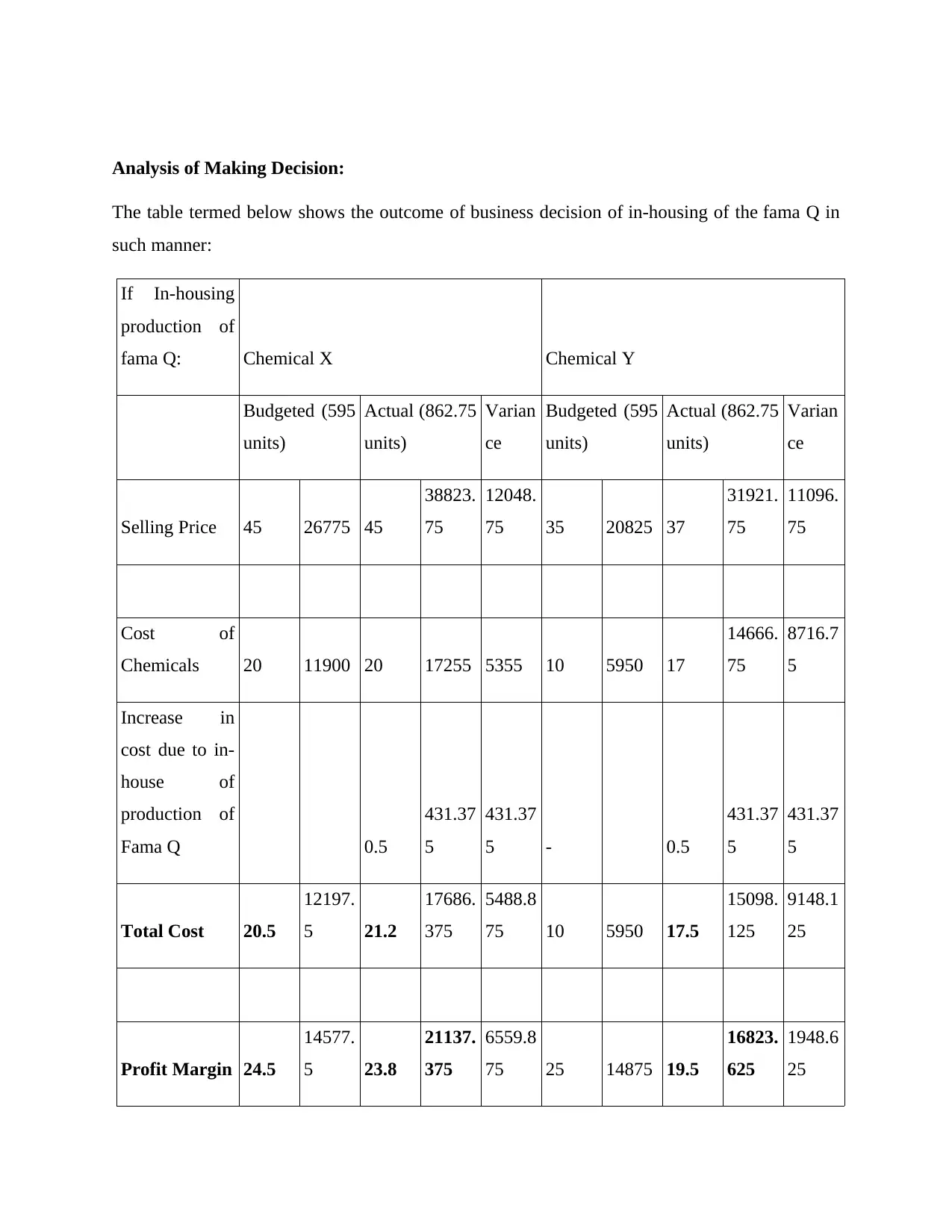
The table termed below shows the outcome of business decision of in-housing of the fama Q in
such manner:
If In-housing
production of
fama Q: Chemical X Chemical Y
Budgeted (595
units)
Actual (862.75
units)
Varian
ce
Budgeted (595
units)
Actual (862.75
units)
Varian
ce
Selling Price 45 26775 45
38823.
75
12048.
75 35 20825 37
31921.
75
11096.
75
Cost of
Chemicals 20 11900 20 17255 5355 10 5950 17
14666.
75
8716.7
5
Increase in
cost due to in-
house of
production of
Fama Q 0.5
431.37
5
431.37
5 - 0.5
431.37
5
431.37
5
Total Cost 20.5
12197.
5 21.2
17686.
375
5488.8
75 10 5950 17.5
15098.
125
9148.1
25
Profit Margin 24.5
14577.
5 23.8
21137.
375
6559.8
75 25 14875 19.5
16823.
625
1948.6
25
The table termed below shows the outcome of business decision of in-housing of the fama Q in
such manner:
If In-housing
production of
fama Q: Chemical X Chemical Y
Budgeted (595
units)
Actual (862.75
units)
Varian
ce
Budgeted (595
units)
Actual (862.75
units)
Varian
ce
Selling Price 45 26775 45
38823.
75
12048.
75 35 20825 37
31921.
75
11096.
75
Cost of
Chemicals 20 11900 20 17255 5355 10 5950 17
14666.
75
8716.7
5
Increase in
cost due to in-
house of
production of
Fama Q 0.5
431.37
5
431.37
5 - 0.5
431.37
5
431.37
5
Total Cost 20.5
12197.
5 21.2
17686.
375
5488.8
75 10 5950 17.5
15098.
125
9148.1
25
Profit Margin 24.5
14577.
5 23.8
21137.
375
6559.8
75 25 14875 19.5
16823.
625
1948.6
25
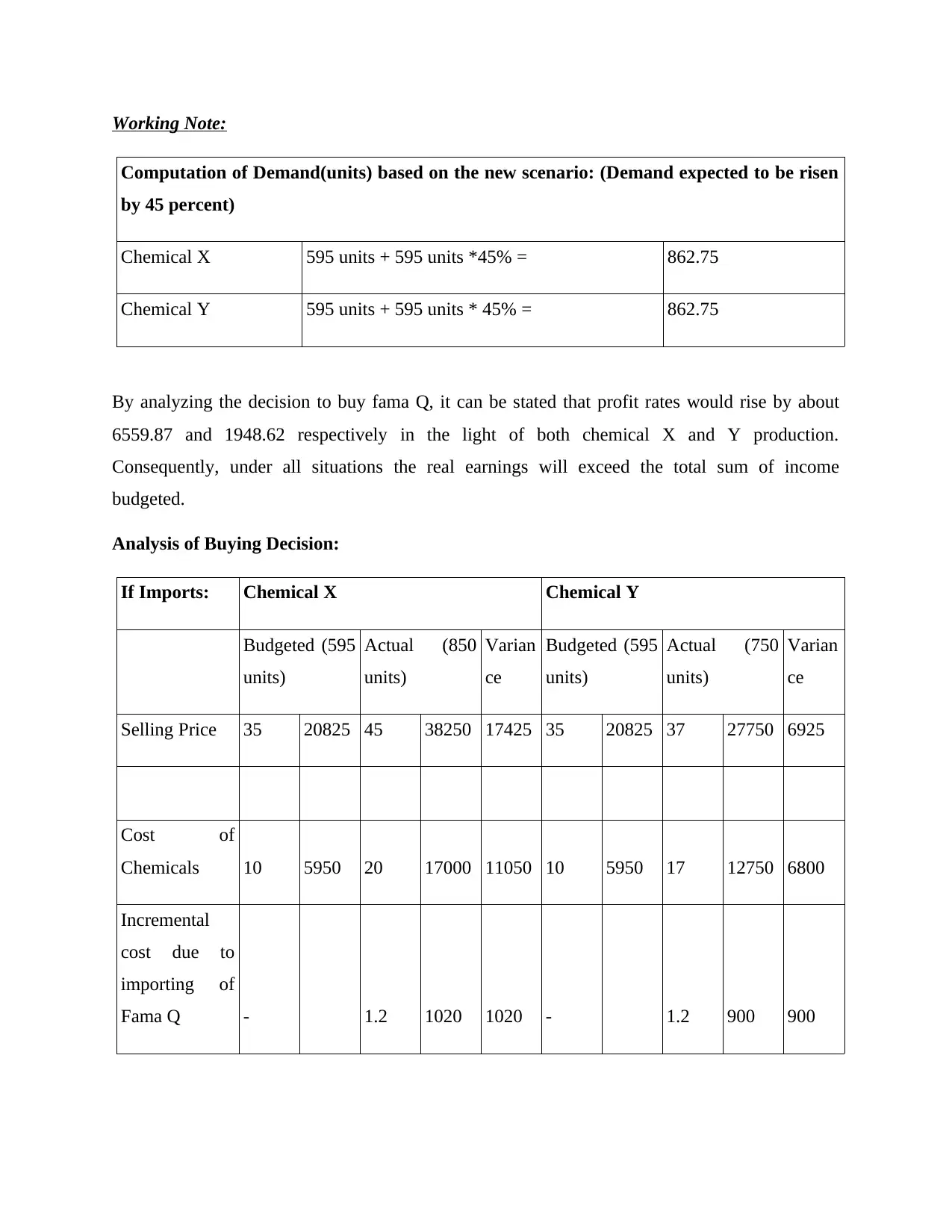
Working Note:
Computation of Demand(units) based on the new scenario: (Demand expected to be risen
by 45 percent)
Chemical X 595 units + 595 units *45% = 862.75
Chemical Y 595 units + 595 units * 45% = 862.75
By analyzing the decision to buy fama Q, it can be stated that profit rates would rise by about
6559.87 and 1948.62 respectively in the light of both chemical X and Y production.
Consequently, under all situations the real earnings will exceed the total sum of income
budgeted.
Analysis of Buying Decision:
If Imports: Chemical X Chemical Y
Budgeted (595
units)
Actual (850
units)
Varian
ce
Budgeted (595
units)
Actual (750
units)
Varian
ce
Selling Price 35 20825 45 38250 17425 35 20825 37 27750 6925
Cost of
Chemicals 10 5950 20 17000 11050 10 5950 17 12750 6800
Incremental
cost due to
importing of
Fama Q - 1.2 1020 1020 - 1.2 900 900
Computation of Demand(units) based on the new scenario: (Demand expected to be risen
by 45 percent)
Chemical X 595 units + 595 units *45% = 862.75
Chemical Y 595 units + 595 units * 45% = 862.75
By analyzing the decision to buy fama Q, it can be stated that profit rates would rise by about
6559.87 and 1948.62 respectively in the light of both chemical X and Y production.
Consequently, under all situations the real earnings will exceed the total sum of income
budgeted.
Analysis of Buying Decision:
If Imports: Chemical X Chemical Y
Budgeted (595
units)
Actual (850
units)
Varian
ce
Budgeted (595
units)
Actual (750
units)
Varian
ce
Selling Price 35 20825 45 38250 17425 35 20825 37 27750 6925
Cost of
Chemicals 10 5950 20 17000 11050 10 5950 17 12750 6800
Incremental
cost due to
importing of
Fama Q - 1.2 1020 1020 - 1.2 900 900
⊘ This is a preview!⊘
Do you want full access?
Subscribe today to unlock all pages.
Trusted by 1+ million students worldwide

1 out of 14


Related Documents


Your All-in-One AI-Powered Toolkit for Academic Success.
+13062052269
info@desklib.com
Available 24*7 on WhatsApp / Email
![[object Object]](/_next/static/media/star-bottom.7253800d.svg)
Unlock your academic potential
Copyright © 2020–2026 A2Z Services. All Rights Reserved. Developed and managed by ZUCOL.