Strategic Analysis of Nutrition and Healthy Eating in Aged Care
VerifiedAdded on 2023/01/20
|32
|7768
|65
Report
AI Summary
This report provides a comprehensive strategic analysis of nutrition and healthy eating in aged care facilities. It begins with an introduction to the importance of nutrition for the elderly, demographic changes in Australia, and the specific nutritional requirements of the aged population. The discussion covers the external environment, including political, economic, social, technological, legal, and environmental factors (PESTLE analysis). The report examines stakeholder influences and governmental approaches to aged care, including food safety standards and theoretical considerations. The report also offers generic strategies for providing healthcare services and concludes with recommendations for future strategies, emphasizing the need for culturally sensitive approaches, improved food service, and effective management to enhance the quality of life for residents in aged care facilities. The analysis underscores the critical role of nutrition in supporting the health and well-being of the elderly population.
Running head: MANAGEMENT
Nutrition and healthy eating in aged care facilities
Name of the student:
Name of the university:
Author note:
Nutrition and healthy eating in aged care facilities
Name of the student:
Name of the university:
Author note:

Paraphrase This Document
Need a fresh take? Get an instant paraphrase of this document with our AI Paraphraser
1
MANAGEMENT
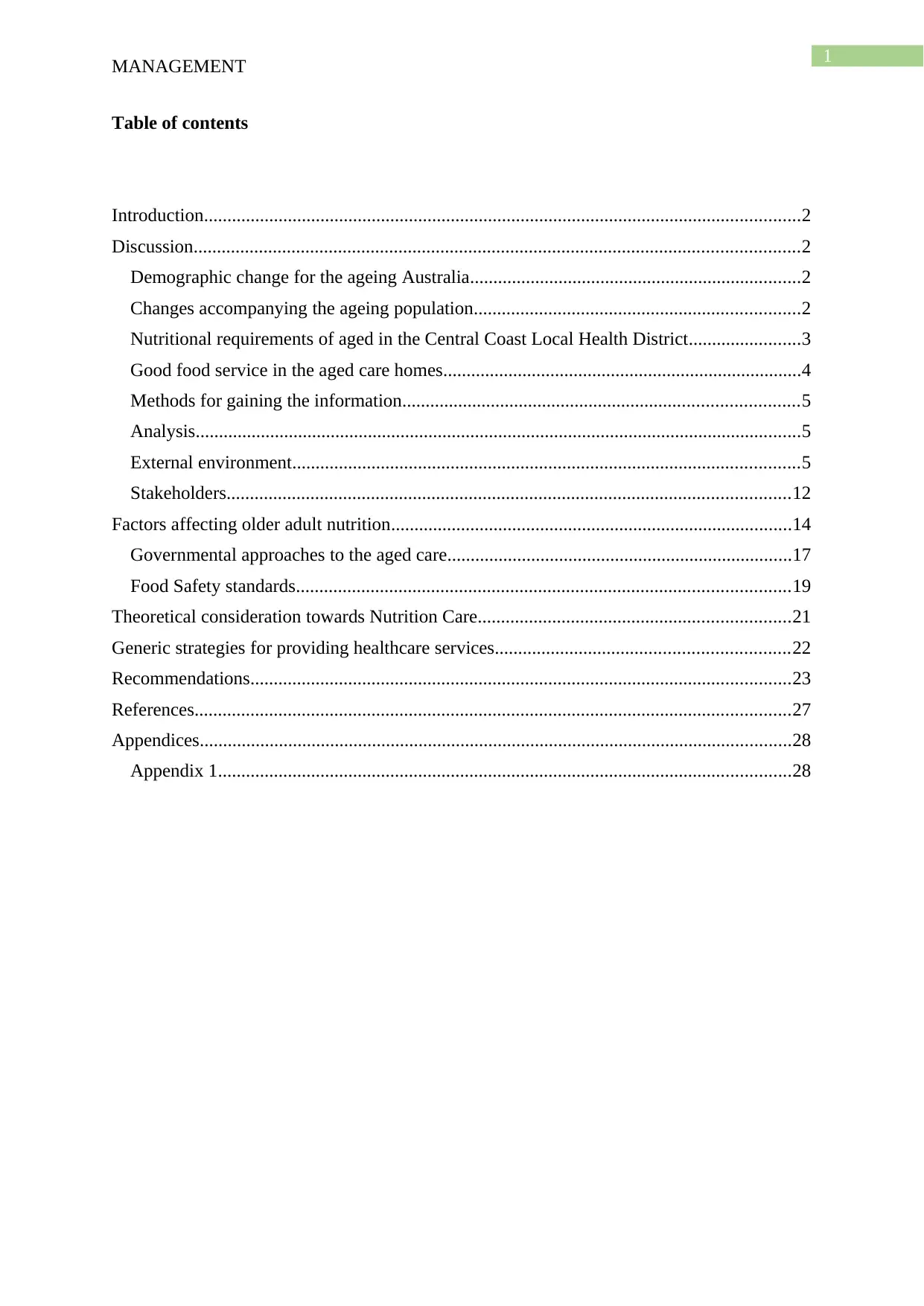
Table of contents
Introduction................................................................................................................................2
Discussion..................................................................................................................................2
Demographic change for the ageing Australia.......................................................................2
Changes accompanying the ageing population......................................................................2
Nutritional requirements of aged in the Central Coast Local Health District........................3
Good food service in the aged care homes.............................................................................4
Methods for gaining the information.....................................................................................5
Analysis..................................................................................................................................5
External environment.............................................................................................................5
Stakeholders.........................................................................................................................12
Factors affecting older adult nutrition......................................................................................14
Governmental approaches to the aged care..........................................................................17
Food Safety standards..........................................................................................................19
Theoretical consideration towards Nutrition Care...................................................................21
Generic strategies for providing healthcare services...............................................................22
Recommendations....................................................................................................................23
References................................................................................................................................27
Appendices...............................................................................................................................28
Appendix 1...........................................................................................................................28
MANAGEMENT
Table of contents
Introduction................................................................................................................................2
Discussion..................................................................................................................................2
Demographic change for the ageing Australia.......................................................................2
Changes accompanying the ageing population......................................................................2
Nutritional requirements of aged in the Central Coast Local Health District........................3
Good food service in the aged care homes.............................................................................4
Methods for gaining the information.....................................................................................5
Analysis..................................................................................................................................5
External environment.............................................................................................................5
Stakeholders.........................................................................................................................12
Factors affecting older adult nutrition......................................................................................14
Governmental approaches to the aged care..........................................................................17
Food Safety standards..........................................................................................................19
Theoretical consideration towards Nutrition Care...................................................................21
Generic strategies for providing healthcare services...............................................................22
Recommendations....................................................................................................................23
References................................................................................................................................27
Appendices...............................................................................................................................28
Appendix 1...........................................................................................................................28
2
MANAGEMENT
Introduction
Like other countries, aged care homes are the support for the elderly people in
Australia. Day by day the concerns of the care home personnel are increasing in terms of
providing quality care to the patients, especially the older ones. Within this, mention can be
made of food and nutrition, which is needed for enhancing the quality and standards of living
(Nsw.gov.au 2019). Typical reference can be cited of the quality controls and checks, which
is performed for the removing the unnecessary dietary restrictions. Along with this, the
assignment sheds light on the mealtime enjoyment. As a final touch, the assignment proposes
some recommendations regarding the efficient and effective ways and means for fulfilling the
dietary needs of the aged patients.
Discussion
Demographic change for the ageing Australia
According to the Australian bureau of statistics, there has been an unprecedented
increase in the population above 65 years of age. It constitutes one fifth of the population. As
a matter of specification, in 2012, there has been a rise in the population above 65 years from
12% to 18%. There are high chances of the percentage rising to 26%. The percentage can also
fall from 67% to 65% in case of the population aged between 15 and 64 years. By 2051, the
percent can be under 60% (Abs.gov.au 2019). The roots of the ageing populating can be
traced back to the sustainable decline of the birth rate followed by the consequences of the
Second World War. Along with this, immigration of the working age population and
increased longevity also contributes in the factors influencing the demarcation of the ageing
population.
MANAGEMENT
Introduction
Like other countries, aged care homes are the support for the elderly people in
Australia. Day by day the concerns of the care home personnel are increasing in terms of
providing quality care to the patients, especially the older ones. Within this, mention can be
made of food and nutrition, which is needed for enhancing the quality and standards of living
(Nsw.gov.au 2019). Typical reference can be cited of the quality controls and checks, which
is performed for the removing the unnecessary dietary restrictions. Along with this, the
assignment sheds light on the mealtime enjoyment. As a final touch, the assignment proposes
some recommendations regarding the efficient and effective ways and means for fulfilling the
dietary needs of the aged patients.
Discussion
Demographic change for the ageing Australia
According to the Australian bureau of statistics, there has been an unprecedented
increase in the population above 65 years of age. It constitutes one fifth of the population. As
a matter of specification, in 2012, there has been a rise in the population above 65 years from
12% to 18%. There are high chances of the percentage rising to 26%. The percentage can also
fall from 67% to 65% in case of the population aged between 15 and 64 years. By 2051, the
percent can be under 60% (Abs.gov.au 2019). The roots of the ageing populating can be
traced back to the sustainable decline of the birth rate followed by the consequences of the
Second World War. Along with this, immigration of the working age population and
increased longevity also contributes in the factors influencing the demarcation of the ageing
population.
⊘ This is a preview!⊘
Do you want full access?
Subscribe today to unlock all pages.

Trusted by 1+ million students worldwide
3
MANAGEMENT
Changes accompanying the ageing population
The ageing of the population goes simultaneously with that of the social, economic
and technological change. Approach towards these changes reflects the kind of treatment,
which the older people would receive in the age of machines. Technological advances have
altered the means of treatment, family lifestyles and the work patterns. Change in the family
structure have adversely affected the incomes and the lifestyle, simultaneously altering the
nature of balance between the formal and the informal care in the aged care homes.
Retirement incomes are crucial aspect in terms of alleviating poverty and securing the
standards of living for the older people. Conscious approach of the caregivers in this aspect
proves beneficial in terms of contributing to the economic growth. With the increase of
longevity, the expectations related to income are increasing (Abs.gov.au 2019).
Nutritional requirements of aged in the Central Coast Local Health District
According to the dieticians, the aged need less protein, vitamins and minerals than the
younger. On the contrary, the aged people need more protein, vitamins and minerals for
tissue repair and maintenance instead of growth. The common sources of protein are meat,
chicken, fish, eggs, cheese, milk, custard and legumes. As the residents of the care home
grow old, the need for vitamins and minerals maintain a consistency in terms of the health.
Instead, the requirement for nutrients like magnesium, zinc, vitamin E, vitamin A, folate and
vitamin b12 increases. Along with the proteins, the requirements for calorie also increases in
case of the aged people. The major drive behind this is the disease like Parkinson’s disease.
Mention can be made of the aged patients suffering from dementia, who lose weight in spite
of having ample quantities of food (Cclhd.health.nsw.gov.au 2019).
The nutritional requirements vary from person to person. This is in terms of the body
size, activity, gender and the illness they suffer. It is during the time of illness and infections,
in which the food requirements increase. This is the case also during the time when healing
MANAGEMENT
Changes accompanying the ageing population
The ageing of the population goes simultaneously with that of the social, economic
and technological change. Approach towards these changes reflects the kind of treatment,
which the older people would receive in the age of machines. Technological advances have
altered the means of treatment, family lifestyles and the work patterns. Change in the family
structure have adversely affected the incomes and the lifestyle, simultaneously altering the
nature of balance between the formal and the informal care in the aged care homes.
Retirement incomes are crucial aspect in terms of alleviating poverty and securing the
standards of living for the older people. Conscious approach of the caregivers in this aspect
proves beneficial in terms of contributing to the economic growth. With the increase of
longevity, the expectations related to income are increasing (Abs.gov.au 2019).
Nutritional requirements of aged in the Central Coast Local Health District
According to the dieticians, the aged need less protein, vitamins and minerals than the
younger. On the contrary, the aged people need more protein, vitamins and minerals for
tissue repair and maintenance instead of growth. The common sources of protein are meat,
chicken, fish, eggs, cheese, milk, custard and legumes. As the residents of the care home
grow old, the need for vitamins and minerals maintain a consistency in terms of the health.
Instead, the requirement for nutrients like magnesium, zinc, vitamin E, vitamin A, folate and
vitamin b12 increases. Along with the proteins, the requirements for calorie also increases in
case of the aged people. The major drive behind this is the disease like Parkinson’s disease.
Mention can be made of the aged patients suffering from dementia, who lose weight in spite
of having ample quantities of food (Cclhd.health.nsw.gov.au 2019).
The nutritional requirements vary from person to person. This is in terms of the body
size, activity, gender and the illness they suffer. It is during the time of illness and infections,
in which the food requirements increase. This is the case also during the time when healing
Paraphrase This Document
Need a fresh take? Get an instant paraphrase of this document with our AI Paraphraser
4
MANAGEMENT
takes place. The program, “One serve fits all” is not adequate in terms of fulfilling the
nutritional needs of all of the residents in the care home. Therefore, arrangements are made
so that lot of fluids and protein enriched foods can be given to the patients. Tests are
conducted before planning the diet. If it is seen that the residents have poor appetite, too tired
and have increased nutritional required, it is considered that they are suffering from
malnutrition. Along with this, experiments are conducted for detecting the main reasons for
weight loss.
This assignment would deal with the issues encountered by the aged in terms of
swallowing problem. As per the revelations of Nsw.gov.au (2019), physiological and
psychological changes like reduced smell and taste reduces the appetite of the aged people.
Socio-cultural factors adversely affects the food and nutrition planning. This is in terms of the
surrounding environment in which the care is provided. Here, mention can be made of the
technologies, which results in the formation of the implicit ideologies and symbols. Typical
evidence of this lies in sitting together and consuming the meals, which develops a sense of
emotional attachment.
Good food service in the aged care homes
In the process of residential care, conscious and rational approach is exposed for the
fulfilling the dietary needs of the patients, especially the elder ones. The main focus here is to
enhancing the standards and quality of living. This is carried out through the means of
renovating the design of the building and upgrading the approach towards providing care.
This upgradation is achieved through the means of training the staffs about the best methods
to take care of the dietary needs of the aged (Cclhd.health.nsw.gov.au 2019).
As a matter of specification, the typical components of the aged care approach include
freshly cooked food in well lighted kitchen, Separate kitchens is fruitful in terms of preparing
MANAGEMENT
takes place. The program, “One serve fits all” is not adequate in terms of fulfilling the
nutritional needs of all of the residents in the care home. Therefore, arrangements are made
so that lot of fluids and protein enriched foods can be given to the patients. Tests are
conducted before planning the diet. If it is seen that the residents have poor appetite, too tired
and have increased nutritional required, it is considered that they are suffering from
malnutrition. Along with this, experiments are conducted for detecting the main reasons for
weight loss.
This assignment would deal with the issues encountered by the aged in terms of
swallowing problem. As per the revelations of Nsw.gov.au (2019), physiological and
psychological changes like reduced smell and taste reduces the appetite of the aged people.
Socio-cultural factors adversely affects the food and nutrition planning. This is in terms of the
surrounding environment in which the care is provided. Here, mention can be made of the
technologies, which results in the formation of the implicit ideologies and symbols. Typical
evidence of this lies in sitting together and consuming the meals, which develops a sense of
emotional attachment.
Good food service in the aged care homes
In the process of residential care, conscious and rational approach is exposed for the
fulfilling the dietary needs of the patients, especially the elder ones. The main focus here is to
enhancing the standards and quality of living. This is carried out through the means of
renovating the design of the building and upgrading the approach towards providing care.
This upgradation is achieved through the means of training the staffs about the best methods
to take care of the dietary needs of the aged (Cclhd.health.nsw.gov.au 2019).
As a matter of specification, the typical components of the aged care approach include
freshly cooked food in well lighted kitchen, Separate kitchens is fruitful in terms of preparing
5
MANAGEMENT
the foods according to the individual needs of the aged patients. These aspects reflect the
flexible choices, which the patients have in terms of availing the healthcare services. Skilled
and qualified chefs are hired for preparing the meals for the aged patients. Regular check-ups
are performed on the patients to ensure that they are getting the nutrition according to the
requirements. In this, courteous approach is maintained for gaining an insight into the issues,
which the aged patients are facing in the treatment.
It has been seen that when the patients moves into the nursing home, they dislike the
food. This is in terms of venturing into a strange and unfamiliar environment with lack of
support. For dealing with the situation, ethnic food options are provided to the patients.
Rationality and consciousness in this direction is assistance in terms of gaining trust, loyalty
and dependence from the patients (Cclhd.health.nsw.gov.au 2019).
Methods for gaining the information
Information related to the diet of the aged people can be accessed by logging into the
government website. Along with this, journal articles consisting of the scholarly reviews on
the diets of the aged people is also helpful. Visiting the aged care homes and interviewing the
managers also enhances the awareness about the steps undertaken for fulfilling the dietary
requirements. Apart from this, mention can be made of the statistical data, which reflects the
transformation in the health conditions of the aged patients. Consideration of the inclusion
and exclusion criteria while selecting the articles and journals is assistance in terms of
establishing relevance and reliability in the research process.
MANAGEMENT
the foods according to the individual needs of the aged patients. These aspects reflect the
flexible choices, which the patients have in terms of availing the healthcare services. Skilled
and qualified chefs are hired for preparing the meals for the aged patients. Regular check-ups
are performed on the patients to ensure that they are getting the nutrition according to the
requirements. In this, courteous approach is maintained for gaining an insight into the issues,
which the aged patients are facing in the treatment.
It has been seen that when the patients moves into the nursing home, they dislike the
food. This is in terms of venturing into a strange and unfamiliar environment with lack of
support. For dealing with the situation, ethnic food options are provided to the patients.
Rationality and consciousness in this direction is assistance in terms of gaining trust, loyalty
and dependence from the patients (Cclhd.health.nsw.gov.au 2019).
Methods for gaining the information
Information related to the diet of the aged people can be accessed by logging into the
government website. Along with this, journal articles consisting of the scholarly reviews on
the diets of the aged people is also helpful. Visiting the aged care homes and interviewing the
managers also enhances the awareness about the steps undertaken for fulfilling the dietary
requirements. Apart from this, mention can be made of the statistical data, which reflects the
transformation in the health conditions of the aged patients. Consideration of the inclusion
and exclusion criteria while selecting the articles and journals is assistance in terms of
establishing relevance and reliability in the research process.
⊘ This is a preview!⊘
Do you want full access?
Subscribe today to unlock all pages.
Trusted by 1+ million students worldwide
6
MANAGEMENT
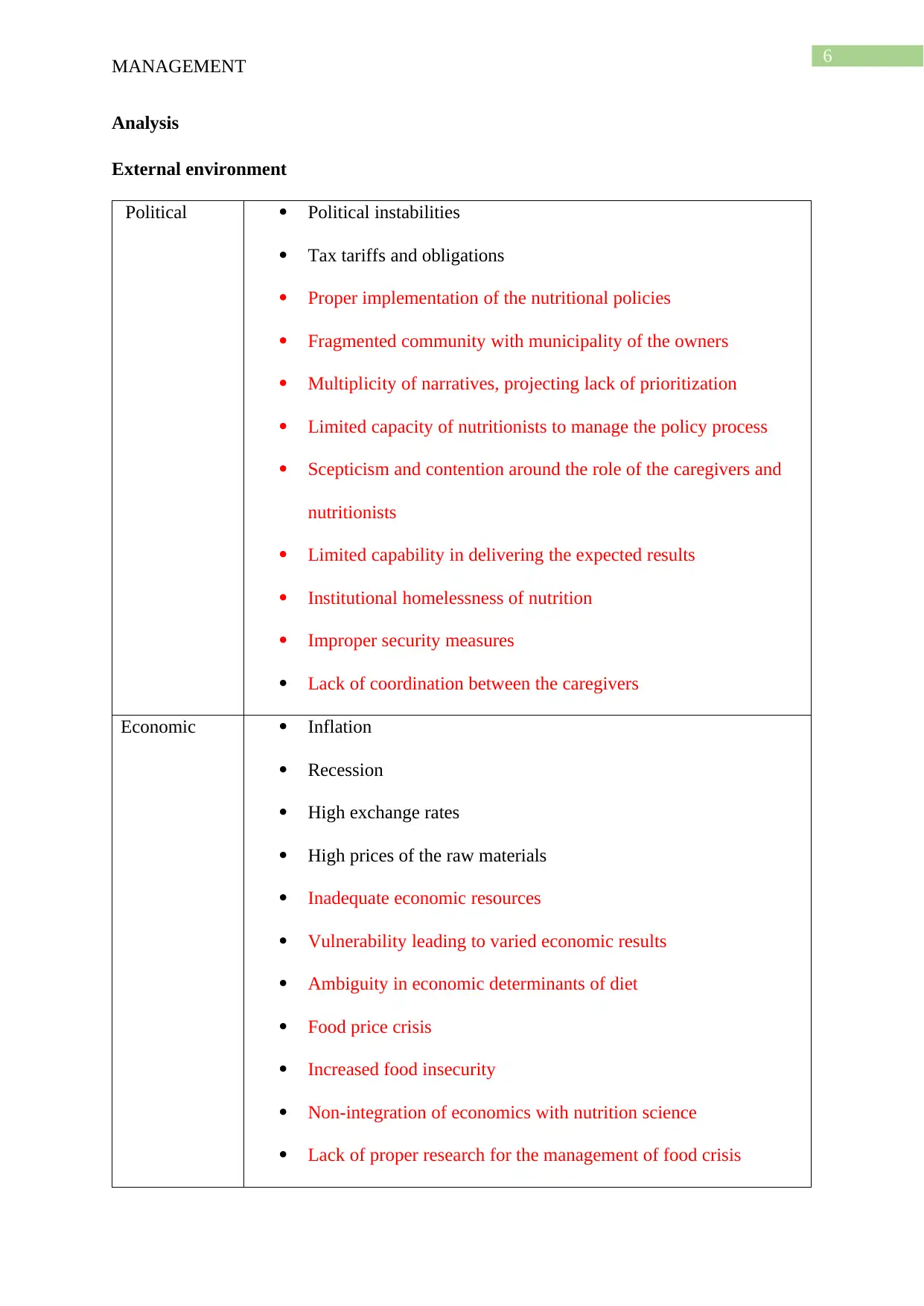
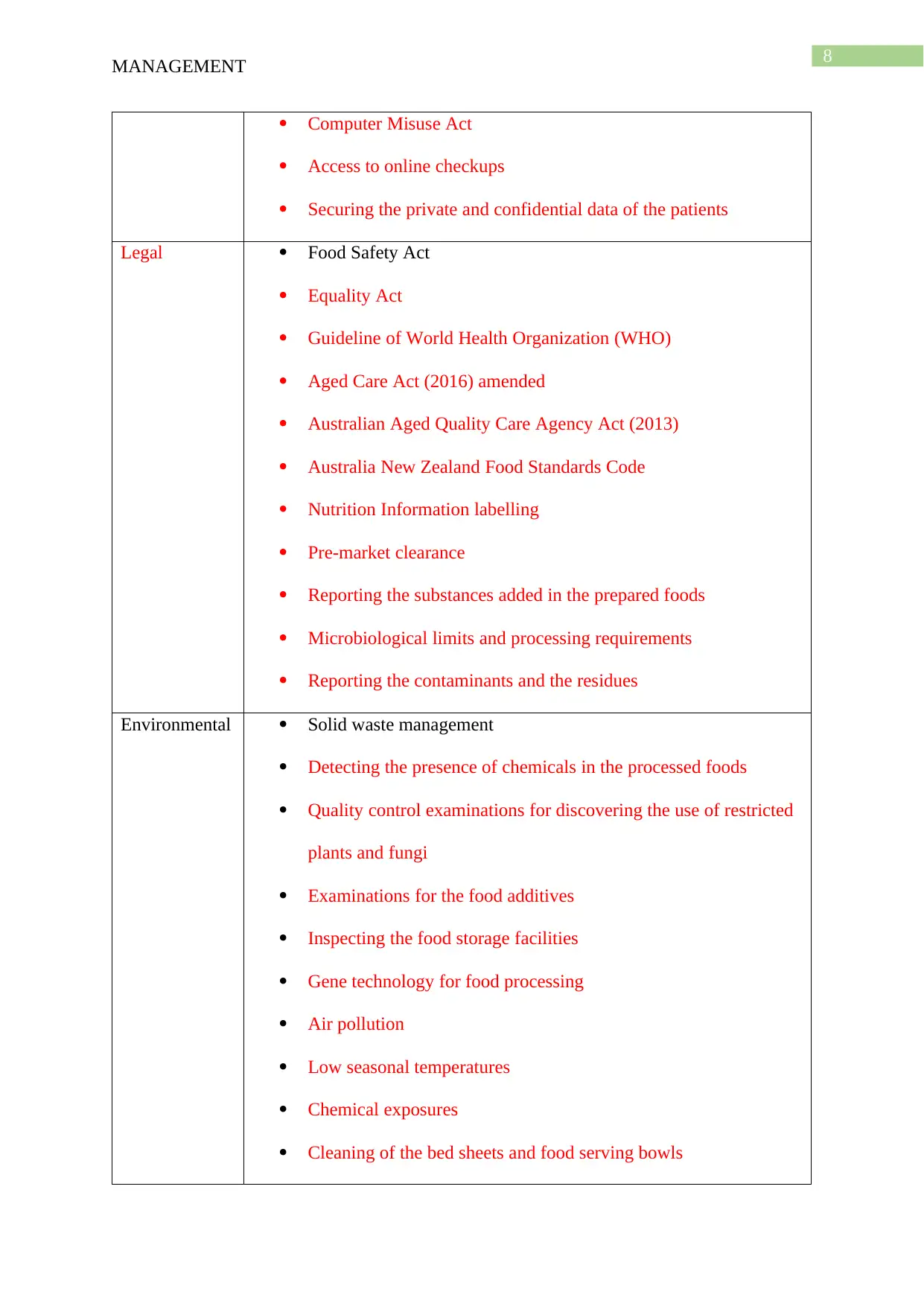
Analysis
External environment
Political Political instabilities
Tax tariffs and obligations
Proper implementation of the nutritional policies
Fragmented community with municipality of the owners
Multiplicity of narratives, projecting lack of prioritization
Limited capacity of nutritionists to manage the policy process
Scepticism and contention around the role of the caregivers and
nutritionists
Limited capability in delivering the expected results
Institutional homelessness of nutrition
Improper security measures
Lack of coordination between the caregivers
Economic Inflation
Recession
High exchange rates
High prices of the raw materials
Inadequate economic resources
Vulnerability leading to varied economic results
Ambiguity in economic determinants of diet
Food price crisis
Increased food insecurity
Non-integration of economics with nutrition science
Lack of proper research for the management of food crisis
MANAGEMENT
Analysis
External environment
Political Political instabilities
Tax tariffs and obligations
Proper implementation of the nutritional policies
Fragmented community with municipality of the owners
Multiplicity of narratives, projecting lack of prioritization
Limited capacity of nutritionists to manage the policy process
Scepticism and contention around the role of the caregivers and
nutritionists
Limited capability in delivering the expected results
Institutional homelessness of nutrition
Improper security measures
Lack of coordination between the caregivers
Economic Inflation
Recession
High exchange rates
High prices of the raw materials
Inadequate economic resources
Vulnerability leading to varied economic results
Ambiguity in economic determinants of diet
Food price crisis
Increased food insecurity
Non-integration of economics with nutrition science
Lack of proper research for the management of food crisis
Paraphrase This Document
Need a fresh take? Get an instant paraphrase of this document with our AI Paraphraser
7
MANAGEMENT
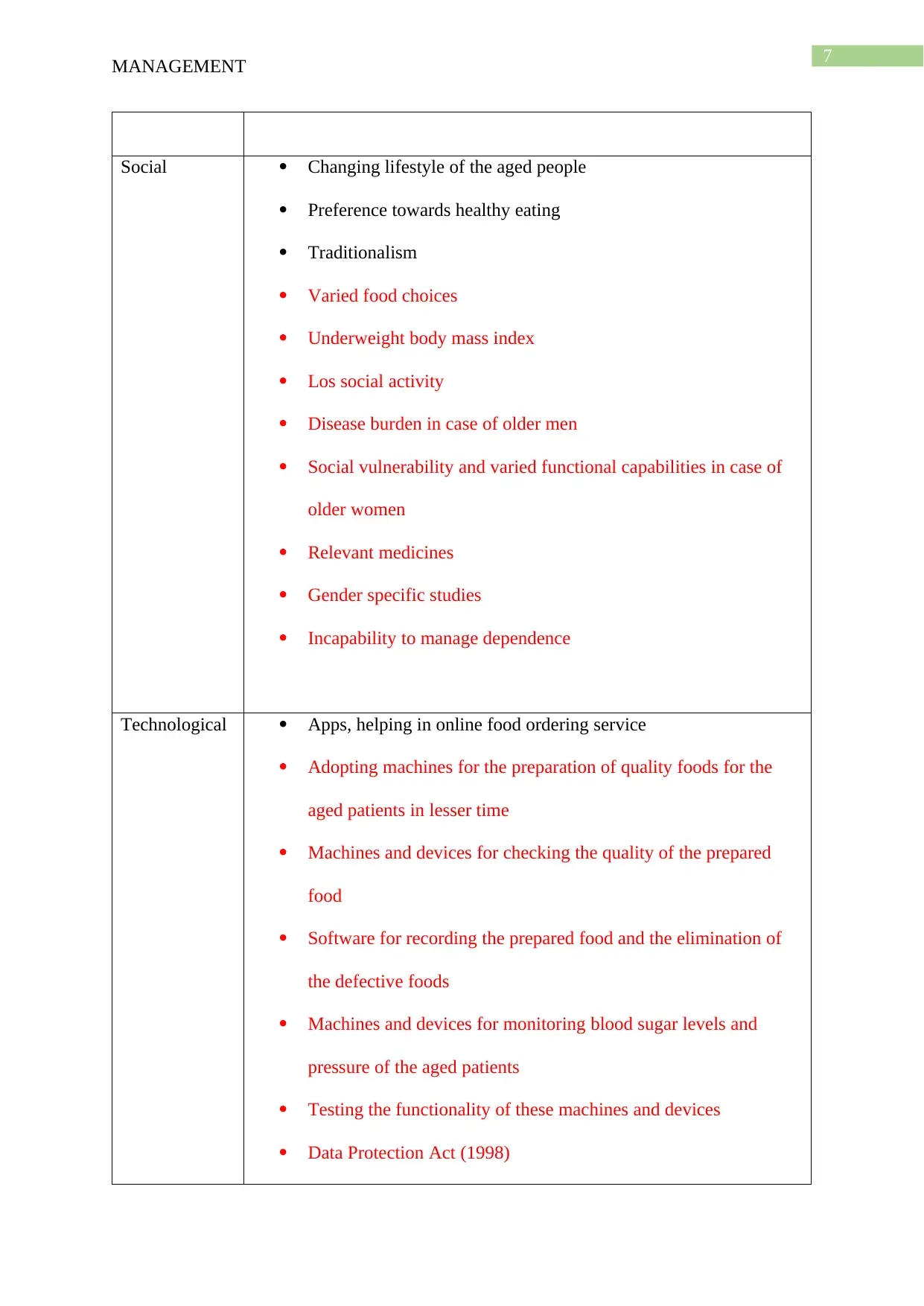
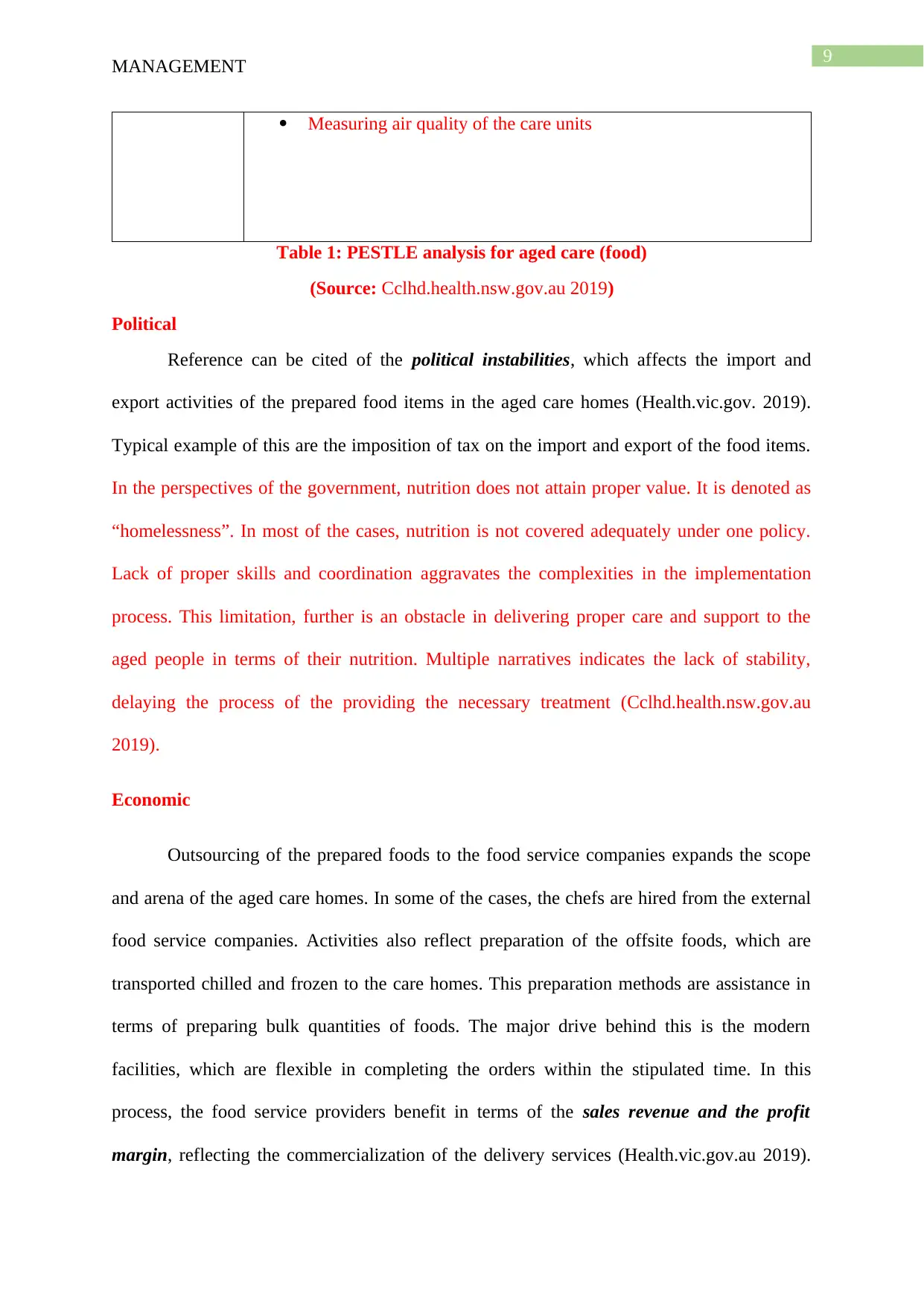
Social Changing lifestyle of the aged people
Preference towards healthy eating
Traditionalism
Varied food choices
Underweight body mass index
Los social activity
Disease burden in case of older men
Social vulnerability and varied functional capabilities in case of
older women
Relevant medicines
Gender specific studies
Incapability to manage dependence
Technological Apps, helping in online food ordering service
Adopting machines for the preparation of quality foods for the
aged patients in lesser time
Machines and devices for checking the quality of the prepared
food
Software for recording the prepared food and the elimination of
the defective foods
Machines and devices for monitoring blood sugar levels and
pressure of the aged patients
Testing the functionality of these machines and devices
Data Protection Act (1998)
MANAGEMENT
Social Changing lifestyle of the aged people
Preference towards healthy eating
Traditionalism
Varied food choices
Underweight body mass index
Los social activity
Disease burden in case of older men
Social vulnerability and varied functional capabilities in case of
older women
Relevant medicines
Gender specific studies
Incapability to manage dependence
Technological Apps, helping in online food ordering service
Adopting machines for the preparation of quality foods for the
aged patients in lesser time
Machines and devices for checking the quality of the prepared
food
Software for recording the prepared food and the elimination of
the defective foods
Machines and devices for monitoring blood sugar levels and
pressure of the aged patients
Testing the functionality of these machines and devices
Data Protection Act (1998)
8
MANAGEMENT
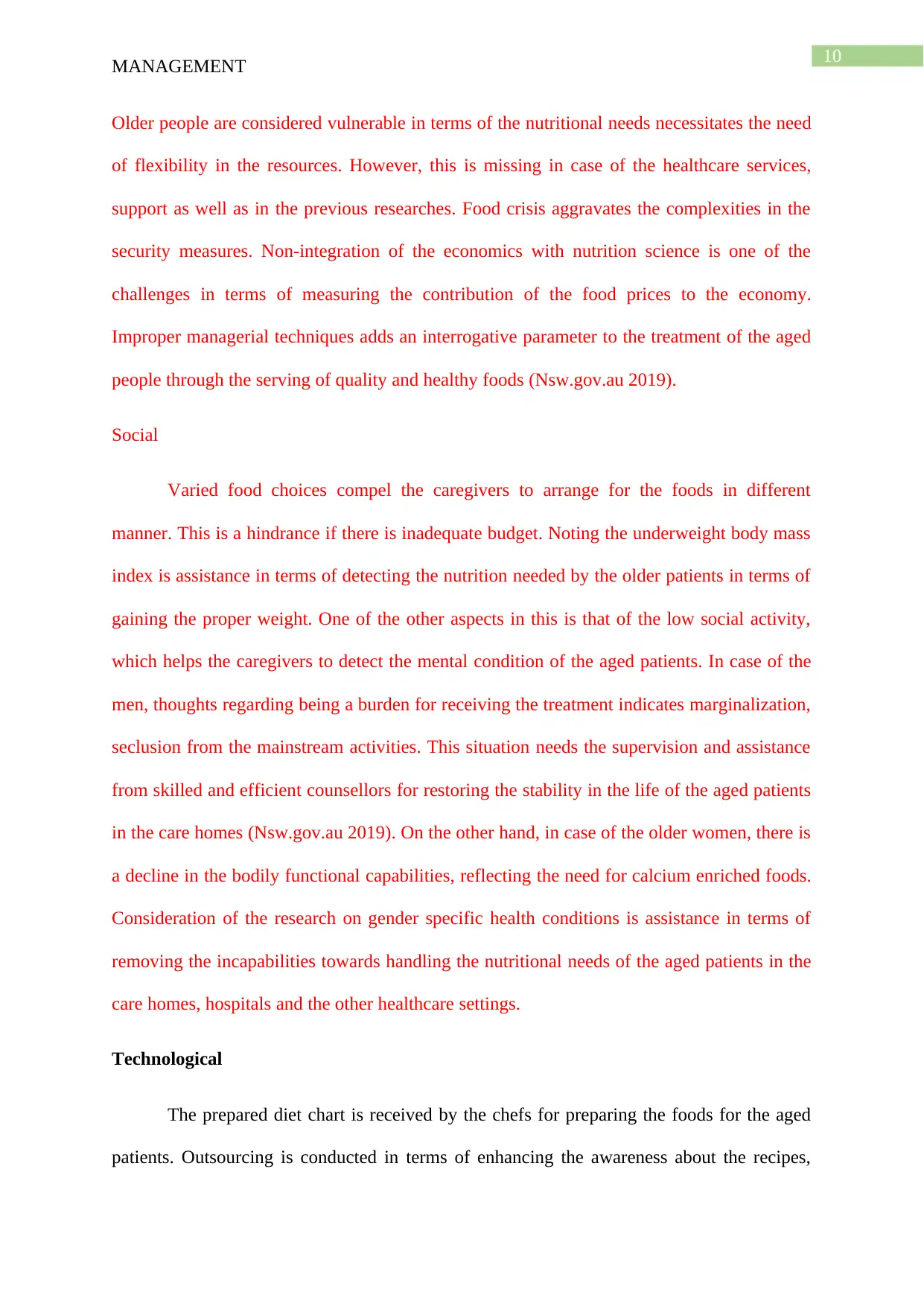
Computer Misuse Act
Access to online checkups
Securing the private and confidential data of the patients
Legal Food Safety Act
Equality Act
Guideline of World Health Organization (WHO)
Aged Care Act (2016) amended
Australian Aged Quality Care Agency Act (2013)
Australia New Zealand Food Standards Code
Nutrition Information labelling
Pre-market clearance
Reporting the substances added in the prepared foods
Microbiological limits and processing requirements
Reporting the contaminants and the residues
Environmental Solid waste management
Detecting the presence of chemicals in the processed foods
Quality control examinations for discovering the use of restricted
plants and fungi
Examinations for the food additives
Inspecting the food storage facilities
Gene technology for food processing
Air pollution
Low seasonal temperatures
Chemical exposures
Cleaning of the bed sheets and food serving bowls
MANAGEMENT
Computer Misuse Act
Access to online checkups
Securing the private and confidential data of the patients
Legal Food Safety Act
Equality Act
Guideline of World Health Organization (WHO)
Aged Care Act (2016) amended
Australian Aged Quality Care Agency Act (2013)
Australia New Zealand Food Standards Code
Nutrition Information labelling
Pre-market clearance
Reporting the substances added in the prepared foods
Microbiological limits and processing requirements
Reporting the contaminants and the residues
Environmental Solid waste management
Detecting the presence of chemicals in the processed foods
Quality control examinations for discovering the use of restricted
plants and fungi
Examinations for the food additives
Inspecting the food storage facilities
Gene technology for food processing
Air pollution
Low seasonal temperatures
Chemical exposures
Cleaning of the bed sheets and food serving bowls
⊘ This is a preview!⊘
Do you want full access?
Subscribe today to unlock all pages.
Trusted by 1+ million students worldwide
9
MANAGEMENT
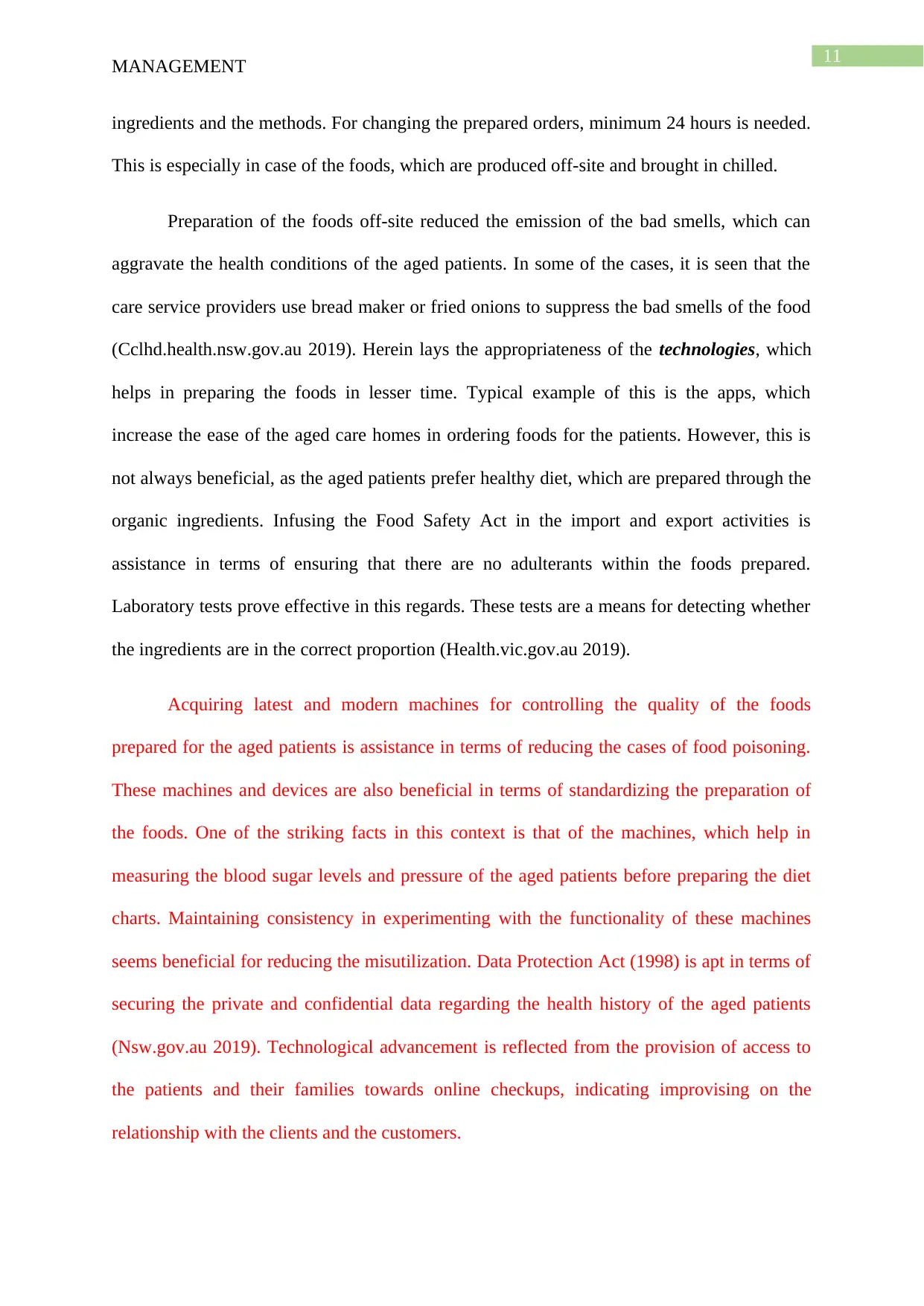
Measuring air quality of the care units
Table 1: PESTLE analysis for aged care (food)
(Source: Cclhd.health.nsw.gov.au 2019)
Political
Reference can be cited of the political instabilities, which affects the import and
export activities of the prepared food items in the aged care homes (Health.vic.gov. 2019).
Typical example of this are the imposition of tax on the import and export of the food items.
In the perspectives of the government, nutrition does not attain proper value. It is denoted as
“homelessness”. In most of the cases, nutrition is not covered adequately under one policy.
Lack of proper skills and coordination aggravates the complexities in the implementation
process. This limitation, further is an obstacle in delivering proper care and support to the
aged people in terms of their nutrition. Multiple narratives indicates the lack of stability,
delaying the process of the providing the necessary treatment (Cclhd.health.nsw.gov.au
2019).
Economic
Outsourcing of the prepared foods to the food service companies expands the scope
and arena of the aged care homes. In some of the cases, the chefs are hired from the external
food service companies. Activities also reflect preparation of the offsite foods, which are
transported chilled and frozen to the care homes. This preparation methods are assistance in
terms of preparing bulk quantities of foods. The major drive behind this is the modern
facilities, which are flexible in completing the orders within the stipulated time. In this
process, the food service providers benefit in terms of the sales revenue and the profit
margin, reflecting the commercialization of the delivery services (Health.vic.gov.au 2019).
MANAGEMENT
Measuring air quality of the care units
Table 1: PESTLE analysis for aged care (food)
(Source: Cclhd.health.nsw.gov.au 2019)
Political
Reference can be cited of the political instabilities, which affects the import and
export activities of the prepared food items in the aged care homes (Health.vic.gov. 2019).
Typical example of this are the imposition of tax on the import and export of the food items.
In the perspectives of the government, nutrition does not attain proper value. It is denoted as
“homelessness”. In most of the cases, nutrition is not covered adequately under one policy.
Lack of proper skills and coordination aggravates the complexities in the implementation
process. This limitation, further is an obstacle in delivering proper care and support to the
aged people in terms of their nutrition. Multiple narratives indicates the lack of stability,
delaying the process of the providing the necessary treatment (Cclhd.health.nsw.gov.au
2019).
Economic
Outsourcing of the prepared foods to the food service companies expands the scope
and arena of the aged care homes. In some of the cases, the chefs are hired from the external
food service companies. Activities also reflect preparation of the offsite foods, which are
transported chilled and frozen to the care homes. This preparation methods are assistance in
terms of preparing bulk quantities of foods. The major drive behind this is the modern
facilities, which are flexible in completing the orders within the stipulated time. In this
process, the food service providers benefit in terms of the sales revenue and the profit
margin, reflecting the commercialization of the delivery services (Health.vic.gov.au 2019).
Paraphrase This Document
Need a fresh take? Get an instant paraphrase of this document with our AI Paraphraser
10
MANAGEMENT
Older people are considered vulnerable in terms of the nutritional needs necessitates the need
of flexibility in the resources. However, this is missing in case of the healthcare services,
support as well as in the previous researches. Food crisis aggravates the complexities in the
security measures. Non-integration of the economics with nutrition science is one of the
challenges in terms of measuring the contribution of the food prices to the economy.
Improper managerial techniques adds an interrogative parameter to the treatment of the aged
people through the serving of quality and healthy foods (Nsw.gov.au 2019).
Social
Varied food choices compel the caregivers to arrange for the foods in different
manner. This is a hindrance if there is inadequate budget. Noting the underweight body mass
index is assistance in terms of detecting the nutrition needed by the older patients in terms of
gaining the proper weight. One of the other aspects in this is that of the low social activity,
which helps the caregivers to detect the mental condition of the aged patients. In case of the
men, thoughts regarding being a burden for receiving the treatment indicates marginalization,
seclusion from the mainstream activities. This situation needs the supervision and assistance
from skilled and efficient counsellors for restoring the stability in the life of the aged patients
in the care homes (Nsw.gov.au 2019). On the other hand, in case of the older women, there is
a decline in the bodily functional capabilities, reflecting the need for calcium enriched foods.
Consideration of the research on gender specific health conditions is assistance in terms of
removing the incapabilities towards handling the nutritional needs of the aged patients in the
care homes, hospitals and the other healthcare settings.
Technological
The prepared diet chart is received by the chefs for preparing the foods for the aged
patients. Outsourcing is conducted in terms of enhancing the awareness about the recipes,
MANAGEMENT
Older people are considered vulnerable in terms of the nutritional needs necessitates the need
of flexibility in the resources. However, this is missing in case of the healthcare services,
support as well as in the previous researches. Food crisis aggravates the complexities in the
security measures. Non-integration of the economics with nutrition science is one of the
challenges in terms of measuring the contribution of the food prices to the economy.
Improper managerial techniques adds an interrogative parameter to the treatment of the aged
people through the serving of quality and healthy foods (Nsw.gov.au 2019).
Social
Varied food choices compel the caregivers to arrange for the foods in different
manner. This is a hindrance if there is inadequate budget. Noting the underweight body mass
index is assistance in terms of detecting the nutrition needed by the older patients in terms of
gaining the proper weight. One of the other aspects in this is that of the low social activity,
which helps the caregivers to detect the mental condition of the aged patients. In case of the
men, thoughts regarding being a burden for receiving the treatment indicates marginalization,
seclusion from the mainstream activities. This situation needs the supervision and assistance
from skilled and efficient counsellors for restoring the stability in the life of the aged patients
in the care homes (Nsw.gov.au 2019). On the other hand, in case of the older women, there is
a decline in the bodily functional capabilities, reflecting the need for calcium enriched foods.
Consideration of the research on gender specific health conditions is assistance in terms of
removing the incapabilities towards handling the nutritional needs of the aged patients in the
care homes, hospitals and the other healthcare settings.
Technological
The prepared diet chart is received by the chefs for preparing the foods for the aged
patients. Outsourcing is conducted in terms of enhancing the awareness about the recipes,
11
MANAGEMENT
ingredients and the methods. For changing the prepared orders, minimum 24 hours is needed.
This is especially in case of the foods, which are produced off-site and brought in chilled.
Preparation of the foods off-site reduced the emission of the bad smells, which can
aggravate the health conditions of the aged patients. In some of the cases, it is seen that the
care service providers use bread maker or fried onions to suppress the bad smells of the food
(Cclhd.health.nsw.gov.au 2019). Herein lays the appropriateness of the technologies, which
helps in preparing the foods in lesser time. Typical example of this is the apps, which
increase the ease of the aged care homes in ordering foods for the patients. However, this is
not always beneficial, as the aged patients prefer healthy diet, which are prepared through the
organic ingredients. Infusing the Food Safety Act in the import and export activities is
assistance in terms of ensuring that there are no adulterants within the foods prepared.
Laboratory tests prove effective in this regards. These tests are a means for detecting whether
the ingredients are in the correct proportion (Health.vic.gov.au 2019).
Acquiring latest and modern machines for controlling the quality of the foods
prepared for the aged patients is assistance in terms of reducing the cases of food poisoning.
These machines and devices are also beneficial in terms of standardizing the preparation of
the foods. One of the striking facts in this context is that of the machines, which help in
measuring the blood sugar levels and pressure of the aged patients before preparing the diet
charts. Maintaining consistency in experimenting with the functionality of these machines
seems beneficial for reducing the misutilization. Data Protection Act (1998) is apt in terms of
securing the private and confidential data regarding the health history of the aged patients
(Nsw.gov.au 2019). Technological advancement is reflected from the provision of access to
the patients and their families towards online checkups, indicating improvising on the
relationship with the clients and the customers.
MANAGEMENT
ingredients and the methods. For changing the prepared orders, minimum 24 hours is needed.
This is especially in case of the foods, which are produced off-site and brought in chilled.
Preparation of the foods off-site reduced the emission of the bad smells, which can
aggravate the health conditions of the aged patients. In some of the cases, it is seen that the
care service providers use bread maker or fried onions to suppress the bad smells of the food
(Cclhd.health.nsw.gov.au 2019). Herein lays the appropriateness of the technologies, which
helps in preparing the foods in lesser time. Typical example of this is the apps, which
increase the ease of the aged care homes in ordering foods for the patients. However, this is
not always beneficial, as the aged patients prefer healthy diet, which are prepared through the
organic ingredients. Infusing the Food Safety Act in the import and export activities is
assistance in terms of ensuring that there are no adulterants within the foods prepared.
Laboratory tests prove effective in this regards. These tests are a means for detecting whether
the ingredients are in the correct proportion (Health.vic.gov.au 2019).
Acquiring latest and modern machines for controlling the quality of the foods
prepared for the aged patients is assistance in terms of reducing the cases of food poisoning.
These machines and devices are also beneficial in terms of standardizing the preparation of
the foods. One of the striking facts in this context is that of the machines, which help in
measuring the blood sugar levels and pressure of the aged patients before preparing the diet
charts. Maintaining consistency in experimenting with the functionality of these machines
seems beneficial for reducing the misutilization. Data Protection Act (1998) is apt in terms of
securing the private and confidential data regarding the health history of the aged patients
(Nsw.gov.au 2019). Technological advancement is reflected from the provision of access to
the patients and their families towards online checkups, indicating improvising on the
relationship with the clients and the customers.
⊘ This is a preview!⊘
Do you want full access?
Subscribe today to unlock all pages.
Trusted by 1+ million students worldwide

1 out of 32


Related Documents


Your All-in-One AI-Powered Toolkit for Academic Success.
+13062052269
info@desklib.com
Available 24*7 on WhatsApp / Email
![[object Object]](/_next/static/media/star-bottom.7253800d.svg)
Unlock your academic potential
Copyright © 2020–2026 A2Z Services. All Rights Reserved. Developed and managed by ZUCOL.