British American Tobacco: Management Style Analysis
VerifiedAdded on 2023/01/05
|12
|3972
|34
Report
AI Summary
This report provides a comprehensive analysis of British American Tobacco (BAT), examining its management style, organizational structure, and leadership practices. The report identifies the autocratic management style employed by BAT's CEO and discusses the principles of planning, organizing, leading, and controlling within the company. It evaluates the steps taken to achieve high performance and foster organizational culture, including outlining management plans, establishing rules, distributing work, and allowing for change over time. The impact of the organizational culture on employees is also assessed, highlighting the positive effects of honest performance appraisals and training and development. Furthermore, the report delves into the autocratic leadership style, evaluating its benefits in terms of fast decision-making and improved communication. The report also examines the impacts of power, influence, and conflicts within BAT, emphasizing the importance of delegating authority, providing effective guidance, and resolving conflicts. Finally, it explores different types of motivation used by BAT, including intrinsic and extrinsic motivations, and applies Maslow's theory to understand how the company motivates its employees by addressing their psychological, safety, social, esteem, and self-actualization needs. The report concludes with suggestions to enhance the performance of British American Tobacco.
Organisational
Theory and Practices
Theory and Practices

Paraphrase This Document
Need a fresh take? Get an instant paraphrase of this document with our AI Paraphraser
Table of Contents
INTRODUCTION...........................................................................................................................1
MAIN BODY...................................................................................................................................1
Management style, principles and functions of management used by CEO of company............1
Steps taken in regards to organisational structure to achieve high performance and
organisation culture in organisation and its impact on employees..............................................2
Description of leadership style used by CEO of organisation to enhance the organisational
effectiveness.................................................................................................................................3
Evaluate the impacts of power, influence and conflicts at British American Tobacco...............4
Explain different types of motivation used by British American Tobacco.................................5
Corporate examples for justifying answer...................................................................................7
Suggestions and recommendation to enhance performance of British American Tobacco........8
CONCLUSION ...............................................................................................................................9
REFERENCES..............................................................................................................................10
INTRODUCTION...........................................................................................................................1
MAIN BODY...................................................................................................................................1
Management style, principles and functions of management used by CEO of company............1
Steps taken in regards to organisational structure to achieve high performance and
organisation culture in organisation and its impact on employees..............................................2
Description of leadership style used by CEO of organisation to enhance the organisational
effectiveness.................................................................................................................................3
Evaluate the impacts of power, influence and conflicts at British American Tobacco...............4
Explain different types of motivation used by British American Tobacco.................................5
Corporate examples for justifying answer...................................................................................7
Suggestions and recommendation to enhance performance of British American Tobacco........8
CONCLUSION ...............................................................................................................................9
REFERENCES..............................................................................................................................10
INTRODUCTION
Organisational theory can be defined as the set of concepts which are interrelated, the behaviour
of individuals and groups, who have interaction with each other to perform the tasks with
intension to accomplish the goal (Acharya and Jena, 2016). The company selected for this
project report is BRITISH AMERICAN TOBACCO which is second largest tobacco group,
produces cigarettes which is demanded by adult smokers all over world. The topics focused in
this report are management style, principles and functions of management, steps taken in regards
to organisational structure to achieve high performance of company. Apart from this of
leadership style used by CEO of organisation to enhance the organisational effectiveness is also
focused.
MAIN BODY
Management style, principles and functions of management used by CEO of company.
Management style refers to those specific principles and techniques that managers use to
handle situations that arise during business operations. It includes the decisions that reflects their
leadership style. It involves decisions taken during the execution of their managerial functions of
planning, organising, controlling, etc. Management styles vary with company leadership,
objectives, policies and situation. The management style used by CEO of BRITISH AMERICAN
TOBACCO is Autocratic style (Alonso and Austin, 2017). It is the most pessimistic style of
management. Some leaders are directive autocrats while some are permissive autocrats.
Directive autocrats believe in supervising their subordinates very closely and the subordinates
are required to just follows the orders. Permissive autocrats on the other hand allow little
flexibility to subordinates on the way of performance of directed duty. Although this style
restricts creative freedom, it is suitable when sub-ordinates are inexperienced or the situation
requires quick decision-making. Autocratic managers of British American Tobacco company
believes in taking all the decisions by themselves at the workplace.
Management principles are those means which helps and guides the management in
getting the designated tasks done from others. It includes all those activities that helps in giving
direction to all human endeavours using machines, materials and money to achieve targets and
goals of the company. This framework is often called as aid to executing P-O-L-C i.e. planning,
1
Organisational theory can be defined as the set of concepts which are interrelated, the behaviour
of individuals and groups, who have interaction with each other to perform the tasks with
intension to accomplish the goal (Acharya and Jena, 2016). The company selected for this
project report is BRITISH AMERICAN TOBACCO which is second largest tobacco group,
produces cigarettes which is demanded by adult smokers all over world. The topics focused in
this report are management style, principles and functions of management, steps taken in regards
to organisational structure to achieve high performance of company. Apart from this of
leadership style used by CEO of organisation to enhance the organisational effectiveness is also
focused.
MAIN BODY
Management style, principles and functions of management used by CEO of company.
Management style refers to those specific principles and techniques that managers use to
handle situations that arise during business operations. It includes the decisions that reflects their
leadership style. It involves decisions taken during the execution of their managerial functions of
planning, organising, controlling, etc. Management styles vary with company leadership,
objectives, policies and situation. The management style used by CEO of BRITISH AMERICAN
TOBACCO is Autocratic style (Alonso and Austin, 2017). It is the most pessimistic style of
management. Some leaders are directive autocrats while some are permissive autocrats.
Directive autocrats believe in supervising their subordinates very closely and the subordinates
are required to just follows the orders. Permissive autocrats on the other hand allow little
flexibility to subordinates on the way of performance of directed duty. Although this style
restricts creative freedom, it is suitable when sub-ordinates are inexperienced or the situation
requires quick decision-making. Autocratic managers of British American Tobacco company
believes in taking all the decisions by themselves at the workplace.
Management principles are those means which helps and guides the management in
getting the designated tasks done from others. It includes all those activities that helps in giving
direction to all human endeavours using machines, materials and money to achieve targets and
goals of the company. This framework is often called as aid to executing P-O-L-C i.e. planning,
1
⊘ This is a preview!⊘
Do you want full access?
Subscribe today to unlock all pages.

Trusted by 1+ million students worldwide
organising, leadership and control. The principles on which CEO of BRITISH AMERICAN
TOBACCO works are discussed as follows: Planning- Planning is a preliminary management function aimed at achieving a fixed
objective. Management undertakes planning function for short, medium and long-term
depending on the type of business. Planning is the key to growing a business, which helps
managers of selected company to maintain a business strategy (Billis, 2020). Organizing- It is another management activity that aims at optimum distribution of
resources to carry out specific plan made earlier. It includes activities such as
reorganizing and assigning tasks then grouping them into departments, and ultimately
allocating resources to those departments to carry out those tasks. Leading- It is a very important function which aims at giving directions to activities of
others. With these perspective leaders of BRITISH AMERICAN TOBACCO wants its
employees to contribute to achieving organizational goals. Leading from the front means
that the leader believes in guiding, motivating and influencing others to achieve targets of
organisation. They are the people who can influence others just by showing up in front.
Controlling- It is an important function because it allows for error checking and
corrective action to be taken so that deviations from standards can be restricted to
minimum possible in the direction of achieving the company's set targets. Controlling in
BRITISH AMERICAN TOBACCO is a predictive action, wherein set standards of
control were used only when deviations were spotted.
Steps taken in regards to organisational structure to achieve high performance and organisation
culture in organisation and its impact on employees.
An organizational structure refers to the system which describes how activities are given
directions towards obtaining the desired goals of an organization. These activities can include
rules, roles and responsibilities. The organizational structure also determines how information
flows between levels within the company (Burgstaller, 2020). The following are the steps which
are taken by CEO of BRITISH AMERICAN TOBACCO to achieve high performance within
company:
Outlining of management plans- The CEO of company determines what kind of
management they need to make decisions. Apart from this identification of different roles in the
2
TOBACCO works are discussed as follows: Planning- Planning is a preliminary management function aimed at achieving a fixed
objective. Management undertakes planning function for short, medium and long-term
depending on the type of business. Planning is the key to growing a business, which helps
managers of selected company to maintain a business strategy (Billis, 2020). Organizing- It is another management activity that aims at optimum distribution of
resources to carry out specific plan made earlier. It includes activities such as
reorganizing and assigning tasks then grouping them into departments, and ultimately
allocating resources to those departments to carry out those tasks. Leading- It is a very important function which aims at giving directions to activities of
others. With these perspective leaders of BRITISH AMERICAN TOBACCO wants its
employees to contribute to achieving organizational goals. Leading from the front means
that the leader believes in guiding, motivating and influencing others to achieve targets of
organisation. They are the people who can influence others just by showing up in front.
Controlling- It is an important function because it allows for error checking and
corrective action to be taken so that deviations from standards can be restricted to
minimum possible in the direction of achieving the company's set targets. Controlling in
BRITISH AMERICAN TOBACCO is a predictive action, wherein set standards of
control were used only when deviations were spotted.
Steps taken in regards to organisational structure to achieve high performance and organisation
culture in organisation and its impact on employees.
An organizational structure refers to the system which describes how activities are given
directions towards obtaining the desired goals of an organization. These activities can include
rules, roles and responsibilities. The organizational structure also determines how information
flows between levels within the company (Burgstaller, 2020). The following are the steps which
are taken by CEO of BRITISH AMERICAN TOBACCO to achieve high performance within
company:
Outlining of management plans- The CEO of company determines what kind of
management they need to make decisions. Apart from this identification of different roles in the
2
Paraphrase This Document
Need a fresh take? Get an instant paraphrase of this document with our AI Paraphraser
organization are also determined. As a rule, a first steering group draws up the business plan,
obtains funding and prepares the first proposals.
Establishment of rules for operations- The leaders and CEO establish formal and
informal rules that establish groups that operate in the organization. By documenting the
operating system, they can minimize confusion and to face misunderstandings, especially for
different cultural environment (Carvalho and Yeoman, 2018).
Distribution of work- Establish working groups and action committees to implement the
activities is main task of managers and CEO of BRITISH AMERICAN TOBACCO. These
people make specific changes to policies and practices to achieve their goals. Defining the
conditions under which a temporary support committee, or group of volunteers, will meet the
needs of the organization.
Allow change over time- It is necessary to change the organizational structure over time.
As organization grows, it is important to differentiate functions into divisions so that members
can produce products and services. Apart from this division leadership needs to manage the
functions required to optimize the specific needs of that particular division.
Easy communication amongst divisions- Other divisions generally specialize in product
marketing development, location marketing and sales. Avoid communication problems by
adopting a matrix management strategy where members take responsibility for divisional and
functional success.
Organizational culture is the set of values, expectations and practices that guide and
inform the actions of all team members. Think of it as the set of attributes that make your
business what it is. A great culture exemplifies positive traits that lead to better performance,
while a dysfunctional corporate culture brings out qualities that can harm even the most
successful organizations (Daff and Jack, 2018). There are many impacts of organisational culture
of BRITISH AMERICAN TOBACCO on its employees, from which two positive impacts are
honest performance appraisal and Training and development.
Description of leadership style used by CEO of organisation to enhance the organisational
effectiveness.
Leadership is guiding a team or individual to achieve a specific goal through direction and
motivation. Leaders encourage others to take the actions they need to be successful. The
leadership style depends upon the work process of company. There are four types of styles which
3
obtains funding and prepares the first proposals.
Establishment of rules for operations- The leaders and CEO establish formal and
informal rules that establish groups that operate in the organization. By documenting the
operating system, they can minimize confusion and to face misunderstandings, especially for
different cultural environment (Carvalho and Yeoman, 2018).
Distribution of work- Establish working groups and action committees to implement the
activities is main task of managers and CEO of BRITISH AMERICAN TOBACCO. These
people make specific changes to policies and practices to achieve their goals. Defining the
conditions under which a temporary support committee, or group of volunteers, will meet the
needs of the organization.
Allow change over time- It is necessary to change the organizational structure over time.
As organization grows, it is important to differentiate functions into divisions so that members
can produce products and services. Apart from this division leadership needs to manage the
functions required to optimize the specific needs of that particular division.
Easy communication amongst divisions- Other divisions generally specialize in product
marketing development, location marketing and sales. Avoid communication problems by
adopting a matrix management strategy where members take responsibility for divisional and
functional success.
Organizational culture is the set of values, expectations and practices that guide and
inform the actions of all team members. Think of it as the set of attributes that make your
business what it is. A great culture exemplifies positive traits that lead to better performance,
while a dysfunctional corporate culture brings out qualities that can harm even the most
successful organizations (Daff and Jack, 2018). There are many impacts of organisational culture
of BRITISH AMERICAN TOBACCO on its employees, from which two positive impacts are
honest performance appraisal and Training and development.
Description of leadership style used by CEO of organisation to enhance the organisational
effectiveness.
Leadership is guiding a team or individual to achieve a specific goal through direction and
motivation. Leaders encourage others to take the actions they need to be successful. The
leadership style depends upon the work process of company. There are four types of styles which
3
can be used by leaders such as transactional, transformational, autocratic and democratic. The
leadership style used by leaders of BRITISH AMERICAN TOBACCO is autocratic leadership
style and the company has autocratic management style.
Autocratic leaders usually make choices based on their ideas and judgments, and rarely
accept the advice of their followers (Erbaş, 2018). When and where this style is most helpful
may depend on factors such as the situation, the type of task the group is working on, and the
characteristics of the team members. The following are some benefits which have been to leaders
BRITISH AMERICAN TOBACCO while implementing this style:
It allows making fast decisions- The autocratic leadership is established within an
organization, as there are fewer levels of government that need to be kept informed of every
decision. This improves the speed of decisions because one person weighs the pros and cons of
each choice, not a C-Suite.
Improved communication- As there are multiple levels of leadership within an
organization, commanding from above becomes like a childhood game from the phone. Each
level of BRITISH AMERICAN TOBACCO may inadvertently (or intentionally) put its own spin
on leadership communication. Autocratic leadership eliminates this problem because the order
goes directly to the workers concerned.
Evaluate the impacts of power, influence and conflicts at British American Tobacco.
Working together not an easy job because every individual has own opinions, perspective
and ways to accomplish a job or task. There are several ways of arising conflicts among
employees (Brown and Capozza, 2016). The managers and leaders of respective organisation
should effectively manage their staffs in order to make them capable of working with full
possible potential and efficiency. Influence of above factors on respective organisation are
considered below:
Power:- It refers as the authority to regulate and mange organisational culture for this
purpose it is necessary for leaders and mangers of respective organisation to delegate authority
and power to their staffs. Power should be assigned with some responsibility so that employees
doesn't misuse it in order to play politics within the firm. Delegating authority and responsibility
to employees will enhance skills and abilities of employees with respect to make them
independent and expert in their tasks. It reflects effectiveness and efficiency in organisational
culture. The right use of power will leads to achievement of business objectives without any
4
leadership style used by leaders of BRITISH AMERICAN TOBACCO is autocratic leadership
style and the company has autocratic management style.
Autocratic leaders usually make choices based on their ideas and judgments, and rarely
accept the advice of their followers (Erbaş, 2018). When and where this style is most helpful
may depend on factors such as the situation, the type of task the group is working on, and the
characteristics of the team members. The following are some benefits which have been to leaders
BRITISH AMERICAN TOBACCO while implementing this style:
It allows making fast decisions- The autocratic leadership is established within an
organization, as there are fewer levels of government that need to be kept informed of every
decision. This improves the speed of decisions because one person weighs the pros and cons of
each choice, not a C-Suite.
Improved communication- As there are multiple levels of leadership within an
organization, commanding from above becomes like a childhood game from the phone. Each
level of BRITISH AMERICAN TOBACCO may inadvertently (or intentionally) put its own spin
on leadership communication. Autocratic leadership eliminates this problem because the order
goes directly to the workers concerned.
Evaluate the impacts of power, influence and conflicts at British American Tobacco.
Working together not an easy job because every individual has own opinions, perspective
and ways to accomplish a job or task. There are several ways of arising conflicts among
employees (Brown and Capozza, 2016). The managers and leaders of respective organisation
should effectively manage their staffs in order to make them capable of working with full
possible potential and efficiency. Influence of above factors on respective organisation are
considered below:
Power:- It refers as the authority to regulate and mange organisational culture for this
purpose it is necessary for leaders and mangers of respective organisation to delegate authority
and power to their staffs. Power should be assigned with some responsibility so that employees
doesn't misuse it in order to play politics within the firm. Delegating authority and responsibility
to employees will enhance skills and abilities of employees with respect to make them
independent and expert in their tasks. It reflects effectiveness and efficiency in organisational
culture. The right use of power will leads to achievement of business objectives without any
4
⊘ This is a preview!⊘
Do you want full access?
Subscribe today to unlock all pages.
Trusted by 1+ million students worldwide
disturbance. On the other hand using power to demotivate and distract someone will result in
reducing quality of employee performance.
Influence:- According to this influencing employees is essential for reaching
effectiveness in their performance. This is possible through proper guidance and direction by
management to sub-ordinates in order to helps them in getting tasks done within specified time
line. In context of respective organisation managers and leaders should provide effective
guidelines in accomplishment of employees duties and constantly direct their performance in
order to motivate and influence them for working with full potential (Carvalho and et. al., 2019).
This helps in reaching effectiveness and efficiency in tasks and duties of employees which result
in effectiveness in overall productivity of business.
Conflict:- Disagreements of employees on opinions and suggestions of other may leads
to the situation called as conflict. This arise due to differences in perspective & opinions of
individuals which impacts each others. Thus, managers and leaders of respective organisation
should ensures proper resolution of conflict between employees and encourage them towards
agreement on common decision. Management of British American Tobacco should also ensure
to make common perspective of mankind in terms of taking decisions rearding goals and
objectives of business. This makes healthy and friendly working environment within the
organisation so that everyone can focus on their work and tasks for achievement of common
goals of business.
Explain different types of motivation used by British American Tobacco.
Motivation styles are refereed as theories and guidelines that help managers for taking
better decisions, formulating effective strategies and implementing them for successful operation
of organisation. Mainly it is divided into two parts intrinsic and extrinsic motivations. In intrinsic
motives are inherent inside of a person. For instance curiosity to learn constantly, relief from
pain, healthy working conditions, hunger of getting power, fear of rejection etc. extrinsic
motivations refers as the motives formulate from outside environment (Delaney and Royal,
2017). For instance bonus, incentives, promotions etc. managers of respective organisations
should focus on Maslow's theory of motivation in order to influence employees through intrinsic
as well as extrinsic motives.
Maslow's theory of basic needs
5
reducing quality of employee performance.
Influence:- According to this influencing employees is essential for reaching
effectiveness in their performance. This is possible through proper guidance and direction by
management to sub-ordinates in order to helps them in getting tasks done within specified time
line. In context of respective organisation managers and leaders should provide effective
guidelines in accomplishment of employees duties and constantly direct their performance in
order to motivate and influence them for working with full potential (Carvalho and et. al., 2019).
This helps in reaching effectiveness and efficiency in tasks and duties of employees which result
in effectiveness in overall productivity of business.
Conflict:- Disagreements of employees on opinions and suggestions of other may leads
to the situation called as conflict. This arise due to differences in perspective & opinions of
individuals which impacts each others. Thus, managers and leaders of respective organisation
should ensures proper resolution of conflict between employees and encourage them towards
agreement on common decision. Management of British American Tobacco should also ensure
to make common perspective of mankind in terms of taking decisions rearding goals and
objectives of business. This makes healthy and friendly working environment within the
organisation so that everyone can focus on their work and tasks for achievement of common
goals of business.
Explain different types of motivation used by British American Tobacco.
Motivation styles are refereed as theories and guidelines that help managers for taking
better decisions, formulating effective strategies and implementing them for successful operation
of organisation. Mainly it is divided into two parts intrinsic and extrinsic motivations. In intrinsic
motives are inherent inside of a person. For instance curiosity to learn constantly, relief from
pain, healthy working conditions, hunger of getting power, fear of rejection etc. extrinsic
motivations refers as the motives formulate from outside environment (Delaney and Royal,
2017). For instance bonus, incentives, promotions etc. managers of respective organisations
should focus on Maslow's theory of motivation in order to influence employees through intrinsic
as well as extrinsic motives.
Maslow's theory of basic needs
5
Paraphrase This Document
Need a fresh take? Get an instant paraphrase of this document with our AI Paraphraser
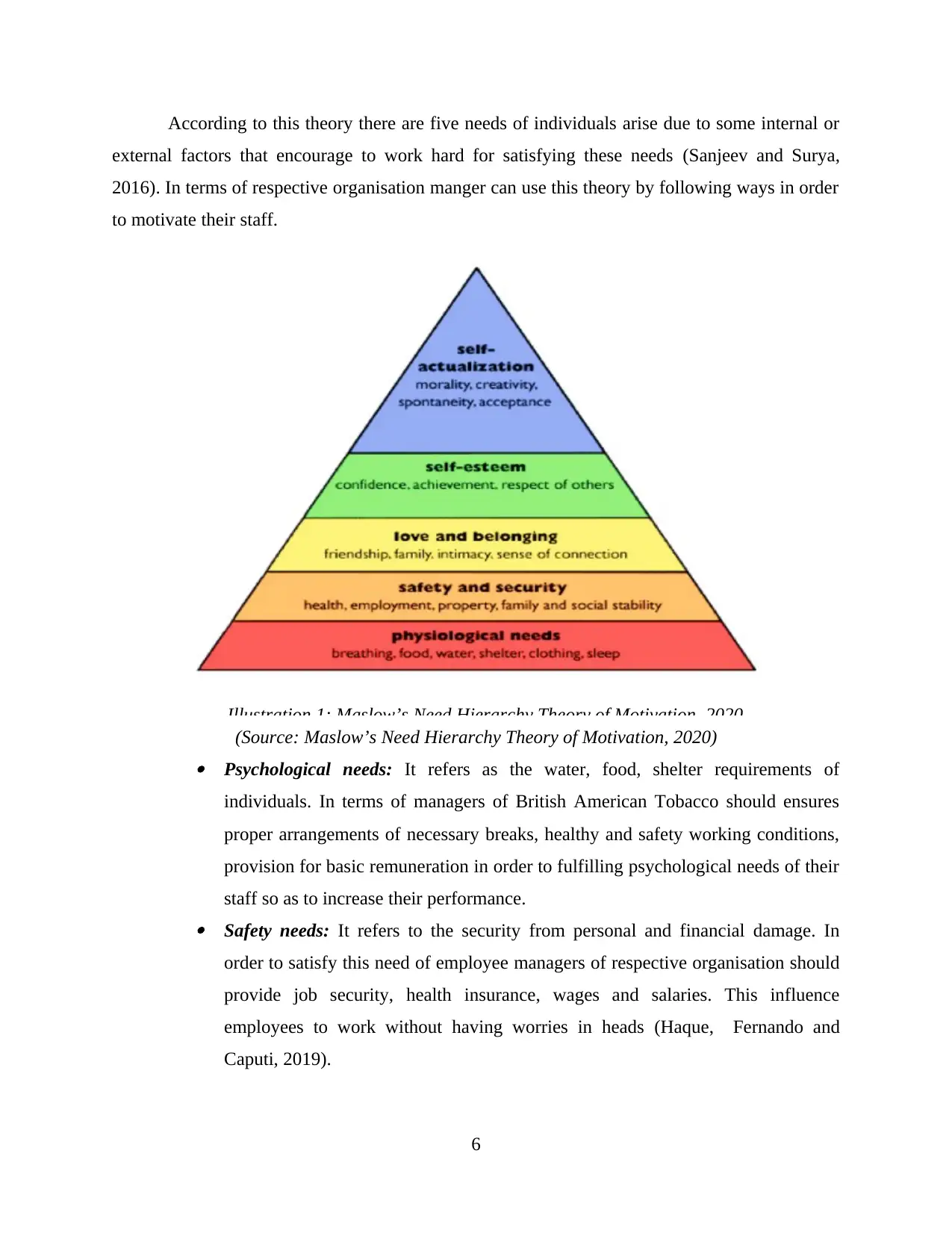
According to this theory there are five needs of individuals arise due to some internal or
external factors that encourage to work hard for satisfying these needs (Sanjeev and Surya,
2016). In terms of respective organisation manger can use this theory by following ways in order
to motivate their staff.
(Source: Maslow’s Need Hierarchy Theory of Motivation, 2020)
Psychological needs: It refers as the water, food, shelter requirements of
individuals. In terms of managers of British American Tobacco should ensures
proper arrangements of necessary breaks, healthy and safety working conditions,
provision for basic remuneration in order to fulfilling psychological needs of their
staff so as to increase their performance.
Safety needs: It refers to the security from personal and financial damage. In
order to satisfy this need of employee managers of respective organisation should
provide job security, health insurance, wages and salaries. This influence
employees to work without having worries in heads (Haque, Fernando and
Caputi, 2019).
6
Illustration 1: Maslow’s Need Hierarchy Theory of Motivation, 2020
external factors that encourage to work hard for satisfying these needs (Sanjeev and Surya,
2016). In terms of respective organisation manger can use this theory by following ways in order
to motivate their staff.
(Source: Maslow’s Need Hierarchy Theory of Motivation, 2020)
Psychological needs: It refers as the water, food, shelter requirements of
individuals. In terms of managers of British American Tobacco should ensures
proper arrangements of necessary breaks, healthy and safety working conditions,
provision for basic remuneration in order to fulfilling psychological needs of their
staff so as to increase their performance.
Safety needs: It refers to the security from personal and financial damage. In
order to satisfy this need of employee managers of respective organisation should
provide job security, health insurance, wages and salaries. This influence
employees to work without having worries in heads (Haque, Fernando and
Caputi, 2019).
6
Illustration 1: Maslow’s Need Hierarchy Theory of Motivation, 2020
Social needs: This need is related to better interactions and relationships between
employees. Mangers and leaders of respective enterprise should focus on team &
group activities in order to formulate interactions and co-operation between staff.
This will satisfy social needs of employees and motivate them for better
performance and stay long.
Self-esteem need: Managers and leaders of British American Tobacco should
concentrate on fulfilling self-esteem needs of their staffs through different
rewards (Mielniczuk and Laguna, 2017). For instance promotion, job-
enhancement, praising and offering achievements for good performance motivates
employees for working hard with full potential.
Self-actualisation need: Last phase of Maslow's motivation theory is related to
extrinsic factors arise from surroundings. Managers and leaders of respective firm
should motivate their employees by offering them challenging tasks, allowing
them to participate in decision-making (Waddell and et. al., 2019). This will result
in increasing the efficiency and effectiveness of employees performance.
Corporate examples for justifying answer.
Motivation theory given by Maslow plays crucial role in analysing different needs and
desires of employees at workplace which is related personal, psychological and external factors.
These factors affects performance of employees. In terms of respective organisation it is
important to identify these needs of employees and satisfying them to motivate & encourage
them for reaching effectiveness and efficiency in their productivity (Howard and et. al., 2016).
Following are the examples which strengthen the impact of Maslow's motivation theory on better
productivity of British American Tobacco:
Instance1: Every individual has some need to be secure physically and financially. With
respect to workplace people has need for securing from harms and injuries, financial support to
fulfil basic needs etc. this is the major factor that motivate and encourage someone to work for
gain money and safety (Mbo, 2017). Lack of safety working conditions & lack of suitable
monetary benefits leads a situation to physical harm and less productivity. Thus, satisfying safety
and security need is important for making effective functioning of business activities. Proper
management of financial and physical security encourage and motivate employees for working
without having any pressure in mind.
7
employees. Mangers and leaders of respective enterprise should focus on team &
group activities in order to formulate interactions and co-operation between staff.
This will satisfy social needs of employees and motivate them for better
performance and stay long.
Self-esteem need: Managers and leaders of British American Tobacco should
concentrate on fulfilling self-esteem needs of their staffs through different
rewards (Mielniczuk and Laguna, 2017). For instance promotion, job-
enhancement, praising and offering achievements for good performance motivates
employees for working hard with full potential.
Self-actualisation need: Last phase of Maslow's motivation theory is related to
extrinsic factors arise from surroundings. Managers and leaders of respective firm
should motivate their employees by offering them challenging tasks, allowing
them to participate in decision-making (Waddell and et. al., 2019). This will result
in increasing the efficiency and effectiveness of employees performance.
Corporate examples for justifying answer.
Motivation theory given by Maslow plays crucial role in analysing different needs and
desires of employees at workplace which is related personal, psychological and external factors.
These factors affects performance of employees. In terms of respective organisation it is
important to identify these needs of employees and satisfying them to motivate & encourage
them for reaching effectiveness and efficiency in their productivity (Howard and et. al., 2016).
Following are the examples which strengthen the impact of Maslow's motivation theory on better
productivity of British American Tobacco:
Instance1: Every individual has some need to be secure physically and financially. With
respect to workplace people has need for securing from harms and injuries, financial support to
fulfil basic needs etc. this is the major factor that motivate and encourage someone to work for
gain money and safety (Mbo, 2017). Lack of safety working conditions & lack of suitable
monetary benefits leads a situation to physical harm and less productivity. Thus, satisfying safety
and security need is important for making effective functioning of business activities. Proper
management of financial and physical security encourage and motivate employees for working
without having any pressure in mind.
7
⊘ This is a preview!⊘
Do you want full access?
Subscribe today to unlock all pages.
Trusted by 1+ million students worldwide
Instance2: Self-actualisation is another important need inherent partly from internal and
external factors. Urge of learning and becoming expert in their filed reflects intrinsic motive of a
person. This is interrelated with extrinsic factor like rewards and praise, increment in job that
create a urge of performing better (Marume and Chikasha, 2016). Lack of suitable rewards and
achievements demotivate employees & creates a situation of deployment in the organisation.
Maslow's motivation theory helps in identifying need of employees and satisfying them which
leads to encourage & motivate employees for working hard to get achievements, rewards,
appraisal. In terms of respective organisation use different method for influence and motivate
employees such as- employee of the year award, incentives for extra work, promotion etc.
Suggestions and recommendation to enhance performance of British American Tobacco.
Organisation's performance includes various aspects such as- working conditions,
employees behaviours, co-ordination & co-operation between teams & groups, employees
performance etc. thus, in terms of smooth functioning of British American Tobacco mangers
should identify the requirement of organisation and make suitable strategies & implement them
so as to ensure constant operation of business. Leaders of respective organisation should ensures
proper implementation of strategies developed by managers to achieve business objectives.
Managers should communicate the vision of the firm with their employees and build trust among
them so that they can work hard for accomplishment of this vision. For increasing organisational
performance it is necessary to create healthy working environment, boosting employees for
better performance and create good relationship between employees and management. It is the
responsibility of managers to formulate teams and groups for getting work done in specified time
limits which saves the time and efforts of management. Working together built mutual co-
ordination between employees and minimising conflict among them. This leads to effectiveness
in organisational performance. Leaders and managers of respective organisation can encourage
and boost employees for reaching highest performance by different method and tools. For
instance management of respective organisation should use Maslow's theory of motivation to
influence employees for better performances through identifying & satisfying different needs of
customers. Fulfilment of individuals needs relies the emotional and financial pressure of
employees which creates barrier in jobs fulfilment. All these enhance overall behaviours and
performance of employees that has prominent impact on end gaol of business. Managers &
leaders of British American Tobacco should also ensures right use of power and remove conflicts
8
external factors. Urge of learning and becoming expert in their filed reflects intrinsic motive of a
person. This is interrelated with extrinsic factor like rewards and praise, increment in job that
create a urge of performing better (Marume and Chikasha, 2016). Lack of suitable rewards and
achievements demotivate employees & creates a situation of deployment in the organisation.
Maslow's motivation theory helps in identifying need of employees and satisfying them which
leads to encourage & motivate employees for working hard to get achievements, rewards,
appraisal. In terms of respective organisation use different method for influence and motivate
employees such as- employee of the year award, incentives for extra work, promotion etc.
Suggestions and recommendation to enhance performance of British American Tobacco.
Organisation's performance includes various aspects such as- working conditions,
employees behaviours, co-ordination & co-operation between teams & groups, employees
performance etc. thus, in terms of smooth functioning of British American Tobacco mangers
should identify the requirement of organisation and make suitable strategies & implement them
so as to ensure constant operation of business. Leaders of respective organisation should ensures
proper implementation of strategies developed by managers to achieve business objectives.
Managers should communicate the vision of the firm with their employees and build trust among
them so that they can work hard for accomplishment of this vision. For increasing organisational
performance it is necessary to create healthy working environment, boosting employees for
better performance and create good relationship between employees and management. It is the
responsibility of managers to formulate teams and groups for getting work done in specified time
limits which saves the time and efforts of management. Working together built mutual co-
ordination between employees and minimising conflict among them. This leads to effectiveness
in organisational performance. Leaders and managers of respective organisation can encourage
and boost employees for reaching highest performance by different method and tools. For
instance management of respective organisation should use Maslow's theory of motivation to
influence employees for better performances through identifying & satisfying different needs of
customers. Fulfilment of individuals needs relies the emotional and financial pressure of
employees which creates barrier in jobs fulfilment. All these enhance overall behaviours and
performance of employees that has prominent impact on end gaol of business. Managers &
leaders of British American Tobacco should also ensures right use of power and remove conflicts
8
Paraphrase This Document
Need a fresh take? Get an instant paraphrase of this document with our AI Paraphraser
through confrontation & mutual agreement between parties. Managers of respective company
should exercise power for assigning tasks, guiding and managing organisation so as to make
effectiveness in business performance. Leaders of BAT should use different leadership styles &
theories like participation, laissez-faire etc. in order to boost employees for work with full
potential. It is also significance task should be done by management of respective organisation is
assigning challenging jobs and duties to employees with some sense of responsibility. Task with
responsibility allows employees to work with their own capabilities. This makes employees
independent and experts so that they can also help their teams. It not only saves time & effort of
business but also added a value in maximising the overall performance of organisation.
CONCLUSION
From above report it is summarised that managers and leaders plays prominent role in
successful operation of a business. Different styles and principles of management are used to
make effective direction, guidelines and monitoring of business. In addition management
functions used by CEO of respective organisation are discussed to know the existing
performance of firm. Moreover, steps taken by firm in order to achieve better performance in
organisational culture. Different styles of leadership and motivation are observed to enhance
productivity which leads to gain highest performance within work culture. Impacts of power,
influence and conflicts are also exercise to for making favourable working condition.
Additionally suitable corporate examples considered for strengthen the report. At last prominent
suggestions and solutions provided to achieve objective of better performance and behaviours of
business. This will create a huge impact on respective organisation's work culture.
9
should exercise power for assigning tasks, guiding and managing organisation so as to make
effectiveness in business performance. Leaders of BAT should use different leadership styles &
theories like participation, laissez-faire etc. in order to boost employees for work with full
potential. It is also significance task should be done by management of respective organisation is
assigning challenging jobs and duties to employees with some sense of responsibility. Task with
responsibility allows employees to work with their own capabilities. This makes employees
independent and experts so that they can also help their teams. It not only saves time & effort of
business but also added a value in maximising the overall performance of organisation.
CONCLUSION
From above report it is summarised that managers and leaders plays prominent role in
successful operation of a business. Different styles and principles of management are used to
make effective direction, guidelines and monitoring of business. In addition management
functions used by CEO of respective organisation are discussed to know the existing
performance of firm. Moreover, steps taken by firm in order to achieve better performance in
organisational culture. Different styles of leadership and motivation are observed to enhance
productivity which leads to gain highest performance within work culture. Impacts of power,
influence and conflicts are also exercise to for making favourable working condition.
Additionally suitable corporate examples considered for strengthen the report. At last prominent
suggestions and solutions provided to achieve objective of better performance and behaviours of
business. This will create a huge impact on respective organisation's work culture.
9
REFERENCES
Books and Journals
Acharya, A. and Jena, L.K., 2016. Employee engagement as an enabler of knowledge retention:
resource-based view towards organisational sustainability. International Journal of
Knowledge Management Studies. 7(3-4). pp.238-256.
Alonso, A.D. and Austin, I.P., 2017. The significance of organisational learning in a global
context. Review of International Business and Strategy.
Billis, D., 2020. Hybrid organisations and human problems: towards a New Organisational
Reality. In Handbook on Hybrid Organisations. Edward Elgar Publishing.
Brown, R. and Capozza, D. eds., 2016. Social identities: Motivational, emotional, cultural
influences. Psychology Press.
Burgstaller, S., 2020. Being and doing SF as an organisational coach. Solution Focused Practice
Around the World.
Carvalho, A.M. and et. al., 2019. Operational excellence, organisational culture and agility: the
missing link?. Total Quality Management & Business Excellence. 30(13-14). pp.1495-
1514.
Carvalho, L. and Yeoman, P., 2018. Framing learning entanglement in innovative learning
spaces: Connecting theory, design and practice. British Educational Research
Journal. 44(6). pp.1120-1137.
Daff, L. and Jack, L., 2018. Accountants’ proactivity in intra-organisational networks: a strong
structuration perspective. Accounting, Auditing & Accountability Journal.
Delaney, M.L. and Royal, M.A., 2017. Breaking engagement apart: The role of intrinsic and
extrinsic motivation in engagement strategies. Industrial and Organizational
Psychology. 10(1). pp.127-140.
Erbaş, E., 2018. Organisational ambidexterity and industrial clockspeed theories in
understanding dynamic managerial capabilities: a multiple case study. International
Journal of Business Environment. 10(2). pp.174-190.
Haque, A., Fernando, M. and Caputi, P., 2019. The relationship between responsible leadership
and organisational commitment and the mediating effect of employee turnover
intentions: An empirical study with Australian employees. Journal of Business
Ethics. 156(3). pp.759-774.
Howard, J. and et. al., 2016. Motivation profiles at work: A self-determination theory
approach. Journal of Vocational Behavior. 95. pp.74-89.
Marume, S.B.M. and Chikasha, A.S., 2016. The concept hierarchy in organisational theory and
practice.
Mbo, M., 2017. Drivers of organisational performance: a state owned enterprise
perspective (Doctoral dissertation, Stellenbosch: Stellenbosch University).
Mielniczuk, E. and Laguna, M., 2017. Motivation and training initiation: evidence from
Poland. Journal of Workplace Learning.
Sanjeev, M.A. and Surya, A.V., 2016. Two factor theory of motivation and satisfaction: An
empirical verification. Annals of Data Science. 3(2). pp.155-173.
Waddell, D. and et. al., 2019. Organisational change: Development and transformation.
Cengage AU.
10
Books and Journals
Acharya, A. and Jena, L.K., 2016. Employee engagement as an enabler of knowledge retention:
resource-based view towards organisational sustainability. International Journal of
Knowledge Management Studies. 7(3-4). pp.238-256.
Alonso, A.D. and Austin, I.P., 2017. The significance of organisational learning in a global
context. Review of International Business and Strategy.
Billis, D., 2020. Hybrid organisations and human problems: towards a New Organisational
Reality. In Handbook on Hybrid Organisations. Edward Elgar Publishing.
Brown, R. and Capozza, D. eds., 2016. Social identities: Motivational, emotional, cultural
influences. Psychology Press.
Burgstaller, S., 2020. Being and doing SF as an organisational coach. Solution Focused Practice
Around the World.
Carvalho, A.M. and et. al., 2019. Operational excellence, organisational culture and agility: the
missing link?. Total Quality Management & Business Excellence. 30(13-14). pp.1495-
1514.
Carvalho, L. and Yeoman, P., 2018. Framing learning entanglement in innovative learning
spaces: Connecting theory, design and practice. British Educational Research
Journal. 44(6). pp.1120-1137.
Daff, L. and Jack, L., 2018. Accountants’ proactivity in intra-organisational networks: a strong
structuration perspective. Accounting, Auditing & Accountability Journal.
Delaney, M.L. and Royal, M.A., 2017. Breaking engagement apart: The role of intrinsic and
extrinsic motivation in engagement strategies. Industrial and Organizational
Psychology. 10(1). pp.127-140.
Erbaş, E., 2018. Organisational ambidexterity and industrial clockspeed theories in
understanding dynamic managerial capabilities: a multiple case study. International
Journal of Business Environment. 10(2). pp.174-190.
Haque, A., Fernando, M. and Caputi, P., 2019. The relationship between responsible leadership
and organisational commitment and the mediating effect of employee turnover
intentions: An empirical study with Australian employees. Journal of Business
Ethics. 156(3). pp.759-774.
Howard, J. and et. al., 2016. Motivation profiles at work: A self-determination theory
approach. Journal of Vocational Behavior. 95. pp.74-89.
Marume, S.B.M. and Chikasha, A.S., 2016. The concept hierarchy in organisational theory and
practice.
Mbo, M., 2017. Drivers of organisational performance: a state owned enterprise
perspective (Doctoral dissertation, Stellenbosch: Stellenbosch University).
Mielniczuk, E. and Laguna, M., 2017. Motivation and training initiation: evidence from
Poland. Journal of Workplace Learning.
Sanjeev, M.A. and Surya, A.V., 2016. Two factor theory of motivation and satisfaction: An
empirical verification. Annals of Data Science. 3(2). pp.155-173.
Waddell, D. and et. al., 2019. Organisational change: Development and transformation.
Cengage AU.
10
⊘ This is a preview!⊘
Do you want full access?
Subscribe today to unlock all pages.
Trusted by 1+ million students worldwide

1 out of 12


Related Documents


Your All-in-One AI-Powered Toolkit for Academic Success.
+13062052269
info@desklib.com
Available 24*7 on WhatsApp / Email
![[object Object]](/_next/static/media/star-bottom.7253800d.svg)
Unlock your academic potential
Copyright © 2020–2026 A2Z Services. All Rights Reserved. Developed and managed by ZUCOL.