Management Consulting Report: Mechanism to Motivate People
VerifiedAdded on 2020/05/01
|21
|4368
|55
Report
AI Summary
This report delves into the critical topic of employee motivation within the context of management consulting, specifically examining its application at Giant hypermarket in Malaysia. It begins by establishing the research background, aims, objectives, and research questions, followed by a comprehensive literature review that explores the concepts of motivation, non-monetary incentives, and their impact on employee performance. The review covers key theories, including Herzberg's Two-Factor Theory and Maslow's Hierarchy of Needs, and analyzes the mechanisms that drive motivation, such as job design, rewards, and the distinction between intrinsic and extrinsic motivation. The methodology chapter outlines the research strategy, design, and data collection methods used to address the research questions. The report then presents findings, conclusions, and recommendations, offering practical insights into enhancing employee motivation and its correlation with improved organizational performance. The report emphasizes the importance of understanding individual characteristics, addressing unmet needs, and fostering affective commitment to reduce turnover and enhance overall productivity.
Running Head: MANAGEMENT CONSULTING
MANAGEMENT CONSULTING
MANAGEMENT CONSULTING

Paraphrase This Document
Need a fresh take? Get an instant paraphrase of this document with our AI Paraphraser
2
MANAGEMENT CONSULTING
Table of Contents
Chapter 1: Introduction..........................................................................................................................3
1.1 Research Background..................................................................................................................3
1.2 Research aim and objectives........................................................................................................3
1.3Research question.........................................................................................................................3
Chapter 2: Literature review..................................................................................................................4
2.1 Non-monetary Incentives in Employee Motivation.....................................................................5
2.2 To explore the meaning and concept of motivation.....................................................................7
2.3 Theoretical framework.................................................................................................................8
2.4 To analyze the mechanism that motivates people......................................................................10
2.5 To identify the relationship between motivation and employee performance............................11
Chapter 3: Research Methodology.......................................................................................................15
3.1Research Strategy.......................................................................................................................15
3.2Research design..........................................................................................................................16
3.3Data Collection Method..............................................................................................................16
3.4Sampling Procedure....................................................................................................................16
3.5Justification of research question selected..................................................................................17
Chapter 4: Finding team......................................................................................................................19
Chapter 5: Conclusion..........................................................................................................................24
Chapter 6: Recommendation...............................................................................................................25
References...........................................................................................................................................26
Appendix.............................................................................................................................................29
MANAGEMENT CONSULTING
Table of Contents
Chapter 1: Introduction..........................................................................................................................3
1.1 Research Background..................................................................................................................3
1.2 Research aim and objectives........................................................................................................3
1.3Research question.........................................................................................................................3
Chapter 2: Literature review..................................................................................................................4
2.1 Non-monetary Incentives in Employee Motivation.....................................................................5
2.2 To explore the meaning and concept of motivation.....................................................................7
2.3 Theoretical framework.................................................................................................................8
2.4 To analyze the mechanism that motivates people......................................................................10
2.5 To identify the relationship between motivation and employee performance............................11
Chapter 3: Research Methodology.......................................................................................................15
3.1Research Strategy.......................................................................................................................15
3.2Research design..........................................................................................................................16
3.3Data Collection Method..............................................................................................................16
3.4Sampling Procedure....................................................................................................................16
3.5Justification of research question selected..................................................................................17
Chapter 4: Finding team......................................................................................................................19
Chapter 5: Conclusion..........................................................................................................................24
Chapter 6: Recommendation...............................................................................................................25
References...........................................................................................................................................26
Appendix.............................................................................................................................................29
3
MANAGEMENT CONSULTING
Chapter 1: Introduction
1.1 Research Background
The research topic is “to identify the mechanism to motivate people: In the context of Giant
hypermarket, Malaysia”. In the existing business scenario, an organization has used
motivation techniques to inspire a large number of people in less time and cost. It can also
support to make a positive environment at the workplace along with enhancing the
productivity of Giant hypermarket, Malaysia in the upcoming period (Bradler 2016). The
utilization of mechanism can also help to decline the stress level at the workplace.
Consequently, it can increase the growth of the economy. The mechanism can be key factors
to inspire people about their work as well as enhance the productivity in long run. The
motivated people can decline the stress level at the workplace and support to make positive
environment (Yousaf 2015).
1.2 Research aim and objectives
The main aim of this report is to identify the mechanism to motivate people: In the context of
Giant hypermarket, Malaysia. The following points demonstrate the research objectives.
To explore the meaning and concept of motivation
To identify the relationship between motivation and employee performance
To analyze the mechanism that motivates the people
1.3 Research question
What is the meaning and concept of motivation?
What is the relationship between motivation and employees performance?
How mechanism motivates the people?
MANAGEMENT CONSULTING
Chapter 1: Introduction
1.1 Research Background
The research topic is “to identify the mechanism to motivate people: In the context of Giant
hypermarket, Malaysia”. In the existing business scenario, an organization has used
motivation techniques to inspire a large number of people in less time and cost. It can also
support to make a positive environment at the workplace along with enhancing the
productivity of Giant hypermarket, Malaysia in the upcoming period (Bradler 2016). The
utilization of mechanism can also help to decline the stress level at the workplace.
Consequently, it can increase the growth of the economy. The mechanism can be key factors
to inspire people about their work as well as enhance the productivity in long run. The
motivated people can decline the stress level at the workplace and support to make positive
environment (Yousaf 2015).
1.2 Research aim and objectives
The main aim of this report is to identify the mechanism to motivate people: In the context of
Giant hypermarket, Malaysia. The following points demonstrate the research objectives.
To explore the meaning and concept of motivation
To identify the relationship between motivation and employee performance
To analyze the mechanism that motivates the people
1.3 Research question
What is the meaning and concept of motivation?
What is the relationship between motivation and employees performance?
How mechanism motivates the people?
⊘ This is a preview!⊘
Do you want full access?
Subscribe today to unlock all pages.

Trusted by 1+ million students worldwide
4
MANAGEMENT CONSULTING
Chapter 2: Literature review
The lens of institutional entrepreneurship has been the basis of evolution in the industry of
management consulting. According to several studies on the same, management consulting
field highlights contradictions between broad cultural logics and the status quo. The field also
highlights broader social benefits, establish organizational distinctiveness, and develop
relationships with actors that are prominent in solving issues (Shah & Beh 2016). There is a
lot of value that is added by management consultants in organizations
Cost economics is the reason for industrial management consulting success. In an
organization, the decision of engaging consultants to address a particular problem depends on
marketing or internal deployment of resources. However, the choice is based on the net
economic value added. The survival of consulting industry depends on consulting firms
providing value additions that outweigh engagement costs. Consulting firms are, therefore
classified in three groups.
Several research activities have established that there is a relationship existing between
voluntary turnover and HR practices. However, the relationship varies among research
activities. There are those that argue that the relationship is unmediated and direct while other
say that the relationship is mediated by commitment between aggregate turnover and HR
systems. The third group argues that the “commitment-based” HR practices reduce aggregate
turnover and increase employee commitment. The last group asserts that workers are likely to
stay in a given work environment when HR practices lead to increased utility.
2.1 Non-monetary Incentives in Employee Motivation
Motivating employees is the most important non-monetary incentives supported by several
research activities. Individuals want to be recognized for their efforts within a workplace and
thus praise or recognition is one strong way of motivation (Bradler, Neckermann & Non
2016). Non-monetary incentives are cost effective and raise morale leading to increased
MANAGEMENT CONSULTING
Chapter 2: Literature review
The lens of institutional entrepreneurship has been the basis of evolution in the industry of
management consulting. According to several studies on the same, management consulting
field highlights contradictions between broad cultural logics and the status quo. The field also
highlights broader social benefits, establish organizational distinctiveness, and develop
relationships with actors that are prominent in solving issues (Shah & Beh 2016). There is a
lot of value that is added by management consultants in organizations
Cost economics is the reason for industrial management consulting success. In an
organization, the decision of engaging consultants to address a particular problem depends on
marketing or internal deployment of resources. However, the choice is based on the net
economic value added. The survival of consulting industry depends on consulting firms
providing value additions that outweigh engagement costs. Consulting firms are, therefore
classified in three groups.
Several research activities have established that there is a relationship existing between
voluntary turnover and HR practices. However, the relationship varies among research
activities. There are those that argue that the relationship is unmediated and direct while other
say that the relationship is mediated by commitment between aggregate turnover and HR
systems. The third group argues that the “commitment-based” HR practices reduce aggregate
turnover and increase employee commitment. The last group asserts that workers are likely to
stay in a given work environment when HR practices lead to increased utility.
2.1 Non-monetary Incentives in Employee Motivation
Motivating employees is the most important non-monetary incentives supported by several
research activities. Individuals want to be recognized for their efforts within a workplace and
thus praise or recognition is one strong way of motivation (Bradler, Neckermann & Non
2016). Non-monetary incentives are cost effective and raise morale leading to increased
Paraphrase This Document
Need a fresh take? Get an instant paraphrase of this document with our AI Paraphraser
5
MANAGEMENT CONSULTING
productivity. According to several research activities, the answer to how to improve and
maintain work morale while retaining cost efficiency is non-monetary incentive. Other
activities on the same topic go ahead to outline the importance of noncash incentives. Such
impacts include reducing absenteeism, lower stress, increasing productivity, increasing
turnover, raising morale, revenue and profit boost, and competitiveness (Judge & Zapata
2015).
2.2 To explore the meaning and concept of motivation
As per the view of Shah et al. (2016), motivation plays an imperative role that encourages the
people to give their best contribution to the workplace. It is also stated that a positive
inspiration will enable the workforces to obtain the positive outcome and eliminate the
possibility offailure in an organization. A major key component of motivation is personnel
management. The motivation is core management that demonstrates that each individual is
providing a sense of wealth in the organization. A higher management can strive to treat
employees with dignity and recognition.
2.3 Theoretical framework
There is a relationship in the concepts of “reward”, “incentive”, and “recognition” regarding
motivation of workers. Distinguishing them is difficult. “Incentive” as a concept is the
broadest. “Incentive” is all about making an employee desire to perform better, expend more
energy, and try harder. There are two categories of incentive. They are monetary and non-
monetary incentives. Monetary incentives are associated with the rewarding employees in
different ways including bonuses and commissions. Forms of recognition cover non-
monetary and monetary rewards. Such forms are referred to as encouraging, crediting, and
appreciating individuals who contribute to organizational success. Recognition ensures
reinforcement of specific kinds of accomplishments and emphasizes on organizational values.
MANAGEMENT CONSULTING
productivity. According to several research activities, the answer to how to improve and
maintain work morale while retaining cost efficiency is non-monetary incentive. Other
activities on the same topic go ahead to outline the importance of noncash incentives. Such
impacts include reducing absenteeism, lower stress, increasing productivity, increasing
turnover, raising morale, revenue and profit boost, and competitiveness (Judge & Zapata
2015).
2.2 To explore the meaning and concept of motivation
As per the view of Shah et al. (2016), motivation plays an imperative role that encourages the
people to give their best contribution to the workplace. It is also stated that a positive
inspiration will enable the workforces to obtain the positive outcome and eliminate the
possibility offailure in an organization. A major key component of motivation is personnel
management. The motivation is core management that demonstrates that each individual is
providing a sense of wealth in the organization. A higher management can strive to treat
employees with dignity and recognition.
2.3 Theoretical framework
There is a relationship in the concepts of “reward”, “incentive”, and “recognition” regarding
motivation of workers. Distinguishing them is difficult. “Incentive” as a concept is the
broadest. “Incentive” is all about making an employee desire to perform better, expend more
energy, and try harder. There are two categories of incentive. They are monetary and non-
monetary incentives. Monetary incentives are associated with the rewarding employees in
different ways including bonuses and commissions. Forms of recognition cover non-
monetary and monetary rewards. Such forms are referred to as encouraging, crediting, and
appreciating individuals who contribute to organizational success. Recognition ensures
reinforcement of specific kinds of accomplishments and emphasizes on organizational values.
6
MANAGEMENT CONSULTING
Recognition also helps in the creation of a sense of being valued in an organizational setup
(Lazaroiu 2015).
Herzberg and Maslow Herzberg theory
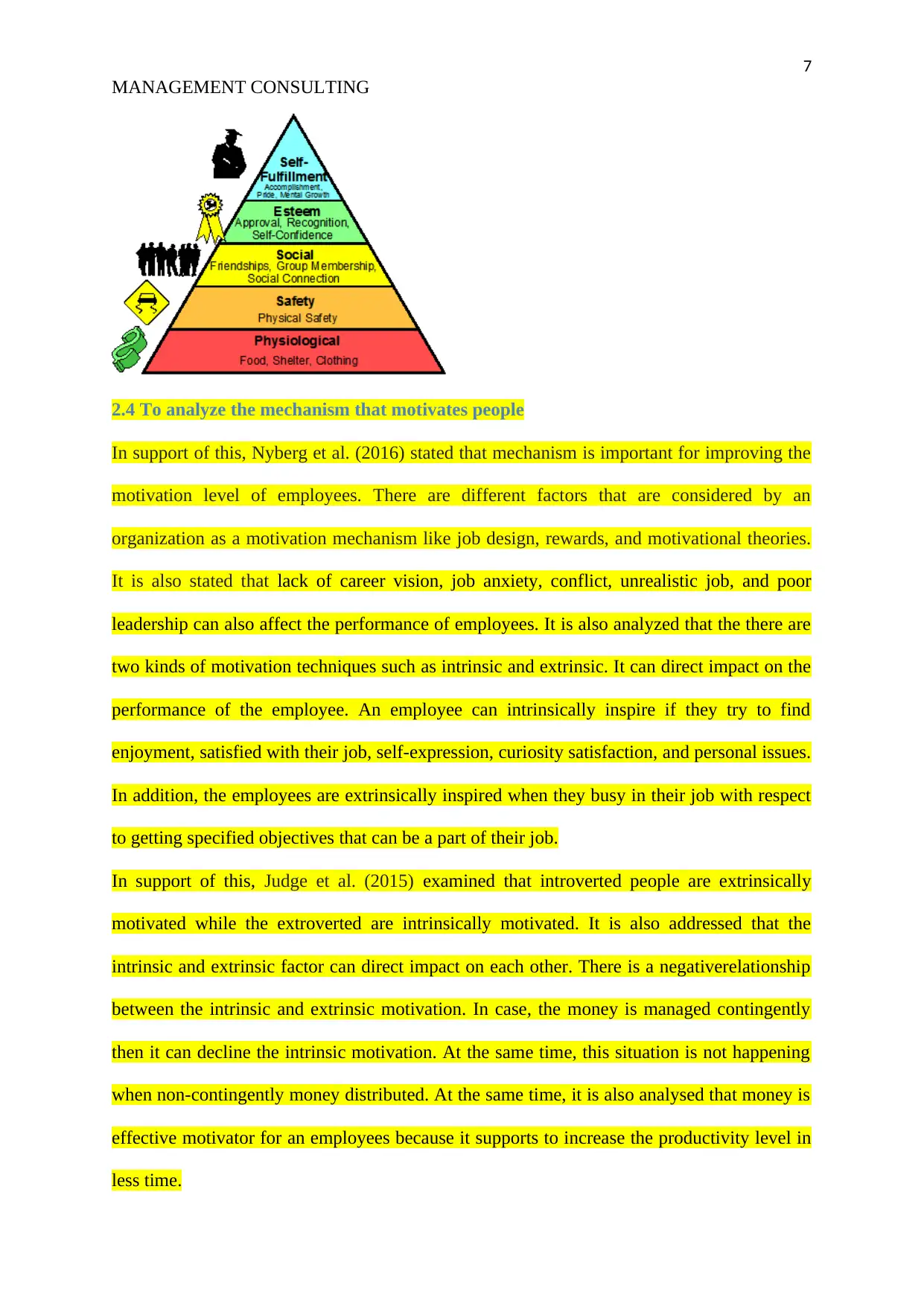
According to the Gong et al. (2017), the Herzberg and Maslow Herzberg theory is a
significant motivational theory that is used to inspire a large number of employees in less
time and cost. The Herzberg theory demonstrates the difference between the hygiene factors
and motivation. It is also examined that the motivators can be intrinsic motivational elements
like recognition, responsibility, and challenging work. Besides this, the hygiene factors can
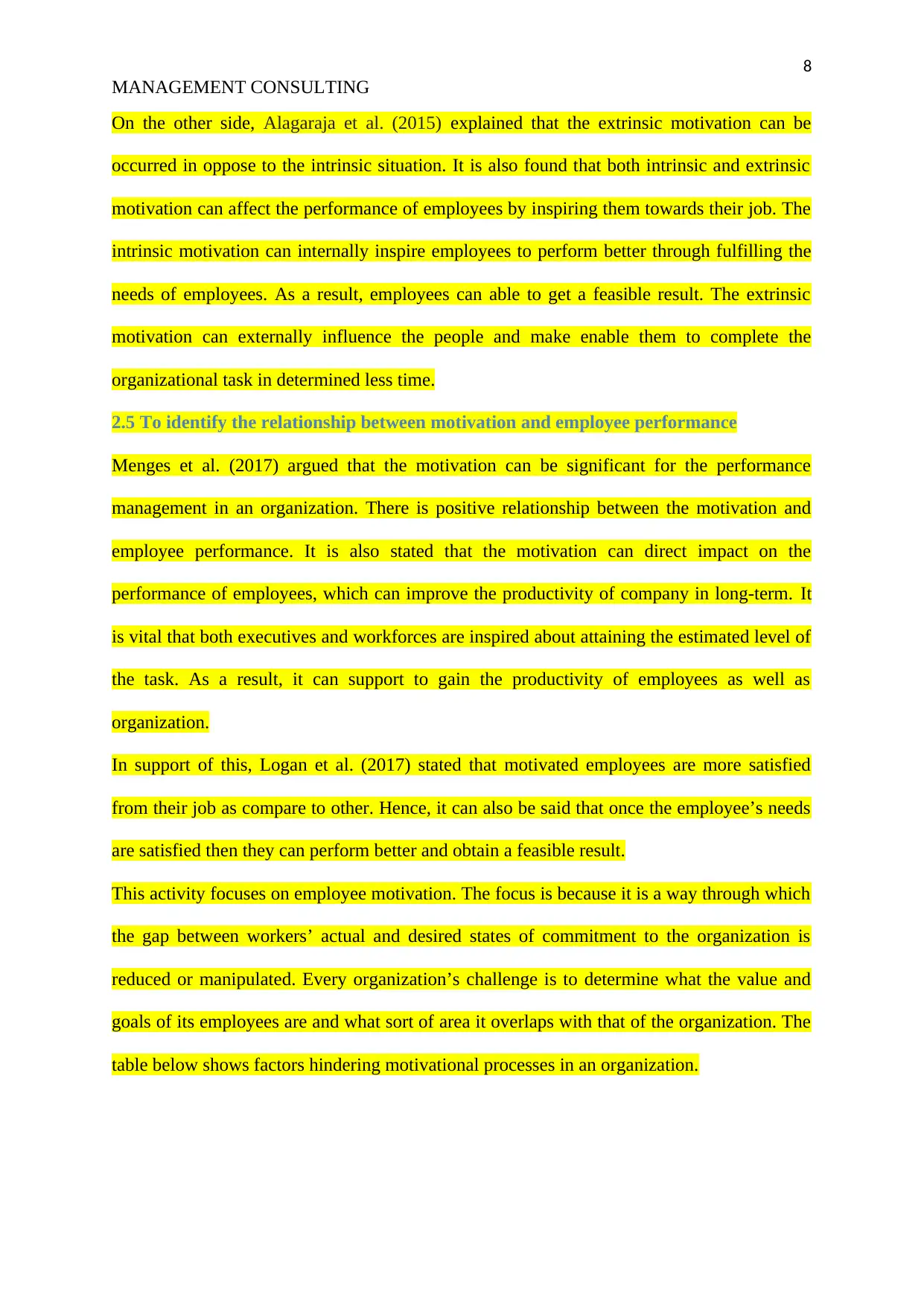
be an extrinsic factor like salary, status, and job security. It is also examined that the Two-
Factor Theory of Herzberg can be related to the hierarchy need theory. The Maslow need
theory considers five factors such as self-actualization, esteem, love, safety, and
physiological. At the same time, it can also be stated that these factors show that different
ages of people are inspired by a different factor. Therefore, an organization can understand
the Maslow need theory to motivate the people and gain their productivity.
MANAGEMENT CONSULTING
Recognition also helps in the creation of a sense of being valued in an organizational setup
(Lazaroiu 2015).
Herzberg and Maslow Herzberg theory
According to the Gong et al. (2017), the Herzberg and Maslow Herzberg theory is a
significant motivational theory that is used to inspire a large number of employees in less
time and cost. The Herzberg theory demonstrates the difference between the hygiene factors
and motivation. It is also examined that the motivators can be intrinsic motivational elements
like recognition, responsibility, and challenging work. Besides this, the hygiene factors can
be an extrinsic factor like salary, status, and job security. It is also examined that the Two-
Factor Theory of Herzberg can be related to the hierarchy need theory. The Maslow need
theory considers five factors such as self-actualization, esteem, love, safety, and
physiological. At the same time, it can also be stated that these factors show that different
ages of people are inspired by a different factor. Therefore, an organization can understand
the Maslow need theory to motivate the people and gain their productivity.
⊘ This is a preview!⊘
Do you want full access?
Subscribe today to unlock all pages.
Trusted by 1+ million students worldwide
7
MANAGEMENT CONSULTING
2.4 To analyze the mechanism that motivates people
In support of this, Nyberg et al. (2016) stated that mechanism is important for improving the
motivation level of employees. There are different factors that are considered by an
organization as a motivation mechanism like job design, rewards, and motivational theories.
It is also stated that lack of career vision, job anxiety, conflict, unrealistic job, and poor
leadership can also affect the performance of employees. It is also analyzed that the there are
two kinds of motivation techniques such as intrinsic and extrinsic. It can direct impact on the
performance of the employee. An employee can intrinsically inspire if they try to find
enjoyment, satisfied with their job, self-expression, curiosity satisfaction, and personal issues.
In addition, the employees are extrinsically inspired when they busy in their job with respect
to getting specified objectives that can be a part of their job.
In support of this, Judge et al. (2015) examined that introverted people are extrinsically
motivated while the extroverted are intrinsically motivated. It is also addressed that the
intrinsic and extrinsic factor can direct impact on each other. There is a negativerelationship
between the intrinsic and extrinsic motivation. In case, the money is managed contingently
then it can decline the intrinsic motivation. At the same time, this situation is not happening
when non-contingently money distributed. At the same time, it is also analysed that money is
effective motivator for an employees because it supports to increase the productivity level in
less time.
MANAGEMENT CONSULTING
2.4 To analyze the mechanism that motivates people
In support of this, Nyberg et al. (2016) stated that mechanism is important for improving the
motivation level of employees. There are different factors that are considered by an
organization as a motivation mechanism like job design, rewards, and motivational theories.
It is also stated that lack of career vision, job anxiety, conflict, unrealistic job, and poor
leadership can also affect the performance of employees. It is also analyzed that the there are
two kinds of motivation techniques such as intrinsic and extrinsic. It can direct impact on the
performance of the employee. An employee can intrinsically inspire if they try to find
enjoyment, satisfied with their job, self-expression, curiosity satisfaction, and personal issues.
In addition, the employees are extrinsically inspired when they busy in their job with respect
to getting specified objectives that can be a part of their job.
In support of this, Judge et al. (2015) examined that introverted people are extrinsically
motivated while the extroverted are intrinsically motivated. It is also addressed that the
intrinsic and extrinsic factor can direct impact on each other. There is a negativerelationship
between the intrinsic and extrinsic motivation. In case, the money is managed contingently
then it can decline the intrinsic motivation. At the same time, this situation is not happening
when non-contingently money distributed. At the same time, it is also analysed that money is
effective motivator for an employees because it supports to increase the productivity level in
less time.
Paraphrase This Document
Need a fresh take? Get an instant paraphrase of this document with our AI Paraphraser
8
MANAGEMENT CONSULTING
On the other side, Alagaraja et al. (2015) explained that the extrinsic motivation can be
occurred in oppose to the intrinsic situation. It is also found that both intrinsic and extrinsic
motivation can affect the performance of employees by inspiring them towards their job. The
intrinsic motivation can internally inspire employees to perform better through fulfilling the
needs of employees. As a result, employees can able to get a feasible result. The extrinsic
motivation can externally influence the people and make enable them to complete the
organizational task in determined less time.
2.5 To identify the relationship between motivation and employee performance
Menges et al. (2017) argued that the motivation can be significant for the performance
management in an organization. There is positive relationship between the motivation and
employee performance. It is also stated that the motivation can direct impact on the
performance of employees, which can improve the productivity of company in long-term. It
is vital that both executives and workforces are inspired about attaining the estimated level of
the task. As a result, it can support to gain the productivity of employees as well as
organization.
In support of this, Logan et al. (2017) stated that motivated employees are more satisfied
from their job as compare to other. Hence, it can also be said that once the employee’s needs
are satisfied then they can perform better and obtain a feasible result.
This activity focuses on employee motivation. The focus is because it is a way through which
the gap between workers’ actual and desired states of commitment to the organization is
reduced or manipulated. Every organization’s challenge is to determine what the value and
goals of its employees are and what sort of area it overlaps with that of the organization. The
table below shows factors hindering motivational processes in an organization.
MANAGEMENT CONSULTING
On the other side, Alagaraja et al. (2015) explained that the extrinsic motivation can be
occurred in oppose to the intrinsic situation. It is also found that both intrinsic and extrinsic
motivation can affect the performance of employees by inspiring them towards their job. The
intrinsic motivation can internally inspire employees to perform better through fulfilling the
needs of employees. As a result, employees can able to get a feasible result. The extrinsic
motivation can externally influence the people and make enable them to complete the
organizational task in determined less time.
2.5 To identify the relationship between motivation and employee performance
Menges et al. (2017) argued that the motivation can be significant for the performance
management in an organization. There is positive relationship between the motivation and
employee performance. It is also stated that the motivation can direct impact on the
performance of employees, which can improve the productivity of company in long-term. It
is vital that both executives and workforces are inspired about attaining the estimated level of
the task. As a result, it can support to gain the productivity of employees as well as
organization.
In support of this, Logan et al. (2017) stated that motivated employees are more satisfied
from their job as compare to other. Hence, it can also be said that once the employee’s needs
are satisfied then they can perform better and obtain a feasible result.
This activity focuses on employee motivation. The focus is because it is a way through which
the gap between workers’ actual and desired states of commitment to the organization is
reduced or manipulated. Every organization’s challenge is to determine what the value and
goals of its employees are and what sort of area it overlaps with that of the organization. The
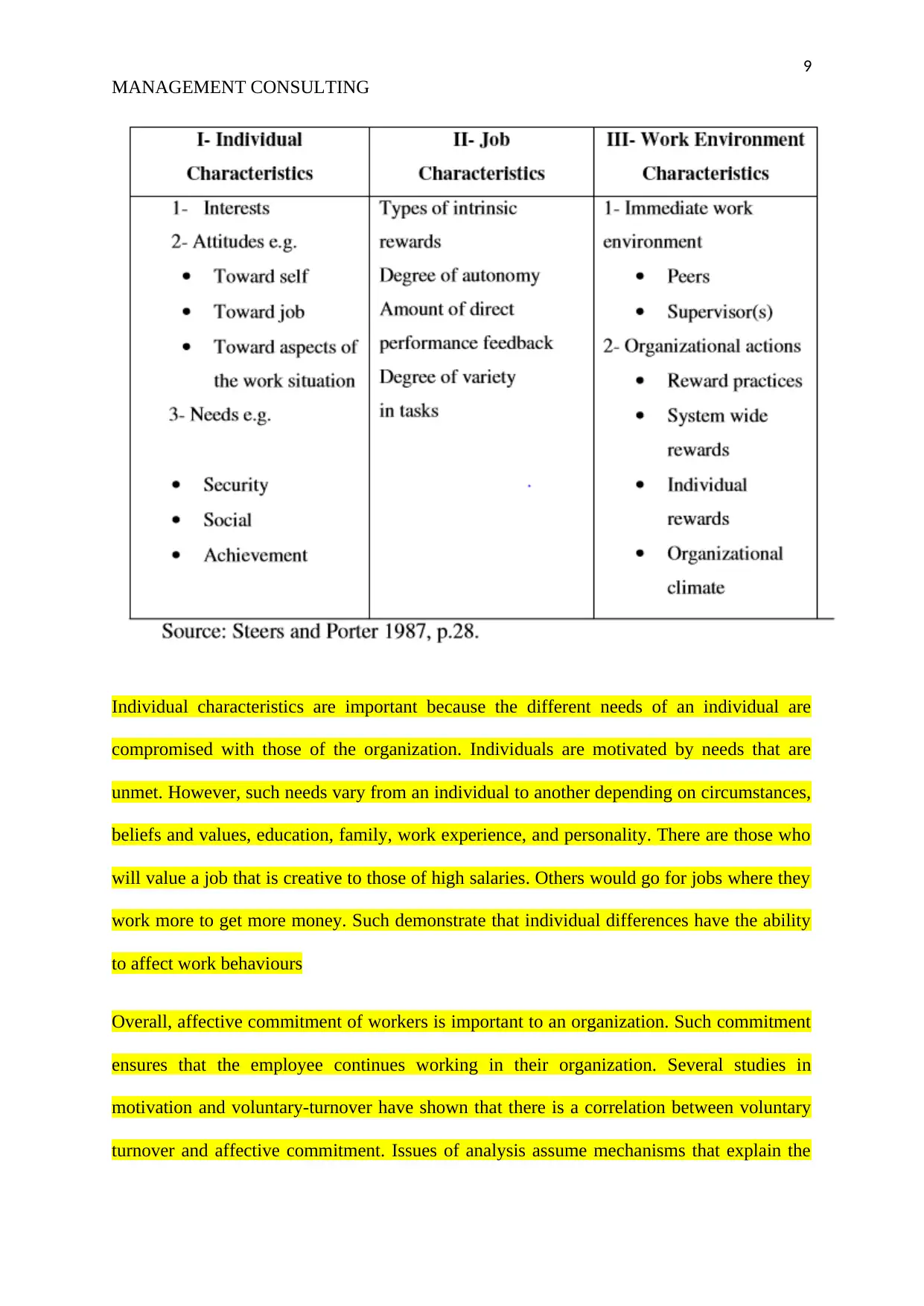
table below shows factors hindering motivational processes in an organization.
9
MANAGEMENT CONSULTING
Individual characteristics are important because the different needs of an individual are
compromised with those of the organization. Individuals are motivated by needs that are
unmet. However, such needs vary from an individual to another depending on circumstances,
beliefs and values, education, family, work experience, and personality. There are those who
will value a job that is creative to those of high salaries. Others would go for jobs where they
work more to get more money. Such demonstrate that individual differences have the ability
to affect work behaviours
Overall, affective commitment of workers is important to an organization. Such commitment
ensures that the employee continues working in their organization. Several studies in
motivation and voluntary-turnover have shown that there is a correlation between voluntary
turnover and affective commitment. Issues of analysis assume mechanisms that explain the
MANAGEMENT CONSULTING
Individual characteristics are important because the different needs of an individual are
compromised with those of the organization. Individuals are motivated by needs that are
unmet. However, such needs vary from an individual to another depending on circumstances,
beliefs and values, education, family, work experience, and personality. There are those who
will value a job that is creative to those of high salaries. Others would go for jobs where they
work more to get more money. Such demonstrate that individual differences have the ability
to affect work behaviours
Overall, affective commitment of workers is important to an organization. Such commitment
ensures that the employee continues working in their organization. Several studies in
motivation and voluntary-turnover have shown that there is a correlation between voluntary
turnover and affective commitment. Issues of analysis assume mechanisms that explain the
⊘ This is a preview!⊘
Do you want full access?
Subscribe today to unlock all pages.
Trusted by 1+ million students worldwide
10
MANAGEMENT CONSULTING
relationship between turnover holds and individual attitudes. As mentioned before, collective
commitment is homogenous concerning interactions among workers. Employees with
specific and well-defined commitment levels transmit such feelings to those with low levels
of commitment. The pattern of shared affection and interaction create behavioural norms for
workers who share attitude. Collective commitment, therefore affect the level of
organizational commitment leading to the creation of a group norm of retention and
committed behaviour (Menges 2017).
Conclusion
This section supports to create the bestunderstanding of thebasic concept of motivation, and
Herzberg and Maslow need theory. It is also analyzed that this section is helpful for providing
depth understanding towards the mechanism that motivates the people. In addition, it is also
found that there is a positiverelationship between the motivation and employee performance.
Chapter 3: Research Methodology
In this chapter, we shall explain the approach towards organizing the research activity and the
methods for data collection and analysis to address the outlined research questions. The
research questions include:
1) To what degree are non-monetary incentives utilized in public sector concerning
public employee perceptions?
2) What is the extent by which non-monetary incentives causes motivating potential for
business organizations?
3) What is the meaning of “non-monetary incentive” to employees?
4) Which are the main job factors that contribute to employee willingness to put more
effort in their work?
5) What is the significant difference between the rankings of the mentioned job factors
based on job tenure and organizational position?
MANAGEMENT CONSULTING
relationship between turnover holds and individual attitudes. As mentioned before, collective
commitment is homogenous concerning interactions among workers. Employees with
specific and well-defined commitment levels transmit such feelings to those with low levels
of commitment. The pattern of shared affection and interaction create behavioural norms for
workers who share attitude. Collective commitment, therefore affect the level of
organizational commitment leading to the creation of a group norm of retention and
committed behaviour (Menges 2017).
Conclusion
This section supports to create the bestunderstanding of thebasic concept of motivation, and
Herzberg and Maslow need theory. It is also analyzed that this section is helpful for providing
depth understanding towards the mechanism that motivates the people. In addition, it is also
found that there is a positiverelationship between the motivation and employee performance.
Chapter 3: Research Methodology
In this chapter, we shall explain the approach towards organizing the research activity and the
methods for data collection and analysis to address the outlined research questions. The
research questions include:
1) To what degree are non-monetary incentives utilized in public sector concerning
public employee perceptions?
2) What is the extent by which non-monetary incentives causes motivating potential for
business organizations?
3) What is the meaning of “non-monetary incentive” to employees?
4) Which are the main job factors that contribute to employee willingness to put more
effort in their work?
5) What is the significant difference between the rankings of the mentioned job factors
based on job tenure and organizational position?
Paraphrase This Document
Need a fresh take? Get an instant paraphrase of this document with our AI Paraphraser
11
MANAGEMENT CONSULTING
3.1Research Strategy
In this research, researcher has executed survey through questionnaire and literature review to
accomplish the research aim. The focus group has enabled the researcher to collect the data
about a mechanism to inspire people (Gagné 2015).
3.2Research design
The researcherhas practiced both research design methods such as a qualitative and
quantitative method for completing the research objectives. The qualitative research design
has used to develop theoretical knowledge about the research topic.
3.3Data Collection Method
In this research, the researcher has used both data collection methods such as primary and
secondary data collection methods (Barrick 2015). The primary data collection method has
practiced by the researcher to collect new or first-hand information about research issue. It
can collect by using many sources such as interview, observation, focus group, survey
through a questionnaire.
3.4Sampling Procedure
For this research, the researcher has selected the probability sampling method including
random sampling method because of choosing the participants for conducting the survey
through a questionnaire (Hanus 2015). Through this, the researcher has selected 55
employees from three companies like Giant hypermarket, Malaysia, Asda, and Iceland
(Mustafa and Othman, 2016).
3.5Justification of research question selected
Researcher has asked the question about age, gender, experience and income, and level of
organisation Menges et al. (2017). It was required to understand the situation of people.
MANAGEMENT CONSULTING
3.1Research Strategy
In this research, researcher has executed survey through questionnaire and literature review to
accomplish the research aim. The focus group has enabled the researcher to collect the data
about a mechanism to inspire people (Gagné 2015).
3.2Research design
The researcherhas practiced both research design methods such as a qualitative and
quantitative method for completing the research objectives. The qualitative research design
has used to develop theoretical knowledge about the research topic.
3.3Data Collection Method
In this research, the researcher has used both data collection methods such as primary and
secondary data collection methods (Barrick 2015). The primary data collection method has
practiced by the researcher to collect new or first-hand information about research issue. It
can collect by using many sources such as interview, observation, focus group, survey
through a questionnaire.
3.4Sampling Procedure
For this research, the researcher has selected the probability sampling method including
random sampling method because of choosing the participants for conducting the survey
through a questionnaire (Hanus 2015). Through this, the researcher has selected 55
employees from three companies like Giant hypermarket, Malaysia, Asda, and Iceland
(Mustafa and Othman, 2016).
3.5Justification of research question selected
Researcher has asked the question about age, gender, experience and income, and level of
organisation Menges et al. (2017). It was required to understand the situation of people.
12
MANAGEMENT CONSULTING
Chapter 4: Finding team
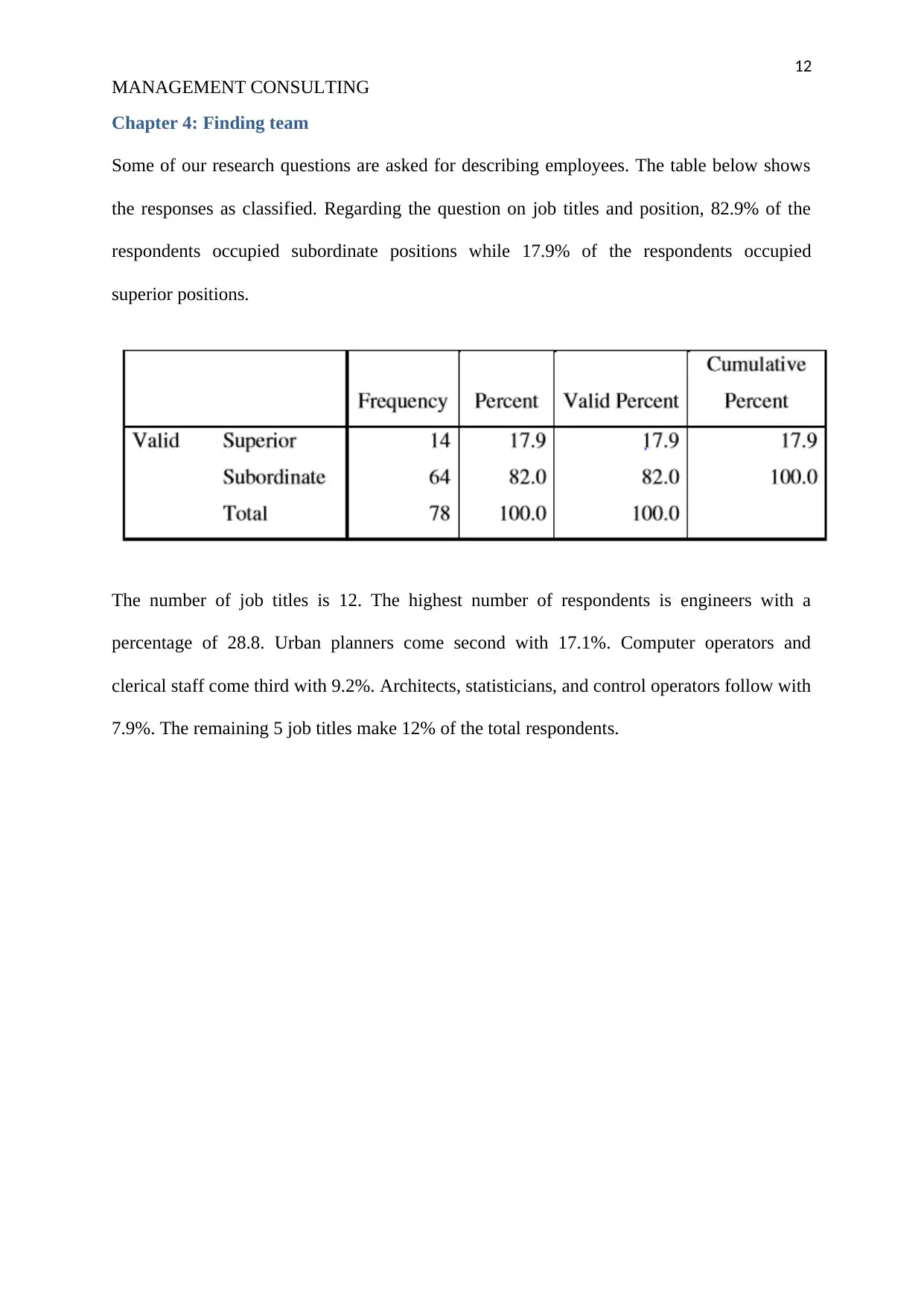
Some of our research questions are asked for describing employees. The table below shows
the responses as classified. Regarding the question on job titles and position, 82.9% of the
respondents occupied subordinate positions while 17.9% of the respondents occupied
superior positions.
The number of job titles is 12. The highest number of respondents is engineers with a
percentage of 28.8. Urban planners come second with 17.1%. Computer operators and
clerical staff come third with 9.2%. Architects, statisticians, and control operators follow with
7.9%. The remaining 5 job titles make 12% of the total respondents.
MANAGEMENT CONSULTING
Chapter 4: Finding team
Some of our research questions are asked for describing employees. The table below shows
the responses as classified. Regarding the question on job titles and position, 82.9% of the
respondents occupied subordinate positions while 17.9% of the respondents occupied
superior positions.
The number of job titles is 12. The highest number of respondents is engineers with a
percentage of 28.8. Urban planners come second with 17.1%. Computer operators and
clerical staff come third with 9.2%. Architects, statisticians, and control operators follow with
7.9%. The remaining 5 job titles make 12% of the total respondents.
⊘ This is a preview!⊘
Do you want full access?
Subscribe today to unlock all pages.
Trusted by 1+ million students worldwide

1 out of 21


Related Documents


Your All-in-One AI-Powered Toolkit for Academic Success.
+13062052269
info@desklib.com
Available 24*7 on WhatsApp / Email
![[object Object]](/_next/static/media/star-bottom.7253800d.svg)
Unlock your academic potential
Copyright © 2020–2026 A2Z Services. All Rights Reserved. Developed and managed by ZUCOL.