Management Accounting for Decision Making: A Business Report

Verified

Added on  2022/08/11

|12
|2135
|17
Report
AI Summary
This report delves into the critical role of management accounting, also known as managerial accounting, in aiding business managers with future planning and decision-making. It begins with an executive summary and table of contents, followed by an introduction defining management accounting as the analysis of internal financial reports to inform business strategies. The discussion section details various techniques of management accounting, including business budgeting, inventory valuation, profit margin analysis, and trend analysis, alongside their limitations. The report emphasizes the importance of accurate financial information and the need for managerial expertise in accounting, statistics, and economics. Real-life examples are used to illustrate how management accounting supports short-term decisions regarding product mix, pricing, and long-term decisions involving capital budgeting and investment. The report underscores the role of management accountants in budgeting, control, and long-term planning, emphasizing the application of management accounting across retail, service, and manufacturing companies. It highlights the use of specific methods such as job costing and activity-based costing. The conclusion summarizes the contribution of management accounting to effective business planning and decision-making, emphasizing its impact on business objectives and forecasting.
Document Page
Running Head: ACCOUNTING FOR MANAGEMENT DECISION
Accounting for Management Decision
Name of the University
Name of the Student
Author Note
tabler-icon-diamond-filled.svg

Paraphrase This Document

Need a fresh take? Get an instant paraphrase of this document with our AI Paraphraser
Document Page
1
ACCOUNTING FOR MANAGEMENT DECISION
Executive Summary
The aim of this report is to evaluate the role and use of management accounting in a
business to make decision for future planning. Management accounting uses various techniques
in business to reach its goal through proper decision. Management accounting or managerial
accounting helps internal analysis in short or long term business planning.
Document Page
2
ACCOUNTING FOR MANAGEMENT DECISION
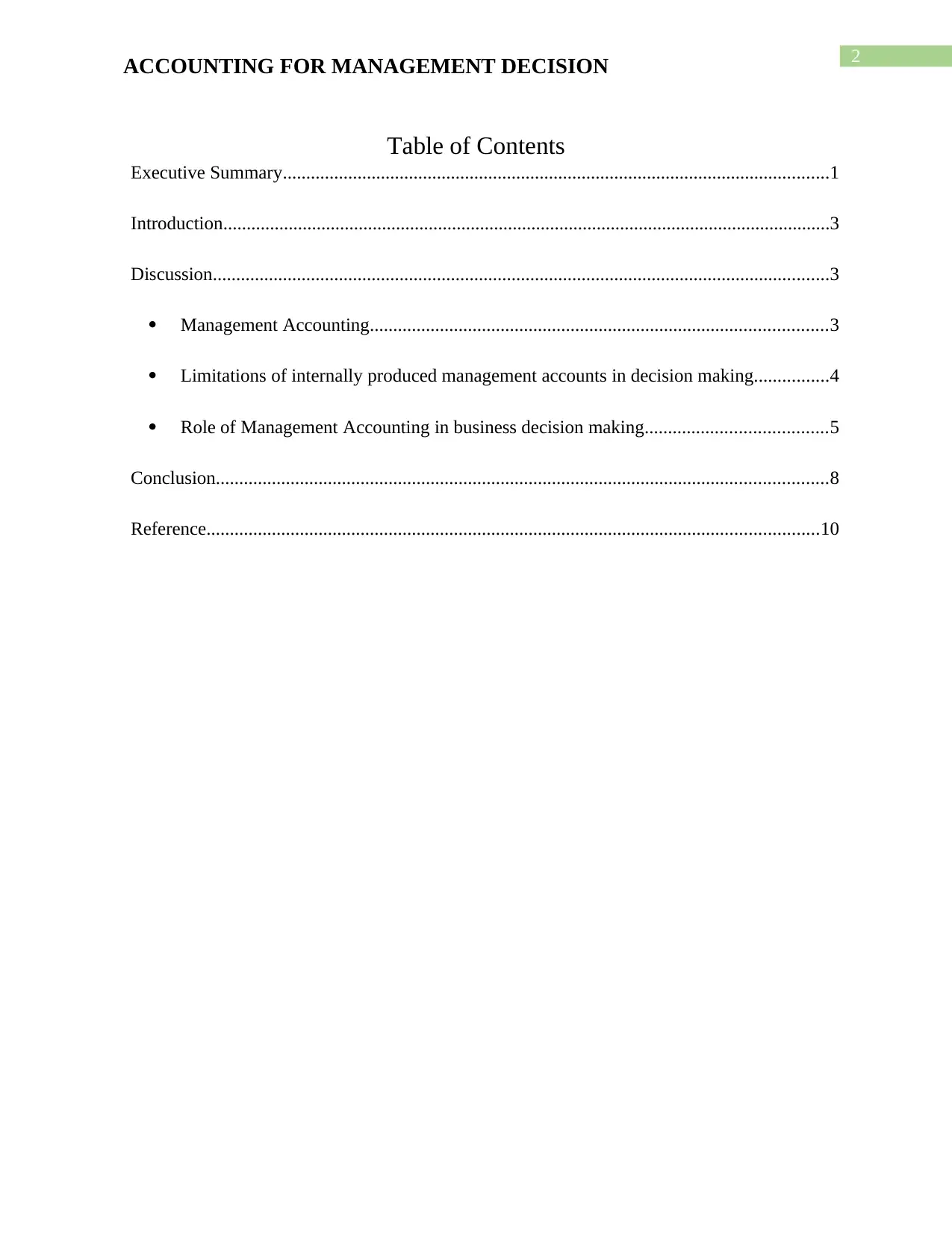
Table of Contents
Executive Summary.....................................................................................................................1
Introduction..................................................................................................................................3
Discussion....................................................................................................................................3
Management Accounting..................................................................................................3
Limitations of internally produced management accounts in decision making................4
Role of Management Accounting in business decision making.......................................5
Conclusion...................................................................................................................................8
Reference...................................................................................................................................10
Document Page
3
ACCOUNTING FOR MANAGEMENT DECISION
Introduction
This report discusses “Management Accounting” or “Managerial Accounting” uses in an
organization to help the managers for future decision-making planning (Malmi 2016).
Management accounting is an activity of analyzing the internal financial report, records and
accounts of an organization to help making business decision for the future to attain its goal. This
management accounting analysis uses in the long-term and short-term decision making to check
the financial health of the business or an organization. It has various limitations concerning the
cost and financial accounting for any organization. It can better be explained by providing the
Management accounting uses in different organization and how it helps to achieve business
objective through correct decision making.
Discussion
Management Accounting
A “Management accounting” is also termed as “managerial accounting” or cost
accounting” which analyzes the business cost and operations through the financial report, records
and accounts to make a business decision to achieve its goal. Management accounting makes
decisions related to production, service and investment made in the market. There are a few
techniques of management accounting which helps in the decision-making process in business
are (Lavia and Hiebl 2015).
1. Business budgeting or capital budgeting it gives the information on capital
expenditure. It calculated the net present value and the internal rate of return to
forecast the capital budgeting decision (Kaplan and Atkinson 2015).
tabler-icon-diamond-filled.svg

Paraphrase This Document

Need a fresh take? Get an instant paraphrase of this document with our AI Paraphraser
Document Page
4
ACCOUNTING FOR MANAGEMENT DECISION
2. Valuation of Inventory and product costing are to identify and analyze the actual cost
of product and inventory of the company. It allocates the overhead charge and
assesses the direct cost related to cost of goods sold.
3. Profit margin analysis is essential for any organization, and it is determined to
identify the business profitability structure over that period and help forecast the
business decision
4. Margin Analysis is concerned with the benefits of the increased production and is
calculated on the break-even point to gather the company’s product sales.
5. Trend analysis and forecasting is evaluated, presented and compared the present with
the future cost and recognized the future variance from the forecasted values.
6. Constraint analysis is identifying the limitation and restriction applied in the business
production and effects on a company’s revenue and profit generation.
Limitations of internally produced management accounts in decision making
(Collier 2015).
Cost and financial accounting- All its information based on cost and financial
accounting and thus information has to be accurate to prepare decision making in
the business. If the information is not valid, then the management accountant
cannot analysis the correct information (Collier 2015).
Lack Knowledge- To make correct decision management must have the
knowledge in accounting, statistics, economics, production, taxation analysis
(Senftlechner and Hiebl 2015).
Lack of coordination and continuity- Management accountant, must apply various
methods in accounting to come up with a robust solution.
Document Page
5
ACCOUNTING FOR MANAGEMENT DECISION
Expensive and Time-based- Management accounting requires extensive
networking based on rules and regulations of the companies in terms of
investment and expenses. Hence its formation is costly. Their decision-making
capacity is based on management planning. Management accountant works
internally to decide based on preparation of the financial records, budgets and
accounting. It has to analysis the financial records correctly, which help the
management to place the forecasting planning on time. The accountant has to
keep update based on the financial records. It works both internally, and financial
accountant works on external reporting.
Role of Management Accounting in business decision making
The vital part of the “Management Accounting” in business is to budgeting. For
any business, a budget can be its all expenses and to fix these expenses each year, the
businessman decides its operation and production cost for the next investment planning.
The role of the management accountant is collecting, recording and reporting financial
information from a different source in the business. They observe and create internal
analyses in the business budget to guide allocating funds. The business includes the cost
of raw material, sales, manufacturing, social media networking, labor, advertisement and
internal business cost. Management accountant helps internally to decide for its business
to achieve the short and long term goal (Azudin and Mansor 2018). Management
accountant makes an overall analysis of all its business used capital and funds and then
report this analyzing information to the senior management and the Board of directors to
decide for business goal (Jamil et al 2015).
Document Page
6
ACCOUNTING FOR MANAGEMENT DECISION
Sometimes, the management accountant has to check the historical data to provide
forecasting of future expenses. Budgeting helps the business future planning, and
management has to decide very quickly to reach out to its business aim in the market.
Management accountant has to create accurate information to deliver its decision-making
process on time, as implementing the decision for future planning is based on market
requirement.
There are some crucial points in the role of management accountant,
Decision making- Management Accountant provide necessary information to the
management regarding the analyses and help to make decisions in the short and
long term. Short-term decision regarding optimum product mix, lease or buy,
make or buy, price of a product, discontinuing a product and long-term decision
making includes in capital budgeting, investment and financing a project (Nielsen,
Mitchell and Nørreklit 2015).
Control- Management Accountant prepares and analyze financial reports for
controlling standard costing, budgeting, explaining variance and its interpretation,
prepare cash and fund flow analysis, testing performance, liquidity management
and accounting (Cuzdriorean 2017).
Maintaining funds- Management accountant has to manage funds between equity
and debt for decision making. Managing and raising debt fund benefits in paying
taxes, however paying its interest can be risky for the business, irrespective of
making a profit or not. Management Accountant has to maintain a huge capacity
of funds for its application in the business cost of capital, leverage and trading on
equity.
tabler-icon-diamond-filled.svg

Paraphrase This Document

Need a fresh take? Get an instant paraphrase of this document with our AI Paraphraser
Document Page
7
ACCOUNTING FOR MANAGEMENT DECISION
Long and short term planning- Management accountant forecasts the business
planning and economic structure for a long-term plan, strategic management
accounting, Corporate Strategy planning and market study (Sands, Lee and
Gunarathne 2015).
Developing management Information system- The management accountant
forward it decision planning for long-term, to the senior management to make a
proper decision on time.
Stewardship accounting- Management accounting manages all the accounting
reports include cost accounting and financial accounting and prepare decision-
based on its operation.
Perform its functions- Management Accountant plays a vital role in business
decision-making planning, it provides a full analysis of the business accounting
and financial records internally. Management accountant performs work of both
accountant and authority to control information. It gives clear information on
report for decision making to the senior management.
The company which uses the role of management accounting are Retail business, service
companies and manufacturing companies. Management accounting does not follow any
accounting standards rules, it follows company’s methods to develop its business objective.
Service companies use management accounting or managerial accounting to ascertaining
the business expenses related to labor charges and material use. Management accounting
help to decide the cost planning and the time spend for its customer. Service companies
use break-even analysis and business forecasting to plan sales and earn revenues. Service
Document Page
8
ACCOUNTING FOR MANAGEMENT DECISION
companies can be a Restaurants, Transportation, Business, Professional and Maintenance
service department.
Manufacturing companies use management accounting to allocate the cost of consumer
goods and the actual cost of the product to the business. It uses the methods of job
costing, activity-based costing, and process costing to allocate the business cost of
production. Based on these methods, it helps the managerial accountant to place an
accurate decision in the company. Cost of production includes direct material, direct
labor, manufacturing cost and overhead. Sale of Finished goods helps in generating
revenue as well as helps in recovering companies production cost of goods.
The retail department uses the management accounting to predict the inventory needs,
profit margin review and business planning decision on financial reports. They track the
inventory cost and inform the suppliers or the vendor about the availability of lower
inventory cost. Companies can select any method for inventory calculation, LIFO or
FIFO method. The retailer often prepares, break-even analysis to decide its sales and
operating cost of the company. A manager uses the information to regulate the profit
margin to attain the income level. In most cases retailer obtain income from the sale
volume and profit margin gets lower on individual goods and hence high sales volume
help to obtain healthy cash flow.
Conclusion
From the above discussion, it can be concluded that “Management Accounting” or
“Managerial Accounting” has a significant contribution to business planning. It helps evaluate
the business decision by applying proper techniques and prepare the financial reports, records
and accounting to analyze the companies cost, budget and financial operation. Management
Document Page
9
ACCOUNTING FOR MANAGEMENT DECISION
accountant must have adequate knowledge to do decision planning. Management accountant
supports its business internally and reflects a positive approach to attain its objective.
Management accounting used in business like in service companies, manufacturing companies
and retail. It helps business through various methods like business budgeting, capital budgeting,
inventory valuation, product costing, trend analysis, margin analysis and constraint analysis,
implementing them in business will help the management to develop and reflect proper
forecasting.
tabler-icon-diamond-filled.svg

Paraphrase This Document

Need a fresh take? Get an instant paraphrase of this document with our AI Paraphraser
Document Page
10
ACCOUNTING FOR MANAGEMENT DECISION
Reference
Azudin, A. and Mansor, N., 2018. Management accounting practices of SMEs: The impact of
organizational DNA, business potential and operational technology. Asia Pacific Management
Review, 23(3), pp.222-226.
Collier, P.M., 2015. Accounting for managers: Interpreting accounting information for decision
making. John Wiley & Sons.
Cuzdriorean, D.D., 2017. The use of management accounting practices by Romanian small and
medium-sized enterprises: A field study. Journal of Accounting and Management Information
Systems, 16(2), pp.291-312.
Jamil, M., Zuriana, C., Mohamed, R., Muhammad, F. and Ali, A., 2015. Environmental
management accounting practices in small medium manufacturing firms. Procedia-Social and
Behavioral Sciences, 172, pp.619-626.
Kaplan, R.S. and Atkinson, A.A., 2015. Advanced management accounting. PHI Learning.
Lavia López, O. and Hiebl, M.R., 2015. Management accounting in small and medium-sized
enterprises: current knowledge and avenues for further research. Journal of Management
Accounting Research, 27(1), pp.81-119.
Malmi, T., 2016. Managerialist studies in management accounting: 1990–2014. Management
Accounting Research, 31, pp.31-44.
Nielsen, L.B., Mitchell, F. and Nørreklit, H., 2015, March. Management accounting and decision
making: Two case studies of outsourcing. In Accounting Forum (Vol. 39, No. 1, pp. 66-82).
Taylor & Francis.
Document Page
11
ACCOUNTING FOR MANAGEMENT DECISION
Sands, J., Lee, K.H. and Gunarathne, N., 2015. Environmental Management Accounting (EMA)
for environmental management and organizational change. Journal of Accounting &
Organizational Change.
Senftlechner, D. and Hiebl, M.R., 2015. Management accounting and management control in
family businesses. Journal of Accounting & Organizational Change.
chevron_up_icon
1 out of 12
circle_padding
hide_on_mobile
zoom_out_icon
[object Object]