AAF0436 - Management Accounting and Financial Planning for BETA
VerifiedAdded on 2023/06/18
|12
|3240
|286
Report
AI Summary
This report provides an analysis of management accounting and financial planning concepts, specifically focusing on their application to BETA, an IT company based in Dubai. The report discusses standard costing, including its types (ideal, normal, basic, and currently attainable) and limitations (expense, need for revision, and impact on employee psychology). It then explores target costing, highlighting its advantages and differences from standard costing. The role of the contribution technique in decision-making is examined, along with an example illustrating its application for BETA. Finally, the report analyzes how transfer pricing approaches can improve a firm's profitability. The overall aim is to provide insights into how BETA can leverage these management accounting tools to enhance its financial performance and operational efficiency. Desklib provides access to a wealth of similar solved assignments and study resources for students.

Management Accounting and Financial
Planning AAF0436
1
Planning AAF0436
1

Paraphrase This Document
Need a fresh take? Get an instant paraphrase of this document with our AI Paraphraser
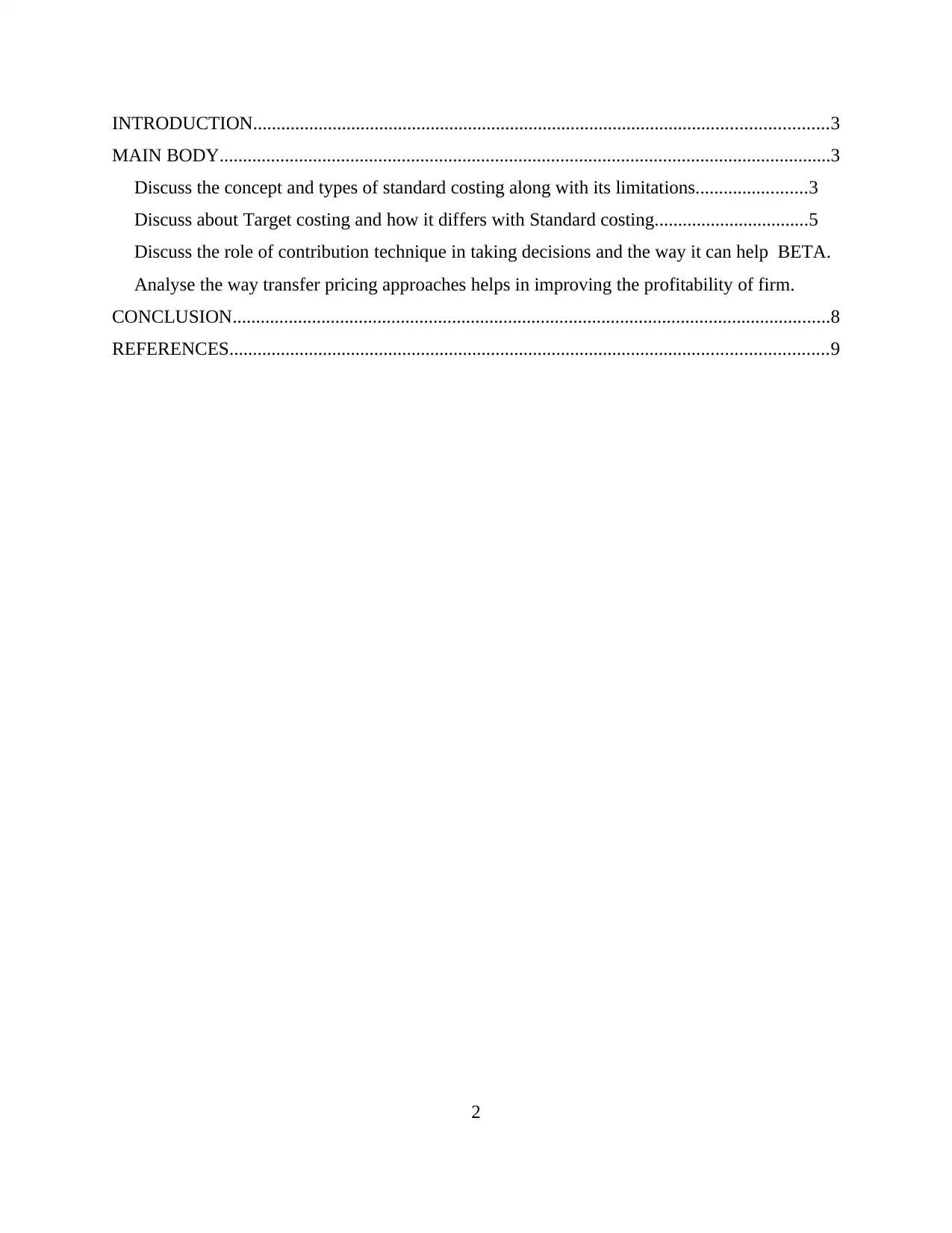
INTRODUCTION...........................................................................................................................3
MAIN BODY...................................................................................................................................3
Discuss the concept and types of standard costing along with its limitations........................3
Discuss about Target costing and how it differs with Standard costing.................................5
Discuss the role of contribution technique in taking decisions and the way it can help BETA.
Analyse the way transfer pricing approaches helps in improving the profitability of firm.
CONCLUSION................................................................................................................................8
REFERENCES................................................................................................................................9
2
MAIN BODY...................................................................................................................................3
Discuss the concept and types of standard costing along with its limitations........................3
Discuss about Target costing and how it differs with Standard costing.................................5
Discuss the role of contribution technique in taking decisions and the way it can help BETA.
Analyse the way transfer pricing approaches helps in improving the profitability of firm.
CONCLUSION................................................................................................................................8
REFERENCES................................................................................................................................9
2
INTRODUCTION
Management accounting is defined as a process associated to preparation of reports about
business operation which helps managers to undertake short term as well as long term decisions.
Management accounting also assist business to fulfil their goals while evaluating measuring in
analysing into protecting and communicating information’s in a systematic manner (Banerjee,
2021). Management accounting play essential role through which business can conduct relevant
cost analysis which helps in determining existing expenses and offer suggestion to conduct
future activities in effective manner. Present report is conducted on better which is operating as
an IT company and conducts Dubai based business while dealing in developing apps, supporting
and maintenance of application, software consultancy, IOT services, etc. In this report discussion
has been conducted on the concept and types of standard costing in addition with its limitation,
along with is target costing. Along with this difference with standard costing is also discussed in
this report. At last role of contribution technique and the manner in which transfer pricing
approach helps in making improvement in profitability of firm is also discussed in present report.
3
Management accounting is defined as a process associated to preparation of reports about
business operation which helps managers to undertake short term as well as long term decisions.
Management accounting also assist business to fulfil their goals while evaluating measuring in
analysing into protecting and communicating information’s in a systematic manner (Banerjee,
2021). Management accounting play essential role through which business can conduct relevant
cost analysis which helps in determining existing expenses and offer suggestion to conduct
future activities in effective manner. Present report is conducted on better which is operating as
an IT company and conducts Dubai based business while dealing in developing apps, supporting
and maintenance of application, software consultancy, IOT services, etc. In this report discussion
has been conducted on the concept and types of standard costing in addition with its limitation,
along with is target costing. Along with this difference with standard costing is also discussed in
this report. At last role of contribution technique and the manner in which transfer pricing
approach helps in making improvement in profitability of firm is also discussed in present report.
3
⊘ This is a preview!⊘
Do you want full access?
Subscribe today to unlock all pages.

Trusted by 1+ million students worldwide
MAIN BODY
Discuss the concept and types of standard costing along with its limitations.
Standard costing is inclusive of setting of predetermined cost estimates as to provide a
basis for the comparison with actual cost. There are mainly three primary categories of standard
cost which is ideal standard, basic standard cost and currently attainable standard cost. It has
been underlined that it is basically a procedure to eliminate the overall amount of expenses
which can take place during the time of production in the estimated cost which is further
compared with actual research with an aim to determine difference between them (Alves, Lichtig
and Rybkowski, 2017). It helps to collect information along with the reason behind the variation.
Main purpose of this is to have estimated budget in a correct manner and determine the
performance of operations. This will help better to control extra cost that can be an occurred with
the help of his better can conduct prior researches and can determine a base of the standard for
next year.
Types of standards
There are basically four types of standards
Ideal or Perfect standard-
It is mainly a measure that can be easily obtained in normal form of condition. In this it is
essential for better to implement appropriate and accurate cost for their material and labour in
addition with maximum possible output that better produce with highest efficiency. It has been
identified that these measures are basically very tight and do not offer any space for kind of
spoilage wastage or inefficiency during work.
Normal standards-
Normal standards are basically expected to be fulfilled in future which can be the time
period of one business cycle. The standard has been duly framed by better on the basis of its
average capacity which can assist in regression as well as boom. Furthermore, it has been
underlined that the cost recognise in this method remains same for the whole cycle and does not
get revised.
Basic standards-
Basic standards are basically developed by organisation for a define time period. It has
been identified that these measures basically stay un- altered. However, they kept revised
4
Discuss the concept and types of standard costing along with its limitations.
Standard costing is inclusive of setting of predetermined cost estimates as to provide a
basis for the comparison with actual cost. There are mainly three primary categories of standard
cost which is ideal standard, basic standard cost and currently attainable standard cost. It has
been underlined that it is basically a procedure to eliminate the overall amount of expenses
which can take place during the time of production in the estimated cost which is further
compared with actual research with an aim to determine difference between them (Alves, Lichtig
and Rybkowski, 2017). It helps to collect information along with the reason behind the variation.
Main purpose of this is to have estimated budget in a correct manner and determine the
performance of operations. This will help better to control extra cost that can be an occurred with
the help of his better can conduct prior researches and can determine a base of the standard for
next year.
Types of standards
There are basically four types of standards
Ideal or Perfect standard-
It is mainly a measure that can be easily obtained in normal form of condition. In this it is
essential for better to implement appropriate and accurate cost for their material and labour in
addition with maximum possible output that better produce with highest efficiency. It has been
identified that these measures are basically very tight and do not offer any space for kind of
spoilage wastage or inefficiency during work.
Normal standards-
Normal standards are basically expected to be fulfilled in future which can be the time
period of one business cycle. The standard has been duly framed by better on the basis of its
average capacity which can assist in regression as well as boom. Furthermore, it has been
underlined that the cost recognise in this method remains same for the whole cycle and does not
get revised.
Basic standards-
Basic standards are basically developed by organisation for a define time period. It has
been identified that these measures basically stay un- altered. However, they kept revised
4
Paraphrase This Document
Need a fresh take? Get an instant paraphrase of this document with our AI Paraphraser
sometime as per the fluctuations occur in price (Bielefeld and Schneider, 2017). Basic standard is
being utilised by better for identification of actual results along with expected results in simple
terms the standard are basically act as measure for other grades.
Currently attainable standards-
These are basically form of standard which are achievable by particular level of efforts.
In addition to this it has been identified that it allows for normal waste, spoilage and non-
productive time. Currently attainable standards are basically for short period of time and is
associated to current condition of work. These standards are being duly followed by better with
an aim to bring efficiency in business operations.
Limitations of standard costing
Expensive tool -
This must need knowledge of expert level in order to set a fixed measures and further
make analysis of them on the basis of results. It has been evaluated that learning of expenses tool
is basically acquired by professional in which better is required to invest lot of money n selection
and recruitment process of such individuals.
Demands regular revision-
Because of fluctuations in frequent level in the market inflation and price level it is
essential to BETA make updating of these measures on continuous basis. However, it is low as
well as complicated process in which better is required to spend comparatively more time.
Effects employee Psychology-
Employees play important role for an organisation. The main limitation of standard costing
is that it affects employee psychology in which organisation management must ensure that level
set a required to be attainable that can be easily fulfilled by employees, as high and unattainable
e measures will lead BETA to face decrease in employee motivation and morale which can affect
their performance.
As per the above discussion it has been identified that standard costing offers a base of
expenses to an organisation according to which it is required to perform its task. However, there
are different constraints of this techniques. However due to the significant advantage of this tool
business organisation can analyse performance and can further control various operation cost that
helps in performing business operations in effective manner.
5
being utilised by better for identification of actual results along with expected results in simple
terms the standard are basically act as measure for other grades.
Currently attainable standards-
These are basically form of standard which are achievable by particular level of efforts.
In addition to this it has been identified that it allows for normal waste, spoilage and non-
productive time. Currently attainable standards are basically for short period of time and is
associated to current condition of work. These standards are being duly followed by better with
an aim to bring efficiency in business operations.
Limitations of standard costing
Expensive tool -
This must need knowledge of expert level in order to set a fixed measures and further
make analysis of them on the basis of results. It has been evaluated that learning of expenses tool
is basically acquired by professional in which better is required to invest lot of money n selection
and recruitment process of such individuals.
Demands regular revision-
Because of fluctuations in frequent level in the market inflation and price level it is
essential to BETA make updating of these measures on continuous basis. However, it is low as
well as complicated process in which better is required to spend comparatively more time.
Effects employee Psychology-
Employees play important role for an organisation. The main limitation of standard costing
is that it affects employee psychology in which organisation management must ensure that level
set a required to be attainable that can be easily fulfilled by employees, as high and unattainable
e measures will lead BETA to face decrease in employee motivation and morale which can affect
their performance.
As per the above discussion it has been identified that standard costing offers a base of
expenses to an organisation according to which it is required to perform its task. However, there
are different constraints of this techniques. However due to the significant advantage of this tool
business organisation can analyse performance and can further control various operation cost that
helps in performing business operations in effective manner.
5
Discuss about Target costing and how it differs with Standard costing.
Target costing is basically an approach which helps in determining product life cycle cost
which is required to be sufficient in order to develop particular quality and functionality while
assuring desired profit. Target costing mainly includes setting of a target cost by making
subtraction of desired profit margin. In simple terms this method of costing is termed as
estimation of expected selling prize in which organisation subtract product desired profit from
selling the product. In this organisation pre-define product cost revenue and price (Finnegan,
2019). In this it is essential for company to conduct in depth research through which they can
earn profit. BETA design team determine the maximum and minimum cost that can be incurred
for purchasing the good. After this product is developed by ensuring material quality, delivery
time of inputs, required quantity along with minimum possible price. Primary reason behind
target costing method is that it helps in offering a proactive to through which incurred can
conduct planning as well as managing of cost in an effective manner. With the help of this
costing method incurred can be a price taker rather than price maker.
Advantages of Target costing
The main advantage associated to target costing is that, it helps in assuring that target of
profit is achievable and are being set on the basis of in-depth research of the associated
product. It helps organisation to make employees confident through which they can put
effort to reach goals (Sun and Carmichael, 2018).
It offers a formal as well as proper process as per the whole operation of project action
which is required to be conducted. It automatically assists BETA in elimination of
wasteful activities that can lead to increase in unnecessary cost.
With the help of pre-define cost BETA can control production cost at every step in a
systematic manner.
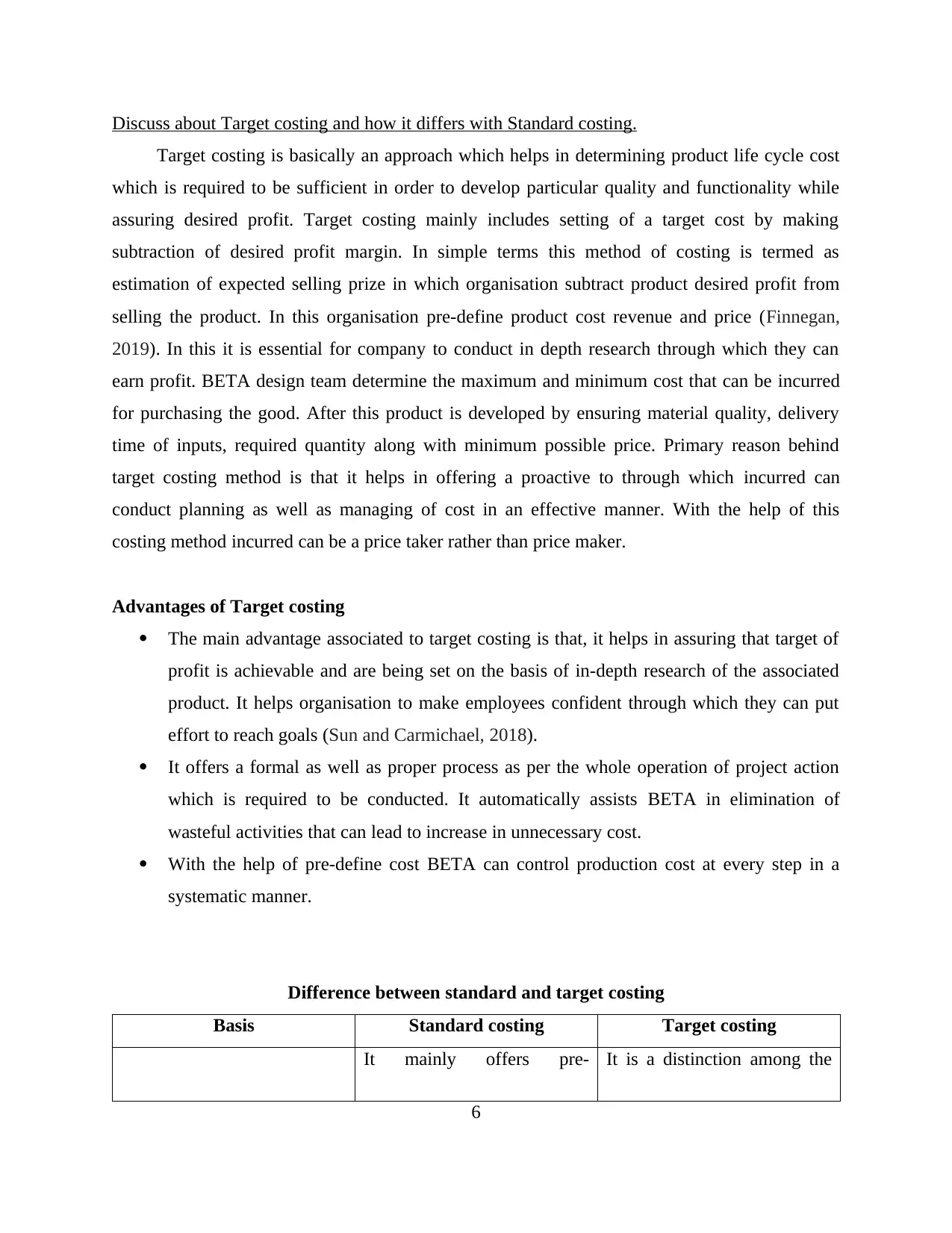
Difference between standard and target costing
Basis Standard costing Target costing
It mainly offers pre- It is a distinction among the
6
Target costing is basically an approach which helps in determining product life cycle cost
which is required to be sufficient in order to develop particular quality and functionality while
assuring desired profit. Target costing mainly includes setting of a target cost by making
subtraction of desired profit margin. In simple terms this method of costing is termed as
estimation of expected selling prize in which organisation subtract product desired profit from
selling the product. In this organisation pre-define product cost revenue and price (Finnegan,
2019). In this it is essential for company to conduct in depth research through which they can
earn profit. BETA design team determine the maximum and minimum cost that can be incurred
for purchasing the good. After this product is developed by ensuring material quality, delivery
time of inputs, required quantity along with minimum possible price. Primary reason behind
target costing method is that it helps in offering a proactive to through which incurred can
conduct planning as well as managing of cost in an effective manner. With the help of this
costing method incurred can be a price taker rather than price maker.
Advantages of Target costing
The main advantage associated to target costing is that, it helps in assuring that target of
profit is achievable and are being set on the basis of in-depth research of the associated
product. It helps organisation to make employees confident through which they can put
effort to reach goals (Sun and Carmichael, 2018).
It offers a formal as well as proper process as per the whole operation of project action
which is required to be conducted. It automatically assists BETA in elimination of
wasteful activities that can lead to increase in unnecessary cost.
With the help of pre-define cost BETA can control production cost at every step in a
systematic manner.
Difference between standard and target costing
Basis Standard costing Target costing
It mainly offers pre- It is a distinction among the
6
⊘ This is a preview!⊘
Do you want full access?
Subscribe today to unlock all pages.
Trusted by 1+ million students worldwide
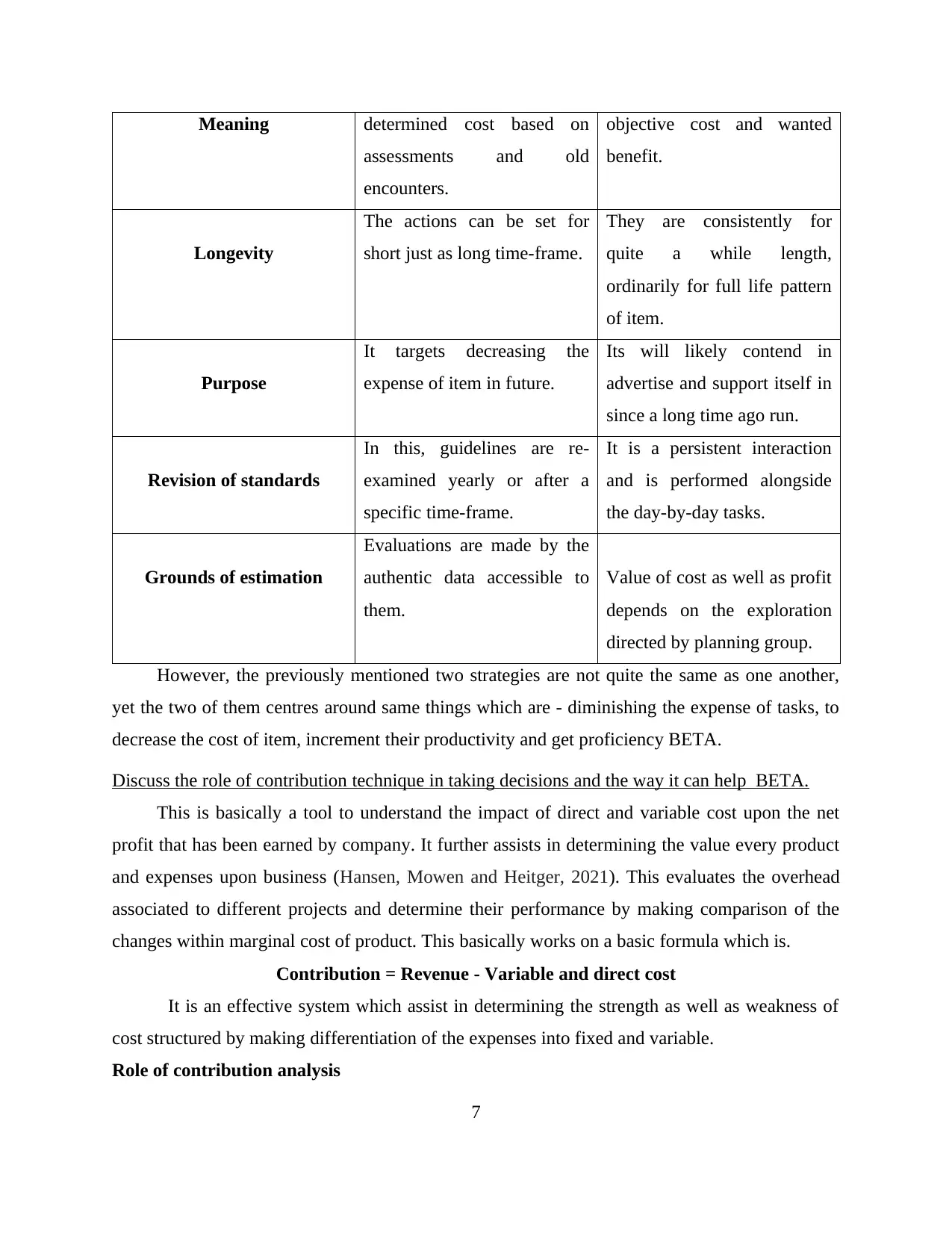
Meaning determined cost based on
assessments and old
encounters.
objective cost and wanted
benefit.
Longevity
The actions can be set for
short just as long time-frame.
They are consistently for
quite a while length,
ordinarily for full life pattern
of item.
Purpose
It targets decreasing the
expense of item in future.
Its will likely contend in
advertise and support itself in
since a long time ago run.
Revision of standards
In this, guidelines are re-
examined yearly or after a
specific time-frame.
It is a persistent interaction
and is performed alongside
the day-by-day tasks.
Grounds of estimation
Evaluations are made by the
authentic data accessible to
them.
Value of cost as well as profit
depends on the exploration
directed by planning group.
However, the previously mentioned two strategies are not quite the same as one another,
yet the two of them centres around same things which are - diminishing the expense of tasks, to
decrease the cost of item, increment their productivity and get proficiency BETA.
Discuss the role of contribution technique in taking decisions and the way it can help BETA.
This is basically a tool to understand the impact of direct and variable cost upon the net
profit that has been earned by company. It further assists in determining the value every product
and expenses upon business (Hansen, Mowen and Heitger, 2021). This evaluates the overhead
associated to different projects and determine their performance by making comparison of the
changes within marginal cost of product. This basically works on a basic formula which is.
Contribution = Revenue - Variable and direct cost
It is an effective system which assist in determining the strength as well as weakness of
cost structured by making differentiation of the expenses into fixed and variable.
Role of contribution analysis
7
assessments and old
encounters.
objective cost and wanted
benefit.
Longevity
The actions can be set for
short just as long time-frame.
They are consistently for
quite a while length,
ordinarily for full life pattern
of item.
Purpose
It targets decreasing the
expense of item in future.
Its will likely contend in
advertise and support itself in
since a long time ago run.
Revision of standards
In this, guidelines are re-
examined yearly or after a
specific time-frame.
It is a persistent interaction
and is performed alongside
the day-by-day tasks.
Grounds of estimation
Evaluations are made by the
authentic data accessible to
them.
Value of cost as well as profit
depends on the exploration
directed by planning group.
However, the previously mentioned two strategies are not quite the same as one another,
yet the two of them centres around same things which are - diminishing the expense of tasks, to
decrease the cost of item, increment their productivity and get proficiency BETA.
Discuss the role of contribution technique in taking decisions and the way it can help BETA.
This is basically a tool to understand the impact of direct and variable cost upon the net
profit that has been earned by company. It further assists in determining the value every product
and expenses upon business (Hansen, Mowen and Heitger, 2021). This evaluates the overhead
associated to different projects and determine their performance by making comparison of the
changes within marginal cost of product. This basically works on a basic formula which is.
Contribution = Revenue - Variable and direct cost
It is an effective system which assist in determining the strength as well as weakness of
cost structured by making differentiation of the expenses into fixed and variable.
Role of contribution analysis
7
Paraphrase This Document
Need a fresh take? Get an instant paraphrase of this document with our AI Paraphraser
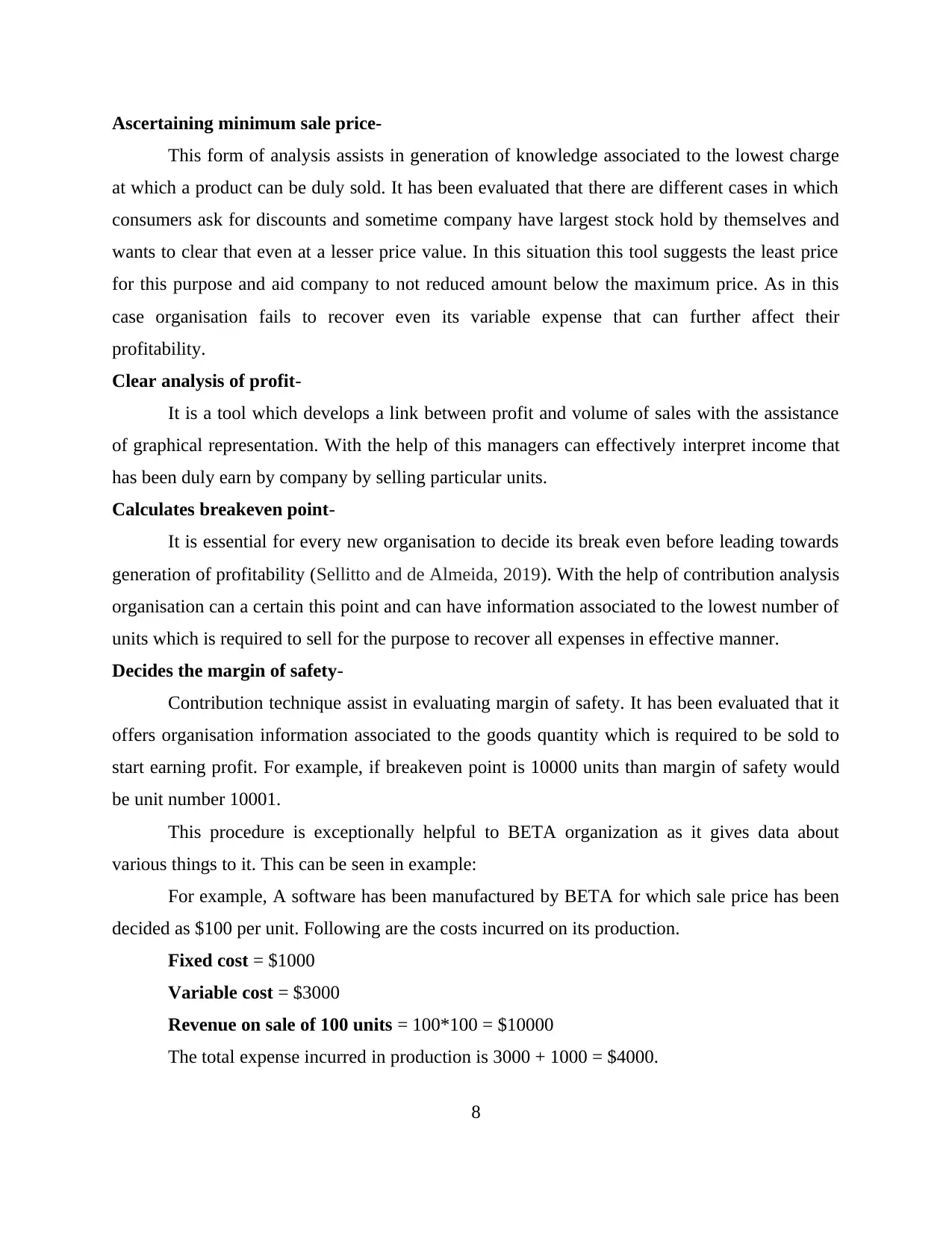
Ascertaining minimum sale price-
This form of analysis assists in generation of knowledge associated to the lowest charge
at which a product can be duly sold. It has been evaluated that there are different cases in which
consumers ask for discounts and sometime company have largest stock hold by themselves and
wants to clear that even at a lesser price value. In this situation this tool suggests the least price
for this purpose and aid company to not reduced amount below the maximum price. As in this
case organisation fails to recover even its variable expense that can further affect their
profitability.
Clear analysis of profit-
It is a tool which develops a link between profit and volume of sales with the assistance
of graphical representation. With the help of this managers can effectively interpret income that
has been duly earn by company by selling particular units.
Calculates breakeven point-
It is essential for every new organisation to decide its break even before leading towards
generation of profitability (Sellitto and de Almeida, 2019). With the help of contribution analysis
organisation can a certain this point and can have information associated to the lowest number of
units which is required to sell for the purpose to recover all expenses in effective manner.
Decides the margin of safety-
Contribution technique assist in evaluating margin of safety. It has been evaluated that it
offers organisation information associated to the goods quantity which is required to be sold to
start earning profit. For example, if breakeven point is 10000 units than margin of safety would
be unit number 10001.
This procedure is exceptionally helpful to BETA organization as it gives data about
various things to it. This can be seen in example:
For example, A software has been manufactured by BETA for which sale price has been
decided as $100 per unit. Following are the costs incurred on its production.
Fixed cost = $1000
Variable cost = $3000
Revenue on sale of 100 units = 100*100 = $10000
The total expense incurred in production is 3000 + 1000 = $4000.
8
This form of analysis assists in generation of knowledge associated to the lowest charge
at which a product can be duly sold. It has been evaluated that there are different cases in which
consumers ask for discounts and sometime company have largest stock hold by themselves and
wants to clear that even at a lesser price value. In this situation this tool suggests the least price
for this purpose and aid company to not reduced amount below the maximum price. As in this
case organisation fails to recover even its variable expense that can further affect their
profitability.
Clear analysis of profit-
It is a tool which develops a link between profit and volume of sales with the assistance
of graphical representation. With the help of this managers can effectively interpret income that
has been duly earn by company by selling particular units.
Calculates breakeven point-
It is essential for every new organisation to decide its break even before leading towards
generation of profitability (Sellitto and de Almeida, 2019). With the help of contribution analysis
organisation can a certain this point and can have information associated to the lowest number of
units which is required to sell for the purpose to recover all expenses in effective manner.
Decides the margin of safety-
Contribution technique assist in evaluating margin of safety. It has been evaluated that it
offers organisation information associated to the goods quantity which is required to be sold to
start earning profit. For example, if breakeven point is 10000 units than margin of safety would
be unit number 10001.
This procedure is exceptionally helpful to BETA organization as it gives data about
various things to it. This can be seen in example:
For example, A software has been manufactured by BETA for which sale price has been
decided as $100 per unit. Following are the costs incurred on its production.
Fixed cost = $1000
Variable cost = $3000
Revenue on sale of 100 units = 100*100 = $10000
The total expense incurred in production is 3000 + 1000 = $4000.
8
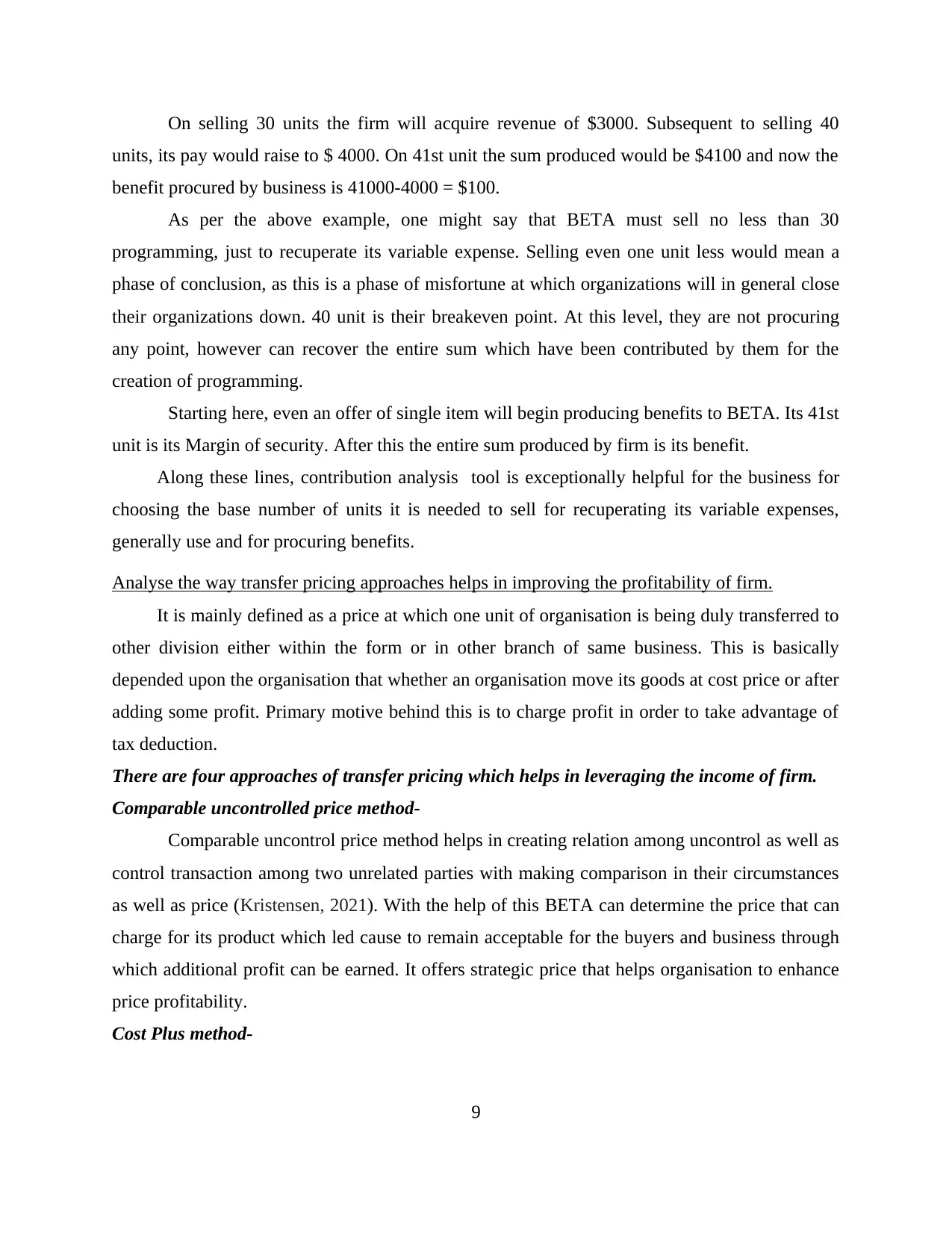
On selling 30 units the firm will acquire revenue of $3000. Subsequent to selling 40
units, its pay would raise to $ 4000. On 41st unit the sum produced would be $4100 and now the
benefit procured by business is 41000-4000 = $100.
As per the above example, one might say that BETA must sell no less than 30
programming, just to recuperate its variable expense. Selling even one unit less would mean a
phase of conclusion, as this is a phase of misfortune at which organizations will in general close
their organizations down. 40 unit is their breakeven point. At this level, they are not procuring
any point, however can recover the entire sum which have been contributed by them for the
creation of programming.
Starting here, even an offer of single item will begin producing benefits to BETA. Its 41st
unit is its Margin of security. After this the entire sum produced by firm is its benefit.
Along these lines, contribution analysis tool is exceptionally helpful for the business for
choosing the base number of units it is needed to sell for recuperating its variable expenses,
generally use and for procuring benefits.
Analyse the way transfer pricing approaches helps in improving the profitability of firm.
It is mainly defined as a price at which one unit of organisation is being duly transferred to
other division either within the form or in other branch of same business. This is basically
depended upon the organisation that whether an organisation move its goods at cost price or after
adding some profit. Primary motive behind this is to charge profit in order to take advantage of
tax deduction.
There are four approaches of transfer pricing which helps in leveraging the income of firm.
Comparable uncontrolled price method-
Comparable uncontrol price method helps in creating relation among uncontrol as well as
control transaction among two unrelated parties with making comparison in their circumstances
as well as price (Kristensen, 2021). With the help of this BETA can determine the price that can
charge for its product which led cause to remain acceptable for the buyers and business through
which additional profit can be earned. It offers strategic price that helps organisation to enhance
price profitability.
Cost Plus method-
9
units, its pay would raise to $ 4000. On 41st unit the sum produced would be $4100 and now the
benefit procured by business is 41000-4000 = $100.
As per the above example, one might say that BETA must sell no less than 30
programming, just to recuperate its variable expense. Selling even one unit less would mean a
phase of conclusion, as this is a phase of misfortune at which organizations will in general close
their organizations down. 40 unit is their breakeven point. At this level, they are not procuring
any point, however can recover the entire sum which have been contributed by them for the
creation of programming.
Starting here, even an offer of single item will begin producing benefits to BETA. Its 41st
unit is its Margin of security. After this the entire sum produced by firm is its benefit.
Along these lines, contribution analysis tool is exceptionally helpful for the business for
choosing the base number of units it is needed to sell for recuperating its variable expenses,
generally use and for procuring benefits.
Analyse the way transfer pricing approaches helps in improving the profitability of firm.
It is mainly defined as a price at which one unit of organisation is being duly transferred to
other division either within the form or in other branch of same business. This is basically
depended upon the organisation that whether an organisation move its goods at cost price or after
adding some profit. Primary motive behind this is to charge profit in order to take advantage of
tax deduction.
There are four approaches of transfer pricing which helps in leveraging the income of firm.
Comparable uncontrolled price method-
Comparable uncontrol price method helps in creating relation among uncontrol as well as
control transaction among two unrelated parties with making comparison in their circumstances
as well as price (Kristensen, 2021). With the help of this BETA can determine the price that can
charge for its product which led cause to remain acceptable for the buyers and business through
which additional profit can be earned. It offers strategic price that helps organisation to enhance
price profitability.
Cost Plus method-
9
⊘ This is a preview!⊘
Do you want full access?
Subscribe today to unlock all pages.
Trusted by 1+ million students worldwide
This form of method is being basically used by parties which deals in semi furnished
goods. In this seller of product charges, a market price along with cost of goods sold from the
purchase. Main aim behind this is to earn enough amount which is direct as well as direct
expenses recovered out of it. With the help of this BETA can estimate the value that can be
charged by them while transferring goods which helps in maximizing.
Transactional net margin method-
Transactional net margin method helps in a certain in the profit via the net profit of
control transaction. This value is further being utilised for making comparison with control
affairs. With the help of this BETA can recognise profit which can be generated from sales
manufacturing and distribution activities. It automatically helps in enhancing overall level of
profitability by significantly making improvement in cost maintenance techniques.
Profit split method-
It is one of the five transfer pricing methods that an organisation can utilise to ensure that
transaction among related company is being carried out at a fair market price. Furthermore, it has
been underlined that it is an effective method that helps in evaluating the manner in which third
party divide profit associated with similar form of transaction (Luca, 2018). Profit split method is
basically applied in intangible assets which is basically difficult to get a path. With the help of
this BETA can understand prices in a more effective manner. It also helps in determining
accurate value of asset. Profit split method will help company to decide the part of tax which is
required to pay associated to particular transaction which automatically helps organisation to
restrict themselves for paying extra taxes. This help organisation to make improvement in its
profitability in effective manner.
CONCLUSION
According to the above-mentioned report it has been concluded that there are different forms
of management accounting techniques which will significantly help organisation to control costs
as well as revenue of organisation. It offers standards and a base which helps in determining
different variations between a budget value and actual results. This will help organisation to
undertake accurate decisions or conduct business operations in effective manner. This report
states that contribution analysis assists in evaluating the extent at which product can cover its
fixed cost and variable and the point that will help organisation to measure profitability. With the
10
goods. In this seller of product charges, a market price along with cost of goods sold from the
purchase. Main aim behind this is to earn enough amount which is direct as well as direct
expenses recovered out of it. With the help of this BETA can estimate the value that can be
charged by them while transferring goods which helps in maximizing.
Transactional net margin method-
Transactional net margin method helps in a certain in the profit via the net profit of
control transaction. This value is further being utilised for making comparison with control
affairs. With the help of this BETA can recognise profit which can be generated from sales
manufacturing and distribution activities. It automatically helps in enhancing overall level of
profitability by significantly making improvement in cost maintenance techniques.
Profit split method-
It is one of the five transfer pricing methods that an organisation can utilise to ensure that
transaction among related company is being carried out at a fair market price. Furthermore, it has
been underlined that it is an effective method that helps in evaluating the manner in which third
party divide profit associated with similar form of transaction (Luca, 2018). Profit split method is
basically applied in intangible assets which is basically difficult to get a path. With the help of
this BETA can understand prices in a more effective manner. It also helps in determining
accurate value of asset. Profit split method will help company to decide the part of tax which is
required to pay associated to particular transaction which automatically helps organisation to
restrict themselves for paying extra taxes. This help organisation to make improvement in its
profitability in effective manner.
CONCLUSION
According to the above-mentioned report it has been concluded that there are different forms
of management accounting techniques which will significantly help organisation to control costs
as well as revenue of organisation. It offers standards and a base which helps in determining
different variations between a budget value and actual results. This will help organisation to
undertake accurate decisions or conduct business operations in effective manner. This report
states that contribution analysis assists in evaluating the extent at which product can cover its
fixed cost and variable and the point that will help organisation to measure profitability. With the
10
Paraphrase This Document
Need a fresh take? Get an instant paraphrase of this document with our AI Paraphraser
help of transfer pricing methods business organisation can improve profitability as well as
performance on simultaneous basis.
REFERENCES
Books and Journals
Alves, T.D.C., Lichtig, W. and Rybkowski, Z.K., 2017. Implementing target value design: Tools
and techniques to manage the process. HERD: Health Environments Research &
Design Journal. 10(3). pp.18-29.
Banerjee, B., 2021. Cost accounting: Theory and practice. PHI Learning Pvt. Ltd..
Bielefeld, B. and Schneider, R., 2017. Costing methods. In Basics Budgeting (pp. 31-50).
Birkhäuser.
Finnegan, M., 2019. Understanding Transfer Pricing and its role in Multinational Corporation
subsidiary revenue and tax reporting: the changing behaviour of MNCs around tax
planning (Doctoral dissertation, Griffith College).
Hansen, D.R., Mowen, M.M. and Heitger, D.L., 2021. Cost management. Cengage Learning.
Kristensen, T.B., 2021. Enabling use of standard variable costing in lean production. Production
Planning & Control. 32(3). pp.169-184.
11
performance on simultaneous basis.
REFERENCES
Books and Journals
Alves, T.D.C., Lichtig, W. and Rybkowski, Z.K., 2017. Implementing target value design: Tools
and techniques to manage the process. HERD: Health Environments Research &
Design Journal. 10(3). pp.18-29.
Banerjee, B., 2021. Cost accounting: Theory and practice. PHI Learning Pvt. Ltd..
Bielefeld, B. and Schneider, R., 2017. Costing methods. In Basics Budgeting (pp. 31-50).
Birkhäuser.
Finnegan, M., 2019. Understanding Transfer Pricing and its role in Multinational Corporation
subsidiary revenue and tax reporting: the changing behaviour of MNCs around tax
planning (Doctoral dissertation, Griffith College).
Hansen, D.R., Mowen, M.M. and Heitger, D.L., 2021. Cost management. Cengage Learning.
Kristensen, T.B., 2021. Enabling use of standard variable costing in lean production. Production
Planning & Control. 32(3). pp.169-184.
11
Luca, O., 2018. Theoretical and Practical Problems of the Transfer Pricing. Cluj Tax FJ, p.61.
Nuhu, N.A., Baird, K. and Appuhamilage, A.B., 2017. The adoption and success of
contemporary management accounting practices in the public sector. Asian Review of
Accounting.
Sellitto, M.A. and de Almeida, F.A., 2019. Analysis of the contribution of waste sorting plants to
the reverse processes of supply chains. Waste Management & Research. 37(2). pp.127-
134.
Sun, Y. and Carmichael, D.G., 2018. Uncertainties related to financial variables within
infrastructure life cycle costing: a literature review. Structure and Infrastructure
Engineering. 14(9). pp.1233-1243.
12
Nuhu, N.A., Baird, K. and Appuhamilage, A.B., 2017. The adoption and success of
contemporary management accounting practices in the public sector. Asian Review of
Accounting.
Sellitto, M.A. and de Almeida, F.A., 2019. Analysis of the contribution of waste sorting plants to
the reverse processes of supply chains. Waste Management & Research. 37(2). pp.127-
134.
Sun, Y. and Carmichael, D.G., 2018. Uncertainties related to financial variables within
infrastructure life cycle costing: a literature review. Structure and Infrastructure
Engineering. 14(9). pp.1233-1243.
12
⊘ This is a preview!⊘
Do you want full access?
Subscribe today to unlock all pages.
Trusted by 1+ million students worldwide

1 out of 12


Related Documents


Your All-in-One AI-Powered Toolkit for Academic Success.
+13062052269
info@desklib.com
Available 24*7 on WhatsApp / Email
![[object Object]](/_next/static/media/star-bottom.7253800d.svg)
Unlock your academic potential
Copyright © 2020–2026 A2Z Services. All Rights Reserved. Developed and managed by ZUCOL.