Management and Leadership Issues in Hang Seng Bank's Growth
VerifiedAdded on 2021/01/03
|33
|6736
|162
Project
AI Summary
This project is a comprehensive analysis of the leadership and management issues affecting the sustainable business growth of Hang Seng Bank, a leading banking institution in Hong Kong. The research delves into the concepts of leadership and management, exploring their impact on achieving sustainable growth, particularly in the context of e-service implementation. The project investigates the factors that initiate management and leadership challenges within Hang Seng Bank, including the competitive landscape and the need for innovation. The methodology includes individual interviews, questionnaire surveys, and focus groups to gather both qualitative and quantitative data. The analysis examines findings in relation to the theoretical framework and provides recommendations for minimizing leadership and management issues to foster sustainable growth, with a focus on e-service implementation and strategies for adapting to a competitive market. The project concludes with recommendations for improving leadership and management practices to ensure the bank's continued success.
Analysing the Management and Leadership
issues in achieving sustainable business growth of
Hang Seng
issues in achieving sustainable business growth of
Hang Seng

Paraphrase This Document
Need a fresh take? Get an instant paraphrase of this document with our AI Paraphraser

Executive summary

Acknowledgement
⊘ This is a preview!⊘
Do you want full access?
Subscribe today to unlock all pages.

Trusted by 1+ million students worldwide
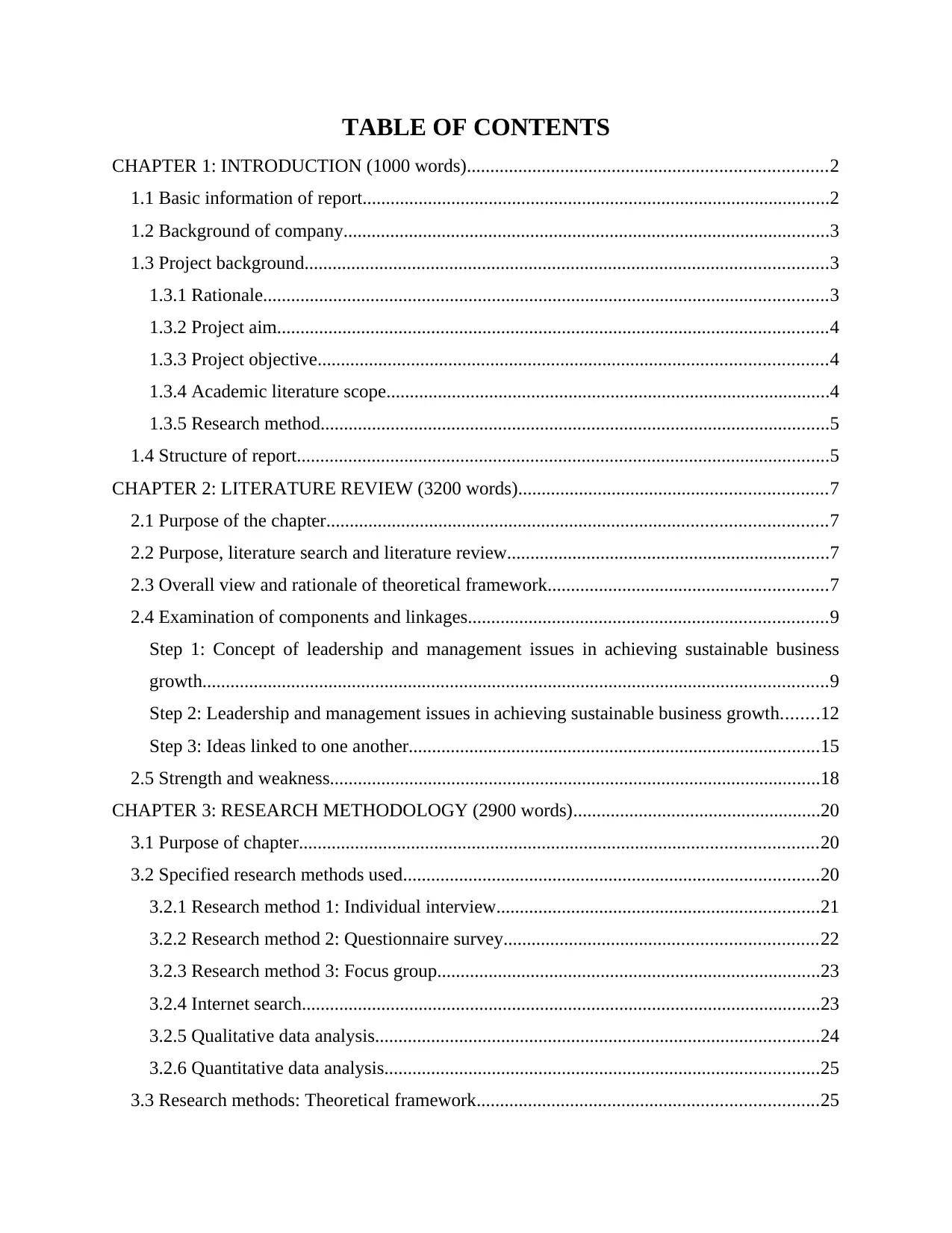
TABLE OF CONTENTS
CHAPTER 1: INTRODUCTION (1000 words).............................................................................2
1.1 Basic information of report....................................................................................................2
1.2 Background of company........................................................................................................3
1.3 Project background................................................................................................................3
1.3.1 Rationale.........................................................................................................................3
1.3.2 Project aim......................................................................................................................4
1.3.3 Project objective.............................................................................................................4
1.3.4 Academic literature scope...............................................................................................4
1.3.5 Research method.............................................................................................................5
1.4 Structure of report..................................................................................................................5
CHAPTER 2: LITERATURE REVIEW (3200 words)..................................................................7
2.1 Purpose of the chapter...........................................................................................................7
2.2 Purpose, literature search and literature review.....................................................................7
2.3 Overall view and rationale of theoretical framework............................................................7
2.4 Examination of components and linkages.............................................................................9
Step 1: Concept of leadership and management issues in achieving sustainable business
growth......................................................................................................................................9
Step 2: Leadership and management issues in achieving sustainable business growth........12
Step 3: Ideas linked to one another........................................................................................15
2.5 Strength and weakness.........................................................................................................18
CHAPTER 3: RESEARCH METHODOLOGY (2900 words).....................................................20
3.1 Purpose of chapter...............................................................................................................20
3.2 Specified research methods used.........................................................................................20
3.2.1 Research method 1: Individual interview.....................................................................21
3.2.2 Research method 2: Questionnaire survey...................................................................22
3.2.3 Research method 3: Focus group..................................................................................23
3.2.4 Internet search...............................................................................................................23
3.2.5 Qualitative data analysis...............................................................................................24
3.2.6 Quantitative data analysis.............................................................................................25
3.3 Research methods: Theoretical framework.........................................................................25
CHAPTER 1: INTRODUCTION (1000 words).............................................................................2
1.1 Basic information of report....................................................................................................2
1.2 Background of company........................................................................................................3
1.3 Project background................................................................................................................3
1.3.1 Rationale.........................................................................................................................3
1.3.2 Project aim......................................................................................................................4
1.3.3 Project objective.............................................................................................................4
1.3.4 Academic literature scope...............................................................................................4
1.3.5 Research method.............................................................................................................5
1.4 Structure of report..................................................................................................................5
CHAPTER 2: LITERATURE REVIEW (3200 words)..................................................................7
2.1 Purpose of the chapter...........................................................................................................7
2.2 Purpose, literature search and literature review.....................................................................7
2.3 Overall view and rationale of theoretical framework............................................................7
2.4 Examination of components and linkages.............................................................................9
Step 1: Concept of leadership and management issues in achieving sustainable business
growth......................................................................................................................................9
Step 2: Leadership and management issues in achieving sustainable business growth........12
Step 3: Ideas linked to one another........................................................................................15
2.5 Strength and weakness.........................................................................................................18
CHAPTER 3: RESEARCH METHODOLOGY (2900 words).....................................................20
3.1 Purpose of chapter...............................................................................................................20
3.2 Specified research methods used.........................................................................................20
3.2.1 Research method 1: Individual interview.....................................................................21
3.2.2 Research method 2: Questionnaire survey...................................................................22
3.2.3 Research method 3: Focus group..................................................................................23
3.2.4 Internet search...............................................................................................................23
3.2.5 Qualitative data analysis...............................................................................................24
3.2.6 Quantitative data analysis.............................................................................................25
3.3 Research methods: Theoretical framework.........................................................................25
Paraphrase This Document
Need a fresh take? Get an instant paraphrase of this document with our AI Paraphraser
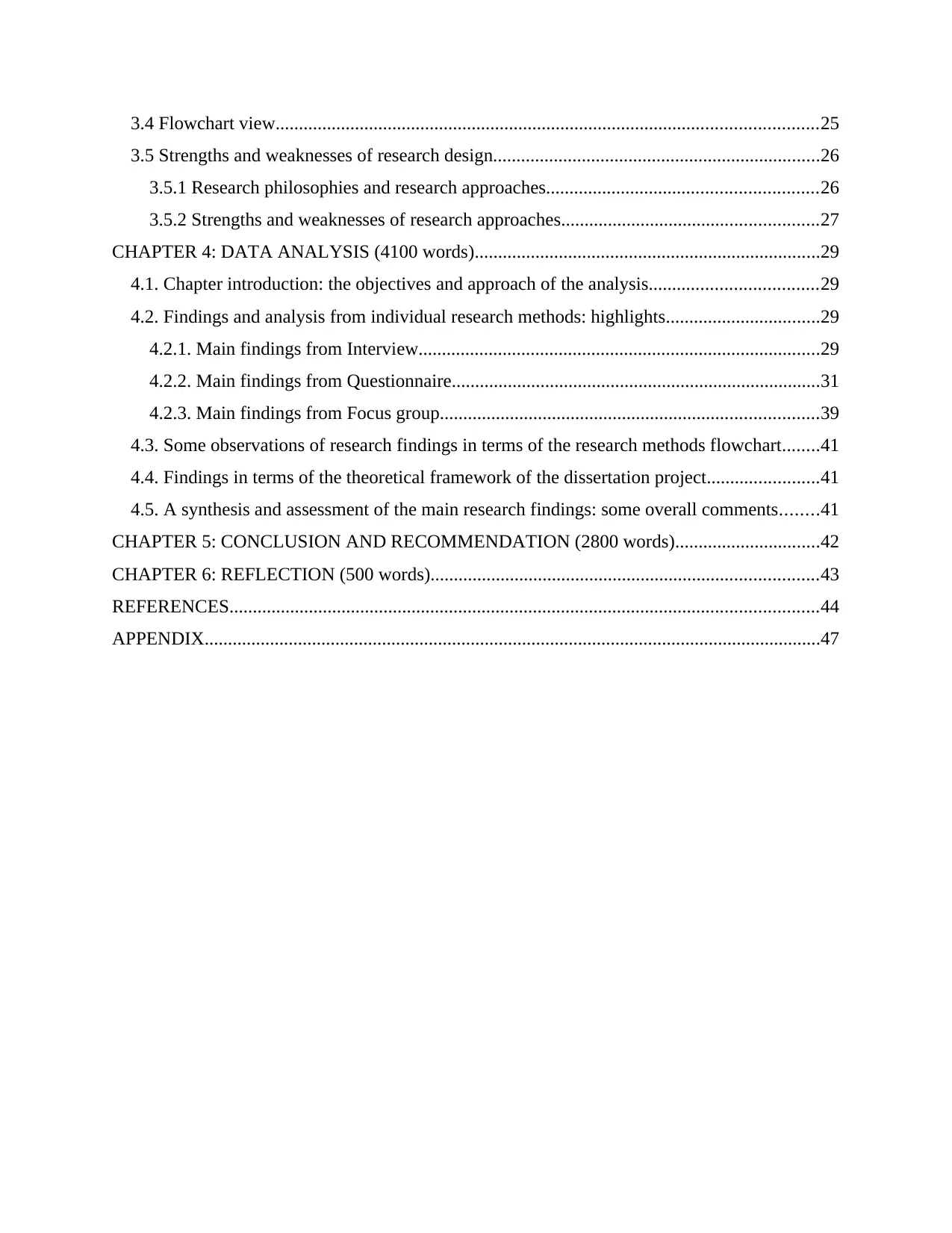
3.4 Flowchart view....................................................................................................................25
3.5 Strengths and weaknesses of research design......................................................................26
3.5.1 Research philosophies and research approaches..........................................................26
3.5.2 Strengths and weaknesses of research approaches.......................................................27
CHAPTER 4: DATA ANALYSIS (4100 words)..........................................................................29
4.1. Chapter introduction: the objectives and approach of the analysis....................................29
4.2. Findings and analysis from individual research methods: highlights.................................29
4.2.1. Main findings from Interview......................................................................................29
4.2.2. Main findings from Questionnaire...............................................................................31
4.2.3. Main findings from Focus group.................................................................................39
4.3. Some observations of research findings in terms of the research methods flowchart........41
4.4. Findings in terms of the theoretical framework of the dissertation project........................41
4.5. A synthesis and assessment of the main research findings: some overall comments........41
CHAPTER 5: CONCLUSION AND RECOMMENDATION (2800 words)...............................42
CHAPTER 6: REFLECTION (500 words)...................................................................................43
REFERENCES..............................................................................................................................44
APPENDIX....................................................................................................................................47
3.5 Strengths and weaknesses of research design......................................................................26
3.5.1 Research philosophies and research approaches..........................................................26
3.5.2 Strengths and weaknesses of research approaches.......................................................27
CHAPTER 4: DATA ANALYSIS (4100 words)..........................................................................29
4.1. Chapter introduction: the objectives and approach of the analysis....................................29
4.2. Findings and analysis from individual research methods: highlights.................................29
4.2.1. Main findings from Interview......................................................................................29
4.2.2. Main findings from Questionnaire...............................................................................31
4.2.3. Main findings from Focus group.................................................................................39
4.3. Some observations of research findings in terms of the research methods flowchart........41
4.4. Findings in terms of the theoretical framework of the dissertation project........................41
4.5. A synthesis and assessment of the main research findings: some overall comments........41
CHAPTER 5: CONCLUSION AND RECOMMENDATION (2800 words)...............................42
CHAPTER 6: REFLECTION (500 words)...................................................................................43
REFERENCES..............................................................................................................................44
APPENDIX....................................................................................................................................47

LIST OF FIGURES AND TABLES
⊘ This is a preview!⊘
Do you want full access?
Subscribe today to unlock all pages.
Trusted by 1+ million students worldwide
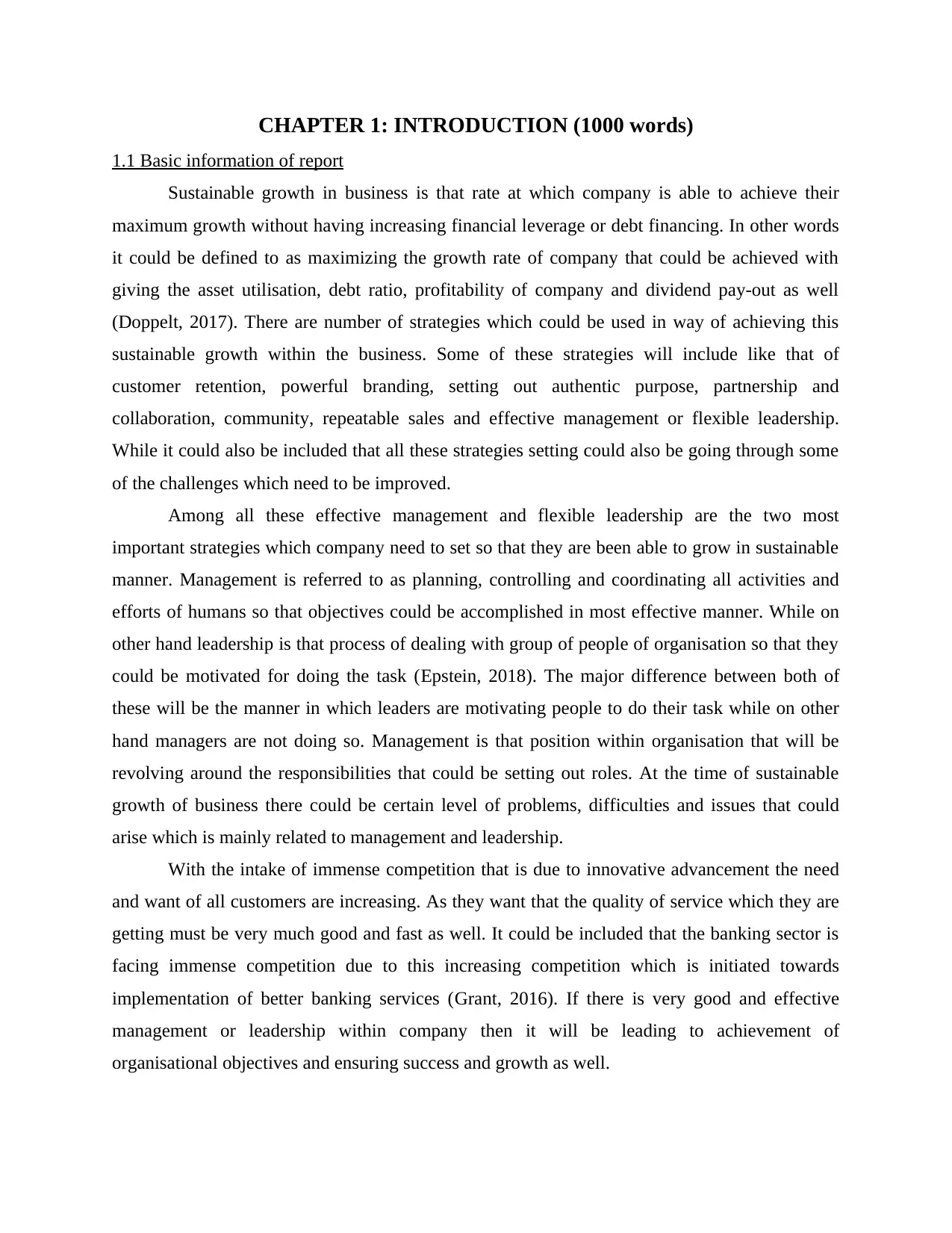
CHAPTER 1: INTRODUCTION (1000 words)
1.1 Basic information of report
Sustainable growth in business is that rate at which company is able to achieve their
maximum growth without having increasing financial leverage or debt financing. In other words
it could be defined to as maximizing the growth rate of company that could be achieved with
giving the asset utilisation, debt ratio, profitability of company and dividend pay-out as well
(Doppelt, 2017). There are number of strategies which could be used in way of achieving this
sustainable growth within the business. Some of these strategies will include like that of
customer retention, powerful branding, setting out authentic purpose, partnership and
collaboration, community, repeatable sales and effective management or flexible leadership.
While it could also be included that all these strategies setting could also be going through some
of the challenges which need to be improved.
Among all these effective management and flexible leadership are the two most
important strategies which company need to set so that they are been able to grow in sustainable
manner. Management is referred to as planning, controlling and coordinating all activities and
efforts of humans so that objectives could be accomplished in most effective manner. While on
other hand leadership is that process of dealing with group of people of organisation so that they
could be motivated for doing the task (Epstein, 2018). The major difference between both of
these will be the manner in which leaders are motivating people to do their task while on other
hand managers are not doing so. Management is that position within organisation that will be
revolving around the responsibilities that could be setting out roles. At the time of sustainable
growth of business there could be certain level of problems, difficulties and issues that could
arise which is mainly related to management and leadership.
With the intake of immense competition that is due to innovative advancement the need
and want of all customers are increasing. As they want that the quality of service which they are
getting must be very much good and fast as well. It could be included that the banking sector is
facing immense competition due to this increasing competition which is initiated towards
implementation of better banking services (Grant, 2016). If there is very good and effective
management or leadership within company then it will be leading to achievement of
organisational objectives and ensuring success and growth as well.
1.1 Basic information of report
Sustainable growth in business is that rate at which company is able to achieve their
maximum growth without having increasing financial leverage or debt financing. In other words
it could be defined to as maximizing the growth rate of company that could be achieved with
giving the asset utilisation, debt ratio, profitability of company and dividend pay-out as well
(Doppelt, 2017). There are number of strategies which could be used in way of achieving this
sustainable growth within the business. Some of these strategies will include like that of
customer retention, powerful branding, setting out authentic purpose, partnership and
collaboration, community, repeatable sales and effective management or flexible leadership.
While it could also be included that all these strategies setting could also be going through some
of the challenges which need to be improved.
Among all these effective management and flexible leadership are the two most
important strategies which company need to set so that they are been able to grow in sustainable
manner. Management is referred to as planning, controlling and coordinating all activities and
efforts of humans so that objectives could be accomplished in most effective manner. While on
other hand leadership is that process of dealing with group of people of organisation so that they
could be motivated for doing the task (Epstein, 2018). The major difference between both of
these will be the manner in which leaders are motivating people to do their task while on other
hand managers are not doing so. Management is that position within organisation that will be
revolving around the responsibilities that could be setting out roles. At the time of sustainable
growth of business there could be certain level of problems, difficulties and issues that could
arise which is mainly related to management and leadership.
With the intake of immense competition that is due to innovative advancement the need
and want of all customers are increasing. As they want that the quality of service which they are
getting must be very much good and fast as well. It could be included that the banking sector is
facing immense competition due to this increasing competition which is initiated towards
implementation of better banking services (Grant, 2016). If there is very good and effective
management or leadership within company then it will be leading to achievement of
organisational objectives and ensuring success and growth as well.
Paraphrase This Document
Need a fresh take? Get an instant paraphrase of this document with our AI Paraphraser
The current dissertation or research is including all issues related to management and
leadership in way of achieving sustainable growth into business with taking the context of
banking sector of Hong Kong. For this project Hang Seng bank is taken which is regarded to as
one of the leading banking institution of Hong Kong.
1.2 Background of company
Hang Seng Bank Limited is the largest banking institution of Hong Kong in terms of
market capitalization and equity. It was founded in 1933 by 4 business partners of Hong Kong in
the name of Hang Seng Ngan Ho which means ever growing in Cantonese. In the starting days of
bank it was only introduced to public as a simple money changing shop and then emerged as
private bank in 1952 (Kerzner and Kerzner, 2017). Then in year 1965 the bank suffered major
loss due to bank run and about ¼th of the deposits were depleted during that time. After this Hong
Kong and Shanghai Banking Corporation (HSBC) got to acquire about 51% of the share of bank
owing to control over the power of Hang Seng.
The bank is providing number of financial related services and products to its customers
which include like that of private, commercial, retail, and wealth management and treasury
services. The parent company of Hang Seng which is HSBC bank is having and owing about
62.14% of shares within bank. Hang Seng is operating into whole of Hong Kong with having its
presence into China as well in the name of Hang Seng Bank China Limited with 46 branches.
There will be certain related issues and problems which will be concern with that of leadership
and management.
1.3 Project background
1.3.1 Rationale
The dissertation is including and studying about the topic related to analysing the issues
which is concern with leadership and management into sustainable growth of business especially
that of banking institution (Schaltegger and Burritt, 2017). It could be included that there are
many banks that are not including innovative progression into their system which is mainly due
to their ill management criteria. There are time when the management are against the
implementation of innovation or technological advancement into the operations and business of
company. As they think that this will be leading to increasing cost and decreasing the revenue for
company. Thus then this would not be helping them in equally sustaining into the competitive
leadership in way of achieving sustainable growth into business with taking the context of
banking sector of Hong Kong. For this project Hang Seng bank is taken which is regarded to as
one of the leading banking institution of Hong Kong.
1.2 Background of company
Hang Seng Bank Limited is the largest banking institution of Hong Kong in terms of
market capitalization and equity. It was founded in 1933 by 4 business partners of Hong Kong in
the name of Hang Seng Ngan Ho which means ever growing in Cantonese. In the starting days of
bank it was only introduced to public as a simple money changing shop and then emerged as
private bank in 1952 (Kerzner and Kerzner, 2017). Then in year 1965 the bank suffered major
loss due to bank run and about ¼th of the deposits were depleted during that time. After this Hong
Kong and Shanghai Banking Corporation (HSBC) got to acquire about 51% of the share of bank
owing to control over the power of Hang Seng.
The bank is providing number of financial related services and products to its customers
which include like that of private, commercial, retail, and wealth management and treasury
services. The parent company of Hang Seng which is HSBC bank is having and owing about
62.14% of shares within bank. Hang Seng is operating into whole of Hong Kong with having its
presence into China as well in the name of Hang Seng Bank China Limited with 46 branches.
There will be certain related issues and problems which will be concern with that of leadership
and management.
1.3 Project background
1.3.1 Rationale
The dissertation is including and studying about the topic related to analysing the issues
which is concern with leadership and management into sustainable growth of business especially
that of banking institution (Schaltegger and Burritt, 2017). It could be included that there are
many banks that are not including innovative progression into their system which is mainly due
to their ill management criteria. There are time when the management are against the
implementation of innovation or technological advancement into the operations and business of
company. As they think that this will be leading to increasing cost and decreasing the revenue for
company. Thus then this would not be helping them in equally sustaining into the competitive
and tougher environment where they need to compete with major firms. This particular research
will be finding out the different types of criteria like that of capabilities of management,
customer trust loyalty and satisfaction of customers as well.
1.3.2 Project aim
The main aim of this research is to analyse the issues regarding leadership and
management which is affecting Hang Seng Bank to achieve sustainable growth. For this purpose,
specific objectives have been formulated to achieve the primary aim of the study.
To analyse the issues regarding leadership and management affecting sustainable growth
of firm: A study on Hang Seng Bank
1.3.3 Project objective
The research objectives crafted for the study are as follows:
To understand the concept of leadership and management issues in achieving sustainable
business growth.
To analyse the leadership and management issues in achieving sustainable business
growth of Hang Seng bank for implementing e-services.
To investigate the factors that initiate management and leadership issues in the business
of Hang Seng bank for implementing e-services.
To provide recommendations for minimising leadership and management issues for the
sustainable business growth of Hang Seng bank for implementing e-services.
1.3.4 Academic literature scope
The scope of whole project and literature will be considering parts like that of leadership
and management concept, their issues which is hindering sustainable growth of firm. Further the
research will be dealing with the factors initiating management and leadership related issues in
context of Hang Seng bank (Schaltegger and Wagner, 2017). The research will also be providing
recommendation for minimising these issues so that sustainable growth of business could be
there in way of implementing e-service within banking institution.
will be finding out the different types of criteria like that of capabilities of management,
customer trust loyalty and satisfaction of customers as well.
1.3.2 Project aim
The main aim of this research is to analyse the issues regarding leadership and
management which is affecting Hang Seng Bank to achieve sustainable growth. For this purpose,
specific objectives have been formulated to achieve the primary aim of the study.
To analyse the issues regarding leadership and management affecting sustainable growth
of firm: A study on Hang Seng Bank
1.3.3 Project objective
The research objectives crafted for the study are as follows:
To understand the concept of leadership and management issues in achieving sustainable
business growth.
To analyse the leadership and management issues in achieving sustainable business
growth of Hang Seng bank for implementing e-services.
To investigate the factors that initiate management and leadership issues in the business
of Hang Seng bank for implementing e-services.
To provide recommendations for minimising leadership and management issues for the
sustainable business growth of Hang Seng bank for implementing e-services.
1.3.4 Academic literature scope
The scope of whole project and literature will be considering parts like that of leadership
and management concept, their issues which is hindering sustainable growth of firm. Further the
research will be dealing with the factors initiating management and leadership related issues in
context of Hang Seng bank (Schaltegger and Wagner, 2017). The research will also be providing
recommendation for minimising these issues so that sustainable growth of business could be
there in way of implementing e-service within banking institution.
⊘ This is a preview!⊘
Do you want full access?
Subscribe today to unlock all pages.
Trusted by 1+ million students worldwide
1.3.5 Research method
Research philosophy- In way of philosophy related pragmatism will be used which is intending
to that both qualitative and quantitative for analysing the issue of leadership and management.
This particular type of research philosophy is only used because this is helping into creating
down clear assumption from previously observation and interpretation into other researchers.
Research approach- The research will be having inductive type of approach that is inclusive of
testing hypotheses with the collection of data with different sources like that of both primary and
secondary.
Research design- There will be use of mixed research design within which the collected data
will be done with use of primary source and qualitative approach as well so that research
problem could be addressed in proper sense.
Data collection- The data will be collected from many sources like that of questionnaire is
prepared using close ended questions on Likert scale so that statistical data could be determined.
Then semi-structured interview will also be taken place form the managers of Hang Seng bank
so that they could be including importance of e-service facilities of bank.
Sampling technique- Non-probability sampling technique will be used which is convenient for
the sampling method in way of questionnaire filled up by the managers (Schaltegger and
Wagner, 2017). Other than this snowball sampling is used for getting some interviews conducted
by strategic managers of other banks and general population as well.
Data analysis- With the use of SPSS tool which is articulating and interpreting numeric data
from using close-ended questionnaires data will be analysed. Then for interview data will be
analysed by using thematic analysis so that findings could be generated accordingly.
1.4 Structure of report
Chapter 1: Introduction- In this particular section brief introduction and background of the
research will be given with setting out aim and objectives of research.
Chapter 2: Literature review- This will be based on Theoretical framework for the whole project
that would be studying about all concerned topics and challenges so that aim could be achieved.
Chapter 3: Research methodology- Various type of methodologies will be included within the
use so that aims could be achieved and conclusion is drawn as well.
Research philosophy- In way of philosophy related pragmatism will be used which is intending
to that both qualitative and quantitative for analysing the issue of leadership and management.
This particular type of research philosophy is only used because this is helping into creating
down clear assumption from previously observation and interpretation into other researchers.
Research approach- The research will be having inductive type of approach that is inclusive of
testing hypotheses with the collection of data with different sources like that of both primary and
secondary.
Research design- There will be use of mixed research design within which the collected data
will be done with use of primary source and qualitative approach as well so that research
problem could be addressed in proper sense.
Data collection- The data will be collected from many sources like that of questionnaire is
prepared using close ended questions on Likert scale so that statistical data could be determined.
Then semi-structured interview will also be taken place form the managers of Hang Seng bank
so that they could be including importance of e-service facilities of bank.
Sampling technique- Non-probability sampling technique will be used which is convenient for
the sampling method in way of questionnaire filled up by the managers (Schaltegger and
Wagner, 2017). Other than this snowball sampling is used for getting some interviews conducted
by strategic managers of other banks and general population as well.
Data analysis- With the use of SPSS tool which is articulating and interpreting numeric data
from using close-ended questionnaires data will be analysed. Then for interview data will be
analysed by using thematic analysis so that findings could be generated accordingly.
1.4 Structure of report
Chapter 1: Introduction- In this particular section brief introduction and background of the
research will be given with setting out aim and objectives of research.
Chapter 2: Literature review- This will be based on Theoretical framework for the whole project
that would be studying about all concerned topics and challenges so that aim could be achieved.
Chapter 3: Research methodology- Various type of methodologies will be included within the
use so that aims could be achieved and conclusion is drawn as well.
Paraphrase This Document
Need a fresh take? Get an instant paraphrase of this document with our AI Paraphraser
Chapter 4: Data analysis- The data will be analysed by using various methods like both
qualitative and quantitative will be used so that data could be analysed and evaluated based on
aims and objectives.
Chapter 5: Conclusion and recommendation- This is the last section which includes the
conclusion and recommendation based on the findings so that it could be evaluated in most
effective manner.
qualitative and quantitative will be used so that data could be analysed and evaluated based on
aims and objectives.
Chapter 5: Conclusion and recommendation- This is the last section which includes the
conclusion and recommendation based on the findings so that it could be evaluated in most
effective manner.
CHAPTER 2: LITERATURE REVIEW (3200 words)
2.1 Purpose of the chapter
A literature review is very important and fundamental concept which is relevant to
research and dissertation as well. This includes review and narrative review of various different
types of articles like that of scholarly articles, books, journals and website articles as well so that
some theoretical and methodological contribution on particular topic could be made. There are
certain steps which are followed while conducting literature review like firstly it is very essential
that researcher is finding out working topic on which they will be making research. Then they
will also be finding out research papers or materials on which they could work upon and write
something meaningful focusing on topic. The selection of articles and materials must be done in
very prescribed and correct manner so that it is easy to evaluate them by developing patterns and
sub topics accordingly.
2.2 Purpose, literature search and literature review
The current research is upon leadership and management issue which is related in
achievement of sustainable growth into this digital era by considering the conditions of Hang
Seng Bank Limited in Hong Kong. There will be various scholarly articles and research papers
which need to find out and then analyse will be done based on the current topic and those
articles. The main purpose of this current study is to research upon topic like that of issues
related to leadership and management in way of sustainable growth of business. As there will be
certain management concern within banking institute like that of increasing consumer demand
more secure and user friendly e-services from Hang Seng bank.
2.3 Overall view and rationale of theoretical framework
As per the view of Spicker, (2012) there are many type of management concern which
will be creating issue including both that related to management and leadership in way of
achieving sustainable business growth in digital era for Hang Seng. These management concern
include like that of increasing demand of customer in relation to more securing and user-friendly
e-services from the bank. This is very much important to include concern like that of which will
be regulated within theoretical framework of bank as doubting about innovation capability for
sustainable business. All the concern which is creating hindrance in way of achievement of
sustainable business growth in current digital era like that of increasing market competition in
2.1 Purpose of the chapter
A literature review is very important and fundamental concept which is relevant to
research and dissertation as well. This includes review and narrative review of various different
types of articles like that of scholarly articles, books, journals and website articles as well so that
some theoretical and methodological contribution on particular topic could be made. There are
certain steps which are followed while conducting literature review like firstly it is very essential
that researcher is finding out working topic on which they will be making research. Then they
will also be finding out research papers or materials on which they could work upon and write
something meaningful focusing on topic. The selection of articles and materials must be done in
very prescribed and correct manner so that it is easy to evaluate them by developing patterns and
sub topics accordingly.
2.2 Purpose, literature search and literature review
The current research is upon leadership and management issue which is related in
achievement of sustainable growth into this digital era by considering the conditions of Hang
Seng Bank Limited in Hong Kong. There will be various scholarly articles and research papers
which need to find out and then analyse will be done based on the current topic and those
articles. The main purpose of this current study is to research upon topic like that of issues
related to leadership and management in way of sustainable growth of business. As there will be
certain management concern within banking institute like that of increasing consumer demand
more secure and user friendly e-services from Hang Seng bank.
2.3 Overall view and rationale of theoretical framework
As per the view of Spicker, (2012) there are many type of management concern which
will be creating issue including both that related to management and leadership in way of
achieving sustainable business growth in digital era for Hang Seng. These management concern
include like that of increasing demand of customer in relation to more securing and user-friendly
e-services from the bank. This is very much important to include concern like that of which will
be regulated within theoretical framework of bank as doubting about innovation capability for
sustainable business. All the concern which is creating hindrance in way of achievement of
sustainable business growth in current digital era like that of increasing market competition in
⊘ This is a preview!⊘
Do you want full access?
Subscribe today to unlock all pages.
Trusted by 1+ million students worldwide

1 out of 33


Related Documents


Your All-in-One AI-Powered Toolkit for Academic Success.
+13062052269
info@desklib.com
Available 24*7 on WhatsApp / Email
![[object Object]](/_next/static/media/star-bottom.7253800d.svg)
Unlock your academic potential
Copyright © 2020–2026 A2Z Services. All Rights Reserved. Developed and managed by ZUCOL.