Evaluating the Critical Approach in Management and Leadership

Verified

Added on  2023/06/13

|4
|794
|224
Essay
AI Summary
This essay critically examines the application of leadership within organizations, focusing on the impact of leadership styles on organizational performance and team productivity. It contrasts traditional leadership theories with a critical theory approach, emphasizing the importance of leaders adapting to complex situations through quality analysis and decision-making. The essay highlights key leadership characteristics such as self-awareness, decisiveness, and integrity, while also addressing legal considerations and the provision of training for employee development. It explores transformational and situational leadership theories, noting their relevance in fostering employee motivation and engagement. Ultimately, the paper underscores the significance of a leader's attitude and decision-making structure in creating a supportive and productive organizational environment, suggesting that a critical situational theory approach offers valuable opportunities for future organizational development.
Document Page
Running head: CRITICAL APPROACH OF MANAGEMENT AND LEADERSHIP
CRITICAL APPROACH OF MANAGEMENT AND LEADERSHIP
Name of the Student
Name of the University
Author Note
tabler-icon-diamond-filled.svg

Paraphrase This Document

Need a fresh take? Get an instant paraphrase of this document with our AI Paraphraser
Document Page
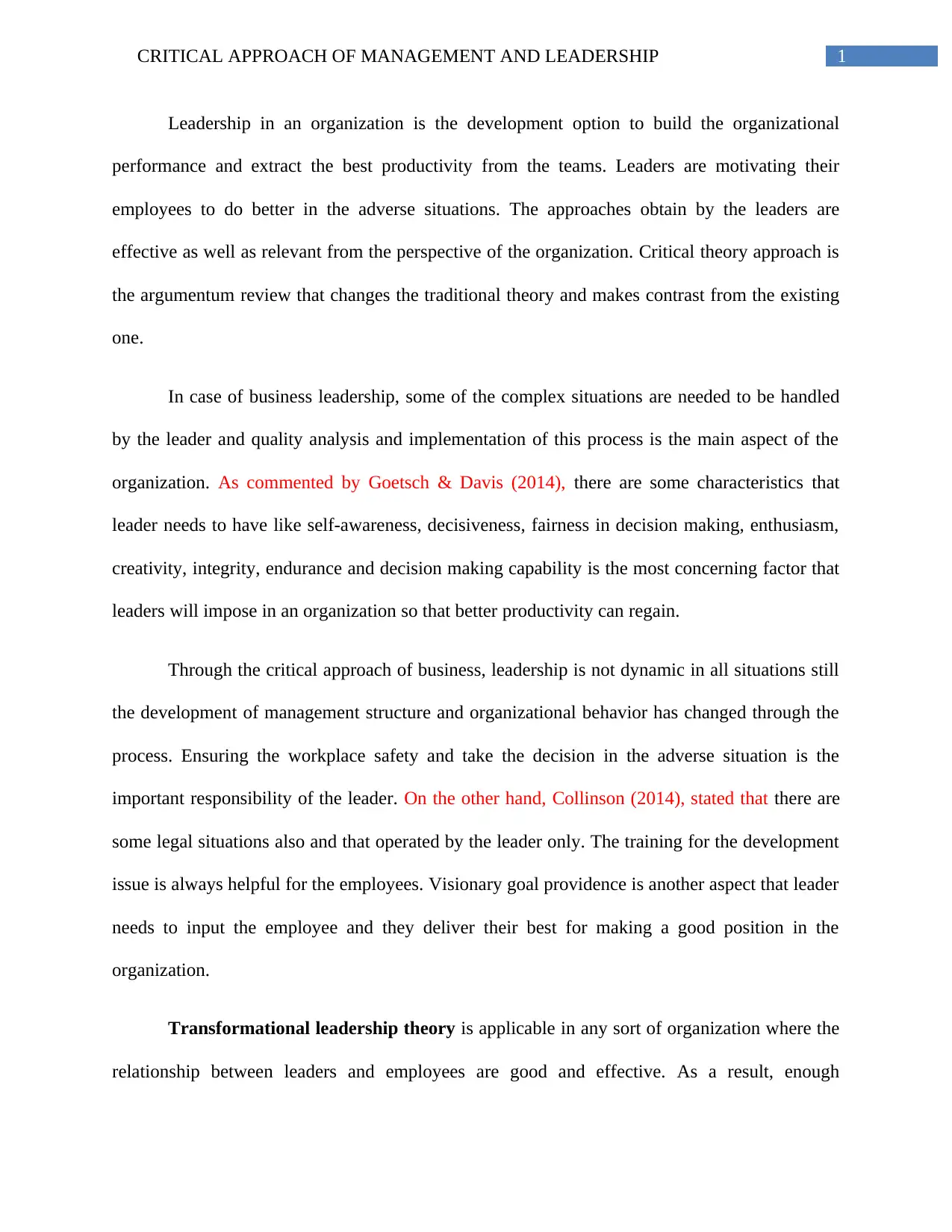
1CRITICAL APPROACH OF MANAGEMENT AND LEADERSHIP
Leadership in an organization is the development option to build the organizational
performance and extract the best productivity from the teams. Leaders are motivating their
employees to do better in the adverse situations. The approaches obtain by the leaders are
effective as well as relevant from the perspective of the organization. Critical theory approach is
the argumentum review that changes the traditional theory and makes contrast from the existing
one.
In case of business leadership, some of the complex situations are needed to be handled
by the leader and quality analysis and implementation of this process is the main aspect of the
organization. As commented by Goetsch & Davis (2014), there are some characteristics that
leader needs to have like self-awareness, decisiveness, fairness in decision making, enthusiasm,
creativity, integrity, endurance and decision making capability is the most concerning factor that
leaders will impose in an organization so that better productivity can regain.
Through the critical approach of business, leadership is not dynamic in all situations still
the development of management structure and organizational behavior has changed through the
process. Ensuring the workplace safety and take the decision in the adverse situation is the
important responsibility of the leader. On the other hand, Collinson (2014), stated that there are
some legal situations also and that operated by the leader only. The training for the development
issue is always helpful for the employees. Visionary goal providence is another aspect that leader
needs to input the employee and they deliver their best for making a good position in the
organization.
Transformational leadership theory is applicable in any sort of organization where the
relationship between leaders and employees are good and effective. As a result, enough
Document Page
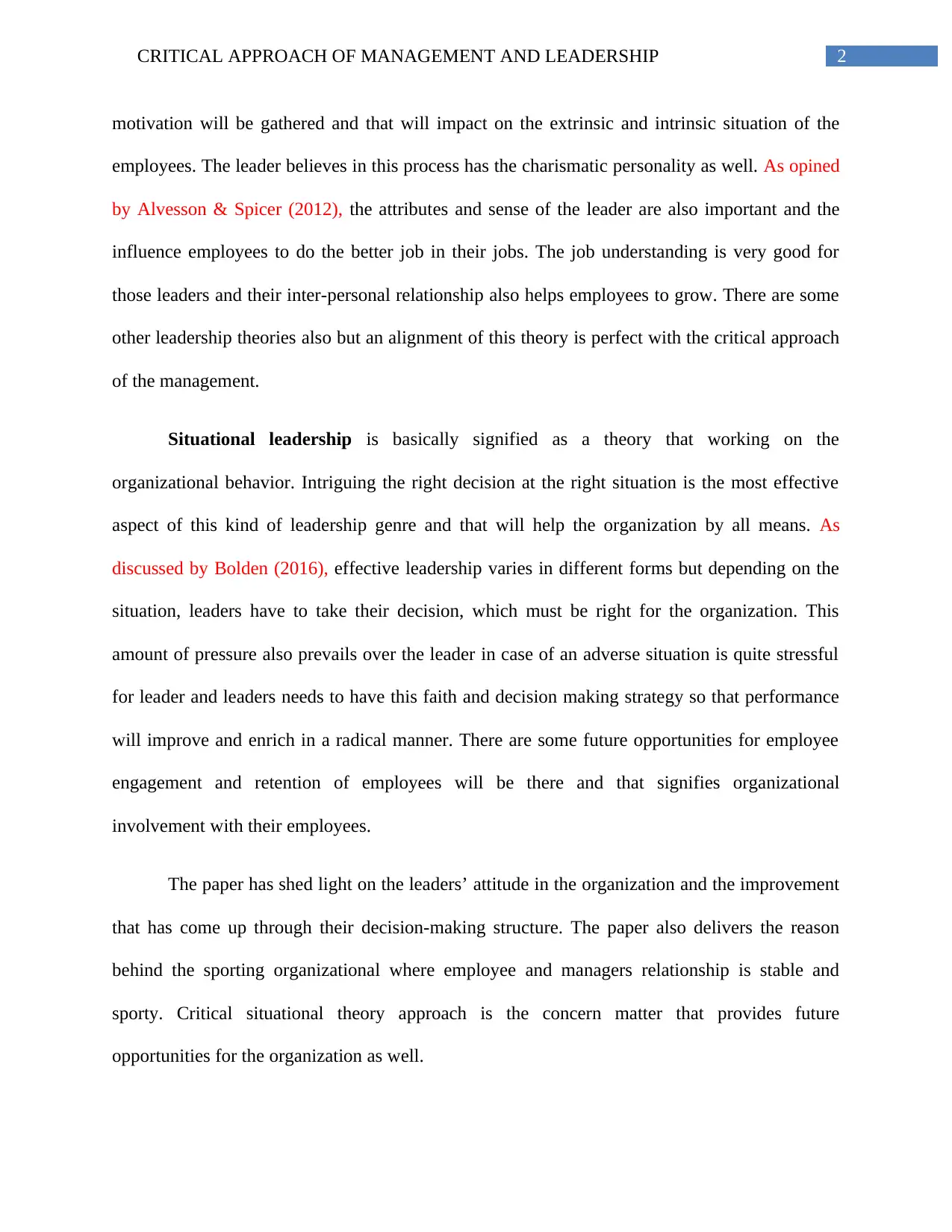
2CRITICAL APPROACH OF MANAGEMENT AND LEADERSHIP
motivation will be gathered and that will impact on the extrinsic and intrinsic situation of the
employees. The leader believes in this process has the charismatic personality as well. As opined
by Alvesson & Spicer (2012), the attributes and sense of the leader are also important and the
influence employees to do the better job in their jobs. The job understanding is very good for
those leaders and their inter-personal relationship also helps employees to grow. There are some
other leadership theories also but an alignment of this theory is perfect with the critical approach
of the management.
Situational leadership is basically signified as a theory that working on the
organizational behavior. Intriguing the right decision at the right situation is the most effective
aspect of this kind of leadership genre and that will help the organization by all means. As
discussed by Bolden (2016), effective leadership varies in different forms but depending on the
situation, leaders have to take their decision, which must be right for the organization. This
amount of pressure also prevails over the leader in case of an adverse situation is quite stressful
for leader and leaders needs to have this faith and decision making strategy so that performance
will improve and enrich in a radical manner. There are some future opportunities for employee
engagement and retention of employees will be there and that signifies organizational
involvement with their employees.
The paper has shed light on the leaders’ attitude in the organization and the improvement
that has come up through their decision-making structure. The paper also delivers the reason
behind the sporting organizational where employee and managers relationship is stable and
sporty. Critical situational theory approach is the concern matter that provides future
opportunities for the organization as well.
Document Page
3CRITICAL APPROACH OF MANAGEMENT AND LEADERSHIP
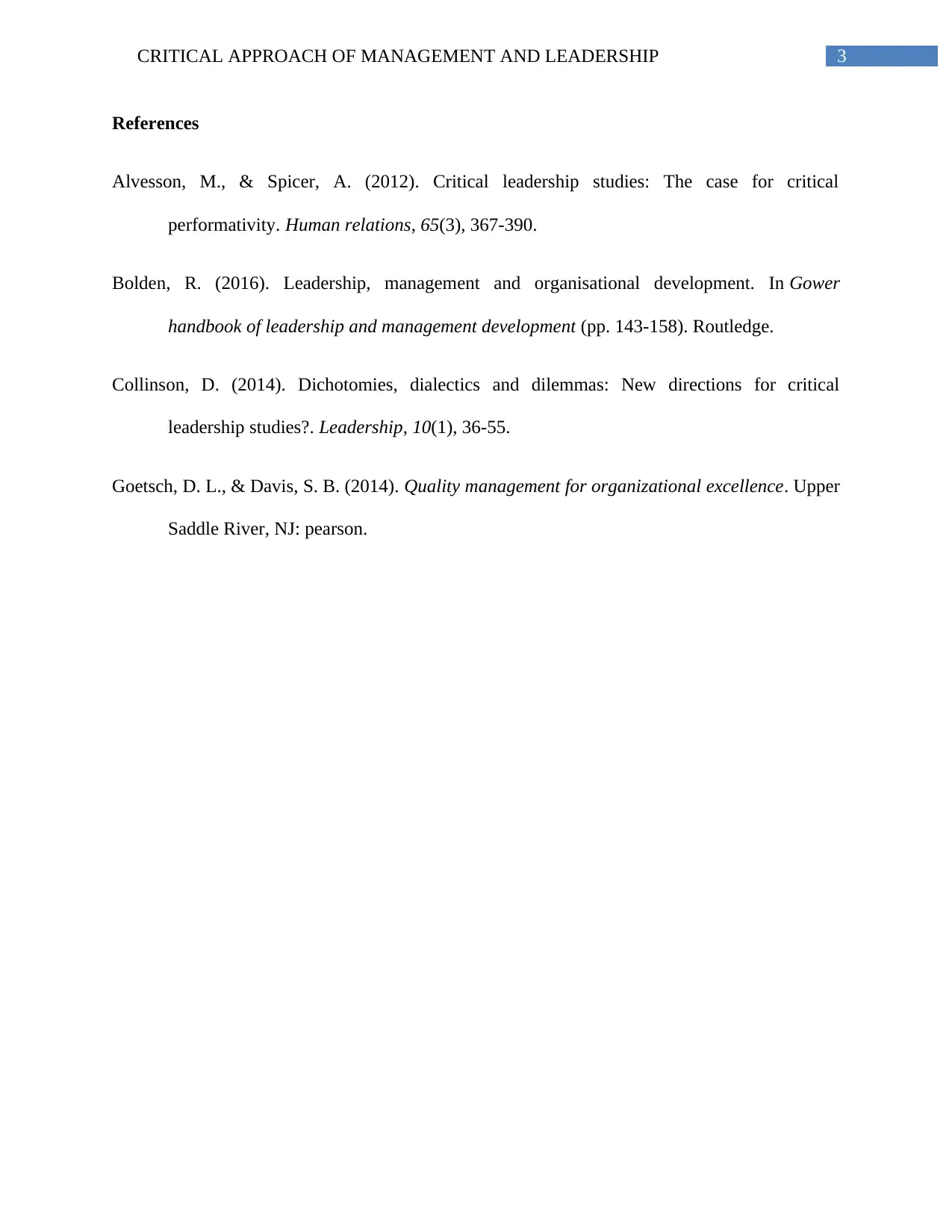
References
Alvesson, M., & Spicer, A. (2012). Critical leadership studies: The case for critical
performativity. Human relations, 65(3), 367-390.
Bolden, R. (2016). Leadership, management and organisational development. In Gower
handbook of leadership and management development (pp. 143-158). Routledge.
Collinson, D. (2014). Dichotomies, dialectics and dilemmas: New directions for critical
leadership studies?. Leadership, 10(1), 36-55.
Goetsch, D. L., & Davis, S. B. (2014). Quality management for organizational excellence. Upper
Saddle River, NJ: pearson.
chevron_up_icon
1 out of 4
circle_padding
hide_on_mobile
zoom_out_icon
[object Object]